Labor is the single largest controllable cost in most distribution centers. In a facility running two or three shifts, wages, overtime, and idle time move your P&L more than almost anything else on the floor. Yet most operations still manage that spend with a clock-in system, a spreadsheet, and a supervisor's gut feel.
That gap is expensive. The warehouse labor management software market reached USD 1.87 billion in 2024 and is projected to grow at a 13.2% CAGR to USD 5.19 billion by 2033, according to Dataintelo (2024). The labor management segment inside broader WMS platforms is growing even faster, from USD 719.4 million in 2025 toward USD 3.72 billion by 2033 at a 23.3% CAGR, per Grand View Research (2025). Operations leaders are funding this because a warehouse management system tells you what happened to inventory, not what happened to people.
That distinction matters. A WMS confirms a pick was completed. It rarely tells you whether that pick took twice as long as the engineered standard, whether the picker walked 40% more than necessary, or whether you scheduled six people for a shift that needed four. Warehouse labor software fills that blind spot. It measures labor productivity at the task level, sets standards for what "good" looks like, and gives you real-time labor visibility to act before a shift goes sideways.
This guide compares the six strongest warehouse labor software platforms for 2026, so you can shortlist by the criteria that actually move your numbers.
What's inside
This guide is written for warehouse managers, operations directors, supply chain leaders, and systems buyers evaluating a warehouse labor management system in 2026. Some readers own the P&L. Some own the tech stack. Both need the same clarity before they commit.
We selected and ranked vendors on five criteria that separate real labor management from repackaged timekeeping:
- Labor visibility and analytics at the task and associate level, not just clock-in data
- Engineered labor standards and the ability to measure performance against them
- Labor planning and workforce scheduling tied to forecasted volume
- Integration depth with WMS, WCS, time and attendance, and payroll
- Operational fit across warehouse size, complexity, and existing stack
Pricing for this category is almost entirely quote-based, so we note that honestly rather than inventing numbers.
TL;DR
Short on time? Here are the fast recommendations by scenario:
- Best for enterprise supply chain depth: Blue Yonder, for large operations that want labor tied to a full planning and execution platform.
- Best for end-to-end execution stacks: Infios, when you want labor management sitting inside OMS, WMS, and TMS.
- Best for configurable WMS plus labor: Made4net, for teams that need tight execution and reporting in one system.
- Best for modern labor planning on an existing WMS: CognitOps, a predictive optimization layer that avoids rip-and-replace.
- Best for live AI-driven visibility: Takt, for teams that want real-time performance intelligence across shifts.
What is warehouse labor software?
Warehouse labor software is a system that plans, measures, and manages the human workforce inside a distribution center, tracking productivity against defined standards and turning labor data into decisions about staffing, scheduling, and cost.
It is often called a labor management system, or LMS, and it sits alongside your WMS rather than replacing it. Where a WMS orchestrates inventory and orders, a labor management system focuses on the people executing that work and how efficiently they do it.
The core building blocks of warehouse labor management software are consistent across vendors:
- Labor planning: Forecasting how many associates each function needs by shift, day, and season, then allocating tasks accordingly.
- Labor productivity tracking: Measuring output at the task and associate level, not just hours worked.
- Engineered labor standards: Defining the expected time to complete each task based on observed motion, distance, and volume, so "good performance" is a number, not an opinion.
- Warehouse labor analytics: Dashboards and reporting that surface utilization, throughput, and cost trends in real time.
- Integration: Connections to WMS, WCS, time and attendance, and payroll so labor data flows without manual re-entry.
A few related concepts help place the category:
- WMS (warehouse management system): Manages inventory, orders, receiving, and putaway. It answers "what moved."
- WCS (warehouse control system): Directs automation and material-handling equipment on the floor.
- Time and attendance: Captures when people clock in and out. Labor software uses this as an input, then layers performance measurement on top.
- Payroll: Consumes verified labor hours. Integration here reduces disputes and manual reconciliation.
The distinction from a WMS is the one buyers get wrong most often. A WMS can tell you a shipment left on time. A labor management system tells you it took 14% more labor than it should have, and where.
When to use warehouse labor software
Not every operation needs a full labor management system on day one. These three situations are the clearest signals that spreadsheets and basic timekeeping have run out of road.
Balance staffing to demand
When your volume swings by shift, day, or season, headcount guesswork gets expensive fast. Overstaff and you burn payroll on idle time. Understaff and you miss cutoffs, pay overtime, and stress the team. Labor planning software uses forecasted volume to tell you how many people each function needs, then helps you build workforce scheduling around that forecast. Operations that run peaks, promotions, or seasonal surges feel this pain most, and see the fastest payback from getting staffing right.
Track productivity at the task level
Clock-in data tells you who showed up. It does not tell you who picked 90 lines an hour versus 140, or which zones drag the whole shift down. When leaders need to understand performance, they need task-level tracking against engineered labor standards. That visibility shows up as:
- Per-associate performance against standard, visible on a dashboard
- Function-level throughput trends across shifts and sites
- Early flags on associates who need coaching, not discipline
- Evidence for incentive programs that reward measurable output
Reduce overtime and improve throughput
Better labor planning stabilizes output and cuts waste. When you can see travel time, idle time, and process bottlenecks, you can fix them before they compound into overtime. A facility that once ran chronic Saturday overtime to clear backlog often finds the backlog was a scheduling and standards problem, not a headcount problem. The same visibility that reduces overtime tends to lift throughput, because you are removing the friction that slowed the floor in the first place.
Comparison table
The table below ranks the six vendors and orients you before the detailed reviews. Pricing across this category is quote-based, so we mark it as custom rather than guessing. G2 ratings reflect each vendor's current listing at the time of writing.
| # | Product | Intent | Key differentiation | Pricing | G2 rating |
|---|---|---|---|---|---|
| 1 | Blue Yonder | Enterprise supply chain | Labor tied to full planning and execution platform | Custom quote | 4.1/5 |
| 2 | Infios | End-to-end execution | Labor inside OMS, WMS, and TMS suite | Custom quote | 3.9/5 |
| 3 | Made4net | Configurable WMS plus labor | Tight execution, reporting, and automation control | Custom quote | 4.5/5 |
| 4 | CognitOps | Modern labor planning | Predictive optimization on top of existing WMS | Custom quote | 5.0/5 |
| 5 | Takt | Real-time intelligence | AI-driven live performance visibility | Custom quote | 4.8/5 |
| 6 | Generix | Supply chain execution | Labor within configurable SaaS execution suite | Custom quote | 4.6/5 |
| 7 | ProTrack Labor Management | Labor performance | Planning, monitoring, coaching, and incentives | Custom quote | 4.6/5 |
1. Blue Yonder
Blue Yonder is an enterprise supply chain software company whose platform spans planning, execution, retail, warehouse, and transportation. Its labor management capabilities sit inside that broader suite, which is the whole point for large operations that want workforce data connected to inventory, orders, and network planning rather than living in a separate tool.
For a distribution network moving serious volume, that adjacency matters. Labor standards, performance visibility, and incentive management all draw on the same operational data that drives the warehouse and transportation modules. That means a labor decision on the floor can be traced back to a demand signal upstream.
Best for: Large retailers, manufacturers, and logistics teams that want labor management as one layer of an end-to-end supply chain platform.
Key strengths
- Engineered standards and performance visibility: Measure associate and function output against defined standards, with reporting that rolls up across sites.
- Incentive management: Tie measurable performance to structured incentive programs that reward output, not just attendance.
- Platform adjacency: Labor data connects to warehouse, transportation, and planning modules on one platform.
Why choose Blue Yonder: If you already run, or plan to run, an integrated supply chain platform, keeping labor management inside it avoids the seams that come from bolting on a standalone tool. It fits operations with the scale and complexity to justify an enterprise deployment, and the appetite to treat labor as part of a larger optimization problem.
Blue Yonder pricing: Blue Yonder does not publish plan pricing. The company uses a quote-based model, so expect to scope your deployment with sales. Blue Yonder holds a 4.1/5 rating on G2.
2. Infios
Infios is a supply chain execution software vendor offering order management, warehouse management, and transportation management. Its labor capabilities live inside that execution suite, which suits teams that want workforce management tied directly to the systems running orders and inventory rather than a disconnected labor tool.
The appeal here is operational continuity. When labor planning and labor visibility draw on the same execution data that powers your WMS and OMS, you spend less time reconciling numbers across systems and more time acting on them. For operations already leaning toward a single execution vendor, that alignment is worth real money.
Best for: Enterprises that want labor management embedded in an end-to-end supply chain execution stack.
Key strengths
- Execution-suite integration: Labor sits alongside OMS, WMS, and TMS, so workforce data connects to order and inventory flows.
- Warehouse management depth: Mature WMS foundation that gives labor measurement accurate task-level context.
- Transportation alignment: Labor planning can account for shipping and dock activity, not just pick-and-pack.
Why choose Infios: Choose Infios when your priority is consolidating supply chain execution under one vendor and you want labor management to inherit that same data foundation. It fits teams that value operational planning and labor sitting together over a best-of-breed standalone labor tool.
Infios pricing: Infios does not display public pricing. Its site directs buyers to talk with an expert, so pricing is scoped through sales. Infios carries a 3.9/5 rating on G2.
3. Made4net
Made4net is a supply chain execution provider focused on warehouse management and adjacent logistics execution, including labor management, yard management, route optimization, and warehouse control for automation and robotics. That breadth makes it a strong fit for operations that want configurable WMS and labor capabilities in one system.
Because labor management sits next to warehouse control and execution, Made4net works well for facilities that mix manual and automated processes. Labor measurement and real-time KPI visibility draw on the same execution layer that directs equipment, so you get a coherent picture of both people and machines on the floor.
Best for: Enterprises needing configurable WMS with labor management and broader execution control in a single platform.
Key strengths
- Labor management with execution context: Task tracking and performance measurement tied to live warehouse execution data.
- Configurable WMS foundation: Adapt workflows to your process rather than forcing your process onto rigid software.
- Automation and robotics support: Warehouse control capabilities that suit facilities blending manual and automated work.
Why choose Made4net: Made4net fits operations that need tighter execution and reporting than a standalone timekeeping tool provides, but want the configurability to match their specific workflows. It suits teams running mixed manual and automated environments who need labor visibility across both.
Made4net pricing: Made4net does not publish public pricing for its software; scoping happens through a demo and sales conversation. Made4net holds a 4.5/5 rating on G2.
4. CognitOps
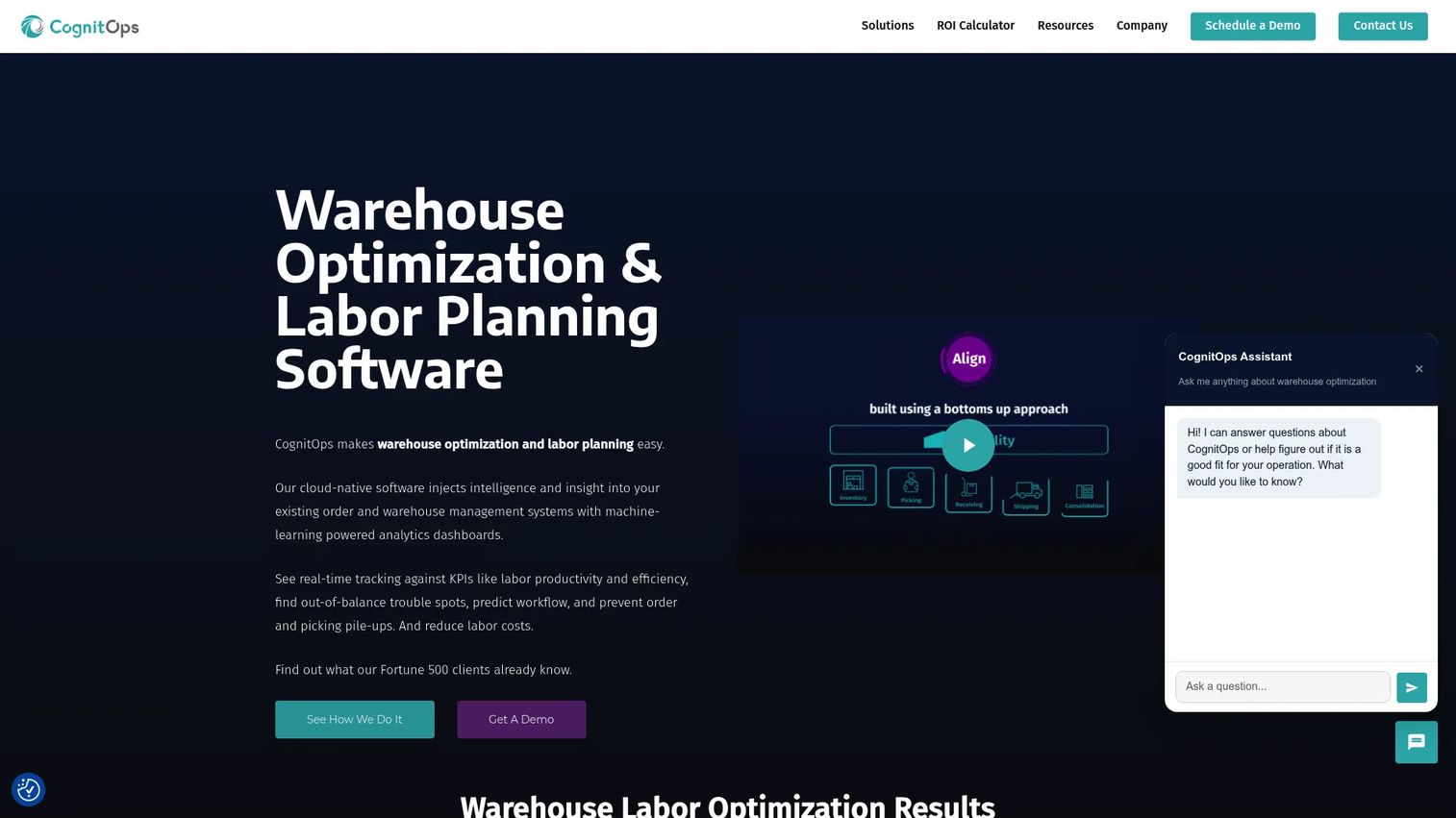
CognitOps is warehouse optimization and labor planning software that layers predictive analytics on top of your existing WMS. Instead of asking you to replace the system you already run, it adds real-time labor visibility, KPI dashboards, and labor forecasting to the data you already generate. That is the modern angle in this category, and it is a compelling one for teams wary of a multi-year rip-and-replace.
The value proposition is speed to insight. Because CognitOps reads from your current WMS, you get predictive labor optimization without re-platforming your execution stack. For a product-minded operations leader, that means faster time to value and lower opportunity cost against everything else competing for engineering and implementation time.
Best for: Mid-market and enterprise warehouse teams that want predictive labor optimization on top of an existing WMS.
Key strengths
- Real-time labor visibility: Live KPI dashboards that surface performance and utilization as the shift runs.
- Predictive forecasting: Labor forecasting that anticipates volume and staffing needs rather than reporting them after the fact.
- WMS integration without rip-and-replace: Adds optimization on top of your current system rather than replacing it.
Why choose CognitOps: Choose CognitOps when you already have a WMS you are committed to and want a planning and optimization layer that respects that investment. It fits teams that value forecasting and real-time decision support over acquiring another full execution platform.
CognitOps pricing: CognitOps states plainly that its pricing is not publicly listed and uses a custom quote model. CognitOps shows a 5.0/5 rating on G2, though from a small number of reviews, so weigh it accordingly.
5. Takt

Takt brings real-time performance metrics and AI-powered warehouse intelligence to labor visibility across shifts and functions. It is built for teams that want live operational insight rather than end-of-day reports, so supervisors can respond while a shift is still in play instead of reviewing what already went wrong.
That live orientation is the differentiator. Instead of pulling a report after the fact, floor leaders watch performance unfold and adjust staffing, task allocation, and coaching in the moment. For operations where minutes matter and volume shifts hour to hour, that adaptability is the difference between hitting cutoffs and chasing them.
Best for: Operations that want live, AI-driven performance intelligence across shifts and functions.
Key strengths
- Real-time performance metrics: Live dashboards that show labor productivity as work happens, not after.
- AI-powered intelligence: Analytics that surface patterns and anomalies across shifts automatically.
- Cross-function visibility: Labor insight spanning multiple functions and shifts in one view.
Why choose Takt: Takt fits teams that want to manage labor in the moment, using live intelligence to reallocate and coach before a shift slips. It suits operations that value adaptability and real-time visibility over static, retrospective reporting.
Takt pricing: Takt does not publish public pricing; it appears to work on a quote basis. Takt holds a 4.8/5 rating on G2.
6. Generix

Generix is an AI-powered SaaS provider for supply chain, commerce, and B2B integration, with warehouse management that includes real-time inventory tracking and picking, packing, and shipping workflows. Its labor and resource management capabilities fit operations that want workforce planning and productivity transparency aligned with broader supply chain execution.
The strength here is resource optimization in context. Because labor planning and scheduling sit inside a configurable execution suite, you can align workforce decisions with the same data driving inventory and fulfillment. That connection supports both productivity transparency and workforce engagement, since associates and supervisors work from a shared, current picture of the operation.
Best for: Enterprises needing configurable supply chain execution with labor planning and scheduling built in.
Key strengths
- Resource and labor management: Workforce planning and scheduling tied to live warehouse execution data.
- Productivity transparency: Clear visibility into labor output and utilization across the operation.
- Configurable SaaS execution: A flexible platform that adapts warehouse and labor workflows to your process.
Why choose Generix: Generix fits operations that want labor planning and scheduling as part of a broader, configurable supply chain execution platform rather than a standalone tool. It suits teams prioritizing resource optimization and workforce engagement alongside inventory and fulfillment.
Generix pricing: Generix does not display public pricing and directs buyers to request a quote. The Generix Solochain WMS product carries a 4.6/5 rating on G2.
Considerations before you buy
The right warehouse labor management system depends on your stack, your scale, and what you actually need to fix. Work through these criteria before you shortlist.
Labor visibility and analytics depth
Decide how granular you need to go. Some teams need per-associate, per-task measurement against engineered labor standards. Others start with function-level throughput trends. Match the tool's analytics depth to the decisions you plan to make with it, not to the demo's most impressive dashboard.
Integration with your existing stack
Labor software is only as good as the data flowing into it. Confirm how each vendor connects to your WMS, WCS, time and attendance, and payroll systems. A tool that reads from your existing WMS without a rip-and-replace can reach value far faster than one that requires re-platforming your execution layer.
Planning and forecasting fit
If your volume swings by season, promotion, or day of week, labor forecasting and workforce scheduling should be first-class features, not afterthoughts. Ask how the vendor turns a demand forecast into a staffing plan, and how quickly that plan adapts when reality diverges from the forecast.
Standalone tool versus platform
Weigh a focused labor tool against a labor module inside a broader execution platform. A dedicated tool concentrates on workforce measurement and coaching. A platform connects labor to inventory, orders, and transportation. Neither is universally better; the right answer depends on whether you are consolidating vendors or solving a specific labor problem.
Conclusion
The six platforms here cover the full range of warehouse labor needs for 2026. Blue Yonder, Infios, Made4net, and Generix suit operations that want labor management inside a broader supply chain execution platform. CognitOps and Takt lead on modern, real-time labor planning and intelligence, with CognitOps notable for layering predictive optimization onto an existing WMS.
Shortlist by three questions. How deep does your labor visibility need to go, from clock-in data to per-task standards? How complex is your planning and forecasting, given your volume swings? And what does your existing stack require, from a clean WMS integration to a full platform consolidation? Answer those honestly, then scope pricing with two or three vendors, since every option here works on a custom quote. The best system is the one that closes the gap between what your WMS reports and what your labor actually costs.
FAQs
Warehouse labor software plans, measures, and manages the workforce inside a distribution center. It tracks labor productivity against defined standards, forecasts staffing needs, and turns labor data into decisions about scheduling and cost. It is often called a labor management system and works alongside your WMS rather than replacing it.
A WMS manages inventory, orders, and the movement of goods; it answers "what moved." Warehouse labor software focuses on the people doing that work and how efficiently they do it. A WMS confirms a pick was completed. A labor management system tells you whether it took more labor than the standard allows, and where.
The core features are labor planning, labor productivity tracking, engineered labor standards, warehouse labor analytics, and integration with WMS, time and attendance, and payroll. Prioritize task-level visibility and standards if your goal is performance measurement, and forecasting plus scheduling if your goal is matching staffing to demand.
Yes. By forecasting volume and matching staffing to it, labor planning software reduces the understaffing that drives reactive overtime. Task-level visibility also exposes travel time, idle time, and process bottlenecks, so you can fix the root causes of overtime instead of paying to clear the backlog they create.
Most platforms integrate with WMS, WCS, time and attendance, and payroll systems. Integration depth varies, so confirm how each vendor connects to your specific stack. Some tools, like CognitOps, are built to layer on top of an existing WMS without replacing it, which shortens time to value.
There is no strict size threshold, but the case strengthens as labor cost, headcount, and volume variability grow. Smaller operations with steady volume may manage with timekeeping and spreadsheets. Facilities running multiple shifts, seasonal peaks, or high labor spend see the fastest payback from a dedicated labor management system.
Engineered labor standards define the expected time to complete a task, based on observed motion, travel distance, and volume. Instead of judging performance by opinion, you compare actual output to a calculated standard. That gives you an objective benchmark for coaching, incentive programs, and staffing decisions.
Compare analytics depth, integration with your existing stack, planning and forecasting capability, and whether you want a standalone labor tool or a labor module inside a broader execution platform. Since pricing across the category is quote-based, scope two or three vendors directly and weigh operational fit over feature-list length.