Your service desk took 10,675 tickets last month. That number comes from InvGate's 2026 ITSM statistics roundup, and it lines up with what most IT leaders feel in their gut: ticket volume keeps climbing, and the same requests keep coming back. InvGate reports that 34% of support teams saw ticket volumes increase year over year.
Choosing the right IT service management tools is no longer a nice-to-have project. It decides whether your team spends its week resolving incidents or drowning in them. And the stakes are rising. InvGate's data shows that 46% of organizations think their current ITSM software is "great," while 24% actively want to replace what they have. That gap is the whole problem. A quarter of IT teams are running platforms they have already outgrown.
Here is the harder part. The ITSM platforms market is crowded, the pricing is opaque, and every vendor claims to be AI-native in 2026. Sorting genuine fit from marketing noise takes hours most IT leaders do not have. A wrong pick means a painful migration, a frustrated service desk, and a budget line you have to defend.
This guide cuts through that. We compare 12 ITSM tools by real use case, AI automation, integration depth, and verified pricing, so you can build a shortlist with confidence instead of guesswork.
What's inside
This guide is for IT leaders, service desk managers, and ITSM administrators building a 2026 shortlist. Whether you run a 10-person service desk or a multi-region enterprise IT org, the goal is the same: match the tool to your team, not the hype.
We evaluated each platform against four criteria that actually move the decision:
- Core ITSM capability depth: incident, request, change, and problem management plus CMDB and asset coverage.
- AI automation and self-service: virtual agents, auto-resolution, and ticket deflection.
- Integrations and ecosystem fit: CRM, Slack, Microsoft Teams, monitoring, and identity connectors.
- Pricing and scalability: how the cost model grows from SMB to enterprise.
TL;DR
Short on time? Here are the decision shortcuts for the best ITSM tools 2026 has to offer:
- Best for enterprise scale: ServiceNow IT Service Management, for unified incident, change, and CMDB on one AI platform.
- Best for fast time-to-value: Freshservice, with clean per-agent pricing starting at $19/agent/month.
- Best for Atlassian-native and dev teams: Jira Service Management, with a genuine free tier for up to 3 agents.
- Best transparent value: InvGate Service Management, with public pricing from $1,499/year.
- Best all-inclusive ITIL platform: HaloITSM, with full modules and a 4.8/5 G2 rating.
- Best AI-native unified platform: Xurrent, spanning ITSM, ESM, and incident response.
What are IT service management tools?
IT service management (ITSM) tools are software platforms that help IT teams deliver, manage, and improve IT services through structured workflows for incident, request, change, problem, asset, and knowledge management. In plain terms, ITSM software turns the chaos of "my laptop is broken" emails into a tracked, measurable, repeatable system.
ITSM platforms sit at the center of internal IT operations. They route tickets, enforce SLAs, document fixes, and give leadership the reporting to prove the team is improving. Most modern it service management software now layers AI on top of that foundation to deflect repetitive requests before a human ever sees them.
Core capabilities of ITSM software
A mature it service management platform covers these capabilities:
- Incident management and service desk: capture, triage, and resolve disruptions to service.
- Request fulfillment: handle access, hardware, and standard service requests through a catalog.
- Change and release management: plan, approve, and deploy changes with minimal risk.
- Problem management: find and fix the root cause behind recurring incidents.
- CMDB and asset management: track hardware, software, and configuration items.
- Knowledge base and self-service portal: let users solve common issues without a ticket. A well-built knowledge base is often the fastest lever for cutting ticket volume.
- SLA management: set, track, and report on service-level commitments.
- AI virtual agents and automation: deflect, classify, and auto-resolve at scale.
- Reporting and analytics: measure resolution time, volume, and satisfaction.
ITIL alignment and ESM
Most ITSM solutions align with ITIL, the framework that defines best practices for service management. ITIL provides the vocabulary (incident, problem, change) that these tools operationalize.
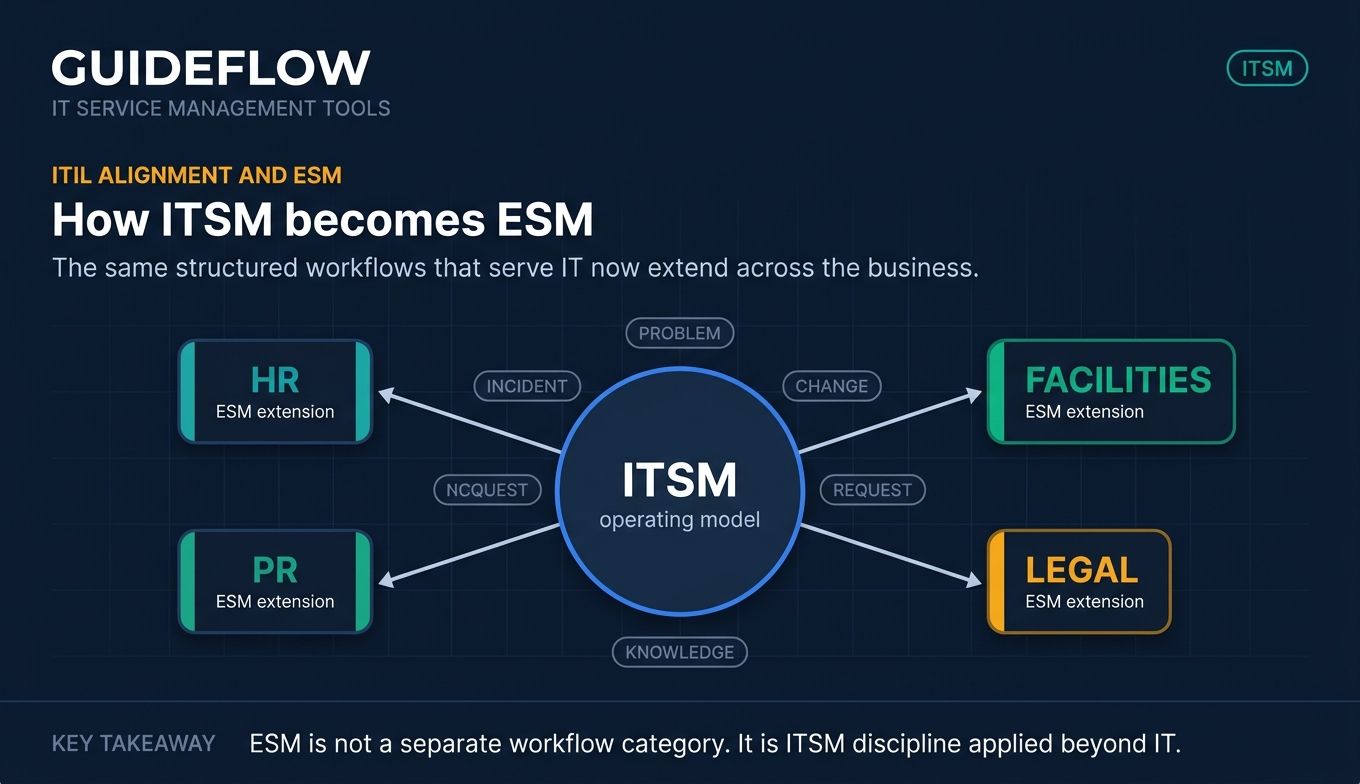
The bigger shift in 2026 is enterprise service management (ESM). The same structured workflows that serve IT now extend to HR, facilities, and legal. Analyst recognition matters here too. Buyers building shortlists often start with the Gartner Magic Quadrant for ITSM and Gartner Peer Insights to validate which vendors are proven at scale before booking a single demo.
When to use an ITSM tool
Not every team needs a full ITSM platform on day one. Here is how to recognize the moment.
Standardize incident and service desk workflows
When ticket volume outpaces ad-hoc handling, things slip. Requests live in inboxes, Slack threads, and someone's memory. An ITSM tool gives every incident a record, an owner, and an SLA. If your team is reconstructing what happened from email history, you have already passed this threshold.
Automate repetitive requests with AI and self-service
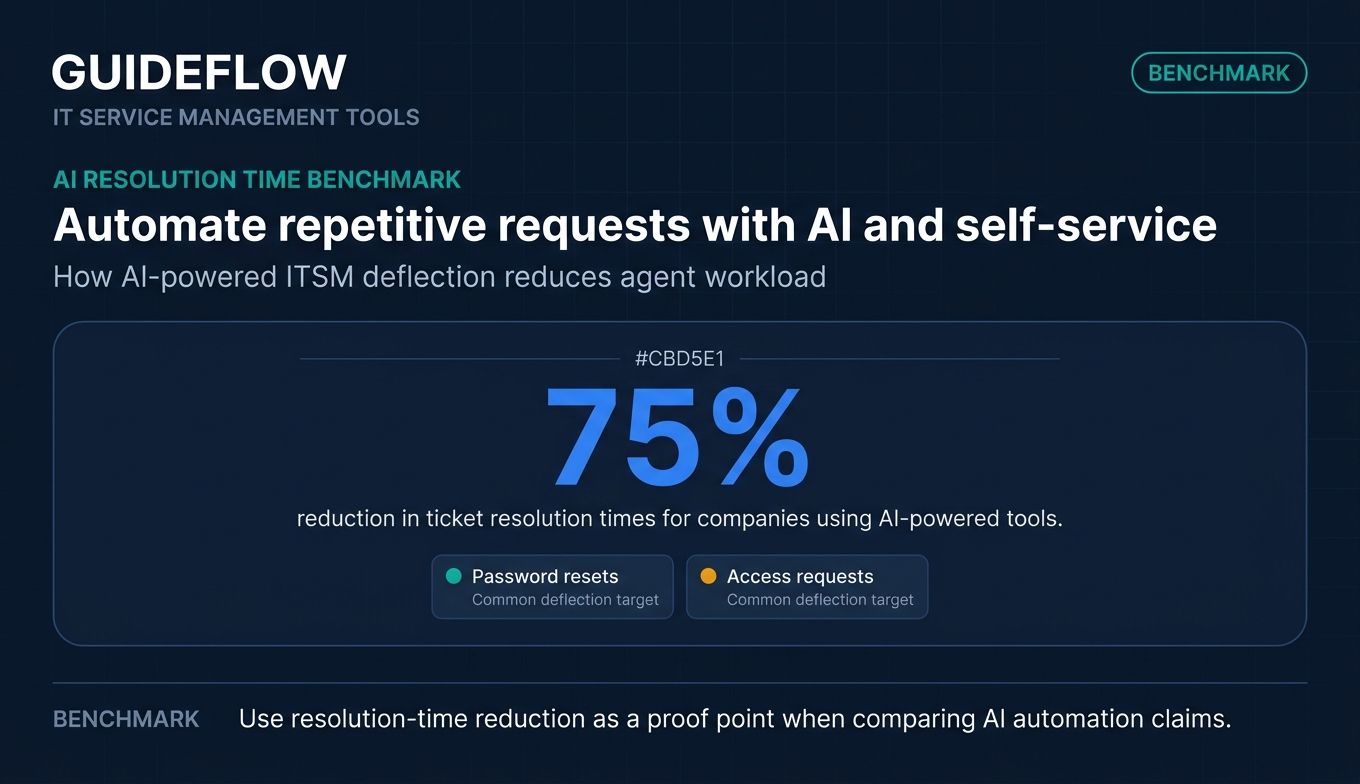
When agents resolve the same five issues over and over, that is wasted capacity. InvGate cites data showing companies using AI-powered tools saw a 75% reduction in ticket resolution times. A self-service portal plus a virtual agent can deflect password resets and access requests before they reach the queue. Many teams pair this with interactive demos and guided walkthroughs to help users self-resolve before they ever file a ticket. If your agents repeat themselves daily, deflection is the fastest ROI you will find.
Scale ITSM into enterprise service management
When HR, facilities, and other departments start asking for the same structured intake and tracking, you are ready for ESM. HDI's State of Tech Support 2025, cited by InvGate, found 71% of respondents named improving customer experience as the top reason for new technology investment. Extending proven IT workflows to other departments delivers that experience without rebuilding from scratch. The same approach also strengthens user onboarding across every service-consuming team.
12 best IT service management tools for 2026 compared at a glance
Below is a scannable view of all 12 ITSM tools. Pricing reflects each vendor's live pricing page as of June 2026, and G2 ratings reflect current listings. Several enterprise vendors publish package names but gate exact numbers behind a quote, which we note honestly rather than guess. Use this table to narrow your shortlist, then read the full sections for fit.
| # | Product | Intent | Key use case | Pricing | G2 rating |
|---|---|---|---|---|---|
| 1 | ServiceNow IT Service Management | Enterprise platform | Unified ITSM across incident, change, CMDB | Custom quote | 4.5/5 |
| 2 | Freshservice | Fast mid-market | Quick-deploy ITIL service desk | From $19/agent/mo | 4.6/5 |
| 3 | Jira Service Management | Dev-aligned | Atlassian-native service desk | Free; from $20/agent/mo | 4.3/5 |
| 4 | ServiceDesk Plus | Value mid-market | ITIL ticketing plus asset management | Free; Pro from $495/yr | 4.2/5 |
| 5 | TOPdesk | Usability-first | Service desk and shared service management | From £51/agent/mo | 4.1/5 |
| 6 | SolarWinds Service Desk | Integrated ITAM | ITSM with built-in asset discovery | From $39/tech/mo | 4.3/5 |
| 7 | Ivanti Neurons for ITSM | Enterprise automation | AI-driven ITSM plus endpoint visibility | Custom quote | 3.9/5 |
| 8 | SysAid | AI-first ITSM | Help desk automation and asset visibility | Custom quote | 4.5/5 |
| 9 | HaloITSM | All-inclusive ITIL | Full ITIL modules, one price | Custom quote | 4.8/5 |
| 10 | InvGate Service Management | Transparent value | No-code workflows and ESM | From $1,499/yr | 4.6/5 |
| 11 | Xurrent | AI-native unified | ITSM, ESM, and incident response | Custom quote | 4.6/5 |
| 12 | BMC Helix ITSM | Complex enterprise | AI-driven ITSM for hybrid environments | Custom quote | 3.7/5 |
The 12 best IT service management tools for 2026
1. ServiceNow IT Service Management
ServiceNow IT Service Management unifies incident, change, problem, and service request management on the ServiceNow AI Platform. It is the platform most large enterprises measure others against. ServiceNow combines deep ITIL workflows with a strong CMDB and AI-assisted automation, all on a single data model that scales across the entire organization.
Best for: Enterprise IT organizations that need AI-assisted, ITIL-aligned service management across incidents, requests, changes, problems, assets, and knowledge.
Key strengths
- Incident management: Capture, triage, and resolve disruptions with mature, configurable ITIL workflows.
- Request management: Drive standardized fulfillment through a service catalog and self-service portal.
- Change management: Plan, approve, and deploy changes with structured risk controls at scale.
Why choose ServiceNow: Choose ServiceNow when you are running IT at enterprise scale and need one platform that connects ITSM to the rest of the business. Its breadth is the differentiator. The trade-off is complexity. ServiceNow rewards organizations with the budget and admin resources to configure it well.
ServiceNow pricing: ServiceNow publishes three packages on its pricing page: ITSM Foundation, ITSM Advanced, and ITSM Prime. Exact prices are not listed publicly. The page directs buyers to request a custom quote based on requirements and scale. ServiceNow holds a 4.5/5 rating on G2.
2. Freshservice
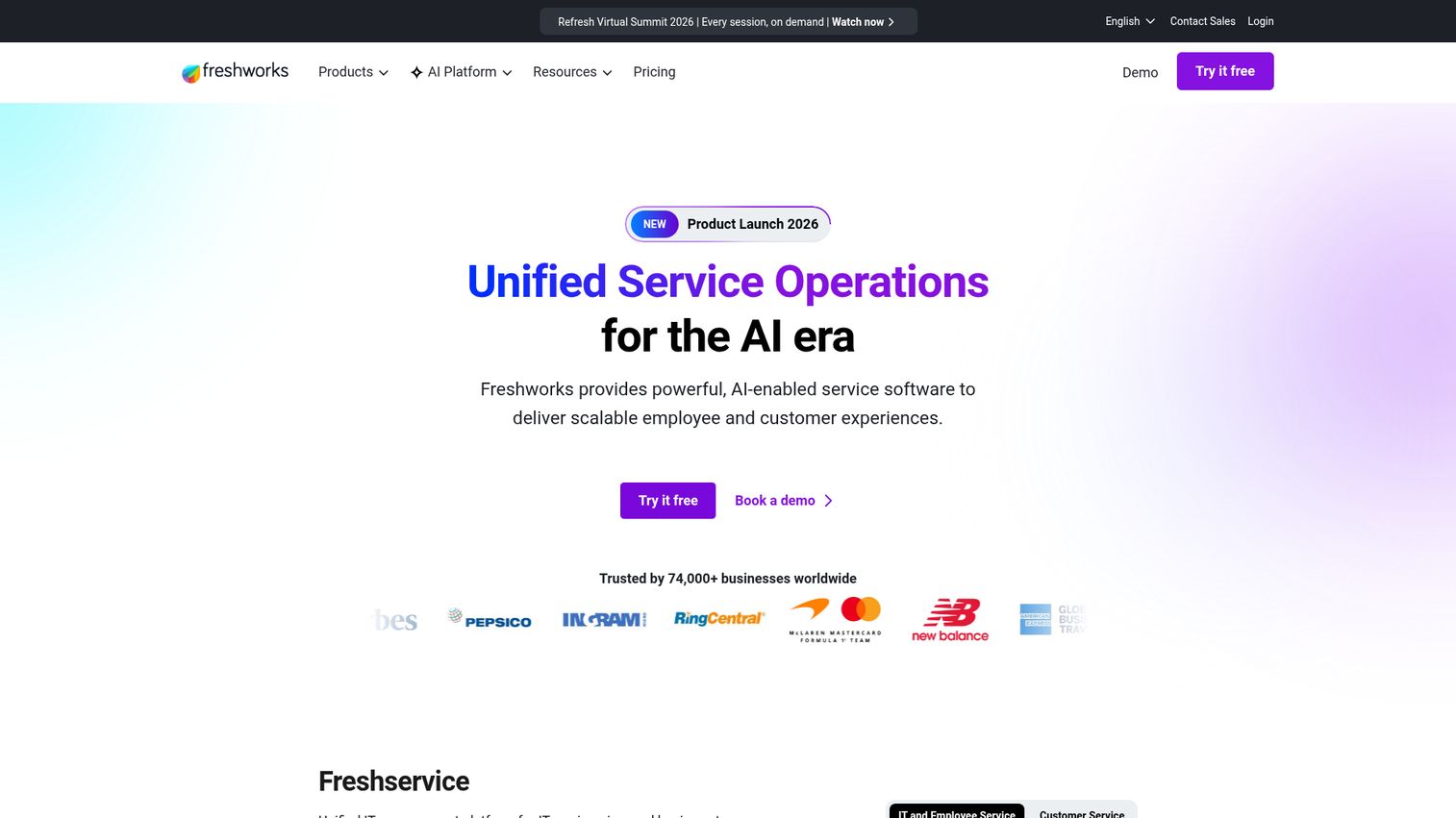
Freshservice is an AI-powered IT service management platform for enterprise IT and employee service delivery. Built by Freshworks, it earns its reputation for a clean interface and quick setup. Teams get an ITIL-aligned service desk with incident management, a service catalog, and workflow automation without a heavy implementation cycle.
Best for: IT teams that need an ITIL-aligned service desk with incident management, service catalog, automation, and asset and operations management capabilities.
Key strengths
- Incident management: Track and resolve incidents through structured, automated workflows.
- Service catalog: Offer self-service request fulfillment through a branded catalog.
- Workflow automation: Route, escalate, and assign tickets without manual handling.
Why choose Freshservice: Choose Freshservice when time-to-value matters more than infinite configurability. It hits the sweet spot for mid-market IT teams that want modern AI features and an intuitive experience. Its transparent per-agent pricing makes budgeting straightforward, a genuine advantage over quote-gated competitors.
Freshservice pricing: Freshservice starts at $19/agent/month (Starter), $49/agent/month (Growth), and $99/agent/month (Pro), all billed annually. Enterprise pricing is custom. There is no permanent free tier, but a free trial is available. Freshservice holds a 4.6/5 rating on G2.
3. Jira Service Management
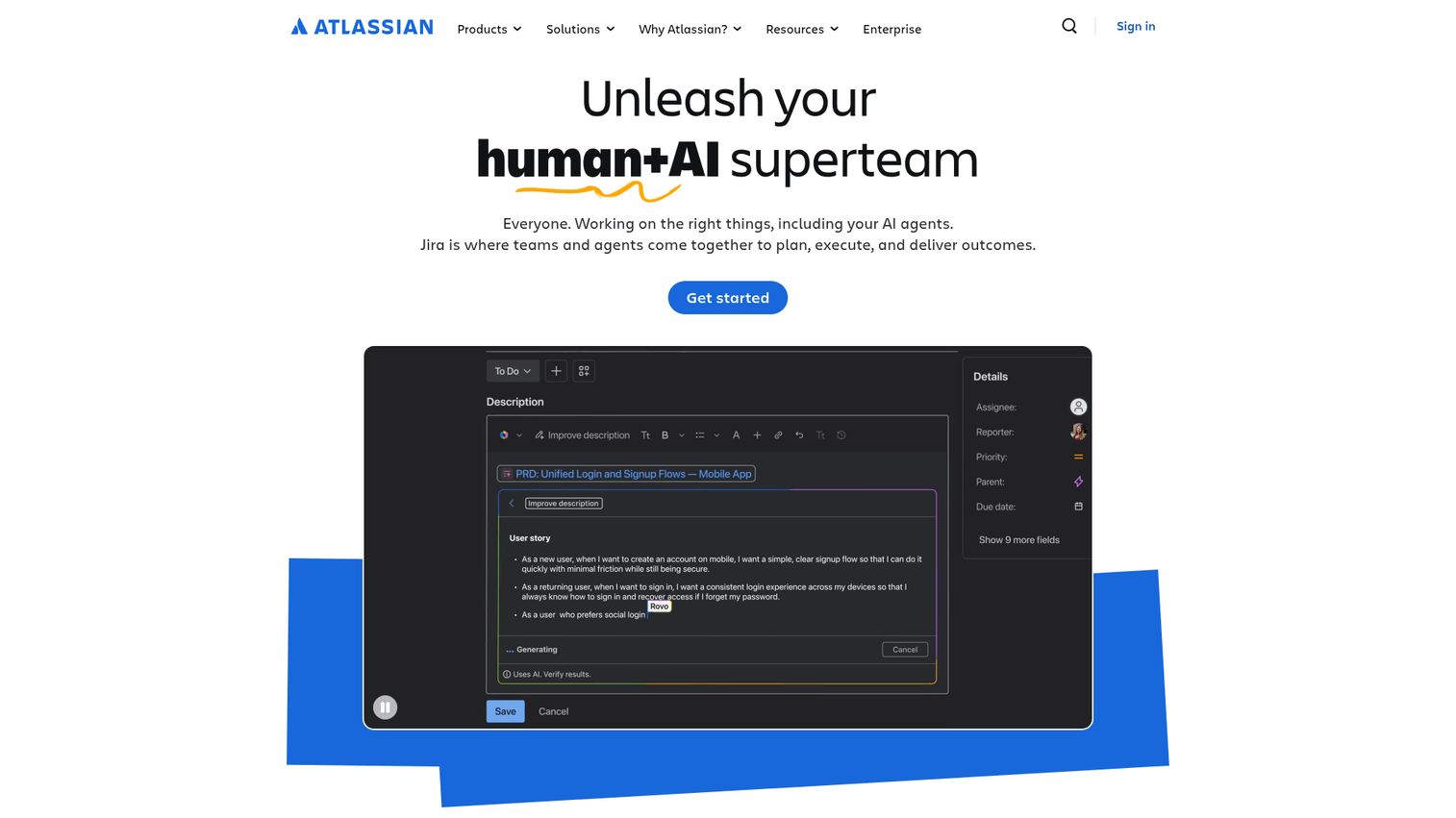
Jira Service Management is Atlassian's service management product for delivering service at high velocity. It connects IT service workflows directly to the development and operations tools many teams already run. For organizations living inside the Atlassian ecosystem, the integration depth is unmatched.
Best for: IT, operations, and business service teams that need ticket intake, incident management, knowledge base, automation, and Atlassian ecosystem integrations.
Key strengths
- Incident and on-call: Manage alerts, on-call schedules, and incident templates in one place.
- Multi-channel support: Take requests via portal, email, chat, Microsoft Teams, Slack, and an embedded widget.
- Flexible work intake: Capture work through customizable forms, workflows, and queues.
Why choose Jira Service Management: Choose Jira Service Management when your IT and engineering teams already use Jira and Confluence. The shared context between dev work and service tickets removes handoff friction. Teams without that ecosystem may not see the same payoff.
Jira Service Management pricing: Jira Service Management offers a Free plan for up to 3 agents, then Standard at $20/agent/month and Premium at $51.42/agent/month. Enterprise is billed annually with custom pricing through sales. The free tier makes it one of the most accessible ITSM platforms to trial. Jira Service Management holds a 4.3/5 rating on G2.
4. ServiceDesk Plus
ServiceDesk Plus is ManageEngine's AI-driven IT and enterprise service management platform combining ITSM, IT asset management, CMDB, and ESM capabilities. It is the value pick for teams that want serious ITIL depth without enterprise pricing, available in both cloud and on-premises deployments.
Best for: IT and enterprise service teams that need ITIL-aligned ticketing, asset management, change and project management, CMDB, and AI-assisted service workflows.
Key strengths
- Incident management: Use customizable ticket templates, a lifecycle builder, automation, and SLA tracking.
- IT asset management: Run asset discovery, software asset management, and purchase and contract tracking.
- Enterprise ITSM: Add service catalog, problem, change, release, project management, and CMDB.
Why choose ServiceDesk Plus: Choose ServiceDesk Plus when budget discipline meets a need for full ITIL coverage. The on-premises option also appeals to teams with data residency requirements. It is one of the few platforms that pairs affordability with both deployment models.
ServiceDesk Plus pricing: The cloud Standard edition is free for 2 technicians and 250 IT assets. The Professional edition starts at US$495 per year and Enterprise at US$1,195 per year, both shown for 2 technicians and 250 IT assets. Pricing scales by technician count and managed assets, with separate on-premises pricing. ServiceDesk Plus holds a 4.2/5 rating on G2.
5. TOPdesk
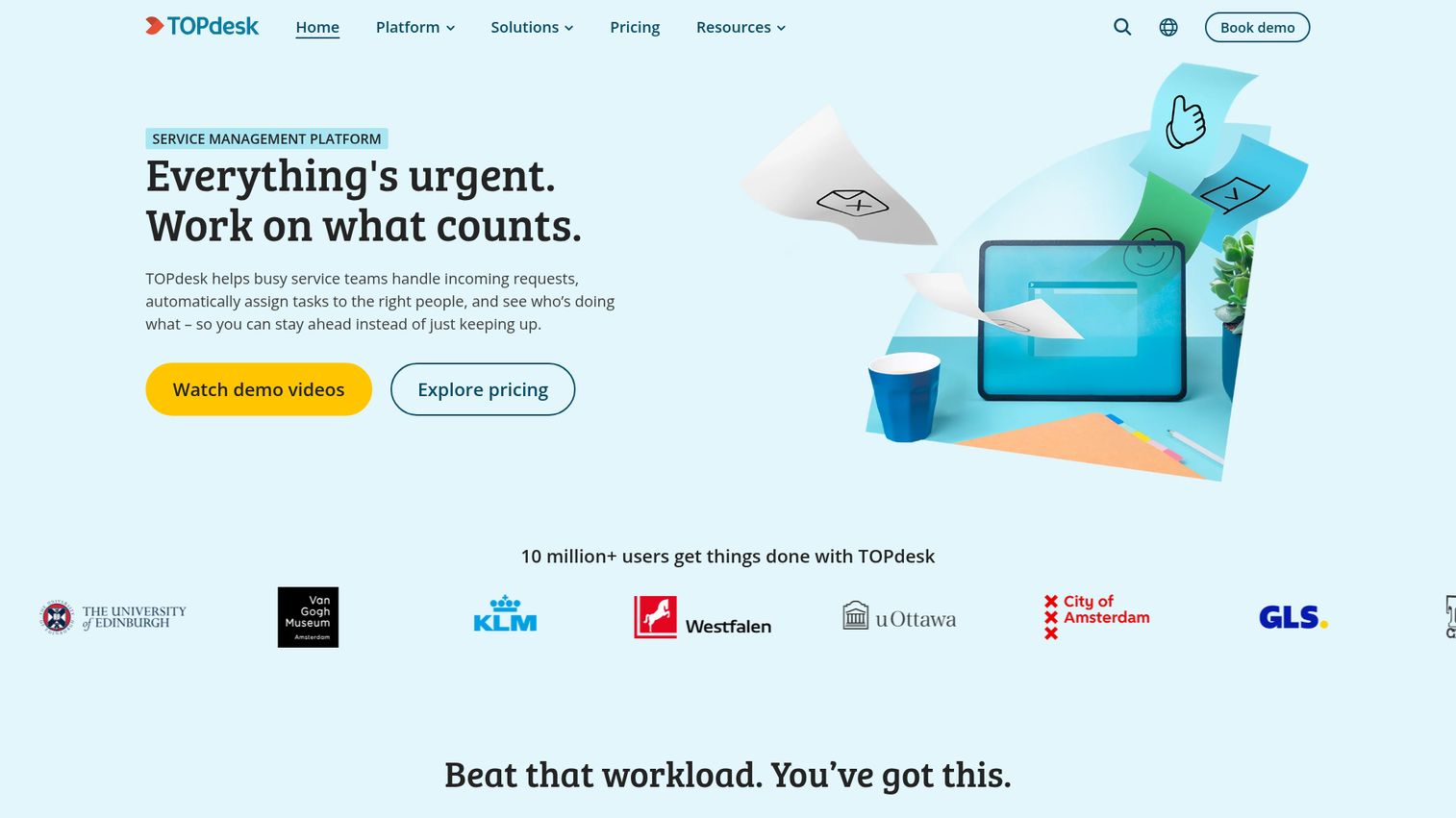
TOPdesk is an IT service management platform for service desks to handle tickets, share knowledge, manage assets, standardize ITIL-based processes, and support users through self-service. It is known for usability and a strong European presence, with a clear path into shared service management.
Best for: Service teams and organizations that need ITSM and service desk workflows with ticketing, assets, knowledge base, self-service, reporting, and ITIL-based process management.
Key strengths
- Incident management: Handle tickets through a clean, approachable interface that agents adopt quickly.
- Asset management: Track unlimited assets across every plan tier.
- Self-service portal: Pair a self-service portal with a knowledge base to deflect routine requests.
Why choose TOPdesk: Choose TOPdesk when ease of use is a priority and you want a smooth path from IT into shared service management. Agents tend to adopt it without heavy training. The higher tiers unlock AI categorization and writing assistance as your maturity grows.
TOPdesk pricing: TOPdesk lists Essential at £51 per agent/month, Engaged at £72 per agent/month, and Excellent at £101 per agent/month. Essential covers incident and asset management with unlimited assets, tickets, and end users. Engaged adds change, problem, and AI features. Excellent adds project management and AI summarization. TOPdesk holds a 4.1/5 rating on G2.
6. SolarWinds Service Desk
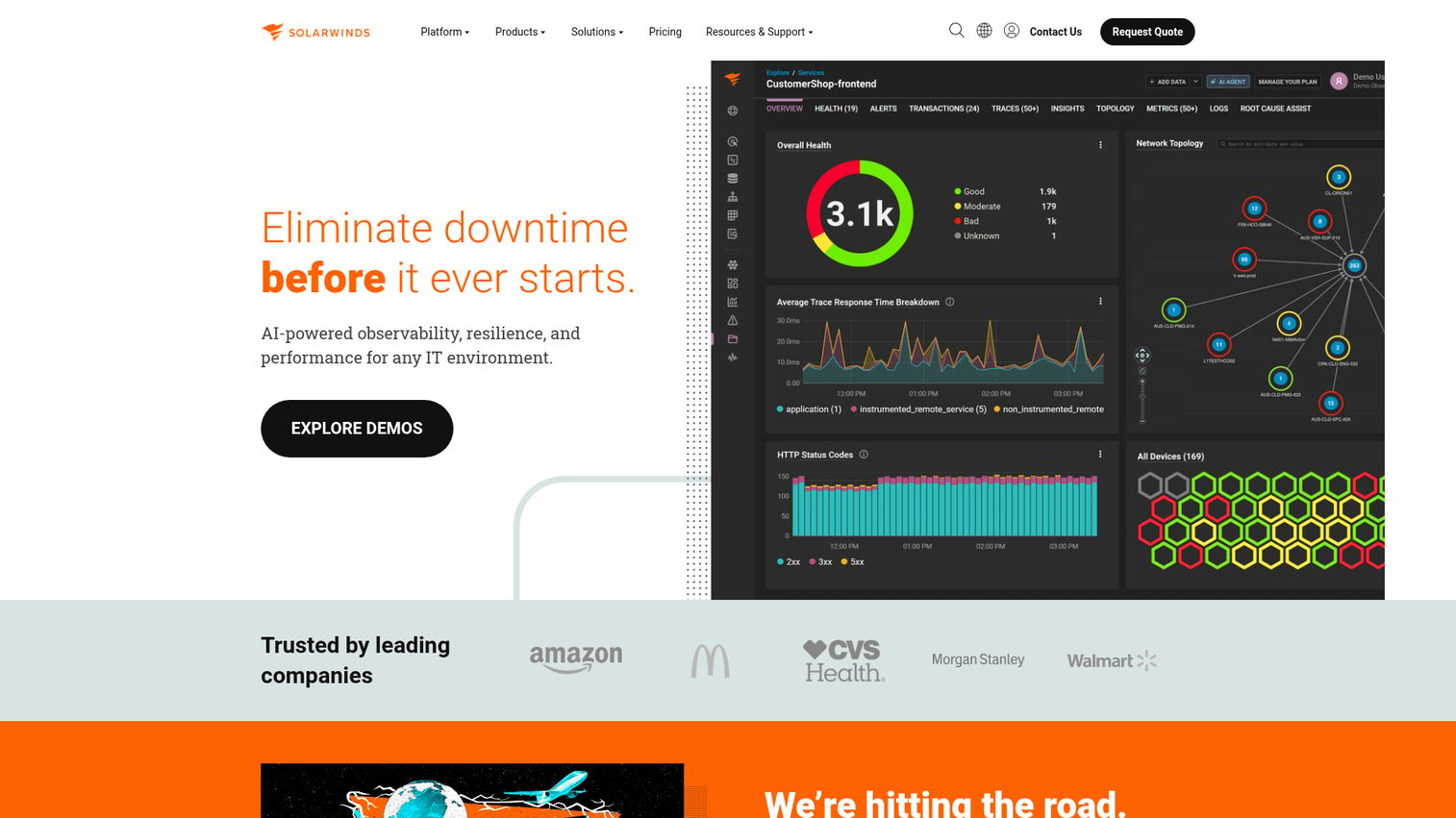
SolarWinds Service Desk is an ITSM solution for managing employee services with ITIL workflows, automation, asset discovery, CMDB, service catalog, and service portal capabilities. Its standout trait is tight integration between service management and automated asset discovery.
Best for: IT teams and service organizations that need scalable ITSM with ticketing, ITIL workflows, asset management, CMDB, automation, and self-service.
Key strengths
- Full ITIL workflows: Cover incident, problem, change, and release management end to end.
- Automated asset discovery: Populate an integrated CMDB through automatic discovery.
- Service catalog and portal: Drive requests through a catalog workflow engine and employee portal.
Why choose SolarWinds Service Desk: Choose SolarWinds Service Desk when integrated IT asset management is central to your strategy. The automatic discovery and CMDB linkage reduce manual inventory work. All tiers support unlimited users, which simplifies scaling across the organization.
SolarWinds Service Desk pricing: Essentials starts at $39 per technician per month, Advanced at $99, and Premier at $124, all billed annually. Every tier supports unlimited users, and asset pricing is available on request. A 30-day free trial is offered, but there is no permanent free tier. SolarWinds Service Desk holds a 4.3/5 rating on G2.
7. Ivanti Neurons for ITSM
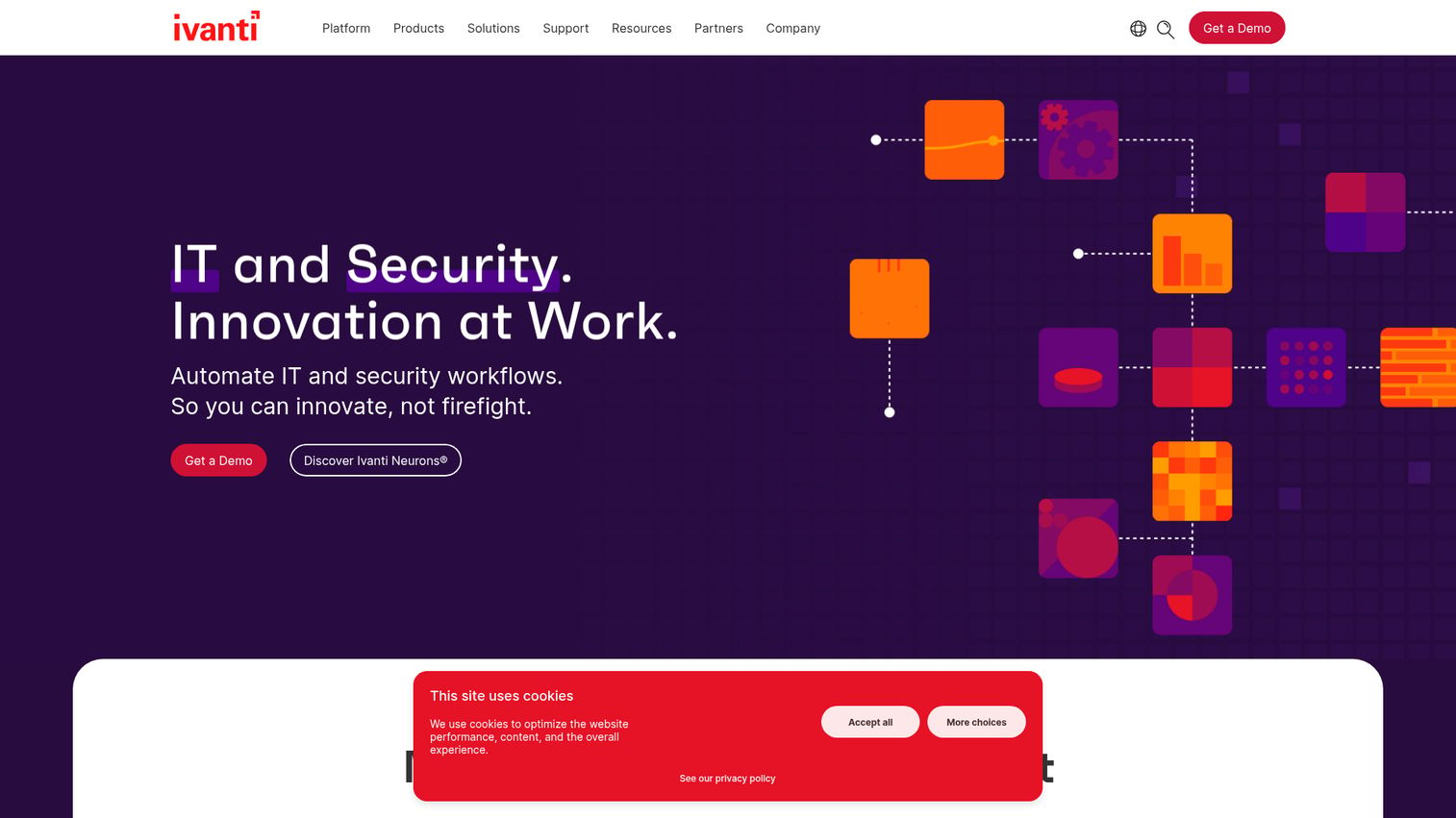
Ivanti Neurons for ITSM is an AI-powered IT service management platform for enterprise service delivery, workflow automation, asset visibility, self-service, and ITIL-aligned service management. It is built for enterprises that want to connect service management with endpoint and asset visibility.
Best for: Enterprise IT teams that need configurable ITSM, IT asset and service workflows, and AI-assisted automation across IT and non-IT service management.
Key strengths
- AI-powered service desk: Use AI ticket classification, incident summarization, and a virtual agent.
- Full ITSM coverage: Manage incident, change, request, knowledge, configuration, and service levels.
- Flexible deployment: Run in cloud, on-premises, or hybrid environments.
Why choose Ivanti Neurons for ITSM: Choose Ivanti when you want ITSM that connects to broader endpoint and asset management under one vendor. Its configurability suits complex enterprise environments. The trade-off is that configurability comes with admin effort, so plan for setup time.
Ivanti Neurons for ITSM pricing: Ivanti lists four packages: ITSM Professional, ITSM Enterprise, ITSM Premium, and ITSM Enterprise Premium. Pricing follows a per-analyst subscription model with named or concurrent analyst licenses. Exact figures are not published publicly, so a quote is required. Ivanti Neurons for ITSM holds a 3.9/5 rating on G2.
8. SysAid
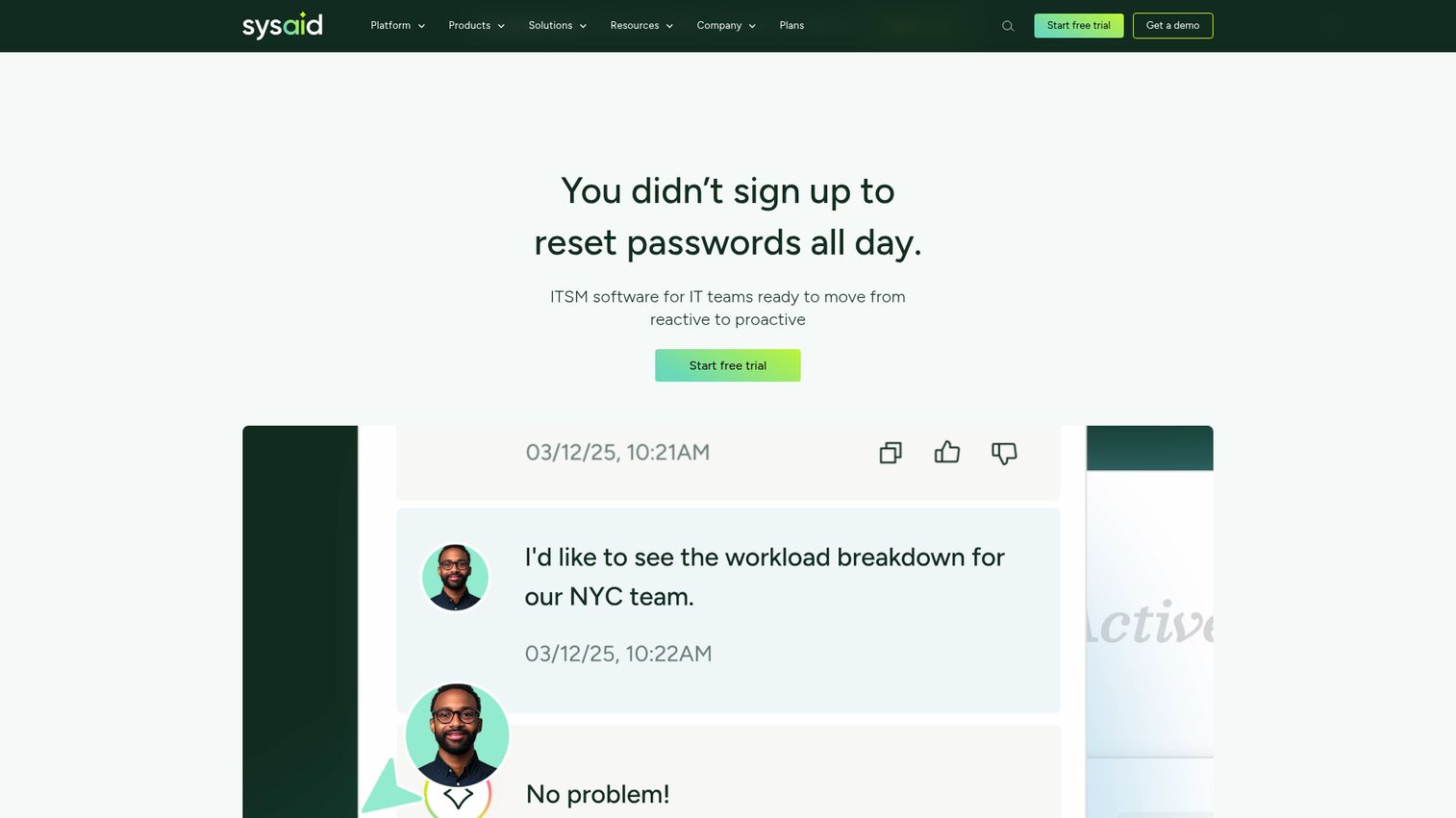
SysAid is an AI-first IT service management platform for IT teams, combining service desk, asset management, automation, self-service, reporting, and ITIL-aligned workflows. It leans hard into AI to reduce manual work across the service desk.
Best for: Mid-sized to enterprise IT teams that need AI-assisted ITSM, help desk automation, asset visibility, and self-service.
Key strengths
- Asset discovery: Manage hardware, software, cloud, and IoT assets in one inventory.
- AI-powered workflows: Automate incident, change, request, problem, and configuration management.
- Self-service portal: Let users submit tickets, track status, and search a knowledge base.
Why choose SysAid: Choose SysAid when automation is your priority and you want AI woven through the service desk rather than bolted on. It suits teams looking to deflect and resolve faster without a heavy admin burden. The AI-first positioning is its clearest differentiator.
SysAid pricing: SysAid lists three plans: Standard for help desk teams, Pro for ITSM teams, and Enterprise for large organizations needing advanced customization. Public prices are not displayed; the page directs buyers to request a customized quote. A free trial with no credit card is available, though there is no permanent free tier. SysAid holds a 4.5/5 rating on G2.
9. HaloITSM
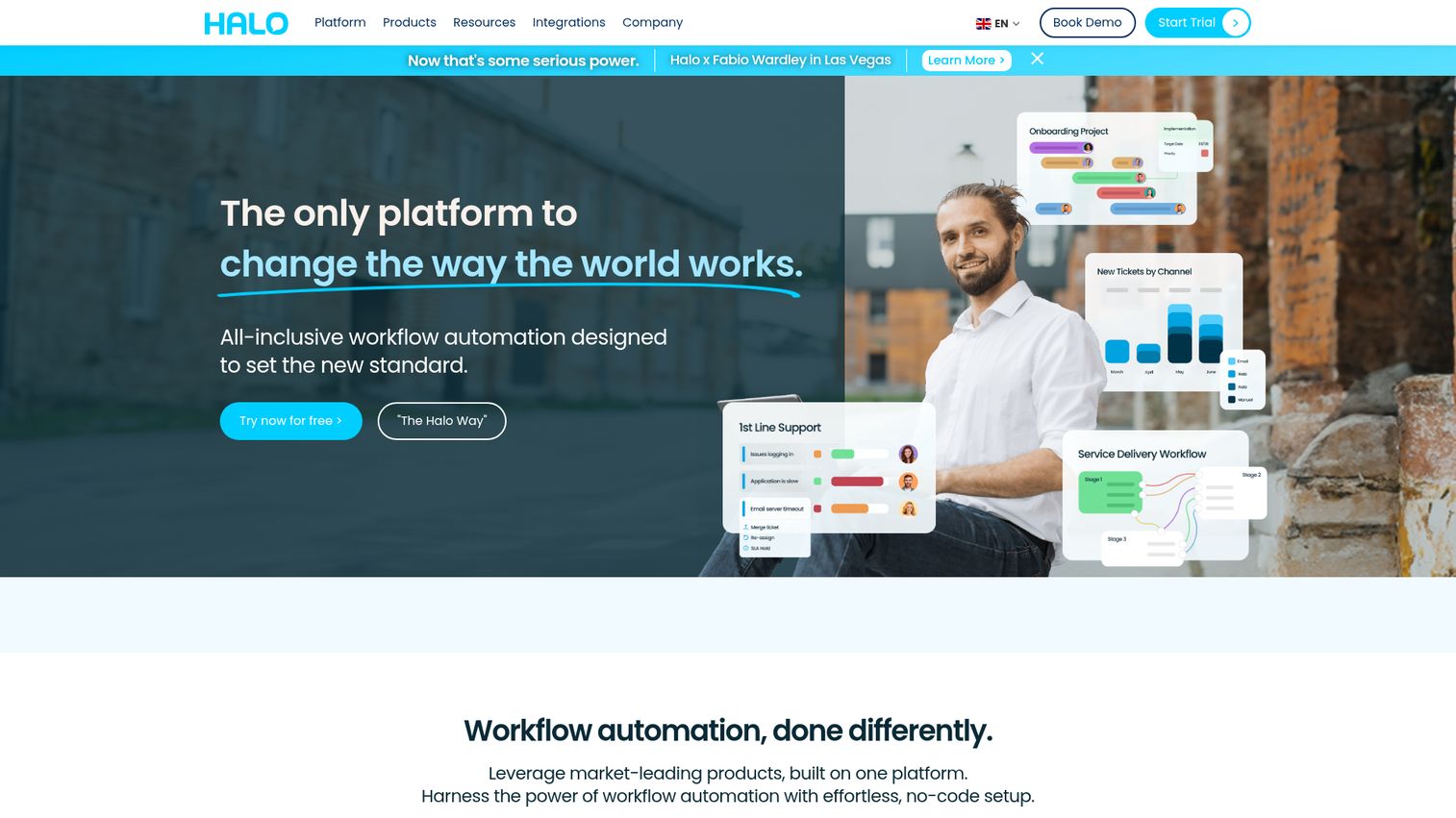
HaloITSM is a unified IT service management platform for ITIL-aligned service delivery and enterprise service desk operations. Its model is all-inclusive: every ITIL module ships together, with no per-module upsell. That approach earns it one of the highest G2 ratings on this list.
Best for: IT and enterprise service teams needing an all-inclusive, ITIL-aligned service desk and workflow automation platform.
Key strengths
- ITIL-aligned incident management: Automate workflows with centralized communications.
- Knowledge base and self-service: Offer a customizable self-service portal backed by a knowledge base.
- Full module coverage: Get SLA, problem, change, release, CMDB, AI, reporting, and asset discovery together.
Why choose HaloITSM: Choose HaloITSM when you want full ITIL coverage without nickel-and-dime module fees. The all-inclusive model removes the guesswork of which features sit behind which tier. Its 4.8/5 G2 rating reflects strong satisfaction among teams that value that simplicity.
HaloITSM pricing: HaloITSM uses an all-inclusive model with no tiered plans or locked-away features, but the pricing page asks visitors to request a personalized quote rather than listing public figures. A trial is available. Buyers should request a quote to confirm cost for their agent count. HaloITSM holds a 4.8/5 rating on G2.
10. InvGate Service Management
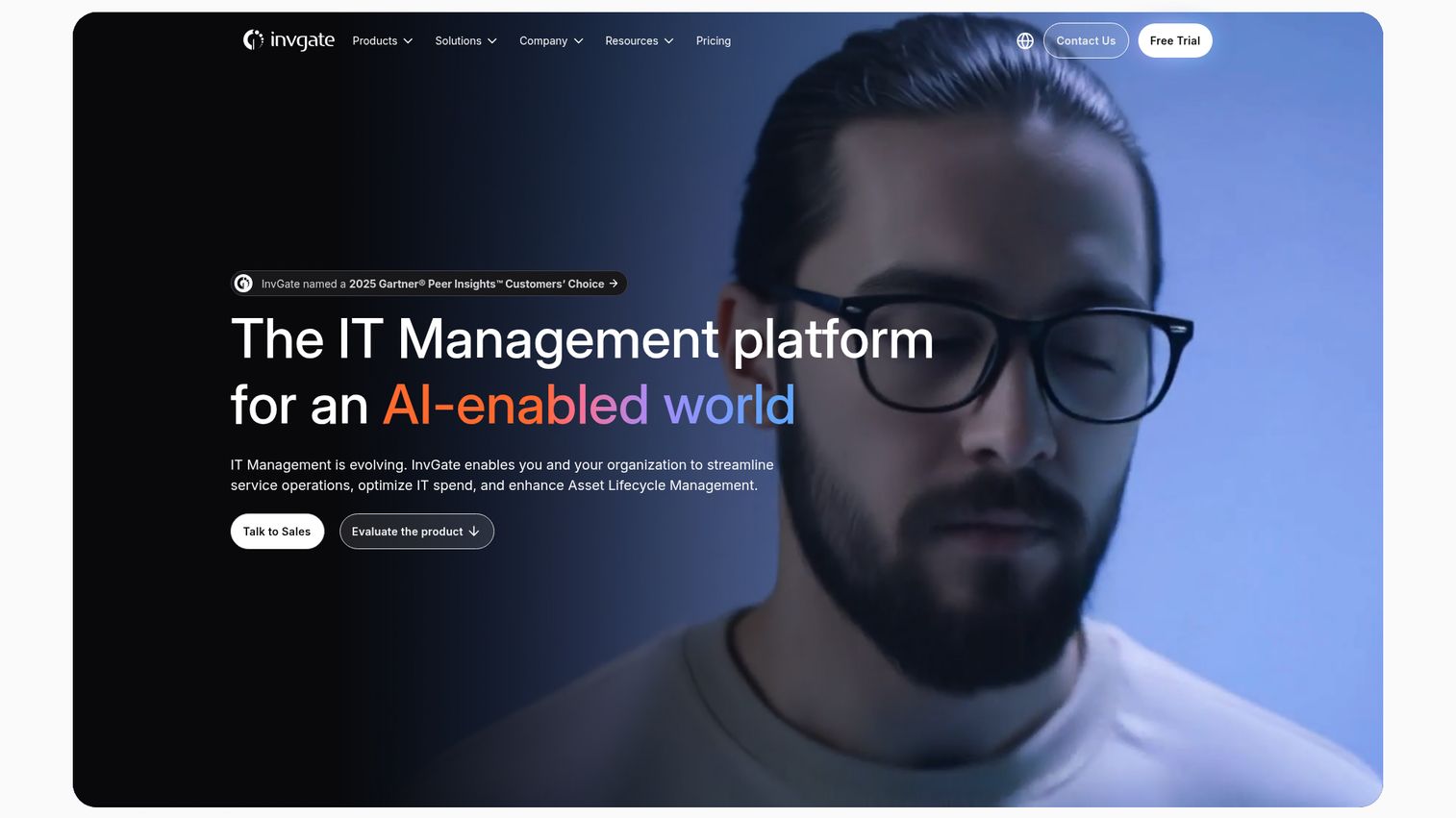
InvGate Service Management is an IT service management platform combining no-code service workflows with embedded AI for faster request resolution and scalable service operations. It stands out for publishing real, transparent pricing, a rarity among ITSM platforms.
Best for: Organizations seeking a configurable ITSM and ESM platform with no-code workflows, AI assistance, self-service, and service desk automation.
Key strengths
- Ticket management: Pair ticketing with a self-service portal and knowledge management.
- No-code workflow builder: Configure automation without engineering help.
- AI Hub: Generate ticket summaries, run a virtual service agent, and assist knowledge articles.
Why choose InvGate Service Management: Choose InvGate when transparent budgeting and fast configuration matter. The no-code builder lets service desk leads adjust workflows without filing a ticket with IT. Published pricing means no surprises when you scale.
InvGate Service Management pricing: InvGate lists Starter at $1,499/year for 5 agents, Pro at $500/agent/year starting at $2,500/year for 5 to 50 agents, and Enterprise as custom starting at $12,000/year. Starter includes unlimited end users, SSO, and AI Hub. Pro adds the workflow builder, AI Service Agent, and Microsoft Teams and WhatsApp. A 30-day free trial is available. InvGate holds a 4.6/5 rating on G2.
11. Xurrent
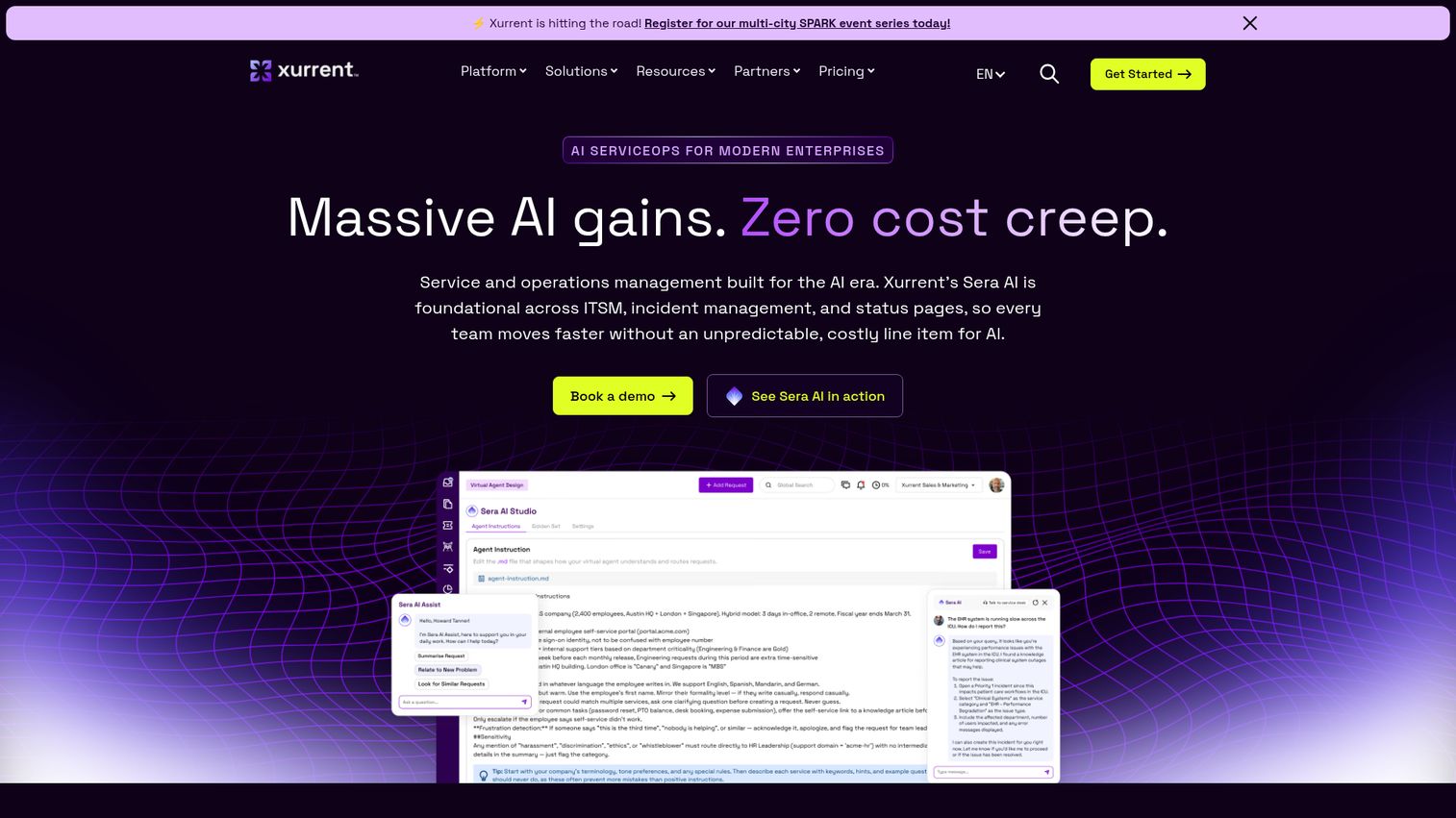
Xurrent is an AI-powered IT service, enterprise service, incident response, and operations management platform. It positions itself as a unified, AI-native system that spans more than traditional ITSM, with a focus on fast implementation.
Best for: Organizations seeking a unified AI-powered platform for ITSM, ESM, IT operations, incident response, and status communications.
Key strengths
- AI request management: Automate ticket handling and request routing with AI.
- Full ITIL support: Cover incident, problem, change, request, knowledge, SLA, and service catalog.
- Cross-domain automation: Extend workflows across ITSM, ESM, ITOM, and incident response.
Why choose Xurrent: Choose Xurrent when you want one AI-native platform that handles service management, operations, and incident response together. The unified scope reduces tool sprawl across IT functions. Its breadth and speed of implementation appeal to enterprises consolidating point solutions.
Xurrent pricing: Xurrent lists corporate IT plans (Starter, Corporate, Enterprise) and MSP plans (MSP Corporate, MSP Enterprise), each with included platform-user allowances from 20 to 100 users per month. No public monetary prices are displayed, so a quote is required. Xurrent holds a 4.6/5 rating on G2.
12. BMC Helix ITSM
BMC Helix ITSM delivers integrated, AI-driven IT service management for enterprise service operations. It is built for large organizations with complex hybrid and multi-cloud environments, layering agentic AI on top of mature ITSM workflows.
Best for: Large enterprises needing AI-enabled ITSM across service desk, change, asset, CMDB, and ServiceOps workflows.
Key strengths
- Agentic AI assistants: Boost support productivity with AI assistants and ChatOps.
- Incident and problem management: Resolve issues with AI-powered, context-aware assistance.
- Change and release management: Manage change across complex hybrid or multi-cloud environments.
Why choose BMC Helix ITSM: Choose BMC Helix when your environment is genuinely complex, with hybrid infrastructure and demanding change management needs. Its predictive AI and ServiceOps orientation suit large enterprises. The platform rewards organizations with the maturity to operationalize it fully.
BMC Helix ITSM pricing: BMC Helix uses a request-pricing model. The pricing page is a form, and BMC states it will reach out to discuss options based on requirements. No public figures, plan names, or free-tier details are listed. Buyers should expect an enterprise sales conversation. BMC Helix ITSM holds a 3.7/5 rating on G2.
How to choose the right ITSM tool
A shortlist is only useful if you pressure-test it against your reality. Run each candidate through these five criteria before committing.
Core ITSM and ITIL capability depth
Confirm the platform covers incident, request, change, problem, and CMDB at the maturity your team actually needs. A team running basic incident management does not need the same depth as one managing multi-stage change approvals. Match capability to your ITIL maturity, not to the vendor's longest feature list.
AI automation and self-service
Evaluate the virtual agent, auto-resolution, and deflection features directly. Ask what percentage of tickets the AI can realistically deflect for your ticket mix. With AI cited as cutting resolution times by up to 75%, this is where the strongest ROI usually lives. Pairing AI with a strong digital adoption platform can push deflection even higher by guiding users in-product.
Integrations and ecosystem fit
Check native connectors for CRM, Slack, Microsoft Teams, monitoring tools, DevOps pipelines, and identity providers. A tool that does not fit your stack creates manual work that erodes its value. Jira Service Management, for example, rewards teams already inside Atlassian. If you rely on a connected stack, see how Guideflow handles integrations across your tools.
Pricing model and scalability
Compare per-agent versus flat-rate models and watch for hidden module fees. Transparent vendors like Freshservice and InvGate make budgeting easier, while quote-gated platforms require a sales conversation. Map the cost from your current size to where you expect to be in two years.
Deployment speed and admin effort
Weigh time-to-value against ongoing configuration burden. Fast-deploy tools get you live in weeks; deeply configurable enterprise platforms take longer but flex further. Be honest about the admin resources you can dedicate after launch. Building guided walkthroughs for new agents can shorten that ramp considerably.
Conclusion
The right ITSM tool depends entirely on your team's size, maturity, and ecosystem. For enterprise scale and complexity, ServiceNow, BMC Helix ITSM, and Ivanti Neurons lead on breadth, CMDB depth, and AI automation. For fast time-to-value in the mid-market, Freshservice and TOPdesk deliver clean experiences and quick deployment. Atlassian-native and dev-aligned teams will get the most from Jira Service Management. And for transparent value, ServiceDesk Plus, InvGate Service Management, and HaloITSM give you serious capability without enterprise pricing opacity.
Do not buy on the comparison table alone. Shortlist 2 or 3 tools that match your criteria, then put them through their paces. Start a free trial with your shortlisted vendor, run your real ticket scenarios through it, and pull in the agents who will live in the tool every day. You can also build interactive product tours to onboard your team faster once you commit. The platform that feels right in a trial is usually the one that sticks. Your service desk, and your ticket backlog, will thank you.
FAQs
ITSM is the practice (and the software) of delivering and managing IT services. ITIL is the best-practice framework that guides how you structure those services. Put simply, ITIL is the playbook, and ITSM tools are how you run the plays. Most ITSM platforms are ITIL-aligned out of the box.
Small businesses tend to favor accessible, fast-to-deploy options. Freshservice starts at $19/agent/month, ServiceDesk Plus offers a free cloud Standard edition for 2 technicians, and Jira Service Management is free for up to 3 agents. SysAid is another strong option for teams wanting AI-driven automation. All four get you running quickly without enterprise overhead.
Pricing usually follows a per-agent or per-technician model, though some vendors use flat or platform-user pricing. Entry tiers can start as low as $19 to $39 per agent per month, while transparent flat plans like InvGate begin at $1,499 per year. Enterprise platforms such as ServiceNow, BMC Helix, and Ivanti use custom quotes based on scale and requirements.
Yes. Jira Service Management offers a free plan for up to 3 agents, and ServiceDesk Plus provides a free cloud Standard edition for 2 technicians. For fully open-source options, teams often consider iTop, OTRS, and GLPI. Open-source tools trade licensing cost for self-hosting and maintenance effort.
For enterprise scale, ServiceNow, BMC Helix ITSM, and Ivanti Neurons for ITSM are the common leaders. They offer deep CMDB capabilities, mature change management, and AI automation built for complex, high-volume environments. Buyers often validate these against the Gartner Magic Quadrant for ITSM before booking demos.
AI now powers virtual agents, automatic ticket classification, incident summarization, and self-service deflection. InvGate cites data showing AI-powered tools cut ticket resolution times by up to 75%. The practical impact is fewer repetitive tickets reaching human agents and faster resolution on the ones that do.
Jira Service Management offers multi-channel support including Microsoft Teams and Slack. InvGate's Pro tier adds Microsoft Teams and WhatsApp. Many modern ITSM platforms now include chat-based service desk integrations, so confirm the specific connector and tier with each vendor during your trial.
Start by exporting your ticket history, knowledge base, and CMDB data from the current platform. Map your configuration items and categories to the new tool's data model before importing. Run a phased rollout, validate with a pilot group, and lean on the vendor's migration support and documentation. A staged approach reduces disruption to your live service desk.