

You shipped a slick onboarding flow. Then you bolted a notification on top of it: "Welcome! Here's a tip." Every user got the same one, at the same moment, regardless of plan, role, or whether they'd already found the feature.
Activation didn't move. Support tickets didn't drop. And a chunk of users muted your app.
Most teams read that as a copy problem. Better headline, better emoji, better timing. It's usually not. It's a targeting and orchestration problem. The message ignored segment, lifecycle stage, and the actual job the user showed up to do.
The market has caught up to this. The global push notification software market is projected to grow from USD 1.83 billion in 2026 to USD 3.78 billion by 2031, a 15.61% CAGR, according to Mordor Intelligence (2026). Meanwhile personalized pushes can lift engagement by 88%, per Gitnux (2026). The gap between generic and targeted messaging is now measurable in retention and revenue.
In-app notification software is how product teams close that gap: contextual in-app messaging, web push, and mobile app push tied to real user behavior, not a broadcast blast.
What's inside
This guide is for product managers, growth marketers, and lifecycle teams shortlisting an in app notification tool in 2026. We picked platforms based on four things that matter to a PM buying this category:
- Segmentation and triggering depth: event-based, role-based, and lifecycle-based targeting
- Orchestration: journeys across in-app, push, email, and SMS without duplicate logic
- Measurement: analytics that tie notifications to activation and retention, not just opens
- Operational overhead: how much engineering lift launch and maintenance require
No generic definitions padded out to hit a word count. Just the shortlist and the decision criteria.
TL;DR
- Best free entry into push notification software: OneSignal. Omnichannel messaging with a genuinely usable free tier and clear starting price.
- Best for enterprise lifecycle programs: Braze. Deep journey orchestration and experimentation for large B2C messaging operations.
- Best for cross-channel campaign control: Iterable. Lifecycle marketing teams that need granular audience and campaign management.
- Best unified customer engagement platform: Insider. One system spanning acquisition through retention with AI-driven timing.
- Best for retention analytics: CleverTap. Real-time segmentation tied directly to product usage.
- Best developer-first notification infrastructure: Novu. Open-source, in-app inbox components, and programmable workflows for product teams.
What is in-app notification software?
In-app notification software delivers contextual messages to users inside a web or mobile application, triggered by user behavior, lifecycle stage, or segment, to drive activation, feature adoption, and retention. It combines in-app messaging with adjacent channels like push notification software, so a single system can reach users whether they're active in the product or away from it.
Most platforms in this category share a common feature set. The differences are in depth, orchestration, and how much they lean toward marketers versus developers.
Core capabilities to expect:
- In-app messaging: modals, banners, tooltips, and inbox-style feeds rendered inside your app
- Push notifications: mobile app push (iOS and Android) plus web push for browser re-engagement
- Segmentation: audience targeting by attributes, events, plan, role, and lifecycle stage
- Personalization: dynamic content, product recommendations, and message variants per segment
- Journeys: multi-step automation that moves users across channels based on behavior
- Send time optimization: delivery timed to when each user is most likely to engage
- Frequency capping: guardrails that stop message fatigue across campaigns
- A/B testing: experiments on copy, timing, and channel with statistical readouts
- Analytics: engagement, conversion, and retention reporting tied to each message
The strongest tools treat notifications as a product operating system for activation and retention. You segment, trigger, personalize, and measure in one place, then feed the results back into your onboarding and lifecycle programs. If a change to your UI breaks an onboarding message, the maintenance cost of that message is part of the total cost of the tool.
When to use in-app notification software
Drive activation without new engineering work
New users hit blank states and setup walls. A well-targeted in-app message points them to the one action that produces first value. Because these tools are event-triggered, you fire the nudge only when a user hasn't completed a key step, not on a blind timer. That respects the user's actual progress and keeps time-to-first-value short.
Re-engage dormant users across channels
Users go quiet. Web push and mobile app push pull them back with a message tied to something they left unfinished. Push notifications average a 41.2% open rate globally, per Gitnux (2026), which makes them a strong lever for reactivation when the message respects segment and recency.
Announce features to the right segment only
A new feature matters to power users on your top plan, not to a trial user who hasn't activated. Segmentation and personalization let you route feature announcements by plan, role, or usage, so you drive adoption where it counts and avoid noise everywhere else.
In-app notification software comparison
Here's the shortlist side by side. Pricing and G2 ratings reflect each vendor's public pages as of mid-2026. Several platforms in this category use usage-based or contact-sales pricing, so treat starting prices as an entry point, not a full quote.
| # | Product | Best for | Key use case | Pricing | G2 rating |
|---|---|---|---|---|---|
| 1 | OneSignal | Teams needing omnichannel lifecycle messaging with a free entry tier | In-app messaging, push, and email from one platform | Free; Growth from $19/mo | 4.7/5 |
| 2 | Braze | B2C brands needing enterprise-grade omnichannel engagement | Large-scale journey orchestration and experimentation | Contact sales; free trial | 4.5/5 |
| 3 | Iterable | Enterprise cross-channel lifecycle marketing | Campaign and audience control across channels | Contact sales | 4.4/5 |
| 4 | Insider | Enterprise teams wanting one unified engagement platform | Omnichannel journeys with unified profiles | Contact sales | High-rated |
| 5 | CleverTap | Teams needing engagement plus retention analytics | Usage-driven segmentation and retention | From ₹600/mo; 30-day trial | 4.6/5 |
| 6 | Pushwoosh | Teams wanting usage-based omnichannel automation | Push and in-app across mobile and web | Free; from $13 per 1,000 MAU | 4.4/5 |
| 7 | Novu | Engineering teams needing programmable notification infrastructure | Developer-built multi-channel notifications | Free; Pro from $30/mo | 4.6/5 |
If you're a PM shipping onboarding and adoption flows, notice how the list splits: marketer-led customer engagement platforms at the top, developer-first infrastructure at the bottom. Your stack maturity and engineering bandwidth decide which half you shortlist from.
Best 7 tools for in-app notification software
1. OneSignal

OneSignal is a customer engagement platform covering email, push notifications, in-app messaging, SMS and RCS, and lifecycle automation. It's the common default for PMs and growth teams because it starts free, sets up fast, and covers the channels most product teams need on day one. You can run mobile app push, web push, and in-app messaging from a single console without stitching together three vendors.
The free tier is genuinely useful for early-stage teams validating whether notifications move activation. Once you need advanced journeys, larger volumes, or deeper controls, the paid tiers take over.
Best for: Product and growth teams that want omnichannel lifecycle messaging with a low-risk free entry point.
Key strengths
- A/B testing: test copy, timing, and channel with clear readouts
- Journeys automation: multi-step flows across push, email, and in-app
- Segmentation and personalization: target by attributes, events, and behavior
Why choose OneSignal: It's the fastest way to get real notifications live without a procurement cycle. Teams outgrow the free plan when they need heavier journey logic or enterprise controls, and the paid tiers scale with them.
OneSignal pricing: Free plan available. Growth starts at $19 per month. Professional and Enterprise are contact-sales plans with a fixed platform fee plus variable usage.
2. Braze
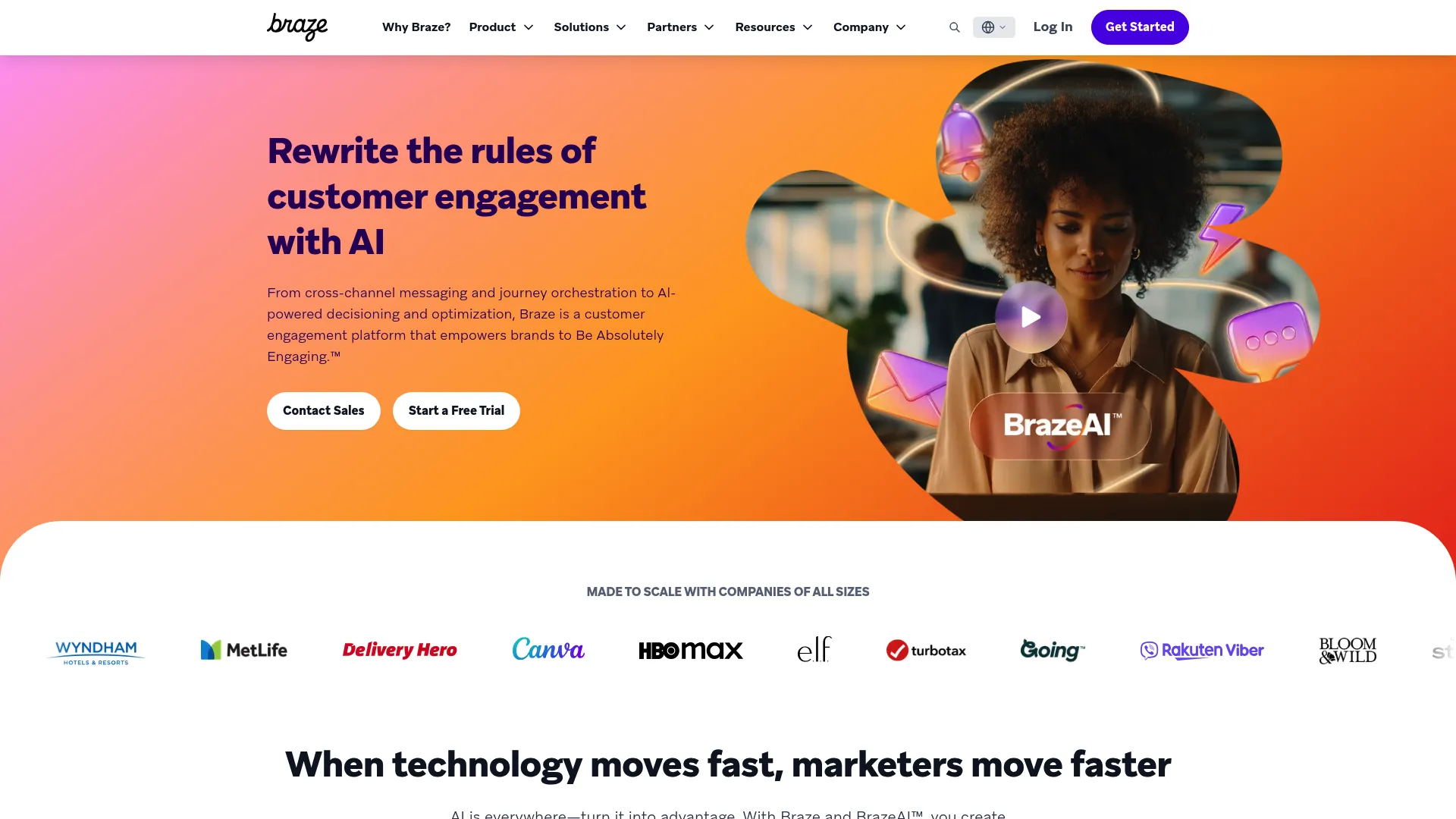
Braze is a customer engagement platform built for cross-channel messaging, orchestration, personalization, and analytics at scale. It suits teams running mature lifecycle programs where a single campaign spans in-app messaging, mobile app push, web push, email, and SMS with shared logic. The orchestration layer is the draw: you build a journey once and Braze decides channel and timing per user.
For a PM at a company with large user volumes and a dedicated lifecycle team, Braze is where segmentation, experimentation, and measurement come together in one system.
Best for: B2C brands and larger product organizations running enterprise-grade omnichannel engagement.
Key strengths
- Cross-channel messaging: unified journeys across in-app, push, email, and SMS
- Journey orchestration: behavior-driven flows with send time optimization
- BrazeAI personalization: AI-driven content and decisioning per user
Why choose Braze: When your lifecycle program is complex enough that duplicate logic across channels becomes a maintenance tax, Braze's orchestration pays off. It's built for teams with the volume and headcount to use that depth.
Braze pricing: Braze lists four editions: Go, Select, Pro, and Enterprise. Pricing scales with monthly active users and action credits and is quoted through sales. A free trial is available.
3. Iterable

Iterable is an AI customer engagement platform for cross-channel marketing automation and personalization. It's strongest for lifecycle teams that need granular campaign and audience control across in-app messaging, push, email, and SMS. The Catalog feature powers personalized recommendations, and agentic AI capabilities help teams scale campaign creation without proportional headcount.
Where Iterable earns its place is workflow control. If your team runs many concurrent campaigns and needs precise audience management and journey branching, this is built for that.
Best for: Enterprise lifecycle marketing teams running cross-channel campaigns with heavy personalization.
Key strengths
- Cross-channel campaigns: coordinate messaging across every channel
- Customer journeys: branch flows on behavior and attributes
- AI intelligence: agentic features plus Catalog-driven recommendations
Why choose Iterable: It fits teams whose bottleneck is campaign volume and audience precision, not channel coverage. The personalization and journey tooling scale with a mature lifecycle program.
Iterable pricing: Iterable does not publish public pricing. Plans are quoted through its sales team based on your channels, volume, and requirements.
4. Insider
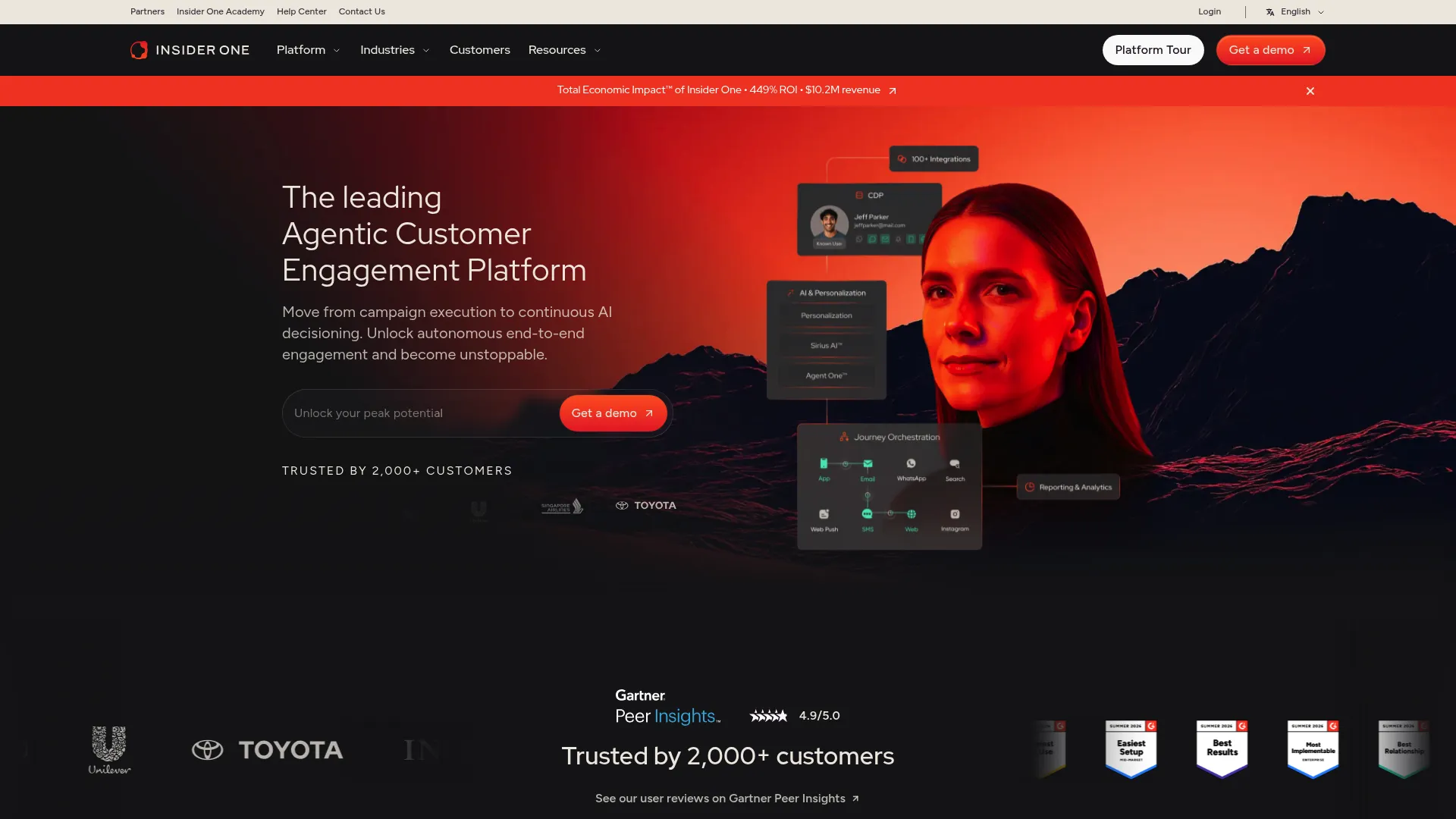
Insider is an AI-native omnichannel experience and customer engagement platform spanning marketing, personalization, segmentation, and analytics. Its differentiator is the built-in customer data platform: unified user profiles feed journeys across web, app, email, SMS, WhatsApp, push, and site search. For a team that wants one system across acquisition and retention rather than a notification point tool, Insider maps to that.
The AI layer handles timing and channel selection, so you define the journey and let the platform optimize delivery per user.
Best for: Enterprise marketing teams wanting a single platform from acquisition through retention.
Key strengths
- Omnichannel journeys: web, app, email, SMS, WhatsApp, push, and search
- Customer data platform: unified profiles and behavioral segmentation
- Personalization and analytics: recommendations, A/B testing, and journey reporting
Why choose Insider: When you're consolidating a fragmented stack into one engagement platform, the unified profiles and CDP layer remove the data-stitching work that usually sits with your data team.
Insider pricing: Insider uses demo-led, sales-quoted pricing. Public dollar figures are not listed, so request a quote scoped to your channels and volume.
5. CleverTap
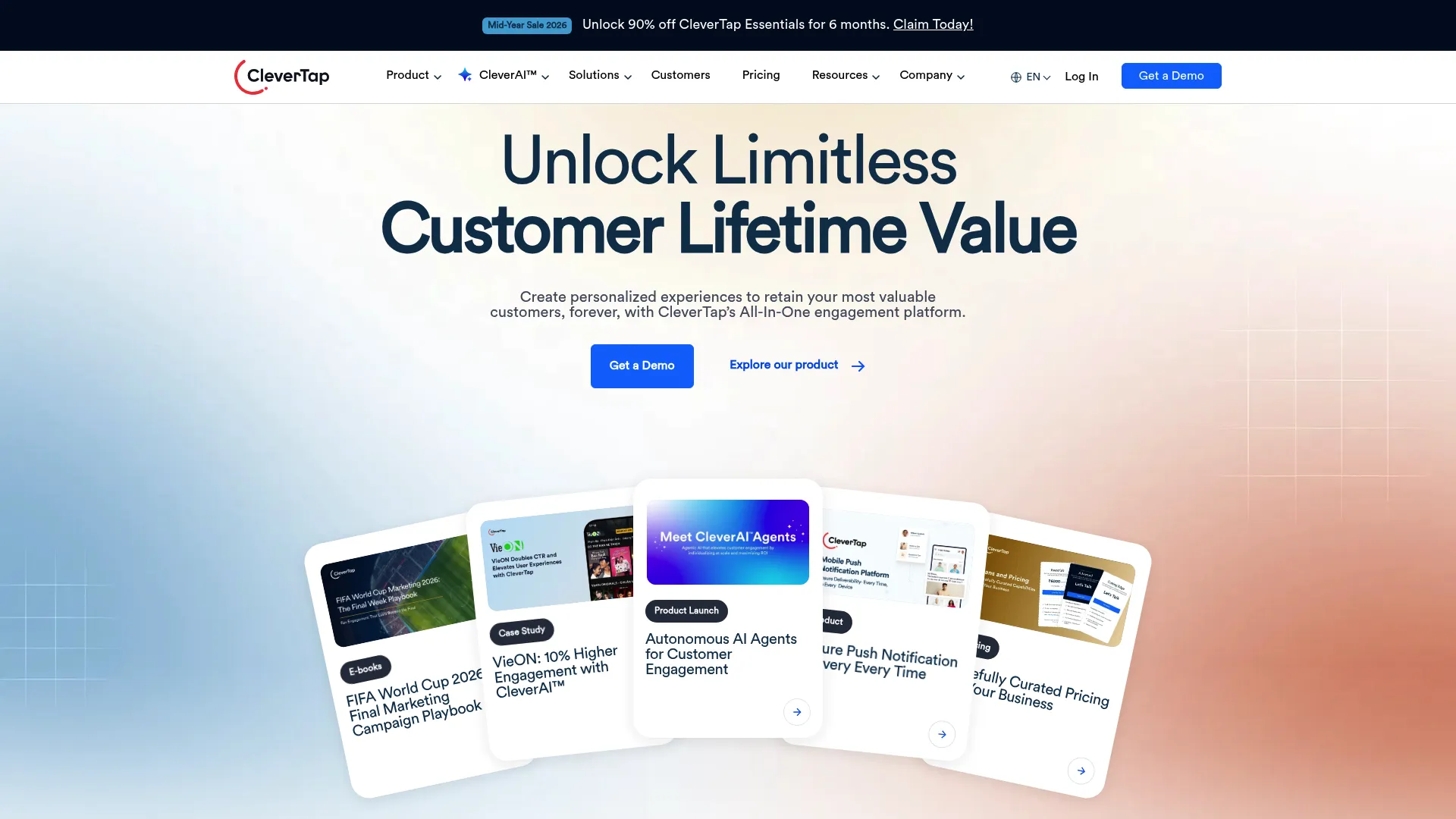
CleverTap is a customer engagement and retention platform that pairs messaging with deep product analytics. It's mobile-first and grounded in retention outcomes: real-time segmentation reacts to product usage, so messages fire based on what users actually do. For a PM whose primary metric is early retention (D7, W1) and activation, that tight loop between analytics and messaging is the point.
The platform combines customer data, experimentation, and campaign orchestration, so you can test a hypothesis, ship the winning variant, and watch its retention impact in one place.
Best for: Mobile-first teams that want engagement and retention analytics in a single platform.
Key strengths
- Customer data and analytics: real-time behavioral segmentation
- Experimentation and optimization: test and optimize campaigns in-platform
- Personalization and orchestration: usage-driven messaging across channels
Why choose CleverTap: If you evaluate notification impact by cohort retention rather than opens, CleverTap's analytics-first design fits how you already think. It's built for teams that treat messaging as a retention lever.
CleverTap pricing: The Essentials plan is publicly listed starting at ₹600 per month, with a 30-day trial. Advanced and Cutting Edge are contact-sales plans.
6. Pushwoosh
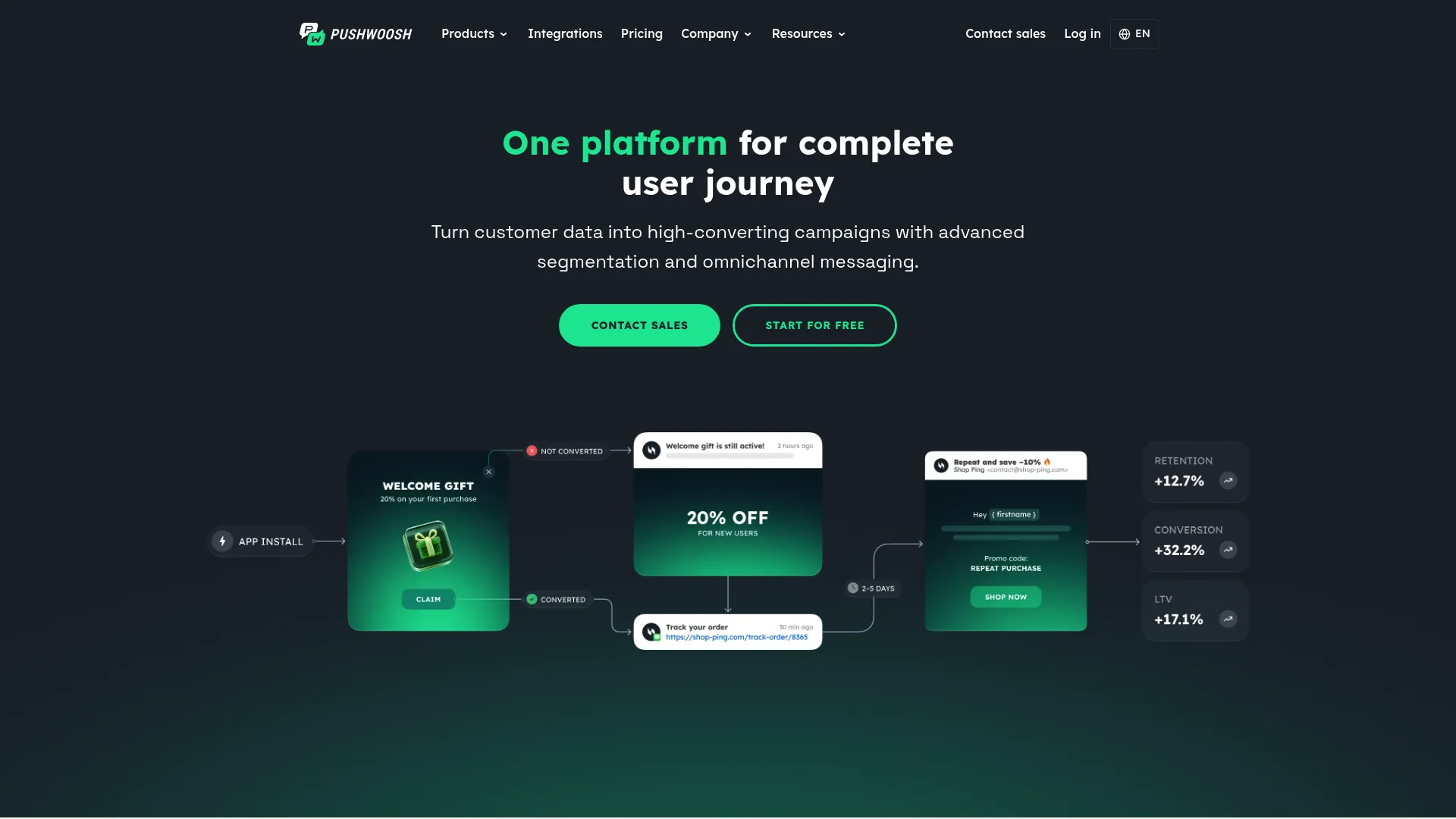
Pushwoosh is an omnichannel customer engagement platform covering push, in-app messaging, email, SMS, and messaging automation. It's practical notification infrastructure with cross-channel coverage and developer-friendly implementation, which suits teams that want to ship mobile app push and web push quickly without a heavy platform commitment. The usage-based pricing means you pay for the monthly active users you actually message.
Journey orchestration, segmentation, personalization, and A/B testing all sit in the platform, plus AI-assisted campaign creation for teams that want to move faster on copy and timing.
Best for: Teams wanting usage-based omnichannel automation across mobile and web.
Key strengths
- Omnichannel messaging: push, in-app, email, and SMS orchestration
- AI-assisted campaigns: faster creation and optimization
- Segmentation and A/B testing: targeted messaging with experimentation
Why choose Pushwoosh: The pay-as-you-go model and developer-friendly setup make it a fit for teams that want full omnichannel coverage without enterprise-tier commitments. You scale spend with active users.
Pushwoosh pricing: Free pay-as-you-go tier up to 1,000 MAU. The Omnichannel plan is usage-based at $13 per 1,000 MAU. An email-only plan starts at $5 per 1,000 monthly unique recipients.
7. Novu
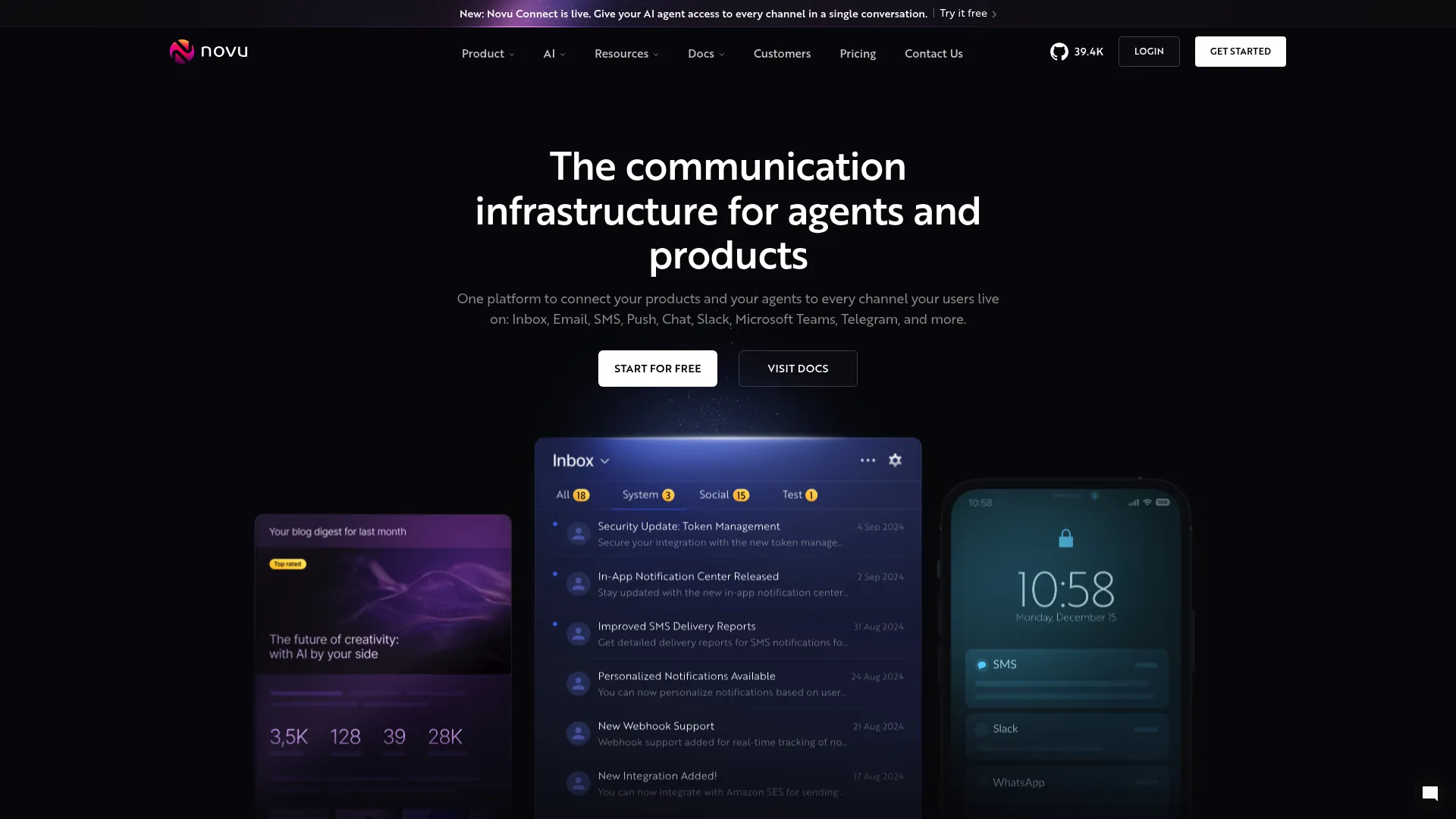
Novu is open-source notification infrastructure built for developers and product teams. It's the most technical option here, and that's the point: instead of a marketer-facing campaign console, Novu gives engineering teams programmable multi-channel workflows across in-app, email, SMS, chat, and push. The embeddable Inbox and Preferences components let you drop a native notification feed straight into your product.
For a product team that wants to own notifications in code, version them with the app, and avoid a separate marketing tool, Novu fits the workflow.
Best for: Engineering and product teams needing programmable, code-owned notification infrastructure.
Key strengths
- Multi-channel notifications: in-app, email, SMS, chat, and push
- Workflow builder: workflow runs and environment management
- Embeddable components: native Inbox and Preferences in your product
Why choose Novu: When notifications belong in your codebase and your engineers want an open-source, API-first system, Novu is built for that motion. It trades a marketer-facing UI for developer control and flexibility.
Novu pricing: Free plan available. Pro starts from $30 per month, Team from $250 per month, and Enterprise is custom-priced.
Considerations before you buy
Segmentation and triggering depth
The whole category lives or dies on targeting. Verify the tool triggers on the events your product actually emits, and that segments can combine plan, role, lifecycle stage, and behavior. A tool that only broadcasts to broad audiences will recreate the noise problem you're trying to solve.
Orchestration across channels
If you plan to run in-app messaging, push notifications, and email together, check that journeys share logic across channels rather than forcing duplicate flows. Duplicate logic is where lifecycle programs rot as your product changes.
Measurement tied to outcomes
Opens and clicks are vanity if they don't connect to activation and retention. Look for analytics that report on cohort retention and conversion, not just delivery. You need to prove notification ROI against feature work.
Engineering and maintenance cost
Ask what breaks when your UI changes. Event-based tools with stable identifiers survive redesigns better than tools tied to DOM selectors. Factor the ongoing maintenance load into total cost, not just the license.
Security and data compliance
You're piping user data into a third party. Confirm the platform meets your compliance requirements and supports the data residency and access controls your security team will ask about.
Conclusion
The right pick comes down to your buying motion and stack maturity. OneSignal is the low-risk starting point when you want omnichannel messaging live fast on a free tier. Braze and Iterable serve mature lifecycle teams that need deep orchestration and experimentation across channels. Insider fits when you're consolidating acquisition and retention into one customer engagement platform. CleverTap is the pick when retention analytics drive your notification strategy. Pushwoosh gives you usage-based omnichannel coverage, and Novu hands notification infrastructure to your engineers as code.
For a PM, the decision is less about channel count and more about segmentation, automation, and measurement without creating maintenance debt. Shortlist two or three tools that match your stack and team maturity, then run a scoped pilot on one real activation or retention flow. Measure the cohort impact, not the open rate.
Pick the tool that helps you segment, trigger, personalize, and measure, then prove the lift before you roll it wide.
FAQs
It's software that delivers contextual messages inside your web or mobile app, triggered by user behavior, segment, or lifecycle stage. The goal is to drive activation, feature adoption, and retention without broadcasting the same message to every user. Most platforms pair in-app messaging with push and email so you can reach users whether or not they're active in the product.
In-app messaging reaches users while they're actively using your product, so it's ideal for contextual guidance and feature adoption in the moment. Push notifications reach users when they're away, on mobile or in the browser via web push, making them a reactivation channel. Most in app notification tools support both, and the best strategies use each for the moment it fits.
It depends on whether a marketer or an engineer owns notifications. Marketer-led product teams often choose OneSignal or CleverTap for fast setup and retention analytics. Engineering-led product teams that want code-owned infrastructure with in-app inbox components tend toward Novu. Larger organizations with dedicated lifecycle teams lean on Braze or Iterable.
Measure cohort outcomes, not delivery metrics. Track activation rate, time to first value, and early retention (D7, W1) for users who received a notification against a holdout that didn't. Opens and clicks tell you the message was seen; retention and conversion tell you it worked. Run the comparison per segment so you can prove ROI against feature work.
You need a one-time integration to install the SDK and pass user events and attributes into the platform. After that, marketer-facing tools let PMs and growth teams build and ship campaigns without further engineering. Developer-first infrastructure like Novu keeps notifications in code, which suits teams that prefer to version them with the app.
Prioritize strong segmentation (plan, role, lifecycle, behavior), event-based triggering, journeys across channels, and analytics that tie to activation and retention. Personalization, send time optimization, frequency capping, and A/B testing matter for scaling without message fatigue. Above all, check integration with your data and analytics stack and how much maintenance the tool needs as your product changes.
Yes. Segmentation and personalization are core to the category. Strong platforms let you build segments from attributes, events, plan, and lifecycle stage, then personalize content, timing, and channel per user. The depth varies, so confirm the tool triggers on the specific events your product emits and can combine multiple conditions in one segment.
If you plan to run in-app messaging, push, email, and SMS together with shared journey logic, an omnichannel customer engagement platform like Braze, Insider, or Iterable reduces duplicate work. If notifications are your focus and you want developer control or a lean setup, a focused tool like Novu or Pushwoosh fits. Match the choice to your channel roadmap and who owns messaging internally.