Your CISO just walked out of a board meeting with one question: "What does our biggest cyber risk cost us if it materializes?" Raw vulnerability counts and CVSS scores don't answer that. Only 15% of organizations currently measure the financial impact of cyber risks to a significant extent, according to PwC's 2025 Global Digital Trust Insights Survey. That gap creates a real problem for product, security, and risk teams who need to prioritize controls, justify budgets, and satisfy regulators, all using different languages.
Cyber risk quantification software closes that gap by converting threat scenarios, control data, and business context into dollar-denominated loss estimates. Whether the driver is a board reporting obligation, an SEC materiality disclosure, or a roadmap decision between shipping a security feature and shipping a product feature, CRQ tools give stakeholders a shared financial basis for the conversation.
This guide covers 12 cyber risk quantification platforms, explains the core models and methodologies, and helps you match the right tool to your data maturity and reporting needs.
What's inside
This guide is for security leads, risk managers, and product managers who influence CRQ platform decisions at B2B SaaS or enterprise organizations.
Tools were selected based on:
- Strength of financial loss modeling or quantification output
- Depth of FAIR, Monte Carlo, or actuarial methodology support
- Executive and board reporting capability
- Instrumentation quality: Integrations, data inputs, and maintainability
The comparison table covers best-fit use case, key differentiator, pricing, and G2 rating for all 12 platforms.
TL;DR
- Best overall for FAIR-aligned CRQ: Safe Security offers continuous exposure management with FAIR-aligned risk modeling across business units
- Best for insurance-grade financial loss modeling: Kovrr combines scenario modeling, materiality assessment, and insurance analytics in one platform
- Best for framework-first compliance teams: CyberSaint (CyberStrong) connects compliance posture directly to financial risk quantification
- Best for enterprise GRC alignment: MetricStream embeds CRQ inside a broader governance, risk, and compliance suite
- Best for exposure management tied to risk: Tenable One starts from asset and vulnerability data to drive risk-based prioritization
- Best for third-party cyber risk quantification: Black Kite quantifies supplier and vendor risk in business impact terms using Open FAIR
What is cyber risk quantification software?
Cyber risk quantification software converts cyber risk scenarios, control data, threat likelihood, and potential business impact into financial terms that executives can compare against budgets, insurance coverage, and risk appetite.
The key distinction from qualitative risk assessment is output format. A qualitative assessment produces labels: High, medium, low. CRQ produces numbers: An estimated range of financial loss, a probability of occurrence within a given period, and a projected reduction in expected loss from a specific control investment. Those numbers support decisions qualitative ratings cannot.
Common inputs CRQ platforms consume:
- Asset inventories and business service maps
- Vulnerability and exposure data
- Security control assessments and maturity scores
- Threat intelligence and incident history
- Third-party and vendor risk data
- Financial impact assumptions and industry benchmarks
Outputs a mature CRQ platform should produce:
- Annual loss expectancy and loss exposure ranges
- Event likelihood estimates by scenario
- Control effectiveness and risk reduction projections
- Board-level risk reports with materiality framing
- Regulatory disclosure support documentation
- Cyber insurance gap and optimization analysis
Methodologies used across this category:
- FAIR (Factor Analysis of Information Risk): A quantitative standard, nearly 45% of organizations use or plan to use FAIR for cyber risk quantification, per the FAIR Institute (2025)
- Monte Carlo simulations: Probabilistic modeling that runs thousands of scenarios to produce loss distribution curves
- Bayesian and actuarial models: Statistical approaches drawing on historical loss data and industry benchmarks
- Exposure-based scoring: Continuous outside-in signals mapped to financial impact ranges
For product managers, the instrumentation question matters as much as the methodology. A CRQ model is only as credible as the data feeding it. Evaluate integration depth with your vulnerability management stack, identity infrastructure, and CMDB before committing to any platform.
When to use cyber risk quantification software
Prioritize security investments in business terms
Security backlogs are rarely short. CRQ gives you a way to compare two competing control investments by expected loss reduction rather than urgency alone. A PM weighing "harden authentication" against "encrypt data at rest" can use CRQ output to frame that tradeoff as a dollar figure, making it comparable to any other roadmap item competing for engineering capacity.
Report cyber risk to boards and executives
Board reporting on cyber risk has changed since the SEC adopted cybersecurity disclosure rules in 2023. Boards now need to understand material incident risk, not just control status. CRQ platforms produce repeatable, assumption-documented outputs that can survive scrutiny from audit committees and external counsel. The key word is repeatable: A one-off analysis doesn't hold up across quarters.
Support regulatory, insurance, and customer trust discussions
DORA, NIS2, and SEC disclosure requirements all push organizations toward documented, defensible risk measurement. Cyber insurers increasingly ask for quantified exposure data at renewal. Enterprise customers run security reviews that benefit from financial risk framing alongside SOC 2 attestations. CRQ platforms help teams prepare for all three conversations from a single data model.
Cyber risk quantification software comparison
Use this table to shortlist three to four platforms before running a detailed evaluation. Pricing reflects what vendors publish or confirm; most CRQ platforms price by contract scope rather than a fixed rate. G2 ratings are drawn from live listings.
| # | Product | Best for | Key differentiator | Pricing | G2 rating |
|---|---|---|---|---|---|
| 1 | Safe Security | Enterprise FAIR-aligned CRQ | Continuous CTEM with AI co-workers | Custom pricing | 4.4/5 |
| 2 | Kovrr | Insurance-grade financial loss modeling | Monte Carlo-driven scenario and insurance analytics | Custom pricing | N/A |
| 3 | CyberSaint | Framework-first risk and compliance teams | Automated compliance mapped to financial CRQ | Custom pricing | 4.0/5 |
| 4 | MetricStream | Enterprise GRC with embedded CRQ | Integrated GRC, IT risk, and compliance data model | Custom pricing | 3.8/5 |
| 5 | Tenable One | Exposure-driven risk prioritization | Unified exposure management across IT, cloud, identity | From $3,500/yr (100 assets) | 4.5/5 |
| 6 | Axio | Cyber risk and insurance readiness | Assessment-to-financial-model workflow in one platform | Custom pricing | N/A |
| 7 | Bitsight | External and third-party cyber risk | Cyber risk intelligence across portfolios and supply chains | Custom pricing | 4.5/5 |
| 8 | SecurityScorecard | Vendor risk monitoring at scale | Free account available; TITAN paid tiers for broader coverage | Free account; paid plans contact sales | 4.3/5 |
| 9 | Black Kite | Third-party CRQ with financial impact | Open FAIR-based vendor quantification with ransomware modeling | Custom pricing | 5.0/5 |
| 10 | UpGuard | Third-party risk operations | Vendor monitoring, questionnaires, and remediation workflows | From $1,750/mo (billed annually) | 4.5/5 |
| 11 | OneTrust | Governance, privacy, and third-party risk | Broad trust platform covering privacy, AI, and vendor risk | Custom pricing | 4.4/5 |
| 12 | RiskLens | FAIR-based CRQ methodology | Managed FAIR analysis and financial prioritization | Custom pricing | N/A |
Best 12 cyber risk quantification software for 2026
1. Safe Security
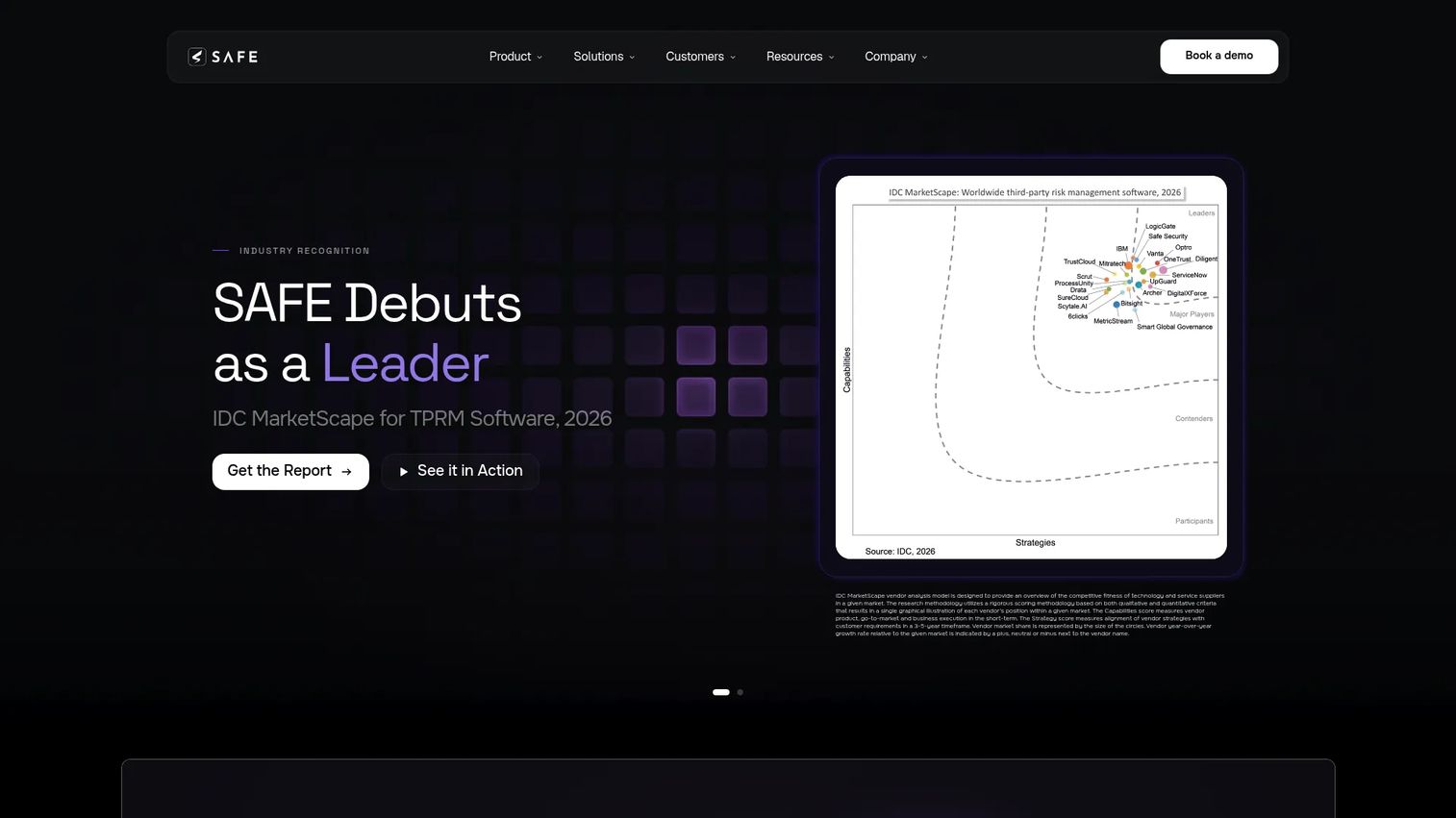
Safe Security is an autonomous cyber risk management platform built around continuous threat exposure management (CTEM) and third-party risk. Its AI co-workers run more than 100 specialized agents that continuously monitor exposure, assess controls, and surface prioritized risk signals. The platform is FAIR-aligned, meaning its financial risk outputs map to the quantitative methodology that security and risk communities recognize as the emerging standard.
Best for: Large enterprise security and risk teams managing exposure, third-party risk, and board reporting with FAIR-aligned quantification.
Key features
- CTEM AI Co-Worker with 100+ specialized AI agents
- TPRM AI Co-Worker for end-to-end third-party risk management
- FAIR-aligned financial risk modeling and scoring
- Continuous control monitoring across the attack surface
- Executive dashboards with exposure-based prioritization
Why choose Safe Security: Choose it when leadership needs continuous, financially quantified visibility rather than point-in-time assessments. For PMs who sit near enterprise readiness decisions, Safe Security's combination of FAIR methodology and AI-driven continuous monitoring reduces the operational cost of keeping risk data current.
Safe Security pricing: Safe Security sells through enterprise contracts; pricing is quote-based and driven by organizational scope, number of entities, modules selected, and API integrations. Contact the vendor for a scoped proposal.
G2 rating: 4.4/5 on G2.
2. Kovrr
Kovrr is a cyber risk quantification and AI governance platform that produces insurance-grade financial loss models. Its scenario engine uses Monte Carlo-style simulations to generate loss distribution curves, materiality assessments, and board-ready outputs. The platform covers both traditional cyber risk quantification and AI risk quantification, mapping AI assets to frameworks including the EU AI Act, NIST AI RMF, and ISO 42001.
Best for: Security and risk leaders who need defensible financial exposure models for board reporting, insurance negotiations, or regulatory disclosure discussions.
Key features
- Monte Carlo-driven cyber loss modeling and scenario analysis
- Insurance analytics and risk-transfer optimization
- Materiality assessment and board-ready reporting outputs
- AI asset discovery and AI risk quantification
- Portfolio-level risk analysis across business units
Why choose Kovrr: Strong fit when stakeholders need models they can explain and challenge. PMs evaluating Kovrr should ask how assumptions, loss distributions, and data inputs are documented, because a model's credibility depends on its auditability, not just its output.
Kovrr pricing: Kovrr uses custom pricing tied to organizational requirements. The vendor states that onboarding and support are included with every subscription tier. Contact Kovrr for a scoped quote.
3. CyberSaint
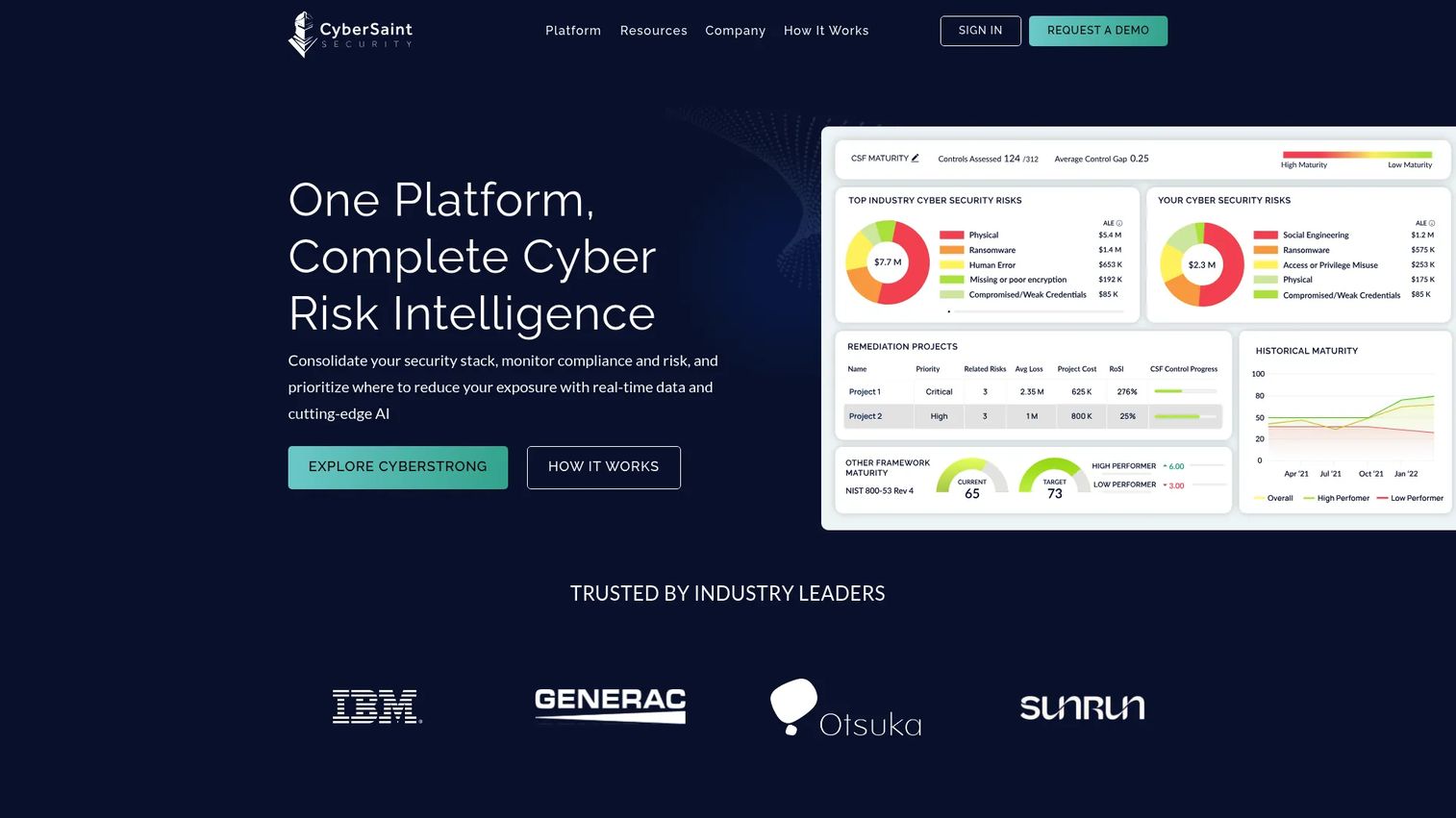
CyberSaint provides CyberStrong, an AI-powered platform that connects compliance automation, control maturity scoring, and cyber risk quantification in one workflow. Teams that already operate through NIST CSF, ISO 27001, or other frameworks can use CyberStrong to crosswalk those assessments into FAIR-based financial risk estimates without rebuilding their data model. The platform includes dynamic risk registers, remediation scenario analysis, and return-on-security-investment (ROSI) calculations.
Best for: Enterprise security and risk teams that want to convert existing framework assessments and control posture data into financially quantified CRQ without starting a separate program.
Key features
- AI-powered findings prioritization and agentic evidence collection
- Automated framework crosswalking across major standards
- Dynamic risk register with FAIR-based cyber risk quantification
- ROSI calculation and remediation scenario analysis
- Executive dashboards and boardroom reporting
Why choose CyberSaint: Choose it when compliance and CRQ need to run from the same data source. The CyberStrong approach reduces duplication between audit-focused work and financial risk modeling, which matters for PMs balancing security investment decisions against engineering opportunity cost.
CyberSaint pricing: CyberSaint offers Compliance Hub, Risk Hub, and Executive Hub packages. Pricing is not publicly displayed and is quote-based, driven by platform modules, organizational scope, and implementation support requirements. Contact the vendor for current pricing.
G2 rating: 4.0/5 on G2 (based on 2 reviews).
4. MetricStream
MetricStream is an enterprise governance, risk, and compliance platform with cyber risk quantification embedded in its broader IT risk and operational risk modules. Its integrated data model connects security findings, compliance status, audit results, and financial risk estimates into a single governance layer. For large organizations that cannot separate cyber risk from enterprise risk management, MetricStream provides a shared operating model for security, compliance, and legal teams.
Best for: Large enterprises that need CRQ connected to GRC, IT risk management, compliance workflows, and enterprise-wide risk visibility.
Key features
- Integrated GRC, IT risk, and compliance data model
- FAIR methodology support for financial risk quantification
- Operational risk linkage and business impact mapping
- Continuous control monitoring and analytics dashboards
- AppStudio for configuration and OpenAPI-compliant integrations
Why choose MetricStream: Best for organizations where cyber risk must share a data model with enterprise risk. For PMs, this matters when product, security, compliance, and legal teams all need a shared view of risk posture and can't afford separate systems producing different numbers.
MetricStream pricing: MetricStream does not display pricing on its website. Contracts are enterprise-scoped and quote-based. Pricing is driven by modules selected, number of users, and implementation scope. Request pricing directly from the vendor.
G2 rating: 3.8/5 on G2 (based on 14 reviews).
5. Tenable One
Tenable One is an exposure management platform that unifies visibility across IT, cloud, web applications, OT/IoT, identity, and AI environments. It is not a pure FAIR-based CRQ platform, but it excels when the quantification question starts from asset and vulnerability data. Tenable One's attack path analysis and risk-based prioritization help security teams answer "which exposures create the most financial risk?" before moving into deeper loss modeling.
Best for: Enterprise security teams that want vulnerability and exposure data as the upstream input for risk-based prioritization and investment decisions.
Key features
- Unified exposure management across IT, cloud, identity, OT, and AI
- Attack path analysis and risk-based prioritization
- Asset inventory, dashboards, and workflow automation
- Cloud exposure signals and third-party data connectors
- Executive reporting across the full attack surface
Why choose Tenable One: Choose it when the primary bottleneck is too many exposures with too little context, not a missing financial model. It performs best as the data foundation for risk quantification rather than as a standalone CRQ platform.
Tenable One pricing: The Vulnerability Management component starts at $3,500 for a one-year subscription covering 100 assets. Web App Scanning starts at $3,578 for 5 FQDNs annually. Foundation and Advanced platform packages are quote-based. Free trials are available for the component products.
G2 rating: 4.5/5 on G2.
6. Axio
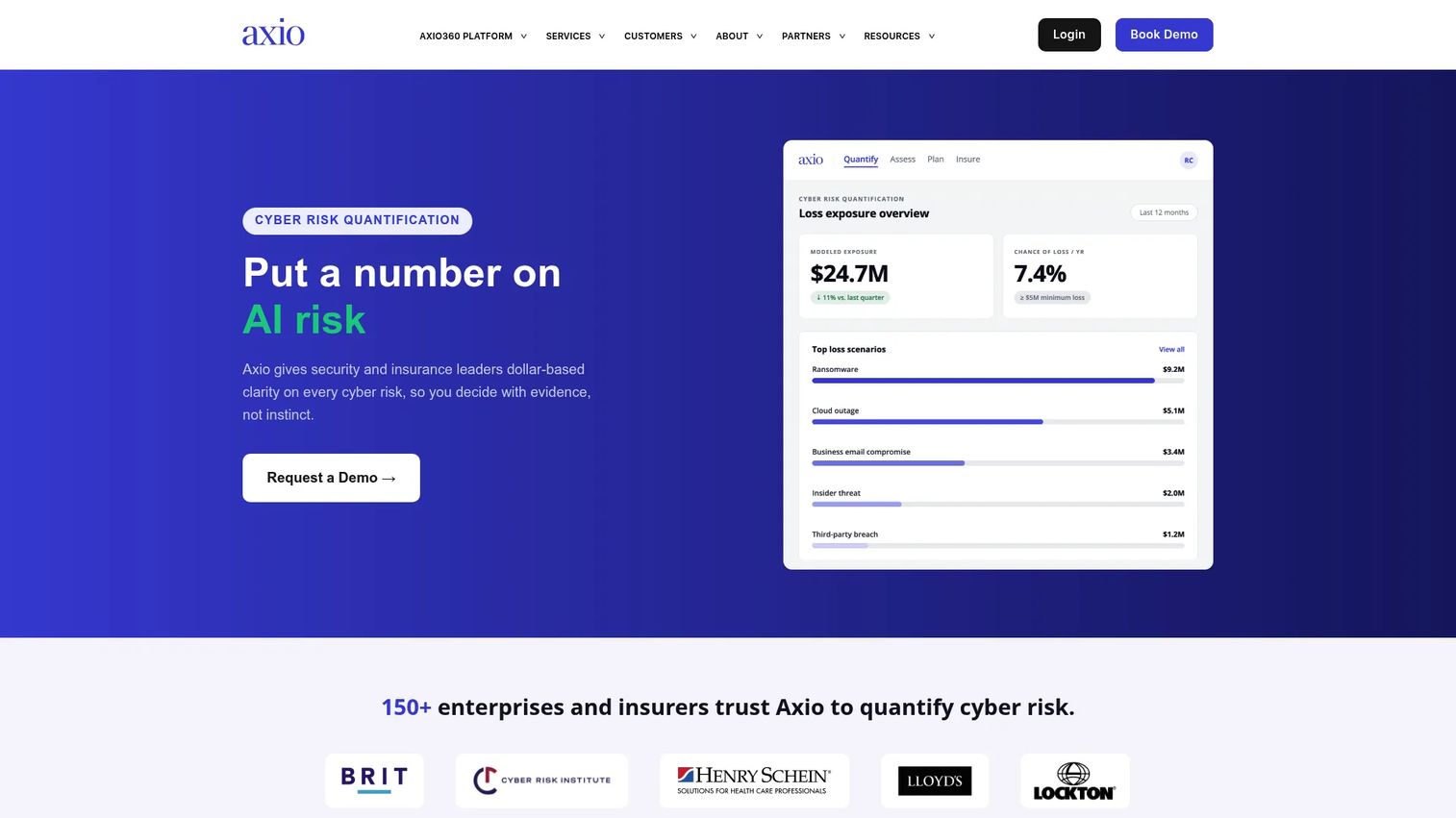
Axio provides Axio360, a cyber risk management platform that connects assessments, financial quantification, insurance readiness, and AI governance in one workflow. Teams use it to run structured cybersecurity assessments against standard or custom frameworks, then translate control gaps into financial exposure estimates. The platform's insurance and risk-transfer analysis module helps organizations understand whether their current coverage aligns with modeled exposure.
Best for: Enterprise security, risk, and insurance teams that need a structured path from assessment to financial risk model to insurance optimization.
Key features
- Cybersecurity assessment across standard or custom frameworks
- Financial exposure quantification expressed in dollar terms
- Cyber insurance and risk-transfer gap analysis
- AI risk governance and exposure quantification
- Centralized roadmap planning and board reporting
Why choose Axio: Strong fit when the organization needs a defensible link between control gaps, risk scenarios, and investment recommendations. PMs should check how Axio maps product or business services to loss scenarios, since that mapping determines how relevant the financial outputs are to roadmap decisions.
Axio pricing: Contracts are enterprise-scoped and quote-based, with pricing driven by assessment scope, modules, users, and support level. Contact the vendor directly.
7. Bitsight
Bitsight provides cyber risk intelligence for managing enterprise exposure, third-party risk, and security posture from an outside-in perspective. Its platform covers external attack surface management, third-party and fourth-party risk visibility, threat intelligence across clear and dark web sources, and vulnerability prioritization through its Dynamic Vulnerability Exploit scoring system. Framework intelligence and compliance mapping connect continuous monitoring outputs to governance requirements.
Best for: Organizations that need centralized cyber risk intelligence across vendors, subsidiaries, or investment portfolios, especially where external posture signals matter as much as internal control data.
Key features
- Continuous security ratings and real-time scoring
- External attack surface management across the organization
- Third-party and fourth-party risk visibility
- Cyber threat intelligence across clear, deep, and dark web
- Vulnerability prioritization with Dynamic Vulnerability Exploit scoring
Why choose Bitsight: Choose it when outside-in risk visibility across vendor ecosystems or portfolio companies is the primary need. It performs best when external cyber posture matters more than internal FAIR-based loss modeling.
Bitsight pricing: Bitsight offers Basic, Standard, Advanced, and specialty intelligence tiers. All tiers are quote-based, with pricing customized by solutions selected, vendor coverage scope, workflow requirements, and integrations. Contact the vendor for a proposal.
G2 rating: 4.5/5 on G2.
8. SecurityScorecard
SecurityScorecard is an AI-native third-party risk management platform built around continuous vendor monitoring, security ratings, and attack surface visibility. It offers a free account that includes a scorecard for your own domain, questionnaire response capability, pre-built dashboards, and basic reporting. Paid TITAN packages extend coverage to broader vendor portfolios and add managed services.
Best for: Procurement, security, and risk teams that need to quantify and track cyber exposure across third-party vendor ecosystems at scale.
Key features
- Continuous vendor risk monitoring and security ratings
- Automated security questionnaires
- Threat intelligence and vulnerability insights
- AI-assisted risk analysis and remediation planning
- Attack surface visibility across your organization's external footprint
Why choose SecurityScorecard: Choose it when practical vendor visibility at scale is the immediate problem. PMs building platform products with many third-party integrations benefit from SecurityScorecard's continuous monitoring, which surfaces inherited risk before it becomes a customer-facing incident.
SecurityScorecard pricing: A free account is available with a scorecard for your own domain, questionnaire response, and basic reporting. Paid TITAN Watch plans (Core, Premium, Elite) require contacting sales. Managed services are separately priced.
G2 rating: 4.3/5 on G2.
9. Black Kite
Black Kite is an AI-native third-party cyber risk management platform that quantifies vendor and supplier risk in business impact terms using Open FAIR. Its Ransomware Susceptibility Index models the likelihood that a given vendor will experience a ransomware event, translating that probability into financial impact estimates for risk transfer discussions. FocusTags surface high-priority risk events across the supply chain in near real time.
Best for: Enterprise security and risk teams where the financial risk conversation centers on supplier, vendor, and supply chain exposure rather than internal infrastructure.
Key features
- Third-party risk quantification using Open FAIR
- Ransomware Susceptibility Index with financial impact estimates
- Nth-party and supply-chain visibility
- AI-powered cyber assessments and continuous monitoring
- Vendor remediation workflows through The Bridge
Why choose Black Kite: Strong fit when the organization's biggest financial risk concentration sits in its supply chain. Outside-in signals differ meaningfully from internal FAIR assessments; Black Kite handles the former well and helps teams decide when to require vendor remediation versus accept risk transfer through insurance.
Black Kite pricing: Black Kite offers Standard and Enterprise tiers. Pricing is quote-based and not publicly displayed; it's driven by vendor count, modules, and reporting depth. Contact the vendor for current pricing.
G2 rating: 5.0/5 on G2 (based on 1 review).
10. UpGuard
UpGuard provides a cyber risk posture management platform covering vendor ecosystems, external attack surfaces, and remediation workflows. It is not a full FAIR-based CRQ platform, but it covers the third-party risk operations layer that feeds upstream quantification work. Teams use it to run security questionnaires, monitor vendor ratings continuously, and manage remediation workflows before losses occur.
Best for: Security and risk teams managing third-party risk operations, vendor onboarding assessments, and external exposure monitoring as inputs to a broader risk quantification program.
Key features
- Vendor security ratings and continuous monitoring
- Attack surface monitoring and typosquatting detection
- Security questionnaires and risk assessments
- Remediation workflows and risk waivers
- Reporting across vendor risk posture
Why choose UpGuard: Choose it when the team needs practical third-party risk operations before investing in deep financial loss modeling. For PMs with many external integrations or partner dependencies, UpGuard's Standard plan offers a concrete starting point with 50 monitored vendors.
UpGuard pricing: The Standard plan monitors 50 vendors at $1,750 per month billed annually. Professional (150 vendors) and Corporate (500 vendors) are quote-based. Enterprise Plus covers unlimited vendors and is also quote-based. A free self-service Vendor Risk plan covers up to 5 vendors, with additional vendors at $30 per month.
G2 rating: 4.5/5 on G2.
11. OneTrust
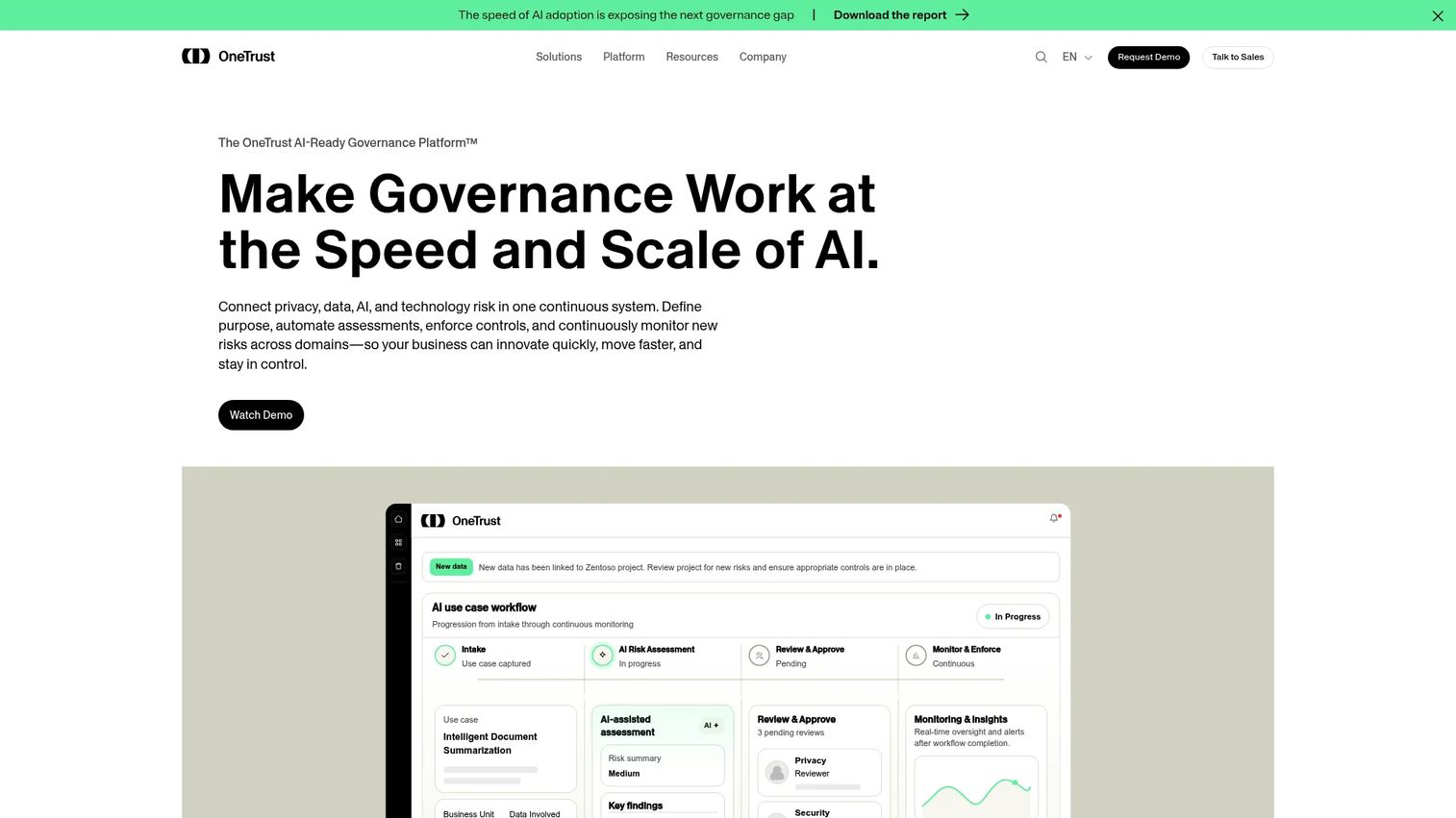
OneTrust is an AI-ready governance platform covering privacy, consent, data use, AI governance, technology risk, compliance, and third-party management. Its relevance to CRQ is broadest when cyber risk quantification is one part of a larger trust and compliance program, particularly in organizations where privacy risk, AI risk, and vendor risk need to connect to the same governance layer. OneTrust's continuous monitoring spans privacy, data, third-party, technology, and AI risk simultaneously.
Best for: Enterprises where cyber risk context must sit inside a broader privacy, AI governance, and compliance program rather than a standalone CRQ tool.
Key features
- AI-driven data discovery and classification across 200+ connectors
- Automated and collaborative risk assessments
- Continuous monitoring across privacy, third-party, technology, and AI risk
- Consent and preference management
- Programmatic policy and control enforcement
Why choose OneTrust: Best for organizations where product data handling, privacy controls, vendor reviews, and customer trust are all connected. For PMs, it matters when security risk is inseparable from privacy and AI governance obligations that affect how the product is built and sold.
OneTrust pricing: OneTrust uses usage-based custom pricing across its modules, including AI Governance, Privacy Automation, Tech Risk and Compliance, and Third-Party Risk Management. Meters include admin users, inventory size, and data volumes. Contact the vendor for a quote.
G2 rating: 4.4/5 on G2.
12. RiskLens
RiskLens is an enterprise cyber risk quantification platform built on the FAIR standard. It quantifies cybersecurity risk in financial terms, producing loss exposure ranges, risk prioritization, and cost-benefit analysis of security investments. RiskLens Pro is described as a managed service that combines software with professional services to deliver FAIR-based analysis. The platform integrates with IRM and GRC systems through APIs to feed quantified risk data into existing governance workflows.
Best for: Organizations standardizing on FAIR as their quantification methodology and looking for a purpose-built platform rather than FAIR support embedded in a broader GRC suite.
Key features
- FAIR-based cyber risk quantification and scenario modeling
- Financial prioritization of cyber risks across the portfolio
- Loss exposure ranges and risk trending over time
- Cost-benefit and risk-reduction ROI analysis
- API integration with IRM/GRC systems
Why choose RiskLens: Choose it when FAIR is a mandate rather than an option and the team wants a platform built around the methodology from the ground up. Teams already running MetricStream or Safe Security should check feature overlap before evaluating RiskLens separately.
RiskLens pricing: RiskLens Pro operates as a managed service. Contact the vendor to understand current packaging and buying path.
Considerations
Modeling methodology
Ask each vendor how their financial outputs are calculated. FAIR, Monte Carlo simulation, actuarial models, exposure scoring, and hybrid approaches produce different outputs for different purposes. The model must be explainable to security, finance, and product stakeholders simultaneously. If your team can't describe how a loss estimate was calculated, it won't survive board scrutiny.
Data quality and integrations
CRQ is only as credible as its inputs. Evaluate how each platform ingests data from vulnerability management, cloud security posture management, identity, CMDB, and threat intelligence sources. Missing or stale instrumentation weakens the financial model. For PMs, this is an engineering opportunity cost question: Who owns the data pipelines, and how often do they break?
Financial output quality
Avoid platforms that reduce risk quantification to a single unexplained score. Strong CRQ outputs show loss ranges, scenario definitions, confidence intervals, and the assumptions driving each estimate. That documentation is what makes the analysis defensible in regulatory disclosures, insurance negotiations, and board conversations.
Executive and board reporting
Boards increasingly need to understand likely loss ranges, materiality thresholds, and the financial impact of control investments. Look for board-ready views that communicate those dimensions clearly without requiring security expertise to interpret. For PMs, this output also shapes how security investment competes with feature work for roadmap budget.
Implementation and maintenance
CRQ programs require ongoing ownership. Scenario assumptions need periodic review, threat data ages quickly, and control effectiveness changes with every new deployment. Build the maintenance cost into your evaluation: Who updates the models, how often, and what triggers a refresh cycle?
Conclusion
The 12 platforms in this guide cover the main patterns in cyber risk quantification: FAIR-aligned continuous monitoring (Safe Security), insurance-grade financial modeling (Kovrr), compliance-integrated quantification (CyberSaint), enterprise GRC with embedded CRQ (MetricStream), exposure-driven prioritization (Tenable One), and third-party financial risk (Black Kite and SecurityScorecard).
For most teams, the right starting point is matching the platform to your data maturity and reporting obligation. If your biggest problem is translating technical exposure data into board-level financial language, start with Safe Security or Kovrr. If compliance posture and CRQ need to run from the same data source, CyberSaint earns a first look. If the risk is concentrated in your vendor ecosystem, Black Kite and UpGuard address different layers of that problem.
Shortlist three platforms, run the same high-value risk scenario through each vendor's demo, and ask how their outputs would hold up against an auditor or an underwriter.
Start your journey with Guideflow today!
FAQs
Cyber risk quantification software converts cyber threat scenarios, control effectiveness data, and business context into dollar-denominated financial estimates. Rather than labeling risks as high, medium, or low, CRQ tools produce loss exposure ranges, event likelihood probabilities, and annual loss expectancy figures that executives and boards can compare against budgets, insurance coverage, and risk appetite.
Qualitative assessments produce priority labels based on expert judgment. CRQ tools produce financial estimates based on models, data inputs, and statistical methods. A qualitative assessment tells you a risk is "high." A quantitative CRQ output tells you that a ransomware event affecting your payment processing system carries an estimated 35% probability of occurring in the next 12 months with a probable loss range of $2 million to $8 million. The financial framing is what makes CRQ useful for budget justification and insurance decisions.
FAIR (Factor Analysis of Information Risk) is a quantitative risk analysis model used to estimate the probable frequency and probable magnitude of loss from cyber risk scenarios. It decomposes risk into measurable components: Threat event frequency, vulnerability, asset value, and loss magnitude. Nearly 45% of organizations use or plan to use FAIR for cyber risk quantification, according to the FAIR Institute (2025). Several platforms in this guide support FAIR natively, including Safe Security, CyberSaint, MetricStream, Black Kite, and RiskLens.
The right choice depends on whether the team prioritizes FAIR methodology, GRC integration, insurance modeling, or exposure management. Safe Security and RiskLens lead on FAIR-based quantification. MetricStream and CyberSaint excel when CRQ must connect to a broader governance program. Kovrr is strongest when financial modeling for insurance and board reporting is the primary output. Tenable One is the starting point when vulnerability and exposure data needs to drive the risk analysis upstream.
It can, and that's one of the most common reasons teams adopt it. CRQ lets you compare the expected loss reduction from a security investment against its cost, giving budget conversations the same financial logic used for any other capital allocation decision. The model's credibility depends on data quality and documented assumptions. Only 13% of cybersecurity professionals currently use CRQ to prioritize risks, per Qualys and Dark Reading (2025), which means most teams are still justifying budgets with qualitative arguments. That gap is an opportunity for teams willing to do the instrumentation work.
CRQ can support governance, reporting, materiality discussions, and risk documentation required by regulations like SEC cybersecurity disclosure rules, DORA, and NIS2. It does not guarantee compliance with any of them. The financial and scenario outputs CRQ generates help teams document how they assess material risk, which is what regulators ask for. Treat CRQ as evidence for a governance program, not as a compliance certification mechanism. Consult legal and regulatory counsel for jurisdiction-specific obligations.
Update the model when major systems, threats, controls, or business processes change. Acquiring a new business unit, deploying a new cloud environment, or experiencing a significant security event are all triggers for a refresh. For mature programs, quarterly or continuous refresh cycles are appropriate. The key operational question is ownership: Without a named person responsible for keeping assumptions current, models go stale and lose credibility faster than the original threat they modeled.
The minimum useful data set includes asset inventories, vulnerability findings, security control assessments, and threat intelligence. More complete instrumentation adds incident history, business service maps showing which systems support which revenue processes, vendor risk data, and financial impact assumptions like revenue at risk per hour of downtime. Incomplete instrumentation produces wider uncertainty ranges in the output, which is honest but can make the results harder to act on. Plan the data infrastructure before choosing the platform.