Your SAP landscape runs finance, supply chain, HR, and customer operations. A security failure here is rarely an isolated IT event. It becomes a delivery delay, an audit finding, or a business continuity problem.
According to SAPinsider (2025), 92% of organizations report their SAP systems are mission-critical or contain highly sensitive data. Yet 68% still rely on manual audits and periodic assessments to detect and monitor threats. That gap between the stakes and the operational reality is exactly where SAP security software earns its place.
The harder truth for product managers and security leaders is this: SAP security is not one category. It is a stack decision across exposure management, threat monitoring, access governance, identity, and operational automation. Buying one platform and assuming it closes every gap is how backlogs grow and audit findings accumulate.
G2 tracks 18 products in the SAP security software category as of October 2026.
This guide cuts through the noise with eight tools that cover distinct jobs, verified pricing models, and current review ratings.
What's inside
This guide is for SAP security leaders, product managers, and GRC teams evaluating an SAP security stack in 2026. Items were chosen based on the following criteria:
- SAP-native coverage: Direct support for S/4HANA, ECC, SAP BTP, and hybrid environments
- Security job breadth: Tools were selected to represent distinct functions: Vulnerability management, threat detection, access governance, identity, and operations monitoring
- Integration depth: Compatibility with SIEM, ITSM, and enterprise security workflows
- Review and pricing transparency: Verified G2 ratings and pricing models
Pricing and G2 ratings reflect verified data as of October 2026. Confirm current figures directly with each vendor before purchasing.
TL;DR
- Best for integrated SAP-native security operations: SecurityBridge Platform covers threat detection, vulnerability management, and compliance in one SAP-focused layer
- Best for SAP application security and exposure prioritization: The Onapsis Platform suits large SAP estates running active migration or cloud programs
- Best for access governance and segregation of duties: Pathlock is the shortlist option when role risk and audit evidence are the immediate gap
- Best for SAP-native controls embedded in SAP operations: Layer Seven Cybersecurity Extension for SAP keeps security checks close to Basis and development workflows
- Best for Microsoft-centric SOC teams: Microsoft Sentinel solutions for SAP Applications routes SAP telemetry into an existing Sentinel environment
- Best for SAP operations monitoring with security checks: Avantra fits teams that need monitoring, automation, and compliance checks together
What is SAP security software?
SAP security software is a group of tools that helps organizations protect SAP applications, identities, configurations, custom code, interfaces, and operational data across on-premises, cloud, and hybrid environments.
The category covers several distinct functions. Understanding which function your team needs first is the most important step in a selection process.
What SAP security software typically covers
- Vulnerability discovery and SAP Security Note prioritization: Identify exposed configurations and track which notes apply to your specific landscape
- Threat monitoring and suspicious-activity detection: Flag anomalous behavior in SAP event logs and route alerts to your SOC
- Access governance, role risk, and segregation of duties: Control who can access critical SAP functions and produce evidence for audit
- Identity lifecycle management and authentication controls: Manage provisioning, single sign-on, and federation across SAP and connected systems
- ABAP and SAP UI5 custom-code assessment: Scan custom development for security vulnerabilities before transport to production
- SAP BTP application and workload security: Extend controls to cloud-native SAP workloads and BTP integrations
- SIEM integration, incident workflows, and audit reporting: Connect SAP telemetry to enterprise detection and response stacks
SAP security software by layer
| Software layer | Primary job | Typical buyer |
|---|---|---|
| SAP vulnerability management | Find and prioritize exposures | SAP security, Basis, security engineering |
| SAP threat detection | Detect suspicious behavior and support response | SOC, incident response, SAP security |
| Access governance | Control access risk and segregation of duties | GRC, IAM, audit, finance systems owners |
| Cloud identity services | Manage authentication and identity lifecycle | IAM, platform, cloud teams |
| SAP operations monitoring | Monitor availability, performance, and security checks | SAP operations, Basis, platform engineering |
| SIEM for SAP | Correlate SAP events with enterprise threats | SOC, security operations |
For a product manager, the relevant question is not which platform has the longest feature list. It is which control gap is creating the most release risk, audit exposure, or engineering overhead right now. Start there.
Pairing your evaluation with broader application security testing software research can help you map SAP-specific tools to your wider security program.
When to use SAP security software
Secure an S/4HANA or RISE with SAP transformation
Migrating to S/4HANA or RISE with SAP reshapes role design, system integrations, and shared responsibility boundaries. Buying decisions made during migration often define the security posture for years. Teams need clear ownership across patching, configuration, identity controls, and detection before go-live, not after.
Reduce a growing backlog of SAP Security Notes
SAP releases Security Notes monthly on Patch Day. The gap between receiving guidance and proving what applies to a specific landscape creates real remediation debt. Dedicated tools help teams assess note relevance, prioritize by risk, track remediation progress, and produce evidence for engineering and change-control workflows.
Bring SAP signals into security operations
SAP application events are frequently missing from SOC workflows. Threat actors who target SAP do so precisely because detection is weak. Integrating SAP telemetry into a SIEM closes that visibility gap, but it requires connector work, detection rules, and clear ownership between SAP teams and the security operations center.
SAP security software comparison
The tools below are ordered by coverage breadth and relevance to enterprise SAP security programs. Pricing across this category is almost universally quote-based, with cost driven by system count, modules in scope, landscape size, and contract terms. Verify figures with each vendor before building a business case.
| # | Product | Best for | Key differentiator | Pricing | G2 rating |
|---|---|---|---|---|---|
| 1 | SecurityBridge Platform | Integrated SAP-native security operations | Threat detection, vulnerability management, and compliance in one SAP-focused platform | Quote-based | 4.6/5 |
| 2 | The Onapsis Platform | SAP application security and exposure management | Continuous vulnerability management with SAP-specific AI guidance | Quote-based | 4.4/5 |
| 3 | Pathlock | Access governance and controls automation | Cross-application SoD analysis with SAP cybersecurity edition pricing | Free edition available; paid from $7,500/year | 4.5/5 |
| 4 | Layer Seven Cybersecurity Extension for SAP | SAP-native controls close to Basis workflows | 1,200+ threat detection patterns, agentless deployment | Quote-based | No current G2 rating |
| 5 | SAP Enterprise Threat Detection | SAP-native event monitoring and SIEM | SAP-focused detection scenarios with on-premises or cloud deployment | SAP contract pricing | No current G2 rating |
| 6 | SAP Cloud Identity Services | SAP cloud and hybrid IAM | Authentication, provisioning, SSO, and federation across SAP landscapes | SAP contract pricing | No current G2 rating |
| 7 | Microsoft Sentinel solutions for SAP Applications | Microsoft-centric SOC operations | Agentless SAP connector with out-of-the-box analytics rules in Sentinel | Azure consumption pricing | No current G2 rating |
| 8 | Avantra | SAP operations monitoring with security checks | Full-stack SAP observability with automation and compliance monitoring | Quote-based (Observability, Automation, Enterprise editions) | 4.6/5 |
Pricing and G2 ratings verified from each vendor's pricing page and G2 listing, October 2026.
Best 8 SAP security software tools for 2026
1. SecurityBridge Platform
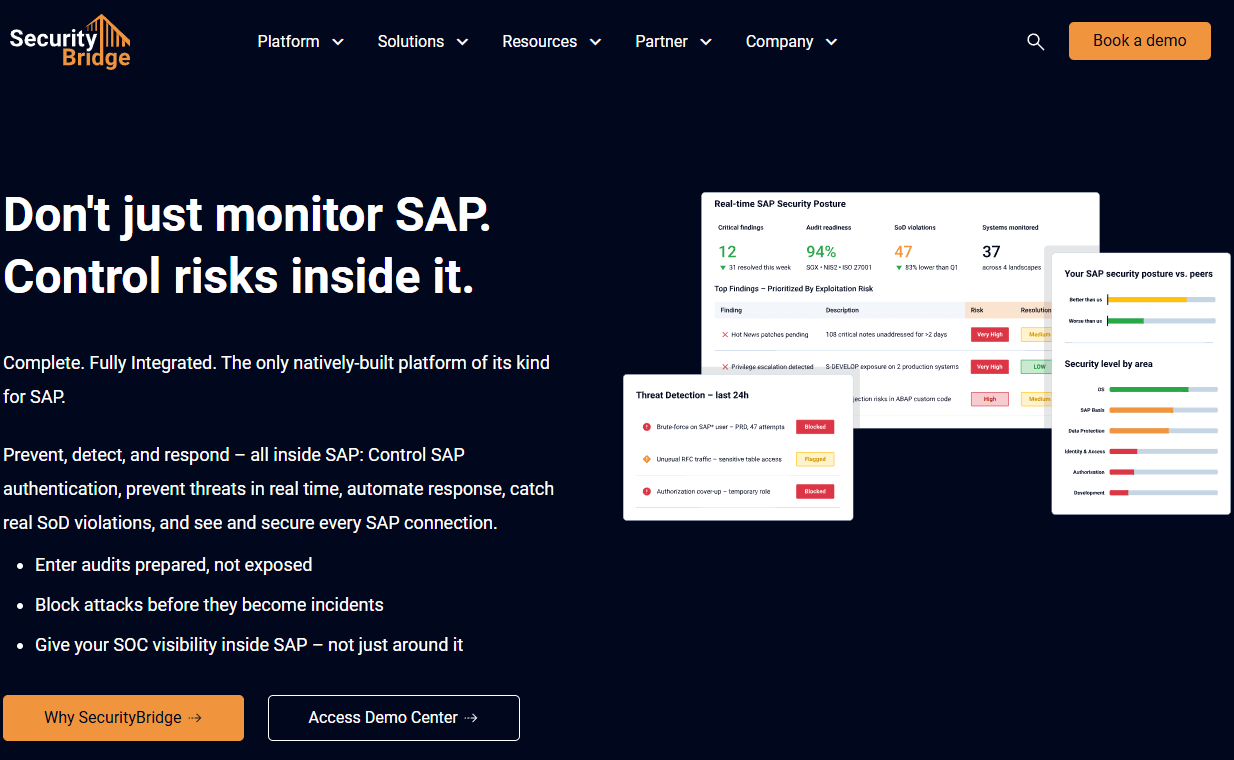
SecurityBridge Platform is an SAP-native cybersecurity and compliance platform that consolidates threat detection, vulnerability management, patch management, code vulnerability analysis, and privileged access management into one layer. It is built specifically for SAP environments, meaning its monitoring context and detection logic are tuned to SAP application behavior rather than generic infrastructure events.
Best for: Organizations that want a single SAP-centered security layer covering detection, exposure visibility, and compliance reporting without stitching together separate tools.
Key features
- Real-time SAP threat detection and security monitoring
- Vulnerability and patch management across SAP landscapes
- Code vulnerability analysis for custom ABAP
- Privileged access management, SSO, and MFA controls
- SIEM and ITSM integrations for SOC workflows
- Compliance automation with security dashboards
Why choose SecurityBridge Platform: It fits teams who need SAP-specific detection context rather than treating SAP logs as generic infrastructure data. For product managers tracking release cadence, the code vulnerability analysis capability means custom ABAP changes can be scanned before reaching production.
SecurityBridge Platform pricing: SecurityBridge uses quote-based annual pricing. The vendor promotes transparent, non-volume-based pricing and directs buyers to request a demo for commercial terms. Contact SecurityBridge directly for a quote.
G2 rating: 4.6/5 (verified October 2026).
2. The Onapsis Platform
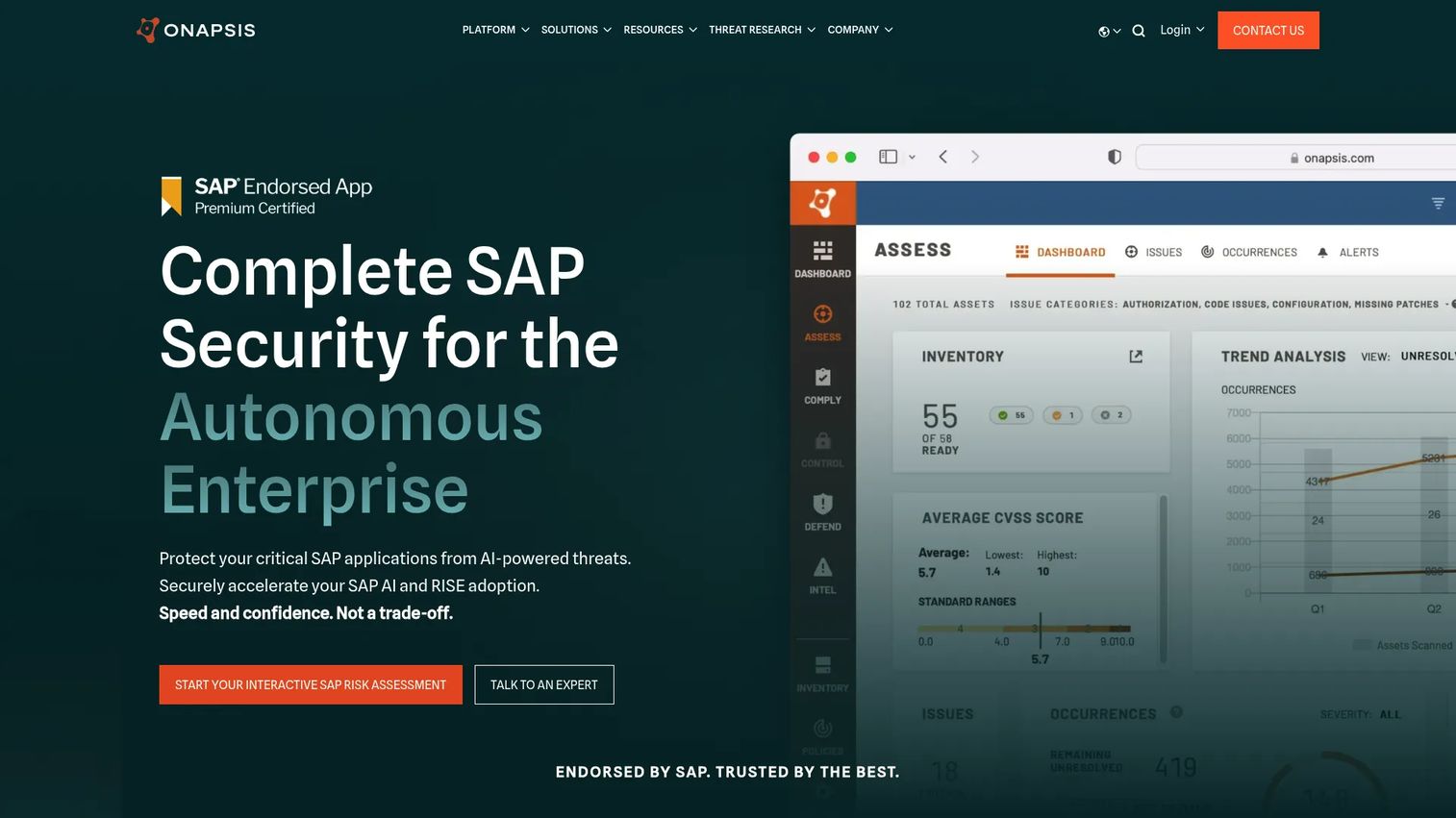
The Onapsis Platform focuses on SAP application security and exposure management. It provides continuous vulnerability management, custom ABAP and SAP BTP code security, automated compliance monitoring, and threat detection, with an AI-powered SAP Security Advisor for prioritization guidance. The platform is designed for large SAP estates where the volume of configurations, custom code, and integrations creates persistent exposure risk.
Best for: Large SAP environments running active S/4HANA, cloud transformation, or RISE with SAP programs that need continuous application-layer visibility.
Key features
- Vulnerability management and risk prioritization across SAP landscapes
- Custom ABAP and SAP BTP code security testing
- Continuous threat detection and response
- Automated compliance monitoring with audit evidence collection
- AI-powered SAP Security Advisor for remediation guidance
Why choose The Onapsis Platform: It fits teams that need to identify security and remediation dependencies before a migration or launch reaches a late gate. The connection between SAP change programs and security control maturity is where this platform earns its place.
The Onapsis Platform pricing: Onapsis directs buyers to sales representatives or authorized systems integrators for pricing. Contact Onapsis for a quote based on landscape scope and deployment model.
G2 rating: 4.4/5 (verified October 2026, from the product review page).
3. Pathlock
Pathlock provides a unified platform for enterprise application access governance, continuous controls monitoring, and SAP cybersecurity application controls. Its access governance capabilities cover segregation of duties analysis, compliant user provisioning, access certifications, elevated access management, and continuous risk monitoring. The cybersecurity edition adds SAP vulnerability management, code scanning, transport control, and threat detection.
Best for: GRC, IAM, and finance systems teams managing role risk, excessive permissions, or audit-readiness requirements across SAP and connected applications.
Key features
- Segregation-of-duties analysis and access risk monitoring
- Compliant user provisioning and lifecycle automation
- User access reviews, certifications, and audit trails
- Role management and entitlement governance
- SAP vulnerability management, code scanning, and threat detection (cybersecurity edition)
Why choose Pathlock: Choose Pathlock when the organization's primary gap is control ownership, excessive permissions, or audit evidence rather than detection. Access governance alone does not replace application vulnerability monitoring, so confirm which capabilities your team needs before selecting an edition.
Pathlock pricing: The SAP Cybersecurity edition has a published free tier with vulnerability management and code scanning. Paid editions start at $7,500 per year (Essential), $15,000 per year (Professional), and $30,000 per year (Advanced). Pricing for broader access governance products is sales-led.
G2 rating: 4.5/5 (verified October 2026, from 12 reviews on the product page).
4. Layer Seven Cybersecurity Extension for SAP
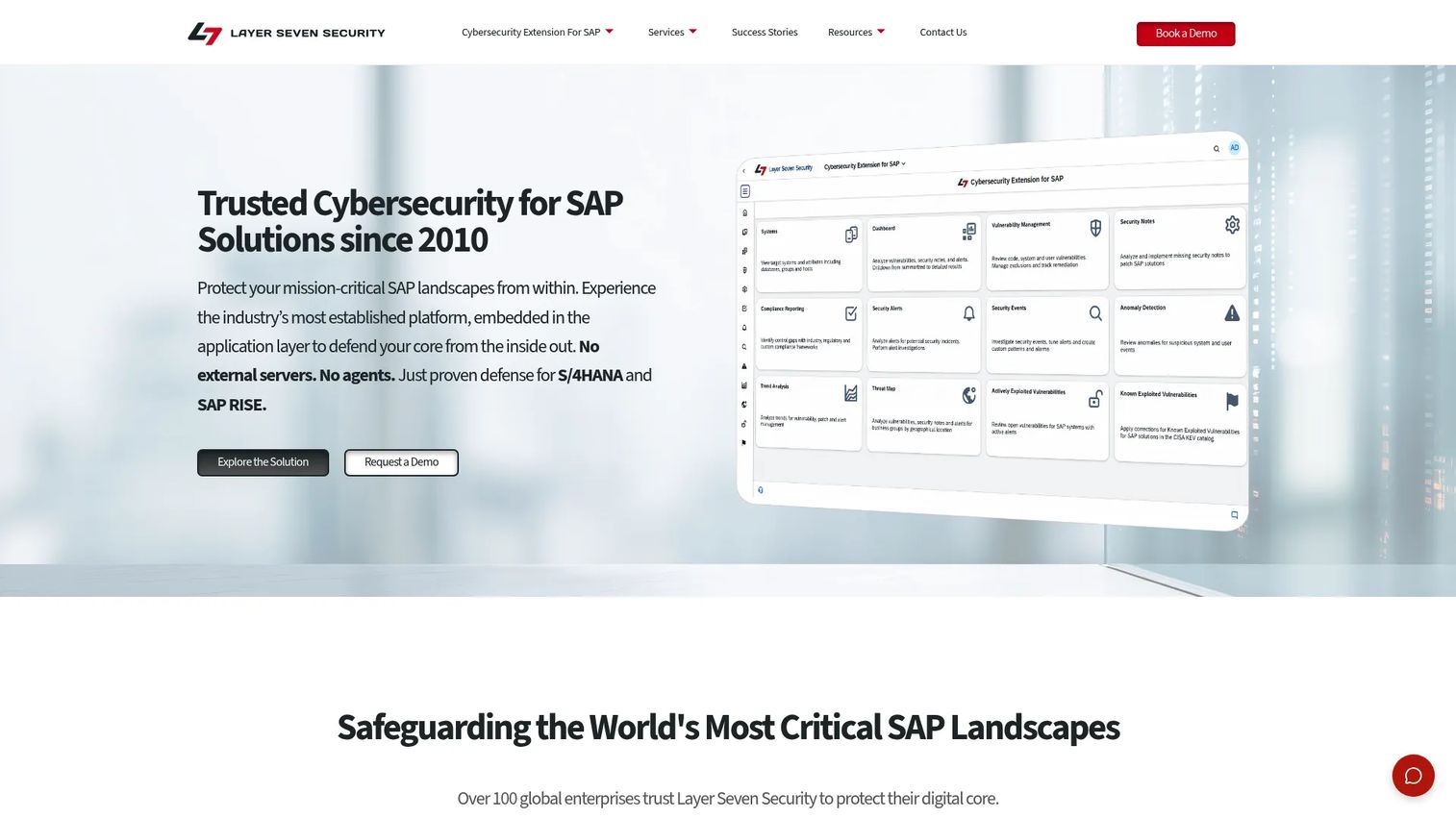
Layer Seven Cybersecurity Extension for SAP is an SAP-certified, agentless cybersecurity platform covering vulnerability management, automated compliance auditing, custom code security, access-risk analysis, and threat detection. It deploys without additional infrastructure and includes over 1,200 threat detection patterns alongside SIEM integrations for Splunk, QRadar, and Sentinel. A 30-day license option supports point-in-time assessments, with annual subscriptions for continuous monitoring.
Best for: SAP teams that want SAP-native security controls embedded close to their Basis and custom development workflows, without introducing additional infrastructure dependencies.
Key features
- Vulnerability and patch management across SAP landscapes
- Automated compliance audits covering GDPR, NIST, SOX, and PCI-DSS
- Custom ABAP and SAP UI5 code security scanning
- Access-control and segregation-of-duties analysis
- Threat detection with 1,200+ detection patterns
- SIEM integrations: Splunk, QRadar, and Sentinel
Why choose Layer Seven Cybersecurity Extension for SAP: It fits teams that want to bring security workflows closer to SAP administration and custom development. For product managers, that means code and configuration changes can be assessed before they become production risk, which reduces late-stage security surprises in release planning.
Layer Seven Cybersecurity Extension for SAP pricing: The vendor offers a 30-day license for one-time assessments and annual subscriptions for continuous monitoring. Contact Layer Seven for a quote.
5. SAP Enterprise Threat Detection
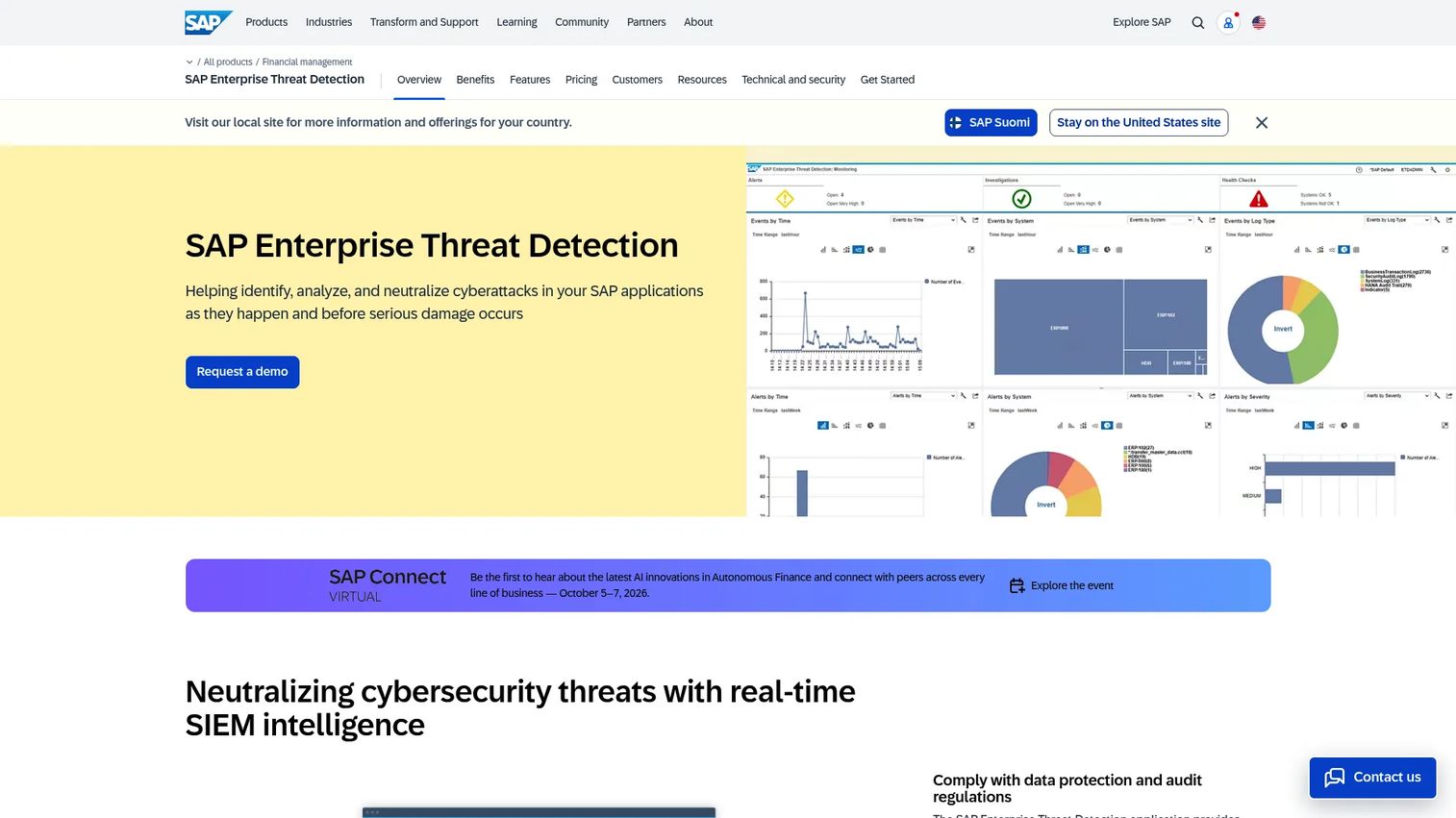
SAP Enterprise Threat Detection is SAP's own SIEM-capable product for monitoring suspicious activity, correlating logs, and supporting security operations across SAP application landscapes. It provides automated threat detection, forensic investigation support, anomaly detection, and integration with third-party systems. Deployment options include on-premises and cloud.
Best for: Organizations that already standardize on SAP security products and want SAP-native detection scenarios aligned with their existing SAP commercial relationships.
Key features
- Log correlation and analysis across SAP systems
- Automated threat detection and risk-based alerting
- Forensic investigations, threat hunting, and anomaly detection
- On-premises or cloud deployment options
- Integration with third-party systems and SAP solutions
Why choose SAP Enterprise Threat Detection: Ecosystem alignment is the primary argument. Where SAP teams want native product support and existing contract coverage, this tool can simplify procurement. Validate SIEM integration requirements and how alert triage fits your SOC operating model before committing.
SAP Enterprise Threat Detection pricing: Pricing is available through SAP directly. Contact SAP for a quote based on deployment model, system count, and support arrangement.
6. SAP Cloud Identity Services
SAP Cloud Identity Services provides identity and access management across SAP and non-SAP systems, covering authentication, single sign-on, identity provisioning, identity directory, and authorization management. It supports OpenID Connect and SAML 2.0, risk-based and multifactor authentication, SCIM 2.0 REST API integration, and policy-based authorization controls across cloud and on-premises environments.
Best for: SAP organizations standardizing identity controls across SAP BTP, cloud applications, and hybrid SAP landscapes where authentication and provisioning are the primary security gap.
Key features
- Authentication and single sign-on via OpenID Connect and SAML 2.0
- Risk-based and multifactor authentication with delegated identity providers
- User and group provisioning across cloud and on-premises systems
- Central identity directory with SCIM 2.0 REST API
- Policy-based authorization management
Why choose SAP Cloud Identity Services: It is a fit when identity architecture is the immediate gap. It will not replace vulnerability management, SAP Security Note operations, or threat detection. That distinction is worth stating explicitly to stakeholders during a buying process.
SAP Cloud Identity Services pricing: Pricing structure and contract details are available through SAP on request. Contact SAP for terms based on your landscape and agreement.
7. Microsoft Sentinel solutions for SAP Applications
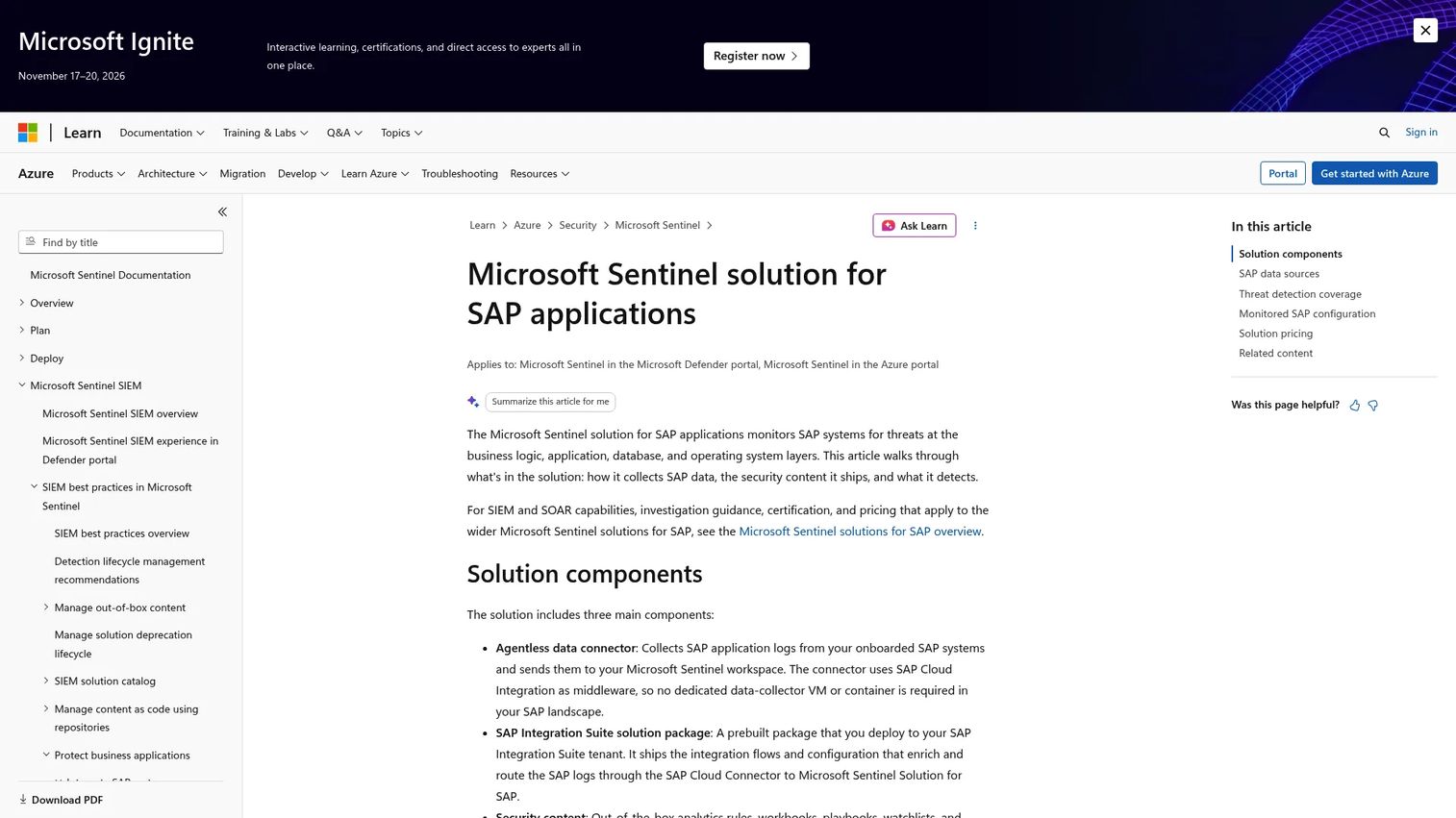
Microsoft Sentinel solutions for SAP Applications brings SAP telemetry into Microsoft Sentinel for analytics, detection, response workflows, and correlation with the broader Microsoft security stack. The solution monitors SAP systems for threats across business logic, application, database, and operating system layers. An agentless SAP data connector using SAP Cloud Integration simplifies deployment, and the solution includes out-of-the-box analytics rules, workbooks, playbooks, watchlists, and functions covering privilege abuse, security-control bypass, data exfiltration, and brute-force patterns.
Best for: Security operations teams already running Microsoft Sentinel that need better visibility into SAP application events as part of a unified detection and response workflow.
Key features
- Agentless SAP data connector using SAP Cloud Integration
- Out-of-the-box analytics rules, workbooks, and playbooks
- Monitoring of SAP Security Audit Logs, change documents, and user master data
- Threat detection for privilege abuse, bypass attempts, and data exfiltration
- Monitoring of sensitive SAP security parameters and system health
Why choose Microsoft Sentinel solutions for SAP Applications: Choose this when the detection and response process already lives in Microsoft Sentinel and the goal is adding SAP visibility without operating a separate tool. It may need complementary SAP-native tooling for vulnerability remediation, access governance, or custom-code assessment.
Microsoft Sentinel solutions for SAP Applications pricing: The solution is free to install. An extra hourly charge applies to connected active production systems. Sentinel ingestion costs vary with the volume of SAP logs processed. Contact Microsoft or review Azure pricing documentation for current rates.
8. Avantra
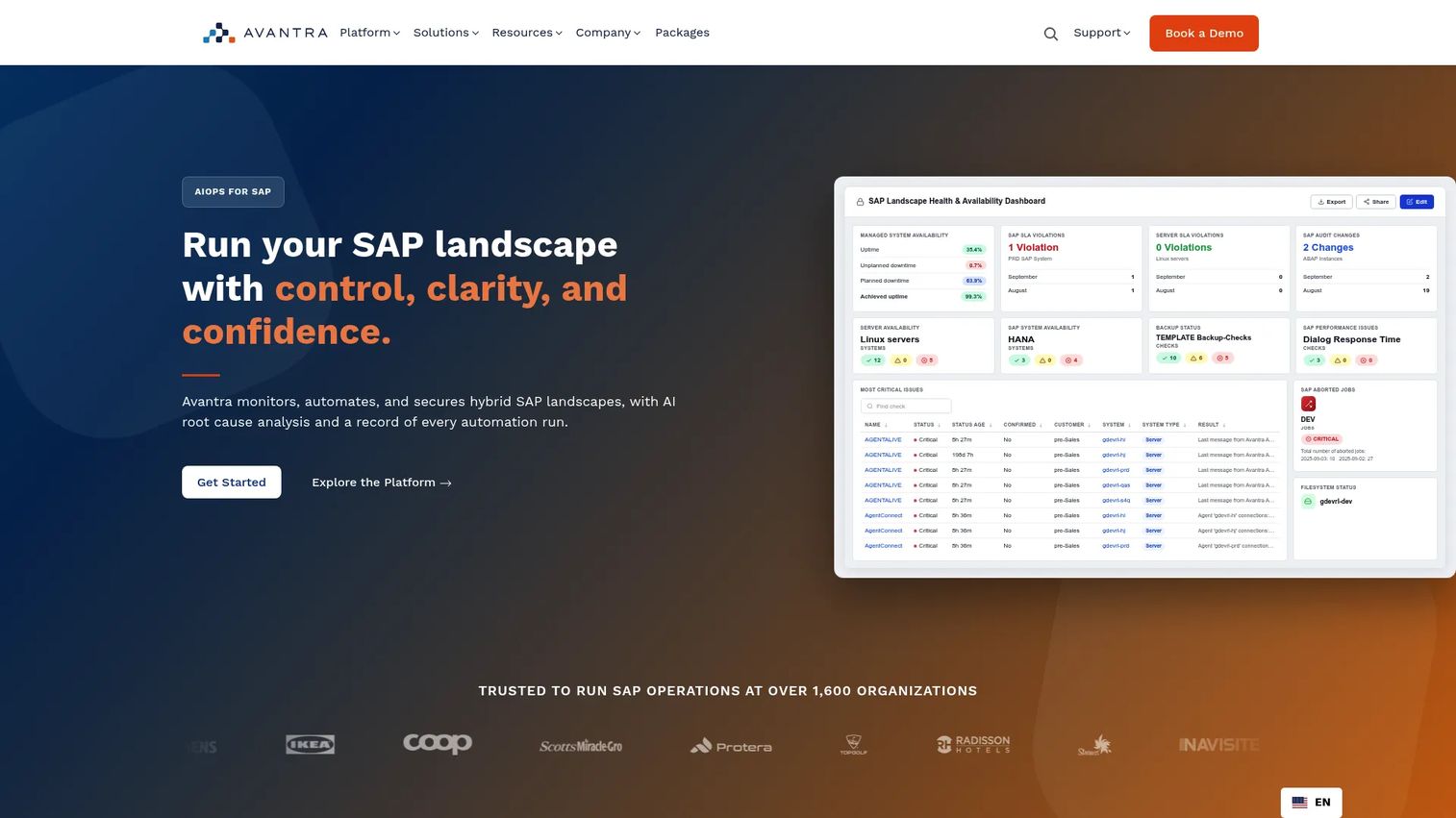
Avantra is an SAP-focused observability, monitoring, automation, and AIOps platform for hybrid SAP landscapes. It provides full-stack SAP observability across servers, databases, SAP systems, cloud services, and third-party APIs. Built-in and custom checks support security and compliance monitoring alongside operational monitoring, and the platform includes workflow automation, ServiceNow integration, predictive analytics, and audit-readiness capabilities.
Best for: SAP operations teams and managed service providers that need monitoring, automation, and selected security checks managed together rather than through separate tools.
Key features
- Full-stack SAP observability across servers, databases, and cloud services
- Built-in and custom security and compliance checks
- Workflow automation with ServiceNow integration
- Predictive analytics and AI-driven root-cause analysis
- Audit-readiness monitoring and reporting
Why choose Avantra: It fits teams where operational monitoring and automation are core requirements, and security checks are an extension of that operational posture rather than a dedicated security program. When security is tied to availability, maintenance, and landscape health, this platform covers both jobs.
Avantra pricing: Avantra offers three editions: Observability, Automation, and Enterprise. Platform add-ons are priced as a percentage of the existing edition subscription. All editions are quote-based. Contact Avantra for current terms.
G2 rating: 4.6/5 (verified October 2026).
Considerations when choosing SAP security software
Match the product to the security job
A threat detection platform, access governance suite, and vulnerability management platform solve different problems. Start with the control gap that is creating risk now. Buying the broadest suite without a clear primary job often means paying for capabilities that go unconfigured.
Map ownership before buying
Identify who owns monitoring, remediation, role design, custom-code review, and audit evidence before shortlisting tools. A product without an operating owner becomes another dashboard. For product managers, this means confirming which team carries the remediation handoff when a high-risk finding appears.
Validate SAP landscape coverage
Check support for ECC, S/4HANA, SAP BTP, RISE with SAP, cloud connectors, custom ABAP, and connected non-SAP systems. Coverage can vary significantly across deployment models. Assumptions made during procurement often surface as gaps during implementation.
Check telemetry and workflow integrations
Verify SIEM, ITSM, ticketing, GRC, IAM, and cloud integration requirements. Ask how a high-risk finding turns into a tracked engineering, Basis, or security task. If that workflow requires manual handoff, the security signal will not reliably reach the right team.
Model implementation and maintenance cost
Pricing often depends on system count, modules in scope, data volume, or enterprise contract terms. Include internal staffing time, implementation partner cost, and ongoing tuning in the business case. A low entry price that requires significant configuration work is not a low total cost.
Pairing this evaluation with your broader compliance management software and access review software assessments can surface overlapping capabilities and help rationalize your stack before purchase.
Conclusion
SAP security software is a category where the shortlist question is always "which job first?" not "which platform covers everything?"
SecurityBridge Platform suits teams seeking SAP-native detection, vulnerability management, and compliance coverage in one product. The Onapsis Platform fits SAP application security and exposure prioritization programs, particularly during active cloud or migration programs. Pathlock is the access governance option for teams managing role risk and segregation of duties, with verified published pricing for its cybersecurity edition. Layer Seven Cybersecurity Extension for SAP brings SAP-native controls closer to SAP operations and custom development. SAP Enterprise Threat Detection fits SAP-aligned monitoring needs within existing SAP commercial relationships. SAP Cloud Identity Services addresses authentication and identity lifecycle gaps in hybrid SAP environments. Microsoft Sentinel solutions for SAP Applications work for teams whose detection and response workflow already runs in Sentinel. Avantra fits operations teams that need monitoring, automation, and security checks together.
Start with a landscape inventory. Identify the control gap generating the most immediate risk. Then run a structured proof of value against two or three shortlist tools before committing.
For a broader view of your security posture tooling, see our roundups on application security testing software, cloud compliance tools, and AI security posture management tools.
Start your journey with Guideflow today!
FAQs
SAP security software is a group of tools that helps organizations protect SAP applications, identities, configurations, custom code, interfaces, and operational data. The category includes distinct functions: Vulnerability management, threat detection, access governance, identity lifecycle management, and operations monitoring. No single platform owns all of those jobs equally.
SAP GRC software focuses on access risk, segregation of duties, controls, audit processes, and compliance evidence. SAP security software is broader and can include threat detection, vulnerability management, application security, identity controls, and monitoring. Many enterprises need both, and several platforms in this list combine GRC capabilities with dedicated security controls.
The right tool depends on whether you need SAP Security Note prioritization, configuration assessment, custom-code analysis, or remediation workflow integration. Platforms like SecurityBridge and Onapsis cover continuous vulnerability management as a core capability. Layer Seven and Pathlock's cybersecurity edition also include vulnerability and code-scanning functions. Compare based on your current landscape and remediation workflow, not feature volume.
SAP-native tools detect SAP-specific risks with context that generic SIEM rules cannot match. A SIEM correlates those events with signals from the rest of your environment and supports broader incident response workflows. Many enterprises use both because the jobs are complementary rather than overlapping. Microsoft Sentinel solutions for SAP Applications is built specifically for teams who want that correlation inside an existing Sentinel deployment.
Software can help customers monitor configurations, identities, vulnerabilities, and application-layer activity within RISE with SAP environments. Operational responsibilities for the underlying infrastructure are shared between SAP and the customer under the RISE agreement. Confirm the specific ownership boundary for patching, monitoring, and incident response in your SAP contract before assuming any tool closes that gap automatically.
Yes. Platforms such as SecurityBridge, Onapsis, and Layer Seven assess which Security Notes apply to a specific landscape, help prioritize remediation by risk level, and track completion. The underlying patch process still requires ownership, transport management, and change control. The tool provides the prioritization and evidence; the team provides the execution.
Focus on release cadence impact, custom-code exposure visibility, integration dependencies between the product and SAP systems, remediation handoff clarity, audit evidence quality, and the operational cost of maintaining controls across SAP releases. Measurable workflows matter more than feature volume. Ask specifically how a finding from the security tool reaches an engineering or Basis task, and who owns that handoff.
No. SAP Cloud Identity Services manages authentication, identity provisioning, single sign-on, and federation. Access governance software adds role-risk analysis, segregation of duties controls, access certification workflows, and control evidence for audit. The two address different layers of identity security and are typically deployed together rather than as substitutes. Pathlock is an example of a platform that covers the access governance layer with a separate SAP IAM integration path.