You do not replace a payer core because the UI looks dated. You replace it because claims exceptions pile up faster than your operations team can clear them, enrollment changes take three sprints instead of one afternoon, and every new carrier integration becomes its own custom project.
The expensive mistake is buying a platform built for the wrong operating bottleneck.
"Health insurance software" covers radically different jobs. A core administration suite, a benefits enrollment platform, a reimbursement product, an underwriting engine, and an open-source health financing framework should not be evaluated with the same checklist. Buying the wrong category creates implementation debt that compounds for years.
The global healthcare insurance software market was valued at $10.27 billion in 2025 and is projected to reach $18.5 billion by 2035, according to Wise Guy Reports (2026). The market is growing because payers are finally replacing brittle legacy stacks, not because the category is fashionable. This guide helps you find the platform that owns your actual bottleneck.
What's inside
This guide is for insurers, benefits administrators, payer technology teams, and founders entering the health insurance market. Eight platforms are reviewed and sorted by operating model fit.
Selection criteria:
- Workflow ownership: Which specific operational layer does the platform own?
- Integration readiness: APIs, EDI, FHIR, and compatibility with existing systems
- Operating model fit: Commercial payer, employer benefits, public health program, or point-solution layer
- Implementation realism: Deployment scope, migration complexity, and configuration versus custom development
TL;DR
- Best for end-to-end payer modernization: Majesco covers policy, billing, claims, and digital operations across insurance lines
- Best for healthcare payer core administration: HealthEdge focuses on health plan claims, payment integrity, and care management
- Best for employer benefits administration: Benefitfocus handles enrollment, carrier connectivity, and benefits data at scale
- Best open-source option for health financing programs: OpenIMIS fits public-sector and NGO programs that need local configuration control
- Best for pricing, rating, and underwriting intelligence: Earnix improves decisioning without requiring a full core replacement
- Best for configurable insurance workflows: Decerto suits carriers that need flexible policy and claims configuration across markets
- Best for digital reimbursement experiences: Hi.health targets the member-facing claims and reimbursement journey
- Best for Nordic and European payer modernization: Tietoevry combines regional market expertise with technology delivery
What is health insurance software?
Health insurance software is a category of platforms that helps payers, benefits administrators, insurers, and public health programs manage policy, enrollment, eligibility, claims, billing, reimbursements, pricing, and member or provider operations.
Core functions health insurance software can cover
Coverage varies significantly across platforms. The major operational areas include:
- Policy and benefit configuration
- Enrollment, eligibility, and membership management
- Claims intake, review, adjudication, and payment
- Premium billing, contributions, and accounting
- Underwriting, quoting, pricing, and risk decisioning
- Provider, employer, broker, and member portals
- EDI, APIs, FHIR, and third-party data exchange
- Reporting, fraud detection, workflow automation, and audit support
The main platform types
Understanding which type you need is the whole decision:
- Core administration suites: Broad systems managing policy, claims, billing, and servicing end to end
- Benefits and enrollment platforms: Centered on employers, brokers, employee enrollment, and benefits administration
- Claims and reimbursement platforms: Focused systems for digital claims, member reimbursements, and payment workflows
- Pricing and underwriting platforms: Systems improving rating, quoting, decisioning, and portfolio performance
- Open-source implementation frameworks: Configurable systems for public health financing and social protection programs
What health insurance software is not
A CRM alone does not replace claims or policy administration. A member portal alone does not replace a core platform. Custom development may extend a platform, but it adds operating and maintenance responsibility that most teams underestimate at the procurement stage.
| Platform type | Primary job |
|---|---|
| Core administration suite | Policy, claims, billing, servicing |
| Benefits and enrollment platform | Employer groups, brokers, employee enrollment |
| Claims and reimbursement platform | Digital claims, member payments |
| Pricing and underwriting platform | Rating, decisioning, portfolio performance |
| Open-source framework | Public health financing, local configuration |
When to use health insurance software
Replace disconnected claims, policy, and billing workflows
Manual exceptions consume your operations team when claims and payment systems cannot reconcile cleanly. New products require engineering work to configure, and a legacy core blocks partner integrations. A core administration platform fits when the bottleneck spans multiple functions simultaneously, not just one workflow layer.
Scale enrollment and benefits administration
Employer groups, brokers, and members need self-service enrollment, and eligibility changes require manual handling when systems do not connect. Benefits data fragmented across HR, carrier, and payroll systems creates reconciliation work that scales poorly. A dedicated benefits enrollment software layer is the right answer here, not a full payer core replacement.
Modernize pricing, underwriting, or reimbursement without a full core replacement
The existing core may remain operational while pricing decisions run too slowly or reimbursement workflows create poor member experiences. A carrier can achieve measurable improvement in one operational layer first. A point platform is the right decision when a full core replacement creates more migration risk than the improvement justifies.
Health insurance software comparison
The eight platforms below are sorted by fit breadth, from full-stack core administration to focused point capabilities. Use the table to shortlist by your primary workflow gap, then read the relevant entries for operating model detail.
| # | Product | Best for | Key differentiator | Pricing | G2 rating |
|---|---|---|---|---|---|
| 1 | Majesco | Insurers modernizing policy, billing, and claims across multiple lines | Integrated core suite covering health, life, annuity, and group insurance | Contact sales | 3.0/5 |
| 2 | HealthEdge | Health plans needing payer core administration and claims | Payer-focused suite spanning core administration, payment integrity, and care management | Contact sales | 4.3/5 |
| 3 | Benefitfocus | Employers, brokers, and benefits administrators | Benefits administration and enrollment infrastructure with carrier connectivity | Contact sales | 4.2/5 |
| 4 | OpenIMIS | Public health financing and social protection programs | Open-source platform with beneficiary management, claims, and FHIR support | Free (open-source) | N/A |
| 5 | Earnix | Insurers improving pricing, rating, and underwriting | AI-driven pricing and decision intelligence for insurance carriers | Contact sales | N/A |
| 6 | Decerto | Insurers needing configurable policy, claims, and distribution workflows | Modular, low-code/no-code insurance platform with configurable processes | Contact sales | 4.5/5 |
| 7 | Hi.health | Digital reimbursement and member claims experiences | Payment cards and direct-payment workflows for cashless healthcare | Contact sales | N/A |
| 8 | Tietoevry | Nordic and European insurers modernizing core operations | Industry-specific technology and managed modernization delivery | Contact sales | N/A |
Pricing and ratings verified October 2026 from each vendor's official website and G2 listing.
Best 8 health insurance software platforms for 2026
1. Majesco
Majesco provides cloud-based insurance software for property and casualty, life, annuity, health, and related insurance operations. Its platform addresses the full insurance core: Policy administration, billing, claims, digital engagement, analytics, and AI capabilities. Carriers evaluating a multi-year modernization program find Majesco relevant when the existing stack fragments across multiple lines of business.
Best for: Established health insurers pursuing a long-term core modernization program across multiple product lines.
Key features
- Policy administration modules for health, life, annuity, and group
- Claims workflow automation and adjudication support
- Billing, payment operations, and premium management
- Digital enrollment and customer experience layers
- Embedded GenAI, Agentic AI, and Copilot analytics capabilities
Why choose Majesco: Majesco fits buyers who need a single platform to consolidate multiple insurance lines rather than point tools for each. It may be more than necessary for a startup seeking a narrowly defined reimbursement or rating capability.
Majesco pricing: Majesco directs all prospects to request a quote directly. Expect pricing to reflect implementation services, data migration scope, integration work, and environment configuration alongside any license component.
G2 rating: 3.0/5 based on 11 reviews (G2, verified October 2026).
2. HealthEdge
HealthEdge provides an integrated, AI-powered technology platform built specifically for health plans. Its core product, HealthRules Edge, handles cloud-native claims administration. The platform also covers payment integrity, care management through GuidingCare, member engagement, and provider data management. This is a category-specific platform built for health plan operating models, not a general insurance suite.
Best for: Health plans and payer organizations where medical claims processing and payer workflows are the central operational concern.
Key features
- Cloud-native claims administration through HealthRules Edge
- Payment integrity and prospective payment accuracy tools
- Care management and automated care planning via GuidingCare
- Provider data management
- AI-based business intelligence and workflow automation
Why choose HealthEdge: HealthEdge is the stronger fit when the business model centers squarely on health plan administration. Buyers should assess interoperability requirements, available implementation partners, and data migration support before committing, as health plan cores carry substantial transition complexity.
HealthEdge pricing: No pricing page is available. Engagement begins through a direct sales conversation, and contract terms reflect the scope of modules deployed, covered lives, and implementation services required.
G2 rating: 4.3/5 (G2, verified October 2026).
3. Benefitfocus
Benefitfocus provides cloud-based benefits administration software for employers, health plans, brokers, and employees. Its platform covers benefits enrollment, employee engagement, carrier connectivity, billing, payroll integration, compliance reporting, and claims-based analytics. The important distinction: Benefitfocus operates where administration begins with employer groups and benefits teams, not where it begins with the payer core.
Best for: Large employers and health plans managing employer-sponsored benefits enrollment and administration at scale.
Key features
- Benefits enrollment workflows and employee engagement tools
- Employer and broker administration portals
- Carrier connectivity and data exchange
- AI-driven decision support and health care data analytics
- Billing, payroll, compliance, and reporting integration
Why choose Benefitfocus: It fits benefits operations where enrollment accuracy and carrier coordination determine customer experience. Buyers whose primary bottleneck is claims adjudication or insurance underwriting will find Benefitfocus addresses a different part of the stack.
Benefitfocus pricing: Pricing is quote-based. When requesting a proposal, ask specifically about employer group volumes, carrier connection counts, implementation service scope, and the ongoing support model. Those four variables drive the contract value.
G2 rating: 4.2/5 based on 30 reviews (G2, verified October 2026).
4. OpenIMIS
OpenIMIS is free, open-source software for managing health financing and social protection programs. Its modules cover beneficiary management, membership and enrollment, provider management, claims processing, payments, and FHIR-based integration with healthcare systems. Country-specific implementations exist across several markets where national health financing programs require configurable, locally governed infrastructure.
Best for: Government agencies, health insurance funds, NGOs, and implementation partners administering health financing or social protection programs that need deep local configuration control.
Key features
- Beneficiary management and registration
- Membership, enrollment, and contribution tracking
- Provider management and network administration
- Claims processing and payment workflows
- FHIR-based integration with healthcare data systems
Why choose OpenIMIS: Use this when local program requirements, implementation control, and open-source adaptability matter more than a packaged commercial deployment. The software itself carries no license cost, but budget realistically for implementation ownership, technical expertise, hosting, and long-term governance. Those costs are real and can exceed what a smaller commercial platform would charge.
OpenIMIS pricing: The software is free to download, use, modify, and redistribute. Implementation, hosting, configuration, support, and local delivery costs vary by program scope and geography. Treat this as infrastructure with implementation services attached, not a zero-cost deployment.
5. Earnix
Earnix provides AI-driven pricing, rating, underwriting, analytics, and customer engagement capabilities for insurance carriers and banks. Its platform includes a dynamic pricing engine, an enterprise rating engine with real-time rate deployment, and automated underwriting with rules management, machine learning simulation, and governed deployment. Earnix typically complements an existing policy administration core rather than replacing it.
Best for: Insurance carriers that need to improve pricing precision, rating speed, and underwriting decisions while retaining their existing core platform.
Key features
- Dynamic pricing and pricing optimization engine
- Enterprise rating engine with real-time deployment
- Automated underwriting with ML simulation and governance
- Decision analytics and product configuration
- Model governance and explainable decisioning
Why choose Earnix: Choose Earnix when commercial performance depends on faster product pricing and more controlled underwriting decisions. It is not a substitute for an end-to-end claims and enrollment system, but for carriers where the rating and decisioning layer is the bottleneck, it targets that problem directly.
Earnix pricing: Earnix sells through direct enterprise sales. Pricing reflects the modules deployed, lines of business covered, and implementation scope. Request a scoping call to understand whether pricing is structured by transaction volume, users, or product configuration complexity.
6. Decerto
Decerto provides configurable insurance software and technology for carriers, MGAs, brokers, and TPAs. Its platform includes an insurance agent portal for quoting, binding, servicing, renewals, commissions, and claims management software, a low-code/no-code product configurator, and AI-assisted underwriting and document analysis. Decerto is designed for insurers that need configuration flexibility without commissioning every workflow from scratch.
Best for: Insurance carriers, MGAs, and TPAs that need configurable policy, claims, and distribution workflows across changing products or markets.
Key features
- Insurance agent portal: Quoting, binding, servicing, and renewals
- Low-code/no-code insurance product configurator with business rules
- Claims and underwriting AI for document analysis and risk assessment
- Digital sales journeys and distribution workflows
- Integration architecture for external systems and data sources
Why choose Decerto: This platform fits when workflow flexibility is the operating requirement. Buyers should confirm which modules are production-ready for their specific health insurance line and geography before signing. Decerto's strength is configuration breadth, not health-plan-specific depth.
Decerto pricing: Decerto directs all prospects to contact its sales team. Pricing reflects the number of users, features selected, and integration requirements. Ask specifically about module-level pricing and local delivery support for cross-market deployments.
G2 rating: 4.5/5 based on 11 reviews (G2, verified October 2026).
7. Hi.health
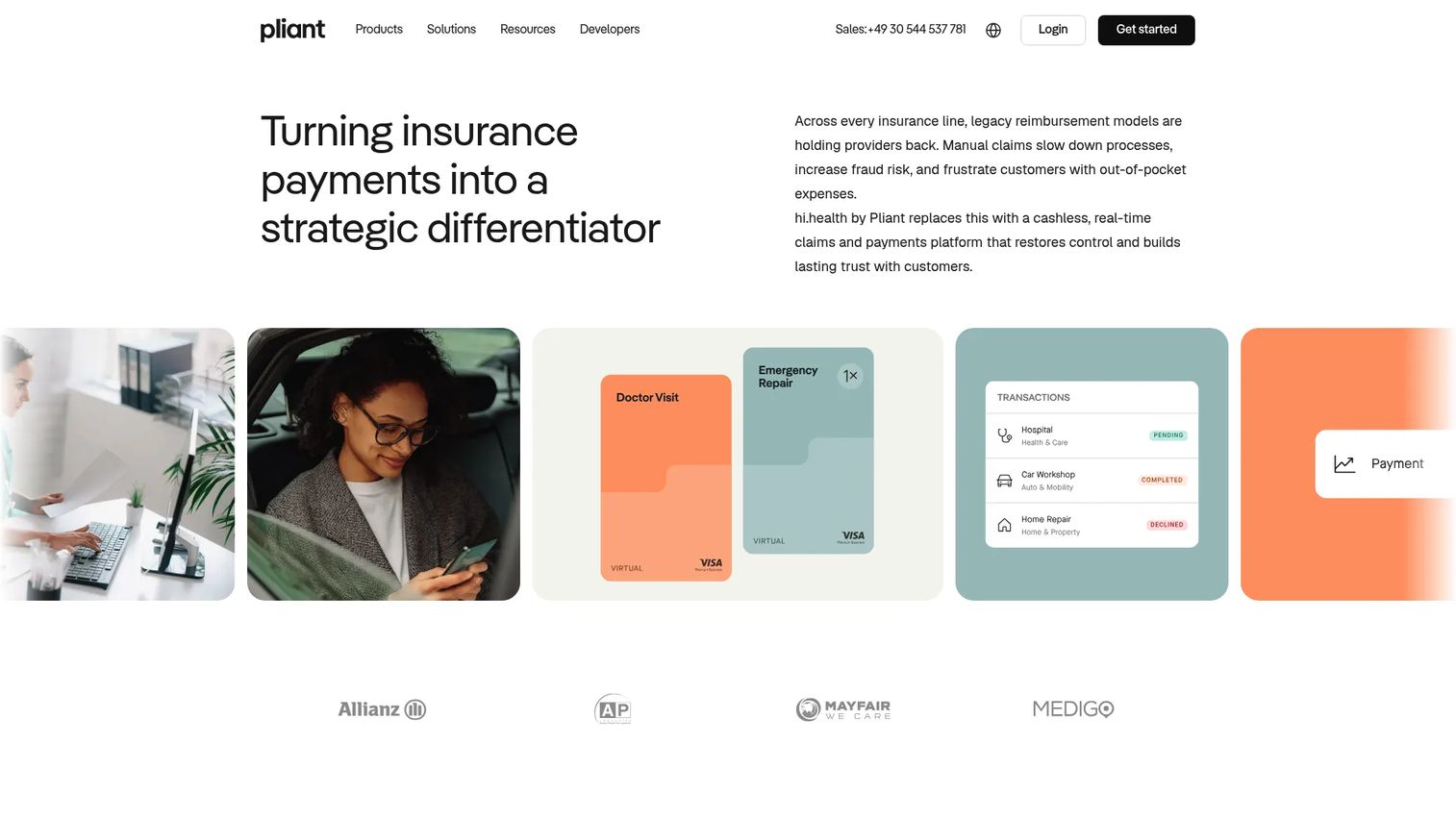
Hi.health provides insurance payment cards and direct-payment tools that simplify healthcare claims and reimbursements. Its product includes physical and digital healthcare payment cards, direct payments, receipt capture, automatic expense categorization, cost-share and deductible handling, Apple Pay support, and insurer integration for claims adjudication software automation. The focus is the member-facing payment and reimbursement experience, not the full insurer operating stack.
Best for: Health insurers, benefits programs, and partners seeking a modern digital claims and reimbursement layer without replacing every back-office system.
Key features
- Physical and digital healthcare payment cards
- Direct payments and reimbursement support
- Receipt capture and automatic expense categorization
- Cost-share, deductible handling, and Apple Pay support
- Insurer integration and claims automation workflows
Why choose Hi.health: It is a focused option when improving the member-facing reimbursement journey is the specific goal. A full core replacement requires broader policy, billing, and claims administration coverage that Hi.health does not provide.
Hi.health pricing: No pricing page is accessible. Pricing likely reflects covered lives, claims volume, or active users. Contact Hi.health directly to understand the commercial model and integration requirements before scoping a deployment.
8. Tietoevry
Tietoevry provides enterprise technology services and industry-specific software for digital transformation. Its capabilities include data and AI-driven business transformation, cloud and infrastructure services, cybersecurity, digital workplace, and industry software for banking, healthcare, public administration, and related sectors. For insurance buyers, Tietoevry's relevance is strongest where regional delivery expertise and managed modernization capacity matter more than a packaged SaaS product.
Best for: Nordic and European insurers that need regional domain expertise and managed implementation capacity alongside insurance technology modernization.
Key features
- Industry software for banking, healthcare, and public administration
- Core modernization support and managed technology delivery
- Data and AI-driven business transformation services
- Cloud and infrastructure services
- Regional market expertise across Nordic and European markets
Why choose Tietoevry: It fits organizations where regional market requirements, local delivery capacity, and implementation support are major buying criteria. Global buyers should validate geographic coverage and health insurance module depth before scoping an engagement, as Tietoevry's depth varies by market.
Tietoevry pricing: All engagements are quote-based. Request clarity on platform licensing, managed services, implementation staffing, and country-level support before comparing contract values.
Considerations when choosing health insurance software
Match the platform to the operating bottleneck
Do not buy a full core suite to fix a reimbursement experience. Do not buy a rating engine when claims operations create the real operational cost. Require every vendor to map their product coverage to the workflow you need to change first, before the demo ends.
Treat data migration as part of the product decision
Migration risk can outweigh feature differences entirely. Ask which data must move, which historical records remain accessible post-migration, and how the platform handles policy, claims, provider, and member data during transition. Vendors who cannot answer that question in the sales cycle will not answer it well in implementation.
Verify interoperability before the demo ends
Ask about APIs, EDI, FHIR compatibility, data exports, identity federation, provider system connections, payment rails, and employer or broker feeds. A well-designed workflow means little if the platform cannot connect to the systems that make it operational. Interoperability gaps become custom development projects.
Separate configuration from custom development
A configurable business rule is cheaper to maintain than a custom code branch. Ask the vendor to demonstrate which common product changes a business operations team can make independently, and which changes require professional services or engineering work. The answer shapes your ongoing operating cost.
Price the full operating model, not just the license
Enterprise software costs include implementation, data migration, integration build-out, environment management, support tiers, and internal change management. Get those cost drivers itemized before comparing contract values. Two platforms with similar license costs can diverge by an order of magnitude in total deployment cost.
Conclusion
The right health insurance software is the platform that owns your most expensive operational bottleneck without forcing an unnecessary core replacement.
Majesco fits insurers pursuing multi-year core modernization across multiple lines. HealthEdge is the stronger choice when health plan claims and payer administration are the central concern. Benefitfocus addresses employer benefits enrollment and carrier coordination. OpenIMIS suits public health financing programs that need open-source flexibility and local governance. Earnix improves pricing and underwriting decisions without requiring a full system migration. Decerto provides configurable policy and claims workflows for carriers operating across changing products or geographies. Hi.health modernizes the member-facing reimbursement experience. Tietoevry delivers regional implementation expertise alongside technology modernization for Nordic and European markets.
Start by mapping the workflow that creates the highest operational cost today. Then shortlist only the platforms that own that workflow, integrate with the systems you will keep, and can demonstrate a credible migration path.
Start your journey with Guideflow today!
FAQs
The right platform depends on whether claims capability is needed inside a full payer core, as a focused point layer, or as a member-facing reimbursement experience. HealthEdge and Majesco address claims within a broader payer administration context. Hi.health targets the digital reimbursement side of claims for members. Confirm which layer your current stack is missing before shortlisting.
Policy administration software is one component within the broader category. Healthcare insurance software may also include eligibility management, benefits enrollment, claims adjudication, premium billing, provider workflows, portals, underwriting engines, analytics, and interoperability capabilities. A policy administration module alone does not replace a full insurer operating stack.
Yes, but coverage differs significantly by platform type. Benefits-oriented platforms like Benefitfocus emphasize employer, employee, and broker enrollment workflows. Full payer core systems may manage eligibility alongside policy, claims, and billing operations. The enrollment architecture you need depends on whether administration begins with the employer group or the health plan.
Many payer platforms support claims intake, review, rules-based adjudication, and payment. Buyers must verify benefit configuration depth, provider network requirements, exception handling, payment integrity tools, and integration with existing claims ecosystems. Not all platforms that market claims capabilities handle adjudication at the same depth. Confirm with a working demonstration before committing.
Open-source platforms like OpenIMIS fit public health financing and social protection programs that need deep local configuration. They require an implementation partner or substantial internal technical capacity, plus ongoing hosting, governance, and long-term maintenance ownership. The software license is free, but the operational cost of running open-source infrastructure in a regulated health program is real and should be budgeted explicitly.
Enterprise vendors structure pricing around modules, covered lives, user counts, transaction volume, geography, implementation scope, and support tier. None of the eight platforms in this guide publish a standard price list. Budget for implementation services, data migration, integration work, and environment management alongside any license component. Those additional costs often exceed the license itself.
Build only when your product's differentiation depends on proprietary workflows that no commercial platform can configure. For claims, enrollment, billing, and policy administration, established platforms reduce time to market and carry regulatory and interoperability groundwork that custom builds must recreate. Most early-stage insurance startups underestimate the ongoing maintenance burden of a custom core. Evaluate platforms that can be configured to your model before commissioning a build.
The integration requirements depend on your operating model, but commonly include APIs for external systems, EDI for claims and eligibility transactions, FHIR for healthcare data exchange, provider and member portals, payment platform connections, CRM, analytics and data warehouse feeds, identity management, document handling, employer payroll feeds, and broker systems. Validate each connection against your existing stack during the evaluation process, not after contract signature.