


A caregiver misses a clock-in. The visit still happened, but now the EVV record is broken. Three days later that visit gets flagged, the claim holds, and your biller is chasing a fix that should have never existed.
This is what running home care on disconnected systems looks like. Scheduling lives in one tool. Visit verification lives in another. Documentation sits in a third. Billing waits on all of them. Every handoff between those systems is a place where a visit slips, a note goes missing, or a claim stalls.
The stakes keep rising. The global home care software market is projected to grow from USD 7.28 billion in 2025 to USD 19.5 billion by 2032, a 15.1% CAGR, according to Data Insights Market (2025). More agencies are buying software because manual coordination stops scaling the moment caregiver count and payer complexity climb.
The real question is not "what is the category?" It is which platform keeps scheduling, EVV, documentation, and billing aligned without your back office falling a week behind care delivery.
What's inside
This guide is for home care agency owners, administrators, and operations leaders comparing platforms that run agency operations end to end. It covers home care software solutions built for scheduling, compliance, and back-office coordination in one home care management system.
We selected the seven platforms below based on:
- Operational breadth: scheduling, EVV, documentation, and billing in one system
- Compliance depth: visit verification, audit readiness, and payer support
- Agency fit: usefulness across small, mid-size, and multi-office agencies
- Verified detail: real features and current G2 ratings, not marketing claims
No single tool wins every category. The goal is to help you shortlist two platforms that fit your agency model.
TL;DR
- Best for deepest all-in-one operations: Alora Health, with EVV, documentation, billing, and offline charting in one home healthcare software platform.
- Best for healthcare-at-home breadth: Axxess, spanning home health, home care, hospice, and palliative workflows.
- Best for EVV-first compliance operations: Caretap, focused on visit verification, scheduling, and automated billing.
- Best for software-plus-services scale: WellSky, pairing home health and hospice workflows with analytics and services.
- Best for usability and day-to-day control: AxisCare, with scheduling, EVV, and client and family portals.
- Best for modern care management: AlayaCare, with a strong care worker mobile app and clinical documentation.
- Best for complex integrated care delivery: Homecare Homebase, an EHR built for clinical, operational, and financial workflows.
What is home care management software
Home care management software is a platform that runs the operational, clinical, and financial workflows of a home care agency in one system, from scheduling and visit verification through documentation, billing, and reporting.
Most home care agency software covers these core capabilities:
- Scheduling and visit management: recurring visits, shift coverage, caregiver matching, and last-minute changes
- EVV and visit verification: GPS, telephony, and mobile check-in that meets state and payer rules
- Documentation, charting, and care plans: point-of-care notes, plan-of-care tracking, and offline entry
- Billing, claims, and revenue cycle: eligibility checks, pre-billing QA, claims submission, and payments
- Caregiver management and credential tracking: licenses, certifications, and expiration alerts
- Mobile access and communication: a caregiver mobile app for schedules, notes, and clock-in
- Reporting and dashboards: analytics on visits, revenue, compliance, and utilization
The difference between home care software and generic scheduling tools is the connection between these functions. When EVV feeds documentation and documentation feeds billing, a single visit moves through the system without manual re-entry. That connection is what separates a home care management system from a stack of point tools stitched together.
When to use home care management software
Reduce scheduling chaos across caregivers and clients
Manual scheduling breaks down fast. One spreadsheet works for 15 clients and five caregivers. It does not work when you are matching 80 clients to 40 caregivers across recurring visits, coverage gaps, and preference constraints. Home care scheduling software handles recurring patterns, flags open shifts, and reshuffles coverage when a caregiver calls out, without your coordinator rebuilding the week by hand.
Keep EVV and documentation aligned
Compliance pressure is where disconnected tools become risky. If your EVV system does not talk to your charting, you get visits verified but undocumented, or documented but unverified. Either gap is an audit problem. A connected platform captures the check-in, the plan-of-care note, and the visit record together, so audit readiness is a byproduct of daily work rather than a scramble before a review.
Tighten billing and revenue cycle operations
When claims lag or denials climb, cash flow suffers. The fix is catching problems before submission. Home care billing software with pre-billing QA checks eligibility, flags missing documentation, and validates payer requirements before a claim goes out. That is the difference between a clean first-pass claim and a denial you rework three weeks later.
Comparison table
The seven platforms below are ranked by relevance to full home care management workflows, leading with the deepest all-in-one operations and moving through platforms with specific strengths in breadth, EVV, services, usability, care management, and complex care delivery. Pricing across this category is quote-based, so ranges depend on agency size, client volume, and payer mix.
| # | Product | Best for | Key differentiator | Pricing | G2 rating |
|---|---|---|---|---|---|
| 1 | Alora Health | All-in-one operations | Cloud EMR with EVV, billing, and offline documentation | Quote-based | 4.5/5 |
| 2 | Axxess | Healthcare-at-home breadth | Home health, home care, hospice, and palliative in one platform | Quote-based | 3.8/5 |
| 3 | Caretap | EVV-first compliance | EVV, scheduling, and automated billing and payroll | Quote-based | Not rated |
| 4 | WellSky | Software plus services | AI-powered analytics with home health and hospice services | Quote-based | 4.2/5 |
| 5 | AxisCare | Usability and control | Scheduling, EVV, and client and family portals | Quote-based | 4.7/5 |
| 6 | AlayaCare | Modern care management | Care worker mobile app with clinical documentation | Quote-based | 4.0/5 |
| 7 | Homecare Homebase | Complex care delivery | Integrated EHR for clinical, operational, and financial workflows | Quote-based | 3.7/5 |
Best home care management software for 2026
1. Alora Health
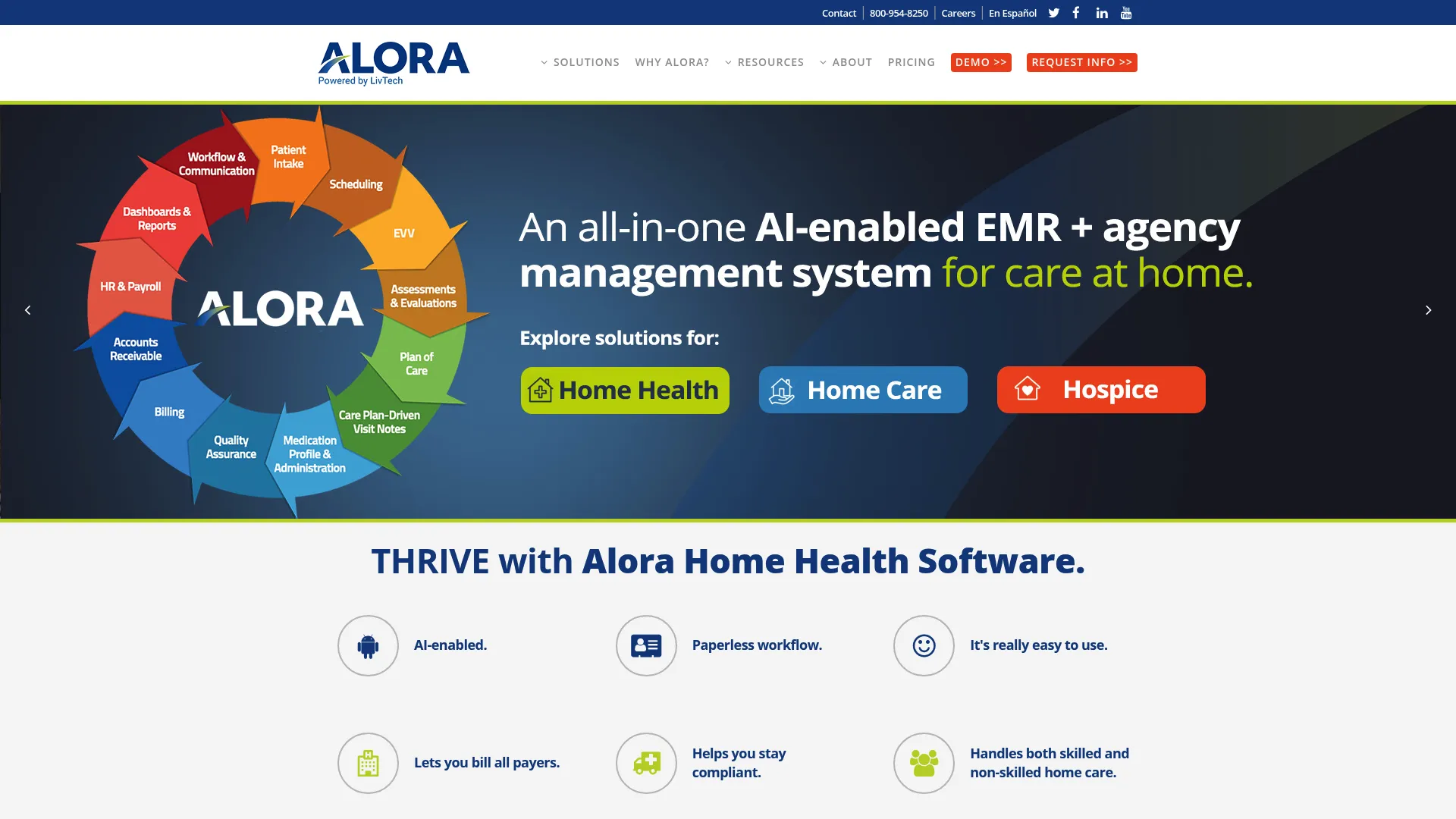
Alora Health is a cloud-based home health EMR built for home health, home care, and hospice agencies that want operations, EVV, documentation, and billing in one system. It is the deepest all-in-one option on this list for agencies that would otherwise stitch together separate scheduling, charting, and billing tools. The platform runs the full workflow from intake to claim inside a single cloud environment.
Best for: Home health agencies that need an all-in-one EMR with billing, EVV, and documentation in one place.
Key strengths
- Cloud-based EMR and workflow management
- EVV with offline documentation
- Billing for major payer types
Why choose Alora Health: If your back office is losing time re-entering the same visit across three tools, Alora consolidates that into one record. The offline documentation matters for caregivers working in areas with spotty connectivity, where notes still need to be captured at the point of care.
Alora Health pricing: Pricing is not publicly listed and depends on agency size. Alora asks prospects to request a quote or demo, and its own FAQ describes expectation ranges that scale with agency size rather than published plan pricing.
2. Axxess
Axxess is cloud-based healthcare-at-home software and services covering home health, home care, hospice, and palliative care in one platform. It suits organizations that deliver more than one line of care and want a single system across all of them. The breadth is the point: intake, scheduling, documentation, and billing follow the same workflow whether the client is home health or personal care.
Best for: Healthcare-at-home organizations needing an integrated EMR, scheduling, billing, and compliance platform.
Key strengths
- Intake and scheduling
- Mobile point-of-care documentation and visit verification
- Claims management and billing
Why choose Axxess: Multi-line agencies pay a tax when hospice runs on one system and home care runs on another. Axxess removes that split. The mobile point-of-care documentation keeps field caregivers charting in real time, which feeds cleaner claims downstream.
Axxess pricing: Axxess does not publish numeric pricing. The site routes prospects to contact and demo requests, so pricing is quote-based by organization.
3. Caretap
Caretap is home care operations software focused on EVV, scheduling, billing, and compliance. It fits agencies that want visit verification at the center of their operations, with billing and payroll automated off the back of verified visits. The paperless documentation and mobile app round out a compliance-first workflow.
Best for: Home care agencies needing an all-in-one compliance and operations platform.
Key strengths
- Electronic visit verification (EVV)
- Scheduling and real-time alerts
- Automated billing and payroll
Why choose Caretap: When EVV is your biggest compliance exposure, a platform that treats verification as the foundation reduces the gap between a visit happening and a visit being provably documented. Automated billing and payroll off verified visits cuts the manual reconciliation that usually eats coordinator time.
Caretap pricing: Caretap's pricing page shows a request form and no public price, so pricing is quote-based per agency.
4. WellSky
WellSky is a healthcare technology and services provider for home-based care, hospice, and related post-acute settings. It is built for organizations that want software plus services, not just a tool they run alone. The analytics and predictive insights are the differentiator, giving larger agencies visibility into patterns across their operations.
Best for: Home health, hospice, and post-acute organizations needing software plus services.
Key strengths
- AI-powered software, analytics, and services
- Home health and hospice workflow support
- Predictive insights and compliance offerings
Why choose WellSky: If your agency has outgrown running everything internally, WellSky's services layer gives you support alongside the software. The predictive analytics suit organizations large enough to act on trend data across dozens of clinicians and hundreds of visits.
WellSky pricing: Public pricing for core software is not listed on WellSky's pages, which direct visitors to request a demo or contact sales. Pricing is quote-based.
5. AxisCare
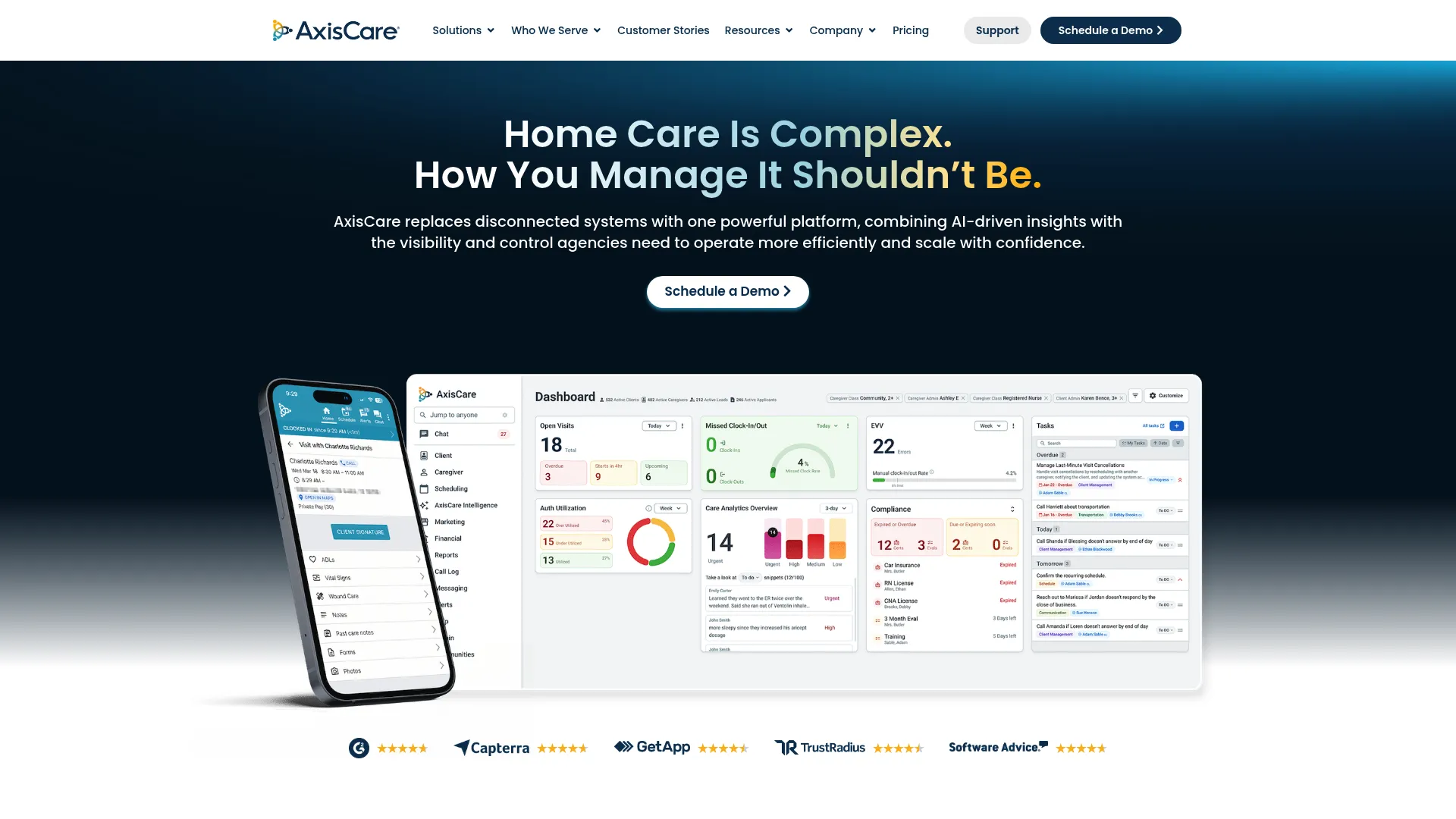
AxisCare is home care software for agencies, covering scheduling, billing, EVV, portals, and related operations tools. It leans toward day-to-day usability and operational control, with client and family portals that keep everyone informed without adding coordinator workload. AxisCare carries the highest G2 rating on this list at 4.7/5.
Best for: Home care agencies needing an all-in-one operations platform with strong usability.
Key strengths
- Scheduling
- Electronic visit verification (EVV)
- Client and family portals
Why choose AxisCare: The client and family portals are the standout. When families can see schedules and updates directly, your coordinators stop fielding status calls, and that time goes back into coverage and coordination. The high review rating reflects agencies that value practical, everyday control over the schedule.
AxisCare pricing: Pricing is customized by agency size and number of clients. The pricing page shows four size-based segments, from small to enterprise agencies, and asks visitors to request a quote.
6. AlayaCare
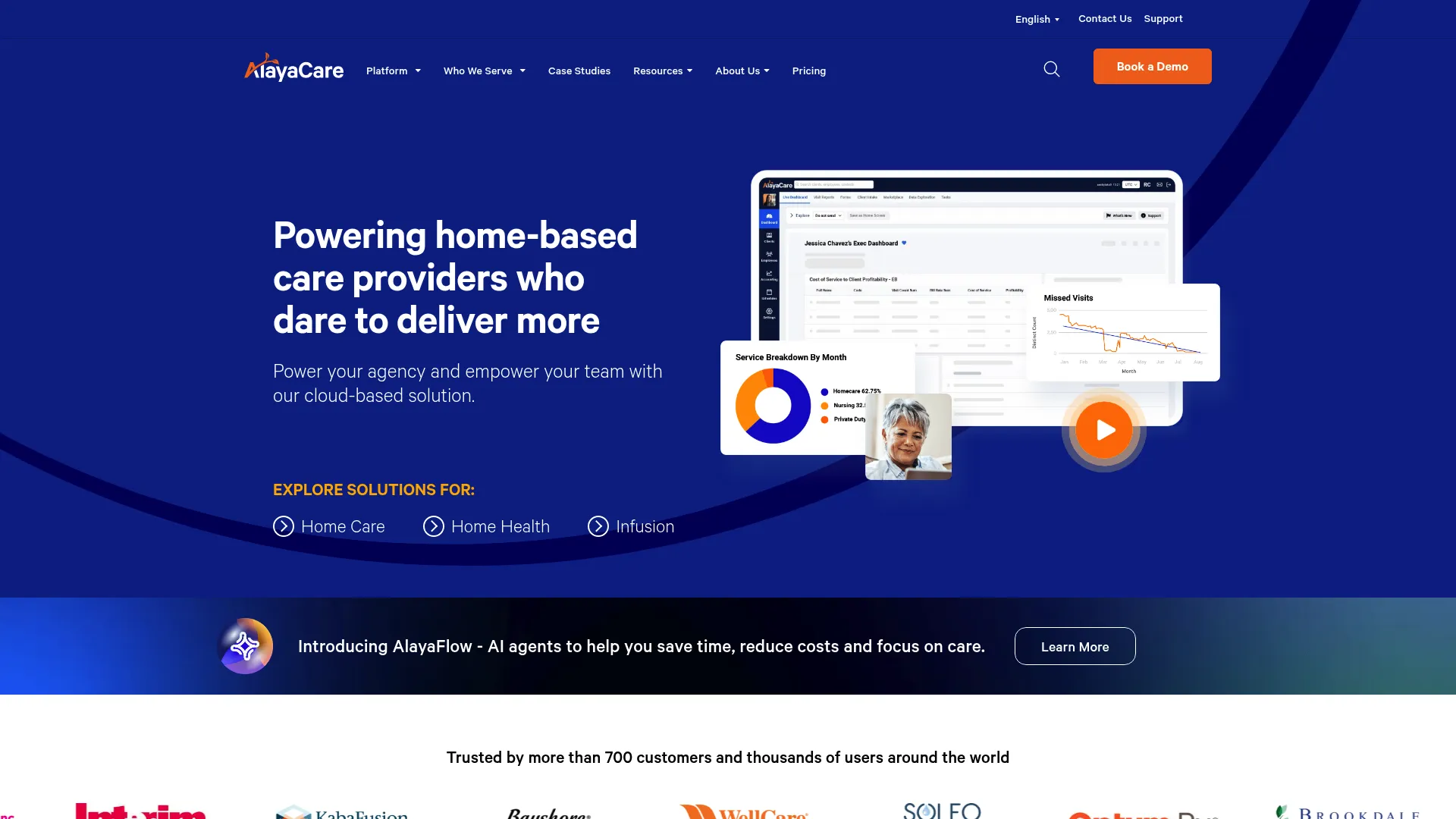
AlayaCare is cloud-based home and community care software built for agencies that want end-to-end operations with modern care management. Its care worker mobile app and clinical documentation depth make it a fit for agencies where field workflow and clinical charting carry equal weight. Medication management and scheduling coordination round out the platform.
Best for: Home-based care agencies needing an end-to-end operational platform with strong care management.
Key strengths
- Scheduling and coordination
- Care worker mobile app
- Clinical documentation and medication management
Why choose AlayaCare: The care worker mobile app is built for caregivers who spend their day in the field, not at a desk. Agencies that need clinical documentation and medication management alongside scheduling get both in one platform rather than bolting on a separate clinical tool.
AlayaCare pricing: Pricing is quote-based and depends on monthly hours of service, tiered by that volume. The site does not list numeric pricing.
7. Homecare Homebase
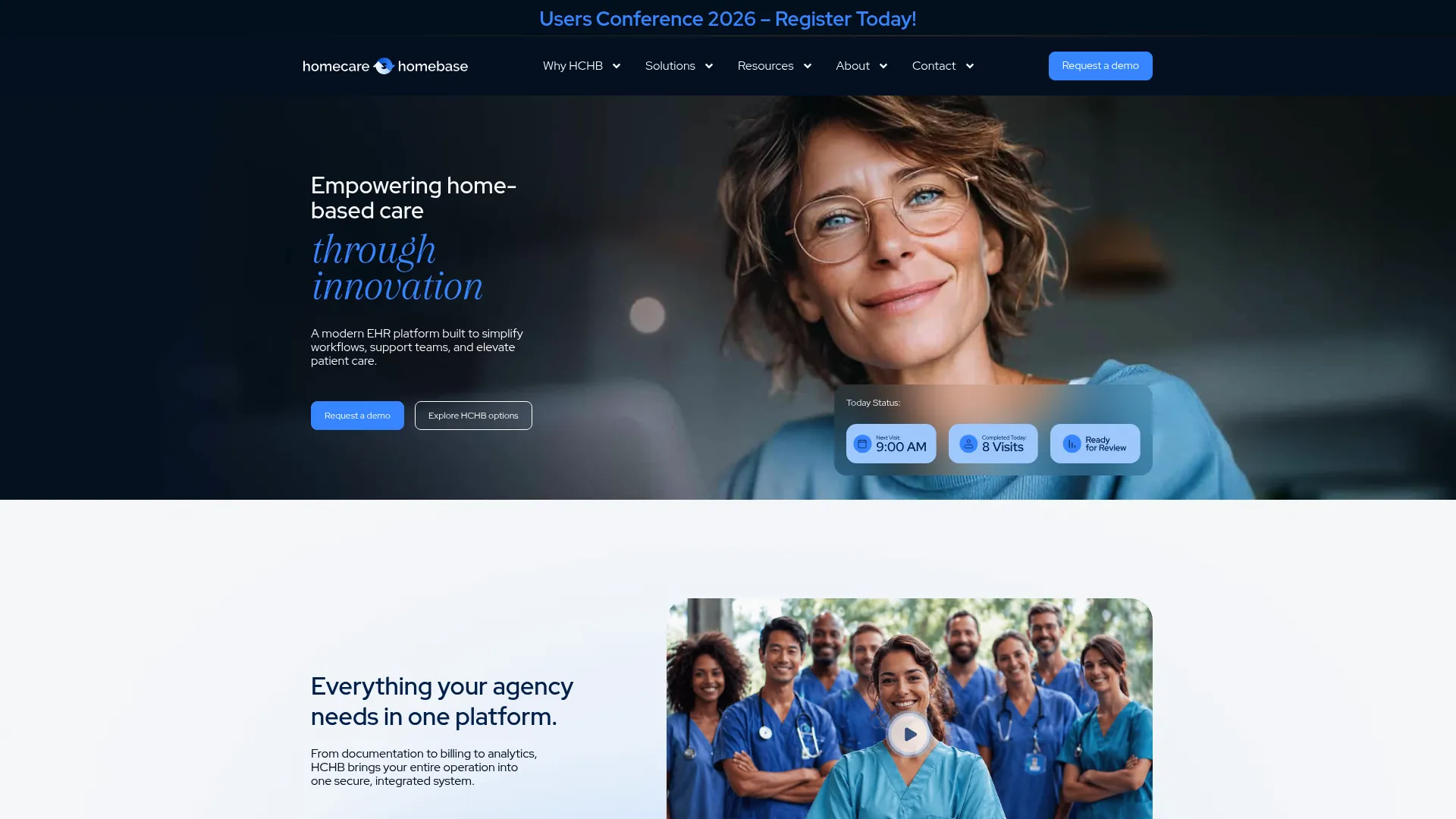
Homecare Homebase is EHR software for home-based care agencies, including home health, hospice, and personal care. It is built for organizations with more complex care delivery that need clinical, operational, and financial workflows in one integrated record. Care coordination and data analytics anchor a platform designed for scale.
Best for: Home-based care organizations needing an integrated EHR for clinical, operational, and financial workflows.
Key strengths
- Care coordination
- Data analytics
- Documentation and compliance workflows
Why choose Homecare Homebase: Larger agencies with clinical complexity need an EHR, not just an operations tool. Homecare Homebase brings care coordination, documentation, and compliance workflows into one system built to handle that complexity. The analytics support organizations managing many clinicians across multiple care lines.
Homecare Homebase pricing: Homecare Homebase does not publish public pricing. Its pages describe functionality and route to demo requests, so pricing is quote-based.
Considerations
Before you commit to a home care management system, work through this checklist against your actual agency operations.
Scheduling and caregiver matching
Test how the platform handles recurring visits, coverage gaps, and caregiver preferences. Ask what happens when a caregiver calls out an hour before a shift. The system should surface qualified replacements and reshuffle coverage without your coordinator rebuilding the day manually.
EVV and visit verification
Confirm the EVV software supports your state's requirements and your payers' aggregators. Check telephony and GPS options, since caregivers work in settings where one method fails and the other saves the visit. Verify that visit verification data flows into billing without re-entry.
Billing, claims, and revenue cycle
Inspect the pre-billing QA. The platform should check eligibility, flag missing documentation, and validate payer rules before a claim goes out. Ask how it handles denials and rework, and confirm which clearinghouses and payers it supports for your specific mix.
Documentation and compliance
Look at charting, care plans, and offline documentation. Field caregivers lose connectivity, so notes captured offline and synced later keep the record complete. Confirm the platform keeps audit-ready logs so a payer review does not become a fire drill.
Integrations and reporting
Check ecosystem fit with your existing tools, your EVV aggregator, and your clearinghouse. Review the dashboards and analytics for the visibility you need across a single office or multiple locations. Reporting should answer operational and financial questions without exporting to a spreadsheet.
Conclusion
The seven platforms here fit different agency models, not a single ranking. Alora Health and Axxess give you the deepest all-in-one and multi-line breadth. Caretap centers EVV and compliance. WellSky adds a services layer for organizations that have outgrown running everything internally. AxisCare wins on everyday usability and portals. AlayaCare brings modern care management and a strong mobile app. Homecare Homebase handles complex, clinically heavy care delivery.
Your next step is narrow, not broad. Shortlist two platforms based on three factors: your agency size, your payer mix, and your billing complexity. Then run a demo focused on the workflow that breaks first in your operation, whether that is scheduling coverage, EVV compliance, or claims turnaround.
The right system is the one that keeps your back office aligned with care delivery instead of a week behind it.
FAQs
Small agencies usually want an all-in-one platform priced to their size rather than an enterprise EHR. AxisCare and Alora Health both scale pricing by agency size and cover scheduling, EVV, documentation, and billing. Since pricing across this category is quote-based, request quotes from two platforms and compare against your client and caregiver counts.
At minimum, look for scheduling and visit management, EVV and visit verification, documentation and care plans, billing and revenue cycle, caregiver credential tracking, a mobile app, and reporting. The value is in how these connect. When EVV feeds documentation and documentation feeds billing, a visit moves through the system without manual re-entry.
The software captures visit verification through GPS, telephony, or mobile check-in that meets state and payer requirements. The bigger benefit is connection. When EVV data flows directly into documentation and billing, you avoid the gap between a verified visit and a documented one, which is where audit problems usually start.
Yes. Most platforms on this list include home care billing software with eligibility checks, pre-billing QA, claims submission, and payment processing. The strongest revenue cycle tools catch problems before submission, checking documentation and payer rules so you get clean first-pass claims instead of denials to rework weeks later.
Focus on recurring visit patterns, coverage gap alerts, and caregiver matching by skill and preference. Test the call-out scenario: when a caregiver cancels an hour before a shift, the system should surface qualified replacements fast. Caregiver scheduling software that reshuffles coverage automatically saves your coordinators hours every week.
All-in-one platforms connect scheduling, EVV, documentation, and billing so data moves without re-entry. Point solutions can be stronger in one area but create handoff gaps where visits and claims stall. For most agencies, the coordination savings of an integrated home care management system outweigh the deeper features of a single-purpose tool.
Yes. Every platform here includes a caregiver mobile app for schedules, notes, clock-in, and visit verification. The feature that matters most is offline documentation, since caregivers often work where connectivity drops. Notes captured offline and synced later keep the record complete and the claim clean.
Very important. Your EVV data has to reach your state's aggregator, and your claims have to reach your clearinghouse. Before you buy, confirm the platform supports the specific aggregator and clearinghouse your payers require. A gap here means manual workarounds that undo the coordination the software is supposed to deliver.