Your annual review cycle is running once a year. Your problems are running every week.
That gap is the core issue continuous feedback software exists to close. When a rep misses quota in March, the manager finds out in a review conversation in November. When onboarding drags and a new hire disengages, the signal shows up months later in a churn number, not in time to fix anything. For a Series B founder trying to prove the company scales without founder heroics, that lag is expensive. Manager effectiveness, retention, and calibration all depend on feedback happening in real time, not once a season.
The market has already moved. The continuous performance management software market is valued at USD 2.97 billion in 2026 and is projected to hit USD 7.63 billion by 2034 at a 12.5% CAGR, according to Straits Research (2026). Among organizations using structured feedback tools, employee retention rates run 14% higher than teams without them, per Market Growth Reports (2026). That retention number is the one that should get a founder's attention, because churned employees quietly eat the growth you raised money to prove.
This guide walks through eight continuous feedback software platforms built for exactly this shift, from lightweight employee feedback software to full continuous performance management software. If you're also thinking about the broader review-and-survey layer, our roundup of feedback software covers adjacent tooling, and our guides to marketing analytics and analytics that drive ROI help once you start tying people data to revenue.
What's inside
This is a buyer's guide for founders and people-ops leaders choosing continuous feedback software in 2026, not a vendor landing page. We looked at eight platforms and evaluated each on four things that matter when you're scaling past 50 employees: feedback cadence and check-ins, manager coaching support, goal management and OKRs, and how cleanly the tool handles HRIS integrations, Slack integration, and reporting. Each entry includes what it's best for, key strengths, and current pricing where the vendor publishes it. Where a price isn't public, we say so rather than guess.
TL;DR
- Best all-in-one people-performance platform: 15Five, for engagement, performance reviews, and manager enablement in one system.
- Best for review-driven teams: Trakstar, for continuous feedback wired tightly into structured review cycles and 360-degree feedback.
- Best configurable feedback records: PerformYard, for searchable feedback history that survives calibration and review time.
- Best for goal alignment: Betterworks, for OKRs and continuous performance management at scale.
- Best modular people platform: Lattice, for teams that want performance, goals, and engagement in one place.
- Best performance-plus-development combo: Leapsome, for pairing reviews and feedback with learning.
- Best deep people analytics: Culture Amp, for engagement data and action planning at enterprise depth.
What is continuous feedback software?
Continuous feedback software is a category of performance management software that lets managers and employees exchange feedback throughout the year, instead of only during annual performance reviews. It replaces the once-a-year review scramble with a steady rhythm of check-ins, real-time feedback, goal tracking, and coaching, so performance data accumulates continuously rather than getting reconstructed from memory each cycle.
The shift is real and measurable. In the 360-degree feedback software segment, 20% of firms have already moved to continuous feedback models, away from exclusively annual cycles, according to Market Growth Reports (2026). The reason is operational: episodic feedback produces stale data and surprised employees. Continuous performance management software produces feedback history you can actually coach against.
Most platforms in this category share a common feature set:
- Continuous check-ins: Lightweight weekly or biweekly pulse and 1:1 workflows that keep managers and reports aligned.
- 360-degree feedback: Structured peer, manager, and upward feedback tied to competencies.
- Goal management and OKRs: Goal setting, alignment, and progress tracking across teams.
- Performance reviews: Configurable review cycles that pull from continuous feedback history.
- Manager coaching: Prompts, tips, and talking points that help managers act on signals.
- Employee engagement: Pulse surveys and sentiment tracking to catch disengagement early.
- Analytics dashboards: Reporting on feedback volume, goal progress, and engagement trends.
- Integrations: Slack integration, Microsoft Teams integration, HRIS integrations, and SSO.
The best tools connect feedback cadence to better reviews, better coaching, and cleaner talent development records, so managers spend less time reconstructing history and more time acting on it.
When to use continuous feedback software
Not every stage needs a dedicated platform. Here's when it earns a spot in the stack.
Replace episodic reviews with a continuous review cycle
If your team runs performance reviews once a year and feedback lands as a surprise, you have a cadence problem. Continuous feedback software turns one big annual conversation into a steady stream of check-ins and real-time feedback. Managers coach against fresh signal, and employees never get blindsided in a review.
Scale manager coaching without the founder in the room
As you hire past 50 people, you can't personally coach every manager. Continuous feedback software gives new managers structured prompts, feedback history, and goal visibility so they run effective 1:1s from day one. That's exactly the founder-to-team handoff a Series B company needs.
Operate distributed teams with clean records
Remote and hybrid teams lose the hallway feedback that co-located teams take for granted. A shared system captures check-ins, goal progress, and 360-degree feedback in one place, so context survives across time zones and calibration stays defensible.
Comparison table
Use this to separate feedback-first tools from broader people platforms. Ratings reflect current G2 listings where available.
| # | Product | Intent | Key differentiation | Pricing | G2 rating |
|---|---|---|---|---|---|
| 1 | 15Five | All-in-one people-performance platform | Engagement, performance, and manager enablement combined | From $4/user/mo (annual) | 4.5/5 |
| 2 | Trakstar | Review-driven continuous feedback | Continuous feedback wired into structured review cycles | Quote-based | Not listed |
| 3 | PerformYard | Configurable performance management | Searchable feedback history and flexible cycles | $5-10/person/mo (annual) | 4.7/5 |
| 4 | Betterworks | OKR and goal alignment | Continuous performance management built around goals | Custom quote | 4.3/5 |
| 5 | Lattice | Modular people platform | Performance, goals, and engagement in one system | From $4/seat/mo (annual) | 4.7/5 |
| 6 | Leapsome | Performance plus development | Reviews and feedback paired with learning | From €199/mo | 4.8/5 |
| 7 | Reflektive | Feedback-first performance management | Real-time feedback and recognition workflows | Custom quote | 4.2/5 |
| 8 | Culture Amp | Deep people analytics | Engagement data and action planning at depth | Quote-based | 4.5/5 |
1. 15Five
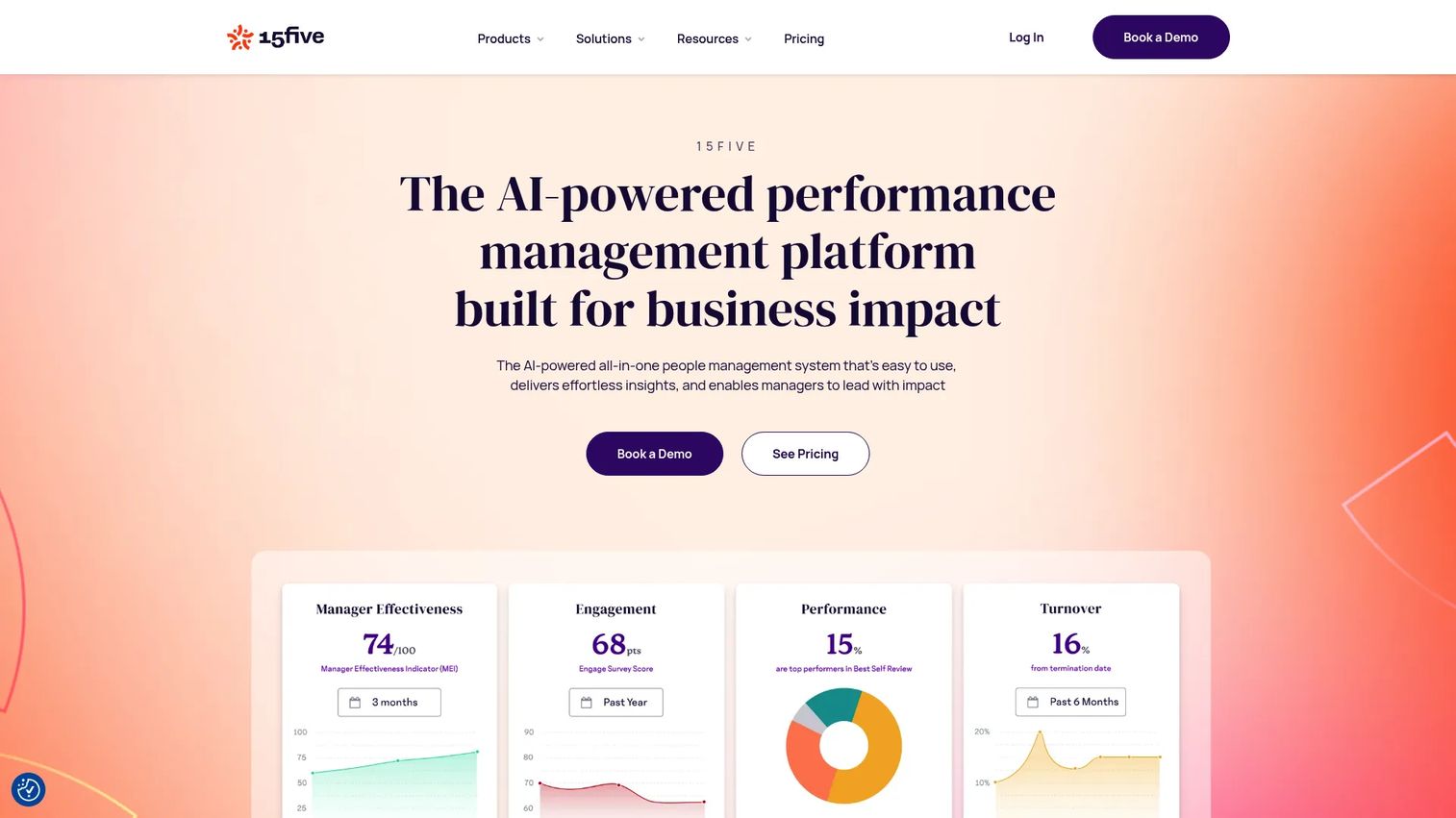
15Five is a people-performance platform that combines employee engagement surveys, performance reviews, continuous feedback, and manager effectiveness in one system. It's built to give a scaling company a single source of truth for reviews, engagement signals, and manager coaching, so people-ops leaders aren't stitching together three separate tools. The platform layers OKRs and goals on top, plus manager-focused products and AI-assisted workflows.
Best for: Mid-market HR teams that want engagement, performance management, and manager enablement in one platform.
Key strengths
- Engagement surveys: Pulse surveys catch disengagement before it shows up as churn in a retention number.
- Continuous feedback and reviews: Weekly check-ins feed structured performance reviews so cycles pull from real history.
- OKRs and goals: Goal management keeps distributed teams aligned on what actually matters this quarter.
Why choose 15Five: For a founder who wants engagement and performance under one roof, 15Five reduces tool sprawl while giving managers coaching support they can use from day one. The manager-effectiveness focus is what separates it from pure review tools, and that leverage matters most exactly when you're handing coaching off to new leaders.
15Five pricing: Public pricing shows three core plans billed annually. Engage starts at $4 per user per month, Perform at $11 per user per month, and Total Platform at $16 per user per month. Add-ons include manager products, AI, and compensation. There is no free tier. The platform holds a 4.5/5 rating on G2.
2. Trakstar
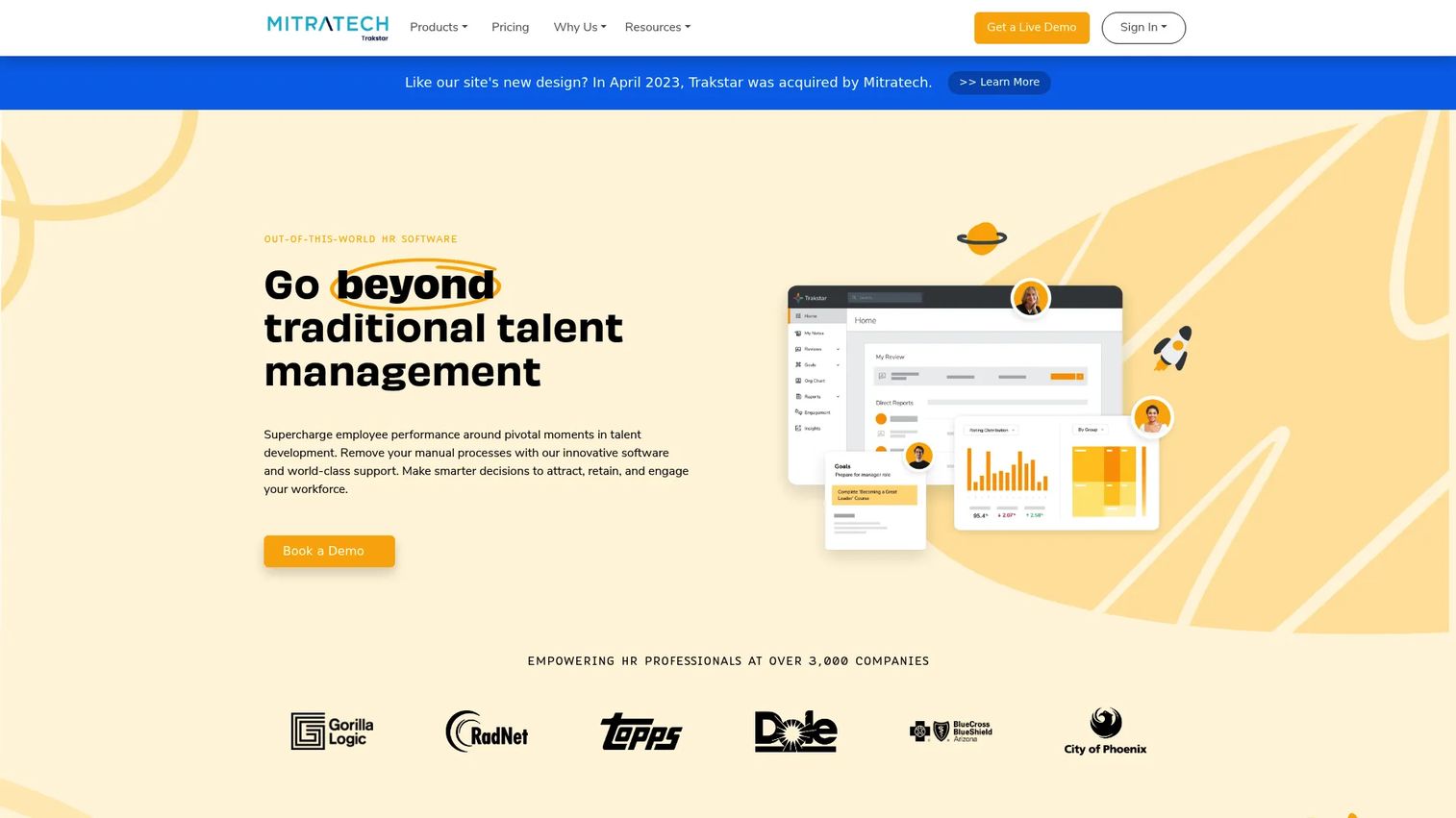
Trakstar is cloud-based talent development software that ties continuous feedback tightly to review workflows, goal setting, and 360-degree feedback. It spans hiring, learning, performance, and workforce analytics, so continuous feedback sits inside a broader talent development system rather than standing alone. For teams that want disciplined performance review cycles improved by year-round feedback, that integration is the draw.
Best for: HR teams needing an all-in-one talent development platform where feedback improves the review, not replaces it.
Key strengths
- 360-degree feedback: Structured peer and manager feedback tied to competencies feeds calibration and coaching.
- Goal setting and OKRs: SMART goals and milestone tracking keep performance conversations grounded in outcomes.
- Performance and analytics: Review workflows plus workforce analytics give leaders a clear read on manager effectiveness.
Why choose Trakstar: Trakstar skews toward teams that want continuous feedback to sharpen structured reviews rather than run a lightweight, standalone feedback loop. If your operating problem is that annual reviews feel disconnected from day-to-day work, Trakstar closes that gap with succession planning and learning management alongside performance.
Trakstar pricing: Trakstar uses quote-based pricing. The pricing page asks visitors to complete a short form for a personalized, no-obligation quote rather than listing public tiers. That structure fits teams buying the broader talent development suite rather than a single module.
3. PerformYard
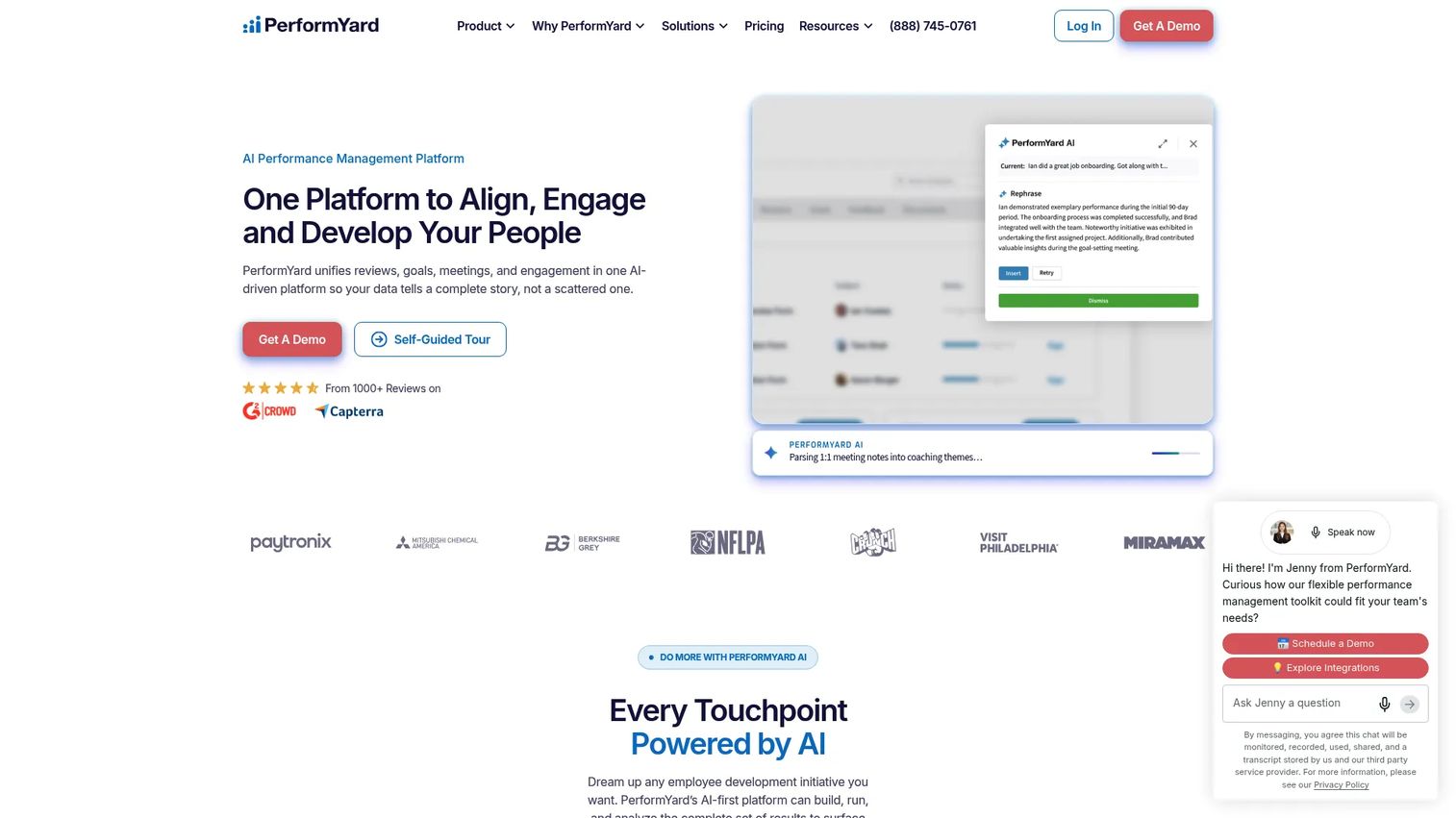
PerformYard is AI-driven performance management software built around configurable reviews, goal management, continuous feedback, and reporting. Its standout is flexibility: you configure review cycles, feedback flows, and goals to match how your team actually operates instead of bending your process to the software. Searchable feedback history means notes and peer feedback survive all the way to calibration.
Best for: HR teams needing a configurable performance management platform with reviews, goals, and engagement tools.
Key strengths
- Continuous feedback and history: Peer and manager notes stay searchable, so review time pulls from a real record.
- Goal management: Track individual and team goals with progress visibility across the org.
- Meetings and check-ins: Structured 1:1s and meeting agendas keep manager coaching consistent.
Why choose PerformYard: For founders who want feedback records that survive calibration and annual reviews, PerformYard's history tracking and configurability are the differentiators. It also adds AI review assist and summaries, plus engagement and survey add-ons, so you can start with performance and expand as the team grows.
PerformYard pricing: The core Performance Management plan runs $5-10 per person per month, billed annually, with a minimum. Add-ons include PerformYard AI, employee engagement, meetings, and surveys, each priced per person per month. There is no free tier. PerformYard holds a 4.7/5 rating on G2.
4. Betterworks
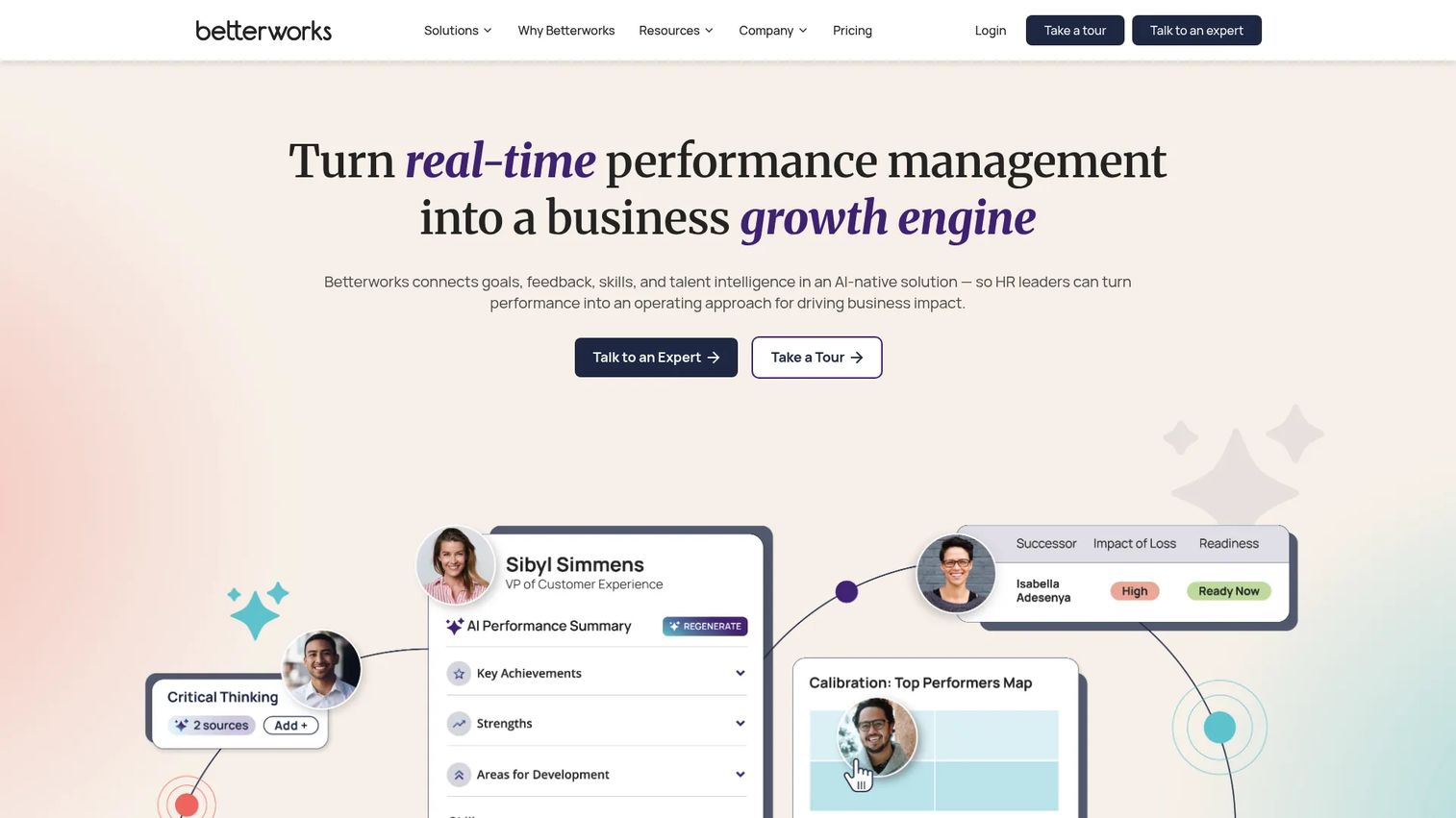
Betterworks is continuous performance management software built around goals and OKRs, with continuous feedback and check-ins layered on top. Its center of gravity is alignment: keeping teams pointed at the same objectives and measuring progress against them. For a company where execution discipline is the bottleneck, that goal-first framing is the reason to look.
Best for: Mid-market and enterprise HR teams managing continuous performance and talent processes at scale.
Key strengths
- Goals and OKRs: Cascading goals keep every team aligned to company objectives, with clear progress visibility.
- Continuous feedback and check-ins: Ongoing feedback and check-ins keep goal conversations current, not annual.
- AI talent intelligence: Calibration and talent-intelligence features help leaders spot patterns across the org.
Why choose Betterworks: If your operating problem is that teams drift from company priorities between planning cycles, Betterworks anchors feedback and coaching to goals rather than the reverse. The OKR discipline is what fast-growing teams reach for when alignment, not just feedback, is the thing that keeps slipping.
Betterworks pricing: Betterworks lists two plans, Mid-Market (starting around 500 employees) and Enterprise (starting around 2,500 employees), both with custom quotes and annual billing. There is no free tier. The platform holds a 4.3/5 rating on G2. The packaging signals it's aimed at larger teams standardizing goals across the org.
5. Lattice
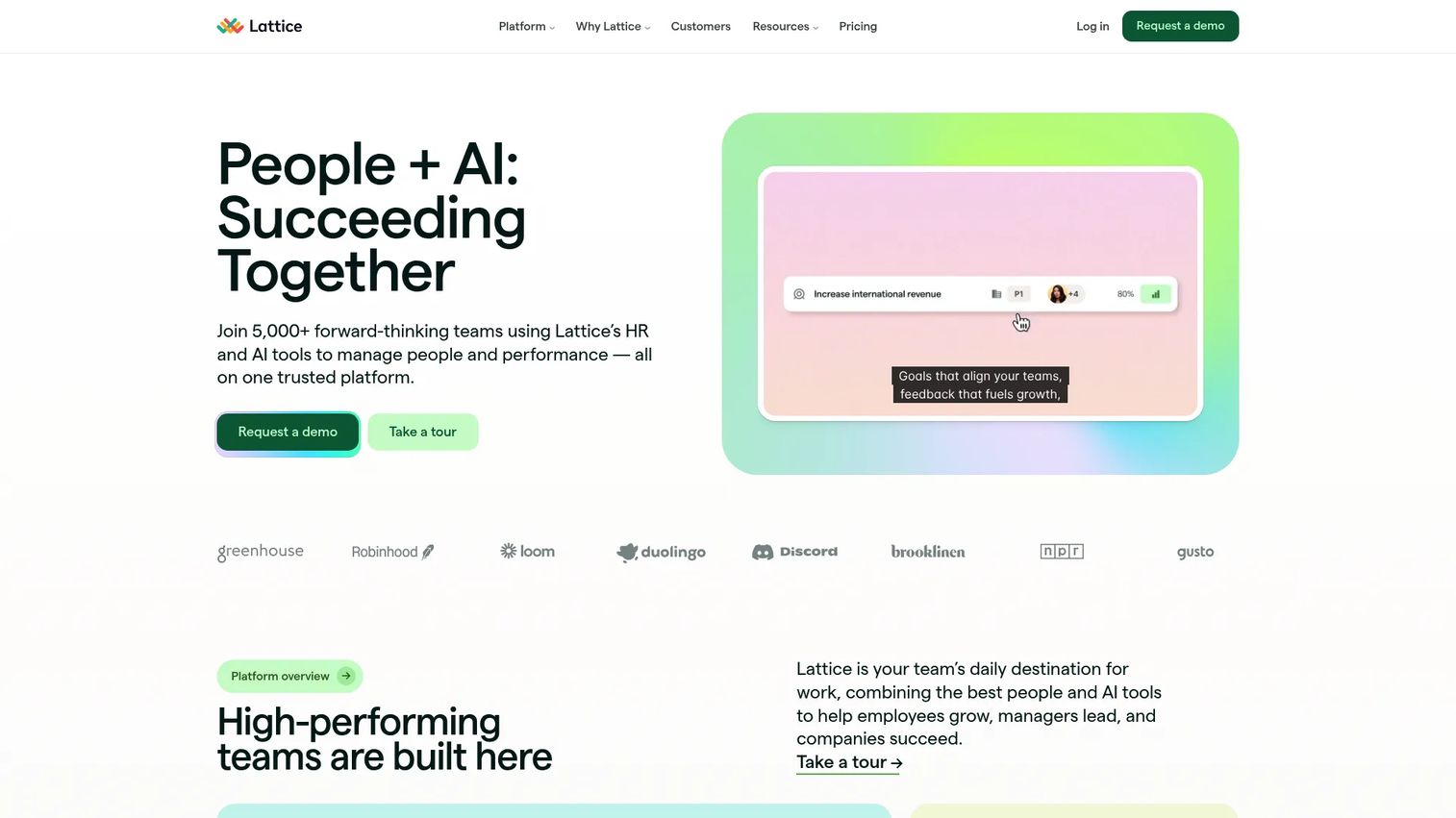
Lattice is a widely used people platform that combines performance reviews, feedback, goals, engagement, and growth in a modular package. Founders evaluate it when they want one platform for the full manager operating rhythm: 1:1s, reviews, goal tracking, and engagement surveys under a single roof. The modular pricing lets you start where the pain is and add modules as you scale.
Best for: Mid-market and enterprise HR teams wanting modular people-performance software they can expand over time.
Key strengths
- Performance reviews and feedback: Continuous feedback workflows feed structured reviews, so cycles reflect real work.
- Goals and OKRs: Goal tracking keeps teams aligned and gives managers a clear coaching anchor.
- Engagement surveys and analytics: Engagement data plus reporting surfaces retention risk before it becomes churn.
Why choose Lattice: Lattice fits founders who want the manager operating rhythm in one system and prefer to buy modules as needs emerge rather than all at once. Lattice's 2026 State of People Strategy Report found that 40% of HR professionals are doubling down on performance management, which is precisely the shift Lattice's modular design supports.
Lattice pricing: Pricing is modular and billed annually in USD, with a stated minimum annual agreement of $4,000. Entry seat pricing starts at $4 per seat per month for modules like Engagement and Grow, with a Performance Management and OKRs bundle at $11 per seat per month and Enterprise on custom quote. Lattice holds a 4.7/5 rating on G2.
6. Leapsome
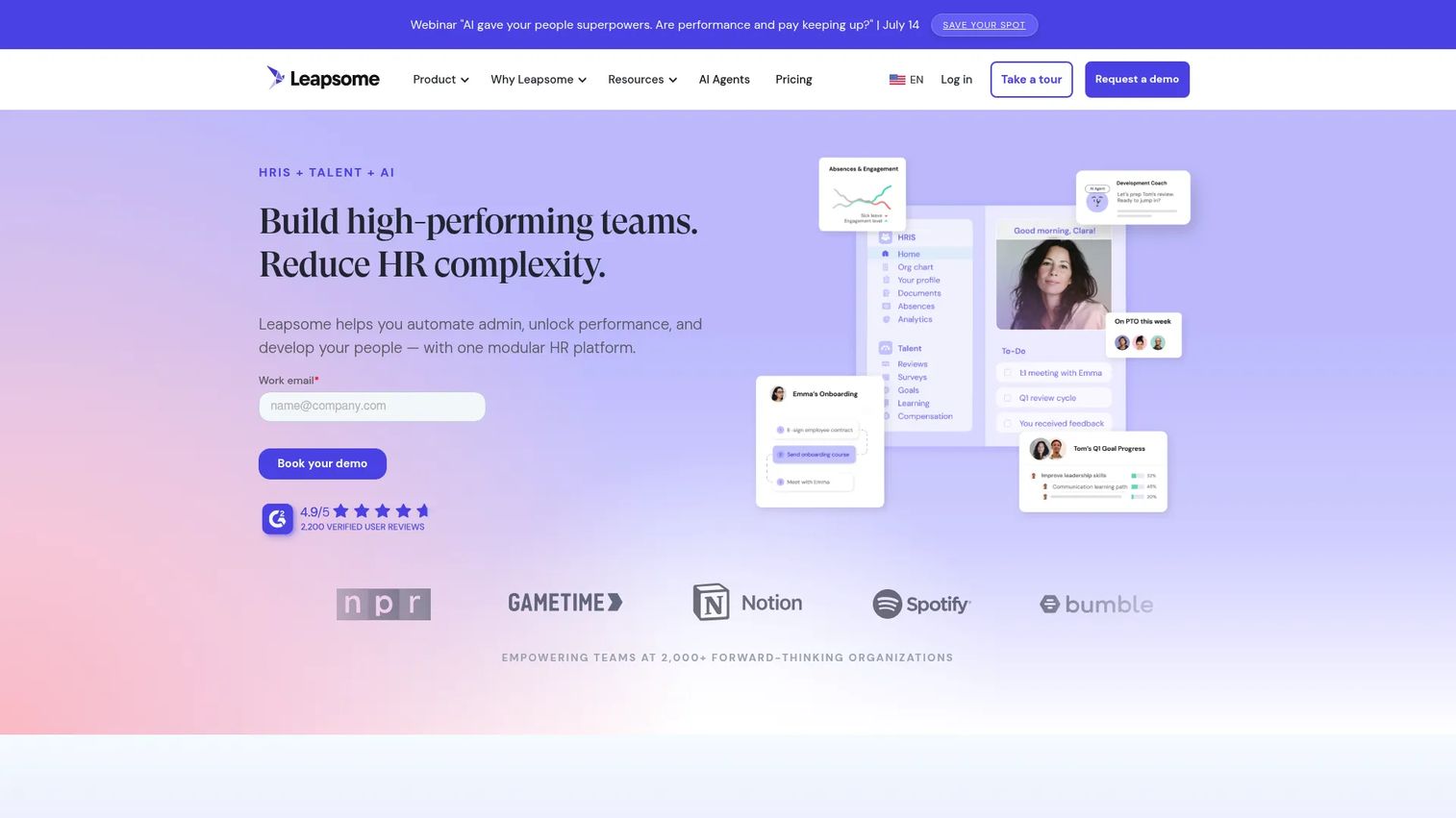
Leapsome is an AI-powered people platform spanning HRIS, performance management, goals, feedback, engagement, and learning. Its distinguishing move is pairing performance and development in one place: continuous feedback loops and manager check-ins sit right next to learning paths and development planning. For teams that treat coaching and growth as the same job, that combination removes a tool.
Best for: Mid-market to enterprise HR teams wanting an all-in-one people platform that connects performance to development.
Key strengths
- Performance, goals, and feedback: Reviews, goal management, and continuous feedback run in one connected workflow.
- Engagement and learning: Development plans and learning workflows turn feedback into concrete growth, not just scores.
- HRIS and people data: Core people-data management keeps records in one place instead of scattered across systems.
Why choose Leapsome: Leapsome is the strongest fit when you want performance and development in the same system, so a coaching conversation flows directly into a learning plan. That connection between manager coaching and talent development is what teams reach for when feedback needs to lead somewhere, not just close a review.
Leapsome pricing: Leapsome uses modular pricing customized by employee count, contract length, and selected modules, so most teams get a tailored quote from sales. Publicly shown pricing starts at €199 per month, and a 14-day free trial is available. There is no free tier. Leapsome holds a 4.8/5 rating on G2, the highest in this list.
7. Reflektive
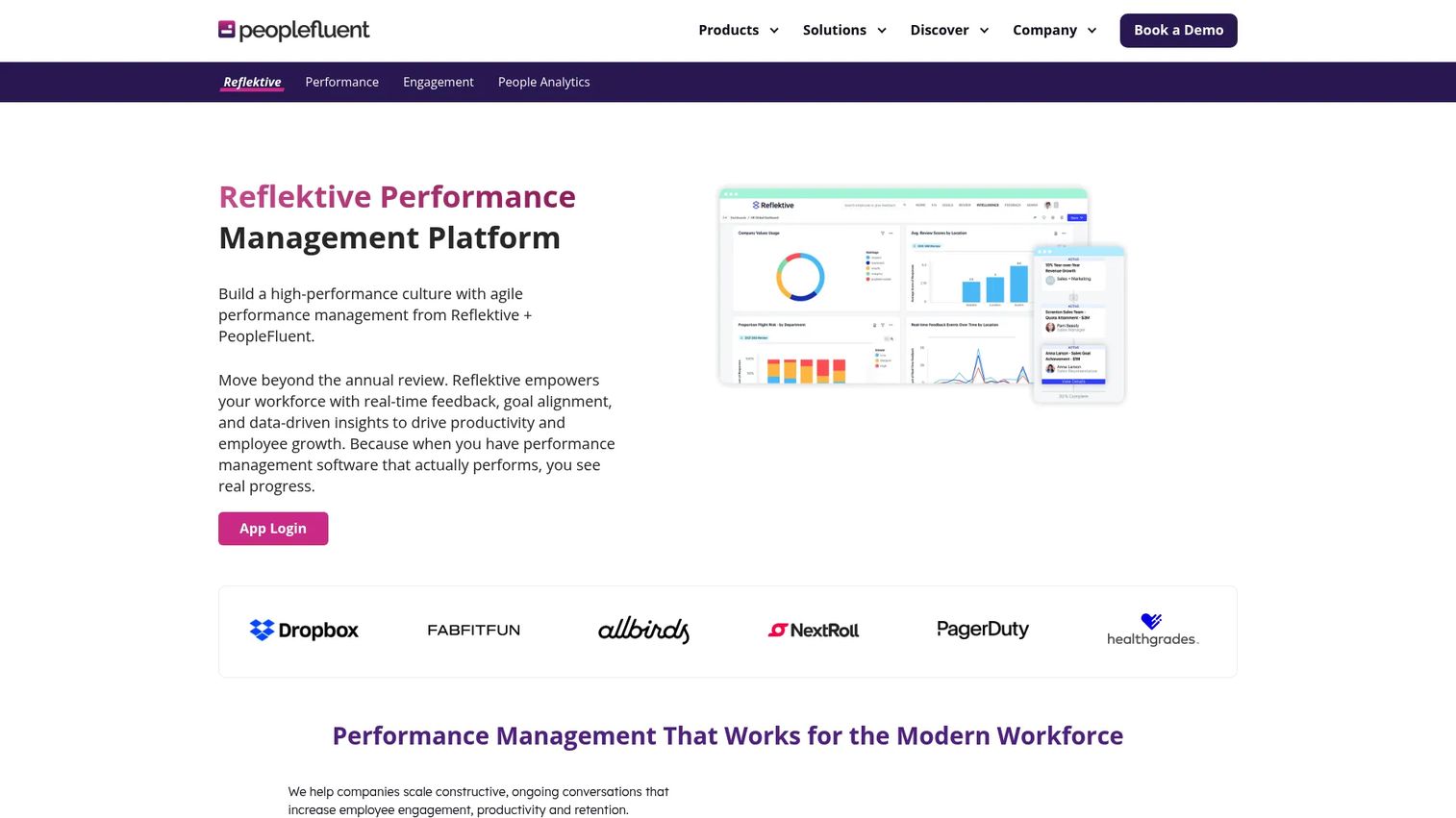
Reflektive is performance management software focused on real-time feedback, recognition, goal management, and manager coaching. It leans toward simpler, feedback-first workflows: continuous check-ins, recognition, goal tracking, and reviews that keep feedback visible without heavy configuration. For teams that want the feedback loop running cleanly before adding complexity, that focus is the appeal.
Best for: Mid-size to enterprise teams needing continuous performance management and employee engagement workflows.
Key strengths
- Real-time feedback and recognition: Ongoing feedback and recognition keep momentum between formal review cycles.
- Goal management and alignment: Goal tracking connects individual work to team and company objectives.
- Reviews and 1:1s: Check-ins and structured 1:1 conversations give managers a consistent coaching cadence.
Why choose Reflektive: Reflektive works well for teams that want a feedback-first performance management workflow without a heavy people-ops build. If your priority is getting real-time feedback and recognition flowing before you layer on deep analytics, its focused design fits that motion.
Reflektive pricing: Reflektive uses custom sales quotes rather than public pricing tiers, so exact figures depend on team size and modules. The product now sits within the PeopleFluent portfolio, and pricing is handled through sales conversations. Reflektive holds a 4.2/5 rating on G2.
8. Culture Amp
Culture Amp is an employee experience platform with the deepest engagement and people analytics in this set, plus performance reviews, feedback, and development layered on top. Where other tools lead with performance, Culture Amp leads with engagement data and action planning, then connects that to performance and growth. For companies that treat people data as a strategic input, that depth is the differentiator.
Best for: Mid-market and enterprise teams needing employee engagement, performance, and development tooling backed by strong analytics.
Key strengths
- Engagement and pulse surveys: Deep survey science surfaces engagement and retention signals with real rigor.
- Performance, 1:1s, and feedback: Reviews, 1:1s, goals, and feedback connect sentiment data to performance.
- Development and action planning: Development plans and action planning turn survey insight into concrete manager steps.
Why choose Culture Amp: Culture Amp fits founders who want engagement and retention data deep enough to drive decisions, with performance and development connected to it. The analytics and action-planning depth is what makes it the pick when culture and retention are board-level metrics, not afterthoughts.
Culture Amp pricing: Culture Amp uses quote-based pricing that depends on employee count, product, and service tier, with products billed annually. No public dollar amount is listed. The platform holds a 4.5/5 rating on G2 and carries recent enterprise and mid-market recognition badges.
Considerations before you buy
Before you commit, run each shortlisted tool through this checklist.
Feedback cadence and workflow fit
Look at how the tool handles check-ins, real-time feedback, and continuous review cycles. The best fit matches how your managers already work, so adoption doesn't require behavior change on day one. If reps have to leave their workflow to give feedback, they won't.
Integrations and stack fit
Verify Slack integration, Microsoft Teams integration, HRIS integrations, and SSO before signing. Feedback happens where work happens, so a tool that pushes prompts into Slack or Teams sees far higher manager adoption than one that lives in a separate tab. HRIS sync keeps org data clean.
Feedback history and reporting
Check whether feedback history is searchable and whether analytics dashboards surface trends you can act on. For calibration and annual reviews, a durable record of who said what and when is the difference between defensible decisions and guesswork.
Manager coaching support
Look for prompts, talking points, and goal visibility that help managers act, not just collect feedback. This is the leverage a Series B founder actually needs, because it lets new managers coach well without the founder in the room.
Fit for remote and hybrid teams
Distributed teams lose informal feedback by default. Confirm the tool captures check-ins and 360-degree feedback in a shared record so context survives across time zones and calibration stays fair.
Conclusion
The eight platforms here solve the same core problem from different angles. 15Five and Lattice give you the broadest all-in-one people platforms, with 15Five leaning into manager effectiveness and Lattice into modular flexibility. Trakstar and Betterworks are the picks when structured reviews or goal alignment are your real bottleneck. PerformYard wins on configurability and feedback history, Leapsome on pairing performance with development, Reflektive on feedback-first simplicity, and Culture Amp on the depth of its engagement analytics.
Start by naming your actual operating problem. If it's manager coaching leverage, look hard at 15Five and Lattice. If it's goal drift, Betterworks. If it's retention data, Culture Amp. Then run a shortlist of two through a real cycle before you commit, checking Slack integration, HRIS integrations, and feedback history against your stack. The right continuous feedback software earns its place in the quarter, not the demo.
FAQs
Continuous feedback software is a type of performance management software that lets managers and employees exchange feedback throughout the year rather than only at review time. It combines check-ins, real-time feedback, goal tracking, and manager coaching so performance data accumulates continuously. The result is fresher signal, fewer surprises, and reviews built on a real record instead of memory.
Performance reviews are point-in-time events, usually annual or semi-annual. Continuous feedback software runs the loop year-round, so the review becomes a summary of accumulated feedback rather than a from-scratch judgment. In practice the two work together: continuous feedback feeds a continuous review cycle that makes the formal review faster and more accurate.
Prioritize check-in cadence, 360-degree feedback, goal management, and searchable feedback history, plus integrations like Slack integration, HRIS integrations, and SSO. For a SaaS company scaling manager headcount, coaching support and analytics dashboards matter most, because they turn feedback into manager leverage rather than just another data collection chore.
No. It structures and captures them. The best tools give managers agendas, prompts, and shared notes for 1:1s, then store that history so it feeds coaching and reviews. The human conversation still matters most. The software makes sure it happens consistently and that the record survives past the meeting.
Slack integration and Microsoft Teams integration bring feedback prompts, recognition, and check-in reminders into the tools where people already work. That proximity drives adoption, because managers and employees don't have to open a separate app to give or request feedback. Higher adoption means more feedback captured and a richer history for reviews.
Look for searchable, durable feedback history and analytics dashboards that surface trends across teams and time. For calibration and annual reviews, you want a defensible record of feedback and goal progress, not scattered notes. Strong reporting also lets you connect engagement and performance data to retention, which is where people data starts affecting the numbers a board cares about.
Yes, arguably more so than for co-located teams. Remote and hybrid teams lose the informal hallway feedback that happens naturally in an office. A shared system captures check-ins, 360-degree feedback, and goal progress in one place, so context and coaching survive across time zones and calibration stays fair regardless of where people sit.
Continuous feedback builds a year-round record, so calibration and annual reviews draw on accumulated data instead of recency bias or memory. Managers compare against real feedback history and goal progress, which makes ratings more defensible and conversations less contentious. The annual review stops being a surprise and becomes a summary of what everyone already knew.