A member cancels mid-cycle. Your billing tool prorates it wrong. Two people booked the same meeting room. A new member emailed twice asking how to get through the front door. It is 9 a.m. on a Monday, and none of this shows up in a feature list.
Running a shared workspace looks simple until the operational reality hits. Booking, billing, member onboarding, visitor access, and reporting all break at the same time, and each one lands on the same small ops team.
The market keeps growing anyway. Mordor Intelligence projects the shared office spaces market at USD 65.22 billion in 2026, and Research and Markets estimates the coworking space management software market at USD 2.21 billion in 2026. More spaces, more members, more admin. The platform you pick decides whether that growth compounds cleanly or turns into manual work.
This guide is a buyer's guide, not a directory. It focuses on the thing operators actually care about: removing admin drag.
What's inside
This guide is for operators, founders, and ops leaders comparing coworking management software before they book demos or trials. It covers seven shared workspace platforms and how each handles the workflows that create day-to-day admin load.
Tools were selected on four criteria:
- Workflow fit: how well booking, billing, and member management map to real operations
- Pricing clarity: whether plan structure and add-ons are concrete enough to budget
- Admin usability: how much manual work the system removes versus creates
- Scale readiness: whether the platform holds up as members and locations grow
TL;DR
- Best overall for operations teams: Spacebring, for automation depth across billing, bookings, and member service
- Best for all-in-one coworking management: Yardi Kube, for operators wanting a single unified platform
- Best for automation-first workflows: Optix, for teams reducing repetitive admin tasks
- Best for white-label member experiences: Nexudus, for multi-site operators needing brand control
- Best for a balanced, growth-ready stack: OfficeRnD, for broad feature coverage and reporting
- Best for simpler coworking operations: Archie or Coworks, for straightforward setups without enterprise overhead
What is shared workspace software
Shared workspace software is a system that helps operators manage desks, rooms, memberships, billing, access, members, visitors, and communication in one platform instead of stitching together spreadsheets, payment tools, and door hardware.
The category overlaps with coworking management software, coworking space software, and shared workspace management software. The naming varies, but the job is the same: run a flexible workspace without drowning in manual admin.
Core capabilities to expect:
- Bookings and resource management: desk booking, room booking, and resource booking across members and teams
- Membership and contract handling: plans, terms, renewals, and cancellations
- Billing and invoicing: recurring memberships, invoices, proration, and payment collection
- Member portals and mobile apps: self-service access for members plus admin tools on the go
- Automation and integrations: workflow automation plus an API and native connections to accounting, access control, and CRM
- Reporting and analytics: occupancy, revenue, and member activity visibility
The pattern here mirrors why teams move from static assets to interactive demos when they want people to experience something at their own pace. Good workspace software does the same for members: it lets them self-serve booking and billing instead of routing every request through your inbox.
When to use
Manage bookings without spreadsheets
Manual calendars work until they don't. Once you have multiple desks, meeting rooms, and members booking across shared resources, a shared calendar creates double-bookings and disputes. Dedicated software enforces booking rules, availability, and resource types automatically, so the front desk stops arbitrating conflicts.
Automate billing and member workflows
Recurring memberships sound simple. Then someone upgrades mid-month, another member cancels, and a third disputes a room charge. Manual invoicing turns each edge case into a task. Workspace software handles proration, reminders, and failed payments on a schedule, which is where most operators reclaim the most hours.
Deliver a better member experience
At some point, internal convenience is not enough. Members expect a branded portal, self-service booking, and a mobile app that lets them get through the door and reserve a room without emailing anyone. When member experience starts affecting retention, a real member portal matters more than admin-side shortcuts.
Comparison table
This comparison focuses on operations depth, pricing clarity, and member experience rather than raw feature counts. The columns below show who each platform fits best, what sets it apart, current starting pricing, and its G2 rating so you can shortlist quickly.
| # | Product | Best for | Key differentiator | Pricing | G2 rating |
|---|---|---|---|---|---|
| 1 | Spacebring | Operators wanting all-in-one operations | Automation across billing, bookings, and member service | From $183/mo | 4.9/5 |
| 2 | Yardi Kube | All-in-one coworking management | Unified space, billing, and member platform | Contact sales | 3.5/5 |
| 3 | Archie | Desk, room, and visitor management | Workplace analytics and office maps | From $2.8/desk/mo | 4.9/5 |
| 4 | Optix | Automation-first workflows | Mobile-first booking and member tools | From $229/mo | 4.7/5 |
| 5 | Nexudus | White-label, multi-site operations | 60+ integrations and white-label branding | Usage-based | 4.2/5 |
| 6 | OfficeRnD | Balanced, growth-ready stack | Memberships, billing, and workplace analytics | From $185/mo | 4.6/5 |
| 7 | Coworks | Simpler coworking operations | Member app plus room and billing basics | From $149/mo | 5.0/5 |
Best 7 shared workspace software for 2026
1. Spacebring
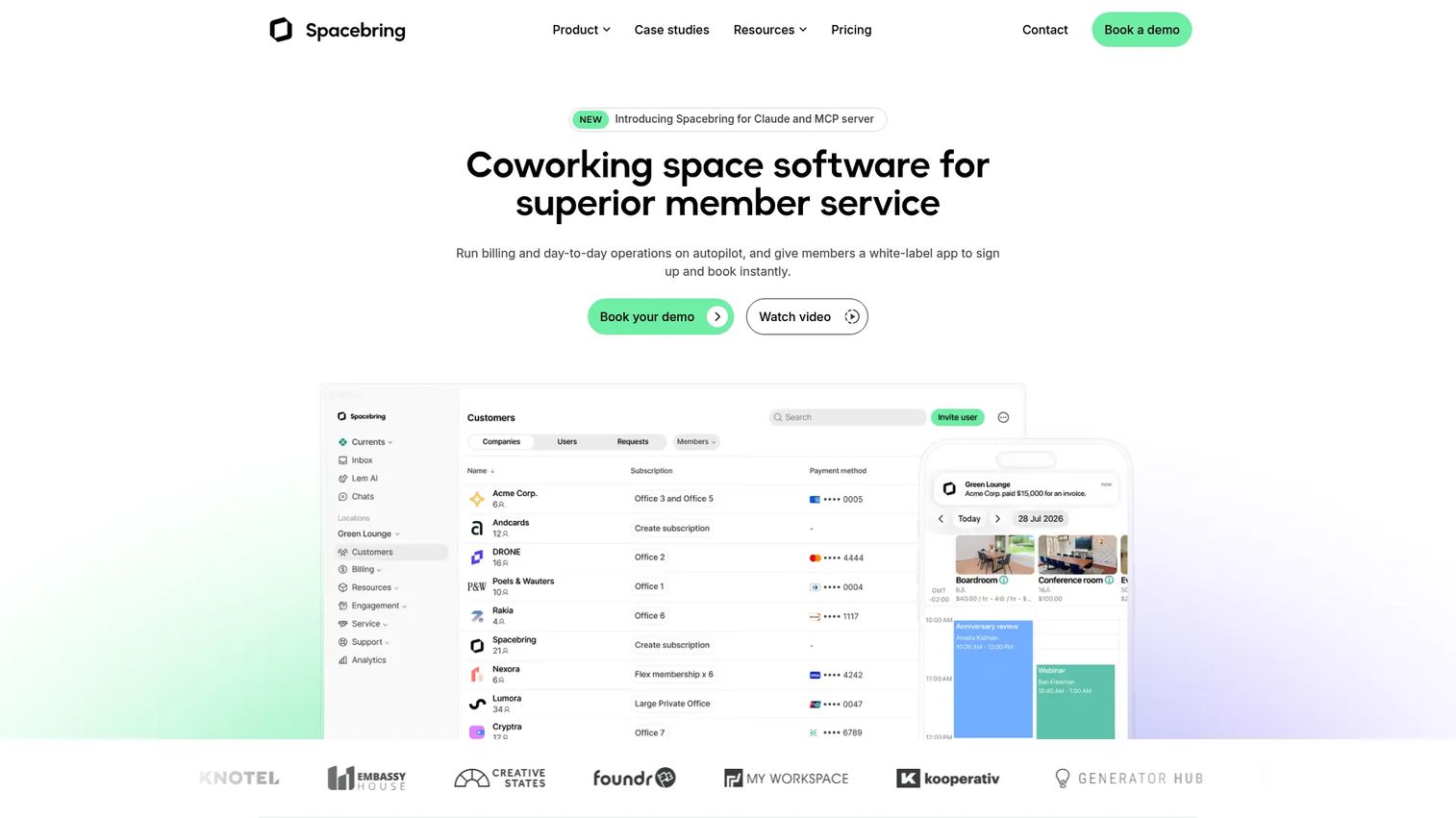
Spacebring is coworking space software built around member management, bookings, billing, access, and community tools in one system. It leans hard into automation, which is why it fits operators who want fewer manual touchpoints across the whole operation, not just one workflow. The admin mobile app means you can run the space from your phone instead of the front desk.
Best for: Coworking and shared-space operators that need an all-in-one operations platform.
Key features
- Billing and invoicing automation
- Bookings and resource management
- Member portal and admin mobile app
Why choose Spacebring: If your biggest pain is repetitive admin across billing, bookings, and member requests, Spacebring's automation-first approach removes more of that load than a tool that only covers one area well. It suits operators who want the whole workflow handled, not patched.
Spacebring pricing: The Business plan starts at $183 per month with a six-month minimum commitment. Enterprise is custom pricing, billed monthly or yearly. A 7-day free trial is available.
Spacebring holds a 4.9/5 rating on G2.
2. Yardi Kube

Yardi Kube is coworking and flexible workspace management software from Yardi, positioned as an all-in-one platform for space, billing, and member experience. It fits operators who want a single unified system for broader workspace operations, especially those already comfortable in the Yardi ecosystem or managing property alongside coworking.
Best for: Coworking operators needing an all-in-one space, billing, and member-experience platform.
Key features
- Flexible reservations and resource scheduling
- Automated invoicing and online payments
- Member portal and mobile experience
Why choose Yardi Kube: The draw is operational breadth under one roof. If you want reservations, billing, and member experience in the same platform rather than integrating separate tools, Yardi Kube covers a wide surface, which suits operators prioritizing consolidation over a lean stack.
Yardi Kube pricing: The product page routes you to contact sales for a quote based on your operation.
Yardi Kube holds a 3.5/5 rating on G2.
3. Archie
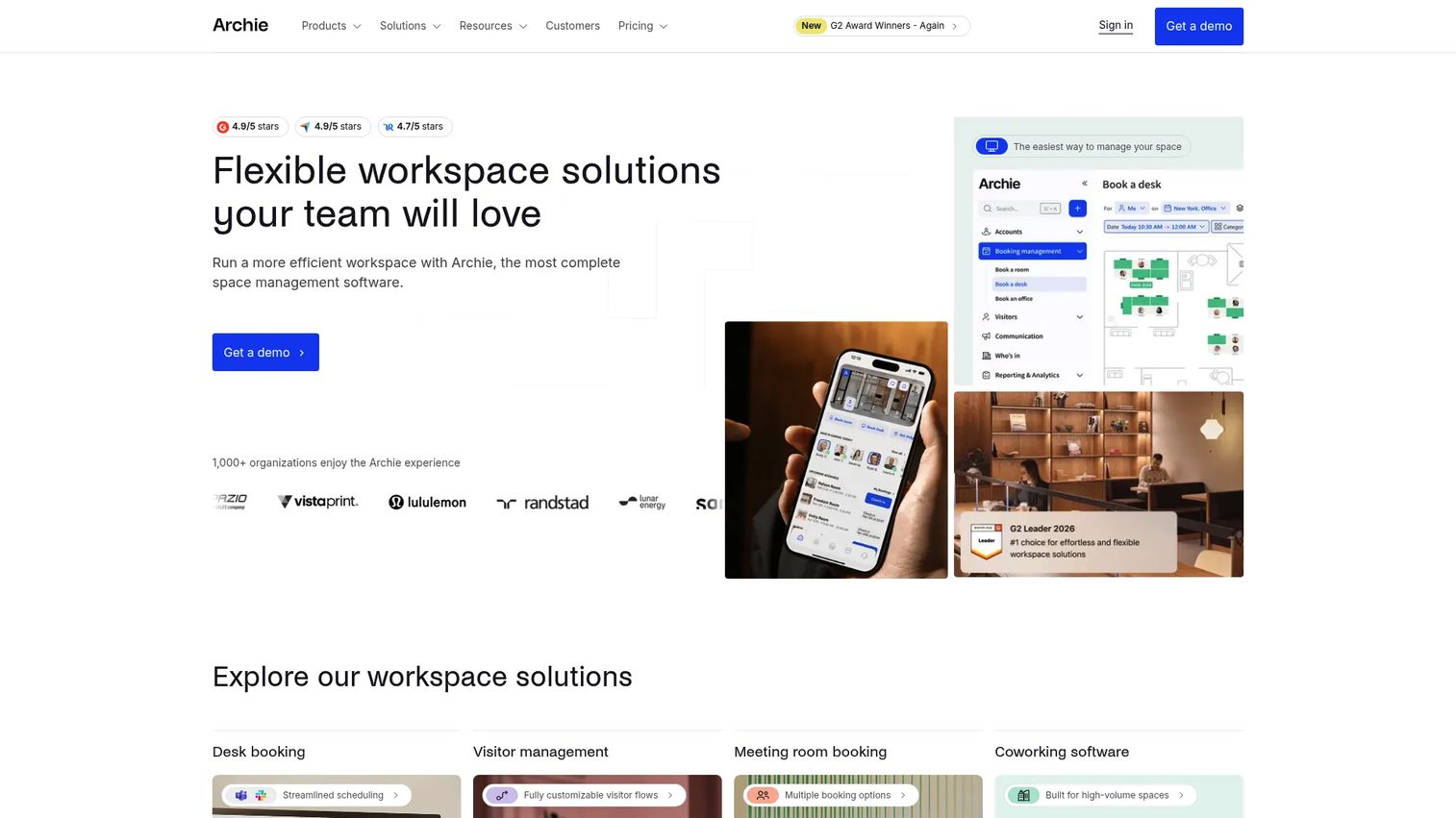
Archie is workplace management software covering desk booking, room booking, visitor management, and coworking operations. It keeps admin straightforward, which makes it a practical fit for mid-sized and larger offices that need reliable core booking plus visitor handling without a heavy configuration project.
Best for: Mid-sized and larger offices needing desk, room, and visitor management.
Key features
- Desk booking and room booking
- Visitor management
- Workplace analytics and office maps
Why choose Archie: Archie fits teams that want core bookings and visitor management to just work, plus analytics and office maps for visibility. It is a strong pick when operational simplicity matters more than a sprawling feature set, and per-desk pricing scales with actual usage.
Archie pricing: Starter is $2.8 per desk per month with a $159 monthly minimum. Pro is $3.5 per desk per month with a $249 monthly minimum. Enterprise is custom. A 14-day test environment is available after a demo.
Archie holds a 4.9/5 rating on G2.
4. Optix
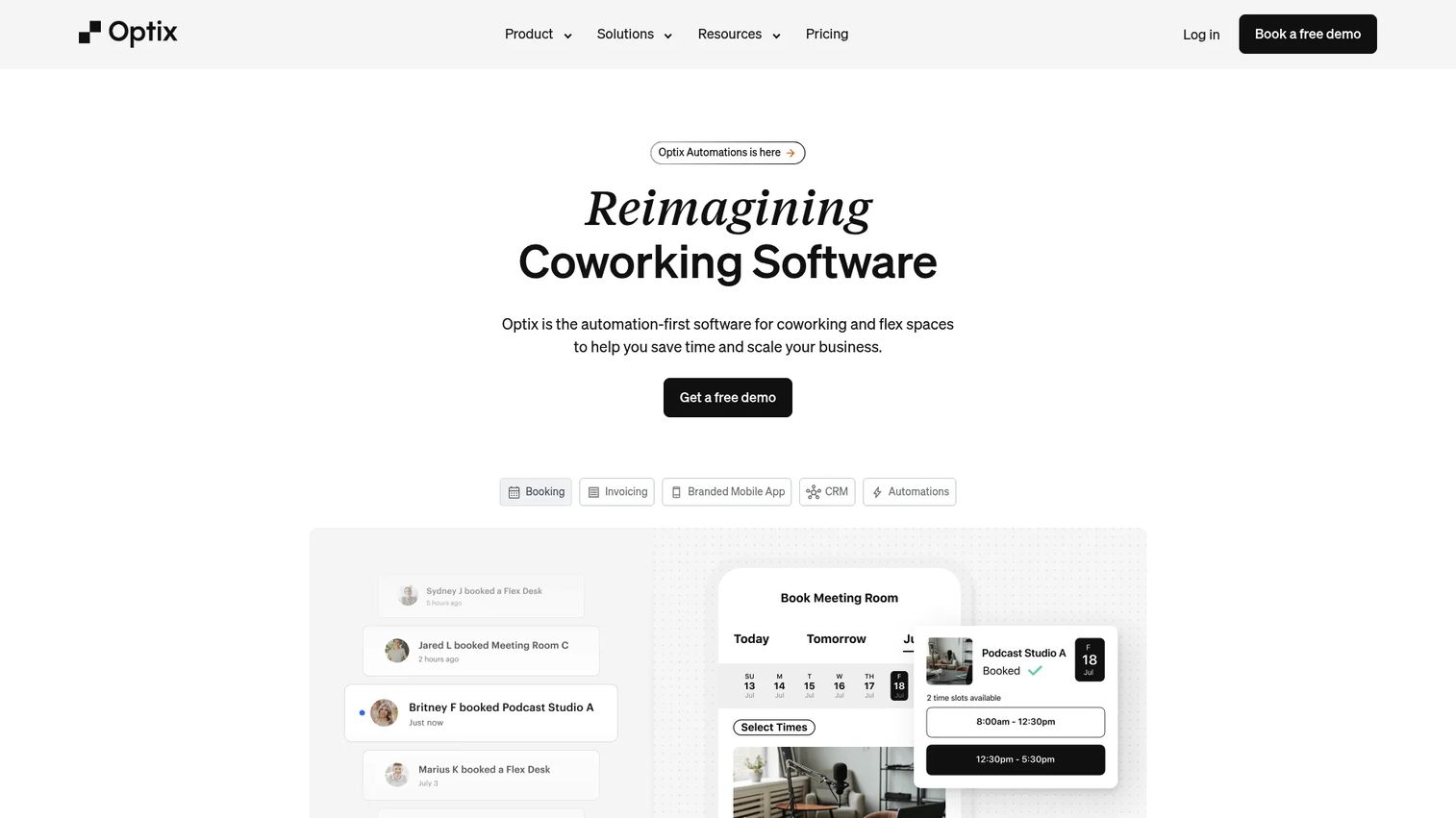
Optix is coworking and flex space management software with a mobile-first approach to booking, billing, and community. It suits operators who want members handling desk, resource, and meeting room bookings from an app, which cuts the front-desk request volume that eats admin time.
Best for: Coworking operators needing booking, billing, and community tools in one platform.
Key features
- Desk booking
- Resource booking
- Meeting room booking
Why choose Optix: If reducing repetitive tasks is the priority, Optix's mobile-first design pushes bookings and self-service to members directly. That fits teams that would rather members act on their own than route every reservation through staff.
Optix pricing: Essentials starts at $229 USD per month, Pro at $349, and Grow at $579. Scale is custom pricing. A 14-day free trial is available.
Optix holds a 4.7/5 rating on G2.
5. Nexudus
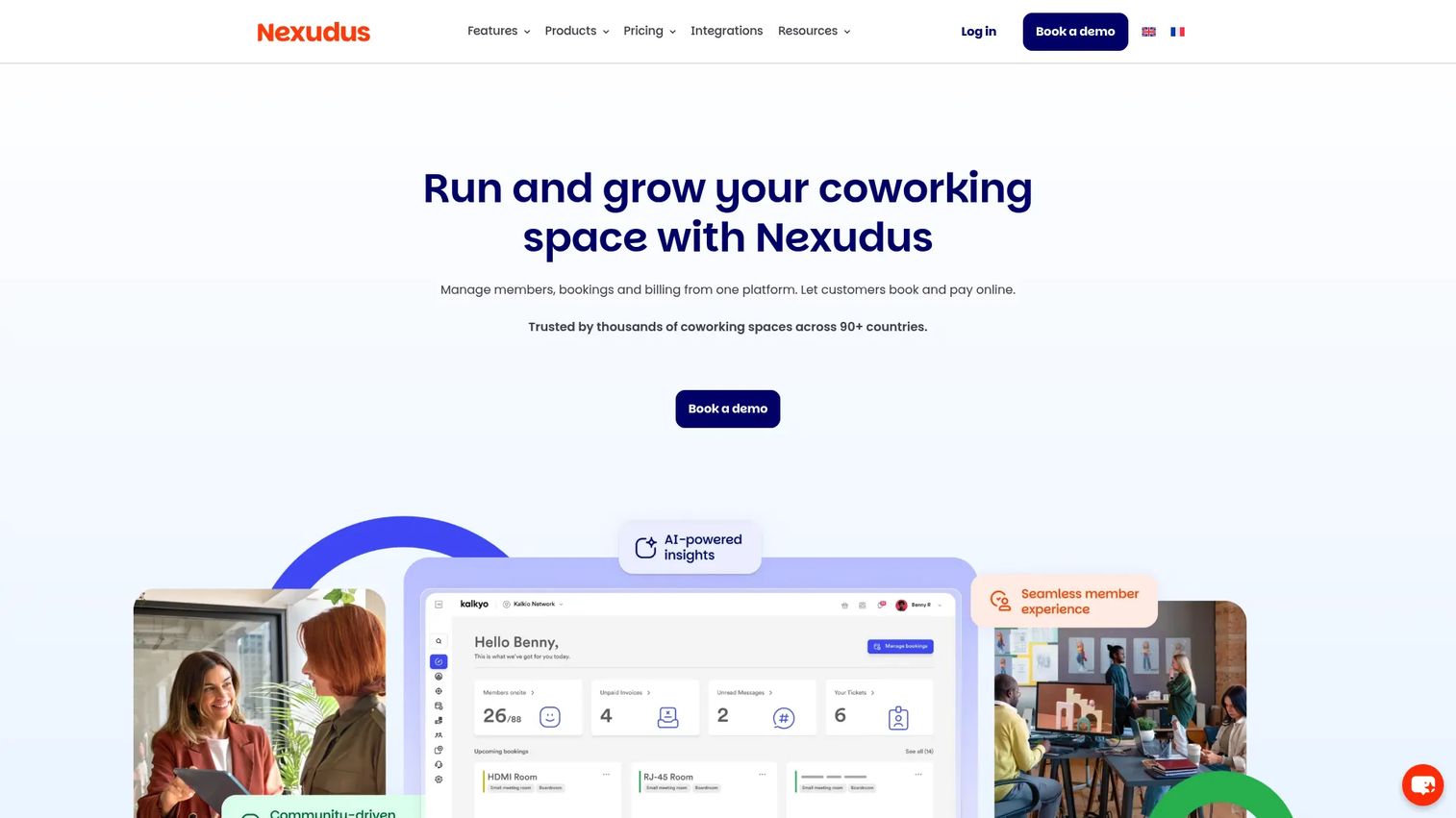
Nexudus is coworking and flexible workspace management software covering bookings, billing, members, and operations, with deep white-label and integration options. It fits operators running multiple locations who need brand control across every member touchpoint and room to customize workflows.
Best for: Coworking operators needing a white-label platform for multi-site management.
Key features
- Member management, bookings, and billing
- Multi-location operations and reporting
- 60+ native integrations and white-label branding
Why choose Nexudus: The strength is depth. With 60+ native integrations and full white-label branding, Nexudus suits larger or more complex operations that want to shape the platform around their processes rather than adapt to a fixed template. Multi-site reporting keeps visibility centralized.
Nexudus pricing: Nexudus uses usage-based pricing. Monthly charges depend on active users per location, with additional costs for some integrations, apps, features, and payment gateways. There is no single published starting price, so request a quote based on your locations and member counts.
Nexudus holds a 4.2/5 rating on G2.
6. OfficeRnD
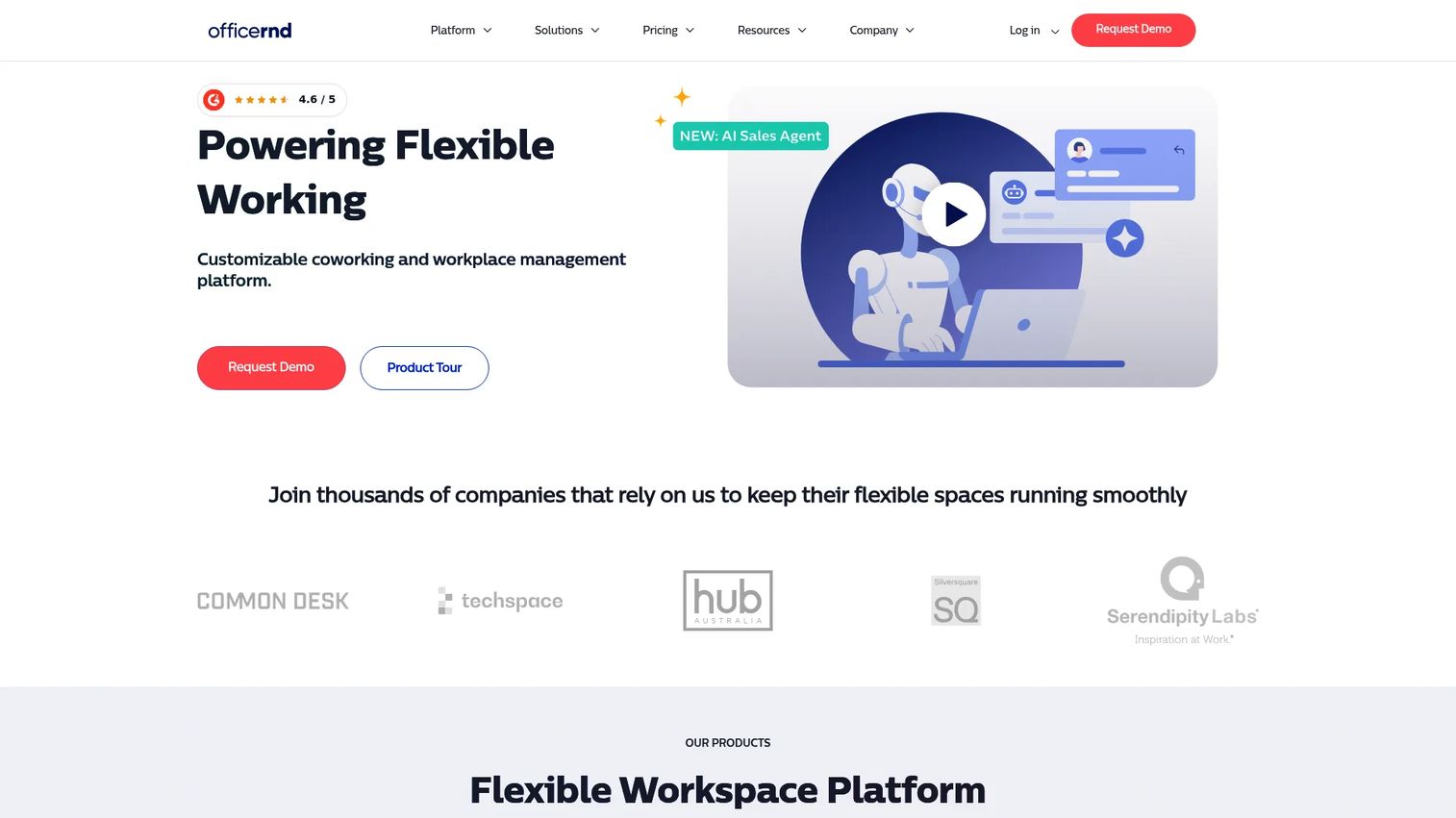
OfficeRnD is software for managing coworking and flex spaces alongside workplace booking. It offers a broad feature set spanning bookings, memberships, billing, and analytics, which makes it a balanced choice for operators who want growth-ready workflows and operational visibility as they scale.
Best for: Coworking operators and workplaces needing bookings, memberships, and space management.
Key features
- Desk and meeting room bookings
- Memberships, contracts, billing, and payments
- Interactive office maps, analytics, and workplace policies
Why choose OfficeRnD: OfficeRnD balances breadth with reporting depth. If you need memberships, contracts, billing, and analytics in one place and expect to grow across locations, its feature coverage and workplace policies support that without forcing a narrow use case.
OfficeRnD pricing: The Flex Start plan starts from $185 per month, Professional from $532 per month, and Enterprise is custom. Annual billing shows lower starting prices, and the pricing page notes volume discounts and add-ons.
OfficeRnD holds a 4.6/5 rating on G2.
7. Coworks
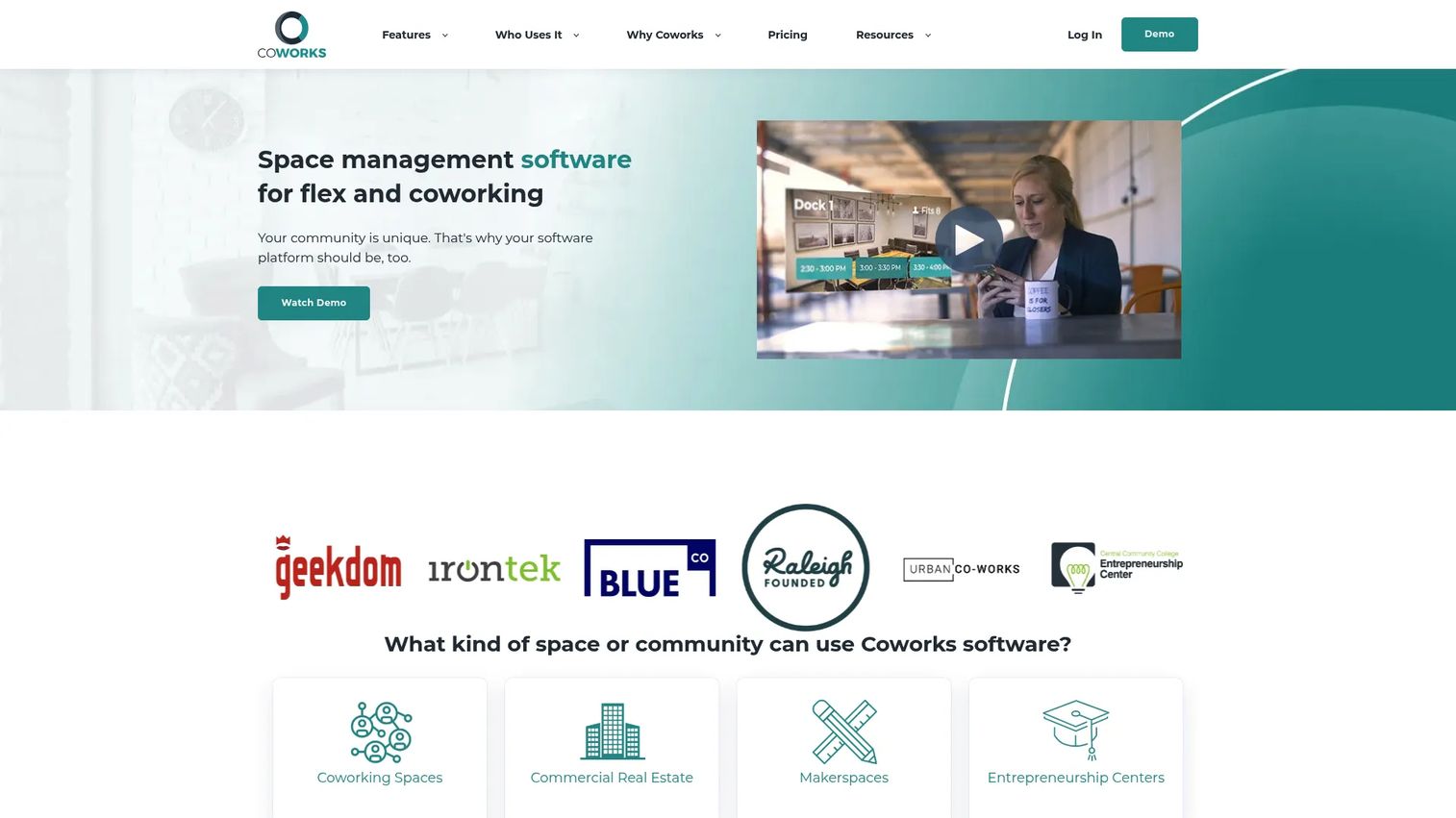
Coworks is coworking space management software for flex spaces, coworking operators, and incubators. It focuses on the essentials: a member app, room and equipment booking, automated billing, and reporting, without the overhead of an enterprise platform. That makes it a practical pick for leaner operations.
Best for: Coworking, flex space, and incubator operators needing space management software.
Key features
- Member mobile app
- Room and equipment booking
- Automated billing, event management, and analytics
Why choose Coworks: Coworks fits teams that want booking, billing, and member management handled cleanly without paying for capabilities they will not use. It is a good match when you want a member app and core operations, not a configuration-heavy suite.
Coworks pricing: On yearly billing, Hybrid Workspace is $149 per month and Coworking Premium is $249 per month. On monthly billing, Hybrid Workspace is $199 per month and Coworking Premium is $299 per month. Enterprise is custom pricing.
Coworks holds a 5.0/5 rating on G2, though from a small number of reviews.
Considerations
Before you commit, pressure-test each platform against the workflows that actually create admin load.
Billing and invoicing complexity
Recurring memberships are the easy part. The real test is edge cases: mid-cycle upgrades, proration, failed payments, and cancellations. Ask how the system handles a member who downgrades on the 14th, and whether refunds and credits are automatic or manual. This is where hours quietly disappear.
Booking rules and resource types
Not all bookings are equal. Hot desks, dedicated desks, meeting rooms, and equipment each need different rules, limits, and permissions. Verify the platform can enforce member-specific booking allowances and prevent double-bookings without staff intervention. Weak booking logic pushes conflict resolution back onto the front desk.
Member portal and brand experience
A member portal is a retention tool, not a convenience. Check whether the portal and mobile app are white-label or carry the vendor's branding, and whether members can self-serve booking, billing, and access. The less members email you, the more the software is earning its cost.
Integrations and automation
Your workspace software sits in a stack. Confirm native integrations and API access for accounting, access control, and CRM tools you already run. Then ask what automation is built in versus what requires a third-party connector. Integration gaps become manual data entry.
Admin usability and support
The best feature set fails if the admin experience is painful or onboarding drags. Evaluate how long setup takes, how responsive support is, and whether day-to-day tasks take three clicks or thirteen. Usability compounds: small friction, repeated daily, is where admin drag lives.
Conclusion
The right shared workspace software depends on what your operation prioritizes. Spacebring leads for operators who want automation across the full workflow. Yardi Kube fits teams wanting one unified, all-in-one platform. Optix is the pick for automation-first, mobile-driven booking. Nexudus stands out for white-label, multi-site brand control. OfficeRnD balances breadth and reporting for growth-ready teams. Archie and Coworks keep things practical for simpler operations without enterprise overhead.
Start by naming your biggest source of admin drag, whether that is billing edge cases, booking conflicts, or member support volume. Shortlist two or three platforms that solve that first, then run trials against your real workflows rather than a feature list. The tool that removes the most manual work wins.
And if part of your job is showing your space or your product to prospects, the same show-don't-tell logic applies. You can share interactive walkthroughs that let people experience it themselves.
Start your journey with Guideflow today!
Start your journey with Guideflow today!
FAQs
Coworking software is a subset of workspace management software focused on flexible, membership-based spaces with community, billing, and member portals. Workspace management software is broader and often covers corporate desk booking, room scheduling, and hybrid office use. In practice, most coworking management software tools now handle both flexible and hybrid workspace operations.
Spacebring, OfficeRnD, and Coworks all automate recurring billing and invoicing, and Yardi Kube brings automated invoicing with online payments. The better question is how each handles edge cases like proration, mid-cycle changes, and failed payments. Test those specific scenarios during a trial, since that is where billing admin actually piles up.
Most operators need booking and resource management, membership and contract handling, automated billing, a member portal or mobile app, and integrations with accounting and access control. Reporting and analytics matter as you scale across locations. The priority order depends on your biggest source of manual work, so map features to your actual admin drag before comparing tools.
Several do. Nexudus is known for deep white-label branding across member touchpoints, which suits multi-site operators who want a consistent brand. Spacebring, Optix, OfficeRnD, and Coworks also offer member portals and apps, though white-label depth varies by plan. Confirm exactly what is brandable and at which pricing tier before committing.
Very, if you want to avoid manual data entry. Integrations with accounting software keep revenue reconciled automatically, and access control integrations let member status drive door access without staff intervention. Nexudus advertises 60+ native integrations, while others focus on core connectors and an API. Confirm the specific tools you already run are supported natively.
Coworks and Archie suit smaller or simpler operations well, since they cover core booking, billing, and member management without enterprise overhead. Coworks starts at $149 per month on yearly billing, and Archie uses per-desk pricing that scales with actual usage. For very small spaces, match the entry plan's included limits to your member count.
Start with your biggest admin bottleneck, then shortlist two or three tools that solve it directly. Run trials against your real billing, booking, and member workflows rather than a feature checklist. Confirm pricing including add-ons, verify the integrations you depend on, and test the admin experience for daily tasks. The platform that removes the most manual work is the right one.