


You are evaluating an enterprise chatbot platform while juggling a stack you are actively trying to shrink. Every vendor calls itself "AI-powered." Every demo looks the same. And the question your CFO keeps asking is the one most vendor pages dodge: what does this actually replace, and what pipeline or deflection does it produce?
That pressure is not imagined. According to a Gartner survey published in December 2024, 85% of customer service leaders planned to explore or pilot a customer-facing conversational generative AI solution in 2025. Gartner also predicts that by 2028, at least 70% of customers will use a conversational AI interface to start their customer service journey. The category is not a side experiment anymore. It is becoming the front door.
The problem is that "enterprise chatbot" now spans everything from a scripted FAQ widget to an agentic system that completes multi-step workflows, integrates with your CRM and ERP, and reports on pipeline influence. Those are not the same purchase. A support leader wants ticket deflection. A demand gen lead wants qualified leads routed into Salesforce. A RevOps team wants both, under one security review, without adding a sixth tool nobody adopts.
This guide treats enterprise chatbots through the lens you actually buy with: integration depth, security and compliance, AI agent capability, and measurable business impact. Not just support deflection, but the full funnel from acquisition to activation to retention. Below, 10 platforms compared on features, integrations, security, and pricing so you can build a defensible shortlist in one sitting.
What's inside
This guide is for growth and demand gen marketers, CX and support leaders, and RevOps teams evaluating enterprise chatbot solutions for support automation, lead capture, and lifecycle workflows. We selected the 10 platforms below against four criteria that decide enterprise deals:
- Enterprise integrations: native connectors to CRM, ERP, ticketing, and knowledge bases.
- Security and compliance: SSO, SOC 2, data governance, and deployment flexibility.
- Omnichannel plus AI agent capability: voice, chat, social, and multi-step agentic workflows, not just scripted FAQs.
- Measurable business impact and pricing transparency: reporting tied to deflection, conversion, and pipeline, with pricing you can actually plan around.
TL;DR
Short on time? Here are the decision shortcuts by sub-segment:
- Best for large enterprises and agent orchestration: Kore.ai, for deep customization and multi-agent workflows at scale.
- Best for contact centers and voice: Cognigy (now part of NICE), recognized as a Leader in the 2026 Forrester Wave for Conversational AI Platforms.
- Best for revenue and marketing teams: Drift, now under Salesloft, for conversational marketing, lead routing, and CRM-native pipeline.
- Best for regulated industries: Boost.ai, for governed self-service in banking, insurance, and public sector.
- Best for self-hosted and data sovereignty: Rasa, for developer control and on-prem deployment with a free developer edition.
- Best for a managed, done-for-you build: ChatBot.com, for no-code automation with a clear public price.
What is an enterprise chatbot platform?
An enterprise chatbot platform is an AI-powered conversational system that automates customer and employee interactions at scale, integrating with enterprise systems like CRM, ERP, ticketing, and knowledge bases under enterprise-grade security and governance.
The difference between a basic chatbot and an enterprise AI chatbot is not the chat window. It is everything behind it: integration depth, compliance posture, the ability to handle thousands of concurrent conversations, and reporting that connects to revenue and cost. Enterprise chatbots are bought by committees, reviewed by security, and measured by finance.
Key capabilities of enterprise chatbots
- NLP, NLU, and conversational AI: understand intent, context, and free-text input, not just keyword triggers, using natural language understanding (NLU) techniques.
- Omnichannel deployment: web, mobile, messaging, social, and voice from a single platform.
- Enterprise integrations: native connectors to Salesforce, HubSpot, ServiceNow, ticketing, and knowledge bases.
- Security, compliance, and SSO: SOC 2, GDPR, data residency, audit trails, and single sign-on.
- Analytics and reporting: deflection rate, CSAT, conversion, and pipeline influence in one view.
- AI agents for multi-step workflows: tool calling and autonomous task completion, not scripted responses.
- Human handoff: clean escalation to live agents with full conversation context.
Basic chatbot vs AI chatbot vs enterprise chatbot
What makes a platform "enterprise" is governance, scale, integration depth, and compliance. A basic bot answers fixed questions. An AI chatbot understands intent. A virtual agent completes tasks. An enterprise chatbot does all of that under security review and at the volume a global company demands.
| Type | What it does | Integration depth | Best fit |
|---|---|---|---|
| Basic chatbot | Answers scripted FAQs | Minimal | Simple, low-volume sites |
| AI chatbot | Understands intent and context | Moderate | Mid-market support and lead capture |
| Virtual agent | Completes guided tasks | Strong | Self-service automation |
| Enterprise chatbot | Automates interactions at scale with governance | Deep (CRM, ERP, ticketing, KB) | Regulated, high-volume, multi-channel orgs |
When to use an enterprise chatbot platform
Enterprise chatbots earn their place when manual conversation does not scale. Here are the three highest-value enterprise chatbot use cases for the marketer and RevOps reader.
Automate customer support and deflect repetitive tickets
The clearest win is 24/7 omnichannel resolution of repetitive questions before they reach an agent. Order status, password resets, billing questions, and "how do I" requests all deflect well. When a conversation gets complex, the bot hands off to a human agent with full context, so resolution stays fast and CSAT holds. For support teams, this shows up as lower average handle time and a smaller queue. Pairing deflection with knowledge base software ensures the bot pulls grounded, accurate answers from a single source of truth.
Capture and qualify leads across the funnel
A chatbot for enterprises is not only a support tool. On a landing page or pricing page, it becomes a top-of-funnel conversion surface that engages visitors, qualifies them with a few questions, and routes high-intent leads straight into your CRM. That ties chatbot activity to pipeline, not just ticket volume. When a qualified lead wants to see how the product works, a chatbot can route them to self-serve interactive demos so they evaluate at their own pace before a call. This is exactly where conversational marketing software shines, and reviewing your CRM software options ensures those leads route cleanly into pipeline. The result is better-qualified meetings and a shorter path from first touch to opportunity.
Streamline internal and employee self-service
Enterprise chatbots also work behind the firewall. HR onboarding questions, IT helpdesk tickets, and internal knowledge access all deflect through an employee-facing bot. New hires get answers without waiting on a person, and IT teams reclaim hours otherwise spent on repetitive resets and access requests. You can also reinforce internal adoption by building an interactive demo library that helps employees and customers understand your product. For more on connecting these motions to your wider stack, see our guide to marketing automation software.
Enterprise chatbot platforms compared
The table below summarizes all 10 platforms by buyer intent, primary use case, pricing, and current G2 rating. Many enterprise tiers are sales-gated, so where no public price exists we note that directly. Use this as your shortlist starter, then read the full sections for fit.
| # | Product | Intent | Key use case | Pricing | G2 rating |
|---|---|---|---|---|---|
| 1 | Kore.ai | Large-scale agent orchestration | Customer and employee AI agents | Custom (Enterprise) | 4.6/5 |
| 2 | Cognigy | Contact center automation | Voice and chat AI agents | Demo-led, custom | 4.6/5 |
| 3 | LivePerson | High-volume messaging care | Omnichannel conversational AI | Quote-based (Bronze/Silver/Gold) | 4.3/5 |
| 4 | Boost.ai | Governed self-service | Regulated-industry automation | Custom, contact sales | 4.7/5 |
| 5 | Freshworks | Support-suite-native bot | Helpdesk and CRM automation | From $9/user/mo (Freshsales) | 4.5/5 |
| 6 | Rasa | Developer control, data sovereignty | Self-hosted conversational AI | Free Developer Edition; Enterprise custom | 4.0/5 |
| 7 | Sprinklr | Unified CXM across social and care | Omnichannel customer experience | Talk to an expert | 4.2/5 |
| 8 | Drift | Conversational marketing and sales | Lead routing and pipeline | Contact Salesloft | 4.4/5 |
| 9 | Enterprise Bot | Contact center automation | Voice, chat, and agentic workflows | From $50/seat/mo | 4.7/5 |
| 10 | ChatBot.com | Managed no-code automation | Sales and service AI agents | From $19/user/mo | 4.5/5 |
The 10 best enterprise chatbot platforms for 2026
1. Kore.ai
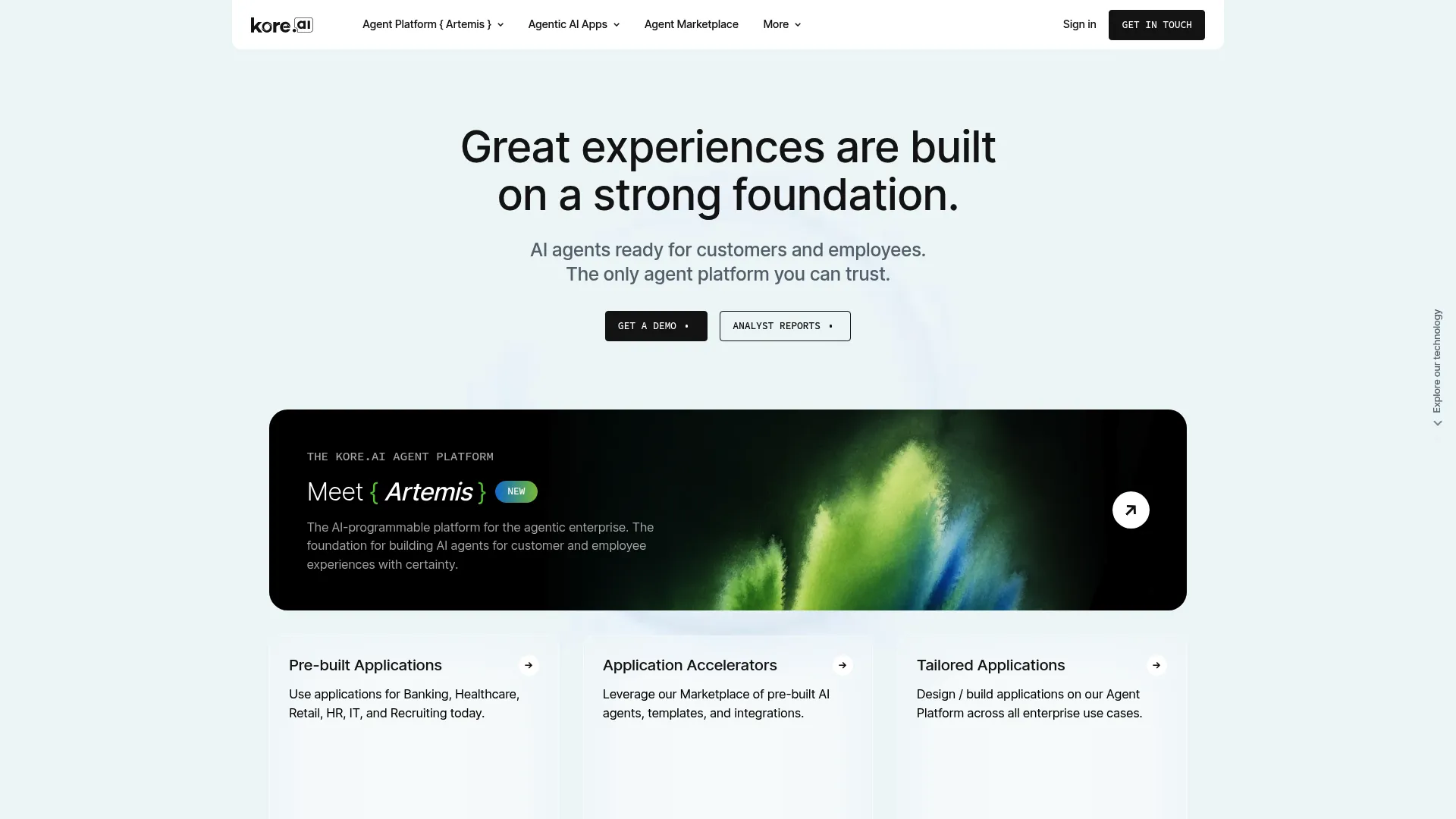
Kore.ai is an enterprise agentic AI platform for building, governing, and orchestrating AI agents across customer and employee experiences. It spans IT, HR, recruiting, and customer service workflows from one platform. The builder runs no-code to pro-code, so business teams and engineers can both ship. For large organizations that need depth and control, it is one of the most complete enterprise AI chatbot solutions on this list.
Best for: Large enterprises building and orchestrating AI agents across customer service and internal operations.
Key strengths
- No-code to pro-code builder: business users and developers work in the same platform without a rebuild.
- Enterprise search: answers pulled across files, apps, chats, and connected systems.
- Multi-agent orchestration: coordinates several AI agents through complex, multi-step workflows.
Why choose Kore.ai: If your roadmap goes beyond FAQ deflection into agentic workflows that touch multiple systems, Kore.ai is built for that scale. RevOps and CX teams running large support volumes get deep customization and governance in one place, which matters when consolidation and security review are both on the table. For teams exploring autonomous workflows, our roundup of AI orchestration platforms is a useful companion read.
Kore.ai pricing: Kore.ai's billing documentation lists Essential, Advanced, and Enterprise plans. The Enterprise plan uses custom pricing, and no public numeric starting price is published, so plan on a sales conversation to scope volume and deployment. Kore.ai holds a 4.6/5 rating on G2.
2. Cognigy
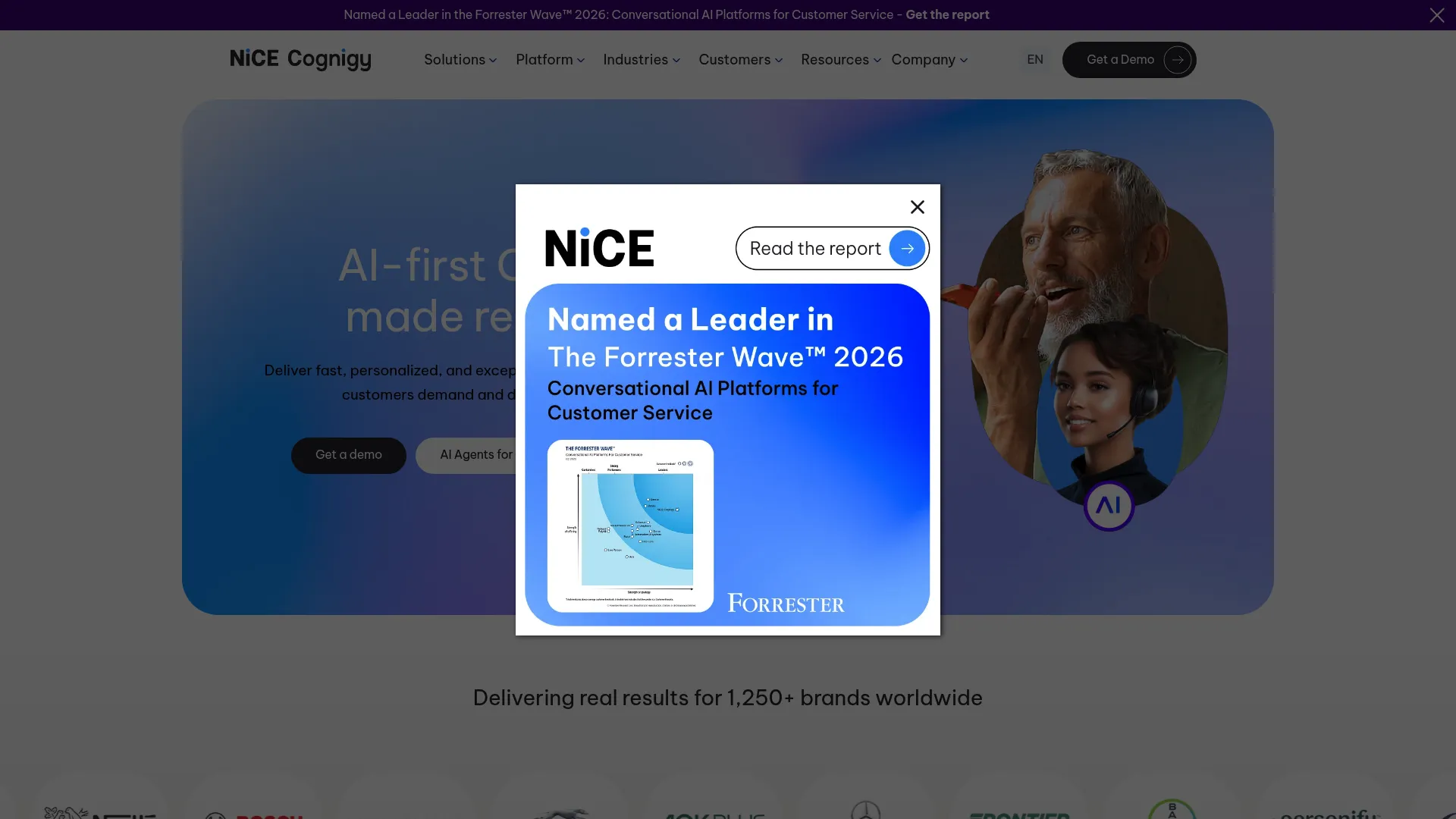
Cognigy, now part of NICE, is an AI-first customer experience platform for building, managing, and deploying AI agents in enterprise contact centers. It combines voice and chat across omnichannel journeys. Cognigy was named a Leader in the 2026 Forrester Wave for Conversational AI Platforms for Customer Service, which carries weight in enterprise procurement. For contact-center-heavy organizations, it is a strong enterprise AI chatbot solution.
Best for: Enterprise contact centers that need scalable AI agents across voice, chat, and agent assist.
Key strengths
- Agentic and hybrid AI: combines LLM-based reasoning with deterministic, rule-based automation for predictable outcomes.
- Low/no-code Agent Studio: teams collaboratively create, test, deploy, and manage AI agents.
- Knowledge AI with RAG: answers grounded in your enterprise knowledge sources, not generic responses, using retrieval-augmented generation (RAG).
Why choose Cognigy: Voice is where Cognigy stands apart. If your enterprise runs a serious contact center and needs AI agents that handle calls as well as chat, Cognigy's voice gateway and contact-center integrations are built for that load. The NICE backing and Forrester recognition give procurement a credible signal.
Cognigy pricing: Cognigy does not publish public pricing or plan names on its site, directing buyers to request a demo instead. Pricing is scoped to deployment and volume, so budget for an enterprise sales process. Cognigy holds a 4.6/5 rating on G2.
3. LivePerson
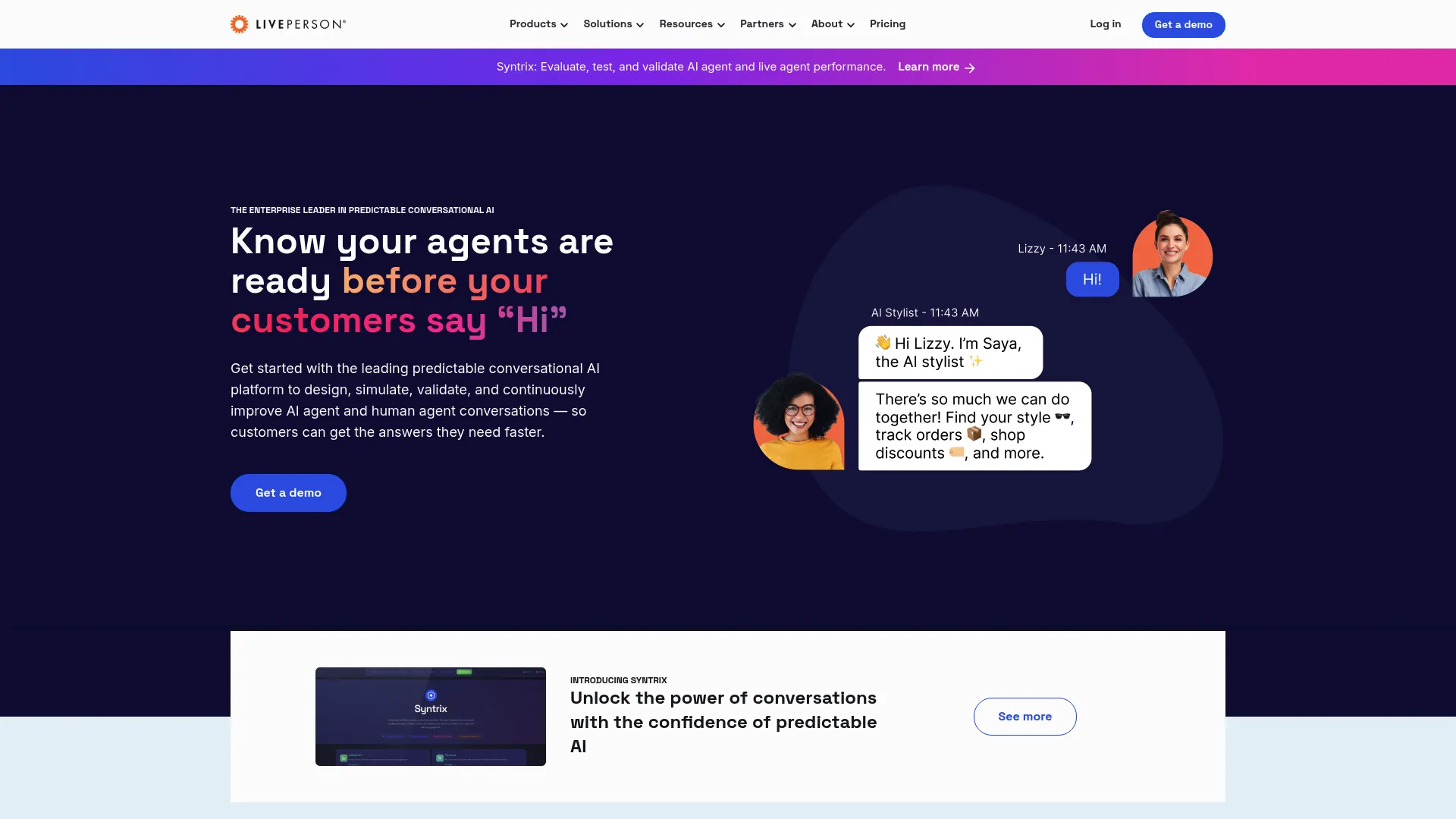
LivePerson is a conversational AI platform for orchestrating AI and human agents across customer messaging, voice, and digital channels. It is built for the realities of high-volume care. Its analytics surface intents and trends across millions of conversations. For consumer-facing brands managing massive message volume, it is a proven enterprise chatbot platform.
Best for: Large customer-facing enterprises that need omnichannel conversational AI with automation and analytics.
Key strengths
- Multi-channel agent workspace: cobrowse and secure forms inside one agent view.
- Conversation Builder: build bots across consumer messaging channels without starting over per channel.
- Conversational analytics: Report Center and Analytics Studio turn conversations into intent and performance data.
Why choose LivePerson: When your support and care volume runs into the millions of conversations, the bottleneck is orchestration between bots and humans. LivePerson is designed for that handoff at scale, and its intent analytics help CX leaders prove deflection and CSAT to the business.
LivePerson pricing: LivePerson packages plans as Bronze, Silver, and Gold, but its pricing page directs buyers to request a quote rather than showing base prices. Expect quote-based, volume-driven pricing. LivePerson holds a 4.3/5 rating on G2.
4. Boost.ai
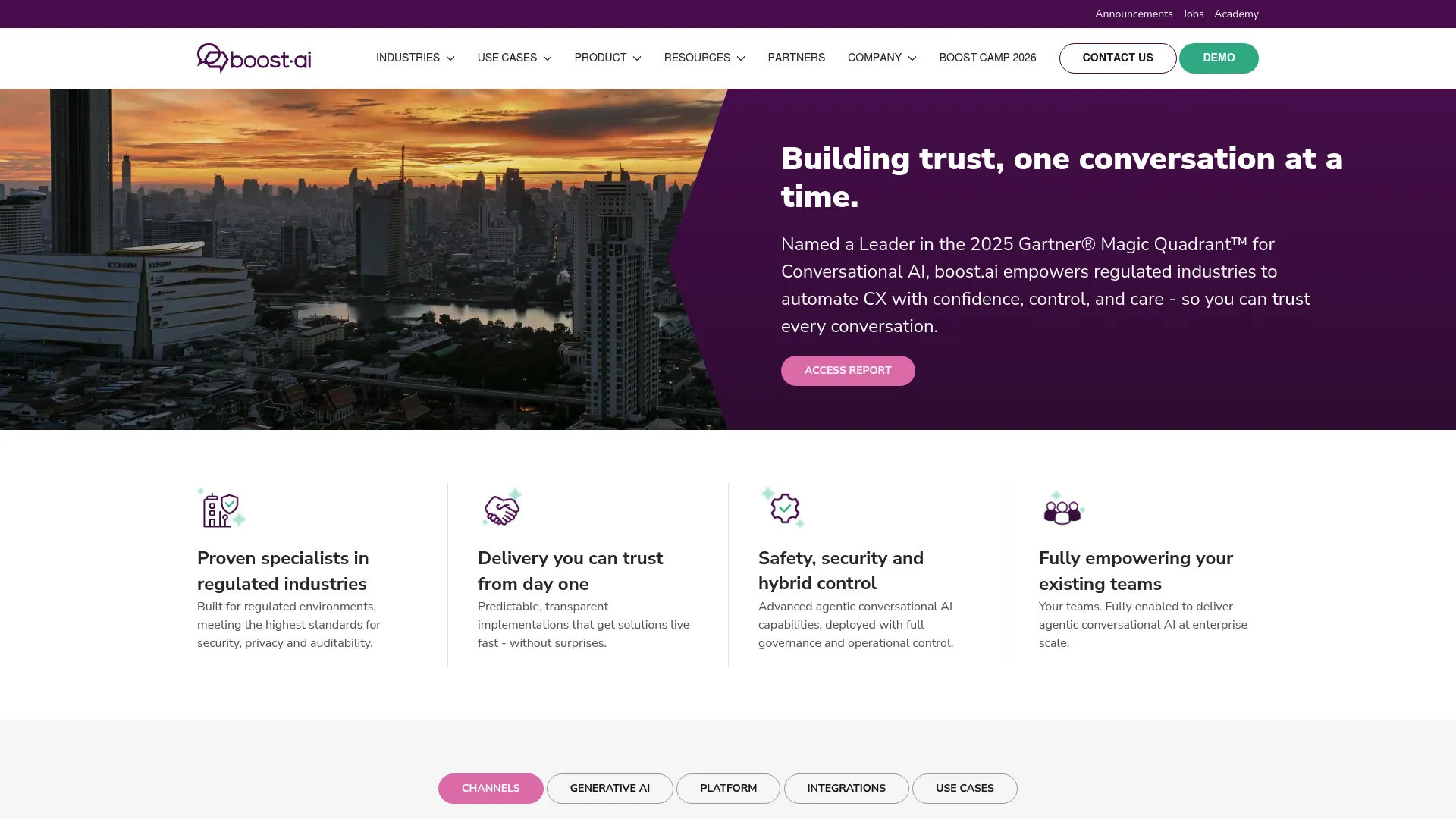
Boost.ai is an enterprise conversational AI platform for regulated industries, automating customer service and internal support across chat, voice, and messaging. Governance is the differentiator here. It pairs hybrid NLU with generative and agentic AI under strict controls. For banking, insurance, telecom, and public sector teams, it is a purpose-built enterprise AI chatbot solution.
Best for: Enterprises in regulated sectors that need governed conversational AI for customer service automation.
Key strengths
- No-code conversation builder: non-technical teams build and maintain AI agents.
- Hybrid NLU plus generative and agentic AI: control and flexibility without sacrificing predictability.
- Built-in guardrails and compliance controls: testing tools, analytics, and governance designed for regulated work.
Why choose Boost.ai: If you operate in financial services or insurance, the risk tolerance for an unpredictable bot is near zero. Boost.ai's guardrails, testing, and compliance posture are built for exactly that constraint, which is why banking and insurance case studies dominate its proof points.
Boost.ai pricing: Boost.ai does not publish public plan names or figures, scoping pricing to deployment and conversation volume through a contact-led sales process. Budget for a custom quote. Boost.ai holds a 4.7/5 rating on G2, the highest tie on this list.
5. Freshworks
Freshworks provides customer service, IT service, and CRM software supercharged with generative AI. Its chatbot capability is native to a wider support and sales suite, which is the draw. Freddy AI runs across contact scoring, sales emails, deal insights, and self-service. For teams standardizing on one suite, it removes the integration tax of bolting a bot onto a separate helpdesk.
Best for: Sales and support teams at startups, SMBs, and mid-market companies that want an AI-powered suite rather than a standalone bot.
Key strengths
- Suite-native CRM: contacts, accounts, and deals managed in Kanban views alongside the bot.
- Built-in chat, email, and phone: omnichannel engagement without separate tools.
- Freddy AI: contact scoring, sales emails, deal insights, and forecasting in one assistant.
Why choose Freshworks: The value here is consolidation. If you are already on, or considering, the Freshworks suite, the chatbot, helpdesk, and CRM share data natively, which answers the "what does this replace?" question directly. That tight coupling is exactly what a mid-market team trimming tools wants.
Freshworks pricing: Freshworks publishes clear pricing for its Freshsales CRM. A Free plan covers up to 3 users, then Growth is $9 per user per month, Pro is $39, and Enterprise is $59, all billed annually. A free plan and the lowest public entry point on this list make it easy to start. Freshsales holds a 4.5/5 rating on G2.
6. Rasa
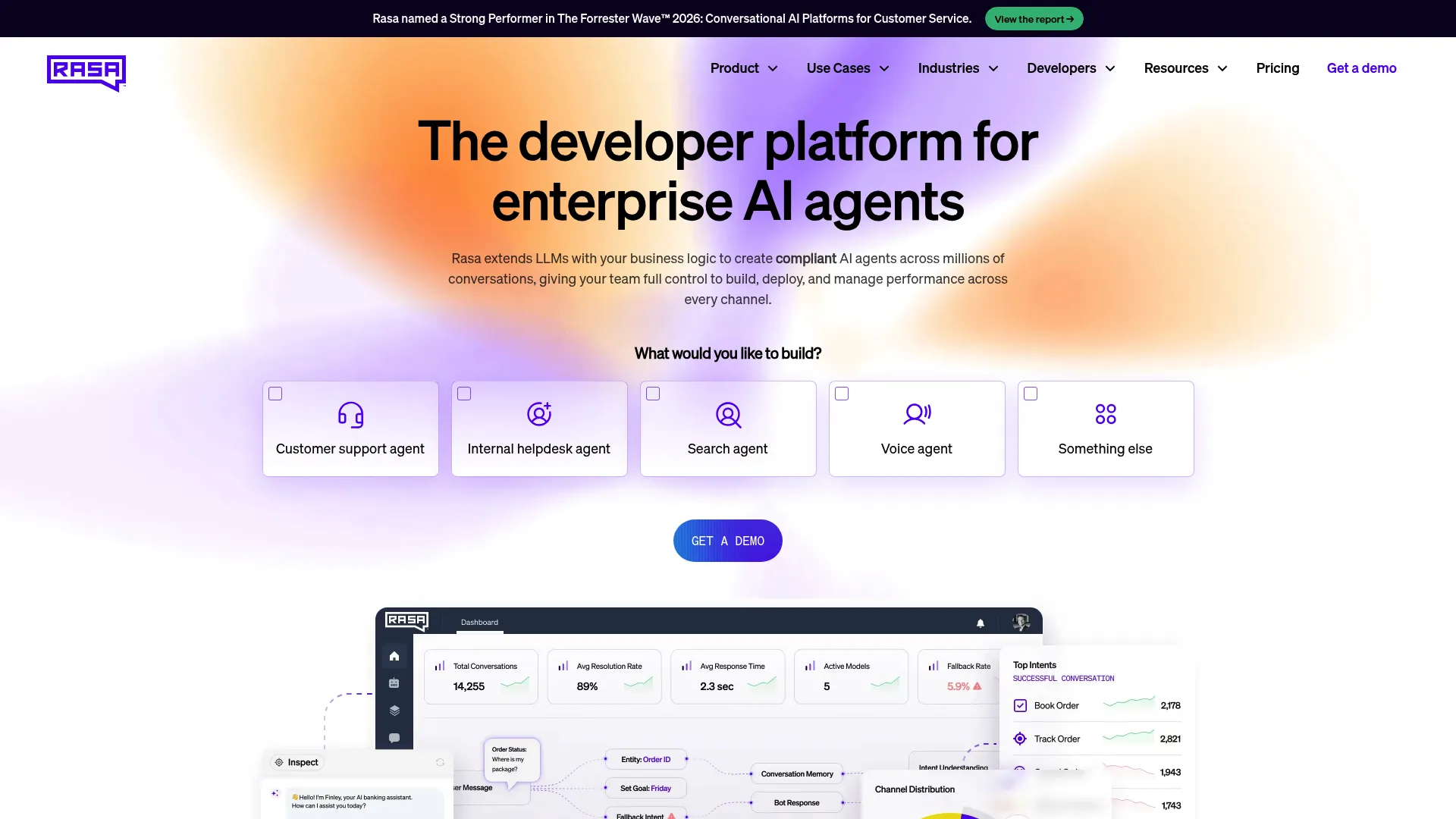
Rasa is a developer platform for enterprise AI agents that extends LLMs with business logic to build, deploy, and manage reliable conversational agents across channels. Control and data sovereignty are its core promise. It runs on-premises, in private cloud, or air-gapped. For engineering teams that need to own their stack, it is the most flexible enterprise chatbot platform here.
Best for: Enterprises and developer teams building controllable, production-scale conversational AI with custom deployment and governance needs.
Key strengths
- Patented dialogue management: reliable control over enterprise AI agent conversations.
- Flexible deployment: on-premises, private cloud, and air-gapped options for data sovereignty.
- Multi-agent orchestration: shared conversational state and clean handoffs between agents.
Why choose Rasa: When data residency and full control are non-negotiable, hosted-only platforms get ruled out fast. Rasa lets engineering teams deploy on their own infrastructure while Rasa orchestrates, which is why it fits enterprises with strict sovereignty or air-gapped requirements.
Rasa pricing: Rasa offers a Free Developer Edition with one bot per company and up to 1,000 external conversations per month, ideal for evaluation and early builds. The Enterprise plan provides full platform access and premium support through a contact-sales process, with no public numeric price. Rasa holds a 4.0/5 rating on G2.
7. Sprinklr
Sprinklr is an AI-native Unified-CXM platform for enterprise customer-facing teams across service, social, insights, marketing, and customer experience. Breadth is its differentiator. Conversational AI sits inside a platform that also runs social and care across 30+ channels. For enterprises consolidating social and support, it is a unifying enterprise chatbot solution. If social is a core channel for you, our list of social media management tools is worth a look alongside it.
Best for: Large enterprises that want one AI-native platform for omnichannel customer experience, social, and service.
Key strengths
- Unified-CXM platform: service, social, marketing, and insights in one AI-native system.
- Social media management: listening, publishing, engagement, advertising, and advocacy together.
- Contact center platform: support across 30+ voice, social, and digital channels.
Why choose Sprinklr: If your conversations span support tickets and social mentions, running them in separate tools creates blind spots. Sprinklr's breadth lets enterprises unify social and care under one platform, which is the consolidation story a large CX org is usually after.
Sprinklr pricing: Sprinklr's pricing pages direct buyers to talk to an expert and do not display public figures or plan tiers, consistent with enterprise platform packaging. Plan for a scoped quote based on modules and seats. Sprinklr holds a 4.2/5 rating on G2.
8. Drift
Drift, now part of Salesloft, is a conversational AI and chat agent platform for engaging website visitors, qualifying leads, routing buyers, and booking meetings in real time. This is the one built for revenue teams. It treats the chat window as a pipeline surface, not a support queue. For demand gen and RevOps, it is the most directly marketing-aligned enterprise chatbot platform on this list.
Best for: B2B revenue, sales, and marketing teams that want AI-powered website chat to qualify visitors and accelerate pipeline.
For the growth marketer: Drift maps cleanly to the funnel. It engages traffic you already paid for, qualifies it against your ICP, routes high-intent buyers to the right rep, and books meetings without a form-fill delay. The metric it moves is pipeline influenced and meetings booked, the numbers your CFO already tracks.
Key strengths
- AI chat agents: real-time website visitor engagement and lead qualification.
- Conversational AI: open-text answers, multilingual support, GPT suggested replies, and translations.
- Lead routing and meeting booking: high-intent buyers routed through Engage and Fastlane.
Why choose Drift: If your problem is converting traffic into qualified pipeline rather than deflecting tickets, Drift is built for that motion. Sitting inside the Salesloft revenue platform, it ties conversational engagement to the rest of the buyer journey, which is what makes it the standout pick for the marketer and RevOps persona. To pair conversational capture with broader outbound and engagement, browse our sales engagement tools comparison.
Drift pricing: Salesloft's pricing page does not display public numeric prices or Drift-specific plan names, directing buyers to contact Salesloft for a quote. Expect a custom, revenue-platform-oriented conversation. Drift holds a 4.4/5 rating on G2.
9. Enterprise Bot
Enterprise Bot provides AI-powered conversational automation for contact centers across voice, chat, email, agent assist, and agentic workflows. Multilingual breadth and end-to-end automation are its strengths. It connects to CRM, CCaaS, and backend systems for real transactions. For global enterprises with voice and multilingual needs, it is a capable enterprise AI chatbot solution.
Best for: Enterprise contact centers that need secure AI automation across voice, chat, email, agent assist, and workflow orchestration.
Key strengths
- Voice, chat, and email automation: omnichannel customer journeys from one platform.
- Agent assist: real-time guidance, live transcription, automated summaries, and wrap-ups.
- Agentic AI: end-to-end workflow automation across connected systems.
Why choose Enterprise Bot: If you operate across regions and languages, the multilingual support and deep integrations into CRM and CCaaS reduce the custom work of going global. Enterprise security features like audit trails, RBAC, and flexible SaaS or on-prem deployment make it a safe pick for procurement.
Enterprise Bot pricing: Enterprise Bot publishes cloud pricing starting at $50 per seat per month for Live Chat Only, with AI Basic at $450 per month and AI Starter at $1,000 per month. AI Scale-up and AI Enterprise tiers are quoted directly through sales. Enterprise Bot holds a 4.7/5 rating on G2, tied for the highest here.
10. ChatBot.com
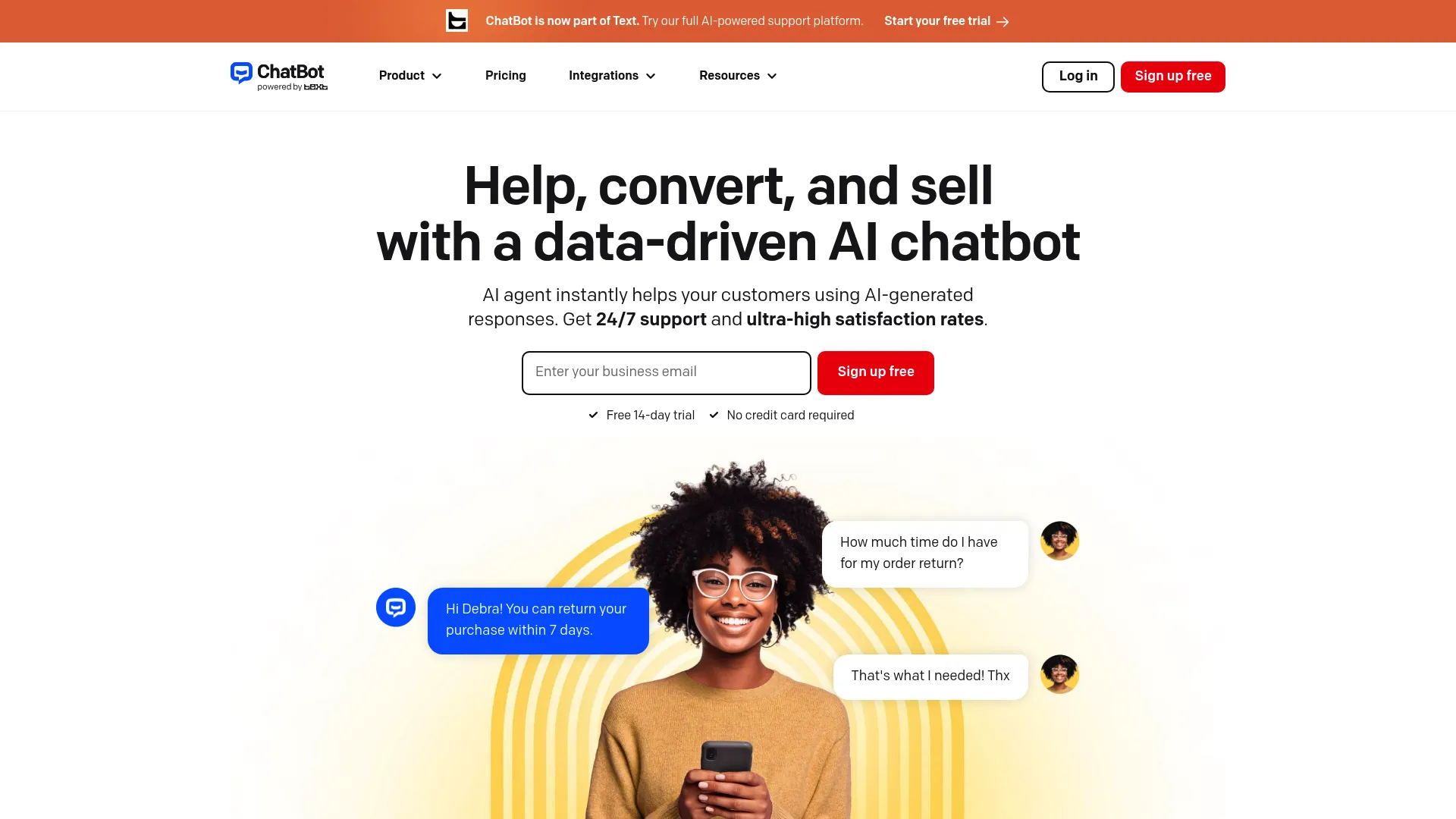
ChatBot.com, part of Text, is an AI-powered customer service and sales automation platform with AI agents, live chat, ticketing, workflows, and integrations. Its appeal is a no-code, managed approach with transparent pricing. It trains on your knowledge hub and hands off to humans when needed. For teams wanting a done-for-you build with a clear entry price, it is the most accessible enterprise chatbot platform on this list.
Best for: Teams that want AI-powered customer service automation with live chat, ticketing, workflows, and human handoff.
Key strengths
- AI agent: automates sales and customer service conversations without scripting every path.
- Custom training: instructions plus a knowledge hub ground the bot in your content.
- Live chat automation: human handoff, lead generation, and cross-sell or upsell messaging.
Why choose ChatBot.com: If you want to launch without an engineering project and know your monthly cost up front, ChatBot.com's no-code build and public pricing remove two common blockers. It fits teams that want automation and lead capture without committing to a long enterprise procurement cycle first.
ChatBot.com pricing: ChatBot.com publishes clear pricing. Essential starts at $19 per user per month billed yearly ($25 monthly), Growth is $79 per user per month billed yearly ($99 monthly), and Enterprise is custom. All plans include a 14-day free trial, though there is no permanent free tier. ChatBot.com holds a 4.5/5 rating on G2.
How to choose an enterprise chatbot platform
A shortlist is only useful if you score it against criteria that survive procurement. Run every candidate through these five checks before you commit.
Integration depth
Confirm the platform connects natively to your CRM, ERP, ticketing, knowledge base, and marketing automation, not just through a generic API you will have to staff. Native connectors to Salesforce, HubSpot, and ServiceNow save weeks of build time. Ask which integrations are native versus custom, because that gap is where implementation budgets quietly grow.
Security and compliance
Enterprise procurement gates on SOC 2, GDPR, SSO, data residency, and audit trails. For regulated industries, on-prem or self-hosted deployment may be mandatory, not optional. Verify the compliance posture early, before you fall for a demo, since a failed security review kills a deal faster than any feature gap. It helps to understand what enterprise-grade security and compliance actually looks like in practice.
AI agent and workflow capability
Distinguish FAQ deflection from true agentic capability. Can the platform handle multi-step workflows with tool calling and autonomous task completion, or does it only answer scripted questions? Gartner predicts agentic AI will autonomously resolve 80% of common customer service issues by 2029, so buying for that trajectory now protects your investment.
Measurable business impact
The platform should report on deflection rate, conversion, and pipeline influence, not just chat volume. Tie those metrics to CAC and activation so finance sees the return. If a vendor cannot show you a dashboard that connects conversations to revenue or cost saved, treat that as a flag.
Pricing and total cost
Pricing models vary widely: per-seat, per-conversation usage, or flat enterprise contracts. Factor in implementation, managed-service, and maintenance costs, which often exceed the license. Most importantly, identify what the platform consolidates, because replacing two tools changes the ROI math your CFO will run.
Conclusion
The right enterprise chatbot platform depends on the job you are buying for, not on which vendor markets the loudest.
- For revenue and marketing teams, Drift, under Salesloft, is the clearest fit for lead routing, qualification, and pipeline influence.
- For contact-center scale and voice, Cognigy carries Forrester Leader recognition and deep voice capability.
- For data sovereignty and developer control, Rasa offers on-prem deployment and a free developer edition to start.
- For regulated industries, Boost.ai brings governance built for banking and insurance.
- For a managed, public-priced build, ChatBot.com lets you launch without an engineering project.
- For large-scale agent orchestration, Kore.ai handles multi-agent workflows across customer and employee operations.
The next step is not to keep researching. Shortlist two or three platforms that map to your top use case, then run a scoped pilot against a single, measurable goal: deflection rate, qualified leads routed, or meetings booked. Score the pilot against the five criteria above, and let the numbers, not the demo, decide your enterprise chatbot solution.
FAQs
An enterprise chatbot platform is an AI-powered conversational system that automates customer and employee interactions at scale, integrating with enterprise systems like CRM, ERP, ticketing, and knowledge bases under enterprise-grade security and governance. Unlike a basic chatbot that answers fixed questions, an enterprise platform handles high conversation volume, passes security review, and reports on business impact like deflection and pipeline.
Pricing varies widely. Some vendors publish clear figures, such as ChatBot.com from $19 per user per month or Freshworks Freshsales from $9 per user per month billed annually. Many enterprise platforms, including Kore.ai, Cognigy, LivePerson, Sprinklr, Boost.ai, and Drift, gate pricing behind a sales conversation scoped to volume and deployment. Factor in implementation and managed-service costs, which often add up beyond the license itself.
A regular chatbot answers scripted questions on a single channel with little integration. An enterprise chatbot operates at scale across many channels, connects deeply to CRM, ERP, ticketing, and knowledge bases, and meets security and compliance requirements like SOC 2, GDPR, and SSO. The biggest difference in 2026 is AI agent capability: enterprise platforms increasingly complete multi-step workflows, not just answer FAQs.
For lead generation, Drift, now part of Salesloft, is the strongest fit because it is built as a conversational marketing and sales tool. The criteria that matter for marketing teams are CRM-native integration, automated lead routing, and pipeline reporting. Look for a platform that qualifies visitors against your ICP, routes high-intent buyers to the right rep, and ties chatbot activity to pipeline rather than ticket volume.
Yes. Most enterprise chatbots integrate with CRM and ERP systems through native connectors or APIs. Common integrations include Salesforce, HubSpot, and ServiceNow, plus ticketing systems and knowledge bases. When evaluating, confirm which integrations are native versus custom-built, because native connectors save significant implementation time and reduce ongoing maintenance.
Enterprise-grade platforms typically support SOC 2, GDPR, SSO, data residency, and audit trails as standard. For regulated industries like banking and insurance, several vendors, including Rasa, offer self-hosted, on-premises, or air-gapped deployment for full data sovereignty. Always verify the specific compliance posture during evaluation, since a failed security review can stop a deal regardless of features.
AI agents are the 2026 evolution of chatbots. Where a scripted chatbot returns fixed answers, an AI agent handles multi-step workflows, calls external tools, and completes tasks autonomously. Gartner predicts agentic AI will autonomously resolve 80% of common customer service issues by 2029. When evaluating platforms, check whether they offer true agentic workflows or only FAQ deflection.
Tie measurement to metrics your finance team believes: deflection rate, CSAT, conversion and lead capture, pipeline influence, and cost-per-resolution. For support, lower average handle time and ticket volume show savings. For marketing, qualified leads routed and meetings booked show pipeline impact. The best platforms report these in a dashboard that connects conversations directly to revenue or cost saved.