

Your front desk juggles a scheduling app. Your clinicians write notes in one system and bill in another. Intake forms live in a fourth tool, and telehealth links get pasted into email by hand.
Every one of those seams is where a client falls through, a claim gets missed, or a therapist loses twenty minutes they should have spent with a patient.
The stakes are getting higher. The global behavioral and mental health software market is forecast to grow from $7.49 billion in 2025 to $30.62 billion by 2034, a 16.98% CAGR, according to Precedence Research (2024). More practices are moving off spreadsheets and sticky notes and onto a single system. If you run a counseling practice, the question is no longer whether to consolidate. It is which platform actually reduces the manual work instead of adding a new tab.
That is the operator's lens this guide uses. Not "which tool has the most features," but which one gives you repeatable workflows, cleaner visibility, and fewer handoffs.
What's inside
This guide covers the best counseling software for 2026, ranked for practice owners and operators who care about workflow, not feature checklists.
We selected tools on five criteria:
- All-in-one coverage: scheduling, intake, clinical notes, billing, and telehealth in one system
- HIPAA readiness: compliance, hosting, and access controls
- Ease of use: how fast staff and clients actually adopt it
- Pricing transparency: whether you can see real numbers before a sales call
- Fit by practice type: solo therapists, group practices, and counseling centers
It is useful whether you are a solo therapist, a behavioral health clinic, or a multi-clinician group practice.
TL;DR
- Best overall for most practices: SimplePractice. Broad practice management software with strong onboarding and a polished client experience.
- Best for deep billing, notes, and portal workflows: TherapyNotes. Operations-first counseling EHR software with AI notes and ePrescribe.
- Best for automation and operational speed: TherapyAppointment. Mental health EMR built around reminders, auto-billing, and client messaging.
- Best for counseling centers and supervision-heavy orgs: Medicat. Purpose-built for campus and institutional behavioral health software needs.
- Bottom line: all four cover the same core jobs. Each wins in a different operating model, so match the tool to your practice, not the other way around.
What is counseling software?
Counseling software is a category of EHR, EMR, and practice management software built specifically for mental and behavioral health practices. It combines clinical documentation, scheduling, billing, and client communication in one HIPAA compliant system, so a practice can run intake through payment without stitching together separate tools.
The terms overlap a lot. A counseling EHR software platform, a mental health EMR, and a therapy software suite usually describe the same thing: one system that handles both the clinical record and the business operations of a practice.
Here are the core jobs counseling software handles:
- Scheduling and reminders: calendar management, self-booking, and appointment reminders
- Intake and client forms: digital intake forms, consent, and assessments
- Clinical notes and documentation: progress notes, treatment plans, and note templates
- Billing and insurance: claims, superbills, statements, and client self-service payments
- Telehealth: built-in video sessions tied to the client record
- Client portal: a self-serve space for scheduling, forms, messaging, and payments
- HIPAA and security: encryption, access controls, and auditability
- Reporting and analytics: revenue, clinician utilization, and operational visibility
Get these under one roof and the practice stops leaking time at every handoff.
When to use counseling software
When you need one system instead of five
Stitching together a scheduling app, a billing tool, a notes doc, and an intake form generator feels cheap at first. Then a client books a session that never makes it into the billing system. A note gets written but the claim never goes out.
Every separate tool is a manual handoff, and every handoff is a place work gets dropped. Counseling software collapses those handoffs into one workflow. Book the session, the record updates, the claim queues, the note attaches. That is the operational repeatability practice owners are actually buying.
When you want to reduce admin load
Front-desk staff spend hours on tasks that software can automate: sending appointment reminders, chasing intake forms, posting payments, generating statements.
Automation around reminders, intake, note templates, and payment workflows gives that time back. Clinicians spend less time on documentation and more on clients. The front desk stops playing phone tag over paperwork. For a growing practice, that recovered time is the difference between hiring another admin and not needing to.
When compliance and visibility matter
HIPAA is not optional in behavioral health. Neither is knowing where your revenue actually comes from.
A real counseling system gives you HIPAA compliant hosting, access controls, and an audit trail, plus reporting that shows clinician utilization, no-show rates, and revenue by service. For an owner, the software choice is also a process-control decision. You are choosing how clean your operations, your compliance posture, and your numbers will be.
Comparison table
Use this table to narrow the shortlist fast. All four platforms handle the core jobs. The difference is the operating model each one fits best, so read "best for" as the deciding column.
| # | Product | Best for | Key differentiator | Pricing | G2 rating |
|---|---|---|---|---|---|
| 1 | SimplePractice | Solo and group practices wanting a broad, polished platform | All-in-one practice management with strong onboarding and client experience | From $24.50/mo (intro), then $49/mo | 4.1/5 |
| 2 | TherapyNotes | Practices that prioritize billing accuracy and clinical notes | Deep billing, documentation, and portal workflows with AI notes | From $69/mo | 4.4/5 |
| 3 | TherapyAppointment | Practices wanting automation and operational speed | Workflow automation around reminders, auto-billing, and messaging | From $10/mo | 4.2/5 |
| 4 | Medicat | Counseling centers and institutional or campus orgs | Structured workflow, supervision, and compliance for larger orgs | Custom pricing | Not listed |
Best 4 counseling software tools for 2026
1. SimplePractice

SimplePractice is all-in-one practice management and EHR software for therapists and wellness professionals. It handles scheduling, documentation, billing, telehealth, and a client portal in one place, and it is one of the most widely adopted platforms in the category. The pull is breadth plus polish: a broad feature set wrapped in an interface that solo practitioners and front-desk staff pick up quickly.
Best for: solo and group practices that want a broad, polished platform rather than a narrowly specialized system.
Key strengths
- Scheduling software with online booking and appointment reminders
- Clinical notes, treatment plans, and documentation templates
- Billing and insurance claims plus client self-service payments
- Built-in telehealth tied to the client record
- Practice-branded client portal for forms, scheduling, and messaging
- Mobile app for on-the-go access
- Credentialing support to help clinicians get on insurance panels
Why choose SimplePractice: it is the safe default when you want one platform that covers the whole practice and gets adopted without a heavy rollout. Where it stands out is the balance of range and usability, plus a smooth path from free trial to daily use. If your priority is broad coverage over deep specialization in any single area, this is the pick.
SimplePractice pricing: three paid plans are available. Starter runs $24.50/month for the first three months, then $49/month billed monthly. Essential is $39.50/month for three months, then $79/month. Plus is $49.50/month for three months, then $99/month. A 30-day free trial is available, and you can choose a plan later at standard pricing.
2. TherapyNotes

TherapyNotes is a behavioral health EHR and practice management platform for therapists, counselors, psychologists, psychiatrists, and social workers. It leans operations-first, with deep billing, clinical documentation, and portal workflows. If your practice lives or dies by claim accuracy and clean notes, this is where the depth shows.
Best for: practices that care most about billing accuracy, clinical notes, and front-to-back office efficiency.
Key strengths
- Integrated scheduling with a shared to-do list
- Customizable clinical note templates and documentation
- Billing, claims, payments, and statements
- Practice-branded client portal with secure messaging
- TherapyFuel AI notes to speed documentation
- Telehealth and ePrescribe available as add-ons
- Mobile app and outcome measures
Why choose TherapyNotes: the module depth is the draw. Billing, documentation, and the portal all run under one roof with enough control for practices that treat operations as a discipline. It fits buyers who want depth and are comfortable running a more operational platform day to day.
TherapyNotes pricing: a 30-day free trial is available with no public free tier. Solo is $69/month. Group is $79/month for the first clinician plus $50/month per additional clinician. Enterprise uses the same rates as Group and requires at least 30 users. Optional add-ons include premium telehealth, TherapyFuel AI, electronic billing, appointment reminders, ePrescribe, and MIPS reporting.
3. TherapyAppointment
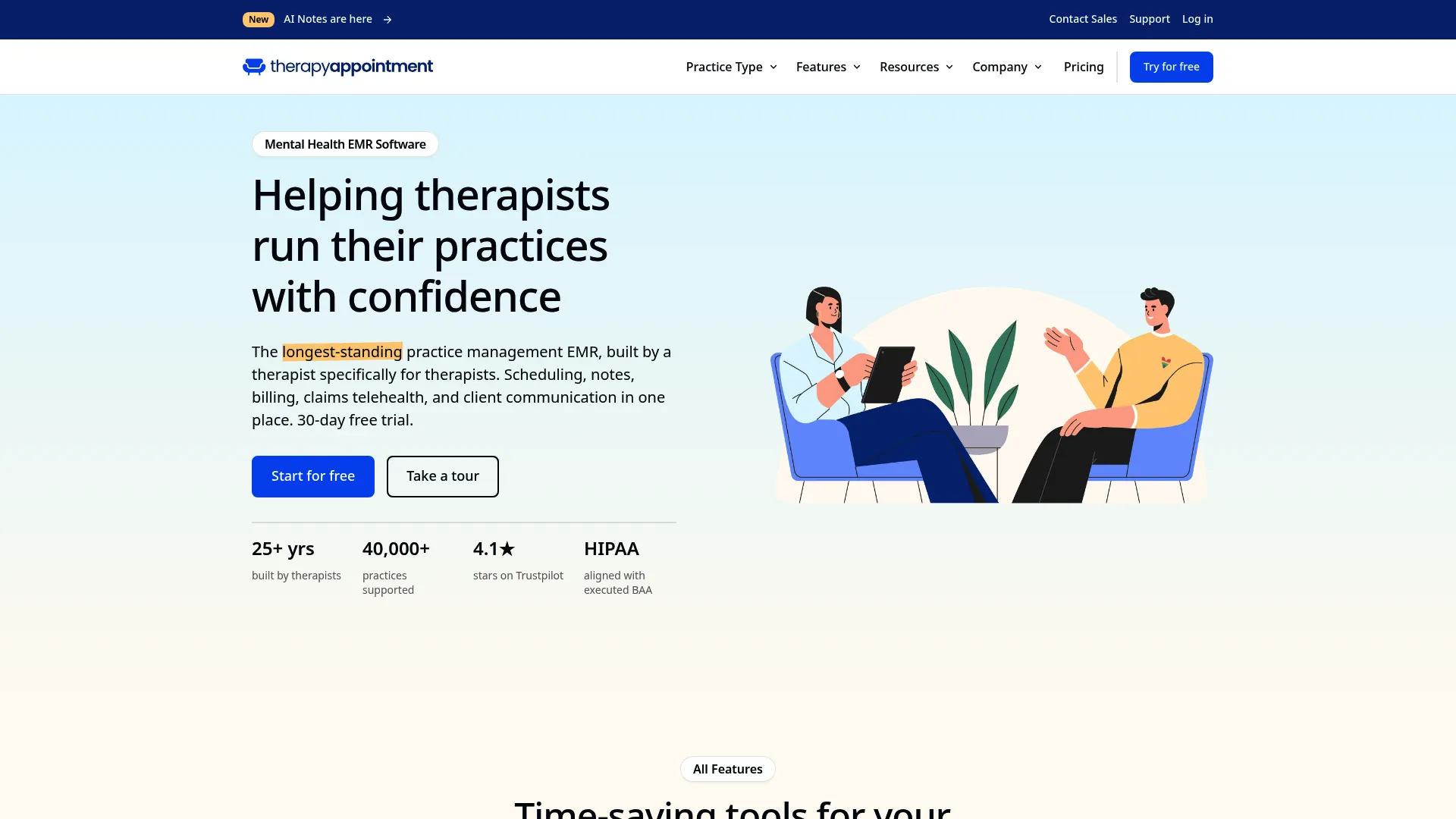
TherapyAppointment is an all-in-one mental health EMR and practice management platform built around automation. It bundles scheduling, billing, documentation, client communication, and reporting, with a clear bias toward removing manual steps. The angle here is operational speed: fewer clicks between a booked session and a posted payment.
Best for: practices that want fast scheduling, reminders, client portal access, and billing automation without a heavy learning curve.
Key strengths
- Scheduling, billing, documentation, and reporting in one system
- Unlimited secure client messaging and appointment reminders
- AI Notes to speed clinical documentation
- Auto-billing and integrated payment processing
- Telehealth and ePrescribe available as add-ons
- Electronic insurance claims and intake forms
Why choose TherapyAppointment: the workflow automation is the differentiator, especially the reminders and billing that run without staff babysitting them. It fits a buyer who wants a straightforward mental health system with broad core coverage and low ongoing admin. The usage-based entry pricing also makes it approachable for smaller or newer practices.
TherapyAppointment pricing: a 30-day free trial with full access is available, then tiered monthly pricing based on booked sessions. Starter is $10/month, Growth is $39/month, and Scale is $59/month as usage rises. Some capabilities carry separate add-on fees, including AI Notes, integrated payments, electronic insurance claims, telehealth, and ePrescribing.
4. Medicat
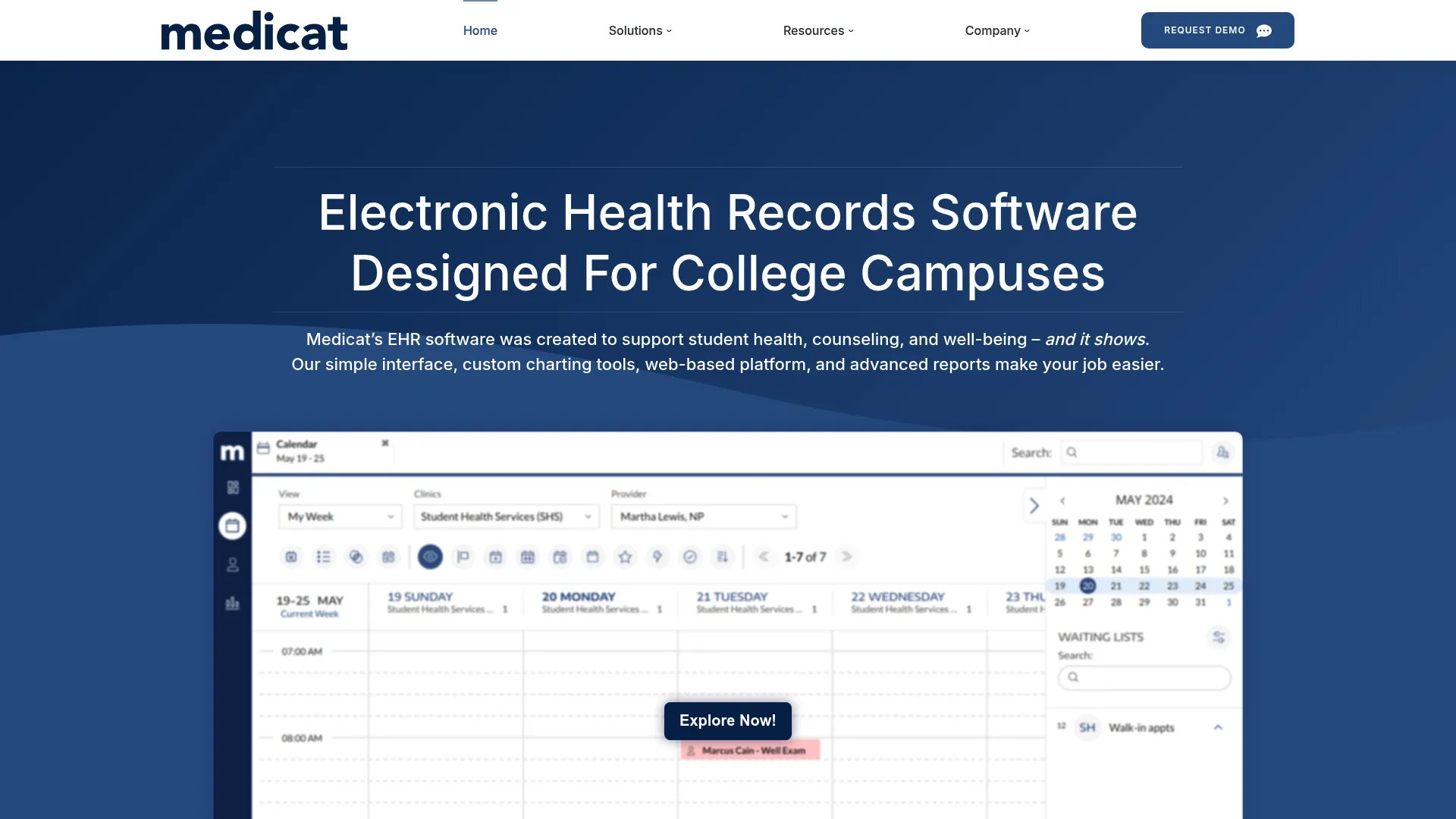
Medicat is a cloud-based counseling EHR built for college and university health and counseling centers, plus institutions with immunization compliance and campus health workflows. It is the most structurally oriented option here, with strong support for workflow management, supervision, and interoperability. Where the other three optimize for private practice, Medicat optimizes for institutional governance.
Best for: counseling centers, training environments, and clinics where supervision, compliance, and institutional workflow matter more than a consumer-friendly front end.
Key strengths
- Web-based platform for student health and counseling clinics
- Workflow management and self-scheduling
- Intake forms and secure messaging
- Immunization compliance management with AI verification
- Ambient listening and AI note generation
- Reporting plus SOC 2 and HIPAA compliance
- Integrations for campus systems
Why choose Medicat: it fits structured counseling organizations far better than lightweight solo-practice use. Supervision, compliance depth, and campus-scale workflow are the reasons a counseling center picks it over a private-practice tool. If your environment involves multiple clinicians, trainees, and institutional reporting, this is the fit.
Medicat pricing: Medicat uses custom pricing tailored to each clinic's needs and number of users. No public price is published, and product pages direct you to contact the team for a quote and demo.
Considerations
Practice size and complexity
A solo therapist, a ten-clinician group, and a campus counseling center have different needs, and buying for the wrong one costs you. Overbuy for a tiny practice and you pay for governance features nobody touches. Underbuy for a growing clinic and you outgrow the tool in a year and migrate again. Match the platform to where you will be in eighteen months, not just today.
Billing and insurance needs
Billing is where most practices feel the pain and where switching decisions usually start. Evaluate claims handling, payment workflows, statements, and reporting carefully. Ask how denied claims get reworked, how superbills are generated, and whether client self-service payments are built in. Billing complexity is often the real trigger that pushes a practice to change systems.
Client experience
Adoption fails when the client side feels clunky. Look hard at intake speed, client portal quality, self-service scheduling, secure messaging, and mobile access. If a new client has to fight the intake forms or can't book online, they feel it before their first session. A clean client portal quietly removes admin work on both sides.
Compliance and trust
The software choice is also an operational risk decision. Confirm the platform is HIPAA compliant, and dig into hosting, access controls, auditability, and support responsiveness. A vendor that answers support tickets slowly becomes your problem the day a claim batch fails. Compliance is table stakes, but the depth behind it varies.
Reporting and visibility
Record-keeping is not the same as visibility. Evaluate operational reporting, clinician utilization, no-show rates, and revenue visibility. For an owner, the reporting layer is what turns the software from a filing cabinet into a decision tool. If you can't see which services and clinicians drive revenue, you are flying blind.
Conclusion
Four solid picks, four different operating models.
SimplePractice is the broad default for most private practices: wide feature coverage, a polished client portal, and an easy path from free trial to daily use. TherapyNotes is the deep operations pick when billing accuracy and clinical notes matter most, with AI notes and ePrescribe under one roof. TherapyAppointment is the automation pick, built to cut manual steps around reminders, auto-billing, and messaging, with approachable usage-based pricing. Medicat is the institutional fit for counseling centers and campus health where supervision, compliance, and structured workflow lead the requirements.
The practical move: shortlist based on your practice type and your biggest source of admin pain, then start a free trial with the one or two that fit. Most of these platforms let you test the real workflow before you commit, so book a demo or start the trial and run a week of actual appointments through it.
The right counseling software is the one that removes handoffs from your specific practice, not the one with the longest feature list.
Start your journey with Guideflow today!
FAQs
In this category, the terms overlap heavily and are often used interchangeably. An EHR (electronic health record) is the clinical record system. Counseling software usually means an EHR built for behavioral health that also bundles practice management: scheduling, billing, intake, telehealth, and a client portal. In practice, most counseling software is an EHR plus the business tools around it.
At minimum: scheduling with appointment reminders, digital intake forms, clinical notes and documentation, billing and insurance claims, telehealth, a client portal, and reporting. HIPAA compliant hosting and access controls are non-negotiable. Beyond that, automation around reminders and payments plus AI notes are the features that most reduce admin load.
No. HIPAA compliance is a baseline, not a differentiator, and every serious platform meets it. Evaluate it alongside hosting, encryption, access controls, auditability, and support responsiveness. Two HIPAA compliant tools can differ a lot in how cleanly they handle a breach, a failed claim batch, or an audit request. Treat compliance depth as part of your operational risk assessment.
Solo practices should prioritize speed to adopt and simplicity over deep configurability. SimplePractice is the broadest and easiest-to-adopt option, and TherapyAppointment's usage-based entry pricing makes it approachable for newer or smaller practices. Start a free trial and see which one you can run a full week of appointments through without friction.
Group practices need stronger scheduling across multiple clinicians, cleaner billing and claims handling, reporting on utilization and revenue, and in some cases supervision workflows. TherapyNotes fits practices that treat billing and documentation as a discipline, while SimplePractice covers broad group needs with a polished front end. For campus or institutional counseling centers, Medicat is built for that scale.
Most do, but telehealth quality and integration depth vary. Some platforms build video directly into the client record so sessions, notes, and billing stay connected. Others offer it as a paid add-on. If you run a meaningful share of sessions virtually, confirm whether telehealth is included or priced separately, and test the client-side experience before committing.
Very. A good client portal reduces admin work on both sides by letting clients handle intake forms, self-service scheduling, secure messaging, and payments themselves. When the portal is clean, the front desk stops chasing paperwork and clients get a smoother first experience. When it is clunky, adoption suffers before the first session even happens.
Price matters, but workflow fit, compliance, and operational depth usually matter more. A cheaper tool that forces manual handoffs or clunky billing costs you far more in staff time than the difference in the monthly fee. Compare pricing against the admin hours each platform actually saves, and weigh the free trial experience heavily before you decide.