Your legal team is the bottleneck, and everyone knows it. A rep closes a deal, the customer sends back a redlined MSA, and it sits in a queue for four days while a lawyer compares it clause by clause against a standard the whole company keeps in someone's head. The deal cools. The rep pings legal again. Legal is buried under the same review they did last week on a nearly identical agreement.
The problem isn't the lawyers. It's that contract review has stayed manual while everything around it sped up. The global AI contract review software market hit USD 2.13 billion in 2025 and is projected to reach USD 7.5 billion by 2035, according to WiseGuyReports (2025). That growth reflects a simple shift: teams are moving repetitive clause-checking off human desks and onto software that flags risk, suggests redlines, and enforces a consistent position on every agreement.
For sales enablement, RevOps, and revenue-adjacent teams, the stakes are practical. Faster review means shorter cycles. Consistent redlining means fewer surprises in the deal room. A shared playbook means a junior reviewer applies the same standard as a senior counsel. This guide walks through the tools that make that happen, what each one is actually good at, and how to shortlist based on your team's size, security needs, and workflow.
What's inside
This guide is for anyone who owns or influences contract review: in-house legal, legal ops, procurement, and the sales enablement and RevOps teams that live downstream of legal's speed. We selected seven tools based on review accuracy and playbook support, security posture, workflow fit (where the tool actually lives, from Word to a repository), and pricing transparency. Each entry covers what the tool does well, who it fits, verified pricing where available, and its current G2 rating. No single tool wins every category, so we flag the best-fit scenario for each.
TL;DR
- Best for attorney-built playbooks and unlimited review: LegalOn, with curated playbooks and a strong security posture.
- Best for research-heavy transactional teams: Lexis+ Agreement Analysis, priced per analysis inside the Lexis ecosystem.
- Best for ongoing counsel plus contract support: Pact, a subscription legal service for growing businesses.
- Best for a contract repository with an AI review layer: ContractSafe, with volume-based pricing and unlimited users.
- Best for governed enterprise AI workflows: LEGALFLY, built around secure review, drafting, and research.
- Best for end-to-end contract creation and review: Juro, an AI-native CLM for legal and business users.
- Best for drafting and redlining inside Word: Spellbook, a Word-native AI assistant for lawyers.
What is contract review software?
Contract review software is a tool that uses AI and rules-based logic to read, analyze, and redline contracts against a defined standard, flagging risky clauses, missing terms, and deviations from a company's preferred position. It compresses a manual, hours-long review into minutes while keeping a human reviewer in control of the final call.
Modern AI contract review software goes beyond keyword search. It understands clause meaning, benchmarks language against market standards, and suggests specific edits. The best contract analysis software plugs into where legal teams already work, whether that's Microsoft Word, a browser, or a central repository.
Core capabilities to expect:
- Clause extraction and classification: automatically pull out indemnification, liability, termination, and other key clauses for structured review.
- Playbooks: codified rules that define acceptable, fallback, and unacceptable positions for each clause type, so review is consistent across reviewers.
- Redlining and version comparison: suggested edits and side-by-side diffs against prior versions or a template.
- Risk detection: automatic flags for clauses that fall outside your standards or introduce legal exposure.
- Human-in-the-loop review: every suggestion is a recommendation, not an auto-accept, so a qualified person approves the final language.
- Security and compliance controls: SOC 2, GDPR, and CCPA alignment, permissions, and clear data-use terms for sensitive agreements.
The category overlaps with contract lifecycle management (CLM) but is distinct. CLM handles the full journey from creation to signature to renewal. Contract review software focuses on the analysis and redlining step, though several tools now blend both.
When to use contract review software
Standardize redlines across reviewers
When five different reviewers apply five different standards, your contracts drift. Contract review software with playbooks enforces one position on liability caps, indemnity, and governing law, so a junior reviewer produces the same redline a senior counsel would. This matters most for high-volume, repetitive agreements like NDAs, MSAs, and vendor contracts.
Clear the legal bottleneck on deals
Sales cycles stall when legal review takes days. AI contract review software cuts first-pass review from hours to minutes, so legal spends time on judgment calls instead of reading boilerplate. For revenue teams, that translates to shorter cycles and fewer deals cooling in the redline queue.
Cut risk on inbound paper
When a counterparty sends their own contract, you're reviewing unfamiliar language under time pressure. Contract analysis software flags deviations from your standards, surfaces missing protections, and highlights unusual clauses, so nothing slips through because a reviewer was rushing.
Comparison table
Here is a side-by-side view of the seven tools, sorted by relevance to a team standardizing contract review. Pricing and ratings reflect verified, current values where publicly available.
| # | Product | Intent | Key use case | Pricing | G2 rating |
|---|---|---|---|---|---|
| 1 | LegalOn | AI review with playbooks | Unlimited review and redlining with attorney-curated playbooks | Quote-based, free trial | 5.0/5 |
| 2 | Lexis+ Agreement Analysis | Research-heavy analysis | Clause benchmarking against market standards | $99 per analysis, 7-day trial | 4.1/5 |
| 3 | Pact | Subscription legal service | Ongoing counsel plus contract support | From $495/mo | Not available |
| 4 | ContractSafe | Repository plus AI review | Store, search, and review contracts at volume | From $450/mo, prepaid annually | 4.7/5 |
| 5 | LEGALFLY | Governed enterprise AI | Secure review, drafting, and research | Book a demo | 4.2/5 |
| 6 | Juro | AI-native CLM | End-to-end creation, review, and signing | Custom | 4.5/5 |
| 7 | Spellbook | Word-native drafting | Redlining and drafting inside Microsoft Word | Free trial, demo | 4.7/5 |
1. LegalOn
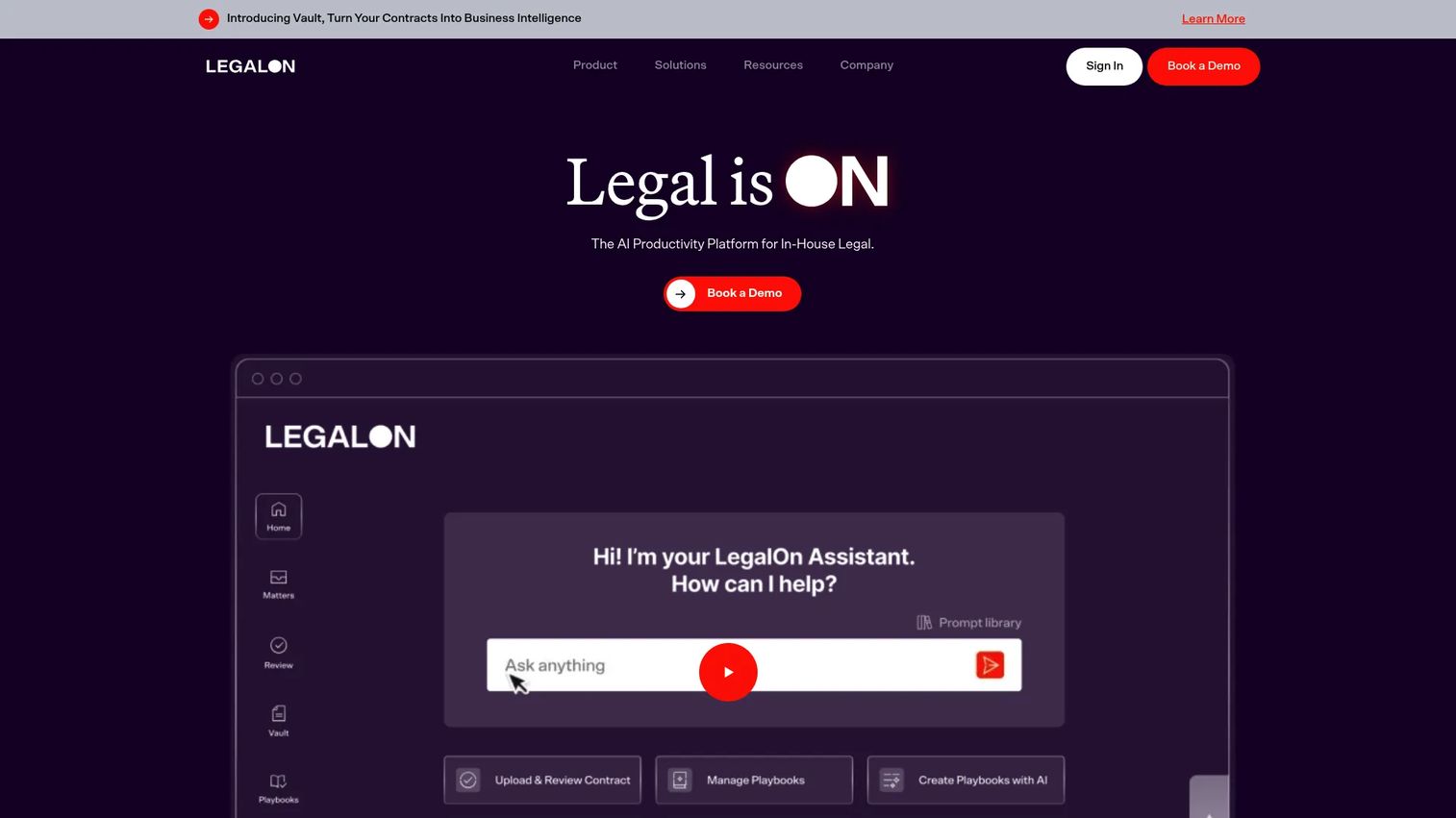
LegalOn is an AI contracting platform built around contract review, drafting, matter management, and contract intelligence. Its defining feature is attorney-curated playbooks that codify a preferred position on each clause type, so review stays consistent whether a paralegal or a general counsel runs it. The platform pairs unlimited AI review and redlining with a searchable repository, making it a strong fit for in-house legal and legal ops teams that want depth without per-review metering.
Best for: In-house legal and legal ops teams that need AI-assisted contract review and lifecycle management with strong playbook governance.
Key strengths
- Unlimited AI review and redlining: run as many contracts as your team needs without per-document charges.
- Attorney-curated playbooks and prompt library: codified positions written by lawyers, not just generic AI suggestions.
- Matter management and repository search: find any clause or agreement across your contract history.
- Translation across 28+ languages: review agreements from international counterparties without a separate step.
Why choose LegalOn: If your team reviews the same clause types over and over and wants a consistent, defensible standard applied every time, LegalOn's playbook depth is the draw. The attorney-built curation means you're not starting from a blank prompt, which shortens the path to trustworthy redlines. It suits teams that value governance and repeatability over a bare-bones price tag.
LegalOn pricing: LegalOn uses quote-based pricing sized to your team and the capabilities you need, so there's no fixed public number. The lineup includes a Core Review tier you can try for free and a Contracting Suite tier available by booking a demo. The free trial lets you validate review quality before committing. LegalOn holds a 5.0/5 rating on G2.
2. Lexis+ Agreement Analysis
Lexis+ Agreement Analysis is an AI contract review tool inside the broader Lexis+ ecosystem, built for analyzing transactional agreements. It leans on LexisNexis's deep legal research backbone, matching heavily negotiated clauses with alternate language and supporting compare-and-edit workflows. For transactional attorneys who already live in Lexis for research, it keeps clause benchmarking and drafting support in the same environment.
Best for: Transactional attorneys who review and compare contract clauses and want market-standard benchmarking backed by legal research.
Key strengths
- Proprietary AI and machine learning: analysis grounded in LexisNexis's legal data, not a generic model.
- Alternate clause matching: surfaces negotiated language options for heavily contested clauses.
- Compare and edit functionality: review agreements side by side and refine language in one flow.
Why choose Lexis+ Agreement Analysis: Research-heavy teams benefit most here, because the tool ties clause analysis to the same authoritative sources they already trust for case law and precedent. If your review process depends on knowing how a clause compares to market standards, the benchmarking depth earns its place. It fits enterprise legal teams and firms with an existing Lexis relationship.
Lexis+ Agreement Analysis pricing: The public price schedule lists Agreement Analysis at $99 per analysis, and the product page offers a complimentary 7-day trial. That per-analysis model differs from flat subscriptions, so cost scales with review volume. The broader Lexis product carries a 4.1/5 rating on G2.
3. Pact

Pact takes a different angle from pure software. It's a business law firm offering subscription, fixed-fee, and hourly legal services, giving small and growing companies a dedicated attorney on a monthly basis. For teams that lack in-house counsel, Pact blends contract review with broader legal support across corporate, contract, startup, employment, IP, and M&A matters.
Best for: Small and growing businesses that need ongoing outside general counsel alongside contract review.
Key strengths
- Dedicated attorney on subscription: a consistent legal partner who learns your business, not a rotating queue.
- Broad legal coverage: corporate, contract, startup, employment, IP, and M&A support in one relationship.
- Flexible engagement models: fixed-fee and hourly services available outside the monthly subscription.
Why choose Pact: If you don't have a lawyer on staff and want contract review as part of a wider legal relationship, Pact fills the gap that pure software can't. You get human judgment plus continuity, which matters when contracts intersect with employment, IP, or fundraising questions. It's the pick for early-stage teams that need a general counsel function without a full-time hire.
Pact pricing: Pact lists a monthly subscription starting at $495, with illustrative plans at $1,000/mo, $2,500/mo, and $5,000/mo, and final terms customized to your needs. There is no free tier, since this is a legal service rather than self-serve software. A verified G2 rating was not available at the time of writing.
4. ContractSafe
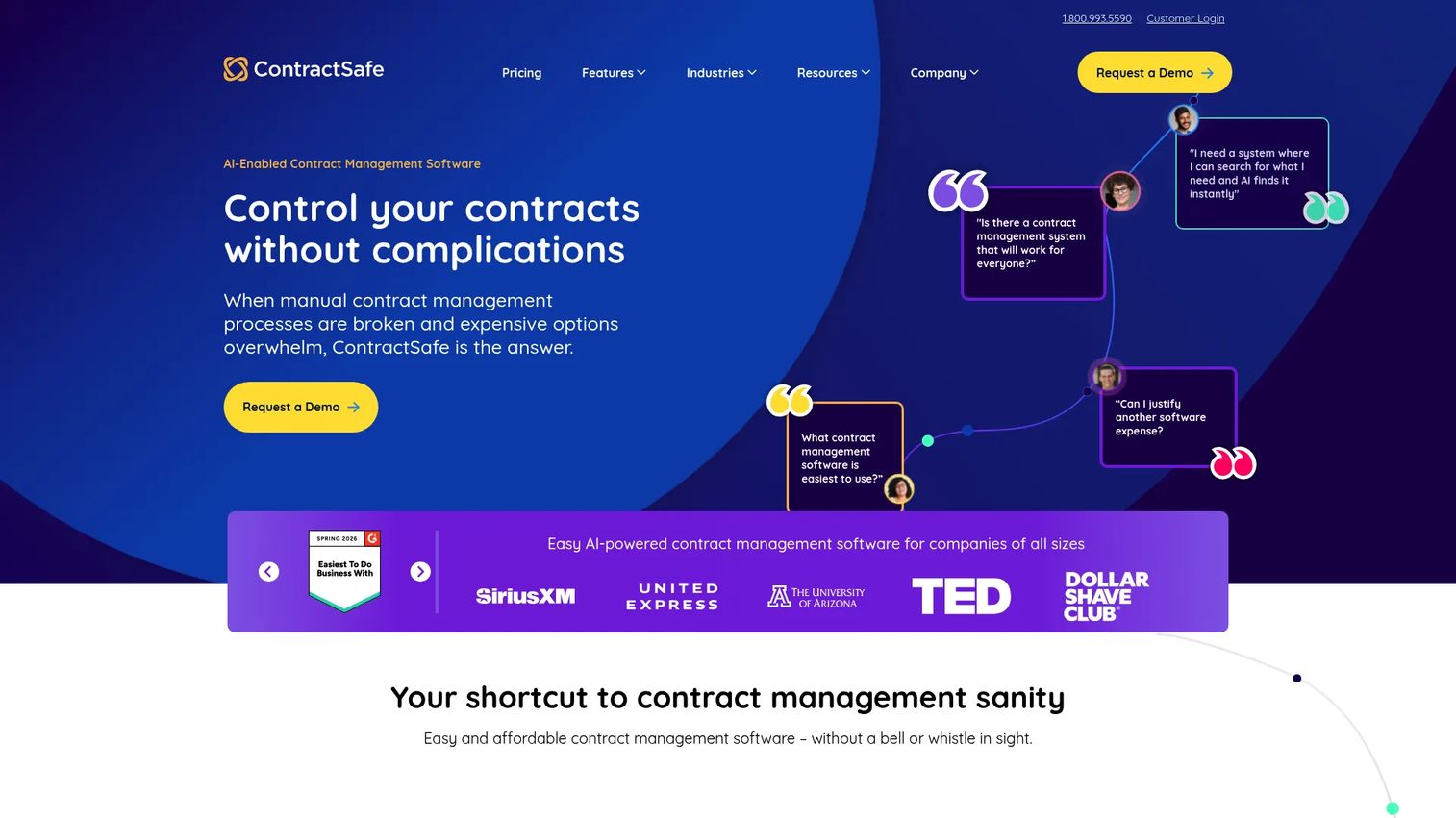
ContractSafe is contract management software focused on storing, searching, tracking, and managing contracts, with an AI-powered organization layer on top. It positions itself as the repository where every agreement lives, then adds extraction, categorization, and intelligent alerts so nothing expires or auto-renews unnoticed. That repository-first design serves legal, procurement, HR, and sales-adjacent teams that need one searchable source of truth.
Best for: Teams that need a simple contract repository with search, alerts, and scalable contract-volume-based pricing.
Key strengths
- AI-powered organization: automatic extraction and categorization so contracts file themselves.
- Search and reporting: find any clause or term across your entire repository in seconds.
- Intelligent alerts: deadline and renewal reminders that prevent costly missed dates.
Why choose ContractSafe: If your primary pain is contract chaos rather than clause-by-clause redlining, ContractSafe's repository-plus-AI approach is the practical fit. Unlimited users on every plan means the whole team can search and reference contracts without seat-cost friction. It works well as the contract management layer for cross-functional teams beyond legal.
ContractSafe pricing: ContractSafe shows three paid plans, all prepaid annually: Organize at $450/mo, Finalize at $660/mo, and Maximize at $815/mo. Pricing scales with features and contract volume, and every plan includes unlimited users plus a free trial. ContractSafe holds a 4.7/5 rating on G2.
5. LEGALFLY
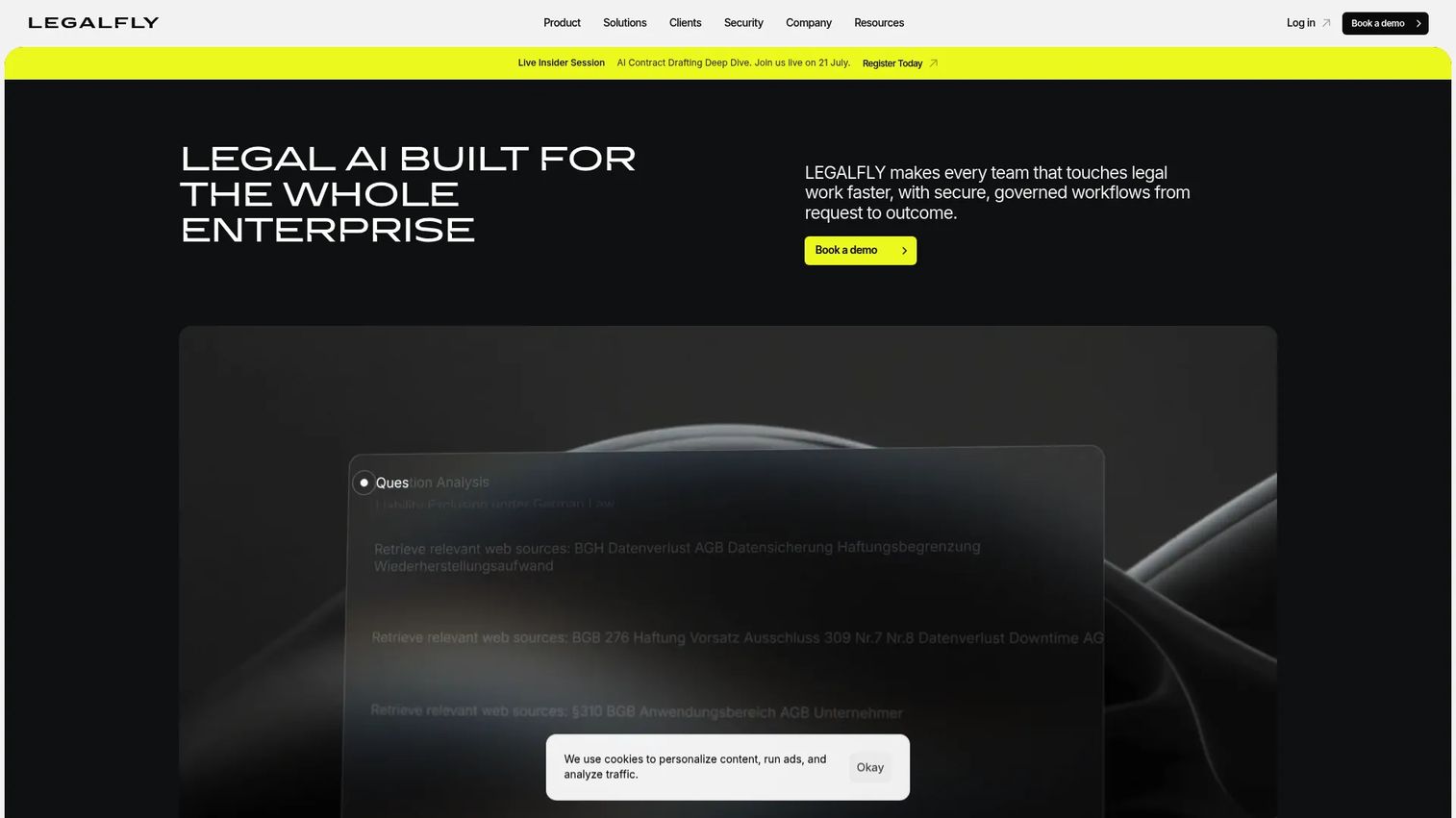
LEGALFLY is an enterprise legal AI platform spanning intake, contract review, drafting, due diligence, research, and regulatory monitoring. Its contract work centers on AI review and redlining against reusable playbooks, with an emphasis on secure, governed workflows and verified-source legal research. For in-house legal teams that need AI without loosening their grip on data privacy, LEGALFLY builds anonymisation and privacy controls into the core.
Best for: In-house legal teams that need secure, governed AI workflows for contracts and legal research.
Key strengths
- AI contract review and redlining: playbook-based suggestions with explainable reasoning behind each edit.
- Legal research and discovery: answers grounded in verified sources, not unverified generation.
- Document drafting and reusable playbooks: codified standards applied consistently across the team.
Why choose LEGALFLY: Enterprise teams with strict privacy requirements are the natural fit, because LEGALFLY's anonymisation and governed workflow design address the security review that often stalls AI adoption in legal. The explainable suggestions help reviewers trust and audit the redlines rather than accept a black box. It suits organizations that want breadth across the legal function, not just contract review.
LEGALFLY pricing: LEGALFLY does not publish a public price on its site and directs prospective buyers to book a demo, which is common for enterprise-focused legal AI. Pricing is therefore scoped to the deployment and capabilities you need. LEGALFLY carries a 4.2/5 rating on G2.
6. Juro
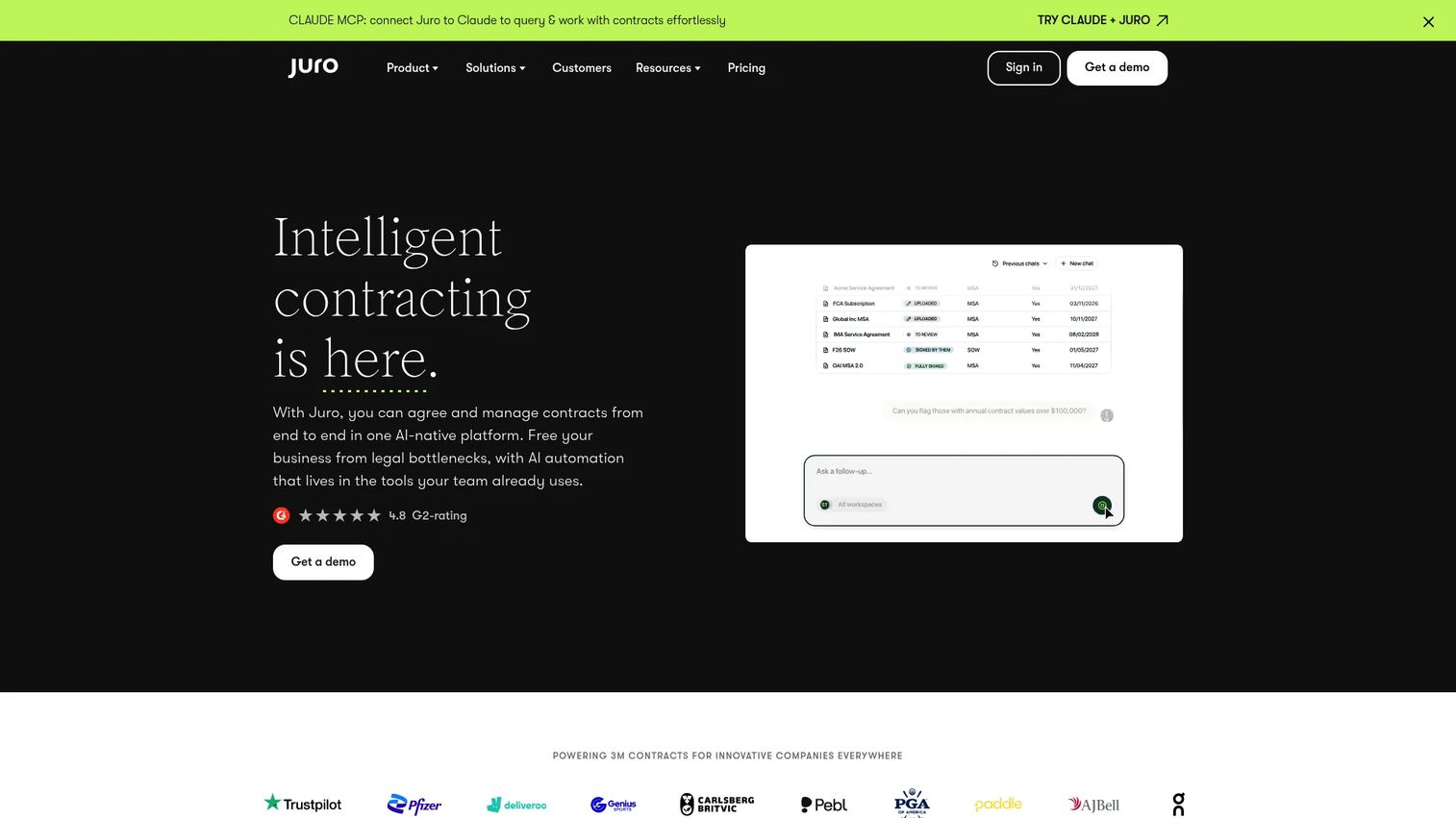
Juro is an AI-native contract automation platform that handles creating, reviewing, signing, and managing contracts end to end. Unlike tools focused purely on review, Juro brings the full lifecycle into one workflow, with AI intake and review, self-serve templates, and an intelligent repository. That breadth helps revenue and legal teams move faster together, since business users can self-serve routine contracts while legal keeps oversight.
Best for: Teams that need a scalable CLM for both legal and business users, with AI-assisted contract workflows.
Key strengths
- AI intake and review: triage incoming contracts and surface risk without manual sorting.
- Self-serve templates: let business teams generate approved contracts without a legal ticket.
- Intelligent repository: structured storage with search and reporting across every agreement.
Why choose Juro: If you want creation and review in the same system rather than stitching tools together, Juro's end-to-end design is the appeal. The tradeoff is scope: a full CLM covers more ground than a specialized review tool, so evaluate whether you need the breadth or just deep redlining. It fits scaling teams that want legal and revenue working in one workflow.
Juro pricing: Juro uses custom pricing based on contract volume and integration complexity, with unlimited users, workflows, and templates included; deeper integrations may cost extra. There's no public starting price, so you'll work through their calculator or sales team to scope a plan. Juro holds a 4.5/5 rating on G2.
7. Spellbook
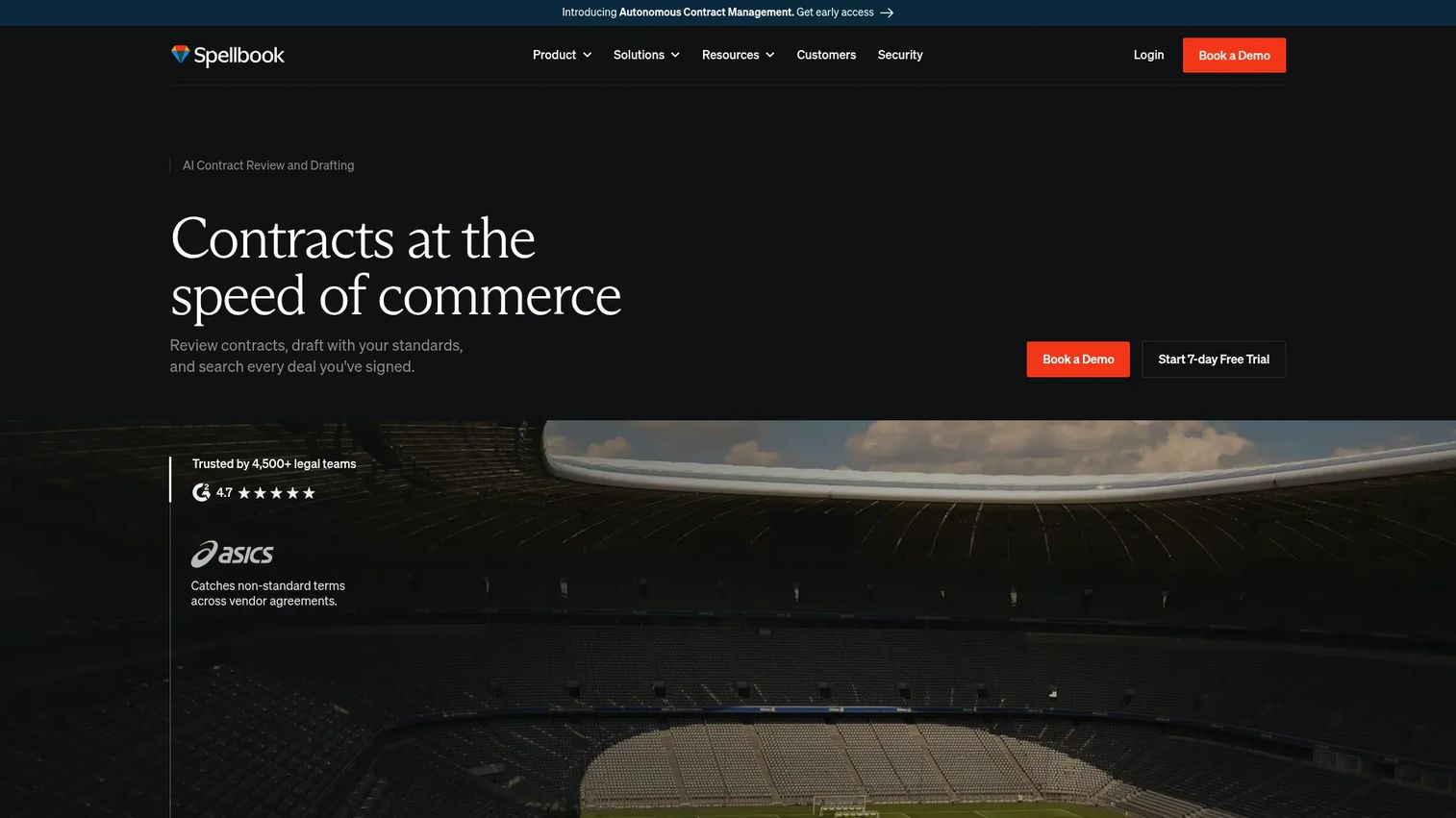
Spellbook is AI contract review and drafting software that lives inside Microsoft Word as an add-in. Lawyers who already draft and redline in Word get AI suggestions in context, without switching tools or copying text into a browser. It handles redlining, full-document drafting, clause suggestions, and grounded answers through its Ask and Legal Sources features, making it a natural fit for drafting-heavy teams.
Best for: Law firms and in-house legal teams that draft and review contracts directly in Microsoft Word.
Key strengths
- AI redlining and review in Word: suggestions appear where lawyers already work, no context switching.
- Drafting support: generate clauses, full documents, and revisions from a prompt.
- Ask and Legal Sources: answers grounded in legal databases rather than open generation.
Why choose Spellbook: For teams whose workflow is Word-first, Spellbook removes the friction of moving contracts into a separate platform. The in-context experience means adoption is easy, since lawyers keep their existing habits and get AI on top. Add playbooks, benchmarks, and a clause library, and it covers both drafting and review for firms that spend their days in documents.
Spellbook pricing: Spellbook does not publish public pricing numbers on its site, promoting a free trial and a demo or onboarding path instead. Pricing is scoped through that conversation based on your team and needs. Spellbook holds a 4.7/5 rating on G2.
Considerations before you buy
A shortlist is only useful once you weigh it against your team's reality. Run each candidate through this checklist before committing.
Security and compliance posture
Contracts are among your most sensitive documents. Confirm the vendor's SOC 2 status, GDPR and CCPA alignment, and how they handle data-use terms. Check whether your inputs train their models, and look for clear permissions and access controls so only the right people see the right agreements.
Human-in-the-loop control
AI should suggest, not decide. Verify that every redline and risk flag is a recommendation a qualified reviewer approves, not an auto-accept. The best tools make the reasoning behind each suggestion visible, so a reviewer can audit and trust the output rather than rubber-stamp it.
Playbook depth and flexibility
Playbooks are what make review consistent across people. Evaluate whether you can codify your own positions, use fallback language, and update standards as your policy shifts. Attorney-curated starting points shorten setup, but you'll want the freedom to tailor them to your risk tolerance.
Workflow fit
The best tool is the one your team will actually use. If your lawyers live in Word, an in-Word add-in beats a browser tool. If you need a searchable source of truth, a repository-first platform matters more. Map the tool to where review already happens.
Pricing model and scale
Per-analysis, per-seat, flat subscription, and contract-volume pricing all behave differently as you grow. Model your expected review volume against each structure, and factor in whether unlimited users or integration add-ons change the real cost.
Conclusion
The right contract review software depends on how your team works, not on a single leaderboard. For attorney-built playbooks and unlimited review, LegalOn leads. Research-heavy transactional teams get the most from Lexis+ Agreement Analysis and its market-standard benchmarking. Early-stage companies without in-house counsel may prefer Pact's subscription legal service, while ContractSafe wins as a repository-plus-AI layer for cross-functional teams.
On the enterprise side, LEGALFLY suits governed, privacy-first AI workflows, Juro covers the full contract lifecycle for legal and business users together, and Spellbook is the pick for drafting-heavy teams that live in Microsoft Word.
To shortlist, start with your non-negotiables: team size, security requirements, and where review actually happens. Run a free trial where one is offered, feed it your real contracts, and measure how much time it saves against your current process. The tool that clears your legal bottleneck without loosening your security controls is the one worth buying.
FAQs
Contract review software uses AI and rules-based logic to read, analyze, and redline contracts against a defined standard. It flags risky clauses, missing terms, and deviations from your preferred position, compressing a manual review into minutes while a human keeps final control.
General AI tools answer prompts but don't apply your company's specific playbook, ground suggestions in legal sources, or maintain security controls built for sensitive agreements. Contract review software is trained for legal analysis, ties redlines to codified standards, and handles clause extraction, version comparison, and permissions that a general chatbot doesn't.
Prioritize playbooks for consistent redlining, clause extraction and risk detection for coverage, version comparison for tracking changes, and human-in-the-loop review so a person approves every edit. Security controls and workflow fit, whether that's Word or a repository, round out the list.
It can be, provided the vendor meets the right standards. Look for SOC 2, GDPR, and CCPA alignment, clear data-use terms that confirm your inputs don't train their models, and granular permissions. Human-in-the-loop review adds a further safeguard against errors slipping through.
Procurement teams review vendor and supplier agreements, HR handles employment contracts, and sales enablement and RevOps teams depend on fast, consistent review to keep deals moving. A shared standard across these functions reduces bottlenecks and keeps seller-facing agreements aligned.
Playbooks are codified rules that define acceptable, fallback, and unacceptable positions for each clause type. They let a junior reviewer apply the same standard a senior counsel would, so redlines stay consistent no matter who runs the review.
Test it on your real contracts, not a demo dataset. Measure review accuracy, playbook flexibility, and time saved against your current process, then confirm the security posture and workflow fit. Most vendors offer a free trial or demo, so validate before you commit.
Often, yes. Smaller teams feel the review bottleneck most acutely, since one lawyer or a lean legal function handles everything. Tools with volume-based or subscription pricing, or a service model like Pact, let smaller teams standardize review without a full-time hire.