You run three branches. One yard manager tracks availability in a spreadsheet, another keeps it in his head, and the front desk confirms a rental that was already promised to someone else. The excavator that was supposed to go out this morning is still in the shop, and nobody logged the work order. By the time finance invoices it, the customer disputes the dates.
None of this is a bookkeeping problem. It is a visibility problem. When your inventory, dispatch, maintenance, and billing live in separate places, the gaps between them cost you utilization, cash, and customer trust. That is the actual job that rental yard software does. Not tidier records, but a single view of what is available, where it is, what condition it is in, and who owes you for it.
The global rental software market was valued at roughly USD 3.5 billion in 2023 and is projected to reach USD 8.9 billion by 2032, growing at 11.2% annually, according to Dataintelo (2024). In the US, over 730,000 pieces of equipment are managed through rental software each year, and 75% of bookings are already automated, per Market Growth Reports (2024). The shift is happening because operators finally have equipment rental software that reflects how a yard actually runs.
This guide compares eight platforms by the criteria that decide whether a system earns its place: yard workflow coverage, cloud and mobile access, pricing transparency, multi-location fit, and reporting depth. Whether you need rental equipment management software for a single tool-rental shop or an equipment rental system spanning dozens of branches, the goal here is to help you shortlist fast.
What's inside
This guide is for operators, founders, and branch managers at rental businesses who are replacing spreadsheets, disconnected point tools, or branch-level manual processes. It covers equipment rental management software that handles the full workflow: inventory and availability, quotes and contracts, dispatch, maintenance and work orders, invoicing and accounting, and reporting and analytics.
We selected platforms on five criteria: yard workflow coverage, cloud and mobile access, pricing visibility, multi-location fit, and buyer support. The list spans SMB-friendly options and enterprise-grade systems. The aim is to help you build a shortlist you can validate with demos, not just learn definitions.
TL;DR
- Best overall for broad rental operations: Point of Rental, for teams that need one system across yard, dispatch, finance, and service.
- Best for stronger operational control and visibility: MCS Rental Software, built around yard workflows and AI-led insight.
- Best for faster setup and simpler adoption: HireHop, with a free tier and browser-based access.
- Best for AI analytics and telematics at scale: Wynne Systems, for large equipment-intensive operations.
- Best for a lower-friction modern option: EZRentOut, for smaller and mid-market teams that want less operational drag.
- Best for pricing-aware shoppers: rent2b, a transparent, lightweight option with per-booking pricing.
What is rental yard software?
Rental yard software is a system that centralizes inventory, quotes, contracts, logistics, maintenance, invoicing, and reporting for equipment rental businesses. It is broader than a simple equipment tracker because it manages the full rental lifecycle, from the moment a customer requests a quote to the moment the asset returns, gets serviced, and goes back out.
The category exists because rental businesses run on turnover, not ownership. A machine sitting idle in the yard is lost revenue. A double-booked asset is a broken promise. Rental software for equipment ties availability, condition, and billing into one record so nothing falls through the cracks.
Key capabilities most buyers evaluate:
- Inventory and availability tracking: real-time view of what is on rent, in the yard, or in service
- Dispatch and branch coordination: multi-location dispatching so branches share a single system of record
- Maintenance and work orders: link asset condition to service history and downtime
- Invoicing and accounting: billing tied to contract dates, with accounting integrations
- Reporting and analytics: utilization, revenue, and fleet performance, increasingly with AI analytics
- Mobile access and cloud deployment: cloud based equipment rental software that field teams reach from any device
Cloud deployment now accounts for 58% of implementations, integrated maintenance scheduling appears in 68% of operations, and inventory and utilization reporting in 82%, per Market Growth Reports (2024).
Rental yard software vs equipment management software
The two get confused, so here is the plain distinction. Equipment management software often centers on asset ownership: where your assets are, their maintenance history, and their depreciation. Rental yard software is built around the rental transaction: bookings, utilization, turnover, contracts, and customer billing.
The difference shows up in outcomes. An asset tracker tells you a machine exists and where it sits. A rental system tells you it is booked from Thursday, out to a specific job site, due back Monday, needs a service before it goes out again, and has an unpaid invoice attached. That is the layer that prevents double bookings, lifts utilization, speeds up invoicing, and produces clean handoffs between branches.
Why the category matters now
Buyers want systems that cut manual coordination and give managers a live view of the yard. Cloud access, mobile use, and AI analytics have moved from nice-to-have to baseline expectation. This is an operational category, not an administrative one. The value is not in cleaner filing. It is in higher utilization, fewer disputes, and faster cash.
When to use rental yard software
Replace spreadsheets and point tools
The trigger is usually growth. A spreadsheet works when one person knows the whole yard. It breaks the moment two people book the same asset, or a manager is out and nobody can find the availability file. Spreadsheet processes have no locking, no audit trail, and no real-time sync, so errors compound quietly until a customer catches one. When manual tracking starts costing you rentals, it is time for a real system.
Manage multiple branches or yards
Multi-location operations need shared availability, coordinated dispatch, and location-aware workflows. Without a single system of record, each branch runs its own version of the truth, and inter-branch transfers turn into phone calls and guesswork. Multi-location dispatching in a central platform lets one branch see and pull from another's inventory, which raises utilization across the whole business.
Improve maintenance and billing
Rental software links asset condition to service work and then to invoicing. When a machine comes back damaged, the work order, the downtime, and the repair cost all attach to the asset and, where relevant, the contract. That connection means fewer billing disputes, cleaner maintenance and work orders, and faster cash collection because invoices reflect what actually happened in the yard.
Comparison table
The list is ranked by breadth of rental workflow coverage and fit for growing operations, starting with the broadest platform and moving through specialized and lower-friction options. Pricing and ratings below reflect verified vendor and G2 data at the time of writing. Where a vendor keeps pricing sales-led, that is noted rather than guessed.
| # | Product | Intent | Key use case | Pricing | G2 rating |
|---|---|---|---|---|---|
| 1 | Point of Rental | Broad operations | Single system across yard, dispatch, finance, service | Quote-based | 4.8/5 |
| 2 | MCS Rental Software | Operational control | Yard workflow, inventory visibility, AI insight | Quote-based | 4.8/5 |
| 3 | HireHop | Fast setup | Cloud-based rental and job management | Free; from $63 USD*/mo first user | 5.0/5 |
| 4 | Wynne Systems | Enterprise scale | Rental ERP, telematics, logistics | Sales-led | 3.7/5 |
| 5 | Texada | Dealer + rental | Rental and service management platform | Contact sales | Not listed |
| 6 | EZRentOut | Lower friction | Inventory, reservations, ecommerce | From $59/mo | 4.5/5 |
| 7 | Quipli | Modern all-in-one | Rentals, dispatch, customer portal | $6,000/yr per location | 5.0/5 |
| 8 | rent2b | Pricing-aware | Online booking and multi-location | Free; from €79/mo | Not listed |
1. Point of Rental
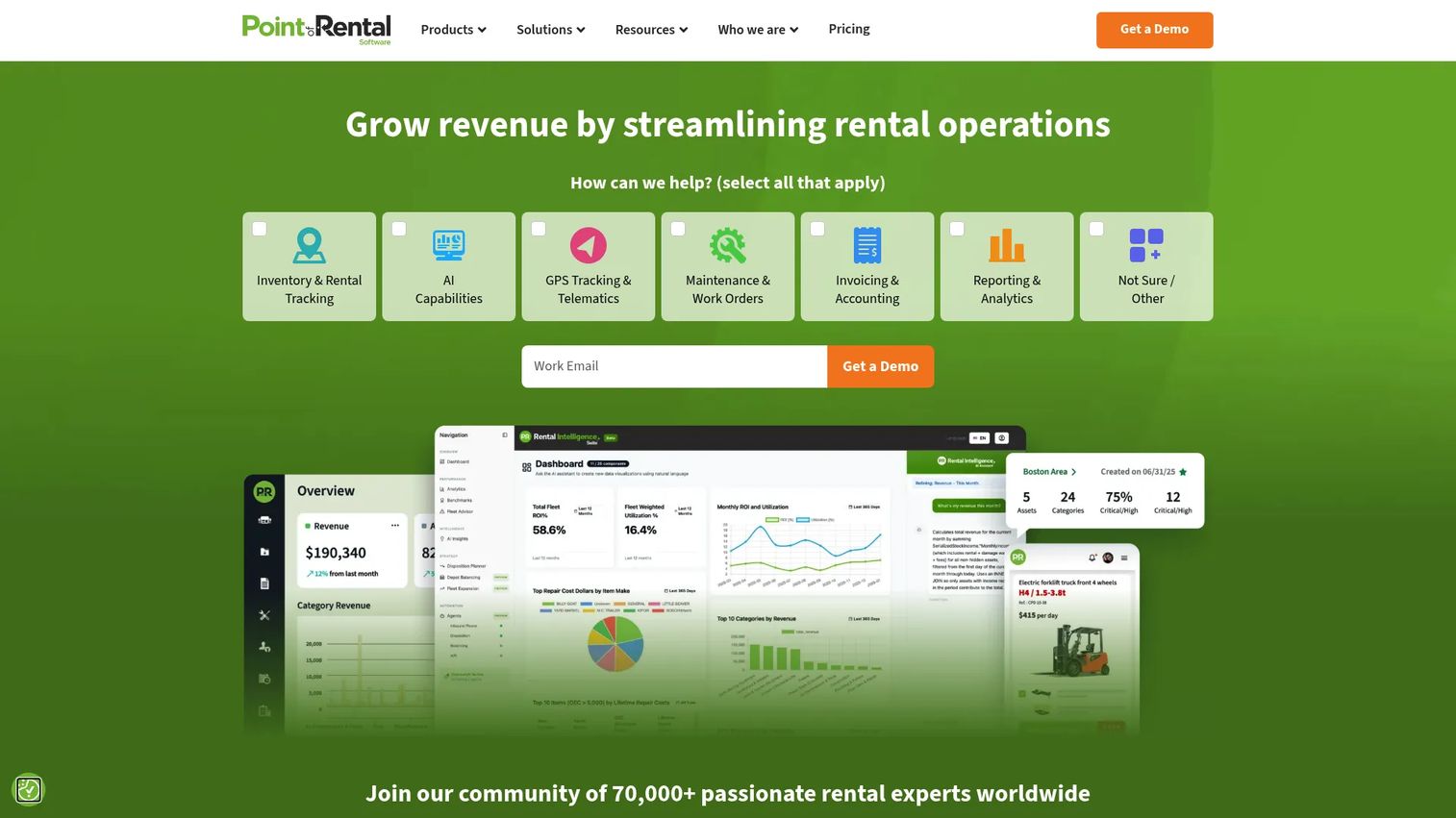
Point of Rental is one of the broadest platforms in the category, built for rental businesses that need inventory and operations management in a single system. It spans the full lifecycle: availability, quotes, contracts, dispatch, maintenance, invoicing, and reporting. For operators running complex multi-branch businesses, the appeal is having yard, finance, and service in one place instead of stitched-together tools.
Best for: Rental businesses that need one system covering yard operations, dispatch, finance, and service across multiple branches.
Key strengths
- Customer storefront: an ecommerce storefront where customers find and rent items directly, capturing self-serve demand.
- Universal search: search across screens so staff find assets, contracts, and customers without hopping between modules.
- Offline mobile app: a mobile app that works offline, so yard and field teams keep operating without a signal.
Why choose Point of Rental: If your operation is complex enough that no single point tool covers it, Point of Rental's breadth is the draw. It fits construction rental software needs, event and party rental, and general tool rental where the yard, the office, and the field all need the same real-time picture. Its 4.8/5 G2 rating reflects strong operator sentiment for depth and reliability.
Point of Rental pricing: Point of Rental does not publish public pricing on its site. Pricing is quote-based, so plan on a demo and a scoped conversation to get a number tied to your branch count and module needs.
2. MCS Rental Software
MCS Rental Software is rental management software focused on quotes, contracts, and invoicing across the rental lifecycle. It leans into cloud access, yard workflow language, inventory visibility, maintenance, and AI-led insights, which makes it a strong fit for operators who want tight operational control rather than a lightweight tracker.
Best for: Rental businesses that want strong operational control and real-time visibility across the yard, from quote to invoice.
Key strengths
- Lifecycle coverage: quotes, contracts, logistics, maintenance, and invoicing in one connected flow.
- Inventory visibility: a real-time picture of what is on rent, in the yard, or under service.
- AI-led insight: analytics that surface utilization and performance signals for faster decisions.
Why choose MCS Rental Software: MCS suits rental businesses that treat the yard as the center of the operation and want a system built around it. It carries a 4.8/5 G2 rating, and its strength is depth of operational control: the kind of reporting and analytics and maintenance and work orders coverage that mid-sized and larger rental operations rely on to keep utilization high.
MCS Rental Software pricing: MCS does not list public pricing. Expect a sales-led process with a demo, so pricing tracks to your operation's size and module requirements.
3. HireHop
HireHop is cloud-based equipment rental software built for rental companies that want browser access and quick rollout. It handles asset management, quotes and supply lists, and connects to accounting and Microsoft 365 or GSuite. The transparent pricing and free tier make it one of the easier ways to move off spreadsheets without a long procurement cycle.
Best for: Smaller teams and buyers who want fast setup, a free starting point, and browser-based access without heavy IT involvement.
Key strengths
- Cloud asset management: manage rental inventory from any browser, with no local install.
- Quotes and supply lists: build quotes and supply lists quickly for jobs and events.
- Accounting integrations: connect to accounting tools and Microsoft 365 or GSuite for cleaner invoicing and accounting.
Why choose HireHop: For a smaller yard or a team that wants to prove value fast, HireHop's free plan and transparent per-user pricing lower the barrier to entry. It earns a 5.0/5 G2 rating, and its practical strength is day-to-day usability: get in, manage the yard, and grow into paid tiers as you add users.
HireHop pricing: HireHop offers a free plan for one user with limited functionality. Paid pricing starts at $63 USD per month for the first user and $31.50 USD per month for each additional user, with an enterprise tier available on request. Billing is charged in GBP (£46 first user, £23 per extra user, plus VAT where applicable), so the USD figures are rough conversions.
4. Wynne Systems
Wynne Systems is enterprise software for rental, construction equipment, logistics, and asset management. Its RentalResult and RentalMan products serve large, equipment-intensive operations that need a structured operating layer, with transportation and logistics management plus mobile apps for field teams.
Best for: Large rental and equipment-heavy construction operations that need enterprise process depth, analytics, and telematics.
Key strengths
- Enterprise rental ERP: RentalMan handles complex rental operations at scale as a full ERP layer.
- Equipment and asset management: RentalResult covers asset lifecycle and utilization for heavy fleets.
- Logistics and mobile: transportation and logistics management with mobile apps for dispatch and field crews.
Why choose Wynne Systems: Wynne fits larger operations where telematics, integration depth, and reporting and analytics carry real weight. It is a structured platform for teams whose scale outgrows lighter tools, and its integration and reporting strength are the reasons enterprise rental businesses adopt it.
Wynne Systems pricing: Wynne does not publish pricing. It runs a sales-led process, so pricing depends on your scale, modules, and deployment. Plan on a scoped enterprise conversation.
5. Texada
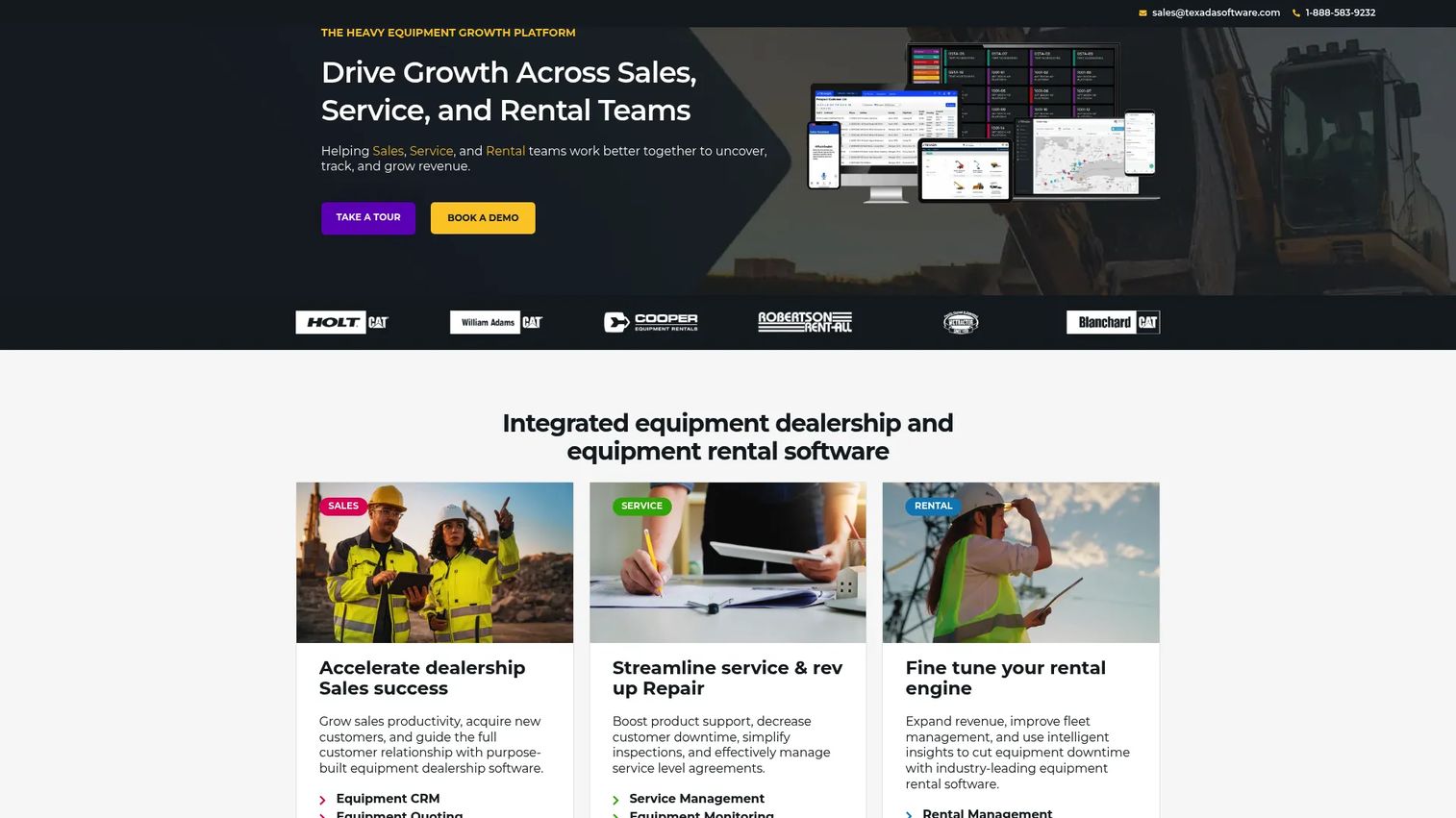
Texada is an equipment growth platform for dealer and rental businesses. It brings rental management, service management, and customer-facing equipment workflows into one integrated operations platform, which suits businesses that both sell and rent heavy equipment.
Best for: Heavy equipment dealers and rental houses that need an integrated platform across inventory, branch operations, and service.
Key strengths
- Rental management: availability, contracts, and utilization across branch operations.
- Service management: service workflows that link asset condition to maintenance and work orders.
- Customer-facing workflows: equipment management experiences that extend to customers.
Why choose Texada: Texada tends to fit dealer-plus-rental businesses that want rental and service under one roof. If your operation spans sales, rentals, and a service department, its integrated structure reduces the number of systems your branches juggle. It benefits operations that value structure and reporting depth over lightweight simplicity.
Texada pricing: Texada does not show public pricing on its site; it points buyers to contact sales. Expect a scoped quote based on your dealer and rental footprint.
6. EZRentOut
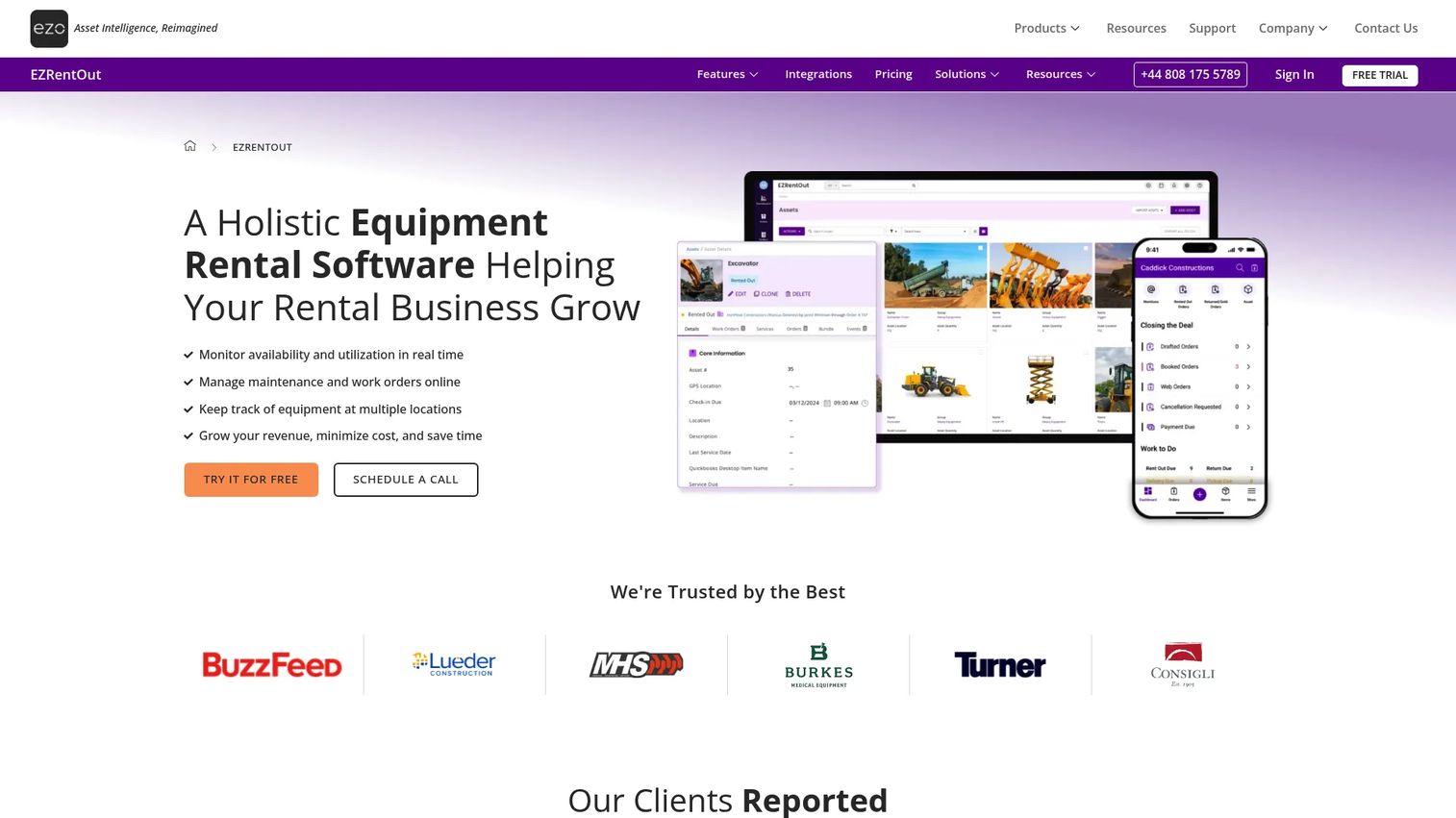
EZRentOut is cloud-based equipment rental management software for tracking inventory, orders, reservations, billing, and maintenance. Its cleaner interface and ecommerce tools make it a lower-friction path from setup to daily use, which appeals to teams that want less operational drag.
Best for: Smaller and mid-market rental businesses that want a clean, modern system with fast adoption and built-in rental equipment tracking.
Key strengths
- Order management: handle orders and reservations in a single, straightforward flow.
- Equipment tracking: inventory management and rental equipment tracking across your catalog.
- Ecommerce tools: reservations and an ecommerce storefront for online demand capture.
Why choose EZRentOut: For teams that want to get running quickly without a heavy implementation, EZRentOut's usability is the draw. It carries a 4.5/5 G2 rating, and its published tiers make budgeting predictable, a plus for mid-market operators who want to avoid drawn-out procurement. It works well as equipment rental company software for a growing single-location or small multi-site business.
EZRentOut pricing: EZRentOut lists four plans: Essential at $59/month, Growth at $399/month, Premium at $499/month, and Enterprise as a custom quote. A free trial is available, and there is no permanently free version.
7. Quipli
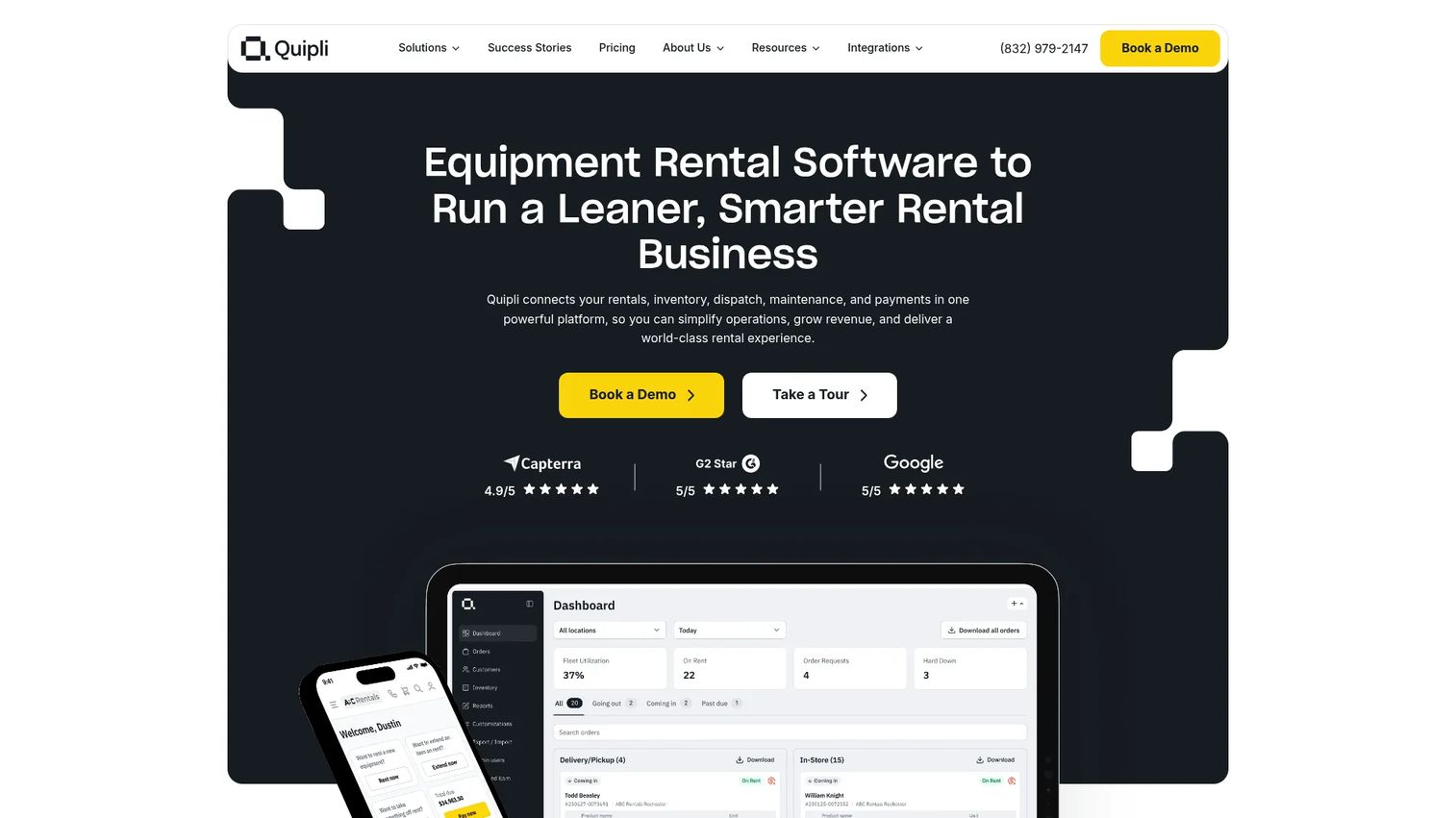
Quipli is cloud-based equipment rental software for managing rentals, inventory, dispatch, maintenance, payments, and customer self-service. Its standout is the customer-facing storefront: an online booking experience that lets independent rental businesses capture self-serve demand the way modern buyers expect.
Best for: Independent heavy-equipment and tool rental businesses that want an all-in-one operating system with a strong customer portal.
Key strengths
- Customer portal and storefront: an online storefront and customer portal for self-serve booking and payments.
- Operations coverage: inventory management, dispatch, and service and repair in one system.
- Accounting integration: QuickBooks Online integration for cleaner invoicing and accounting.
Why choose Quipli: Quipli matters for rental businesses that want to move demand capture online without bolting on a separate ecommerce tool. Its flat per-location pricing and unlimited users make it easy to reason about as you grow. It carries a 5.0/5 G2 rating, and its digital-first workflows fit operators who want customers to book online rather than call in.
Quipli pricing: Quipli uses a flat fee of $6,000/year per rental location, with no implementation fees and unlimited users and inventory. The pricing page mentions discounts for multi-location operations, though exact discounted amounts are not published.
8. rent2b
rent2b is rental software for managing bookings, items, payments, and multi-location operations. It leans modern and lightweight, with an online booking page, real-time availability, Stripe payments at checkout, and multi-location support, which makes it a clear lower-friction alternative on this list, particularly for DACH-region operators.
Best for: Rental businesses that want transparent pricing, fast go-live, and online booking with payment handling across locations.
Key strengths
- Online booking with no double bookings: a booking page with real-time availability that prevents conflicts.
- Stripe payments: collect payment at the moment of booking.
- Multi-location and API: multi-location management, API access, custom branding, analytics, and a mobile app.
Why choose rent2b: rent2b suits teams that want a modern, transparent option they can stand up quickly. Its per-booking pricing model and free starter tier make it comparison-friendly for pricing-aware shoppers who want to test the waters before committing. The real-time availability and Stripe integration give smaller yards a clean path to online rentals.
rent2b pricing: rent2b's Starter plan is free at €0/month plus 7.5% per booking. Professional is €79/month plus 4.5% per booking, and Enterprise is €199/month plus 2.5% per booking, both billed yearly. All tiers share the same core features, differing on support and integration levels.
Considerations before you buy
Yard workflow coverage
Map your actual workflow before you shortlist. If you need inventory, dispatch, maintenance and work orders, and invoicing in one system, confirm each is native rather than bolted on. Broad platforms like Point of Rental and MCS Rental Software cover the full lifecycle; lighter tools may cover the core and integrate the rest.
Multi-location fit
If you run or plan to run multiple branches, verify shared inventory visibility and multi-location dispatching. A tool that treats each location as a silo will recreate the exact problem you are trying to solve. Ask specifically how one branch sees and pulls another's availability.
Cloud and mobile access
Field teams live on phones and tablets. Confirm cloud based equipment rental software with genuine mobile access, and ask about offline behavior for yards with weak signal. Point of Rental's offline mobile app is a useful benchmark to compare against.
Pricing transparency
Some vendors publish pricing (HireHop, EZRentOut, Quipli, rent2b) and some run sales-led quotes (Point of Rental, MCS, Wynne, Texada). Neither is wrong, but know which you are dealing with. If you need a fast decision, a published-price tool with a free trial shortens the path.
Reporting and analytics
Decide what you need to see weekly: utilization, revenue per asset, downtime, branch performance. Confirm the reporting and analytics depth matches, and check whether AI analytics adds signal or just dashboards you will not open.
Conclusion
The right rental yard software depends on three things: how complex your yard is, how many branches you run, and how much reporting depth you need to make weekly decisions. Point of Rental and MCS Rental Software fit broad, control-heavy operations. Wynne Systems and Texada suit enterprise and dealer-plus-rental businesses. HireHop, EZRentOut, Quipli, and rent2b give smaller and mid-market operators faster, more transparent paths to get off spreadsheets.
Do not buy on a feature list. Book two demos and run one pricing check before you commit. Then get operations, finance, and your branch managers to validate the same criteria: yard coverage, multi-location fit, mobile access, and reporting. When all three functions agree the fit is real, you have a shortlist worth acting on. That alignment is what turns rental business software from another tool into a system your whole operation runs on.
FAQs
Rental yard software is a system that manages the full rental lifecycle for equipment rental businesses: inventory and availability, bookings, dispatch, maintenance and work orders, and invoicing. It centralizes what used to live in spreadsheets and separate tools so managers get a real-time view of the yard.
Rental yard software is built around the rental transaction: bookings, utilization, turnover, contracts, and customer billing. Equipment management software is broader or more asset-focused, centered on where assets are and their maintenance and depreciation history. The rental version adds the booking and billing layer that prevents double bookings and speeds up cash.
Start with availability tracking, contracts, invoicing, maintenance, and branch coordination. Those five cover the daily workflow that keeps utilization high and disputes low. Add reporting and analytics second, once the core operational data is flowing cleanly through one equipment rental management software system.
Yes. Cloud access gives distributed teams and field staff a shared, real-time view from any device, which is essential for multi-location dispatching. It reduces handoff errors because everyone reads the same availability data, and mobile access lets yard crews update status without walking back to a desk.
Pricing varies by model. Published tools range from a free tier (HireHop, rent2b Starter) to flat per-location fees (Quipli at $6,000/year) and per-user or per-tier plans (EZRentOut from $59/month). Enterprise and broad platforms like Point of Rental, MCS, Wynne, and Texada run sales-led quotes, so plan on a demo to get a number.
Look for shared inventory visibility, multi-location dispatching, and location-aware workflows. Point of Rental and MCS Rental Software are strong fits for complex multi-branch operations, Wynne Systems and Texada for enterprise scale, and rent2b for smaller multi-location teams that want online booking with transparent pricing.
Yes. Centralized inventory and real-time availability mean a booked asset shows as unavailable everywhere at once, so two branches cannot promise the same machine. That leads to faster confirmations and fewer customer issues, which is one of the clearest returns an equipment rental system delivers.
Yes. HireHop offers a free plan for one user, and rent2b's Starter tier is free with a per-booking fee. EZRentOut and others offer free trials so you can test before paying. The tradeoff is that lighter or free tiers may cover the core workflow while broader platforms add deeper multi-location and reporting depth.