Your product is still changing while purchasing has already started. Finance needs margin visibility, production needs a schedule, and the BOM won't be final for another three weeks. That's not a process problem. That's the defining challenge of engineer-to-order manufacturing, and standard ERP systems weren't built for it.
According to Eurostat (2025), 57.62% of EU manufacturing enterprises now use ERP software. The gap between those running modern ETO ERP and those still stitching together spreadsheets, standalone CAD, and accounting exports shows up in one place: Board meetings, when leadership can't answer basic questions about margin risk before a job closes.
The right ETO ERP connects engineering changes, BOMs, procurement, production scheduling, job costing, and WIP into one system your operations team can actually run without five people chasing data every morning.
What's inside
This guide covers 14 ETO ERP systems for custom manufacturers, machine builders, system integrators, and project-based production teams in 2026.
Tools were selected and evaluated on:
- Fit for engineer-to-order workflows, including CAD integration, BOM revision control, and change-order management
- Project costing, procurement, WIP visibility, and margin tracking
- Production planning, MRP, inventory management, and shop-floor execution
- Pricing transparency and G2 rating availability
Pricing and G2 data were verified against live vendor sources.
TL;DR
- Best dedicated ETO fit: Total ETO for custom machine builders needing purpose-built CAD-to-production workflows
- Best Salesforce-native ERP: Rootstock for manufacturers whose operating model already centers on Salesforce
- Best for mid-market cloud ERP: Acumatica or Microsoft Dynamics 365 Business Central for flexible finance and manufacturing operations
- Best for enterprise scale: SAP S/4HANA Cloud or IFS Cloud for multi-site manufacturers with complex global operations
- Best specialist options: Genius ERP and Jobscope for small to mid-market ETO and project-based shops
- Best shop-floor focus: Global Shop Solutions for job shops that need floor execution tied directly to costing
What is ETO ERP software?
ETO ERP software is enterprise resource planning software built for engineer-to-order manufacturers that design, quote, source, build, cost, and deliver customer-specific products as part of one continuous project workflow.
Unlike standard ERP, which assumes a stable product catalog and repeatable production runs, ETO ERP must handle a world where the design changes after the quote is approved, purchasing needs to begin before the full BOM is released, and finance needs job costing visibility before the product ships.
Key capabilities ETO ERP must support
- CAD and PLM integration (SolidWorks, Autodesk Inventor, and similar)
- Project-based bills of materials with staged release
- Revision and engineering change-order control
- Estimating and quoting workflows
- Job costing and WIP tracking
- Long-lead component procurement
- MRP and capacity planning
- Shop-floor data collection and labor tracking
- Nonconformance and quality management
- Field service and post-delivery support
How ETO differs from adjacent production models
Understanding the boundary helps you pick the right system:
- Engineer-to-order: Design starts or changes after the customer order is placed
- Make-to-order: Production starts after the order, but the design is already defined
- Configure-to-order: Customer selects from predefined options; no new engineering
- Make-to-stock: Products are manufactured before demand is confirmed
If your team is regularly designing while simultaneously purchasing and scheduling, you need a true ETO system, not a configure-to-order or make-to-order platform that approximates the workflow.
When to use ETO ERP software
Connect engineering changes to purchasing and production
ETO teams make design decisions that ripple immediately into procurement and scheduling. When an engineer revises a BOM, that change needs to flow into open purchase orders, work orders, and cost estimates without manual intervention. ETO ERP handles revision control and change-order management so purchasing and production stay synchronized with engineering, even mid-project.
Track margin before the job closes
Waiting until final delivery to understand project profitability is how ETO manufacturers lose money on jobs they thought were healthy. ETO ERP gives founders and CFOs actual-versus-budget reporting, labor capture, material commitments, and WIP visibility throughout the project lifecycle, not just at closure. That's the difference between a board conversation with real data and a board conversation with approximations.
Replace disconnected systems at the scale inflection point
Spreadsheet BOMs, standalone CAD, accounting exports, and manual purchasing trackers work for one or two concurrent projects. They break when you have ten running simultaneously. The scale trigger is usually obvious: Data stops being trustworthy, jobs overlap in ways nobody can track, and leadership decisions start lagging the actual project state by days or weeks.
ETO ERP software comparison
Use this table to build your initial shortlist. Verify deployment options, CAD integrations, implementation scope, and G2 ratings directly with vendors before moving to evaluation calls.
| # | Product | Best for | Key differentiator | Pricing | G2 rating |
|---|---|---|---|---|---|
| 1 | Total ETO | Custom machine builders | Purpose-built ETO with CAD and project control | From $265/year for shop-floor users | 4.7/5 |
| 2 | Rootstock | Salesforce-native manufacturers | Cloud ERP on Salesforce with ETO project visibility | Quote-based | 4.0/5 |
| 3 | Epicor | Broad manufacturing operations | Deep production, supply chain, and scheduling | Quote-based | 4.1/5 |
| 4 | Infor CloudSuite Industrial | Complex industrial manufacturers | Manufacturing ERP with strong planning and operations | Quote-based | 3.9/5 |
| 5 | SAP S/4HANA Cloud | Enterprise manufacturers | Global ERP backbone for finance and manufacturing | Quote-based | 4.4/5 |
| 6 | Oracle NetSuite | Multi-entity growing manufacturers | Cloud ERP with finance-first operational control | Quote-based | 4.1/5 |
| 7 | Microsoft Dynamics 365 Business Central | Microsoft-stack manufacturers | Flexible ERP with strong finance and operations | From $80/user/month | 4.0/5 |
| 8 | Acumatica | Mid-market cloud ERP buyers | Unlimited users with manufacturing and project accounting | From under $1,495/month | 4.4/5 |
| 9 | IFS Cloud | Asset-heavy manufacturers | Unified ERP, projects, service, and asset lifecycle | Quote-based | 4.0/5 |
| 10 | Genius ERP | Small to mid-market custom manufacturers | ETO and make-to-order in one specialist platform | Quote-based | 4.3/5 |
| 11 | Global Shop Solutions | Job shops | Shop-floor execution tied to job costing and scheduling | Quote-based | 3.9/5 |
| 12 | Jobscope | Project-based manufacturers | Engineer-to-order and contract manufacturing workflows | Quote-based | 3.3/5 |
| 13 | SYSPRO | Industrial manufacturers | Manufacturing ERP with WIP, BOM, and MRP | Quote-based | 4.1/5 |
| 14 | QAD Adaptive ERP | Global manufacturers | Manufacturing ERP for complex supply chain and compliance | Quote-based | 3.5/5 |
Best 14 ETO ERP software tools for 2026
1. Total ETO
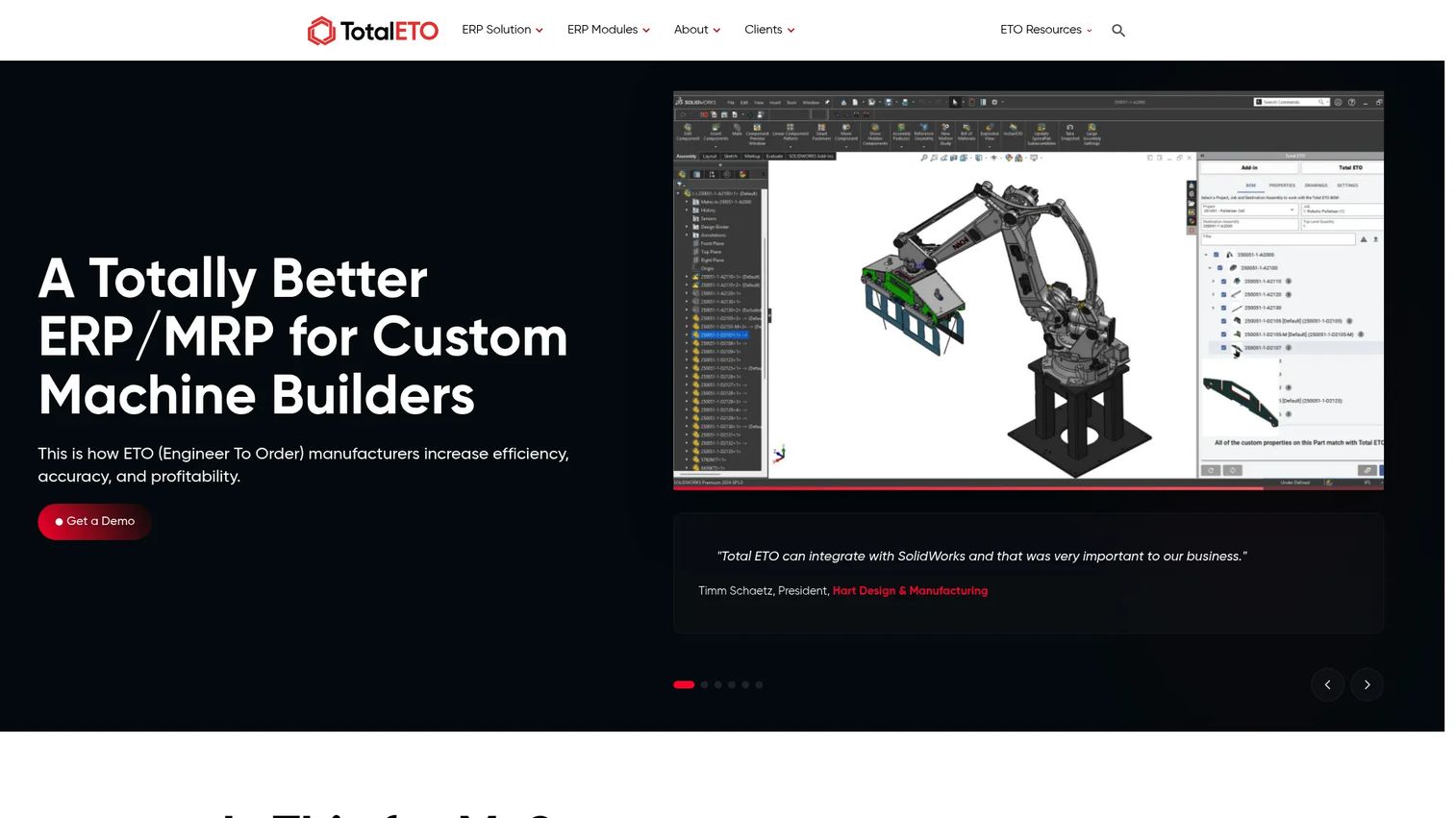
Total ETO is a web-based ERP and MRP platform built specifically for engineer-to-order manufacturers. It serves custom machine builders, system integrators, panel shops, and OEMs that need a single system connecting engineering, purchasing, production, and accounting. The platform includes direct integrations with SolidWorks and Autodesk Inventor, so BOMs flow from CAD into procurement without manual re-entry.
Best for: Small and midsize custom machine builders and ETO manufacturers that want a purpose-built system rather than a configured general ERP.
Key features
- SolidWorks and Autodesk Inventor CAD integrations
- Project-based BOM control with staged procurement release
- Purchasing, inventory, receiving, and supplier workflows
- Job costing, WIP tracking, and 200+ pre-designed reports
- Shop-floor task routing, labor tracking, and nonconformance reports
Why choose Total ETO: This is the specialist pick. If your operating model is true ETO, with designs still moving after purchase orders have started, Total ETO's native workflow fits the problem without customization overhead. Teams that need broad ERP coverage across multiple production models should evaluate broader platforms.
Total ETO pricing: Shop-floor timecard packs start at $265 per year per 5-user block, with additional kiosk licenses at the same annual rate. Main ERP user pricing is quote-based. Ask sales for per-seat costs, module scope, cloud vs. on-premise deployment, and implementation fees.
G2 rating: 4.7/5
2. Rootstock
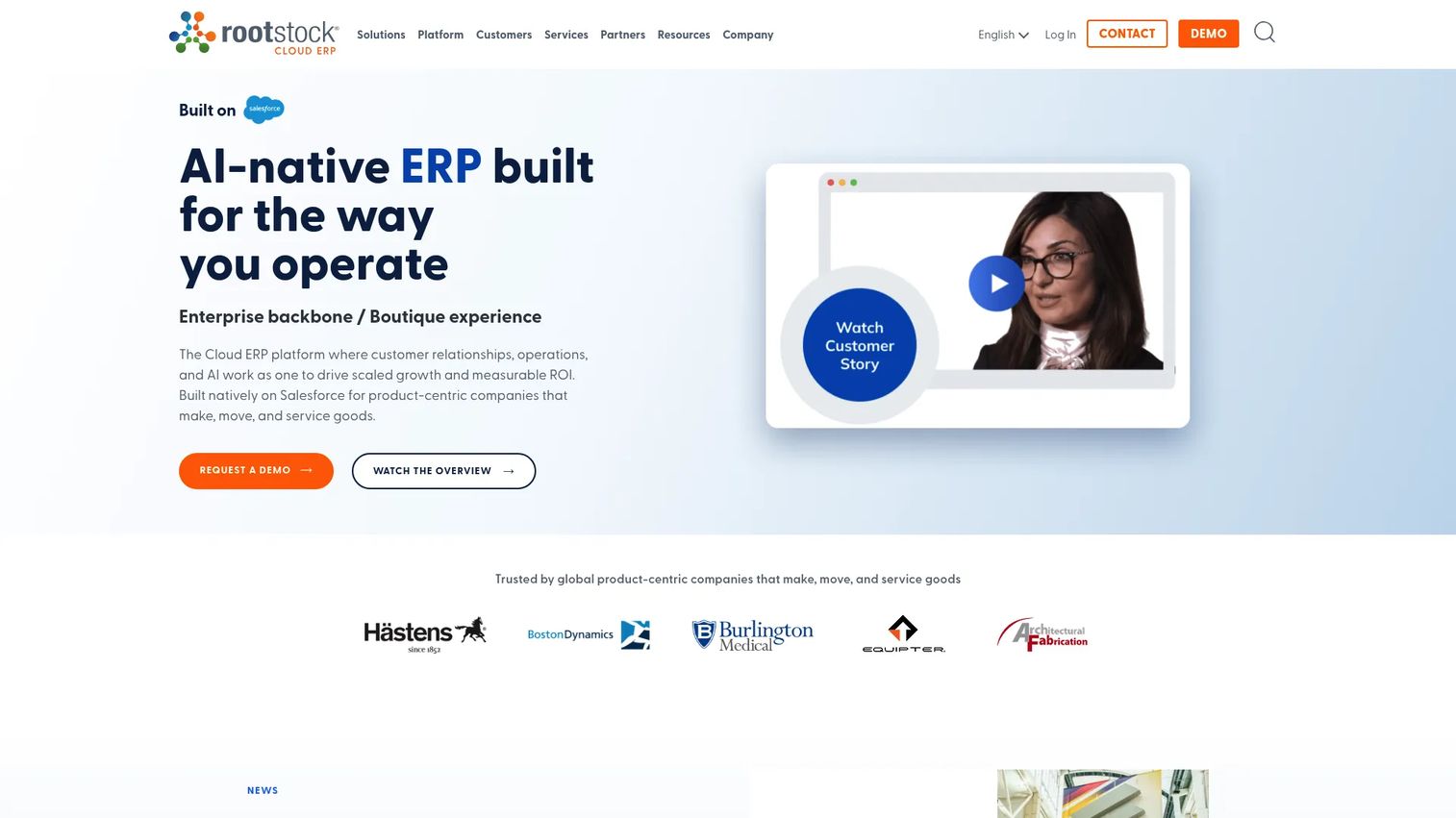
Rootstock is an AI-native cloud ERP platform built directly on Salesforce, serving manufacturers, distributors, and product-centric companies. Because it runs inside Salesforce, sales data, customer service records, and manufacturing operations share one data layer rather than syncing across separate systems. It covers order management, production planning, BOMs, MRP, capacity planning, procurement, inventory, financials, field service, and quality management.
Best for: Manufacturing companies already running Salesforce that want ERP data close to CRM, customer operations, and service workflows.
Key features
- Salesforce-native ERP architecture with shared data model
- Project Workbench for ETO project visibility
- Manufacturing planning: BOMs, routings, MRP, work orders, and shop-floor control
- Field service, serial-number tracking, and RMA management
- PLM synchronization capabilities
Why choose Rootstock: The case for Rootstock is clear when Salesforce is already central to your operating model. Sales, service, manufacturing, and customer data stop living in different systems. Teams not on Salesforce should evaluate other options first, since the Salesforce dependency is both the platform's strength and its architectural constraint.
Rootstock pricing: Pricing is quote-based across Growth, Advanced, and Enterprise packages. Ask sales for user counts, module scope, Salesforce edition requirements, and implementation partner costs.
G2 rating: 4.0/5
3. Epicor
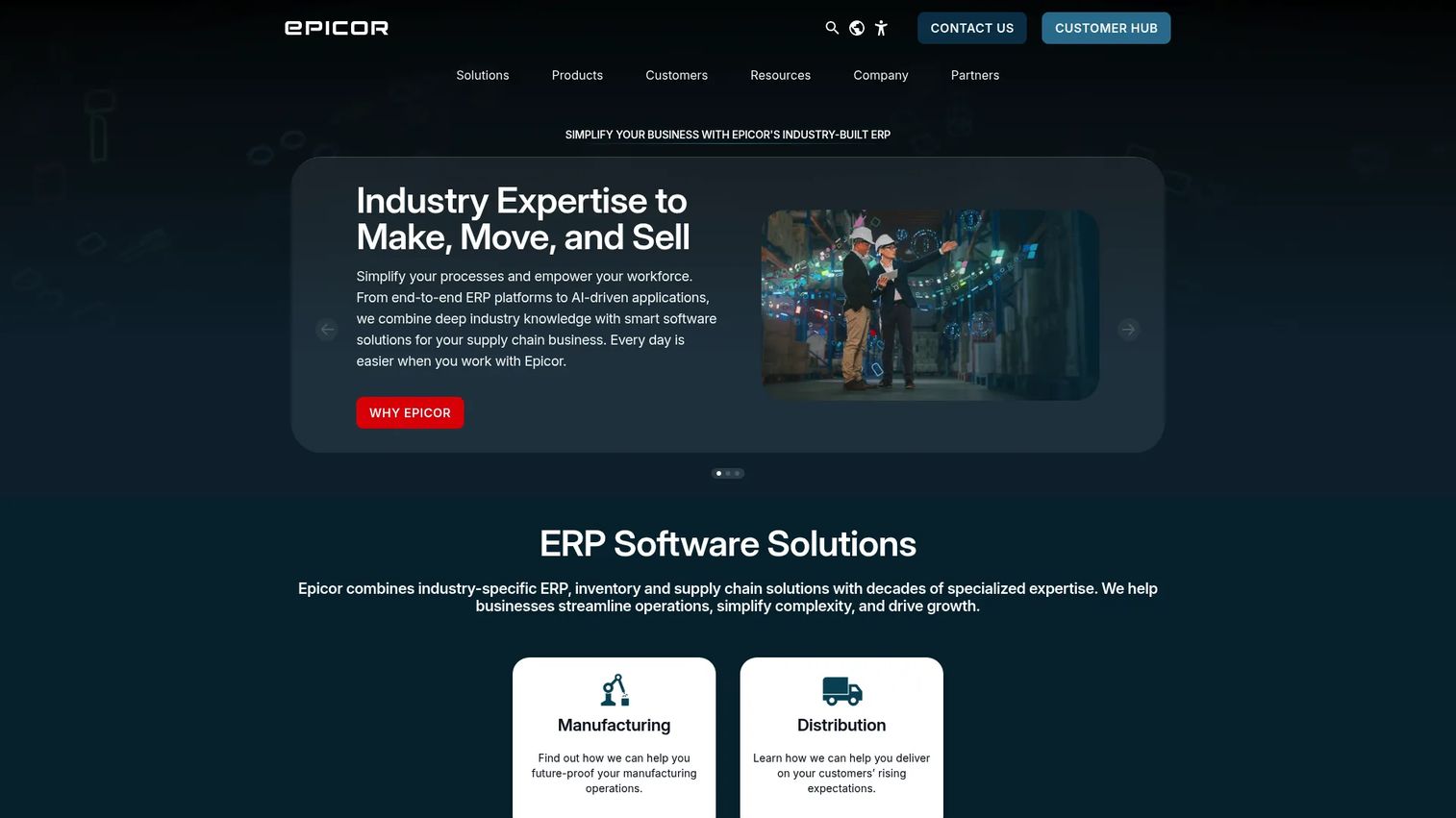
Epicor provides industry-specific ERP software for manufacturing, distribution, retail, building supply, and automotive organizations. For manufacturing teams, it covers production, supply chain, inventory management, financial management, and business intelligence. The platform includes AI capabilities through Epicor Prism and supports integration via REST, OData, and EDI.
Best for: Mid-market and enterprise manufacturers that need broad operational depth across multiple production models, not only pure ETO workflows.
Key features
- Industry-specific manufacturing ERP with production scheduling
- Supply chain and inventory management
- AI-powered analytics via Epicor Prism
- Financial management and reporting
- Integration through REST, OData, EDI, and automation tools
Why choose Epicor: Epicor fits teams that want a manufacturing ERP backbone with enough breadth to support multiple production types. ETO-specific workflows like CAD integration and revision control will need validation during the demo process, as the platform's strengths lie in broad manufacturing depth rather than dedicated ETO specialization.
Epicor pricing: Pricing requires contacting sales. Ask about modules, user counts, deployment options (cloud vs. on-premise), implementation partner costs, and manufacturing-specific add-ons.
G2 rating: 4.1/5
4. Infor CloudSuite Industrial
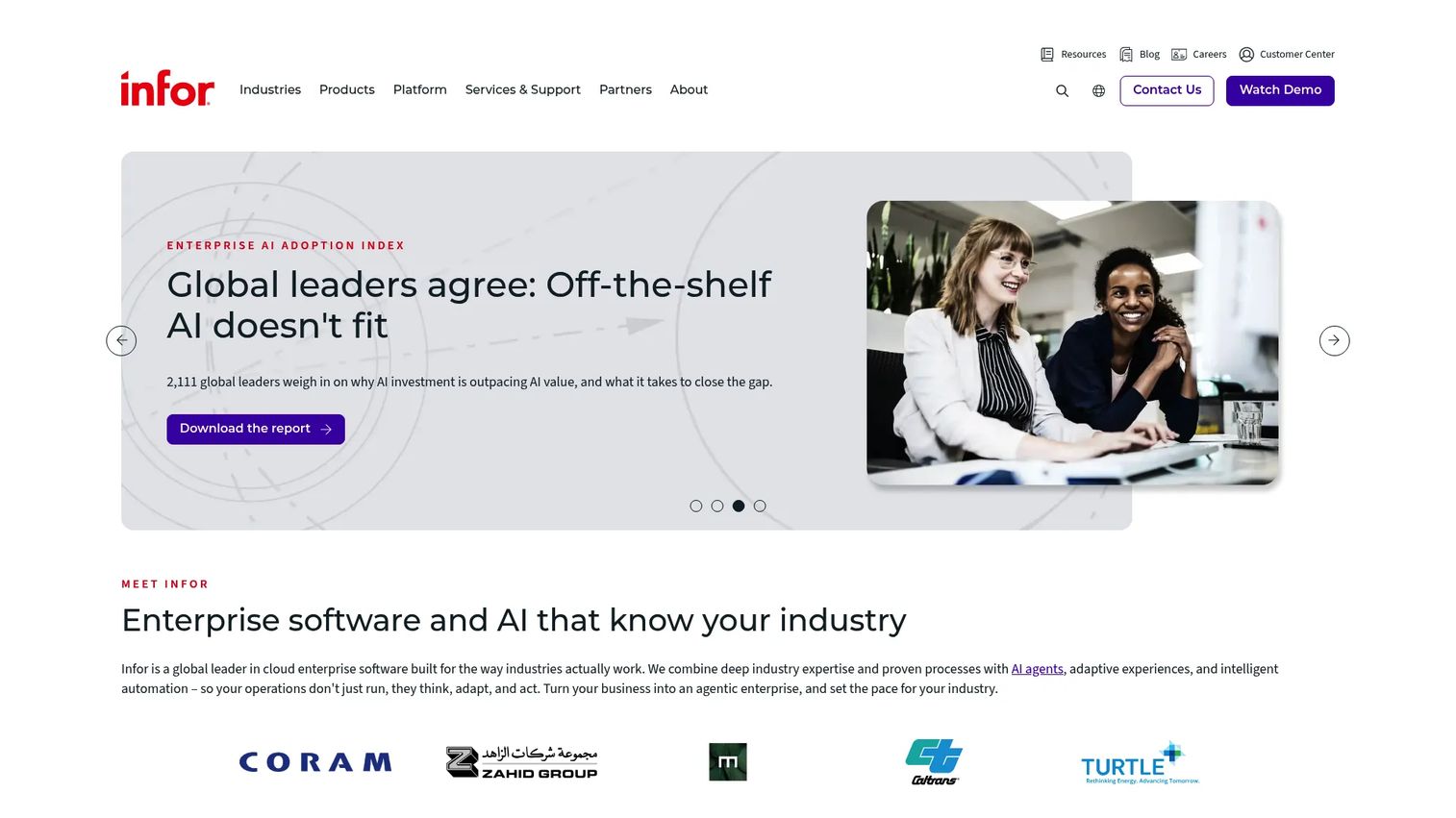
Infor CloudSuite Industrial is an industry-specific cloud ERP for small, midsize, and enterprise industrial manufacturers. The platform covers manufacturing operations, advanced planning and scheduling, quality management, service management, multi-site operations, and supply chain visibility. It runs on the Infor OS platform with built-in analytics capabilities.
Best for: Small to enterprise industrial manufacturers needing industry-specific cloud ERP with manufacturing operations management and multi-site support.
Key features
- Advanced planning and scheduling for complex production environments
- Manufacturing operations management
- Quality management and service management
- Multi-site operations and supply chain visibility
- Infor OS with embedded analytics
Why choose Infor CloudSuite Industrial: Strong fit for industrial manufacturers with complex planning and operational requirements that extend beyond a single plant or production model. ETO-specific workflows like CAD integration and project-based BOM release should be validated during vendor demos, as the platform targets broader industrial complexity.
Infor CloudSuite Industrial pricing: Pricing requires contacting sales. Ask about cloud deployment options, module scope, user licensing, multi-site configuration, and implementation costs.
G2 rating: 3.9/5
5. SAP S/4HANA Cloud
SAP S/4HANA Cloud is an enterprise ERP system using in-memory processing, embedded AI, and real-time analytics. It covers finance, supply chain, manufacturing, logistics, procurement, sales, HR, and asset management across public and private cloud deployment options. For large manufacturers, it provides the global process standardization and governance backbone that multi-entity operations require.
Best for: Large manufacturers that need global ERP standardization, deep finance control, and compliance infrastructure across multiple entities and regions.
Key features
- Global financial management and accounting
- Supply chain, manufacturing, and logistics management
- Procurement, sales, and project management
- Embedded AI and machine learning
- Real-time analytics and integration via SAP Business Technology Platform
Why choose SAP S/4HANA Cloud: The right choice when ERP selection is fundamentally about governance, global process standardization, and long-term operating model control across multiple sites. It is not the starting point for a 50-person ETO shop. Implementation complexity and investment are substantial, so this fits companies where the board is asking for enterprise-grade infrastructure.
SAP S/4HANA Cloud pricing: Pricing is quote-based. Ask about cloud edition options, user types, manufacturing modules, implementation partner requirements, and total first-year cost including migration and training.
G2 rating: 4.4/5
6. Oracle NetSuite
Oracle NetSuite is a cloud ERP platform providing financial management, supply chain, procurement, order management, customer relationship management, and HR. For growing manufacturers, it delivers multi-entity financial visibility and can support manufacturing functionality through modules and partner extensions. NetSuite also offers a free QuickStart program for eligible early-stage U.S. technology startups within stated usage limits.
Best for: Growing multi-entity manufacturers that need finance-first cloud ERP with manufacturing extensions added as the operational model matures.
Key features
- Cloud financials and multi-entity accounting
- Inventory management and procurement workflows
- Order management and customer relationship management
- Embedded AI with Ask Oracle and NetSuite Next
- Integration and platform development capabilities
Why choose Oracle NetSuite: Strong fit when the CEO or CFO needs cleaner financial operations across multiple entities and the manufacturing workflow, while complex, doesn't require the depth of a dedicated ETO system. Teams running heavily custom machine-builder workflows should validate ETO-specific BOM and revision control capabilities before committing.
Oracle NetSuite pricing: Standard pricing requires contacting sales. The QuickStart free program exists for eligible early-stage U.S. startups within specific usage limits. For manufacturing deployments, ask about module costs, user licensing, implementation partner fees, and data migration scope.
G2 rating: 4.1/5
7. Microsoft Dynamics 365 Business Central
Microsoft Dynamics 365 Business Central is a cloud business management platform connecting finance, sales, service, inventory, and operations for small and midsize businesses. The Premium tier adds manufacturing and service management on top of the core Essentials capabilities. It integrates natively with Microsoft 365 and supports Power BI reporting, making it a natural fit for teams already using the Microsoft ecosystem.
Best for: Small and midsize manufacturers that want ERP close to finance, operations, and Microsoft productivity tools, with strong partner availability for extensions.
Key features
- Financial management, inventory control, and purchasing
- Manufacturing and service management (Premium tier)
- Microsoft 365 and Microsoft Copilot integration
- Power BI reporting and analytics
- Partner ecosystem for manufacturing-specific extensions
Why choose Microsoft Dynamics 365 Business Central: Good fit for teams that want broad ERP flexibility, familiar Microsoft workflows, and a large partner network for manufacturing customizations. ETO-specific requirements like CAD integration and project-based BOM control will likely need a partner-built extension, so validate that before selection.
Microsoft Dynamics 365 Business Central pricing: Team Members plans start at $8.00 per user per month (billed annually). Essentials is $80.00 per user per month and Premium is $110.00 per user per month, both billed annually. A 30-day free trial is available. Implementation partner costs are separate.
G2 rating: 4.0/5
8. Acumatica
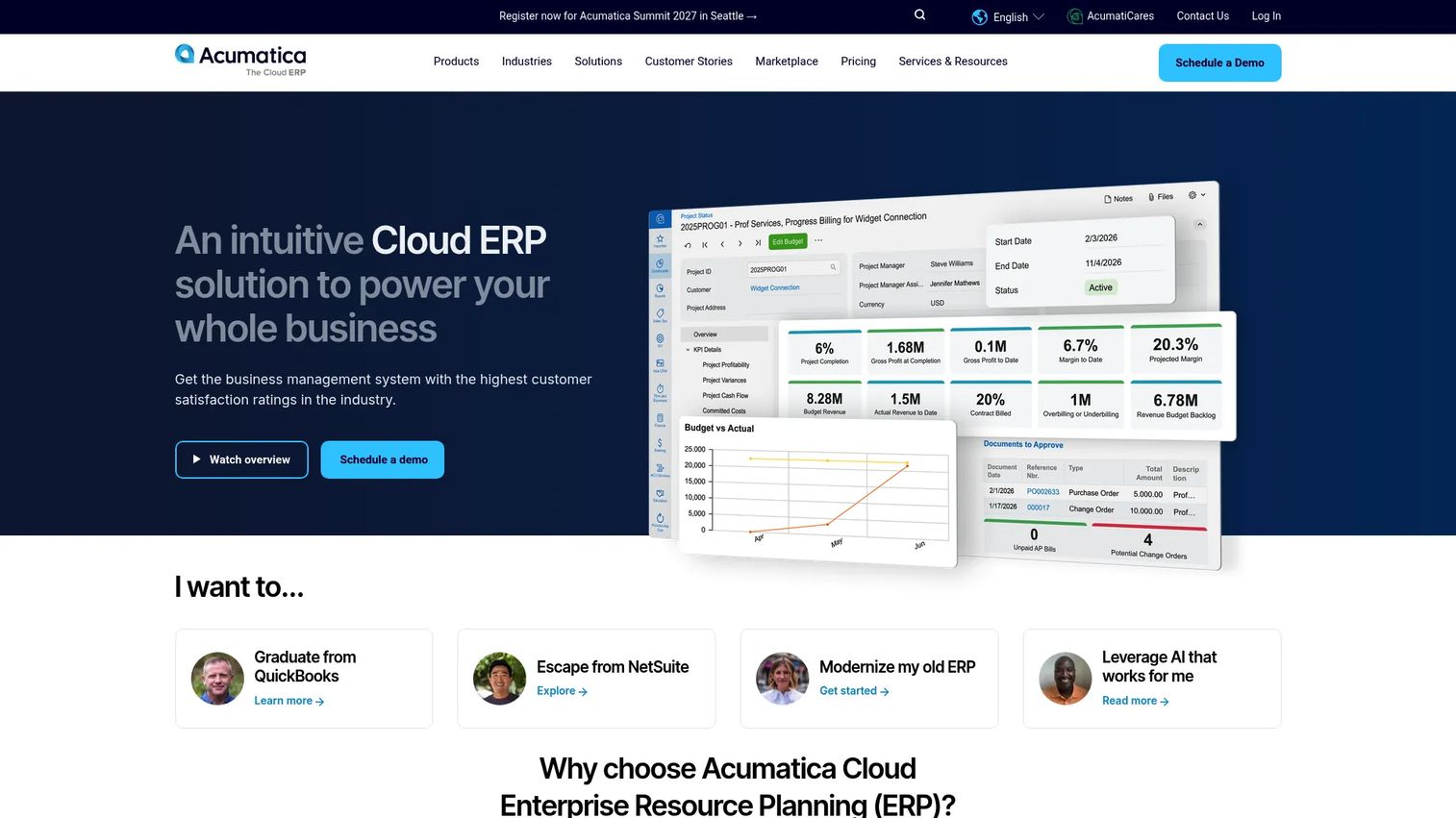
Acumatica is a cloud ERP platform for growing businesses with industry-specific editions covering manufacturing, distribution, construction, and retail. Its pricing model is based on computing resources and application scope rather than per-seat count, which means adding users doesn't trigger automatic cost increases. The Manufacturing edition includes production management, project accounting, and inventory management.
Best for: Growing mid-market manufacturers that need cloud ERP with manufacturing and project visibility, and want unlimited users without per-seat pricing pressure.
Key features
- Cloud ERP with AI-powered automation
- Manufacturing edition with production management
- Project accounting and financial management
- Inventory and order management
- Role-based dashboards and reporting
Why choose Acumatica: The unlimited-user model removes a common scaling penalty. For a founder audience, the operational visibility without enterprise overhead is the main draw. APEX for Manufacturing packages start under $2,185 per month, giving you a floor for budget planning before you go into a full scoping conversation.
Acumatica pricing: APEX for Distribution packages start under $1,495 per month. APEX for Manufacturing starts under $2,185 per month. Standard Acumatica pricing is customized based on application scope and resource requirements. No free tier is available.
G2 rating: 4.4/5
9. IFS Cloud
IFS Cloud is a composable enterprise platform unifying ERP, enterprise asset management, supply chain management, and field service management with embedded Industrial AI. It uses an evergreen delivery model so customers stay current without major upgrade projects. For manufacturers where the sale doesn't end at shipment, IFS covers the full lifecycle from project delivery through ongoing service, maintenance, and asset management.
Best for: Asset-heavy manufacturers and industrial companies that need ERP, project management, field service, and asset lifecycle operations in one platform.
Key features
- Enterprise resource planning and manufacturing operations
- Enterprise asset management and maintenance
- Supply chain management
- Field service management with scheduling and dispatch
- Embedded Industrial AI and predictive analytics
Why choose IFS Cloud: Strong fit when manufacturing complexity extends into long-term service obligations, maintenance contracts, or asset-intensive delivery models. Industrial equipment manufacturers, aerospace suppliers, and energy-sector manufacturers often find IFS's service and asset capabilities match their post-delivery reality better than pure ERP alternatives.
IFS Cloud pricing: Pricing requires contacting sales. Ask about modules (ERP, asset management, field service), user licensing, regional deployment, implementation scope, and support tiers.
G2 rating: 4.0/5
10. Genius ERP
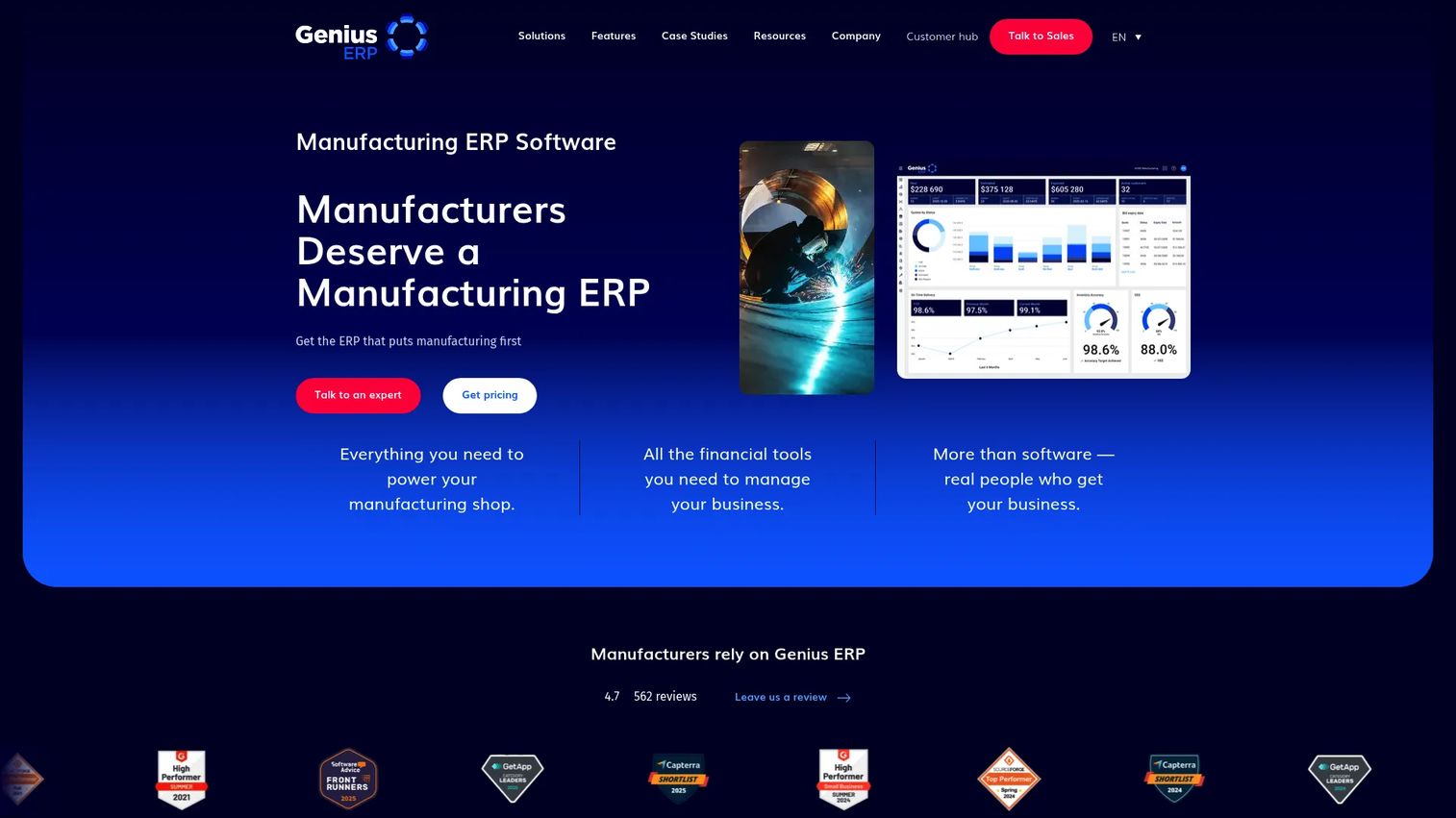
Genius ERP is manufacturing ERP software built specifically for custom, engineer-to-order, make-to-order, and assemble-to-order manufacturers. It integrates engineering, production, inventory, purchasing, finance, sales, and field services in a single platform. A standout feature is CAD2BOM, which connects CAD files directly to BOM management and procurement workflows.
Best for: Small and mid-sized custom manufacturers needing ETO and make-to-order workflows in a specialist platform without jumping to a global ERP suite.
Key features
- CAD2BOM engineering integration for BOM management
- Estimating, quoting, and project management
- Smart scheduling and production management
- Purchasing, inventory control, and accounting with job costing
- Quality control, CRM, field services, and analytics
Why choose Genius ERP: A strong specialist option for custom manufacturers that want ETO manufacturing depth, CAD-to-BOM workflows, and job costing without the implementation weight of an enterprise platform. If your business is predominantly custom or project-based production, Genius fits the workflow without significant configuration effort.
Genius ERP pricing: Pricing is quote-based and varies by company size, users, modules, deployment, and implementation scope. Contact Genius ERP directly with your user count and production model for a scoped estimate.
G2 rating: 4.3/5
11. Global Shop Solutions
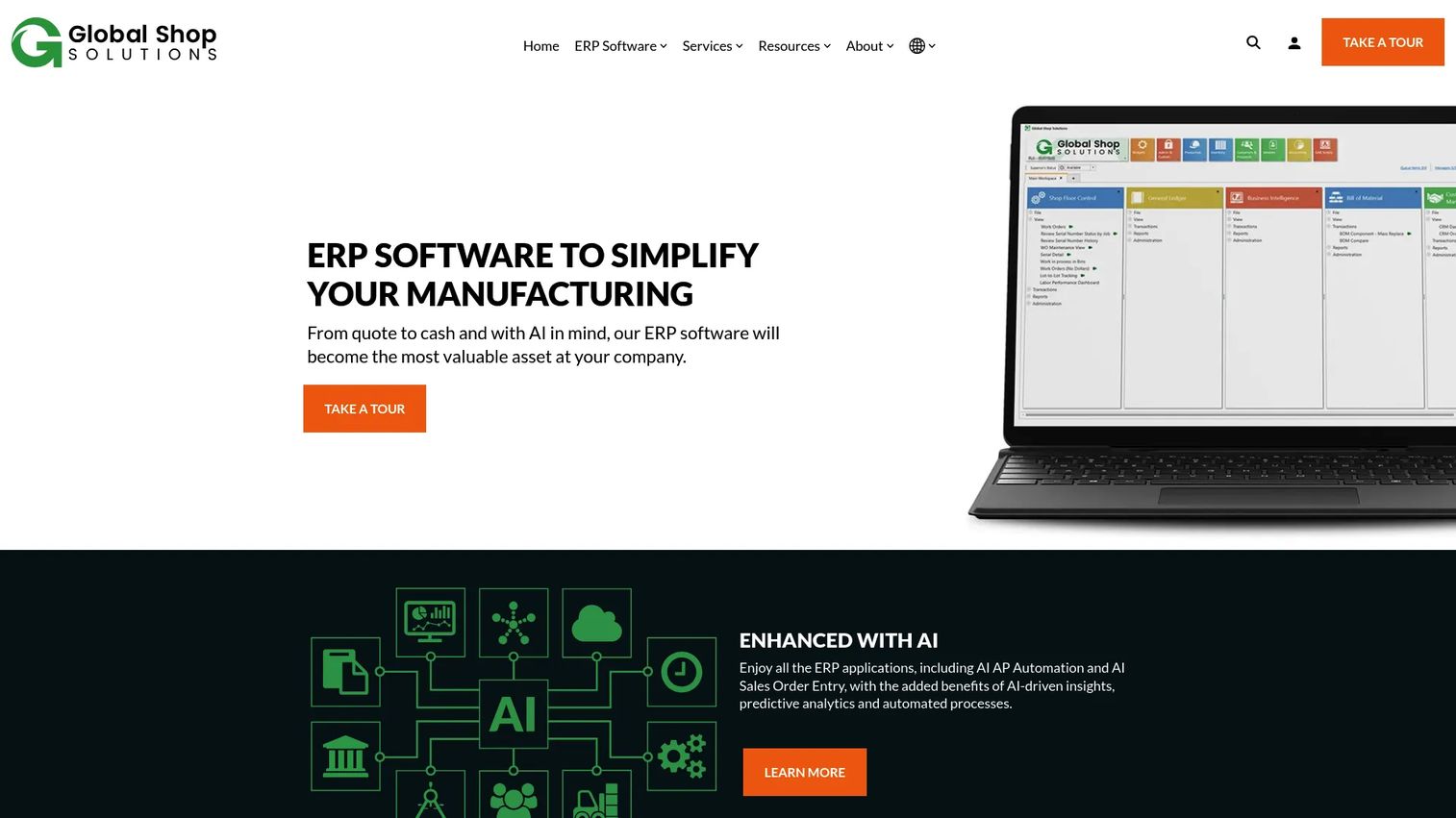
Global Shop Solutions is an AI-enhanced ERP for manufacturers available in cloud and on-premise deployments. It covers production scheduling, advanced planning, shop-floor data collection, inventory tracking, automated purchasing, job costing, quality control, shipping, and CRM. The platform targets manufacturers that need shop-floor execution tied directly to ERP rather than a loosely integrated bolt-on.
Best for: Manufacturing companies and job shops that need integrated shop-floor execution with production scheduling, job costing, and inventory in one system.
Key features
- Production scheduling and advanced planning
- Shop-floor data collection and shop management
- Inventory tracking and automated purchasing
- Job costing, accounts receivable, and accounts payable
- AI AP Automation and AI Sales Order Entry
Why choose Global Shop Solutions: The fit is strongest when leadership needs real-time visibility into what's happening on the floor, without waiting for someone to manually update a spreadsheet or push data between disconnected systems. For ETO teams with high shop-floor activity and job-by-job margin tracking, this combination of scheduling and costing in one system removes a common data gap.
Global Shop Solutions pricing: Pricing uses a concurrent-user model with upfront and ongoing quarterly costs. Deployment options include on-premise, cloud, and SaaS. Contact sales for a quote that reflects your user count, modules, and deployment preference.
G2 rating: 3.9/5
12. Jobscope
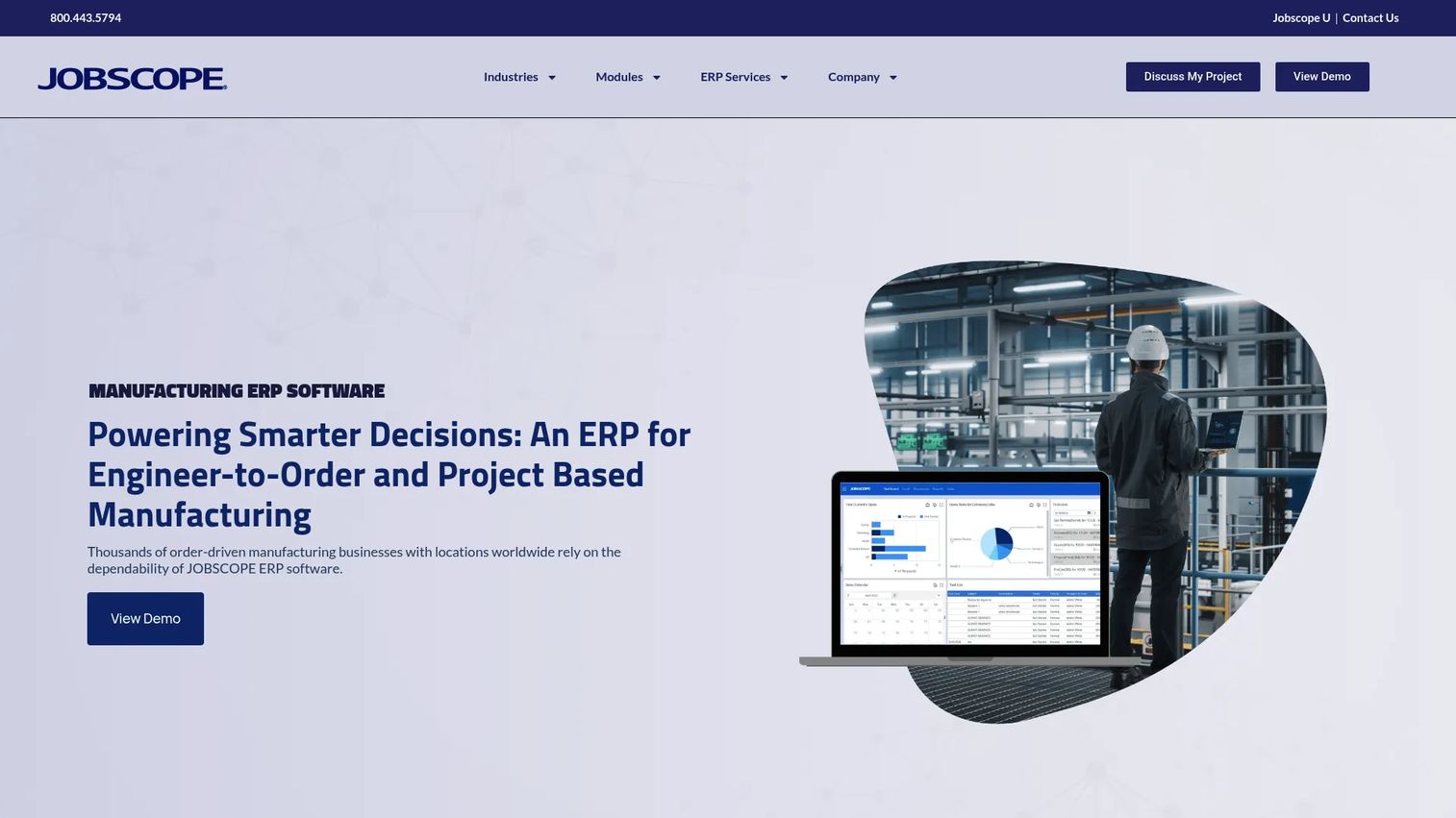
Jobscope is an ERP platform built for engineer-to-order, make-to-order, job-shop, and project-based manufacturers. It covers real-time job costing, project management, scheduling, materials, inventory, purchasing, production management, and CRM with quoting capabilities. Deployment options include on-premise, cloud-hosted, and self-hosted cloud, with both perpetual and subscription licensing available.
Best for: Order-driven manufacturers that run every customer order as a project and need budget, cost, and delivery visibility job by job.
Key features
- Real-time job costing and project management
- Scheduling and production management
- Materials, inventory, and purchasing control
- CRM with quoting, account, contact, and pipeline tracking
- Configurator for custom-product quoting and order creation
Why choose Jobscope: Strong fit for contract manufacturers and project-based shops that treat each order as a distinct financial project. The real-time job costing capability addresses the core ETO pain of needing margin visibility before a job closes. Licensing flexibility (perpetual or subscription) gives buyers options that most cloud-only platforms don't offer.
Jobscope pricing: Both perpetual licenses and subscription licenses are available, plus optional cloud hosting. Contact Jobscope to get quotes for each licensing model alongside implementation, training, and hosting fees.
G2 rating: 3.3/5
13. SYSPRO
SYSPRO is an ERP platform for manufacturing and distribution businesses. It covers work in progress management, bills of materials, MRP, inventory planning, lot traceability, and supply chain visibility. SYSPRO is moving to a named-user, subscription-based licensing model and positions itself for mid-sized manufacturers that need operational discipline across production and distribution.
Best for: Mid-sized manufacturers and distributors needing production, inventory, supply chain, and financial control in one ERP with strong WIP and BOM capabilities.
Key features
- Work in progress management and BOM management
- Material requirements planning
- Inventory planning and lot traceability
- Supply chain visibility and portal
- Financial management
Why choose SYSPRO: A solid fit for manufacturers that need WIP accounting, BOM management, and MRP without the implementation scale of an enterprise platform. ETO teams should validate project-based BOM release, revision control, and CAD integration fit during demos, as SYSPRO's core strengths lean toward discrete manufacturing rather than pure engineer-to-order.
SYSPRO pricing: Pricing is not displayed and requires contacting SYSPRO directly. The platform is transitioning to a named-user subscription model. Ask about user counts, module scope, deployment options, and total first-year costs.
G2 rating: 4.1/5
14. QAD Adaptive ERP
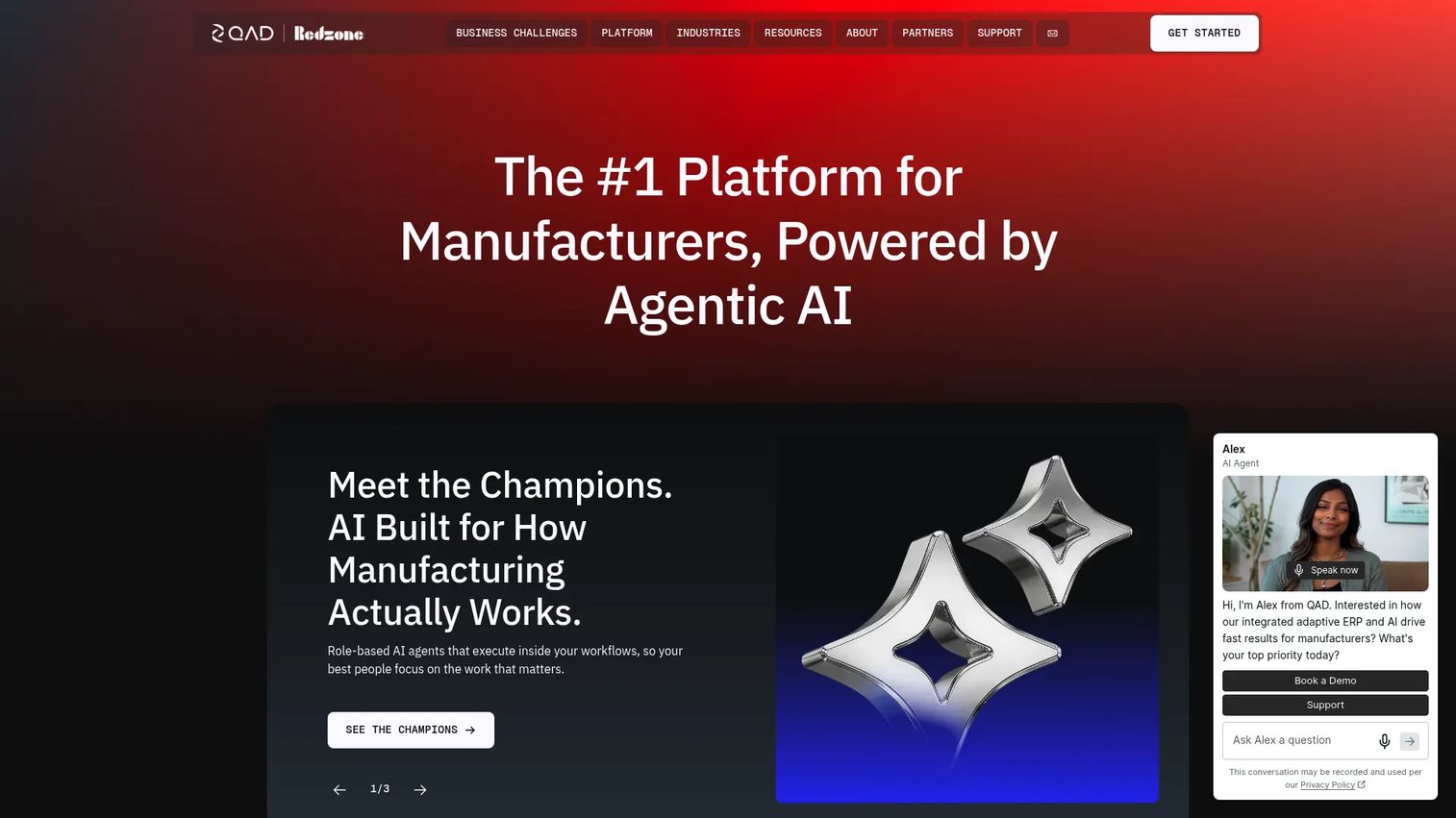
QAD Adaptive ERP is a manufacturing-focused ERP combining production management, financial management, inventory, enterprise asset management, supply chain planning, quality management, and global compliance. It includes a low-code/no-code QAD Enterprise Platform for extensibility, mobile and role-based Adaptive UX, and internationalization support for global operations.
Best for: Global manufacturers needing an adaptable ERP spanning production, finance, supply chain, asset management, and international operations across multiple regions.
Key features
- Manufacturing management and production scheduling
- Financial management, budgeting, and reporting
- Inventory management, traceability, and barcode scanning
- Enterprise asset management and purchasing
- Internationalization, global compliance, and embedded analytics
Why choose QAD Adaptive ERP: Use QAD when manufacturing complexity extends across multiple plants, regions, or compliance frameworks. The Adaptive UX and low-code extensibility help teams adapt the platform as operations evolve. ETO-specific buyers should confirm how QAD handles project-based BOM release and engineering change orders, since its strongest positioning is around global supply chain and manufacturing operations management.
QAD Adaptive ERP pricing: Pricing requires contacting sales. Ask about regional deployment, manufacturing modules, user licensing, implementation partner requirements, and integration costs.
G2 rating: 3.5/5
Considerations when choosing ETO ERP software
CAD, BOM, and revision control
ETO selection starts in engineering. The ERP must handle design changes without breaking procurement, production, or costing. During demos, ask vendors to walk through a CAD-to-BOM-to-purchase workflow using a real or representative design file. If they can't show it, the integration may be shallower than the marketing suggests.
Project costing and margin visibility
Test actual-versus-budget reporting, labor capture, material commitments, and WIP accounting during the evaluation process. Founders and CFOs should be able to see margin risk before delivery, not only at job closure. Ask whether percentage-of-completion accounting is supported if your contracts use milestone billing.
Procurement and long-lead component tracking
ETO projects fail when long-lead parts are invisible until it's too late to substitute or expedite. Evaluate purchasing workflows, supplier commitment visibility, inventory reservation for specific jobs, and alert mechanisms for delayed components. This is where many general ERPs show gaps against dedicated ETO manufacturing software.
Shop-floor adoption
A system can look strong in a demo room and still fail on the floor. Evaluate kiosk and mobile data collection, work order visibility for operators, quality and nonconformance workflows, and supervisor dashboards. Ask what percentage of your operators will interact with the system daily and how they'll be trained. For related change order software evaluation patterns, review how vendors handle mid-job revisions.
Implementation burden and operating fit
ERP failure more often comes from change management than from software. Ask about data migration approach, training scope, partner experience with ETO manufacturers, typical implementation timelines, and what ongoing support looks like after go-live. The subscription price is only part of the first-year cost.
Conclusion
For true engineer-to-order and custom manufacturing workflows, Total ETO, Genius ERP, and Jobscope are the most purpose-built options. Each is designed around project-based production where the design keeps changing after the commercial commitment is made.
Rootstock is the clearest choice when Salesforce already anchors your operating model. Epicor, Infor CloudSuite Industrial, SYSPRO, and QAD Adaptive ERP fit manufacturers with broader operational complexity across multiple production models. SAP S/4HANA Cloud and IFS Cloud fit large or multi-site operations where enterprise governance is the core requirement. Microsoft Dynamics 365 Business Central and Acumatica serve mid-market teams that need flexible cloud ERP without enterprise implementation overhead.
The practical next step: Shortlist three vendors, then give each one the same scripted scenario. Walk them through customer quote, CAD revision, partial BOM release, long-lead purchase, shop-floor labor update, change order, WIP report, and margin review. That sequence reveals real fit faster than any generic product tour.
If your team sells complex software to buyers who evaluate ERP and manufacturing workflows before committing, consider how interactive demos let prospects explore your product's workflows before a live call. A Demo Center can organize those demos by use case and buyer role, giving a purchasing committee self-serve access to exactly what they need.
Start your journey with Guideflow today!
FAQs
ETO ERP software is enterprise resource planning software built for engineer-to-order manufacturers that design, quote, source, produce, cost, and deliver customer-specific products within a single project workflow. It connects engineering changes, BOMs, procurement, production scheduling, job costing, and WIP tracking in one system. Standard ERP assumes stable products and repeatable production, while ETO ERP is designed for manufacturers where the design is still evolving after the order is placed.
Standard ERP typically assumes a stable product catalog, predictable BOMs, and repeatable production cycles. ETO ERP must support customer-specific engineering, project-based costing, revision control, and procurement that starts before the final design is complete. The difference becomes operationally significant when engineering changes need to flow into open purchase orders and production schedules without manual rework.
Total ETO, Genius ERP, and Jobscope are the most purpose-built options for custom machine builders. Total ETO's direct SolidWorks and Autodesk Inventor integrations and project-based BOM workflows align closely with machine-builder operations. Genius ERP's CAD2BOM feature takes a similar approach. During demos, validate CAD integration, BOM release workflows, and job costing before making a shortlist decision.
CAD integration eliminates manual BOM entry and ensures that engineering changes flow directly into procurement and production records. When an engineer updates a part or assembly in SolidWorks or Inventor, the connected ERP can reflect that change in open purchase orders and work orders without someone manually transcribing the revision. This matters most for custom machine builders and system integrators where designs change frequently after the commercial commitment. For further reading on how software buyers evaluate advanced planning and scheduling software, the same demo-scripting discipline applies.
The features that separate ETO ERP from general manufacturing ERP include project-based BOM management with staged release, revision and change-order control, estimating and quoting tools, job costing with WIP tracking, long-lead procurement visibility, MRP and capacity planning, shop-floor data collection, and quality management. Without these working together, engineering changes become manual coordination across disconnected systems. Teams evaluating capacity planning software as a standalone tool often find it's more effective when integrated within a full ETO ERP.
Total year-one costs vary based on users, modules, deployment model (cloud vs. on-premise), implementation scope, data migration, training, and ongoing support. Microsoft Dynamics 365 Business Central starts at $80 per user per month for the Essentials tier (billed annually), with Premium at $110 per user per month. Acumatica APEX for Manufacturing starts under $2,185 per month. Most dedicated ETO platforms like Total ETO, Genius ERP, and Jobscope are quote-based. The subscription or license cost is often 30 to 50% of the first-year total once implementation and training are included.
Sometimes, if it supports project manufacturing, revision control, BOM flexibility, job costing, and engineering integration through native features or vetted partner extensions. Platforms like Epicor, SYSPRO, and Microsoft Dynamics 365 Business Central can approximate ETO workflows with the right configuration. Dedicated ETO ERP is typically a better fit for custom machine builders and system integrators where designs change frequently and CAD-to-BOM workflows are central to daily operations, since general platforms often require significant customization to reach the same functional depth. For teams also evaluating business process management software, the same question of native fit versus configuration applies.
Give every vendor the same scenario: Customer quote, CAD revision, partial BOM release, long-lead purchase order, shop-floor labor entry, engineering change order, WIP report, and margin review. Script the scenario before the demo and require each vendor to work through it in their system rather than presenting a curated highlight reel. That sequence surfaces integration gaps, workflow limitations, and reporting depth faster than a generic feature comparison. Reviewing how each vendor handles change order software workflows within their ERP is a useful proxy for overall ETO fit.