You do not feel the pain of IP management when the company has two trademarks and one provisional patent. You feel it when the board asks for a clean portfolio view, finance wants renewal forecasts, and the only complete answer lives in outside counsel's inbox.
By Series B, IP data sits across product, legal, finance, and outside counsel. That breaks under diligence. It breaks when a VP of Legal joins and asks where everything lives. It breaks when a competitor files something that overlaps your roadmap and nobody can find the prior art submission your engineer submitted eight months ago.
Worldwide patent applications reached 3.7 million in 2024, up 4.9% from the prior year, according to WIPO (2025). That volume means the companies building systems to track and protect their filings gain a structural advantage over those still managing deadlines in shared spreadsheets.
This guide covers 14 intellectual property management software platforms for 2026 to help you choose the right system before the next diligence cycle.
What's inside
This guide is for founders, general counsel, heads of IP, legal ops leaders, and finance teams evaluating IP management software.
- Who this covers: Corporate IP teams, law firms, R&D-led companies, and lean in-house legal functions
- How tools were chosen: SERP presence, category fit, portfolio management depth, docketing capabilities, and suitability for corporate or law firm workflows
- Selection criteria used:
- Docketing and deadline automation
- Portfolio visibility and reporting for board and diligence use
- Fit for company stage, from lean in-house to enterprise operations
- Pricing transparency and implementation realism
TL;DR
- Best for corporate IP portfolio management: IPfolio, built on Clarivate data, gives in-house teams structured visibility without requiring law firm workflows
- Best for large multinational teams: Memotech handles complex global portfolios with configurable workflows and deep data validation
- Best for smaller firms and lean legal teams: AppColl offers patent docketing, invention intake, and billing with published pricing starting at $0
- Best for trademark-heavy portfolios: Alt Legal starts at $60/month and automates deadline tracking across 180+ jurisdictions
- Best enterprise suite: Anaqua or Clarivate, depending on portfolio complexity and desired services depth
- Best for analytics and R&D intelligence: PatSnap starts at $200/month and covers patent landscapes, competitive intelligence, and innovation research
What is intellectual property management software?
Intellectual property management software is a system for tracking, managing, and reporting on patents, trademarks, copyrights, trade secrets, designs, invention disclosures, renewals, deadlines, documents, and related legal workflows.
The category covers a wide operational range. At the narrower end, docketing tools focus on deadline calculation and prosecution event tracking. At the broader end, full IP management suites connect asset records, workflows, reporting, renewals, outside counsel coordination, and budget visibility in a single system.
Core capabilities the category covers:
- Patent and trademark portfolio records with ownership, status, and jurisdiction data
- Docketing and deadline calculation with jurisdiction-specific rules
- Invention disclosure intake and committee review workflows
- Renewal and annuity management across global filing jurisdictions
- Document and correspondence storage tied to specific matters
- Outside counsel collaboration and data sharing
- Portfolio reporting for board reviews, diligence, and strategy
- Integrations with legal systems, ERP, and patent office data feeds
- Budgeting and legal spend visibility
Adjacent categories worth distinguishing:
Patent analytics tools such as PatSnap and LexisNexis focus on search, competitive landscapes, and innovation intelligence. They are strong for R&D strategy but may not replace docketing or portfolio administration. Docketing tools handle prosecution timelines and deadline reminders but may not cover invention intake or spend reporting. Full IP management suites attempt to cover most of this in one system.
For founders and legal leaders, the goal is clean ownership, auditability, and decision-ready visibility. The right system removes IP from the diligence panic cycle and gives leadership a shared source of truth across legal, finance, and product.
When to use intellectual property management software
Prepare for diligence without rebuilding the portfolio by hand
Fundraising, M&A conversations, and board reviews all require a clean IP picture fast. That means ownership records, filing status by jurisdiction, renewal schedules, and open risks in one place. Teams without a system spend weeks reconstructing this from outside counsel emails and spreadsheets, often under time pressure. A structured IP management tool makes this a report, not a fire drill.
Control patent and trademark deadlines across jurisdictions
Missed deadlines in patent prosecution or trademark maintenance are not just administrative errors. They create real business risk: Abandoned applications, lapsed rights, and costly reinstatement proceedings. Docketing software automates deadline calculation with jurisdiction-specific rules, sends reminders, and escalates overdue items before they become irreversible.
Connect invention intake to portfolio strategy
R&D teams invent faster than legal can track without a structured intake process. Invention disclosure software lets engineers submit ideas, legal evaluates patentability, and leadership decides which ideas merit prosecution budget. For a Series B company allocating R&D capital, this workflow makes innovation auditable and strategy-driven rather than ad hoc.
Intellectual property management software comparison
The table below covers all 14 tools in ranked order. Pricing and G2 ratings reflect data verified against live vendor pages and G2 listings.
| # | Product | Best for | Key differentiator | Pricing | G2 rating |
|---|---|---|---|---|---|
| 1 | IPfolio | Corporate IP portfolio management | Clarivate-backed portfolio system with country-laws engine | From $20,000/year | 4.6/5 |
| 2 | Memotech | Large multinational IP departments | Configurable enterprise IP operations with IP One Data integration | Custom pricing | 4.0/5 |
| 3 | Unycom | Enterprise patent and trademark teams | Full IP lifecycle management, available on-premise or hosted | Custom pricing | N/A |
| 4 | FoundationIP | Law firms and IP service providers | Cloud-based docketing and lifecycle management by Clarivate | Custom pricing | 4.0/5 |
| 5 | Inprotech | IP law firms and large practices | Practice management plus global IP workflows with billing | Custom pricing | 4.3/5 |
| 6 | AppColl | Smaller firms and lean corporate teams | Published pricing with free tier, docketing and invention intake | From $0/month | 4.7/5 |
| 7 | Anaqua | Enterprise IP operations | Unified IP suite with AI docketing and analytics depth | Custom pricing | 4.1/5 |
| 8 | Clarivate | Broad IP software and intelligence needs | Large ecosystem across IP management and intelligence products | Custom pricing | 4.1/5 |
| 9 | Alt Legal | Trademark-focused legal teams | Automated docketing across 180+ jurisdictions | From $60/month | 4.8/5 |
| 10 | Questel | Patent, trademark, and IP services teams | Software plus IP services and AI patent drafting | From €200/user/month | 3.7/5 |
| 11 | Dennemeyer | Global IP management and renewals | Software, renewals, and service-backed IP operations across 220 jurisdictions | Custom pricing | 4.5/5 |
| 12 | LexisNexis | Patent analytics and legal research teams | Legal data depth with analytics and AI-assisted research | Custom pricing | 4.0/5 |
| 13 | PatSnap | R&D and patent analytics teams | Innovation intelligence, patent landscapes, and competitive analysis | From $200/month | 4.3/5 |
| 14 | Computer Packages Inc | Patent law firms and corporate IP teams | Established patent, trademark, and annuity management systems | Custom pricing | 4.1/5 |
Best 14 tools for intellectual property management
1. IPfolio
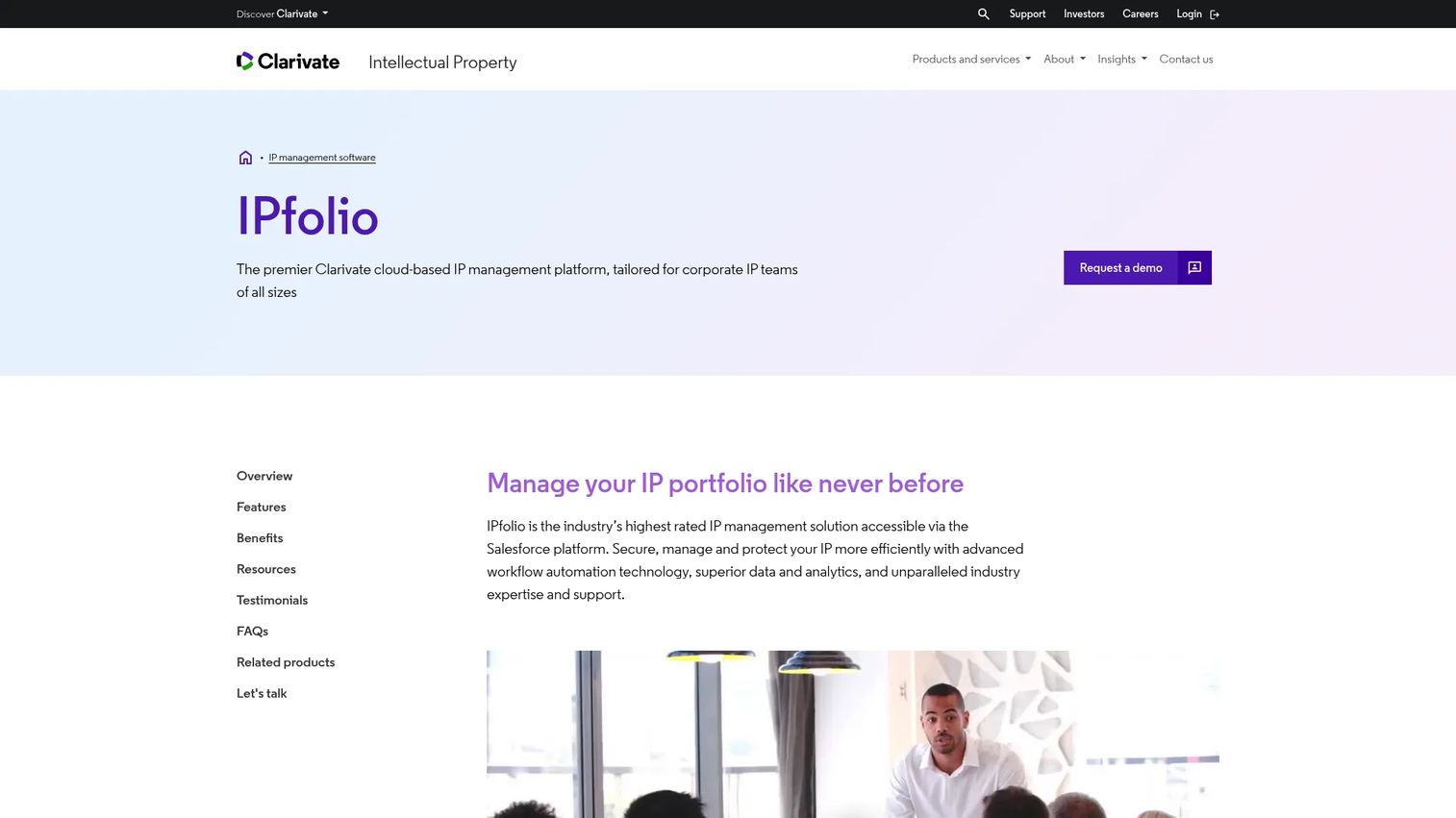
IPfolio is a cloud-based intellectual property management platform built for corporate IP teams and backed by Clarivate's data infrastructure. It centralizes inventions, patents, trademarks, domain names, and copyrights in one configurable system. The platform connects with Clarivate IP data for verification and enrichment, and its country-laws engine automates deadline monitoring across jurisdictions.
Best for: In-house IP teams that need structured portfolio management without inheriting law firm practice workflows.
Key features
- Centralized records for inventions, patents, trademarks, domains, and copyrights
- Country-laws engine for automated deadline monitoring and calculation
- Configurable dashboards, reports, record pages, and taxonomies
- Workflow automation for reports, due-date calculations, and task assignments
- Integrated Clarivate IP data with verification and enrichment
Why choose IPfolio: For founders whose new VP of Legal is walking in on day one, IPfolio removes the dependency on outside counsel for basic portfolio status. The Clarivate data integration means records stay accurate without manual updates.
IPfolio pricing: The Salesforce AppExchange lists a starting price of $20,000 per company per year, billed annually. Exact module pricing and multi-year terms require a conversation with Clarivate's sales team.
G2 rating: 4.6/5
2. Memotech
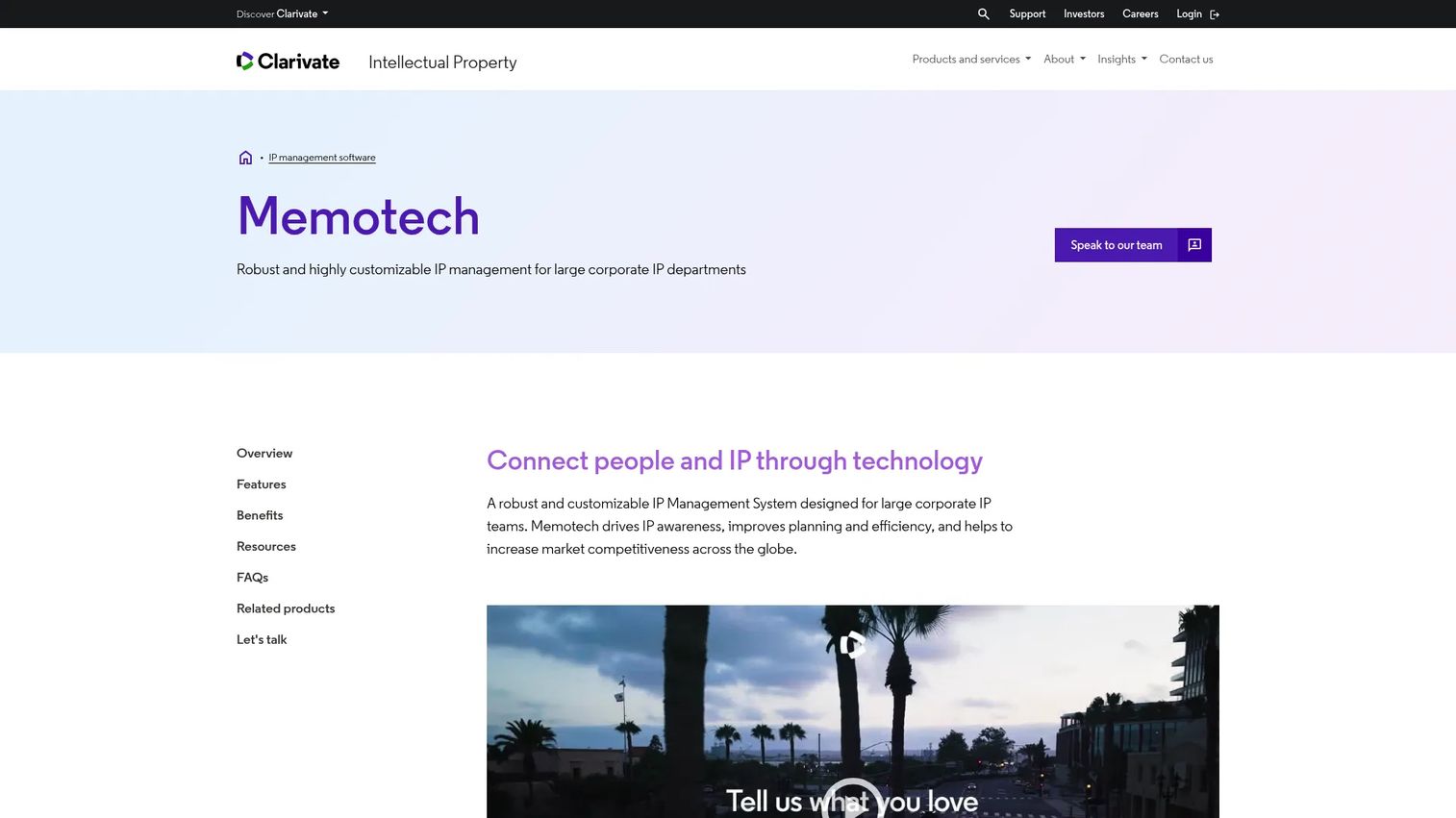
Memotech is a highly configurable IP management system designed for large corporate IP departments managing complex global portfolios. The platform connects with Clarivate's IP One Data for automated data verification and enrichment, and it supports custom approval chains, meeting management for IP decisions, and integrations with ERP systems and external collaboration tools.
Best for: Enterprise IP departments with multinational portfolios, many stakeholders, and internal process complexity.
Key features
- Global portfolio visibility across patents, trademarks, and designs
- Automated data verification against IP One Data
- Custom workflows, approval chains, and reporting dashboards
- Meeting management for IP committee decisions
- ERP and IP Collaboration Hub integrations
Why choose Memotech: When a portfolio spans dozens of jurisdictions and requires governance controls across multiple internal teams, Memotech's configuration depth handles that without workarounds. Evaluate admin ownership requirements during the demo process.
Memotech pricing: Clarivate does not display Memotech pricing on its product page. Pricing is quote-based and will depend on portfolio size, number of users, modules selected, and implementation scope.
G2 rating: 4.0/5
3. Unycom
Unycom is an enterprise IP lifecycle management platform that covers patents, trademarks, and other IP types through an on-premise or privately hosted deployment model. Originally a standalone product, it is now part of the Clarivate IP management portfolio. The system supports automated docketing, PTO data and document integration, configurable workflows, and portfolio analytics with custom reporting.
Best for: Corporate IP teams, particularly in Europe and globally, that need an enterprise system connecting invention intake, prosecution, and portfolio reporting.
Key features
- Centralized management across all IP types and portfolios
- Automated docketing and PTO data and document integration
- Configurable workflows with analytics, custom reports, and dashboards
- Invention management and patent lifecycle tracking
- On-premise and privately hosted deployment options
Why choose Unycom: The on-premise and hosted deployment options matter when data residency or security requirements make cloud-only tools a non-starter. For corporate R&D teams turning invention output into protected assets, the invention management workflows create a repeatable process.
Unycom pricing: Request a quote directly from Clarivate, and expect the conversation to cover deployment model, jurisdictions, portfolio size, and required modules.
4. FoundationIP
FoundationIP is a cloud-based IP lifecycle management and docketing platform from Clarivate, designed for law firms and legal teams that manage patent and trademark prosecution workflows. It covers IP docketing and deadline management, workflow automation, portfolio tracking, and reporting. The system is built around matter-centric IP prosecution rather than corporate portfolio strategy.
Best for: IP law firms and legal teams managing patent and trademark portfolios, prosecution deadlines, and reporting for clients or internal stakeholders.
Key features
- IP docketing and deadline management
- Workflow automation and customization
- Portfolio tracking, reporting, and analytics
- Correspondence and document management
- Matter-centric prosecution workflows
Why choose FoundationIP: Law firm IP teams that need prosecution-depth docketing rather than portfolio analytics should evaluate FoundationIP alongside other Clarivate products. Corporate founders may encounter it through their outside counsel's system.
FoundationIP pricing: Expect pricing to reflect the number of matters, users, and any additional Clarivate product modules.
G2 rating: 4.0/5
5. Inprotech

Inprotech is an IP management system built for high-performing IP law firms and large practices. It covers the full IP lifecycle across patents, trademarks, domains, copyrights, disputes, and agreements, and integrates time tracking, billing, fee generation, and e-billing. Patent and trademark office integrations include USPTO, EPO, IP Australia, IPONZ, and EUIPO.
Best for: Mid-sized to large IP law firms that need configurable practice and portfolio management with integrated billing.
Key features
- IP lifecycle management across patents, trademarks, domains, and agreements
- Integrated time tracking, billing, fee generation, and e-billing
- Patent and trademark office integrations: USPTO, EPO, IP Australia, IPONZ, EUIPO
- Case administration and correspondence management
- Configurable workflows for firm-specific processes
Why choose Inprotech: If your outside counsel runs Inprotech, data sharing and collaboration become easier. For corporate teams evaluating this directly, the billing features are designed for firm economics rather than in-house legal operations.
Inprotech pricing: Expect implementation, module configuration, and user count to drive the number.
G2 rating: 4.3/5
6. AppColl
AppColl is a practical intellectual property management platform for patent and trademark law firms and corporate IP teams. It covers docketing, matter management, invention disclosure workflows, USPTO integrations, client portals, and reporting. Uniquely among this list, AppColl publishes its pricing openly, making it the clearest choice for teams that want to evaluate cost before sitting through a demo.
Best for: Boutique IP firms, lean corporate IP functions, and teams that need a working system without enterprise implementation overhead.
Key features
- Patent and trademark docketing with USPTO integrations
- Matter, prior-art, document, contact, and billing management
- Invention disclosure and committee workflow management
- Automated workflows and deadline reminders
- Client portal and collaboration tools
Why choose AppColl: For a founder hiring a first full-time IP counsel or a small legal team replacing spreadsheets, AppColl gives structure without enterprise complexity. The published pricing removes negotiation from the procurement process.
AppColl pricing: AppColl Tandem (the client-facing portal) is free. AppColl PM Pro starts at $100 per user per month billed monthly. AppColl PM Plus is $130 per user per month billed monthly. AppColl PM Corporate is $130 per user per month billed annually, plus $100 per month per connected law firm. The Invention Manager plan is $350 per month for up to 100 users, billed annually.
G2 rating: 4.7/5
7. Anaqua
Anaqua provides enterprise IP management software for corporations and law firms managing complex global IP portfolios. Its AQX platform covers patent and trademark management, AI-powered docketing and document processing, dynamic dashboards, portfolio analytics, competitive benchmarking, and innovation management. The platform is built for mature IP operations that need both software infrastructure and services depth.
Best for: Large corporations and law firms managing complex global IP portfolios that require broad workflow coverage and analytics.
Key features
- Enterprise IP portfolio management through AQX
- AI-powered docketing, document processing, and classification
- Dynamic dashboards, portfolio analytics, and competitive benchmarking
- Innovation management and product-centered IP management
- Patent and trademark management with renewal workflows
Why choose Anaqua: When IP is genuinely strategic and the portfolio is large enough to justify enterprise implementation, Anaqua delivers operational depth. For a 50-person SaaS company, the implementation overhead may exceed what the team can absorb quickly.
Anaqua pricing: Pricing will depend on modules, user count, jurisdictions covered, and professional services scope.
G2 rating: 4.1/5
8. Clarivate

Clarivate is a broad data and analytics company with a significant IP management and intelligence product portfolio. Its IP offerings span portfolio management, patent intelligence, trademark tools, renewals support, and professional services. Products in the portfolio include IPfolio, Memotech, Unycom, FoundationIP, Inprotech, and data services like Derwent Innovation.
Best for: Organizations that want an IP software ecosystem rather than a single-point docketing tool, particularly teams comfortable with enterprise procurement processes.
Key features
- IP portfolio management products across corporate and law firm segments
- Patent intelligence and search through Derwent Innovation
- Trademark management tools
- Renewals and annuity support services
- Professional services and implementation
Why choose Clarivate: The breadth of Clarivate's IP portfolio means buyers can consolidate multiple needs under one vendor relationship. Before engaging, identify which specific Clarivate product matches your workflow, because the ecosystem is wide and product fit varies significantly by use case.
Clarivate pricing: Each product line is priced separately, and terms are negotiated based on modules, user count, and services.
G2 rating: 4.1/5
9. Alt Legal
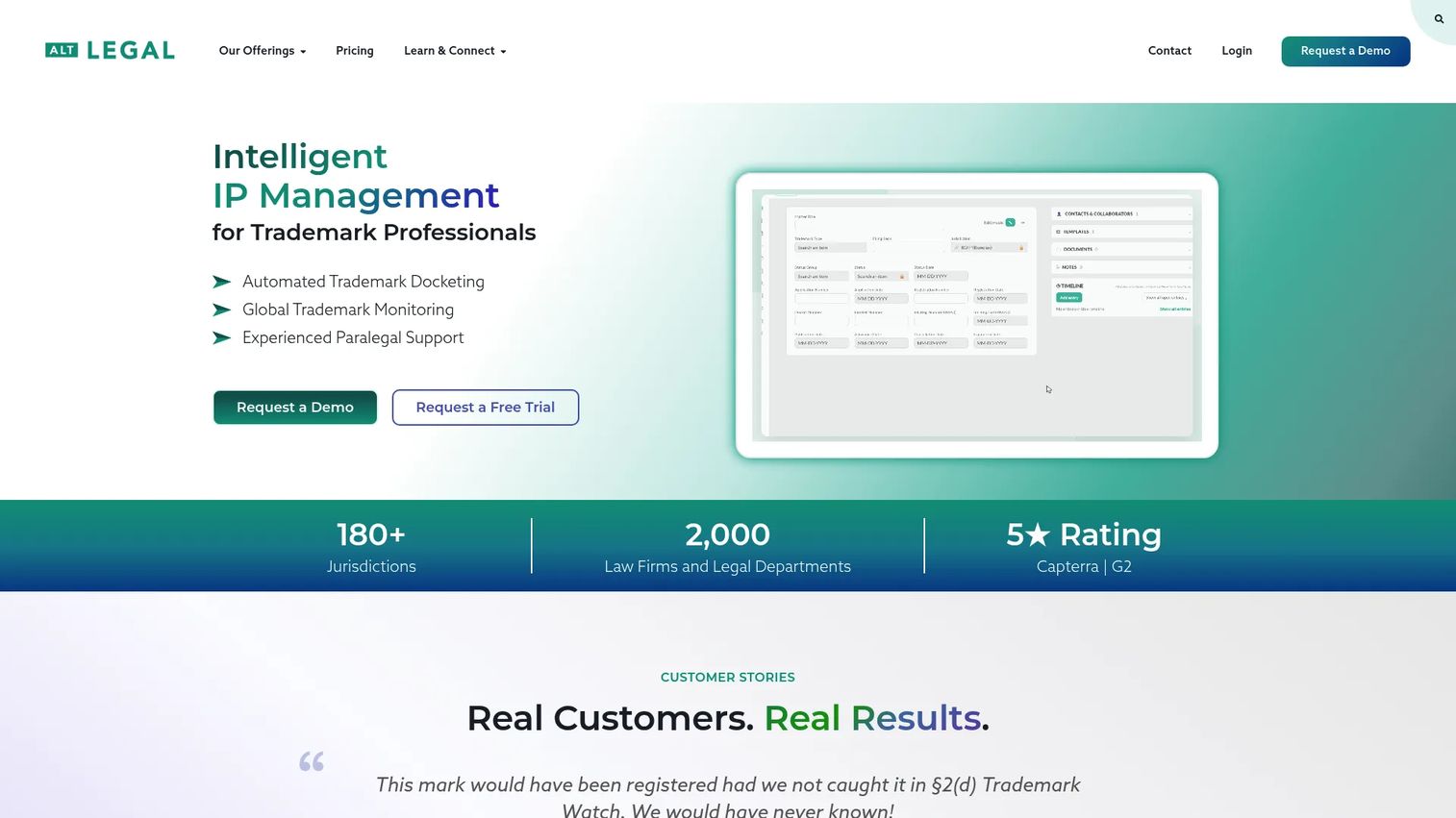
Alt Legal is an intelligent IP management platform built specifically for trademark professionals. It automates docketing across 180+ jurisdictions, generates quick docket reports, and integrates with USPTO Trademark Center filing tools, email, calendars, and third-party systems. Features include an AI Filtering Assistant and a Goods & Services Composer for faster filing preparation.
Best for: Trademark law firms and in-house legal teams managing domestic or global trademark portfolios with significant deadline volume.
Key features
- Automated docketing across 180+ jurisdictions
- Quick docket reports and personalized email reminders
- USPTO Trademark Center filing tools and integrations
- AI Filtering Assistant for docket management
- Unlimited third-party docket access
Why choose Alt Legal: For SaaS companies protecting brand names, product marks, and logos across international markets, Alt Legal removes the manual work from trademark deadline management. The published pricing and matter-based model makes cost predictable from day one.
Alt Legal pricing: Plans are priced by total docketed matters. Up to 50 matters costs $60 per month. Up to 100 matters costs $100 per month. Up to 200 matters costs $195 per month. Up to 400 matters costs $295 per month. Larger portfolios require a direct quote.
G2 rating: 4.8/5
10. Questel
Questel provides integrated IP and innovation management software alongside tech-enabled professional services. The platform covers patent searching and analysis, IP portfolio and docketing management, trademark clearance and watching, and renewal and filing services. AI tools for IP professionals include qatent for patent drafting and Qthena for IP research workflows.
Best for: Global IP teams that want a combined software, data, and managed services relationship for patents, trademarks, and renewals.
Key features
- Patent search and analysis
- IP portfolio and docketing management
- Trademark clearance and watching
- AI patent drafting via qatent
- Renewal and annuity management with filing services
Why choose Questel: When internal capacity is limited and the team needs software plus operational support around filings and renewals, Questel's combined model reduces the number of vendor relationships to manage. The G2 rating of 3.7/5 is worth probing during reference calls.
Questel pricing: Qatent AI patent drafting is priced at €200 per user per month (billed monthly) or €2,000 per user per year (billed annually). Broader platform pricing and Qthena plans require a quote, as amounts vary by modules and services scope.
G2 rating: 3.7/5
11. Dennemeyer

Dennemeyer provides IP management software and services for corporations, universities, law firms, and brand owners managing international portfolios. Its software includes DIAMS and DIAMS Infinity for portfolio management, and its IP law engine automates deadline calculations across 220 jurisdictions. The company also provides annuity and renewal payment services directly.
Best for: Teams managing international IP portfolios with heavy renewal and annuity needs who want software and managed operations under one provider.
Key features
- Centralized IP portfolio, document, task, cost, and matter management
- Integrated IP law engine with automated deadline calculations across 220 jurisdictions
- Workflow automation, reporting, dashboards, and collaboration tools
- Annuity and renewal payment services
- Patent and trademark administration
Why choose Dennemeyer: Renewal costs and missed annuity deadlines are a predictable financial risk for any company with a patent portfolio. Dennemeyer makes those costs forecastable and the deadline calendar auditable, which is exactly what finance and the board need to see.
Dennemeyer pricing: Pricing is quote-based and will depend on portfolio size, jurisdictions, modules, and the mix of software versus managed services required.
G2 rating: 4.5/5
12. LexisNexis

LexisNexis provides legal research, patent analytics, litigation intelligence, and business information tools for professional and enterprise users. Its IP-relevant offerings include patent analytics, competitive intelligence, portfolio benchmarking, and AI-assisted legal research through the Nexis and Nexis+ platforms. PatentSight, a patent analytics product within the LexisNexis ecosystem, is used for portfolio quality assessment.
Best for: IP, legal, and R&D teams that need patent intelligence and portfolio analytics for strategic decisions rather than operational docketing.
Key features
- Patent analytics and portfolio benchmarking
- Legal research with primary law and secondary sources
- AI-assisted legal question answering and document analysis
- Litigation analytics and judicial and attorney insights
- Business and competitive intelligence
Why choose LexisNexis: LexisNexis is strong for answering strategic questions: How does our patent portfolio compare to a competitor's, where are the gaps, and which filings carry the most value? It is better positioned as a complement to docketing systems rather than a replacement.
LexisNexis pricing: Pricing is customized by subscription term, user count, datasets, and functionality. Nexis Essential, Nexis+ with Protégé Essential, Nexis+ with Protégé, and enterprise packages are all available, with amounts determined through a direct quote.
G2 rating: 4.0/5
13. PatSnap
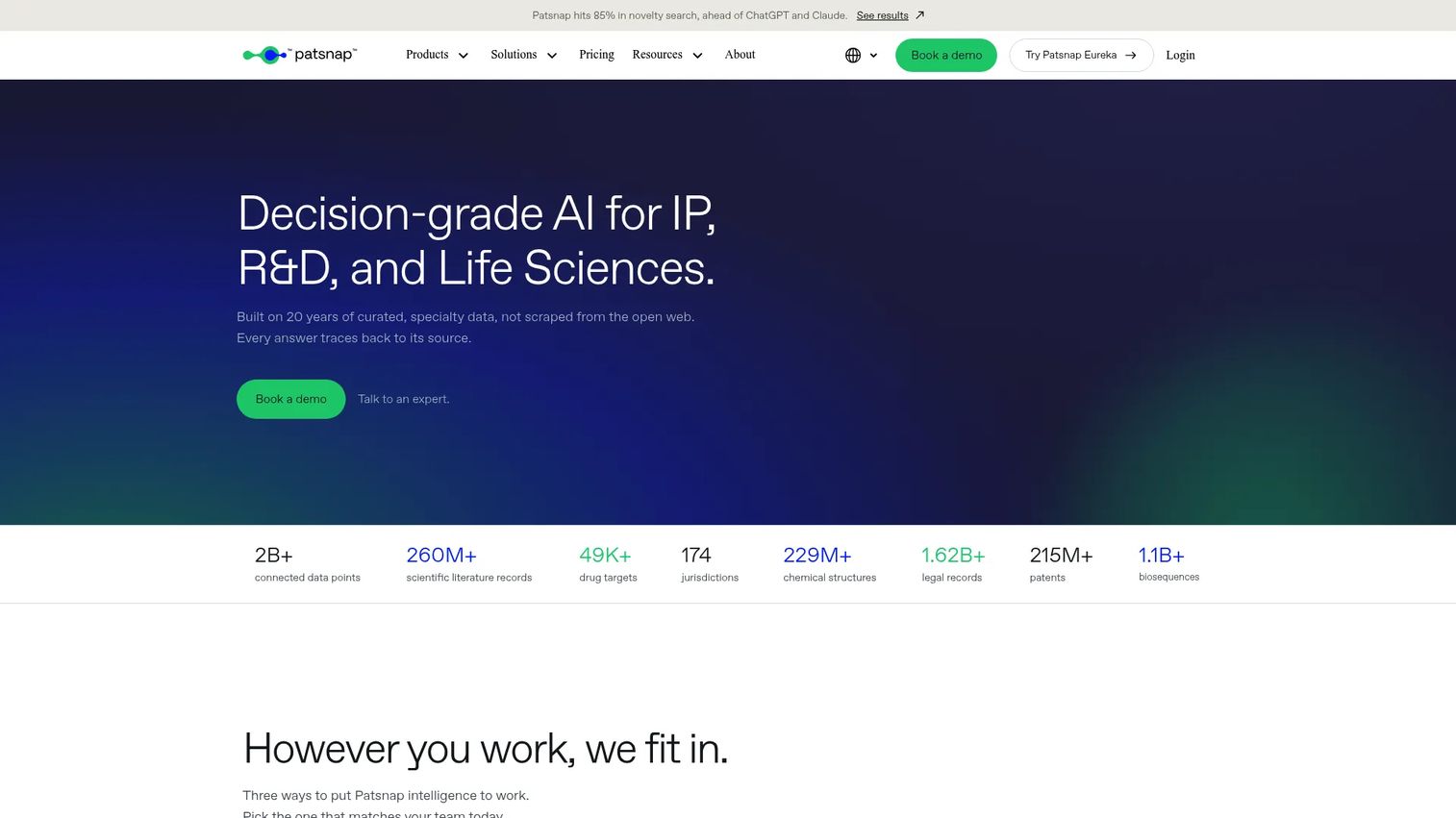
PatSnap is an AI-native innovation intelligence platform for IP, R&D, and life sciences teams. It covers patent search, competitive landscaping, novelty assessment, freedom-to-operate analysis, technology scouting, and scientific literature intelligence. The platform supports R&D decision-making rather than legal deadline management.
Best for: R&D leaders and IP strategists who need patent landscape analysis, competitive intelligence, and innovation research to guide where to invent and file.
Key features
- AI agents for patent research, novelty assessment, and drafting
- Patent search, competitive landscaping, and technology scouting
- Freedom-to-operate analysis and scientific literature intelligence
- Chemical, biosequence, and drug intelligence for life sciences
- R&D workflow support and collaboration tools
Why choose PatSnap: For engineering and product teams deciding where to allocate R&D investment, PatSnap answers "what should we build and can we protect it?" before legal has to answer "did we file in time?" The free 14-day trial makes it easy to evaluate before committing.
PatSnap pricing: Basic access is free for 14 days. Pro plans start at $200 per month, billed monthly. Enterprise plans use custom pricing. A separate Pro tier at $400 per month covers life sciences research workflows specifically.
G2 rating: 4.3/5
14. Computer Packages Inc
Computer Packages Inc provides intellectual property management software and patent annuity payment services for law firms and corporate IP teams. The platform covers real-time patent management with automated docketing and patent office data integration, trademark portfolio management, disclosure and document workflows, and patent annuity management with global renewal support and decision management.
Best for: Patent firms and corporate IP teams that want established IP management software with docketing depth and annuity payment services combined.
Key features
- Real-time patent management with automated docketing and patent office data integration
- Trademark portfolio management with automated docketing
- Disclosure, document, workflow, and reporting tools
- Patent annuity management with global renewal and decision support
- General matters management for licenses, agreements, and deadlines
Why choose Computer Packages Inc: The combination of software and annuity payment services in one relationship reduces vendor coordination for teams managing significant renewal volume. Buyers should evaluate the user interface, integration options, and data migration process given the platform's established history.
Computer Packages Inc pricing: Expect discussions to cover portfolio size, modules, users, and whether annuity services are included.
G2 rating: 4.1/5
Considerations when choosing intellectual property management software
Match the system to your operating model
A law firm practice management system is built around matters, billing, and client reporting. A corporate IP suite is built around portfolio strategy, invention intake, and executive reporting. Choosing the wrong model creates friction your team will live with for years. Map your primary use cases first, then filter by product type.
Verify deadline rules and jurisdiction coverage
Docketing quality determines whether the system is actually protecting your IP or just organizing it. Ask vendors how country-law rules are maintained and updated, who is responsible for validating rule changes, and how errors are handled. A missed deadline caused by a stale rule is a system failure, not a user error.
Pressure-test data migration
IP software lives or dies on clean asset records. Before committing, ask for a detailed walkthrough of the import process: Which fields map automatically, how documents attach to records, how duplicate assets are handled, and whether outside counsel data can be pulled in without manual re-entry.
Check reporting for board and diligence readiness
For founders and legal leaders, the test of an IP system is whether it can produce ownership, filing status, renewal schedule, cost, and risk views without manual cleanup. Ask vendors to show you a sample board report. If the answer requires a spreadsheet export and cleanup, that is what your team will do every quarter.
Evaluate integrations and outside counsel collaboration
Focus on connections to document systems, legal billing platforms, outside counsel portals, and patent office data feeds. API availability matters for teams with existing legal operations infrastructure. Export formats determine how easily you can share data with auditors, investors, or acquirers.
Conclusion
The right intellectual property management software is the one that removes IP from the diligence panic cycle and gives your legal, finance, and leadership teams a shared source of truth.
For enterprise operations, Anaqua, Clarivate, Memotech, and Unycom offer the depth and services infrastructure that complex global portfolios require. For lean in-house legal teams, AppColl and Alt Legal give you structure, deadline automation, and published pricing without enterprise overhead.
Law firms and prosecution-heavy practices should look at FoundationIP, Inprotech, and Computer Packages Inc. For analytics and R&D strategy, PatSnap and LexisNexis cover the intelligence side where docketing tools stop. For teams with significant renewal volume, Questel and Dennemeyer bring both software and managed services under one roof.
Before any demo, have your list of current systems ready: Where assets live, how deadlines are tracked today, and what a new legal or finance hire would need on day one. The best system is the one your team will actually use, that gives leadership confidence in the data, and that survives the next investor or acquirer's review process.
You can also explore our roundups on ai legal assistant software, contract management software, and application portfolio management software if your evaluation spans adjacent categories.
FAQs
Intellectual property management software is a system for tracking and reporting on patents, trademarks, copyrights, trade secrets, designs, invention disclosures, renewals, deadlines, and related legal workflows. It gives legal teams, founders, and executives a structured record of what the company owns, what is in prosecution, when rights expire, and what upcoming deadlines require action. The goal is clean ownership data and audit-ready visibility.
For early-stage companies, AppColl is worth evaluating first because it publishes pricing openly and covers patent docketing, invention intake, and matter management without enterprise implementation requirements. Alt Legal works well when the primary concern is trademark portfolio management. Both are built for lean teams. As the portfolio grows, a more comprehensive platform may be worth the implementation investment.
Patent docketing software focuses on tracking prosecution events, calculating deadlines by jurisdiction, and sending reminders. IP management software is broader: It can include invention intake, portfolio reporting, renewal and annuity management, document storage, outside counsel collaboration, and budget tracking alongside docketing. Some platforms do both. Others specialize in one. Knowing which workflows your team needs prevents buying a docketing tool when you need a portfolio system, or vice versa.
Not at the earliest stage. Once a company has patents in prosecution, multiple trademarks across jurisdictions, outside counsel managing filings, or investor and acquirer diligence requirements, a system reduces risk and manual work materially. By Series B, most SaaS companies are past the threshold where spreadsheets and shared documents create more risk than they save in cost.
Docketing and deadline calculation with jurisdiction-specific rules is the foundation. Beyond that, portfolio records tied to ownership and filing status, invention disclosure workflows, renewal and annuity tracking, document storage linked to specific matters, and board-ready reporting all determine whether the system actually reduces legal risk or just reorganizes it.
Most enterprise platforms use custom pricing based on modules, user count, portfolio size, jurisdictions covered, and implementation and support services included. AppColl is the clearest exception, with plans starting at $100 per user per month. Alt Legal starts at $60 per month for up to 50 trademark matters. PatSnap Pro starts at $200 per month. Enterprise platforms like Anaqua, Memotech, Clarivate, and Dennemeyer will require a sales conversation to get a number.
IP law firms generally need docketing, matter management, billing or practice workflows, client reporting, and patent office integrations. FoundationIP, Inprotech, AppColl, and Computer Packages Inc are all built with law firm operations in mind. Inprotech and AppColl include billing features. FoundationIP and Computer Packages Inc lean toward prosecution-depth docketing. The right choice depends on firm size and whether billing integration is a requirement.
R&D teams typically need invention intake, patent search, prior art review, technology scouting, and patent landscape analytics more than they need deadline docketing. PatSnap and LexisNexis are the strongest options for R&D intelligence. Unycom includes invention management alongside full lifecycle tracking, which makes it a fit when R&D and legal workflows need to connect in one system.