Most engagement programs die in the gap between collecting feedback and acting on it. You run a survey. Scores come back. A deck gets built. Then nothing changes, and six months later you run the same survey and watch participation drop because employees already learned that talking didn't move anything.
That gap is the real problem. It isn't that teams lack data. It's that sentiment sits in a spreadsheet, managers never see the issues tied to their own teams, and leadership reads a summary instead of an action path. The software you pick decides whether feedback becomes a routine that managers run or a report nobody opens.
The stakes are getting harder to ignore. The employee engagement software market was valued at roughly USD 0.93 to 1.22 billion in 2023 to 2025 and is forecast to reach USD 2.61 to 4.47 billion by 2030 to 2034, implying an 11 to 16% CAGR (Grand View Research, 2024; Fortune Business Insights, 2024). Buyers are pouring budget into this category because retention, manager effectiveness, and visible sentiment now sit on the same line as revenue.
This guide compares nine platforms by how they actually operate, not by how they market themselves. If you're also evaluating adjacent internal-comms tooling, our roundup of the best employee advocacy software tools pairs well with this one. And if your shortlist hinges on data unification, the best customer data platform guide covers how engagement signals connect to the rest of your stack.
What's inside
This guide covers employee engagement software across five core motions: surveys, recognition, communication, analytics, and manager enablement. Some tools lead with recognition. Others lead with listening or performance. A few try to cover all of it.
We picked the nine platforms below on four criteria: breadth of engagement features, integration depth with HRIS and communication tools, analytics and action-planning quality, and pricing clarity. The goal is to help you compare by operating fit, not by feature-list length. Every pricing figure and rating here comes from each vendor's own pages or current public listings, and where a vendor gates pricing behind sales we say so plainly.
TL;DR
- Best for recognition-first programs: Bonusly, with peer-to-peer recognition, rewards, and a free tier for small teams.
- Best for engagement surveys plus analytics depth: Culture Amp and Workday Peakon Employee Voice, both built for listening at enterprise scale.
- Best for performance-linked engagement: Lattice and 15Five, which tie surveys to reviews, goals, and manager workflows.
- Best for combining recognition and surveys in one place: WorkTango and Vantage Circle, which centralize multiple engagement motions.
- Best for benchmark-driven engagement programs: Quantum Workplace, with its validated e9 model and structured action planning.
- Best for large-scale appreciation programs: Achievers, with a global rewards network built for enterprise participation.
What is employee engagement software?
Employee engagement software is a category of HR technology that helps organizations measure, improve, and act on how connected, motivated, and committed employees feel about their work and workplace.
Most platforms in this category combine several of the following:
- Pulse surveys: short, frequent check-ins that track sentiment over time.
- Annual and lifecycle surveys: deeper measurement tied to onboarding, milestones, and exit moments.
- Recognition and rewards: peer-to-peer appreciation, points, and redeemable rewards.
- Communication: announcements, shoutouts, and visible appreciation feeds.
- Manager check-ins: structured one-on-ones and ongoing feedback.
- Action planning: turning survey results into owned, trackable next steps.
- Reporting and analytics: dashboards, benchmarks, eNPS, and segmentation by team, role, or location.
The categories matter because they map to different buying intents. Communication, collaboration, and feedback or survey tools make up roughly 30 to 34% of feature adoption in this market, ahead of recognition, performance enablement, and wellness modules (Grand View Research, 2024; Strategic Market Research, 2024). That means most buyers start with listening, then layer on recognition and manager workflows. The platforms below sit at different points on that spectrum, and knowing where each one leads is the fastest way to narrow your shortlist. For teams building out the broader stack, it helps to think about how these tools fit alongside other HR software categories you already run.
When to use employee engagement software
Improve feedback loops without living in spreadsheets
You have survey data. What you don't have is a path from a low score to a fixed problem. This is the most common trigger for buying engagement software. The right platform collects sentiment, segments responses by team and demographic, and routes specific issues to the manager or leader who owns them. Instead of one HR analyst manually slicing a CSV, the system surfaces what changed, where, and who needs to act. Good pulse surveys only pay off when the follow-through is built into the tool, not bolted on after.
Build recognition into everyday work
Recognition matters most when morale is low, when teams are distributed, or when peer contributions go unseen. Software makes appreciation a visible habit rather than an occasional manager gesture. Points-based employee recognition tied to company values, public shoutout feeds, and milestone automation all push appreciation into the flow of daily work. For remote and hybrid teams especially, this visibility replaces the hallway praise that no longer happens.
Give managers a better operating system
Engagement lives or dies with frontline managers. The best platforms give managers a running view of their team's sentiment, a structured way to run one-on-ones, and clear prompts to respond to issues consistently. This is where performance management and engagement overlap. When managers can see a dip and act on it inside the same tool they use for reviews and goals, follow-through stops being ad hoc. Strong manager training workflows turn a survey result into a coaching moment.
Comparison table
The table below ranks tools by breadth of engagement features, adoption ease, and fit for mid-market or enterprise teams. Pricing and ratings reflect each vendor's current public pages and live G2 listings. Where a vendor gates pricing behind sales conversations, that is noted rather than guessed.
| # | Product | Intent | Key use case | Pricing | G2 rating |
|---|---|---|---|---|---|
| 1 | Bonusly | Recognition-first | Peer recognition and rewards | Free; Team from $30/user/year | 4.7/5 |
| 2 | Culture Amp | Survey and analytics-led | Engagement surveys and action planning | Custom (annual) | 4.5/5 |
| 3 | Lattice | Performance-linked | Surveys tied to reviews and goals | From $8/seat/month | 4.7/5 |
| 4 | WorkTango | Full-suite engagement | Recognition plus surveys in one place | Request pricing | 4.7/5 |
| 5 | Achievers | Enterprise recognition | Large-scale rewards programs | Custom | 4.6/5 |
| 6 | Workday Peakon Employee Voice | Listening and analytics | Continuous feedback and sentiment | Custom | Listed on G2 |
| 7 | 15Five | Manager-led performance | One-on-ones and feedback | From $4/user/month | Listed on G2 |
| 8 | Quantum Workplace | Benchmark-driven | Structured engagement programs | From $15,000/year | 4.3/5 |
| 9 | Vantage Circle | Rewards-centered suite | Recognition, wellness, and perks | Custom | 4.7/5 |
1. Bonusly
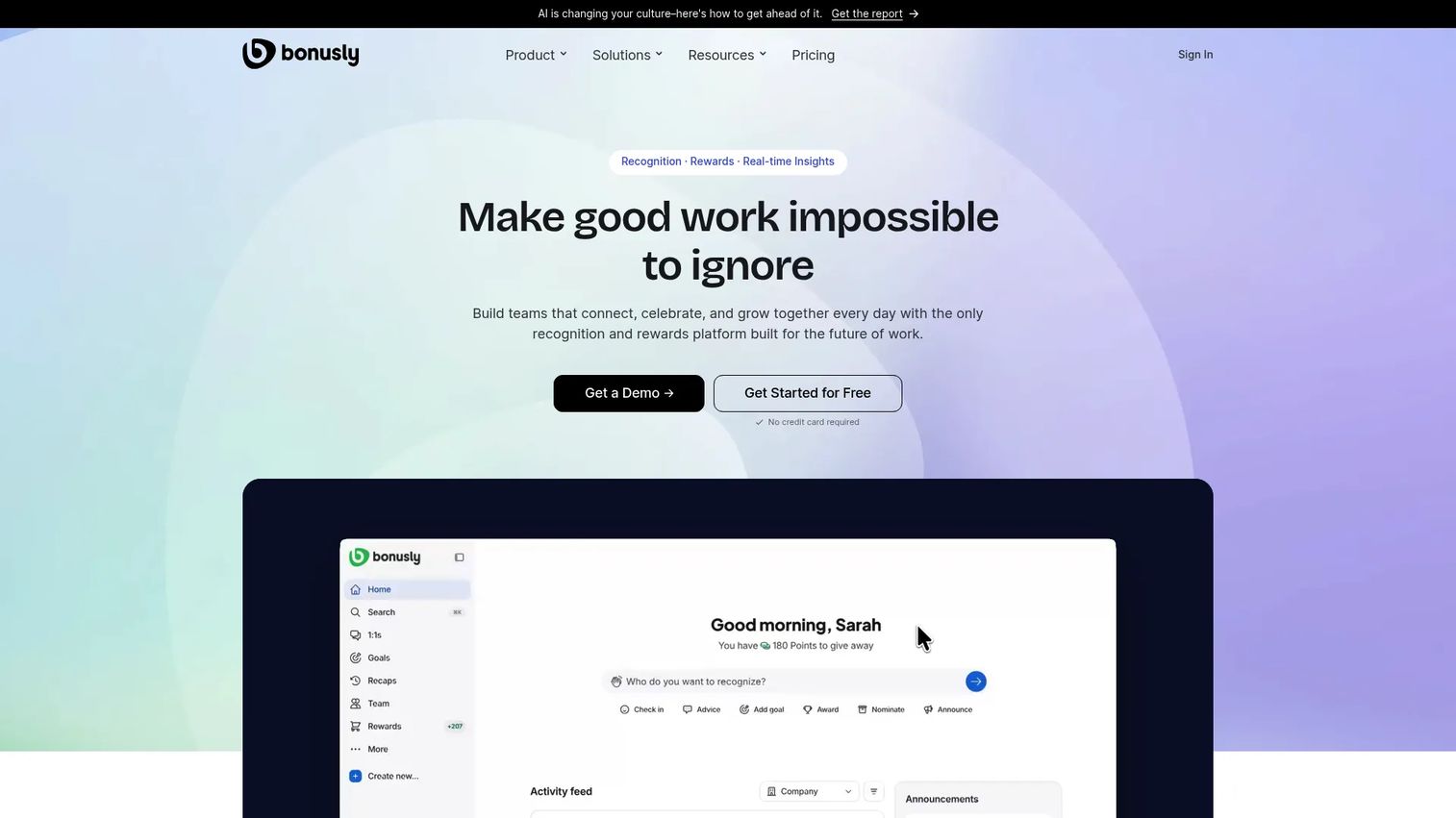
Bonusly is a recognition and rewards platform built for peer-to-peer appreciation, engagement, and culture-building. It fits teams whose engagement strategy starts with recognition rather than measurement. Small, frequent acts of appreciation tied to company values flow through Slack, Teams, and the Bonusly feed, which makes good work visible across the organization instead of staying buried in private one-on-ones.
Best for: Companies that want peer recognition and lightweight rewards with HRIS and chat integrations.
Key strengths
- Peer-to-peer recognition: Employees award small bonuses to each other, tied to values, so appreciation becomes a daily habit.
- Meaningful rewards: Points convert to gift cards, donations, and custom rewards that employees actually want.
- Automated milestones: Birthdays and work anniversaries trigger recognition automatically, so no manager forgets.
Why choose Bonusly: Choose Bonusly when culture reinforcement is your starting point and you want adoption to feel effortless. It is strongest as a recognition-first layer rather than a full survey-and-performance suite, which makes it a clean fit for teams that want to build appreciation habits before adding heavier analytics. It is a top-rated recognition platform on G2 and Capterra, and it holds a 4.7/5 G2 rating.
Bonusly pricing: A Free plan covers up to 8 users. The Team plan runs $3/user/month or $30/user/year without Bizy AI, and $5/user/month or $50/user/year with Bizy AI included. The Organization plan with Bizy AI is custom-priced and billed annually. Reward costs are billed separately from the subscription.
2. Culture Amp
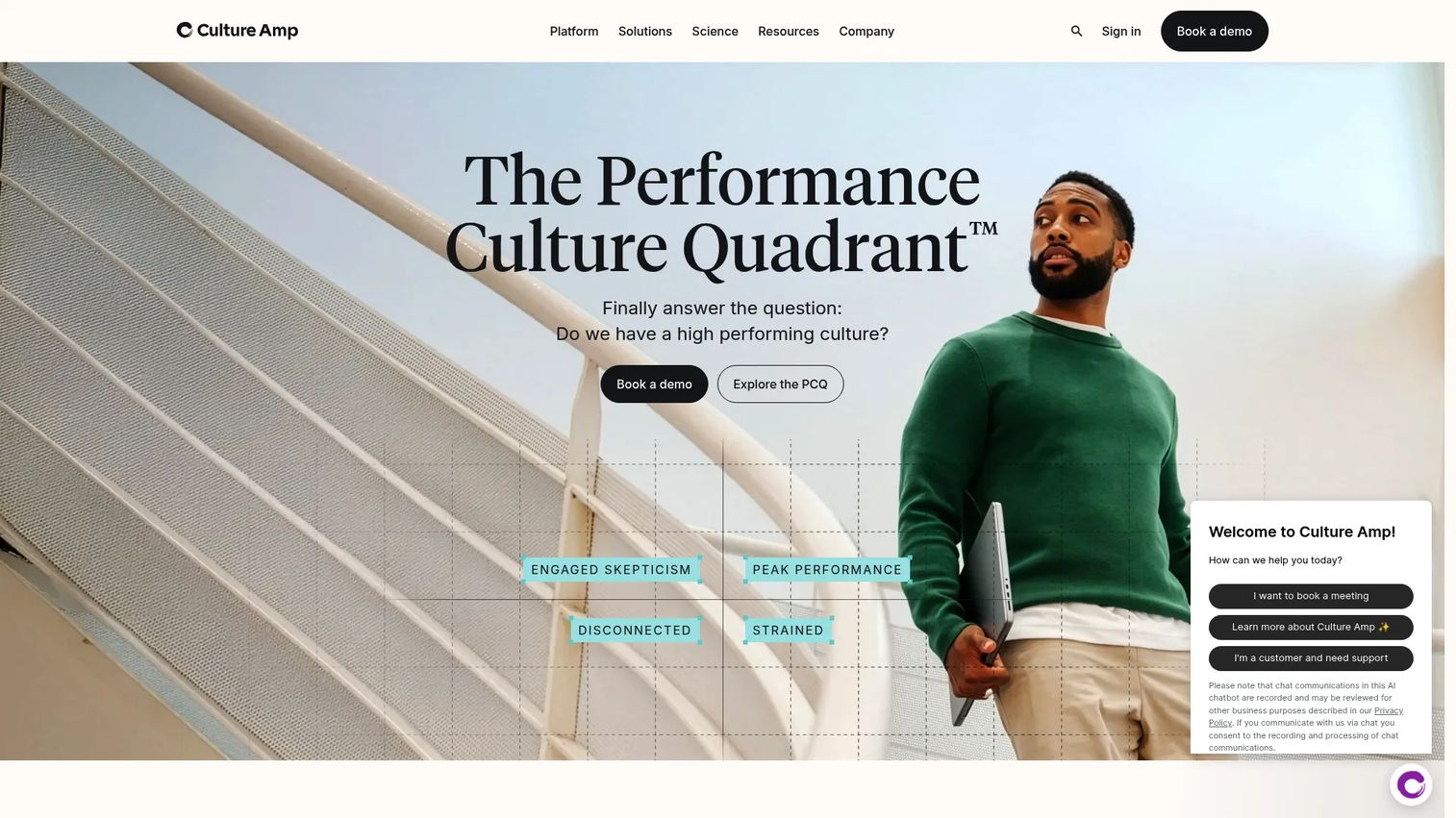
Culture Amp is an employee experience platform spanning engagement, performance, and development. It leads with listening. The survey engine, science-backed question sets, and action-planning tools are the reason most buyers shortlist it, and the analytics depth is what keeps enterprise HR teams there. Managers get insight tied to their own teams, not just a company-wide rollup, which is where follow-through actually starts.
Best for: Mid-market to enterprise HR teams managing engagement, performance, and development in one platform.
Key strengths
- Engagement surveys and action planning: Launch surveys quickly, then convert results into owned, trackable plans.
- Performance management: Goals, feedback, and calibrations live alongside engagement data.
- Career development tools: Role paths and growth plans connect engagement to retention.
Why choose Culture Amp: Choose Culture Amp when analytics depth and benchmarking matter more than a free entry point. It holds a 4.5/5 G2 rating and carries G2 leader recognition across enterprise and mid-market segments. The trade-off to plan for is implementation: a platform this broad rewards teams that commit to rolling out surveys, action planning, and manager workflows together rather than piecemeal.
Culture Amp pricing: Culture Amp does not publish prices. Plans (Engage, Perform, Develop, and Enterprise) are billed annually and priced by employee count, product choice, and service tier. You request a quote through their sales team, so budget for an annual contract conversation rather than a self-serve signup.
3. Lattice
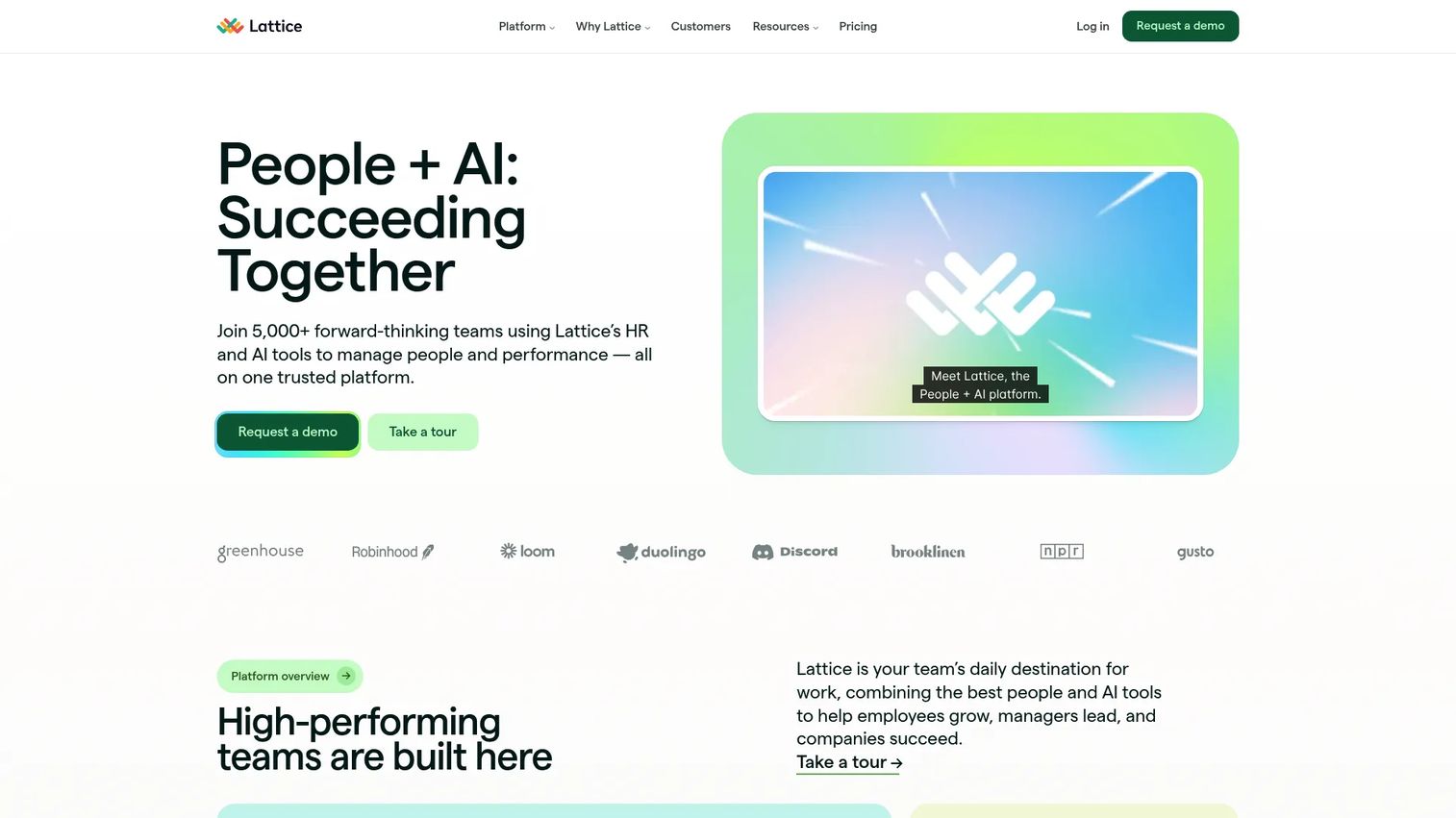
Lattice is people management software that connects performance, goals, engagement, growth, and AI-assisted HR workflows. Its strength is the connection between engagement and performance. Surveys don't sit in a separate tool from reviews, goals, and one-on-ones, so a manager seeing a sentiment dip can respond inside the same workflow they use for coaching and development. For teams that want engagement to be part of how managers operate, not a standalone annual event, that integration is the whole point.
Best for: Mid-market and enterprise HR teams managing performance, goals, and employee development in one platform.
Key strengths
- 1:1s, feedback, and weekly updates: Ongoing manager-employee touchpoints that keep engagement continuous.
- Reviews and calibration: Performance reviews, promotions, PIPs, and calibration in one place.
- Goals, OKRs, and AI Agent: Analytics and engagement data feed directly into goal-setting and manager prompts.
Why choose Lattice: Choose Lattice when you want engagement and performance management to live in the same operating system. It holds a 4.7/5 G2 rating. The modular pricing means you can start with one area and expand, though it also means costs add up as you stack modules, so map which pieces you actually need first.
Lattice pricing: Pricing is modular and billed annually in USD. Foundations is $11/seat/month. Performance and Goals & OKRs are each $8/seat/month. Engagement is listed without a public number and routes to sales. There is no free tier.
4. WorkTango
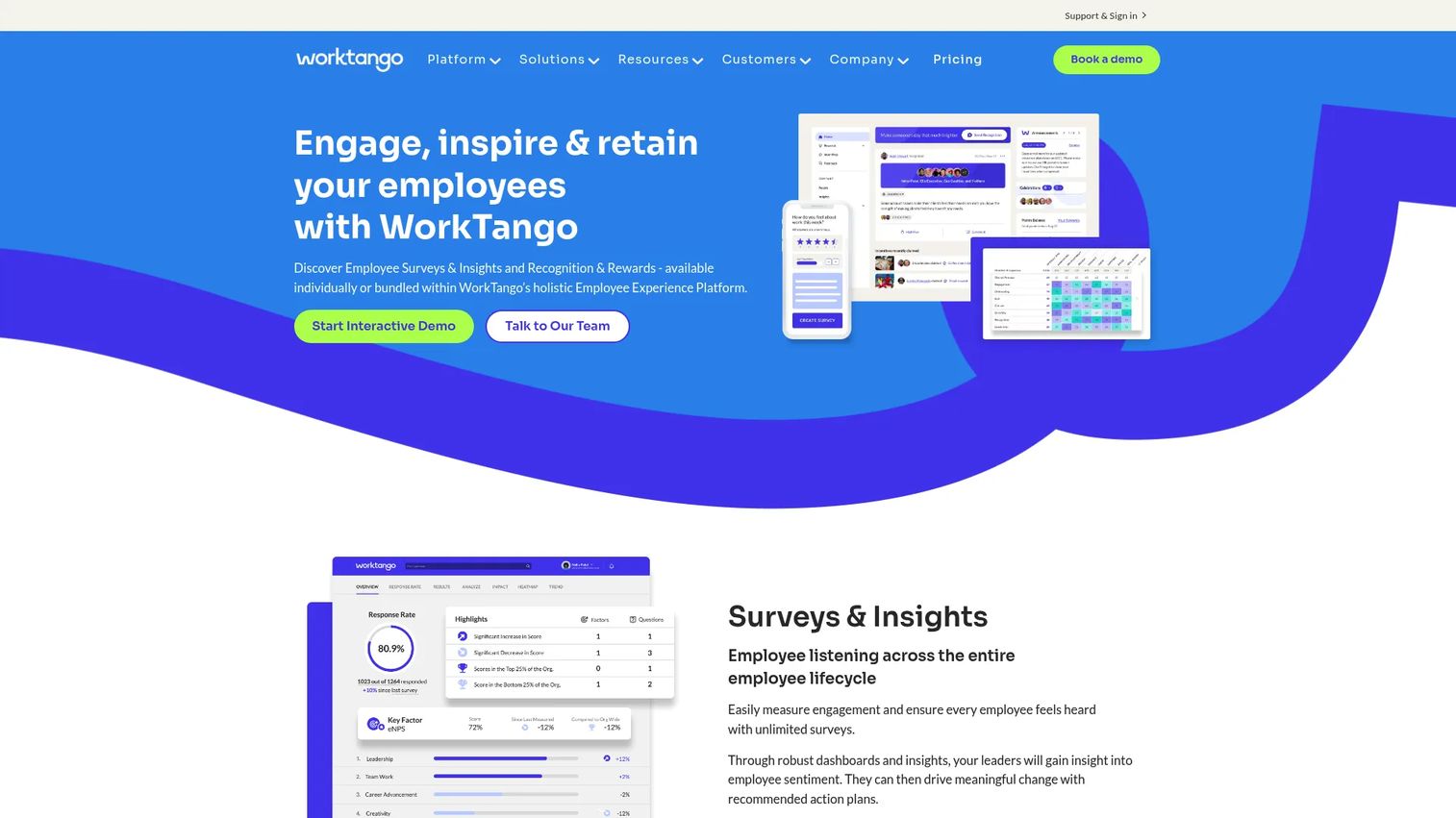
WorkTango is an employee experience platform that combines recognition and rewards, surveys and insights, analytics, and leadership tools. It fits teams trying to centralize multiple engagement motions instead of stitching together a recognition tool and a separate survey tool. The surveys and insights and recognition and rewards modules are available individually or bundled within the broader platform, so you can start with one and expand without switching vendors.
Best for: Mid-sized and enterprise HR teams looking to combine employee recognition, surveys, and analytics in one platform.
Key strengths
- Recognition and rewards: Points-based appreciation tied to values, with a global rewards catalog.
- Surveys and insights: Pulse and lifecycle surveys feed a unified engagement view.
- AI dashboards and analytics: Sentiment and participation data surface where managers need to act.
Why choose WorkTango: Choose WorkTango when you want recognition and listening under one roof rather than across two tools. It holds a 4.7/5 G2 rating. The single-platform approach reduces the integration and reporting overhead of running separate systems, which matters most for mid-market teams without a large HR ops function.
WorkTango pricing: WorkTango does not publish numeric pricing. The pricing page lists three offerings (Employee Surveys & Insights, Recognition & Rewards, and the Full Employee Experience Platform) and directs you to request pricing for each. Expect a sales conversation scoped to your headcount and module mix.
5. Achievers
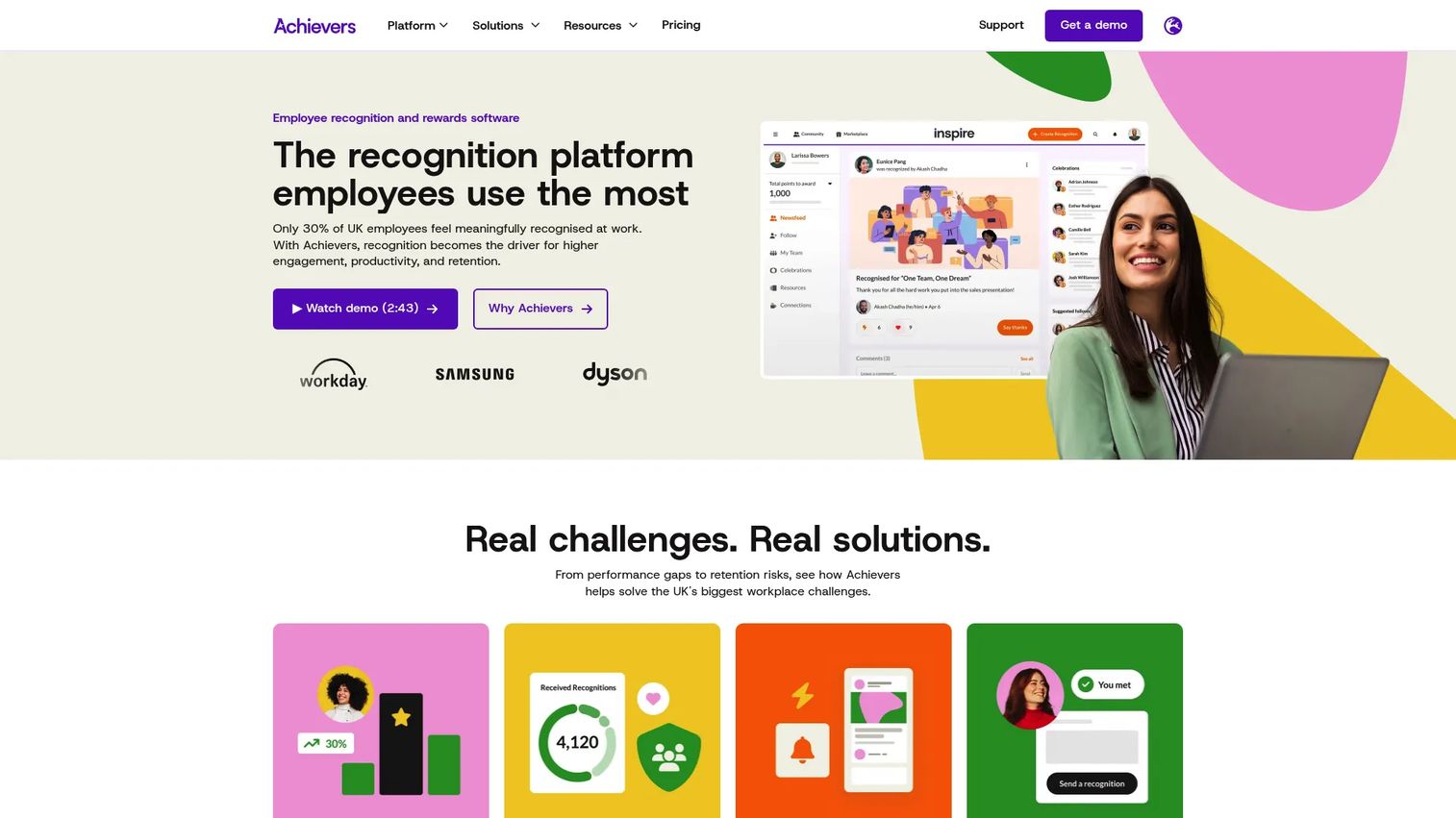
Achievers is an employee recognition and engagement platform built for organizations that need appreciation programs to scale. It reports driving 2x more engagement than other platforms, and its core strength is reach: access to one of the world's largest in-country reward networks, with 3M+ employee rewards delivered across 190 countries. For global enterprises that need recognition to work the same way for an employee in Toronto as one in Singapore, that distribution network is the deciding factor.
Best for: Large enterprises wanting recognition, rewards, and engagement tooling in one platform.
Key strengths
- AI-powered recognition insights: Engagement signals surface from recognition activity, not just surveys.
- Monetary and non-monetary recognition: Flexible appreciation that fits different cultures and budgets.
- Global rewards marketplace: In-country rewards across 190 countries for distributed workforces.
Why choose Achievers: Choose Achievers when scale and global reward fulfillment are the priority. It holds a 4.6/5 G2 rating. As an enterprise-focused platform, it rewards organizations that need measurable participation across thousands of employees rather than small teams running a lightweight program.
Achievers pricing: Achievers uses custom pricing only. The pricing page directs you to request a quote, so there is no public entry price. Plan on an enterprise procurement cycle scoped to headcount, reward budget, and module selection.
6. Workday Peakon Employee Voice
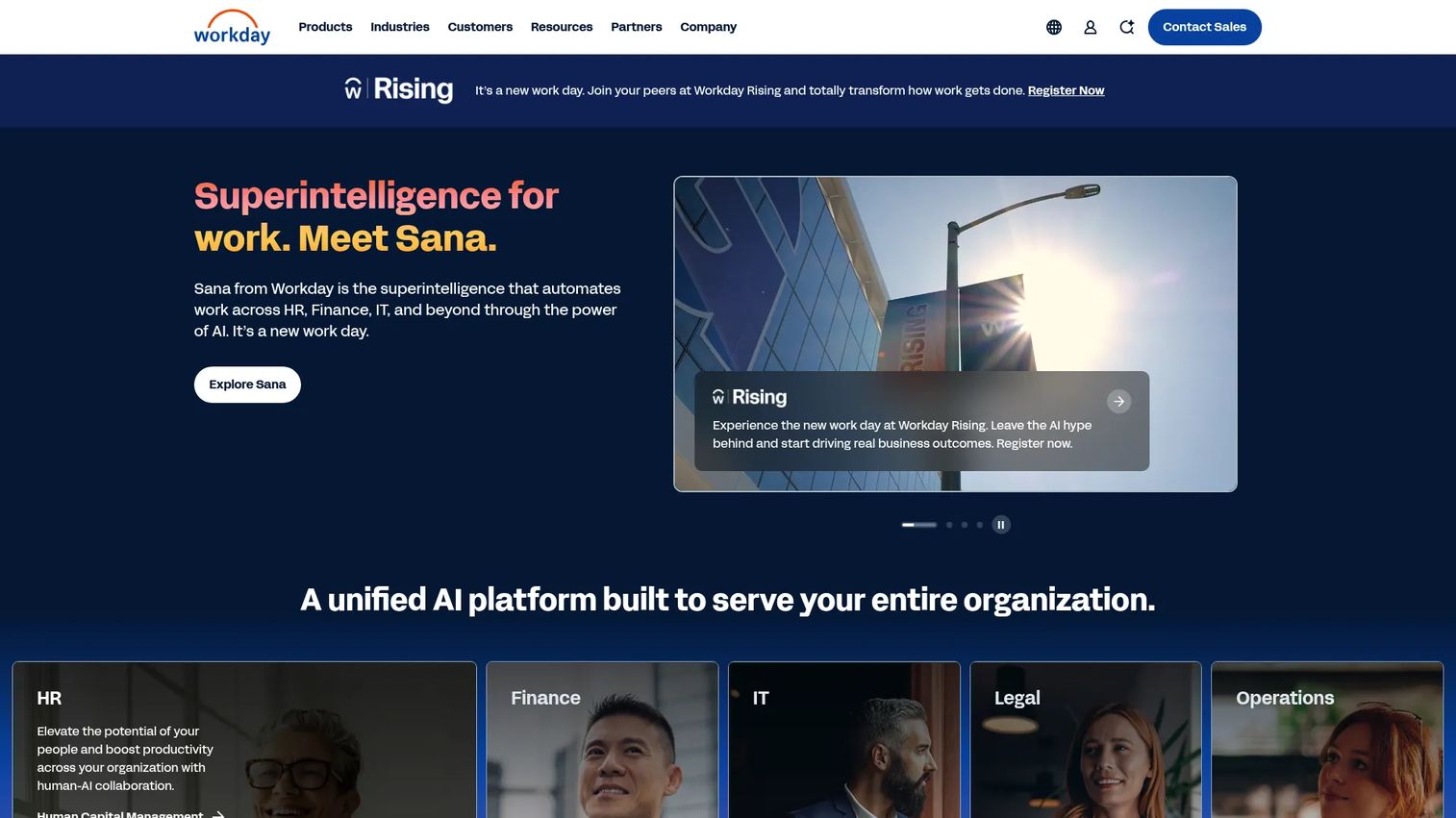
Workday Peakon Employee Voice is Workday's AI-powered listening platform for surveys, analytics, and action planning. It is built for continuous feedback at scale. Intelligent surveys, global benchmarks, and attrition prediction help organizations boost retention, improve workplace satisfaction, and turn sentiment into manager action. Reported customer outcomes include a 57 eNPS point increase over 12 months, a 10% reduction in voluntary turnover, an 11% rise in Glassdoor rating, and 10x ROI from lower attrition and reduced hiring spend.
Best for: Mid-market and enterprise organizations needing continuous employee feedback and sentiment analytics.
Key strengths
- Intelligent surveys: Adaptive questions keep listening continuous without survey fatigue.
- Global benchmarks: Compare scores against external and industry baselines.
- Attrition prediction: Models flag turnover risk before it shows up in exits.
Why choose Workday Peakon Employee Voice: Choose it when you already operate in the Workday ecosystem or need deep workforce analytics tied to your core HR data. Its listening and prediction depth is the draw for organizations that treat sentiment as a leading indicator of retention.
Workday Peakon Employee Voice pricing: Pricing is not publicly displayed. The product pages direct you to request a demo or contact sales, so expect an enterprise quote scoped to your Workday footprint and employee count.
7. 15Five
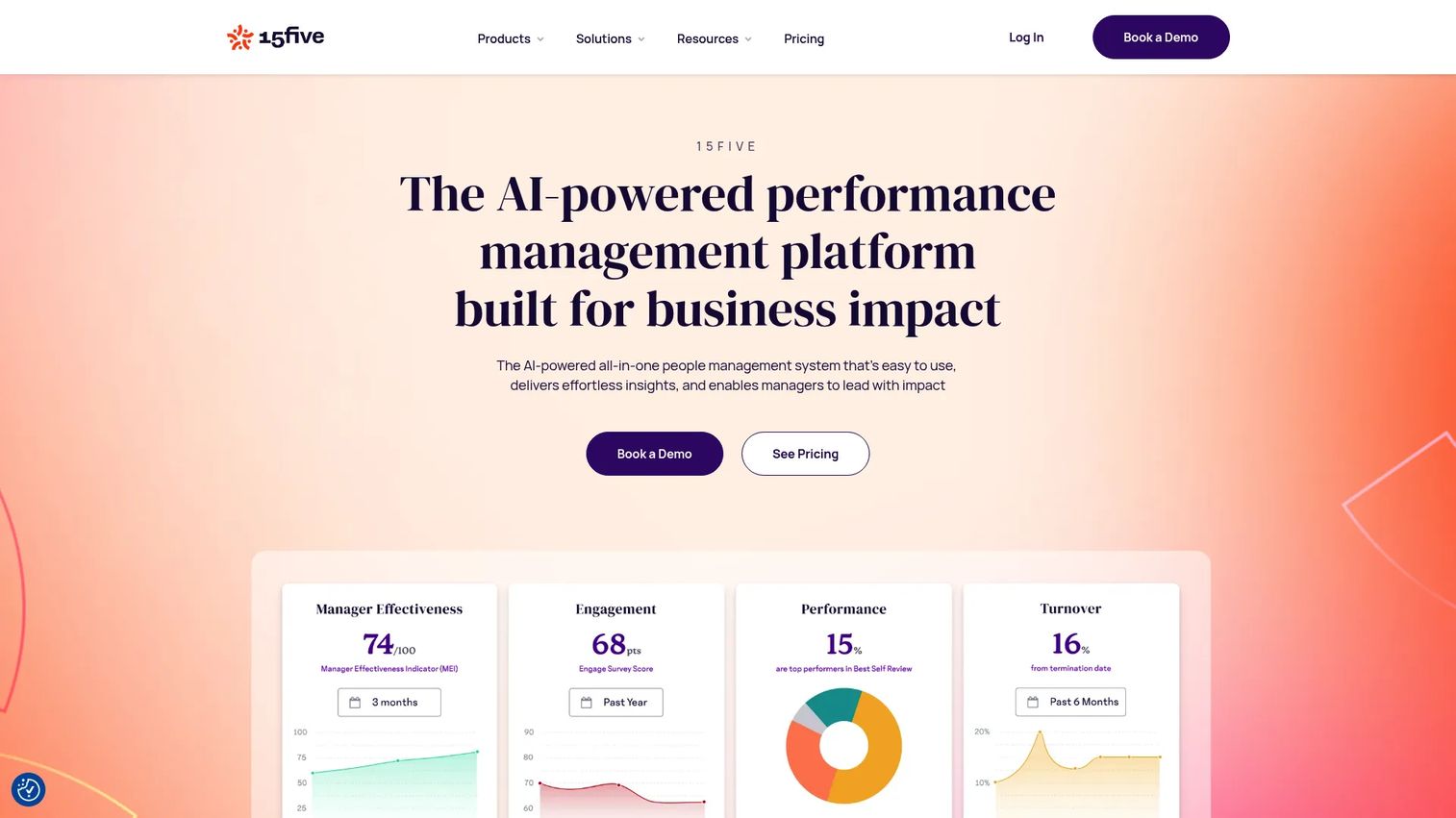
15Five is AI-powered people management software for performance, engagement, and manager effectiveness. It positions engagement as part of day-to-day management rather than a separate annual program. Weekly check-ins, one-on-ones, continuous feedback, and manager coaching tools make engagement something managers run every week. Over 3,000 companies use 15Five to increase engagement, performance, and retention.
Best for: Mid-market HR teams needing engagement, performance, and manager effectiveness in one platform.
Key strengths
- Engagement surveys and action planning: Measure sentiment, then assign owned next steps.
- AI-assisted reviews and continuous feedback: Performance reviews and ongoing feedback in one flow.
- Goals, one-on-ones, and manager coaching: Tools that make managers more effective week to week.
Why choose 15Five: Choose 15Five when you want engagement embedded in the manager's weekly rhythm rather than handled by HR in isolation. Its manager-enablement focus fits teams that believe engagement is mostly a frontline-management problem.
15Five pricing: Three plans are billed annually. Engage is $4/user/month. Perform is $11/user/month. The Total Platform plan is $16/user/month. There is no free tier.
8. Quantum Workplace
Quantum Workplace is an all-in-one HR platform for employee engagement, performance, development, and recognition. It stands out for organizations that want benchmark-driven reporting and a structured program. Its engagement software uses a proprietary e9 model of employee engagement, which is described as scientifically validated and rigorously tested. For HR teams that need both measurement and a clear action-planning path, that research grounding gives surveys more authority with leadership.
Best for: Mid-market and enterprise HR teams wanting a connected employee experience platform.
Key strengths
- Surveys and action planning: Engagement, pulse, and lifecycle surveys feed structured action plans.
- Performance management: Goals, OKRs, feedback, one-on-ones, and reviews in one system.
- Development and recognition: Development plans, succession planning, and recognition round out the suite.
Why choose Quantum Workplace: Choose it when benchmark-driven measurement and a validated engagement model matter to how you sell programs internally. It holds a 4.3/5 G2 rating and draws 500+ reviews from HR, managers, and employees. The connected suite suits teams that want measurement and action planning under one vendor.
Quantum Workplace pricing: Pricing is quote-based. Packages start at $15,000 and can be purchased together, separately, or à la carte across Engagement, Performance, Development, and Recognition. There is no free tier, and all plans are billed annually.
9. Vantage Circle
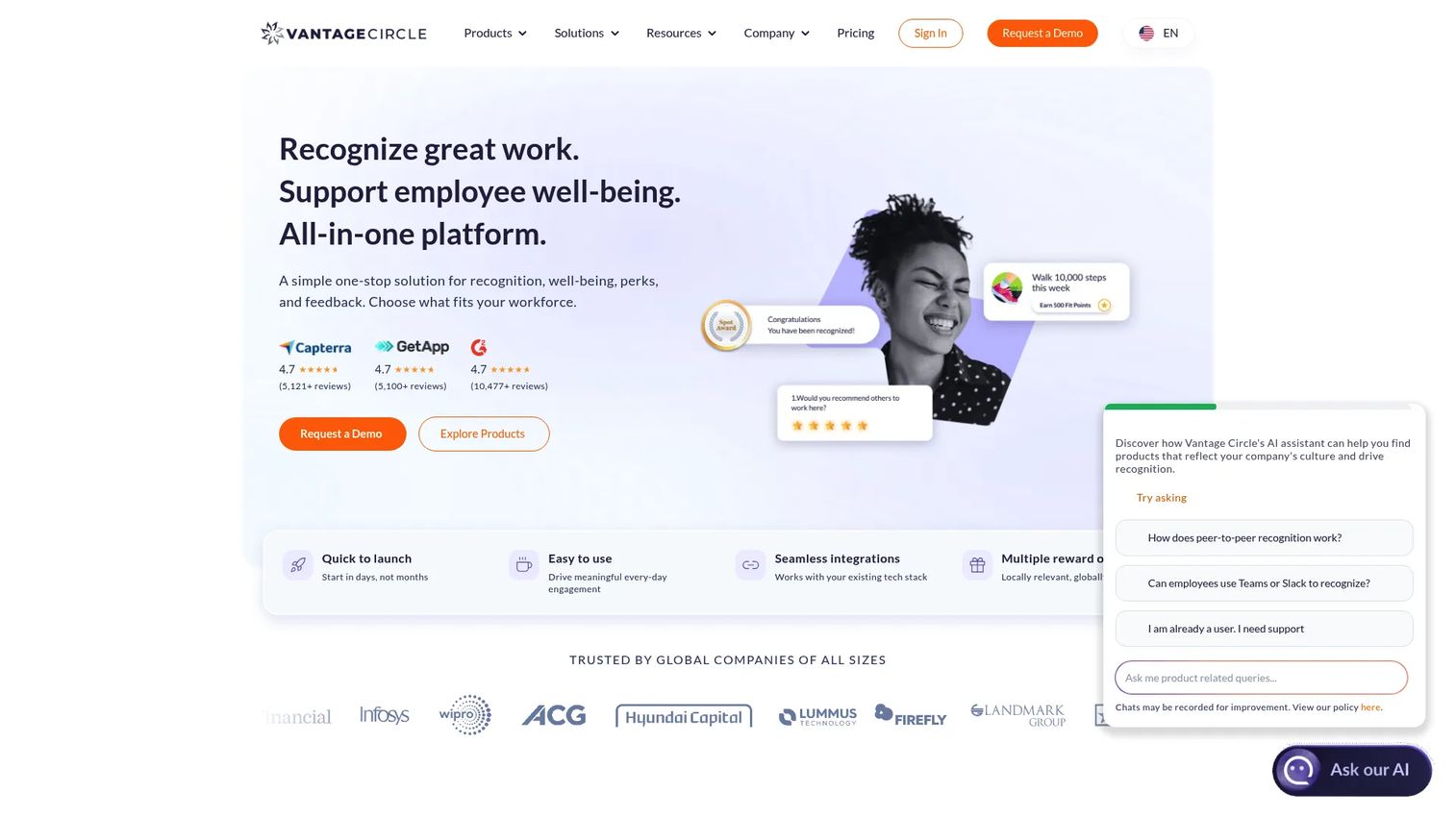
Vantage Circle is an employee engagement platform for recognition, rewards, wellness, perks, and feedback. It serves companies that want a broad suite with recognition at the center. Beyond points and rewards, it layers in wellness challenges, employee perks, and eNPS surveys, which makes it a fit for teams that want appreciation and well-being in the same place. It is trusted by over 3.2 million users and 700+ clients.
Best for: Mid-market to enterprise teams seeking an all-in-one employee engagement platform.
Key strengths
- Recognition and rewards: Points-based appreciation with a global rewards catalog.
- Wellness challenges and analytics: Well-being programs with participation tracking.
- Feedback and eNPS surveys: Listening tools that round out the engagement picture.
Why choose Vantage Circle: Choose Vantage Circle when recognition anchors your program but you also want wellness and perks in one platform. It holds a 4.7/5 G2 rating. The Scale plan adds Vantage Pulse for employee feedback plus enterprise features like team awarding, a dedicated account manager, and 15+ language support, which matters for global rollouts.
Vantage Circle pricing: Pricing is custom, based on organization size, selected products, and required integrations. The Grow, Transform, and Scale plans are quote-based with no public price shown, so expect a sales conversation scoped to your needs.
How to choose the right employee engagement platform
Before you shortlist, run each candidate against the criteria below. These are the factors that separate a tool that gets adopted from one that gets ignored.
Engagement model fit
Decide what your program leads with. Recognition-first, survey-first, performance-linked, and full-suite platforms solve different problems. Buying a survey-heavy platform when your real gap is appreciation, or vice versa, is the most common mismatch. Map the tool's center of gravity to yours.
Integration depth
Engagement software only works if it lives where employees already are. Check HRIS sync, Slack and Teams integrations, and SSO. A recognition feed nobody sees because it sits in a separate app will not change behavior. Verify the specific integrations your stack needs before signing.
Analytics and action planning
Measurement without a path to action is the gap that kills programs. Look for segmentation by team and demographic, benchmarks you trust, and action-planning tools that assign owners and track follow-through. Ask to see how a low score becomes an owned task inside the tool.
Pricing clarity and contract terms
Several platforms here gate pricing behind sales and bill annually. That is normal for enterprise HR tooling, but it means budgeting and procurement take longer. Confirm seat minimums, annual commitments, and whether reward costs are separate from the subscription, as they are with several recognition tools.
Adoption and manager participation
The best feature set fails if managers don't use it. Evaluate how the tool prompts managers, how it fits their existing workflow, and how much change management the vendor supports. Tools that route issues to the right manager and prompt action consistently get adopted; tools that dump a dashboard on HR and walk away do not.
Conclusion
The best employee engagement software depends entirely on what your program leads with. If recognition and culture are your starting point, Bonusly, Achievers, and Vantage Circle put appreciation at the center. If you lead with listening and analytics, Culture Amp and Workday Peakon Employee Voice are built for survey depth and sentiment prediction. If you want engagement tied to performance and manager workflows, Lattice and 15Five connect surveys to reviews, goals, and one-on-ones. WorkTango and Quantum Workplace sit in the middle, combining recognition and surveys with benchmark-driven reporting.
The practical move is simple. Shortlist two tools that match your engagement model, compare their integrations and pricing against your actual stack and budget, and run a demo with a real engagement scenario from your own team. Don't evaluate on feature lists. Evaluate on whether a manager on your team would actually open the tool and act on what it shows them. That is the only test that predicts whether the program survives past the first survey cycle.
FAQs
Employee engagement software is HR technology that helps organizations measure and improve how connected and motivated employees feel. The best employee engagement platforms combine feedback, recognition, and analytics so that sentiment data turns into action rather than sitting in a report.
Teams usually track a mix of signals: survey scores, eNPS, participation rates, recognition activity, manager follow-through, and retention trends. No single number tells the full story. The most useful approach pairs a quantitative score with action-planning data that shows whether managers actually responded to what employees said.
Core features include pulse and annual surveys, anonymous feedback, recognition and rewards, dashboards with segmentation, integrations with your HRIS and communication tools, and action planning. The mix you prioritize depends on whether your program leads with listening, recognition, or manager workflows.
In practice, anonymity depends on minimum response thresholds. Reputable employee engagement tools won't show results for a group below a set size, usually five to ten responses, so individuals can't be identified by team and demographic filters. Confirm the threshold and how the vendor handles small teams before you promise employees anonymity.
For small teams, prioritize simplicity, fast adoption, and clear pricing over deep enterprise analytics. Bonusly offers a free tier for up to eight users and a low per-user price, which makes it an easy starting point for a recognition-first program. The right pick is the one your team will actually open without training.
Enterprise buyers should weigh analytics depth, security, permissions, and workflow scale. Culture Amp and Workday Peakon Employee Voice are built for survey and sentiment analytics at scale, while Achievers handles global recognition across many countries. Confirm SSO, role-based permissions, and benchmarking before committing to an annual contract.
Adoption comes down to three things: manager participation, clear communication about why the tool exists, and visible action on feedback. If employees see leaders respond to survey results and managers use the tool in real one-on-ones, participation holds. If feedback disappears into a report nobody acts on, usage drops within a cycle or two.