A mid-market security team pulls logs from 40-plus sources: cloud workloads, endpoints, identity providers, firewalls, and a dozen SaaS apps. On a normal day, that stack throws thousands of alerts. Most are noise. A few are the start of a breach. The team can't always tell which is which fast enough.
That gap between signal and noise is the reason SIEM software exists, and it's why picking the right platform matters more in 2026 than it did five years ago. The global SIEM market was valued at roughly USD 8.39 billion in 2026 and is forecast to reach USD 13.67 billion by 2031, growing at a 10.3% CAGR, according to MarketsandMarkets. Money is flowing into the category because logs keep multiplying and detection keeps getting harder.
For security teams, the payoff of a good SIEM is measurable: faster mean time to detect (MTTD), faster mean time to respond (MTTR), cleaner compliance reporting, and a security operations center that spends less time chasing false positives. For the presales and sales engineers who have to explain, demo, and defend a SIEM during a technical evaluation, the stakes are just as real. You have to prove log coverage, detection logic, and operational fit against a buyer's actual environment.
This is a practical shortlist of SIEM solutions built for that job. It's less a definition page and more a buying guide: what each tool is for, who it fits, and the questions that actually matter when you evaluate. Whether you're comparing threat detection depth or planning your incident response workflow, the goal here is to help you pattern-match your situation to a tool. If your evaluations also touch adjacent security categories, our roundups of the best AI cybersecurity solutions and best AI security posture management tools cover neighboring parts of the stack, and our audit management software guide is useful when compliance sits in the same buying committee.
What's inside
This guide is for security leaders, SOC managers, analysts, and the presales teams who support technical SIEM evaluations. We chose the ten platforms below based on four things that matter most in a real buying decision: detection depth and correlation quality, integration breadth across cloud and on-prem sources, scalability from mid-market to enterprise, and reporting plus compliance fit. The list mixes AI-first analytics platforms, cloud-native SIEM built for elastic scale, and enterprise-grade SIEM systems with long SOC track records. Each entry is framed by buyer fit, not feature counts, so you can find the tool that matches your data sources and team maturity.
TL;DR
- Best for Microsoft-native security operations: Microsoft Sentinel, a cloud-native SIEM and SOAR platform that fits teams already invested in Azure and Microsoft security tooling.
- Best for deep search and complex data environments: Splunk Enterprise Security, for large SOCs that need flexible analytics and heavy customization.
- Best for mature enterprise SOCs: IBM QRadar SIEM, for teams that want proven correlation and compliance support with ecosystem depth.
- Best for behavioral analytics and AI SIEM: Exabeam Fusion and Securonix, for teams prioritizing UEBA and analyst-guided investigation.
- Best for flexible, search-driven, cost-conscious teams: Elastic Security and Graylog Security, for technical teams that want usage-based pricing and control.
- Best for network-centric and MSSP-friendly deployments: Fortinet FortiSIEM and Logpoint, for teams anchored in infrastructure visibility or multitenant operations.
What is SIEM software?
SIEM software is a security platform that collects, normalizes, and correlates log and event data from across an organization's infrastructure to detect threats, support investigations, and produce compliance reporting. SIEM stands for security information and event management, and it combines what used to be two separate disciplines: log management and real-time security event analysis.
The core SIEM workflow runs in a predictable sequence:
- Log collection: Ingest data from endpoints, servers, cloud services, identity systems, firewalls, and SaaS apps.
- Normalization and parsing: Convert varied log formats into a consistent structure so events can be compared.
- Correlation: Link related events across sources into meaningful patterns that signal an attack.
- Dashboards: Surface security posture, active investigations, and trends for analysts and leadership.
- Alerts: Fire prioritized notifications when correlation rules or analytics detect suspicious activity.
- Monitoring: Provide continuous, centralized visibility into the whole environment.
What a strong SIEM system does well:
- Visibility: Centralizes fragmented telemetry into one place.
- Threat detection: Spots known and unknown threats through rules and analytics.
- Incident response: Gives analysts the context to triage and act quickly.
- Compliance reporting: Maintains retention, audit trails, and report templates for regulated environments.
- SOC efficiency: Cuts alert noise and speeds up mean time to detect and respond.
Modern SIEM has also absorbed adjacent concepts. AI SIEM applies machine learning to surface anomalies humans miss. UEBA (user and entity behavior analytics) baselines normal behavior and flags deviations. SOAR (security orchestration, automation, and response) automates repetitive response actions. And XDR (extended detection and response) tightens the loop between detection and endpoint or network response. The best SIEM tools now blend several of these into one platform, which is exactly what makes the buying decision harder.
When to use SIEM software
Not every environment needs a full SIEM, and not every SIEM fits every environment. Here's how to tell when the category earns its place.
Centralize logs across a fragmented stack
When your logs live in ten different places, cloud consoles, endpoint agents, identity providers, network gear, and SaaS admin panels, you can't answer basic questions fast. A SIEM pulls all of it into one searchable store. Normalization matters here because a firewall log and an identity log describe events differently, and correlation only works once they speak a common language. This is the baseline use case: one place to look, one query language, one timeline.
Improve detection and response
When your team is triaging blind, missing lateral movement, or spending hours reconstructing what happened, a SIEM gives you the connective tissue. Correlation rules and behavioral analytics link a suspicious login to a privilege change to a data pull, turning scattered events into a single investigation. The outcome metrics are MTTD and MTTR. If those numbers are trending the wrong way, a SIEM with strong detection logic and guided investigation is the fix.
Satisfy compliance and audit needs
Regulated teams, finance, healthcare, government, and anyone facing SOC 2, ISO 27001, HIPAA, or PCI DSS, use SIEM for retention, audit trails, and repeatable reporting. Auditors want proof that logs are collected, retained for a defined period, and searchable on demand. This is often where enterprise buying pressure originates: the security team wants better detection, but the compliance mandate is what unlocks the budget.
Comparison table
Use this table for a fast fit-check before you read the full sections. It shows broad positioning, deployment intent, and where each SIEM system earns its keep, not an exhaustive feature list. Sort your shortlist by the intent column, then dig into the two or three that match your environment.
| # | Product | Intent | Key differentiation | Pricing | G2 rating |
|---|---|---|---|---|---|
| 1 | Microsoft Sentinel | Cloud-native SIEM/SOAR | Microsoft ecosystem fit, data lake tier | Usage-based, ingestion tiers | 4.4/5 |
| 2 | Splunk Enterprise Security | Enterprise SIEM/SOAR/UEBA | Deep search, flexible analytics | Custom quote | 4.3/5 |
| 3 | IBM QRadar SIEM | Enterprise SIEM | Correlation depth, ecosystem | Custom quote | - |
| 4 | Exabeam Fusion | Cloud-delivered SIEM/UEBA | Behavioral analytics, timelines | Custom quote | 4.2/5 |
| 5 | Securonix | Cloud-native SIEM/UEBA/SOAR | Analytics-driven detection | Capacity-band tiers | 4.0/5 |
| 6 | LogRhythm SIEM | Self-hosted SIEM | Built-in detection and response | Subscription or perpetual | 4.2/5 |
| 7 | Elastic Security | SIEM/XDR | Search-driven, usage-based | From $0.11/GB ingested | 4.5/5 |
| 8 | Logpoint | SIEM/NDR for MSSPs | Multitenant, compliance reporting | Quote-led | 4.3/5 |
| 9 | Fortinet FortiSIEM | Network-centric SIEM | IT/OT visibility, CMDB | Subscription or perpetual | 4.3/5 |
| 10 | Graylog Security | Lean SIEM/log management | Risk-based alerting, cost-conscious | From $18,000/yr | 4.4/5 |
1. Microsoft Sentinel
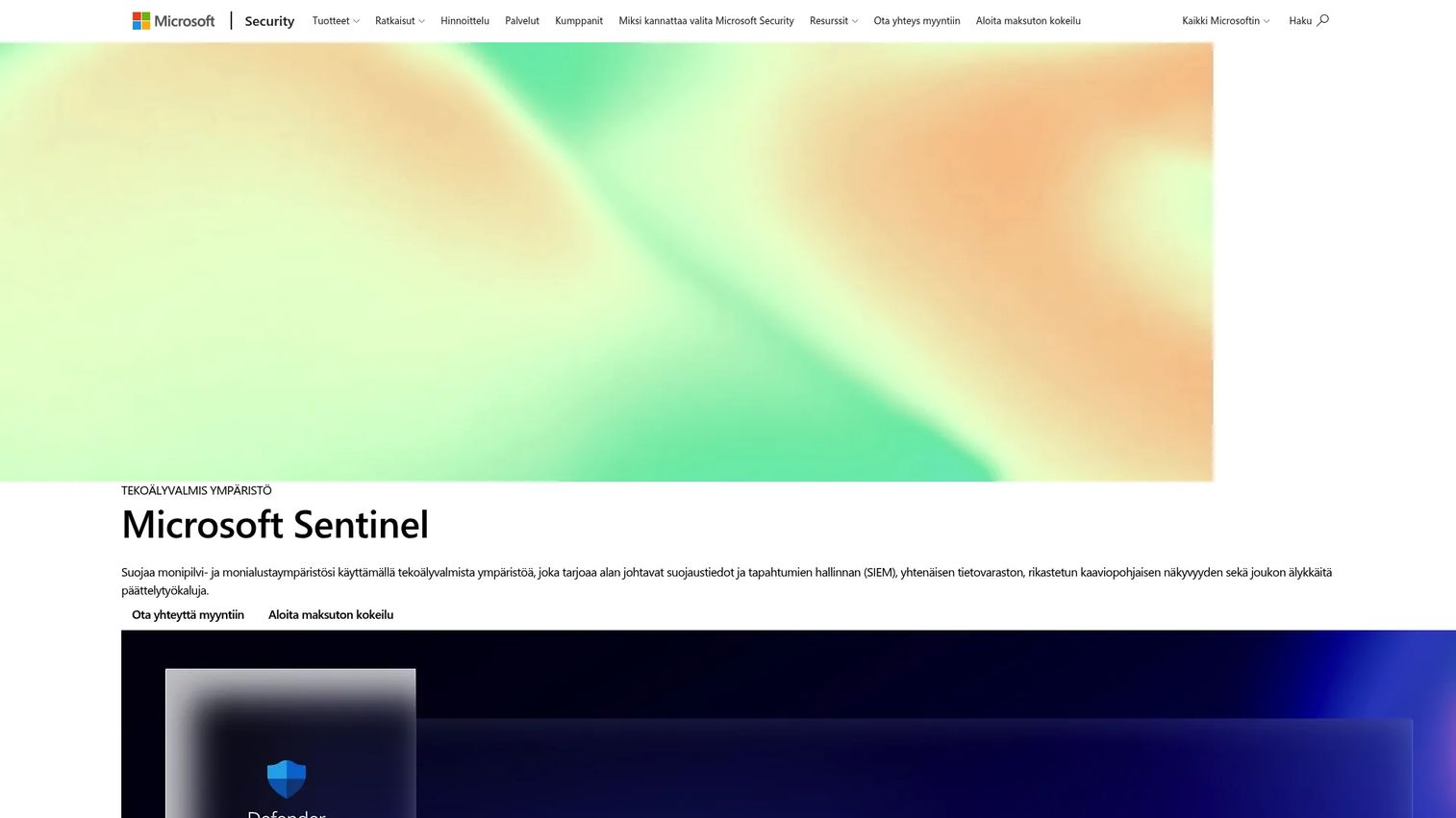
Microsoft Sentinel is Microsoft's cloud-native SIEM and SOAR platform, built for security analytics, threat detection, and automated response. It runs on Azure, scales elastically with ingestion, and connects tightly to the rest of the Microsoft security stack. For teams already living in Azure Active Directory, Microsoft 365, and Defender, Sentinel removes a lot of integration friction because the connectors and identity signals are native.
Best for: Organizations that want a Microsoft-native SIEM/SOAR for cloud security operations.
Key strengths
- Analytics tier: Full analytics, alerts, and query capabilities for active detection and hunting.
- Data lake tier: Low-cost long-term storage for security data you need to retain but rarely query.
- Commitment tiers: Reserved daily ingestion capacity that smooths out cost as volume grows.
Why choose Microsoft Sentinel: If your identity, productivity, and cloud infrastructure already run on Microsoft, Sentinel is the path of least resistance. The native telemetry and built-in automation shorten deployment, and the tiered storage model lets you separate hot detection data from cold retention. Teams outside the Microsoft ecosystem can still use it, but the value concentration is highest for Azure-centric SOCs.
Microsoft Sentinel pricing: Sentinel is billed by the volume of data ingested and analyzed. There's a Pay-As-You-Go option in the Analytics tier plus commitment tiers that reserve daily ingestion capacity, and a separate Data lake tier for long-term storage. Microsoft notes that displayed prices are estimates and actual pricing varies, and the public pricing page does not show fixed numeric rates in the table. A free tier is available for getting started. G2 reviewers rate it 4.4/5.
2. Splunk Enterprise Security
Splunk Enterprise Security is an AI-powered security operations platform for threat detection, investigation, and response. Its reputation was built on search: if you can describe what you're looking for, Splunk's query language can usually find it across enormous, messy datasets. That depth makes it a favorite for large SOCs with complex, high-volume environments and analysts who want to build exactly the detections they need.
Best for: Large security teams that need a unified SIEM/SOAR/UEBA platform with heavy customization.
Key strengths
- SIEM: Centralized log correlation and detection across diverse, high-volume data sources.
- SOAR: Automated response playbooks that cut manual toil on repetitive incidents.
- UEBA: Behavioral analytics that baseline users and entities to surface anomalies.
Why choose Splunk Enterprise Security: Choose Splunk when your data is complex, your team has the skill to wield a powerful query language, and you want the flexibility to customize detections deeply. Teams with simpler environments or smaller analyst benches may find lighter-weight platforms a faster path to value, but for organizations that live in their data, Splunk's search and analytics are hard to match.
Splunk Enterprise Security pricing: Splunk uses custom quote pricing for Enterprise Security. It lists Workload Pricing and Ingest Pricing as available models, with Essentials and Premier edition options. There are no public numeric prices; you'll need to contact sales for a quote scoped to your data volume and edition. G2 reviewers rate it 4.3/5.
3. IBM QRadar SIEM
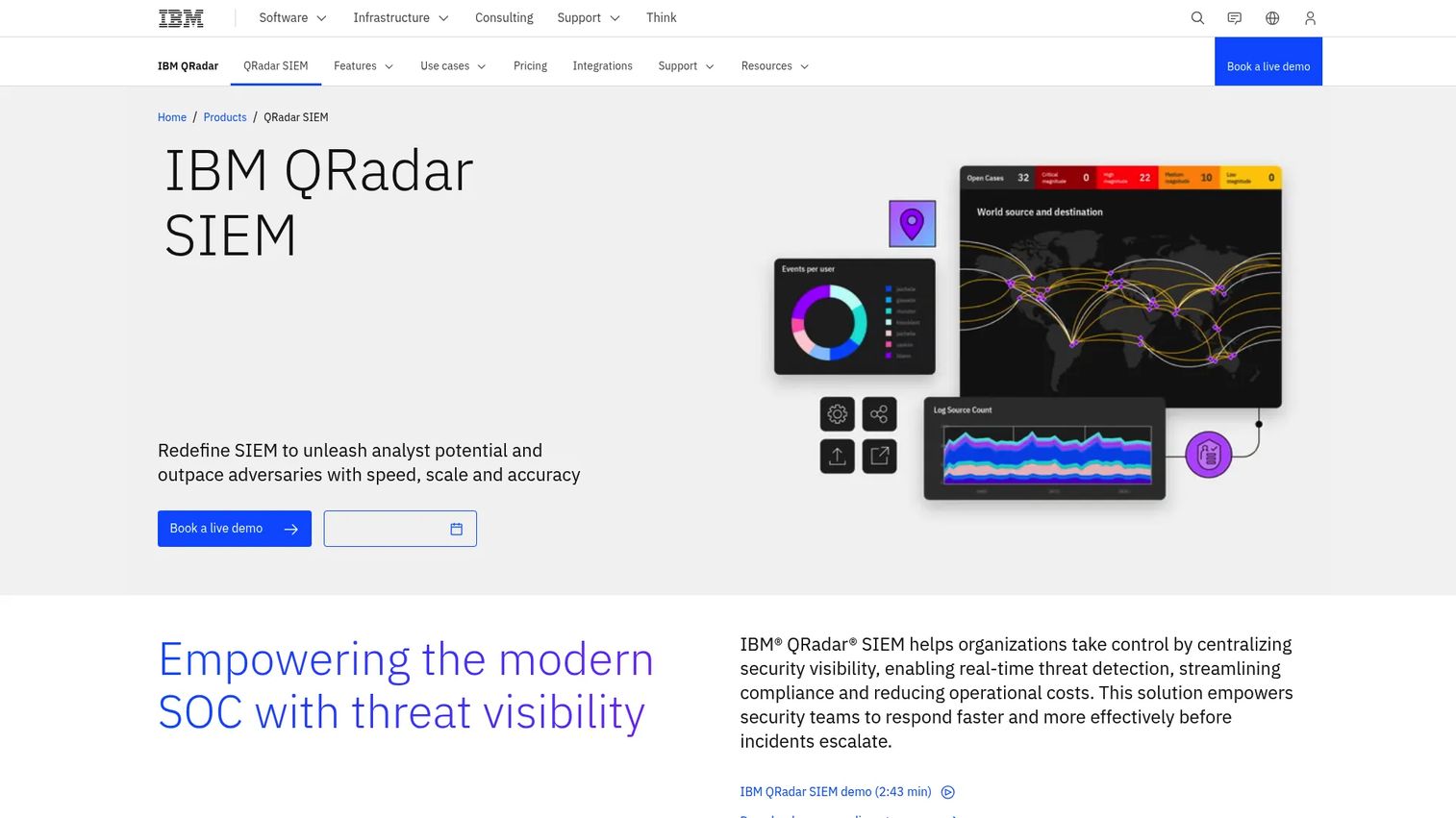
IBM QRadar SIEM is IBM's SIEM platform for centralized security visibility, real-time threat detection, and compliance support. It has a long track record in enterprise SOCs and a reputation for reliable correlation at scale. QRadar appeals to mature security operations that value proven detection, deep compliance capabilities, and integration into IBM's broader security ecosystem.
Best for: Enterprise security teams that need SIEM with IBM ecosystem integration and flexible licensing options.
Key strengths
- User behavior analytics (UBA): Baselines user activity to flag insider and compromised-account risk.
- Sigma community rules: Support for open detection rules speeds up rule authoring and sharing.
- Network threat analysis: NDR integration adds network-level context to detections.
Why choose IBM QRadar SIEM: QRadar fits buyers who prioritize a mature, well-supported SIEM system with strong correlation and compliance depth, and who value on-prem licensing flexibility alongside cloud options. It's a natural fit for large regulated enterprises that already trust IBM for other parts of their security operations center.
IBM QRadar SIEM pricing: IBM does not display public numeric prices; the pricing page directs you to request a quote. It describes Usage-based licensing (EPS/FPM) and Enterprise (MVS) licensing models, plus subscription or perpetual licensing for on-premises deployments. Scope pricing to your event and flow volume when you talk to sales.
4. Exabeam Fusion
Exabeam Fusion is a cloud-delivered security operations platform combining SIEM, UEBA, and response automation. Its differentiator is behavioral analytics: Fusion builds risk scores and automated timelines that stitch related events into a coherent story, so analysts spend less time reconstructing incidents and more time deciding what to do about them.
Best for: Security teams that want cloud-native threat detection, investigation, and response with guided analytics.
Key strengths
- Cloud-delivered SIEM and XDR/TDIR: Threat detection, investigation, and response in one platform.
- Behavioral analytics and risk scoring: UEBA that prioritizes the events most likely to matter.
- Automation and investigation support: Workflows and auto-built timelines that reduce analyst overhead.
Why choose Exabeam Fusion: Fusion fits teams that want to lower the analytical burden on their SOC. Automated timelines and risk scoring mean junior analysts can triage with more context and senior analysts can focus on the highest-risk activity. If reducing manual investigation time is a priority, Fusion's analytics-forward approach is a strong match.
Exabeam Fusion pricing: Exabeam does not publish a public price for Fusion, and product naming varies across current pages between Exabeam Fusion and New-Scale Fusion. Contact Exabeam for pricing scoped to your environment. G2 reviewers rate Exabeam 4.2/5.
5. Securonix
Securonix is a cloud-native security operations platform spanning SIEM, UEBA, SOAR, and threat detection and response. It's built for scale and leans heavily on behavioral analytics to surface threats that signature-based detection misses. For teams that want strong behavioral insight across large data volumes, Securonix is a serious contender.
Best for: Large enterprises that need a unified SIEM/UEBA/SOAR platform with analytics-driven detection.
Key strengths
- Unified Defense SIEM: Centralized detection across cloud and on-prem telemetry.
- UEBA: User and entity behavior analytics that catch anomalous activity at scale.
- SOAR: Built-in orchestration and automated response to speed up containment.
Why choose Securonix: Securonix appeals to enterprises that want behavioral analytics as a first-class capability rather than a bolt-on. Its cloud-native architecture handles large ingestion volumes, and the combined SIEM/UEBA/SOAR footprint makes it compliance-friendly for regulated organizations that need both detection depth and audit-ready reporting.
Securonix pricing: Securonix prices by GB/day capacity bands across four tiers: BASIC, STANDARD, ADVANCED, and ALL-IN. No public numeric prices are shown; you'll match your daily data volume to a band with sales. G2 reviewers rate it 4.0/5.
6. LogRhythm SIEM
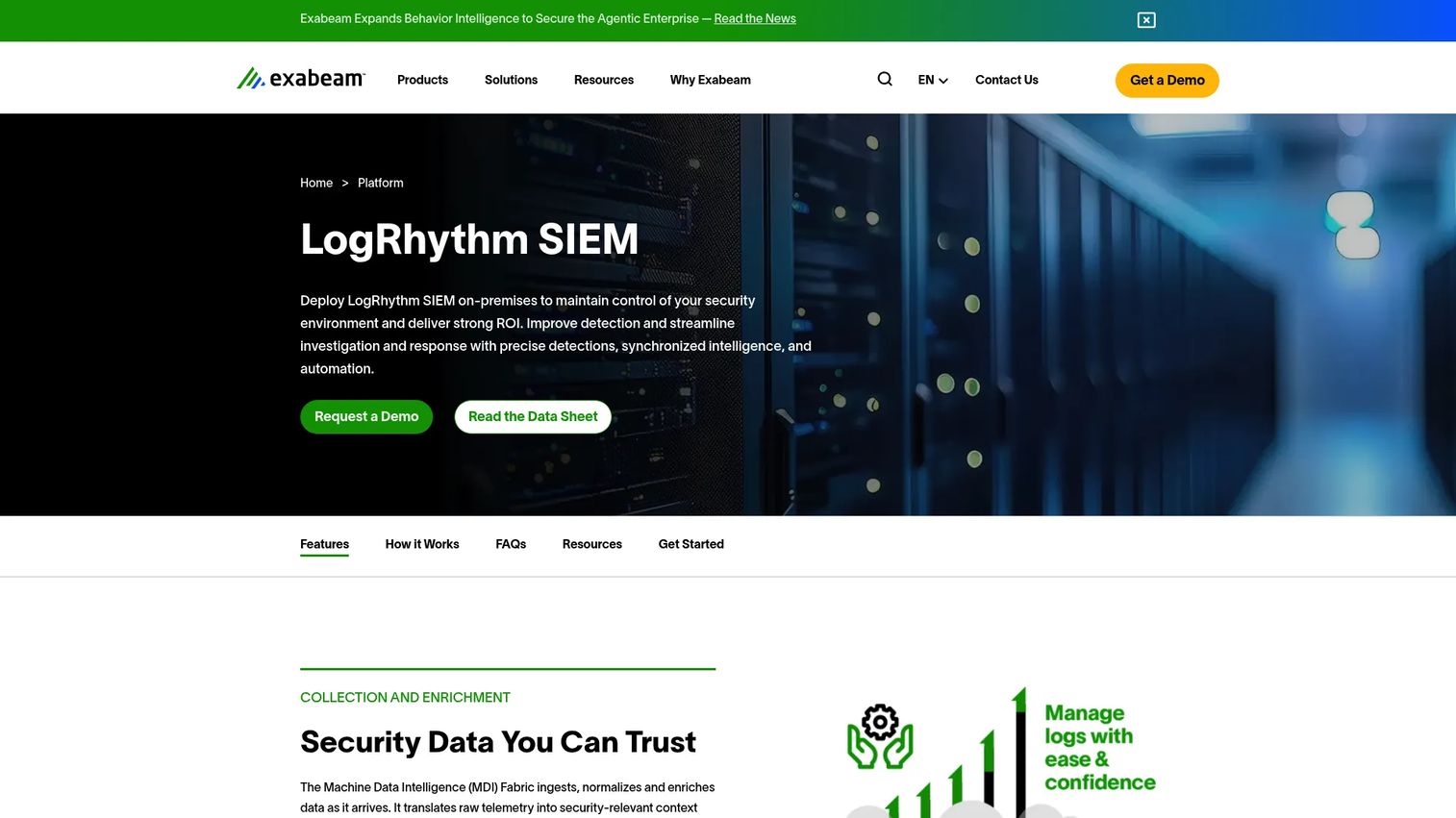
LogRhythm SIEM is a self-hosted SIEM for threat detection, investigation, response, and compliance. It ships with a large library of prebuilt detection content and embedded response actions, which makes it practical for teams that want a working SIEM without building everything from scratch. Its self-hosted model appeals to organizations with data-residency or control requirements.
Best for: Enterprises that need a self-hosted SIEM with built-in detection and response.
Key strengths
- 1,100+ out-of-the-box correlation rules: Prebuilt detection content that shortens time to value.
- Embedded SOAR with SmartResponse: Automated response actions built into the platform.
- Self-hosted deployment: Runs in your data center or private cloud for full control.
Why choose LogRhythm SIEM: LogRhythm fits mid-market and enterprise teams that want operational practicality: a lot of detection content ready on day one, embedded automation, and the option to keep everything self-hosted. For SOCs with compliance-driven data-residency needs and a preference for owning their infrastructure, it's a sensible pick.
LogRhythm SIEM pricing: Pricing is not publicly listed. LogRhythm offers subscription or perpetual licensing and requires a sales conversation for a quote. G2 reviewers rate it 4.2/5.
7. Elastic Security
Elastic Security is Elastic's security operations platform for SIEM, XDR, endpoint, and cloud security, built on the same search engine that powers the Elastic Stack. Teams that already run Elasticsearch for logs or observability often extend into Elastic Security because the data and skills carry over. Its search-driven detection and flexible data handling appeal to technical teams that want control.
Best for: Security teams that want a unified, usage-based SIEM/XDR platform with cloud and endpoint coverage.
Key strengths
- SIEM and XDR capabilities: Detection and response unified on a single search platform.
- Endpoint security: Native endpoint telemetry and protection.
- Cloud security and posture protection: Coverage for cloud workloads and configuration posture.
Why choose Elastic Security: Choose Elastic when you have technical depth and want flexibility, whether self-managed or cloud, plus usage-based pricing that scales with what you actually ingest. Teams with existing Elastic infrastructure get the fastest ramp, but the platform stands on its own for any team comfortable with a search-first approach to security analytics.
Elastic Security pricing: Elastic Security on Elastic Cloud Serverless is usage-based, starting as low as $0.11 per GB ingested and $0.19 per GB retained per month, with automation executions free for the first 10,000 and low per-execution rates after. Hosted and self-managed options are also available. A free tier exists to get started. G2 reviewers rate it 4.5/5.
8. Logpoint

Logpoint is a cybersecurity platform for SIEM, NDR, automation, and case management. It's designed for unified security operations with a strong focus on detection and compliance reporting, and its multitenant Director makes it a common choice for MSSPs managing many customer environments from one console.
Best for: MSSPs and security teams that need SIEM-centric detection and response with compliance support.
Key strengths
- SIEM: Log and event collection, detection, and compliance reporting in one place.
- NDR: Anomaly detection and network traffic analysis for network-level threats.
- Automation and multitenant Director: Case management and multitenancy built for MSSP operations.
Why choose Logpoint: Logpoint fits teams that want practical SIEM deployment while keeping cost and governance in view, along with MSSPs that need clean multitenancy. Its compliance reporting and case management make it a solid operational choice for organizations balancing detection needs against budget and manageability.
Logpoint pricing: Logpoint does not publish first-party numeric pricing; the vendor uses demo and quote-led selling. Request a quote scoped to your data volume and tenancy needs. G2 reviewers rate it 4.3/5.
9. Fortinet FortiSIEM
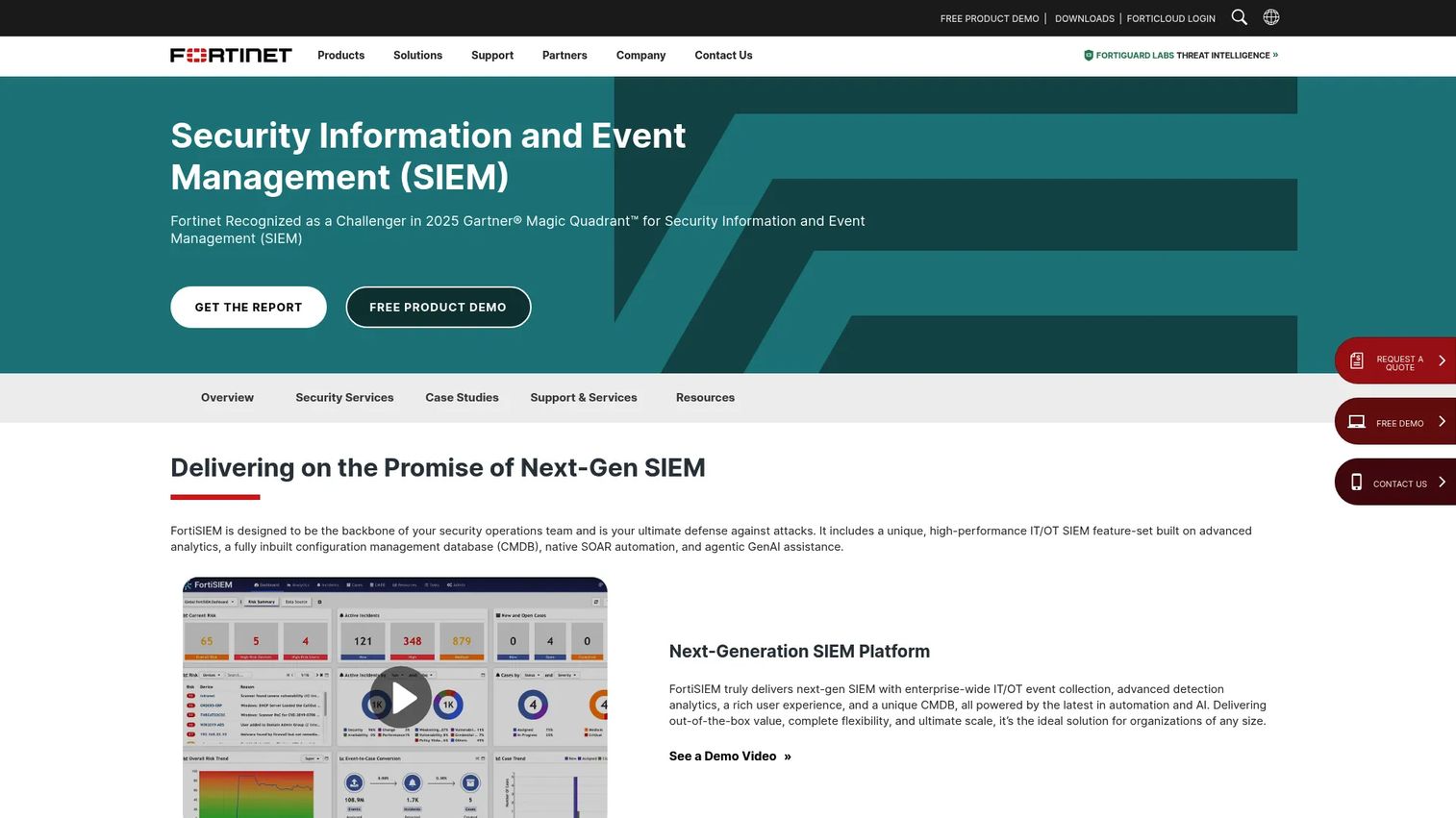
Fortinet FortiSIEM is Fortinet's SIEM platform for threat detection, investigation, response, compliance reporting, and IT/OT visibility. Its standout trait is infrastructure awareness: a built-in CMDB and strong network-centric correlation make it a natural fit for teams that already run Fortinet gear and care deeply about operational and OT visibility.
Best for: Enterprises that need SIEM with IT/OT visibility, UEBA, and automation.
Key strengths
- Built-in IT/OT CMDB: Passive and active discovery for full infrastructure inventory.
- Real-time security analytics with UEBA: 2,800+ correlation rules plus behavioral analytics.
- Built-in SOAR automation and FortiAI-Assist: Automated response with GenAI assistance.
Why choose Fortinet FortiSIEM: FortiSIEM shines in network-centric and OT-heavy environments, especially for organizations already invested in the Fortinet ecosystem. The integrated CMDB and correlation give strong operational visibility, and the built-in automation helps teams move from detection to response without stitching together separate tools.
Fortinet FortiSIEM pricing: Fortinet documents subscription and perpetual licensing models for FortiSIEM but does not publish a public price figure; the site directs you to request a quote. Scope licensing to your event volume and deployment model. G2 reviewers rate it 4.3/5.
10. Graylog Security
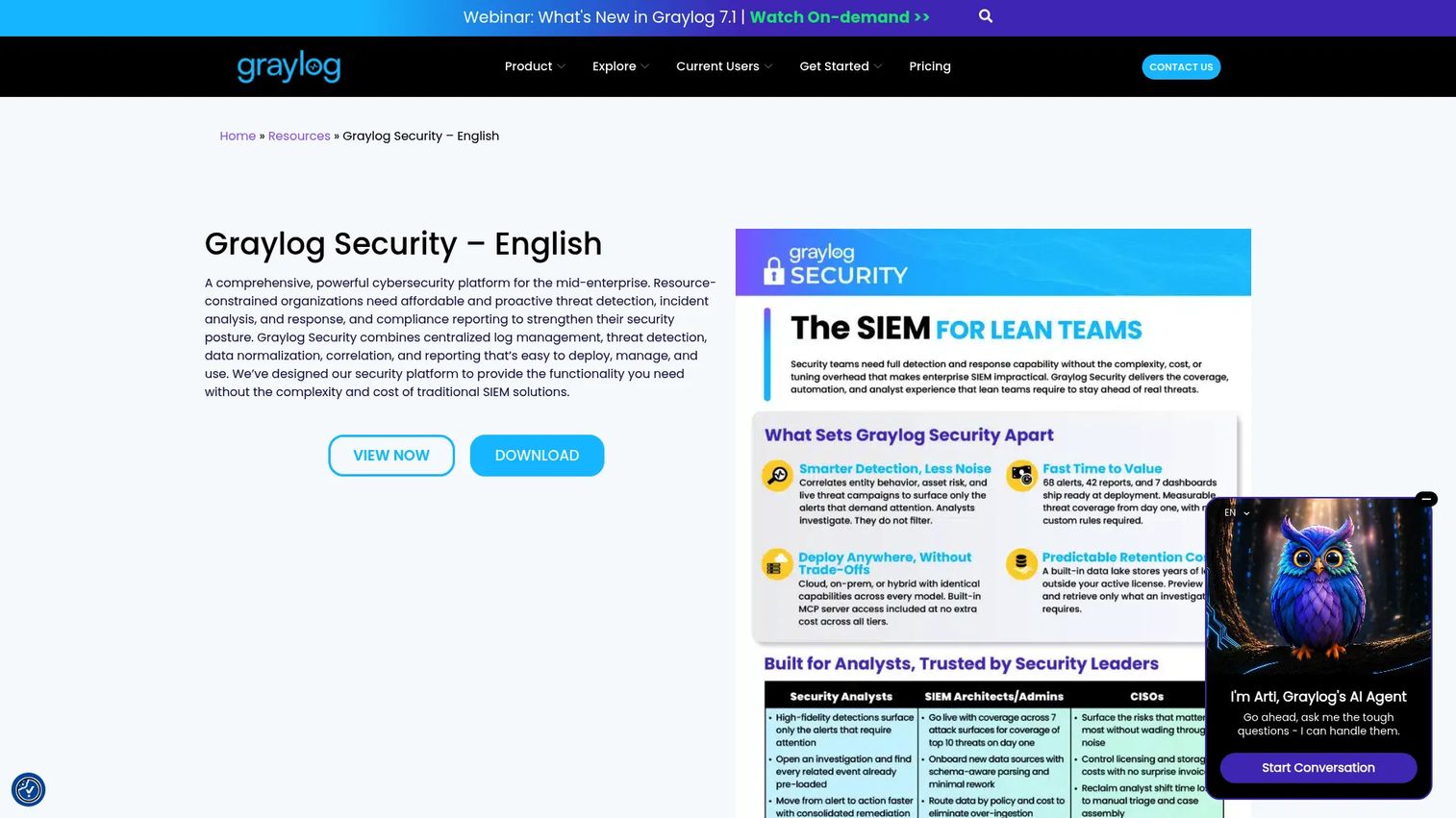
Graylog Security is a SIEM and cybersecurity platform built on Graylog's log management foundation, with threat detection, investigation, and response for security teams. It's often chosen as a more flexible, cost-conscious option by lean teams that want strong log management and investigation workflows without the weight of a full enterprise suite.
Best for: Lean security teams that need SIEM with log management and investigation workflows.
Key strengths
- Risk-based alerting: Prioritizes alerts by risk so analysts focus on what matters.
- UEBA/anomaly detection: Behavioral analytics to catch deviations from baseline.
- AI investigation summaries: AI-generated context that speeds up investigations.
Why choose Graylog Security: Graylog fits teams that want capable SIEM and log management without heavyweight enterprise pricing or complexity. It sits well below the largest platforms in operational overhead while still offering risk-based alerting and investigation tooling, making it a practical option for smaller SOCs and cost-aware buyers.
Graylog Security pricing: Graylog Security starts at $18,000 per year, based on daily volume or annual consumption, with sales contact for a scoped quote. There is no free plan for the security product. G2 reviewers rate Graylog 4.4/5.
How to choose the right SIEM
The right SIEM software depends less on a feature scorecard and more on a handful of decisions about your environment and team. Work through these before you shortlist.
Match the deployment model to your data gravity
On-premises still holds the majority of SIEM deployments, roughly 55% of the market in 2025 per Mordor Intelligence, while cloud SIEM is the faster-growing segment at nearly 13% CAGR through 2031. If your data and workloads sit mostly in the cloud, a cloud-native SIEM reduces friction. If compliance or residency rules keep data on-prem, favor a self-hosted or hybrid platform.
Weigh detection depth against team maturity
A powerful, highly customizable SIEM only pays off if your analysts can wield it. Mature SOCs with strong query skills benefit from deep search and custom detections. Leaner teams often get more value from platforms with rich out-of-the-box content and analytics that reduce manual work.
Check integration coverage against your actual sources
List your real log sources: identity, endpoint, cloud, firewall, and critical SaaS apps. Then confirm each candidate has native connectors, not just an API you'll have to build against. Integration gaps are where SIEM projects stall.
Model pricing on your data volume and retention
Most SIEM pricing tracks ingestion and retention, so the cheapest sticker price is not always the lowest operating cost. Model a year of your real data volume, including retention for compliance, before you compare quotes.
Confirm compliance and reporting fit
If you're in a regulated environment, verify retention windows, audit trails, role-based access, and prebuilt report templates for your specific frameworks. Compliance reporting is often the difference between a smooth audit and a scramble.
Conclusion
There's no single best SIEM software for 2026, only the best fit for your data sources, team maturity, compliance load, and workflow. The decision usually collapses into a few patterns. Microsoft-native shops gravitate to Sentinel. Large SOCs with complex data lean on Splunk and IBM QRadar. Teams that want behavioral analytics and lower analyst overhead look at Exabeam and Securonix. Technical, cost-conscious teams favor Elastic and Graylog. Network-centric and MSSP operations find their fit in Fortinet FortiSIEM and Logpoint, with LogRhythm covering self-hosted enterprise needs.
The practical next step: pick two finalists and run them against the same log sources and the same incident response scenario. Feed both your identity, endpoint, and cloud logs, then walk a realistic detection through triage to response. The platform that surfaces the signal faster, with less noise, is the one that will actually reduce your MTTD and MTTR in production. Evaluate on your data, not the vendor's demo dataset, and the right SIEM system will make itself obvious.
FAQs
SIEM software aggregates logs and events from across your infrastructure, normalizes them into a common format, and correlates them to detect threats. It surfaces findings through dashboards and prioritized alerts, gives analysts context for investigations, and retains data for compliance. In short: centralized visibility, faster detection, and audit-ready reporting.
SIEM is broader. It collects and correlates log and event data from many sources, cloud, identity, network, endpoint, and SaaS, and doubles as a compliance and retention system. XDR is more focused on detection and response across endpoints, network, and email, with tighter automated response built in. Many modern platforms blend both, but SIEM remains the wider net for correlation and reporting.
It depends on log volume, compliance pressure, and staffing. Small teams facing SOC 2 or similar audits, or handling sensitive data, often need SIEM for retention and reporting even if their alert volume is modest. Smaller teams usually favor cloud-native or lighter-weight SIEM tools that reduce operational overhead and don't require a large analyst bench to run.
Start with identity (who logged in and changed permissions), endpoint (what ran where), cloud (workload and configuration activity), firewall (network traffic), and your most critical SaaS apps. Prioritization matters because ingestion drives cost, and these sources give the most detection value per gigabyte. Add lower-signal sources once the high-value ones are correlated.
Most SIEM pricing depends on data volume, ingestion rate, retention period, and add-on modules like UEBA or SOAR. Model a full year of your real data, including compliance retention, before comparing quotes. The cheapest tool per gigabyte is not always the lowest total operating cost once tuning, storage, and analyst time are factored in.
Strong compliance support means configurable retention windows, tamper-evident audit trails, role-based access control, and prebuilt reporting templates for frameworks like SOC 2, ISO 27001, HIPAA, and PCI DSS. In regulated environments, the ability to prove what was collected, how long it was kept, and who accessed it is what carries you through an audit.
Neither is universally better. Cloud-native SIEM scales elastically and reduces infrastructure overhead, which suits cloud-heavy environments. On-prem SIEM gives more control and can satisfy strict data-residency rules. The right choice depends on where your data lives, your compliance obligations, and your team's operational skills. Many organizations run a hybrid.
Focus on the buyer's real environment: log coverage across their actual sources, the detection logic behind key alerts, how alerts route and prioritize, reporting for their compliance frameworks, and the investigation workflow end to end. Show ease of administration and integration with their existing stack, and tie every capability to a scenario they recognize. Reducing alert noise is usually the point that lands hardest.