You bought 200 software seats last year. Around 50 of them sit unused right now. Nobody can tell you which 50, because the record lives in a spreadsheet that was last accurate three reorgs ago.
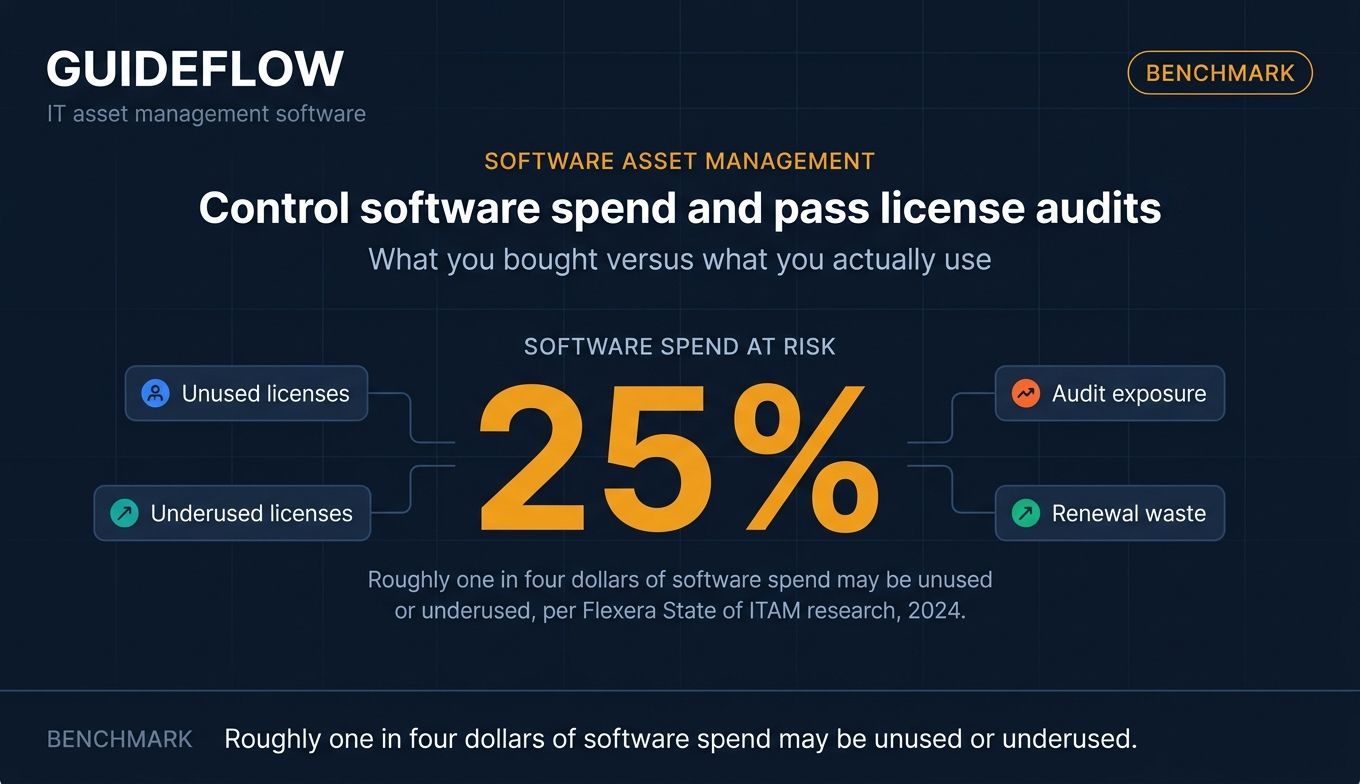
That gap is expensive. Flexera's State of ITAM research (2024) found that organizations waste roughly a quarter of their software spend on unused or underused licenses. Multiply that across hardware refreshes, cloud subscriptions, and SaaS sprawl, and the cost of not knowing what you own becomes a line item leadership notices.
IT asset management software exists to close that gap. It discovers, tracks, and governs the hardware, software, and cloud assets your organization runs, from the laptop on a new hire's desk to the AWS instance someone spun up and forgot. The global IT asset management market is projected to grow at roughly 12 to 13 percent annually toward about 5 billion dollars by 2030, driven by cloud adoption, remote work, and tightening compliance demands. That growth reflects a simple shift: spreadsheets stop scaling the moment your asset count outpaces your memory.
The teams searching for the best IT asset management software usually know the pain firsthand. A license audit is coming. A laptop walked out the door. The CMDB is out of date and the service desk is flying blind. This guide ranks the tools that fix those problems, with verified pricing, ratings, and clear "best for" framing so you can shortlist fast. As you evaluate vendors, watch how each one presents its platform - the strongest teams use interactive demos to let you experience the discovery and lifecycle workflows before you commit.
What's inside
This guide is for IT managers, ITAM and ITSM administrators, IT procurement leads, and presales or sales engineers vetting their own internal stack. It compares 10 IT asset management tools that earn their place through real capability, not marketing polish. If you sit on the presales side of these evaluations, our roundup of presales software tools covers the broader stack you'll be building.
We selected and ranked each tool on four criteria that matter most to buyers:
- Discovery breadth: how well it finds hardware, software, cloud, and SaaS assets in real time
- Lifecycle and license governance: tracking from procurement to retirement, plus software asset management (SAM) and audit readiness
- ITSM and integration fit: CMDB depth, service desk ties, and how cleanly it connects to your existing stack
- Pricing transparency and scalability: clear costs and a path from SMB to enterprise
TL;DR
Short on time? Here are the decision shortcuts by buyer type:
- Best free and open source: Snipe-IT, the leading self-hostable ITAM option with a hosted tier
- Best AI-driven ITSM plus ITAM: SysAid, for teams wanting asset management inside an AI-assisted service desk
- Best enterprise ITAM at scale: ServiceNow IT Asset Management, governed HAM, SAM, and CMDB on one platform
- Best for network discovery depth: Lansweeper, for the most accurate cross-environment inventory
- Best for SAM and license compliance: Flexera One, for software spend and license governance
- Best all-in-one ITSM and asset management: Freshservice, for mid-market teams wanting one platform
Background: what is IT asset management software?
IT asset management (ITAM) software is a system that discovers, tracks, and manages an organization's hardware, software, and cloud assets across their full lifecycle. It replaces manual spreadsheets and disconnected tools with a single, continuously updated source of truth for everything your IT estate owns and runs.
Modern information technology asset management has expanded well beyond a hardware list. Today's ITAM software ties asset records to service tickets, license entitlements, contracts, and security posture. That makes it foundational infrastructure, not a niche tracking utility. The category overlaps with ITSM platforms, dedicated discovery tools, and software asset management suites, which is why the best fit depends on your existing stack. Software-heavy estates often pull teams toward contract management software and contract lifecycle management software to govern the license and vendor agreements behind those assets.
Core features of ITAM software
A strong IT asset inventory software platform usually covers:
- Real-time discovery and inventory: automatic detection of hardware, software, cloud, and SaaS assets
- Lifecycle management: tracking each asset from procurement through deployment, maintenance, and retirement
- Software asset management and license compliance: reconciling entitlements against usage for audit readiness
- CMDB and configuration item relationships: mapping how assets connect and depend on each other
- ITSM and service desk integration: tying assets to tickets, incidents, and changes
- Automation: onboarding, remediation, renewals, and alerts
- Reporting and dashboards: spend, compliance, warranty, and risk visibility
- Security and governance controls: access management, audit trails, and data protection
Types of assets ITAM tools track
A capable IT asset management system covers the full estate:
- Hardware: laptops, desktops, servers, network gear, peripherals
- Software and licenses: installed applications, entitlements, and usage
- Cloud and virtual: virtual machines, cloud instances, and containers
- Endpoints: mobile devices, workstations, and remote machines
- OT and IoT: operational technology and connected devices in industrial settings
When to use IT asset management software
Not every team needs dedicated itam software on day one. These three situations are the most common triggers.
Replace spreadsheets with real-time asset discovery
The moment you cannot answer "how many laptops do we have and where are they" without three Slack threads, spreadsheets have stopped working. IT asset tracking software scans your network and endpoints automatically, building a live inventory that updates itself. This is the entry point for most teams adopting an IT asset management system, and it eliminates the manual reconciliation that eats sysadmin hours.
Control software spend and pass license audits
Software audits arrive without warning, and unmanaged licenses turn into financial exposure fast. SAM-focused tools reconcile what you bought against what you actually use, flagging both overspend and compliance gaps. If you are renewing major vendor contracts or bracing for an audit, this capability alone justifies the investment. It directly attacks the roughly 25 percent of software spend that Flexera research links to unused licenses.
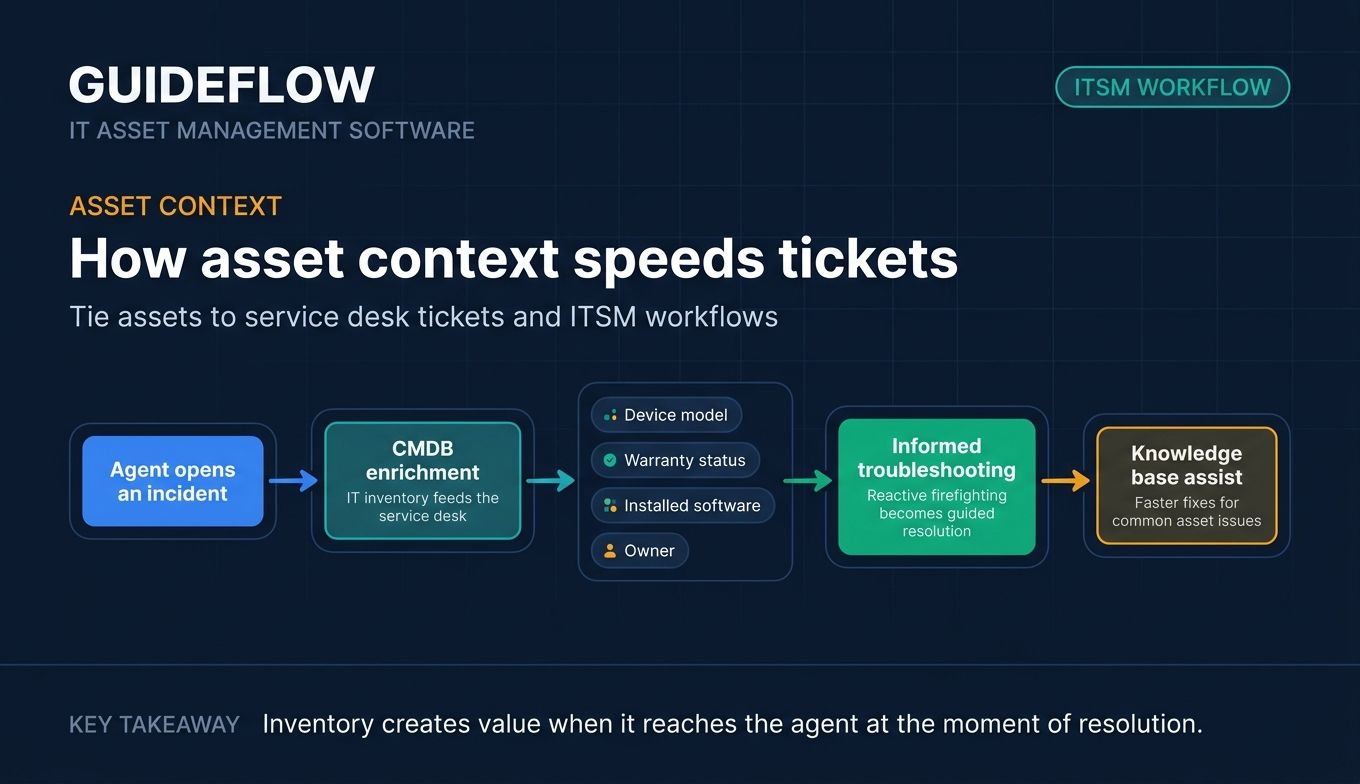
Tie assets to service desk tickets and ITSM workflows
If you already run a help desk, asset context makes every ticket faster to resolve. When an agent opens an incident and instantly sees the device model, warranty status, installed software, and owner, resolution time drops. IT inventory management that feeds your CMDB and service desk turns reactive firefighting into informed troubleshooting, which is why ITSM-native ITAM is a popular path for growing teams. Pairing this with strong knowledge base software lets agents resolve common asset issues even faster.
Comparison table
The table below ranks the 10 best IT asset management software tools by relevance to the core ITAM job. Pricing and G2 ratings reflect verified values as of June 2026 and may change, so confirm current figures on each vendor's pricing page before you buy.
| # | Product | Intent | Key use case | Pricing | G2 rating |
|---|---|---|---|---|---|
| 1 | ServiceNow IT Asset Management | Enterprise ITAM | Governed HAM, SAM, and CMDB at scale | Custom quote | 4.3/5 |
| 2 | SysAid | AI-driven ITSM + ITAM | Asset management inside an AI service desk | Custom quote | 4.5/5 |
| 3 | Lansweeper | Discovery depth | Accurate cross-environment inventory | From $239/month (billed annually) | 4.4/5 |
| 4 | Snipe-IT | Free / open source | Self-hostable hardware and license tracking | Free (self-hosted); hosting from $39.99/month | 4.6/5 |
| 5 | Freshworks Freshservice | All-in-one ITSM + asset | Mid-market ITSM with asset management | From $19/agent/month (billed annually) | 4.6/5 |
| 6 | ManageEngine AssetExplorer | Dedicated ITAM + SAM | Affordable discovery and license compliance | From $115/month (250 assets) | 4.6/5 |
| 7 | Flexera One | SAM / cloud cost | Software license and cloud spend optimization | Custom quote | 4.3/5 |
| 8 | EZO AssetSonar | Hardware + software tracking | Combined asset and service workflows | From $0.75/asset/month | 4.5/5 |
| 9 | InvGate Asset Management | ITAM + ITSM | Structured discovery and CMDB governance | From $1,499/year | 4.7/5 |
| 10 | Setyl | Asset + SaaS spend | IT asset and SaaS management with finance ties | From $300/month | 4.8/5 |
1. ServiceNow IT Asset Management
ServiceNow IT Asset Management manages the full lifecycle of hardware, software, and cloud IT assets on the ServiceNow AI Platform. It connects asset records to the CMDB, procurement, and service workflows, giving large IT organizations a single governed system for cost, compliance, and risk. For enterprises already running ServiceNow ITSM, ITAM extends the same platform rather than adding another silo.
Best for: Large enterprises that need centralized lifecycle, compliance, cost, and risk management across hardware, software, and cloud assets.
Key strengths
- Full lifecycle automation: Manages assets from planning and procurement through to end-of-life retirement.
- Connected platform data: Links ITAM with catalogs, the CMDB, and procurement for real-time visibility and cross-team collaboration.
- Audit-ready records: Maintains asset and license records that support audit readiness and compliance reporting.
Why choose ServiceNow: The trade-off with ServiceNow is depth versus simplicity. It is the most complete option for governed enterprise ITAM, but it rewards organizations that commit to the platform and have the scale to use it fully. If your IT estate spans thousands of assets across hardware, software, and cloud, the integrated CMDB and workflow automation pay off. Smaller teams may find it more platform than they need.
ServiceNow pricing: ServiceNow does not publish public pricing for IT Asset Management. Its pricing page directs buyers to a custom quote based on the modules and scale required. There is no public free tier listed. Expect enterprise-tier packaging tied to the broader Now Platform, so budget for a sales-led evaluation. ServiceNow holds a 4.3 out of 5 rating on G2 across 456 reviews.
2. SysAid
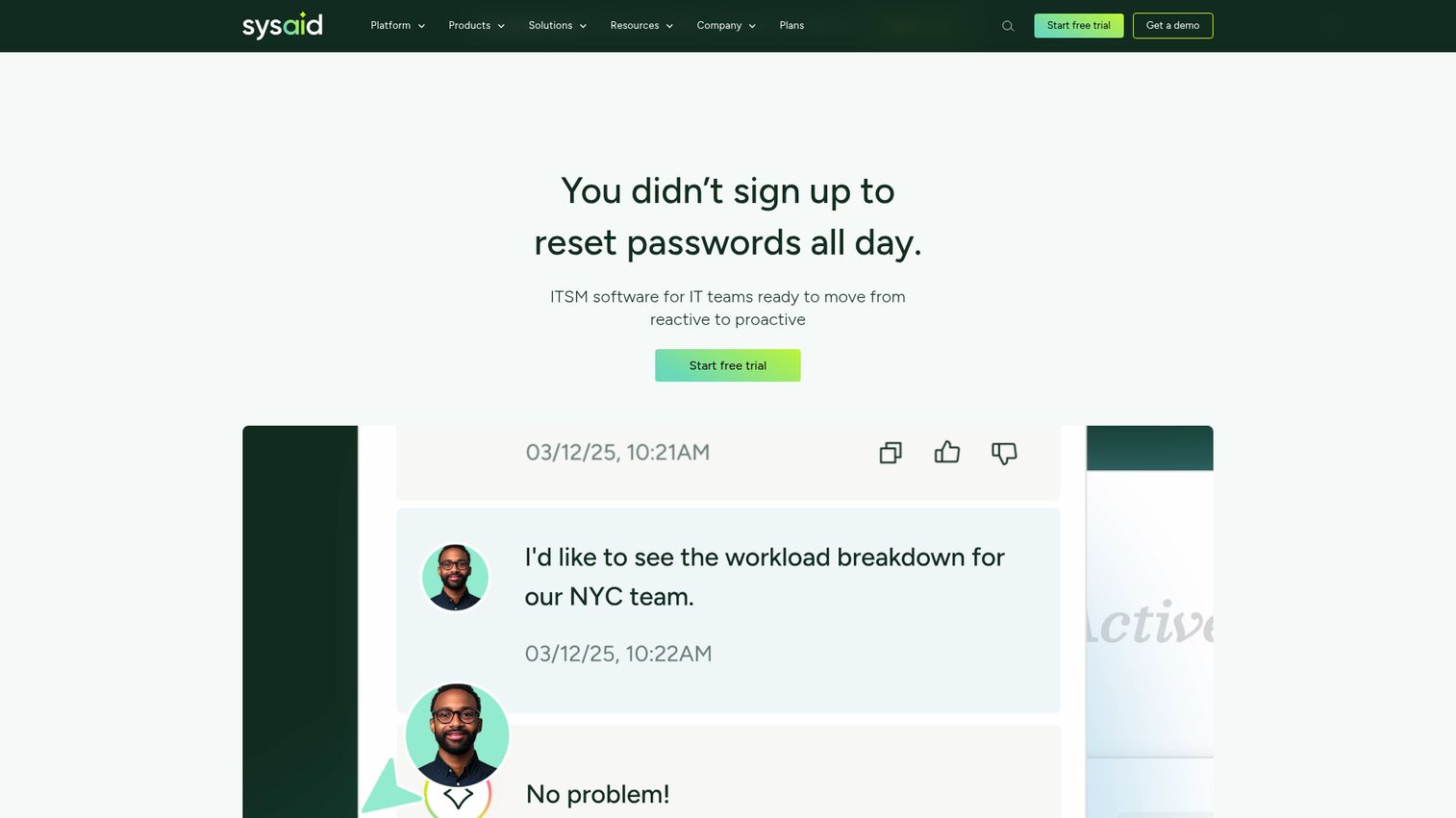
SysAid is an AI-first IT service management platform that combines a help desk, ITSM workflows, self-service, reporting, automation, and asset management. It emphasizes AI across ticket handling, case summarization, and intelligent categorization, with IT asset management tied directly into the service desk. For IT teams that want asset visibility inside an AI-assisted ITSM platform, SysAid keeps both jobs in one place.
Best for: IT teams that need AI-assisted ITSM, help desk automation, self-service, asset visibility, and ITIL-aligned workflows.
Key strengths
- AI-powered ITSM: Includes a chatbot, agent assist, AI case summarization, AI authoring, and AI usage dashboards.
- Service desk essentials: Covers incident management, knowledge base, multi-channel support, customizable forms, workflows, queues, and self-service portals.
- Asset and ITIL coverage: Provides IT asset management, configurable dashboards, and ITIL-aligned incident, problem, change, request, and configuration management.
Why choose SysAid: SysAid fits teams whose primary job is running a service desk, with ITAM as a connected capability rather than the headline. If you want assets and tickets in one AI-driven system, it consolidates the stack. Teams seeking a dedicated, discovery-heavy ITAM tool may want to pair it or look at a discovery specialist.
SysAid pricing: SysAid offers three plans: Standard (help desk with AI for lean teams), Pro (ITSM with AI that takes action for mid-sized teams), and Enterprise (advanced customization and organization-wide automation). The plans page confirms a free trial but does not display public pricing numbers, directing buyers to request a customized quote. SysAid holds a 4.5 out of 5 rating on G2.
3. Lansweeper
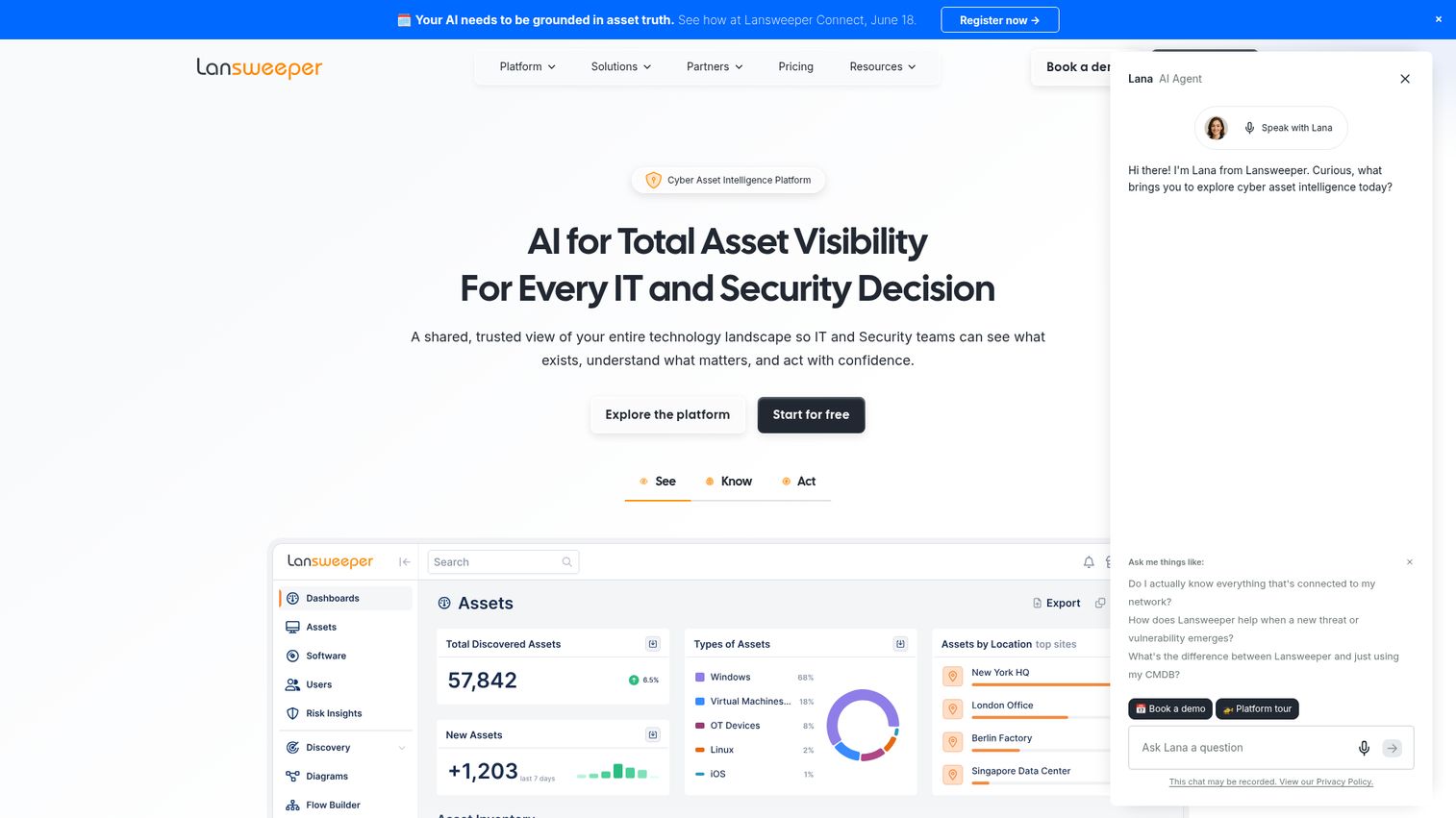
Lansweeper is a cyber asset intelligence platform for discovering, inventorying, and enriching data about IT, OT, IoT, and cloud assets. Its core strength is discovery breadth and accuracy, scanning complex environments to build a trusted, continuously updated inventory. For teams that prioritize knowing exactly what is on the network, Lansweeper sets the benchmark.
Best for: IT and security teams that need a trusted, continuously updated inventory of technology assets across complex environments.
Key strengths
- Cross-environment discovery: Scans IT, OT, cloud, and agent-based environments to surface assets others miss.
- Unified inventory: Normalizes, federates, and cleans asset data, with warranty collection and documentation built in.
- Insights and automation: Delivers dashboards, vulnerability and lifecycle insights, a GraphQL API, webhooks, and workflow automation.
Why choose Lansweeper: Lansweeper is the discovery-first choice. If your pain is incomplete or inaccurate inventory across a sprawling estate, its scanning depth is hard to beat. Teams that need a heavy ITSM service desk layer may pair Lansweeper with a dedicated ticketing tool, since discovery and intelligence are where it leads.
Lansweeper pricing: All plans are billed annually. The Free Trial includes 14 days of full access and can continue free for up to 100 assets. Starter is $239 per month for 2,000 assets and one installation. Pro is $439 per month, covering up to 9,000 assets and three installations. Enterprise starts at 10,000 assets with custom pricing. Lansweeper holds a 4.4 out of 5 rating on G2.
4. Snipe-IT
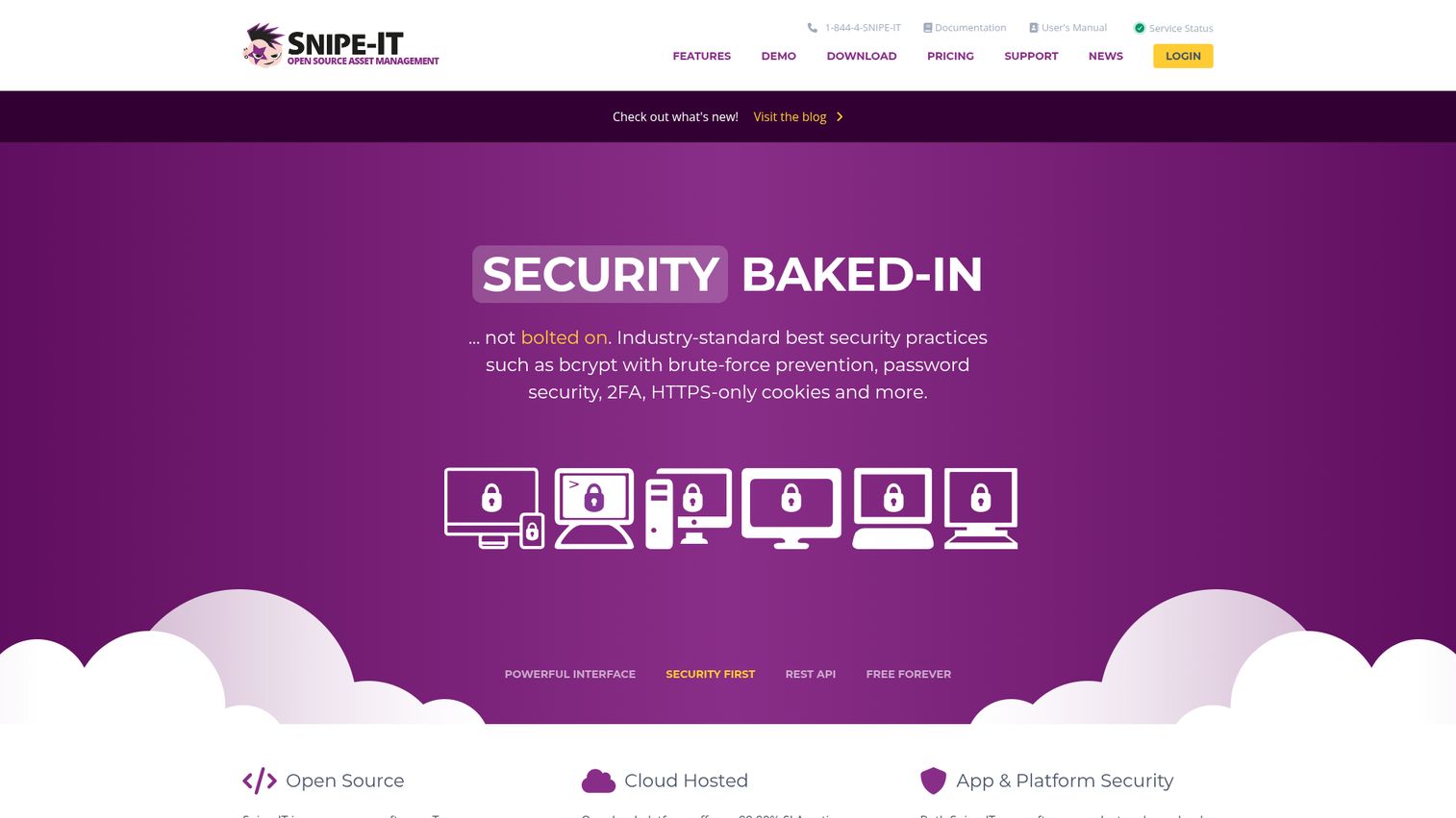
Snipe-IT is a free, open-source IT asset management system with optional hosted plans. It gives cost-sensitive and security-conscious teams a transparent, self-hostable tool for tracking hardware assets and software licenses, with a REST API for automation. The open-source model means no vendor lock-in and full control over your data.
Best for: Organizations that want low-cost or self-hosted IT asset and license tracking with optional managed hosting.
Key strengths
- Asset management: Handles assignment, location, status, full history, checkin/checkout, audits, custom fields, import/export, and QR code labels.
- License management: Tracks license records and sends email alerts for expiring licenses.
- Integrations and automation: Offers a JSON REST API, Slack notifications, SAML login, and LDAP/SCIM user provisioning.
Why choose Snipe-IT: Snipe-IT is the pragmatic pick when budget and data ownership matter most. The self-hosted edition is free, which makes it ideal for teams with the technical capacity to run it. If you would rather not manage infrastructure, the hosted plans remove that overhead while keeping the same tool. Teams needing deep network discovery or a full ITSM suite will need additional tools.
Snipe-IT pricing: The Self-Hosted edition is free with unlimited users and assets. Basic Hosting is $39.99 per month or $399.99 billed annually. Small Business Hosting is $99.99 per month or $999.99 billed annually. Dedicated Hosting starts at $249.99 per month or $2,499.99 billed annually, with larger dedicated servers available. Snipe-IT holds a 4.6 out of 5 rating on G2.
5. Freshworks Freshservice
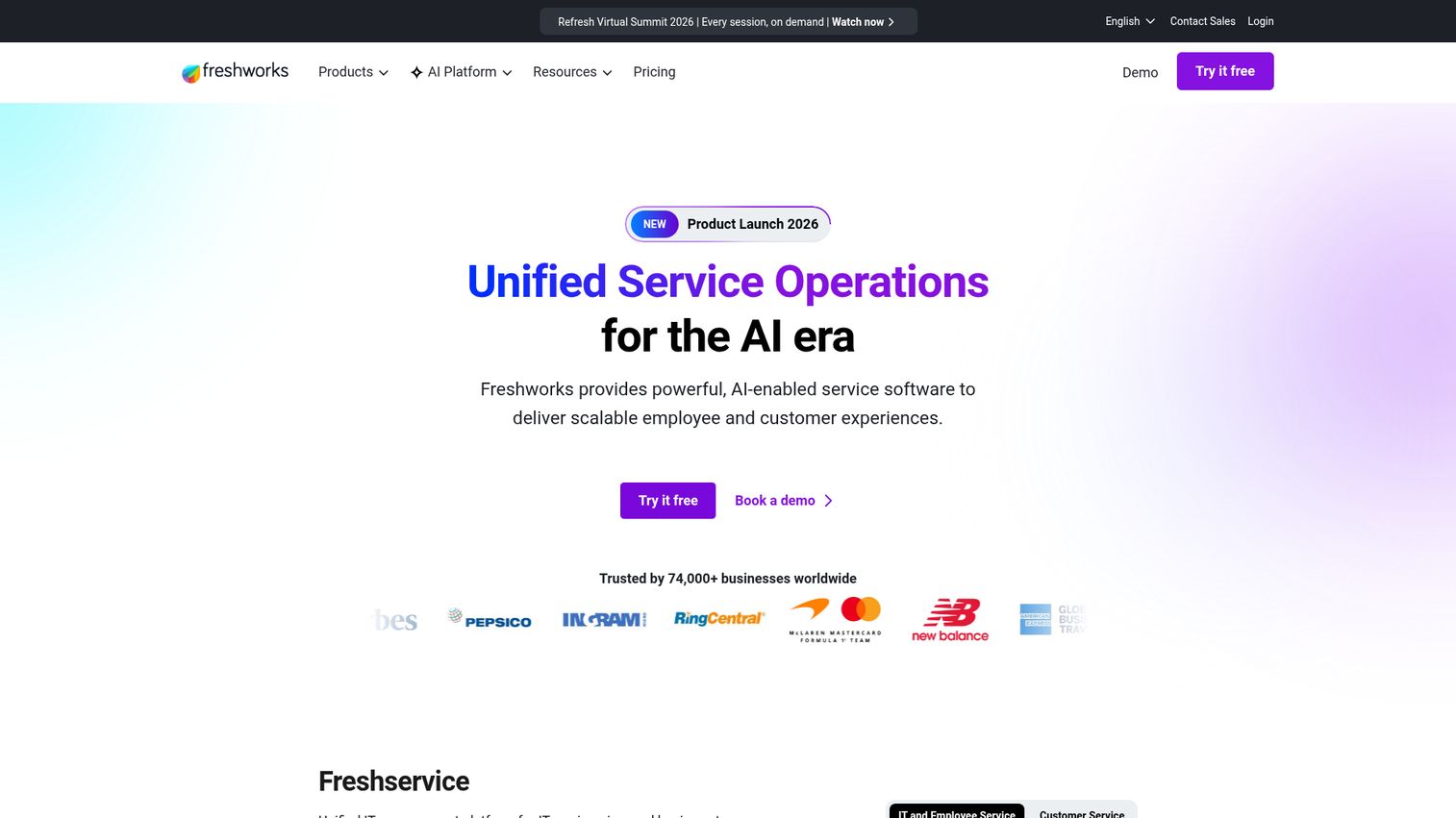
Freshworks Freshservice is an AI-powered IT service management platform covering IT service, asset, operations, and enterprise service management. It pairs strong asset management with an easy-to-use service desk and the Freddy AI copilot, making it a popular all-in-one choice for mid-market IT teams. Asset data enriches tickets, and discovery plus CMDB keep the inventory current. You can explore how Freshworks presents its platform in this Freshworks demo.
Best for: IT teams that need an AI-powered service desk with ITSM, ITAM, ITOM, automation, and enterprise service management capabilities.
Key strengths
- Service management core: Handles incident, problem, change, and asset management in one platform.
- Automation and catalog: Includes workflow automation and a service catalog to standardize requests.
- Discovery and CMDB: Provides a configuration management database, advanced discovery, and dependency mapping.
Why choose Freshservice: Freshservice fits mid-market teams that want one platform for service and assets without enterprise complexity. Its reputation for ease of use lowers adoption friction, and the agent-based pricing scales predictably. If your priority is the deepest possible discovery across OT and IoT, a discovery specialist may go further, but Freshservice covers the all-in-one job well.
Freshservice pricing: Plans are Starter at $19 per agent per month, Growth at $49, and Pro at $99, all billed annually, with Enterprise priced via custom quote. There is a 14-day free trial but no permanent free tier. Freshservice holds a 4.6 out of 5 rating on G2.
6. ManageEngine AssetExplorer
ManageEngine AssetExplorer is IT asset management software for tracking and managing IT and non-IT assets across their lifecycle. It is a standalone ITAM tool with auto-discovery, software license management, and license compliance, priced by the number of assets managed. For teams that want dedicated, affordable ITAM without committing to a full platform, AssetExplorer is a practical choice.
Best for: IT teams that need centralized discovery, lifecycle tracking, CMDB, software license compliance, purchase order, and contract capabilities for IT assets.
Key strengths
- Full lifecycle monitoring: Tracks complete IT asset lifecycle from procurement to disposal.
- Auto-discovery: Automatically discovers and manages hardware and software inventory.
- CMDB mapping: Provides a CMDB with configuration items and relationship mapping.
Why choose ManageEngine AssetExplorer: AssetExplorer is the budget-conscious dedicated ITAM option, especially for teams that want SAM and contract tracking without enterprise pricing. Its asset-based model keeps costs proportional to scale. Teams that also want a tightly integrated service desk often pair it with ManageEngine ServiceDesk Plus.
ManageEngine AssetExplorer pricing: Pricing is based on the number of IT assets managed. The cloud table starts at 250 IT assets for $115 monthly or $1,245 yearly, with a separate billed-annually option starting at $955 for 250 assets. Higher bands scale up to 10,000 assets, and a free tier is available. AssetExplorer holds a 4.6 out of 5 rating on Capterra.
7. Flexera One
Flexera One is a SaaS suite for managing technology spend and risk across IT asset management, SaaS management, FinOps, cloud cost optimization, and IT visibility. It is widely recognized as a leader in software asset management and cloud cost optimization, built for organizations whose biggest exposure is software and cloud spend. If license governance and audit defense are your top priorities, Flexera leads here.
Best for: Large organizations with complex hybrid IT environments that need unified ITAM, SaaS, and cloud spend visibility and optimization.
Key strengths
- Hybrid estate visibility: Covers hardware, software, SaaS, and cloud in one view.
- Software license optimization: Delivers compliance and audit defense through ITAM and SAM.
- Cloud cost optimization: Provides FinOps capabilities across public and private cloud environments.
Why choose Flexera One: Flexera is the SAM and spend-governance specialist. The trade-off is that it targets enterprise complexity, so it fits organizations with large license footprints and hybrid cloud estates rather than small teams tracking laptops. If your driver is the roughly quarter of software spend that goes to waste, Flexera's optimization focus addresses it directly.
Flexera One pricing: Flexera states that pricing is a fixed subscription fee based on term length and usage metrics, but it does not publish public price figures or named tiers on its first-party pages. Expect a sales-led, enterprise-oriented evaluation. Flexera One holds a 4.3 out of 5 rating on G2.
8. EZO AssetSonar
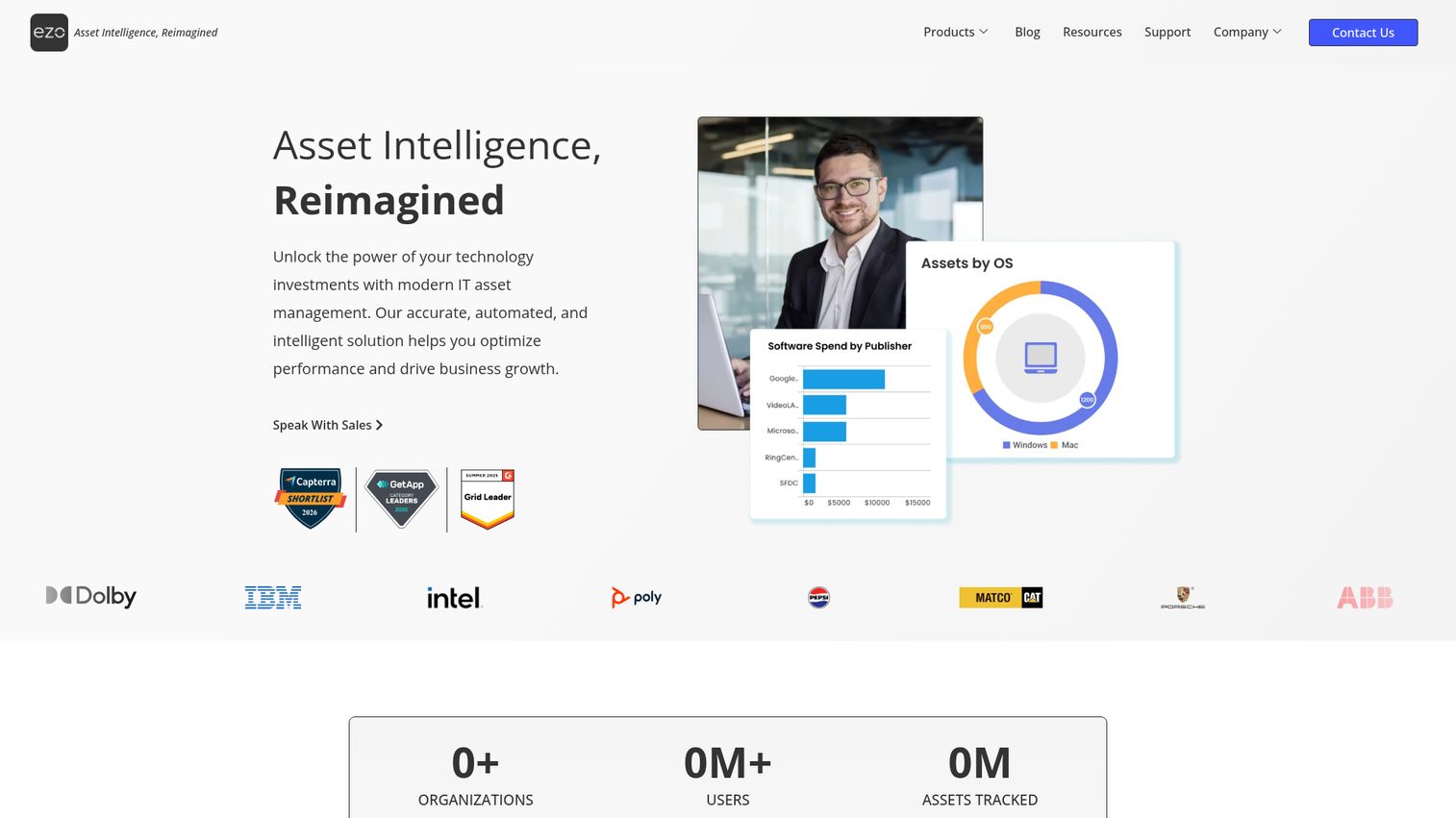
EZO AssetSonar is an IT asset management and IT service management platform for tracking hardware, software, licenses, users, services, and tickets with asset context. It combines strong hardware and software asset tracking with discovery agents, advanced SAM, and integrations with tools like Jamf, Intune, and Zendesk. Its per-asset pricing makes it accessible for teams that want combined tracking and service workflows. You can preview the vendor's platform in this EZO demo.
Best for: IT teams that need asset lifecycle visibility across hardware, software, licenses, and service workflows.
Key strengths
- Asset discovery and tracking: Provides IT asset discovery and tracking alongside inventory management.
- Software and SAM: Includes software discovery and tracking with advanced software asset management.
- Service workflows: Covers request, incident, problem, and change management plus reporting and analytics.
Why choose EZO AssetSonar: AssetSonar fits teams that want hardware and software tracking with a service layer, at transparent per-asset pricing. The integrations with Jamf, Intune, and Zendesk make it a natural fit for mixed-device environments. Teams that need only basic tracking may find the ITSM features more than they require, while those wanting full enterprise governance may look higher up the list.
EZO AssetSonar pricing: The ITAM plan starts at $0.75 per asset per month and includes discovery, inventory, user management, and reporting. ITSM (with ITAM included) is $1.08 per asset per month, adding service desk capabilities. Advanced Software Asset Management is an add-on at $0.42 per asset per month. Volume discounts apply above 1,000 assets, and a free trial is available. AssetSonar holds a 4.5 out of 5 rating on G2.
9. InvGate Asset Management
InvGate Asset Management is an IT asset management platform for discovering, tracking, governing, and optimizing hardware, software, cloud assets, licenses, contracts, and asset lifecycles. It pairs structured discovery with CMDB mapping, software metering, and automation, making it a fit for mid-market and enterprise teams that want disciplined asset governance alongside ITSM. Its fixed-price entry tier makes budgeting predictable.
Best for: Mid-market and enterprise IT teams that need structured IT asset discovery, inventory, lifecycle governance, CMDB mapping, and license/contract tracking.
Key strengths
- Automated discovery: Detects hardware, software, servers, containers, databases, and cloud services.
- Unified inventory: Manages asset lifecycle, contracts, warranties, reporting, barcode/QR generation, and software licenses.
- CMDB and automation: Provides CMDB mapping, automation, integrations, software metering, and configuration deployment on higher tiers.
Why choose InvGate: InvGate suits teams that want structured, governed ITAM with a clear path from mid-market to enterprise. The fixed-price Starter tier removes the per-asset math at smaller scale, and higher tiers add SSO, automatic CMDB mapping, and software deployment. Teams that only need lightweight tracking may find it more structured than necessary.
InvGate Asset Management pricing: Starter is a fixed $1,499 per year for 500 IP devices, including automated discovery, AI Hub, and health rules. Pro starts at $2,500 per year at $5 per IP device for 500 to 5,000 devices, adding SSO, automatic CMDB mapping, and software deployment. Enterprise is custom, starting around $12,000 per year. A 30-day free trial is available but no permanent free tier. InvGate holds a 4.7 out of 5 rating on G2.
10. Setyl
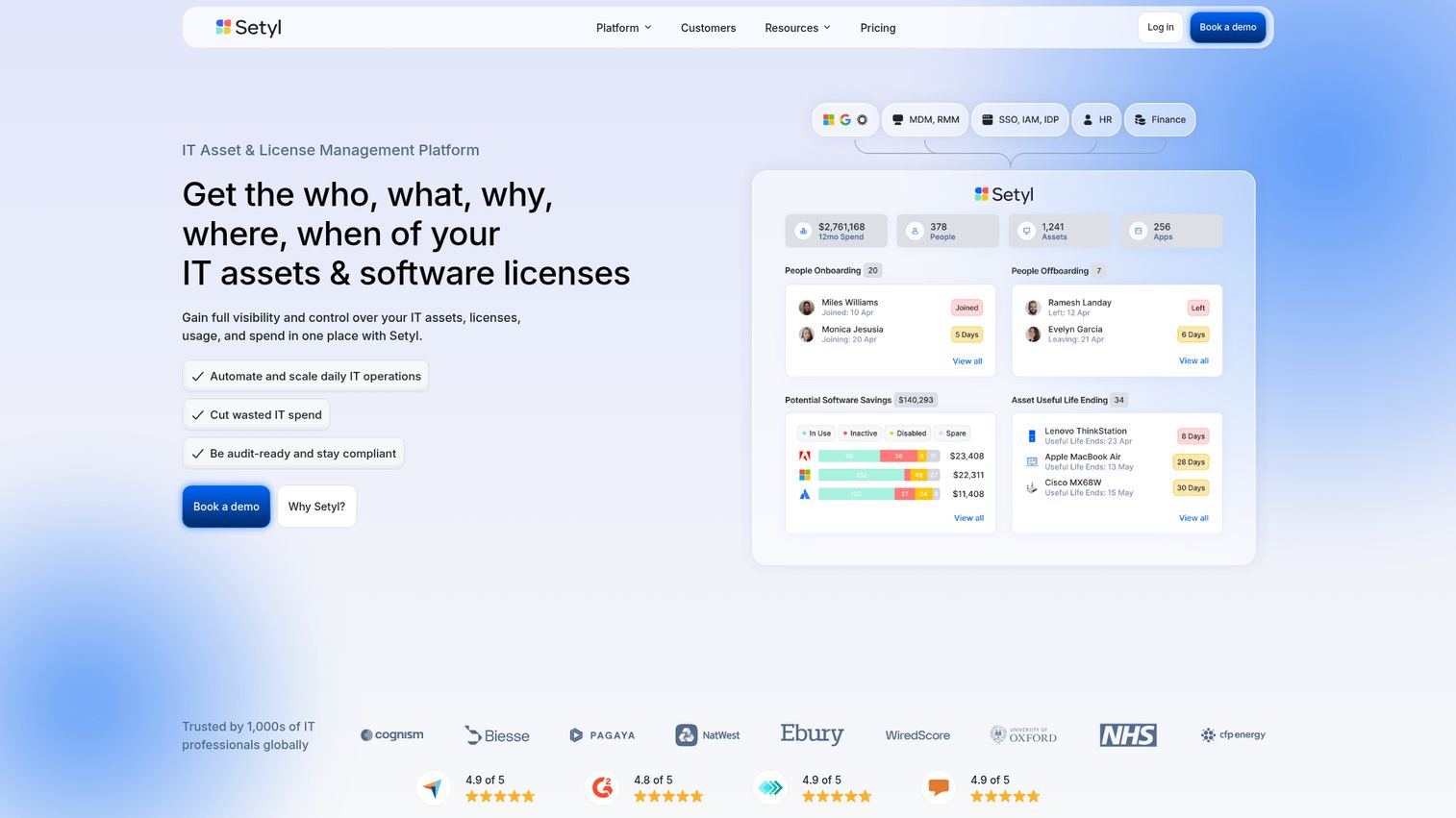
Setyl is an IT asset and license management platform for managing hardware assets, software licenses, users, vendors, integrations, compliance, and IT spend in one place. It is built for the modern reality where ITAM converges with SaaS and finance, offering shadow IT detection, spend management, and accounting and HR integrations. For growing companies managing both physical assets and SaaS subscriptions, Setyl ties them together.
Best for: Organizations that need centralized IT asset, SaaS/license, user, vendor, compliance, and spend management.
Key strengths
- Hardware lifecycle: Manages hardware asset inventory and lifecycle from onboarding to offboarding.
- Software and SaaS: Handles software asset management with renewals, costs, and shadow IT detection.
- Spend and compliance: Provides IT spend management, license rightsizing, and compliance/audit support.
Why choose Setyl: Setyl fits companies that treat asset management and SaaS spend as one problem, especially those wanting finance and HR integrations baked in. Its onboarding and offboarding workflows and shadow IT detection address the sprawl that traditional hardware-only tools miss. Enterprises needing deep network discovery across OT and IoT may want a discovery specialist alongside it.
Setyl pricing: The Essential plan starts from $300 per month and includes unlimited assets, software applications and licenses, lifecycle management, and onboarding/offboarding workflows. Complete adds automated workflows, shadow IT detection, vendor audits, and IT spend management via custom quote. Advanced adds custom integrations, API access, SAML 2.0, and a dedicated Customer Success Manager. Setyl holds a 4.8 out of 5 rating on G2.
Considerations: how to choose IT asset management software
The right tool depends on your asset scope, existing stack, and what is driving the purchase. Use these criteria as a buyer's checklist, and weight them against the IT asset management best practices your team already follows.
Discovery breadth and accuracy
Confirm the tool finds every asset type you care about: hardware, software, cloud, SaaS, and where relevant OT and IoT. Ask whether discovery is real time and whether it uses agentless scanning, agents, or both. A tool that misses a third of your estate gives you a false sense of control.
Software asset management and license compliance
If audit risk or software overspend is your driver, prioritize SAM depth. Look for license reconciliation, entitlement tracking, and audit-ready reporting. Tools like Flexera One and ManageEngine AssetExplorer lead here, while Setyl adds SaaS-specific shadow IT detection.
ITSM and integration fit
Check how cleanly the tool connects to your service desk, CMDB, and the rest of your stack. If you already run a help desk, asset context inside tickets is a major efficiency win. Confirm CMDB support and the specific integrations you depend on before committing.
Scalability and pricing model
Match the pricing model to your growth. Per-asset, per-agent, and flat-rate models behave very differently as you scale, so model your costs at your projected size, not just today's. Watch for hidden costs like add-on modules, installation limits, and enterprise feature gating.
Security, governance, and reporting
Verify access controls, audit trails, and data residency options against your compliance needs. Strong dashboards and reporting turn raw inventory into decisions leadership can act on. For regulated environments, on-premise or data residency options may be non-negotiable.
Conclusion
The best IT asset management software is the one that matches your asset scope and your existing stack, not the one with the longest feature list. Start by naming your primary driver: discovery, license compliance, ITSM fit, or spend control.
For cost-sensitive teams and those wanting data ownership, Snipe-IT is the free, open-source standout. For enterprise ITAM at scale on a governed platform, ServiceNow IT Asset Management leads. Teams wanting AI-assisted ITSM with assets in one place fit SysAid, while mid-market teams seeking an easy all-in-one will land on Freshservice. If software and cloud spend is your top exposure, Flexera One specializes in SAM and license governance. And for the most accurate cross-environment inventory, Lansweeper sets the discovery benchmark.
Your next step is simple: shortlist two or three tools that match your asset scope and ITSM stack, then run trials or request demos. Map each against the considerations checklist above, and let your real environment, not a vendor pitch, decide the fit. Many of these vendors use interactive demos to walk buyers through complex discovery workflows during evaluation, so take advantage of hands-on previews before you commit.
FAQ
IT asset management software is a system that discovers, tracks, and governs an organization's hardware, software, and cloud assets across their full lifecycle. It replaces spreadsheets with a continuously updated source of truth, covering everything from procurement and deployment to maintenance and retirement. Modern tools also tie assets to license entitlements, service tickets, and security posture.
ITAM software tracks and governs assets: what you own, where it is, and how it is licensed. ITSM software manages services and tickets: incidents, requests, changes, and the workflows that resolve them. Many platforms combine both, such as ServiceNow, Freshservice, SysAid, and InvGate, so asset context enriches every service ticket.
Snipe-IT is the leading free, open-source option. Its self-hosted edition is free with unlimited users and assets, and it offers paid hosting plans for teams that prefer not to manage infrastructure. Other tools, including Lansweeper, ManageEngine AssetExplorer, and Freshservice, offer free trials or limited free tiers, but Snipe-IT is the clearest no-cost path.
Pricing spans three broad models. Free or open-source tools like Snipe-IT cost nothing to self-host. Mid-market tools use per-asset or per-agent pricing, with Lansweeper starting at $239 per month, Freshservice at $19 per agent per month, and EZO AssetSonar at $0.75 per asset per month. Enterprise platforms like ServiceNow and Flexera One use custom, quote-based pricing.
Software asset management (SAM) is the software and license subset of ITAM. It focuses on tracking entitlements, reconciling licenses against actual usage, and staying audit-ready, all of which directly control software spend. Tools strong in SAM include Flexera One and ManageEngine AssetExplorer, with Setyl adding SaaS-specific license management and shadow IT detection.
Many do. A CMDB (configuration management database) stores configuration items and maps the relationships and dependencies between assets. ServiceNow, Freshservice, InvGate, and ManageEngine AssetExplorer all include CMDB capabilities, while SysAid ties assets to tickets through configuration management. A CMDB matters most when you run a service desk and need asset context during incidents.
Yes. Modern IT asset management tools have expanded beyond on-premise hardware to cover cloud resources, virtual machines, and SaaS subscriptions. Flexera One specializes in cloud cost and SaaS management, and Setyl focuses on SaaS and app management with shadow IT detection. ServiceNow and InvGate also discover cloud services as part of their inventory.
Start with your primary driver, then weigh discovery breadth, SAM and compliance needs, ITSM and integration fit, scalability, and security. Confirm the tool covers every asset type you manage and connects to your existing stack. Model pricing at your projected scale, then shortlist two or three tools and run trials before deciding.