You already know where the day goes. A quote lives in one tool, the client record lives in another, the accounting export lives in a spreadsheet, and someone on your team is rekeying the same policy number for the third time this week. Every re-entry is a chance to introduce an error, and every disconnected app is a place where context quietly disappears.
That friction has a real cost. By 2024, over 78% of brokerages globally had adopted at least one integrated brokerage management platform, according to Market Growth Reports, and the firms that made the move report agent productivity gains averaging 29%. The pattern is clear: brokerages that consolidate onto a single operating layer move faster and make fewer mistakes than those running on stitched-together tools.
The problem is that "broker management system" means two very different things depending on your operating model. For an insurance agency, it means an agency management system that centralizes clients, policies, carriers, and commissions. For a freight brokerage, it means a freight broker TMS that handles quoting, dispatch, tracking, and invoicing. The tools are not interchangeable, and buying from the wrong shortlist wastes months.
This guide separates the two intents cleanly so you can build a real single source of truth for your operation, improve data visibility, and stop losing time to manual re-entry. We rank seven systems, split by operating model, with pricing and ratings where they are publicly available.
What's inside
This guide covers broker management software for two distinct operating models: insurance agencies that need insurance broker management software, and freight brokerages that need a freight broker TMS. We ranked each tool against four criteria that matter most when you are replacing tool sprawl with one reliable system:
- Integrations: how well it connects to carriers, quoting engines, accounting, and reporting
- Workflow automation: how much manual admin it removes without adding headcount
- Reporting and analytics: whether it gives you real-time visibility into the business
- Compliance and platform fit: how it handles data retention, access control, and your operating scale
The list includes broad insurance brokerage software platforms and specialized freight systems. Match the tool to your model first, then to your stack.
TL;DR
- Best insurance broker software for mid-size to enterprise agencies: Applied Epic, for its depth across P&C and benefits workflows.
- Best insurance agency management system for commercial and mixed-line agencies: Zywave Partner Platform, for centralized operations and quoting integration.
- Best enterprise P&C brokerage management platform: EbixEvolution, for multi-region policy administration.
- Best entry-level insurance broker system: BrokerTool, with a free plan for smaller teams.
- Best freight broker TMS with transparent pricing: BrokerPro TMS, for volume-based freight brokerage software.
- Best freight broker TMS for connected quoting-to-billing: Tai TMS, for API and EDI carrier connections.
- Best AI-native freight back office: Keelway, for carrier-email triage plus TMS in one product.
What is broker management system software?
Broker management system software is a platform that centralizes a brokerage's client or shipment data, automates operational workflows, connects third-party systems, and delivers reporting from one place. It replaces the disconnected mix of spreadsheets, email, and point tools that most brokerages accumulate as they grow.
The term splits along operating model. In insurance, it refers to an agency management system or brokerage management platform that manages the full client and policy lifecycle. In freight, it refers to a freight broker TMS that runs the load lifecycle from quote to settlement. Both share the same core promise: one system of record that reduces rekeying and gives leaders a reliable view of the business.
Core capabilities you should expect across the category:
- Single source of truth: one record for each client, policy, or shipment, so teams stop reconciling data across apps.
- Workflow automation: renewal reminders, task routing, document generation, and status updates that run without manual effort.
- Integrations: connections to carriers, quoting engines, accounting systems, and analytics so data flows without re-entry.
- Compliance: document retention, role-based access, and audit trails that hold up under review.
- Reporting and analytics: real-time dashboards on retention, revenue, load status, or policy activity.
- Self-service access: browser and mobile access so staff work from anywhere without a local install.
The market reflects the shift. The global broker management systems market was valued at USD 4.2 billion in 2025 and is projected to reach USD 8.1 billion by 2034 at an 8.3% CAGR, per MarketIntelo. Cloud-based deployments now account for 54.8% of the market in 2026 and are growing far faster than on-premises systems.
When to use a broker management system
Not every brokerage needs to replace its stack tomorrow. Here is how to tell when the timing is right.
When disconnected tools are causing rekeying and lost context
If your team enters the same client, policy, or load data into more than one system, you are paying a rekeying tax every day. Each handoff between apps is a place where a number gets transposed or a status goes stale. A unified brokerage management platform ends the double entry and keeps context attached to the record, so the next person who touches it sees the full history.
When brokers need better visibility across clients, policies, carriers, or shipments
When leadership cannot answer basic questions without stitching together exports, you have a visibility problem, not a reporting problem. A broker management system with real-time dashboards gives you retention, revenue, load status, or policy activity on demand. That single view is what lets a founder step out of the daily detail and still trust the numbers.
When the team needs more automation without expanding headcount
Growth usually arrives before the budget for more staff does. If renewals, follow-ups, invoicing, and check calls are eating hours that should go to selling or servicing, workflow automation is the cheaper answer than a new hire. The ROI shows up as time recovered and errors avoided, not as a longer feature list.
Comparison table
Here are the seven broker management software options ranked, with insurance brokerage software listed first and freight broker TMS tools after. Pricing and ratings reflect publicly available figures at the time of writing; several vendors quote pricing on request.
| # | Product | Intent | Key differentiation | Pricing | G2 rating |
|---|---|---|---|---|---|
| 1 | Applied Epic | Insurance | Browser-native platform for P&C and benefits | Quote-based | 4.4/5 |
| 2 | Zywave Partner Platform | Insurance | Centralized operations with TurboRater quoting | Quote-based | 3.4/5 |
| 3 | EbixEvolution | Insurance | Enterprise P&C policy administration | Quote-based | 4.0/5 |
| 4 | BrokerTool | Insurance | AI-powered workflow with a free entry plan | Free; CA$79.99/yr Pro | Not listed |
| 5 | BrokerPro TMS | Freight | Volume-based freight TMS, full platform day one | $950/mo base | Not listed |
| 6 | Tai TMS | Freight | Connected quoting, tracking, and billing | $945/mo starting | 4.4/5 |
| 7 | Keelway | Freight | AI inbox triage plus TMS in one product | $799/mo flat | Not listed |
1. Applied Epic

Applied Epic, from Applied Systems, is the best-known insurance agency management system and the strongest fit for mid-size to enterprise insurance brokerages. It runs in the browser, so your team works from any device without a local install, and it holds client relationships, policy management, accounting, and reporting in one platform. For agencies handling both property and casualty and benefits under one roof, that breadth is the point.
Best for: Mid-size to enterprise independent insurance agencies that need a single system for P&C and benefits workflows.
Key strengths
- Browser-native platform: Staff access the full agency management system from anywhere, with no desktop dependency to maintain.
- End-to-end insurance workflows: Policy administration, accounting, reporting, and digital payments live in one place, cutting the rekeying between systems.
- Integrated benefits and quoting: Embedded quoting and benefits management let mixed agencies run both lines without a second tool.
Why choose Applied Epic: If you run a growing agency and every department currently owns its own spreadsheet, Epic is built to become the single source of truth. It is a serious platform for complex insurance operations, which means it rewards teams ready to commit to a structured rollout rather than those wanting a light tool for a handful of policies.
Applied Epic pricing: Applied Systems does not publish pricing on its site. Pricing is quote-based and scoped to your agency size and module mix, so plan to run a scoping conversation before you can compare cost to alternatives. Applied Epic holds a 4.4/5 rating on G2.
2. Zywave Partner Platform
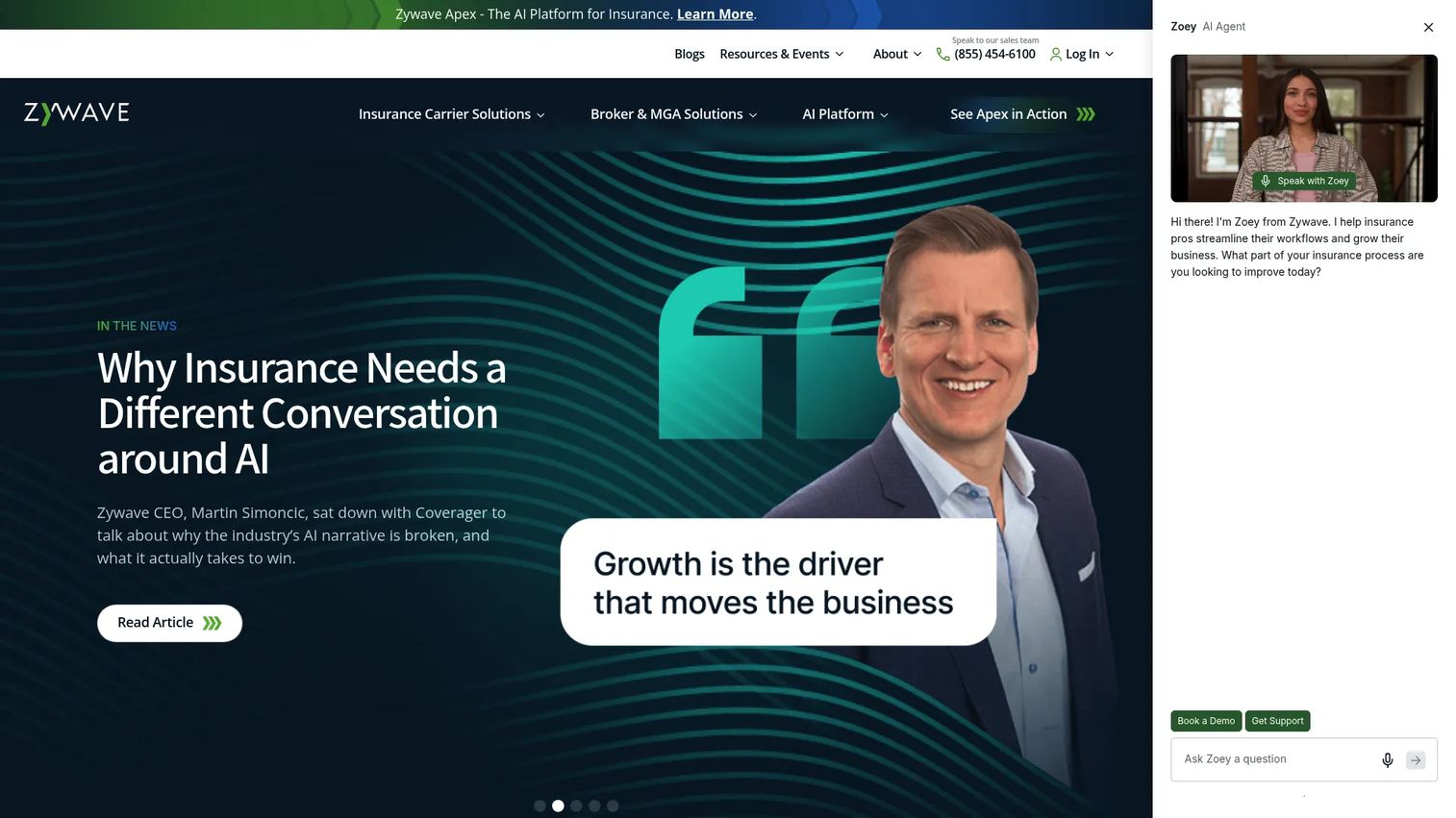
Zywave Partner Platform is a cloud-based insurance agency management system aimed at commercial and mixed-line agencies that want operational control without heavy overhead. It centralizes client relationships, policy management, accounting, document control, and daily operations, then layers real-time reporting on top so leaders can watch retention and financial activity as it happens.
Best for: Insurance agencies managing complex commercial and mixed-line accounts.
Key strengths
- Centralized operations: Client data, policies, accounting, and documents sit in one system, so brokers stop hunting across tools.
- Real-time reporting: Financial, retention, and policy-activity dashboards give leadership current numbers instead of month-old exports.
- TurboRater integration: A two-way link transfers policy details automatically, cutting the manual re-entry that slows quoting.
Why choose Zywave Partner Platform: Agencies that live in commercial and mixed lines benefit from the centralized structure and the quoting integration, which together remove two of the biggest sources of double entry. It fits teams that want a single operating layer and clearer reporting as they scale across more accounts.
Zywave Partner Platform pricing: Zywave does not disclose public pricing; the site uses demo and request language rather than published tiers. Expect a quote scoped to your agency. The Partner Platform holds a 3.4/5 rating on G2 based on a small review count, so weigh that against a hands-on evaluation.
3. EbixEvolution
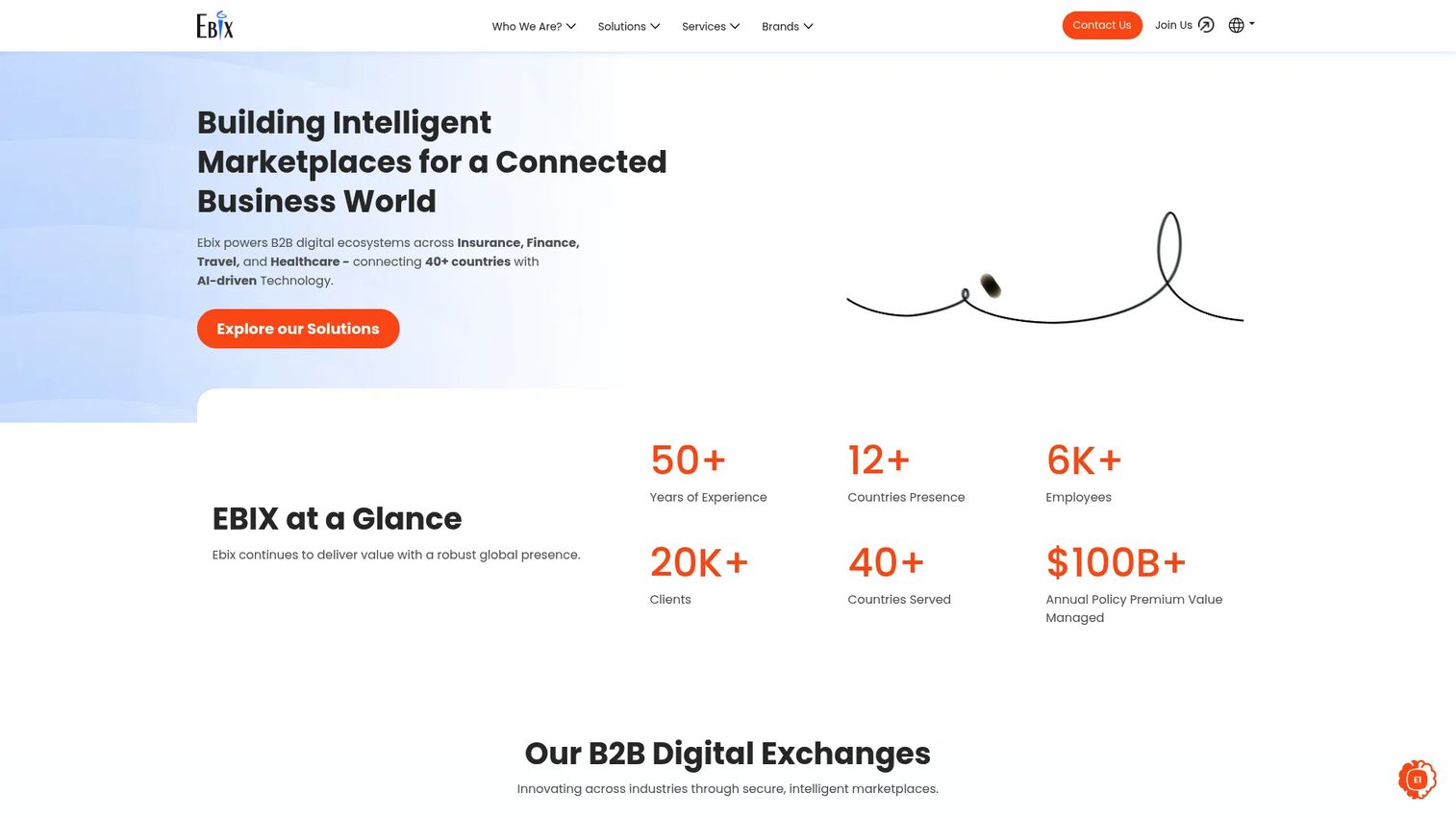
EbixEvolution is an enterprise policy administration and broker management platform built for property and casualty insurance operations. It handles policy and risk management, broker operations, client servicing, and premium management, and it is designed to work across multiple regions and currencies. For large brokers with distributed teams, that multi-region depth is the differentiator.
Best for: Large and enterprise P&C brokers operating across multiple regions and currencies.
Key strengths
- Policy and risk management: Full administration of complex P&C policies from one platform, built for high account volumes.
- Broker operations and servicing: Account handling and client servicing workflows tailored to enterprise brokerage environments.
- Financial and compliance reporting: Premium management plus reporting and compliance controls that suit multi-region operations.
Why choose EbixEvolution: This is a platform for the complex end of the insurance market, where a broker manages high policy volumes across geographies. Smaller agencies will find it heavier than they need; large brokers get an insurance broker system built to handle their scale and regulatory footprint.
EbixEvolution pricing: No public pricing is available for EbixEvolution; it is contact-sales only. The G2 rating of 4.0/5 is listed under the Ebix seller page rather than a dedicated EbixEvolution product page, so treat it as directional rather than product-specific.
4. BrokerTool
BrokerTool is an AI-powered insurance broker management platform aimed at brokers who want a workflow tool with a low barrier to entry. It covers client management, policy tracking and renewal monitoring, and document generation, and it is one of the few options in the category with a genuine free plan. That makes it a practical starting point for smaller teams testing whether a dedicated system beats their current spreadsheets.
Best for: Insurance brokers who want a broker management workflow tool with a free entry plan.
Key strengths
- Client management: A central record for each client that keeps contact, policy, and history in one place.
- Policy tracking and renewal monitoring: Automated renewal alerts so lapses do not slip through, tied to each policy record.
- Document generation: Templated document creation that removes repetitive manual drafting.
Why choose BrokerTool: The free plan and low annual pricing make it the easiest way to move off spreadsheets without a procurement cycle. It fits smaller brokerages and independents who want client management, renewal automation, and document handling without committing to an enterprise platform on day one.
BrokerTool pricing: BrokerTool offers a free plan at CA$0/month, a Pro Yearly plan at CA$79.99/year, and an Ultra Yearly plan at CA$159.99/year. Pricing is listed in Canadian dollars, and annual billing is positioned as the best value with a stated 17% saving. No G2 rating is currently listed for the product.
5. BrokerPro TMS
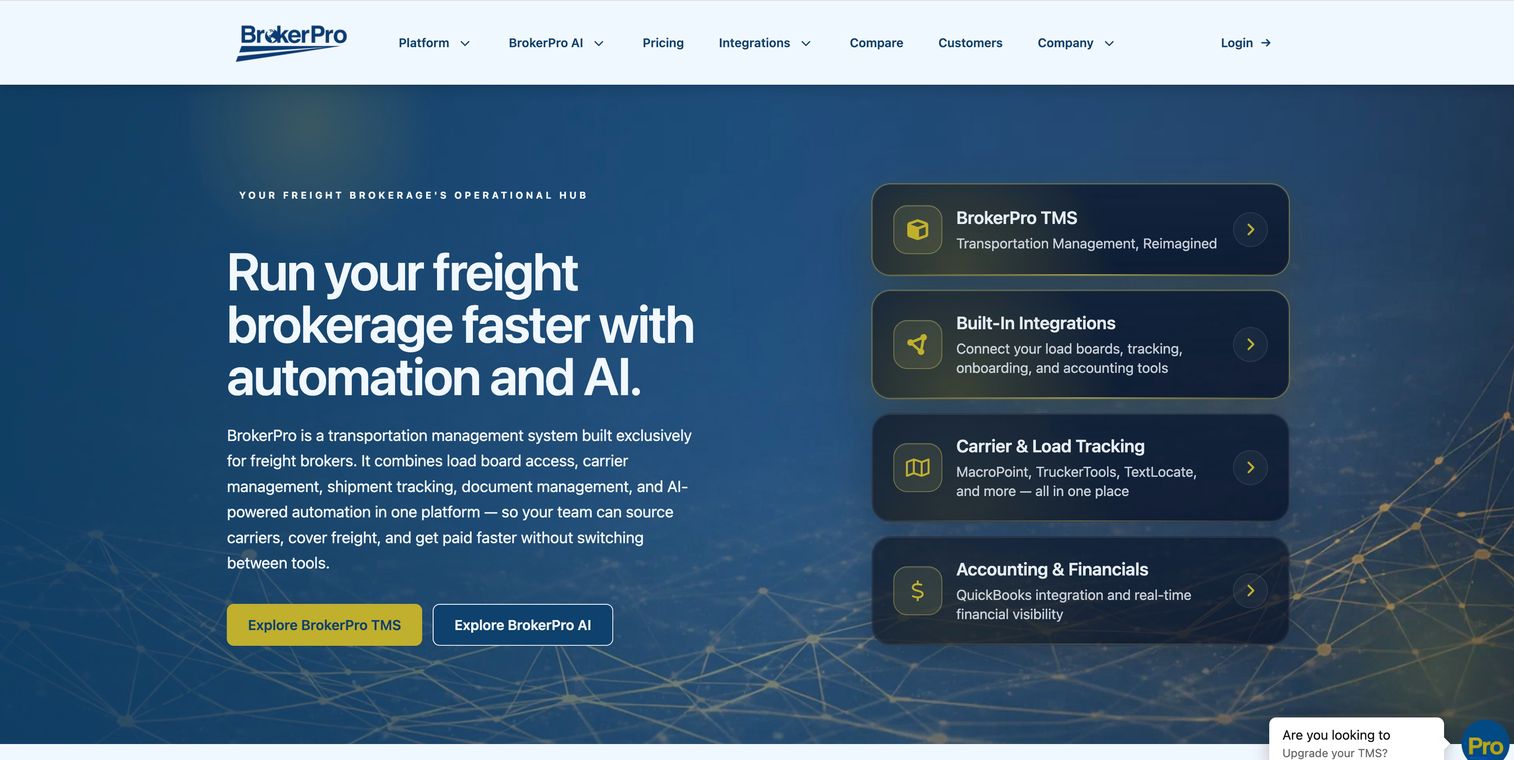
This is where the freight interpretation of the keyword begins. BrokerPro TMS is a cloud-based freight broker TMS built to run the load lifecycle in one system: load management and execution, carrier management and onboarding, and tracking with check calls. Rather than gating features behind tiers, it hands you the full platform from day one and prices on load volume, which keeps the model simple for a growing brokerage.
Best for: Freight brokerages that want a broker-specific TMS with transparent, volume-based pricing.
Key strengths
- Load management and execution: End-to-end load handling from booking through delivery in one screen.
- Carrier management and onboarding: Carrier records, onboarding, and vetting kept in the same system as your loads.
- Tracking and check calls: Visibility and status updates built in, so dispatch stops chasing information across email.
Why choose BrokerPro TMS: For a freight brokerage tired of feature gating, the full-platform-day-one approach removes the guesswork about which tier unlocks what. Volume-based pricing scales with the business instead of penalizing you per seat, which fits teams that are growing headcount and load count together.
BrokerPro TMS pricing: BrokerPro TMS publishes a base platform fee of $950/month, with volume-based tiers structured around load counts and no seat limits or feature gates. There is no free tier. A current G2 rating was not verifiable from a primary source at the time of writing.
6. Tai TMS

Tai TMS is a cloud-based freight broker TMS for brokers and 3PLs running domestic FTL and LTL operations. Its differentiator is a connected workflow across the shipment lifecycle: instant quotes, one-screen booking, automatic tracking with AI Track and Trace, and automated billing and audit. The point is fewer disconnected systems, so a load moves from quote to invoice without leaving the platform.
Best for: Freight brokers and 3PLs running domestic FTL and LTL operations.
Key strengths
- Instant quotes and one-screen booking: Quoting and booking in a single view, cutting the clicks between screens.
- AI Track and Trace: Automatic tracking that reduces manual check calls and keeps shipment status current.
- Automated billing and integrations: Billing, audit, and carrier connections via API and EDI that keep data flowing without re-entry.
Why choose Tai TMS: If your operation currently bounces between a quoting tool, a tracking sheet, and a billing system, Tai collapses that into one workflow. The direct API and EDI carrier connections are what make the single-workflow claim real, which matters most for brokers scaling load volume without adding admin staff.
Tai TMS pricing: Tai publishes four monthly plans: Growth at $945/month, Premium at $2,345/month, Premium+ at $4,350/month, and Pro at $7,545/month, with Pro also available as a contact-sales enterprise option. There is no free tier. Tai TMS holds a 4.4/5 rating referenced on its own site.
7. Keelway

Keelway is an AI-native freight broker software that puts a TMS and carrier-email triage in one product. It combines a freight broker TMS with AI carrier-email triage and FMCSA carrier vetting, which is a modern answer to the flood of carrier email that eats a small brokerage's day. For lean teams that want automation without a heavy platform, it is a simpler operating model.
Best for: Freight brokerages that want AI inbox triage and a TMS in one platform.
Key strengths
- AI carrier-email triage: Automatic sorting of inbound carrier email so dispatch stops manually reading every message.
- Freight broker TMS: Core load and carrier management in the same product as the inbox automation.
- FMCSA carrier vetting: Built-in vetting that supports compliance monitoring before you assign a load.
Why choose Keelway: Smaller freight teams get the most here, because the AI triage removes a real daily burden without requiring the process overhead of a larger TMS. The flat-rate pricing with unlimited users fits a growing brokerage that does not want per-seat costs climbing with every hire.
Keelway pricing: Keelway lists an SMB plan at $799/month flat with unlimited users on month-to-month billing, or $639/month effective when billed annually. Fraud Shield is a $199/month add-on and Voice is $399/month per seat; enterprise is a custom quote. There is no free tier, and a current G2 rating was not verifiable from a primary source at the time of writing.
Considerations before you buy
Before you commit to any broker management platform, run the shortlist against the criteria that actually determine whether it becomes your operating layer or another abandoned tab.
Integration depth
Integrations are where a broker management system either earns its place or fails to. Confirm it connects to the specific carriers, quoting engines, accounting system, and reporting tools you already use. Shallow integrations force the rekeying you are trying to eliminate, so ask for the exact list of supported connections, not a generic "we integrate" claim.
Compliance and data ownership
Insurance and freight both carry regulatory weight. Check for document retention, role-based access, audit trails, and, in freight, carrier vetting and compliance monitoring. Just as important, confirm who owns the data and how you export it if you leave, so you are never locked in without a clean exit.
Implementation burden and time to value
The best platform is useless if the rollout stalls. Ask how long a comparable brokerage took to go live and what the migration path looks like for your existing records. A system that takes two quarters to implement has a different ROI profile than one live in weeks.
Pricing model fit
Seat-based, volume-based, and flat-rate pricing each scale differently. A freight brokerage adding headcount fast may prefer volume-based or flat pricing over per-seat costs that climb with every hire. Match the model to how your business actually grows.
Conclusion
The single most important decision here is not which vendor, but which operating model. Insurance agencies and freight brokerages should never buy from the same shortlist.
For insurance, Applied Epic is the depth pick for mid-size to enterprise agencies, Zywave Partner Platform fits commercial and mixed-line operations, EbixEvolution serves the enterprise P&C end, and BrokerTool is the low-barrier entry point for smaller teams. For freight, BrokerPro TMS offers transparent volume-based pricing, Tai TMS connects quoting through billing in one workflow, and Keelway pairs AI inbox triage with a TMS for lean teams.
Start with the platform that matches your operating model, then filter by integration depth, compliance requirements, and pricing fit. The goal is a real single source of truth that improves operational efficiency and data visibility, so your team stops rekeying and starts working from one reliable system. Pick the tool that removes the most manual work for your specific model, and let the ROI show up as time recovered.
FAQs
A broker management system is software that centralizes a brokerage's workflows, client or shipment data, and operational tasks in one platform. The term means different things by context: in insurance it refers to agency management or brokerage management software, while in freight it refers to a freight broker TMS. Both aim to create a single source of truth that reduces rekeying and improves visibility.
Insurance broker management software should include policy and client records, workflow automation, reporting and analytics, compliance controls, and document management. It should also integrate with carrier and quoting systems so policy data flows without manual re-entry. The stronger the integration layer, the less time your team spends reconciling data across tools.
Freight broker TMS software should cover load quoting, dispatch, tracking, carrier onboarding and vetting, document handling, and invoicing. Accounting integrations matter too, so billing flows from the same system that runs the load. The best freight brokerage software connects these steps into one workflow rather than leaving them in separate tools.
A CRM is usually lighter and focused on the sales relationship, while an agency management system or brokerage management platform handles the operational backbone: policies, accounting, compliance, and servicing. Many brokerages run both, but only one should be the system of record. Let the agency management system own the operational data and use the CRM for pipeline, not the other way around.
Integrations are central, because they are what reduce rekeying, improve data quality, and keep brokers working from one source of truth. Look for connections to carrier systems, accounting, quoting engines, and reporting tools. Without solid integrations, you recreate the exact data silos the platform is supposed to eliminate.
Compliance support typically includes document retention, role-based access, audit trails, and workflow controls. In insurance, that extends to insurance verification and policy documentation; in freight, it covers FMCSA carrier vetting and compliance monitoring. The exact controls differ by use case, so confirm the platform covers the requirements specific to your regulatory environment.
Yes, when manual admin, context switching, and tracking overhead are slowing growth. The ROI for smaller teams comes from time saved and mistakes avoided, not from the length of the feature list. A lean brokerage that recovers hours each week from automated renewals, tracking, or invoicing usually justifies the cost quickly.