You planned the campaign in a spreadsheet. The brief lived in a doc. Approvals happened in email. The final asset ended up in three different drives, and someone still shipped the old version to the ad.
This is the daily reality of content ops without a system. Marketing teams are asked to ship more content, across more channels, in more languages, with the same headcount. The work does not slow down. The tooling underneath it just quietly falls apart.
Most teams blame effort. They think they need to work faster. They do not. The bottleneck is coordination, not speed. Every stalled approval, duplicated asset, and lost brief is a coordination failure, not a productivity one.
The market agrees. The global content services platforms market hit USD 69.62 billion in 2024 and is growing at a 15.4% CAGR through 2034, according to Market.us (2025). Over 70% of enterprises are actively implementing content management systems to streamline workflows, per Archive.com (2025).
So the question is not whether to buy content operations software. It is which platform actually fits how your team plans, creates, reviews, approves, and measures content across its full lifecycle.
What's inside
This guide is for marketing leaders, content operations managers, product marketers, and brand teams choosing a content operations platform in 2026. Every tool here was evaluated against the same criteria that decide whether a rollout sticks.
We scored each platform on:
- Workflow depth: intake, routing, review, and approval automation
- DAM strength: whether the asset library is a real backbone, not a bolt-on
- Governance: brand control, version history, and access management
- Integrations: how well it connects to your existing stack
- AI support: whether AI is an operational layer or a marketing sticker
Pricing for most enterprise platforms in this category is quote-based, so we note plan structure where public numbers are not published.
TL;DR
- Best for enterprise governance: Aprimo, for large teams that need a DAM backbone plus spend and planning under one roof.
- Best for marketing workflow automation: Screendragon, for configurable approvals and resource management across marketing and agency teams.
- Best for content planning and calendaring: Opal, for centralizing campaign and content plans before production starts.
- Best for DAM-led teams: Canto and Bynder, for teams that need asset control and AI search first.
- Best for content lifecycle at scale: Papirfly for templated on-brand production, Contentful for structured, omnichannel delivery.
What is content operations software?
Content operations software is a platform that coordinates the full content lifecycle, from planning and creation through review, approval, distribution, and measurement, in one governed system. It replaces the spreadsheets, email threads, and scattered drives that most teams use to manage content by default.
Think of content ops as the operating layer beneath everything your team ships. It is not one tool doing one job. It is the connective tissue between the brief, the asset, the reviewer, the channel, and the report.
Core capabilities of a content operations platform:
- Workflow automation: move work through defined stages without manual handoffs
- Intake and routing: capture requests and send them to the right owner
- Review and approvals: structured feedback and sign-off, not email chaos
- DAM and asset libraries: a single source of truth for every approved asset
- Localization and distribution: adapt and push content across regions and channels
- Analytics and governance: track throughput, enforce brand rules, and control access
The distinction that matters: marketing content operations is about the system, not the individual artifact. A CMS stores pages. A DAM stores assets. A content operations platform coordinates the people, stages, and rules that turn a brief into a measurable published asset.
That is why the category is growing fast. The enterprise content management market alone is projected at USD 59.53 billion in 2026 with a 10.0% CAGR through 2031, per MarketsandMarkets (2026). Teams are consolidating fragmented tools into a single content ops layer.
When to use content operations software
Not every team needs a full platform on day one. Here is how to tell when the spreadsheet stops scaling.
Speed up approvals without losing control
You have a review process. It just lives in email and Slack, and nobody can tell you where a given asset is stuck. Content operations software replaces ad hoc routing with defined approval workflows, so a legal review or a brand check happens in sequence, with a record. You get faster sign-off and an audit trail, not one or the other.
Centralize assets across teams and regions
Your logo exists in nine folders. Three of them are outdated. When a regional team needs an approved asset, they ping someone or guess. A DAM-backed content ops platform gives every team one governed library, with the current, on-brand version always the one they find. Duplication drops and brand governance holds even as headcount grows.
Replace spreadsheets and email-based routing
The plan is a spreadsheet. The status is in someone's head. The handoff is a forwarded email. This works until it does not, usually right when volume spikes. Content operations software turns that manual coordination into intake forms, automated routing, and shared calendars, so the process survives scale instead of breaking under it.
Content operations software comparison table
Here is the shortlist at a glance. Pricing across this category is largely quote-based, reflecting the enterprise buyers these platforms serve. G2 ratings are pulled from each tool's current listing.
| # | Product | Best for | Key differentiator | Pricing | G2 rating |
|---|---|---|---|---|---|
| 1 | Aprimo | Enterprise content operations | DAM backbone plus planning, spend, and productivity | Custom quote | 4.3/5 |
| 2 | Screendragon | Marketing workflow automation | AI workflow automation with resource and approval management | Request-based | 4.7/5 |
| 3 | Opal | Content planning and calendaring | Visual campaign and content calendar for large teams | Quote-based | 4.1/5 |
| 4 | Papirfly | Templated on-brand production | Brand portal plus templated content creation | Custom quote | 4.5/5 |
| 5 | Canto | DAM-led content control | AI visual search and auto-tagging | Request pricing | 4.4/5 |
| 6 | Bynder | Mid-market and enterprise DAM | Centralized DAM with AI search experience | Quote-based | 4.5/5 |
| 7 | Contentful | Structured omnichannel content | Modular, API-first content delivery | Free tier and paid plans | 4.3/5 |
Best content operations software for 2026
Below is each platform in detail: what it is, who it fits, its key strengths, why you would choose it, and how pricing works.
1. Aprimo
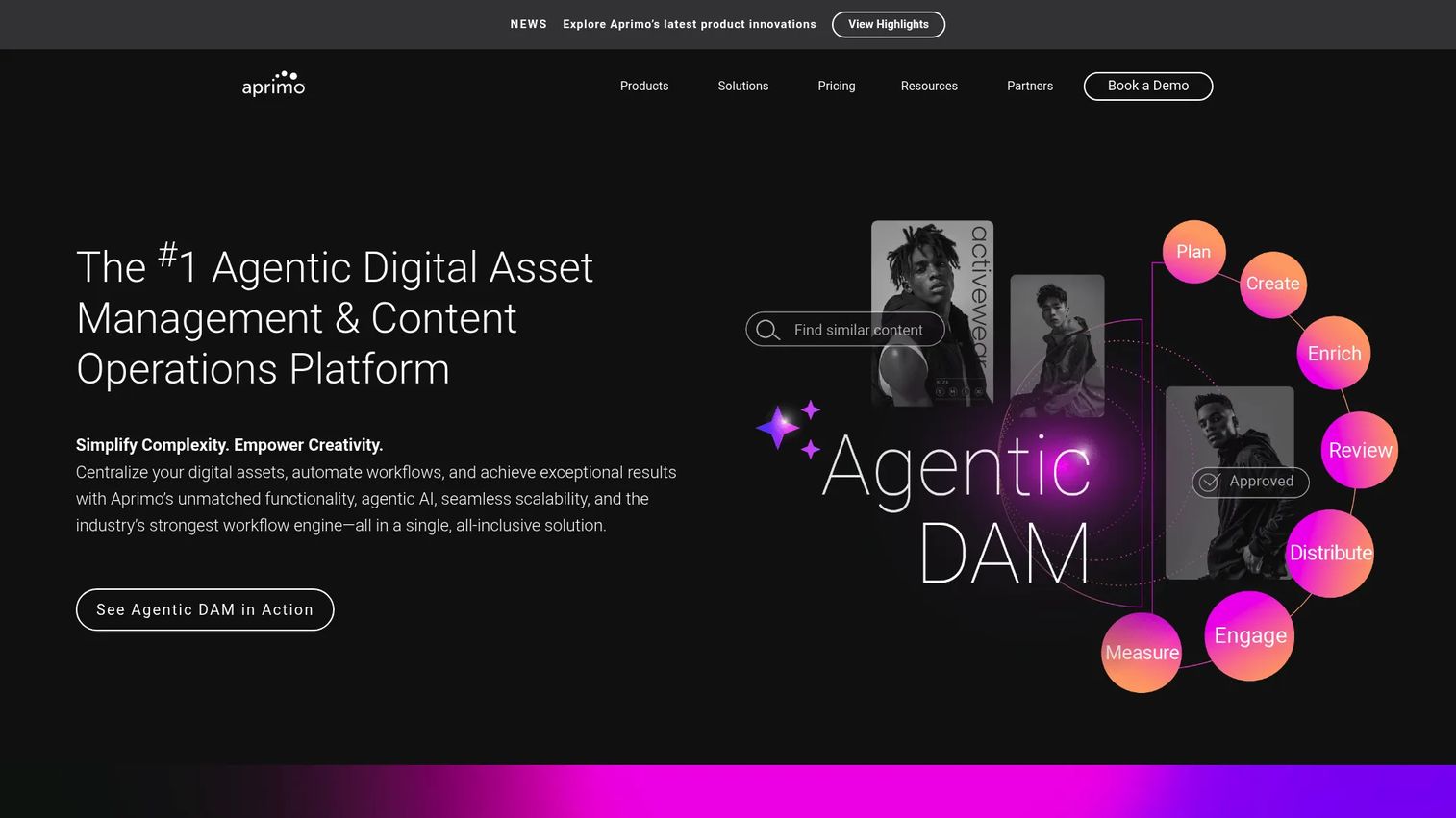
Aprimo is an enterprise content operations platform built around a digital asset management backbone, with planning, productivity, spend, and personalization layered on top. It is designed for large marketing organizations that treat content as a governed, measurable operation rather than a series of one-off projects. Aprimo positions content ops as the system connecting strategy to execution across the full lifecycle.
Best for: Large enterprises that need governed content operations with DAM, planning, and spend management under one roof.
Key strengths
- Digital asset management as the core backbone
- Personalization for delivering tailored content at scale
- Content intelligence for asset insight and governance
- Productivity tools for workflow and task management
- Plan and Spend modules for campaign and budget control
Why choose Aprimo: If your content ops problem is really an enterprise governance problem, spanning DAM, approvals, planning, and budget, Aprimo puts those under one platform. It suits teams with the scale and process maturity to use all of it, not teams looking for a lightweight starting point.
Aprimo pricing: Aprimo does not publish public prices. Pricing is quote-based and scales with the products you select (Standard Package, AI Elite, Personalization, Content Intelligence, Productivity, Plan, and Spend) and your user count. Contact Aprimo for a custom quote.
2. Screendragon
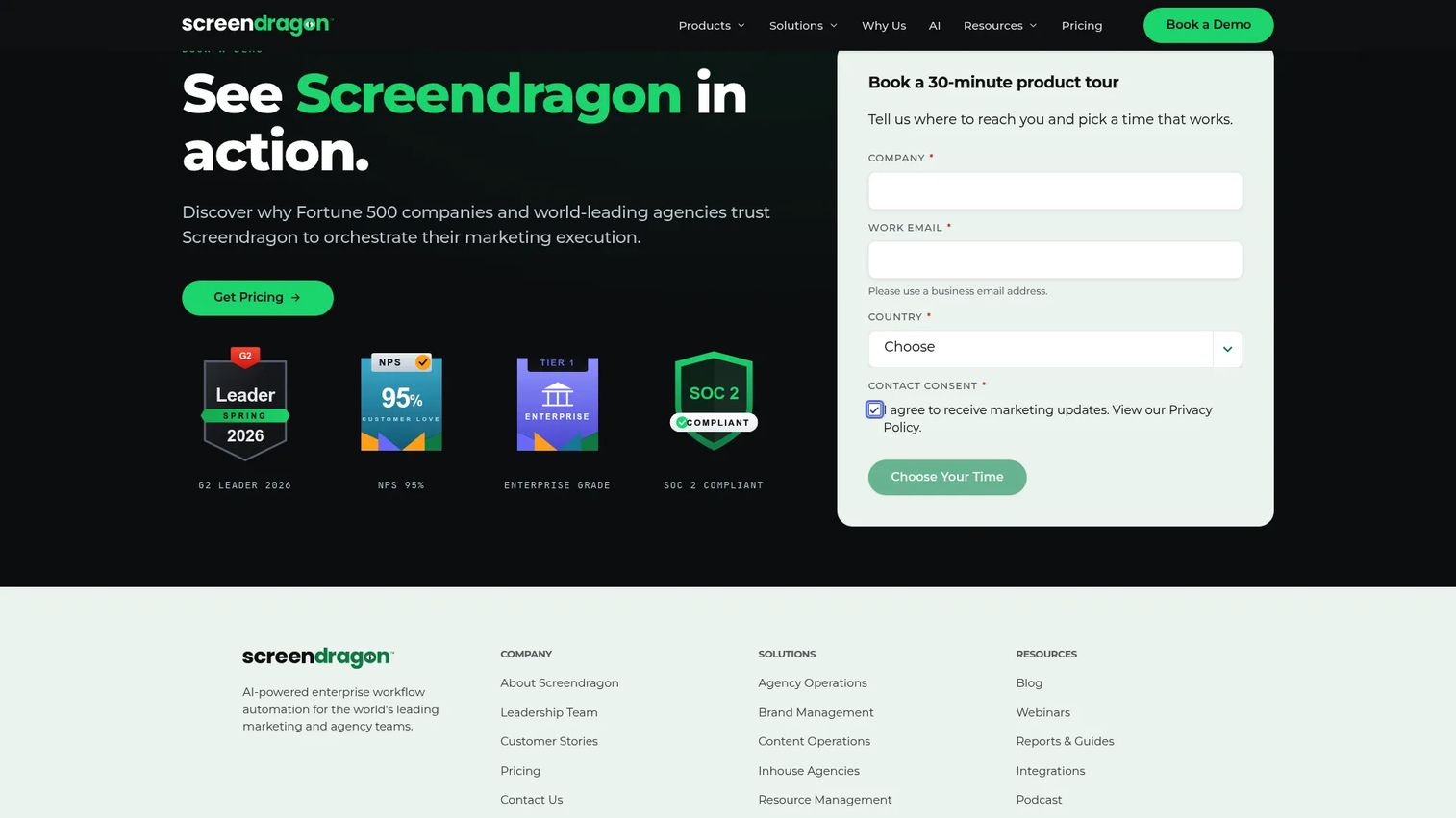
Screendragon is an AI-powered workflow automation platform for marketing, agency, and professional services teams. It focuses on the operational engine of content ops: configurable workflows, approvals, resource management, and real-time visibility into what is in flight and what is stuck. If your team's pain is process, not storage, this is where Screendragon earns its place.
Best for: Marketing, agency, and professional services teams that need configurable work management and approval automation.
Key strengths
- AI workflow automation across content stages
- Project, resource, approval, and profitability management
- Real-time visibility and operational insights
- Configurable processes for complex team structures
Why choose Screendragon: When your bottleneck is coordination (who is doing what, what is waiting on whom, where budget is going) Screendragon turns that into automated, visible workflow. It fits teams running high-volume, multi-stakeholder marketing operations that need approvals and resourcing in the same system.
Screendragon pricing: Pricing is request-based. Screendragon states it charges a per-user, per-month cost plus a one-off setup and training fee, but does not publish a public number. Contact Screendragon for a quote tailored to your team size.
3. Opal
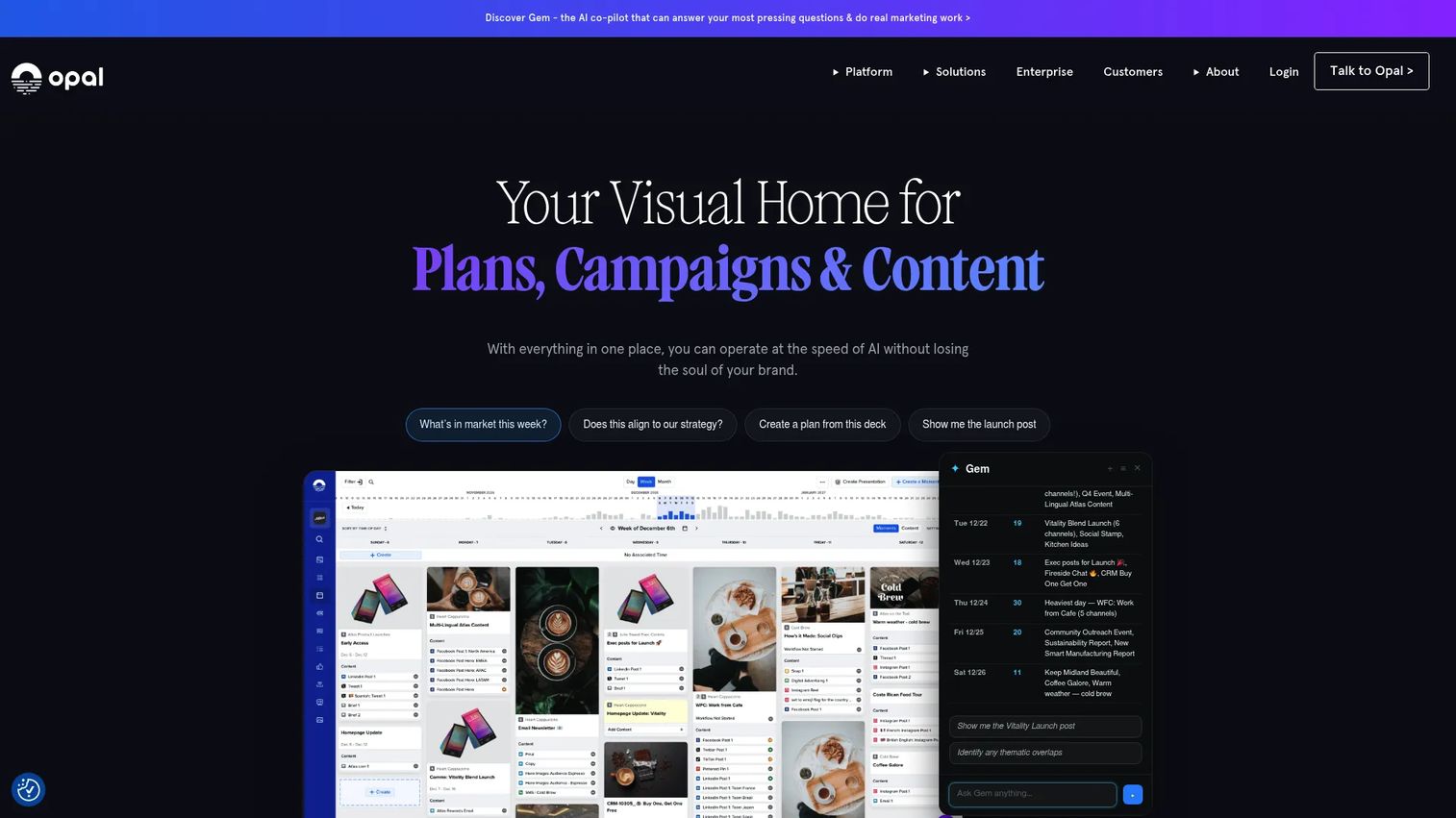
Opal is an AI-empowered marketing planning platform that helps teams plan, create, and visualize campaigns and content in one place. Its strength sits upstream of production: giving large marketing teams a shared visual calendar so plans, campaigns, and content are aligned before anyone starts building. Opal is where content strategy software meets day-to-day planning.
Best for: Enterprise marketing teams that need centralized campaign and content planning across many contributors.
Key strengths
- Visual calendar for plans, campaigns, and content
- AI-assisted planning and content workflows
- Integrations with common marketing and collaboration tools
- Shared visibility across distributed teams
Why choose Opal: If your chaos starts at the planning stage, with too many campaigns, calendars, and stakeholders to track, Opal centralizes that view. It pairs well with a DAM or workflow tool downstream, and fits teams whose first problem is alignment rather than asset storage.
Opal pricing: Pricing is quote-based. Opal finalizes price and package in a conversation with a product expert, and notes that cost depends on per-user licenses, platform fees by workspace size, and integrations. Contact Opal for pricing.
4. Papirfly
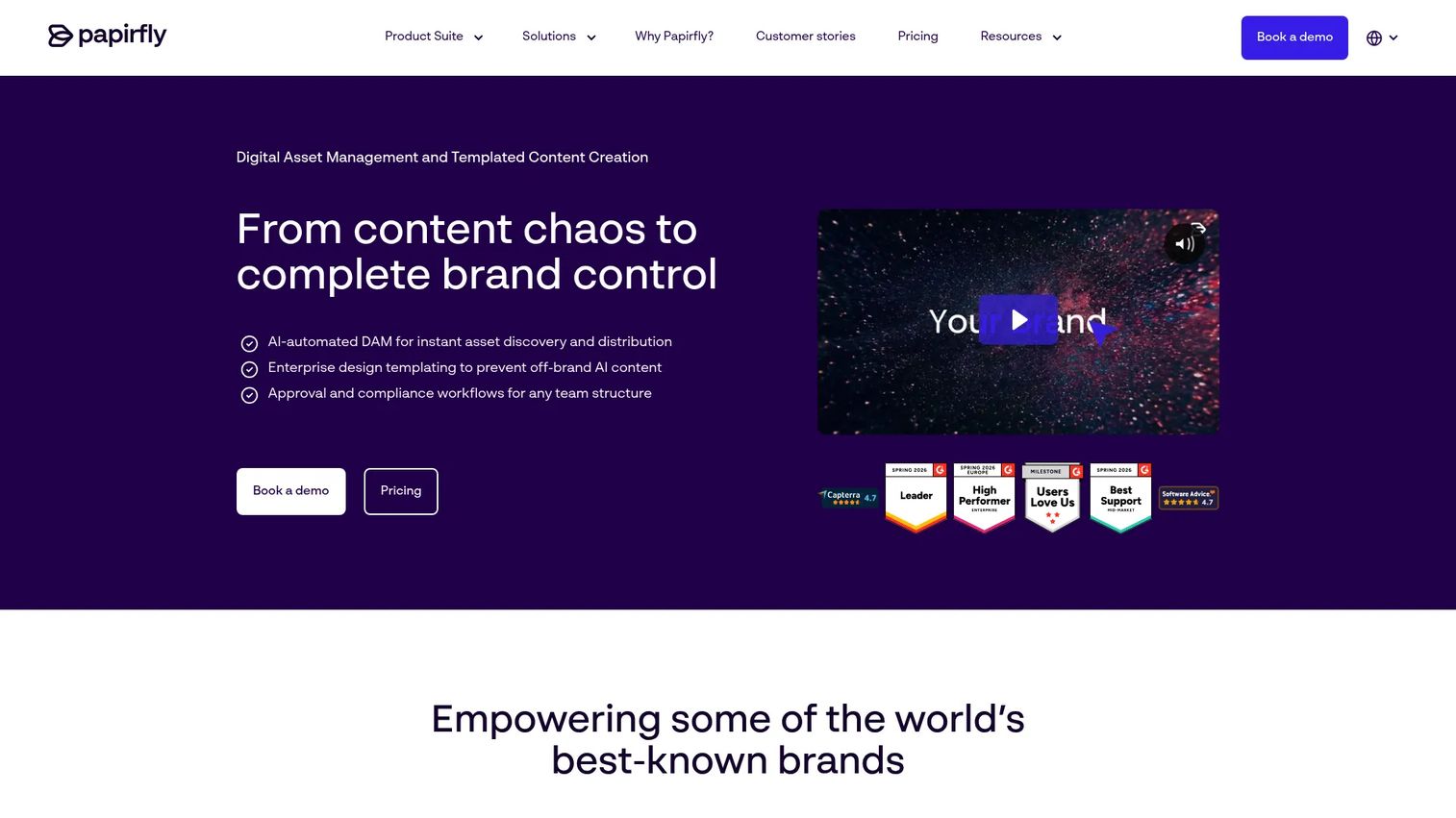
Papirfly is an enterprise digital asset management and templated content creation platform built for brand governance at scale. It combines a brand portal, DAM, and templated production so distributed teams can create on-brand content without routing every request through a design team. Papirfly is strong when brand consistency across many markets is the priority.
Best for: Global brands that need DAM plus on-brand, templated content creation and governance.
Key strengths
- AI-automated digital asset management
- Brand portal for guidelines, templates, and campaign assets
- Templated content creation with approval workflows
- On-brand production for distributed teams
Why choose Papirfly: When local and regional teams need to produce content fast but must stay on-brand, Papirfly's templated creation solves both. It reduces the design bottleneck and enforces governance at the same time, which suits brands managing consistency across many markets.
Papirfly pricing: Papirfly does not publish public first-party pricing. It offers a Basic plan billed annually with a custom quote, and lists no free trial or free version. Contact Papirfly for a tailored quote.
5. Canto
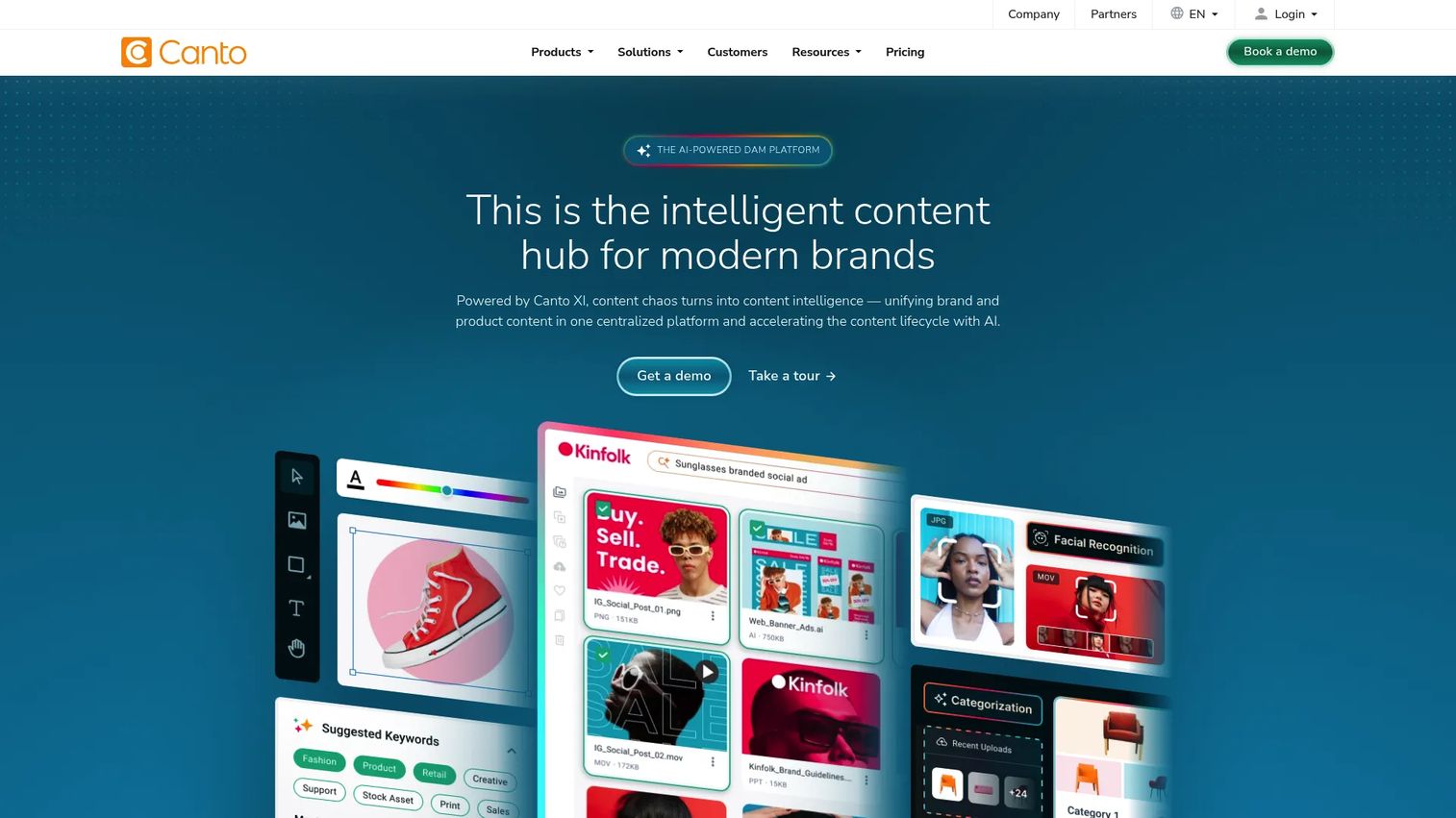
Canto is an AI-powered digital asset management platform for organizing, searching, and distributing brand and product content. It leads with findability: AI visual search, facial recognition, auto-tagging, and smart categorization so teams stop losing assets in folders. For teams whose first requirement is asset control, Canto anchors the content ops stack.
Best for: Marketing, creative, and product teams that need enterprise DAM with AI search and governance.
Key strengths
- AI visual search, facial recognition, and auto-tagging
- Workflow and collaboration tools with review and approval
- Brand templates for consistent output
- Security controls including SSO, MFA, and encryption
Why choose Canto: If your content ops problem starts with "we can never find the right asset," Canto's AI search and tagging fix that first. It fits DAM-led teams that want strong organization and governance, then add planning or workflow tools around it.
Canto pricing: Canto does not expose public prices. Its plans (Core Essentials, DAM Plus, DAM for Products, and DAM Pro) are priced around team size, storage needs, and capabilities. Request pricing from Canto directly.
6. Bynder
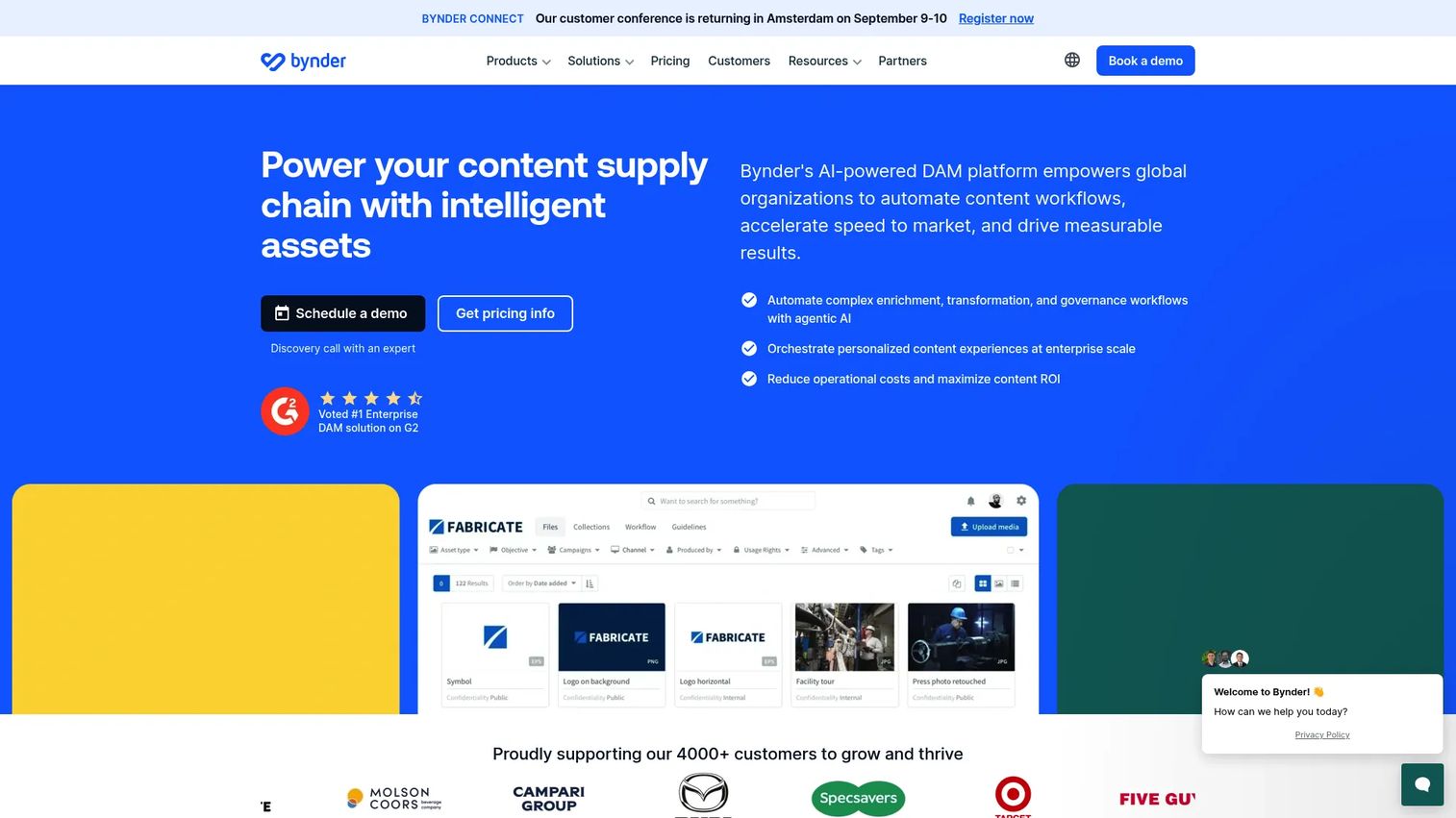
Bynder is an enterprise digital asset management platform for centralizing, finding, and delivering brand content. It pairs a strong DAM core with an AI search experience and asset workflow, making it a fit for mid-market and enterprise teams that need both control and distribution. Bynder sits comfortably as the asset backbone in a larger content ops setup.
Best for: Mid-market and large organizations that need centralized DAM, AI search, and content workflows.
Key strengths
- Digital asset management as the central hub
- AI search experience for fast asset retrieval
- Asset workflow for review and distribution
- Brand governance across teams and regions
Why choose Bynder: For teams that need a reliable, scalable asset backbone with workflow attached, Bynder covers both centralization and delivery. It suits mid-market and enterprise organizations that want DAM at the core and workflow layered on, rather than a planning-first tool.
Bynder pricing: Bynder's pricing is quote-based and not published publicly. Cost varies with your requirements, so contact Bynder for a tailored quote.
7. Contentful
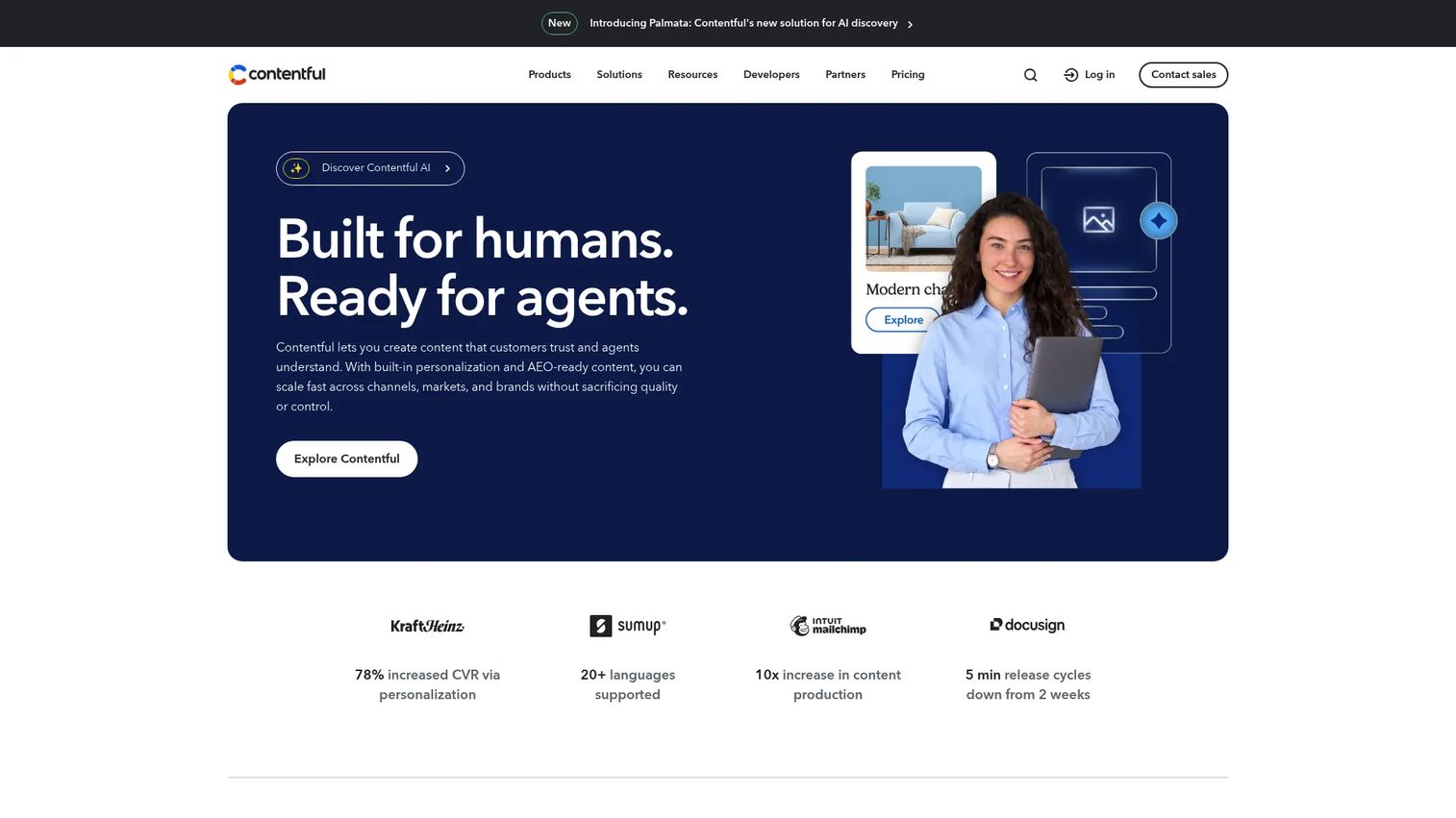
Contentful is a composable, API-first content platform built for structured content operations and omnichannel delivery. Instead of managing pages, it manages modular content that can be published across web, app, and other channels from one source. For teams whose content ops challenge is delivery across many surfaces, Contentful is the structured backbone.
Best for: Digital and product teams that need structured, modular content delivered across many channels.
Key strengths
- Structured, modular content model
- API-first omnichannel delivery
- Governance and role-based access
- Integrations with the broader digital stack
Why choose Contentful: When your content ops problem is technical, delivering the same content across web, mobile, and other channels, Contentful's structured model is built for it. It fits teams with developer support who need content decoupled from any single front end. Less design-team-heavy than a templated DAM, more engineering-adjacent.
Contentful pricing: Contentful offers a free tier for smaller projects, with paid plans available for larger teams and a custom enterprise tier. Check Contentful's pricing page for current plan details.
Considerations
Before you commit, run the shortlist through these criteria. The right platform is the one that fits your actual workflow, not the one with the longest feature list.
Workflow fit
Map your real content lifecycle first: intake, creation, review, approval, distribution, measurement. Then check which stages each platform actually automates. A tool that nails DAM but leaves approvals in email solves half your problem. Match the software to where your coordination breaks, not to a generic feature checklist.
DAM strength
Treat the asset library as the backbone, not a feature. Ask how assets are tagged, searched, versioned, and governed. AI search and auto-tagging matter more as volume grows, because manual folders always collapse at scale. If duplication and stale assets are your pain, weight DAM heavily.
Governance and approvals
Look for defined approval workflows, version history, and access controls. Governance is the recurring constraint in content ops: every regulated review, every brand check, every regional variant needs a record. A platform without real governance shifts that burden back onto people, which is exactly what you are trying to fix.
Integration depth
Content ops software does not live alone. Check how it connects to your CMS, marketing automation, analytics, and collaboration tools. Shallow integrations create the same silos you are trying to escape. Verify the specific connectors you need exist before you buy, not after.
AI, analytics, and total cost
AI should be operational, not decorative: auto-tagging, workflow routing, content generation you would actually use. Pair that with content performance analytics so you can prove throughput and ROI. Then weigh total cost, including setup and training fees, since most platforms here are quote-based and scale with users.
Conclusion
The right content operations platform depends on where your process breaks first.
If you are an enterprise that needs DAM, planning, and spend governed in one system, Aprimo is the most complete fit. If your bottleneck is workflow and approvals across marketing or agency teams, Screendragon turns coordination into automation. If the chaos starts at planning, Opal centralizes campaigns and calendars before production begins.
For DAM-led teams, Canto and Bynder both give you asset control and AI search as the backbone, with Bynder leaning more mid-market to enterprise. If on-brand production at scale is the goal, Papirfly solves the design bottleneck with templated creation. And if your challenge is structured, omnichannel delivery, Contentful is built for it.
The practical next step: map your content lifecycle on one page, mark where work stalls, and shortlist the two platforms that fix that stall directly. Then run a scoped trial or demo against your real workflow, not a canned one. That single exercise will tell you more than any feature comparison.
Start your journey with Guideflow today!
FAQs
Content operations software coordinates the full content lifecycle, from planning and creation through review, approval, distribution, and measurement, in one governed system. It replaces spreadsheets, email routing, and scattered drives with automated workflows, a central asset library, and analytics. The goal is to ship more content, faster, without losing brand control or visibility.
A digital asset management (DAM) system stores, organizes, and retrieves approved assets. Content operations is broader: it covers the entire lifecycle, including planning, workflow, approvals, distribution, and measurement, with DAM as the asset backbone inside it. Put simply, DAM manages the files; content ops manages the process that produces and governs them.
The features that matter most are workflow automation, intake and routing, structured review and approvals, a strong DAM, localization and distribution, and analytics with governance. Prioritize based on where your process breaks. If approvals stall, weight workflow. If assets get lost, weight DAM. Integration depth with your existing stack is the multiplier on all of them.
It improves ROI by cutting duplicated work, accelerating approvals, and reducing the time content sits idle between stages. Centralizing assets removes rework from lost or outdated files, and analytics let you tie throughput to output. The result is more published content per person and faster speed-to-market, both measurable against your current baseline.
No, though enterprises are the heaviest adopters. Large enterprises captured 68.1% of the content services platforms market in 2024, per Market.us (2025). But mid-market teams facing content sprawl, approval bottlenecks, or brand governance issues benefit too. The trigger is process breaking under volume, not company size. Some platforms, like Contentful, offer entry tiers that scale up.
AI acts as an operational layer, not a novelty. In practice it powers auto-tagging and visual search in DAM, routes work through approval stages, assists with planning, and helps generate or adapt content. The useful test is whether the AI reduces manual coordination in a stage you actually run, versus adding a feature you never touch.
Start by mapping your content lifecycle and marking where work stalls. Match the platform to that specific break: workflow tools for approval bottlenecks, DAM-led tools for asset chaos, planning tools for upstream misalignment. Then check integration depth, governance, and total cost including setup. Finally, run a scoped trial against your real workflow before committing.