The interactive patient care systems market sits at $224.18 million in 2025 and is on track to reach $456.81 million by 2030, according to Mordor Intelligence (2025). That growth reflects a straightforward pressure: Patients now expect hospital technology to behave like the digital tools they use everywhere else, while hospitals need those tools to connect to EHRs, nurse workflows, dietary systems, telehealth infrastructure, and discharge planning without creating another operational island.
The gap between expectation and reality is still wide. Most rooms still run on aging TV platforms that can't push education content, can't accept meal orders, and can't notify a care team when a patient needs something. Meanwhile, ASTP/ONC data from 2025 shows that 80% of U.S. hospitals have all four foundational patient engagement capabilities in place, up from 72% in 2021. The category is maturing fast, and the vendor landscape has grown with it.
Choosing the wrong system creates a compounding problem: A portal that doesn't reach patients in the room, a TV platform that can't feed discharge education into the EHR, or a smart room investment that nursing never adopts. This guide cuts through the landscape so you can shortlist the right tools before a demo, RFP, or board conversation.
What's inside
This guide is for hospital patient experience leaders, healthcare CIOs, clinical informatics teams, and healthcare SaaS founders mapping the vendor landscape.
- A comparison of 21 interactive patient care systems for 2026
- The difference between bedside platforms, portals, smart room tools, and mobile engagement products
- Selection criteria: EHR integration depth, bedside usability, education library, workflow coverage, communication tools, and implementation fit
- Pricing and G2 ratings verified at time of writing; where platforms do not publish pricing, that is stated directly
TL;DR
- Best overall inpatient patient engagement platform: Oneview Healthcare covers bedside experience, education, care coordination, and EHR integration in one connected system
- Best for established inpatient education workflows: GetWell Inpatient suits health systems with mature patient activation programs
- Best for smart room and bedside experience modernization: eVideon and Vibe Health by eVideon handle TV, education, meal ordering, and digital whiteboards
- Best for patient portal continuity: MyChart and Epic MyChart Bedside extend the patient record into the inpatient room for Epic environments
- Best for communication-heavy and smart room coordination: TigerConnect Smart Rooms connects room technology to clinical communication workflows
- Best for bedside virtual care: Caregility iConsult supports video visits, remote clinicians, and interpreter access at the bedside
What is interactive patient care systems?
Interactive patient care systems are digital platforms that let patients, families, caregivers, and clinical teams communicate, learn, request services, and access care resources through bedside TVs, tablets, smart room devices, portals, mobile apps, or connected hospital displays.
The category spans a wide range of interfaces and workflow depths. A hospital evaluating these systems is often choosing between a bedside entertainment and education layer, a full smart room operating environment, a patient portal, a mobile outreach platform, or some combination. Each solves a different gap.
Core capabilities to look for
- Patient education and learning verification tied to EHR documentation
- Entertainment access and in-room media management
- EHR and EMR integration for ADT feeds, care plans, and medication data
- Care plan and discharge preparation workflows
- Secure messaging, video visits, and family communication
- Nurse call, meal ordering, and service request workflows
- Digital whiteboards and smart room controls
- Analytics for patient engagement tracking and workflow adoption measurement
The integration layer is often the deciding factor. A platform that runs independently of your EHR creates a documentation gap and a nursing workflow burden. Platforms that write back education completion, service requests, and patient feedback directly into the clinical record remove that friction and make adoption sustainable across unit-level rollouts.
Systems also differ in what they prioritize: Entertainment-led platforms focus on the room experience and keep patients occupied; education-led platforms focus on condition-specific learning, discharge readiness, and care activation; communication platforms prioritize care-team visibility and patient messaging. Hospitals with complex inpatient populations often need capabilities across all three areas, which is why platform scope matters alongside feature depth.
When to use interactive patient care systems
Modernize bedside education and entertainment
Hospitals with aging in-room TV infrastructure are buying a dated patient experience every day that system stays in place. Modern interactive patient care platforms replace passive television with condition-specific education, medication teaching, discharge preparation content, and service request tools, all from the same screen. Children's hospitals, specialty floors, and units with high education compliance requirements see the most immediate gains from upgrading bedside content delivery.
Coordinate care across the hospital stay
Patients who can view their care team, daily schedule, meal options, and lab results on a bedside device ask fewer questions at the nurses' station, which reduces interruptions and improves satisfaction scores. For care coordination workflows, interactive patient care systems support meal ordering, service request routing, nurse call integration, language support, and telehealth access from a single point in the room. Discharge planning tools embedded in the platform help nursing staff and patients move through discharge education before the day of discharge.
Extend engagement beyond the room
Mobile apps, SMS outreach platforms, and patient portals extend the care relationship past discharge. Postacute follow-up, home education, appointment reminders, and caregiver communication all live in this tier. Hospitals that close the loop between inpatient experience and outpatient follow-up reduce readmission risk and improve the continuity of care across the patient journey. Some platforms cover both inpatient and outpatient engagement in one system; others specialize in one setting.
Interactive patient care systems comparison
Interactive patient care products differ substantially by care setting, interface type, workflow depth, and integration model. A bedside TV platform is not a patient portal, and a mobile outreach tool is not a smart room system. The table below maps each product to its primary use case.
| # | Product | Best for | Key differentiator | Pricing | G2 rating |
|---|---|---|---|---|---|
| 1 | Oneview Healthcare | Enterprise inpatient engagement | Connected care experience platform with EHR integration | Custom pricing | 3.5/5 |
| 2 | GetWell Inpatient | Inpatient education and patient activation | Education, rounding, discharge readiness, and EHR-connected workflows | Custom pricing | 4.5/5 |
| 3 | eVideon | Smart room and bedside experience | Bedside TV, education, meal ordering, and digital whiteboards | Custom pricing | N/A |
| 4 | MyChart | Patient portal continuity across the care journey | Broad portal access for records, messaging, and billing | Custom pricing | 4.4/5 |
| 5 | Epic MyChart Bedside | Epic-connected inpatient bedside access | Bedside extension of the Epic portal for inpatient stays | Custom pricing | N/A |
| 6 | Avidex TigrPX | Education-led bedside engagement | Condition-specific education with EMR documentation and workflow integrations | Custom pricing | N/A |
| 7 | SONIFI Health | In-room entertainment and engagement | EHR-integrated TV, digital whiteboards, mobile app, and digital signage | Custom pricing | N/A |
| 8 | TigerConnect Smart Rooms | Clinical communication and smart room workflows | Communication platform tied to patient room technology and EHR | Custom pricing | 4.5/5 |
| 9 | Uniguest Hub IPS | Hospitality-style in-room patient experience | Interactive TV, digital whiteboard, video visits, and mobile connect | Custom pricing | N/A |
| 10 | TrakCare | Connected clinical and administrative workflows | Unified EHR and health information system with patient engagement touchpoints | Custom pricing | N/A |
| 11 | Care Experience Platform | Broad inpatient and care-team engagement | Integrated patient experience layer from Oneview Healthcare | Custom pricing | N/A |
| 12 | Get Well 360 | Cross-continuum engagement across care settings | Inpatient engagement, outreach, and guided care programs | Custom pricing | 4.5/5 |
| 13 | pCare Interactive Patient System | Dedicated bedside interactive platform | Open-API bedside system with TV, video visits, and analytics | Custom pricing | N/A |
| 14 | Aceso Digital Signage | Patient-facing display communication | Healthcare digital signage for rooms, lobbies, and wayfinding | Custom pricing | N/A |
| 15 | E3 Patient Engagement Solutions | Education and nonclinical workflow automation | Personalized education, room controls, and meal ordering | Custom pricing | N/A |
| 16 | eCareBoard | Digital whiteboard workflows | Patient room information board with EHR and ADT integration | Custom pricing | N/A |
| 17 | ExtendedCare Bedside | Virtual care and bedside communication | Telehealth, remote monitoring, and EHR-integrated bedside support | Custom pricing | N/A |
| 18 | mPulse Mobile | Mobile outreach beyond the room | AI-driven omnichannel engagement via SMS, WhatsApp, and health portals | Custom pricing | N/A |
| 19 | My CareBoard | Bedside digital care board | Patient-facing room board displaying care team, goals, and schedule | Custom pricing | N/A |
| 20 | Caregility iConsult | Bedside virtual care and video | Secure virtual visits, remote clinicians, and interpreter access | Custom pricing | N/A |
| 21 | Vibe Health by eVideon | Connected smart room experience | Smart room platform for engagement, education, and clinical workflow | Custom pricing | N/A |
Best 21 interactive patient care systems for 2026
1. Oneview Healthcare
Oneview Healthcare provides a connected care experience platform designed for hospitals and health systems that need more than an entertainment system. The platform combines patient education, care-team workflow automation, meal ordering, entertainment, and family communication into one cloud-native environment. An AI-powered voice assistant, the Ovie Care Assistant, handles patient requests and escalates them to the appropriate care team member.
Best for: Large hospitals and health systems modernizing the inpatient care experience across multiple units.
Key features
- Bedside patient engagement: Education, entertainment, meals, and service requests
- AI-powered Ovie Care Assistant with voice interaction and request escalation
- Care-team workflow automation and real-time patient information
- EHR and healthcare-system integrations
- Cloud-native analytics dashboards
Why choose Oneview Healthcare: Oneview suits organizations that want a platform spanning the patient experience from admission to discharge, rather than a point solution for a single workflow. The AI assistant differentiates it from systems that rely on screen-only navigation.
Oneview Healthcare pricing: Oneview directs hospitals to request a demo rather than publishing tier pricing. Expect costs to reflect room count, device deployment, integration scope, and implementation services.
G2 rating: 3.5/5
2. GetWell Inpatient
GetWell Inpatient is a digital inpatient engagement platform focused on patient education, care plan activation, digital rounding, and discharge preparation. The platform supports bedside tablets, in-room TVs, and mobile experiences, with automated clinical workflow routing and service request tools built in.
Best for: Health systems with mature inpatient engagement programs that need a structured education and patient activation workflow.
Key features
- Interactive patient education with care plan engagement
- Digital whiteboard: Schedule, care-team info, and goals
- Meal ordering and nonclinical service requests
- Entertainment and videoconferencing
- Automated clinical workflow routing and EHR integration options
Why choose GetWell Inpatient: GetWell has a long track record in inpatient patient engagement, which matters when nursing adoption and content governance are key concerns during implementation. The discharge readiness tools are particularly relevant for units focused on reducing avoidable readmissions through education compliance.
GetWell Inpatient pricing: Pricing is not published on the vendor website. Get Well directs prospects to request a demo. Costs will depend on facility size, modules selected, integration scope, and support tier.
G2 rating: 4.5/5
3. eVideon
eVideon provides healthcare patient experience technology that combines interactive bedside TV, education, entertainment, meal ordering, patient surveys, video visiting, digital signage, and companion tablets into one platform. EHR and ADT integration enables personalized education assignments and workflow automation tied to patient data.
Best for: Health systems replacing aging in-room TV systems with a connected patient experience platform.
Key features
- Interactive bedside TV with education, entertainment, and meal ordering
- EHR and ADT integration for personalized education and workflow triggers
- Patient surveys and real-time service recovery
- Video visiting and conferencing
- Digital signage and companion bedside tablets
Why choose eVideon: eVideon covers the broadest surface area of the bedside experience in one system, from HD television and video on demand to multilingual education and digital signage. It fits organizations that want to consolidate multiple room-experience vendors into one contract.
eVideon pricing: eVideon does not publish pricing. Contact the vendor directly for quotes that reflect room count, device configuration, integrations, and implementation scope.
4. MyChart
MyChart is Epic's secure patient portal, used across ambulatory, inpatient, and post-discharge settings. Patients can view medications, test results, clinical notes, and health summaries; schedule appointments; attend video visits; message care teams; and manage billing. ASTP/ONC data from 2025 shows 99% of U.S. hospitals enable patients to view health information electronically, and MyChart is one of the primary vehicles for that access at Epic institutions.
Best for: Health systems that prioritize longitudinal patient access across appointments, records, messaging, and billing on the Epic platform.
Key features
- Access to health records: Medications, results, notes, and care summaries
- Appointment scheduling, eCheck-In, and video visits
- Secure patient-to-care-team messaging and refill requests
- Billing management, payment plans, and insurance details
- Proxy access for family members and account linking via MyChart Central
Why choose MyChart: MyChart is the natural choice for Epic institutions that want consistent patient access across the entire care continuum. Its breadth covers pre-visit, inpatient, and post-discharge engagement without requiring a separate tool for each setting.
MyChart pricing: MyChart is typically licensed as part of broader Epic platform agreements. Contact your Epic account team for pricing specific to your organization's configuration.
G2 rating: 4.4/5
5. Epic MyChart Bedside
Epic MyChart Bedside extends the MyChart portal into the inpatient room through bedside tablets or supported devices. Hospitalized patients gain real-time access to their care plan, care team details, schedule, medications, and patient education, all connected to the Epic record. It also integrates with bedside dining applications.
Best for: Hospitals already running Epic that want to extend portal engagement into the inpatient room without a separate bedside platform.
Key features
- Real-time access to inpatient care plan and health information
- Care-team details and schedule visibility
- Patient education delivery tied to the Epic record
- Medication information access
- Integration with bedside dining applications
Why choose Epic MyChart Bedside: For Epic hospitals, this approach keeps the patient experience inside one platform and reduces the integration work associated with third-party bedside systems. The tradeoff is that it focuses on portal continuity rather than entertainment or room-control features.
Epic MyChart Bedside pricing: This product is typically packaged within Epic contracts. Confirm availability and pricing with your Epic account team, as it is not separately priced on Epic's public site.
6. Avidex TigrPX patient engagement and education system
Avidex TigrPX is an interactive hospital patient engagement system designed around condition-specific education with automatic EMR documentation. Beyond education, it handles patient communication, service requests, virtual care, family communication, and digital patient whiteboards, all from the in-room TV and supported devices. The platform integrates with EMR, EHR, ADT, dietary, pharmacy, nurse call, and environmental hospital systems.
Best for: Hospitals seeking an integrated bedside platform where patient education documentation and EMR integration are the primary requirements.
Key features
- Condition-specific education with automatic EMR documentation
- Digital patient whiteboards and room-door signage with real-time EMR data
- Virtual care, telehealth, and family communication via in-room TV
- Patient surveys, satisfaction feedback, and service recovery workflows
- Integrations: EMR, EHR, ADT, dietary, pharmacy, nurse call, environmental systems
Why choose Avidex TigrPX: TigrPX is built for organizations where education compliance and EMR documentation are non-negotiable, such as accreditation programs requiring verifiable patient education completion. The depth of system integrations also suits hospitals with complex existing infrastructure.
Avidex TigrPX pricing: Avidex does not publish TigrPX pricing. Ask the vendor for a quote covering hardware, software, implementation, content management, and support.
7. SONIFI Health interactive patient engagement solutions
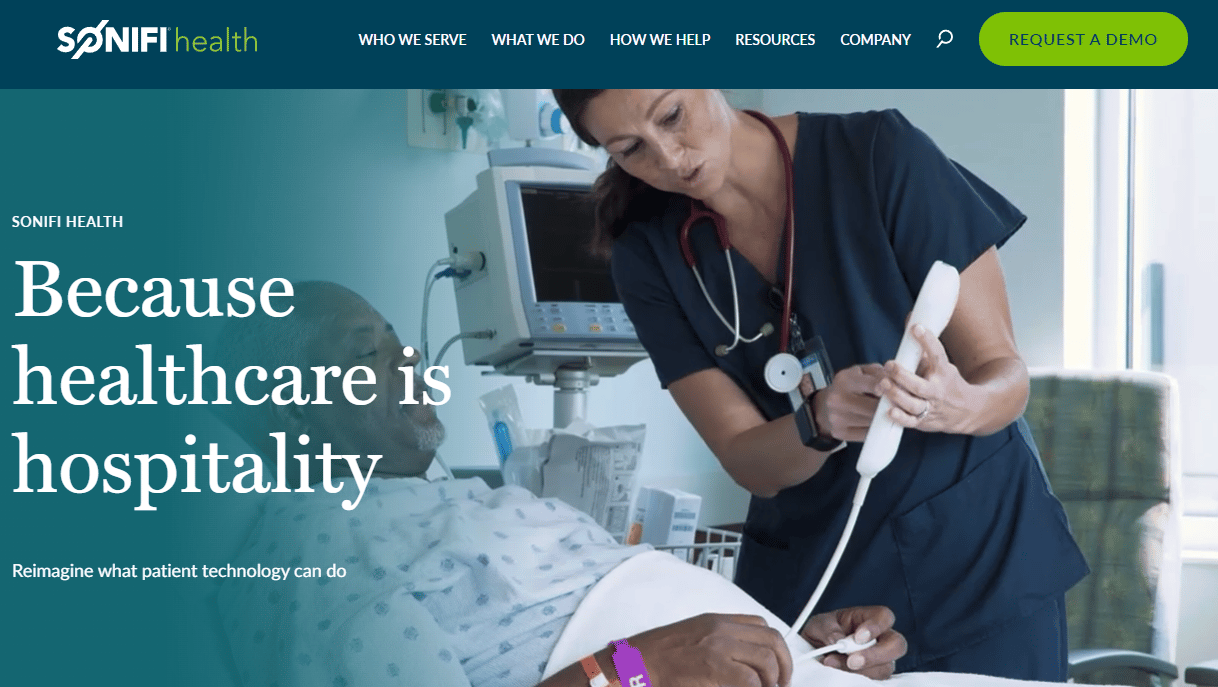
SONIFI Health provides integrated patient engagement technology across in-room TVs, digital whiteboards, patient door signs, mobile apps, APIs, and facility-wide digital signage. The platform integrates with Epic, Cerner, and MEDITECH, plus education, virtual care, dietary, and nurse call systems. Analytics and usage monitoring tools support ongoing optimization after go-live.
Best for: Hospitals and healthcare organizations that want a hospitality-oriented patient engagement environment with broad integration support.
Key features
- EHR-integrated interactive TVs: Education, entertainment, surveys, screenings, and service requests
- Digital whiteboards: Care details, care-team information, schedules, goals, and discharge prompts
- Mobile apps and APIs extending engagement to personal devices
- Digital patient door signs and facility digital signage
- Integrations: Epic, Cerner, MEDITECH, dietary, virtual care, nurse call
Why choose SONIFI Health: SONIFI serves organizations that want one vendor covering both the room-level engagement layer and facility-wide signage, with strong EHR integration across the major platforms. The mobile app and API layer also suit health systems that want to extend the bedside experience to patients' own devices.
SONIFI Health pricing: Contact SONIFI Health to request a proposal based on facility size, deployment scope, and integration requirements.
8. TigerConnect Smart Rooms
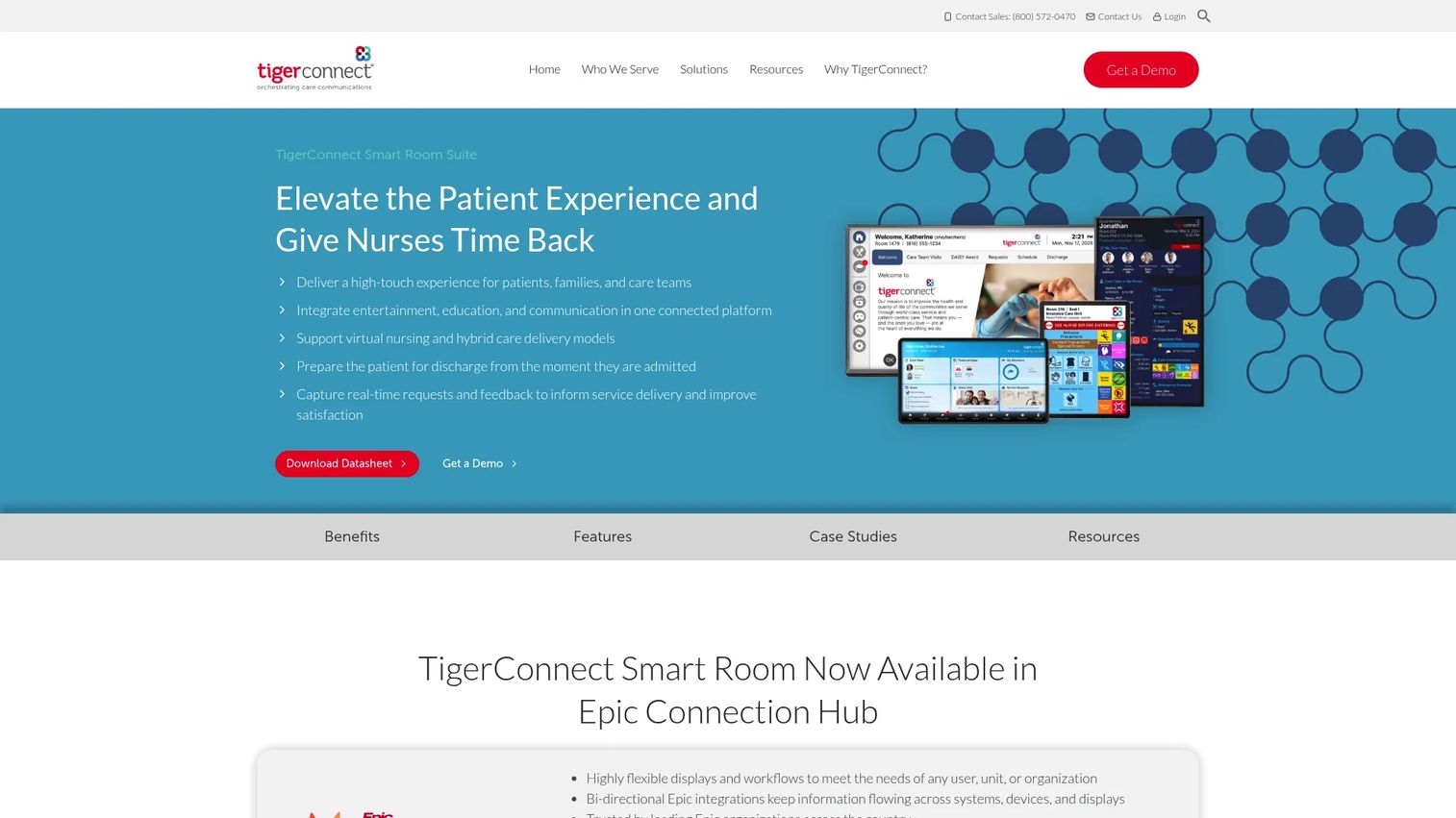
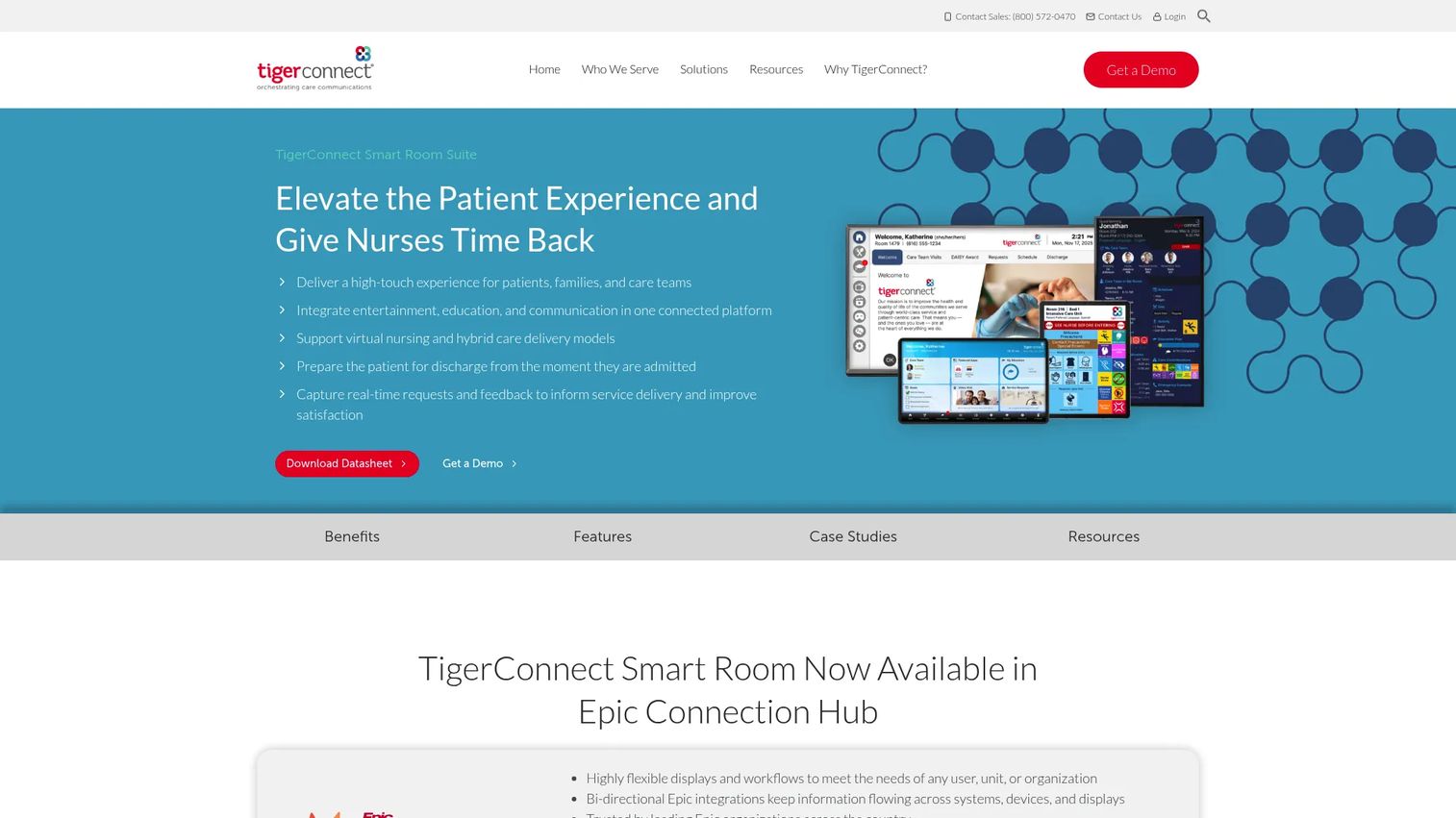
TigerConnect Smart Rooms connects patient room technology to clinical communication workflows. The platform combines an interactive TV with entertainment, meal ordering, education, and multilingual support; an EHR-integrated digital whiteboard; digital door signs showing isolation precautions and safety alerts; and a software-based nurse call system with location awareness and analytics.
Best for: Hospitals connecting patient room technology to clinical communication infrastructure for coordinated care-team workflows.
Key features
- Interactive TV: Entertainment, meals, education, surveys, and multilingual support
- EHR-integrated digital whiteboard: Care team, medications, and clinical trends
- Digital door signs: Isolation precautions, safety alerts, and active requests
- Software-based nurse call with location awareness and unified notifications
- Bedside tablet access for TV and whiteboard functions
Why choose TigerConnect Smart Rooms: TigerConnect's differentiation is the communication layer. Where other platforms focus on the patient-facing experience, Smart Rooms also addresses the care-team side, connecting room data to the clinical communication workflows TigerConnect is known for.
TigerConnect Smart Rooms pricing: Pricing is not displayed on the vendor website. TigerConnect directs prospects to contact sales for a quote.
G2 rating: 4.5/5
9. Uniguest Hub IPS
Uniguest Hub IPS (formerly pCare, rebranded in 2026) transforms hospital television infrastructure into a patient communication hub. The platform supports interactive TV with live broadcast and video on demand, VideoConnect for virtual visits and interpreter services, Mobile Connect for meal ordering and room controls, real-time location services, and open-API integrations with EHR, dietary, communications, and other systems.
Best for: Hospitals seeking an integrated bedside interactive system with broad open-API integration support.
Key features
- Interactive TV: Broadcast, video on demand, education, and service requests
- VideoConnect: Virtual visits, interpreter services, and EHR-connected consultations
- Mobile Connect: Meal ordering, room controls, and post-discharge education
- Digital whiteboards and patient room signs with clinical data
- Dashboards tracking more than 120 aspects of patient interactions
Why choose Uniguest Hub IPS: The open-API architecture makes Hub IPS a practical choice for health systems with complex existing vendor ecosystems that need flexible integration paths. The analytics depth, tracking more than 120 patient interaction dimensions, supports outcomes measurement and compliance reporting.
Uniguest Hub IPS pricing: Pricing is not published by the vendor. Request a quote through Uniguest's sales team based on facility size and integration scope.
10. TrakCare
TrakCare is InterSystems' unified, patient-centric electronic health record and health information system. It covers clinical decision support, revenue cycle management, medication management, laboratory, pharmacy, and departmental workflows. It includes patient engagement touchpoints but operates primarily as a clinical and administrative HIS rather than a dedicated bedside engagement platform.
Best for: Healthcare organizations outside the U.S. or those evaluating a unified health information system that includes patient engagement alongside clinical and administrative workflows.
Key features
- Unified patient-centric EHR across care settings
- HL7 FHIR and SMART on FHIR interoperability
- Clinical decision support and intelligent workflows
- TrakCare Assistant search-based clinician workflows
- Revenue cycle, laboratory, pharmacy, and departmental capabilities
Why choose TrakCare: TrakCare suits organizations that need a connected clinical and administrative backbone rather than a standalone bedside engagement layer. It is particularly common in international health systems evaluating a full HIS rather than a point solution for patient experience.
TrakCare pricing: InterSystems does not publish TrakCare pricing. Contact InterSystems for an enterprise quote that reflects deployment scope, modules, and implementation services.
11. Care Experience Platform
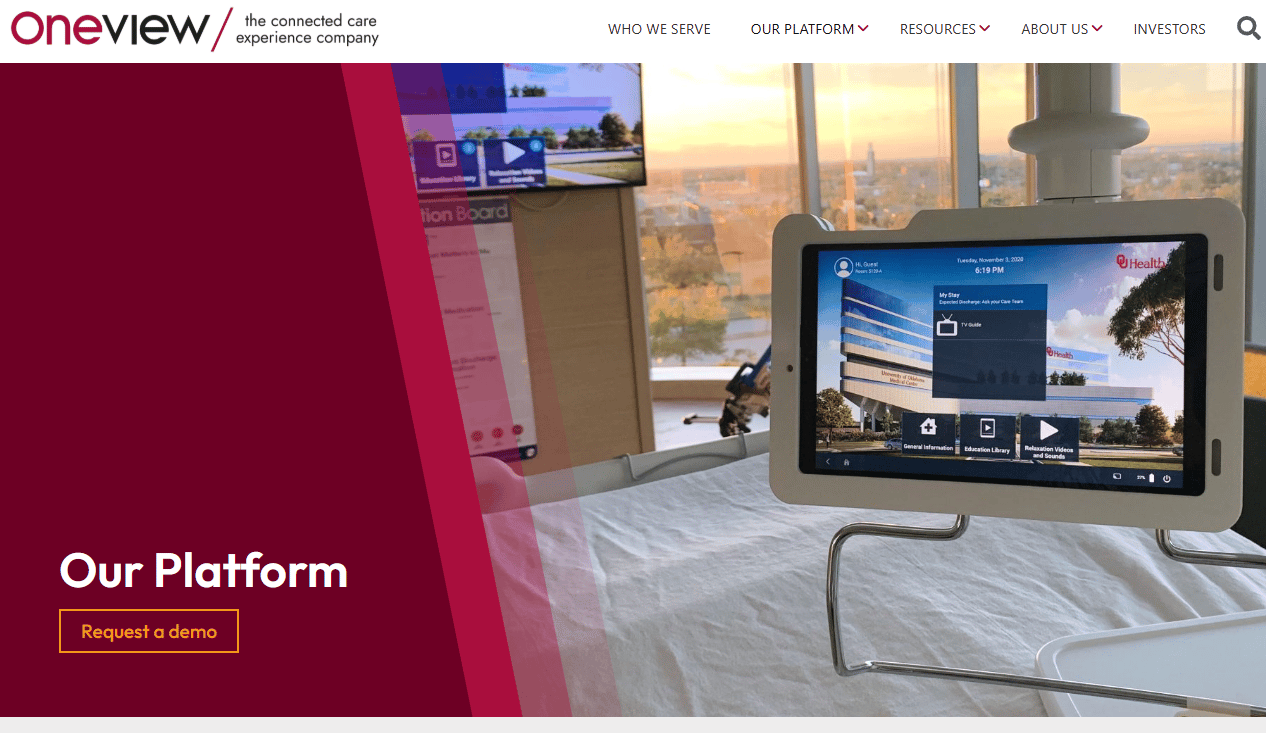
Care Experience Platform is Oneview Healthcare's product that integrates systems, content, and services to support patients, families, and care teams in hospital settings. It includes patient education, entertainment, meal ordering, service requests, care-team workflow automation, virtual care integration, and EHR-connected analytics. Available deployment options include Cloud Start, Cloud Enterprise, and Enterprise On-Prem configurations.
Best for: Hospitals and health systems seeking an integrated patient experience and care-team workflow layer with flexible deployment options.
Key features
- Patient education, entertainment, and service requests
- Meal ordering and nonclinical workflow automation
- Virtual care integration
- Care-team communication and workflow automation
- EHR integrations and self-service analytics dashboards
Why choose Care Experience Platform: The Care Experience Platform suits organizations that need deployment flexibility, including on-premises options, alongside the full bedside engagement stack. It serves organizations that need governance controls across multi-site health systems.
Care Experience Platform pricing: Pricing across the Cloud Start, Cloud Enterprise, and Enterprise On-Prem tiers is available only through direct sales engagement with Oneview Healthcare.
12. Get Well 360
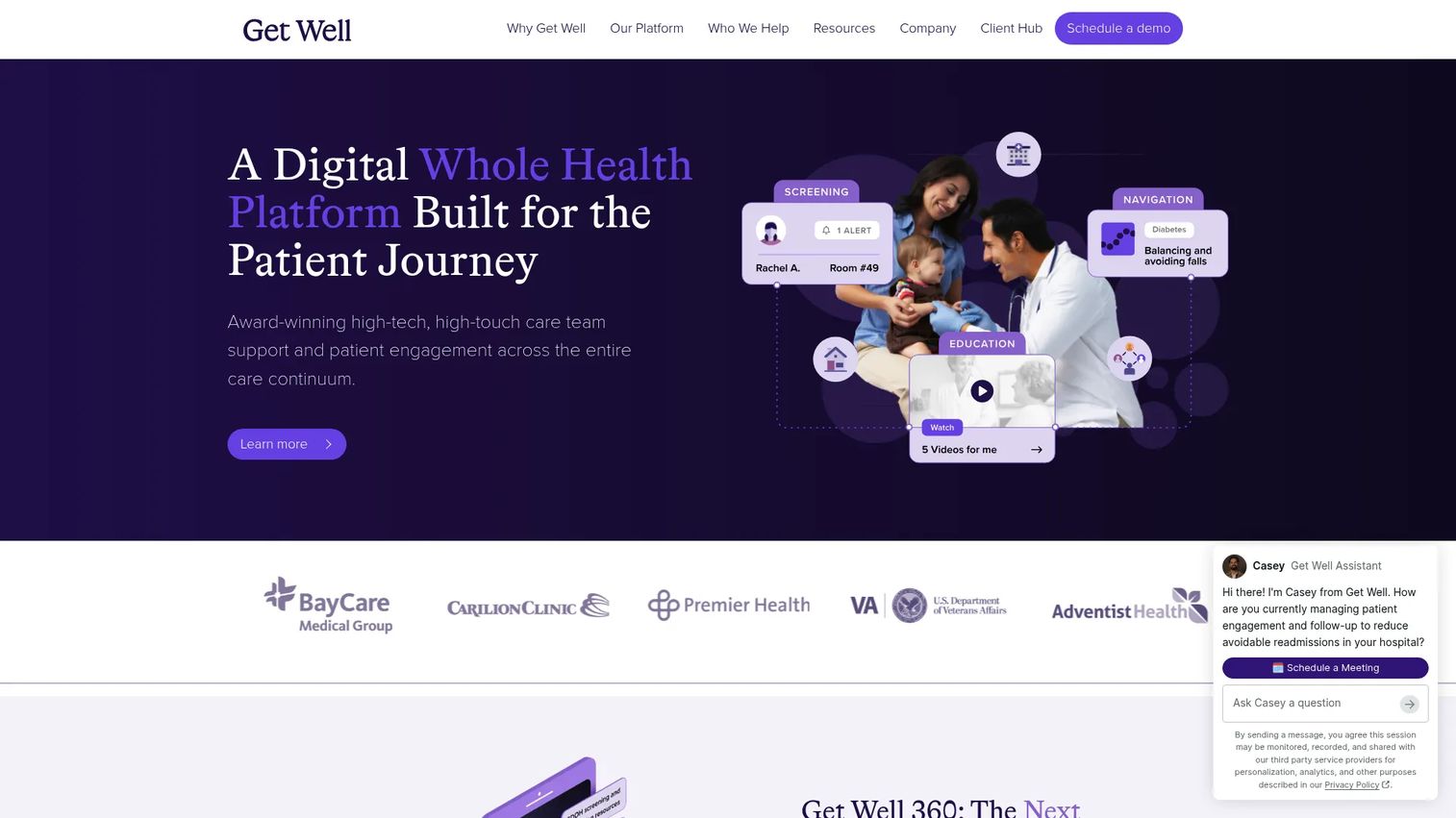
Get Well 360 is a whole-health digital engagement platform for health systems and health plans that covers inpatient point-of-care engagement, digital rounding, telehealth enablement, and guided care programs for ongoing patient outreach. The platform supports personalized outreach, automated check-ins, virtual monitoring, patient-reported outcomes collection, and care plan support across the care continuum.
Best for: Health systems and health plans connecting inpatient engagement with post-discharge outreach and ongoing guided care programs.
Key features
- Personalized patient outreach and activation
- Interactive point-of-care engagement and digital rounding
- Telehealth enablement during the hospital stay
- Guided care programs with virtual monitoring and automated check-ins
- Patient-reported outcomes collection and triage support
Why choose Get Well 360: Get Well 360 is the right fit for organizations that want one vendor covering both the inpatient engagement layer and the ongoing care management relationship, particularly for chronic condition management or post-acute care programs.
Get Well 360 pricing: Get Well does not publish pricing. Request a demo through the vendor's website to get a quote based on care setting, program scope, and volume.
G2 rating: 4.5/5
13. pCare interactive patient system
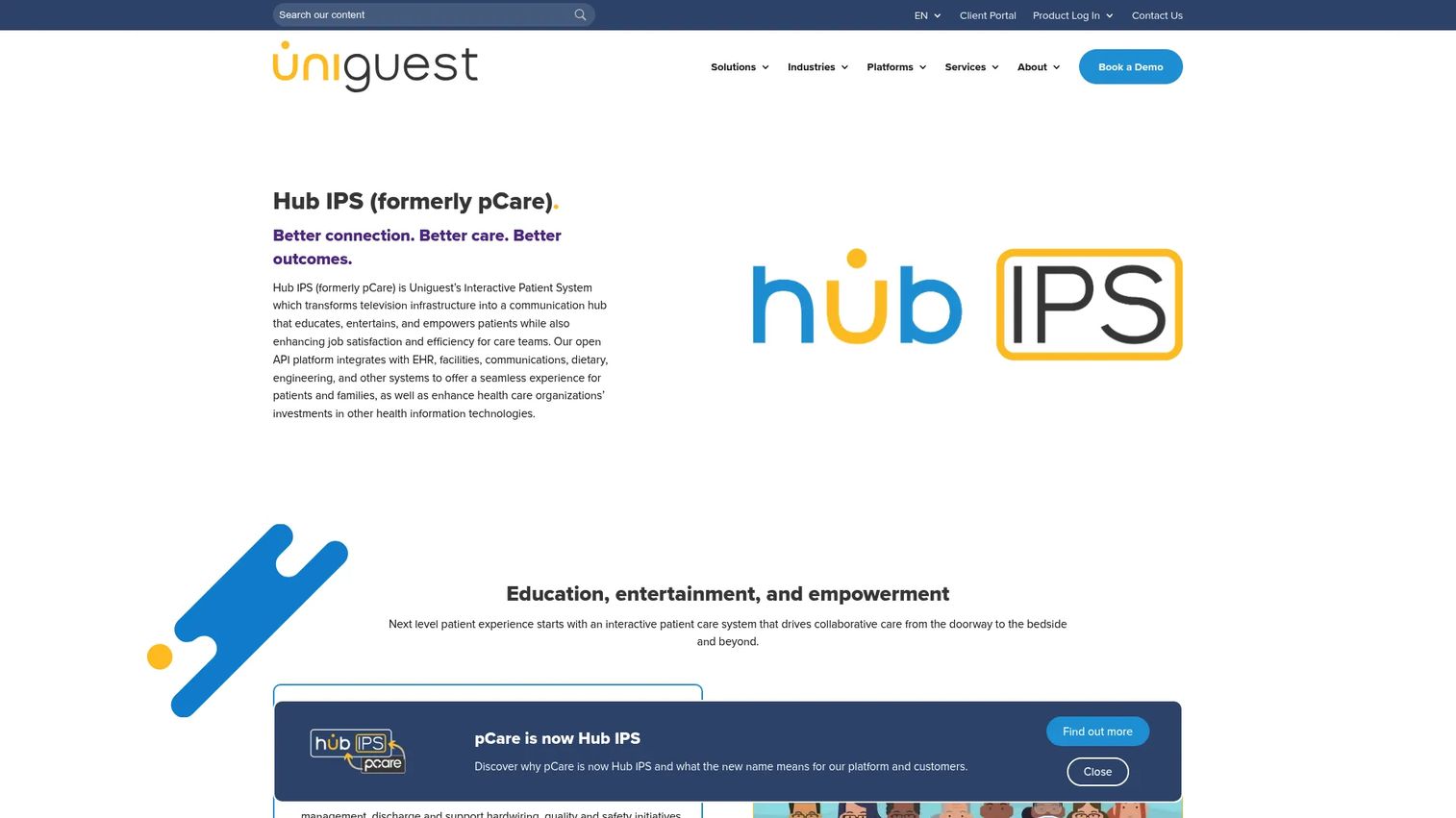
pCare is the legacy brand name under which Uniguest Hub IPS was marketed before the 2026 rebrand. The platform (now Hub IPS) provides interactive patient TV, VideoConnect for virtual visits and interpreter services, Mobile Connect for room controls and meal ordering, open-API EHR integrations, digital whiteboards, and patient interaction analytics. Organizations evaluating this product today should confirm they are reviewing the Hub IPS documentation and pricing.
Best for: Hospitals seeking a dedicated interactive bedside system with open-API integration architecture and a long install base in hospital environments.
Key features
- Interactive patient TV with education, entertainment, and customizable interfaces
- VideoConnect for virtual visits and EHR-connected consultations
- Open-API integrations with EHR, dietary, engineering, and communications systems
- Digital whiteboards and room signs with clinical data
- Analytics tracking more than 120 patient interaction and feedback dimensions
Why choose pCare (Hub IPS): For hospitals that have evaluated pCare historically or have existing pCare installations, the Uniguest rebrand to Hub IPS maintains the same platform capabilities. Organizations in active procurement should evaluate Hub IPS documentation to confirm current feature coverage.
pCare pricing: Pricing is not available on the vendor website. Contact Uniguest for a quote based on room count, integration needs, and deployment scope.
14. Aceso Digital Signage
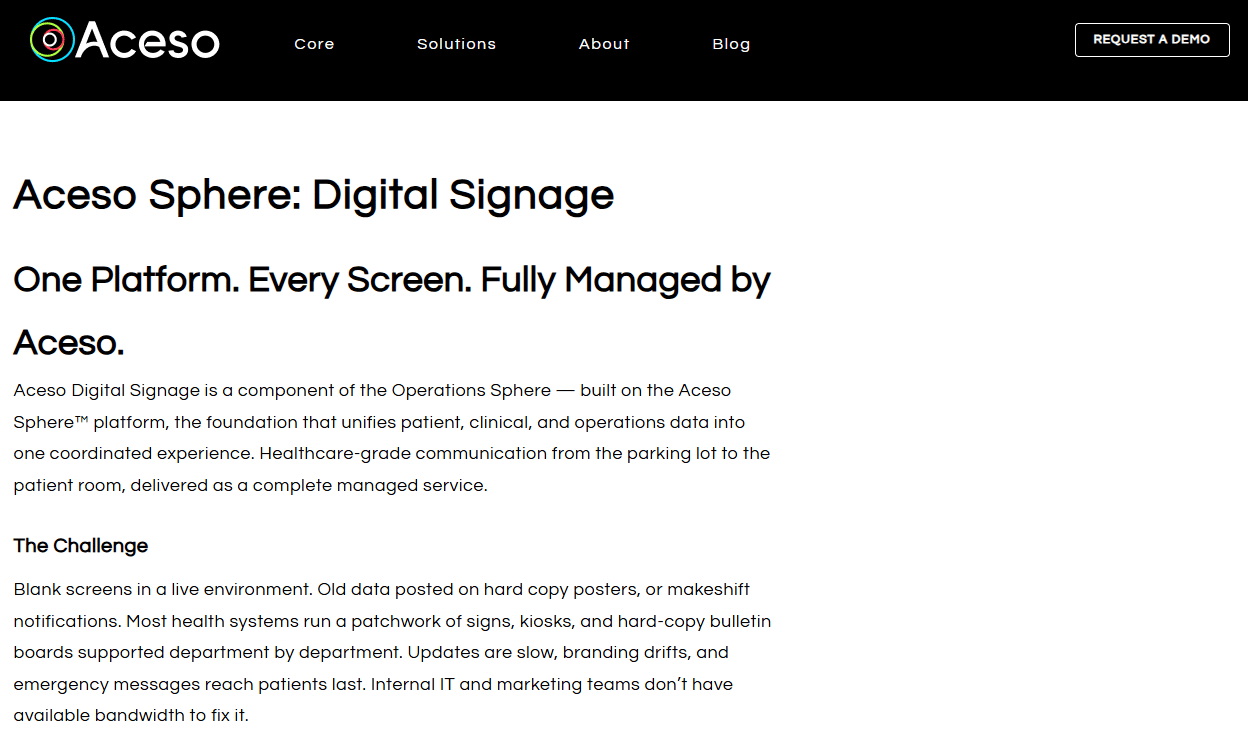
Aceso Digital Signage provides digital signage technology for healthcare communication, including patient-facing displays for rooms, lobbies, corridors, and wayfinding. Aceso also produces eCareBoard, a digital whiteboard product (covered separately as entry 16). The digital signage offering addresses facility communication across broader hospital environments rather than the interactive bedside experience specifically.
Best for: Hospitals that need patient-facing display networks for facility communication, public areas, or department signage alongside or separate from bedside engagement.
Key features
- Digital signage management for patient-facing displays
- Patient-facing messaging and content scheduling
- Facility and department communication networks
- Display network management and content delivery
- Healthcare-specific signage workflows
Why choose Aceso Digital Signage: Aceso is most relevant as a signage infrastructure vendor for hospitals that need managed display networks across the facility, not as a primary bedside engagement platform. It makes sense when a health system is standardizing display content management facility-wide.
Aceso Digital Signage pricing: Pricing is not published on the vendor website. Contact Aceso directly for a quote that reflects display count, software licensing, and support scope.
15. E3 patient engagement solutions
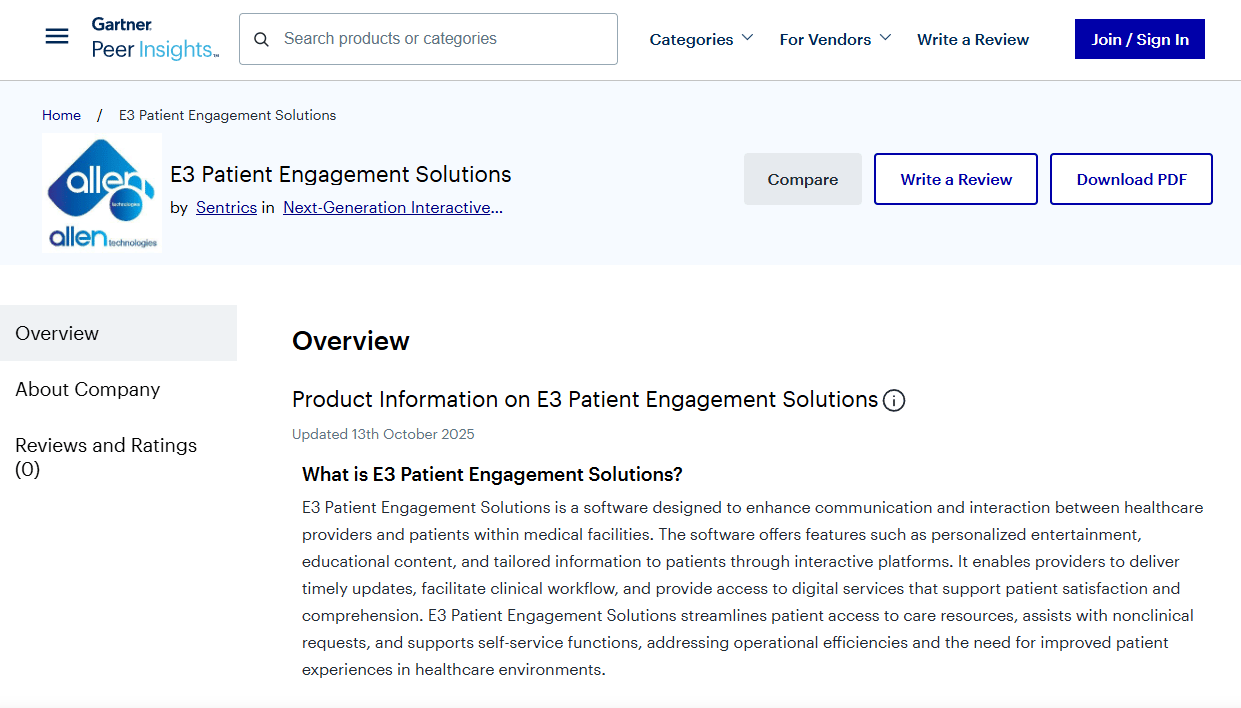
E3 is the Sentrics E3 Patient Experience Platform, providing personalized patient education, two-way communication integrated with the EMR, room-comfort controls, meal ordering, entertainment, and service request automation. The platform is designed to reduce nonclinical disruptions to care teams and improve patient self-sufficiency during the hospital stay.
Best for: Hospitals seeking a bedside interactive platform that combines education, comfort controls, and nonclinical workflow automation.
Key features
- Personalized patient education and health information delivery
- Two-way communication integrated with the EMR
- Room-comfort controls and entertainment access
- Meal ordering and service request automation
- Patient engagement and interaction reporting
Why choose E3: E3's combination of EMR-integrated communication, room-comfort controls, and nonclinical service automation suits facilities where care teams spend significant time on requests that patients could handle independently. Reducing that interruption load is a measurable nursing efficiency outcome.
E3 pricing: Sentrics does not publish E3 pricing publicly. Contact the vendor for a proposal reflecting facility size, configuration, and integration requirements.
16. eCareBoard
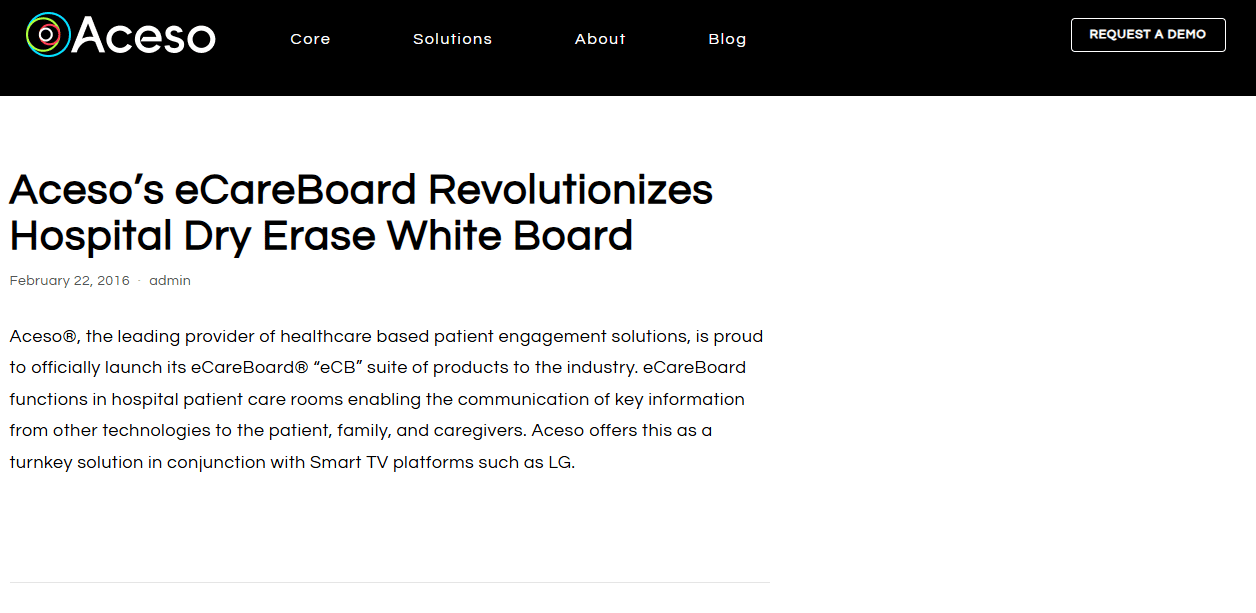
eCareBoard is a digital hospital whiteboard product from Aceso that communicates personalized patient care information to patients, families, and care teams. It integrates with administrative and EHR systems to display care providers, goals, diet orders, allergies, scheduled tests, mobility orders, and other patient-specific information in real time on the room display.
Best for: Hospitals digitizing dry-erase whiteboards and standardizing room-level care information display.
Key features
- Real-time digital care board integrated with EHR and ADT systems
- Displays care providers, goals, diet orders, and allergies
- Scheduled tests, mobility orders, and safety reminders
- Automated updates from clinical and administrative systems
- Patient-facing room communication display
Why choose eCareBoard: eCareBoard addresses a specific problem: Care-team information on room whiteboards goes stale, gets erased, or never gets written in the first place. A digitized board that pulls directly from the EHR removes that maintenance burden and ensures patients and families see current information.
eCareBoard pricing: Pricing is not available on the vendor website. Contact Aceso for a quote based on room count, display hardware, and integration scope.
17. ExtendedCare Bedside
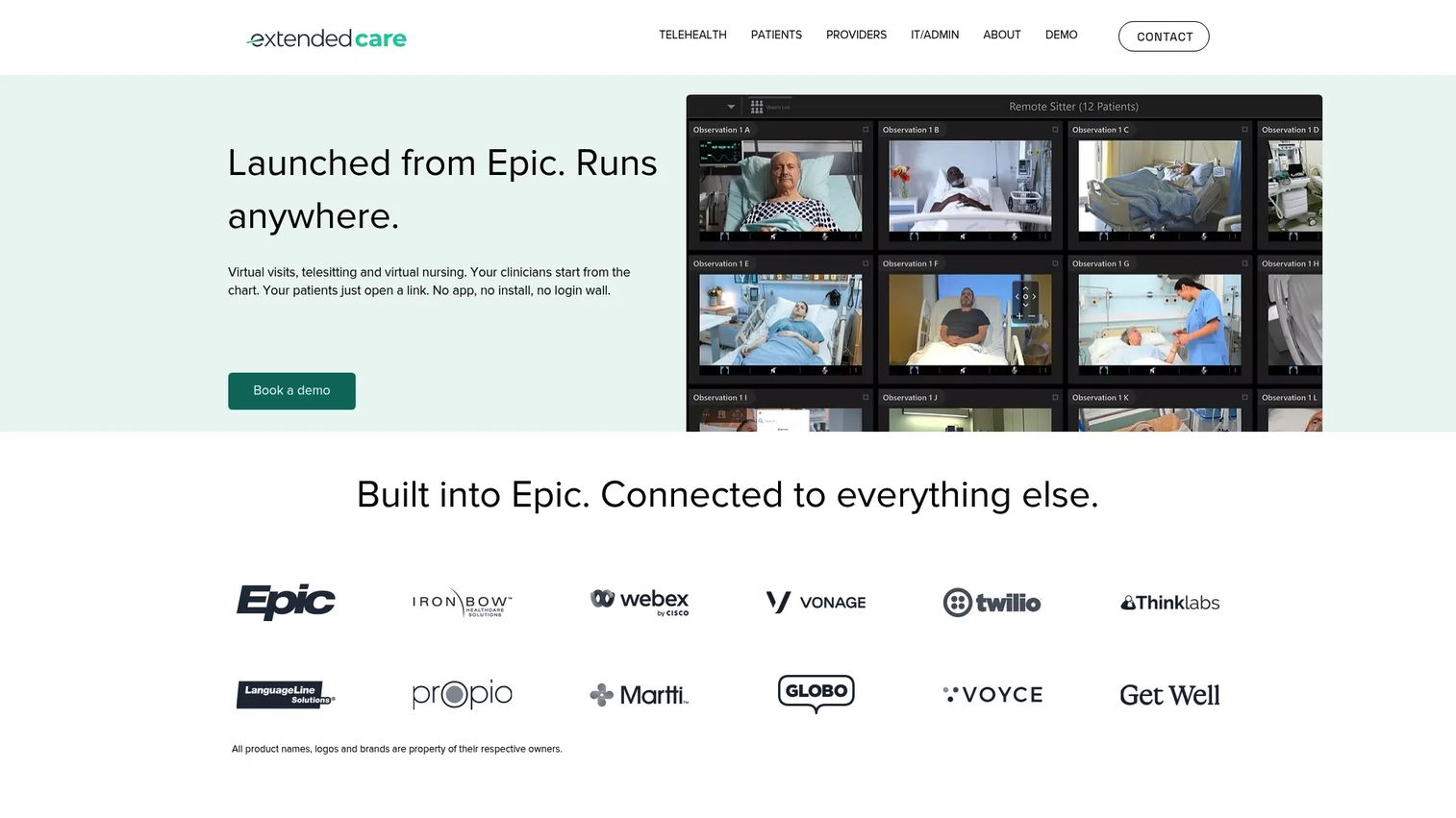
ExtendedCare provides clinically integrated telehealth and patient engagement capabilities for healthcare organizations, including interactive patient waiting room content, two-way audio and video communication, remote patient monitoring through TeleSitter, and Epic Monitor integration. The platform focuses on bedside virtual care and remote workflow support rather than entertainment or meal ordering.
Best for: Health systems integrating virtual nursing, telesitting, and telehealth workflows into inpatient bedside operations.
Key features
- Two-way audio and video communication for remote patient monitoring
- TeleSitter remote patient monitoring and safety observation
- Interactive patient waiting room content: Education, music, and notifications
- Epic Monitor integration for EHR-connected bedside workflows
- Bedside telehealth and virtual care support
Why choose ExtendedCare Bedside: ExtendedCare fits health systems expanding virtual nursing programs or building telesitting capabilities, where the priority is clinical remote oversight rather than entertainment or education content delivery. It complements a broader bedside platform rather than replacing one.
ExtendedCare pricing: ExtendedCare directs prospects to contact sales for pricing. Quotes will reflect virtual care module selection, integration scope, and implementation requirements.
18. mPulse Mobile
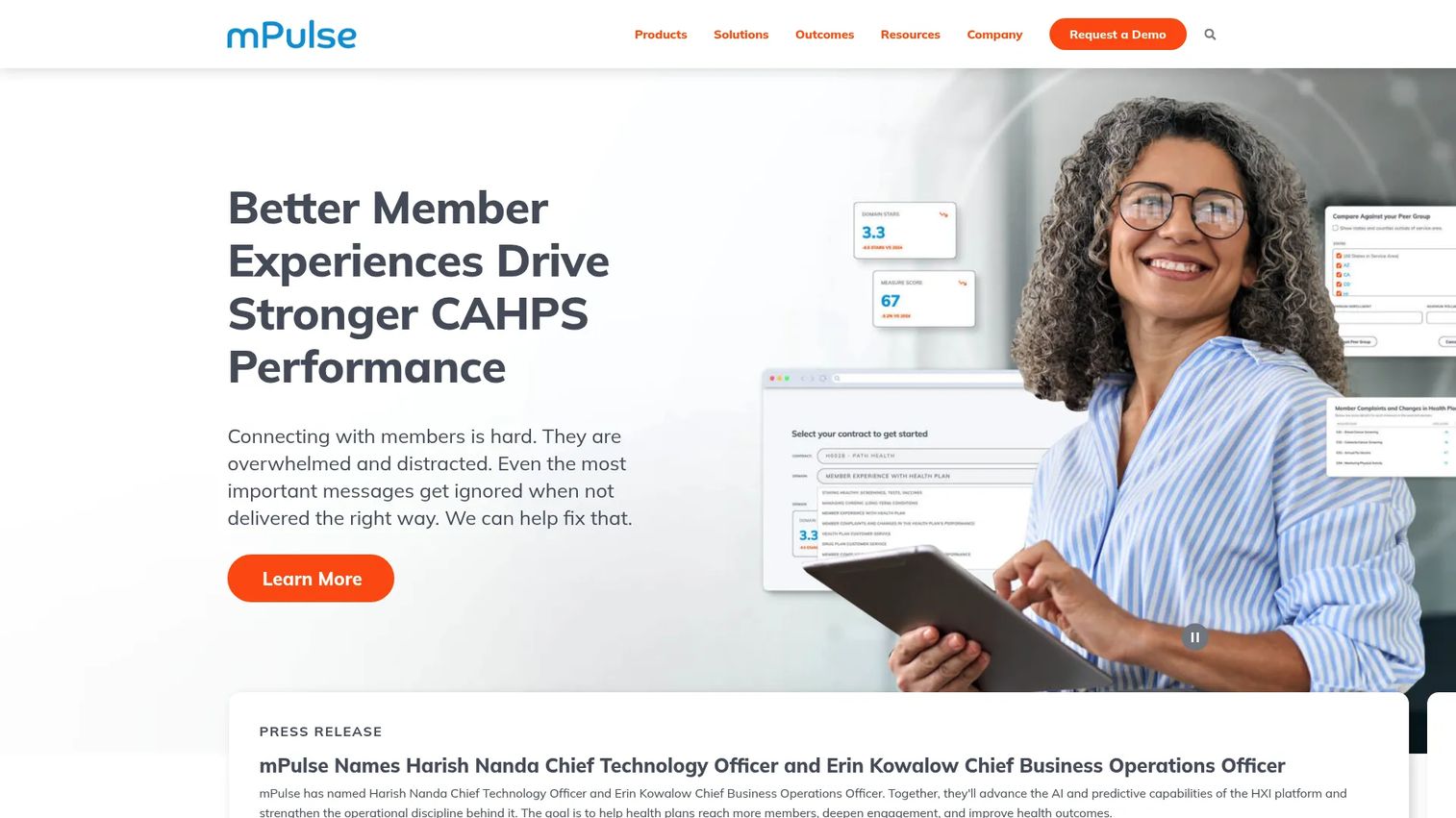
mPulse Mobile is a digital health engagement platform focused on mobile-first patient and member outreach. The platform combines predictive analytics and machine-learning risk models with AI-driven omnichannel engagement across SMS, WhatsApp, IVR, and other channels, plus self-service health portals with secure messaging and live chat. mPulse serves health systems and health plans looking to engage patients outside the hospital room.
Best for: Health plans and health systems running mobile outreach programs for post-discharge engagement, chronic condition management, or pre-visit preparation.
Key features
- Predictive analytics and machine-learning risk stratification
- AI-driven omnichannel engagement: SMS, WhatsApp, and IVR
- Health portals with secure messaging and live chat
- Patient outreach campaign workflows and automation
- Engagement analytics and program performance reporting
Why choose mPulse Mobile: mPulse is the right fit when the primary engagement gap is outside the hospital room, specifically reaching patients through mobile channels before, between, and after care encounters. It is not a bedside system and should be evaluated alongside, rather than instead of, an in-room platform.
mPulse Mobile pricing: mPulse does not publish pricing. The cost will reflect program scope, message volume, channel mix, and integration requirements.
19. My CareBoard
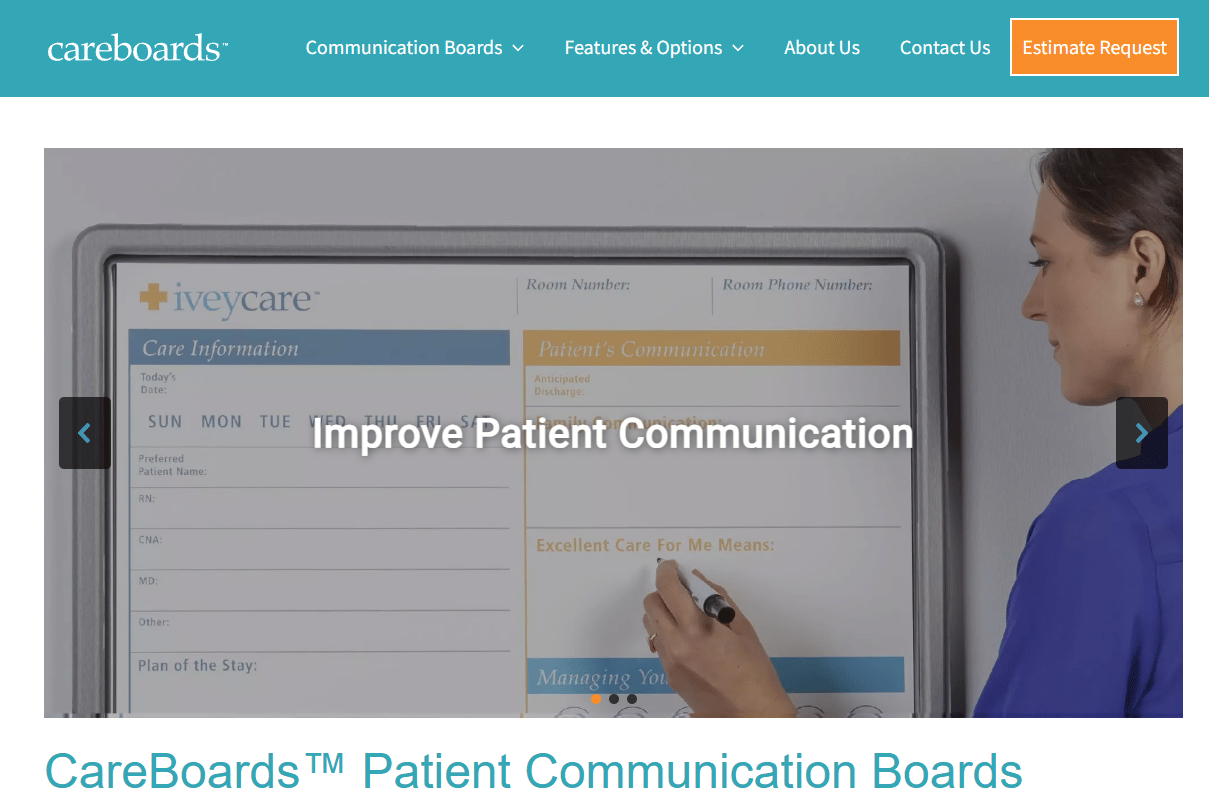
My CareBoard (by Lincor Solutions) is a patient-facing digital care board designed to display care team information, daily goals, schedules, and instructions in the patient room. The product is listed on Gartner Peer Insights. At the time of writing, the domain redirects to a parked page, so buyers should contact Lincor Solutions directly to confirm current availability and product status before including it in a shortlist.
Best for: Hospitals improving room-level care visibility through a patient-facing digital board integrated with clinical systems.
Key features
- Digital care board with care team and goal display
- Daily schedule and patient instruction visibility
- Room communication and care plan information
- Patient-facing information updated from clinical systems
- Bedside room communication display
Why choose My CareBoard: My CareBoard addresses the same room-board problem as eCareBoard but comes from a different vendor lineage. Confirm the current product availability with Lincor Solutions before making a procurement decision.
My CareBoard pricing: Contact Lincor Solutions directly. Pricing information was not accessible through the product website at the time of writing.
20. Caregility iConsult
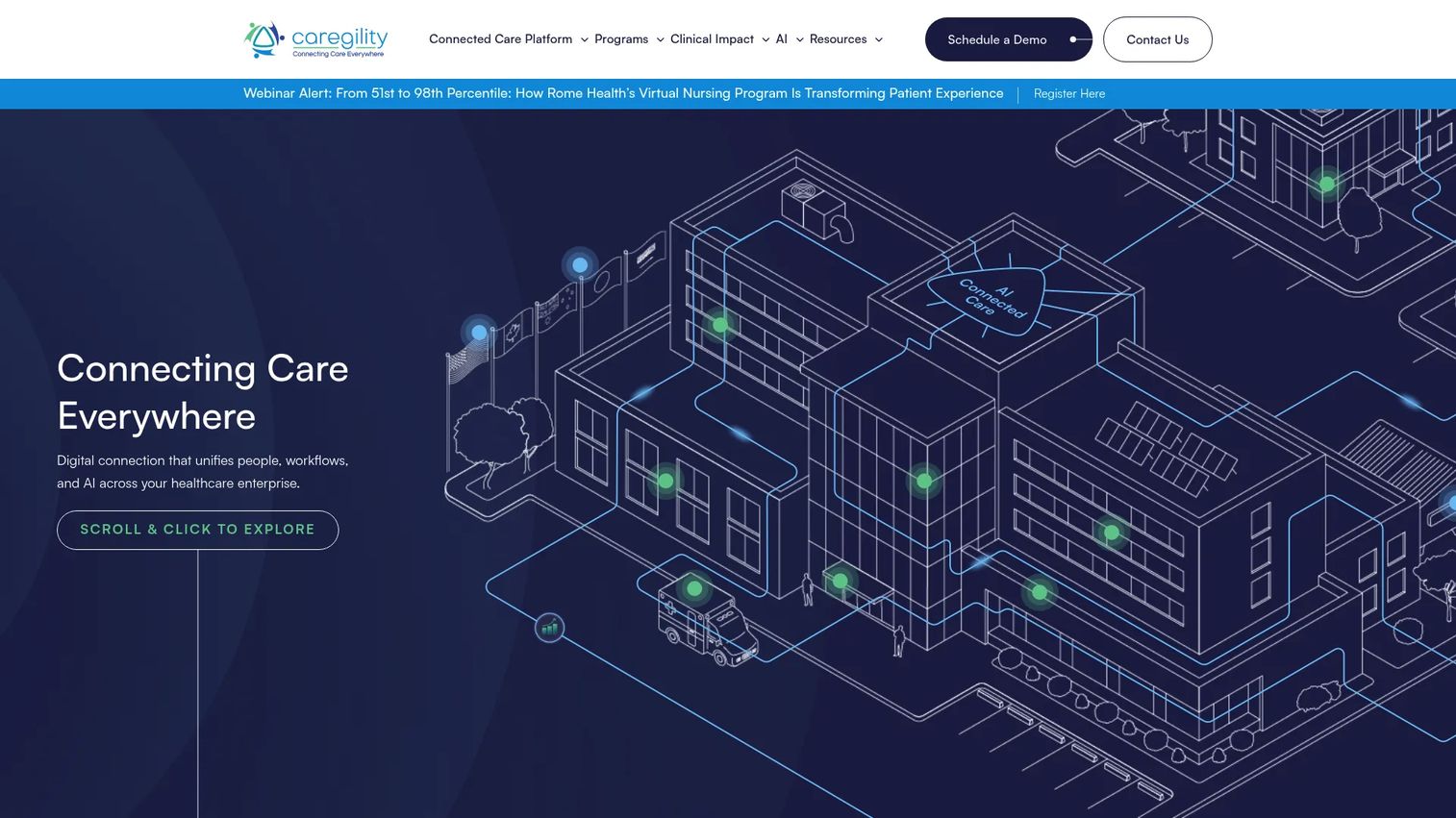
Caregility iConsult is a secure telehealth application for one-to-one virtual engagement between patients, clinicians, specialists, interpreters, and family members. Clinicians and interpreters can be invited by text, email, or call without requiring an app download. The platform supports desktop, mobile, browser, and EHR-integrated virtual visits, with remote camera and audio controls for Caregility bedside devices.
Best for: Healthcare organizations expanding virtual nursing, specialist consults, interpreter access, and family communication at the bedside.
Key features
- One-click invitations for clinicians, interpreters, and family via text, email, or call
- Virtual waiting room, content sharing, and patient hold for private consultations
- EHR-integrated virtual visits across desktop, mobile, and browser
- Remote far-end camera and audio controls for Caregility bedside hardware
- Supports iOS, Android, Chrome, and Safari
Why choose Caregility iConsult: iConsult fits hospitals that need video-first bedside communication without requiring patients or external clinicians to download an app. Its interpreter access workflow is particularly relevant for facilities serving multilingual patient populations or those building a language access program.
Caregility iConsult pricing: Caregility provides pricing in written proposals and quotes rather than publishing rates publicly. Contact the vendor to initiate a scoping conversation.
21. Vibe Health by eVideon
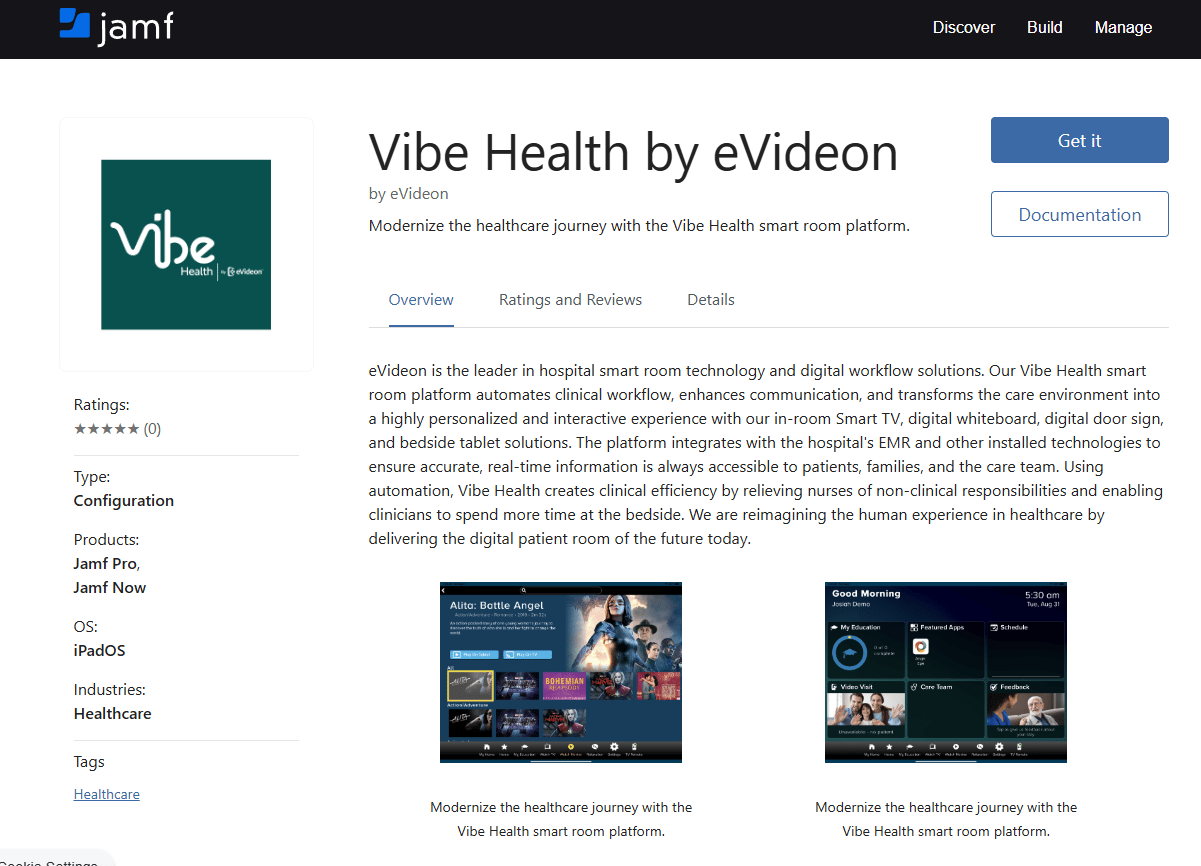
Vibe Health by eVideon is a hospital smart-room platform that connects patient room technologies to improve patient engagement, clinical workflows, communication, and care coordination. Following TigerConnect's acquisition of eVideon in 2025, Vibe Health was rebranded as TigerConnect Smart Room. Organizations evaluating Vibe Health by eVideon should confirm the current product name and feature set directly with TigerConnect before proceeding with procurement.
Best for: Hospitals building a modern connected room environment with integrated engagement, education, and clinical workflow support.
Key features
- Interactive TV with entertainment, meals, service requests, and multilingual support
- Digital whiteboard with EHR-integrated care team information and clinical trends
- Digital door signs: Isolation alerts, PPE requirements, and safety information
- Patient education delivery and engagement tracking
- Connected room platform with clinical workflow integration
Why choose Vibe Health by eVideon: If your organization was evaluating eVideon or Vibe Health before the TigerConnect acquisition, the current equivalent is TigerConnect Smart Room (listed separately as entry 8). Confirm which product documentation and contract terms apply to your procurement with the TigerConnect sales team.
Vibe Health by eVideon pricing: Contact TigerConnect directly. Pricing will reflect the current Smart Room product structure following the 2025 acquisition.
Considerations when choosing interactive patient care systems
Verify EHR and hospital IT integration early
Integration depth determines whether a platform reduces nursing workload or adds to it. Ask specifically about ADT feeds, education documentation write-back, patient authentication, dietary system connections, nurse call integration, and telehealth platform compatibility. A system that runs independently of your EHR creates a manual documentation gap that clinical staff will quickly stop working around.
Map the primary interface before buying
Bedside TV platforms, portal extensions, mobile outreach tools, and digital whiteboards solve different problems. A portal that works well for ambulatory follow-up may not reach a patient who never looks at their phone during an inpatient stay. A TV system that delivers education may not cover post-discharge outreach. Match the interface to the care setting and patient population before evaluating features.
Separate education depth from entertainment depth
Some platforms prioritize condition-specific education with EMR documentation, learning verification, and accreditation-ready reporting. Others prioritize entertainment quality, media variety, and room experience. Both matter, but the budget and implementation effort required to excel at both is significant. Clarify which capability is the primary driver before negotiating scope.
Check implementation ownership and change management
Nursing adoption is the single biggest predictor of whether a bedside engagement system succeeds. Assess the vendor's unit-by-unit rollout approach, content governance model, patient education ownership, device deployment plan, and ongoing support structure. Systems that require significant nursing workflow change without a structured adoption program rarely reach their potential utilization.
Measure workflow and patient experience impact
Define the metrics before go-live: Education completion rates, discharge readiness scores, service request volume and response times, nurse call reduction, meal ordering adoption, virtual visit utilization, and patient satisfaction scores where relevant. Systems that can't report against these metrics make it difficult to justify renewal or expansion investment.
Conclusion
The right interactive patient care system depends on where in the hospital workflow the biggest gap sits. Start by identifying your primary interface requirement, your EHR integration priorities, and whether inpatient education, room experience, virtual care, or mobile outreach is the first problem to solve.
For broad enterprise inpatient experience, Oneview Healthcare and Care Experience Platform provide the widest platform coverage. GetWell Inpatient and Avidex TigrPX are stronger fits for education-first programs with EMR documentation requirements. eVideon and Vibe Health by eVideon (now TigerConnect Smart Room) address smart room modernization. MyChart and Epic MyChart Bedside suit Epic environments prioritizing portal continuity in the room. TigerConnect Smart Rooms and Caregility iConsult are the clearest choices for communication-heavy and virtual care workflows. mPulse Mobile handles mobile-first outreach beyond the room.
Build your shortlist based on care setting, interface type, integration depth, and implementation capacity, then verify total cost of ownership across software, devices, implementation services, and ongoing support before moving to an RFP or demo cycle.
For related reading on care coordination software and digital adoption platforms relevant to healthcare organizations, see those guides for additional market context.
FAQs
Interactive patient care systems are digital platforms that let patients, families, and care teams communicate, access care resources, and request services during a healthcare encounter. They operate through interfaces such as bedside TVs, tablets, smart room devices, patient portals, mobile apps, and connected hospital displays, and typically integrate with EHR, nurse call, dietary, and telehealth systems.
Interactive patient care is typically inpatient and bedside-focused, covering room experience, education, communication, and service requests during a hospital stay. Patient engagement software is a broader category that includes portals, mobile outreach, appointment reminders, survey tools, and post-discharge programs. Some platforms in this list cover both; others specialize in one setting.
Many do, but integration depth varies significantly across vendors. The most important connections to verify are ADT feeds for patient context, education completion write-back, patient authentication, dietary system links, and order or care plan data. Ask each vendor specifically which EHR platforms they have validated integrations with and what data flows in each direction.
GetWell Inpatient, Oneview Healthcare, Avidex TigrPX, pCare (Hub IPS), and Epic MyChart Bedside are strong options for education-focused bedside programs. The right fit depends on your existing EHR, whether you need accreditation-ready education documentation, and whether entertainment and room controls are also required alongside the education layer.
eVideon, Vibe Health by eVideon (now TigerConnect Smart Room), TigerConnect Smart Rooms, and Oneview Healthcare all address smart room use cases. The best fit depends on your hardware environment, existing display infrastructure, clinical communication platform, and whether patient-facing or care-team-facing capabilities are the higher priority.
Some platforms support video visits, remote clinician access, and telesitting workflows. Caregility iConsult is built specifically for this use case. ExtendedCare Bedside covers telesitting and remote patient monitoring. TigerConnect Smart Rooms and eVideon also support video-based clinical workflows. Confirm which clinical scenarios each platform supports before including it in a virtual nursing evaluation.
Most platforms in this category quote based on room count, device type and quantity, integration scope, content library access, implementation services, and ongoing support tier. Ask for total cost of ownership across all components, not only the software subscription, and request references from facilities of a similar size and EHR environment. Board scrutiny on these investments typically requires a full lifecycle cost model rather than a per-room rate.
No. Patient portals focus on longitudinal access to records, messaging, appointments, and billing across the patient relationship. Bedside interactive systems focus on the inpatient room experience, including education, entertainment, service requests, and care-team communication during the hospital stay. Some health systems use both. Portals do not typically handle room controls, meal ordering, nurse call, or real-time care-team visibility, which are core features of dedicated bedside platforms.