A repair order comes in. The estimate lives in one tool. Parts get ordered from a second. Invoices run through QuickBooks. Status updates go out by text, if someone remembers. Every handoff between those systems is a place where a car sits idle, a customer goes quiet, or a margin quietly leaks away.
That gap is exactly what body shop software is built to close. The market backs this up: the auto collision repair management software market is projected to grow from $11.04B in 2025 to $15.62B in 2030, a 7.2% CAGR, according to Research and Markets (2024). Shops are digitizing workflows and integrating with insurers because the manual version stopped scaling.
If you run a collision shop, the pain is not learning what body shop management software is. It is choosing the right one without betting the whole operation on a bad fit. Collision repair software now spans everything from estimating-only tools to full auto body shop software suites that handle repair orders, parts, accounting integrations, and customer communication in one place. Cloud deployment already accounts for roughly 70% of bodyshop management software implementations, per a 2024 Global Bodyshop Management Software Market Outlook, so the question is less "cloud or not" and more "which cloud platform fits my shop's size and cycle time goals."
This guide compares 5 platforms by the operational outcomes that actually move the needle: cycle time visibility, integration depth, pricing posture, and how well each scales from a single bay to multi-site operations.
What's inside
This is for collision repair owners, shop managers, and operations leads comparing software to run estimating, repair orders, scheduling, parts, accounting, and customer updates without stitching five tools together. We selected platforms based on four criteria that matter most to a working shop:
- Workflow depth: how much of the estimate-to-delivery process the tool covers natively.
- Integrations: accounting, DMS integrations, parts ordering, and insurer connectivity.
- Pricing posture: transparent public pricing versus quote-only, and whether there is a free trial.
- Operational scale: fit for a single independent shop versus multi-site capabilities.
We ranked by how completely each tool addresses end-to-end repair operations, not by brand size.
TL;DR
- Best broad operational suite: Mitchell RepairCenter, for established shops that want end-to-end shop management with integrated accounting.
- Best connected ecosystem: CCC Repair Solutions, for shops that live inside insurer and OEM repair procedure workflows.
- Best estimating-first tool for independents: Web-Est, with transparent pricing and a 14-day trial.
- Best modern all-in-one: AutoLeap, for shops wanting management, estimates, payments, and CRM in one platform.
What is body shop software?
Body shop software is a category of collision repair management software that runs the core operating workflow of an auto body shop, from the first estimate through repair, parts, invoicing, and customer delivery, in one connected system.
At minimum, a full shop management software platform handles:
- Estimating: collision repair estimating software that builds line-item estimates, often from an OEM parts and labor database.
- Repair orders: converting approved estimates into tracked repair orders.
- Production tracking: monitoring each vehicle's stage across the shop floor for cycle time visibility.
- Parts management: ordering, receiving, and reconciling parts against the estimate.
- Accounting integrations: syncing invoices and payments to tools like QuickBooks.
- Customer communication: automated status updates, approvals, and delivery notices.
Broader repair management software adds scheduling, workflow automation, reporting, insurer connectivity, OEM repair procedures, and multi-site capabilities. The distinction that matters: estimating tools focus on producing accurate quotes fast, while shop management platforms tie that estimate to the entire operation so nothing falls between systems.
When to use body shop software
Replace spreadsheets and disconnected apps
If your estimate lives in one tool, parts in another, and status updates in a group text, you are paying a coordination tax every day. A single platform removes the manual re-entry between an approved estimate and the repair order, and between a finished job and the invoice. This is usually the trigger that pushes shops from "we manage" to "we need software," especially once volume climbs past what one person can track in their head.
Standardize estimating and repair orders
When two estimators write the same damage two different ways, margins get unpredictable and insurer pushback rises. Standardized estimate workflow, built on a shared parts and labor database, makes every quote consistent and defensible. It also speeds repair scheduling, because approved estimates flow straight into a tracked repair order instead of being rekeyed.
Improve cycle time visibility across the shop
Cycle time is the single number most collision shops fight to lower. You cannot improve what you cannot see. Production tracking that shows every vehicle's current stage, who owns it, and what is blocking it turns cycle time from a monthly guess into a live dashboard. That visibility is where repair efficiency gains actually come from, not from working harder but from removing the idle hours between steps.
Comparison table
We built this comparison from each vendor's own product and pricing pages, cross-referenced with public review ratings from G2 and Capterra. Pricing reflects publicly listed starting prices where available; several vendors sell by quote. The ratings and figures below were the current published values at the time of writing.
| # | Product | Intent | Key differentiation | Pricing | G2 rating |
|---|---|---|---|---|---|
| 1 | Mitchell RepairCenter | End-to-end shop management | Broad operational suite with accounting and payroll integrations | From $149/mo (Capterra) | Not published |
| 2 | CCC Repair Solutions | Connected estimating and repair planning | Insurer and OEM repair procedure ecosystem | Quote-based | 4.7/5 |
| 3 | Web-Est | Estimating-first for independents | Mitchell OEM database with QuickBooks and unlimited imaging | From $154/mo | 3.0/5 |
| 4 | AutoLeap | Modern all-in-one management | Management, estimates, payments, and CRM in one platform | From $179/mo | 4.8/5 |
| 5 | BodyShop Booster | Lead capture and estimate booking | AI-driven 24/7 lead capture and instant reply | Quote-based | 4.0/5 |
1. Mitchell RepairCenter
Mitchell RepairCenter is collision repair shop management software built for auto body operations that want the whole workflow under one roof. It ties estimating, repair orders, and status tracking to the back office, so an approved estimate flows through to parts, invoicing, and customer updates without leaving the platform. For established shops running real volume, that end-to-end coverage is the draw.
Best for: Collision repair shops needing end-to-end shop management and integrated workflows across estimating, parts, and accounting.
Key strengths
- Repair order and workflow management: Runs the full estimate-to-delivery process in one connected system, reducing manual handoffs.
- Accounting and payroll integrations: Syncs financials so invoicing and payroll are not separate silos.
- Online repair status and customer communication: Keeps customers updated on repair progress without manual calls.
Why choose Mitchell RepairCenter: It fits shops that have outgrown point tools and want one operational backbone rather than a stack of apps. If your priority is consolidating estimating, parts management, accounting integrations, and customer updates into a single workflow, this is the broadest option here. It leans toward shops with the volume to justify a full suite.
Mitchell RepairCenter pricing: Mitchell's own pages present modular packages without a public price on the pages reviewed. Capterra lists a starting price of $149 per month flat rate. Because packaging is modular, the practical cost depends on which modules you enable, so a scoped quote is the reliable path. There is no free tier listed.
2. CCC Repair Solutions
CCC Repair Solutions is CCC's collision-repair software suite covering repair planning, diagnostics, OEM repair procedures, parts, and shop workflow. Built on CCC ONE data, it is designed for shops that operate inside the insurer and estimating ecosystem, where connectivity to carriers and access to manufacturer procedures shape daily work. For high-volume DRP shops, that network is the point.
Best for: Collision repair shops needing integrated estimating, repair-planning, and workflow tools connected to insurers and OEM data.
Key strengths
- Repair planning tools built from CCC ONE data: Turns estimate data into structured repair plans that keep jobs moving.
- Diagnostics workflow with scan and calibration management: Tracks scans and calibrations as part of the repair record.
- OEM repair procedures and multi-platform access: Puts manufacturer procedures at the technician's fingertips across devices.
Why choose CCC Repair Solutions: Choose it when your workflow is defined by insurer relationships and you need OEM repair procedures baked into the process rather than looked up separately. The connected ecosystem is the differentiator: estimating, diagnostics, and repair planning share one data spine. The G2 rating of 4.7/5 reflects the overall CCC Intelligent Solutions portfolio, not a standalone product page.
CCC Repair Solutions pricing: Public numeric pricing was not visible on the first-party product pages reviewed. CCC sells through a contact-and-quote model, so cost is scoped to your shop's size, module mix, and insurer connectivity needs. Plan for a sales conversation rather than a self-serve signup.
3. Web-Est
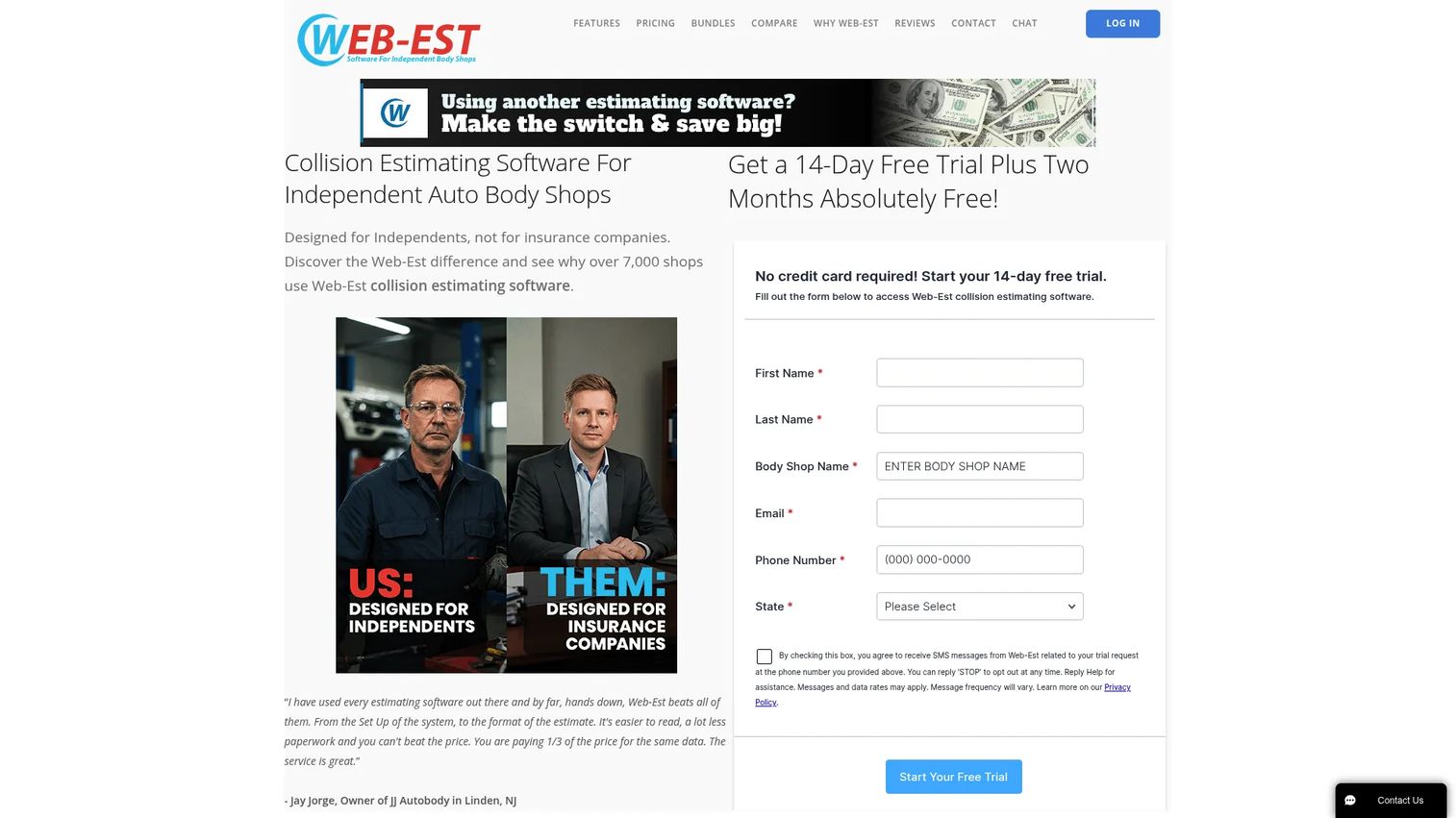
Web-Est is web-based collision estimating software built for independent auto body shops. It is estimating-first by design, pairing the Mitchell International OEM collision database with unlimited imaging and a QuickBooks integration, so smaller shops get accurate, defensible estimates without carrying the overhead of a full enterprise suite. The pricing is refreshingly transparent for this category.
Best for: Independent auto body shops that want lean, estimating-centric collision repair estimating software.
Key strengths
- Mitchell International OEM collision database: Builds estimates on a trusted parts and labor source.
- Unlimited imaging: Attaches unlimited damage photos to estimates without extra cost.
- QuickBooks integration: Connects estimates and invoices to your accounting integrations without manual entry.
Why choose Web-Est: Pick it if estimating is your core need and you would rather not pay for modules you will not use. It suits independents who want a focused tool with a low barrier to entry, backed by no auto-renew contracts and no setup fees. The G2 rating sits at 3.0/5, so weigh reviews against your specific workflow before committing.
Web-Est pricing: Web-Est starts at $154 a month, with a separate Basic Website Package at $20 a month. The pricing page emphasizes a 14-day free trial, no auto-renew contracts, and no setup fees, which lowers the risk of trying it against your current estimating workflow.
4. AutoLeap
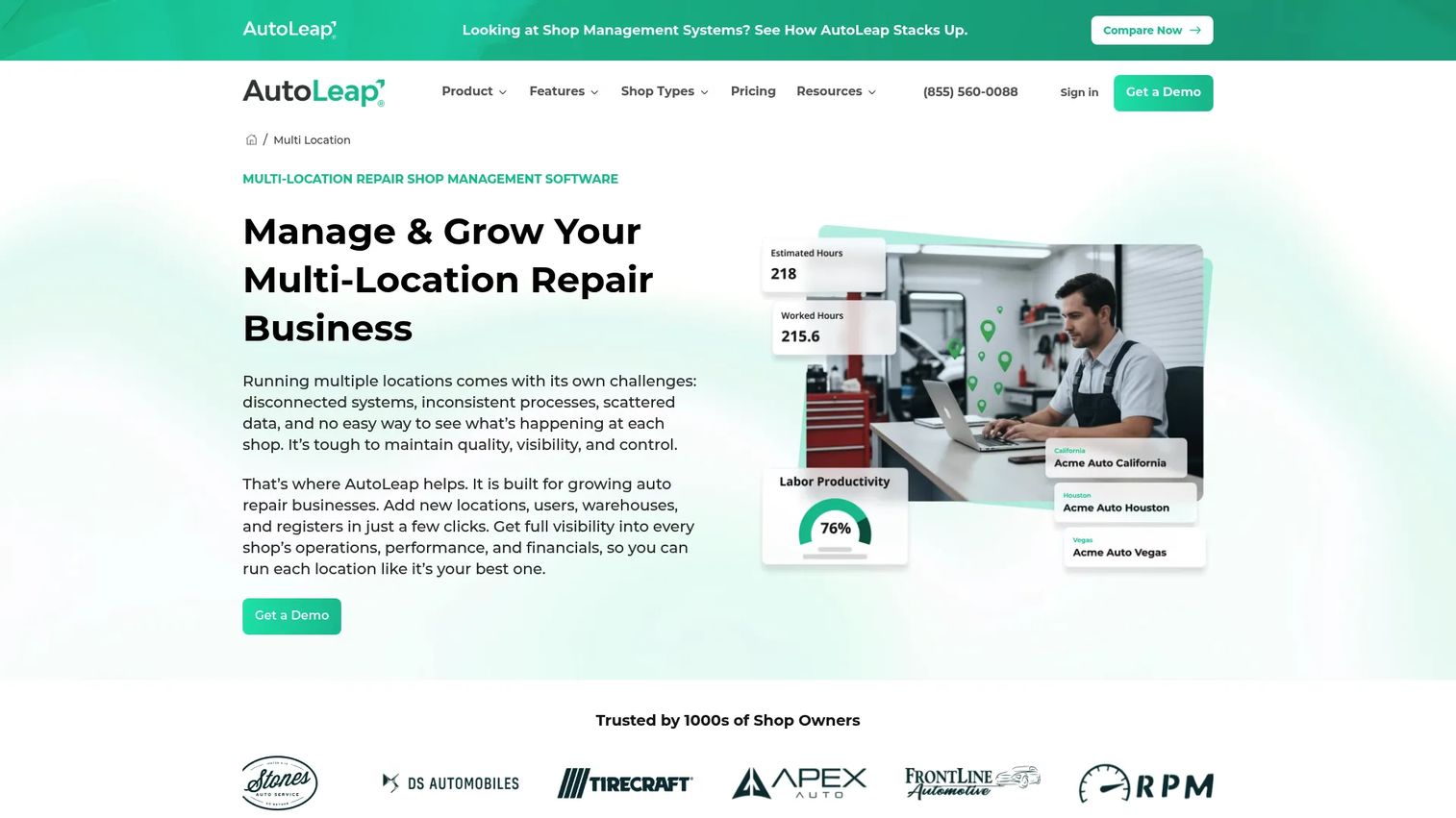
AutoLeap is all-in-one auto repair shop management software that combines shop management, estimates, payments, and customer communication in one modern platform. It leans into a strong front-office experience: digital inspections, labor guides, and CRM-style follow-up, making it a fit for shops that want current workflow tooling rather than legacy software. The transparent tiered pricing helps shops budget before a sales call.
Best for: Auto repair shops needing shop management, estimates, payments, and customer communication in one platform.
Key strengths
- Digital inspections: Runs photo-based inspections that build trust and support estimates.
- Labor guides: Standardizes labor time so estimates stay consistent and defensible.
- CRM and customer communication: Automates service reminders and customer updates to drive repeat business.
Why choose AutoLeap: Pick it when you want a modern, integrated platform with strong customer communication and reporting, not a patchwork of older tools. Its 4.8/5 G2 rating is the highest on this list, and the front-office polish appeals to shops focused on repeat business and repair efficiency. It suits owners who value a clean interface their team will actually use.
AutoLeap pricing: AutoLeap publishes four tiers billed annually: Essentials at $179/month, Pro at $309/month, Elite at $409/month, and Enterprise at custom pricing. Monthly and annual billing are both shown, with annual priced lower. There is no free trial, so scope your needs against the tier features before committing.
5. BodyShop Booster
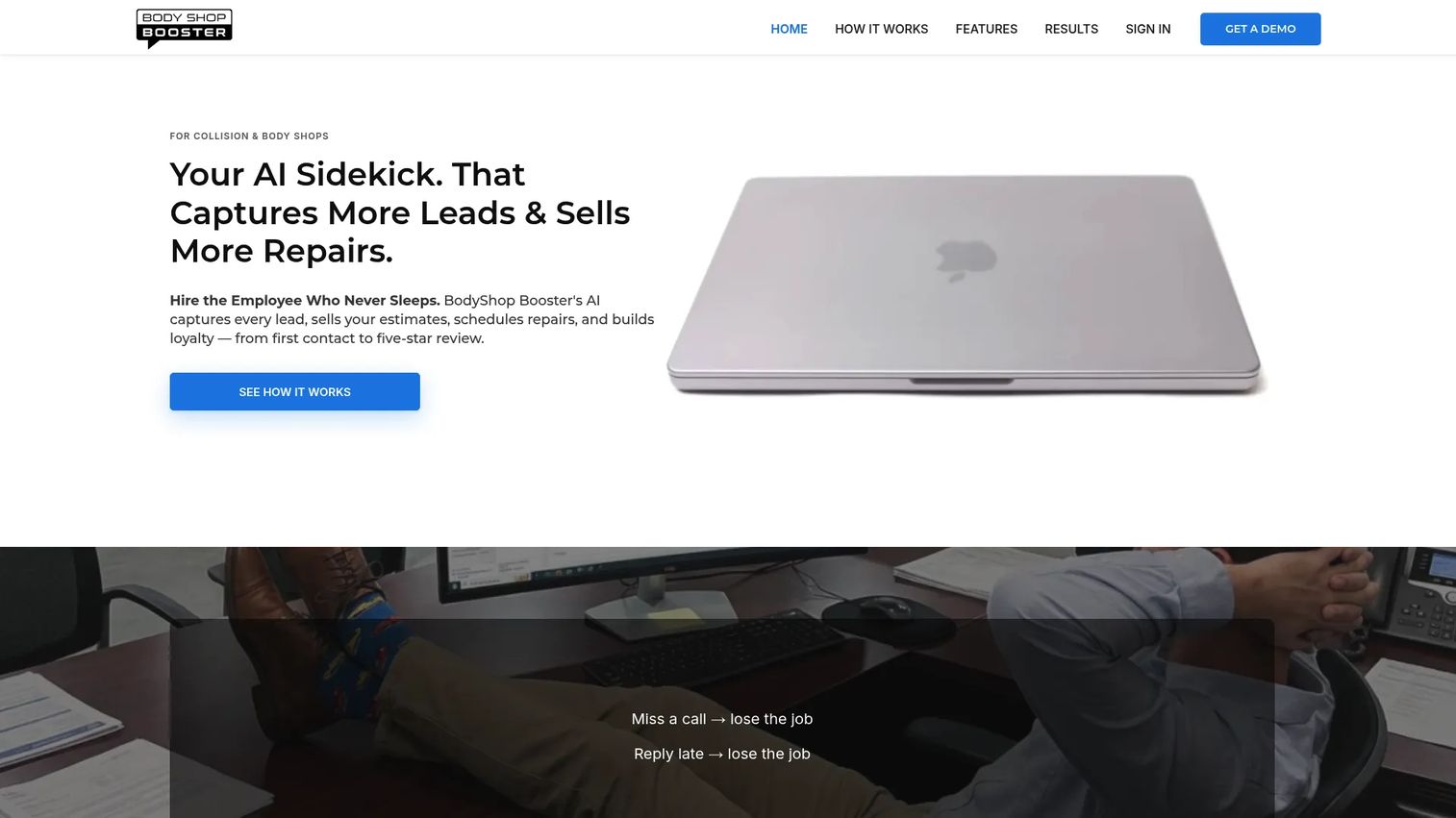
BodyShop Booster is AI lead capture and booking software for collision and body shops. Instead of managing the full repair backend, it focuses on the front door: capturing leads 24/7, replying instantly, and helping shops sell and book repair estimates. It is a customer-experience and workflow-visibility layer aimed at converting more inbound interest into booked jobs.
Best for: Collision shops that want automated lead capture and estimate booking with simpler operational control.
Key strengths
- 24/7 lead capture: Captures inbound leads around the clock so none slip through.
- Instant reply automation: Responds to prospects immediately to keep them engaged.
- Repair estimate selling and booking: Turns estimate interest into scheduled appointments.
Why choose BodyShop Booster: Choose it when your bottleneck is converting inbound interest and booking estimates, not managing the repair floor itself. It pairs well with a core management tool, adding a lead-capture and customer-experience layer on top. The 4.0/5 G2 rating is based on limited reviews, so treat it as an emerging option and validate with a demo.
BodyShop Booster pricing: No public pricing number was found on the brand's site. Pricing is discussed during a demo rather than published, so plan for a sales conversation to scope cost against your lead volume and booking goals.
Considerations
Before you commit, run each shortlisted tool through this checklist.
Workflow coverage versus your actual process
Map the tool to your real estimate-to-delivery flow. A broad suite like Mitchell RepairCenter earns its keep only if you use the modules; an estimating-first tool like Web-Est is a better fit if that is your core gap. Buying more than you need is as costly as buying too little.
Integrations and DMS integrations
Confirm the tool connects to your accounting integrations (QuickBooks is common), your parts ordering vendors, and any DMS integrations you rely on. Broken data flow between systems reintroduces the manual re-entry you were trying to eliminate.
Cycle time and production tracking
If lowering cycle time is the goal, prioritize production tracking that shows live vehicle status by stage. Ask each vendor exactly how the tool surfaces bottlenecks, not just whether it "tracks jobs."
Pricing posture and total cost
Some tools publish flat pricing; others quote per user or by module. Model the real cost at your team size and volume, and factor in trials. Web-Est let you test at low or no cost, while AutoLeap and CCC require more upfront scoping.
Scale and multi-site capabilities
If you run or plan to run multiple locations, confirm multi-site capabilities and centralized reporting now. Migrating later is far more painful than choosing for scale up front.
Conclusion
The right auto body repair software depends on what you are trying to fix. If you are replacing a legacy system and want one operational backbone across estimating, parts, and accounting, Mitchell RepairCenter and CCC Repair Solutions are the broadest, most connected suites. If your operation is defined by insurer relationships and OEM repair procedures, CCC's ecosystem is hard to beat.
For independents who want lean, transparent estimating, Web-Est delivers with a real trial and no contract lock-in. For a modern all-in-one that scales with multi-site capabilities and strong front-office workflow, AutoLeap carries the highest rating here. And if converting inbound leads into booked estimates is the bottleneck, BodyShop Booster targets exactly that.
Next step: shortlist two tools that match your primary outcome, whether that is cycle time, integration depth, or repair efficiency, and run each against your actual repair flow during a trial before you sign.
FAQs
Body shop software is auto body shop software that runs collision repair operations, estimating, repair orders, parts, accounting, and customer updates, in one connected system. It replaces the patchwork of spreadsheets, standalone estimating tools, separate accounting apps, and manual text updates that most shops accumulate over time. The goal is to remove the handoffs between those disconnected systems.
Prioritize estimating built on a trusted OEM database, repair order and production tracking, parts management, accounting integrations, and automated customer communication. For growing shops, add multi-site capabilities and reporting. The features that matter most are the ones that eliminate manual re-entry between steps in your specific workflow.
It gives you production tracking that shows every vehicle's stage in real time, so idle hours and bottlenecks become visible instead of hidden. When approved estimates flow straight into repair orders and parts ordering, you cut the delays that come from rekeying data between systems. Lower cycle time comes from removing those gaps, not from rushing the work.
Estimating software, like collision repair estimating software, focuses on producing accurate, defensible quotes fast, often from an OEM parts and labor database. Shop management software takes that estimate and connects it to the whole operation: repair orders, scheduling, parts, accounting, and customer updates. Estimating tools solve one job well; management platforms tie the whole shop together.
If you want to stop double-entering invoices and payments, yes. Accounting integrations, commonly with QuickBooks, sync financial data automatically so your books stay current without manual work. Shops running any real volume find this one of the highest-value connections in a shop management software stack.
For many shops, yes, especially mobile mechanics and owners who move around the floor. Mobile access lets you build estimates, run inspections, and send customer updates from a phone or tablet instead of a back-office desktop.
Prioritize multi-site capabilities, centralized reporting across locations, and consistent estimate workflow so every shop quotes the same way. Confirm the platform can roll data up for owners while giving each location its own operational view. Choosing for scale early avoids a painful migration once you add sites.
Match the tool to your primary bottleneck. If estimating accuracy and speed are your gap and you already handle the back office, a focused estimating tool keeps cost and complexity low. If manual handoffs between estimating, parts, accounting, and customer communication are draining time, a full shop management software suite pays for itself by closing those gaps.