You shipped four ad variants on Monday. By Friday, media wanted forty. Different sizes, three languages, two product lines, and a brand team that still needs to approve every frame before anything goes live.
That gap between what performance marketing demands and what manual production can deliver is the exact friction creative management platforms exist to close. The category market is projected at USD 1.58 billion in 2026, climbing toward USD 4.6 billion by 2035 at a 12.67% CAGR, according to Business Research Insights (2026). That growth is not hype. It tracks a real operational shift: channels multiplied, formats fragmented, and ad creative production cycles stayed stuck in a world where one designer rebuilds the same banner forty times.
A creative management platform pulls production, variant generation, dynamic creative optimization, omnichannel publishing, and performance visibility into one centralized workflow. Instead of fragmented files across drives, drag-and-drop builders, and a separate analytics tool nobody opens, you get a single system where creative ops, design, and media actually move in sync. The payoff is measurable ROI: more campaigns launched, brand consistency held, and creative output that scales without adding headcount or operational drag. If you are also rethinking how you track downstream performance, it pairs naturally with the way analytics platforms drive roi and how marketing analytics tie creative to revenue.
What's inside
This guide is for performance marketers, creative ops leads, demand gen managers, and marketing leaders who need faster ad creative production, tighter collaboration between design and media, and stronger performance optimization across channels. We evaluated seven creative management platforms against four criteria that actually predict fit: workflow depth (templates, approvals, version control), DCO and variant generation support, publishing flexibility across display, social, video, and CTV, and creative analytics. We also weighed how each platform fits different team sizes, from lean startups to enterprise creative orgs. No tool wins every category. The point is to match the platform to your specific bottleneck.
TL;DR
- Best for enterprise-scale automation: Celtra, for large creative orgs producing and governing high volumes of ad creative.
- Best for omnichannel publishing: Bannerflow, for teams pushing campaigns live across markets and channels fast.
- Best for collaboration-heavy teams: Storyteq, for brand consistency and localization across distributed markets.
- Best for design speed: Rocketium, for fast variant generation without rebuilding assets.
- Best for AI-assisted ad creation: AdCreative.ai, for leaner teams that want performance-oriented creative quickly.
- Best for rich media and display: Somplo, for agencies and brands building interactive display campaigns.
Each pick reflects a different operational reality. Read your bottleneck first, then read the list.
What is a creative management platform?
A creative management platform is software that centralizes ad creative production, dynamic creative optimization, omnichannel publishing, and creative analytics so marketing and creative teams can produce, scale, and measure campaigns from one place.
Unlike a basic design tool or a digital asset manager that mostly stores files, creative management software is built around the full production lifecycle. It connects templating, variant generation, approvals, publishing, and performance data into one centralized workflow. That is the difference between storing creative and operating it.
Core functions that matter when evaluating any creative automation platform:
- Centralized asset management: A single source of truth for templates, brand assets, and approved creative, with version control so teams never ship the wrong file.
- Template-based production: Master templates that auto-resize and adapt across formats, so one build produces dozens of on-brand variants.
- Variant generation: Programmatic creation of size, language, message, and audience variants without rebuilding from scratch.
- Dynamic creative optimization: DCO software that swaps creative elements (copy, imagery, offers) in real time based on audience, feed, or performance data.
- Omnichannel publishing: Direct publishing to display, social ads, video, and CTV, with scheduling and live campaign updates.
- Creative analytics: Performance visibility tied to creative variants, so you know which version is driving the result.
- Collaboration and approvals: Review workflows, comments, and sign-off so brand and legal stay in the loop without email chains.
- Localization: Translation and market-specific adaptation built into the production flow, not bolted on after.
The platforms that win combine all of these into one system. The ones that frustrate teams cover two or three well and force you back into spreadsheets for the rest. Strong creative analytics and clean DCO execution are usually the dividing line between a directory of features and a platform that actually moves your numbers.
When to use creative management platforms
Not every team needs one. If you run a handful of static campaigns a quarter, a design tool and a shared drive may be enough. The case for a creative management platform sharpens in three specific situations.
Scale ad production across multiple channels
When media keeps asking for more variants than your team can hand-build, manual production becomes the bottleneck that caps spend. A creative management platform lets one master build produce dozens of channel-ready sizes and formats automatically. This is where creative workflow automation stops being a nice-to-have and starts protecting your campaign scaling targets. If you are launching across display, social, video, and CTV at once, programmatic variant generation is the only way the math works.
Keep brand consistency across distributed teams
When multiple teams, regions, or agencies all touch creative, drift is inevitable. Logos shift, colors slip, and off-brand assets reach live campaigns. Template-based production with locked brand rules and version control keeps every output on-brand without a manual QA pass on each file. Strong brand governance inside the platform means brand consistency holds even when production scales across dozens of contributors.
Localize campaigns without rebuilding every asset
When you expand into new markets, region-specific and audience-specific variants pile up fast. Rebuilding each asset by hand for every language and locale does not scale. Localization built into the production flow lets you adapt copy, currency, imagery, and legal text from a master template, so a campaign that hits five markets does not become five separate production projects. This is often the single biggest time saver for teams running global rollouts, and it ties directly into marketing workflow efficiency across the org.
Comparison table
The table below sorts the seven platforms by their primary fit. Pricing for most of this category is custom and tailored to scale, so we have noted where public figures exist and where vendors quote based on use case. G2 ratings reflect current listings at the time of writing. Use the table to shortlist two or three platforms against your bottleneck, then read the full sections.
| # | Product | Intent | Key use case | Pricing | G2 rating |
|---|---|---|---|---|---|
| 1 | Bannerflow | Omnichannel scale | Multi-market creative automation and publishing | Custom (tailored) | 4.5/5 |
| 2 | Smartly | Enterprise performance | AI-assisted creative, media, and DCO at scale | Custom (contact sales) | 4.4/5 |
| 3 | Celtra | Enterprise automation | High-volume ad creative production and governance | Custom (by scale) | 4.4/5 |
| 4 | Rocketium | Production speed | Fast variant generation and on-brand scaling | Custom (by plan) | 4.2/5 |
| 5 | Somplo | Rich media display | Interactive rich media and display campaigns | Custom | 4.9/5 |
| 6 | Storyteq | Localization and brand | Multi-market content adaptation and approvals | Price on application | 4.4/5 |
| 7 | AdCreative.ai | AI ad creation | Fast AI-generated ad variants for lean teams | From $39/mo | 4.3/5 |
A quick read: enterprise creative orgs gravitate to Celtra, Smartly, and Storyteq. Teams chasing speed lean toward Rocketium and AdCreative.ai. Bannerflow and Somplo sit in the middle, strong on publishing and rich media respectively. For a broader view of how creative connects to the rest of the stack, the roundups on marketing automation and marketing resource management are worth a scan.
1. Bannerflow
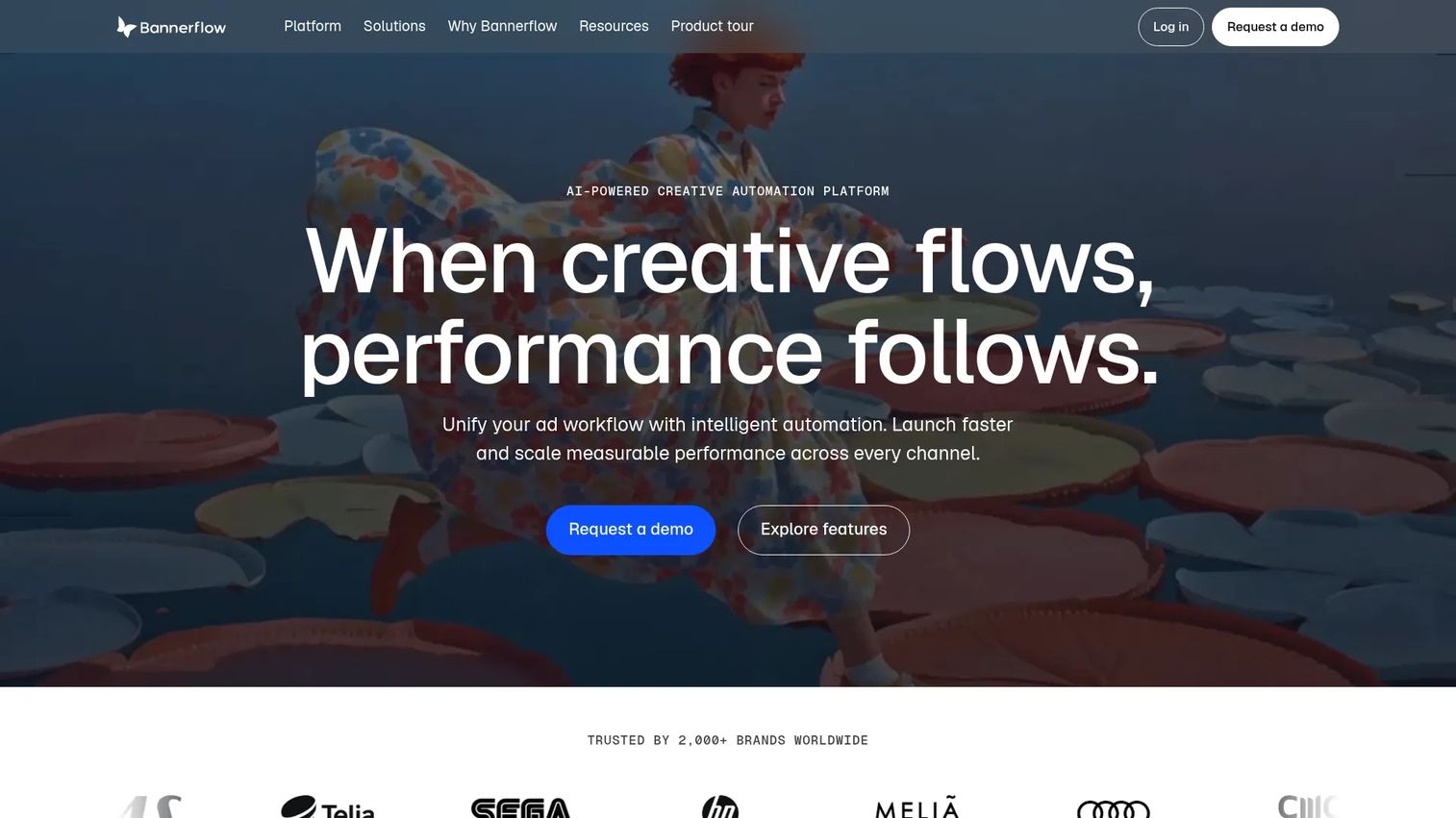
Bannerflow is a creative automation platform built for marketing teams that produce, localize, publish, and optimize digital ad campaigns across many markets at once. It centers on an AI-powered Creative Studio, feed-based dynamic ads, and direct publishing, so in-house teams can move from concept to live campaign without bouncing between five disconnected tools. The pitch is straightforward: bring multi-market ad production in-house and stop paying the agency tax on every resize.
Best for: In-house marketing teams that need enterprise-scale creative automation for multi-market, multi-channel ad production.
Key strengths
- AI-powered Creative Studio: Build master creatives once, then auto-generate sizes and variants across formats without rebuilding.
- Feed-based dynamic ads: Drive DCO from data feeds so creative updates automatically as products, prices, or offers change.
- Publishing and scheduling: Push campaigns live across channels with scheduling and real-time management from one dashboard.
Why choose Bannerflow: If your bottleneck is speed-to-market across many regions, Bannerflow's combination of localization, dynamic creative optimization, and integrated publishing removes the manual handoffs that slow global teams. It suits performance marketers who want to control creative end to end and tie output directly to campaign scaling, rather than waiting on external production for every variant.
Bannerflow pricing: Bannerflow does not publish fixed prices. Its pricing page offers tailored plans, referenced as Grow, Pro, and Enterprise tiers, and asks teams to request a demo for an estimate based on scale and usage. Expect enterprise-oriented packaging rather than a self-serve monthly plan.
2. Smartly
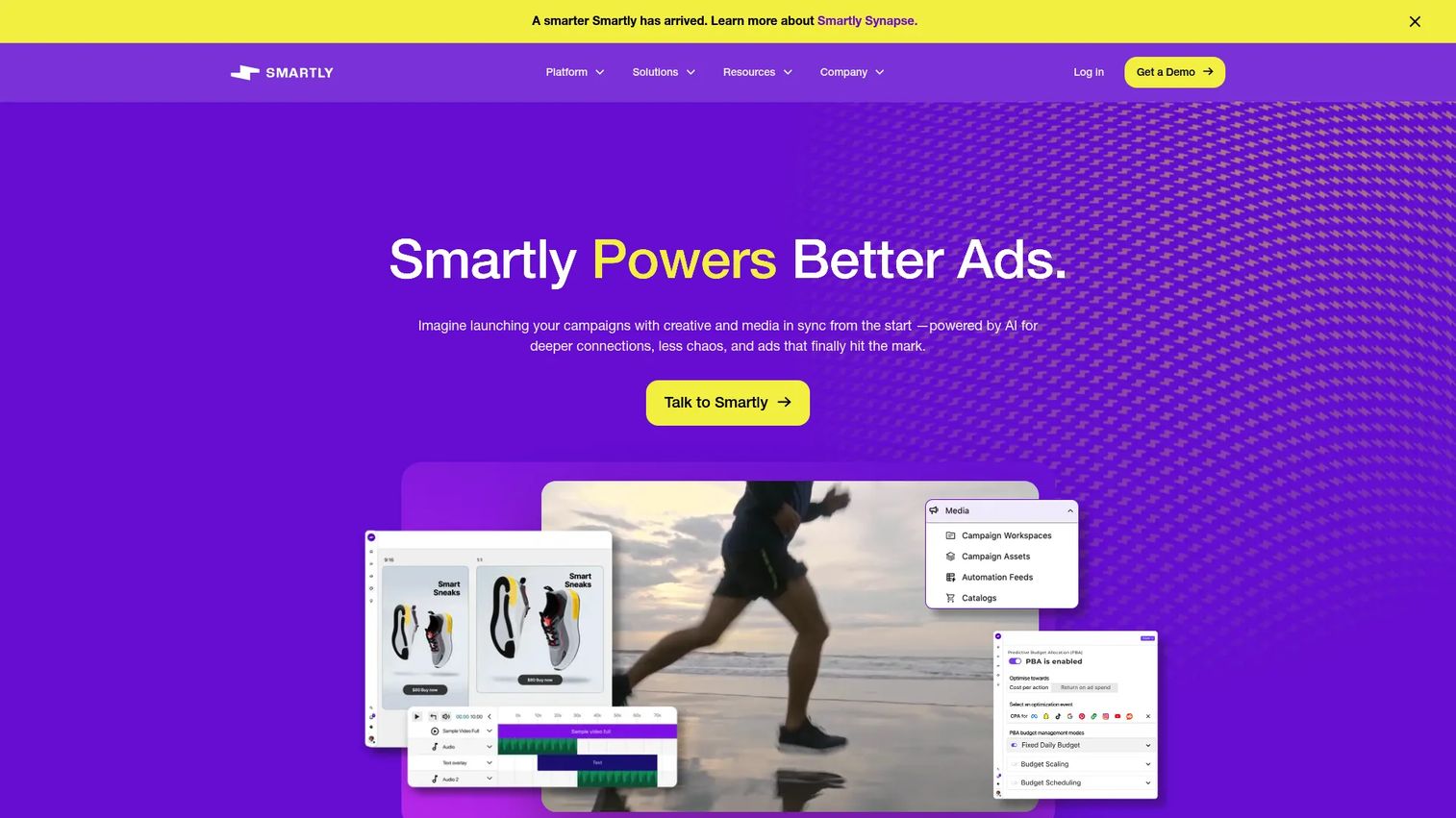
Smartly is an AI-powered advertising platform that connects creative, media, and measurement in one workflow. It is built for enterprise brands and agencies running multi-channel digital advertising at scale, where creative production, dynamic creative optimization, and budget allocation all need to operate together rather than in separate tools. Smartly's positioning leans heavily on AI-assisted creative generation paired with performance feedback loops.
Best for: Enterprise performance marketing teams and agencies that want creative production and media optimization unified under one platform.
Key strengths
- AI Studio for creative: Generate and enhance image and video creative, then scale variants for testing across channels.
- Dynamic creative optimization: Run DCO across channels so the right creative reaches the right audience automatically.
- Predictive budget allocation: Use performance insights to shift spend toward the creative and placements that convert.
Why choose Smartly: Smartly fits teams that see creative and media as one problem, not two. If you are tired of producing creative in one tool, trafficking it in another, and reconciling performance in a third, Smartly's unified model reduces that handoff cost. It is built for scale, so it resonates most with larger teams managing significant spend across paid social and beyond.
Smartly pricing: Smartly does not disclose public pricing. The site directs prospects to request a demo or contact sales, and packaging is tailored to channel mix, spend, and team size. Plan for enterprise-level investment rather than a published entry tier.
3. Celtra
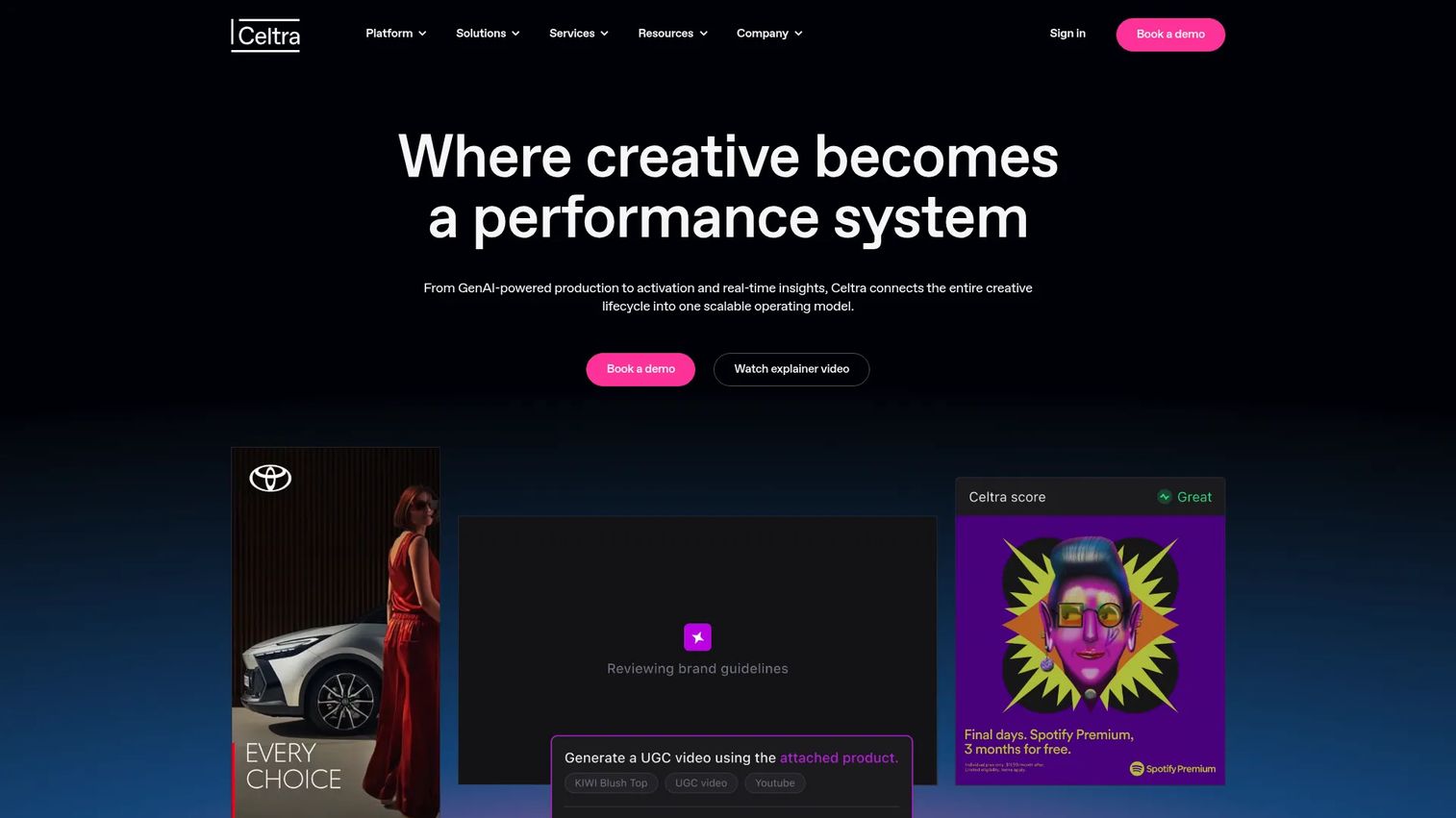
Celtra is enterprise creative automation software for designing, scaling, and activating digital ad creative at high volume. It is built for large marketing and creative teams that need to produce thousands of on-brand assets while keeping governance, QA, and brand consistency intact. Celtra leans into AI-powered production alongside dynamic product ads and rich media, making it a strong fit for creative orgs that treat production as an operational discipline.
Best for: Large creative and marketing teams that need to produce and govern ad creative at serious scale.
Key strengths
- AI-powered creative production: Automate the repetitive build work so designers focus on concept, not resizing.
- Dynamic product and rich media ads: Generate dynamic product ads, video, and rich media creative from structured data.
- Enterprise governance and QA: Built-in performance insights, quality checks, and approval controls keep large workflows on-brand.
Why choose Celtra: Celtra is for teams where creative volume and brand control are both non-negotiable. If you are producing at a scale where a single off-brand asset slipping through is a real risk, Celtra's governance and QA layers earn their place. It is an enterprise-grade creative automation platform, so it fits creative ops leaders standardizing production across global teams.
Celtra pricing: Celtra does not publish fixed pricing. The company states that pricing is tailored to use case and scale, and directs prospects to book a demo. There is no free tier; expect custom enterprise packaging aligned to production volume.
4. Rocketium
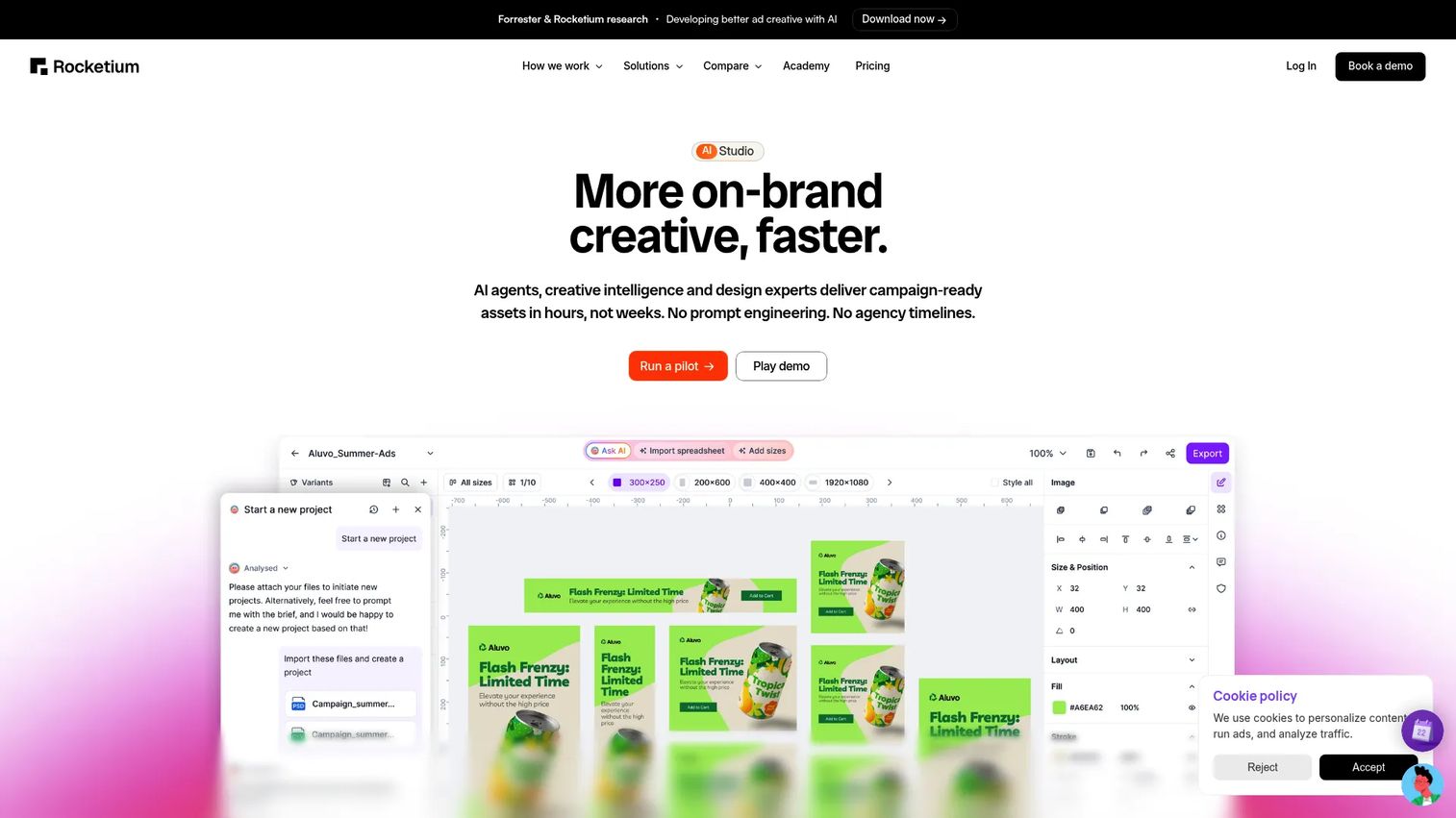
Rocketium is an AI studio for scaling on-brand creative production, combining AI agents, self-serve editing, and collaboration in one workspace. It is built for teams that need to turn briefs into finished assets fast and generate many variants without rebuilding each one by hand. Rocketium's emphasis on speed and usability makes it a practical pick for marketing teams under constant pressure to ship more creative.
Best for: Enterprise and growth teams that need to scale creative production and versioning quickly.
Key strengths
- AI agents for asset creation: Turn briefs into ready-to-edit assets, compressing the gap between request and output.
- Self-serve editing and collaboration: Let marketers make changes without a designer in the loop for every tweak.
- Asset repository and brand compliance: Keep approved assets centralized with brand rules applied across outputs.
Why choose Rocketium: If your core problem is throughput, the volume of variants your team is expected to produce, Rocketium is built to attack that directly. It reduces the design dependency that bottlenecks campaign launches, which matters for lean teams where a single designer cannot keep up with media's appetite for variants. The trade is a focus on production velocity over deep enterprise governance.
Rocketium pricing: Rocketium publishes a pricing page, but specific plan figures are not displayed publicly and are quoted by plan. Teams should request details directly to match pricing to volume and seat needs. The homepage now resolves at rocketium.ai.
5. Somplo
Somplo is a creative management platform focused on rich media advertising campaigns. It combines a no-code Creative Studio, an AdServer for campaign management with live updates, and a library of ready-to-go rich media, video, and social ad templates. The platform is built for media agencies and brands that want to produce interactive display and rich media creative without writing code or wrangling complex integrations.
Best for: Media agencies and brands creating rich media and interactive display ads at scale.
Key strengths
- No-code Creative Studio: Build interactive rich media creative without developers, lowering the barrier to advanced display formats.
- AdServer with live updates: Manage campaigns and change creative in live campaigns without re-trafficking everything.
- Ready-to-go templates: Start from proven rich media, video, and social ad templates to speed production.
Why choose Somplo: Somplo is the specialist pick when rich media and interactive display are central to your media plan. If your campaigns rely on engaging, interactive ad formats rather than static banners, Somplo's no-code studio and live-update AdServer remove the technical drag that usually comes with rich media. It earns strong user satisfaction, reflected in its high G2 standing among creative management software.
Somplo pricing: Somplo does not publish public pricing on its site, and plans are quoted directly. Teams interested in rich media production should contact Somplo for a tailored estimate based on campaign volume and needs.
6. Storyteq
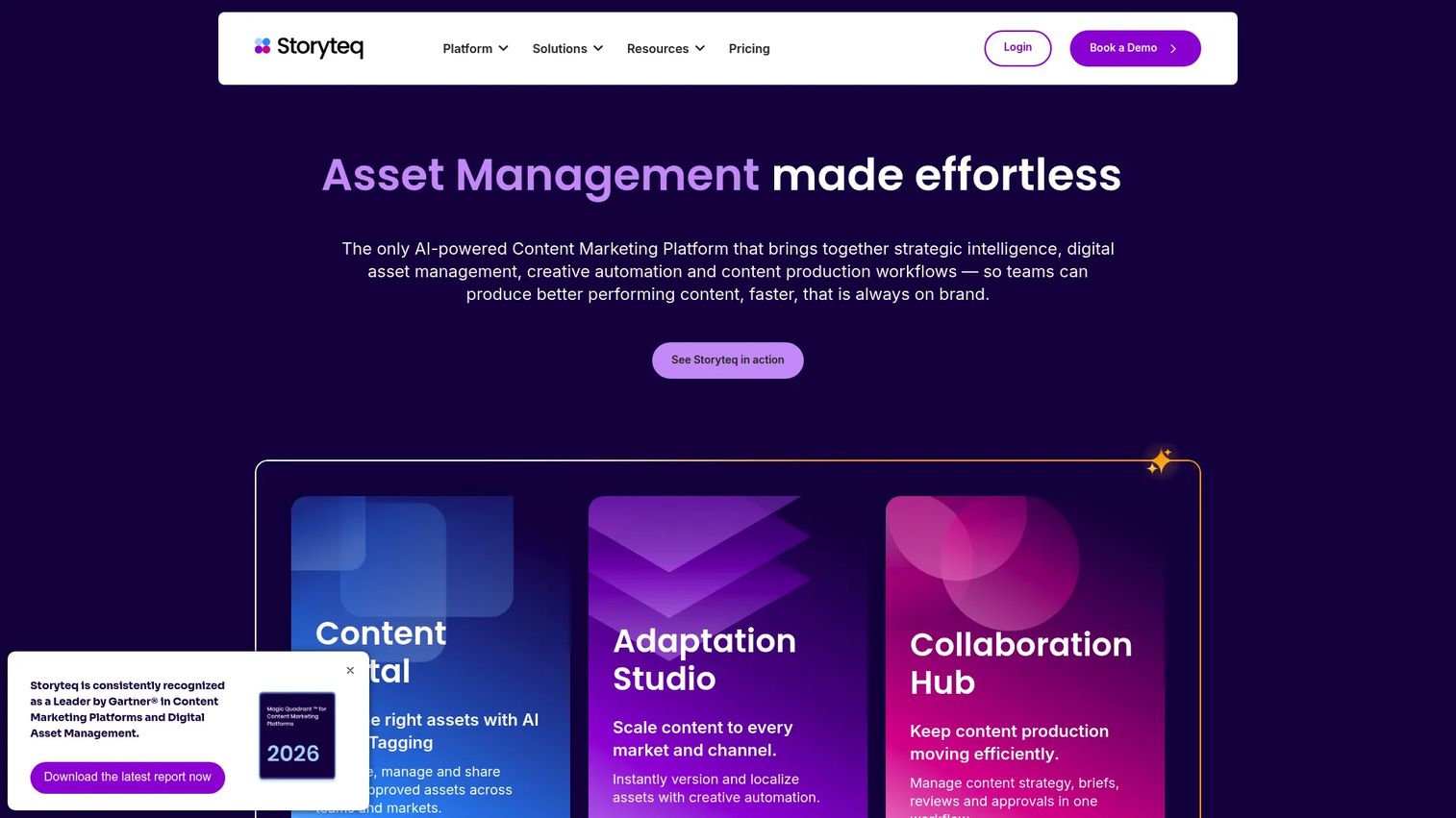
Storyteq is an AI-powered content and creative automation platform for finding, adapting, and collaborating on content at scale. It centers on three pillars: a Content Portal that acts as an AI-powered DAM, an Adaptation Studio for versioning and localizing content across channels and markets, and a Collaboration Hub for briefs, reviews, and approvals. That combination makes it a strong fit for large organizations standardizing creative production across many markets.
Best for: Mid-sized to enterprise marketing teams managing content rollout across multiple markets and channels.
Key strengths
- Content Portal (AI-powered DAM): Centralize assets with intelligent search and asset intelligence, so teams find and reuse approved creative fast.
- Adaptation Studio: Version and localize content for every channel and market from master templates.
- Collaboration Hub: Run strategy, briefs, reviews, and approvals in one workflow to keep brand consistency intact.
Why choose Storyteq: Storyteq is built for the localization and collaboration problem specifically. If your team produces creative for many markets and the approval chain is where things stall, Storyteq's combination of adaptation, DAM intelligence, and built-in review workflows targets that exact friction. It suits marketing and creative ops teams standardizing production across regions while holding brand consistency.
Storyteq pricing: Storyteq does not publish fixed numeric prices. It offers Professional and Enterprise plans on a price-on-application basis, with an annual recurring license fee plus a one-off implementation charge. Pricing is tailored to each setup; there is no free tier.
7. AdCreative.ai
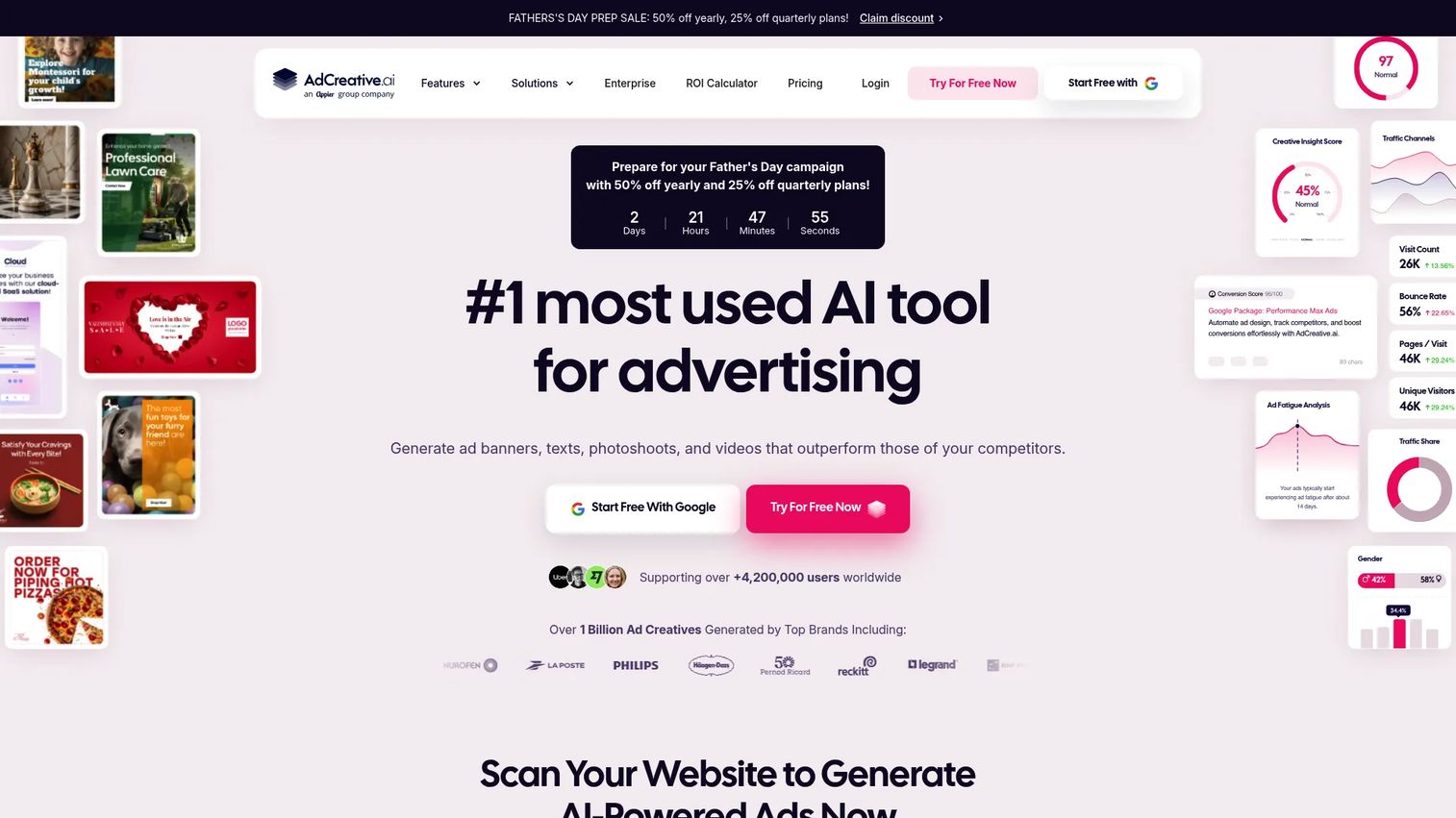
AdCreative.ai is an AI platform for generating ad creatives, ad copy, and creative insights. It is built for teams that need to produce and test many ad variants quickly without a large design function. With AI creative generation, creative scoring, and competitor insights, it gives leaner teams a way to ship performance-oriented creative fast and learn which versions work. The accessibility and entry pricing make it the most approachable option on this list for smaller teams.
Best for: Lean teams that need to generate and test ad creatives quickly and at scale.
Key strengths
- AI ad creative generation: Produce on-format ad creatives in minutes, cutting the dependency on dedicated design resources.
- Creative scoring AI: Get a predicted performance score before you spend, so you ship the variants most likely to convert.
- Competitor insights AI: See what creative competitors are running to inform your own variant strategy.
Why choose AdCreative.ai: AdCreative.ai is the right fit when your constraint is design capacity, not enterprise governance. For startups and small growth teams that need volume and speed without hiring designers, it lowers production overhead dramatically. The trade is breadth: it is focused on AI ad generation rather than the full omnichannel publishing and DCO depth of enterprise platforms.
AdCreative.ai pricing: AdCreative.ai publishes public pricing with monthly, quarterly, and yearly billing views. Plans run from Starter at $39/mo, Professional at $249/mo, and Ultimate at $999/mo, up to a custom-priced Enterprise tier. There is no free plan, but a free trial is available.
What to evaluate before you buy
Shortlisting two or three platforms is the easy part. These are the criteria that actually separate a good fit from an expensive mismatch.
Workflow depth and approvals
Map your real production flow first: who briefs, who builds, who reviews, who publishes. Then check whether the platform handles that flow natively, including collaboration and approvals, version control, and brand locks. A tool that produces variants fast but forces approvals into email is a half-solution.
DCO and variant generation
If dynamic creative optimization is core to your media plan, test the depth, not the demo. Confirm how the platform handles feed-based DCO, real-time element swaps, and the volume of variants you actually need. Some platforms market DCO software lightly; others build their whole engine around it.
Publishing and channel coverage
Confirm the platform publishes natively to the channels you run: display ads, social ads, video ads, and CTV. Native omnichannel publishing removes the manual trafficking step that quietly eats hours every week. If a channel you rely on needs an export-and-upload workaround, factor that in.
Analytics and measurement
Creative analytics is where ROI gets proven or lost. Check whether performance ties back to specific creative variants, and whether that data exports cleanly into the reporting your CFO actually trusts. Pair platform-level creative analytics with your broader marketing analytics stack so creative impact is not a black box.
Localization and scale
If you run global campaigns, evaluate localization as a first-class feature, not an afterthought. Confirm the platform handles translation, currency, legal text, and market-specific variants from master templates, so expansion does not multiply your production work market by market.
Conclusion
The right creative management platform depends entirely on which bottleneck is costing you most. For enterprise-scale automation and governance, Celtra and Smartly lead. For omnichannel publishing across markets, Bannerflow is built for the job. For collaboration-heavy teams wrestling with localization and approvals, Storyteq targets that friction directly. For raw production speed and variant generation, Rocketium delivers throughput. For AI-assisted ad creation on a lean team, AdCreative.ai is the most accessible entry point. And for rich media and interactive display, Somplo is the specialist.
Do not buy on feature lists. Start with your single biggest constraint, whether that is volume, brand drift, localization, or proving creative ROI, then compare two or three platforms against that specific problem and your approval complexity. The platform that fixes your worst bottleneck without adding tool sprawl is the one worth paying for. Run a focused trial or scoped demo on your real workflow before you sign, and weight time-to-value and integration fit as heavily as the headline features.
FAQs
A creative management platform is software that centralizes ad creative production, dynamic creative optimization, omnichannel publishing, and creative analytics in one workflow. Its core job is helping marketing and creative teams produce, scale, localize, and measure campaigns without bouncing between disconnected tools. The result is faster output, stronger brand consistency, and clearer performance visibility.
A digital asset manager (DAM) is mainly about storing, organizing, and retrieving finished assets. A creative management platform covers the full production and publishing lifecycle: templating, variant generation, DCO, approvals, and omnichannel publishing. Put simply, a DAM holds your creative, while a creative management platform builds, adapts, and ships it. Some platforms, like Storyteq, blend AI-powered DAM capabilities into a broader creative automation workflow.
Prioritize dynamic creative optimization, template-based production, collaboration and approvals, omnichannel publishing, and creative analytics. DCO and templates drive output volume, approvals and version control protect brand consistency, publishing removes trafficking work, and analytics prove ROI. The right weighting depends on your bottleneck: a high-volume team prizes DCO and templates, while a global team prizes localization and approvals.
Evaluate enterprise fit on governance, scale, security, and integration depth rather than a single winner. Platforms like Celtra, Smartly, and Storyteq are built for high-volume production, brand governance, and multi-market rollout. The best choice is the one that matches your channel mix, approval complexity, and existing stack, so test integration quality and reporting depth during evaluation.
Yes, though the right tier matters. Smaller teams often get the most value from accessible, AI-assisted platforms like AdCreative.ai that lower production overhead without heavy setup. Look for fast time-to-value, transparent pricing, and features that reduce design dependency rather than enterprise governance you will not use. Match the platform's complexity to your actual production volume.
Most strong platforms support localization through translation, market-specific variants, and adaptation from master templates. This lets teams adapt copy, currency, imagery, and legal text for each market without rebuilding every asset. Storyteq and Bannerflow are particularly focused on multi-market localization, which makes them a fit for global campaign rollouts where region-specific variants are a recurring bottleneck.
Compare integration quality with your existing stack, workflow and approval fit, pricing model, and reporting depth. Confirm the platform publishes natively to your channels, handles DCO at the depth you need, and ties creative analytics back to specific variants. Run a scoped trial on your real production flow, then weight time-to-value and consolidation value, what this replaces, as heavily as the headline feature set.