A product specification changes. Packaging needs an update. A supplier submits against an old requirement. Quality catches the issue after production planning is already running.
The root problem is rarely one bad spreadsheet. It is that the company has no controlled system for product data changes. Specifications live across shared drives, email threads, disconnected ERP records, and spreadsheets owned by people who have since left the team.
The specification management software market reached $545.66 million in 2025 and is forecast to hit $1.07 billion by 2034, growing at 7.8% annually, according to The Insight Partners (2025). That growth reflects how many operations leaders are finally replacing fragile, person-dependent processes with structured systems.
This article targets founders and functional leaders at companies managing physical products, packaging, ingredients, materials, or regulated product data. It is not a generic SaaS operations category. If your company is scaling SKUs, onboarding new suppliers, or entering new markets, the question is whether your specification process will hold up under that pressure.
The warning sign: Your team cannot answer "which version is current?" in under a minute.
What's inside
This guide covers seven specification management software tools evaluated for 2026. Selection criteria include:
- Data model fit: Does it handle your record types (product, packaging, ingredient, BOM, supplier)?
- Change control: Does it enforce version history, approval workflows, and audit trails?
- Supplier collaboration: Can external parties submit, update, and track records without engineering overhead?
- Integration and implementation: Does it connect to your ERP, PLM, or quality stack, and can your team own it?
Who should read this: Founders, VP Operations, quality leads, procurement leaders, and packaging teams deciding between a dedicated specification platform, a broader PLM, a quality-led system, or an artwork-focused tool.
Pricing and ratings were verified against vendor pages and G2 listings. Re-verify before signing because vendor packaging changes frequently.
TL;DR
- Best for product and packaging specification data: Specright, with a spec-first data model covering product, packaging, formulation, and supplier records
- Best for supplier collaboration in food, beverage, and CPG: TraceGains, with a network-based supplier data exchange purpose-built for regulated product workflows
- Best for enterprise product lifecycle management: Centric PLM, when specifications are part of a broader concept-to-launch program
- Best for configurable workflows across complex supply chains: Atom Millnet, for teams whose processes do not fit a standard out-of-the-box template
- Best for packaging artwork and label approvals: ManageArtworks, starting at $399/month with dedicated proofing and approval controls
- Best for manufacturing environments connected to Siemens software: Opcenter Specification, for process-industry teams needing specification and laboratory workflows inside one stack
- Best for architecture and construction specifications: Deltek Specpoint, a purpose-built AEC specification platform not designed for product or packaging data
What is specification management software?
Specification management software is a system for creating, controlling, approving, sharing, and tracking product or packaging requirements across materials, formulas, suppliers, quality processes, and finished goods.
What the software manages
- Raw materials, ingredients, and component records
- Product formulas, bills of materials, and finished-goods specifications
- Packaging dimensions, artwork, labels, and claims
- Supplier submissions, certifications, and approvals
- Quality requirements, test results, and deviations
- Version history, change requests, and audit trails
- Compliance-related evidence and market-specific requirements
What separates a system from shared files
Shared drives and spreadsheets store documents. A product specification management system connects structured data, relationships, workflows, permissions, and history. When a formula changes, the system knows which packaging specifications, supplier records, and downstream products are affected. A folder does not.
How it relates to adjacent systems
| System type | Primary job | Where it overlaps | Where it differs |
|---|---|---|---|
| Specification management software | Control structured product and packaging requirements | Product data, approvals, supplier records | Deepest focus on specification relationships and change control |
| PLM software | Manage the broader product lifecycle | Product development, BOMs, collaboration | Broader roadmap and lifecycle scope |
| ERP | Run transactions and operational records | Item master, suppliers, inventory | Usually weaker on granular specification detail |
| Quality management system | Control quality processes and evidence | Quality requirements, audits, CAPA | Centered on quality operations, not full product data |
| Artwork management software | Review packaging artwork and labels | Packaging records and approvals | More specialized for creative files, markups, and artwork approval |
When to use specification management software
Replace spreadsheet-led change control
Teams that cannot confidently identify the current specification, who changed it, or which products and suppliers inherit a change need a controlled system. If a label update requires someone to manually notify six teams and hope everyone finds the right file version, the process is fragile. A specification management platform records the change, routes approvals, and makes the updated record the only record in circulation.
Coordinate suppliers and internal approvers
When suppliers submit specifications, certificates, ingredients, or packaging details through email attachments and informal channels, the risk of working against an outdated version compounds with every new supplier onboarded. Supplier specification management tools give external parties a controlled submission path, and give your team a single place to review and approve incoming data.
Prepare for audits, scale, and new markets
More SKUs, more regions, and more labeling requirements create new traceability demands. A company entering a regulated market cannot produce an audit trail if the records live in a spreadsheet owned by one person. Specification version control and structured approval history are foundational to that evidence.
Specification management software comparison
Use this table as a first-pass routing tool. Validate data model fit, implementation support, and integration requirements in a live evaluation before committing.
| # | Product | Best for | Key differentiator | Pricing | G2 rating |
|---|---|---|---|---|---|
| 1 | TraceGains | Supplier collaboration and food, beverage, CPG workflows | Network-based supplier data exchange | Quote-based | 4.1/5 |
| 2 | Specright | Product and packaging specification data governance | Spec-first data model with connected records | Quote-based | 4.5/5 |
| 3 | Centric PLM | Enterprise product lifecycle and specification programs | Broad PLM workflow across concept-to-launch | Quote-based | Not listed on G2 |
| 4 | Atom Millnet | Configurable specification workflows for complex supply chains | Configurable data structures and approval cycles | Quote-based | Not listed on G2 |
| 5 | ManageArtworks | Packaging artwork and label approval workflows | AI-powered proofing with version control | From $399/month | 4.4/5 |
| 6 | Opcenter Specification | Manufacturing teams in Siemens environments | Specification and laboratory management in one stack | Quote-based | Not listed on G2 |
| 7 | Deltek Specpoint | Architecture, engineering, and construction specifications | AIA MasterSpec content with AI-assisted writing | Quote-based | 3.9/5 |
Pricing and ratings verified October 2026 from each vendor's pricing page and G2 listing.
Best 7 specification management software tools for 2026
1. TraceGains

TraceGains is a connected product development and supply chain collaboration platform built for food, beverage, and consumer packaged goods organizations. It combines specification management for ingredients and finished goods with supplier compliance workflows, formula management, and packaging records inside one platform. The network-based model means suppliers already on the TraceGains network can exchange data without starting from zero.
Best for: Food, beverage, and CPG teams where supplier data collection is a recurring operational bottleneck.
Key features
- Centralized finished-goods specification records with supplier data links
- Supplier network collaboration and compliance workflows
- Formula management and digital recipe records
- Packaging specification and artwork management
- AI-powered formulation and intelligent document processing
Why choose TraceGains: The supplier network is the clearest differentiator. If your onboarding delays consistently trace back to chasing supplier documentation through email, TraceGains addresses that pattern directly. Assess network participation rates for your specific supplier base during evaluation.
TraceGains pricing: TraceGains prices by quote. Contact their sales team for a proposal. Buyers should ask specifically about module scope, the number of supplier connections included, and implementation costs, as these drive total cost significantly.
G2 rating: 4.1/5 (verified October 2026, based on 8 reviews on G2).
2. Specright
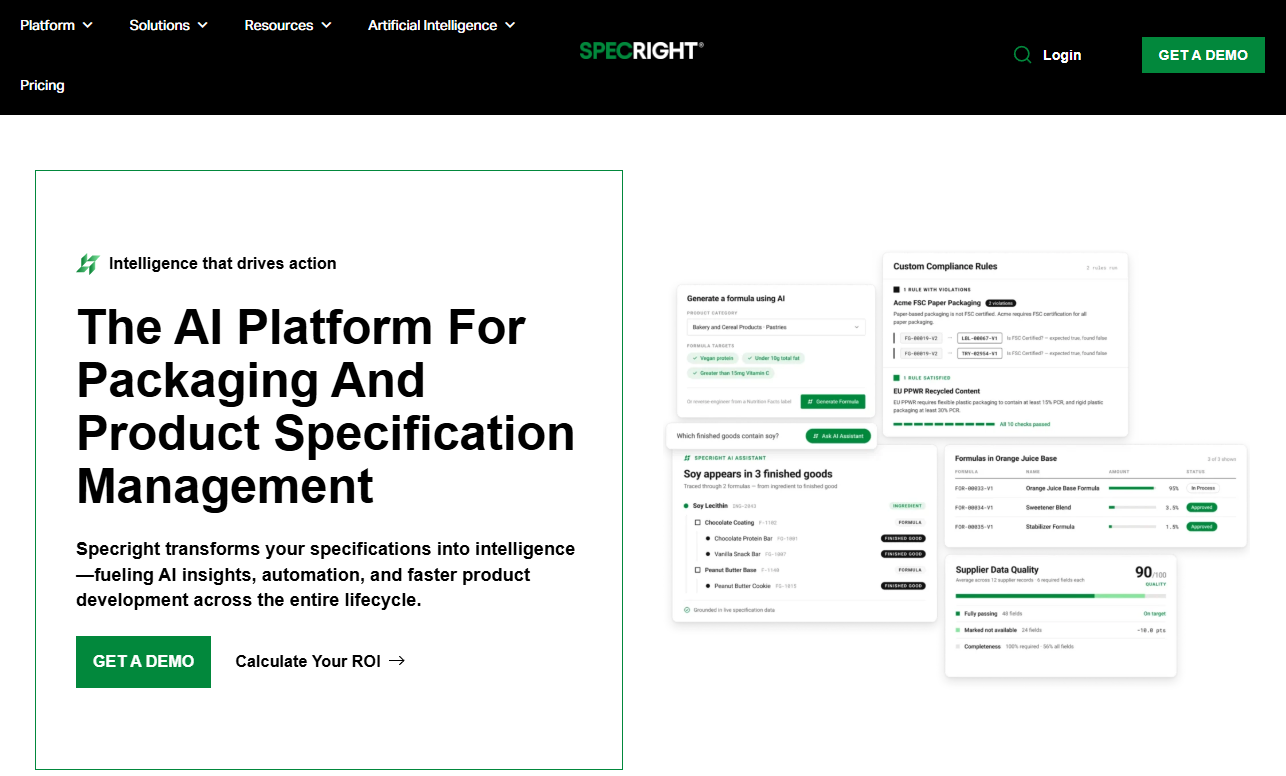
Specright is an AI-powered specification data management platform built around a spec-first data model. Rather than treating specifications as attached documents, Specright structures product, packaging, formulation, ingredient, and supplier data as connected records with relationships, field-level history, and automated downstream calculations. It covers product data management, BOM management, supplier workflows, quality management including non-conformance and certificate of analysis records, and sustainability reporting.
Best for: Companies that need one structured source of truth for product and packaging specifications across a growing SKU portfolio.
Key features
- Spec-first product data architecture with connected record relationships
- Packaging and BOM management with automated rollups
- Supplier specification comparisons and collaboration workflows
- Field-level history tracking and change audit trails
- AI Assistant for specification search and data health monitoring
Why choose Specright: When specification records are your operating backbone, not a side process, Specright's data model handles complexity that spreadsheets and shared-drive attachments cannot. Founders preparing for due diligence, audits, or market expansion find that structured field-level history and traceability are considerably harder to produce retroactively than to capture from the start.
Specright pricing: Specright offers three plans: Foundations, Plus, and Enterprise. All tiers are priced by quote. Request a proposal from Specright directly to understand user model, implementation scope, supplier access terms, and integration costs before comparing quotes.
G2 rating: 4.5/5 (verified October 2026 on G2).
3. Centric PLM
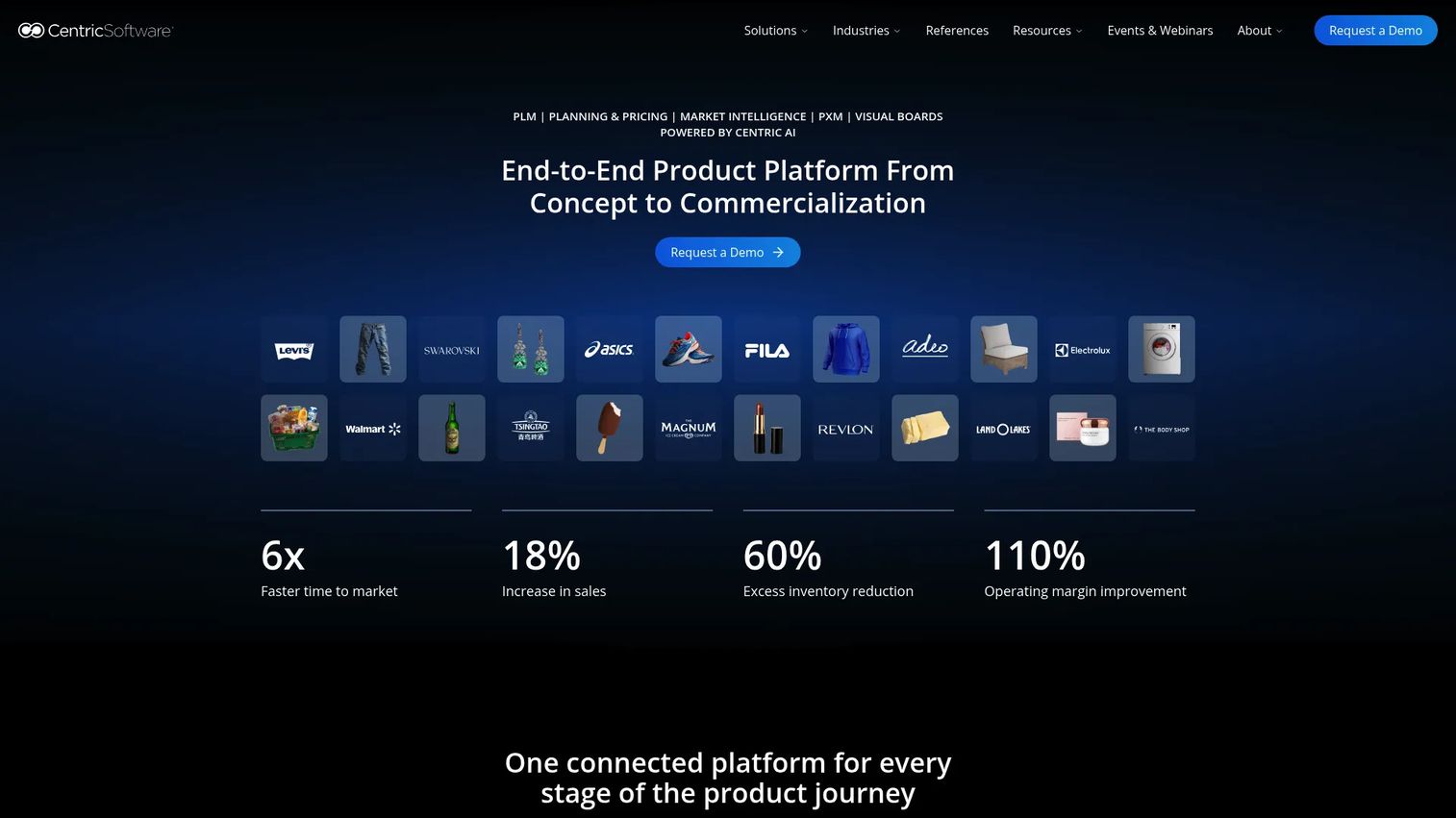
Centric PLM connects product teams, suppliers, product data, and AI-powered insights to manage product development from concept through commercialization. Specification workflows exist inside a broader product lifecycle management platform that also covers sourcing, costing, BOM and margin visibility, and sustainability and compliance management. It serves brands, retailers, and manufacturers managing complex, multi-category product lines.
Best for: Enterprise teams that need specification management as part of a wider product development, sourcing, or commercialization program.
Key features
- Product design, development, sourcing, and commercialization workflows
- Supplier collaboration and centralized product data management
- Costing, BOM, and margin visibility in one system
- Mobile PLM access with product data workflows
- AI-powered product development and decision-support capabilities
Why choose Centric PLM: Centric fits when the company's challenge is broader than controlling specifications. If coordinating concept-to-launch across product, sourcing, design, and operations is the actual problem, a dedicated specification platform may leave too many gaps. Validate deployment timeline and data model flexibility early, as enterprise PLM implementations carry meaningful setup complexity.
Centric PLM pricing: Centric PLM does not display pricing. Contact Centric directly for a proposal. Implementation scope, industry modules, and integration requirements drive significant cost variation, so budget conversations should happen early.
4. Atom Millnet
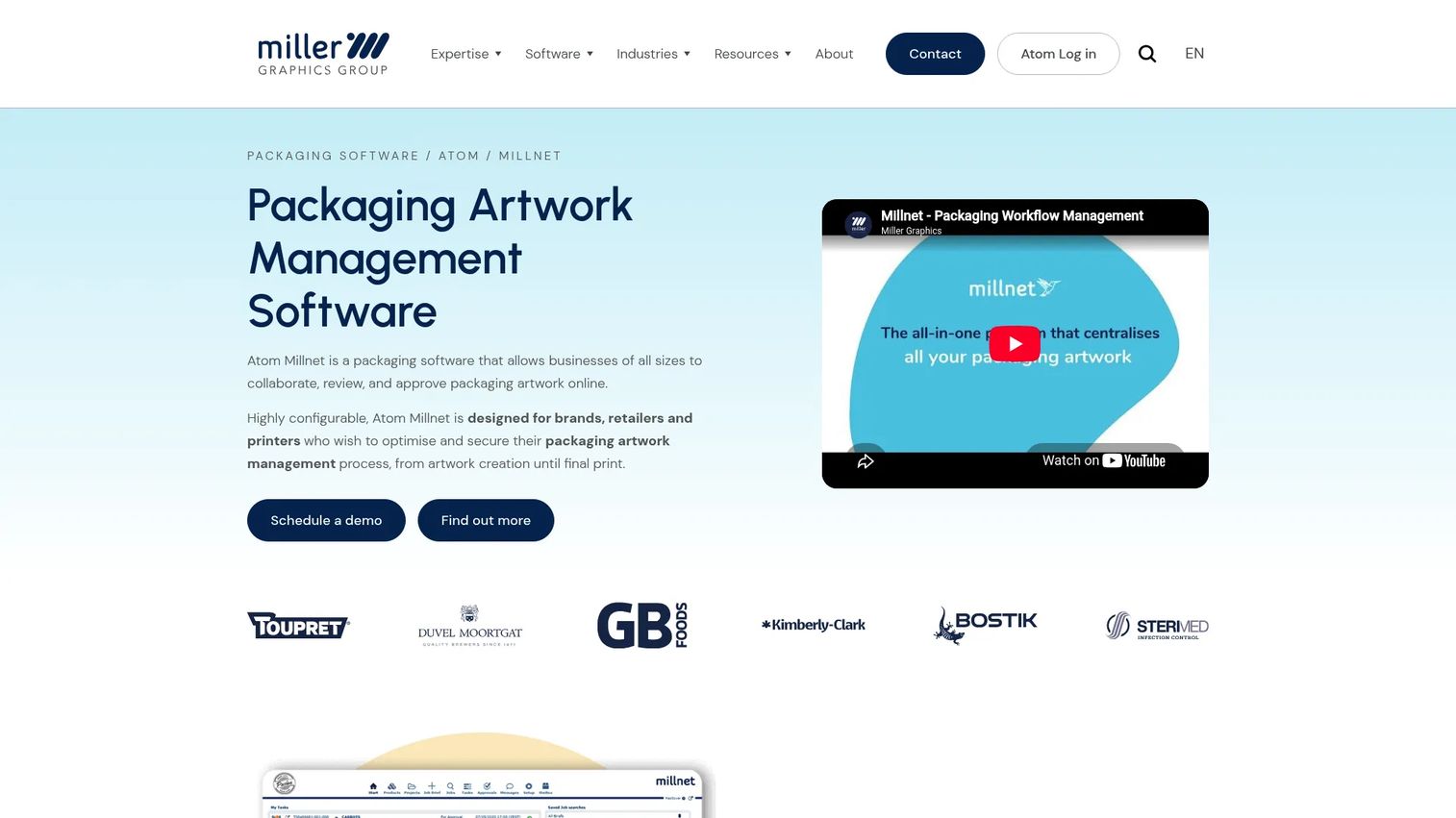
Atom Millnet is a cloud-based packaging artwork management platform offering configurable approval workflows, collaborative review and amendment tracking, and automated graphic-file processing. It is built for brands, retailers, printers, and packaging teams managing end-to-end packaging artwork workflows. Configurable approval cycles allow teams to adapt the system to their actual process rather than conforming to a rigid template.
Best for: Teams with complex packaging artwork workflows that require configurable approval cycles and traceable amendment records.
Key features
- Online approval workflows with configurable approval cycles
- Collaborative chat, comments, and traceable amendments
- Automated graphic-file processing
- Integration capabilities with external systems
- Content management, reporting, and dashboard extensions
Why choose Atom Millnet: The appeal is workflow flexibility. It is worth evaluating when your packaging approval process has multiple stakeholders, non-standard routing, or integration requirements that a simpler tool cannot accommodate. Confirm how supplier collaboration works in the context of your specific workflow before shortlisting.
Atom Millnet pricing: Atom Millnet does not publish pricing. Contact Miller Graphics directly for a proposal covering your workflow scope, user count, and integration needs.
5. ManageArtworks
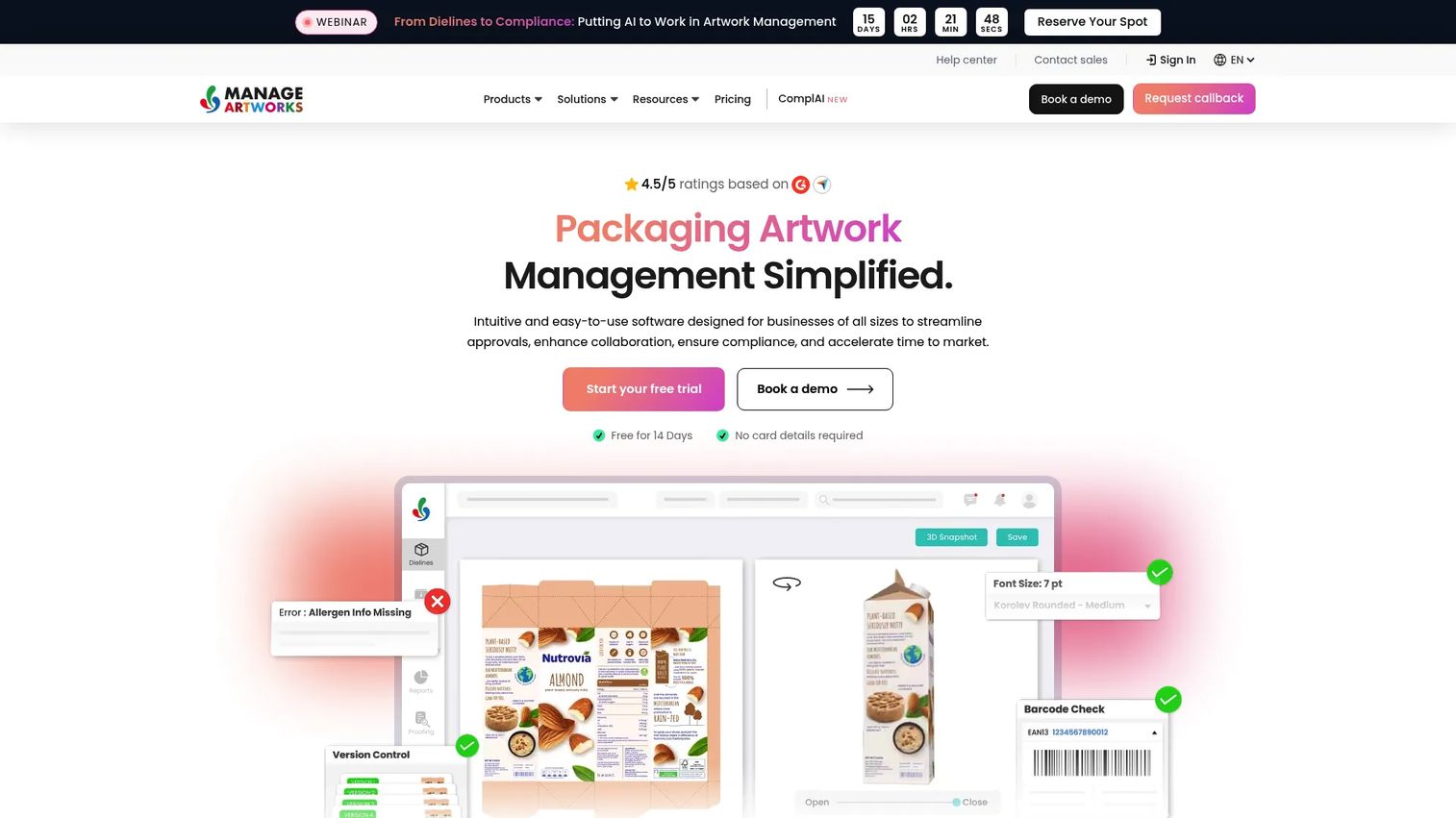
ManageArtworks is packaging artwork management software for creating, reviewing, approving, and managing packaging artwork across the full lifecycle. It includes AI-powered proofing covering image, text, barcode, spell, font, layer, and color analysis, alongside digital asset management, pack copy management, dieline management, and 3D packaging visualization. The platform integrates with ERP, PLM, DAM, and PIM systems.
Best for: Consumer-product and packaging teams where artwork approval cycles are the primary source of launch delays or version-control risk.
Key features
- Artwork workflow and approval management with version control
- AI-powered proofing: Image, text, barcode, spell, font, layer, and color
- Pack copy management and dieline management
- 3D packaging visualization
- Enterprise integrations with ERP, PLM, DAM, and PIM systems
Why choose ManageArtworks: It is narrower than a full specification or PLM platform, which is often an advantage. When packaging execution is the immediate operational constraint and you need a system that your packaging and regulatory teams can own quickly, ManageArtworks delivers depth on the artwork workflow without the overhead of a broader platform implementation.
ManageArtworks pricing: The Pro plan starts at $399/month and includes proofing, digital asset management, 50GB storage, and up to 10 users. The Growth plan is $499/month and adds workflow automation with 100GB storage. A Custom plan covers tailored features including pack copy management, dieline and 3D management, advanced integrations, and advanced workflows. A 14-day free trial is available.
G2 rating: 4.4/5 (verified October 2026 on G2).
6. Opcenter Specification
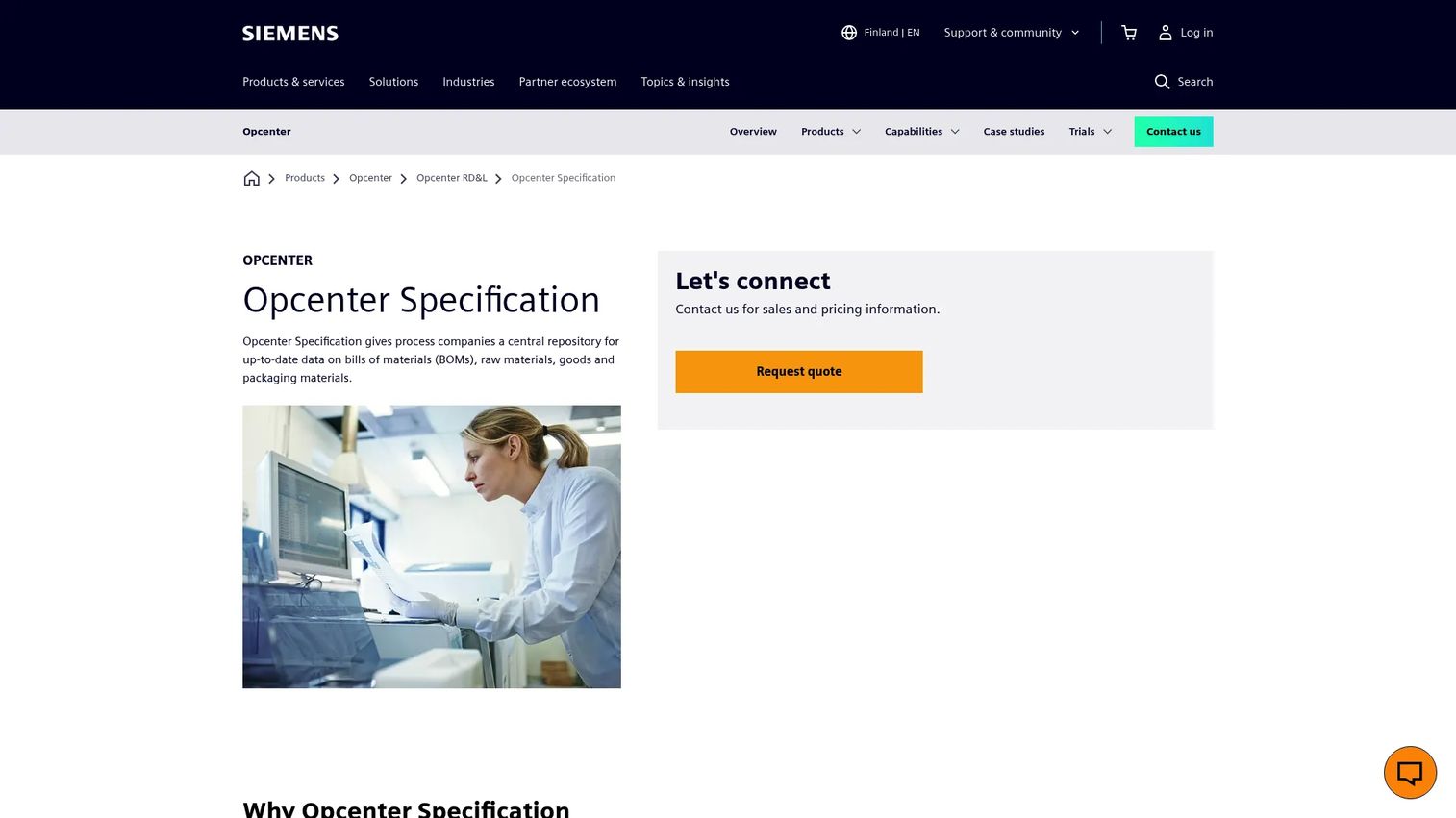
Opcenter Specification from Siemens is centralized software for managing material and product specifications, bills of materials, research data, certifications, and related documentation. It generates ingredient lists, labels, product claims, and process instructions automatically from specification records. Secure supplier collaboration supports material data and certification maintenance. Document and version management covers certificates, safety sheets, and process instructions with full versioning and audit trails.
Best for: Process-industry and consumer-packaged-goods organizations already operating within a Siemens manufacturing software environment.
Key features
- Central specification repository with versioning and audit trails
- Automatic generation of ingredient lists, labels, claims, and process instructions
- Secure supplier collaboration for material data and certifications
- Document and version management for certificates and safety sheets
- Automatic production of product data sheets, approval reports, and KPI reports
Why choose Opcenter Specification: Platform fit matters more here than standalone feature count. Organizations already running related Siemens manufacturing software gain connected workflows and shared data standards. For teams outside that environment, the implementation and integration complexity requires careful assessment before committing.
Opcenter Specification pricing: Siemens does not display pricing for Opcenter Specification. Contact Siemens directly for an enterprise proposal that reflects your implementation scope, modules, and integration requirements.
7. Deltek Specpoint
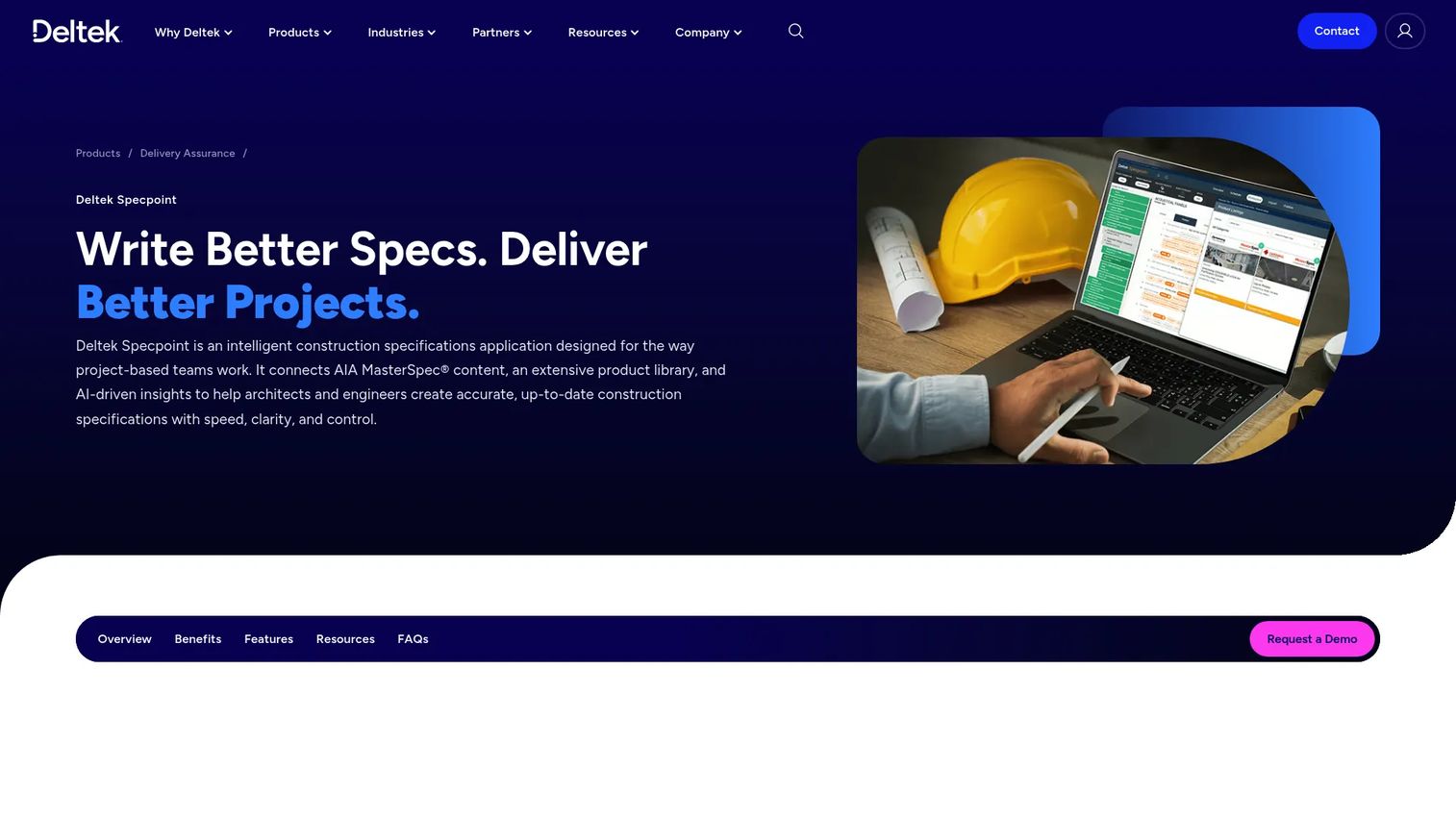
Deltek Specpoint is cloud-based construction specification software for architects, engineers, and building product manufacturers. It should not be evaluated alongside product, packaging, or ingredient specification platforms because it serves an entirely different category. AEC firms use Specpoint for specification writing, master specification libraries, AIA MasterSpec content with automatic updates, and AI-powered specification assistance.
Best for: Architecture and engineering firms managing construction specifications, product research, and collaborative specification workflows.
Key features
- AIA MasterSpec content with automatic updates
- AI-powered Ask Dela specification answers
- 50,000-plus product listings with Revit integration
- Best-practice automation and smart tagging
- Smart reports for submittal requirements and product selections
Why choose Deltek Specpoint: This is the right category fit for firms producing construction specifications. The AIA MasterSpec integration alone removes significant maintenance overhead for firms that previously managed master spec libraries manually. It is not designed for packaging, formula, or supplier specification workflows and should not be compared to product-data platforms.
Deltek Specpoint pricing: Deltek does not display pricing for Specpoint. Contact Deltek directly for a proposal based on firm size, project volume, and deployment requirements.
G2 rating: 3.9/5 (verified October 2026, based on 29 reviews on G2).
Considerations
Match the tool to your specification type
A formula, a packaging label, a manufacturing work instruction, and a construction specification carry different data structures and governance needs. Start with the records you must control, then evaluate which platform's data model fits those records without requiring significant customization just to get the basics right.
Audit your source data before migration
A platform cannot resolve duplicate records, unclear ownership, or inconsistent naming. Before implementation begins, identify data owners, consolidate duplicate sources, and document approval rules. Teams that skip this step consistently report that migration takes two to three times longer than projected.
Test supplier and external-user workflows
A supplier portal only delivers value if suppliers can complete submissions without excessive training. During evaluation, test the submission, revision, documentation, and approval paths with a realistic external user, not just an internal admin account.
Validate integration boundaries
Confirm what should live in the specification system versus your PLM, ERP, quality management system, laboratory system, or artwork tool. Duplicating records across systems creates the same version-control problem you are trying to solve, and resolving that during rollout is expensive.
Assign an operating owner
The founder should not own this platform day to day. The business needs a named leader responsible for data standards, workflow governance, adoption, and release management. Hire or designate that person before implementation starts, not six months in when the rollout has stalled.
Conclusion
Each tool on this list serves a specific type of specification problem.
Specright is the strongest fit for organizations that need one structured source of truth for product and packaging specification data governance. TraceGains is the natural choice for supplier-centric workflows in food, beverage, and CPG. Centric PLM fits when the challenge extends into broader product lifecycle management. Atom Millnet is worth evaluating when configurable workflow logic is the deciding factor. ManageArtworks addresses packaging artwork and approval execution directly, with the clearest public pricing in the group. Opcenter Specification belongs in environments already running Siemens manufacturing software. Deltek Specpoint is the right call for AEC specification workflows and should not be compared to the others.
Before you book demos, map one critical change-control workflow. A label update, a supplier substitution, or a formula revision works well. Then ask each shortlisted vendor to walk through that exact workflow from request to approval, record change, downstream impact, and audit history. That single test will tell you more about fit than any feature matrix.
Start your journey with Guideflow today!
FAQs
Specification management software controls structured product, packaging, material, formula, supplier, and quality requirements in a single governed system. Its core value is a controlled record with workflow routing, version history, and traceability rather than a file that gets emailed around. It connects requirements to the materials, suppliers, packaging components, and quality checkpoints that depend on them.
PLM manages the broader product lifecycle, from concept and design through sourcing, development, and commercialization. Specification management focuses on the detailed requirement records themselves and their relationships across materials, packaging, suppliers, and finished goods. Many PLM platforms include specification capabilities, but teams with deep specification complexity often find a dedicated platform handles those records more precisely.
ERPs typically store item and supplier records well, but may not handle granular specifications, linked packaging components, structured approval workflows, or detailed field-level change history. The right answer depends on product complexity and compliance demands. A company with hundreds of SKUs, multiple packaging formats, and regulated ingredient records will quickly hit the limits of ERP-based specification management.
Consumer goods, food and beverage, cosmetics, chemicals, and retail businesses where packaging components, labels, artwork, and claims must remain accurate through repeated change cycles are the clearest fit. The trigger is usually a costly error caused by a team member working from an outdated packaging file or an unapproved label version reaching production.
It gives suppliers a controlled submission path for data, certifications, and documentation instead of email. Structured approval routing means the right internal stakeholders review incoming records before they become live in the system. Change requests flow through traceable approval cycles so both parties have a clear record of what was submitted, reviewed, and accepted.
Structured records and version control prevent the core problem. Approval workflows with audit history give you defensible evidence for audits and quality reviews. Data relationships between ingredients, packaging, and finished goods surface downstream impacts when a specification changes. Supplier participation paths reduce the manual data-chasing that slows down procurement and quality cycles. Prioritize those before evaluating analytics or AI features.
The drivers are SKU count, data quality, integration scope, supplier participation requirements, workflow complexity, and whether you are replacing a spreadsheet process or a legacy enterprise system. A focused packaging artwork workflow deployment can move faster than a full product and ingredient specification migration. Teams that complete data cleanup before kickoff consistently have faster go-lives than those that discover data issues mid-implementation.
Set baselines before deployment on change-request cycle time, time spent locating current records, errors caused by outdated versions, supplier response time, packaging rework incidents, audit preparation time, and launch delays. These are the operational costs the system is designed to reduce. Measuring them before and after gives you a defensible payback calculation rather than a vendor-supplied benchmark.
Ask for a live demonstration of your most complex workflow, not a scripted product tour. Confirm how data migration is scoped, who owns it, and what data quality requirements exist before go-live. Understand the total cost across license fees, implementation services, and supplier or external-user access. Finally, confirm the vendor has customers at your company size and product complexity, not just enterprise reference accounts that required a two-year rollout.