

A producer renames a column. Nobody tells the analytics team. Three dashboards break, a machine learning model starts scoring garbage, and someone spends a Thursday afternoon tracing the failure back to a schema change that shipped without warning.
That is schema drift. It is not a rare event. It is the default outcome when producer and consumer expectations live in Slack threads and tribal knowledge instead of an enforced agreement.
Data contract software formalizes those expectations before breakage reaches production. It turns the informal handshake between a data producer and a downstream consumer into a machine-readable, versioned, enforceable artifact. When the producer tries to make a breaking change, the contract catches it in CI/CD, not in a 2am incident channel.
The category is growing fast. The global data contract platform market was worth $1.2 billion in 2025 and is projected to reach $11.8 billion by 2034, according to Market Intelo (2025). A separate estimate from Research and Markets (2026) put the data-contracts-for-AI segment at $1.28 billion in 2025, growing to $3.64 billion by 2030. AI pipelines break for the same reasons analytics pipelines do, and contracts are how teams stop the bleeding.
This guide breaks down eight tools worth evaluating in 2026, from open standards to enterprise governance platforms.
What's inside
- Who this guide is for: data engineers, platform teams, and anyone who owns pipeline reliability or governance.
- How the tools were chosen: standards support, enforcement depth, governance workflows, and real-world usability.
- The decision factors that matter most: schema validation, CI/CD enforcement, runtime monitoring, ownership, and versioning.
- What you get: a comparison table, eight tool breakdowns, a buyer's checklist, and answers to the questions technical teams actually ask.
TL;DR
- Best for open standards and CLI workflows: Data Contract CLI, MIT-licensed and ODCS-native.
- Best for enterprise governance and access workflows: Data Contract Manager, now part of Entropy Data.
- Best for upstream enforcement and reliability protection: Monte Carlo, observability plus contracts.
- Best for AI-assisted governance and data products: Entropy Data.
- Best for platform teams enforcing contracts in CI/CD: Gable.
- Best for data mesh and distributed ownership: Data Mesh Manager.
- Best for teams evaluating the standards themselves: Open Data Contract Standard (ODCS) and Data Contract Specification.
If you build products that are easier to understand through interaction than explanation, tools like Guideflow solve a different problem entirely, but the same principle applies to data contracts: show the expectation explicitly instead of hoping everyone remembers it.
What is data contract software?
Data contract software helps teams define, validate, enforce, version, and monitor formal agreements about data structure, semantics, quality, ownership, and terms of use. It sits between the team that produces data and the teams that consume it, turning an implicit expectation into an explicit, machine-readable specification.
A data contract answers concrete questions. What fields exist? What types and constraints apply? Who owns this dataset? How fresh should it be? What happens when the schema changes? Instead of tracking those answers in someone's head, the contract writes them down in a format a machine can check.
Core capabilities of data contract software:
- Contract-as-code authoring: define contracts in YAML or a UI, version them in Git alongside your pipeline code.
- Schema and constraint validation: check field names, types, and rules against real data.
- CI/CD enforcement: block breaking changes at pull-request time before they merge.
- Runtime monitoring: detect drift, freshness issues, and quality violations in production.
- Ownership and versioning: assign accountable owners and track contract history over time.
- Standards support: work with the Open Data Contract Standard (ODCS), JSON Schema, Avro, Protobuf, and schema registries.
Here is how data contracts differ from adjacent tools teams often confuse them with:
| Concept | What it does | Primary job |
|---|---|---|
| Data contract | Defines and enforces producer-consumer agreements on structure, quality, and ownership | Prevent breakage before it ships |
| Schema registry | Stores and versions schemas (Avro, Protobuf) for serialization | Manage schema evolution at the message level |
| Data catalog | Indexes datasets with metadata for discovery and search | Help people find and understand data that already exists |
A schema registry handles the format. A catalog handles discovery. A contract handles the agreement, and enforces it.
When to use data contract software
Prevent downstream breakage before it ships
Contracts earn their keep in pipelines that change often. If your producers ship schema changes weekly and your consumers find out through broken dashboards, a contract enforced in CI/CD catches the breaking change at pull-request time. The producer sees a failed check, not an angry analyst. This is the single most common reason teams adopt data contract software.
Formalize producer-consumer expectations
When engineering owns the source table and analytics owns the reporting layer, the two teams share data but not a shared agreement. A machine-readable contract makes the expectation explicit: these fields, these types, this freshness, this owner. Both sides review and version it together, so nobody has to reverse-engineer intent from a query.
Support data mesh and governance initiatives
Distributed ownership scales badly on tribal knowledge. In a data mesh, dozens of teams publish data products for each other to consume. Contracts give each product a versioned, enforced interface, so a consumer in one domain can trust a producer in another without a standing meeting. That is the difference between governance that scales and governance that lives in a wiki nobody updates.
Comparison table
The table below summarizes the eight tools. Read "best for" as the primary buyer profile, and "key differentiator" as the reason a team picks that tool over the others. Pricing for several tools is contact-sales or open-source, so treat the pricing column as a starting point and verify current terms with each vendor.
| # | Product | Best for | Key differentiator | Pricing | G2 rating |
|---|---|---|---|---|---|
| 1 | Data Contract Manager | Governed data marketplaces | Marketplace lifecycle with access workflows | Free tier; paid per editor | Not available |
| 2 | Gable.ai | CI/CD enforcement | Static code analysis of producing code | Demo-based | 4.5/5 |
| 3 | Monte Carlo | Reliability and observability | Contracts plus data observability | Contact sales | 4.3/5 |
| 4 | Data Contract CLI | Open-source CLI workflows | ODCS-native linting, testing, export | Free (open-source) | Not available |
| 5 | Entropy Data | AI-assisted governance | Data products plus contract management | Free tier; paid per editor | Not available |
| 6 | Data Mesh Manager | Data mesh ownership | Data product marketplace and contracts | Free tier; paid per editor | Not available |
| 7 | Data Contract Specification | Standardizing definitions | Open YAML specification | Free (open) | Not available |
| 8 | Open Data Contract Standard | Vendor-neutral standard | Open governance standard | Free (open) | Not available |
Best 8 data contract software tools for 2026
1. Data Contract Manager
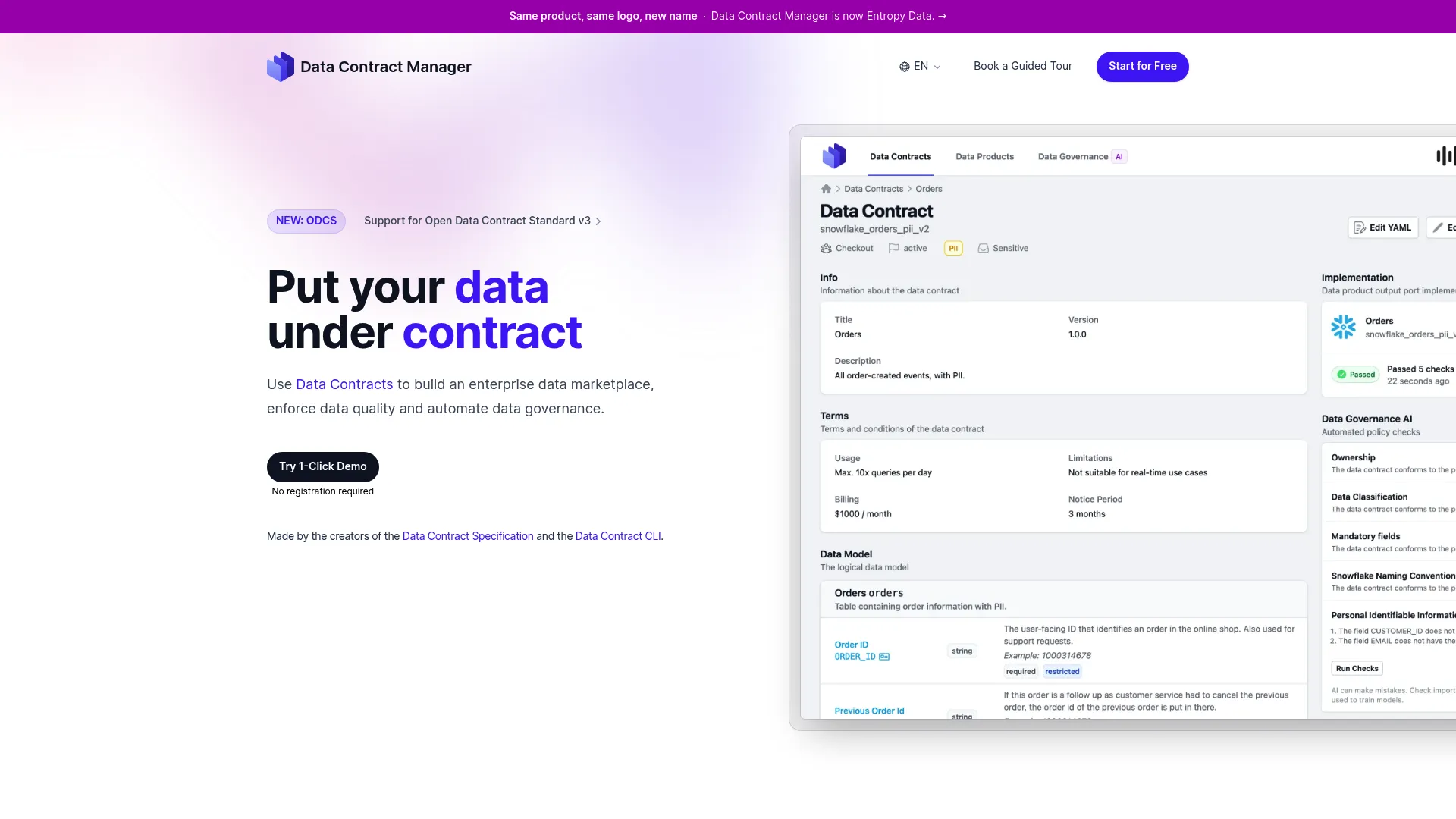
Data Contract Manager is a data product marketplace and governance platform built around data contracts. It gives teams a self-service marketplace where consumers browse available data products, request access, and route those requests through an approval workflow. The product now operates under the Entropy Data brand, so evaluate both names as the same lineage.
The core idea is lifecycle. A contract is not just a definition, it is the spine of an access workflow: define the product, publish it to the marketplace, handle requests and approvals, then enforce and revoke access as terms change. That makes it a strong fit for teams that want governance automation wrapped around their data products rather than a bare validation script.
Best for: teams building governed data marketplaces around data contracts and access workflows.
Key strengths
- Define data contracts in YAML or a web UI
- Self-service data marketplace with request and approval workflow
- AI-driven policy compliance checks
- Access request, approval, and revocation lifecycle
Why choose Data Contract Manager: pick it when you need governance and access workflows around data products, not just contract authoring. It suits enterprise data teams who treat data as a product and need a branded marketplace with approvals baked in.
Data Contract Manager pricing: a free Starter Cloud tier and a free Community Self-hosted tier are available. Paid Team and Business plans are priced per editor per month, billed annually. Enterprise plans are contact-sales.
2. Gable.ai
Gable.ai is a data governance and lineage platform that uses static code analysis to detect contract violations before they deploy. Instead of catching problems at runtime, it reads the code that produces data and flags changes that would break a downstream contract, right inside the CI/CD workflow.
That upstream position is the differentiator. Gable drafts data contracts automatically from producing code, traces field-level lineage, and surfaces violations at pull-request time. For platform and engineering teams that want enforcement to live where the change originates, that is a meaningful shift from reactive monitoring to proactive prevention.
Best for: engineering teams that want to enforce data contracts upstream in CI/CD workflows.
Key strengths
- Static code analysis for data-producing code
- Automatically drafts data contracts from code
- Field-level data lineage
- Detects contract violations before deployment
Why choose Gable: it fits teams who believe the right place to stop breakage is the pull request, not the dashboard. Regulated data teams also value the source-code-based lineage as audit evidence.
Gable pricing: Gable does not publish numeric pricing. Access runs through a demo and waitlist flow, so pricing is quote-based. Contact the vendor for current terms.
3. Monte Carlo
Monte Carlo is a data and AI observability platform that monitors, triages, and resolves data reliability issues. Its take on data contracts is reliability-first: contracts are one layer inside a broader system that watches your pipelines for schema drift, freshness lapses, volume anomalies, and quality violations.
The strength here is the combination. You get automated data quality coverage, field-level lineage, and incident triage with root cause analysis, plus contract enforcement on top. For teams whose primary pain is production breakage rather than access governance, that observability foundation is the draw. Contract elements like metadata, freshness, ownership, and versioning fit naturally into a monitoring-led rollout.
Best for: enterprise data teams needing observability, lineage, and incident resolution alongside contracts.
Key strengths
- Automated data quality coverage
- Field-level lineage
- Incident triage and root cause analysis
- Contracts layered on observability
Why choose Monte Carlo: choose it when reliability is the headline problem and contracts are one tool in a wider observability program. It suits larger teams that want monitoring, lineage, and enforcement in one platform.
Monte Carlo pricing: the public pricing page lists Start, Scale, and Enterprise plans, all presented as contact-sales. No public dollar amount is shown. Reach out to the vendor for a quote.
4. Data Contract CLI
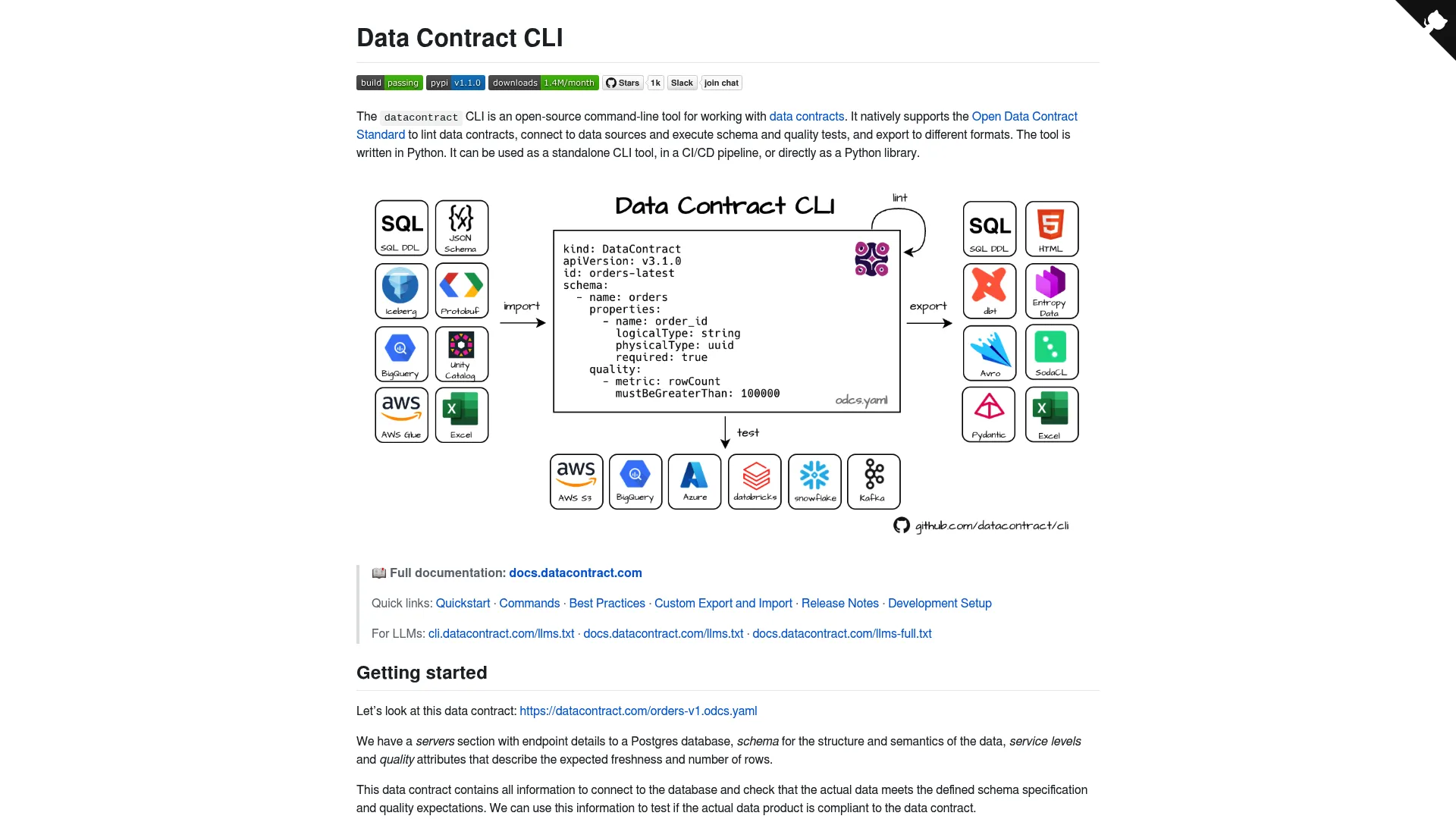
Data Contract CLI is an open-source command-line tool for creating, testing, linting, and exporting data contracts. It is MIT-licensed and built around the Open Data Contract Standard, which makes it the natural entry point for engineering teams that want contract tooling in their terminal and their pipeline, not behind a login.
The workflow is developer-first. Lint a contract against ODCS, run schema and quality tests against real sources, then export the contract to other formats for downstream tooling. It connects to sources like Snowflake, BigQuery, Databricks, Postgres, Kafka, and S3, and can import and export contracts across multiple formats. For teams that live in Git and CI, that interoperability matters more than a polished dashboard.
Best for: teams that want an open-source CLI to validate and automate data contracts.
Key strengths
- Lints data contracts using ODCS
- Runs schema, quality, and service-level tests against data sources
- Exports and imports contracts across multiple formats
- Open-source under the MIT license
Why choose Data Contract CLI: it fits engineering-led teams who want to start with an open standard and automate everything in CI/CD. There is no license cost and no vendor lock-in, which lowers the bar to adoption.
Data Contract CLI pricing: free and open-source under the MIT license. No paid plans or pricing page exist.
5. Entropy Data
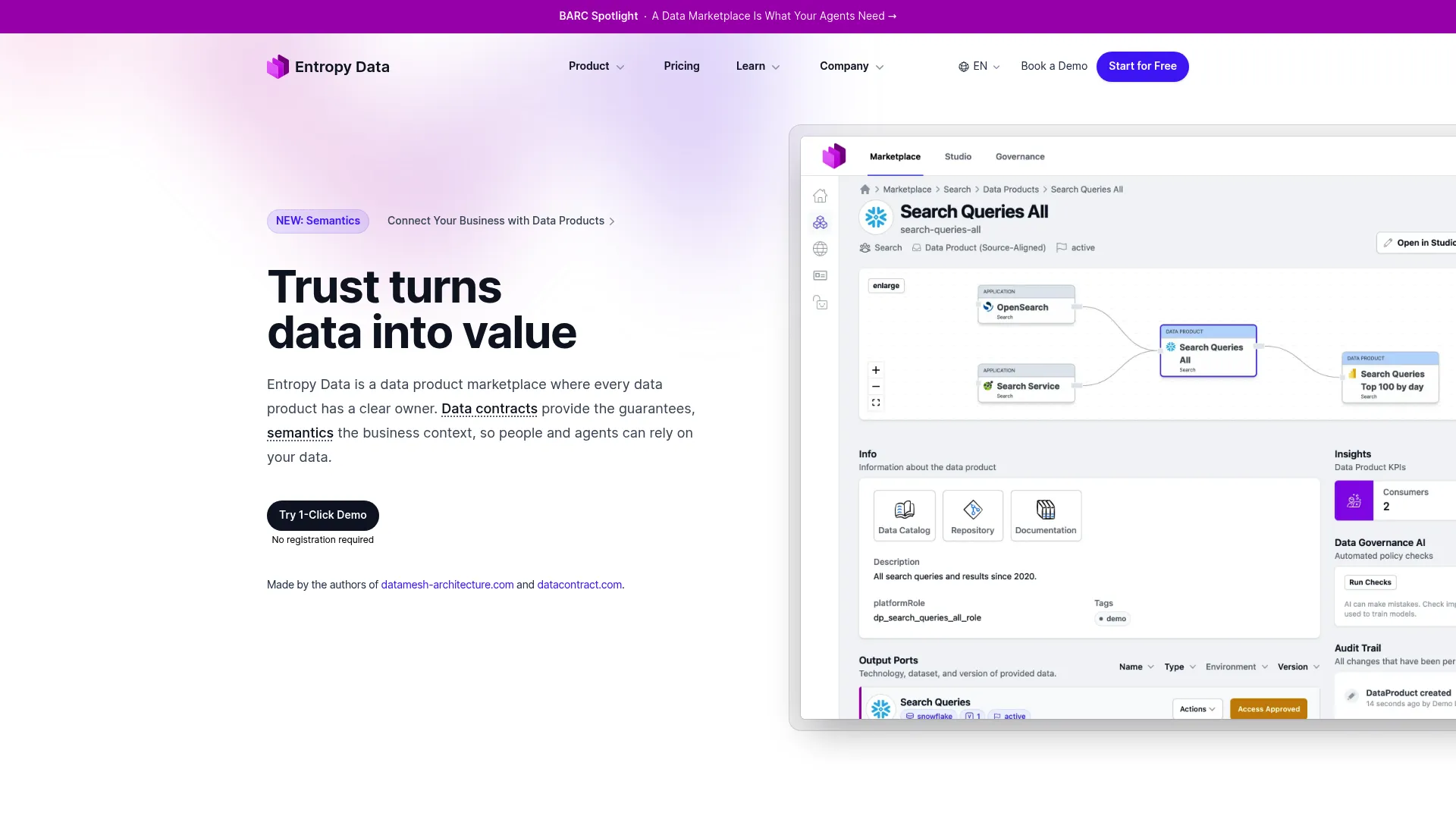
Entropy Data is the current brand for the data product and data contract management software formerly known as Data Contract Manager. If you evaluated Data Contract Manager in the past, Entropy Data is the same ecosystem, now positioned around data products, contracts, and governance automation for data mesh setups.
The product covers data product discovery and management, contract management, a self-service marketplace with request and approval workflows, and AI-assisted governance tooling. The continuity story matters for buyers: the brand changed, the lineage did not. For teams weighing vendor stability, the transition is worth understanding, but the underlying capabilities carry forward.
Best for: teams managing data products, contracts, and governance in a data mesh setup.
Key strengths
- Data products discovery and management
- Data contract management
- Self-service marketplace with request and approval workflow
- AI-assisted governance and contract tooling
Why choose Entropy Data: pick it when you want governance automation and AI-assisted contract checks tied to a data product marketplace. It suits teams that already think in data products and need the marketplace layer.
Entropy Data pricing: the public pricing table shows Free, Team, Business, and Enterprise tiers. Prices are per editor per month, billed annually, with viewers and shoppers free. The Enterprise tier is contact-sales.
6. Data Mesh Manager
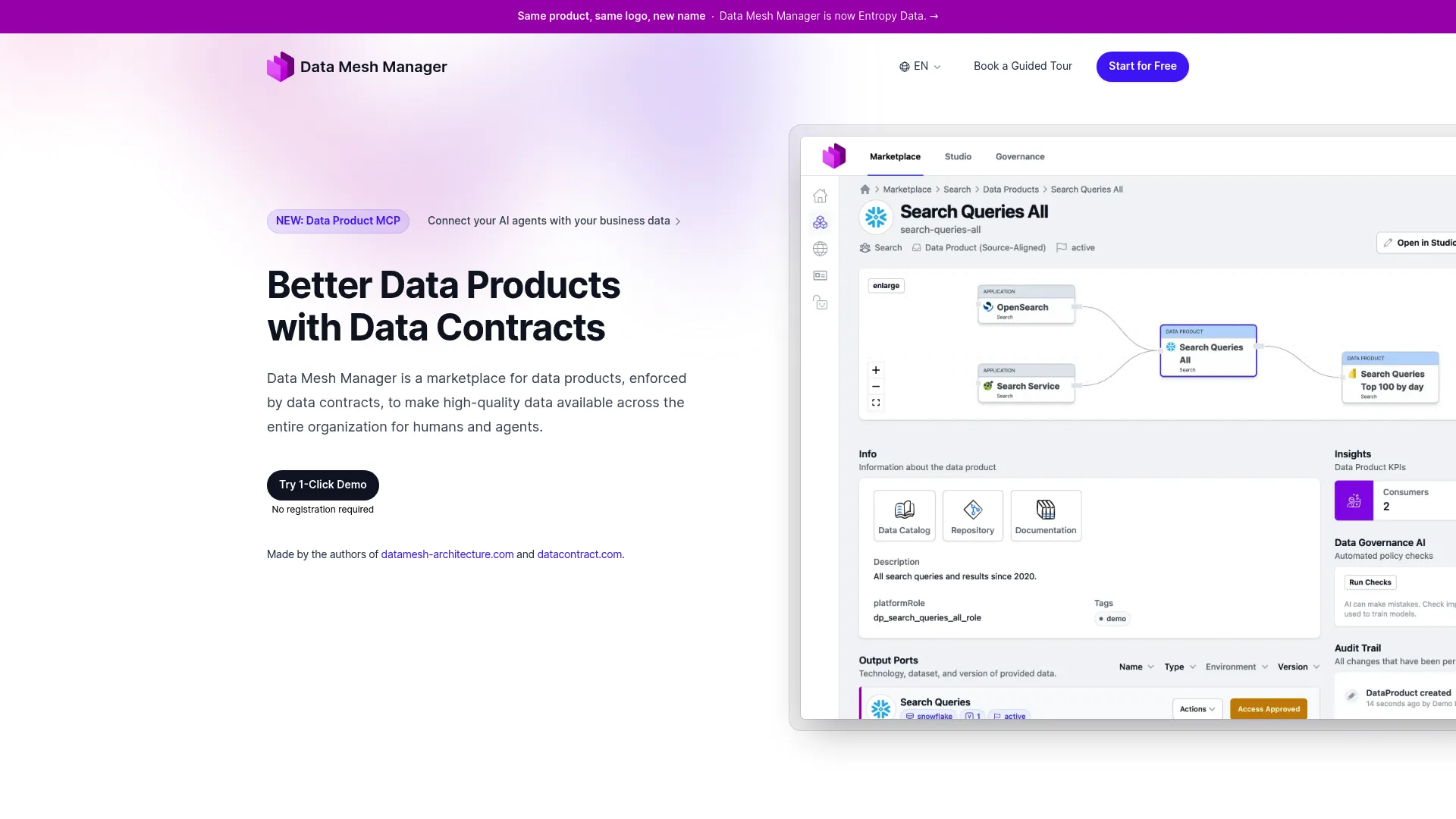
Data Mesh Manager is a data product marketplace for managing data products, data contracts, and governance across distributed teams. It is built for the data mesh model, where many domains own their own data products and need a shared way to publish, discover, and contract with each other.
The distributed-ownership angle is the point. Producers define contracts in a web UI, YAML, API, or even Excel, publish products to a marketplace, and route access through self-service request flows. AI-powered governance and policy checks sit on top. For organizations rolling out a mesh across multiple teams, that combination of discovery, contracts, and access workflow is the operational backbone.
Best for: teams building a governed data product marketplace with data contracts and self-service access.
Key strengths
- Data product discovery and marketplace
- Data contracts in web UI, YAML, API, and Excel
- AI-powered data governance and policy checks
- Self-service access request workflows
Why choose Data Mesh Manager: it fits multi-team environments adopting data mesh, where distributed ownership needs a shared marketplace and contract layer. Like Data Contract Manager, it now sits under the Entropy Data brand, so track the continuity.
Data Mesh Manager pricing: a free Starter Cloud tier and a free Community Self-hosted tier are available. Paid Team and Business plans are priced per editor per month, billed annually. Enterprise is custom.
7. Data Contract Specification
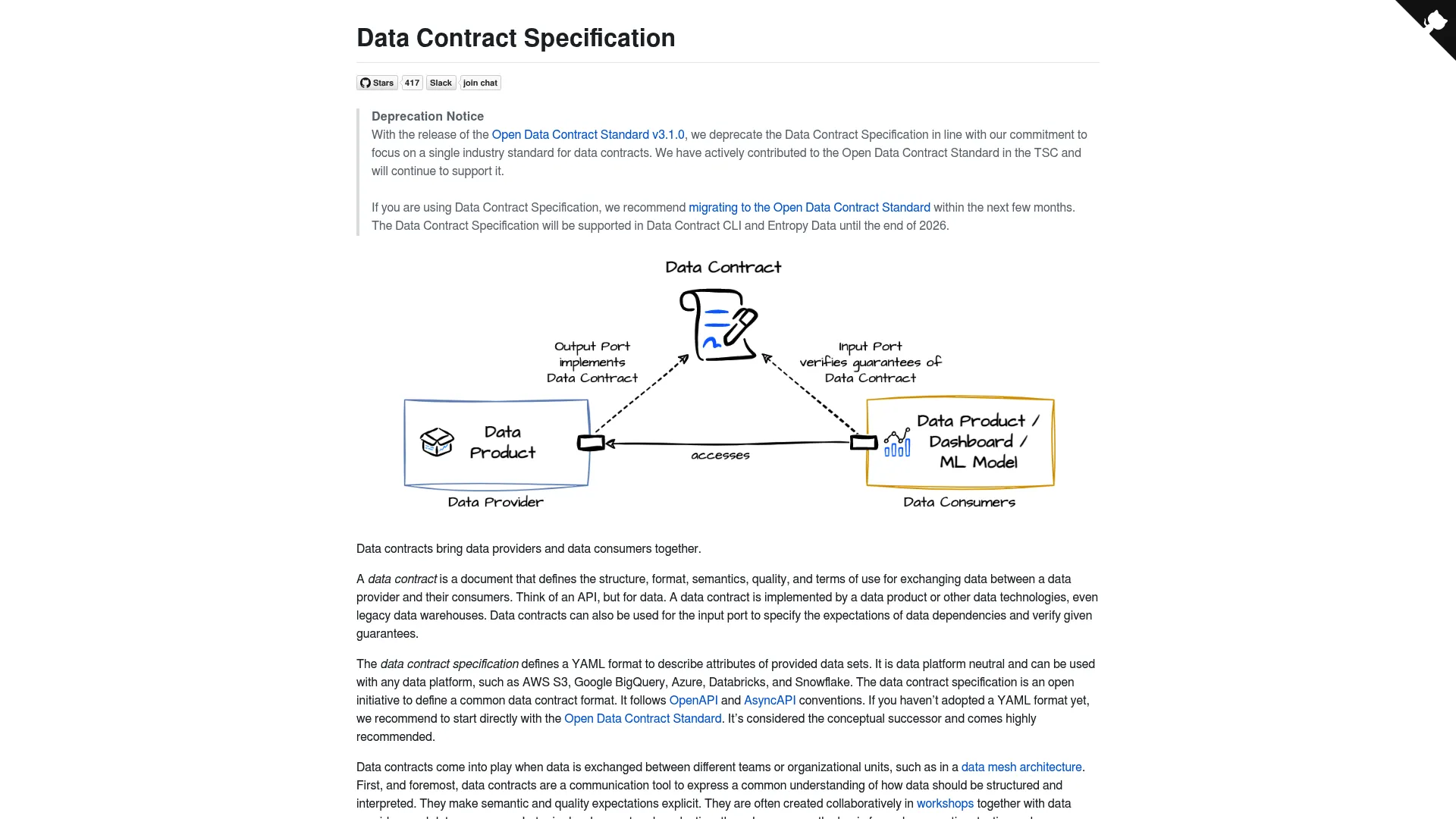
Data Contract Specification is an open, YAML-based specification for defining data contracts that describe data structure, semantics, quality, and terms of use. It is not a platform, it is a standard, and understanding it changes how you evaluate every tool on this list.
The value of a specification is portability. When your contracts follow an open, platform-neutral format, you are not locked into one vendor's schema. The spec covers structure, semantics, quality, and terms of use in a YAML file that works across major data systems. Teams that care about long-term portability read the spec first, then pick tooling that supports it.
Best for: teams standardizing data contract definitions and validation across data platforms.
Key strengths
- YAML format for data contracts
- Supports structure, semantics, quality, and terms of use
- Platform-neutral across major data systems
- Contract-as-code workflow in Git
Why choose Data Contract Specification: it fits teams who want a vendor-neutral definition format before committing to a platform. It is the reference point, not the enforcement engine.
Data Contract Specification pricing: free and open. There are no paid plans or pricing page.
8. Open Data Contract Standard
Open Data Contract Standard (ODCS), maintained under the Bitol project, is an open standard for defining and governing data contracts. It has become a common reference point for tooling: several products on this list, including Data Contract CLI, build directly on ODCS.
ODCS defines a YAML-based contract with schema and data quality sections, plus support for stakeholders, security, and service-level agreements. Fields like contract version and contract URL give each contract a stable identity you can reference across systems. If you want your contracts to remain portable as your stack evolves, understanding ODCS is table stakes, because it is the standard most enforcement tooling now targets.
Best for: teams looking for an open, vendor-neutral data contract standard.
Key strengths
- YAML-based contract standard
- Schema and data quality sections
- Stakeholders, security, and SLA support
- Widely supported by enforcement tooling
Why choose Open Data Contract Standard: choose it as the foundation your tooling should support, not as a tool itself. Standardizing on ODCS keeps your contracts portable and your options open.
Open Data Contract Standard pricing: free and open. ODCS is a standard, not a commercial product, so there are no plan tiers.
Considerations
Standards support
Check whether a tool supports ODCS, JSON Schema, Avro, Protobuf, or your schema registry. Standards support decides portability. If your contracts follow an open format, switching tools later means porting definitions, not rewriting them. Teams adopt faster when the tool speaks a standard they already use rather than a proprietary schema.
Enforcement depth
Authoring a contract and enforcing one are different jobs. Ask where enforcement actually happens: does the tool block breaking changes in CI/CD at pull-request time, validate at runtime against live data, or both? A tool that only stores definitions leaves the hard part, catching violations before they ship, to you.
Ownership and workflow fit
Look at how the tool handles producer accountability. Can you assign owners, route reviews, and require approvals before a contract changes? Contracts are agreements between teams, so the review and collaboration workflow matters as much as the validation engine. A tool that fits your existing Git and CI habits gets adopted; one that fights them gets abandoned.
Monitoring and change management
Evaluate whether the tool surfaces drift, versioning, and downstream impact fast enough for production. When a producer changes a schema, you want to know which consumers are affected before the change lands. Freshness monitoring, version history, and impact analysis separate tools built for real production use from tools built for demos.
Governance and scale
Decide whether you are equipping one team or an organization. A single engineering team might live happily in a CLI and Git. A distributed data mesh needs a marketplace, access workflows, and policy checks across dozens of domains. Match the governance model to your operating reality, not to the most feature-rich option on the list.
Conclusion
The right data contract software depends on your team's maturity and where breakage hurts most.
If you are engineering-led and want to start with an open standard, begin with Data Contract CLI on top of ODCS. It costs nothing, locks you into nothing, and automates enforcement in CI/CD from day one. If you need governance, marketplaces, and access workflows for an enterprise data program, Data Contract Manager and Entropy Data cover that lifecycle, and Data Mesh Manager extends it to distributed ownership. If breakage prevention and reliability are the headline, Monte Carlo pairs contracts with full observability, while Gable pushes enforcement upstream into the code that produces data.
Before you commit, do one thing: take two or three tools and run them against the same contract definition and the same enforcement checklist. Write one contract, try to break it, and see which tool catches the violation, where, and how fast. The tool that fails the change at pull-request time, not in production, is the one worth paying for.
FAQs
Data contract software helps teams define, validate, enforce, version, and monitor agreements about data structure, quality, ownership, and terms of use. It turns an informal producer-consumer expectation into a machine-readable, enforceable artifact. The goal is to catch breaking changes before they reach production rather than after a pipeline breaks.
A data catalog indexes datasets so people can find and understand data that already exists. A data contract defines and enforces the agreement about that data, then blocks changes that would violate it. A catalog helps you discover; a contract prevents breakage. Many teams run both, because they solve different problems.
The most common standards are the Open Data Contract Standard (ODCS), JSON Schema, Avro, and Protobuf, plus integration with schema registries. ODCS has become a widely supported reference point, and tools like Data Contract CLI build directly on it. Standards support matters because it keeps your contracts portable across tools.
Enforcement happens in two places. In CI/CD, the tool checks a proposed change at pull-request time and fails the build if it would break a downstream contract. At runtime, the tool validates live data against the contract and flags drift, freshness lapses, or quality violations. The strongest tools do both.
Contract-as-code means defining data contracts in a machine-readable format, usually YAML, and versioning them in Git alongside your pipeline code. It lets you review contracts in pull requests, track their history, and enforce them automatically in CI/CD. The contract becomes a first-class artifact, not a document that drifts out of date.
In a data mesh, many teams publish data products for each other to consume. Contracts give each product a versioned, enforced interface, so a consumer in one domain can trust a producer in another without a standing meeting. That makes distributed ownership scale, because trust is enforced by tooling rather than tribal knowledge.
It depends on who owns the workflow. Engineering-led teams often prefer a CLI like Data Contract CLI, because it lives in the terminal and CI. Cross-functional teams that include analysts and governance owners tend to want a UI and marketplace, like the Entropy Data lineage of tools. Many organizations use both: a UI for authoring and approvals, a CLI for automation.
Track the metrics that reflect breakage and trust. Count pipeline incidents caused by schema changes before and after adoption, and watch that number fall. Measure how many breaking changes get caught in CI/CD versus in production. Then look at time-to-resolution and how many downstream consumers were affected per incident. Fewer production breakages and faster catches are the signal that the software is doing its job.