You made a final-round offer. The candidate looked perfect on paper, nailed the interviews, and your VP wants them in the seat by month end. Then the reference check stalls. One referee never picks up. Another sends a two-line email that says nothing useful. A third gives feedback so generic you could attach it to anyone. Three days pass. The candidate gets nervous. The momentum you built across four interview rounds quietly leaks out.
Manual reference checking is one of the last hiring steps still run on phone tag and inbox chasing. It is slow, inconsistent, and it produces uneven signal at the exact moment a bad call costs the most. A single mis-hire at a 50-person company is not a line item. It is a quarter of lost output, a backfill cycle, and a dent in team trust.
The reference check software market reflects how seriously teams now take this. Market Research Future valued the category at roughly USD 0.29 billion in 2024 and projects a 6.72% CAGR through 2035, driven by demand for automation and compliance in hiring workflows. The pull is obvious. Software replaces the back-and-forth with structured, automated reference checking that returns consistent answers faster.
This guide compares the best reference checking software for 2026 by the factors that actually change hiring outcomes: speed, defensibility, and signal quality. If you are building a hiring engine that runs without you in every loop, this is infrastructure worth getting right. The same logic that makes you adopt a customer data platform or a digital adoption platform applies here: reduce manual work, increase signal, and make the process repeatable.
What's inside
This guide is for HR leaders, recruiters, talent acquisition managers, and founders who want faster, more consistent reference checks without adding headcount. We cover 10 tools built for automated reference checking and adjacent screening.
We selected and ranked each tool on six criteria that matter for buyers comparing options in 2026:
- Automation depth: how much of the request, reminder, and collection flow runs without manual effort
- ATS integration: how cleanly it fits your existing hiring stack
- Reporting and analytics: the quality of structured feedback and hiring signal it returns
- Compliance: GDPR and FCRA compliance, data retention, and security controls
- Candidate experience: a candidate-friendly mobile experience and clean referee flow
- Pricing clarity: how transparent the pricing tiers are
TL;DR
Short on time? Here are the fast picks by buying situation:
- Best for compliance-heavy and enterprise workflows: Mitratech AssureHire, with FCRA-compliant screening and deep ATS integration.
- Best for structured digital reference checks: Refapp, a digital reference checking platform with science-based templates and strong ATS fit.
- Best for consolidating hiring signal: HiPeople, which pairs automated reference checks with assessments and screening.
- Best for transparent pricing tiers: Xref, with public per-month plans starting low and scaling by volume.
- Best for fast turnaround: Vitay, built to cut reference-checking time dramatically with automated requests and reminders.
- Best for budget-conscious self-serve checks: Certn, with public per-check pricing for criminal and identity verification.
If you want the same repeatability you get from marketing automation or 360 feedback software, shortlist two or three of these and test them on real roles.
What is reference check software?
Reference check software is a digital reference checking platform that automates collecting, organizing, and reporting structured feedback from a candidate's professional references during hiring.
Instead of a recruiter calling each referee by hand, the software sends reference requests automatically, collects responses through customizable questionnaires, sends reminders, and compiles results into a clean report. Most modern tools add fraud detection and identity verification to confirm the reference is a real person, not the candidate filling in their own praise.
Here is how automated reference checking typically works under the hood:
- Automated request management: The system emails or texts each referee with a unique, secure link, then chases non-responders with scheduled reminders so recruiters stop manually following up.
- Customizable questionnaires: Teams build role-specific or competency-based question sets, so a sales hire and an engineering hire get relevant, comparable questions.
- Candidate and referee flow: Candidates submit references through a portal, and referees complete the check on their own time, often on mobile, which lifts completion rates.
- Reporting and analytics: Responses roll up into structured, side-by-side reports that surface real hiring signal instead of scattered email threads.
- Fraud detection and verification: Identity verification, IP checks, and false-reference prevention flag suspicious submissions before they influence a decision.
- ATS integration: Results sync back into your applicant tracking system so the record lives where your hiring team already works.
- Compliance and retention controls: Encryption, access controls, consent capture, and data retention policies support GDPR and FCRA compliance obligations.
The category overlaps with broader background screening. Some tools focus purely on references, while others bundle reference checks into identity verification, criminal checks, and ongoing monitoring.
When to use reference check software
Not every team needs to automate references on day one. These three situations are where the switch pays for itself fast.
Replace manual reference calls with a repeatable workflow
If your recruiters are drowning in phone tag, voicemail, and one-off email templates, you do not have a process. You have a series of improvised tasks that produce different results every time. Reference request automation turns that into a standard workflow: same questions, same reminders, same report format for every candidate. The output becomes comparable, and the recruiter time spent chasing referees drops toward zero.
Add better signal to final-stage hiring decisions
When two finalists look equally strong, vague references force a gut call. Structured feedback collected through customizable questionnaires lets you compare candidates on the same competencies, scored the same way. That is the difference between "the references were fine" and "this candidate scored consistently higher on ownership and follow-through." Better signal at the final stage is where reference software protects hiring quality most.
Support distributed or high-volume hiring
If you are hiring across time zones or running dozens of roles at once, recruiter capacity becomes the bottleneck. Automation removes the dependency on someone being awake to make a call. References get requested, completed on mobile, and reported around the clock. For a scaling team, that is the difference between a process that breaks at volume and one that holds.
Comparison table
Here is how the 10 tools compare at a glance. Ratings are from G2 where available, and pricing reflects publicly listed figures at the time of writing. Many vendors in this category use quote-based pricing that scales with volume.
| # | Product | Intent | Key differentiation | Pricing | G2 rating |
|---|---|---|---|---|---|
| 1 | Mitratech AssureHire | Compliance-heavy and enterprise screening | FCRA-compliant background screening with deep ATS workflows | Quote-based | 4.2/5 |
| 2 | Refapp | Structured digital reference checks | Science-based templates and ATS integrations | Usage-based, quote | 5.0/5 |
| 3 | HiPeople | Consolidated hiring signal | References plus AI assessments and screening | Free; from $60/mo | 4.6/5 |
| 4 | Xref | Transparent automated referencing | Public per-month tiers, surveys and reminders | From $70/mo | 4.6/5 |
| 5 | VidCruiter | Enterprise hiring workflow stack | Reference checks inside broader interview automation | Quote-based | 4.8/5 |
| 6 | Referoo | Fast digital reference checks | References, background, and ID in one platform | Free trial; quote | 4.8/5 |
| 7 | Vitay | Fast automated reference checks | Automated requests, follow-ups, custom question sets | From $699/yr | 4.8/5 |
| 8 | Checkmate | Screening at scale | Reference checks with fraud detection and monitoring | Quote-based | 4.8/5 |
| 9 | Certn | Budget-conscious verification | Public per-check criminal and identity checks | From $13.99/check | 4.7/5 |
| 10 | Verified First | Integration-friendly screening | Background, drug, and I-9 with HRIS integrations | Free tier; from $29.99 | 4.4/5 |
1. Mitratech AssureHire
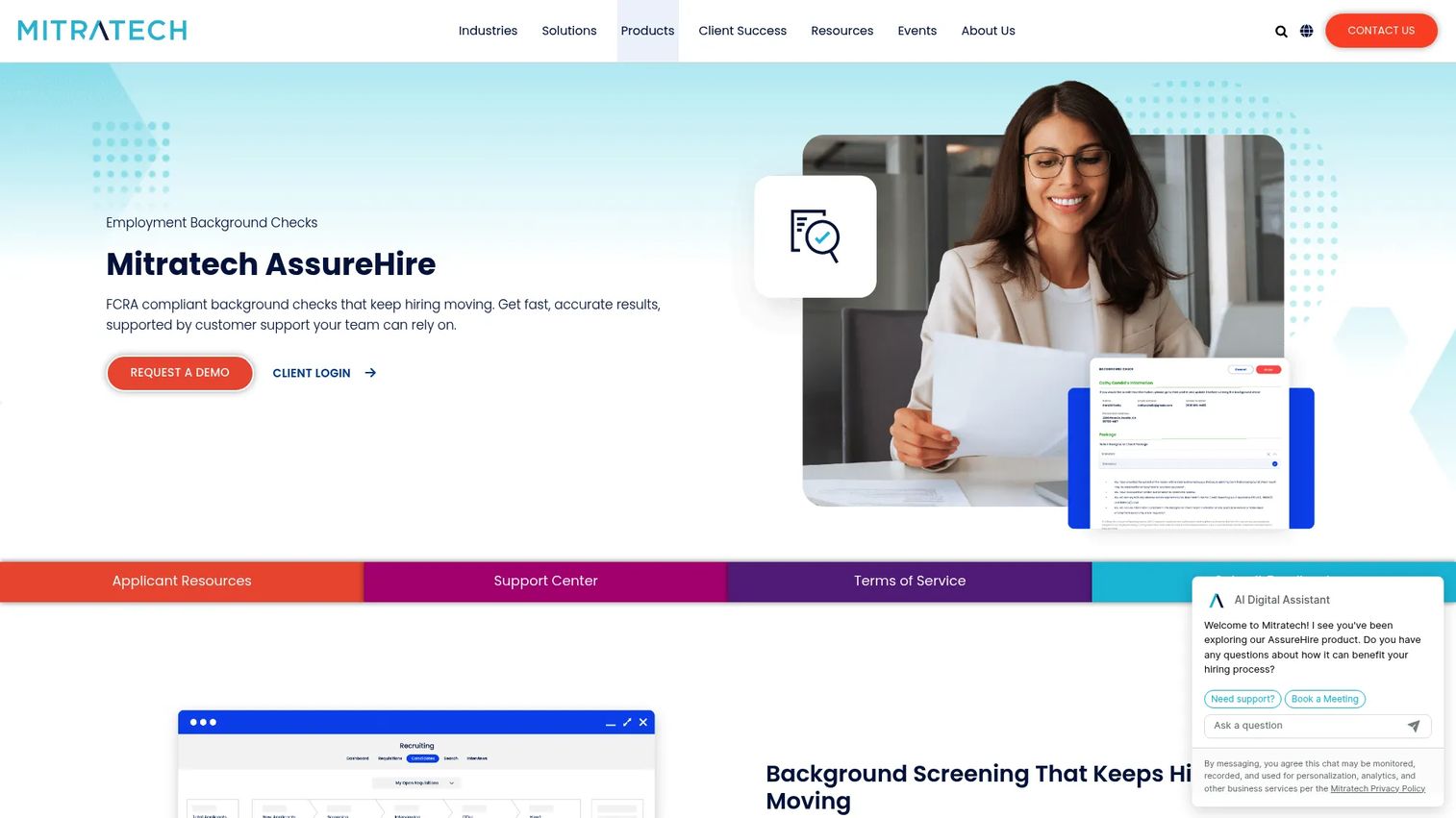
Mitratech AssureHire is FCRA-compliant background screening software with reference checking built into ATS-integrated hiring workflows. It is aimed at teams that treat hiring risk as a compliance problem first, where every check needs a clean, defensible paper trail. AssureHire pairs automated form fill with a live activity feed of pending and completed reports, so recruiters always know where each candidate sits.
Best for: Mid-market and enterprise teams that need compliant background and reference screening wired into their ATS and HR systems.
Key strengths
- Built-in compliance: Coverage spans EEOC, FCRA, GDPR, and HIPAA, backed by PBSA accreditation and SOC 2 certification for defensible hiring decisions.
- Automated form fill: Candidate data populates automatically, cutting manual entry and speeding up consent and onboarding steps.
- Activity feed: A real-time view of pending and completed reports keeps recruiters and hiring managers aligned without status-check emails.
Why choose Mitratech AssureHire: If your hiring volume and regulatory exposure mean a sloppy check could become a legal problem, AssureHire is built for that reality. It fits founders and people leaders who want screening and references handled inside one compliant system rather than stitched across point tools.
Mitratech AssureHire pricing: Pricing is not publicly listed. Mitratech says cost scales with the package and volume you run, and invites teams to request a demo and quote. For a fast-scaling company, ask for pricing tied to your expected monthly hire count so you can model cost against headcount plans.
2. Refapp
Refapp is a digital reference checking platform focused on structured, automated reference checks with strong ATS integration. It leans on science-based question templates so the feedback you collect is consistent and comparable across candidates, not improvised per call. Refapp is widely used across recruiting teams in Europe and beyond for digital reference checks and background screening.
Best for: Teams that want structured digital reference checks that plug directly into their existing ATS.
Key strengths
- Science-based templates: Pre-built, research-backed question sets standardize what you ask, improving the quality and comparability of structured feedback.
- Benchmark and compare: Side-by-side candidate comparison turns reference responses into a clear hiring signal instead of anecdotes.
- ATS integrations: References sync into your hiring stack so the record lives where recruiters already work.
Why choose Refapp: Refapp suits teams that care about defensibility and consistency more than bundling every screening type into one tool. The structured templates remove recruiter bias from how questions get asked, which matters when you are trying to make repeatable, comparable final-stage decisions.
Refapp pricing: Refapp uses flexible, usage-based pricing tailored to organization size and hiring volume, and offers a free demo for a personalized quote. No public numeric price is listed. Because pricing scales with usage, it works well for teams that want cost to track actual hiring activity rather than a flat seat fee.
3. HiPeople
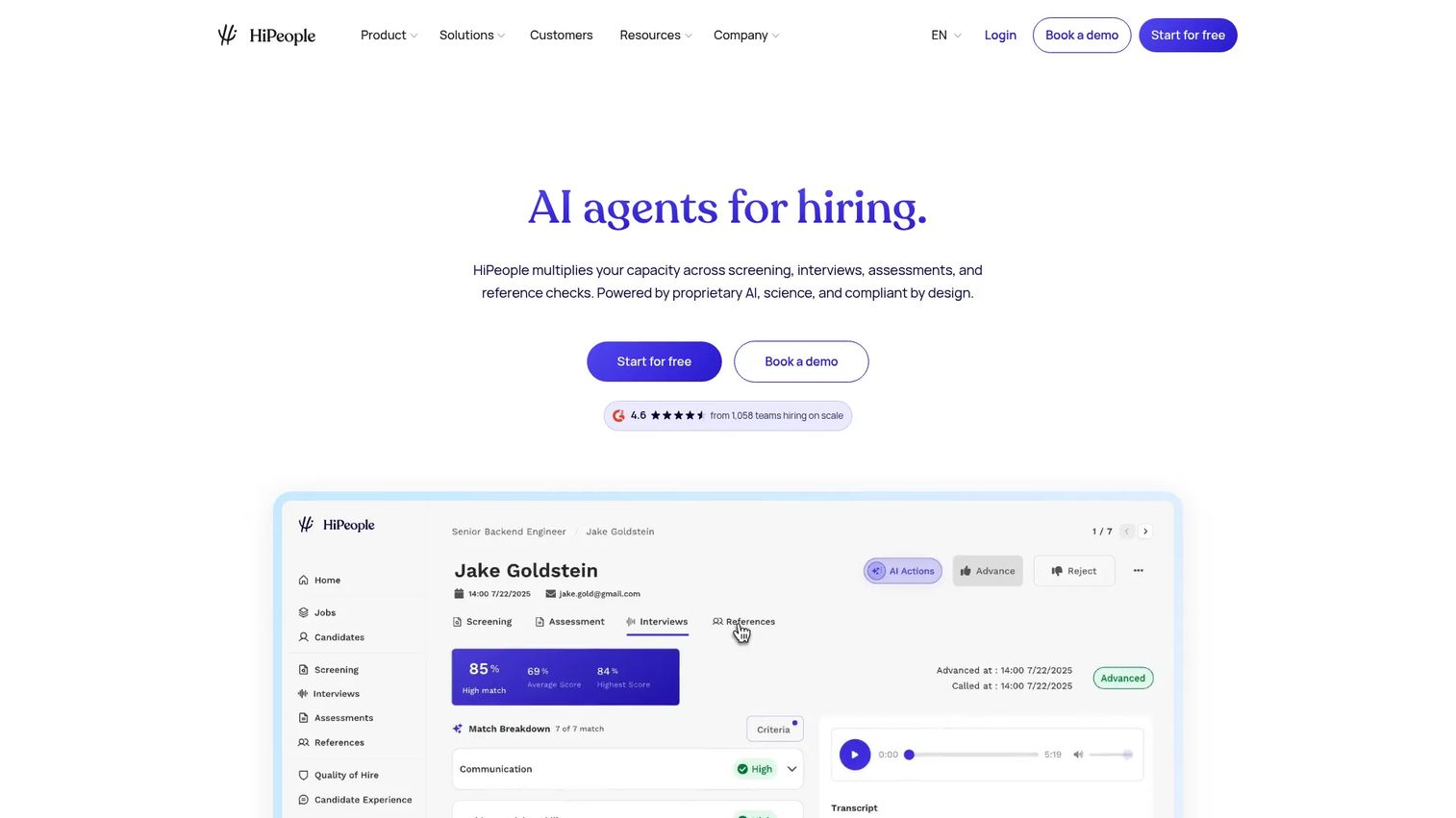
HiPeople is an AI hiring platform that combines automated reference checks with candidate assessments and screening workflows. The pitch is consolidation: instead of running references in one tool and skills assessments in another, you get hiring signal from multiple sources in one place. For teams hiring at volume, that single view of a candidate is the draw.
Best for: Teams that want to automate high-volume hiring and consolidate reference checks with assessments.
Key strengths
- Automated reference checks: Requests, reminders, and reporting run automatically, removing manual chasing from the recruiter's plate.
- AI-powered assessments: Skills and competency assessments add an objective signal layer alongside reference feedback.
- AI screening workflows: Screening and interview automation help high-volume teams move candidates through faster.
Why choose HiPeople: HiPeople fits founders who want fewer tools doing more. If you are already evaluating assessment platforms, folding references into the same system reduces stack sprawl and gives you one consolidated read on each candidate. That consolidation is exactly the kind of signal-over-tools tradeoff scaling teams look for.
HiPeople pricing: HiPeople publishes Free, Grow, Scale, and Enterprise plans. The Free plan includes full product access with $300 in credits and no ATS integration. Grow starts at $60 per month and Scale at $84 per month, with Enterprise priced custom. The free tier makes it easy to test on a single role before committing.
4. Xref
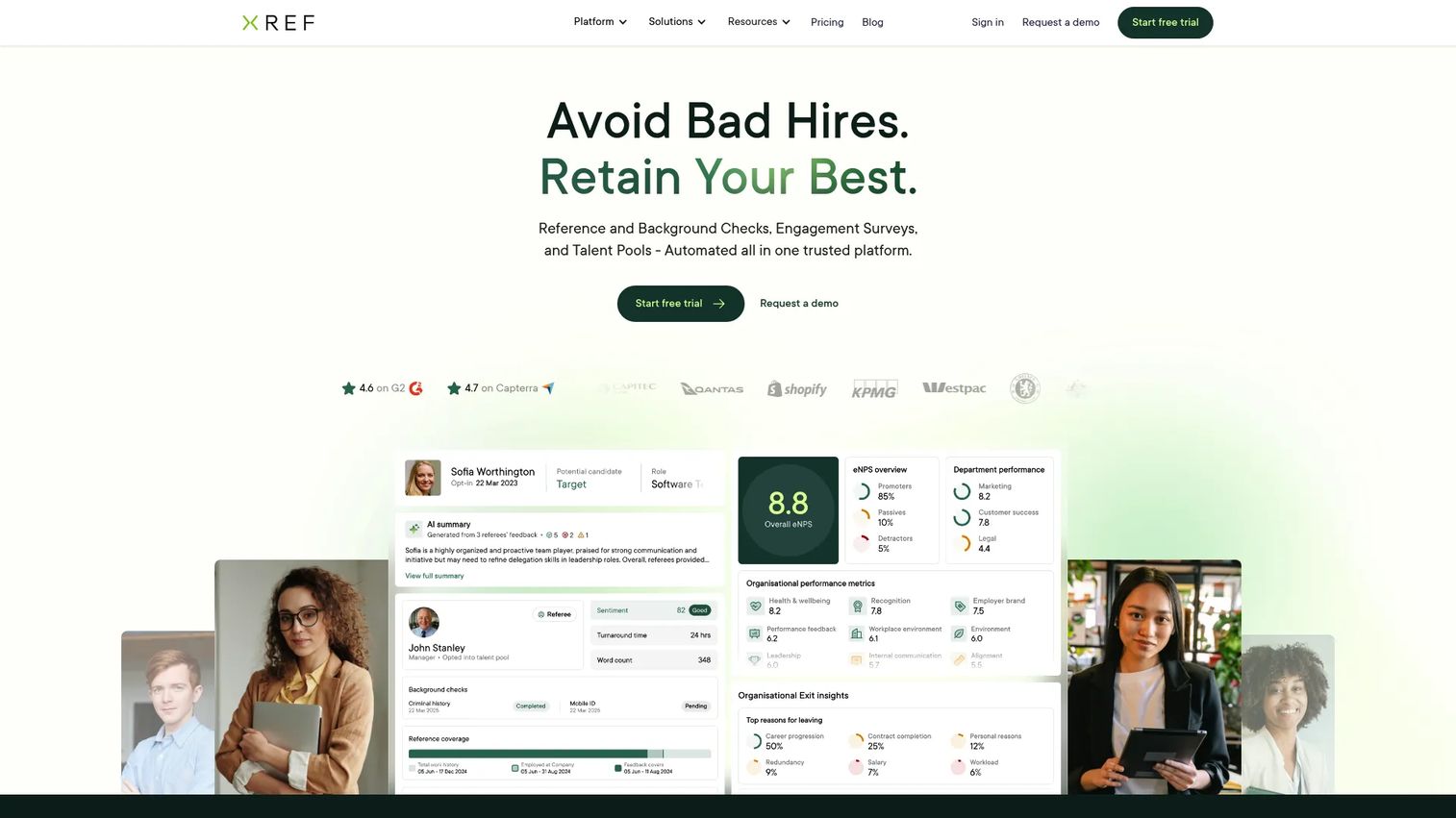
Xref is an automated reference checking and talent feedback platform that also handles retention and exit surveys. Its standout for buyers is rare in this category: transparent, public pricing with clear tiers. Xref automates the full reference flow with candidate and referee surveys, custom reminders, and alerts.
Best for: HR teams that want automated reference checks with surveys, reporting, and transparent pricing tiers.
Key strengths
- Automated reference checking: The full request, reminder, and collection cycle runs without manual follow-up.
- Candidate and referee surveys: Customizable surveys capture structured feedback from both sides for richer hiring signal.
- Custom reminders and alerts: Scheduled nudges keep response rates high and turnaround time low.
Why choose Xref: If opaque "contact sales" pricing frustrates you, Xref is refreshing. Published per-month tiers let you model cost upfront and pick a plan that matches your hiring volume. That transparency makes it easy for a founder or people lead to budget without a sales cycle.
Xref pricing: Public tiers start at $70 per month for Starter on annual billing ($80 monthly), then Growth at $140, Plus at $290, and Premium at $485 per month on annual terms. Enterprise is custom. Plans carry employee-size caps, so match the tier to your headcount and hire volume.
5. VidCruiter
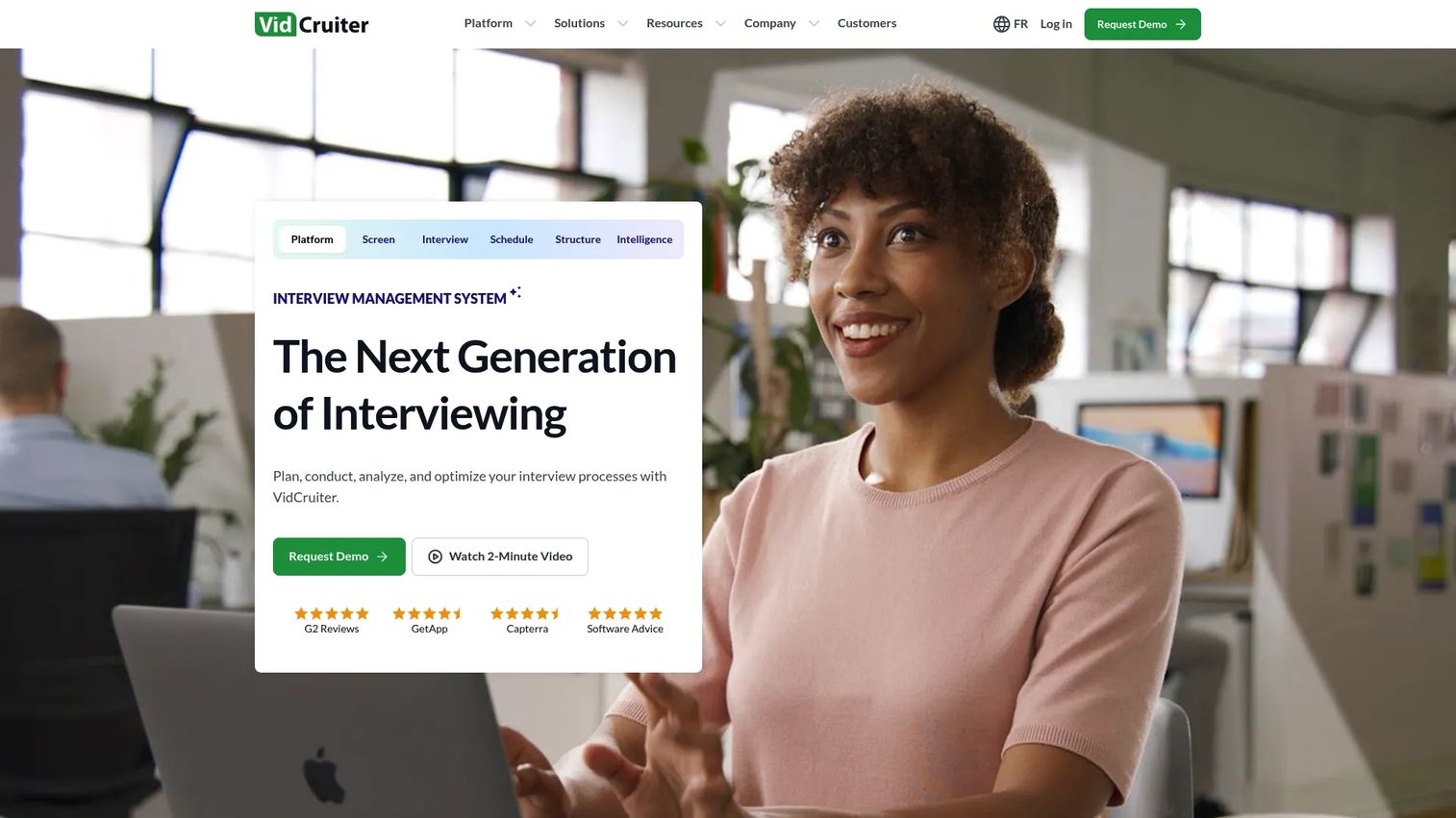
VidCruiter is interviewing and hiring software where reference checks sit inside a larger recruiting automation stack. Alongside structured and video interviews and scheduling, it offers automated reference collection as part of an end-to-end hiring workflow. The value is breadth: one platform from screening through references for teams that want to standardize the whole pipeline.
Best for: Mid-to-large organizations that need customizable interview management with reference checks built into one workflow.
Key strengths
- Structured interviews: Standardized interview workflows reduce bias and keep evaluation consistent across roles.
- Video interviewing: Pre-recorded and live video interviews handle high-volume and distributed hiring.
- Interview scheduling: Automated scheduling removes coordination overhead before references even begin.
Why choose VidCruiter: Choose VidCruiter when references are one piece of a larger hiring-automation problem you want solved in a single system. For a scaling company standardizing its entire recruiting motion, consolidating interviews, scheduling, and references reduces handoffs and tool sprawl.
VidCruiter pricing: VidCruiter does not publish public pricing. The company states pricing is custom and quote-based, determined by company-specific needs. If you are evaluating it primarily for references, ask the sales team to break out reference-check cost from the broader platform so you can compare it fairly against point tools.
6. Referoo
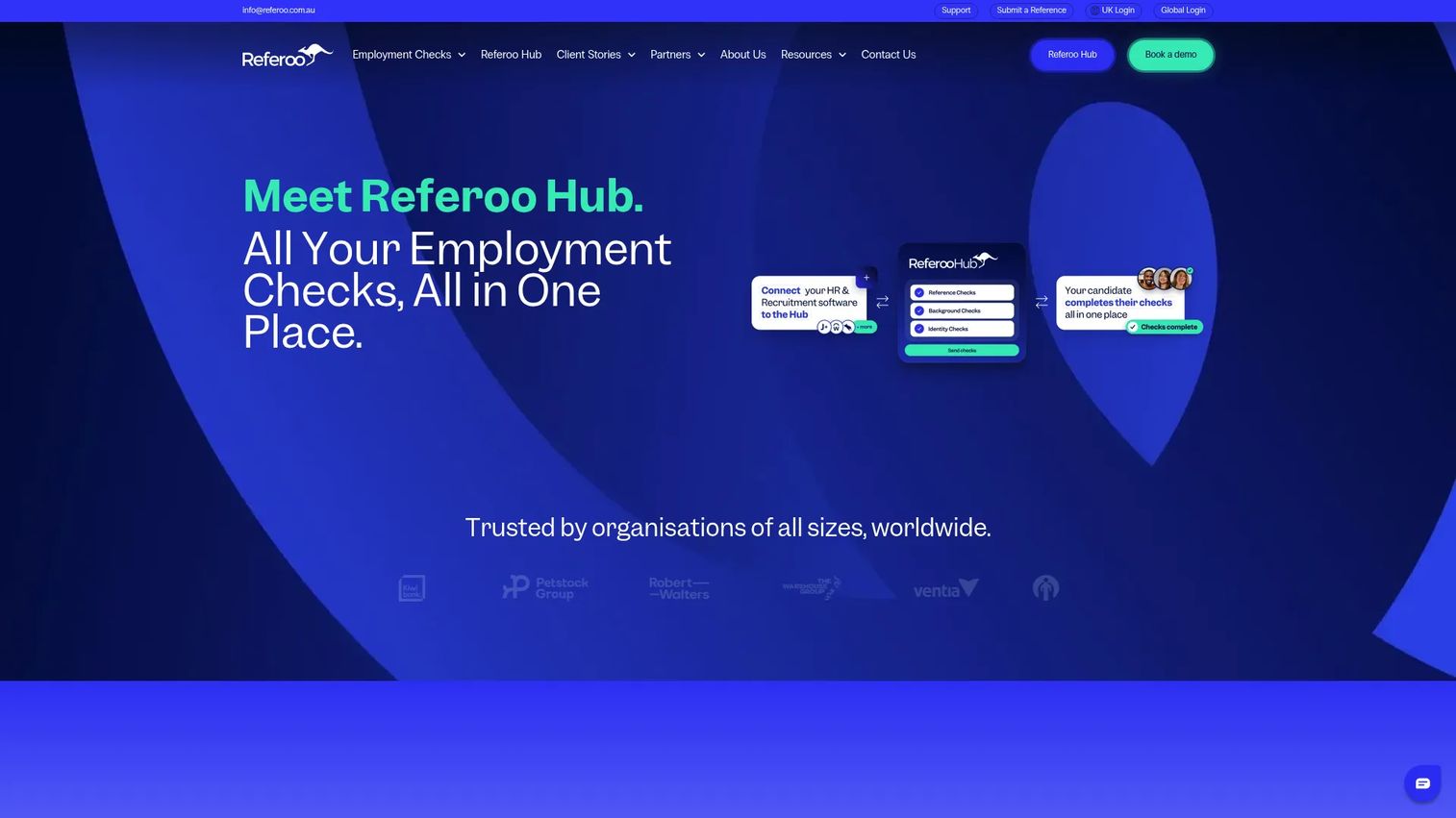
Referoo is employment-checking software that combines reference checks, background checks, and ID verification in one platform. References can be collected by email, SMS, or phone, which gives recruiters flexibility based on each referee's preference. Built-in fraud detection helps confirm responses are legitimate before they shape a decision.
Best for: HR and recruitment teams that need streamlined reference and background checks with built-in identity verification.
Key strengths
- Multi-channel references: Collect checks by email, SMS, or phone to fit how each referee prefers to respond.
- Background and ID in one place: Reference checks, background checks, and identity verification live in a single platform.
- Fraud detection: Built-in checks support false-reference prevention so questionable responses get flagged early.
Why choose Referoo: Referoo fits teams that want references and identity verification handled together without juggling separate vendors. The multi-channel approach lifts completion rates, which directly improves turnaround time when a referee would rather text than fill out a form.
Referoo pricing: Referoo lists plan names including Referoo Essential and Referoo Hub, plus a 14-day free trial, but does not publish numeric pricing on its site. The free trial lets you test the referee flow and fraud detection on a live role before requesting a quote.
7. Vitay
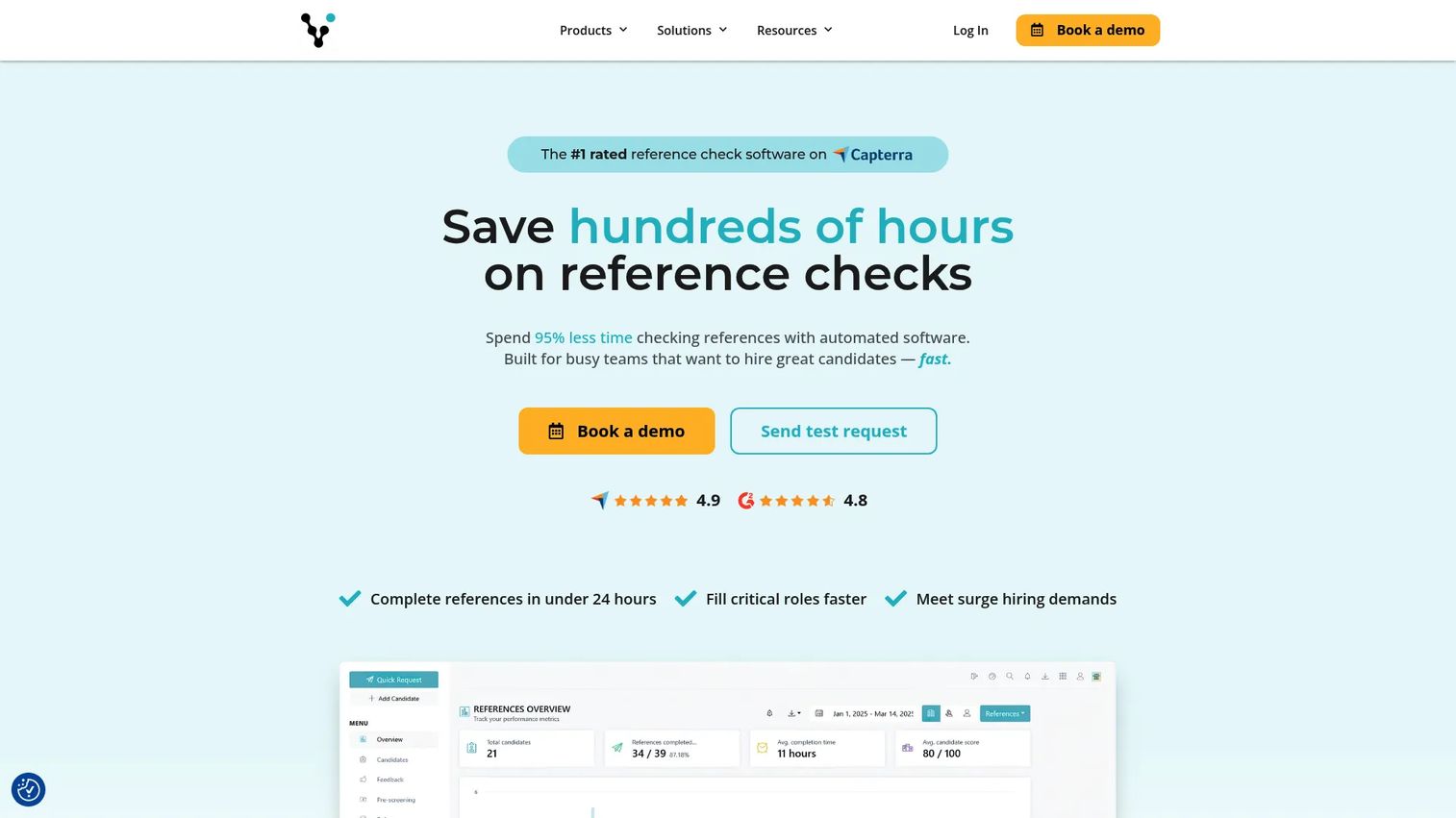
Vitay is automated reference checking software built for recruiting teams that want speed. It automates reference requests and follow-ups, supports custom question sets, and rolls results into reporting and analytics. The focus is straightforward: cut the time recruiters spend chasing references and return results fast.
Best for: Hiring teams that need faster automated reference checks without manual chasing.
Key strengths
- Automated requests and follow-ups: The system sends and reminds automatically, removing the manual chase that slows references down.
- Custom question sets: Role-specific questionnaires produce comparable, structured feedback across candidates.
- ATS integrations and reporting: Results sync to your stack and roll up into analytics that surface hiring signal.
Why choose Vitay: Vitay suits teams where turnaround time is the priority and references routinely stall the offer stage. The automation is designed to compress days of back-and-forth into a fast, hands-off cycle, which matters when a hot candidate is weighing competing offers.
Vitay pricing: Public third-party pricing lists Vitay's Scout plan starting at $699 per year on a usage-based model. Vitay's own site frames pricing around affordability but does not show a numeric figure. For a small team running a steady but modest hire volume, the annual usage model is worth modeling against your expected check count.
8. Checkmate
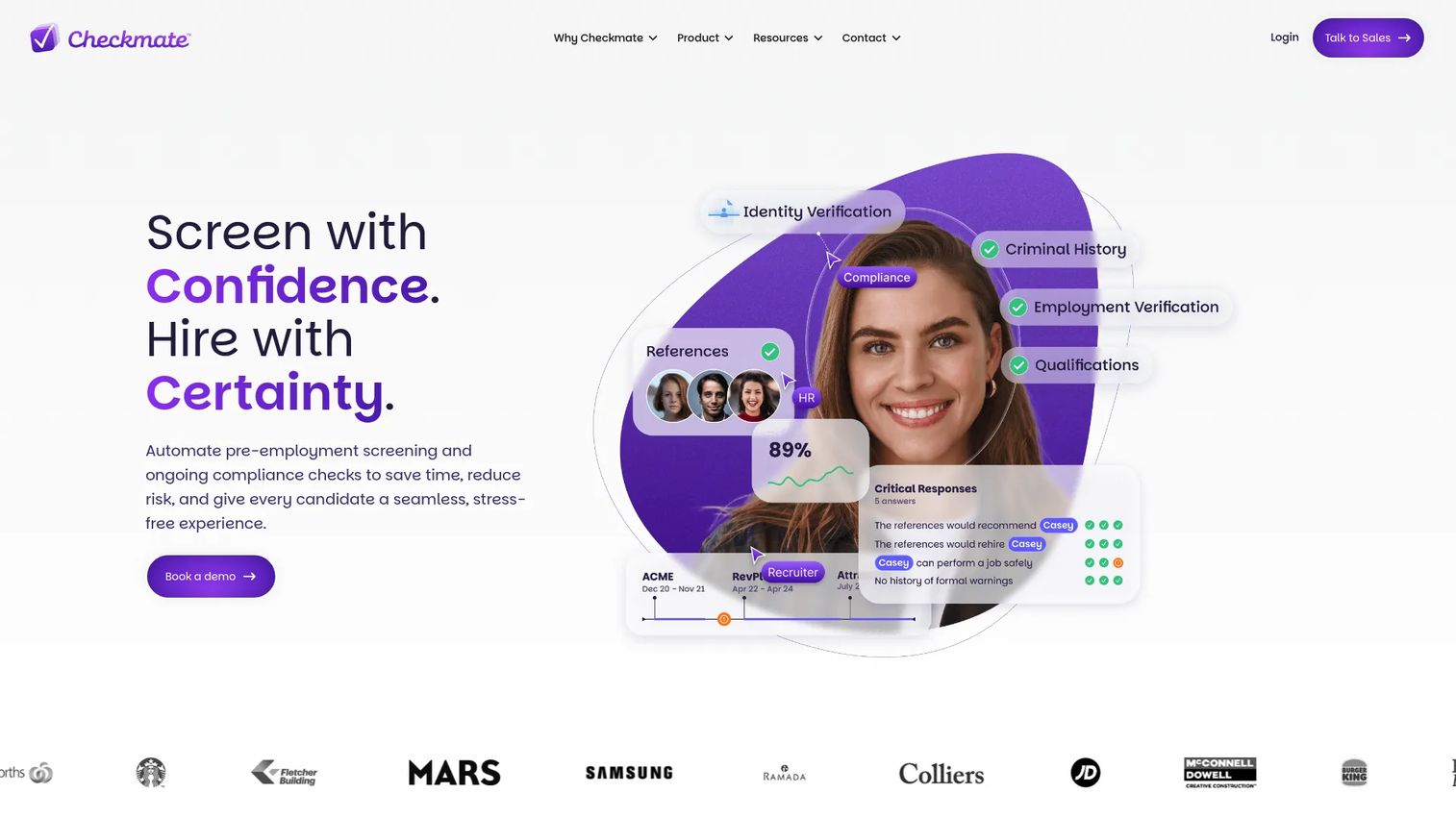
Checkmate is hiring screening software for automated background checks, reference checks, and ongoing compliance monitoring. Its reference checking includes fraud detection, and the platform extends into pre-employment screening and visa checks. Checkmate is built on AWS with encrypted storage and holds ISO 27001, SOC 2, FCRA, and GDPR compliance.
Best for: Teams that need automated reference and background screening at scale with strong security posture.
Key strengths
- Automated reference checks with fraud detection: Built-in checks support false-reference prevention while automating the request flow.
- Pre-employment screening: Background checks and reference checks run together for a complete candidate picture.
- Ongoing compliance monitoring: Continuous monitoring and visa checks extend screening beyond the initial hire.
Why choose Checkmate: Checkmate fits teams that value simplicity and speed alongside a serious security and compliance footprint. The ISO 27001 and SOC 2 posture, plus FCRA and GDPR compliance, make it defensible for companies that need to clear security reviews as they scale.
Checkmate pricing: Checkmate does not publish public pricing. The company says cost is based on what you actually run, with custom and enterprise options. Because pricing tracks usage, ask for a per-check estimate tied to your reference and background-check mix so you can compare against bundled competitors.
9. Certn
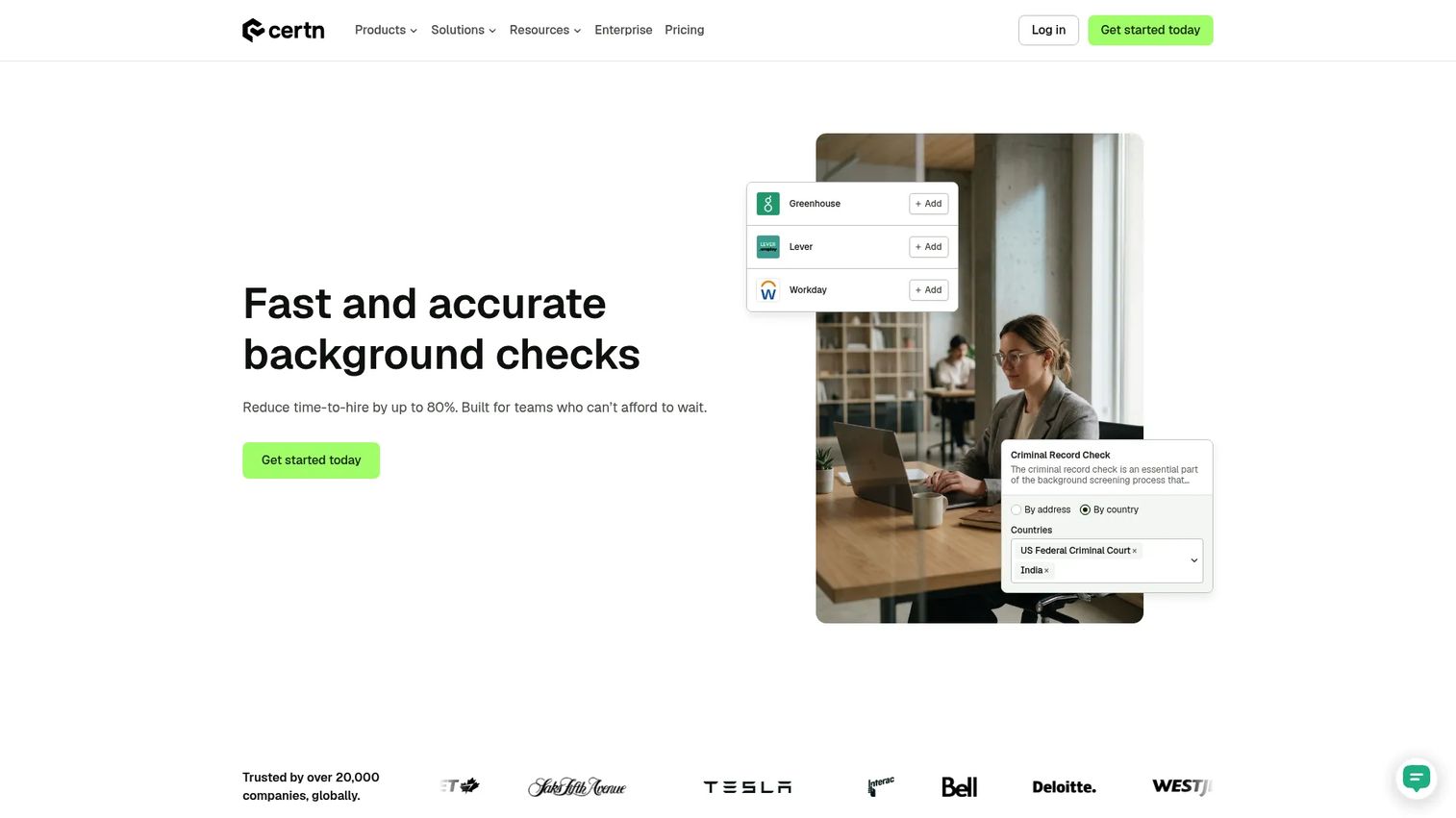
Certn is background screening software offering criminal record checks, identity verification, and verifications with strong API and ATS integration. It stands out for publishing self-serve per-check pricing, which is rare in this space. Certn's OneID identity verification and US and Canadian criminal checks make it a practical pick for teams that want transparent, fast verification.
Best for: Teams that need fast, API-friendly background screening and candidate verification with public per-check pricing.
Key strengths
- Criminal record checks: US and Canadian checks return results quickly for distributed hiring.
- Identity verification: OneID confirms candidate identity to support fraud detection and false-reference prevention.
- API and ATS integrations: Strong integration options let you wire checks directly into your hiring stack.
Why choose Certn: Certn fits budget-conscious teams that want predictable per-check costs and adjacent verification capabilities. The public pricing removes guesswork, and the API-first design suits founders who want screening triggered automatically from their ATS rather than run by hand.
Certn pricing: Certn publishes US self-serve pricing: a Core Criminal Check at $13.99, a Complete Criminal Check at $49.99, and a Complete+ Criminal Check at $79.99, each one-time. Enterprise and custom solutions are available but not publicly priced. The per-check model makes it easy to control spend at low volume.
10. Verified First
Verified First is background screening and drug testing software for employers, built around deep HR platform integrations and compliance-focused workflows. Its strength is workflow fit: it plugs into a wide range of HRIS and ATS systems, so screening runs inside tools your team already uses. Alongside background checks, it covers drug screening and I-9 and E-Verify.
Best for: Employers that need background screening with broad HRIS and ATS integrations.
Key strengths
- Background checks: Core screening runs inside your existing HR platform rather than a separate portal.
- Drug screening: Drug testing workflows extend screening for roles that require it.
- I-9 and E-Verify: Built-in employment eligibility verification supports compliance obligations.
Why choose Verified First: Verified First suits teams that prioritize integration breadth and want screening embedded in their current stack. With a PBSA-accredited, SOC 2 posture and a reported 98% client satisfaction rating, it is a defensible pick for employers who care about workflow fit above all.
Verified First pricing: Verified First shows five plans. Basic is $29.99, Essential $54.99, and Premium $79.99, each one-time. Build Your Own and Enterprise require a custom quote. A free tier is reported via Capterra. The published one-time prices make it easy to start small before scaling into a custom plan.
What to evaluate before buying
A feature list does not tell you whether a tool fits your hiring motion. Run every shortlisted option against these criteria.
Automation and turnaround time
The whole point is removing manual chasing. Check how reminders work, whether referees can complete on mobile, and what real turnaround time looks like on a live role, not a sales demo. Test it on an actual hire before you commit.
ATS integration and workflow fit
If results do not sync into your applicant tracking system, your team ends up copying data between tools. Confirm which ATS and HRIS systems each vendor supports natively, and how deep the integration goes beyond a simple data dump.
Compliance and security
For regulated or cross-border hiring, GDPR and FCRA compliance is non-negotiable. Look for encryption, role-based access controls, consent capture, clear data retention policies, and certifications like SOC 2 and ISO 27001 for secure feedback collection.
Fraud detection and signal quality
A reference is only useful if it is real. Identity verification, IP checks, and false-reference prevention protect you from candidates gaming the process. Pair that with structured questionnaires so the feedback you collect is comparable and decision-grade.
Pricing fit
Many vendors quote based on volume, so model cost against your expected monthly hires, not a flat number. Where public pricing tiers exist, compare them against the depth of automation, reporting, and integration you actually need.
Conclusion
The right reference checking software should do three things: save recruiter time, tighten final-stage hiring decisions, and fit the stack you already run. For compliance-heavy and enterprise teams, Mitratech AssureHire and Checkmate bring serious screening and security depth. For structured digital reference checks, Refapp and Vitay focus on consistent, fast feedback. If transparent pricing matters, Xref and Certn publish clear figures upfront. And for consolidating hiring signal across assessments and references, HiPeople reduces tool sprawl.
There is no single best pick, only the best fit for your hiring volume, compliance needs, and existing tools. Shortlist two or three from this list, run them on a real role, and measure turnaround time and signal quality directly. The same discipline you bring to evaluating a marketing analytics platform or an email verification tool applies here. Test, measure, and pick the one that earns its place in your hiring engine.
Start your journey with Guideflow today!
FAQs
Reference check software automates collecting and organizing feedback from a candidate's professional references. It standardizes the questions asked, sends and chases requests automatically, and compiles responses into structured reports, replacing manual phone calls and scattered email threads with a consistent, repeatable process.
The software sends each referee a secure, unique link by email or text, then collects their answers through customizable questionnaires. Automated reminders chase non-responders, and completed responses roll up into side-by-side reports. Most tools sync results back into your ATS so the record lives where your hiring team already works.
Automated reference checking saves recruiter time by removing manual follow-up, produces consistent structured feedback across candidates, and improves candidate experience with a fast, mobile-friendly flow. The biggest payoff is signal quality: comparable, decision-grade feedback at the exact moment a hiring mistake costs the most.
Yes. Most modern tools offer ATS integration so reference requests trigger automatically and results sync back into your hiring records. Before buying, confirm the vendor supports your specific ATS or HRIS natively, and check how deep the integration goes beyond basic data transfer.
Reputable platforms support GDPR and FCRA compliance with encryption, role-based access controls, consent capture, and defined data retention policies. Look for certifications like SOC 2 and ISO 27001, which signal that secure feedback collection and data handling meet recognized standards.
Most leading tools offer a candidate-friendly mobile experience so referees can respond from their phone. Mobile access matters because it removes friction, and a referee who can answer a few questions on their phone responds faster than one asked to sit at a desktop, which improves completion rates and turnaround time.
Pricing varies widely. Some tools publish pricing tiers, like Xref starting at $70 per month or Certn at $13.99 per check, while others such as Mitratech AssureHire and VidCruiter quote custom pricing based on volume. Compare any price against your expected hire count and the depth of automation, reporting, and integration you need.
Prioritize automation depth, reporting and analytics, fraud detection, customizable questionnaires, ATS integration, and compliance support. Then weigh pricing against your hiring volume. The best fit is the tool that removes the most manual work while returning the cleanest hiring signal for the roles you actually hire for.