You hired three people in two states last quarter. Now you owe payroll tax filings in both, your health plan renewal is sitting in your inbox, and a contractor just asked why their classification changed. None of this is on your roadmap. All of it is on your plate.
That is the moment most founders start looking at PEO providers. A professional employer organization absorbs payroll, benefits, workers compensation, and compliance under a co-employment model, so the people-ops work that quietly eats leadership time stops routing through you. The market reflects how common this shift has become. IBISWorld pegs the U.S. PEO industry at $254.8 billion in 2026 across 6,675 businesses, and NAPEO reports that over 500 PEOs already serve more than 230,000 client companies. Done right, a PEO is the fastest way to make HR repeatable without building an internal HR function before you need one.
The catch: the best PEO providers for one company are the wrong fit for another. A distributed team hiring across borders needs something different from a 40-person team consolidating onto one health plan. This guide ranks eight PEO companies through a founder lens, with pricing, ratings, and fit you can actually use. If you are also rationalizing the rest of your stack, our roundups of the best business intelligence software and the best ASO tools follow the same decision-first format.
What's inside
This guide is for SaaS founders and operators who need HR outsourcing that reduces overhead without becoming another internal project. We ranked eight PEO providers on six criteria that matter when you are scaling: compliance support, benefits quality, pricing transparency, service quality, geographic coverage, and fit for fast-growing teams. Each provider gets a plain breakdown of what it does well, who it suits, current pricing where it is public, and a verified G2 rating. The comparison table up top is built for fast scanning. The item sections below give you the detail before you ever talk to a sales rep.
TL;DR
- Best overall for fast-growing SaaS teams: Deel, especially if you hire across borders.
- Best for a well-known PEO brand: TriNet, for established full-service HR.
- Best for service-heavy support: G&A Partners, with hands-on guidance.
- Best for simpler onboarding and bundled HR tools: Justworks.
- Best for enterprise-scale infrastructure: ADP TotalSource.
- Best for payroll-heavy teams wanting a broad HR stack: Paychex.
- Best for HR outsourcing depth: Insperity.
- Best for smaller teams wanting hands-on support: CoAdvantage PEO.
The right pick depends on your hiring footprint, benefits needs, and how much complexity you want to absorb now. A PEO for small business should remove work, not add a vendor you have to manage.
What is a PEO?
A professional employer organization (PEO) is a company that co-employs your workforce so it can administer payroll, benefits, taxes, workers compensation, and HR compliance on your behalf. You stay in charge of day-to-day management and the work your team does. The PEO becomes the employer of record for tax and benefits purposes, which is the heart of the co-employment model.
Co-employment in plain English: your company and the PEO share specific employer responsibilities under a contract. You direct the work. The PEO handles the administrative and regulatory load that comes with employing people. Because the PEO pools your employees with thousands of others, you often get access to benefits plans and rates that a small team could not negotiate alone.
Most PEO services cover the same core functions:
- Payroll and payroll tax filing across the states where you employ people
- Benefits administration, including health, dental, vision, and retirement plans
- Workers compensation coverage and claims management
- HR compliance support for federal, state, and local employment law
- Onboarding, offboarding, and employee self-service tools
- Risk and safety guidance to reduce employer liability
That bundle is what separates a PEO from a payroll-only vendor. We cover the PEO vs payroll provider distinction, along with PEO vs EOR and PEO vs ASO, in the FAQs.
When to use a PEO
Not every team needs a PEO. These three situations are the most common triggers for founders.
Multi-state hiring is creating compliance drag
The moment you employ people in a second or third state, you inherit new payroll tax registrations, unemployment insurance accounts, and a stack of state-specific employment rules. A PEO already operates in those states and folds the registrations, filings, and compliance into one relationship. Instead of researching California meal-break law at 11pm, you hand the question to a provider whose job is to know the answer.
Benefits administration is taking too much leadership time
When health plan renewals, open enrollment, and benefits questions start landing on a founder or office manager, it is a sign the function has outgrown ad hoc handling. A PEO centralizes benefits administration, gives employees a self-service portal, and uses its pooled scale to offer plans that help with retention. The manual coordination drops to near zero.
Payroll and tax coordination are outgrowing internal ops
Fragmented payroll is a quiet risk. Spreadsheets, a basic payroll tool, and a part-time bookkeeper work until they do not, usually right when you add headcount or hit a tax deadline. Founders often switch to a PEO when the cost of a mistake (a missed filing, a misclassified worker) starts to outweigh the cost of the service. Consolidating payroll tax filing under one provider removes a category of error you do not want to be responsible for.
Comparison table
This table is built to help you compare fit fast. Scan the intent and key use case columns to find the two or three providers worth a closer look, then read their full sections below. Pricing reflects publicly listed figures at publish time, and several providers use quote-based PEO pricing tied to headcount and services. G2 ratings are current as of publication.
| # | Product | Intent | Key use case | Pricing | G2 rating |
|---|---|---|---|---|---|
| 1 | Deel | Global, fast-growing teams | Hire, pay, and manage distributed teams across countries | Global Payroll from $29 per employee/mo | 4.8/5 |
| 2 | TriNet | Recognized full-service PEO | Outsourced HR, payroll, benefits, compliance for SMBs | Quote-based, flat PEPM | 4.1/5 |
| 3 | G&A Partners | Service-heavy support | Hands-on HR, payroll, and benefits for SMBs | $65–150 per employee/mo | 4.6/5 |
| 4 | Justworks | Simpler onboarding | Payroll, HR, benefits, compliance in one platform | PEO Basic from $79 per employee/mo | 4.6/5 |
| 5 | ADP TotalSource | Enterprise-scale infrastructure | Managed PEO with bundled HR and payroll | Quote-based | 4.3/5 |
| 6 | Paychex | Payroll-heavy teams | Bundled payroll, HR, benefits with add-ons | Quote-based | 4.1/5 |
| 7 | Insperity | HR outsourcing depth | Outsourced HR with dedicated support | Quote-based PEPM | 4.1/5 |
| 8 | CoAdvantage PEO | Smaller, growing teams | Outsourced HR, payroll, benefits, compliance | Quote-based | 4.4/5 |
1. Deel
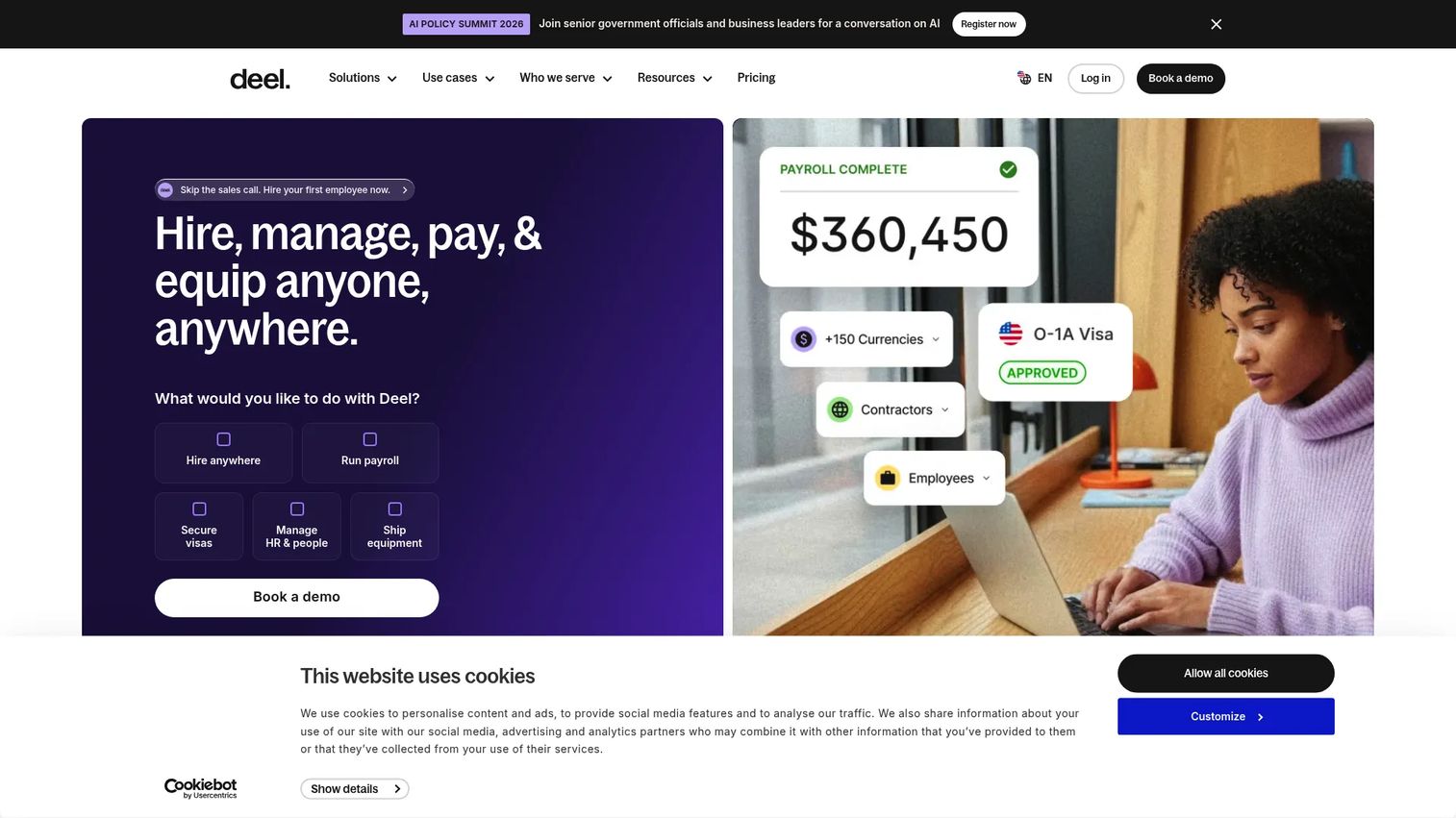
Deel is a global HR, payroll, and employer-of-record platform built for hiring and paying workers across countries. For a SaaS founder running a distributed team, that breadth is the draw. You get domestic PEO services plus contractor management, international payroll, and EOR hiring under one platform, which means you are not stitching together a U.S. PEO and a separate global vendor as you expand.
Best for: Fast-growing, globally minded teams that want one platform for HR, payroll, and compliance across borders.
Key strengths
- Employer of Record hiring: Hire full-time employees in countries where you have no legal entity, with Deel handling local compliance.
- Global contractor management and payments: Onboard, classify, and pay contractors worldwide from a single dashboard.
- International payroll: Run payroll across multiple countries without standing up local infrastructure for each one.
Why choose Deel: If your hiring plan crosses borders, Deel removes the need to manage a patchwork of country-specific providers. It carries a 4.8/5 rating on G2, the highest on this list, which signals a polished experience for distributed teams that value moving fast over a legacy brand name.
Deel pricing: Global Payroll starts at $29 per employee per month. Contractor Standard runs $49 per contractor per month, with Contractor of Record at $325 per contractor per month. EOR Standard is $599 per employee per month and EOR Premium is $899 per employee per month. There is no free tier. Several offerings, including PEO, are quote-based, so confirm your exact configuration with Deel.
2. TriNet
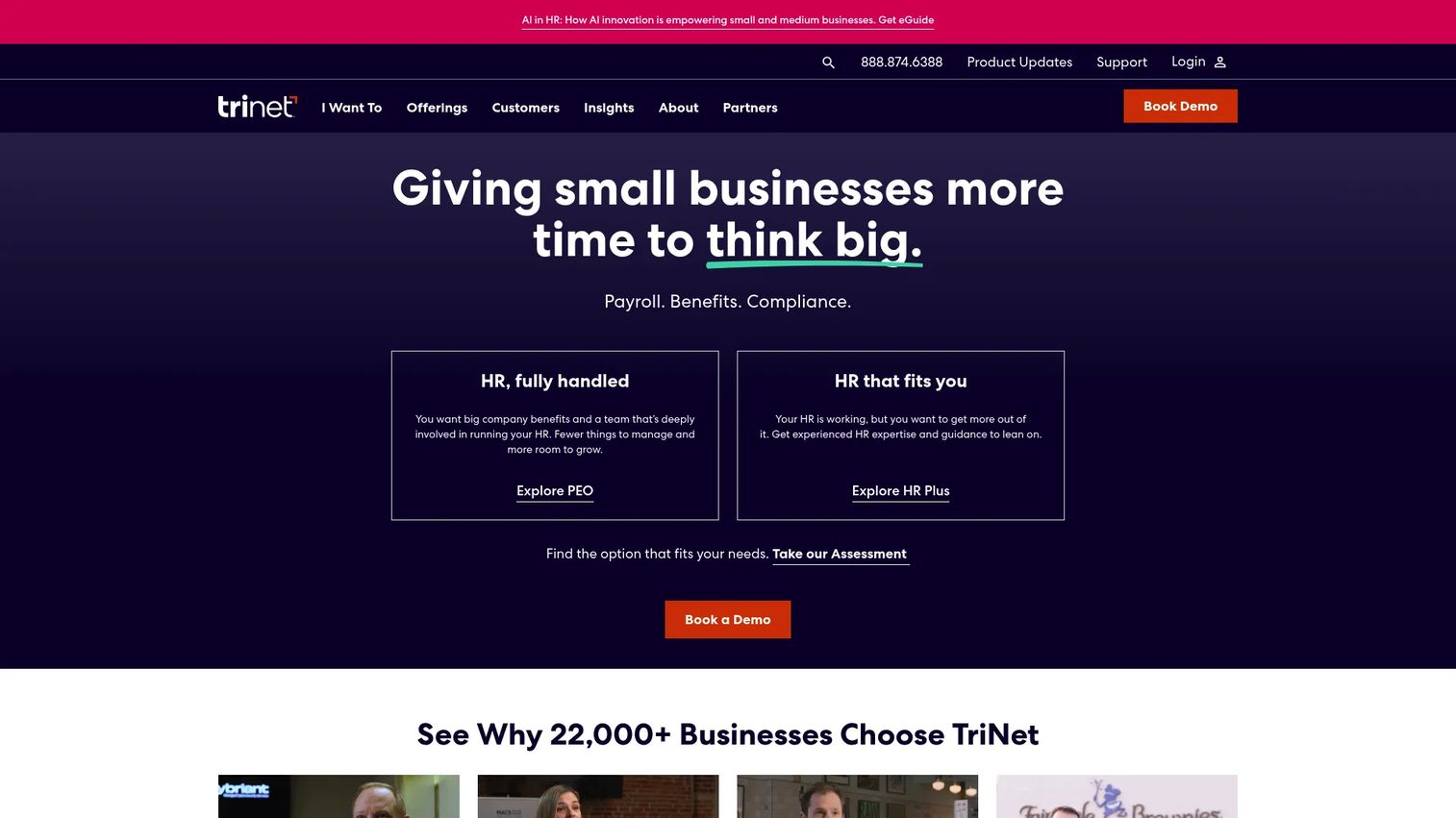
TriNet is one of the most recognized PEO companies for small and midsize businesses, offering full-service HR that bundles payroll, benefits, compliance, and risk support. If you want an established provider with a long track record rather than a newer entrant, TriNet sits squarely in that category.
Best for: Small and midsize businesses that want outsourced HR, payroll, benefits, and compliance from a well-known PEO brand.
Key strengths
- Full-service PEO: Payroll, benefits, risk, and compliance handled under one co-employment relationship.
- HR Plus ASO option: A per-employee-per-month ASO model for teams that want HR support without full co-employment.
- HR platform tooling: Payroll processing, time off, and employee self-service in one interface.
Why choose TriNet: TriNet appeals to founders who weigh brand familiarity and a proven service model heavily in vendor decisions. It also gives you a path between PEO and ASO under one provider, which is useful if your needs shift as you grow.
TriNet pricing: TriNet uses a flat fee per employee per month for its PEO, but does not publish a numeric price. HR Plus pricing is quote-based and depends on company size and the services you need. Expect to request a quote tied to your headcount and benefits requirements.
3. G&A Partners
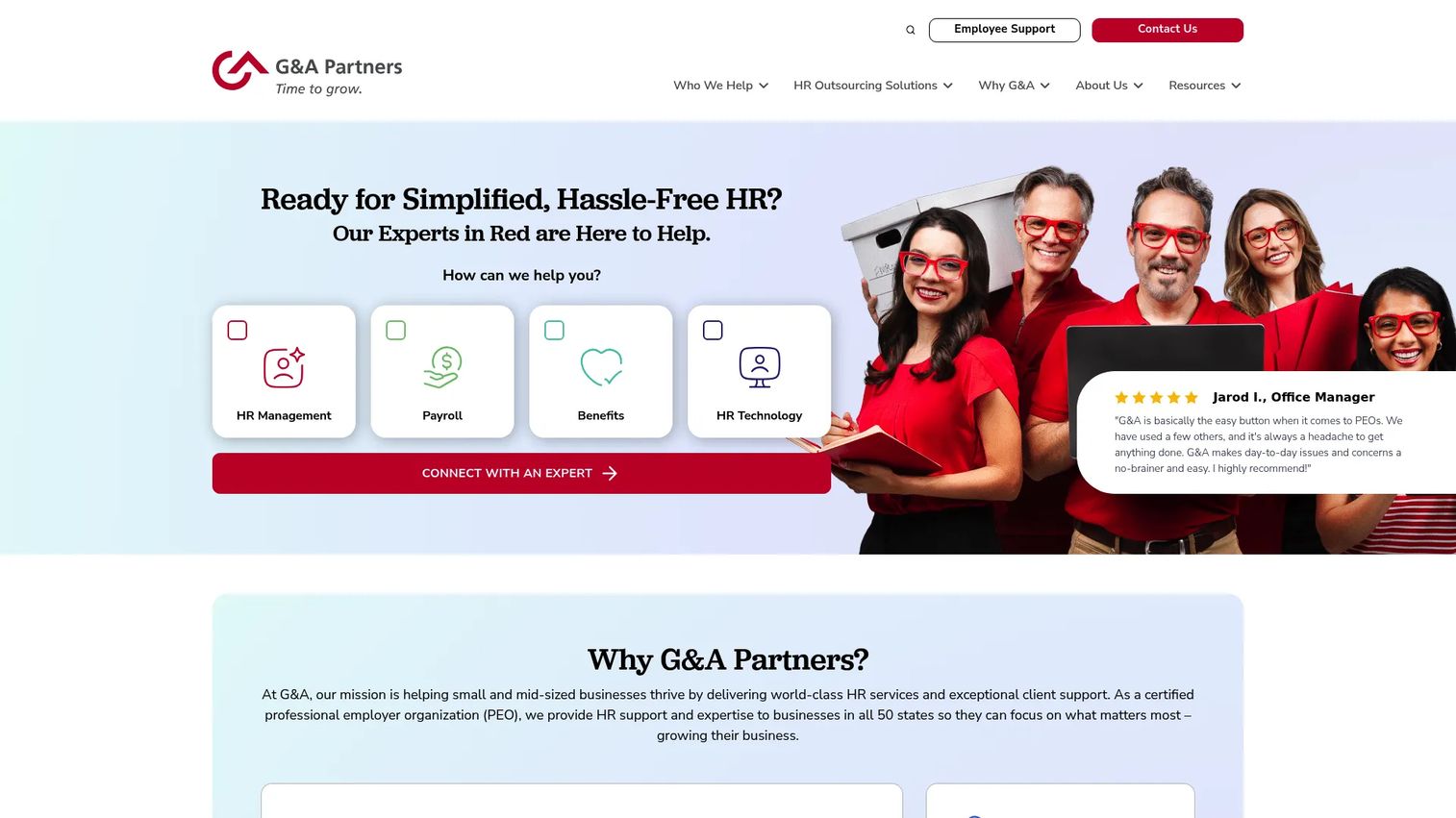
G&A Partners is a U.S.-based PEO and HR outsourcing provider with a service-oriented model. It covers payroll, benefits, compliance, HR technology, and recruiting support, with an emphasis on hands-on guidance rather than a purely self-serve interface.
Best for: Small and mid-sized businesses that want a more guided, high-touch HR experience.
Key strengths
- Dedicated HR support: Access to HR professionals for compliance questions, employee issues, and policy guidance.
- Benefits and payroll administration: Full benefits administration alongside payroll and tax handling.
- Recruiting and hiring support: Help sourcing and onboarding as you scale headcount.
Why choose G&A Partners: If you would rather pick up the phone than navigate a portal, G&A leans into white-glove support. Its 4.6/5 G2 rating reflects strong sentiment from teams that value the guided experience. It fits founders who want a partner that does more of the work, not just the software.
G&A Partners pricing: G&A lists PEO services in a typical range of $65 to $150 per month per employee. Employer-paid benefits are usually billed separately, and implementation fees may apply. Your rate depends on headcount, plan selections, and the scope of services you bundle.
4. Justworks
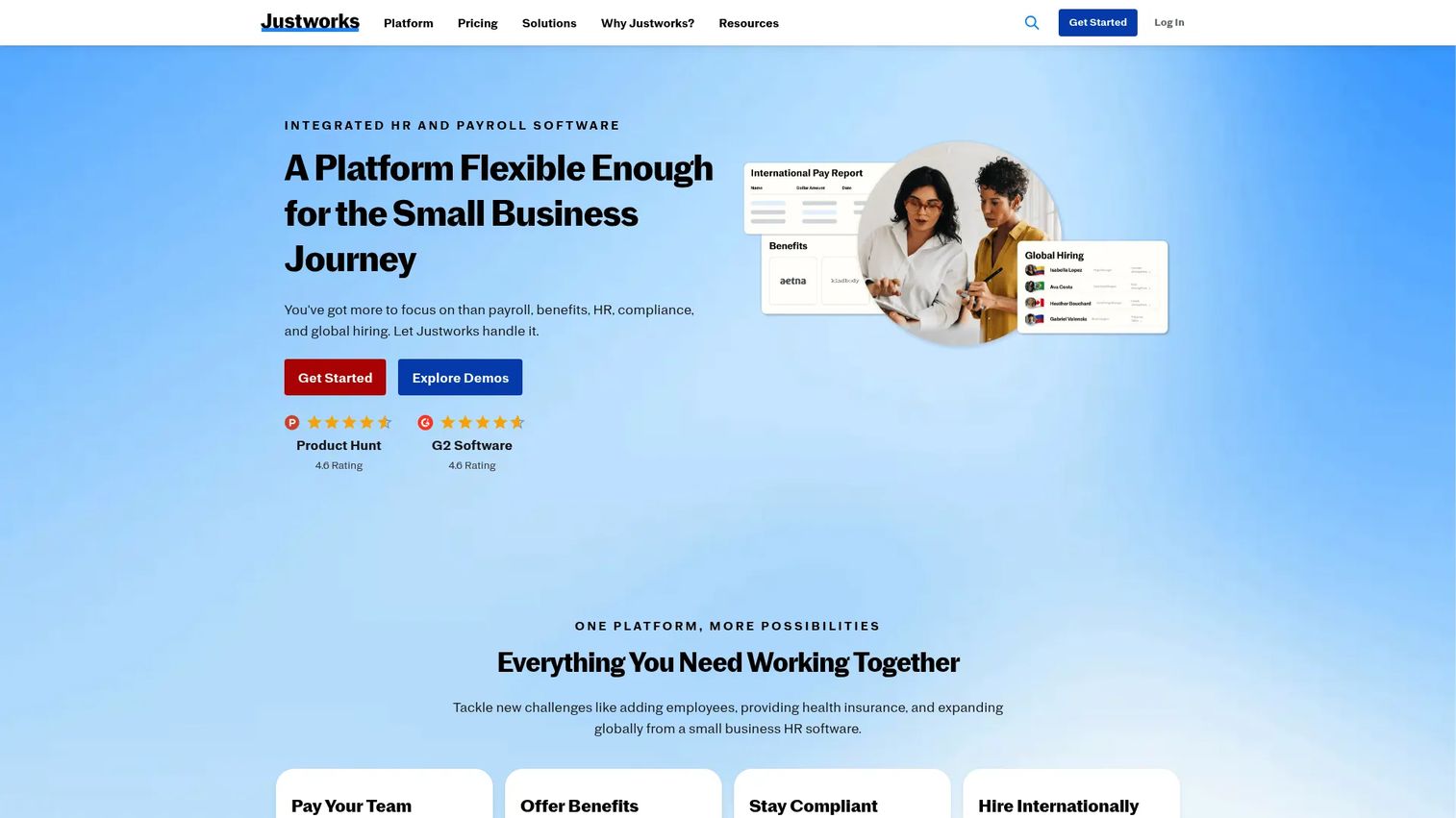
Justworks is a payroll, HR, benefits, and compliance platform built for small businesses that want a clean, streamlined admin experience. It pairs a straightforward interface with PEO services and an EOR option for global hiring, which makes setup feel less like an enterprise implementation.
Best for: Small businesses that want payroll, HR, benefits, and compliance in one easy-to-use platform.
Key strengths
- PEO Basic and PEO Plus plans: Clear tiers so you can match service depth to your stage.
- Employer of Record for global hiring: Hire internationally without a separate vendor.
- Benefits administration and HR support: Centralized benefits with support built in, plus a time-tracking add-on.
Why choose Justworks: Justworks is the pick for founders who want quick setup and a simple user experience over a heavy, configurable system. Its 4.6/5 G2 rating tracks with that reputation for ease. The transparent pricing also makes it one of the easier providers to budget against.
Justworks pricing: Payroll starts at $8 per employee per month plus a $50 monthly base fee. PEO Basic is $79 per employee per month with no base fee, and PEO Plus is $124 per employee per month. The EOR plan is $599 per employee per month. There is no public free tier.
5. ADP TotalSource
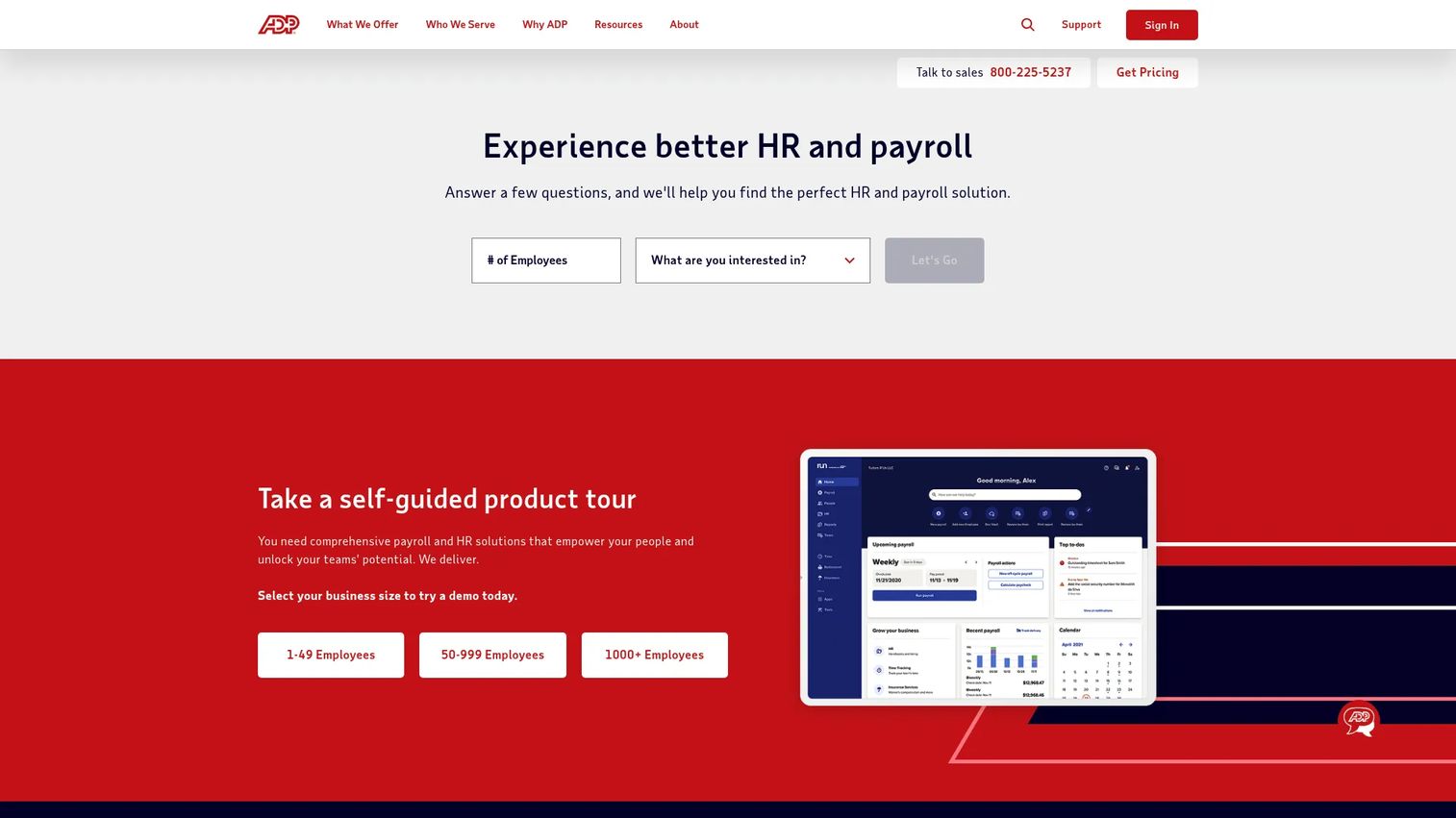
ADP TotalSource is ADP's full-service PEO for small and midsize businesses, combining HR, payroll, benefits, compliance, and technology under the backing of one of the largest payroll providers in the market. When you want the infrastructure of a major provider behind your people operations, ADP's scale is the argument.
Best for: Businesses that want a managed PEO with bundled HR, payroll, benefits, and compliance from a large, established provider.
Key strengths
- All-in-one platform: Payroll, benefits, HR, compliance, time tracking, reporting, onboarding, and talent management in one place.
- Employee self-service: Self-service tools and a mobile app for your team.
- Dedicated HR support: Access to HR professionals and legally backed guidance.
Why choose ADP TotalSource: Scale matters when your reporting and administrative needs get more complex. ADP's breadth and 4.3/5 G2 rating make it a fit for growing teams that want a single provider capable of handling more sophisticated requirements as they expand.
ADP TotalSource pricing: ADP does not publish pricing for TotalSource and directs prospective customers to talk with sales for a quote. Expect pricing tied to headcount, benefits selections, and the services you include.
6. Paychex
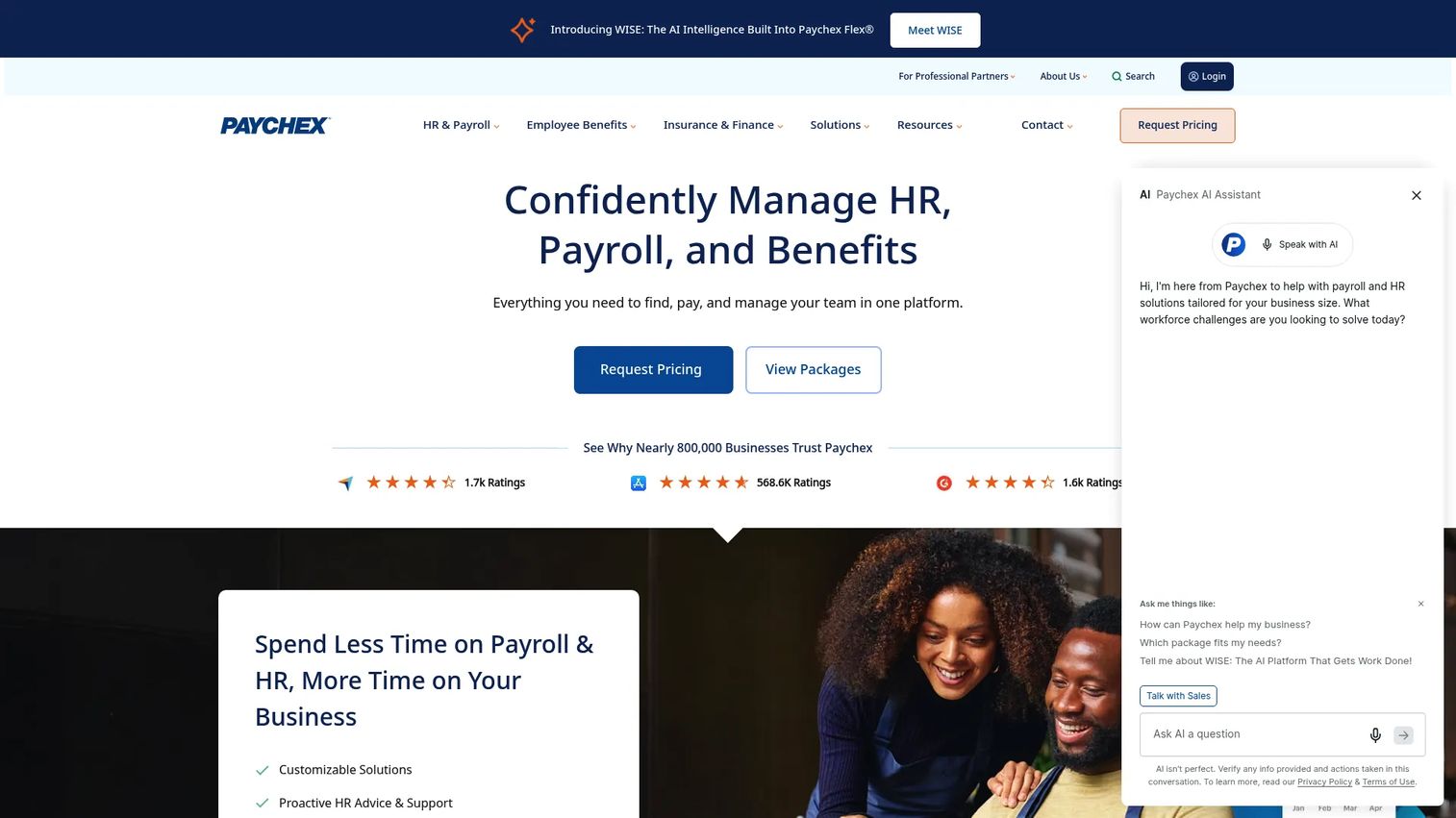
Paychex is a payroll, HR, and benefits provider with PEO capabilities, built for teams that want payroll depth alongside broad HR tooling. Its Paychex Flex tiers and HR PEO plan let you scale the service level to your needs, which appeals to founders who already know the brand or want extensive HR functionality in one place.
Best for: Businesses that want a bundled payroll, HR, and benefits provider with add-on options like time tracking.
Key strengths
- Payroll processing and tax administration: Deep payroll capability with payroll tax filing handled for you.
- HR and benefits management: Benefits administration and HR support across plan tiers.
- Time and attendance tools: Time clock and attendance features as add-ons.
Why choose Paychex: Paychex suits founders who value payroll depth and brand familiarity, with the option to layer HR and PEO services on top. Its tiered structure, from Flex Select through Enterprise and HR PEO, gives you room to start lighter and add depth as the team grows.
Paychex pricing: Paychex uses request-a-quote pricing across its main plans, including Flex Select, Flex Pro, Flex Enterprise, HR Pro, and HR PEO. Pricing depends on employee count and business needs, so you will request a quote rather than see a public number.
7. Insperity
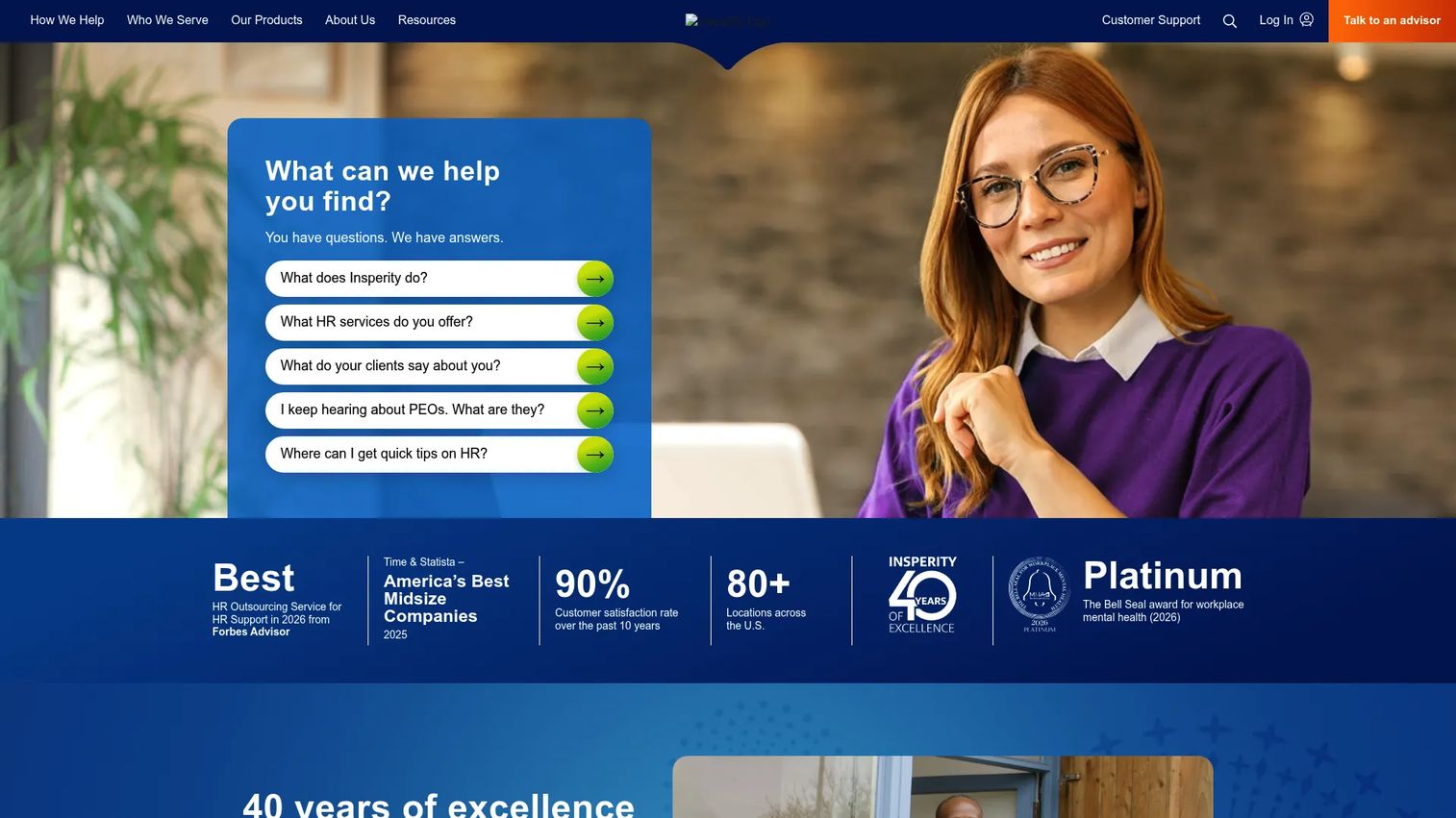
Insperity is an HR outsourcing and PEO provider known for a heavier service orientation and dedicated HR support. It bundles payroll, time and attendance, benefits administration, HR compliance, and workforce reporting, with add-ons like applicant tracking and 401(k) integration for teams that want a fuller HR program.
Best for: Mid-market and growing businesses that want outsourced HR, payroll, and benefits with a guided, support-led model.
Key strengths
- Dedicated HR support: A guided service model with HR professionals attached to your account.
- Full HR suite: Payroll, time and attendance, benefits administration, compliance, and workforce reporting.
- Add-on services: Applicant tracking, scheduling, and 401(k) integration to extend the platform.
Why choose Insperity: Insperity fits founders who want a premium, service-led provider rather than a lighter admin stack. If you would rather lean on a dedicated team than self-manage HR through software, the higher-touch model is the draw. Its tiered structure spans HR Core, HR 360, and HR Scale.
Insperity pricing: Insperity prices HR Core on a per-employee, per-month basis but does not publish a numeric figure. HR 360 and HR Scale require custom quotes. Plan on a quote tied to headcount and the services you select.
8. CoAdvantage PEO
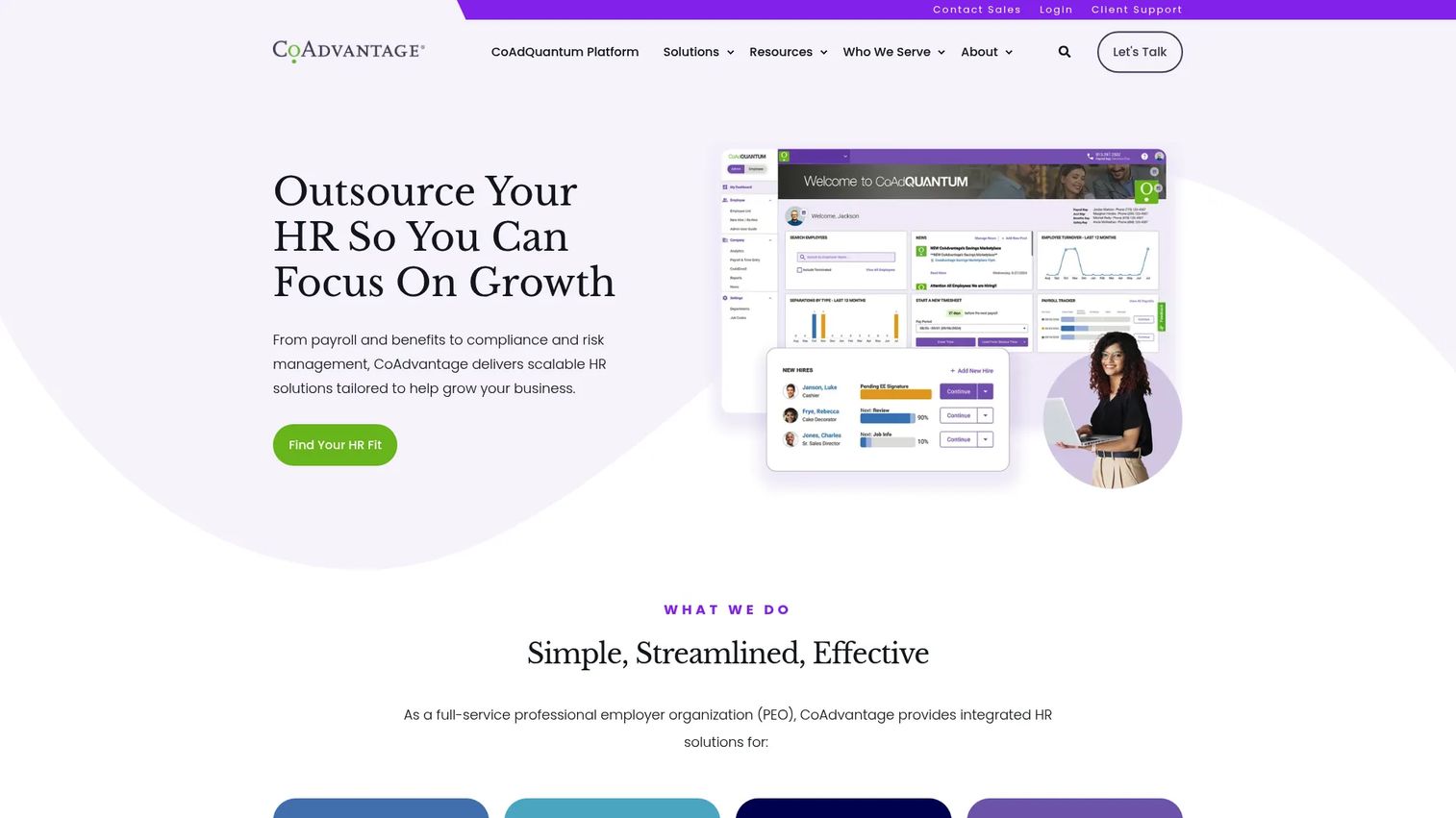
CoAdvantage PEO is a U.S.-based professional employer organization offering outsourced HR, payroll, benefits, compliance, and HR technology. It positions itself as a practical partner for smaller and growing teams that want direct HR support without overbuying enterprise complexity.
Best for: Small to mid-sized businesses that want an outsourced PEO partner for HR, payroll, benefits, and compliance.
Key strengths
- Payroll processing: Core payroll handled across the states where you employ people.
- Employee benefits administration: Benefits administration with access to pooled plan options.
- Risk and compliance support: Guidance to reduce employer liability and stay compliant.
Why choose CoAdvantage PEO: CoAdvantage is a sensible alternative for founders who want hands-on support sized to a smaller team. Its 4.4/5 G2 rating reflects solid sentiment, and the right-sized positioning means you are less likely to pay for infrastructure you will not use yet.
CoAdvantage PEO pricing: CoAdvantage does not publish pricing and directs prospects to request a consultation. Pricing will reflect your headcount, benefits selections, and the scope of services you bundle.
Considerations before you choose
Use this checklist as your PEO provider checklist before signing anything. The goal is to confirm the provider reduces work without creating new liability or surprise costs.
Confirm the co-employment model
Get specific about what the PEO takes on and what you still own. The provider typically handles payroll, taxes, benefits, and compliance administration, while you keep direction of the work and day-to-day management. Clarify liability, control, and your internal responsibilities in writing so there is no ambiguity later.
Check benefits quality, not just access
Access to benefits is not the same as good benefits. Review plan depth, employee choice, and carrier options. Benefits are a major part of the value proposition and directly affect retention, so a thin plan menu undercuts the reason you signed up. Ask which carriers are available in the states where you hire.
Validate the pricing structure
PEO pricing comes in a few shapes: per-employee-per-month, a percentage of payroll, or a quote-based bundle. Per-employee pricing is the most predictable to budget against. Percentage-of-payroll pricing can rise as salaries grow, which matters as you add senior hires. Make sure you understand exactly what is included and what bills separately, especially employer-paid benefits and implementation fees.
Review the support model and response speed
Service quality matters as much as features. A slow or low-quality support experience erases the admin savings that justified the switch. Ask how support is staffed, whether you get a dedicated contact, and what response times look like during open enrollment and tax season.
Verify state coverage and onboarding timing
A provider that cannot support your hiring plan becomes a bottleneck. Confirm the PEO operates in every state where you employ people, and ask how long onboarding takes. If you plan to hire fast, implementation speed and geographic footprint are not details, they are deal-breakers.
Conclusion
The best PEO providers for 2026 each win a specific scenario. Deel is the strongest overall for fast-growing, distributed SaaS teams, especially if you hire across borders. TriNet and ADP TotalSource bring established, full-service infrastructure. G&A Partners and Insperity lean into hands-on, service-led support. Justworks keeps onboarding and administration simple with transparent pricing. Paychex pairs payroll depth with broad HR tooling. CoAdvantage PEO right-sizes support for smaller, growing teams.
Your next step is straightforward: pick the provider that removes the most administrative load without becoming a project you have to manage. Match the choice to your hiring footprint, benefits needs, support expectations, and how much complexity you can absorb now. If you are deciding between a PEO and a lighter ASO model, weigh how much of the employer liability you want to hand off versus keep. Shortlist two providers, request quotes tied to your real headcount, and choose the one that gets HR off your plate fastest.
FAQs
A PEO provider co-employs your workforce and administers payroll, HR, benefits, payroll tax filing, workers compensation, and compliance on your behalf. You keep direction of the work and your team; the provider handles the administrative and regulatory load. Because it pools your employees with many others, a PEO can often offer benefits plans and rates a small team could not access alone.
A payroll provider runs payroll and files payroll taxes, and that is largely where it stops. The PEO vs payroll provider difference is co-employment: a PEO becomes a co-employer and adds benefits administration, workers compensation, HR support, and broad compliance on top of payroll. If you only need checks cut and taxes filed, a payroll provider is enough. If you want the full HR burden handled, a PEO is the broader fit.
The PEO vs EOR distinction comes down to the employer relationship. With a PEO, your company still legally employs your team and co-employs alongside the provider, which means you generally need your own legal entity in each state. An EOR becomes the full legal employer, letting you hire in a country or state where you have no entity. Use a PEO to offload HR for employees you already employ, and an EOR to hire where you cannot or do not want to set up an entity.
The PEO vs ASO difference is co-employment again. A PEO co-employs your staff and can sponsor benefits and assume shared employer responsibility. An ASO (administrative services organization) handles the same HR, payroll, and benefits administration but does not co-employ, so you remain the sole employer and typically sponsor your own benefits. Founders who want maximum offload lean PEO; those who want to keep the employer relationship while outsourcing admin lean ASO.
PEO pricing typically follows one of three models: per-employee-per-month (often roughly $65 to $150 per employee in published ranges), a percentage of total payroll, or a quote-based bundle. Many providers, including TriNet, ADP TotalSource, Paychex, Insperity, and CoAdvantage, quote based on headcount and services rather than listing a public price. Benchmark by requesting quotes from two or three providers using your actual headcount, and confirm what is included versus billed separately.
Confirm the co-employment terms, benefits quality and carrier options, the pricing structure and what bills separately, the support model and response times, and state coverage and onboarding speed. Also ask about exit terms: how easy it is to leave and move employees off the PEO if your needs change. A clean exit path is as important as a clean onboarding.
Often, yes. A PEO for small business makes the most sense once headcount, multi-state hiring, or benefits complexity starts consuming founder or leadership time. If you are below a handful of employees in one state with simple needs, a payroll provider may be enough for now. Once compliance exposure or benefits expectations grow, small business HR outsourcing through a PEO removes a category of work and risk you do not want to own.
Yes, this is one of the strongest reasons to use a PEO. Each new state brings payroll tax registrations, unemployment accounts, and state-specific employment rules. A PEO already operates in those states and folds the registrations, filings, workers compensation, and compliance into one relationship, so multi-state hiring stops generating administrative drag every time you add a location.