Estimates live in one tool. Approvals happen over text threads that nobody logs. Payments run through a separate terminal. Then someone re-keys the whole day into QuickBooks at 7 p.m. That is how most repair shops actually run, and it is why the software you pick matters more than the feature list on any vendor's homepage.
The market backs up the urgency. Persistence Market Research (2024) projects the global auto repair software market to reach US$ 8.6 billion by 2033, growing at a 14.2% CAGR, and reports that cloud-based platforms already account for about 63% of demand in 2025. Shops are consolidating fragmented workflows into single systems, and they are doing it fast.
This is a practical buyer's list, not a vendor roundup. The angle here is the one a growing operator actually cares about: how each platform handles the handoffs that break down when a shop scales past one bay or one location. We look at estimating, digital vehicle inspections, customer communication, repair order software depth, payments, accounting integration, and how hard it is to migrate off your current system.
If you run a single independent shop, a two-location group, or a multi-shop operation trying to standardize, the trade-offs differ. A tool that feels great at one bay can slow you down at five. So we weighted each pick on workflow coverage and how cleanly it scales, not just its starting price.
What's inside
This guide is for shop owners, general managers, and multi-location operators comparing auto shop management software before they book demos or switch systems. We picked platforms based on four criteria: workflow coverage (estimates, repair orders, DVI, approvals), customer communication and payments, accounting and integration depth, and migration fit for shops that already run on something else. Each entry includes verified pricing where the vendor publishes it, current G2 ratings, and the shop profile it fits best. No brochure language. Just what you need to shortlist two or three tools and move.
TL;DR
- Best for all-in-one workflow depth: Tekmetric. The most complete modern cloud platform for shops that expect to scale.
- Best for modern cloud stack with clear tiering: AutoLeap. Strong digital inspections, texting, and QuickBooks Online integration.
- Best for pricing transparency and add-ons: Shopmonkey. Clear plan ladder with unlimited estimates and invoices.
- Best for legacy workflows and parts ordering: RO Writer. Deep operational roots and supplier catalog integrations.
- Best for budget-conscious independents: AutoRepair Cloud. Low entry pricing, a free trial, and OBD2 diagnostics.
- Best for repair information plus shop management: Mitchell 1. Manager SE paired with ProDemand repair data.
What is auto shop management software?
Auto shop management software is a system that runs the operational workflow of a repair shop, from the moment a vehicle is booked through the estimate, approval, repair order, payment, and accounting handoff. It replaces the patchwork of paper tickets, spreadsheets, texting apps, and standalone payment terminals that most shops start with.
The best auto repair software consolidates the jobs that otherwise leak time and money at every handoff. Here are the core capability areas to evaluate:
- Estimates and repair orders: Build accurate quotes with labor guides and parts pricing, then convert them to repair orders without re-entry.
- Digital vehicle inspections and customer approvals: Send photo and video inspections so customers approve work from their phone.
- Customer communication and reminders: Two-way texting, appointment reminders, and status updates that keep the front desk out of phone tag.
- Parts and inventory: Order parts through supplier catalogs, track inventory, and apply pricing matrices.
- Payments and accounting handoff: Take payments in the shop or online and sync clean data to your bookkeeping.
- Reporting and multi-shop control: See ARO, technician productivity, and revenue across one or many locations.
Cloud based auto repair software dominates the category for a reason: it centralizes this data, updates automatically, and gives owners visibility without being on-site. That matters most for operators trying to standardize across locations.
When to use auto shop management software
Simplify estimates and approvals
Every hour a service advisor spends chasing an approval is an hour a bay sits idle. Auto repair estimating software cuts the back-and-forth by letting advisors build a quote once, attach digital vehicle inspections with photos, and send it straight to the customer's phone. The customer taps approve, the repair order updates, and the tech starts work. That loop tightens cycle time and reduces the "I never approved that" disputes that eat into margin.
Centralize customer communication
Missed follow-up is lost revenue. When texting, reminders, and approval requests live inside the repair order software instead of a personal phone, nothing falls through. Auto repair CRM features log every interaction against the customer and vehicle record, so any advisor can pick up the thread. That consistency is what lets a shop run the same way whether the owner is there or not.
Standardize payments and accounting handoff
As a shop grows, manual bookkeeping stops scaling. Auto repair payments software that takes cards, mobile wallets, and financing options at the counter or online removes the standalone terminal. Paired with auto repair accounting integration, closed tickets flow into QuickBooks without re-keying. That clean handoff is the difference between a Friday-night reconciliation marathon and books that are always current.
Comparison table
Here is how the six platforms compare on intent, core use case, verified pricing, and current G2 rating. Pricing reflects each vendor's published rates as of mid-2026.
| # | Product | Intent | Key use case | Pricing | G2 rating |
|---|---|---|---|---|---|
| 1 | Tekmetric | All-in-one cloud platform | Scaling shops needing full workflow depth | From $179/mo | 4.9/5 |
| 2 | AutoLeap | Modern cloud stack | Shops wanting clear tiers and strong DVI | From $179/mo | 4.8/5 |
| 3 | Shopmonkey | Transparent pricing | Shops wanting unlimited estimates and invoices | From $239/mo | 4.6/5 |
| 4 | RO Writer | Legacy operational depth | Shops needing parts ordering and multi-store | From $199/mo | 3.0/5 |
| 5 | AutoRepair Cloud | Budget cloud option | Small to midsize independents | From $44.99/mo | 4.8/5 |
| 6 | Mitchell 1 | Repair info plus management | Shops wanting repair data with management | Custom pricing | 3.8/5 |
1. Tekmetric
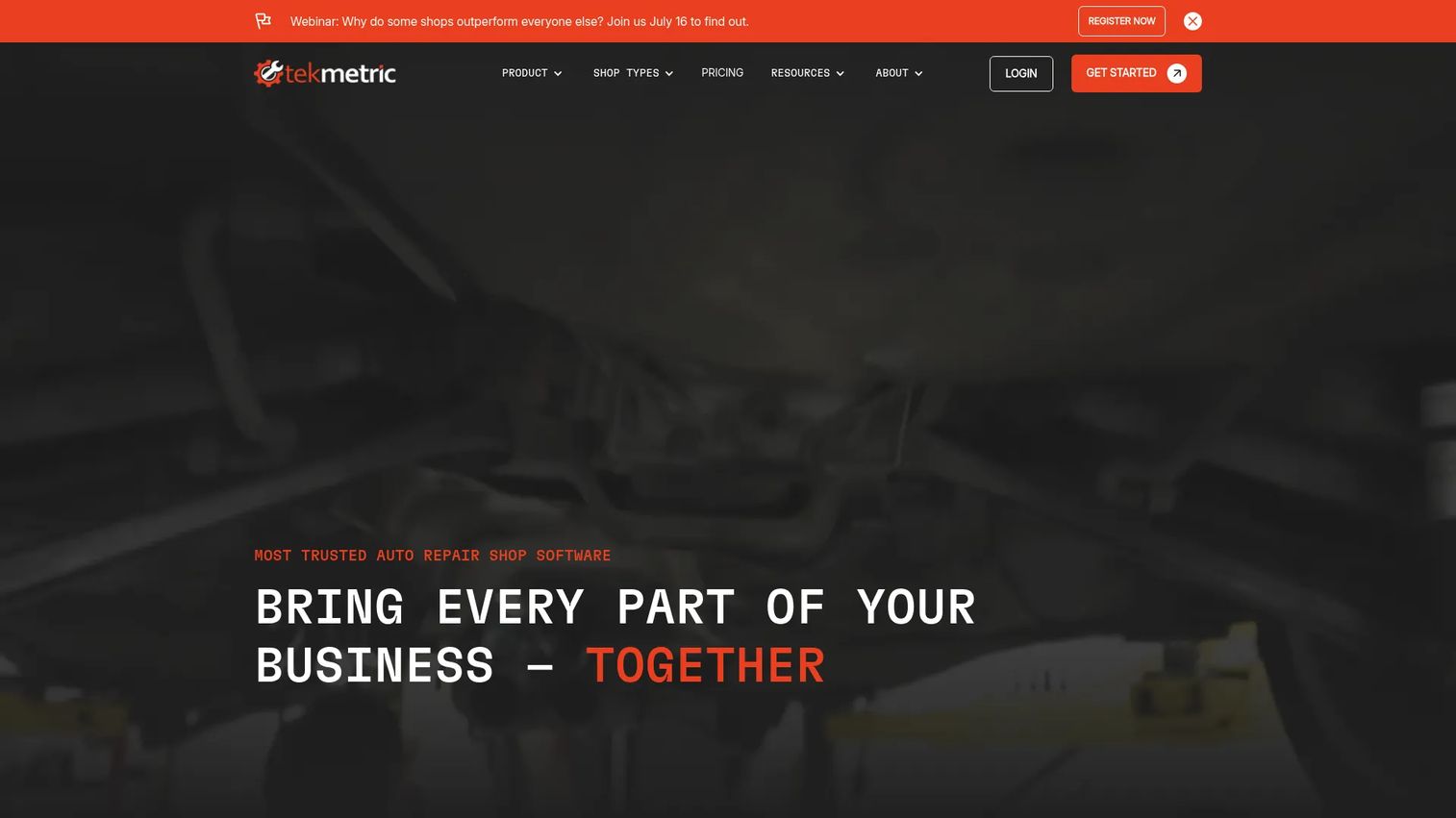
Tekmetric is a cloud-based auto repair shop management platform built for shops that expect to grow. It handles the full workflow: digital vehicle inspections, estimates and repair orders, two-way texting, payments, invoicing, and online booking. Reporting rolls up across locations, which is what makes it a strong fit for operators moving from one bay to several. If you want the most complete modern option and you are planning for scale, this is the one to shortlist first.
Best for: Auto repair shops that want an all-in-one platform designed to standardize across multiple locations.
Key strengths
- Digital vehicle inspections: Photo and video DVI that customers approve from their phone, tightening the approval loop.
- Two-way texting: Customer communication logged against the repair order so any advisor can follow up.
- Payments, invoicing, and online booking: Integrated billing that reduces the standalone terminal and the manual re-entry that follows.
Why choose Tekmetric: The pull here is workflow depth without the sprawl. Estimates, approvals, payments, and reporting live in one system, so a growing shop does not have to stitch together five tools. For an operator whose real goal is a repeatable process that does not depend on being on-site, that consolidation matters more than any single feature.
Tekmetric pricing: Tekmetric starts at $179 per month on its Start plan when billed annually. The Grow plan runs $349 per month and the Scale plan runs $439 per month, with a custom-priced Enterprise tier for larger groups. There is no free tier shown on the public pricing page. Pricing is structured per shop, which is what keeps it predictable as your team grows.
2. AutoLeap
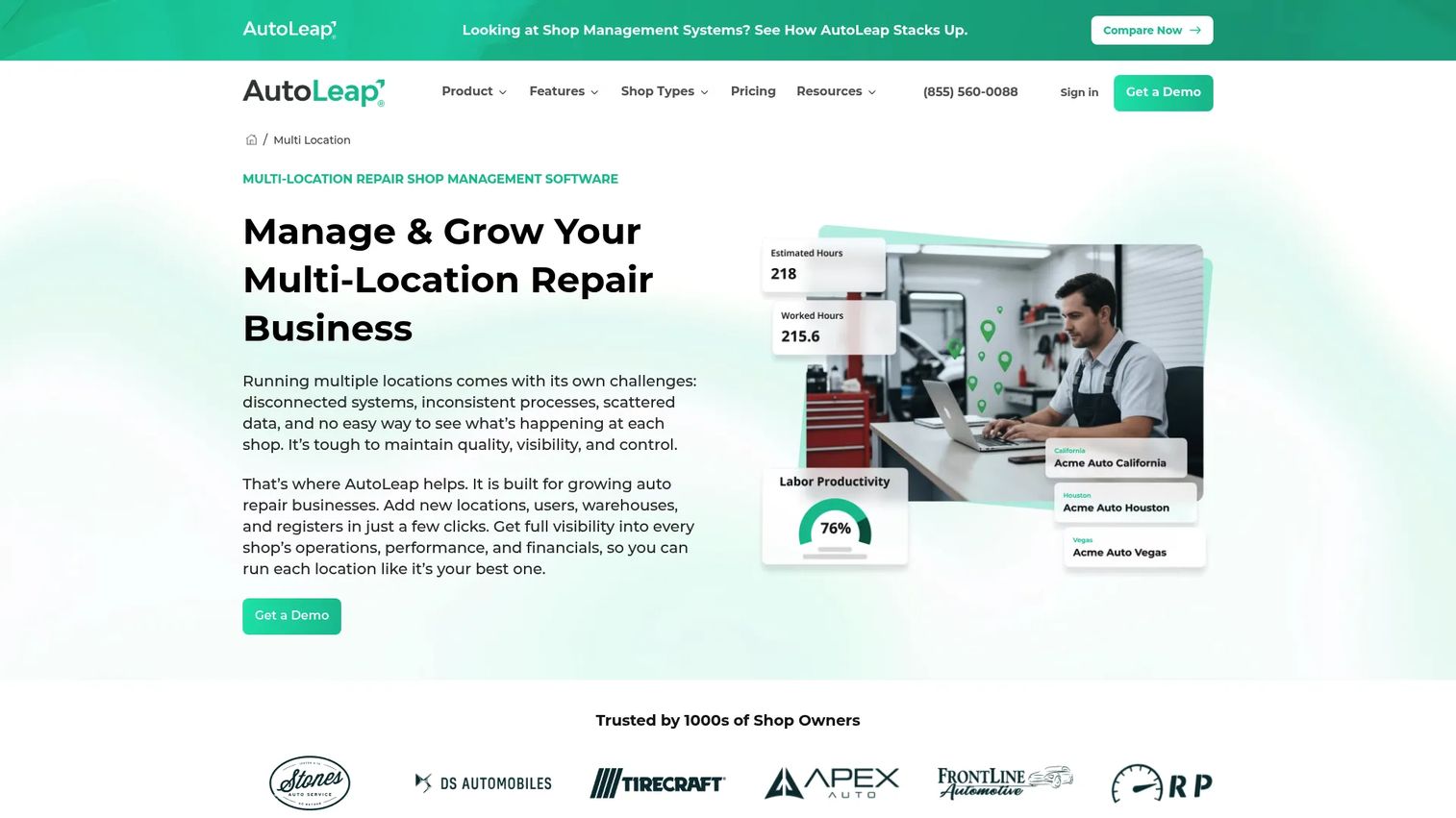
AutoLeap is cloud-based auto repair shop management software built for auto repair and tire shops that want a modern stack with clear tiering. It leads with digital inspections, scheduling, and two-way texting, and integrates with QuickBooks Online for a clean accounting handoff. The tier structure makes it easy to match a plan to your shop size without paying for capabilities you will not use yet.
Best for: Auto repair shops that need an all-in-one platform with transparent tiers and strong inspection workflows.
Key strengths
- Digital inspections: Photo-driven DVI that speeds customer approvals and lifts average repair order value.
- Scheduling: Appointment management that keeps the bay calendar full without double-booking.
- Two-way texting: Customer communication that runs inside the repair order flow instead of a personal phone.
Why choose AutoLeap: The clear Essentials, Pro, Elite, and Enterprise ladder is the differentiator for owners who want to know exactly what they are buying. Pair that with QuickBooks Online integration and you get a modern cloud based auto repair software setup that a new shop manager can pick up on day one. It fits shops that value predictable packaging over à la carte complexity.
AutoLeap pricing: AutoLeap starts at $179 per month on Essentials. The Pro plan is $309 per month and Elite is $409 per month, with a custom-priced Enterprise tier. AutoLeap does not offer a free trial, so plan on a demo to evaluate fit before committing.
3. Shopmonkey
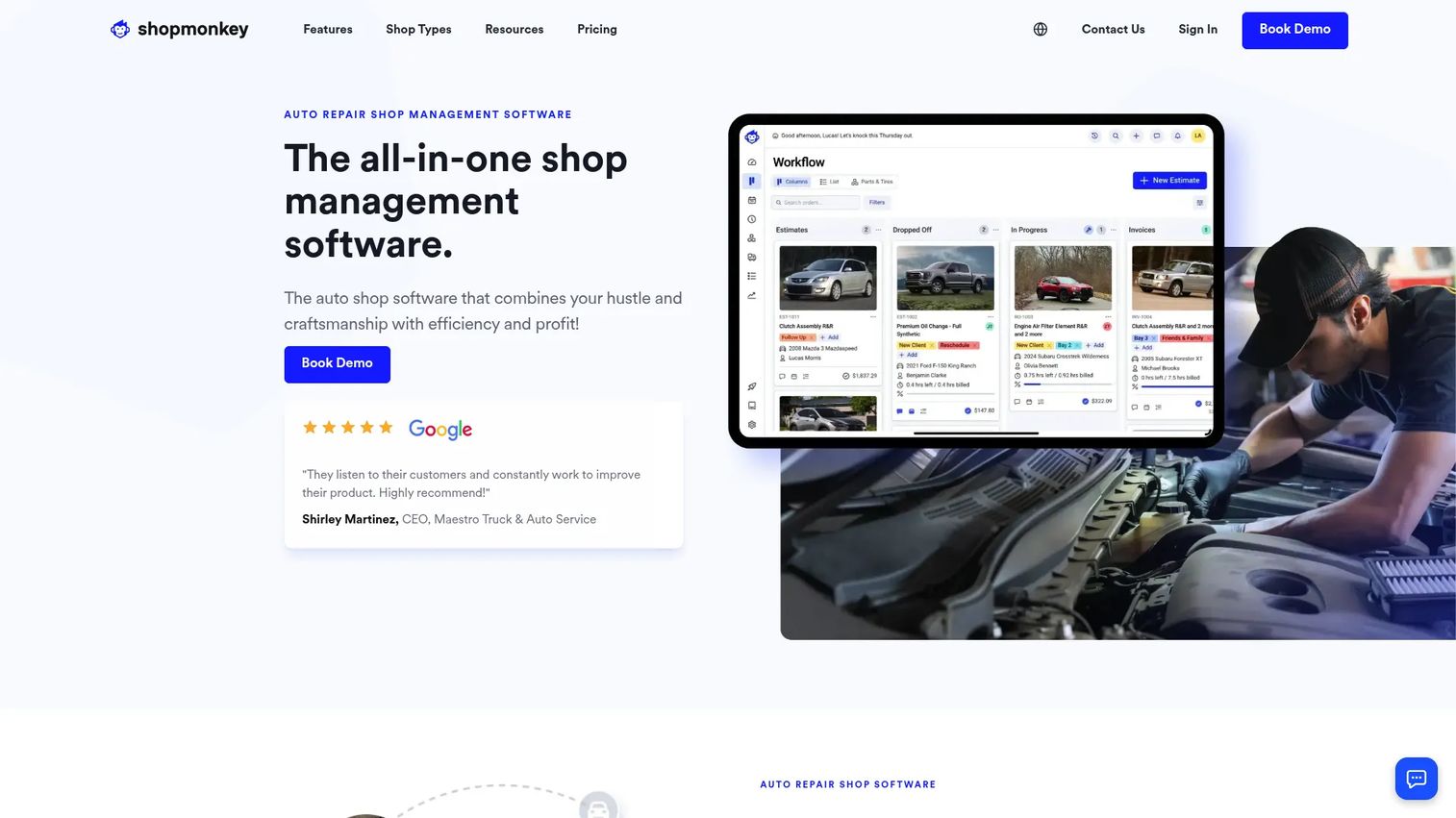
Shopmonkey is cloud-based shop management software for auto repair shops and service centers, and its calling card is a transparent, easy-to-read plan ladder. You get two-way text and email, unlimited estimates and invoices, and digital vehicle inspections across its plans, with payments and accounting add-ons layered on top. For owners tired of guessing what a platform actually costs, the pricing clarity is a genuine advantage.
Best for: Auto repair shops that want a straightforward product with a clear plan structure and unlimited estimating.
Key strengths
- Two-way text and email: Centralized customer communication that keeps the front desk out of phone tag.
- Unlimited estimates and invoices: No caps on repair order software volume, so busy shops are not metered.
- Digital vehicle inspections: DVI built in to speed approvals and document recommended work.
Why choose Shopmonkey: The simple commercial framing is the reason to pick it. The Basic, Clever, Genius, and Multi-Shop tiers make it obvious where you land as you grow, and unlimited estimates and invoices remove a common friction point for high-volume shops. It suits operators who want a clean product without a steep configuration curve.
Shopmonkey pricing: Shopmonkey starts at $239 per month on Basic. Clever runs $399 per month and Genius runs $499 per month, with a custom-priced Multi-Shop tier for groups. Annual billing saves up to 10%. There is no free tier, so a demo is the way to confirm fit.
4. RO Writer
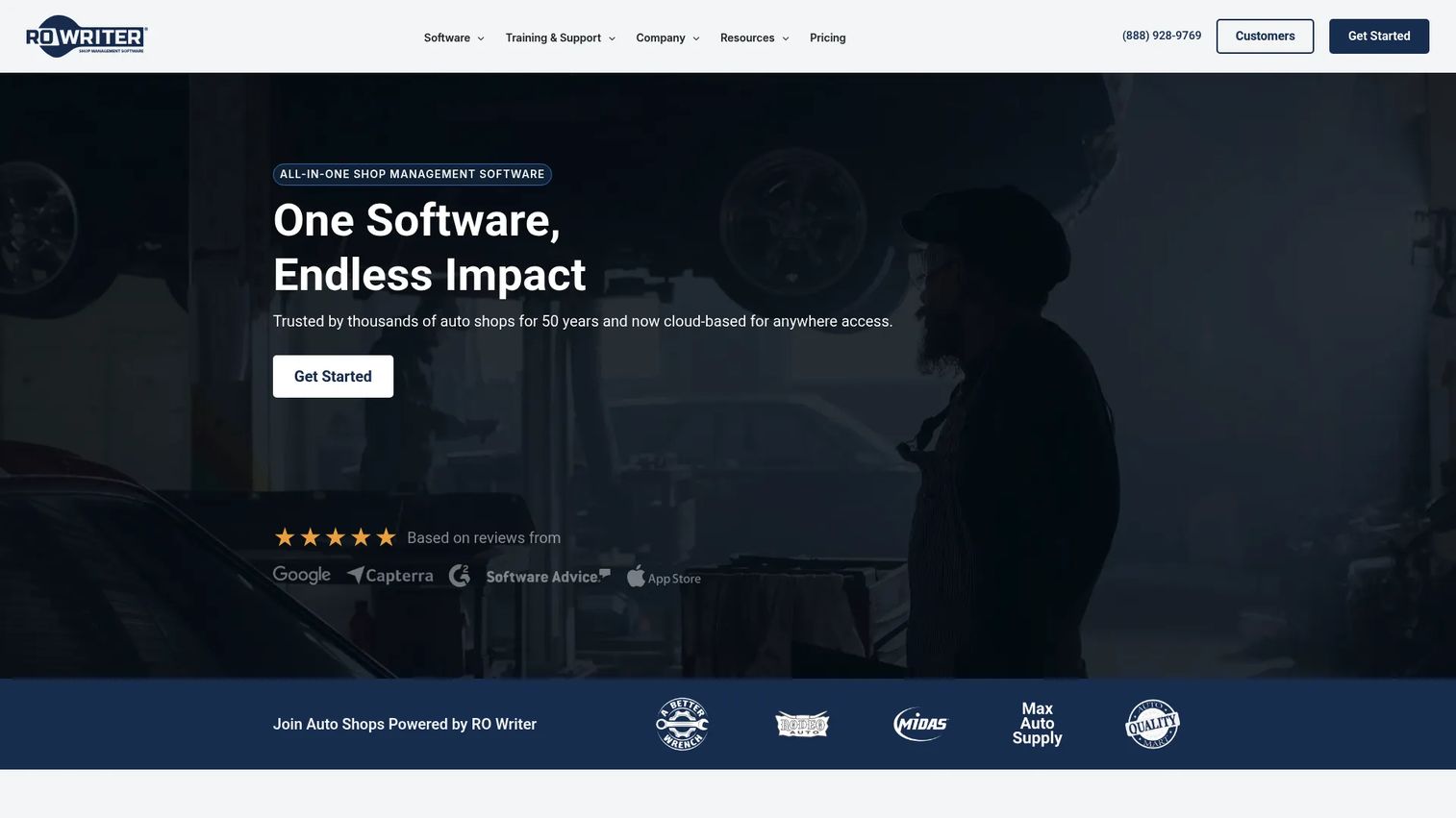
RO Writer is auto repair management software with deep operational roots, built for service writing, parts ordering, customer communication, and multi-store operations. Its strength is breadth: two-way texting and emailing, parts ordering through supplier catalog integrations, and inventory management with Smart Matrix Pricing. Shops that have run on legacy systems and need serious parts-sourcing depth tend to find it familiar.
Best for: Auto repair shops that need shop management, parts ordering, and customer communication in one established system.
Key strengths
- Two-way texting and emailing: Customer communication tied to the repair order for consistent follow-up.
- Parts ordering with supplier catalog integrations: Direct catalog access that cuts sourcing time at the counter.
- Inventory management and Smart Matrix Pricing: Automated pricing rules that protect parts margin as volume grows.
Why choose RO Writer: The case for RO Writer is parts and inventory depth combined with multi-location workflows. If your shop's bottleneck is sourcing and pricing parts rather than the front-of-house experience, its supplier integrations do real work. It fits operators who value operational depth and a system that maps to how established shops already run.
RO Writer pricing: RO Writer Essentials starts at $199 per month for the first year. The main RO Writer plan starts at $299 per month for the first year, then moves to a custom quote after year one. There is no free tier shown. Its G2 rating sits lower than the cloud-native picks on this list, so weigh reviews against your specific parts-sourcing needs during evaluation.
5. AutoRepair Cloud
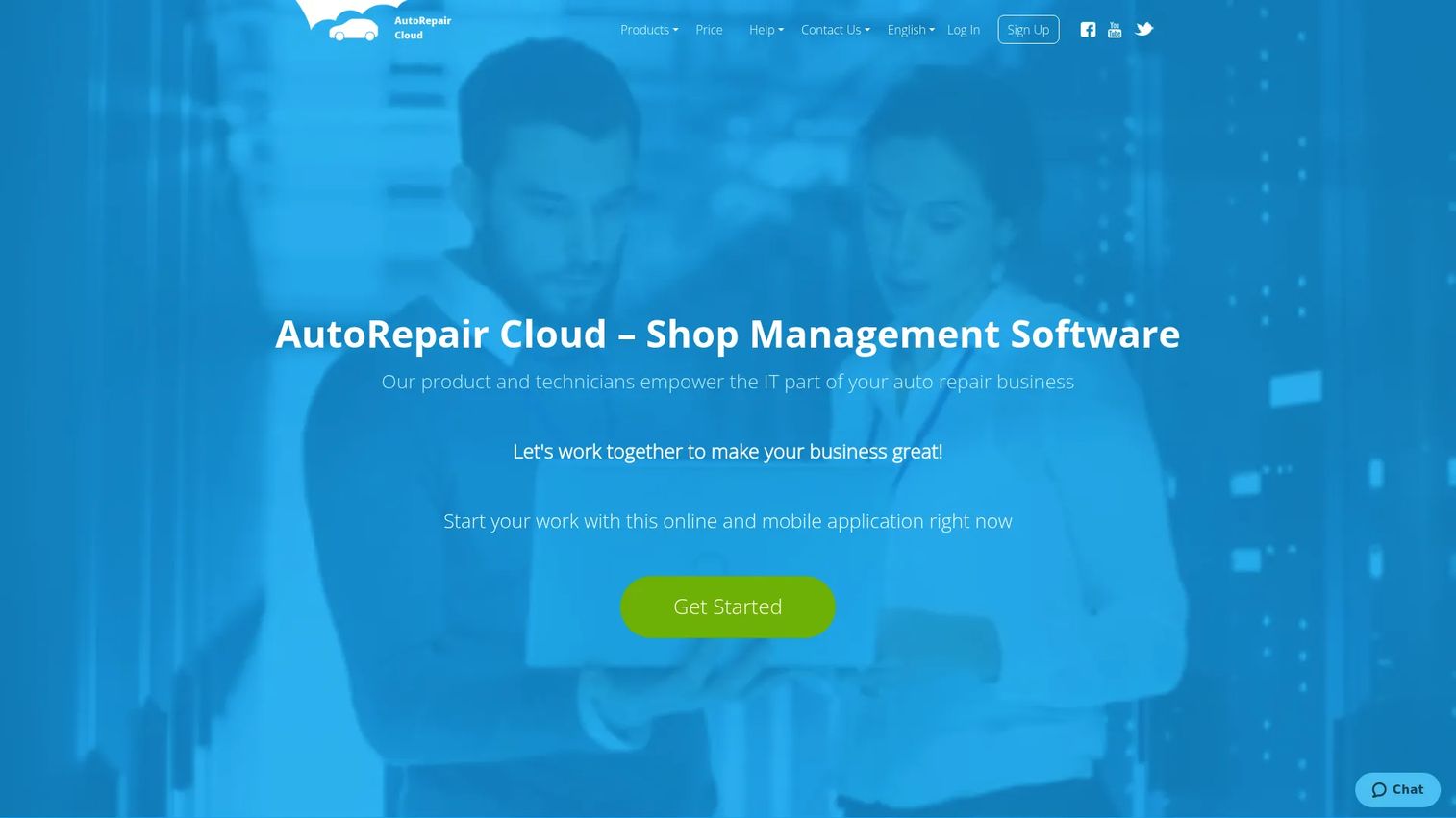
AutoRepair Cloud is cloud-based auto shop management software covering repair orders, customer and vehicle tracking, diagnostics, parts, and communications. It stands out on price, with an entry tier well below the rest of the field, plus a free trial and OBD2 diagnostics baked in. For a small or midsize independent shop testing the waters on cloud based auto repair software, the low barrier to entry is the draw.
Best for: Small to midsize auto repair shops needing an affordable all-in-one shop management platform.
Key strengths
- Appointment scheduling: Booking management that keeps the calendar organized without extra tools.
- Inventory and auto parts management: Parts tracking and ordering inside the same system as repair orders.
- Digital vehicle inspection and OBD2 diagnostics: DVI paired with diagnostic reads to document and justify recommended work.
Why choose AutoRepair Cloud: The reason to pick it is cost-to-value at the low end. A shop can start on a sub-$60 monthly plan, run a 14-day free trial first, and still get diagnostics and inventory management. For budget-conscious operators who want to prove the workflow before committing, it lowers the risk of switching.
AutoRepair Cloud pricing: AutoRepair Cloud offers three plans: Mini, Standard, and Full. Monthly pricing runs $59.99, $99.99, and $139.99. On an 18-month term, the same tiers drop to $44.99, $77.99, and $109.99 per month. A 14-day free trial is included, and the vendor notes users stay on a free plan if they take no action after the trial.
6. Mitchell 1
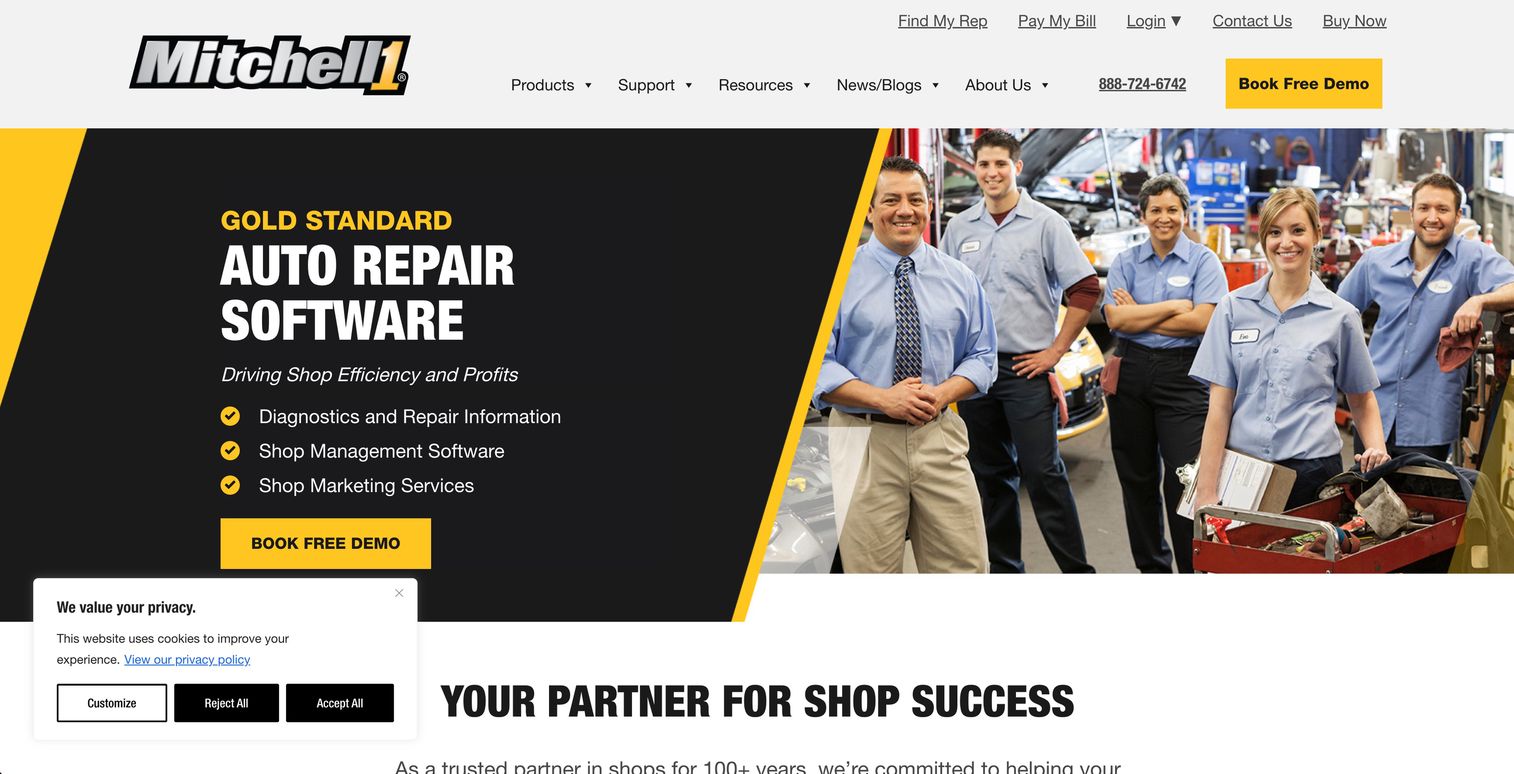
Mitchell 1 pairs shop management with the repair information that technicians rely on. Manager SE handles estimates, invoices, scheduling, reporting, and inspections, while ProDemand delivers OEM repair info, diagnostics, labor estimating, wiring diagrams, and SureTrack fixes. Its SocialCRM tools add reviews, text and email campaigns, websites, and online scheduling. The combination is what sets it apart: management plus deep repair data in one relationship.
Best for: Independent auto repair shops that want repair information alongside shop management and marketing tools.
Key strengths
- Manager SE shop management: Estimates, invoices, scheduling, reporting, and inspections in one management workspace.
- ProDemand repair information: OEM repair data, diagnostics, labor guides, and wiring diagrams for accurate repair order software.
- SocialCRM marketing tools: Reviews, text and email campaigns, websites, and online scheduling to keep bays booked.
Why choose Mitchell 1: The differentiator is repair-content depth. For shops where technicians live inside labor guide software and wiring diagrams, having that data integrated with the management side reduces tool switching. It fits established independents who value repair information as much as front-office workflow.
Mitchell 1 pricing: Mitchell 1 does not publish a numeric starting price on its main product pages. The site points shops to demos and promotional pricing rather than a public tier ladder, so you will need to request a quote to compare it directly against the cloud-native platforms here.
How to choose the right platform
The right pick comes down to matching the tool to your current scale and your next 18 months of growth. Run every shortlisted platform through these criteria before you book a demo.
Workflow coverage
Confirm the system covers estimates, digital vehicle inspections, repair orders, and approvals in one flow. The value is in the handoffs, not the individual features. A gap anywhere in that chain means someone re-enters data, and that is where errors and lost time creep in.
Customer communication and approvals
Check that texting, reminders, and DVI approvals are logged against the customer and vehicle record, not a personal phone. Auto repair CRM depth is what lets any advisor pick up a job and keeps follow-up from falling through as you add staff.
Payments and accounting integration
Verify how the platform handles auto repair payments software and whether closed tickets sync cleanly to QuickBooks or your bookkeeping tool. Auto repair accounting integration is the difference between current books and a manual reconciliation every night.
Multi-shop and reporting
If you run or plan to run more than one location, confirm the platform offers true multi shop management software controls: consolidated reporting, centralized admin, and per-location visibility. A tool that works at one bay can slow you down at five without it.
Migration and data portability
Ask exactly how your existing customer, vehicle, and history data moves over. Migration risk is the most underrated factor in this category. A platform that imports your history cleanly saves weeks; one that does not can stall your shop for a month.
Conclusion
The six platforms here fit different shop profiles. Tekmetric is the most complete modern option for shops built to scale. AutoLeap and Shopmonkey both offer clean, transparent tiering, with AutoLeap strong on inspections and QuickBooks Online and Shopmonkey strong on unlimited estimating. RO Writer brings legacy operational depth and serious parts sourcing. AutoRepair Cloud is the budget cloud entry point. Mitchell 1 wins where repair information matters as much as management.
Whatever you shortlist, weigh it on the criteria that actually determine whether the software scales with you: communication, approvals, payments, integrations, and migration fit. The practical move is to pick the two platforms that match your current scale and your location-growth plans, book demos for both, and run your real workflow through each. The tool that handles your handoffs cleanest, not the one with the longest feature list, is the one to buy.
FAQs
Auto shop management software is a system that runs a repair shop's operational workflow, from booking and estimates through repair orders, approvals, payments, and accounting handoff. It replaces paper tickets, spreadsheets, and standalone terminals with one connected platform, which is why most growing shops adopt cloud based auto repair software to centralize the whole flow.
Prioritize the workflow chain: estimating and repair order software, digital vehicle inspections with customer approvals, two-way texting, payments, and accounting integration. The value lives in the handoffs between those steps. A platform that covers each stage without re-entry saves the most time and prevents the errors that eat margin.
Published cloud plans in this list range from about $44.99 per month on AutoRepair Cloud's entry tier to $499 per month for Shopmonkey's Genius plan, with most mid-tier plans landing between $179 and $439 per month.
Tekmetric, AutoLeap, and Shopmonkey all ship strong photo and video DVI built into the approval flow, so customers approve recommended work from their phone. If digital vehicle inspections are your top priority, evaluate how each platform ties inspection results directly to the estimate and repair order.
Tekmetric is built for multi-location scaling with consolidated reporting and centralized admin, and RO Writer supports multi-store operations with deep parts and inventory workflows. Shopmonkey and AutoLeap both offer dedicated multi-shop and enterprise tiers. Confirm per-location visibility and centralized controls in your demo.
Yes, several platforms do. AutoLeap integrates with QuickBooks Online, and most cloud based auto repair software on this list offers accounting integration so closed tickets sync without manual re-keying. Confirm whether the integration covers QuickBooks Online, Desktop, or both for your setup.
Usually yes, but migration effort varies widely. Ask each vendor exactly how customer, vehicle, and repair history data imports, and whether they assist with the transfer. Clean data portability is the most underrated factor when switching, so treat it as a make-or-break question during evaluation.
For most growing shops, yes. Cloud based auto repair software updates automatically, centralizes data across locations, and gives owners visibility without being on-site, which is why Persistence Market Research (2024) reports cloud platforms account for about 63% of demand. One-time license options like AutoTraker still fit shops that prefer to own their software and avoid recurring fees.