You are evaluating a system that touches clinical documentation, visit scheduling, billing, and Medicare compliance at the same time. One wrong choice does not just annoy your admin team. It slows chart completion, delays claims, creates audit exposure, and pulls clinicians away from patients. That is the real cost of picking the wrong platform.
The stakes are also getting higher. The hospice software market was valued at USD 335 million in 2025 and is projected to reach USD 738.1 million by 2034, growing at a 9.2% CAGR, according to Dataintelo (2025). More agencies are moving off paper and disconnected spreadsheets, and vendors are competing hard on documentation speed, compliance automation, and mobile access.
The problem for buyers is that most of what you find online is vendor homepages. Every one claims to be the most complete. Few give you a clean way to compare a hospice EHR against a hospice EMR built for a smaller team, or to weigh integrated billing against modular add-ons. Founders and operations leaders evaluating mission-critical software care about the same things across every category: proof, workflow fit, and how much manual work the tool removes. If you are also researching adjacent operational stacks, our roundups of AI customer service software and AI governance tools follow the same buyer-first comparison approach.
This guide gives you a shortlist that respects your time.
What's inside
This is a hospice software comparison of seven platforms for agencies evaluating workflow fit in 2026. It is written for hospice operations leaders, clinical directors, and founders who own the software decision and need to reduce manual overhead without adding compliance risk.
We selected and compared each tool on five criteria that decide day-to-day operations:
- Clinical documentation and charting
- Compliance support, including Medicare and audit readiness
- Billing and revenue cycle
- Scheduling and mobile access for field teams
- Integrated operations across clinical and financial workflows
Pricing and ratings reflect publicly available data at the time of writing. Where a vendor keeps pricing behind a sales conversation, we say so rather than guess.
TL;DR
- Best overall for coordinated care at scale: WellSky, for agencies running home health, hospice, and personal care on one platform.
- Best for compliance-heavy agencies: Alora Hospice Software, for hospice-specific documentation, CTI, and physician signature workflows.
- Best for integrated post-acute records: Netsmart myUnity, for a unified patient record across multiple care settings.
- Best for enterprise-scale operations: Homecare Homebase, for large home-based care agencies needing an enterprise EHR.
- Best for smaller and independent agencies: Hospice Tools EMR, for transparent per-user pricing and hospice-focused charting.
- Best for hospice-focused all-in-one workflows: Axxess Hospice, for IDG collaboration, scheduling, and automated billing in one place.
What is hospice software?
Hospice software is a purpose-built EHR or EMR designed for end-of-life care, combining clinical documentation, care planning, visit management, billing, and compliance into one system for hospice agencies. It replaces the patchwork of paper charts, spreadsheets, and email that breaks down as an agency grows.
Unlike general medical records systems, hospice EHR software is built around the interdisciplinary group model, the hospice benefit under Medicare, and the documentation standards regulators expect. That is why hospice EMR systems tend to bundle clinical, financial, and compliance workflows rather than treat them as separate products.
Core capabilities you should expect from any serious platform:
- Clinical charting and documentation: Assessments, plans of care, certification of terminal illness (CTI), and physician signatures.
- Care plan and visit management: Scheduling, visit tracking, and interdisciplinary group (IDG) coordination.
- Hospice billing software: Medicare claims, revenue cycle management, and clean-claim workflows.
- Hospice compliance software: Audit readiness, documentation controls, and support for the HOPE assessment.
- Interdisciplinary collaboration: Shared records so nurses, physicians, social workers, and chaplains work from the same chart.
- Hospice mobile access: Point-of-care charting on phones and tablets for field clinicians.
- Hospice analytics: Reporting on operations, quality measures, and reimbursement.
Terminology to keep straight: EHR (electronic health record) is the broader, interoperable record; EMR (electronic medical record) is the clinical chart itself. In practice, most hospice care software blends both. HOPE refers to the Hospice Outcomes and Patient Evaluation assessment that replaced the older HIS data set.
When to use hospice software
Replace paper-based or disconnected workflows
Manual charting, spreadsheet scheduling, and email handoffs work until they do not. As patient volume climbs, missed signatures, late chart completion, and version confusion become compliance risk, not just inconvenience. Paperless hospice software becomes necessary the moment your team spends more time chasing documentation than delivering care.
Improve billing and compliance visibility
Medicare hospice software exists because the billing rules are specific and the audit exposure is real. When claims bounce or documentation gaps surface during review, the cost is delayed revenue and regulatory attention. Purpose-built hospice billing and claims workflows tie documentation to reimbursement, so cleaner charts produce cleaner claims.
Coordinate field and office teams
Hospice care is distributed by nature. Nurses, aides, social workers, and chaplains work in homes while billing and intake run from the office. Hospice scheduling software with mobile charting keeps everyone on the same record, so a visit logged in the field updates the office in real time.
Support growth without adding manual overhead
If you are opening a second location or adding clinicians, the software decision is a scaling decision. The right platform absorbs more patients, more staff, and more visits without a proportional jump in admin work. That is the difference between growth that compounds and growth that buries your back office.
Hospice software comparison
Here is a quick view of the seven platforms, sorted by relevance to agencies evaluating a full hospice software stack for 2026. Ratings come from G2 where a current product rating was available, and pricing reflects public data or is marked accordingly.
| # | Product | Intent | Key use case | Pricing | G2 rating |
|---|---|---|---|---|---|
| 1 | WellSky | Coordinated care platform | Home health, hospice, and personal care on one system | Custom, contact sales | 4.2/5 |
| 2 | Alora Hospice Software | Cloud hospice EMR | Hospice documentation, CTI, and mobile charting | Custom, contact sales | Not available |
| 3 | Netsmart myUnity | Post-acute EHR | Unified patient record across care settings | Based on average daily census | 3.4/5 |
| 4 | Homecare Homebase | Enterprise EHR | Large home-based care agencies | Custom, contact sales | 3.7/5 |
| 5 | MatrixCare Home Health and Hospice | Integrated EHR | Interoperability and care-team collaboration | Custom, contact sales | 3.8/5 |
| 6 | Hospice Tools EMR | Hospice EMR and billing | Smaller and independent agencies | From $85/user/month | 1.5/5 |
| 7 | Axxess Hospice | Hospice all-in-one | IDG collaboration, scheduling, billing | From $1,200/user/month | Not available |
1. WellSky
WellSky is a healthcare technology company that builds software and services for coordinated care across home health, hospice, personal care, and related post-acute segments. For agencies that operate more than one line of business, it consolidates referral, intake, scheduling, documentation, and revenue cycle into one connected platform rather than separate tools stitched together.
Best for: Mid-market healthcare providers running coordinated care across home-based and post-acute workflows on a single platform.
Key strengths
- AI-assisted documentation: AI-powered workflows and documentation support that reduce time spent charting.
- End-to-end care delivery: Referral, intake, scheduling, and care delivery management in one connected system.
- Revenue and compliance tooling: Revenue cycle, analytics, and hospice compliance software built into the platform.
Why choose WellSky: If your agency spans hospice plus home health or personal care, WellSky removes the friction of running parallel systems. The coordinated-care model is the point. One record, one billing engine, and shared analytics across service lines make it a strong fit for operations leaders who want fewer platforms feeding their weekly numbers. Its G2 seller rating sits at 4.2/5, the highest in this comparison.
WellSky pricing: WellSky does not publish general pricing on its corporate site. Plans are quoted based on your agency's size, service lines, and module needs, so you will need to contact sales for a tailored figure. There is no public free tier.
2. Alora Hospice Software
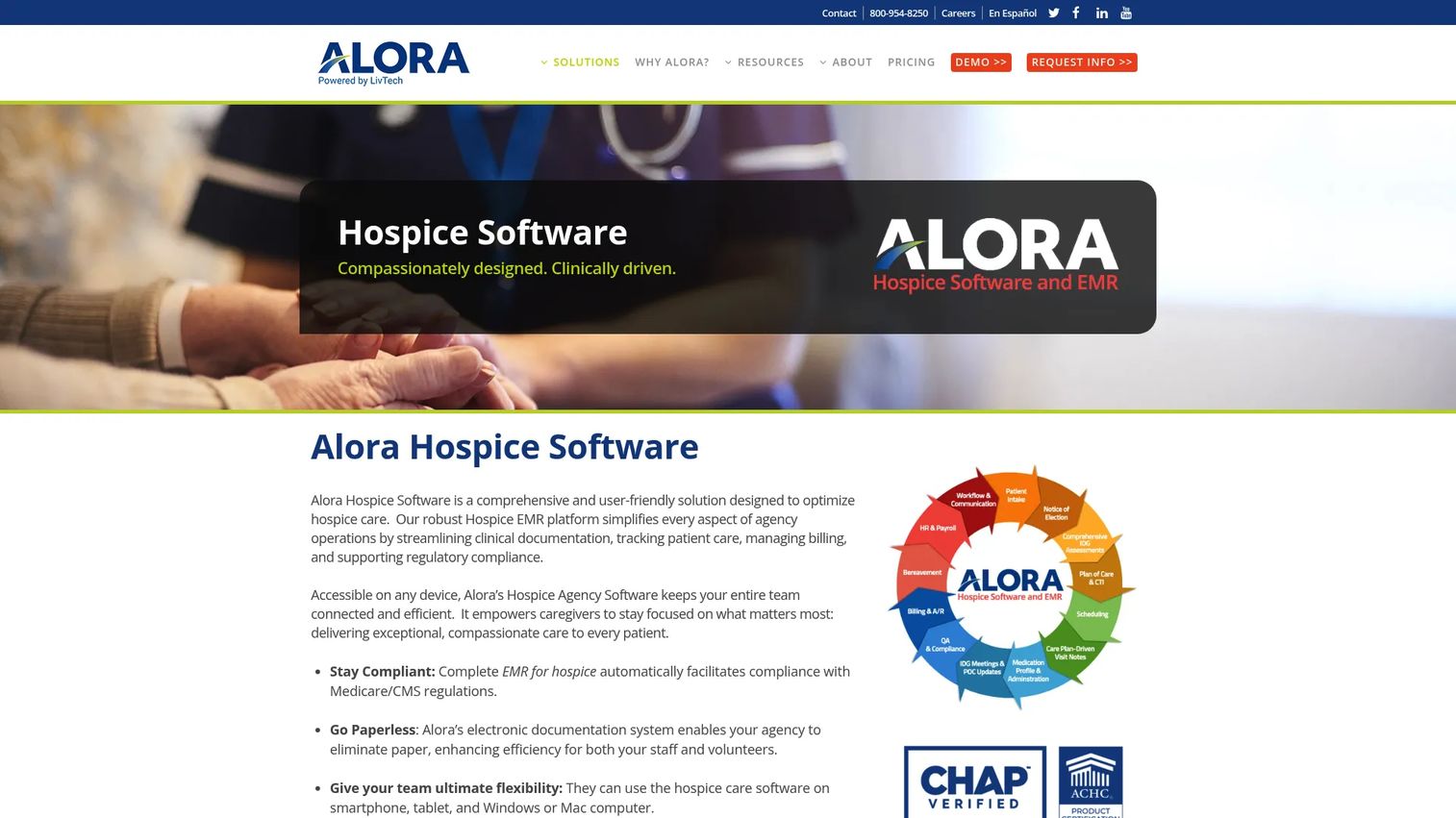
Alora Hospice Software is a cloud-based hospice EMR/EHR built specifically for hospice agencies. It covers the full operational stack in one place, from clinical documentation through scheduling, billing, payroll, and compliance, and works across smartphones, tablets, and computers so field and office teams share the same record.
Best for: Hospice agencies that want a cloud-based EMR with deep hospice-specific documentation and workflow tools.
Key strengths
- Hospice documentation depth: Assessments, plans of care, CTI, and physician signature workflows built for the hospice benefit.
- Full operational coverage: Scheduling, billing, payroll, and compliance in one connected system.
- Mobile-ready access: Point-of-care charting on smartphones, tablets, and computers for distributed teams.
Why choose Alora: Alora leans into hospice specificity rather than a broad post-acute platform. If your agency is hospice-first and you want documentation, CTI, and physician signatures handled without workarounds, the fit is tight. The mobile-ready design also suits teams that chart heavily in the field.
Alora pricing: Alora does not display pricing publicly. The hospice product page routes you to request a quote based on your agency's needs. There is no confirmed public free tier, so plan to speak with sales for a figure tailored to your size and workflows.
3. Netsmart myUnity
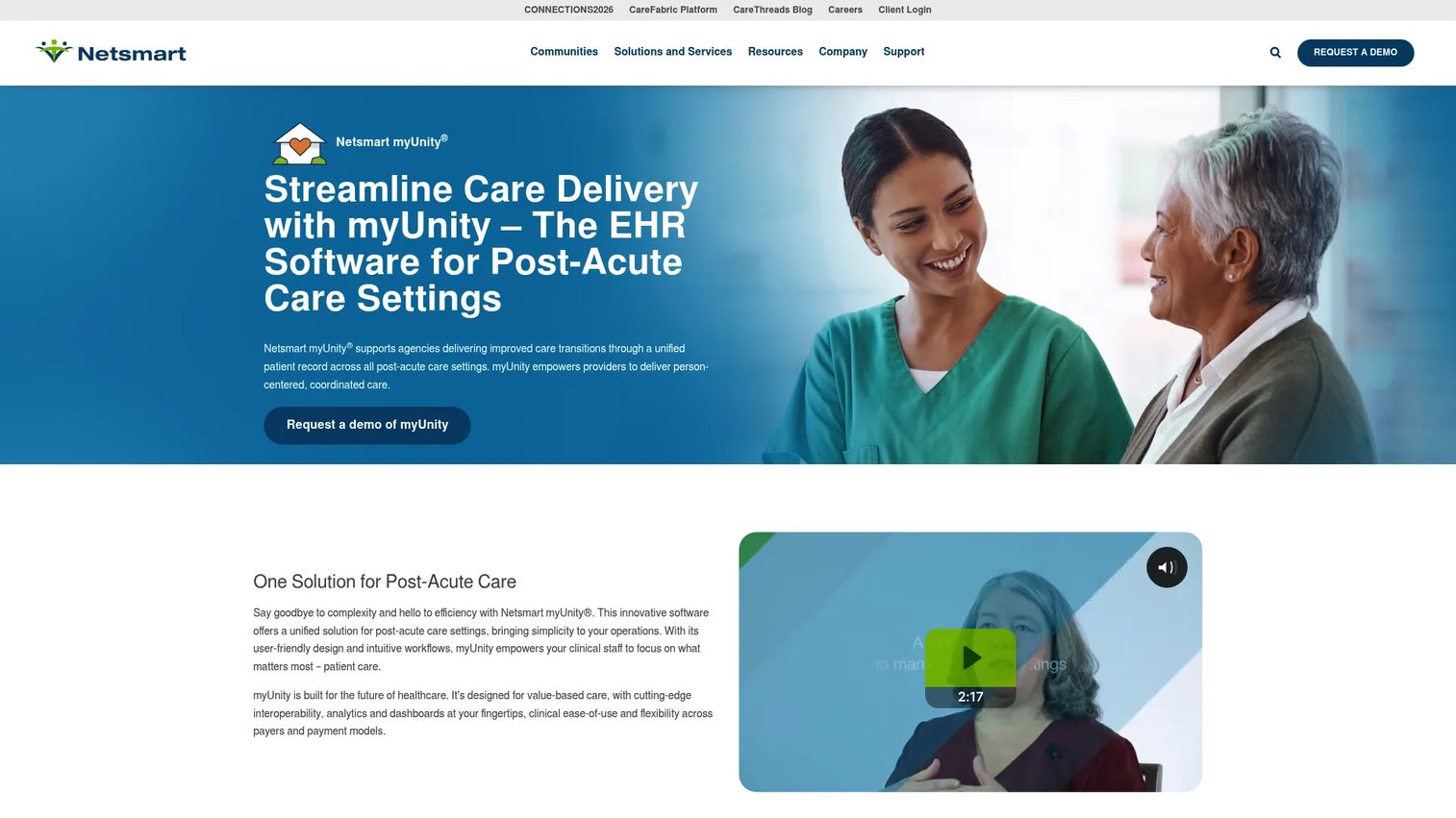
Netsmart myUnity is a post-acute EHR designed to coordinate care across multiple settings, including home health, hospice, senior living, and skilled nursing. Its central promise is a single unified patient record that follows the patient across care environments, which matters most for organizations operating value-based or multi-setting models.
Best for: Post-acute providers needing one EHR across home health, hospice, senior living, skilled nursing, and related settings.
Key strengths
- Unified patient record: A single record across post-acute settings so care teams work from the same data.
- Interoperability: Electronic referrals and data exchange with external systems.
- Analytics and dashboards: Operational and clinical reporting to support value-based care decisions.
Why choose Netsmart myUnity: If your organization spans several care settings and cares about interoperability and value-based care reporting, myUnity is built for that breadth. The unified record reduces the handoff gaps that appear when patients move between service lines. Larger, multi-setting organizations tend to get the most from it.
Netsmart myUnity pricing: Netsmart states that myUnity is priced based on average daily census and requires a subscription. No public dollar figure is listed on the brand site, and no free tier was found, so pricing is quoted per organization. Its G2 rating is 3.4/5.
4. Homecare Homebase
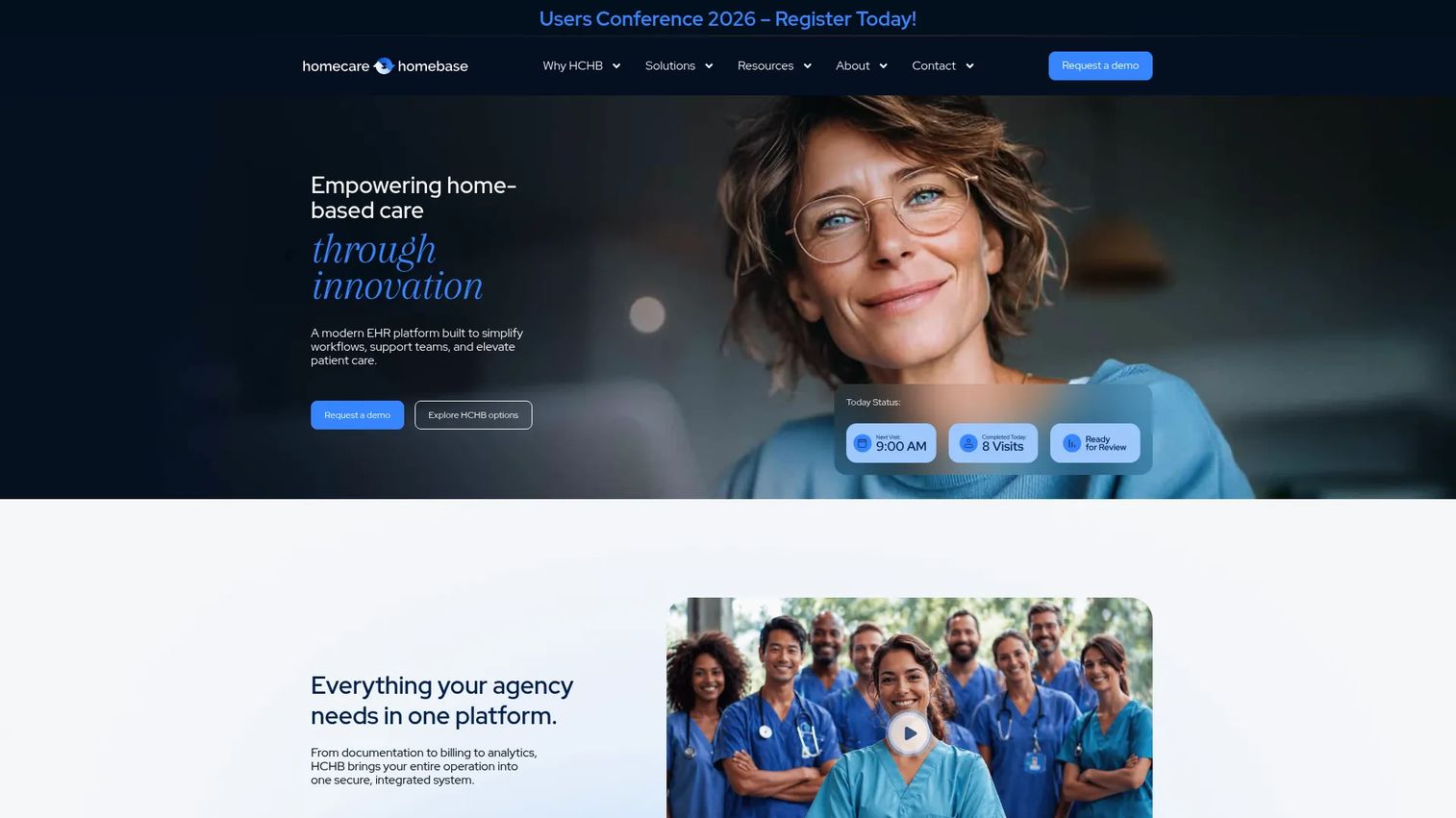
Homecare Homebase is a cloud-based EHR for home health, hospice, and personal care agencies, positioned as an enterprise platform for larger operations. It centers on streamlined documentation, scheduling, and billing, paired with real-time communication and care coordination tools that keep distributed teams aligned.
Best for: Home-based care agencies that need an enterprise EHR platform built for scale.
Key strengths
- Streamlined core workflows: Documentation, scheduling, and billing in one enterprise-grade system.
- Real-time collaboration: Real-time communication and secure data exchange across field and office.
- Care coordination: Interoperability and coordination tools to keep the interdisciplinary team aligned.
Why choose Homecare Homebase: Homecare Homebase is built for volume. If you run a large agency and need an EHR that holds up across hundreds of clinicians and high visit counts, its enterprise orientation is the reason to look. It also publishes guidance on what makes strong hospice software, which reflects an educational stance toward buyers. Its G2 rating is 3.7/5.
Homecare Homebase pricing: Homecare Homebase does not publish pricing. The site emphasizes a request-a-demo and contact-sales flow, so figures are quoted based on agency size and needs. No public free tier was found.
5. MatrixCare Home Health and Hospice
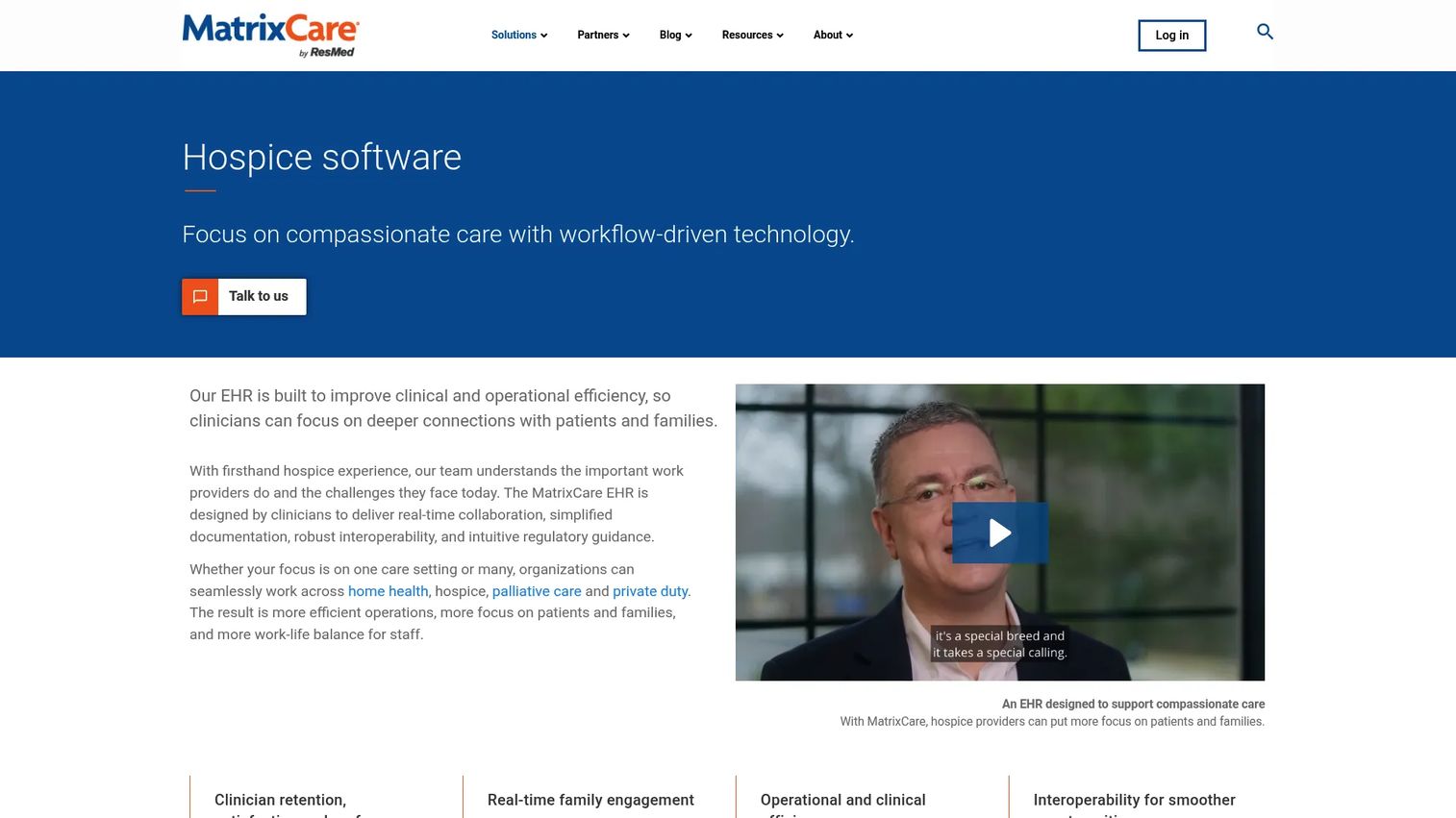
MatrixCare Home Health and Hospice is an EHR built for clinical documentation, interoperability, and care coordination across home health and hospice. Its strength is connecting the care team and the patient's family through real-time engagement, while linking to major health data networks for a fuller clinical picture.
Best for: Hospice and home health agencies needing an integrated EHR with strong interoperability and care-team collaboration.
Key strengths
- Family engagement: Real-time family engagement that keeps loved ones informed and involved.
- Broad interoperability: Connections with networks like CommonWell, Carequality, and SureScripts.
- IDG/IDT support: Interdisciplinary group workflows so the full care team collaborates on one plan.
Why choose MatrixCare: MatrixCare fits agencies that want a broader post-acute platform with serious interoperability. If pulling in medication history and external clinical data matters to your workflow, the network connections are a real advantage. The family engagement layer also differentiates it for agencies focused on the patient and family experience. Its G2 rating is 3.8/5.
MatrixCare pricing: MatrixCare does not display public pricing. The hospice software page routes visitors to contact sales, so plans are quoted per agency. No free tier was verified from the brand's pages.
6. Hospice Tools EMR
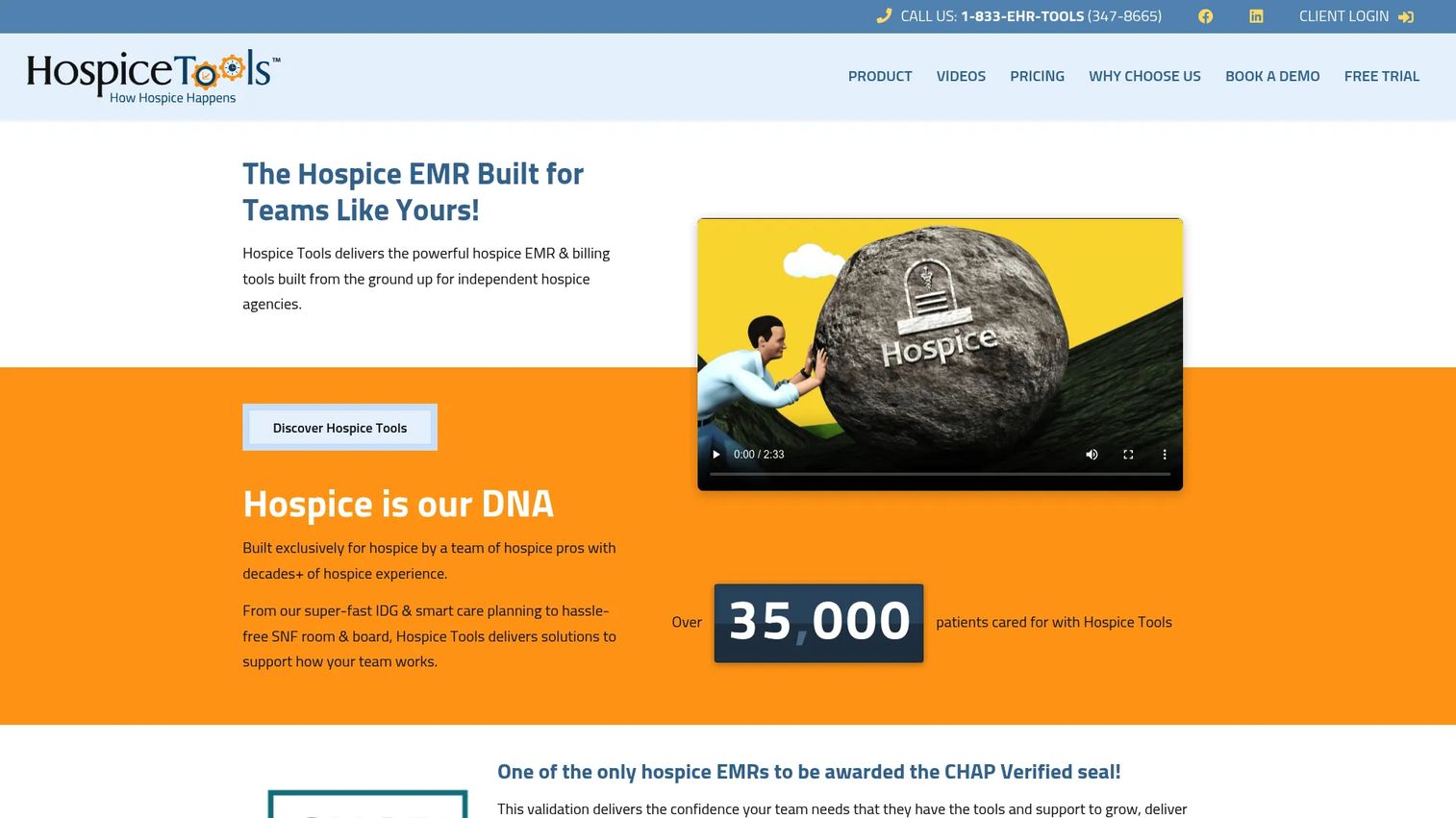
Hospice Tools EMR is a hospice-focused EMR and billing platform for hospice and palliative care agencies. It keeps the feature set tight and hospice-specific, pairing clinical charting with timesheets and integrated billing, and it is one of the few platforms in this comparison with transparent public pricing.
Best for: Hospice and palliative care agencies that want an EMR with integrated charting, timesheets, and billing.
Key strengths
- eDocs EMR: Clinical charting and patient management built for hospice documentation.
- TimeKeeper: Timesheets, mileage, and payroll tracking in the same system.
- Mobile and web access: Mobile apps plus web access for point-of-care charting.
Why choose Hospice Tools EMR: For a leaner or independent agency, transparent pricing and a focused feature set lower the barrier to getting off paper. You can see the cost before you talk to anyone, which is rare in this category. The integrated eBilling with a built-in clearinghouse is the reason smaller teams that want charting and claims in one place tend to shortlist it.
Hospice Tools EMR pricing: eDocs EMR and TimeKeeper start at $85 per user per month. eBilling with an integrated clearinghouse is $235 per NPI or site, with a one-time setup of $995 and transaction overage at $0.16 per transaction. A free trial is offered. Its G2 listing shows a 1.5/5 rating based on limited reviews, so weigh that against a hands-on trial.
7. Axxess Hospice
Axxess Hospice is hospice software built for hospice professionals, covering the clinical, scheduling, and billing workflows an agency runs day to day. It is designed around hospice-specific operations, with interdisciplinary collaboration and automated billing at the center.
Best for: Hospice agencies seeking an all-in-one clinical, scheduling, and billing platform.
Key strengths
- IDG collaboration: Interdisciplinary group workflows that keep the care team coordinated.
- Flexible scheduling: Hospice scheduling software that adapts to visit patterns and staffing.
- Medication management: Medication tracking built into the clinical workflow.
Why choose Axxess Hospice: Axxess appeals to agencies that want a hospice-focused, all-in-one platform rather than a broad post-acute suite. The combination of IDG collaboration, scheduling, medication management, and automated billing keeps operations in one place. If your priority is a system built specifically around hospice rather than adapted from home health, it belongs on your shortlist.
Axxess Hospice pricing: Axxess does not publish pricing on its hospice product page. Capterra, a third-party source, lists a Basic plan at $1,200 per user per month, though that figure should be confirmed with Axxess directly. No free tier was found.
Considerations before you buy
Use this checklist to pressure-test any platform before you commit. The best hospice software for another agency may not be the best for yours.
Documentation and clinical fit
Test whether the charting workflow matches how your clinicians actually work. Assessments, plans of care, CTI, and physician signatures should feel native, not bolted on. If charting is slow or clunky, chart completion suffers and compliance risk rises.
Compliance and audit readiness
Confirm the platform supports current standards, including the HOPE assessment and Medicare documentation requirements. Ask how the vendor handles regulatory updates. Hospice compliance software is only useful if it stays current without heavy work from your team.
Billing and revenue cycle
Look at how tightly documentation feeds billing. Clean-claim rates, denial handling, and clearinghouse connections directly affect cash flow. If the platform separates charting and hospice billing software into loosely connected modules, ask how data moves between them.
Scheduling and mobile access
Field teams need reliable mobile charting, not a stripped-down phone view. Verify that a visit logged in a home updates the office record in real time, and that scheduling handles your visit patterns and staffing without constant manual fixes.
Scale and integration
Consider where your agency is headed. A second location, more clinicians, or a new service line should not force a re-platform. Ask what integrates cleanly, what is modular, and what is locked to higher tiers.
Conclusion
The right choice comes down to scale, billing complexity, and workflow requirements. For agencies running multiple service lines, WellSky and Netsmart myUnity offer the coordinated, multi-setting breadth that keeps everything on one record. Large home-based operations lean toward Homecare Homebase for enterprise scale, while MatrixCare stands out for interoperability and family engagement.
If you are hospice-first, Alora Hospice Software and Axxess Hospice give you documentation and operations built specifically around the hospice benefit. And if you are a smaller or independent agency that wants transparent pricing and a focused feature set, Hospice Tools EMR lets you get off paper without a long sales cycle.
Your next step is simple: shortlist two or three platforms that match your service lines and billing complexity, then run a hands-on trial or demo with your actual charting and claims workflows. The tool that reduces manual work in week one is usually the one that scales cleanly in year two.
FAQs
Hospice software is a purpose-built EHR or EMR for end-of-life care that combines clinical documentation, care planning, visit management, billing, and compliance in one system. It replaces paper charts and disconnected spreadsheets, and it is designed around the interdisciplinary group model and the Medicare hospice benefit.
At minimum, look for clinical charting and documentation, care plan and visit management, hospice billing software, compliance and audit tools, interdisciplinary collaboration, mobile charting, and analytics. Strong platforms tie these together so documentation feeds billing and compliance automatically rather than living in separate modules.
Hospice compliance software builds Medicare documentation requirements and standards like the HOPE assessment directly into the charting workflow, so clinicians capture what regulators expect at the point of care. It also supports audit readiness by keeping records complete, signed, and traceable, which reduces the risk of denied claims and regulatory findings.
An EMR (electronic medical record) is the clinical chart itself, focused on documentation within one organization. A hospice EHR is broader and interoperable, designed to share the patient record across settings and external systems. In practice, most hospice EMR systems and EHR platforms blend both, so the label matters less than whether the workflow fits your agency.
Smaller and independent agencies often favor Hospice Tools EMR because it offers transparent per-user pricing and a focused, hospice-specific feature set. It lets a leaner team get off paper without a long enterprise sales process, and integrated billing keeps charting and claims in one place.
Platforms that tie documentation directly to hospice billing and claims tend to perform best on cash flow. WellSky offers built-in revenue cycle tooling, while Hospice Tools EMR provides integrated eBilling with a built-in clearinghouse. The right fit depends on your volume and whether you want billing native to the EHR or handled as a connected module.
Yes. Most modern hospice care software includes mobile access for point-of-care charting. Alora Hospice Software works across smartphones, tablets, and computers, and Hospice Tools EMR offers mobile apps alongside web access. Confirm that a visit logged in the field updates the office record in real time before you commit.
Integrated platforms bundle clinical, billing, and compliance into one system, which reduces handoffs and data gaps. Modular platforms let you add capabilities as you grow but require attention to how data moves between components. Choose based on your scale and complexity: multi-setting organizations often benefit from integrated suites, while focused agencies may prefer a leaner core with select add-ons.