
A customer signs up. They poke around for ten minutes. Then they go quiet.
You schedule an onboarding call. You walk them through the same five steps you walked the last account through. The week after, three tickets land in your queue asking how to do something the help center already covers. Sound familiar?
This is the daily reality for customer success teams at SaaS companies. Customers sign up but do not engage deeply. Onboarding is manual and does not scale. The same questions cycle through the queue, and your strategic accounts wait while you firefight the basics.
The shift toward self-service is not subtle. Research cited in Insider's 2026 customer engagement statistics found that 81% of customers prefer self-service options before contacting a live agent. That number reframes the whole job. Customers want to figure things out on their own, and the right customer engagement software lets them.
The problem is not effort. CSMs work hard. The problem is that manual touchpoints do not scale, and static documentation gets skipped. When a customer cannot reach value quickly, the risk is not a bad call. It is churn.
The good news: the customer engagement tools below are built to close that gap. Some deflect repetitive tickets. Some surface adoption risk before it becomes churn. Some let customers experience your product through a guided interactive demo instead of waiting on a live walkthrough.
This guide is for teams that measure success in retention, adoption, and time-to-value, not vanity engagement.
What's inside
This guide is written for SaaS customer success, onboarding, support, and product-led growth teams. Not generic marketers, not contact-center buyers. The people who own adoption and retention.
We evaluated each customer engagement platform against four criteria that matter to CS teams:
- Real engagement impact: Does it move adoption, retention, or ticket deflection, not just opens?
- Stack integration: Does it connect to your CRM, help desk, and chat tools instead of adding a silo?
- Analytics and visibility: Can you see where customers struggle and prove CS impact?
- Ease of adoption: Can your team and your customers actually use it without a heavy rollout?
Pricing and G2 ratings were verified against live vendor pages in June 2026.
TL;DR
Short on time? Here are the decision shortcuts by job.
- Best for self-serve onboarding, adoption, and ticket deflection: Guideflow, the interactive product engagement platform.
- Best for in-app product analytics and adoption: Pendo.
- Best for no-code in-app onboarding flows: UserGuiding.
- Best for AI-first chat and support engagement: Intercom.
- Best for omnichannel lifecycle messaging at scale: Braze.
- Best for CRM-native engagement: HubSpot.
- Best for dedicated CS account health: Velaris.
Most teams end up combining two or three. The trick is starting with the job that costs you the most hours today.
What are customer engagement tools?
Customer engagement tools are software that help companies communicate with, educate, and activate customers across channels to drive adoption, satisfaction, and retention.
For SaaS teams, that definition is broader than email or chat. A customer engagement platform spans how you onboard, how you educate, how you collect feedback, and how you spot accounts at risk. The strongest customer engagement solutions tie every touchpoint back to a measurable outcome.
Here are the core capabilities you will see across the category:
- Omnichannel communication: Live chat, email, in-app messages, and SMS, so you meet customers where they already are.
- Product education and guided onboarding: Interactive demos, walkthroughs, and in-app guides that scale education without a live call.
- Feedback and surveys: NPS, CSAT, and sentiment tools that surface how customers actually feel.
- Behavioral analytics and intent signals: Visibility into what customers explored, where they dropped off, and which accounts are stalling.
- Automation and journey orchestration: Triggered sequences that move customers toward value without manual effort.
- CRM and CDP integration: A clean connection to your existing data so engagement is not isolated from the rest of the business. Many teams pair these tools with a customer data platform to unify that data.
How customer engagement software differs from a CRM
People conflate the two constantly. A CRM stores customer data and tracks relationships and deals. It is a system of record. Customer engagement software is a system of action. It activates that data: it communicates, educates, and nudges customers across channels.
Put simply, your CRM tells you who the customer is. Your customer engagement platform helps that customer succeed. The best customer engagement platforms read from the CRM and write engagement signals back to it, so both stay in sync. If you're still evaluating your system of record, our roundup of the best CRM software is a useful starting point.
When SaaS teams use customer engagement tools
The category is broad, so the smartest way to evaluate it is by the job in front of you. Here are the three jobs CS teams reach for these customer engagement solutions most often.
Onboard customers without live calls
Manual onboarding does not scale past a few dozen accounts per CSM. A guided, self-serve experience does. Interactive demos and guided walkthroughs let customers learn your product at their own pace, through a curated path, without booking your calendar.
This is where time-to-value compresses. Instead of waiting for a call slot, a new user follows a clickable walkthrough the moment they sign up. The result is faster activation and fewer stalled accounts. With 81% of customers preferring self-service first, this is exactly the experience they want. Teams comparing approaches here often look at dedicated user onboarding software as well.
Deflect repetitive "how do I" tickets
The same questions land in the queue every week. Embedding guided content directly in your help center and your ticket replies answers those questions before they become tickets.
Instead of writing a long step-by-step macro, you embed an interactive guide that shows the steps. Instead of a text article customers skim and skip, you give them something they click through. That shift moves volume off the queue and frees agents for the issues that genuinely need a human. A solid knowledge base software stack pairs well with embedded guides here.
Spot adoption risk before churn
Churn rarely arrives without warning. It shows up as declining logins, unused features, and drop-off inside a workflow. Behavioral analytics and engagement signals make those patterns visible.
When you can see that an account stopped completing a key onboarding flow, you can reach out before the renewal conversation goes sideways. Engagement analytics turn CS from reactive to proactive, and they give you the data to prove your impact internally. For deeper usage insight, many teams add product analytics software to the mix.
Comparison table
Here is a side-by-side look at the 10 best customer engagement tools for SaaS teams in 2026. Pricing and G2 ratings were verified against live vendor and G2 pages in June 2026. Use it to filter by intent and budget before reading the full reviews. Guideflow leads the list as the pick for interactive, self-serve product engagement.
| # | Product | Intent | Key use case | Pricing | G2 rating |
|---|---|---|---|---|---|
| 1 | Guideflow | Self-serve product engagement | Interactive onboarding, adoption, and ticket deflection | Free; paid from $40/mo (monthly) | 5.0/5 |
| 2 | Pendo | In-app product adoption | Product analytics plus in-app guides | Free up to 500 MAUs; paid custom | 4.4/5 |
| 3 | UserGuiding | No-code onboarding | In-app product tours and checklists | Free; paid from $174/mo (billed yearly) | 4.7/5 |
| 4 | Intercom | Conversational support | AI agent plus omnichannel chat | From $0.99 per Fin outcome + seat cost | 4.5/5 |
| 5 | Braze | Omnichannel messaging | Cross-channel journey orchestration | Custom pricing | 4.5/5 |
| 6 | HubSpot | CRM-native engagement | Unified marketing, sales, and service | Free; paid from $10/seat/mo | 4.4/5 |
| 7 | Tidio | SMB chat and deflection | Live chat plus Lyro AI | Free; paid from $24.17/mo | 4.6/5 |
| 8 | Velaris | CS operations | Account health and success plans | Custom pricing | 4.5/5 |
| 9 | SurveySparrow | Feedback and sentiment | Conversational surveys and NPS | Free plan; paid tiers available | 4.4/5 |
| 10 | Front | Collaborative comms | Shared inbox and omnichannel routing | From $25/seat/mo (billed annually) | 4.7/5 |
The 10 best customer engagement tools for SaaS teams in 2026
1. Guideflow
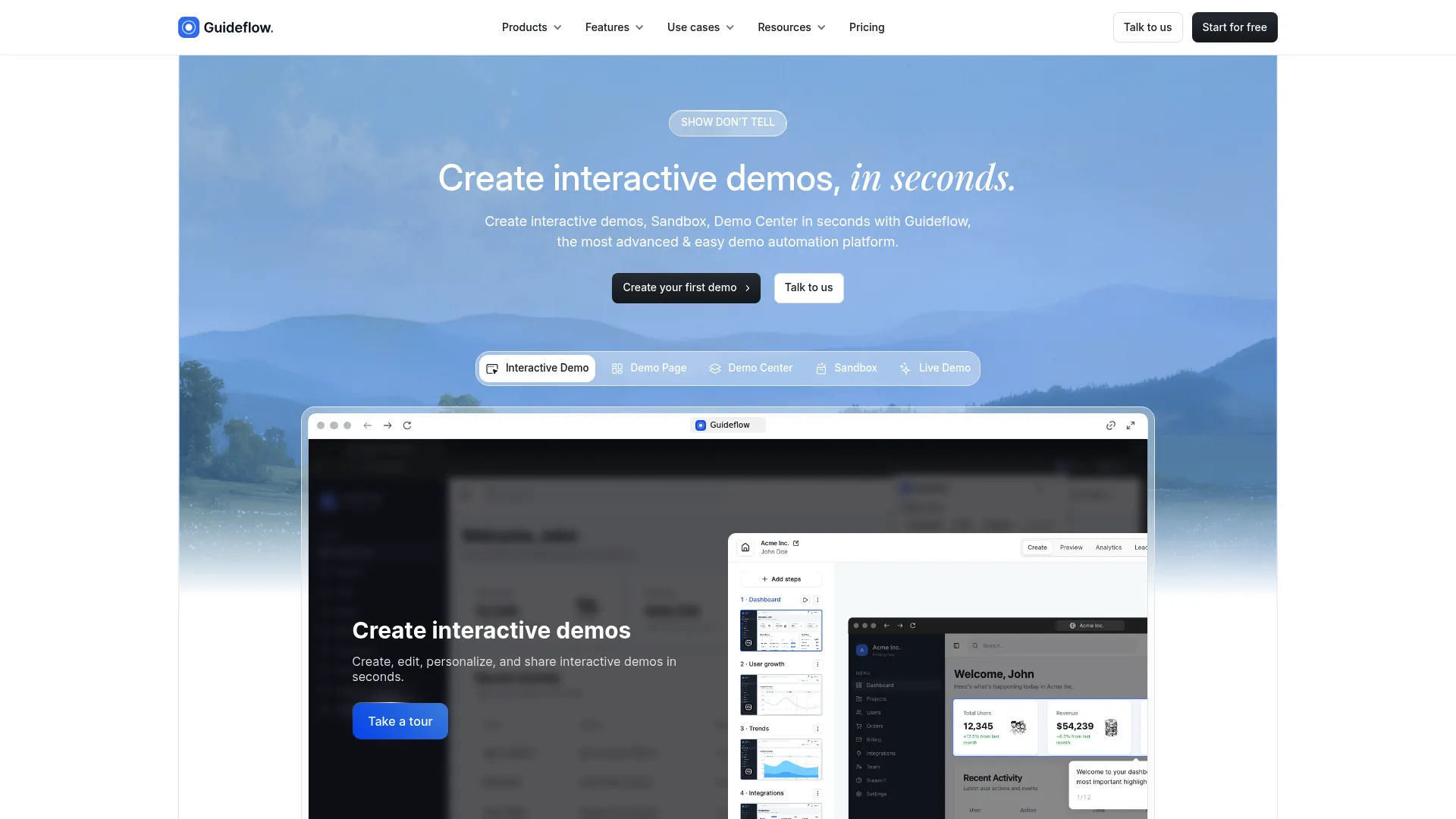
Guideflow is a demo automation platform for creating interactive product demos and step-by-step guides. For CS teams, that translates into something specific: turn your product into self-serve onboarding, adoption guides, and a customer education hub that customers actually use. Instead of scheduling another walkthrough or writing another long macro, you capture the flow once and let customers experience it on their own terms.
The workflow starts with capture. You record your app directly from the browser, click through the flow as you normally would, and Guideflow generates a step-by-step interactive guide automatically. From there you refine it in a plug-and-play editor with tooltips, forms, highlights, branching paths, and voiceovers. You can capture the flow once and analyze how customers move through it.
Best for: SaaS CS and onboarding teams that want customers to reach value without manual walkthroughs.
Key strengths
- Capture-based demo creation: Record your product in the browser and get an editable, step-by-step guide automatically, so onboarding content ships fast.
- Embed anywhere: Drop interactive guides into help centers, onboarding emails, and in-app flows to deflect repetitive tickets at the point of friction.
- Engagement analytics: Track completion rate, drop-offs, leads, and conversions in real time, so you can see where customers struggle and prove CS impact.
Guideflow's format suite covers the full lifecycle of self-serve engagement. The Interactive Demo excels when you want to guide a customer through a specific onboarding story. The Sandbox excels when customers want to explore freely and validate workflows on their own terms. The Demo Center gives you a single branded hub where every guide lives, organized by feature, persona, or journey stage. The Mobile Demo meets customers on their phones for mobile-first products, and the Live Demo adds the human layer for QBRs and high-touch walkthroughs. Together they let you onboard, educate, and support customers across every surface.
Why choose Guideflow: If your biggest costs are manual onboarding and repetitive education, Guideflow attacks both directly. It scales the walkthroughs you currently do live and embeds them where customers get stuck, while the analytics give you adoption signals to act on before churn. It also integrates into the stack you already run, so engagement data does not live in a silo.
Guideflow pricing: Guideflow offers a free plan with 5 guideflows, unlimited viewers, and 7-day analytics. Paid plans on monthly billing start at $40/month for Solo, $599/month for Startup, and $1,799/month for Advanced, with Enterprise from $3,499/month. On yearly billing, Solo is $35/month, Growth is $499/month, Advanced is $1,499/month, and Enterprise starts at $2,999/month. See the full pricing breakdown for details. Guideflow holds a 5.0/5 rating on G2.
Start your journey with Guideflow today!
2. Pendo
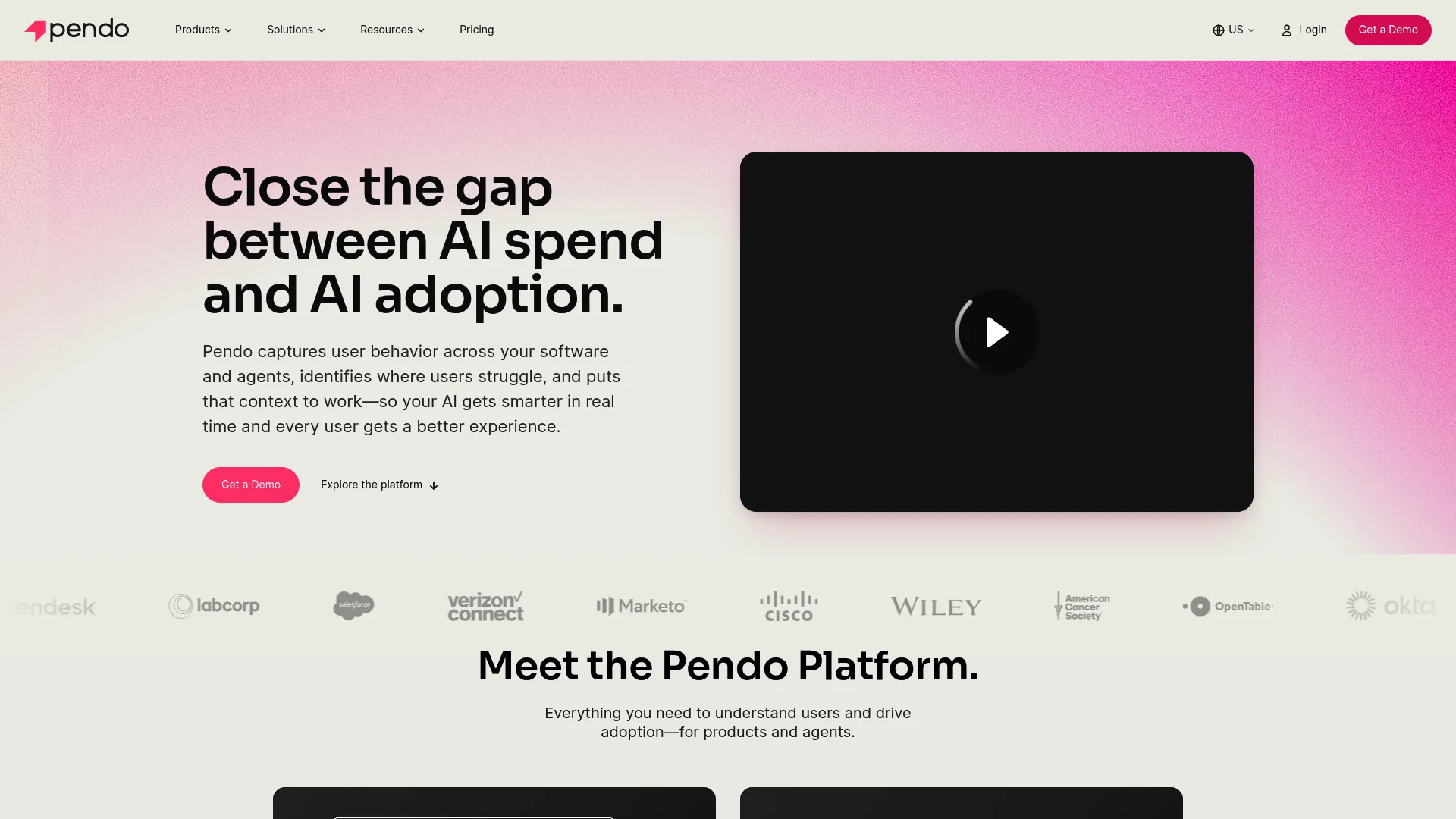
Pendo is a software experience management platform for product analytics, in-app guidance, session replay, and user sentiment. It is a strong fit for product and CS teams that want to understand how customers actually use the product and then nudge adoption in the moment. The analytics run without manual event tagging, which lowers the barrier to getting useful data fast.
Best for: Product and CS teams driving in-app feature adoption with behavioral data.
Key strengths
- Product analytics: Track usage and feature adoption without manual event tagging, so you see what customers do, not just what they say.
- In-app guides: Deliver contextual onboarding and feature prompts directly inside the product where customers need them.
- Session replay: Watch real sessions to understand exactly where customers get stuck before they churn.
Why choose Pendo: Pendo shines when you want analytics and in-app engagement in one place. The behavioral data tells you which accounts are at risk, and the in-app guides let you intervene without a CSM touch. It is well suited to product-led teams that treat adoption as the core retention lever. It also fits naturally alongside other digital adoption platforms you might be evaluating.
Pendo pricing: Pendo offers a free plan that includes product analytics, in-app guides, and Net Promoter Score with Pendo branding for up to 500 monthly active users. Paid tiers, Base, Core, and Ultimate, use custom pricing based on MAU volume, with higher tiers adding session replay and sentiment surveys such as NPS, PMF, and CSAT. Pendo holds a 4.4/5 rating on G2.
3. UserGuiding
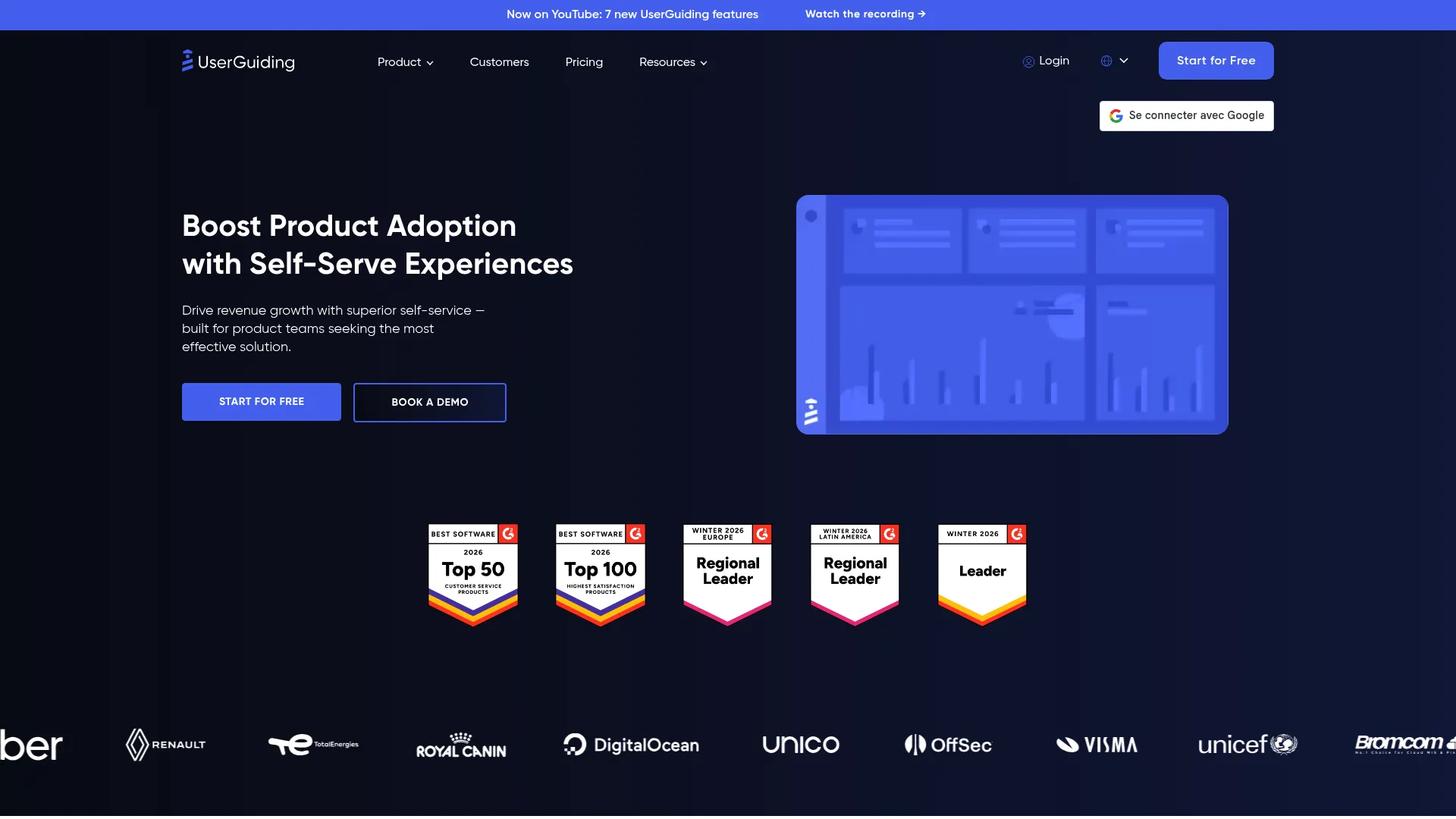
UserGuiding is a no-code product adoption and user onboarding platform for building in-app guides, surveys, resource centers, product updates, and self-service support experiences. It is built so CS and product teams can launch onboarding flows without engineering, which matters when developer bandwidth is tight.
Best for: Teams that want to build no-code in-app onboarding and adoption flows quickly.
Key strengths
- Product tours and checklists: Build guided onboarding flows and progress checklists that walk new users to first value.
- In-app surveys and feedback: Run NPS surveys and collect feedback inside the product to catch friction early.
- Resource centers and updates: Give customers a self-service hub and product update feed, reducing repeat questions.
Why choose UserGuiding: UserGuiding is a good fit when your priority is in-app onboarding you can ship without code. The checklists and resource centers reduce hand-holding, and the surveys feed adoption signals back to your team. It works well for teams standardizing onboarding across many accounts. If tours are your focus, compare it against other product tour software options too.
UserGuiding pricing: UserGuiding offers a free Support Essentials plan. Paid plans are priced on monthly active users, with Starter at $174/month and Growth at $349/month, both billed yearly at the 2,000 MAU view. Enterprise pricing is custom. UserGuiding holds a 4.7/5 rating on G2.
4. Intercom
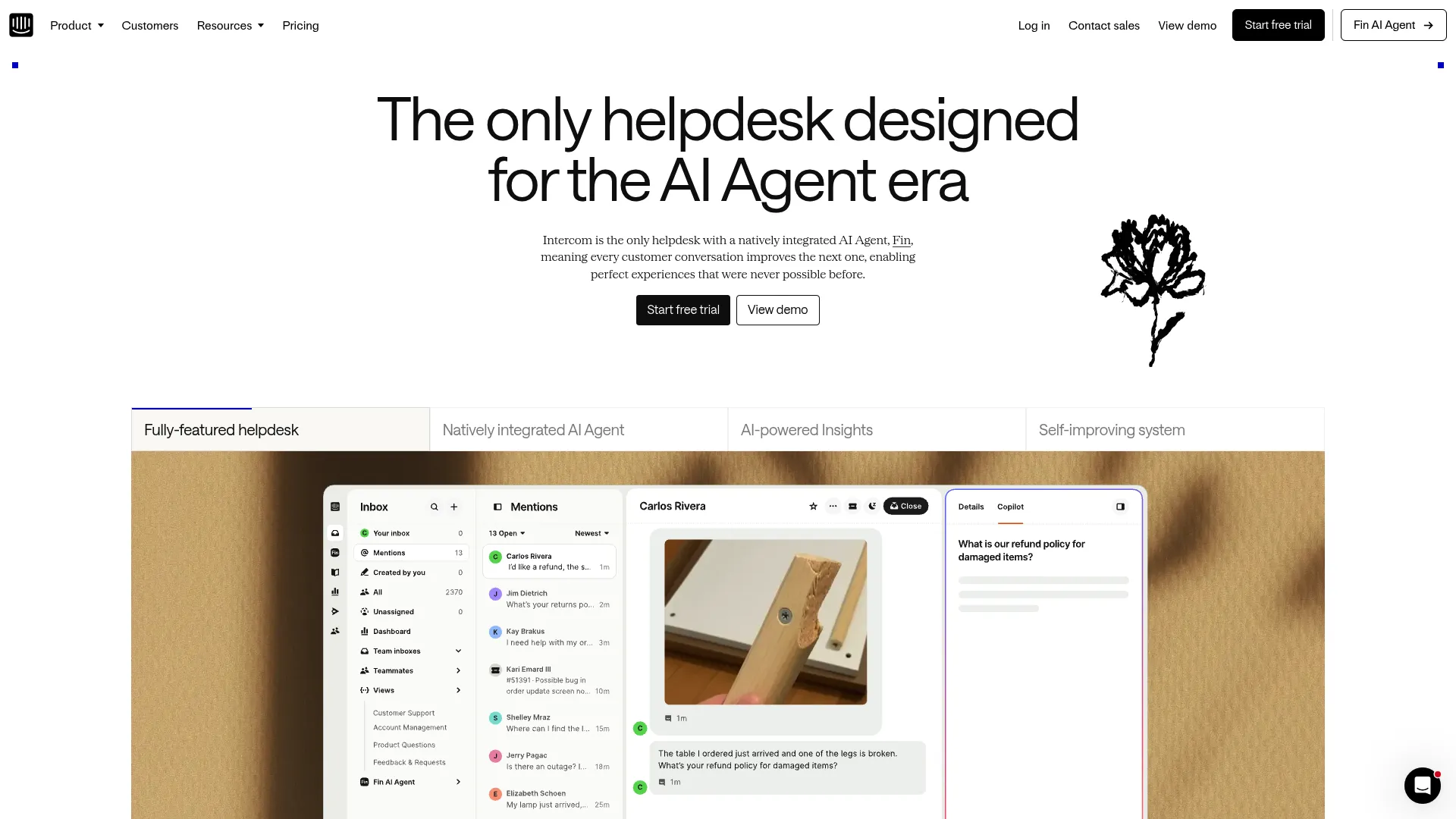
Intercom is an AI-first customer service helpdesk with a natively integrated AI agent, Fin, for support automation and human-agent workflows. For CS and support teams, it blends live chat, proactive messaging, and AI deflection in one place, which is useful when engagement and support sit on the same team.
Best for: CS and support teams combining chat with proactive, AI-driven engagement.
Key strengths
- Fin AI Agent: Resolve common customer questions automatically across service, sales, and ecommerce, deflecting tickets at scale.
- Omnichannel inbox: Manage shared inbox, ticketing, live chat, email, phone, WhatsApp, and social from one workspace.
- AI reporting and quality: Score conversations and monitor quality with AI-powered insights, so you see what is working.
Why choose Intercom: Intercom fits teams that want AI deflection layered on top of human support. Fin handles the repetitive questions, and the omnichannel inbox keeps every conversation in one view. It is a strong choice when chat is your primary engagement surface.
Intercom pricing: Intercom pricing combines seat costs with usage. Plans start with Essential at $29 per seat per month, Advanced at $85 per seat per month, and Expert at $132 per seat per month, all billed annually, plus $0.99 per Fin outcome. A standalone Fin AI Agent option is available at $0.99 per Fin outcome with no seats required. Intercom offers a 14-day free trial and holds a 4.5/5 rating on G2.
5. Braze
Braze is a customer engagement platform for real-time, cross-channel customer messaging, journey orchestration, data activation, and AI-powered personalization. It is enterprise-grade and built for teams running lifecycle messaging at scale. Braze's own 2026 customer engagement guide frames engagement as a driver of retention, loyalty, and growth, which matches how mature CS and lifecycle teams use it.
Best for: Mid-market to enterprise teams running cross-channel lifecycle messaging.
Key strengths
- Cross-channel messaging: Reach customers across email, push, SMS, in-app messages, content cards, and more from one platform.
- Journey orchestration: Build and test multi-step campaigns with frequency capping, experimentation, and rate limiting.
- BrazeAI personalization: Use AI to personalize paths and content variants, so each customer gets a relevant experience.
Why choose Braze: Braze is the pick when you need lifecycle messaging across many channels at high volume. The journey orchestration and personalization scale with large user bases, and the experimentation tools let you optimize systematically. It is best suited to teams with the scale to justify enterprise tooling. For broader lifecycle automation, also see our marketing automation software roundup.
Braze pricing: Braze lists platform editions named Braze Go, Braze Select, Braze Pro, and Braze Enterprise. Pricing scales with monthly active users and uses Action Credits, and Braze does not display public price figures, so plan on a custom quote. Braze holds a 4.5/5 rating on G2.
6. HubSpot
HubSpot is an AI-powered customer platform offering software for marketing, sales, customer service, content management, operations, and revenue. Its Service Hub and Marketing Hub give CS teams engagement workflows that sit natively on the CRM, which removes the data-silo problem many tools create.
Best for: Teams that want CRM-native engagement across marketing, sales, and service.
Key strengths
- Unified CRM platform: Run marketing, sales, and service on one customer record, so engagement data stays connected.
- Marketing automation: Build omni-channel campaigns and nurture sequences without stitching tools together.
- Service workflows and Breeze AI: Manage help desk, knowledge base, and feedback with an AI assistant guiding the work.
Why choose HubSpot: HubSpot fits teams that want engagement and CRM in one system rather than a separate platform. Because everything reads from the same record, your service and marketing motions stay aligned. It is a practical choice for companies already standardizing on HubSpot.
HubSpot pricing: HubSpot offers a free tier with no credit card required. Paid plans for its customer platform start with Starter at $10 per seat per month, Professional at $1,450 per month with 6 seats included, and Enterprise at $4,700 per month with 8 seats included. HubSpot Marketing Hub holds a 4.4/5 rating on G2.
7. Tidio
Tidio is an AI customer service platform for automating and managing support across live chat, ticketing, email, and social channels. Its Lyro AI Agent handles customer questions automatically, which makes it a fit for smaller teams that need deflection without a big budget.
Best for: SMB and ecommerce teams needing affordable chat plus AI deflection.
Key strengths
- Lyro AI Agent: Deliver data-backed, multilingual answers across channels, deflecting common questions automatically.
- Live chat: Engage customers in real time with typing previews, macros, transcripts, and pre-chat surveys.
- Ticketing and workflows: Manage, assign, and prioritize customer requests in one place.
Why choose Tidio: Tidio works well when you want chat and AI deflection without enterprise pricing. The Lyro agent handles repetitive questions, and the ticketing keeps the rest organized. It is a strong starting point for SMB and ecommerce CS teams.
Tidio pricing: Tidio offers a free plan with 50 billable conversations. Paid plans include Starter at $24.17/month, Growth starting at $49.17/month, and Plus starting at $749/month, with Premium available as custom pricing. Tidio holds a 4.6/5 rating on G2.
8. Velaris
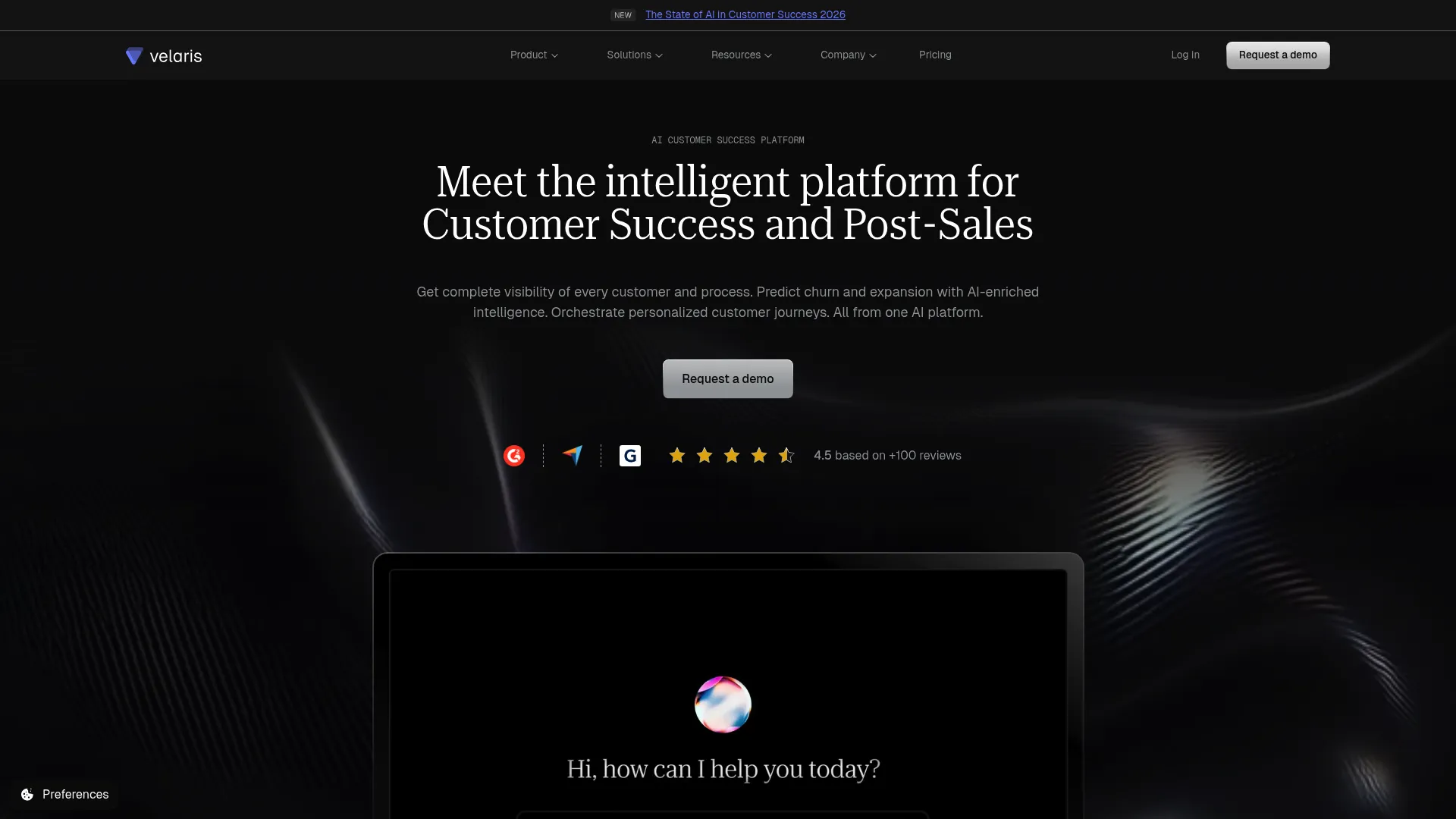
Velaris is an AI-native Customer Success Platform for mid-market and enterprise B2B SaaS and recurring revenue teams. It is purpose-built for the CSM workflow: account health, engagement tracking, success plans, and analytics in one system, rather than a general engagement tool adapted to CS.
Best for: Dedicated CS teams managing account health and renewals at scale.
Key strengths
- Customer 360: See accounts, contacts, timelines, and custom objects in one view for a full picture of each account.
- AI health scoring: Use AI-assisted health scores, sentiment analysis, and conversation intelligence to spot risk early.
- Playbooks and automation: Run success plans, email campaigns, and task automation with 70+ integrations.
Why choose Velaris: Velaris fits teams that want a CS-specific command center rather than a general engagement platform. The health scoring surfaces at-risk accounts, and the playbooks standardize how your team responds. It suits post-sales teams managing renewals and expansion.
Velaris pricing: Velaris uses custom pricing. Its pricing page lists 5 users, unlimited viewers, and available add-ons, with capabilities grouped into View, Analyze, Orchestrate, and Execute, but no public price figure is shown. Velaris holds a 4.5/5 rating on G2.
9. SurveySparrow
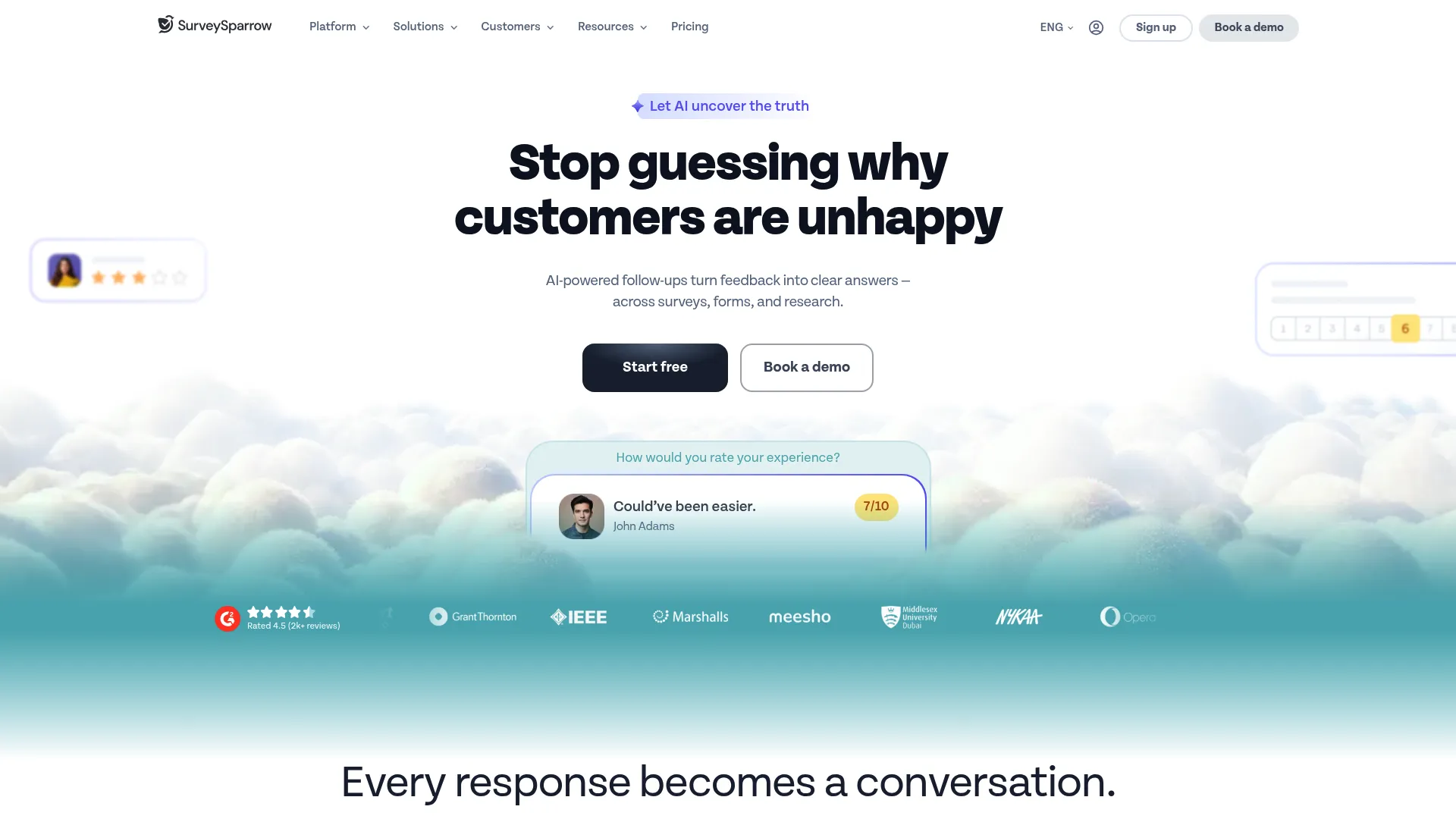
SurveySparrow is an experience management and online survey platform for collecting feedback through conversational surveys and multiple channels. For CS teams, it closes the feedback loop with NPS, CSAT, and sentiment data that informs where to focus engagement efforts.
Best for: Teams prioritizing structured feedback and sentiment analysis.
Key strengths
- Conversational surveys: Run chat-style surveys, NPS, offline surveys, and 360 feedback that customers actually finish.
- Smart logic: Use conditional branching, skip logic, and piping to tailor each survey to the respondent.
- Real-time reporting: Filter, cross-tabulate, schedule reports, and export to PDF, Excel, and SPSS.
Why choose SurveySparrow: SurveySparrow is the pick when feedback quality drives your engagement strategy. The conversational format lifts completion rates, and the reporting turns responses into signals you can act on. It fits teams that want sentiment to guide retention work. Pair it with user research tools when you need deeper qualitative insight.
SurveySparrow pricing: SurveySparrow offers a forever free plan. Paid tiers, Basic, Starter, and Business, are billed yearly, with Enterprise available as contact sales. The pricing page also lists an additional users add-on at $49 per user per month. SurveySparrow holds a 4.4/5 rating on G2.
10. Front
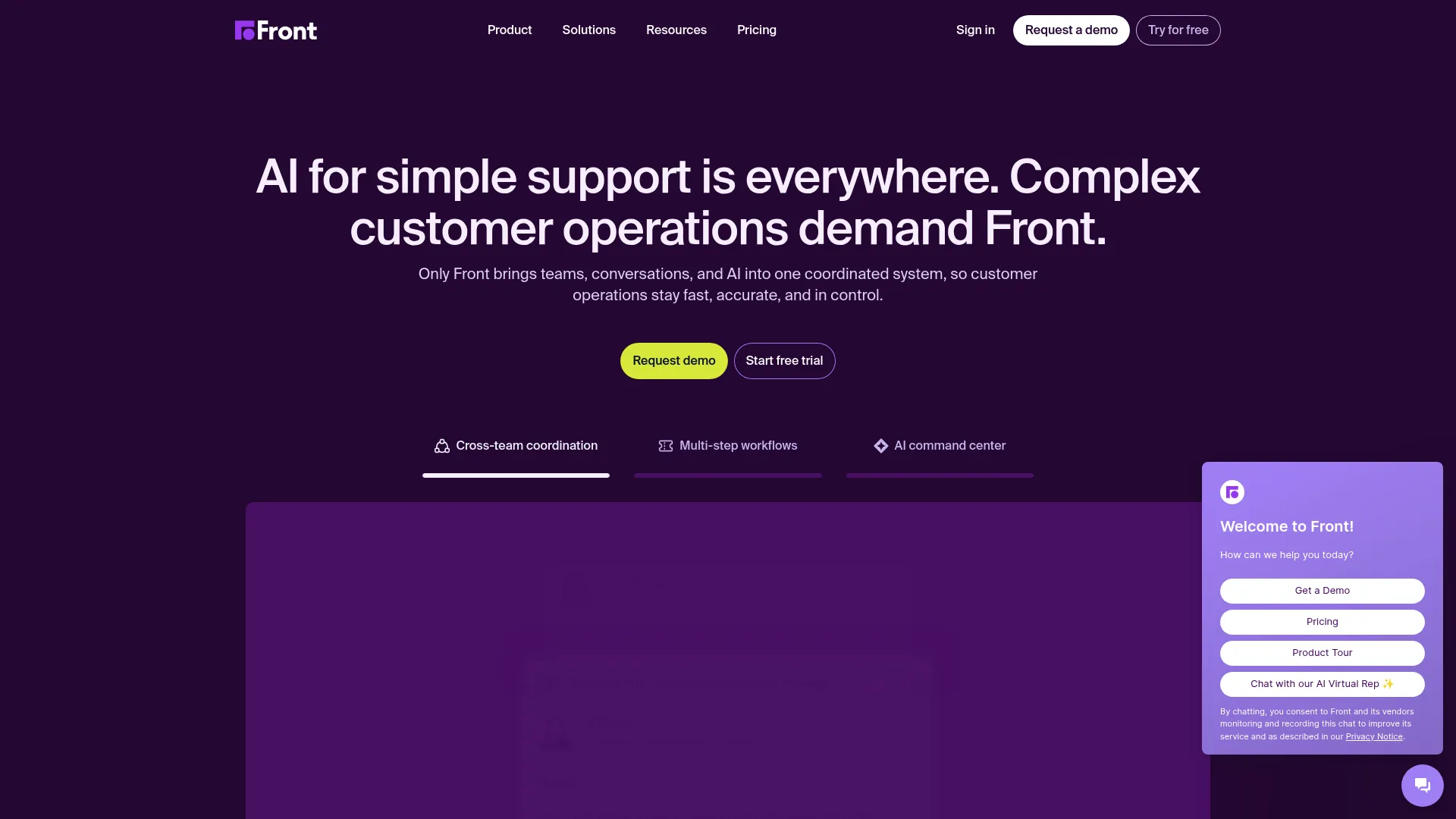
Front is a customer operations platform for B2B teams that keeps customer conversations, teams, and tools in sync. Its shared inbox model is built for collaborative CS and support, where multiple people touch the same high-value account.
Best for: CS teams managing high-touch customer communication collaboratively.
Key strengths
- Shared inbox and ticketing: Manage customer conversations as a team without losing context or duplicating replies.
- Omnichannel support: Handle email, SMS, social, WhatsApp, and more in one collaborative workspace.
- AI features: Use Topics, Copilot, Smart QA, and Smart CSAT to speed up replies and monitor quality.
Why choose Front: Front fits teams where several people manage the same accounts and need shared context. The collaborative inbox prevents dropped balls, and the AI features keep response quality high. It suits high-touch CS motions over self-serve ones.
Front pricing: Front does not offer a permanent free tier, but it provides a 14-day free trial. Paid plans, billed annually, include Starter at $25 per seat per month for up to 10 seats, Professional at $65 per seat per month for up to 50 seats, and Enterprise at $105 per seat per month. Front holds a 4.7/5 rating on G2.
What to consider when choosing a customer engagement tool
The right pick depends less on feature lists and more on how a tool fits your operational reality. Here is the checklist CS teams should run before buying any customer engagement management software.
Integration with your existing stack
Engagement data is only useful when it connects to the rest of your systems. Check that the tool integrates with your CRM, help desk, and chat tools, like HubSpot, Salesforce, Zendesk, Intercom, and Slack. A disconnected system creates more manual work, not less. Among customer engagement software vendors, integration depth varies widely, so verify it before you commit. Guideflow's integrations are a good example of connecting engagement data back to your stack.
Time-to-value and ease of adoption
A tool only helps if your team and your customers actually use it. Ask how fast you can launch without engineering, and whether onboarding requires a heavy implementation. The faster you reach first value, the sooner the tool earns its place in the stack.
Engagement analytics and visibility
You need to see where customers struggle and tie engagement to retention and adoption KPIs. Look for completion rates, drop-off data, and intent signals, not just surface metrics like opens. Without analytics, engagement becomes a black box and CS impact stays hard to prove.
Scalability across accounts
The whole point is to scale onboarding and education without adding a manual touchpoint per account. Check whether the tool lets you reuse content, segment by persona, and serve many accounts from one source. If every new account means more manual work, it does not scale.
Pricing model and total cost
Compare per-seat versus flat pricing, free tiers, and what sits behind enterprise gating. Some tools lock analytics or integrations into higher tiers, which changes the real cost. Map the pricing to your account volume and growth, not just the headline number.
Conclusion
The right customer engagement tool depends on the job costing you the most hours. For omnichannel lifecycle messaging at scale, Braze leads. For AI-driven chat deflection, Intercom and Tidio fit. For CRM-native workflows, HubSpot. For dedicated CS account health, Velaris. For structured feedback, SurveySparrow. For collaborative high-touch comms, Front. And Pendo and UserGuiding cover in-app adoption and onboarding.
But for the core CS problem, customers who sign up and stall, the highest-leverage move is interactive, self-serve product engagement. When customers can experience your product through a guided walkthrough, time-to-value drops, repetitive tickets fall, and adoption signals surface before churn. That is the gap Guideflow is built to close.
If your team is focused on scalable onboarding, adoption, and proving CS impact, start there. Capture your product once, embed it where customers get stuck, and watch the analytics tell you where to focus next.
Start your journey with Guideflow today!
FAQs
Customer engagement software is a category of tools that help companies communicate with, educate, and activate customers across channels. It spans communication like chat and email, product education and onboarding, feedback and surveys, and behavioral analytics. The goal is to drive adoption, satisfaction, and retention, not just send messages.
A CRM stores customer data and manages relationships and deals; it is a system of record. Customer engagement software activates that data by communicating, educating, and nudging customers across channels. In practice, the two work together: the engagement platform reads from the CRM and writes engagement signals back to it.
It depends on the job. For self-serve onboarding and adoption, interactive product engagement tools fit best. For AI chat deflection, conversational platforms lead. For omnichannel lifecycle messaging, enterprise messaging platforms win, and for account health, dedicated CS platforms work best. Most SaaS teams combine two or three based on their biggest cost.
Run a short checklist. Confirm it integrates with your CRM, help desk, and chat tools. Check time-to-value and whether it launches without engineering. Verify the analytics show where customers struggle. Finally, confirm it scales across accounts and that the pricing model fits your account volume.
They reduce churn in four ways. They speed time-to-value through guided onboarding, surface adoption risk through behavioral signals, scale education so customers understand the product, and deflect support friction. Confident, activated customers renew more often, so engagement directly supports retention.
Yes. Self-serve guided experiences and in-app education let customers onboard at their own pace, without a scheduled call. Interactive walkthroughs, checklists, and resource centers walk new users to first value automatically. With 81% of customers preferring self-service first, this approach matches how people want to learn a product.
Pricing in 2026 ranges widely. Many tools offer free tiers or SMB plans, with paid plans starting in the low tens of dollars per month or per seat. Mid-market and enterprise platforms often use custom pricing tied to monthly active users or usage. Always check whether analytics and integrations sit behind higher tiers when comparing total cost.