Double bookings on your busiest Saturday. A waiver stack that never quite matches the bikes on the rack. Inventory scattered across a whiteboard, a spreadsheet, and one employee's memory. If you run a rental operation, none of this is theoretical. It is the reason your margins leak during peak season and your staff burns out managing the chaos instead of the customers.
The real problem is not that you need "rental software" in the abstract. It is keeping every bike in your fleet bookable, billable, and trackable without the admin sprawl that grows every time you add a location or a season. The global bike and scooter rental market reached USD 5.52 billion in 2025, according to Straits Research, and the operators capturing that growth are the ones who stopped running their fleet on manual coordination.
Most operators start with pen, paper, and goodwill. That works until it doesn't. The moment you cross a few dozen bikes, or open a second location, or hit a summer weekend with a walk-in line out the door, the manual system becomes the bottleneck. The right platform turns booking, waivers, payments, and maintenance into repeatable workflows that run without you standing over them.
What's inside
This guide compares 4 real bike rental software platforms built for operators who need fewer manual steps and clearer control over their fleet. We evaluated each tool against the criteria that actually matter when you are billing bikes by the hour: booking and reservation workflows, live fleet tracking, digital waivers, payment handling, and how well the system scales across seasons and locations.
The list is aimed at rental shops, tour outfitters, and micromobility operators deciding which system fits their business model. Each entry breaks down what the tool does best, who should choose it, and what to verify before you commit. No landing-page fluff, just the tradeoffs that shape a buying decision.
TL;DR
- Best overall for all-in-one rental operations: Bike Rental Manager. Rentals, repairs, tours, waivers, and POS in one system, strong for shops that want breadth over narrow specialization.
- Best for booking, QR workflows, and analytics: Valet. Fast checkout, live fleet visibility, and a transparent 5% booking fee with no upfront cost.
- Best for app-led bike sharing and micromobility: Joyride. White-label rider app, fleet dashboard, and geofencing for self-serve, app-driven operations.
- Best if you need POS ecosystem integration: Lightspeed with Bike.rent Manager. Native POS sync for stores already anchored in a commerce platform.
- Small fleets and seasonal operators lean toward Valet's pay-per-booking model. Multi-location shops favor Bike Rental Manager. Shared-mobility businesses should start with Joyride.
What is bike rental software?
Bike rental software is a system that manages the full lifecycle of renting out bikes: taking reservations, tracking fleet availability, collecting waivers, processing payments, and logging maintenance, all from one place instead of across disconnected tools.
The core job of the category is to replace manual coordination with repeatable workflows. Here are the functional areas any serious platform should cover:
- Reservations and booking: online and walk-in booking, availability calendars, and double-booking prevention.
- Fleet visibility: real-time inventory status, so you always know which bikes are out, reserved, or in for service.
- Waivers and checkout: digital signatures, kiosk-friendly flows, and fast point-of-rental handoff.
- Payments: integrated checkout, deposits, and refunds without a separate terminal.
- Maintenance: service logs, condition tracking, and assignment history to protect uptime.
- Reporting: utilization, revenue, and seasonal demand data you can act on.
One important distinction: traditional bicycle rental management systems are built for staffed, counter-based operations where a person hands over a bike. Bike-sharing app models are built for self-serve, unattended fleets where the rider unlocks a bike from their phone. The workflows, hardware, and software look different, and choosing the wrong model creates friction you will feel every day.
When to use bike rental software
Not every operation needs the same features on day one. Here is how to pattern-match your situation to what these tools solve.
Prevent double bookings and bottlenecks
Peak season is where manual systems break. When three customers want the same five e-bikes on a Saturday morning, a shared spreadsheet cannot arbitrate fast enough. Online booking software with live fleet status shows availability in real time, so a reservation made online instantly updates what your counter staff sees. That single sync kills the most common revenue leak in the business: renting a bike you already promised to someone else.
Standardize waivers and checkout
A signed waiver protects you legally, and a slow checkout costs you rentals during the rush. Digital signatures, kiosk mode, and a fast handoff flow matter whether the customer booked online last night or walked in two minutes ago. When the waiver, payment, and bike assignment happen in one continuous flow, you move the line faster and keep your paperwork clean for both walk-in and online rentals.
Keep maintenance and fleet condition visible
A bike in for repair that nobody logged is a bike you accidentally rent to a customer. Service logs, condition tracking, and assignment history let you see which bikes are ready and which are out of commission before you promise them. Fewer out-of-service surprises means fewer refunds, fewer angry customers, and more of your fleet actually earning revenue.
Comparison table
The table below sorts the four platforms by relevance to typical bike rental buyers. Pricing and ratings reflect the most recent verified figures available; confirm current numbers on each vendor's site before you commit, since plans and fees change.
| # | Product | Intent | Key use case | Pricing | G2 rating |
|---|---|---|---|---|---|
| 1 | Bike Rental Manager | All-in-one rental operations | Rentals, repairs, tours, waivers, and POS in one system | Not publicly listed | Not listed on G2 |
| 2 | Valet | Booking and fleet workflows | Reservations, waivers, QR ops, and analytics | 5% booking fee, no upfront cost | Not listed on G2 |
| 3 | Joyride | App-led bike sharing | White-label rider app, fleet dashboard, geofencing | From $4,200/year | 4.0/5 |
| 4 | Lightspeed (with Bike.rent Manager) | POS ecosystem integration | POS sync for retail-anchored rental shops | From $69 USD/month | 4.4/5 |
Quick read: if you want everything under one roof, start at row one. If you want to pay only when you book revenue, look at Valet. If you are running self-serve shared bikes, Joyride is built for that motion. If your store already lives in a POS platform, the Lightspeed integration is the path of least friction.
1. Bike Rental Manager
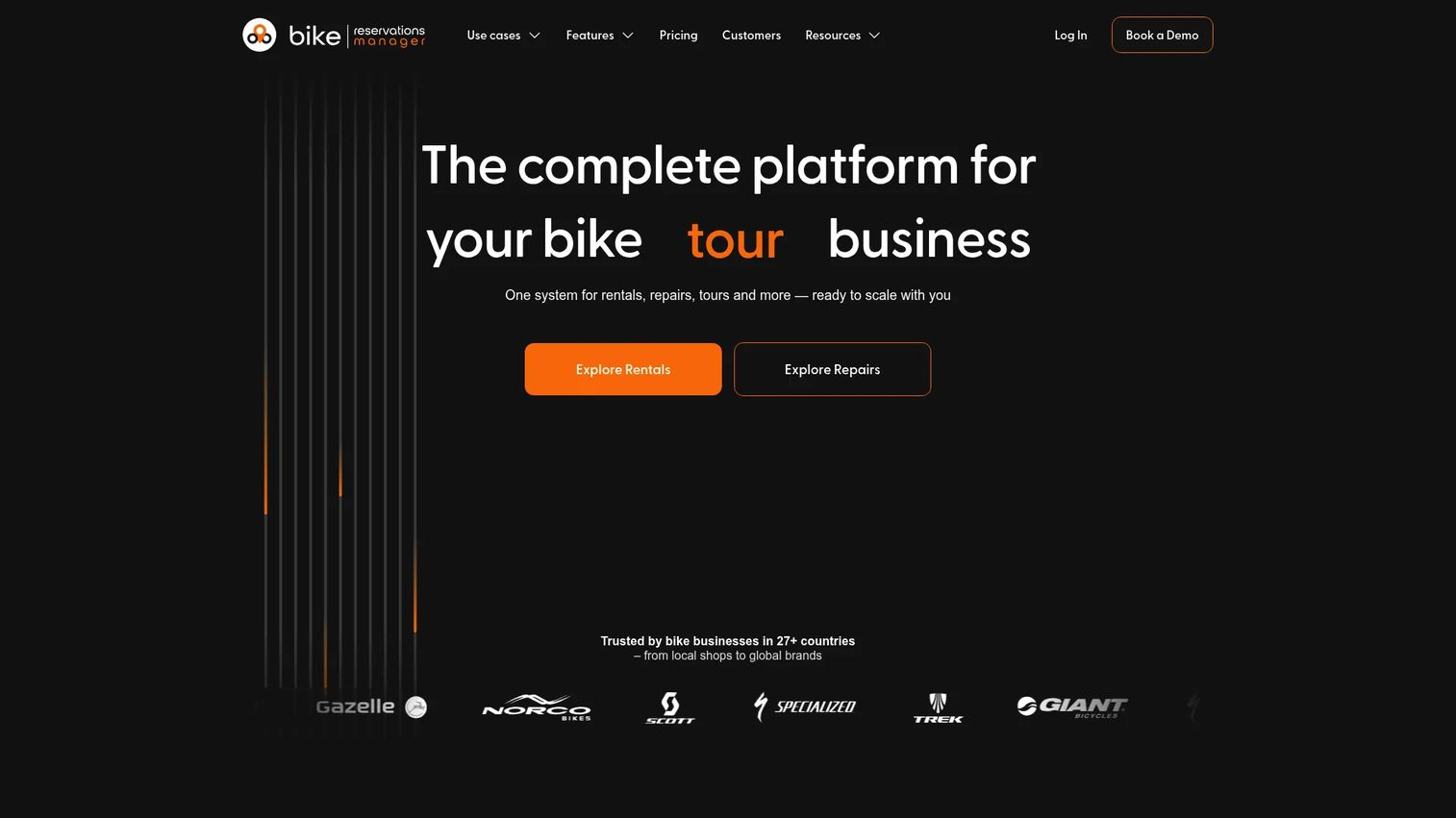
Bike Rental Manager is the most all-in-one platform in this set. It pulls rentals, repairs, tours, waivers, point-of-sale, and inventory into a single system, which makes it a strong fit for shops that run more than one revenue line. If you rent bikes, service them, and run guided tours out of the same location, having those workflows in one place removes the tool-switching tax that eats your team's time. The platform is used by bike businesses across dozens of countries, which signals it handles the operational edge cases that come with real-world volume.
Best for: Bike rental shops that want inventory, reservations, and service workflows unified in one system rather than stitched together across apps.
Key strengths
- Multi-service operations: Manage rentals, repairs, and tours from one dashboard instead of separate tools.
- Real-time inventory tracking: See fleet status live, so counter staff and online bookings stay in sync.
- Online bookings and digital waivers: Take reservations and collect signed waivers before the customer arrives.
Why choose Bike Rental Manager: The case for this platform is breadth. If your operation spans rentals, a repair bench, and organized tours, a specialized booking-only tool leaves gaps you fill manually. Bike Rental Manager earns its place when you would otherwise be running three systems and reconciling them by hand. It is the operator's choice when consolidation matters more than any single standout feature.
Bike Rental Manager pricing: The company does not publish a public pricing page or a standard rate on its own domain, so you will need to request a quote directly. Capterra reviewers rate the product 4.7 out of 5. Because pricing is quote-based, confirm the plan structure, any per-location fees, and what maintenance and tour modules cost before you sign.
2. Valet
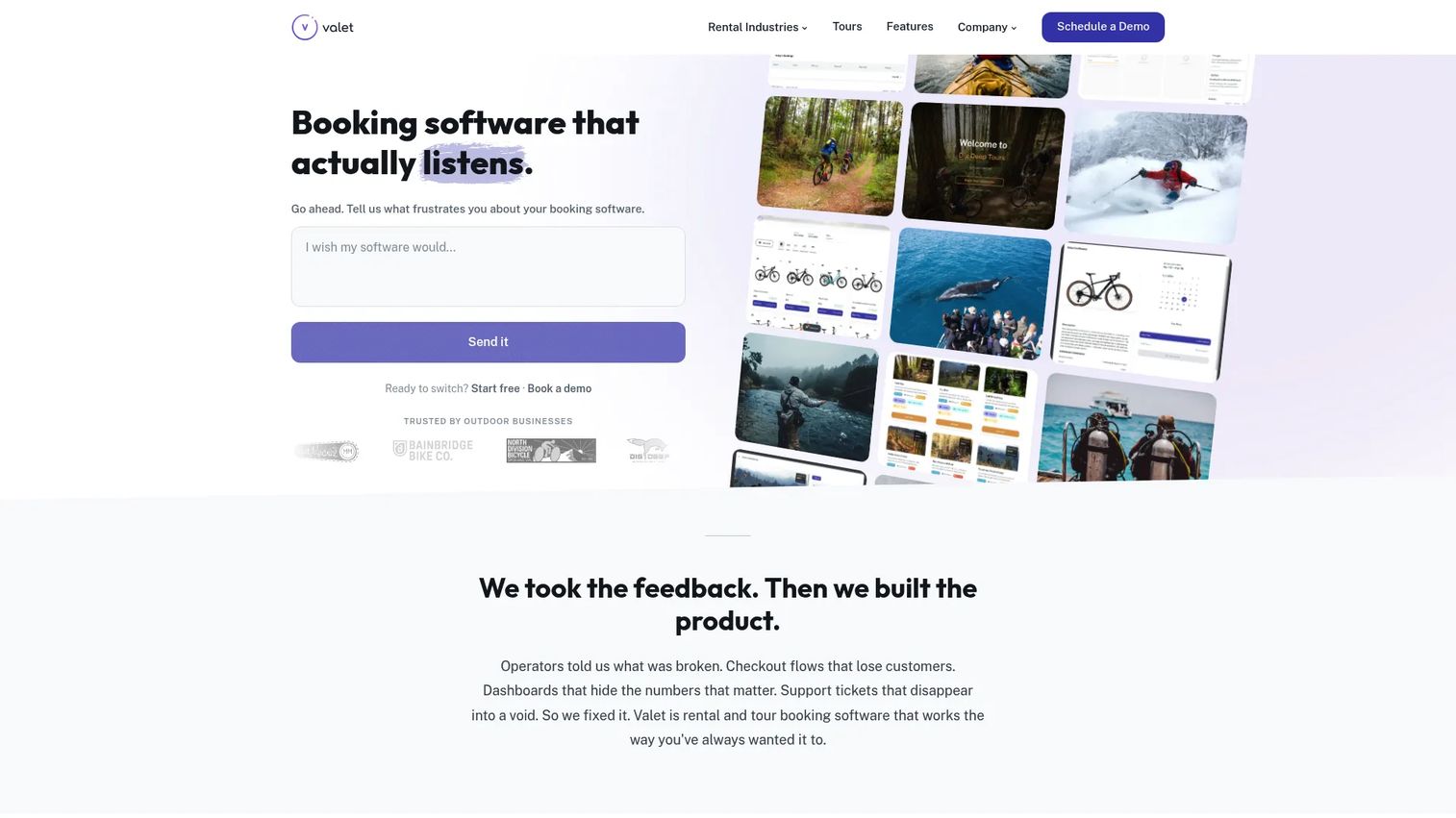
Valet is built around booking flow, fleet tracking, and fast checkout for rental and tour operators. It handles walk-in and online reservations, real-time inventory, digital waivers, and Stripe payments in one flow, with QR-code operations that speed up bike assignment at the counter. For operators who care about utilization, Valet's analytics show you which bikes earn and which sit idle, so you can right-size your fleet instead of guessing.
Best for: Outdoor rental and tour outfitters who want strong booking workflow control and clear visibility into fleet utilization.
Key strengths
- Walk-in and online reservations: One system handles both booking paths without separate workflows.
- Digital waivers and Stripe payments: Signature capture and payment happen in the same checkout flow.
- Real-time inventory tracking: Live fleet status prevents double bookings and shows utilization at a glance.
Why choose Valet: The pricing model is the standout. Valet charges a 5% booking fee with no upfront cost and no long-term contract, which aligns what you pay with revenue you actually collect. For a seasonal operator, that structure removes the risk of paying a flat subscription through a slow winter. If you want to test a bike rental reservation software without committing capital, Valet's pay-as-you-book model lowers the barrier to trying it.
Valet pricing: Valet uses an industry-standard 5% booking fee per reservation, with no upfront costs and no long-term contracts, according to its public FAQ. It is free to try. Because the cost scales with booking volume, run the math against your seasonal revenue to compare it with a flat-fee alternative before deciding.
3. Joyride
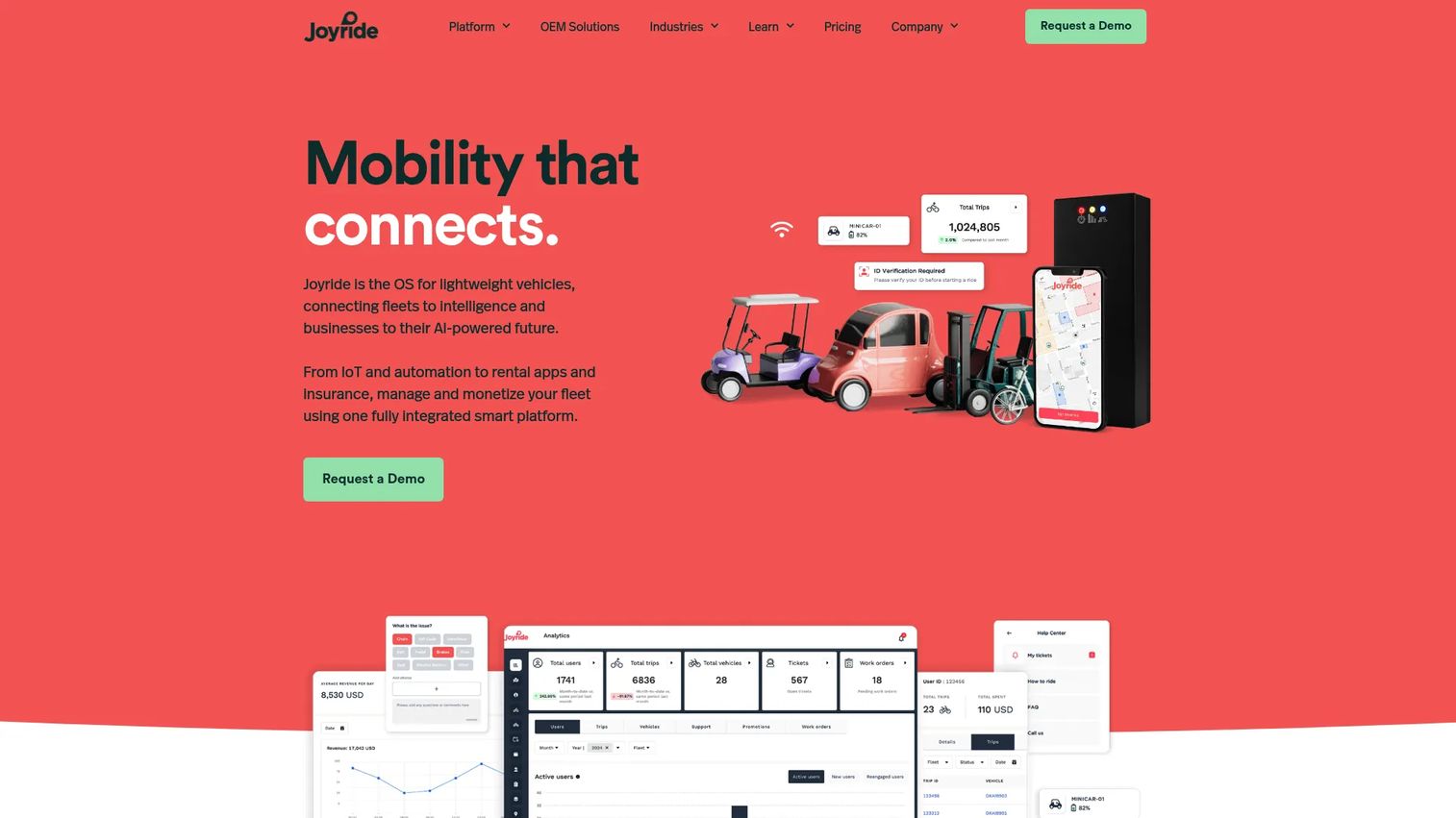
Joyride is built for a different motion than the counter-based shops above. It is a software and hardware platform for managing rentable connected vehicle fleets, spanning bikes, scooters, and other micromobility. If your model is app-led and self-serve, where riders unlock a bike from their phone rather than a staffed counter, Joyride is the fit. It pairs a white-label rider app with a fleet management dashboard, payments, ID verification, and geofencing, giving you the automation and tracking that unattended fleets require.
Best for: Operators of shared micromobility or connected vehicle fleets who need white-label, app-driven fleet software.
Key strengths
- White-label rider app: Launch a branded bike sharing app without building one from scratch.
- Fleet management dashboard: Track vehicle location, status, and battery across a distributed fleet.
- Payments and ID verification: Handle self-serve rentals with built-in payment and rider verification.
Why choose Joyride: This is the tool for businesses moving toward or already running app-based rentals. Traditional rental management systems assume a staffed handoff; Joyride assumes the rider is the operator. With over 70% of shared micromobility users preferring apps to reserve bikes and scooters, according to Global Market Insights, an app-led platform matches how riders already behave. Choose Joyride when self-serve sharing is central to your model, not a bolt-on.
Joyride pricing: Joyride publishes multiple plan families for scooters, bikes, golf carts, and LSVs. The Revii Launchpad plan starts at $4,200 per year, with a White Label tier starting at $15,500 per year, plus monthly plans including Grow at $900, Scale at $2,500, and Pro at $5,000, and per-vehicle and Enterprise options. It holds a 4.0 out of 5 rating on G2. Given the range, map your fleet size and hardware needs to a specific plan before requesting a demo.
4. Lightspeed (with Bike.rent Manager)
Lightspeed is a cloud POS and commerce platform, and its integration with Bike.rent Manager is what makes it relevant to rental operators already anchored in a retail system. If your shop sells bikes, parts, and accessories through Lightspeed and also rents, the integration syncs customers, tickets, and transactions two ways, so rental activity flows into the same POS and reporting you already use. For a store built on a commerce platform, that ecosystem fit removes the double-entry that plagues shops running rental and retail on separate systems.
Best for: Bike retail shops already using a POS platform that want rental operations to sync natively rather than run in a silo.
Key strengths
- POS and checkout workflows: Handle retail and rental transactions in one familiar checkout.
- Inventory and pricing management: Keep parts, accessories, and rental fleet stock in one catalog.
- Reporting and analytics: See rental and retail revenue in unified reports.
Why choose Lightspeed: The value here is ecosystem compatibility, not standalone rental depth. The Bike.rent Manager integration is built by operators for shops running roughly 20 to 2000 bikes, and its two-way sync means a rental customer becomes a POS customer automatically. If you are already committed to Lightspeed for retail, adding rental through this integration is the path of least friction. Choose it when your store's center of gravity is already the POS.
Lightspeed pricing: Lightspeed's public Restaurant pricing runs from a Starter plan at $69 USD per month, with Essential at $189, Premium at $399, and a quote-based Enterprise tier. Retail pricing is not shown publicly on the pages reviewed, so request a quote for the retail plus rental configuration. Lightspeed holds a 4.4 out of 5 rating on G2. Confirm the Bike.rent Manager integration cost separately, since it is a distinct add-on.
Considerations before you buy
Shortlisting is easy. Choosing correctly means pressure-testing a few things the marketing pages gloss over.
Business model fit
Decide first whether you run a staffed, counter-based operation or a self-serve, app-led fleet. A bicycle rental management system built for one model creates friction in the other. Traditional rental shops and tour outfitters lean toward counter-based tools; shared-mobility operators need app-first platforms. Get this wrong and no feature list saves you.
Payment and pricing structure
A 5% booking fee and a flat monthly subscription behave very differently across a seasonal calendar. Model both against your real revenue curve, including your slow months. Also confirm which payment processor the platform uses and whether deposits, partial refunds, and no-show fees are supported natively.
Waiver and checkout flow
Test the actual point-of-rental flow before you buy, not just the demo screenshots. Time how long it takes to sign a waiver, take payment, and assign a bike to a walk-in customer. If the flow adds friction during your busiest hour, it will cost you rentals regardless of how good the reporting looks.
Migration and data import
Ask exactly how your existing inventory, customer records, and future bookings move over. A messy migration during peak season is a nightmare. Confirm whether the vendor imports your fleet catalog for you or leaves it to your team, and whether historical booking data comes along.
Conclusion
The right bike rental software depends less on a feature scoreboard and more on how you actually operate. If you want everything, rentals, repairs, tours, waivers, and POS, under one roof, Bike Rental Manager is the all-in-one choice. If you want strong booking workflows and pay only for revenue you collect, Valet's 5% model fits seasonal and small-fleet operators. If your business is app-led shared mobility, Joyride is built for that self-serve motion. And if your store already runs on a POS platform, the Lightspeed integration with Bike.rent Manager removes the double-entry between retail and rental.
Here is the practical next step: shortlist the two platforms that match your operating model, verify current pricing directly with each vendor, and then test the booking plus waiver workflow on day one with a real reservation. The system that keeps your fleet bookable, billable, and trackable without you standing over it is the one worth paying for.
FAQs
Bike rental software is a system that manages reservations, fleet availability, waivers, payments, and maintenance for a bike rental operation in one place. It replaces the manual coordination of spreadsheets, paper waivers, and separate payment terminals with connected workflows. The goal is to keep every bike bookable, billable, and trackable without constant staff oversight.
Prioritize availability planning that prevents double bookings, real-time fleet tracking, digital waivers, fast checkout, and reporting you can act on. Availability and checkout speed protect revenue during peak hours, while maintenance logging protects uptime across your fleet. Reporting matters because it tells you which bikes earn and which sit idle, so you can size your fleet to actual demand rather than guesswork.
Yes, and often more so than for year-round operations. Seasonal demand concentrates your revenue into a short window, which makes double-booking prevention and fast setup far more valuable when the rush hits. A pay-per-booking model like Valet's 5% fee is especially attractive because you avoid paying a flat subscription through the off-season while still getting the workflow benefits during peak months.
Scan-based workflows help most when you assign specific bikes to specific customers at speed. Scanning a QR code on the bike ties it to the reservation instantly, which cuts check-in time and reduces the chance of assigning a bike that is already out or in for service. If you run a high-volume operation with walk-in lines, scanning meaningfully speeds up the counter; smaller fleets may not need it on day one.
The stronger platforms do. Look for service history logging, condition tracking, and maintenance alerts that flag when a bike is due for attention. This matters because an untracked repair leads to accidentally renting an out-of-service bike, which means refunds and unhappy customers. Bike Rental Manager, for example, includes maintenance and repair management alongside its rental workflows.
Confirm how data migration works for your inventory, customer records, and existing bookings, and whether the vendor handles the import or leaves it to you. Verify payment processor compatibility, waiver setup, and how the checkout flow performs under real conditions. The safest approach is a pilot: run a handful of real bookings and one full waiver-to-payment cycle before you move your whole operation over.
It comes down to whether a staff member hands over the bike or the rider unlocks it themselves. Traditional bike rental and tour operators need counter-based workflows for reservations, waivers, and checkout, which tools like Bike Rental Manager and Valet handle well. If self-serve, unattended sharing is central to your model, an app-led platform such as Joyride is the better fit because it is built for riders reserving and unlocking bikes from their phones.