You launched last week. Reviews are trickling in. Support tickets are piling up. Social mentions are spiking. And somewhere in that pile of unstructured text is the answer to whether your positioning landed or missed.
You can't read all of it. Nobody can.
That's the real problem. Not that teams lack feedback, but that they drown in it. A standard dashboard tells you how many people replied to a survey. It won't tell you that 40% of them are frustrated about the same onboarding step, or that a competitor comparison is quietly gaining traction on social. The tone, the theme, the urgency: that all lives in language a bar chart can't capture.
Sentiment analysis software exists to fix that gap. It reads reviews, tickets, survey comments, and social posts, then classifies tone and surfaces themes you can act on. The market reflects the demand. The global sentiment analysis software market is estimated at $3.60 billion in 2026, projected to reach $11.33 billion by 2035, a 13.6% CAGR, according to Market Growth Reports (2025). And 63% of enterprise CX teams already use automated sentiment analysis in at least one workflow, per Gartner and Forrester data summarized by Stealth Agents (2025).
The catch is that "sentiment analysis" covers very different jobs. Social listening, customer feedback analysis, and enterprise experience management are not the same tool. So the question isn't which platform is best. It's which one fits the signal source that matters most to you.
What's inside
This guide is built for product marketing managers, CX leaders, and growth teams choosing a sentiment analysis tool that fits their stack.
Here's what it covers:
- A shortlist of 7 sentiment analytics tools, each mapped to a specific use case
- A definition of sentiment analysis software and its core capabilities
- When to use these tools for launches, feedback analysis, and social monitoring
- A comparison table with pricing and G2 ratings
- What to evaluate before you buy
We chose tools based on four criteria: sentiment classification quality, multi-source coverage, dashboards and monitoring, and advanced NLP outputs like emotion detection and topic modeling.
TL;DR
- Best for enterprise feedback intelligence: Qualtrics XM Platform, for teams already running experience programs at scale
- Best for social media monitoring: Hootsuite Listening, when social is your primary signal
- Best for broad brand monitoring: Brand24, for fast visibility into brand health with AI-assisted tracking
- Best for advanced consumer intelligence: Talkwalker Consumer Intelligence Platform, for large-scale cross-market listening
- Best for customer feedback analysis at scale: Chattermill, when the goal is product and CX decisions
- Best for text analytics and sentiment modeling: Lexalytics, for teams that want configurable NLP
- Best for Microsoft-centric or API use cases: Azure Text Analytics, to embed sentiment scoring into workflows
Match the tool to your dominant signal source. Social chatter, survey comments, and support tickets each reward a different pick.
What is sentiment analysis software
Sentiment analysis software is a type of text analytics tool that uses natural language processing to classify the emotional tone of written text as positive, negative, or neutral, then surfaces themes and patterns across large volumes of feedback.
At its core, it takes unstructured language (reviews, tickets, survey responses, social posts) and turns it into structured signal you can measure and act on. Instead of reading 5,000 comments by hand, you see that sentiment dropped 12 points after a pricing change, and you see why.
Most sentiment analytics tools share a common set of capabilities:
- NLP and machine learning: models trained to interpret language, context, and tone at scale
- Text analytics: extraction of topics, entities, and themes beyond a simple polarity score
- Dashboards and visualization: trend lines, breakdowns, and comparisons that make patterns visible
- Alerts and trend tracking: real-time alerts and sentiment monitoring so spikes reach you fast
- Emotion detection and topic modeling: finer classification that separates anger from disappointment, and clusters comments into recurring themes
- Confidence scoring and urgency detection: flags on how certain the model is and which items need attention now
The better tools go past positive, negative, and neutral. AI sentiment analysis adds emotion detection, topic modeling, and urgency signals, which is what turns a score into a decision. Confidence scoring tells you when to trust the classification and when a human should check.
When to use
Sentiment analysis earns its place in three situations most product marketing and CX teams recognize.
Track brand sentiment during launches
A launch changes brand perception fast, and not always the way you planned. Social chatter spikes, review volume climbs, and message resonance either holds or slips. Brand sentiment analysis during a launch window tells you whether your positioning landed before the numbers show up in pipeline. If sentiment dips around a specific claim, you can adjust messaging in days, not quarters.
Analyze customer feedback across channels
Survey comments, support tickets, and reviews all describe the same customers, but they usually live in separate systems. Customer feedback analysis brings them together so themes emerge that no single channel would reveal. A PMM validating a message, or a CX team hunting churn drivers, needs multi-source feedback in one view. That's where recurring frustrations and unmet needs finally become visible.
Monitor social media and competitor chatter
Social moves fastest, so it's where risk and opportunity surface first. Social media sentiment analysis helps you catch a spike (good or bad) before it defines your week. Campaign monitoring shows which messages travel. Competitive benchmarking shows how your brand sentiment compares to rivals, mention for mention, over time.
Comparison table
Compare these tools by matching the "best for" column to your dominant use case, then check pricing and rating against your budget and team size. Social listening tools, feedback analytics platforms, and enterprise CX suites solve different problems, so the right pick depends on your signal source more than on any single feature.
| # | Product | Best for | Key differentiator | Pricing | G2 rating |
|---|---|---|---|---|---|
| 1 | Qualtrics XM Platform | Enterprise experience programs | Sentiment plus full CX, EX, and research suites | Custom (usage-based) | 4.4/5 |
| 2 | Hootsuite Listening | Social media monitoring | Listening plus social management in one platform | From $99/user/mo | 4.3/5 |
| 3 | Brand24 | Broad brand monitoring | AI Brand Assistant with real-time mention tracking | From $199/mo | 4.6/5 |
| 4 | Talkwalker Consumer Intelligence Platform | Large-scale consumer intelligence | Cross-market social and media benchmarking | Custom quote | 4.3/5 |
| 5 | Chattermill | Customer feedback analysis at scale | Omnichannel feedback ingestion with AI insight extraction | Custom | 4.4/5 |
| 6 | Lexalytics | Text analytics and modeling | Configurable NLP across cloud, on-prem, or hybrid | Contact sales | 4.3/5 |
| 7 | Azure Text Analytics | Microsoft and API use cases | Pay-as-you-go language AI with free monthly tier | Pay-as-you-go | 4.4/5 |
Best 7 sentiment analysis tools for 2026
Below is each tool in detail, with what it does, who it fits, key strengths, and pricing. Read the "best for" line first to jump to the pick that matches your signal source.
1. Qualtrics XM Platform
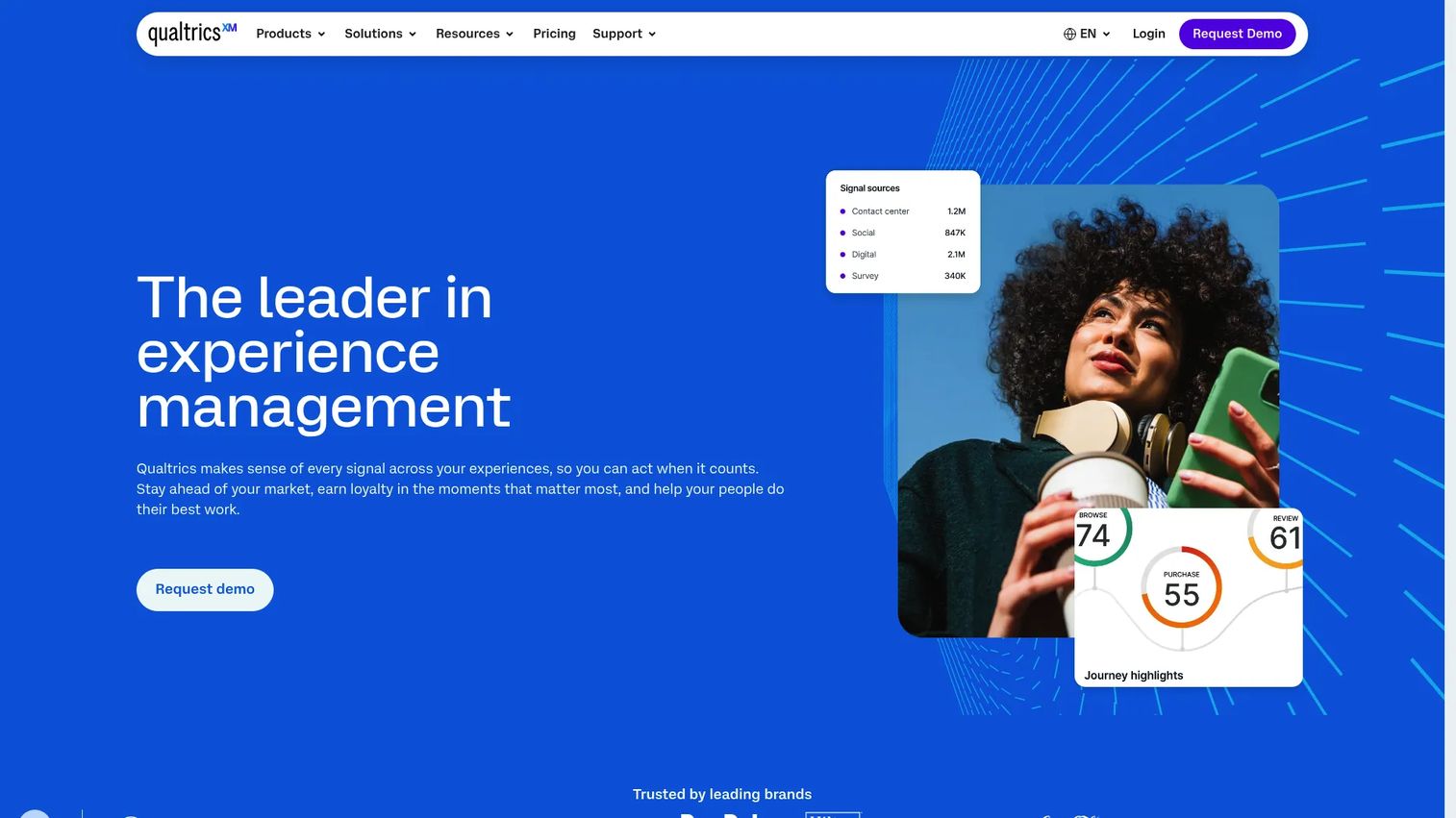
Qualtrics XM Platform is an experience management platform that runs customer, employee, and research programs, with sentiment analysis layered across surveys, feedback, and experience data. It sits at the enterprise end of the market, where sentiment is one part of a broader measurement system. If you already run experience programs, sentiment analysis here plugs into workflows you already own.
Best for: Enterprises running customer, employee, or research experience programs at scale.
Key features
- AI-powered experience management suites
- Survey creation and distribution
- Dashboards, analytics, and action workflows
- Text analytics and theme detection across feedback
Why choose Qualtrics XM Platform: It's the strongest fit when sentiment is part of a wider CX and EX program, not a standalone monitoring task. Teams that already run experience management get sentiment plus governance, dashboards, and action workflows in one system.
Qualtrics XM Platform pricing: Pricing is usage-based and packaged into three suites (Customer Experience, Employee Experience, Strategy & Research). Public numbers are not listed; pricing depends on planned interactions. A free account is available to start.
2. Hootsuite Listening
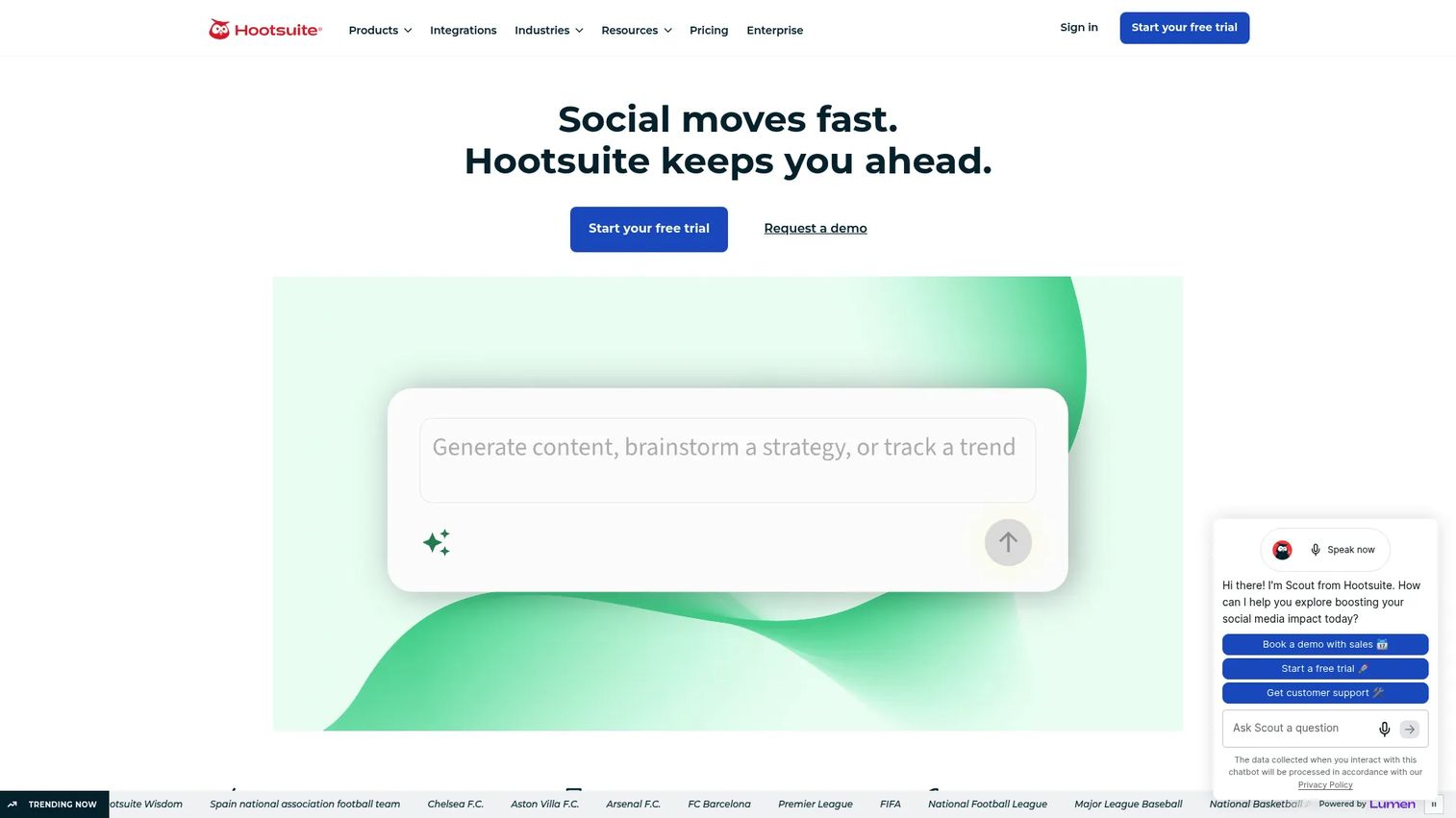
Hootsuite Listening is Hootsuite's social listening and media monitoring offering, built to track brand mentions, trends, and sentiment across social networks and beyond. Because it lives inside Hootsuite, listening sits next to publishing and engagement in one workspace. For teams where social is the primary signal, that consolidation matters.
Best for: Enterprise and mid-market teams that need social listening plus social media management in one platform.
Key features
- Social listening across networks, news, blogs, and forums
- Sentiment analysis and AI summaries
- Historical data and real-time alerts
- Reporting and trend visualization
Why choose Hootsuite Listening: Pick it when social media is your dominant signal source and you already manage publishing in Hootsuite. Combining listening with management in one seat cuts down on tool sprawl for social-first teams.
Hootsuite Listening pricing: Paid plans start at $99/user/month for Standard, $199 for Professional, and $399 for Advanced, all billed annually. Enterprise is custom priced. Hootsuite offers a 14-day free trial.
3. Brand24
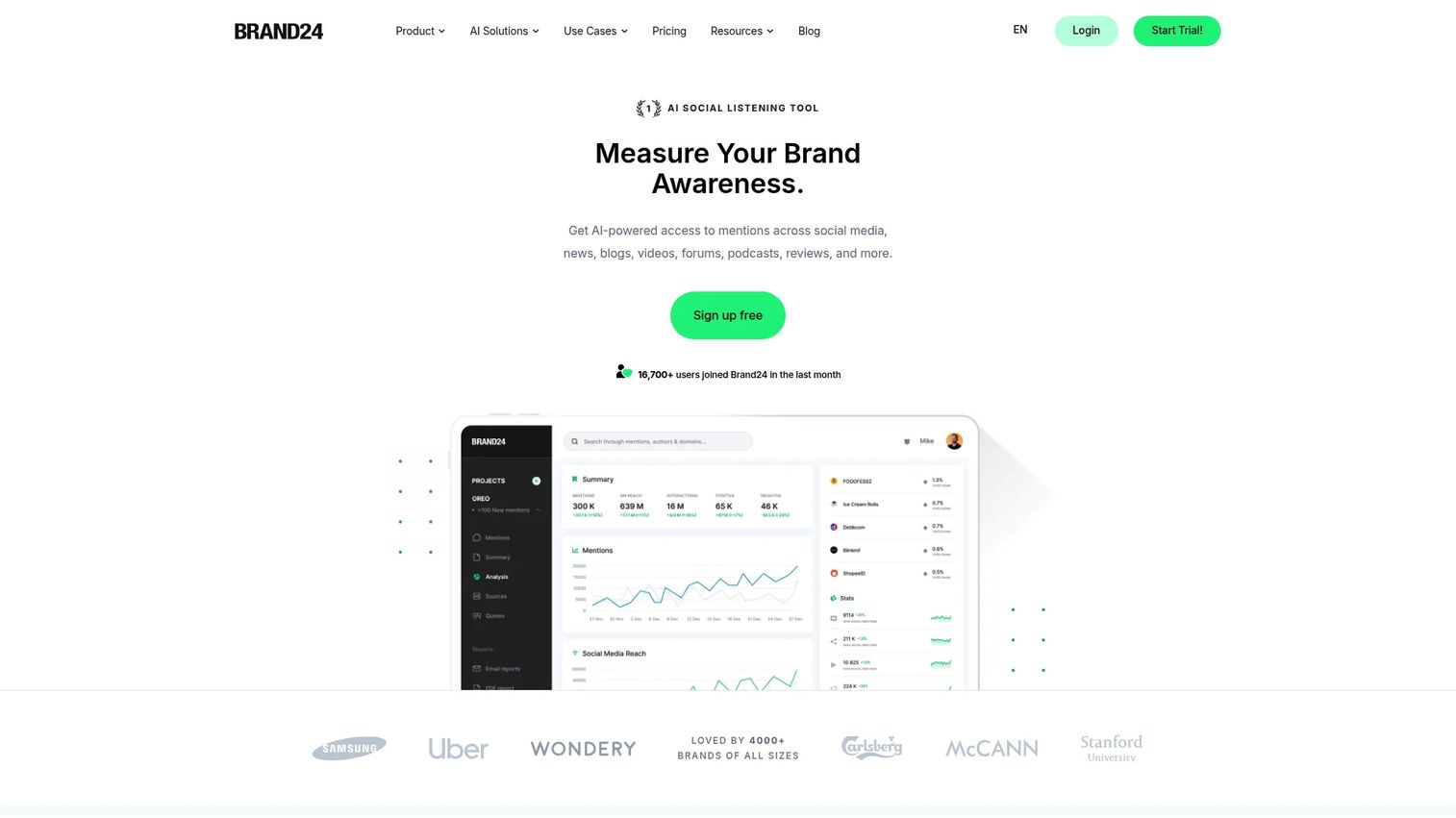
Brand24 is AI-powered social listening and media monitoring software that tracks mentions across social, news, blogs, and the wider web. It balances usability with monitoring breadth, which makes it a fast way to get visibility into brand health without a long setup. Its AI Brand Assistant summarizes what's happening so you spend less time reading raw mentions.
Best for: Teams that need AI-assisted social listening, brand monitoring, and reputation tracking.
Key features
- Real-time mention tracking
- Sentiment analysis
- AI Brand Assistant
- Alerts and source aggregation
Why choose Brand24: It's a strong balance of ease and coverage for teams that want brand sentiment analysis without enterprise overhead. The AI assistant makes it approachable for smaller marketing teams monitoring reputation day to day.
Brand24 pricing: Plans run Individual, Team, Pro, Business, and Enterprise. Annual pricing starts at $199/month for Individual, $299 for Team, $399 for Pro, and $599 for Business. Enterprise starts from $1,499/month. A 14-day free trial is available.
4. Talkwalker Consumer Intelligence Platform
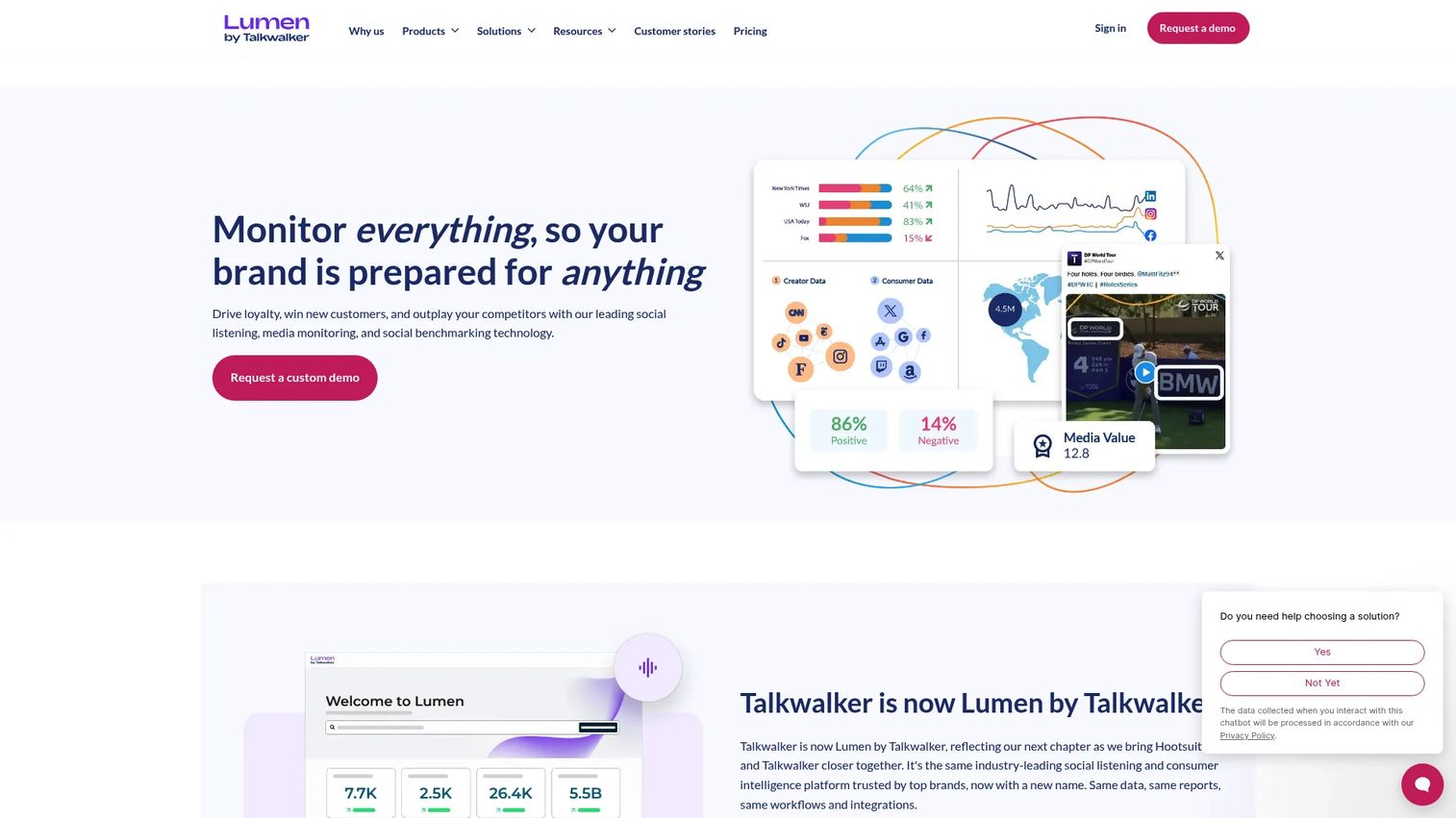
Talkwalker Consumer Intelligence Platform is an enterprise consumer intelligence platform covering social listening, media monitoring, benchmarking, and audience insights. It's built for scale, analyzing brand and market sentiment across many channels and regions at once. Large teams use it to understand not just what people say, but how sentiment moves across markets.
Best for: Large teams needing enterprise social and consumer intelligence across multiple channels.
Key features
- Social listening at scale
- Media monitoring
- Social benchmarking
- Advanced analytics and visual dashboards
Why choose Talkwalker Consumer Intelligence Platform: Choose it for large-scale listening and cross-market analysis where breadth and benchmarking matter most. It suits enterprise brand and insights teams tracking sentiment across regions and competitors.
Talkwalker Consumer Intelligence Platform pricing: Pricing is custom. The platform lists Core, Analyze, and Business plans, each requiring a quote rather than a public price.
5. Chattermill
Chattermill is an AI-native customer experience intelligence platform that unifies and analyzes feedback across channels. It pulls reviews, surveys, support data, and more into one place, then extracts themes and sentiment you can act on. The focus is decisions, not dashboards for their own sake, which fits product and CX teams closing the loop between feedback and roadmap.
Best for: Enterprise CX, insights, and product teams needing unified feedback analytics.
Key features
- Omnichannel feedback ingestion
- AI-powered insight extraction and summarization
- Context enrichment with customer and channel data
- Theme and sentiment analysis with sharing
Why choose Chattermill: It's the best fit when the goal is product and CX decisions rather than social monitoring. Teams that need multi-source feedback turned into clear insight get an AI-native platform built for exactly that.
Chattermill pricing: Chattermill uses custom enterprise pricing. Public numbers are not listed; contact sales for a quote based on your feedback volume and channels.
6. Lexalytics
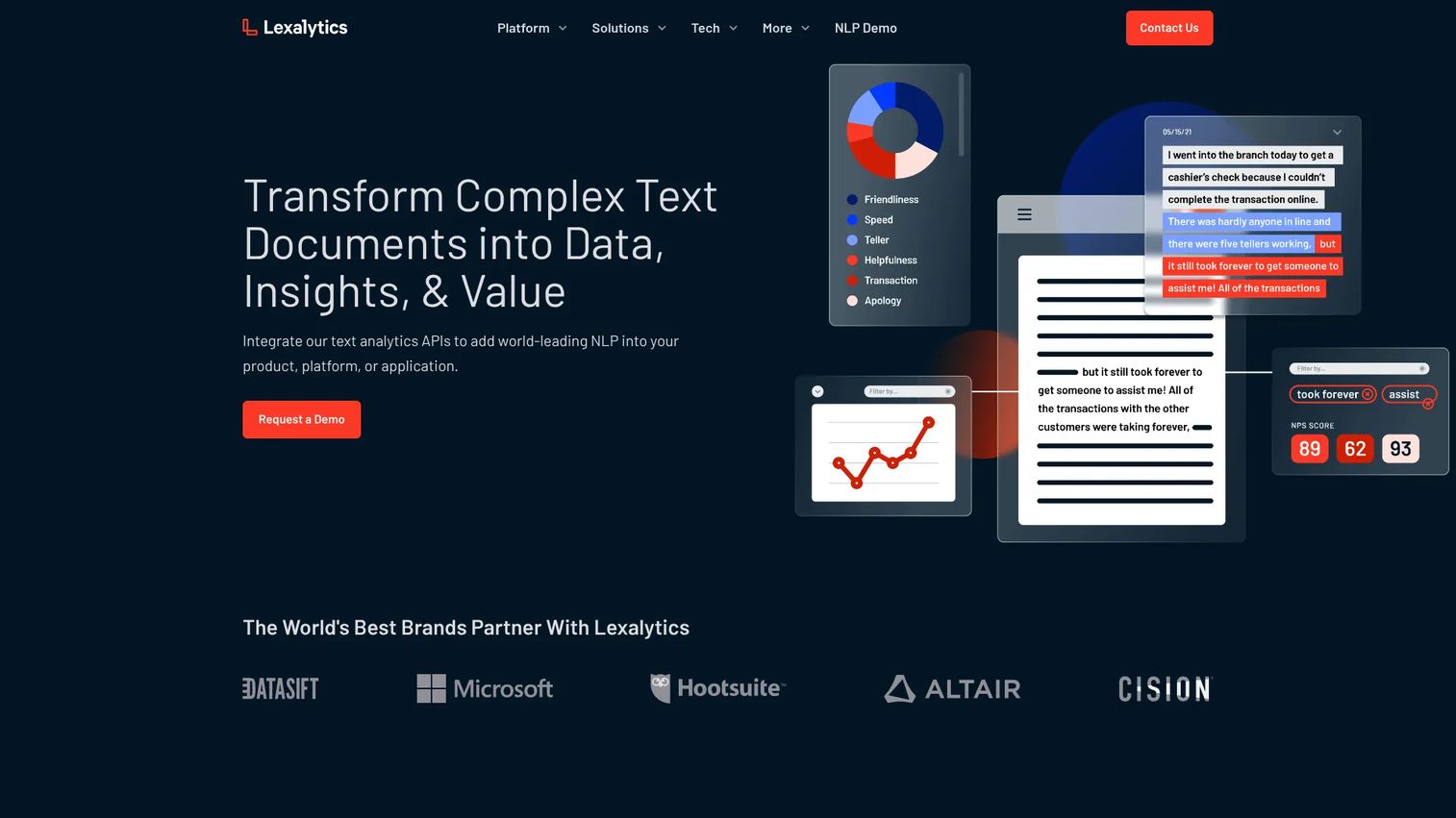
Lexalytics is text analytics and NLP software that runs across cloud, on-prem, and hybrid deployments. It gives technical teams control over sentiment logic, entity extraction, and theme analysis rather than a fixed UI-first workflow. That makes it a fit when you need to tune how language gets classified, not just consume a score.
Best for: Enterprises needing customizable text analytics across cloud or on-prem environments.
Key features
- Sentiment analysis
- Entity extraction
- Categorization and theme analysis
- Flexible deployment across cloud, on-prem, or hybrid
Why choose Lexalytics: It's the best pick for technical teams that want configurable NLP and sentiment logic under their own control. Deployment flexibility across cloud and on-prem also suits organizations with data residency requirements.
Lexalytics pricing: Pricing is not publicly listed. Lexalytics directs prospects to contact sales for a quote based on deployment and usage.
7. Azure Text Analytics
Azure Text Analytics is Microsoft's language AI service for sentiment scoring, entity detection, summarization, and related NLP tasks, delivered through APIs. It's built to embed sentiment into your own workflows rather than sit behind a full platform UI. For teams already on Azure or building custom pipelines, that API-first model is the draw.
Best for: Teams building NLP features on Azure that need enterprise language processing APIs.
Key features
- Sentiment scoring
- Named entity extraction
- Personal data detection and redaction
- Summarization and conversational language understanding
Why choose Azure Text Analytics: Choose it when you want to embed sentiment scoring into workflows rather than buy a UI-first platform. It's a natural fit for teams already in the Microsoft ecosystem or building custom applications on Azure.
Azure Text Analytics pricing: Azure Language uses pay-as-you-go pricing, with 5,000 free text records per month shared across several language features. Beyond the free tier, cost scales with usage.
Considerations
Before you commit, run your shortlist against these criteria. The right choice depends less on feature counts and more on how the tool fits your signal source, your team, and your stack.
Data sources
The best tool depends on what you actually need to read. Social-first teams need strong social listening. CX teams need survey, ticket, and review ingestion. If you need all of them in one view, prioritize multi-source feedback coverage over any single channel's depth. Match the tool to where your feedback lives.
Depth of analysis
Some tools stop at polarity: positive, negative, neutral. Others add emotion detection, topic modeling, and urgency detection. If you only need a health score, basic classification works. If you need to know why sentiment moved and which comments demand action now, look for deeper NLP outputs and confidence scoring.
Dashboards and reporting
PMMs and CX leaders need trends, not just scores. Look for trend visualization, segment breakdowns, and comparisons over time. A single sentiment number tells you little. A trend line around a launch, split by theme, tells you what to change and when.
Integrations
Sentiment data is most useful where your team already works. Check for connections to CRM, BI tools, survey platforms, and support systems. The tighter the integration, the less your insight sits in yet another silo no one opens.
Governance and scale
For larger teams, collaboration, permissions, and workflow matter as much as classification. Consider who needs access, how insights get shared, and whether the tool supports the volume you'll throw at it. Enterprise programs also need audit trails and role-based control.
Conclusion
Sentiment analysis isn't one job, so there isn't one winner. The strongest pick depends entirely on the signal that matters most to you.
For enterprise experience programs, Qualtrics XM Platform gives you sentiment inside a full CX and EX system. For social monitoring, Hootsuite Listening and Brand24 turn chatter into brand health signals, while Talkwalker Consumer Intelligence Platform scales that across markets. For customer feedback analysis, Chattermill centralizes multi-source feedback into decisions. And for teams that want control over the modeling, Lexalytics and Azure Text Analytics put NLP in your hands.
The mistake is buying a social listening tool when you needed feedback analytics, or vice versa. Social chatter, survey comments, and support tickets answer different questions.
So start with the signal source that matters most right now. Pick the tool built for that job, prove value on one workflow, then expand. Better customer experience starts with actually hearing what your customers are saying, in the words they used.
FAQs
Sentiment analysis classifies emotional tone: positive, negative, or neutral. Text analytics is broader and can also extract topics, entities, and themes from language. Sentiment analysis is one capability inside the larger text analytics category, and most modern tools combine both.
Some tools handle nuance better than others, but sarcasm remains genuinely hard. A comment like "great, another outage" reads as positive to a basic model. Advanced AI sentiment analysis with context and emotion detection improves accuracy, though no tool catches every case. For high-stakes decisions, a human spot-check still helps.
Reviews, surveys, support tickets, and social posts all work well, but each needs different handling. Social is fast and noisy. Surveys are structured but lower volume. Tickets carry urgency signals. The best results come from combining sources rather than relying on one.
Yes. It tracks reactions in real time, shows whether your message resonates, and flags early brand risk before it hits pipeline. Watching brand sentiment analysis in the days after a launch tells you if positioning landed while you can still adjust it.
They answer different questions. Survey data tells you what customers say when you ask. Social chatter tells you what they say unprompted, often faster and more candidly. Many teams run both, using surveys for depth and social listening for early signals and reach.
Some platforms do. Beyond positive, negative, and neutral, advanced tools use emotion detection to separate anger from disappointment or excitement from satisfaction. Simpler tools stay at basic polarity. If emotional granularity matters to your team, confirm the tool supports it before you buy.