

A lead fills out a form on Tuesday. By the time someone follows up on Friday, they've already booked a call with a competitor.
That gap is not a lead quality problem. It's a lifecycle problem. Data sits in one system, the onboarding checklist lives in another, and the retention playbook is a spreadsheet someone updates when they remember. Every handoff between acquisition, onboarding, activation, and renewal is a place where context leaks out and momentum dies.
The market has noticed. The global lifecycle software market was estimated at USD 14.5 billion in 2024 and is forecast to reach USD 30.2 billion by 2033, a compound annual growth rate of 9.2%, according to Verified Market Reports (2024). The reason is simple. Teams are tired of stitching together five tools to answer one question: where is this customer in their journey, and what should happen next?
Customer lifecycle management software is the operating layer that answers that. It unifies customer data, automates the workflows between stages, and gives every team touching the journey a shared view. This guide breaks down seven of the strongest options for 2026 so you can match the right tool to your biggest bottleneck.
What's inside
This guide is for revenue, operations, and customer teams evaluating customer lifecycle software in 2026. Whether you're an SDR who wants cleaner handoff data or an ops leader consolidating a fragmented stack, the goal is the same: pick the tool that fits your actual bottleneck.
We chose these seven based on four criteria:
- Lifecycle coverage: how much of the acquisition-to-retention journey the tool spans
- Automation depth: how well it removes manual follow-up and orchestrates workflows
- Data unification: whether it creates a single source of truth or another silo
- Workflow fit: how cleanly it plugs into your existing CRM, marketing, and analytics stack
TL;DR
- Best overall for broad enterprise lifecycle coverage: Salesforce, for teams that need a central system spanning CRM, marketing, and service.
- Best for lifecycle automation and engagement: Braze, for cross-channel journey orchestration.
- Best for CRM-native lifecycle management: HubSpot, where small and mid-market teams often start.
- Best for financial-services CLM and compliance: Fenergo, built for regulated onboarding and governance.
- Best for perpetual KYC and risk workflows: KYC360, for continuous monitoring and audit trails.
- Best for banking-native lifecycle flow: nCino, tying lifecycle to lending and banking operations.
- Best for operational workflow automation: ServiceNow, for cross-functional process governance.
What customer lifecycle software is
Customer lifecycle software is a category of tools that manage and automate a customer's full journey with a company, from first touch through onboarding, activation, retention, and offboarding, using unified data and workflow automation.
Think of it as the connective tissue between the teams and systems that touch a customer. A CRM stores contact records. A marketing tool sends emails. Lifecycle software coordinates what happens across all of them, at each stage, based on real customer behavior.
The lifecycle usually breaks into five stages:
- Acquisition: turning a prospect into a lead and a lead into a customer
- Onboarding: getting a new customer set up and to first value
- Activation: driving the behaviors that signal the product is sticking
- Retention: keeping customers engaged, renewing, and expanding
- Offboarding: managing churn, compliance, and clean exits
Core capabilities you'll find across the category:
- Unified customer data: a single customer view pulled from every system
- Workflow automation: triggered actions that replace manual follow-up
- Segmentation and orchestration: routing the right message to the right stage
- Analytics and reporting: lifecycle scoring, funnel visibility, and health metrics
- Retention and compliance support: renewal signals, risk flags, and audit trails
When to use customer lifecycle software
Your handoffs keep breaking
The classic symptom: a lead converts, but nobody tells onboarding. Or a customer shows churn signals, but the CS team finds out at renewal. Lifecycle software makes the handoff automatic, so context moves with the customer instead of getting lost between teams.
Onboarding or retention is still manual
If your onboarding checklist lives in someone's head and your retention motion depends on a rep remembering to check in, you're leaving revenue on the table. Lifecycle automation triggers the right steps at the right moment without anyone babysitting the process.
Multiple teams touch the same journey
When sales, marketing, success, and support all interact with a customer, they need a shared view. Lifecycle software gives every team the same source of truth, so nobody contradicts the last conversation.
Your data lives in disconnected systems
Financial services adoption of lifecycle solutions already sits near 70%, per LinkedIn's United States Lifecycle Software Market analysis (2024), largely because regulated data cannot afford to live in silos. If answering "what's happening with this account" means opening four tabs, unified customer data is the fix.
Customer lifecycle software comparison for 2026
Here's how the seven options stack up. Pricing and ratings reflect publicly available figures at the time of writing. Several enterprise and compliance tools use custom, demo-led pricing, which is common in regulated categories.
| # | Product | Best for | Key differentiator | Pricing | G2 rating |
|---|---|---|---|---|---|
| 1 | Salesforce | Broad enterprise lifecycle | CRM plus AI agents and unified data | Free tier; paid from $25/user/mo | 4.4/5 |
| 2 | HubSpot | CRM-native lifecycle | All-in-one across sales, marketing, service | Free tier; Starter from $20/mo/seat (annual) | 4.4/5 |
| 3 | Braze | Engagement and orchestration | Cross-channel journey messaging | Value-based, custom | 4.5/5 |
| 4 | Fenergo | Financial-services CLM | Compliance-grade onboarding and KYC | Custom, demo-led | 5.0/5 |
| 5 | KYC360 | Perpetual KYC and risk | Continuous monitoring and audit trails | Custom core; Academy from £3,500/yr | Not listed |
| 6 | nCino | Banking-native lifecycle | Lending and onboarding on cloud banking | Custom, demo-led | 4.2/5 |
| 7 | ServiceNow | Workflow automation | Enterprise process orchestration | Custom quote | 4.4/5 |
Best 7 customer lifecycle software tools
1. Salesforce

Salesforce is the default answer when a company needs one central system for the entire customer lifecycle. It combines a mature CRM with AI agents, automation, and a unified data layer, then extends into marketing, service, and commerce through its broader product family. For teams managing multi-stakeholder journeys across departments, that breadth is the draw.
The lifecycle story here runs on connected data. Sales records, marketing engagement, and service history sit in one place, so an SDR sees the same customer view as the CS manager. That shared context is what makes handoffs clean and retention motions proactive rather than reactive.
Best for: Organizations needing a scalable CRM with AI, automation, and unified customer data across teams.
Key strengths
- Sales CRM with deep lifecycle record-keeping
- AI agents and automation across stages
- Unified data connecting sales, service, and marketing
- Extensive integration and app marketplace
Why choose Salesforce: If your lifecycle spans several departments and you want one platform to govern it, Salesforce scales further than most. The trade-off is complexity, so it fits teams with the resources to configure it well.
Salesforce pricing: A free Starter Suite is available at $0. Paid plans run from Starter Suite at $25/user/month, Pro Suite at $100, Enterprise at $175, Unlimited at $350, and Agentforce 1 Sales at $550/user/month, billed annually.
2. HubSpot
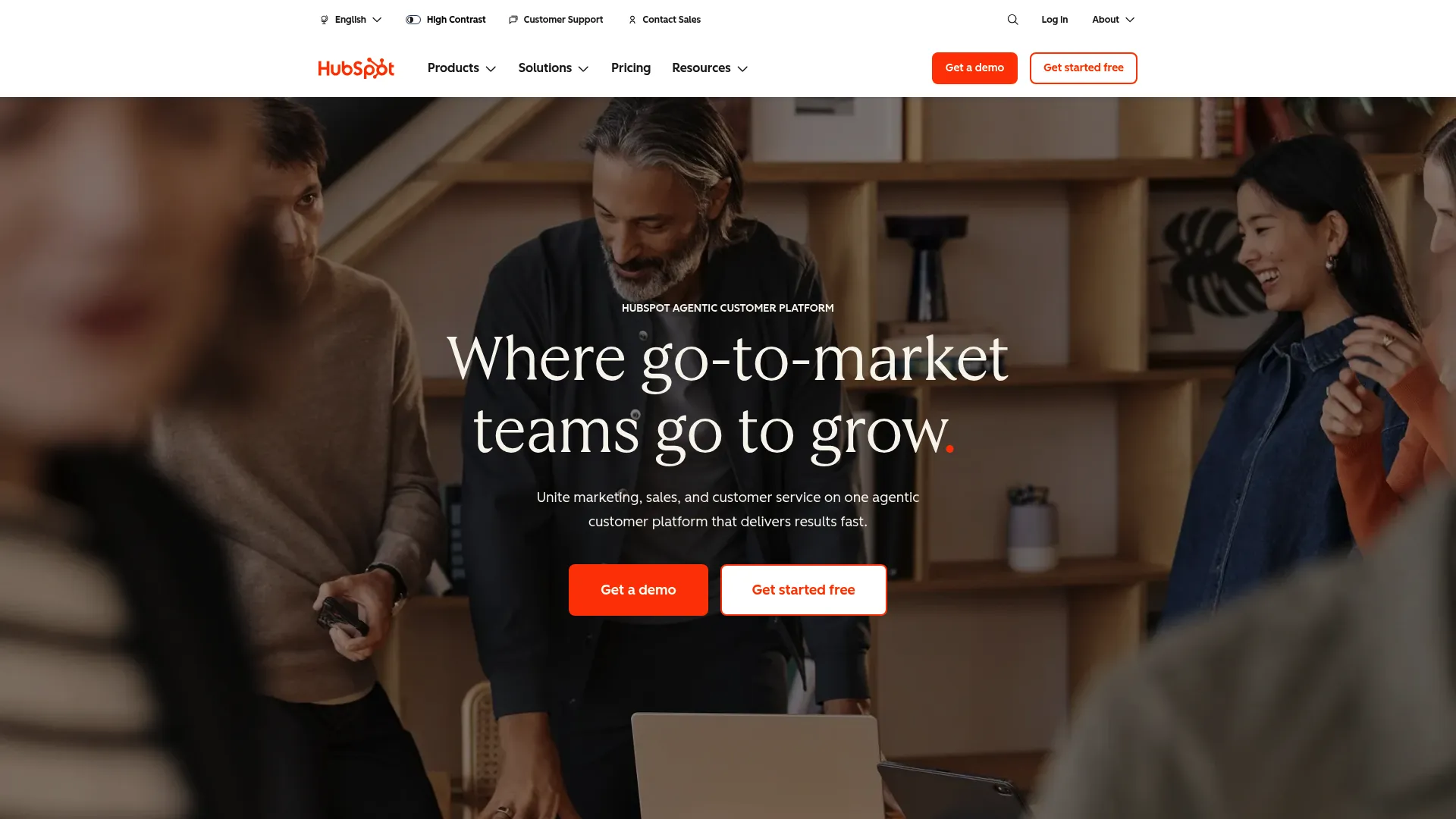
HubSpot is where many small and mid-market teams start their lifecycle journey. It bundles CRM, marketing, sales, service, content, and commerce into one customer platform, so the whole lifecycle sits under a single roof without heavy integration work. That all-in-one design is exactly what appeals to a team that doesn't want to bolt five tools together.
For CRM automation and retention, HubSpot's workflows trigger follow-ups, route leads, and update records automatically. An SDR gets cleaner handoff data because the same platform that captured the lead runs the nurture and books the meeting.
Best for: Businesses wanting an all-in-one CRM and go-to-market platform without complex setup.
Key strengths
- Free CRM as a starting point
- Live chat and engagement tools
- AI content writer for lifecycle campaigns
- Unified workflows across sales, marketing, and service
Why choose HubSpot: HubSpot fits teams that value speed to value and a single, learnable platform over maximum configurability. Larger enterprises may outgrow the higher tiers, but the on-ramp is the smoothest in this list.
HubSpot pricing: A free plan is available at $0/month. Starter begins at $20/month per seat billed annually (or from $7/month per seat monthly). Professional starts at $1,450/month billed annually, and Enterprise starts at $4,700/month, with higher tiers sales-led.
3. Braze
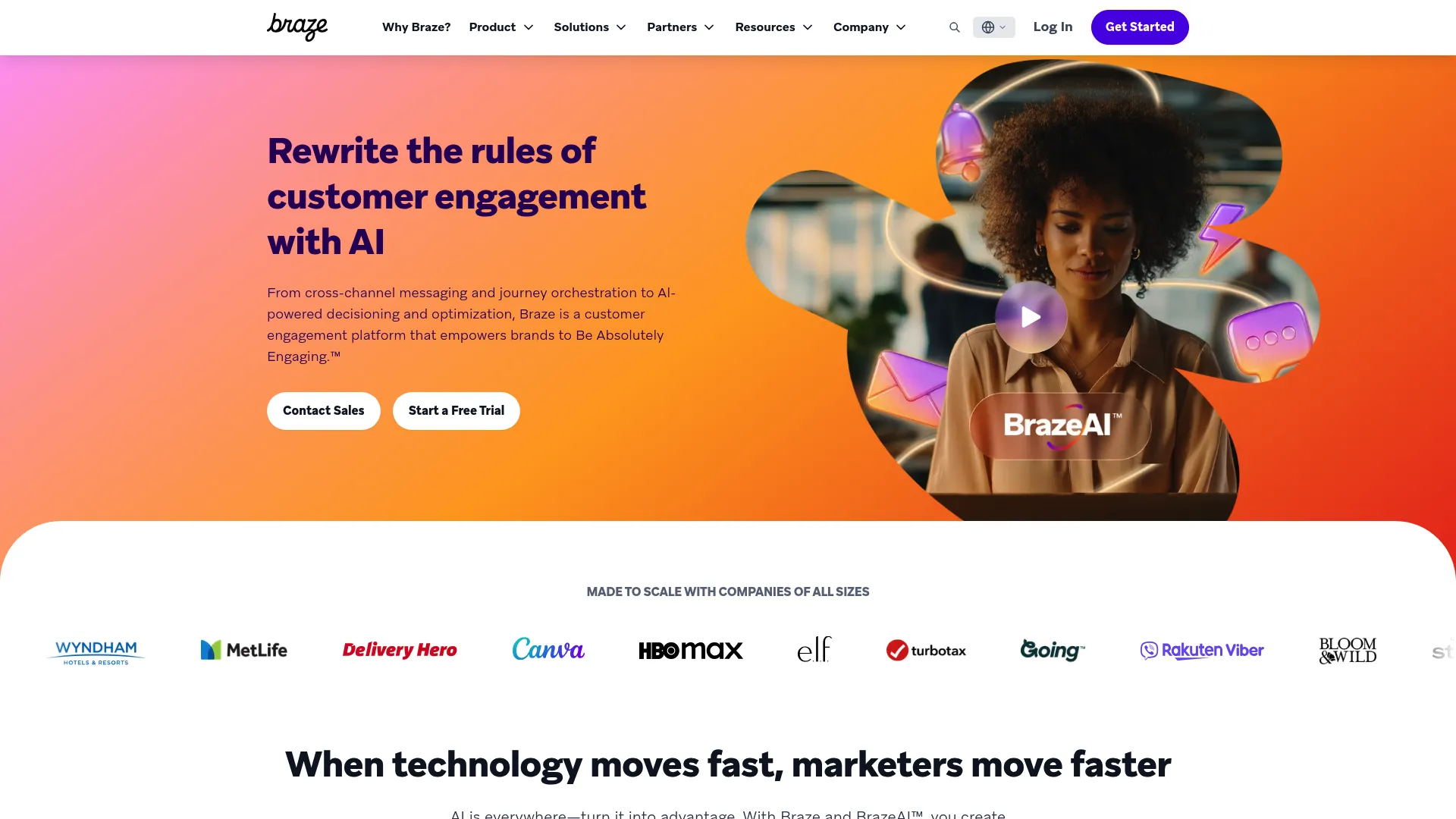
Braze approaches the lifecycle from the engagement angle. It's a customer engagement platform built for cross-channel messaging and journey orchestration, covering acquisition, activation, retention, and reactivation. Where a CRM stores the record, Braze runs the conversation across email, push, in-app, and more.
Its strength is orchestration. You segment audiences, build journeys that adapt to behavior, and run experiments to see which path drives retention. For consumer and product-led teams that live or die by engagement, this is the lifecycle layer that actually moves the numbers.
Best for: Teams needing enterprise-grade customer engagement across multiple channels.
Key strengths
- Cross-channel messaging across email, push, and in-app
- Journey orchestration tied to real behavior
- BrazeAI and a built-in data platform
- Segmentation and experimentation tools
Why choose Braze: Braze wins when your lifecycle challenge is engagement, not record-keeping. It pairs well with a CRM rather than replacing one, so it fits teams that already have a system of record and need to activate it.
Braze pricing: Braze lists four editions, Go, Select, Pro, and Enterprise, with pricing that scales by Monthly Active Users and Action Credits. No public numeric price is displayed; pricing is value-based and quote-driven.
4. Fenergo
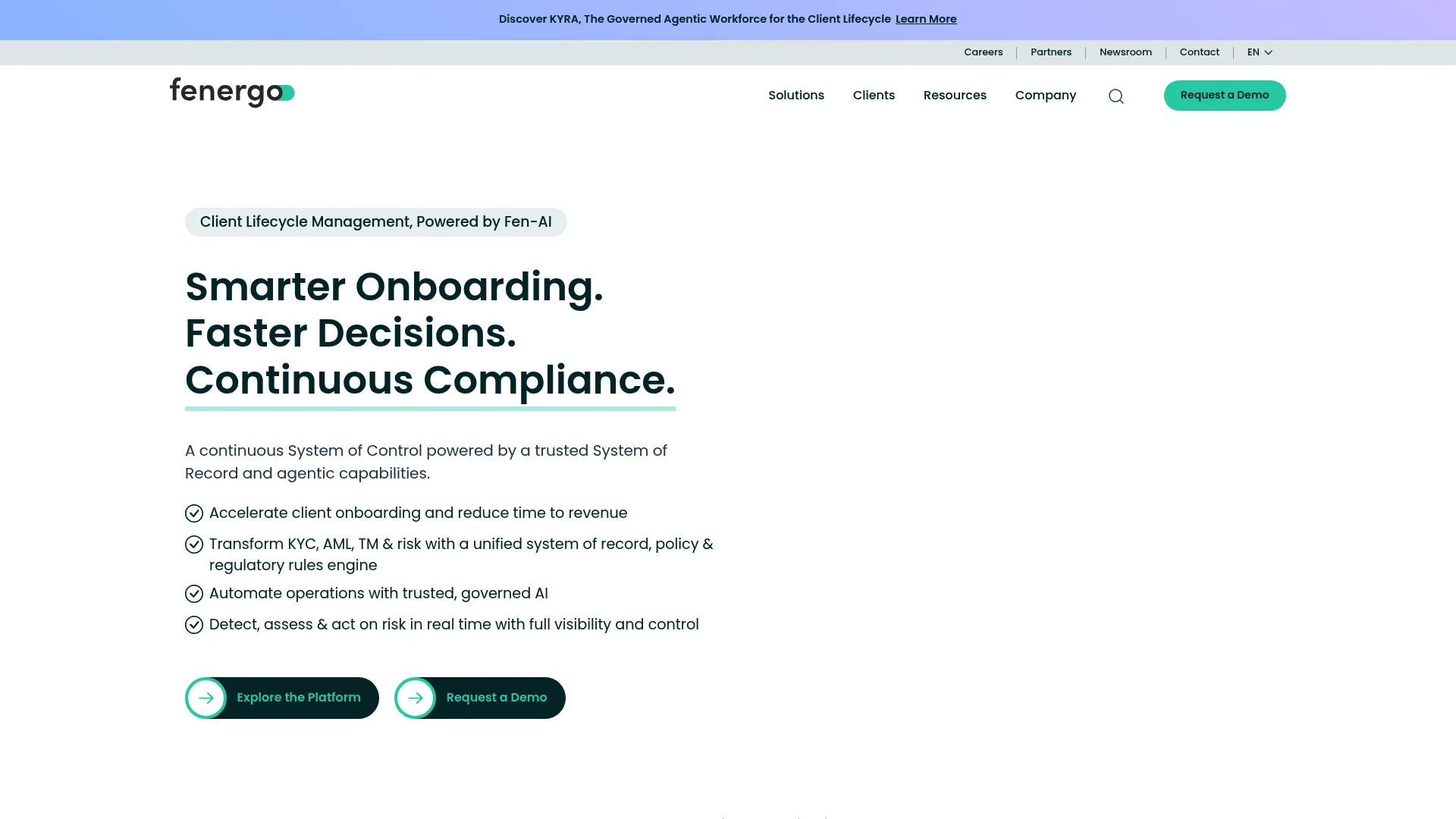
Fenergo is client lifecycle management built for financial institutions. It handles onboarding, KYC, AML, transaction monitoring, and identity verification through a no-code, API-first SaaS platform. Where general lifecycle tools stop at engagement, Fenergo goes deep on the governance and compliance that regulated onboarding demands.
The lifecycle here runs from first client contact through ongoing compliance and offboarding, with digital portals and jurisdiction coverage designed for heavy regulatory scrutiny. For banks and financial firms, the value is a single system that manages the client journey without letting compliance gaps open up between stages.
Best for: Banks and other financial institutions needing enterprise CLM and compliance automation.
Key strengths
- Client onboarding and full lifecycle management
- KYC, AML, and transaction monitoring
- Identity verification built in
- No-code, API-first SaaS deployment
Why choose Fenergo: Fenergo fits regulated institutions where compliance is not optional and onboarding has to survive audit. It's purpose-built for that context rather than a general CRM stretched to fit.
Fenergo pricing: Fenergo does not publish list pricing. The company routes prospects to a request-a-demo and contact-sales flow, which is standard for enterprise compliance platforms.
5. KYC360
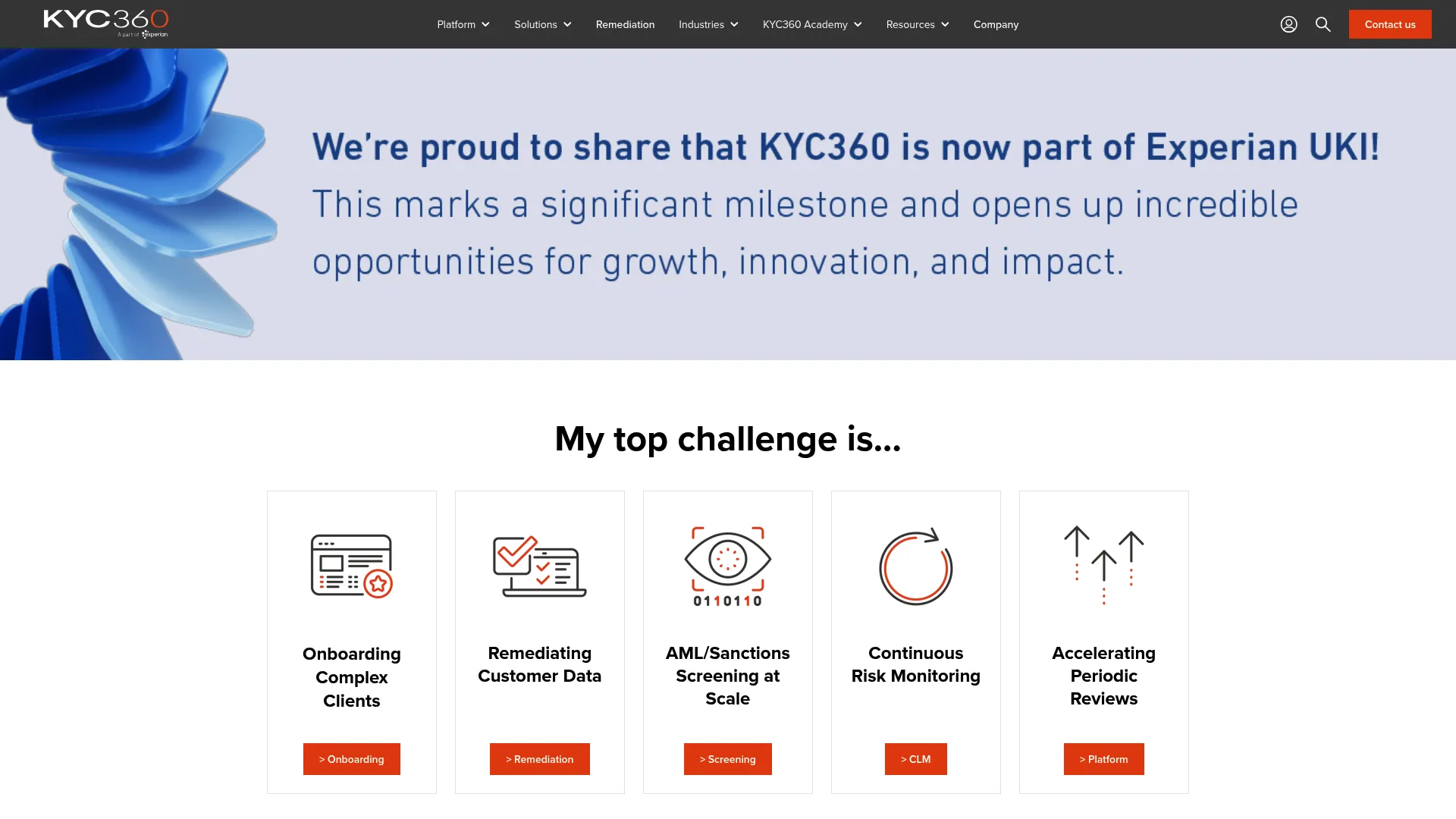
KYC360 focuses on the compliance side of the lifecycle, with a strong emphasis on perpetual KYC. It's a no-code SaaS platform covering KYC onboarding, AML screening, ongoing monitoring, and client lifecycle management. Instead of treating KYC as a one-time gate, it keeps risk profiles live and re-screens as data changes.
That continuous approach is the differentiator. Automated triggers, external data collection, and full audit trails mean compliance teams monitor risk in real time rather than at fixed review dates. Pre-built connectors and two-way APIs let it plug into existing systems of record.
Best for: Financial services and regulated businesses needing KYC/AML workflow automation.
Key strengths
- End-to-end onboarding, screening, and perpetual KYC
- Pre-built connectors and two-way RESTful APIs
- No-code, modular, configurable deployment
- Continuous monitoring with audit trails
Why choose KYC360: KYC360 fits teams that treat compliance as a living process, not a checkbox. Its perpetual KYC model is the reason to pick it over tools that stop screening once onboarding ends.
KYC360 pricing: Core platform pricing is modular and demo-led, so no public core price is listed. KYC360 Academy, its training product, is priced by number of learners, from a Starter tier at £3,500/year up to Diamond at £45,000/year.
6. nCino
nCino ties the customer lifecycle to banking operations. It's a cloud banking platform covering lending, onboarding, AI assistants, and risk workflows, framing CLM around acquisition, onboarding, retention, and loyalty with compliance woven through. For financial institutions, the lifecycle and the core banking workflow are the same thing, and nCino builds for that reality.
The platform runs digital account opening, commercial lending origination, and continuous credit monitoring on one system. That means a customer's lifecycle stage and their lending status live together, closing the gap that appears when banking and CRM data sit apart.
Best for: Financial institutions needing a unified cloud banking platform for lending and digital banking.
Key strengths
- Agentic AI banking assistants
- Commercial lending and origination workflows
- Digital onboarding and account opening
- Continuous credit monitoring and automated spreading
Why choose nCino: nCino fits banks that want lifecycle management fused with lending and account operations rather than layered on top. It's the right pick when banking workflow, not generic CRM, is the center of gravity.
nCino pricing: nCino does not publish list pricing on its public pages. The company uses a demo and contact-sales flow, typical for enterprise banking software.
7. ServiceNow
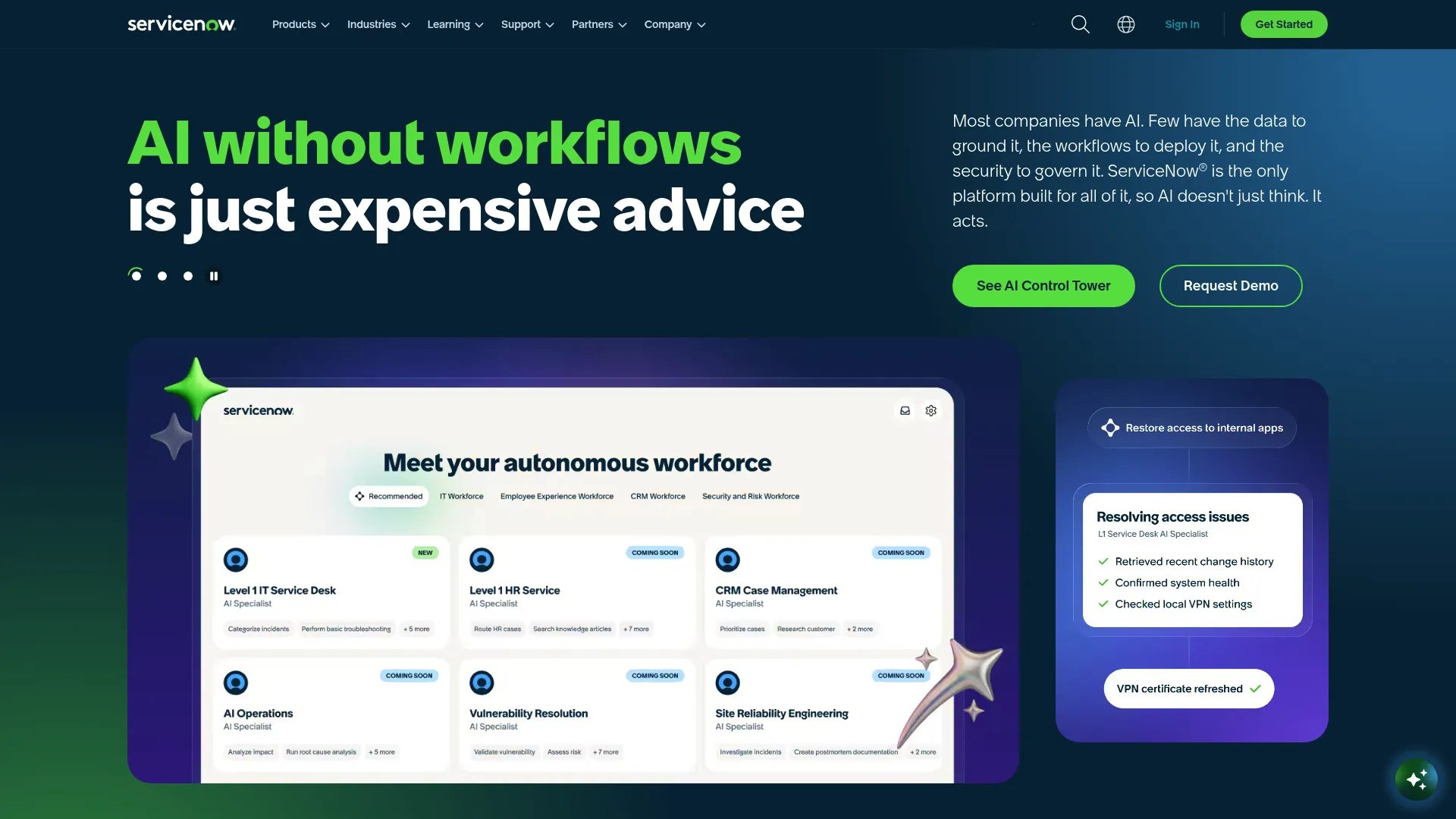
ServiceNow approaches the lifecycle as a workflow problem. It's an enterprise AI workflow platform spanning IT, employee, customer, and business operations, built on a unified data model. For teams whose lifecycle challenge is process governance across many departments, ServiceNow orchestrates the work itself.
The lifecycle value shows up in case workflows, service automation, and cross-functional orchestration. When a customer request touches support, operations, and product, ServiceNow routes and tracks it through each team with governance intact. Low-code app development lets teams build the exact process their journey needs.
Best for: Large organizations that need enterprise-wide workflow automation and AI-enabled service management.
Key strengths
- AI agents and agentic workflows
- Workflow automation on a unified data model
- Low-code app development and integrations
- Cross-functional process orchestration
Why choose ServiceNow: ServiceNow fits enterprises where the lifecycle is really a web of cross-team processes that need governance. It's less a CRM and more the automation layer that connects the systems around one.
ServiceNow pricing: ServiceNow uses custom, quote-only pricing. The public pricing page shows no list prices, so figures come from a sales conversation scoped to your needs.
Considerations before you buy
Picking lifecycle software is less about feature checklists and more about matching the tool to your actual gap. Here's what to weigh.
Lifecycle coverage vs. depth
Some tools span the whole journey shallowly; others go deep on one stage. Decide whether you need broad coverage across acquisition to retention, or depth in a specific stage like compliance onboarding or retention messaging. Buying broad when you need deep, or vice versa, is the most common mismatch.
Data unification
The whole point is a single customer view. Ask whether the tool creates one source of truth or just adds another system to sync. Check how it pulls from your CRM, marketing automation, and analytics, and how clean that unified customer data actually stays.
Automation and orchestration fit
Look at how the tool triggers actions across stages. Good lifecycle automation removes manual follow-up and orchestrates the journey without constant babysitting. Map a real workflow you run today and see how many manual steps the tool actually eliminates.
Compliance and governance needs
If you're in a regulated industry, compliance is not a feature, it's the foundation. Perpetual KYC, audit trails, and risk workflows separate compliance-grade CLM from general engagement tools. Match the governance depth to your regulatory reality.
Integration and stack fit
The best tool is the one your team will actually use inside their existing workflow. Verify native integrations with your CRM, sequencer, and analytics before committing, and confirm the data flows both ways.
Conclusion
There's no single best customer lifecycle software, only the best fit for your biggest bottleneck. Start there.
If you need broad enterprise coverage with a central system, Salesforce is the safe bet. If you're small or mid-market and want an all-in-one on-ramp, HubSpot gets you moving fastest. When the challenge is engagement and cross-channel orchestration, Braze moves the retention numbers.
For regulated industries, the picture shifts. Fenergo owns compliance-grade client lifecycle management, KYC360 leads on perpetual KYC and continuous monitoring, and nCino fuses the lifecycle with banking operations. If your real problem is cross-functional workflow governance, ServiceNow is the automation layer to reach for.
The practical next step: name your single biggest handoff or retention gap, then shortlist the two tools above that target it directly. Run a real workflow through each in a trial or demo before you commit. The tool that eliminates the most manual steps in your actual process is the one worth buying.
FAQs
Customer lifecycle software manages and automates a customer's full journey with a company, from acquisition and onboarding through activation, retention, and offboarding. It unifies customer data and automates the workflows between stages, so teams share one view and act on the same signals. Think of it as the coordination layer sitting above your CRM, marketing, and service tools.
A CRM is the system of record; it stores contacts, deals, and history. Customer lifecycle software orchestrates what happens across the whole journey, triggering actions at each stage based on behavior. Many platforms include CRM functionality, but the lifecycle layer adds automation, orchestration, and stage-aware workflows that a pure CRM does not.
Most tools cover five stages: acquisition, onboarding, activation, retention, and offboarding. Acquisition turns prospects into customers, onboarding drives them to first value, activation reinforces sticky behavior, retention keeps them renewing and expanding, and offboarding manages clean, compliant exits. The best platforms connect these stages so context flows through instead of resetting at each handoff.
Sales, marketing, customer success, support, and operations all touch it. SDRs benefit from cleaner handoff data and faster follow-up, marketing runs lifecycle campaigns, success teams monitor health and retention, and ops teams govern the workflows. In regulated industries, compliance and risk teams rely on it for KYC and audit trails.
Perpetual KYC keeps a customer's risk profile continuously updated instead of reviewing it only at fixed dates. Automated triggers re-screen customers as data changes, pulling in external information and flagging risk in real time. Tools like KYC360 build around this model so compliance is an ongoing process rather than a one-time onboarding gate.
Start with your biggest bottleneck, whether that's broken handoffs, manual onboarding, weak retention, or compliance risk. Match the tool's strength to that gap, then check data unification, automation depth, and integration with your existing stack. Run a real workflow through a trial and pick whichever eliminates the most manual steps.
Yes, because it makes retention proactive instead of reactive. By tracking health signals and triggering the right outreach automatically, it catches churn risk before renewal rather than after. Engagement-focused platforms like Braze go further with cross-channel journeys and experimentation tuned specifically to keep customers active.
Look for triggered actions across every stage, not just email sends. Strong lifecycle automation routes leads, updates records, flags risk, and orchestrates journeys based on real behavior without manual intervention. Map a workflow you run today, then count how many of its manual steps the tool can remove; that number is your best signal.