
Your team spends three weeks building a category strategy. Kraljic matrix, supplier segmentation, savings targets, the works. The deck looks sharp. Leadership nods. Then it lands in a shared drive and dies there. Six months later, nobody can tell you which initiatives shipped, what they saved, or whether the supplier risk you flagged ever got addressed.
That gap between category planning and category execution is the exact problem procurement category management software exists to close. The discipline has been around for decades. The software layer that operationalizes it, connecting spend analytics, supplier management, and strategy creation into one system, is what changed.
And the market is moving fast. Future Market Insights valued the global category management software market at roughly USD 2.1 billion in 2025, projecting USD 6.0 billion by 2035 at an 11.0% CAGR. Strategic Market Research reports that about 44.8% of large procurement teams are expected to integrate AI-enabled spend intelligence and supplier classification systems by 2026. Buyers are not just shopping for a category management platform anymore. They want AI-guided planning, supplier intelligence, and execution tracking in one place.
So which tools actually deliver on that? This guide breaks down the strongest category management solutions for 2026, what each one does best, and how to match a platform to how your procurement team really works. The point is not to hand you a feature checklist. It is to help you pick a category management system you will still be using, and measuring against, a year from now.
What's inside
This is a buyer's guide to category management tools for procurement, sourcing, and operations teams. Every platform here supports the core jobs: category strategy, spend visibility, supplier management, analytics, execution tracking, and integration with wider procurement systems.
We chose tools on four criteria: relevance to strategic category management specifically (not generic procurement), product depth across planning and execution, AI or automation maturity, and enterprise fit. We prioritized platforms with verifiable feature sets and real market presence over marketing claims. Pricing and ratings reflect what vendors and review platforms publish, and we note where numbers are not public.
TL;DR
- Best overall for enterprise category strategy: SAP Ariba Category Management, for teams already living in the SAP spend ecosystem.
- Best for AI-guided execution: Coupa Category Strategy, which ties strategy creation to sourcing and value tracking in one loop.
- Best category strategy specialist: Cirtuo, for turning ad hoc planning into repeatable, guided programs.
- Best for supplier and market intelligence: Beroe, when external market data drives your category decisions.
- Best broad source-to-pay suites: GEP SMART and JAGGAER ONE, for category management inside a wider procurement platform.
- Best for mid-market spend control: Planergy, for teams that want procurement visibility without a massive enterprise rollout.
What is category management software?
Category management software is a procurement system that helps teams plan, execute, and track sourcing strategies across defined spend categories, connecting spend analytics, supplier management, and strategy creation in one workflow.
Here is the distinction that trips up a lot of buyers. Category management is a procurement discipline: grouping related spend into categories, then applying strategy to each one to reduce cost and risk. Category management software is the system that operationalizes that discipline, so strategy does not stay trapped in slides and spreadsheets. It is not the same as general procurement software, which often focuses on transactional buying, purchase orders, and invoicing.
A strong category management platform typically covers:
- Spend analytics: classifying and visualizing spend across categories to find savings and consolidation opportunities.
- Supplier management: tracking supplier performance, risk, and relationships within each category.
- Strategy creation: guided frameworks like the Kraljic Matrix and SWOT to build defensible category strategies.
- Execution tracking: turning strategy into initiatives with owners, timelines, and measurable savings.
- Source-to-pay integration: connecting category strategy to sourcing events, contracts, and downstream buying.
- ERP integration: syncing spend, supplier, and contract data with core financial systems.
The tools that win in 2026 do not treat these as separate modules. They connect strategic sourcing to execution, so the strategy you write is the strategy you can measure.
When to use category management software
Not every procurement team needs a dedicated category management system. Here is how to know you have crossed the line.
Use it when category planning lives in slides, docs, and Slack
If your category strategies are scattered across decks, spreadsheets, and message threads, nobody owns the source of truth. Plans drift, versions multiply, and execution stalls. A category management platform gives you one place where strategy, owners, and progress live together, so a plan written in Q1 is still trackable in Q4.
Use it when supplier data and spend data are fragmented
When spend analytics sit in one tool, supplier records in another, and market intelligence in a third, building a category strategy means stitching data by hand. That is slow and error-prone. Category management software pulls spend, supplier, and often external market data into one view, so category decisions rest on current, connected data instead of stale exports.
Use it when teams need to turn strategy into measurable initiatives
Writing a strategy is easy. Proving it worked is hard. If leadership keeps asking what your category work actually delivered, and you cannot answer with numbers, you need execution tracking. The right system links each initiative to savings, risk reduction, or margin impact, so category management becomes a measurable program instead of an annual planning ritual.
Comparison table
We ranked this list by relevance to procurement category management buyers specifically. Purpose-built category strategy tools and platforms with dedicated category management modules rank higher than broad suites where category management is one feature among many. Pricing across this category is almost entirely quote-based, so treat the ratings as directional and confirm current numbers with each vendor.
| # | Product | Intent | Key differentiation | Pricing | G2 rating |
|---|---|---|---|---|---|
| 1 | SAP Ariba Category Management | Enterprise category strategy in the SAP ecosystem | AI-powered strategy with guided creation and spend management | Price upon request | 4.1/5 |
| 2 | Coupa Category Strategy | AI-guided strategy tied to sourcing and value tracking | Category strategy connected to sourcing optimization and spend insights | Not publicly listed | 4.2/5 |
| 3 | Cirtuo | Repeatable, guided category strategy creation | Guided strategy creation with initiative management and value tracking | Not publicly listed | 5.0/5 |
| 4 | Beroe | Market and supplier intelligence for category decisions | Beroe Live.ai intelligence platform with Abi AI assistant | Not publicly listed | 5.0/5 |
| 5 | GEP SMART | Category management inside a source-to-pay suite | Unified source-to-pay with spend analytics and sourcing | Not publicly listed | 4.3/5 |
| 6 | JAGGAER ONE | Category management in a configurable procurement OS | AI-powered source-to-pay with sourcing, contracts, and SRM | Not publicly listed | 4.2/5 |
| 7 | Ivalua Strategic Sourcing | Category management alongside strategic sourcing | Configurable source-to-contract with AI-driven bid analysis | Not publicly listed | 4.3/5 |
| 8 | Planergy | Mid-market spend control and procurement operations | Procure-to-pay with AP automation and budget tracking | Not publicly listed | Not listed |
1. SAP Ariba Category Management
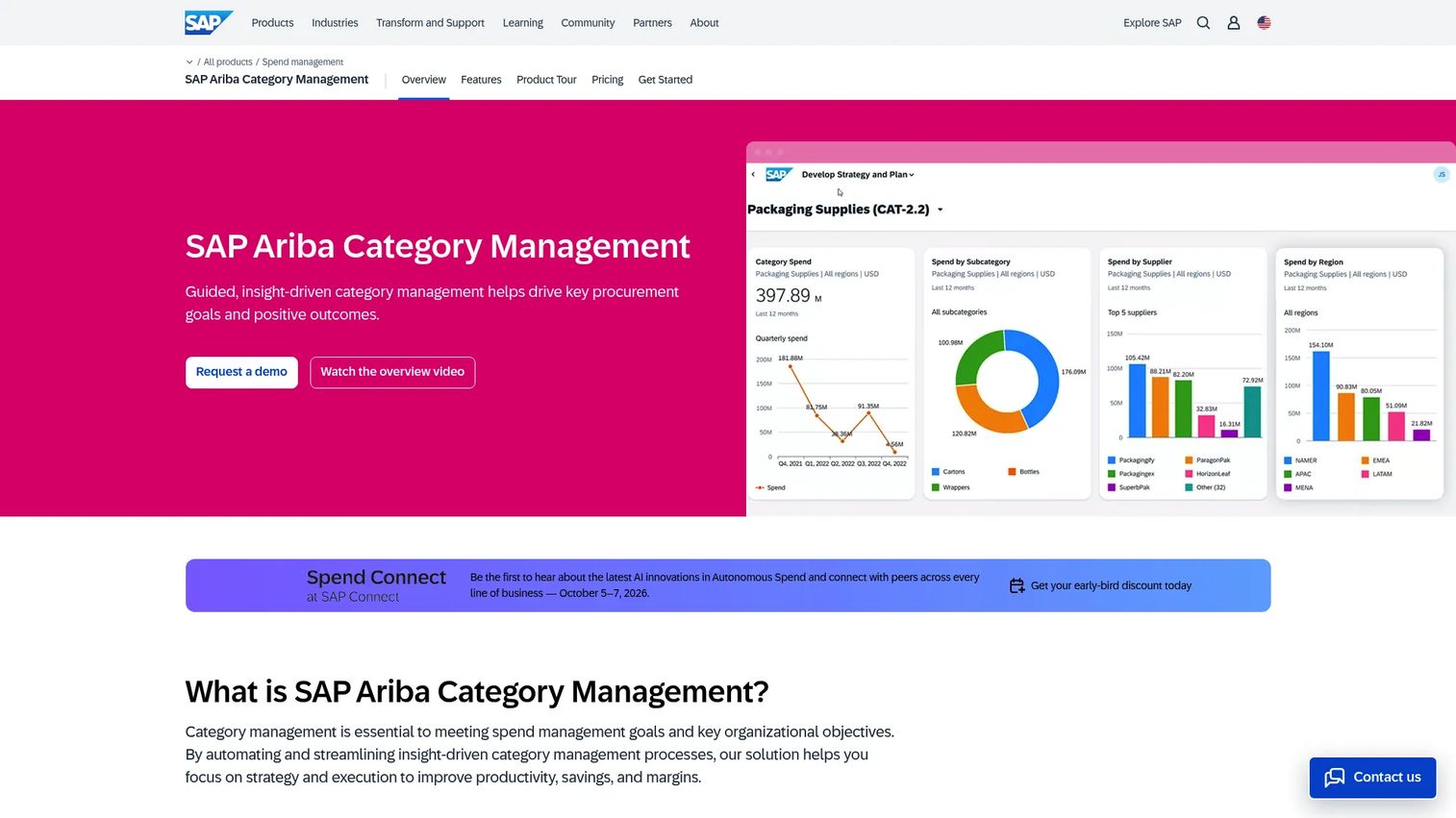
SAP Ariba Category Management is cloud category management software built for procurement teams that need to create, execute, and monitor category strategies at enterprise scale. It fits organizations already running SAP for spend management, where category strategy connects to the wider source-to-pay and ERP stack. The pull here is depth and integration, not lightness.
Best for: Enterprise procurement teams managing strategic category planning and execution inside an existing SAP environment.
Key strengths
- AI-powered category strategy: Uses AI to surface market intelligence and recommendations that inform strategy decisions.
- Streamlined category spend management: Connects spend data to category planning so strategy rests on real numbers.
- Guided category strategy creation: Walks teams through structured frameworks to build defensible, repeatable strategies.
Why choose SAP Ariba Category Management: If your procurement organization already lives in SAP, the integration story is hard to beat. Category strategy, spend, supplier data, and downstream sourcing sit in one connected ecosystem, which matters when you are managing hundreds of categories across a global footprint. This is a platform for teams ready to commit to the depth of a full enterprise procurement system, not a quick standalone tool.
SAP Ariba Category Management pricing: SAP prices the service per user per year and displays "Price upon request" rather than a public number. A partner-only cloud test, demo, and development edition is also listed. There is no free tier. Expect a sales-led evaluation and a quote tied to your user count and existing SAP footprint. On G2, SAP Ariba carries a 4.1/5 rating across its broader product reviews.
2. Coupa Category Strategy
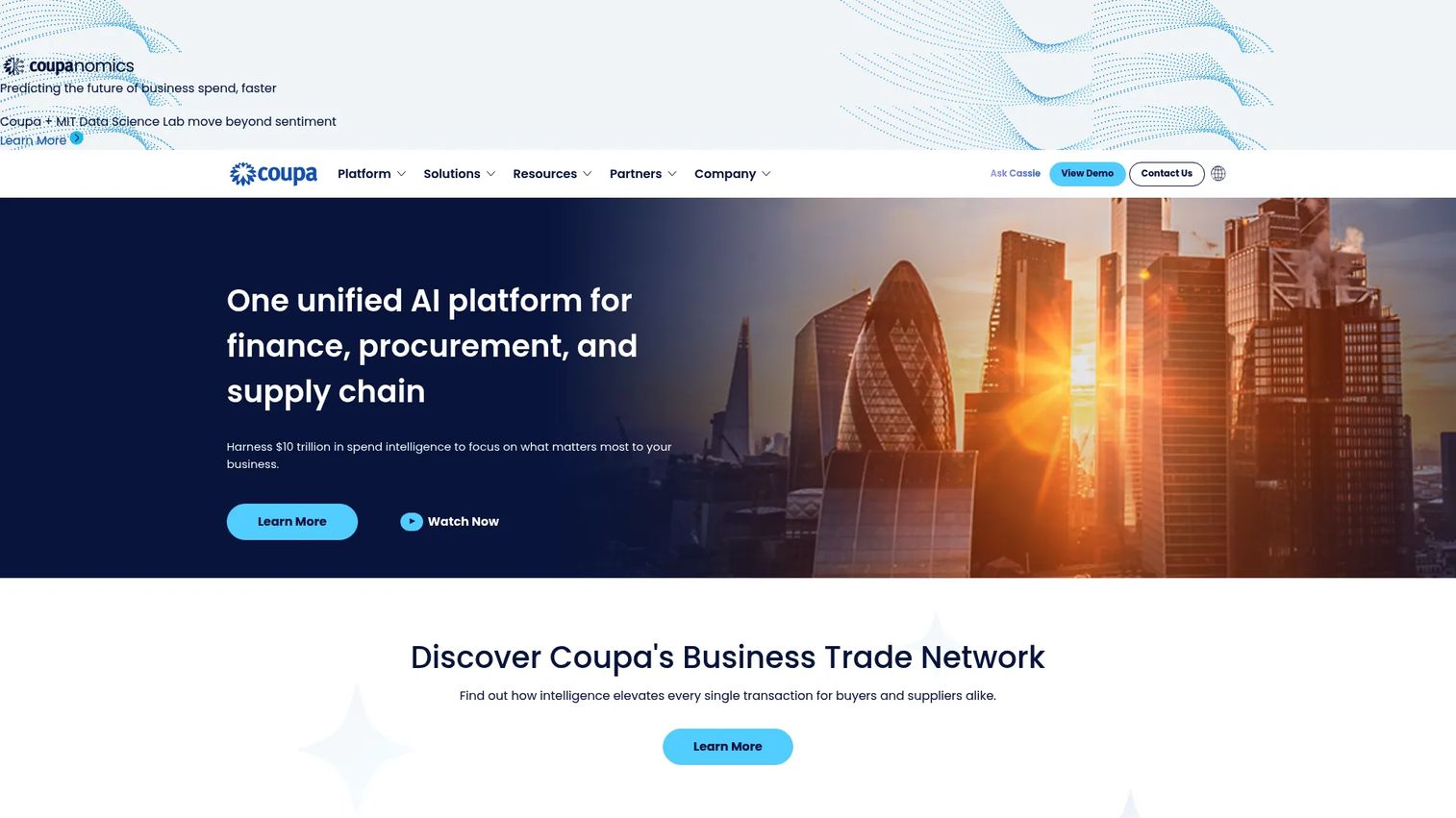
Coupa Category Strategy is a category management capability inside Coupa's broader spend management platform, built for teams that want strategy creation and execution connected in one loop. This is the strongest execution-focused pick on the list. It is designed so a category strategy does not just get written, it gets sourced, tracked, and measured against value delivered.
Best for: Procurement teams that want AI category management software with category strategy, sourcing, and value tracking in a single spend platform.
Key strengths
- AI-powered category strategy support: Guides strategy creation and helps define categories intelligently rather than from scratch.
- Intelligent category definition: Uses spend and market signals to structure categories in a way that reflects real spend behavior.
- Sourcing and spend integration: Connects category strategy to Coupa sourcing optimization and spend insights, closing the loop from plan to result.
Why choose Coupa Category Strategy: The appeal is the closed loop. Strategy creation feeds sourcing, sourcing feeds spend data, and spend data feeds value tracking, so you can show the margin impact of a category program instead of guessing at it. For teams tired of strategy that ends at the deck, that connective tissue is the differentiator. It fits organizations that already run, or plan to run, Coupa as their spend backbone.
Coupa Category Strategy pricing: Coupa does not publish a public price for Category Strategy on its own domain, and there is no visible free tier. Pricing is sales-led and typically scoped to your platform footprint. On G2, Coupa carries a 4.2/5 rating across its product reviews.
3. Cirtuo
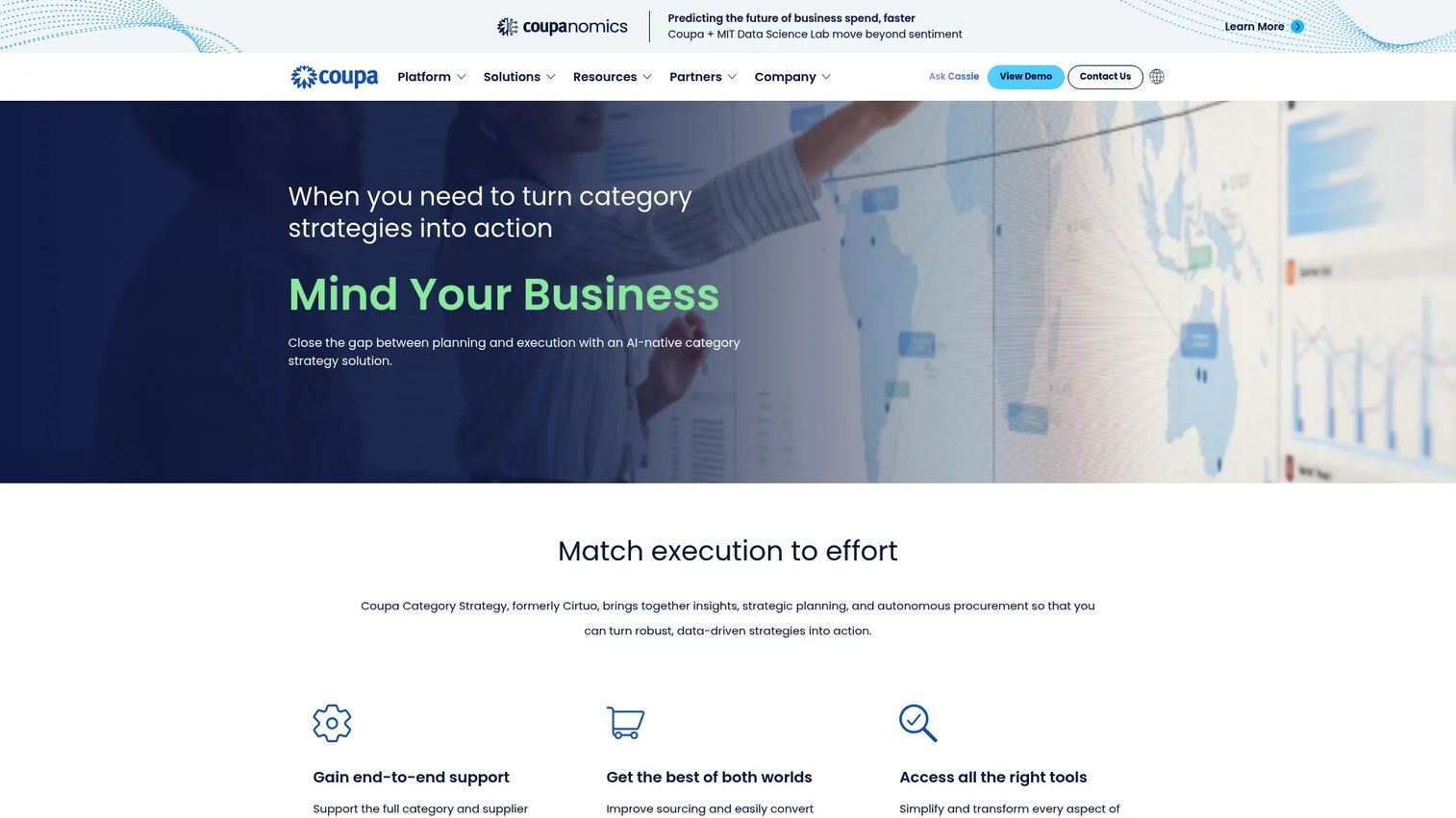
Cirtuo is procurement software focused on one thing and doing it well: guided category strategy creation. Where broad suites treat category management as a module, Cirtuo treats it as the product. It is built to move teams from ad hoc, one-off planning to a repeatable, standardized category program the whole procurement function can run the same way.
Best for: Procurement teams that want to standardize category strategies and savings initiatives across the function.
Key strengths
- Guided category strategy creation: Walks teams through a structured, repeatable process so every category strategy follows the same rigorous logic.
- Initiative management and value tracking: Turns strategy into tracked initiatives with measurable savings, not static plans.
- Supplier strategy and reporting: Connects supplier decisions to category strategy and surfaces them in clear reporting.
Why choose Cirtuo: If your problem is inconsistency, where every category manager builds strategy their own way, Cirtuo's guided approach is the fix. It enforces a shared method, which makes strategies comparable, defensible, and easier to review. For a product marketing or procurement leader who cares about a repeatable process over a scattered one, this specialist focus is exactly the point. It is a strong choice when category strategy quality, not suite breadth, is the priority.
Cirtuo pricing: Cirtuo does not display public pricing on its site; pricing is contact-sales. On G2, Cirtuo's guided strategy creation product shows a 5.0/5 rating, though based on a small review sample, so weigh that accordingly.
4. Beroe

Beroe approaches category management from the intelligence side. It is a procurement intelligence platform built to feed strategic sourcing teams the external market data, supplier intelligence, and category insights they need to make defensible category decisions. When your strategy depends on knowing the market, not just your own spend, Beroe fills that gap.
Best for: Enterprise procurement teams that need decision-grade market intelligence and supplier intelligence to inform category strategy.
Key strengths
- Beroe Live.ai procurement intelligence platform: Delivers market intelligence and category insights that inform strategy from the outside in.
- Abi AI assistant: Puts AI-driven answers to procurement and category questions at analysts' fingertips.
- Supplier discovery and supplier risk monitoring: Surfaces new suppliers and flags supplier risk so category decisions account for the full landscape.
Why choose Beroe: Beroe sits in the decision stack rather than the execution stack. It shines when market research and supplier benchmarking drive your category choices, and pairs naturally with an execution-focused platform elsewhere in your toolkit. For teams whose category strategies live or die on external context, decision-grade intelligence is worth its own line item. Think of it as the research engine behind your category decisions.
Beroe pricing: Beroe lists three subscription tiers, BASE, PLUS, and PRO, but does not show public prices; pricing is quote-based. There is no listed free tier. On G2, Beroe shows a 5.0/5 seller rating, based on a very small sample, so treat it as directional.
5. GEP SMART
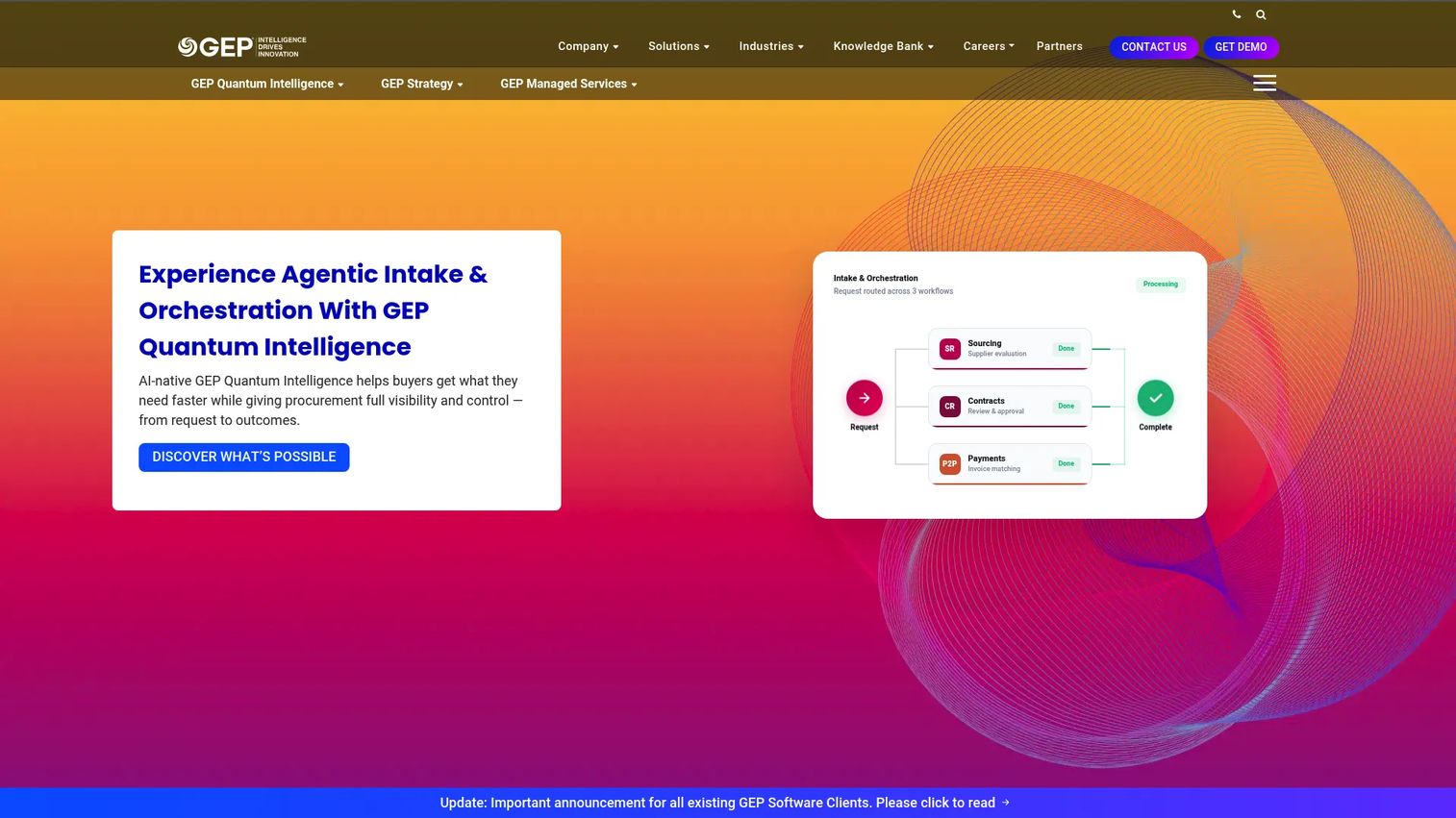
GEP SMART is a cloud-based source-to-pay platform where category management sits inside a wider procurement suite. This is the pick for teams that do not want a standalone category tool, they want category management, spend analytics, and sourcing living in one unified system. GEP is currently consolidating GEP SMART into GEP Quantum Intelligence, while SMART remains supported.
Best for: Large enterprises that want an end-to-end procurement suite with category management built in.
Key strengths
- Source-to-pay suite: Covers sourcing, contracts, supplier management, and procure-to-pay in one platform.
- Spend analytics: Classifies and analyzes spend to feed category strategy and surface savings.
- Sourcing and workflow depth: Handles complex sourcing events and procurement workflows at enterprise scale.
Why choose GEP SMART: The value is consolidation. Instead of bolting a category tool onto a separate procurement stack, you get category management, analytics and reporting, and sourcing in one place, which simplifies data flow and vendor management. For enterprises prioritizing suite breadth and workflow depth over specialist category features, GEP SMART is a serious contender. It suits teams that treat category management as one part of a larger procurement operating system.
GEP SMART pricing: GEP does not publish general list pricing on its site; pricing is contract-specific and sales-led. There is no free tier. On G2, GEP SMART carries a 4.3/5 rating.
6. JAGGAER ONE
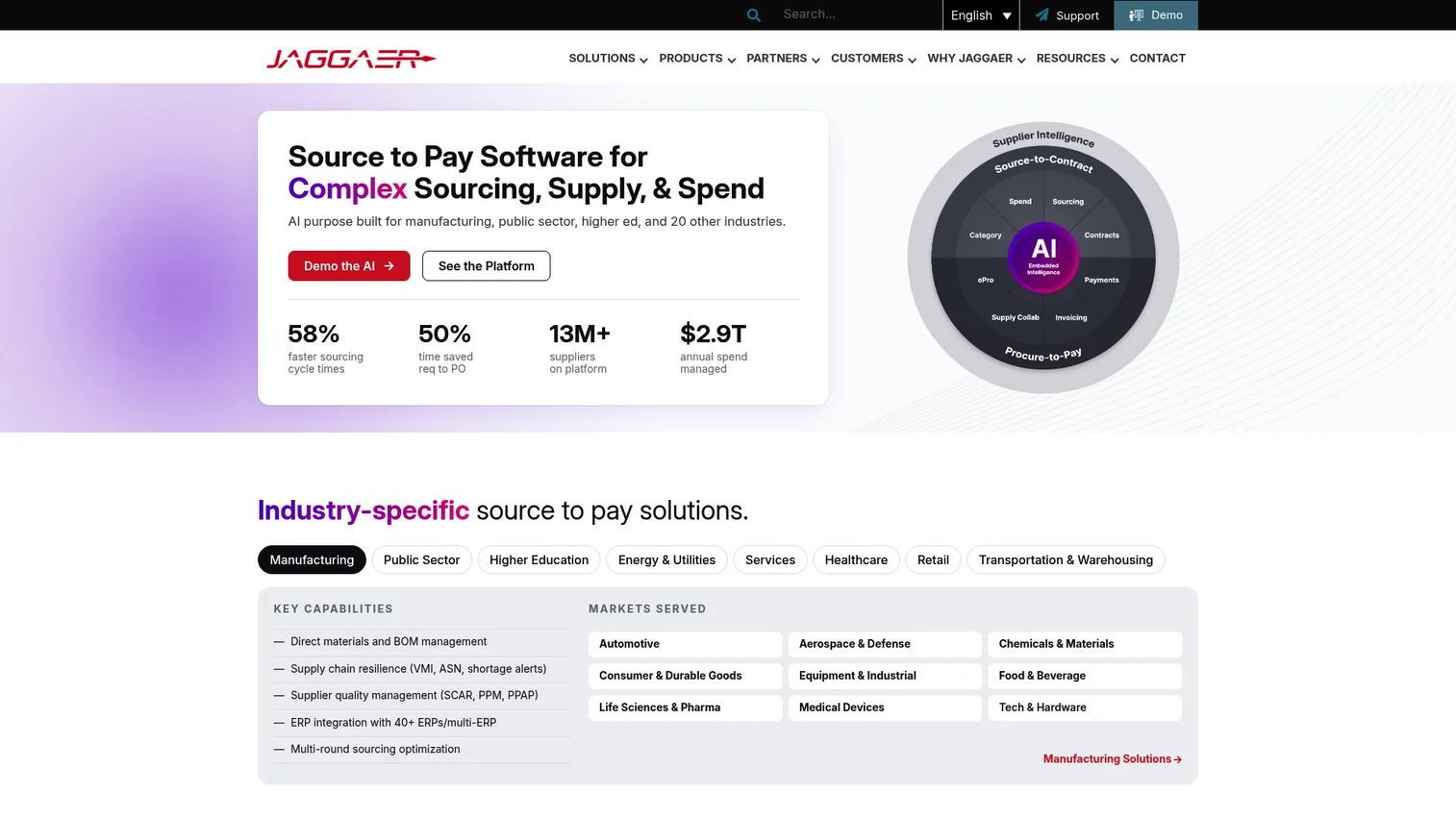
JAGGAER ONE is an AI-powered source-to-pay platform with category management as part of a broader procurement operating system. It is built for complex procurement organizations that want a wide, configurable operating layer around category strategy, not just a planning tool. Sourcing, contracts, spend, and supplier relationships all sit under one roof.
Best for: Enterprises that need a configurable source-to-pay suite with procurement, supplier, and invoice workflows around their category strategy.
Key strengths
- AI-powered sourcing: Applies AI to sourcing events and bid analysis to speed strategic sourcing.
- Contract and supplier management: Handles contract lifecycle management and supplier relationship management in one system.
- Spend analytics and eProcurement: Combines spend analytics, guided buying, invoicing automation, and payments for full-cycle procurement.
Why choose JAGGAER ONE: If your procurement organization is complex, with many categories, stakeholders, and process requirements, JAGGAER's configurability is the draw. It gives you an operating system around category strategy rather than a narrow point tool, with deep integrations and enterprise process support. For teams that need category management embedded in a wider, adaptable procurement platform, it earns a place on the shortlist. It fits process-heavy organizations that value flexibility.
JAGGAER ONE pricing: JAGGAER does not publish public pricing; the site uses a demo and contact-sales model. There is no listed free tier. On G2, JAGGAER carries a 4.2/5 rating.
7. Ivalua Strategic Sourcing
Ivalua Strategic Sourcing is AI-powered strategic sourcing software that carries category management alongside sourcing, supplier management, and analytics. It fits organizations that want category management as part of a broader, highly configurable source-to-contract platform rather than a category-first specialist tool. The strength here is depth and adaptability across enterprise procurement processes.
Best for: Large enterprises that need a configurable source-to-contract and strategic sourcing platform with category management included.
Key strengths
- Guided RFx and project management: Structures sourcing events and projects with guided workflows.
- AI-driven bid analysis and optimization: Applies AI to analyze bids and optimize sourcing outcomes.
- Category management and savings tracking: Manages category strategy and tracks savings within the sourcing platform.
Why choose Ivalua Strategic Sourcing: Ivalua is broad-suite first, category-management-second, and that framing matters when you evaluate it. If you want a single configurable platform that spans strategic sourcing, supplier management, and category work, Ivalua delivers real depth. Its configurability lets enterprises shape the platform to their process rather than the reverse. For teams that prize adaptability and enterprise process depth over a narrow category focus, it is a strong fit.
Ivalua Strategic Sourcing pricing: Ivalua does not display public pricing; both its site and G2's pricing tab point to contact-sales. There is no listed free tier. On G2, Ivalua carries a 4.3/5 rating.
8. Planergy
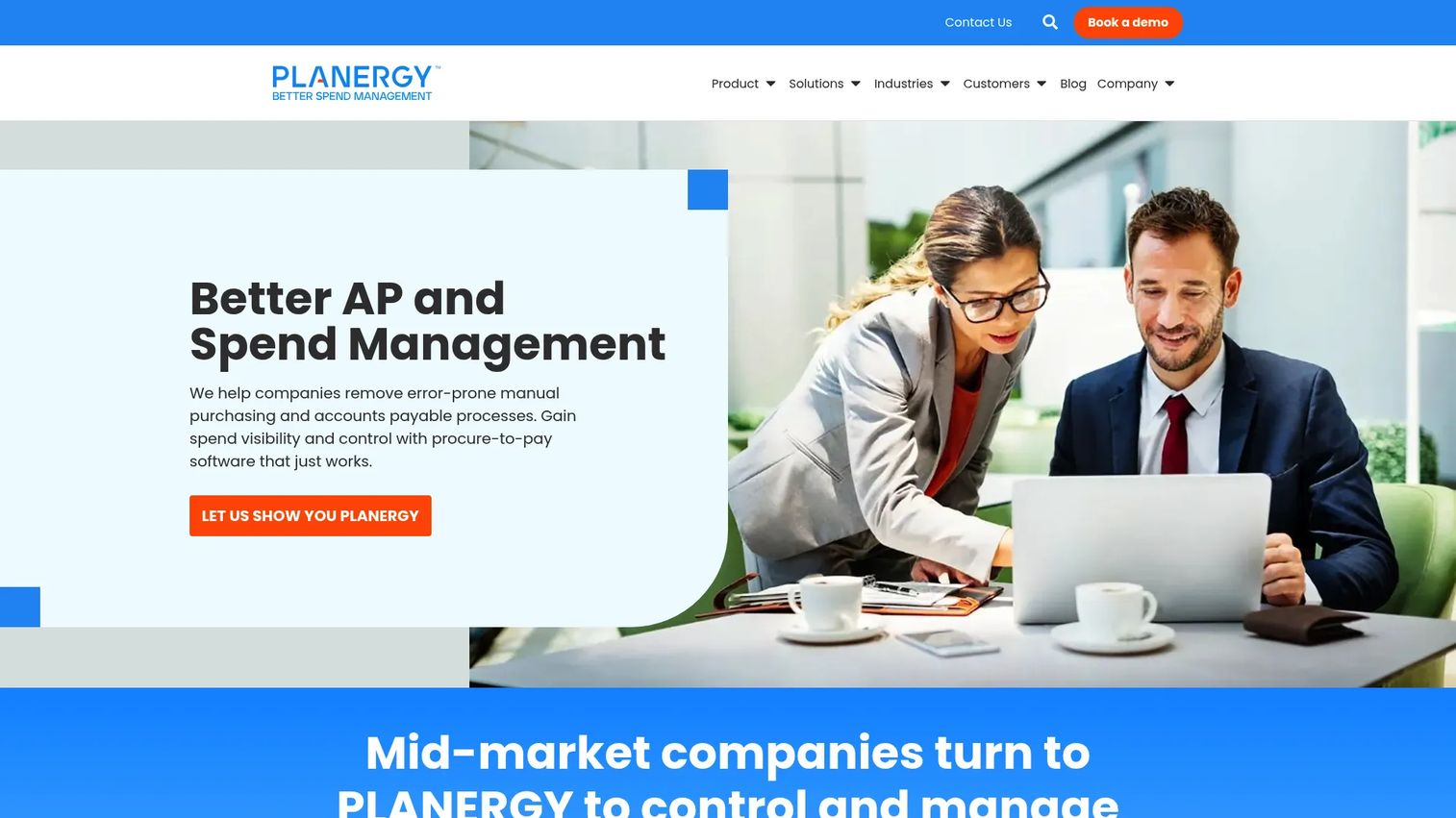
Planergy is a procure-to-pay and spend management platform aimed at teams that want practical procurement and spend control without a heavyweight enterprise rollout. It is the most accessible option on this list. Rather than deep strategic category modeling, it focuses on the operational backbone: budgeting, spend visibility, approvals, and reporting that keeps procurement under control.
Best for: Mid-market teams that need centralized spend control and AP automation without an enterprise-scale implementation.
Key strengths
- Purchase and PO management: Handles purchase requests, approvals, PO management, and receiving in one flow.
- AP automation: Automates invoice capture, three-way matching, and duplicate invoice detection.
- Budget tracking and reporting: Delivers budget visibility, reporting, and PunchOut integrations for practical spend control.
Why choose Planergy: If category strategy at enterprise scale is more than your team needs right now, Planergy gives mid-market procurement a simpler path to visibility and control. It focuses on operational procurement and spend management rather than deep strategic category planning, which is exactly right for leaner teams. For organizations that want spend under control without a long enterprise deployment, it is the pragmatic pick. Match it to your needs if operational control, not strategic modeling, is the priority.
Planergy pricing: Planergy uses a demo-based sales model and does not display public pricing on its site. A Capterra listing shows a 4.6/5 rating, though a primary-source G2 rating was not verified. Confirm current pricing and terms directly with Planergy.
Considerations before you buy
A shortlist is only useful if you know what to test. Run every candidate through this checklist before committing.
Integration depth
Check how the platform connects to your source-to-pay stack, ERP, and data pipelines. A category management system that cannot pull clean spend and supplier data automatically will force manual work that undermines the whole point. Confirm API availability, native connectors, and how often data syncs.
Strategy workflow fit
See whether the tool actually supports planning, collaboration, and execution tracking, not just one of the three. The best category management platform lets a team draft a strategy, assign initiatives, and monitor progress in the same place. Map the tool's workflow against how your category managers really work.
Supplier intelligence quality
Evaluate the freshness and credibility of the market and supplier data the platform provides or ingests. Stale market intelligence leads to weak category decisions. If the tool relies on your own data, confirm you can keep supplier records and supplier performance management current.
Reporting and value tracking
Confirm the platform can prove savings, risk reduction, or margin impact in numbers leadership will trust. Analytics and reporting are where category work earns its budget. If you cannot tie initiatives to measurable outcomes, you cannot defend the program.
Governance and adoption
Look for versioning, approvals, and role-based permissions. Category strategies involve multiple stakeholders, and stakeholder alignment breaks down without clear ownership and controls. A tool the team actually adopts beats a more powerful one that sits unused.
Conclusion
The right category management software depends on how your team works and where it sits on the maturity curve. For enterprise teams already standardized on SAP, SAP Ariba Category Management is the natural best-overall fit. For teams that want AI-guided strategy tied directly to sourcing and value tracking, Coupa Category Strategy is the strongest execution-focused pick. And when external market and supplier intelligence drives your category decisions, Beroe is the specialist worth its own line item.
Cirtuo stands out if you need a category strategy specialist to standardize a scattered process, while GEP SMART, JAGGAER ONE, and Ivalua Strategic Sourcing suit teams that want category management inside a broader source-to-pay suite. Planergy gives mid-market teams a simpler path to spend control.
The practical next step: audit your current category planning workflow against this shortlist. Where does strategy stall today, in creation, in supplier data, or in execution tracking? Match that gap to the platform that closes it, and you will pick a category management system that proves its margin impact instead of gathering dust in a shared drive.
FAQs
Category management software is a procurement system that helps teams plan, execute, and track sourcing strategies across defined spend categories. It connects spend analytics, supplier management, strategy creation, and execution tracking in one workflow, so category plans turn into measurable initiatives instead of static documents.
General procurement software focuses on transactional buying: purchase orders, invoicing, and approvals. Category management software focuses on strategy: grouping related spend, building sourcing strategies per category, and tracking execution. Many enterprise platforms include both, but category management solutions specifically operationalize the strategic side of procurement.
Look for spend analytics, supplier management, guided strategy creation using frameworks like the Kraljic Matrix, execution and initiative tracking, and analytics that prove savings. Strong source-to-pay integration and ERP integration matter too, since category strategy depends on clean, connected spend and supplier data.
Most enterprise category management platforms integrate with ERP and source-to-pay systems, either natively or through APIs. Suites like SAP Ariba, GEP SMART, and JAGGAER ONE connect category management to sourcing, contracts, and financial data directly. Always confirm the specific connectors and sync frequency for your stack before buying.
AI category management software uses market signals and spend data to suggest category definitions, surface supplier and market intelligence, and recommend strategy actions. Tools like Coupa Category Strategy and Beroe apply AI to speed strategy creation and inform decisions with external context, reducing the manual research behind each category.
No. Enterprise suites suit large, complex procurement organizations, but mid-market teams have options too. Platforms like Planergy focus on practical spend control and procurement operations without a heavy rollout, while specialists like Cirtuo help smaller teams standardize category strategy without a full enterprise suite.
Tie each category initiative to measurable outcomes: realized savings, risk reduction, contract compliance, and margin impact. The platform's value tracking and reporting should show these numbers against your baseline. Strong ROI comes from proving that documented strategies produced tracked results, not just cleaner plans.
Compare integration depth with your ERP and source-to-pay systems, strategy workflow fit across planning and execution, supplier intelligence quality, reporting and value tracking, and governance features like versioning and approvals. A clear vendor comparison against these criteria matters more than any single feature list.