You can spend six figures on job ads and still have no idea which channel produced a single qualified hire. That is the recruitment marketing problem in one sentence.
Recruiting has become a performance marketing problem. The same funnel math applies: Awareness, conversion, attribution, cost per acquisition. But most teams still measure it like an admin process, counting applications and calling it a day. The result is wasted job ad spend, career pages that leak candidates, and talent pipelines that go cold between open roles.
The recruitment marketing platform market reached $1.18 billion in 2025 and is projected to grow at 9.29% annually through 2031, according to Mordor Intelligence (2026). More than 66% of job applications now happen on mobile, per Appcast (2025). If your candidate experience is not built for that, you are losing qualified people before they finish the form.
This guide covers 21 platforms that address different parts of the candidate acquisition funnel, from employer branding and career sites to programmatic job advertising and talent CRM.
What's inside
This guide is for talent acquisition leaders, recruitment marketing managers, HR operations buyers, and growth marketers supporting TA teams. Tools were evaluated on:
- Candidate attraction and employer branding capabilities
- Career site and candidate conversion features
- Candidate engagement software and nurture functionality
- Job distribution reach and programmatic advertising
- Recruitment marketing analytics and source attribution
- Integration depth with ATS and HRIS systems
The list includes full platforms, ATS-connected suites, job distribution networks, and employer brand channels. Pricing and G2 ratings are sourced from each vendor's live page and G2 listing.
TL;DR
- Best overall enterprise recruitment marketing platform: Phenom, for organizations that need AI-powered career sites, talent CRM, and candidate analytics in one system
- Best for talent CRM and candidate nurture: Beamery or iCIMS, for companies building owned candidate audiences
- Best for programmatic job advertising: Joveo, for teams that need budget optimization and cost-per-applicant tracking across channels
- Best for employer brand visibility: LinkedIn, Glassdoor, and Indeed, for reach, reviews, and social proof
- Best for smaller teams: Manatal ($15/user/month), Workable ($299/month), or Teamtailor for growing companies that need fast setup without enterprise complexity
What is recruitment marketing software?
Recruitment marketing software is a category of tools that helps companies attract, engage, nurture, and convert candidates before they apply for a role.
Think of it as the demand-generation layer for hiring. Where an applicant tracking system (ATS) manages candidates after they submit an application, recruitment marketing platforms work upstream, influencing candidate awareness, research, and conversion. Some platforms combine both functions.
Key capabilities that fall under recruitment marketing software include:
- Career site builder: Branded, conversion-optimized pages for job listings and employer content
- Job distribution: Posting to job boards, search engines, and paid channels from one place
- Talent CRM: Candidate relationship management software for tracking, segmenting, and engaging candidate pools
- Candidate nurture: Email, SMS, and chat campaigns to warm cold or passive candidates
- Employer brand content: Reviews, employee stories, and culture content that builds trust
- Source attribution: Tracking which channel drove each applicant and each hire
- Recruitment analytics: Cost per applicant, cost per hire, apply completion rate, and channel quality reporting
- AI candidate matching: Surfacing relevant candidates from existing talent pools
- Consent and governance controls: Data residency, opt-in management, and compliance features
Recruitment marketing vs. ATS: An ATS manages workflows after application (interview stages, offer letters, onboarding). A recruitment marketing platform manages everything before apply. Many enterprise suites now cover both, which matters for teams trying to reduce tool sprawl and improve source attribution across the full hiring funnel.
AI recruiting software tools increasingly sit inside both categories, adding matching, rediscovery, and automated screening to the stack.
When to use recruitment marketing platforms
Improve candidate conversion before the application
Your career site is a conversion path, not a brochure. If candidates visit but do not apply, the problem is usually a combination of weak employer brand content, slow page load, a long application form, or poor mobile experience. Recruitment marketing platforms address this with personalized career pages, employee story content, and apply-start optimization. Treating apply completion rate the same way you'd treat landing page conversion rate gives you an actionable metric to improve.
Reduce wasted spend across hiring channels
Paid job distribution without attribution is the recruiting equivalent of running campaigns with no UTM tracking. Programmatic job advertising platforms automatically allocate budget to the channels producing qualified applicants, not just raw volume. Metrics like cost per applicant and cost per qualified applicant let you reallocate spend based on channel quality rather than guessing which board produced your last good hire.
Nurture candidates who are not ready today
Passive candidates do not become active overnight. A talent community lets you maintain relationships with past applicants and silver-medalist candidates so you can fill future roles faster. Candidate nurture campaigns, using email and SMS, function like lifecycle marketing: Regular touchpoints that keep your employer brand top of mind. The payoff is a shorter time-to-fill when roles open, because you already have a warm pipeline.
Recruitment marketing platforms comparison
The table below covers all 21 platforms in the order they appear in this guide. Pricing and G2 ratings reflect data sourced from each vendor's live pricing page and G2 listing. Where pricing requires a sales conversation, that is noted plainly.
| # | Product | Best for | Key differentiator | Pricing | G2 rating |
|---|---|---|---|---|---|
| 1 | Phenom | Enterprise candidate experience | AI career sites, CRM, and workforce intelligence | Custom pricing | 4.3/5 |
| 2 | iCIMS | Large TA teams with complex workflows | Talent Cloud: ATS, CRM, career sites, and texting | Custom pricing | 4.2/5 |
| 3 | Beamery | Talent CRM and workforce planning | Skills-based CRM and AI workforce intelligence | Custom pricing | 4.1/5 |
| 4 | Symphony Talent | Employer branding and campaign execution | Full-funnel: Brand, media, career site, CRM, assessments | Custom pricing | 3.7/5 |
| 5 | Greenhouse | ATS-connected recruitment marketing | Structured hiring with sourcing, CRM, and analytics | Custom pricing | 4.4/5 |
| 6 | Bullhorn | Staffing and recruiting agencies | Agency CRM and ATS with Starter at $99/user/month | From $99/user/month | 4.2/5 |
| 7 | Professional talent reach | Recruiter network, sponsored jobs, employer brand pages | From $119.99/month (Sales Nav Core) | 4.4/5 | |
| 8 | Indeed | High-volume applicant acquisition | Free job postings plus results-based sponsored jobs | Free tier available | 4.3/5 |
| 9 | Glassdoor | Employer reputation and brand | Company reviews, salary data, employer profiles | Free tier; paid plans by quote | 4.0/5 |
| 10 | ZipRecruiter | SMB job distribution | Broad distribution to 100+ boards plus AI matching | Free trial; plans by quote | 4.8/5 |
| 11 | Social and local recruiting | Paid social, community groups, and Meta ad targeting | Free to use; ad spend varies | 4.3/5 | |
| 12 | Joveo | Programmatic job advertising | AI budget optimization across job advertising channels | Custom pricing | 4.8/5 |
| 13 | Manatal | Affordable recruiting CRM | AI-powered ATS and CRM from $15/user/month | From $15/user/month | 4.8/5 |
| 14 | PowerToFly | Diversity recruiting and community hiring | Candidate communities for underrepresented talent | Custom pricing | 4.8/5 |
| 15 | Freshteam | SMB HR and recruiting teams | HR suite with recruiting and onboarding workflows | Free tier; Growth from $1/employee/month + $59.99 platform fee | 4.4/5 |
| 16 | Jobvite | Recruitment marketing and ATS alignment | Career sites, CRM, texting, and analytics in one suite | Custom pricing | N/A |
| 17 | PageUp | Global talent acquisition teams | Recruitment marketing, ATS, onboarding, and analytics | Custom pricing | 4.4/5 |
| 18 | Teamtailor | Employer branding for growing teams | Career site builder, AI co-pilot, and candidate experience | Custom pricing | 4.6/5 |
| 19 | Workable | SMB and mid-market hiring | Job distribution to 200+ boards plus AI sourcing | From $299/month | 4.4/5 |
| 20 | SmartRecruiters | Enterprise hiring platform consolidation | ATS, CRM, career sites, AI matching, and onboarding | From $14,995 (Essential plan) | 3.9/5 |
| 21 | Workday | Enterprise HCM-connected recruiting | Recruiting inside the full Workday HCM suite | Custom pricing | 4.2/5 |
Best 21 recruitment marketing platforms for 2026
1. Phenom
Phenom is an AI-powered talent experience platform covering candidate attraction, employee development, workforce planning, and HR technology management. The platform personalizes career site content based on visitor behavior, candidate profile, and role fit. It also supports internal mobility, helping existing employees find growth paths alongside external candidate acquisition.
Best for: Mid-market and enterprise organizations that need an integrated AI platform for recruiting, talent management, and workforce planning.
Key features
- AI-powered candidate matching and sourcing
- Personalized career sites with content management
- Talent CRM with SMS, WhatsApp, and campaign tools
- Automated screening and interview scheduling
- Workforce intelligence and AI governance controls
Why choose Phenom: Phenom suits enterprise teams that need a platform spanning the full talent lifecycle, not just candidate attraction. The AI-driven career site personalization and workforce intelligence layer are strong differentiators for large organizations with complex hiring journeys.
Phenom pricing: Phenom prices by quote and directs prospects to contact sales. The vendor does not display public plan tiers or pricing on its pricing page. G2 reviewer-reported ranges and Capterra may offer context for budgeting conversations.
G2 rating: 4.3/5
2. iCIMS
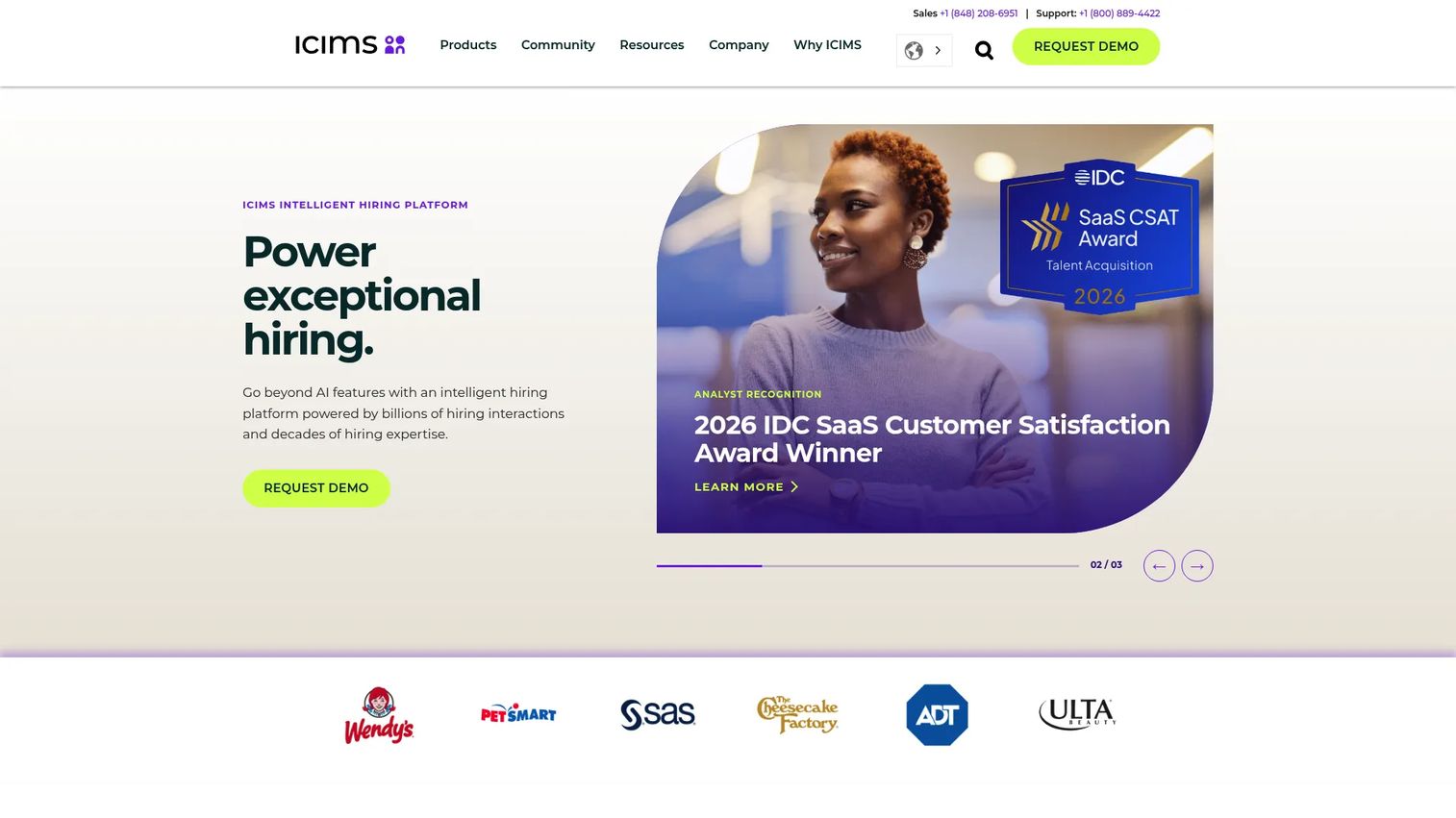
iCIMS offers an enterprise talent acquisition platform that covers applicant tracking, candidate engagement, AI-powered sourcing, career sites, onboarding, and internal mobility. The Talent Cloud connects these modules so TA teams can manage the full hiring workflow without stitching together separate tools. Its text recruiting and chatbot capabilities help teams engage candidates at scale.
Best for: Large and growing organizations that need a configurable, enterprise-grade talent acquisition platform for complex or high-volume hiring.
Key features
- Applicant tracking with configurable hiring workflows
- Talent CRM and candidate relationship management
- AI-powered candidate matching, ranking, and sourcing
- Career sites, recruitment chatbot, and employer branding
- Employee onboarding and internal mobility
Why choose iCIMS: For enterprise TA teams that want recruitment marketing, ATS, and engagement in one connected platform rather than point solutions, iCIMS covers that ground well. The breadth of its Talent Cloud reduces handoff friction between recruiting stages.
iCIMS pricing: iCIMS does not display pricing on its website and directs buyers to contact sales for a quote. Pricing is configured by module, hiring volume, and organizational complexity. Check G2 or Capterra for reviewer-reported ranges before entering a sales conversation.
G2 rating: 4.2/5
3. Beamery
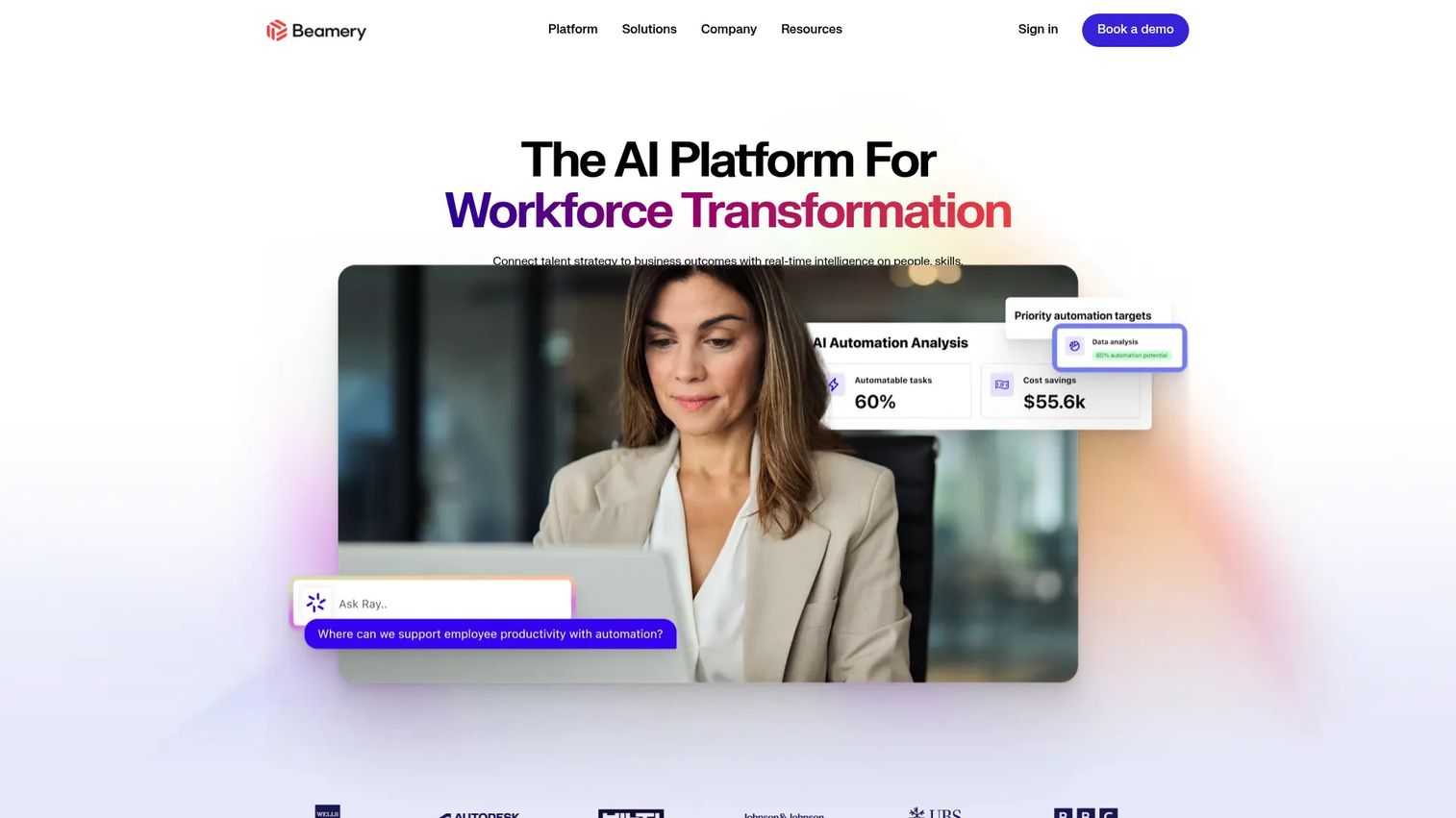
Beamery is an AI platform for workforce transformation. It connects talent strategy with real-time intelligence on people, skills, and tasks. Beyond candidate relationship management, Beamery offers skills intelligence and scenario modeling that help HR leaders understand workforce gaps before they become hiring emergencies. Its agentic AI consultant, Ray, surfaces workforce insights on demand.
Best for: Large enterprises seeking skills-based workforce planning, talent acquisition, talent mobility, and workforce intelligence.
Key features
- Skills intelligence and talent market insights
- Talent CRM and talent marketing automation
- Workforce intelligence with scenario modeling
- AI-powered sourcing, matching, and engagement
- Career sites, chatbots, and talent analytics
Why choose Beamery: Beamery goes deeper on workforce strategy than most talent acquisition tools. Teams that want to connect candidate relationship management with longer-term workforce planning will find it the most complete option in this space.
Beamery pricing: Beamery prices through sales and displays no tiers or numbers on its website. Contact sales to request a quote. G2 and Capterra may carry reviewer-reported price ranges that help set expectations.
G2 rating: 4.1/5
4. Symphony Talent
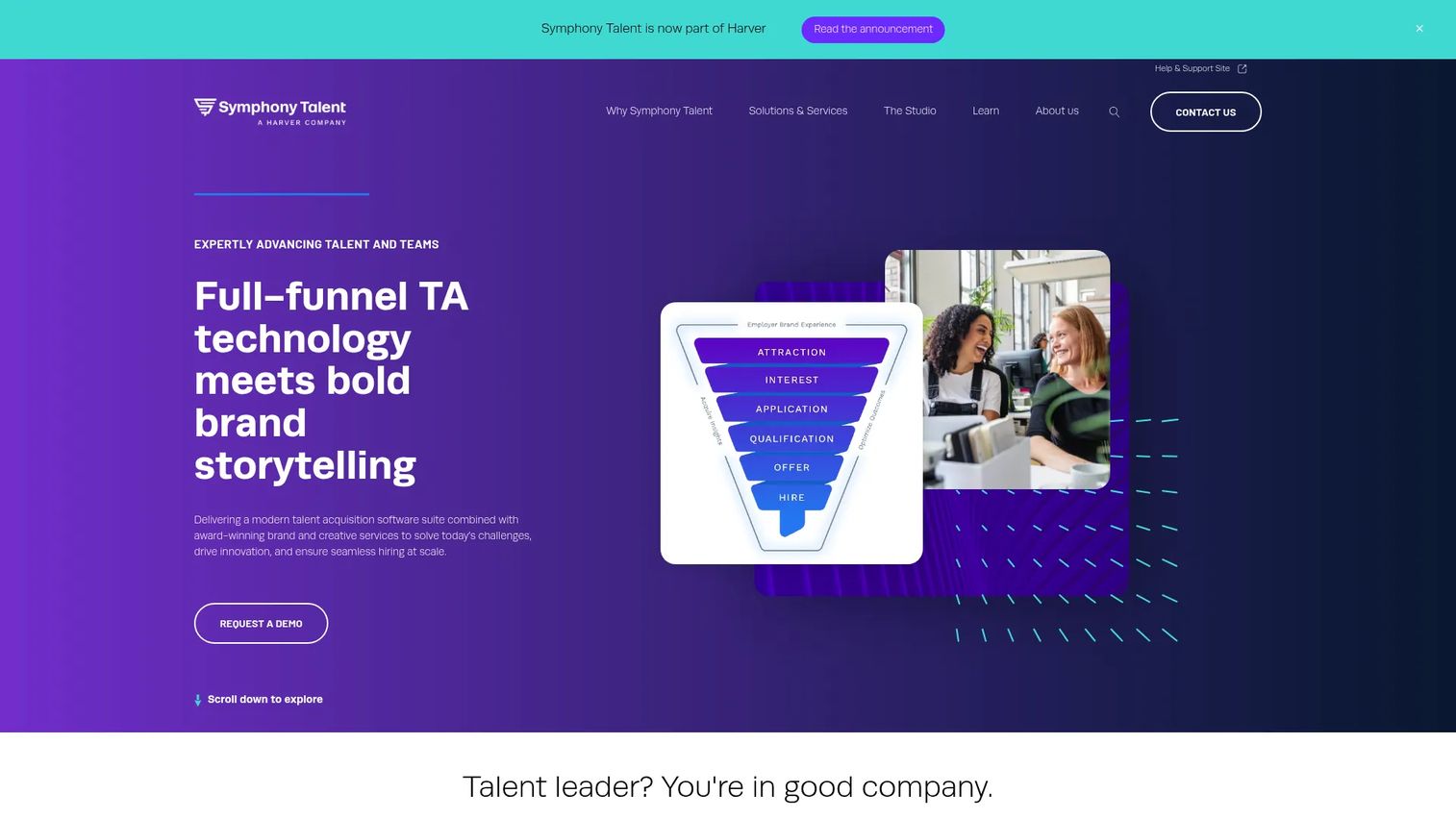
Symphony Talent provides full-funnel talent acquisition software and employer branding services. The platform covers candidate relationship management with automated workflows, programmatic recruitment advertising, AI-powered career sites with a chatbot, pre-employment assessments, and full-funnel recruitment analytics. It combines software with managed services for teams that want agency support alongside technology.
Best for: Enterprise talent acquisition teams seeking integrated recruitment marketing, CRM, career sites, advertising, assessments, and employer brand services.
Key features
- Candidate CRM with automated workflows and segmentation
- Programmatic recruitment advertising with automated bidding
- AI-powered career sites with chatbot and analytics
- Pre-employment assessments: Skills, cognitive, and behavioral
- Full-funnel recruitment analytics and attribution
Why choose Symphony Talent: Symphony Talent suits enterprise teams that need employer brand creative alongside technology, rather than building that capability internally. The combination of managed media and platform tools is its clearest differentiator.
Symphony Talent pricing: Symphony Talent handles pricing through sales conversations and does not publish rates or plan names on its website. Reach out directly for a quote, and cross-reference G2 and Capterra for available reviewer context on typical investment levels.
G2 rating: 3.7/5
5. Greenhouse
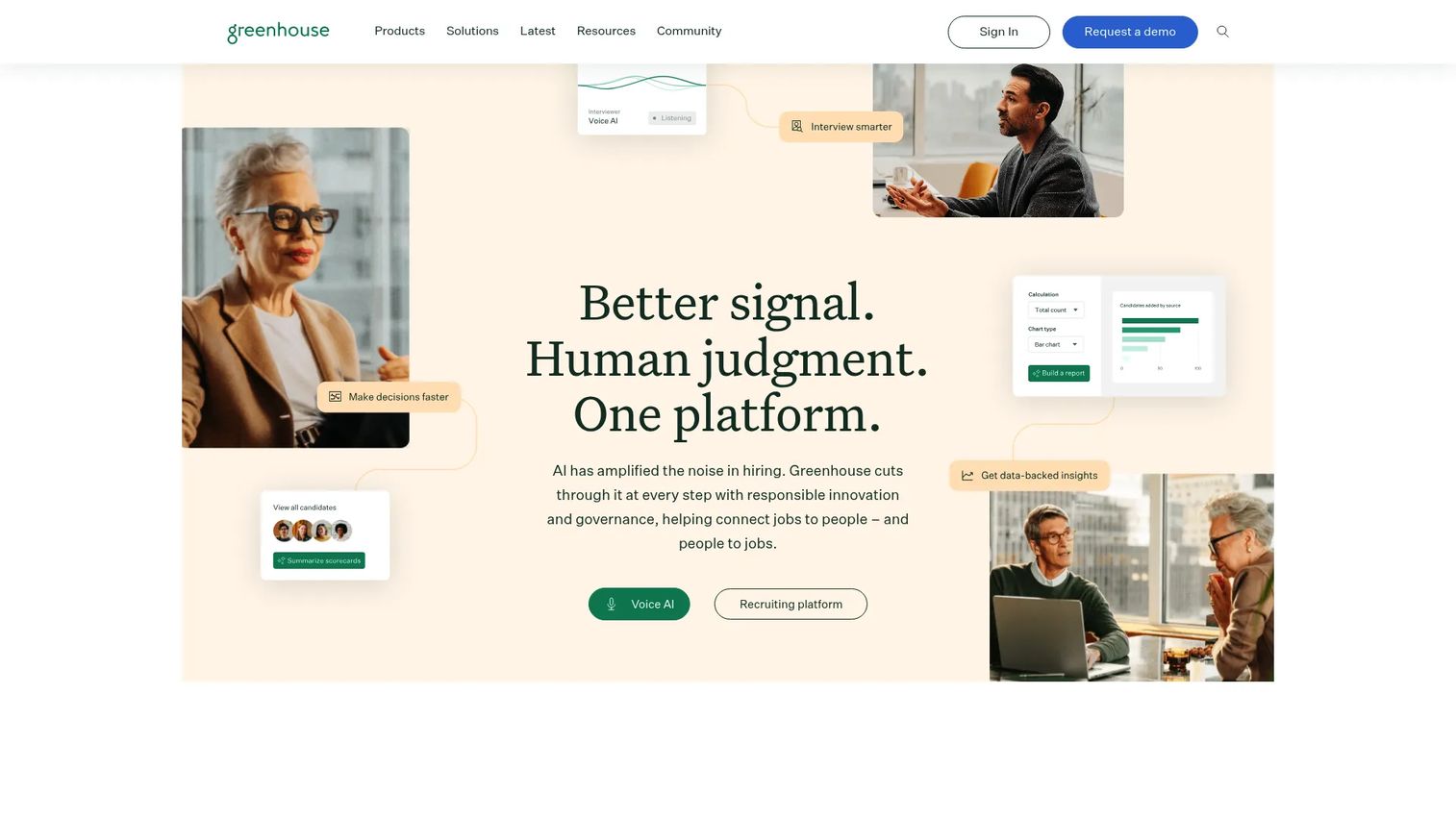
Greenhouse is a hiring platform built around structured recruiting workflows. Its sourcing tools, CRM, AI Notetaker, interview kits, scorecards, and scheduling automation help hiring teams run consistent, repeatable processes. The integrations marketplace connects Greenhouse to hundreds of recruiting, HRIS, and analytics tools. DE&I tools and reporting are included across plans.
Best for: Organizations needing a structured, scalable hiring platform with sourcing, interviewing, analytics, automation, and governance capabilities.
Key features
- Sourcing tools and candidate CRM
- Structured interview kits and scorecards
- AI Notetaker and scheduling automation
- Reporting, analytics, and DE&I tools
- Integrations marketplace with hundreds of HR tools
Why choose Greenhouse: Greenhouse is strong for mid-market and enterprise teams that want recruitment marketing capabilities adjacent to a well-structured ATS foundation. The integrations marketplace gives teams flexibility to add specialized point tools without losing data continuity.
Greenhouse pricing: Greenhouse offers Core, Plus, and Pro plans, all at custom pricing. No public numbers appear on the pricing page. Request a quote from sales. Capterra and G2 carry third-party context on typical ranges.
G2 rating: 4.4/5
6. Bullhorn
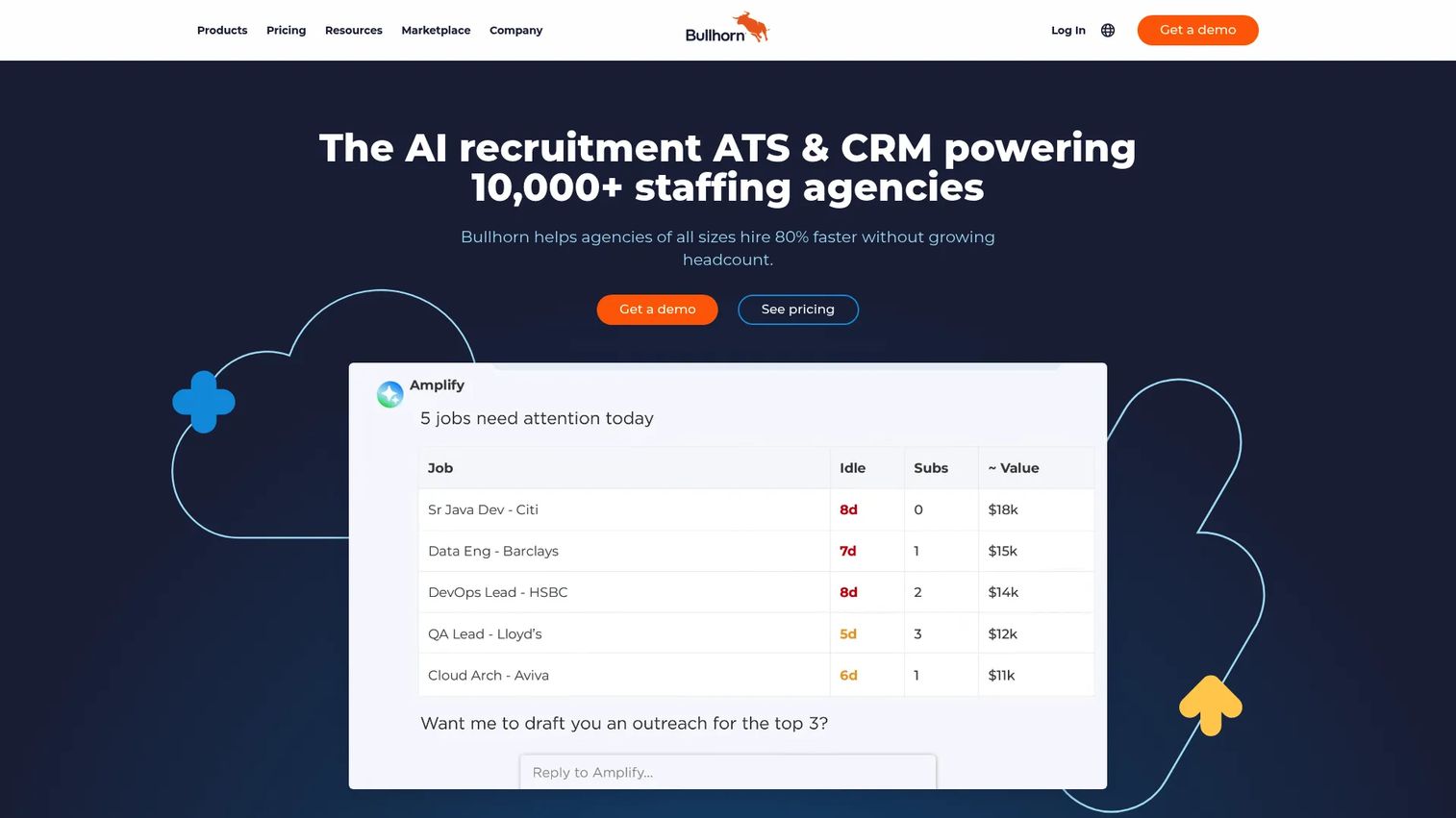
Bullhorn provides cloud-based applicant tracking, CRM, automation, analytics, AI, and back-office software built specifically for staffing and recruitment firms. It handles candidate database management, job order workflows, real-time analytics, and operational workflows including billing and payroll capabilities for agencies. Bullhorn is one of the few platforms on this list that publishes entry-level pricing.
Best for: Staffing and recruitment agencies needing an integrated ATS, CRM, automation, AI, and operational platform.
Key features
- Staffing-specific CRM and applicant tracking
- AI-powered candidate search and matching
- Workflow automation and real-time reporting
- Workforce management and onboarding
- Billing, payroll, and agency operations capabilities
Why choose Bullhorn: If you run a staffing agency rather than an internal TA function, Bullhorn is built for your workflow. The Starter plan gives smaller agencies a cost-controlled entry point with published pricing, which most enterprise competitors do not offer.
Bullhorn pricing: The Starter plan runs $99/user/month and the Core plan $165/user/month. Pro and Max plans require a custom quote. No free trial is available.
G2 rating: 4.2/5
7. LinkedIn
LinkedIn is the largest professional network, with recruiting tools that span job posting, sponsored jobs, LinkedIn Recruiter for candidate search, company pages for employer branding, and Talent Insights for labor market data. For professional, managerial, and technical roles, LinkedIn is often the highest-quality source of active and passive candidates. Sponsored content lets you run recruitment advertising campaigns alongside organic employer brand content.
Best for: Teams hiring professional, managerial, technical, or knowledge-worker roles who need direct access to the world's largest professional talent network.
Key features
- LinkedIn Recruiter with advanced candidate search and outreach
- Sponsored jobs and recruitment advertising
- Company pages and employer brand content
- Talent Insights for labor market data
- InMail candidate messaging and saved searches
Why choose LinkedIn: LinkedIn gives you direct access to passive candidates who are not actively applying elsewhere. The combination of job advertising, employer brand content, and recruiter outreach makes it effective for roles where candidate quality matters more than application volume.
LinkedIn pricing: LinkedIn's free account is available to all users. Sales Navigator Core starts at $119.99/month or $1,079.88/year; Sales Navigator Advanced runs $159.99/month or $1,799.88/year. LinkedIn Recruiter Lite and full Recruiter seat pricing require contacting LinkedIn Talent Solutions directly.
G2 rating: 4.4/5
8. Indeed
Indeed operates one of the largest job seeker marketplaces globally, with free job postings and results-based Sponsored Jobs that drive applicant volume. Smart Screening questions, AI-powered candidate matching, and an employer dashboard for managing applicants and interviews round out the hiring experience. For teams that need fast reach to active job seekers at scale, Indeed remains one of the highest-reach channels available.
Best for: Employers seeking broad reach across active job seekers and fast applicant volume for open roles.
Key features
- Free and sponsored job postings
- AI-powered candidate matching and invitations
- Smart Screening questions for applicant filtering
- Employer Dashboard for candidate and interview management
- Hiring events support
Why choose Indeed: Indeed suits any team that needs to scale applicant flow quickly, particularly for high-volume, frontline, or time-sensitive roles. The free tier gives small employers a no-cost starting point, while Sponsored Jobs scale based on employer budget and desired results.
Indeed pricing: Job postings are free. Sponsored Jobs use a results-based pricing model where employers set a budget and pay per application or per click, depending on the current marketplace model. Specific cost per result varies by role, location, and competition. Check Indeed's employer pricing page for current details.
G2 rating: 4.3/5
9. Glassdoor
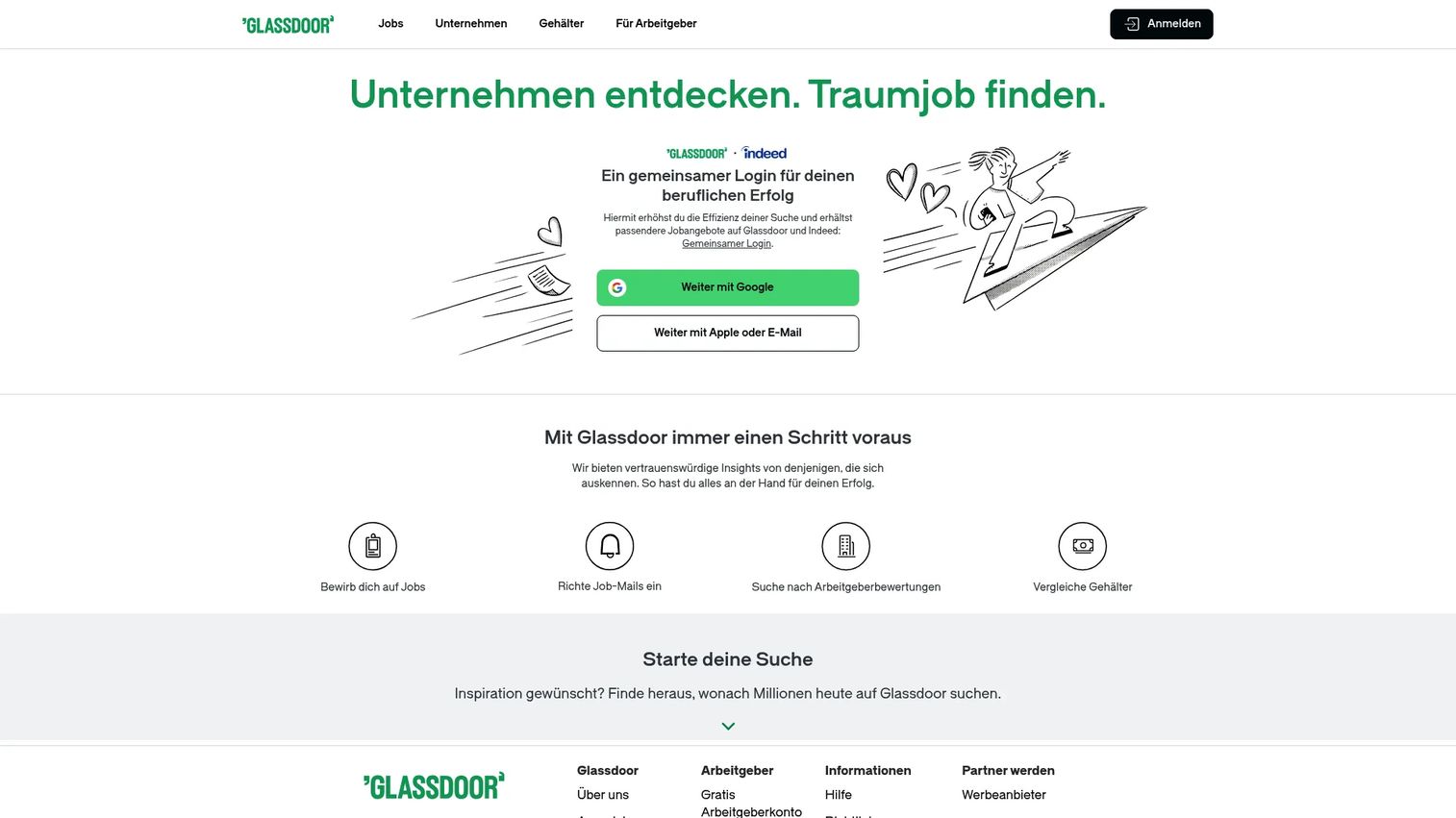
Glassdoor is the go-to channel for candidates researching employers before they apply. Company reviews, salary data, interview insights, and CEO approval ratings all influence whether a candidate submits an application or moves on. Employers can claim and manage their profile, respond to reviews, add branded content, and access analytics on how candidates engage with the company page.
Best for: Companies that need to improve employer perception, build trust with hesitant candidates, and influence conversion before the application.
Key features
- Company reviews and employer ratings
- Salary data and compensation benchmarks
- Employer profile management and review responses
- Branded content and culture sections
- Employer analytics and competitive benchmarking
Why choose Glassdoor: Glassdoor closes the trust gap. Candidates research employers here before deciding to apply, so a neglected Glassdoor profile actively hurts application rates. The employer branding tools help shape that first impression.
Glassdoor pricing: The free employer profile includes basic company information and review management. Paid plans add advanced branding, richer analytics, and competitive benchmarking. Paid pricing is handled through a sales conversation; no public rate appears on the pricing page.
G2 rating: 4.0/5
10. ZipRecruiter
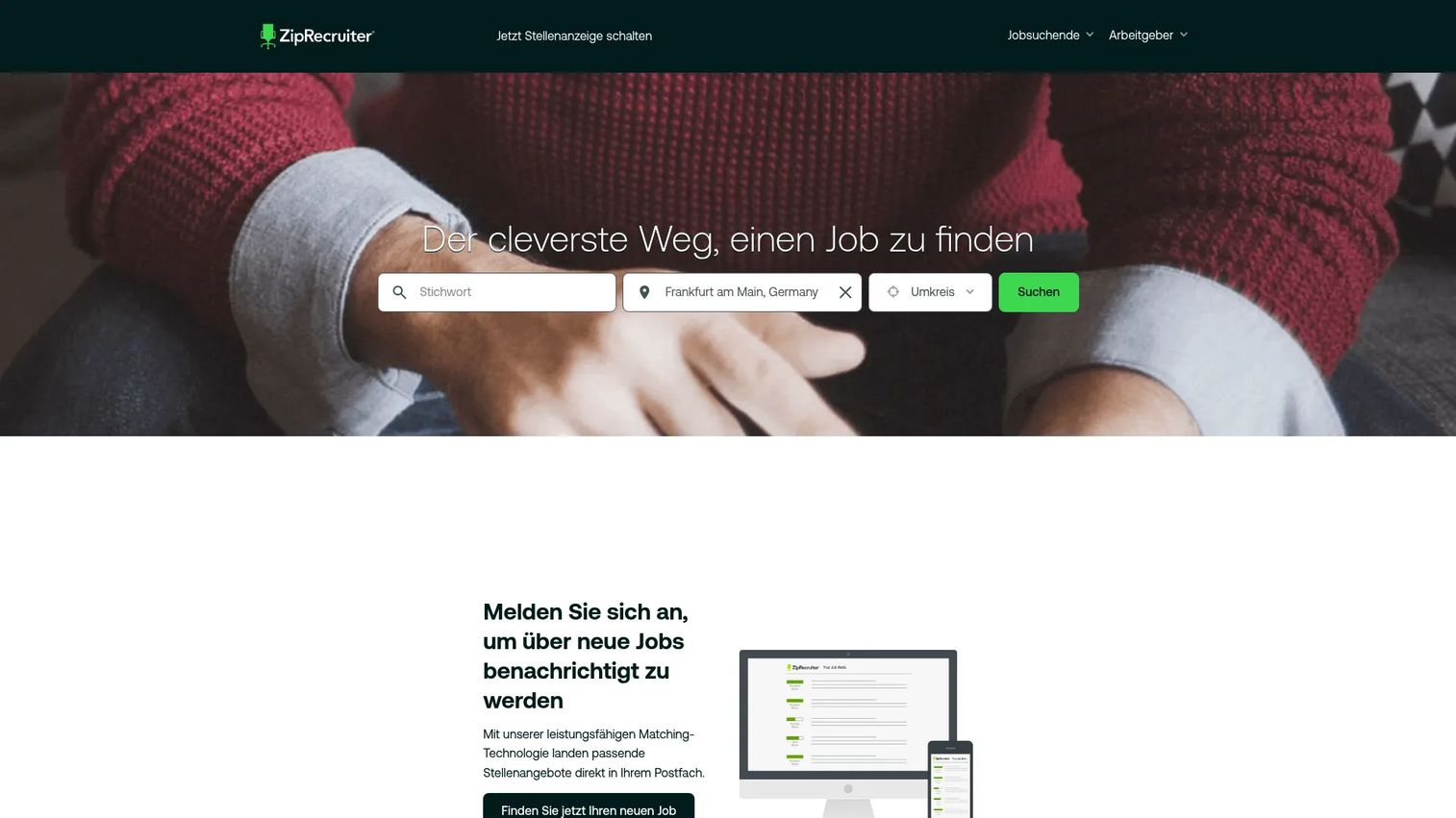
ZipRecruiter distributes job postings to more than 100 job boards from a single submission and uses AI matching to surface qualified candidates and send them proactive invitations to apply. The employer dashboard centralizes applicant management, and screening questions help filter early-stage candidates before the pipeline gets too wide.
Best for: Small and mid-sized businesses that need fast, broad job distribution and AI-assisted candidate matching without an enterprise suite.
Key features
- Job distribution to 100+ job boards from one post
- AI-powered candidate matching and proactive invitations
- Customizable screening questions and job-description templates
- Applicant dashboard for candidate management
- Resume database access
Why choose ZipRecruiter: For SMB and mid-market teams that want wide distribution without managing individual job board accounts, ZipRecruiter consolidates reach efficiently. The AI matching reduces time spent reviewing unqualified candidates.
ZipRecruiter pricing: ZipRecruiter offers Standard, Premium, and Pro plans. Free trials are available for Standard and Premium. Specific pricing requires visiting the plans page, as numeric rates are not displayed publicly. Contact ZipRecruiter or check G2 and Capterra for reviewer-reported ranges.
G2 rating: 4.8/5
11. Facebook
Facebook via Meta's ad platform supports employer branding content, paid social recruitment campaigns, local job distribution, and community group recruitment. For teams hiring local, frontline, hourly, or community-connected candidates, Facebook's audience targeting and group ecosystem offer reach that professional networks cannot replicate. Candidate storytelling through video and reels performs well for employer brand building with non-professional candidate segments.
Best for: Teams recruiting local, frontline, hourly, or community-connected candidates through social channels where professional networks have low penetration.
Key features
- Paid social recruitment ads with Meta audience targeting
- Company page content and employer branding posts
- Local community groups for organic hiring reach
- Video and reels for employer brand storytelling
- Audience retargeting for candidate pipeline building
Why choose Facebook: Facebook is the right channel for candidates who are not on LinkedIn. For local, seasonal, and frontline hiring, social recruiting through Meta reaches audiences that job boards often miss. Pairing it with strong social media marketing tools for content distribution amplifies the employer brand impact.
Facebook pricing: Facebook is free to use as a platform. Paid recruitment advertising costs vary by audience, budget, and ad auction dynamics. Meta Ads Manager sets spending based on the employer's chosen budget.
G2 rating: 4.3/5
12. Joveo
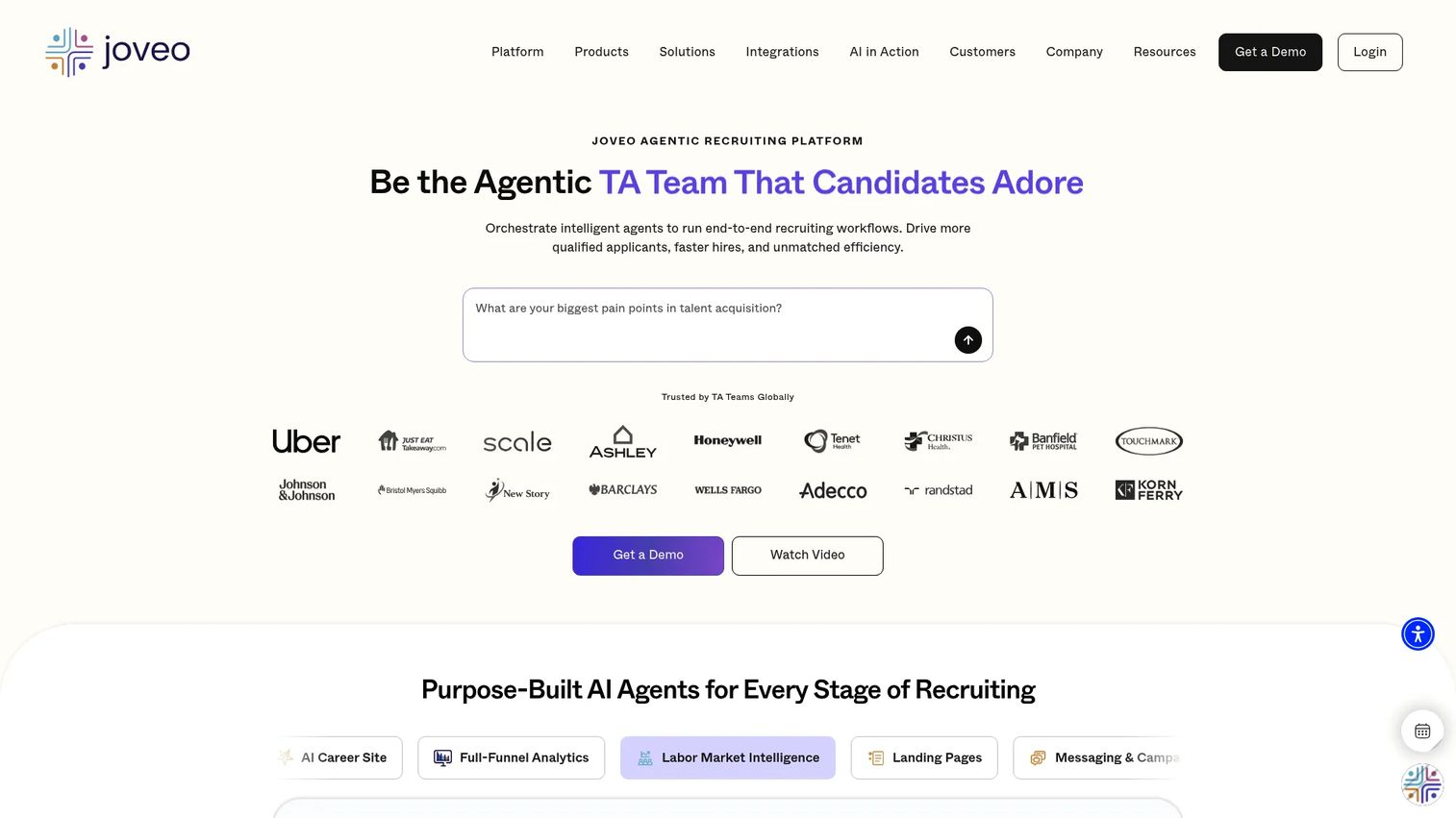
Joveo is an AI-powered recruitment marketing platform built for large employers, staffing firms, RPOs, and recruitment agencies managing high-volume, multi-channel hiring. Its programmatic job advertising engine automatically distributes job ads, adjusts bids and budgets in real time, and tracks performance from source to hire. Full-funnel attribution covers cost per applicant, cost per qualified applicant, and cost per hire across every channel.
Best for: Recruitment teams with substantial job advertising spend who need performance visibility, budget control, and source-quality attribution.
Key features
- AI-powered programmatic job advertising and distribution
- Full-funnel source-to-hire tracking and budget optimization
- AI career sites, chatbots, and talent CRM
- Automated screening and interview scheduling
- Unified analytics with real-time campaign performance
Why choose Joveo: Joveo is the clearest answer for teams treating job advertising like a paid acquisition channel. If you want cost-per-qualified-applicant data and automated budget reallocation, Joveo is built for that specific job. It is also a strong tool for the analytics that drive ROI from hiring spend.
Joveo pricing: Joveo prices by quote and does not display rates or tiers on its website. Contact sales directly. Budget expectations typically reflect programmatic media spend plus platform fees.
G2 rating: 4.8/5
13. Manatal
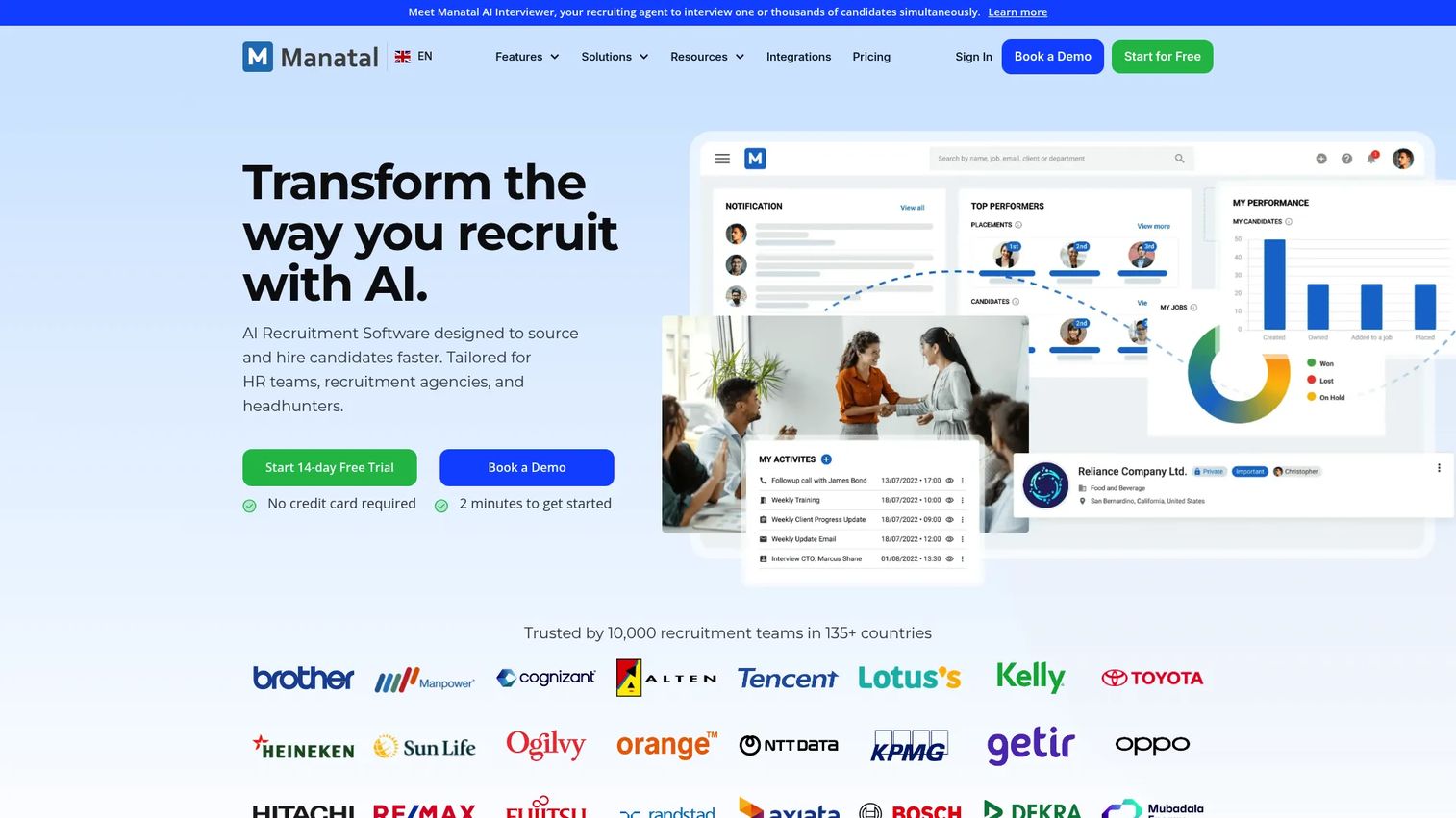
Manatal is AI-powered recruitment software for HR teams, recruitment agencies, and headhunters that want ATS and CRM capabilities at a low entry cost. It covers customizable job pipelines, AI candidate recommendations, resume enrichment with social media data, and job posting to 2,500+ channels. The 14-day free trial lets teams evaluate before committing.
Best for: Small recruiting teams and staffing agencies that need practical ATS and CRM features without enterprise complexity or enterprise pricing.
Key features
- Applicant tracking with customizable job pipelines
- AI-powered candidate recommendations, scoring, and enrichment
- Job posting across 2,500+ organic and premium channels
- Team collaboration with role-based permissions
- Reporting and recruitment analytics
Why choose Manatal: Manatal is the most accessible entry point on this list for smaller teams that want AI-assisted recruiting without a six-figure contract. The Professional plan at $15/user/month (billed annually) covers the core ATS and CRM workflow.
Manatal pricing: The Professional plan runs $15/user/month billed annually ($19/user/month billed monthly). Enterprise is $35/user/month annually. Enterprise Plus is $55/user/month annually. A custom plan is available on demand. A 14-day free trial is offered; no free tier exists.
G2 rating: 4.8/5
14. PowerToFly
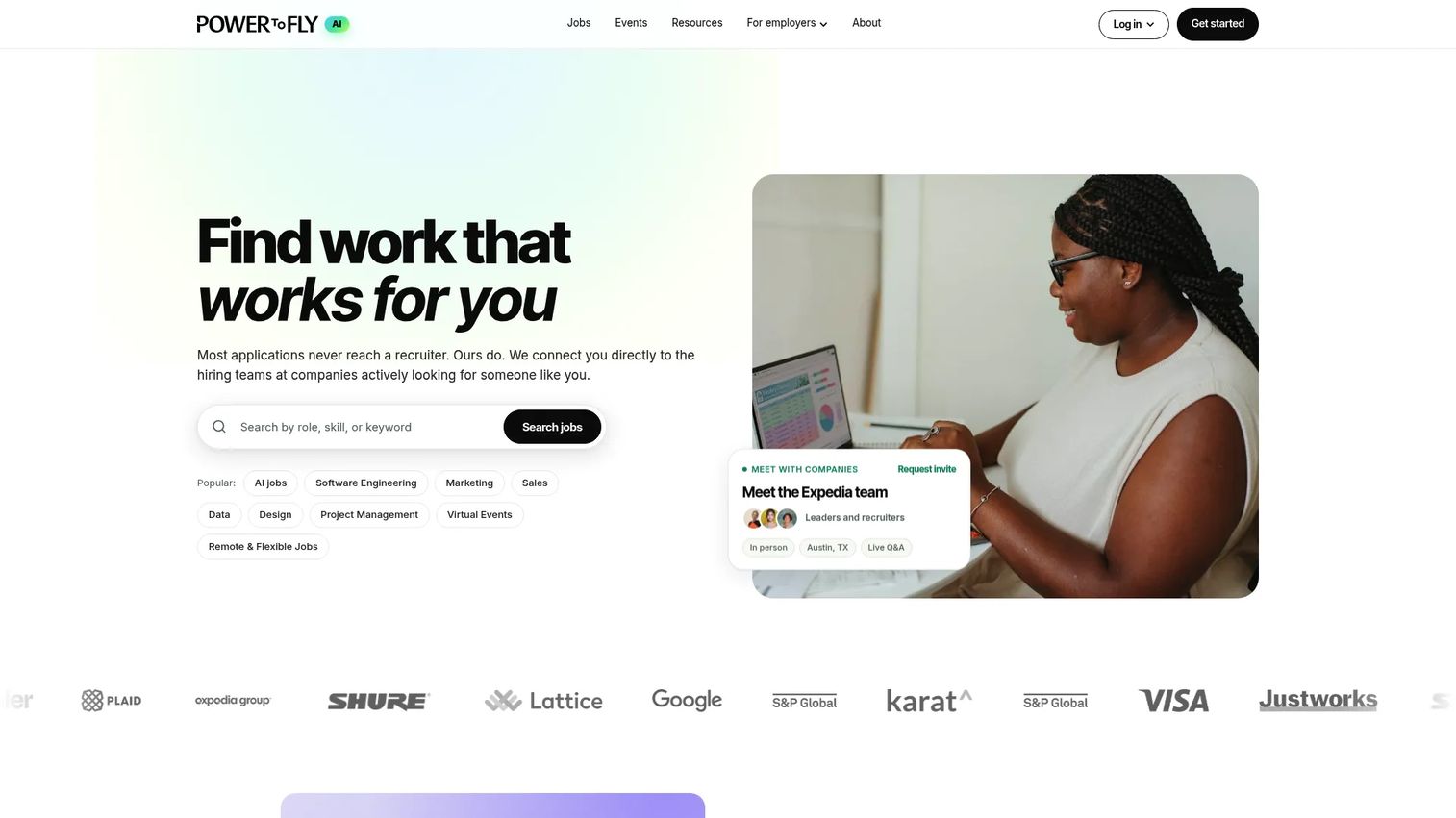
PowerToFly connects companies with domain-qualified professionals, with a particular focus on underrepresented and diverse talent in tech and AI fields. It supports full-time and contract hiring, model training and AI evaluation work, virtual hiring events, and job board access for diverse candidate communities. Employers use it to build community-connected employer branding alongside sourcing.
Best for: Companies hiring diverse talent, particularly in tech and AI roles, who want community access, virtual events, and employer branding tools in one place.
Key features
- Diverse talent community sourcing and job board access
- Hiring events: Virtual and community-focused
- Full-time, contract, and project-to-hire candidate access
- Employer branding and culture content tools
- AI model training, evaluation, and QA candidate sourcing
Why choose PowerToFly: PowerToFly is the strongest option on this list for DEI-focused candidate sourcing combined with community engagement. It is particularly relevant for tech and AI hiring teams that need both skilled candidates and a credible employer brand story for underrepresented talent.
PowerToFly pricing: PowerToFly handles pricing through discovery calls and does not display rates on its employer pages. Contact sales to request a quote. Pricing varies by hiring volume and campaign scope.
G2 rating: 4.8/5
15. Freshteam
Freshteam is an HR software platform for recruiting, onboarding, employee information management, and time-off administration. It covers applicant tracking, candidate management, interview scheduling, feedback collection, and employee onboarding workflows. Freshteam sits within the Freshworks product family, which means integrations with other Freshworks tools are available. For small businesses that need recruiting inside a broader HR context, Freshteam consolidates several workflows.
Best for: Growing small businesses that want recruiting, onboarding, and basic employee management workflows in one HR platform.
Key features
- Applicant tracking and candidate management
- Recruiting workflows and interview scheduling
- Employee onboarding and employee database management
- Time-off management and employee self-service
- Feedback collection and hiring collaboration
Why choose Freshteam: Freshteam suits small businesses that want to consolidate recruiting and HR without paying enterprise prices. The free tier and low per-employee Growth pricing make it accessible for teams under 50 people.
Freshteam pricing: A free forever plan is available. The Growth plan runs $1/employee/month plus a $59.99 platform fee per month. The Pro plan runs $2/employee/month plus a $99 platform fee per month. These figures are sourced from G2; the Freshworks official Freshteam page was not directly accessible at the time of research, so confirm current pricing on the Freshworks site before purchasing.
G2 rating: 4.4/5
16. Jobvite
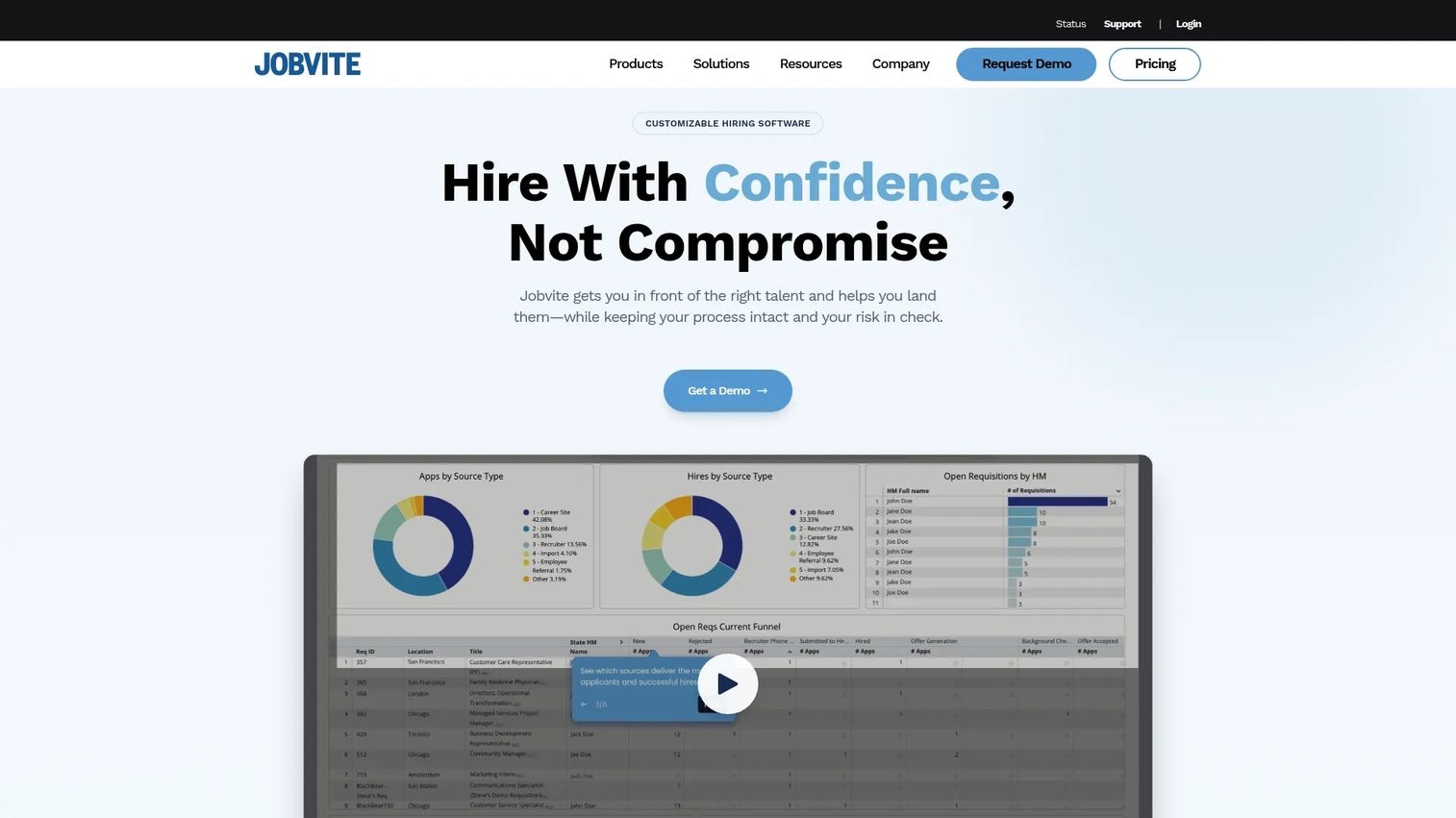
Jobvite is an enterprise talent acquisition suite covering recruiting, applicant tracking, recruitment marketing, onboarding, referrals, and analytics. The recruitment marketing module includes branded career sites, talent CRM, email and SMS campaigns, job distribution, and source attribution analytics. AI-powered candidate matching, screening, chatbots, and interview scheduling are included as part of the modular platform.
Best for: Enterprise recruiting teams that want recruitment marketing, career sites, CRM, and ATS alignment without managing separate systems.
Key features
- Career sites and branded candidate experience
- Talent CRM with email and SMS campaign tools
- AI-powered candidate matching and screening
- Job distribution and source attribution analytics
- ATS workflows with configurable dashboards and collaboration
Why choose Jobvite: Jobvite suits mid-market and enterprise teams that want the recruitment marketing layer tightly connected to the full hiring process. If source attribution and campaign analytics are central to how you report hiring ROI, Jobvite's connected suite reduces data gaps between marketing and recruiting.
Jobvite pricing: Jobvite uses a modular, quote-based approach. There is no public pricing displayed. Contact sales to build a quote starting from the core ATS, then adding recruitment marketing, onboarding, and AI modules as needed.
17. PageUp
PageUp is an AI-powered talent acquisition and talent management platform for enterprise organizations. It covers recruitment marketing with career sites, talent pools, and automation, plus applicant tracking, onboarding, performance management, learning, and succession planning. AI capabilities include skills matching, anonymized candidate profiles, interview guides, and intelligent quick actions across the platform.
Best for: Enterprise and global talent acquisition teams that want recruitment marketing inside a broader talent management platform.
Key features
- Recruitment marketing with career sites and talent pools
- Applicant tracking with customizable workflows
- Onboarding with personalized portals and compliance safeguards
- AI skills matching and anonymized candidate profiles
- Performance, learning, and succession analytics
Why choose PageUp: PageUp suits organizations that want to connect recruitment marketing to the broader talent lifecycle, including onboarding, performance, and succession. Global teams with compliance and localization needs should evaluate PageUp's enterprise governance capabilities directly with the vendor.
PageUp pricing: PageUp does not display pricing on its website. Contact sales for a quote. No public tiers or numeric rates were found during research.
G2 rating: 4.4/5
18. Teamtailor

Teamtailor is an all-in-one recruitment platform combining applicant tracking, employer branding, candidate engagement, hiring workflows, and onboarding. Its career site builder supports custom branded pages, employee story content, and campaign-specific landing pages. The AI Co-pilot assists with candidate screening, resume summaries, interview preparation, and content creation. Teamtailor is built for teams that want a polished candidate-facing presence without enterprise complexity.
Best for: Startups and mid-market companies that want an attractive career site, structured ATS workflows, and AI-assisted recruiting in one tool.
Key features
- Employer-branded career site with campaign pages
- AI Co-pilot for screening, summaries, and content creation
- Applicant tracking and customizable recruitment workflows
- Candidate messaging and automated communication
- Hiring and onboarding workflows
Why choose Teamtailor: Teamtailor is the clearest choice for growing companies that have an employer branding problem more than a distribution problem. The career site builder and candidate experience tools are strong for the price point, and the AI Co-pilot reduces manual work in screening and communication.
Teamtailor pricing: Teamtailor provides custom quotes and does not display pricing publicly. Plans include unlimited job postings, unlimited users, and over 250 features. Contact sales for pricing.
G2 rating: 4.6/5
19. Workable
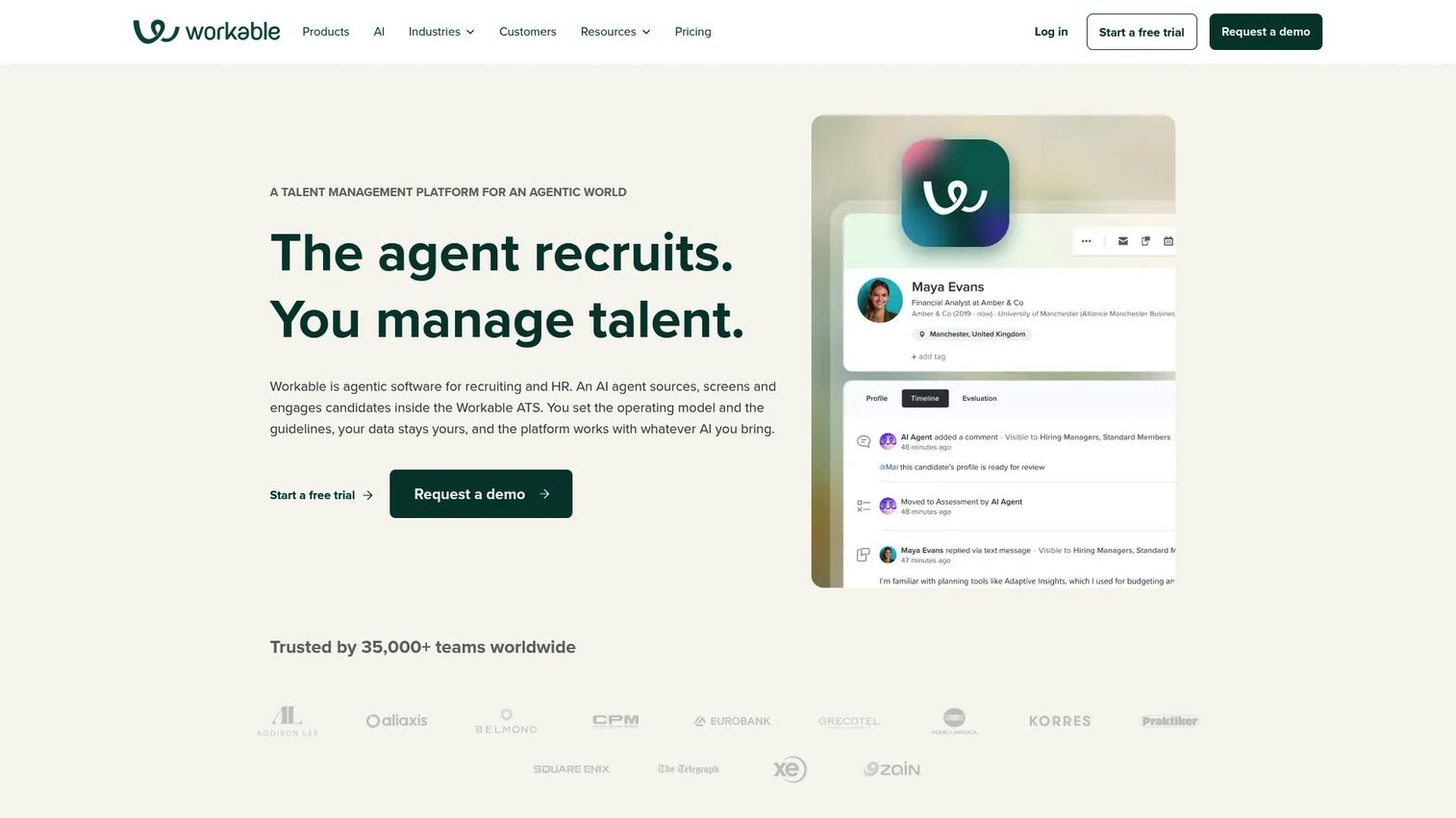
Workable is an all-in-one recruiting and HR platform combining applicant tracking, candidate sourcing, hiring workflows, and employee management. It distributes job postings to 200+ job boards, uses AI for candidate recommendations and sourcing, and includes interview kits, scorecards, and scheduling tools for structured hiring. Employee profiles, time off, time tracking, and payroll integrations extend it into broader HR territory.
Best for: Organizations seeking an integrated recruiting ATS and HR platform with AI sourcing, structured hiring workflows, and broad job distribution.
Key features
- Job distribution to 200+ job boards from one posting
- AI-powered candidate sourcing and recommendations
- Applicant tracking with customizable pipelines and scorecards
- Interview scheduling and video-conferencing integrations
- Employee profiles, onboarding, and payroll integrations
Why choose Workable: Workable gives growing teams transparent pricing, broad distribution, and AI sourcing without requiring an enterprise contract. The Standard plan at $299/month covers small teams, and the platform scales from recruiting into basic HR operations as the company grows.
Workable pricing: The Standard plan runs $299/month (for 1 to 20 employees). Premier is $599/month and Enterprise $719/month for the same employee tier. Pricing scales with employee count. A 15-day free trial is offered.
G2 rating: 4.4/5
20. SmartRecruiters
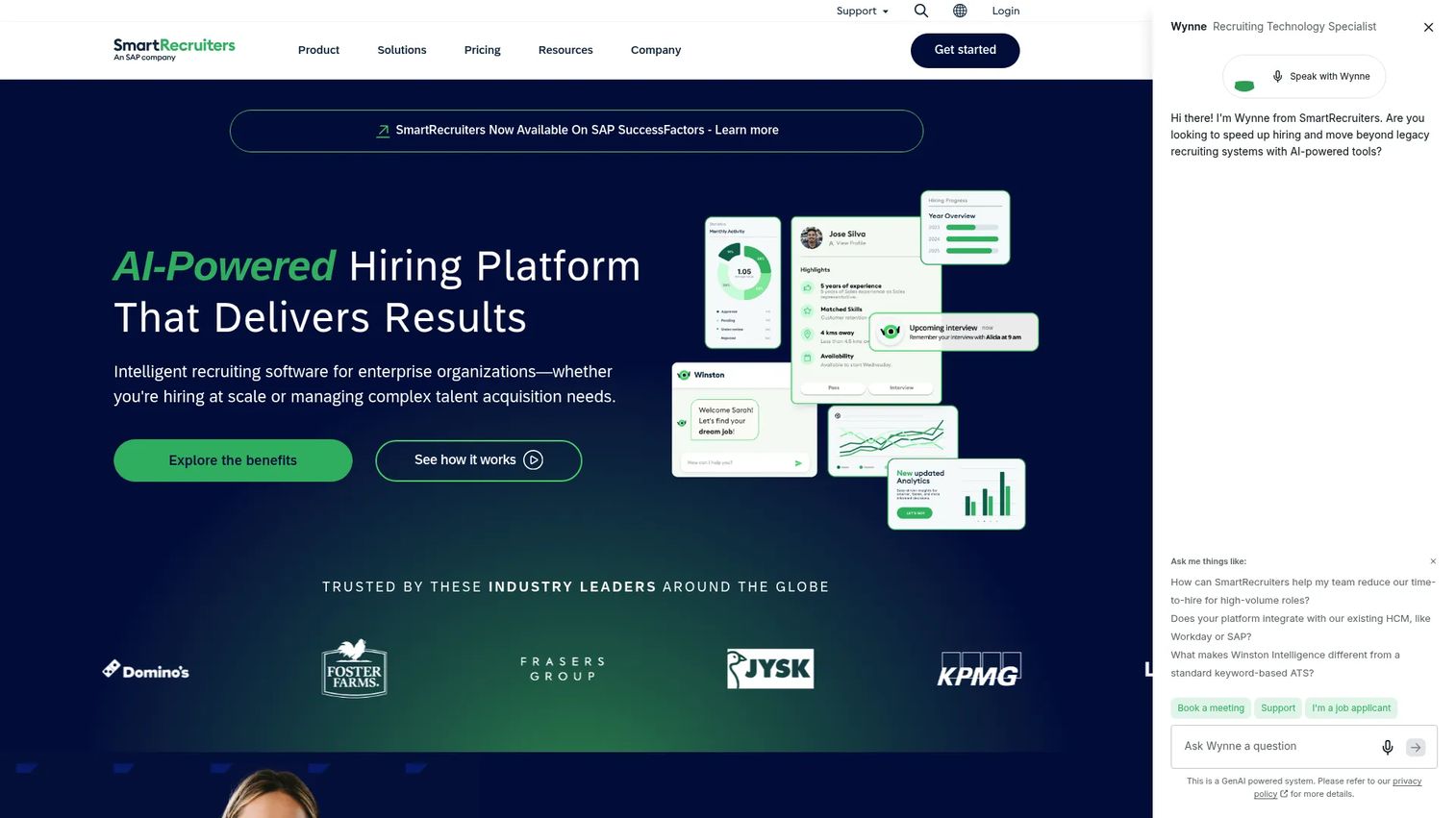
SmartRecruiters provides an AI-powered talent acquisition platform for mid-market and enterprise organizations. It covers candidate attraction, applicant tracking, talent CRM, AI matching, conversational AI for candidate engagement, dynamic interview scheduling, job distribution, offer management, and onboarding. The marketplace integrations connect SmartRecruiters to hundreds of HR tools. Enterprise governance and analytics capabilities support multi-region and multi-business-unit deployments.
Best for: Larger teams consolidating talent acquisition operations across regions or business units into one platform.
Key features
- Applicant tracking and talent CRM
- AI talent matching and candidate screening
- Conversational AI and dynamic interview scheduling
- Job distribution and offer management
- Analytics, onboarding, and enterprise governance
Why choose SmartRecruiters: SmartRecruiters suits enterprise teams that want a comprehensive talent acquisition platform with published entry-level pricing. The Essential plan gives buyers a concrete starting point before moving to Professional, High Volume, or Complete tiers.
SmartRecruiters pricing: The Essential plan starts at $14,995. Professional, High Volume, and Complete plans require a sales conversation for pricing. No free tier was verified.
G2 rating: 3.9/5
21. Workday
Workday is an AI-powered enterprise platform that unifies HR, finance, payroll, workforce management, and related business operations. Workday Recruiting sits within that broader HCM suite, covering candidate management, internal mobility, requisition workflows, and workforce analytics. For organizations already running Workday for HR and finance, recruiting inside the platform removes data silos and simplifies reporting across the talent lifecycle.
Best for: Large organizations using Workday for HR and finance who want recruiting integrated with HCM, workforce data, and internal mobility.
Key features
- Recruiting workflows within the full Workday HCM suite
- HCM integration for seamless workforce data continuity
- Internal mobility and career pathing
- Workforce analytics and succession planning
- Embedded AI agents and conversational self-service
Why choose Workday: Workday makes sense when recruiting is a downstream concern from broader enterprise HR and finance operations. If your organization already runs Workday, consolidating recruiting into that system eliminates integration overhead and gives workforce analytics a single data model.
Workday pricing: Workday prices through enterprise sales and does not display numeric rates. Contact Workday directly. Implementation costs, module selection, and contract scope all drive the total investment.
G2 rating: 4.2/5
Considerations when choosing a recruitment marketing platform
Start with the funnel gap
The right platform depends on which part of the candidate funnel is broken. Low awareness calls for employer brand investment on LinkedIn, Glassdoor, and social. High traffic with few applicants points to a career site and conversion problem. High spend with weak quality suggests a programmatic advertising and attribution gap. Strong applicant volume with a weak pipeline is a talent CRM and nurture issue. Diagnose before you shortlist.
Verify integration depth
Ask whether the integration is native, API-based, one-way, two-way, batch, or real-time. A recruitment marketing platform that sends data to your ATS once a day is not the same as one that syncs candidate status in real time. Check which specific ATS, HRIS, CRM, analytics, and background check tools are supported before assuming compatibility.
Compare attribution beyond source names
Most ATS reports show source by name. That is not enough for growth marketers accountable for hiring ROI. Look for platforms that track cost per applicant, cost per qualified applicant, cost per hire, apply completion rate, and channel quality separately. The difference between a platform that counts applications and one that attributes hires is where recruiting marketing analytics software earns its value.
Check governance and compliance needs
Consent management, data retention, accessibility, localization, permissions, and data residency all vary significantly across platforms. Enterprise buyers with global hiring teams or regulated industries should ask specific questions about where candidate data is stored, how consent is captured, and whether the platform supports local data privacy requirements. This is an operational evaluation question, not legal advice.
Model total cost before signing
Platform licensing is rarely the full cost. Add implementation, career site development, media spend, integration work, and ongoing professional services. For teams asking "what does this replace?", list the current tools the platform eliminates and credit those savings against the new investment before comparing line-item prices.
Conclusion
Recruitment marketing platforms span a wide spectrum: Full enterprise suites, programmatic job advertising engines, employer brand channels, and SMB-friendly recruiting tools. The right choice depends on your funnel gap, not your feature wishlist.
For enterprise candidate experience at scale, Phenom, iCIMS, SmartRecruiters, and Workday are the primary options. For talent CRM and candidate nurture, Beamery, Jobvite, and iCIMS cover the ground best. If paid job advertising attribution is the problem, Joveo, Indeed, and LinkedIn give the most direct control over spend and quality. Employer brand and community hiring point to Symphony Talent, Glassdoor, Teamtailor, and PowerToFly. Smaller teams that need fast setup and published pricing can start with Workable, Manatal, or Freshteam.
Choose the platform that fixes the specific part of your candidate acquisition funnel that is costing you qualified hires. Review integration compatibility with your ATS and HRIS, verify total cost including implementation and media, and request a quote from the two or three vendors that fit your operating gap.
Start your journey with Guideflow today!
FAQs
A recruitment marketing platform is software that helps companies attract, engage, nurture, and convert candidates before they submit an application. It covers employer branding, career sites, job distribution, talent CRM, candidate nurture campaigns, source attribution, and recruitment analytics. Recruitment marketing platforms work upstream of the applicant tracking system, influencing the candidate funnel from awareness through application.
An ATS manages candidates after they apply, covering interview stages, offer letters, and onboarding workflows. Recruitment marketing software works before the application, building employer brand awareness, converting career site visitors, distributing jobs, and nurturing passive candidates. Some platforms, including iCIMS, SmartRecruiters, Jobvite, and Workday, combine both functions in one system, which helps teams reduce tool sprawl and improve attribution across the full hiring funnel.
Core capabilities include a career site builder, job distribution to multiple channels, talent CRM for candidate pipeline management, email and SMS nurture campaigns, employer brand content tools, source attribution reporting, and recruitment analytics covering cost per applicant and cost per hire. More advanced platforms add AI candidate matching, programmatic job advertising with budget optimization, and consent and governance controls for data privacy compliance.
The most useful hiring ROI metrics are cost per applicant, cost per qualified applicant, cost per hire, apply completion rate, channel quality, and hire attribution by source. Measuring these requires a platform that tracks the candidate from first touchpoint through hire, not just from application. Establishing a baseline before switching platforms is critical; without a starting point, attribution data has nothing to compare against.
Enterprise teams typically evaluate Phenom, iCIMS, SmartRecruiters, Workday, and Beamery. The best fit depends on the specific operating gap: Phenom for AI-driven candidate experience, iCIMS for a connected talent cloud, SmartRecruiters for platform consolidation, Workday for HCM integration, and Beamery for skills-based workforce planning alongside recruiting. These platforms all price through sales conversations and require multi-stakeholder evaluation.
Joveo, Indeed, ZipRecruiter, LinkedIn, and SmartRecruiters are strong for high-volume scenarios. Joveo provides the most direct control over programmatic budget and source quality. Indeed gives free baseline reach plus scalable sponsored job spend. ZipRecruiter distributes to 100+ job boards from one post. LinkedIn reaches professional and technical candidates at volume. For high-volume hourly and frontline hiring, Facebook's paid social and local community reach often outperforms professional networks.
Small businesses rarely need enterprise suites. Workable ($299/month), Manatal ($15/user/month), Freshteam (free to start), ZipRecruiter, LinkedIn, or Teamtailor are more appropriate starting points. The deciding factors are hiring volume, ATS need, and budget. A 20-person company filling two or three roles a year has different requirements than a 200-person company scaling quickly. Start with the tool that fixes your most expensive hiring problem, then expand.
Pricing varies significantly by platform type and company size. Job boards like Indeed offer free basic posting with results-based sponsored pricing. SMB tools like Manatal and Workable publish monthly rates starting from $15 to $299/month. Enterprise suites like Phenom, iCIMS, Beamery, Jobvite, and Workday price by quote, with costs driven by module selection, hiring volume, user count, integrations, and implementation scope. SmartRecruiters publishes an Essential plan starting at $14,995 as an enterprise entry point. Verify all pricing directly with the vendor before shortlisting, as rates change and depend on the specific contract terms.