

Leads come in faster than you can qualify them. A form fill lands at 2:14pm, and by the time you open it, three more are waiting. Half have a personal Gmail address. One listed "1-10 employees" but is clearly a 500-person company. You have no idea which of these is worth a call and which will waste 20 minutes of discovery.
Speed is the whole game here. The global lead management software market was valued at $2.77 billion in 2023 and is projected to reach $7.76 billion by 2030, growing at a 16.6% CAGR, according to Grand View Research (2024). That growth exists because manual qualification does not scale. Reps burn hours on low-fit leads while good ones cool off in the queue.
The real problem is not that you have too many leads. It is that you cannot tell them apart fast enough. Lead scoring, routing, enrichment, and clean handoff are the four levers that fix that, and the right software pulls all four. Most of these tools were built to reduce the number of clicks between a lead arriving and a rep knowing exactly what to do with it.
What's inside
This guide is for SDRs, sales ops, and RevOps teams who need to qualify inbound leads faster and hand them off cleaner. We picked 10 tools that cover the full qualification workflow: scoring, routing, enrichment, scheduling, and conversational capture.
We evaluated each tool on:
- Speed: how fast it moves a lead from arrival to actionable
- CRM fit: how well it plugs into your existing stack
- Data quality: enrichment depth and accuracy
- Automation depth: scoring logic, routing rules, and real-time recalculation
- Ease of adoption: how quickly a team can run it without RevOps babysitting
TL;DR
- Best for qualify-at-capture: Perspective builds mobile-first funnels that qualify leads before they ever hit your queue.
- Best for AI conversational qualification: Meera uses two-way SMS to qualify and warm-transfer leads to reps.
- Best for real-time, event-driven scoring: Default recalculates qualification as new signals land.
- Best all-in-one for smaller teams: HubSpot bundles scoring, routing, and workflows inside one CRM.
- Best for routing and handoff: Chili Piper removes friction between form fill and booked meeting.
- Best for enrichment-heavy workflows: Clearbit and Apollo.io clean and enrich data so you stop wasting touches.
What is lead qualification software?
Lead qualification software is a category of sales and marketing tools that automatically evaluate, score, and route incoming leads so teams can prioritize high-fit prospects and hand them off faster. It combines data enrichment, scoring logic, routing rules, and scheduling into a single qualification workflow.
The category is often lumped together, but each function does something distinct. Understanding the difference is how you avoid buying the wrong tool.
- Lead scoring software assigns a numeric or grade-based value to each lead using firmographic fit, behavior, and intent signals. Higher score, higher priority.
- Lead routing software decides who gets the lead and sends it there instantly, using round-robin, territory, account ownership, or segment rules.
- Lead enrichment software fills gaps in a record: company size, industry, tech stack, job title, verified email. Better data means better scoring.
- Scheduling and handoff tools turn a qualified lead into a booked meeting without back-and-forth, protecting speed-to-lead.
- Conversational qualification uses chat or SMS to ask qualifying questions in real time, then routes or books based on the answers.
The strongest platforms combine several of these. A form fill gets enriched, scored against your ideal customer profile, routed to the right rep, and booked, all in seconds. That is the difference between real-time lead qualification and a spreadsheet you review on Fridays.
When to use lead qualification software
Not every team needs every function. Here is how to pattern-match to your situation.
When inbound speed matters more than volume
If most of your pipeline comes from demo requests and form fills, speed-to-lead is your moat. Research consistently shows the odds of connecting drop sharply after the first few minutes. Tools that score and route the instant a lead arrives protect that window. This is where automated scoring and instant routing earn their cost.
When CRM data is too messy to qualify manually
Half-filled records, generic email domains, and duplicate contacts make manual qualification a guessing game. Lead enrichment software fills the gaps before a rep ever looks. If your CRM integration is the bottleneck, enrichment-first tools clean the data at capture so scoring actually means something.
When routing and handoff break deals
A qualified lead that sits unassigned for six hours is a lost lead. If good meetings die in the gap between marketing and sales, you have a routing and handoff problem, not a qualification one. Routing tools remove the manual assignment step and get the lead to the right rep with context attached.
When SDRs need qualification without adding clicks
SDRs already live in 7-plus tabs. If a tool adds work instead of removing it, adoption dies. The best qualification software runs in the background of your existing CRM and sequencer, scoring and routing without asking the rep to do anything extra.
Lead qualification software comparison
These tools differ most by which stage of qualification they strengthen. Some qualify at capture, some score with predictive models, some route and book, and some enrich the data everything else depends on. Sort by the workflow gap you actually have.
| # | Product | Intent | Key differentiation | Pricing | G2 rating |
|---|---|---|---|---|---|
| 1 | Perspective | Qualify at capture | Mobile-first funnels that qualify before the queue | From €297/month | 4.7/5 |
| 2 | Meera | Conversational qualification | AI two-way SMS with warm transfer to reps | Custom pricing | 4.7/5 |
| 3 | Default | Real-time scoring | Event-driven recalculation and GTM orchestration | From $500/month | 4.5/5 |
| 4 | HubSpot | All-in-one workflow | Native scoring, routing, and workflows in one CRM | Free; paid from $7/seat/mo | 4.4/5 |
| 5 | Chili Piper | Routing and scheduling | Form-to-meeting booking with instant handoff | From $1,250/month | 4.6/5 |
| 6 | Apollo.io | Prospecting and enrichment | Data, enrichment, and outreach in one platform | Free; paid from $49/seat/mo | 4.7/5 |
| 7 | Clearbit | Data enrichment | Real-time enrichment and visitor intent signals | Custom pricing | 4.4/5 |
| 8 | MadKudu | Predictive scoring | Predictive models for lead prioritization | Custom pricing | 4.5/5 |
| 9 | 6sense | Account qualification | Intent data and account-level prioritization | Custom pricing | Not listed |
| 10 | Drift | Chat qualification | AI chat that qualifies and routes web visitors | Free tier available | 4.4/5 |
Best 10 lead qualification software tools for 2026
1. Perspective
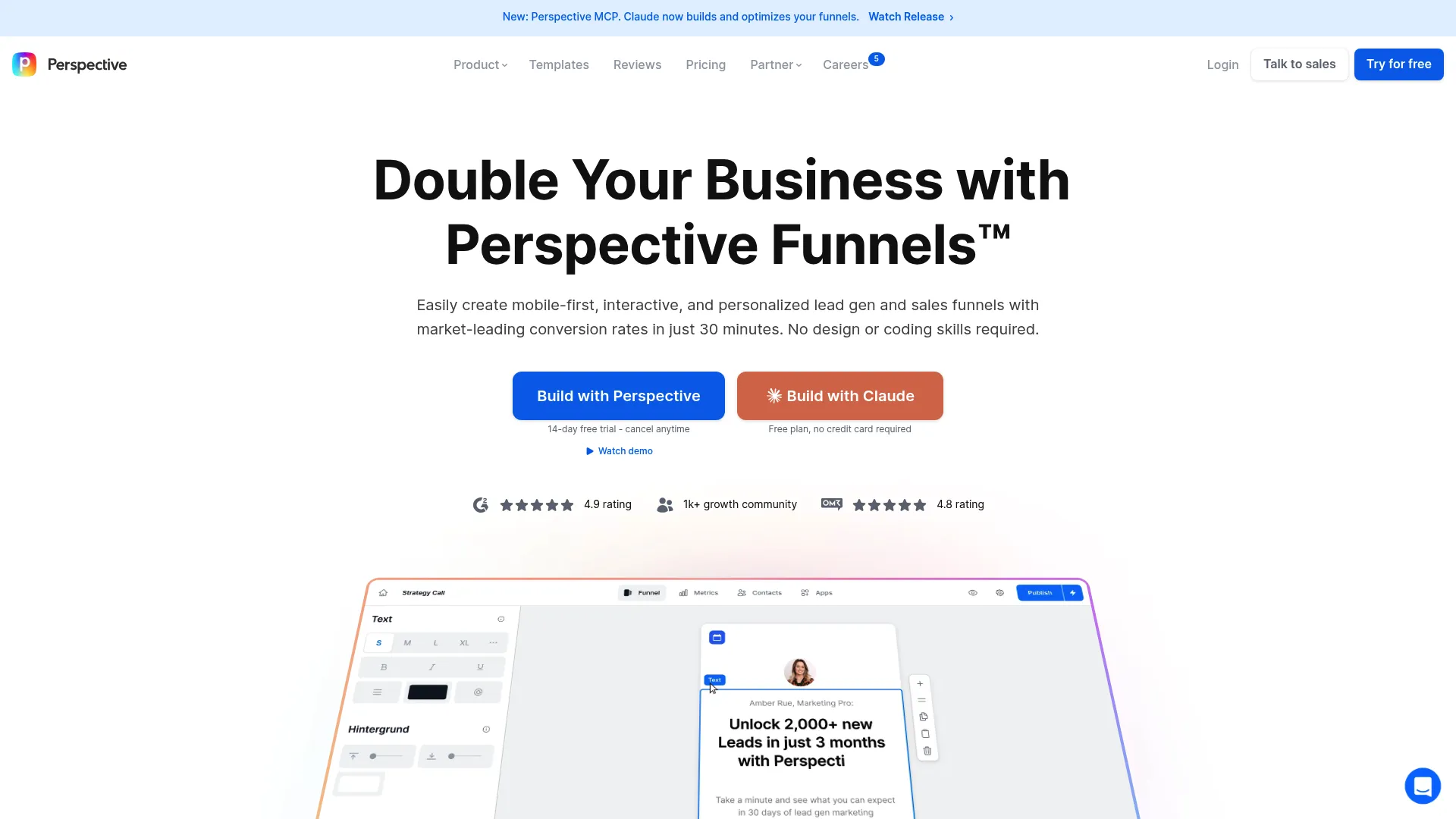
Perspective is mobile-first funnel and landing page software built to qualify leads at the point of capture. Instead of dumping every form fill into your queue, it uses short, interactive funnels that ask qualifying questions up front. By the time a lead reaches you, the low-fit ones have already filtered themselves out.
For SDRs, that changes the math. You spend less time triaging and more time on leads that already answered the questions you would have asked on a first call. The AI funnel builder and A/B testing let marketing tune the qualification questions without engineering.
Best for: Agencies and growth teams building mobile-first lead funnels that qualify before the handoff.
Key strengths
- AI funnel builder for fast qualification flows
- A/B testing to optimize qualification questions
- Mobile-responsive funnels for high-intent traffic
Why choose Perspective: If your pain is volume of low-fit leads, moving qualification to capture cuts the noise before it reaches your CRM. It fits marketing and growth teams running paid campaigns more than pure outbound SDR motions.
Perspective pricing: No permanent free tier. The Expand plan is €297/month and the Scale plan is €969/month, both charged annually. A 14-day free trial is available.
2. Meera
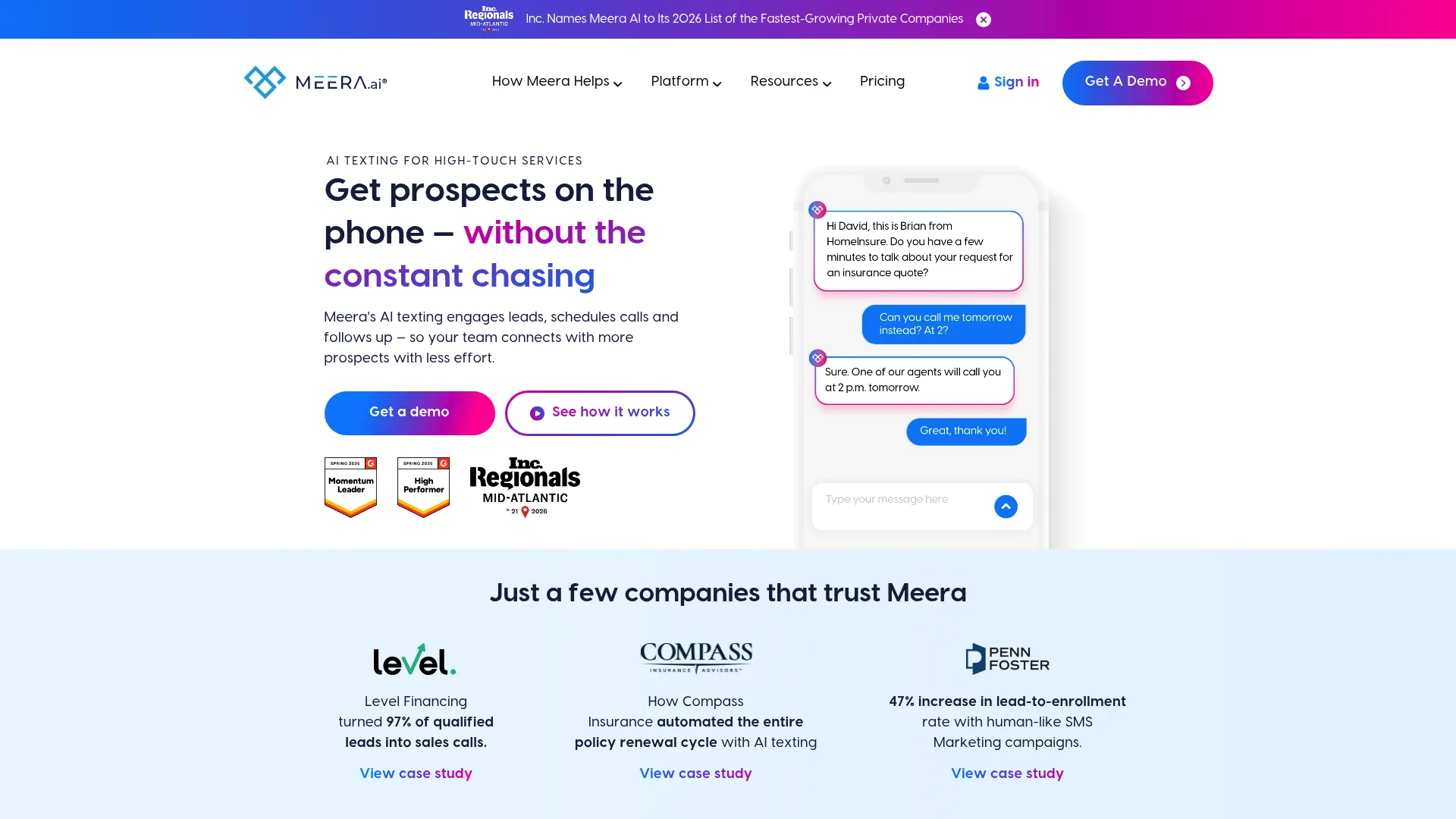
Meera is an AI texting and conversational qualification platform. It runs two-way SMS conversations with inbound leads, asks qualifying questions, handles common objections, and warm-transfers the ready ones to a live rep. The point is to keep leads engaged in the channel they actually respond to while a human only steps in when it counts.
For high-volume inbound teams, this closes the speed-to-lead gap without adding headcount. A lead that would have waited in a queue gets a text back in seconds and moves through qualification on its own.
Best for: High-volume teams that want AI-assisted text outreach and qualification before a rep gets involved.
Key strengths
- Two-way SMS conversations with leads
- Automated qualification and objection handling
- Warm transfer to live agents at the right moment
Why choose Meera: If your leads respond to text far better than calls or email, conversational SMS qualification protects speed-to-lead at scale. It fits teams with heavy inbound volume more than low-volume, high-touch enterprise motions.
Meera pricing: Pricing is customized based on lead volume. The pricing page directs you to request a quote rather than listing a public number.
3. Default
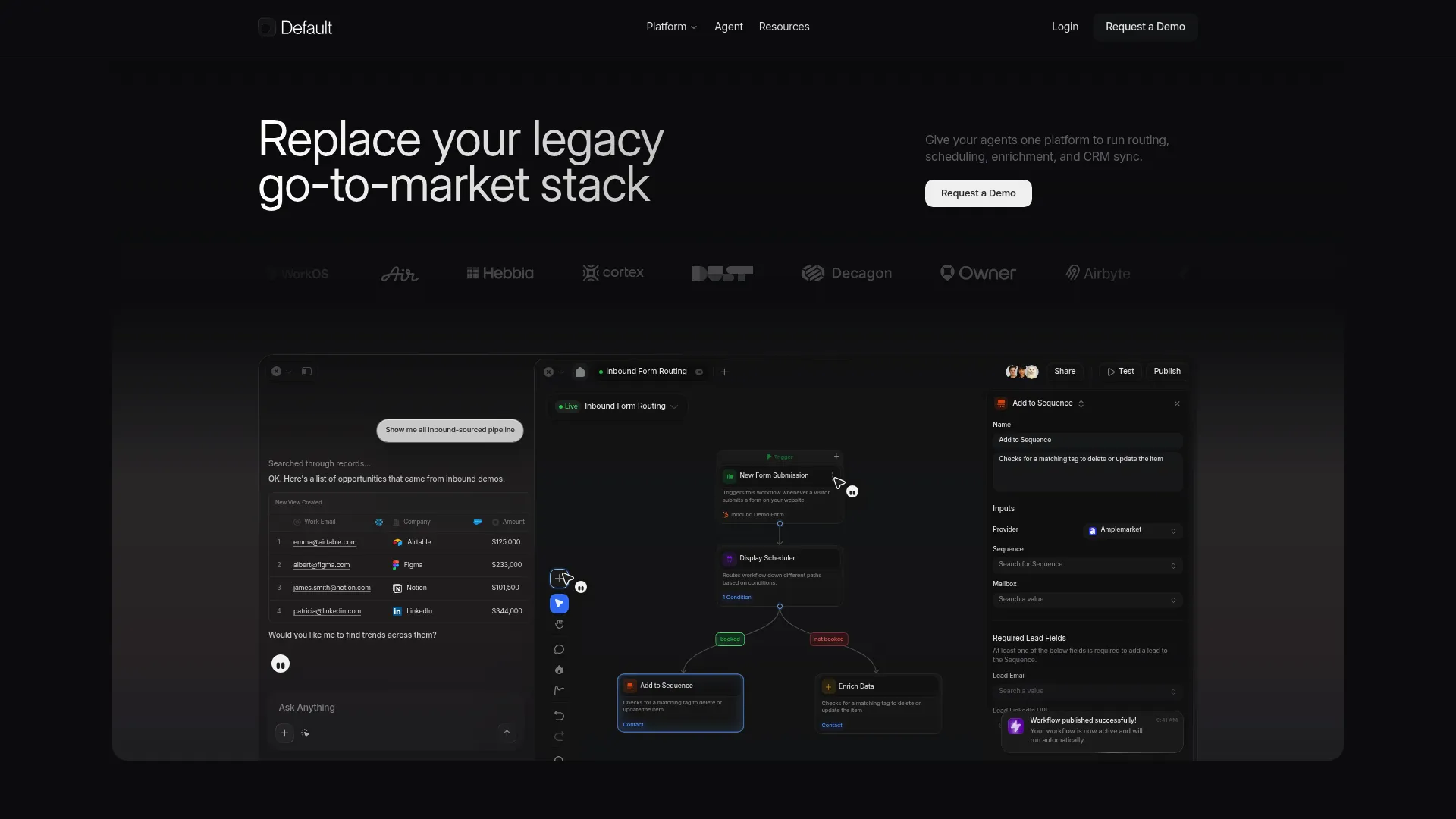
Default is AI infrastructure for go-to-market teams, built around a unified revenue data layer. Its differentiator is real-time, event-driven qualification: when a new signal lands, a form fill, an enrichment update, a product event, the lead score recalculates immediately rather than on a batch schedule. Scheduling, routing, and workflows run on top of that live data.
For RevOps teams, the appeal is transparency. You can see why a lead scored the way it did and audit the logic, instead of trusting a black-box number. That auditability is a real gap in most scoring tools.
Best for: RevOps and GTM teams that need workflow automation for routing, scheduling, and enrichment on live data.
Key strengths
- Unified revenue data and orchestration layer
- Agent-native scheduling, routing, and workflows
- Bi-directional integrations with revenue tools
Why choose Default: If your scoring feels stale by the time a rep acts on it, event-driven recalculation keeps qualification current. It fits teams that want to own and audit their qualification logic rather than accept a fixed model.
Default pricing: The Growth plan is listed at $500/month, with the Scale plan at custom pricing. Default uses quote-based pricing rather than published per-seat plans.
4. HubSpot
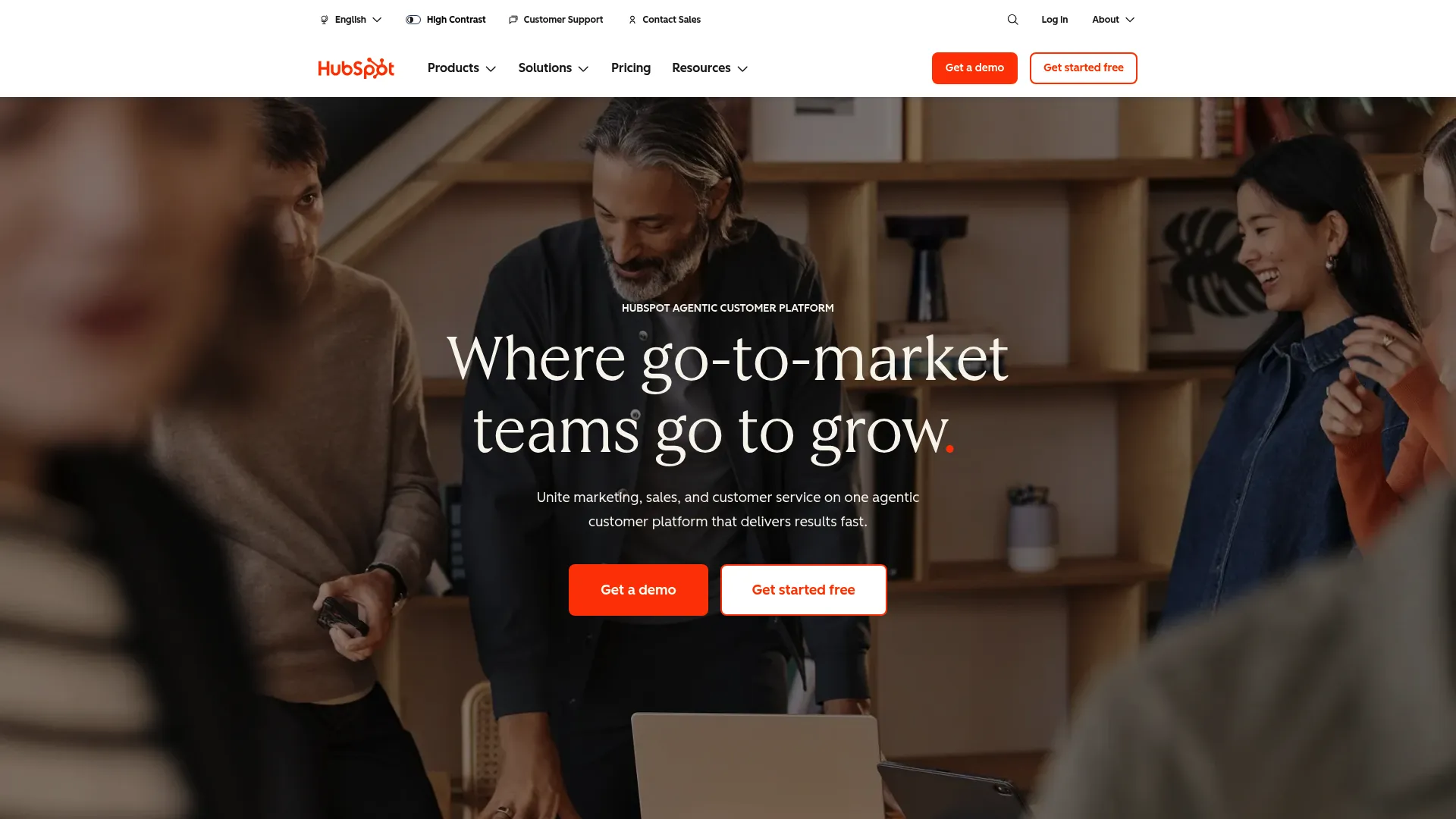
HubSpot is a full customer platform with CRM, marketing, sales, and service tools. For qualification, the value is that scoring, routing, and workflow automation all live natively inside the CRM where your reps already work. No separate tool, no extra tab, no sync lag. You build lead scoring rules and routing workflows in the same place you track the pipeline.
For teams already on HubSpot, this is the lowest-friction path to real qualification. The scoring and routing are not the deepest on this list, but the CRM integration is native by definition, and adoption is easy because reps never leave the platform.
Best for: Teams that want an all-in-one CRM with qualification workflows built in.
Key strengths
- Smart CRM as the system of record
- Marketing automation and lead scoring
- Sales and service hubs with routing workflows
Why choose HubSpot: If you value one platform over best-in-class point tools, native scoring and routing beat stitching together five vendors. It fits smaller and HubSpot-native teams better than orgs needing predictive models or account-based intent.
HubSpot pricing: A free plan is available. Starter starts at $7/seat/month, Professional at $800/month, and Enterprise at $4,700/month, billed monthly or annually.
5. Chili Piper
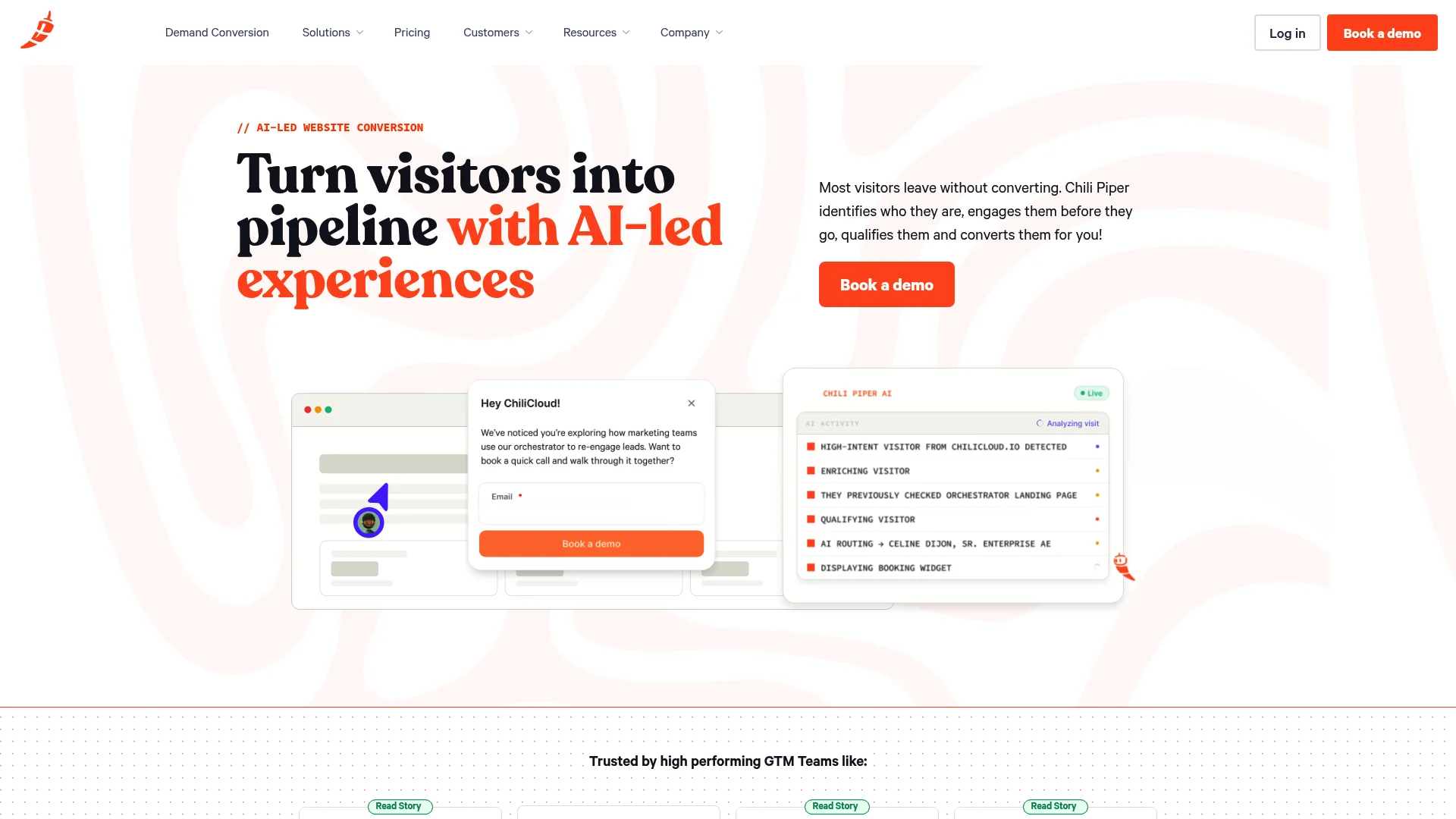
Chili Piper is an inbound conversion platform focused on the moment between qualification and booking. When a lead submits a form, it qualifies, routes to the right rep by territory or account ownership, and books the meeting instantly, before the lead has a chance to cool off. That is the speed-to-lead problem solved at the exact point most teams lose it.
For SDRs and AEs, the win is fewer dropped handoffs. The lead does not sit unassigned. It lands on the right calendar with context attached, which means better meeting quality downstream.
Best for: Revenue teams that want to automate inbound routing and meeting booking in one flow.
Key strengths
- Routing and scheduling from web form to booked meeting
- Chat journeys for visitor qualification and routing
- Handoff flows for sales and customer success transitions
Why choose Chili Piper: If good leads die in the gap between form fill and first meeting, instant routing and booking closes it. It fits teams whose main friction is handoff speed rather than data quality or scoring depth.
Chili Piper pricing: Annual billing only. Routing & Scheduling starts at $1,250/month and Experiences at $3,500/month. ChiliCal standalone is $12/user/month with a 200-seat minimum.
6. Apollo.io
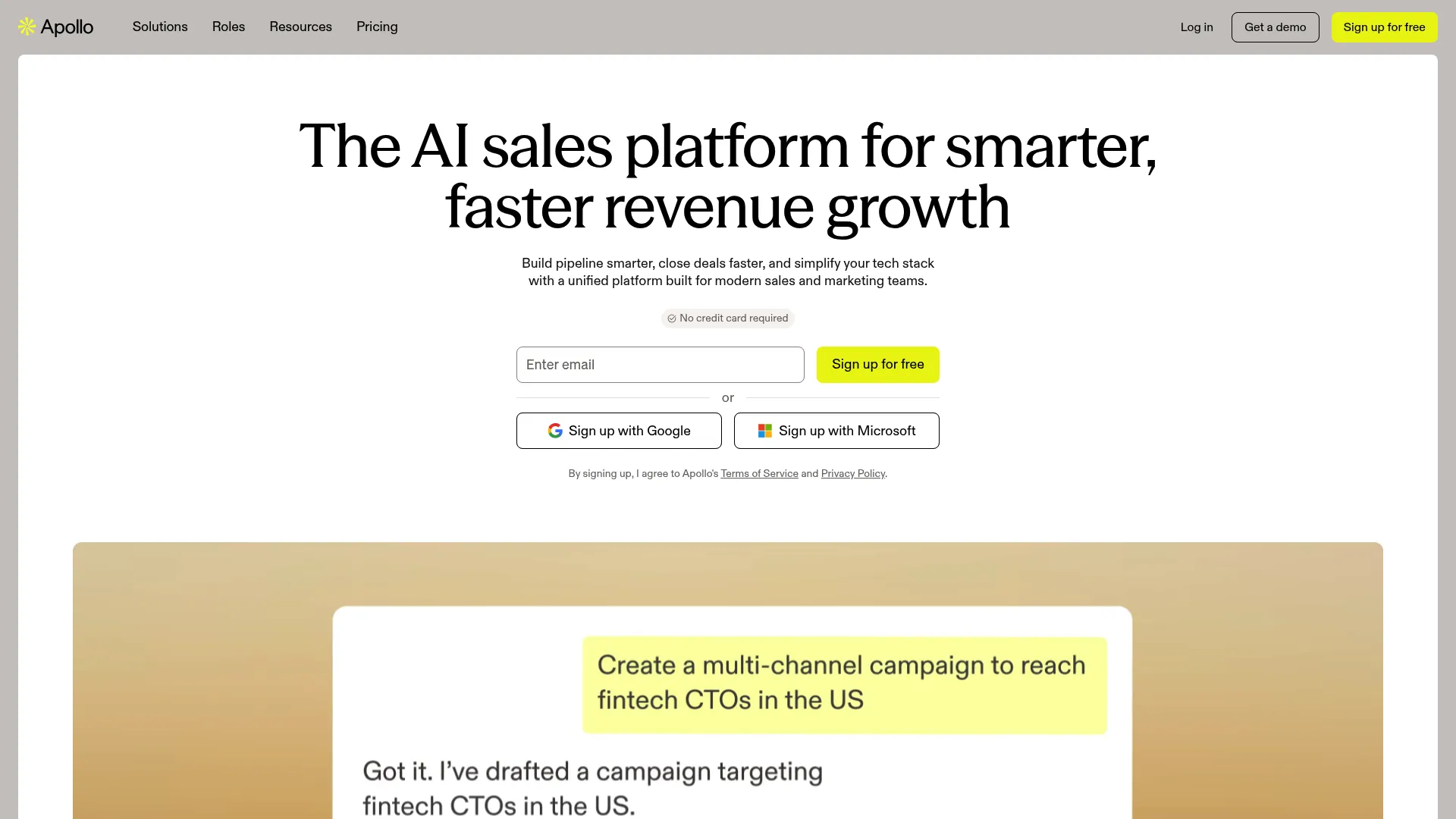
Apollo.io is a sales intelligence and go-to-market platform that combines B2B data, enrichment, and outreach in one place. For qualification, its strength is running the whole find-enrich-qualify workflow without switching tools. You pull contact and account data, enrich records automatically via CRM, API, or CSV, and use the fit and intent signals to prioritize.
For SDRs juggling seven tabs, consolidating prospecting and enrichment into one platform is a real time saver. Cleaner data at the top means fewer wasted touches downstream, which is the whole point of qualification.
Best for: B2B sales teams that need prospecting, enrichment, and outreach in a single platform.
Key strengths
- B2B contact and account data
- Automated CRM, API, and CSV enrichment
- Sales engagement and inbound/outbound workflow tools
Why choose Apollo.io: If you want one platform across finding, enriching, and qualifying leads, consolidation cuts tool sprawl and improves data quality. It fits outbound-heavy SDR teams more than pure inbound routing motions.
Apollo.io pricing: A free plan is available. Basic is $49/seat/month, Professional $79/seat/month, and Organization $119/seat/month, all billed annually.
7. Clearbit
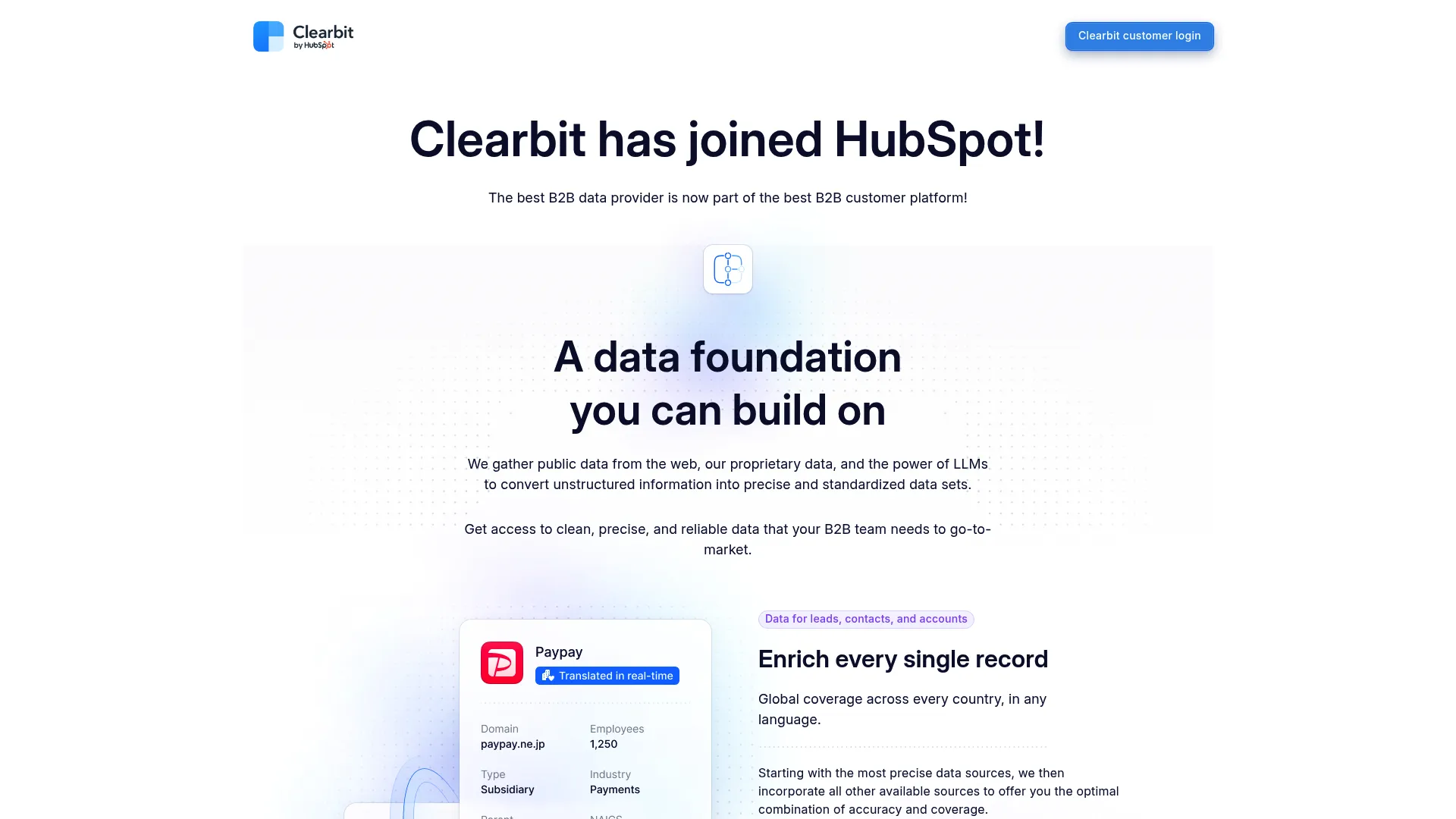
Clearbit, now part of HubSpot, is a B2B data provider built around enrichment, routing, and buying-intent signals. Its core job is data quality: it enriches leads, contacts, and accounts in real time, so a thin form fill becomes a full record the moment it lands. Form shortening lets you ask for just an email and fill in the rest automatically, which lifts conversion without sacrificing data.
For teams whose scoring keeps breaking on bad data, this is the fix. Better enrichment feeds better qualification. Clearbit also identifies anonymous website visitors, turning intent into a qualification input.
Best for: B2B teams that need data enrichment and visitor intent signals feeding their qualification.
Key strengths
- Real-time enrichment of leads, contacts, and accounts
- Lead scoring and routing inputs
- Website visitor identification and buying intent
- Form shortening to lift conversion
Why choose Clearbit: If your qualification fails because the underlying data is thin, enrichment-first tooling fixes the root cause. It fits teams that want to clean data at capture, especially those already in the HubSpot ecosystem.
Clearbit pricing: Public pricing is not listed. The standalone free platform was sunset on April 30, 2025, with users directed to Breeze Intelligence inside HubSpot.
8. MadKudu

MadKudu is B2B revenue intelligence software built around predictive lead scoring. Instead of hand-built point rules, it uses models trained on your historical conversion data to predict which leads are most likely to become revenue. It then feeds that prioritization into sales workflows so reps work the highest-probability leads first.
For data-driven teams, this is the difference between guessing at scoring weights and letting the model learn what actually converts. It pulls from CRM, product, and marketing data sources, which makes it a scoring layer rather than a front-end capture tool.
Best for: B2B teams that want predictive lead scoring and AI-assisted sales prioritization.
Key strengths
- Predictive lead scoring and qualification
- Sales prospecting and prioritization
- Integrations with CRM, product, and marketing data
Why choose MadKudu: If your manual scoring model has drifted from reality, predictive models recalibrate on real conversion data. It fits teams that want scoring depth and prioritization more than capture funnels or routing.
MadKudu pricing: Public pricing is not listed on the site. Access is arranged through a demo and quote process.
9. 6sense
6sense is a B2B go-to-market intelligence platform built around intent data and account identification. Rather than scoring individual leads in isolation, it qualifies at the account level, using buyer intent signals to surface which accounts are actively in-market and where they sit in the buying journey. Smart forms and web visitor identification tie anonymous activity back to accounts.
For teams running account-based motions, this reframes qualification. You are not just asking "is this lead good," you are asking "is this account buying now." That predictive, account-level view helps sales prioritize the accounts worth the effort.
Best for: B2B revenue teams that need account intelligence and intent-driven prioritization.
Key strengths
- Intent data and account identification
- Sales intelligence with predictive AI and data credits
- Smart forms and web visitor identification
Why choose 6sense: If you sell into accounts rather than individuals, account-level intent qualification beats scoring one contact at a time. It fits ABM and enterprise revenue teams more than high-velocity inbound SMB motions.
6sense pricing: Public pricing is not listed. The pricing page shows plan bundles by capability and directs you to book a demo.
10. Drift

Drift is an AI chat and buyer engagement platform that turns website visitors into pipeline. Its AI chat agents hold real-time conversations with visitors, ask qualifying questions, and route or book meetings based on the answers. For high-intent traffic, that means a visitor gets qualified and handed off while they are still on the page, not hours later.
For SDRs, chat-led qualification captures intent at its peak. Someone browsing your pricing page right now is worth more than the same person tomorrow. Drift also identifies visitors and reports on chat-sourced pipeline.
Best for: B2B teams that want website chat to qualify and route inbound buyers in real time.
Key strengths
- AI chat agents for real-time conversations
- Live chat and meeting booking
- Visitor identification and ROI reporting
Why choose Drift: If your best leads are high-intent visitors on your site right now, chat qualification captures them at the moment of interest. It fits teams with meaningful web traffic more than outbound-only motions.
Drift pricing: A free account signup is available. Public plan prices are not listed on the site; paid plans are arranged through Drift directly.
Considerations before you buy
The right tool depends on which part of your qualification workflow is broken. Run through this checklist before committing.
Workflow fit
Map where your leads actually stall. Is it at capture, scoring, routing, or booking? Buy for the gap you have, not the feature list that looks impressive. A routing tool will not fix a data quality problem, and enrichment will not fix a slow handoff.
Scoring logic and rules
Decide whether you want hand-built rules or predictive models. Point-rule scoring is transparent and easy to adjust. Predictive scoring learns from conversion data but needs enough history to train on. Real-time recalculation matters if your leads change status fast.
CRM and routing compatibility
The tool has to live in your existing CRM and sequencer, or reps will not use it. Verify native integration, not just an API you have to build against. Check that routing rules support your model: round-robin, territory, or account ownership.
Data quality and enrichment depth
Scoring is only as good as the data under it. If your CRM is messy, prioritize enrichment first. Confirm how fresh the data is and how often it refreshes, since stale enrichment quietly degrades every score downstream.
Adoption and speed
The best qualification software removes clicks instead of adding them. If a rep has to open another tab or run a manual step, adoption will slide. Favor tools that score and route in the background of the workflow reps already use.
Conclusion
Pick by the gap, not the brand. If low-fit volume is drowning your queue, qualify at capture with Perspective or route and book instantly with Chili Piper. If your scores keep breaking on thin data, fix the root cause with Clearbit or Apollo.io for enrichment. If you want models that learn what converts, MadKudu handles predictive scoring, while Default keeps qualification current with event-driven recalculation.
For account-based motions, 6sense qualifies at the account level on real intent. For high-intent web traffic, Drift and Meera turn conversations into qualified handoffs in real time. And if you want scoring, routing, and workflows in one place your reps already live, HubSpot is the lowest-friction all-in-one.
The next step is simple: name the single point where good leads slow down or slip away, then shortlist the two tools above that target it directly. Run a trial on your real lead flow, not a demo dataset, and measure speed-to-lead before and after.
FAQs
Lead qualification software automatically evaluates, scores, and routes incoming leads so your team can prioritize high-fit prospects and act on them faster. It combines enrichment, scoring, routing, and scheduling into one workflow, so instead of manually triaging every form fill, the system tells you which leads deserve attention and gets them to the right rep.
Lead scoring is one input into qualification, not the whole thing. Scoring assigns a value to a lead based on fit and behavior. Qualification is the broader process that uses that score, plus enrichment and routing rules, to decide whether a lead is worth pursuing and who should handle it. Scoring ranks; qualification decides and hands off.
For inbound teams where speed-to-lead is the priority, Chili Piper stands out for instant routing and booking, while Drift and Meera qualify leads through real-time chat and SMS. If you want qualification to happen at capture before leads hit your queue, Perspective builds funnels that filter fit up front. The best pick depends on whether your friction is handoff speed or lead volume.
Chili Piper is purpose-built for the routing-and-scheduling moment, taking a form fill and turning it into a booked meeting on the right rep's calendar instantly. HubSpot also handles routing natively if you want it inside your CRM rather than as a separate tool. Choose based on whether you need best-in-class handoff speed or platform consolidation.
Start with enrichment, not scoring. If your data is thin or inconsistent, scoring will produce garbage regardless of how good the model is. Tools like Clearbit and Apollo.io enrich records at capture, filling in company size, title, and intent so scoring has something reliable to work with. Fix the data layer first, then layer scoring and routing on top.
Yes, where the bottleneck is response time. AI qualification through chat or SMS engages a lead within seconds instead of hours, which matters because connect rates drop fast after the first few minutes. Where AI helps less is judgment on complex, high-value deals, so treat it as a first-touch accelerator that protects speed while a human handles nuance.
It replaces the repetitive part, not the judgment part. Software handles enrichment, scoring, and routing far faster and more consistently than a human triaging a queue. But nuanced discovery, reading intent between the lines, and handling a non-standard deal still need an SDR. The best setups automate the filtering so reps spend their time only on leads worth a human conversation.