Your engineering team says they need a runtime decision. The problem is that "runtime" can mean a JavaScript execution environment, an OCI container engine, or a fully managed cloud platform. Each of those answers carries a different operational cost, a different release cadence, and a different migration exposure.
This guide covers software runtimes used to execute applications, containers, and cloud functions, not data-recovery products that share the "Runtime" name.
The choice matters more than most PMs initially expect. The runtime you commit to shapes how fast services ship, how much infrastructure your team must own, and whether a performance problem is debuggable before a user notices it. The global runtime software market was valued at $11.59 billion in 2025 and is projected to reach $28.84 billion by 2034, growing at a 10.66% CAGR, according to The Insight Partners (2026). That growth reflects how central this decision has become for product-led organizations. The right runtime matches the work your product needs to do and the operational load your team can afford to own.
What's inside
This guide is for product managers evaluating runtime infrastructure as an architecture or platform decision.
- A plain-English definition of runtime software and its three main categories
- A 10-tool comparison table with verified pricing and G2 ratings
- Tool-by-tool guidance organized by workload type: APIs, background jobs, containerized services, and edge delivery
- A decision framework tied to engineering opportunity cost, release cadence, and operational ownership
Tools were selected based on adoption, workload relevance, ecosystem maturity, and verifiable product information.
TL;DR
- Best for JavaScript and TypeScript services: Node.js for event-driven APIs and backend-for-frontend layers
- Best for Microsoft-aligned teams: .NET for C#, Azure, and enterprise application tooling
- Best for Java services: Java Virtual Machine for mature, long-running backend workloads
- Best for container-first workflows: Podman for developer environments, containerd for platform infrastructure
- Best for managed event-driven workloads: AWS Lambda (AWS-native), Google Cloud Run (containerized services), or Cloudflare Workers (edge delivery)
- Best modern TypeScript runtime: Deno for teams wanting a TypeScript-first runtime with web-standard APIs and built-in tooling
What is runtime software?
Runtime software is the environment that provides the code, services, and resources an application needs while it executes.
The term covers three distinct categories, and conflating them leads to the wrong decision.
Runtime software is a category, not one product type
Runtime software can include:
- A language runtime such as Node.js, Python, .NET, or the JVM, which executes code written in a specific language
- A container runtime that starts and manages containerized processes using OCI images
- A serverless runtime that runs code in a managed cloud environment on demand
- Supporting runtime libraries, virtual machines, and execution engines that underpin the above
Runtime system vs runtime environment vs runtime library
| Term | Plain-English meaning | Example |
|---|---|---|
| Runtime system | Broader services supporting program execution | Memory management, scheduling, type checks |
| Runtime environment | The place where code executes | A managed Node.js cloud environment |
| Runtime library | Shared code used while the application runs | C runtime library or standard libraries |
| Virtual machine | Software layer that executes intermediate code | Java Virtual Machine |
| Container runtime | Software that runs OCI containers | containerd |
| Serverless runtime | Managed environment for event-driven code | AWS Lambda |
Compile time vs runtime
Compile time converts source code or prepares a build artifact. Runtime begins when that artifact executes. Runtime errors happen during execution, and they require logging, tracing, test coverage, and defensive handling to catch before users do.
Core capabilities to evaluate
When comparing runtime software, look at:
- Language and framework compatibility
- Startup behavior and concurrency model
- Memory and garbage-collection approach
- Isolation and security controls
- Observability and debugging support
- Deployment portability across environments
- Managed infrastructure vs team-owned operations
When to use runtime software
Run long-lived APIs and backend services
Language runtimes suit services that stay available, maintain persistent connections, or depend on a mature language library. For product teams, the relevant evaluation factors are predictable request latency, dependency compatibility across versions, and how runtime upgrades fit the release cadence. A Node.js or Java service running on a cloud VM or Kubernetes node gives the team full control over instrumentation and memory tuning.
Package applications for consistent deployment
Container runtimes fit teams standardizing development, CI, and production delivery around the same image. Containers reduce environment mismatch between a developer's laptop and production, but they create responsibilities: Image security scanning, observability configuration, and orchestration overhead. This is an opportunity-cost decision. A managed container service can offload most of that work if the team does not need deep control over the runtime layer.
Execute event-driven or bursty workloads
Serverless runtimes fit webhooks, scheduled tasks, file processing, background automations, and traffic that spikes unpredictably. The tradeoffs are real: Cold starts add latency on the first invocation, execution duration limits cap long-running jobs, and vendor-specific APIs create portability risk. Model those constraints against the workload before committing to a serverless architecture.
Runtime software comparison
These 10 products do different runtime jobs. The table is not a rank order from best to worst. It is a shortlist organized by relevance to common application-delivery decisions.
| # | Product | Best for | Key differentiator | Pricing | G2 rating |
|---|---|---|---|---|---|
| 1 | Node.js | JavaScript and TypeScript backend services | Event-driven JavaScript runtime with npm ecosystem | Free and open source | 4.8/5 |
| 2 | .NET | C# applications and Microsoft-aligned teams | Cross-platform runtime with enterprise tooling | Free and open source | 4.3/5 |
| 3 | Java Virtual Machine | Java services and JVM-language ecosystems | Bytecode execution with mature tooling and portability | Free (open-source distributions) | N/A |
| 4 | Python | Automation, APIs, and data-connected services | Broad library base and readable development model | Free and open source | 4.8/5 |
| 5 | Deno | Modern TypeScript and JavaScript workloads | TypeScript-first runtime with web-standard APIs | Free; Deno Deploy from $0/month | N/A |
| 6 | Podman | Developer-friendly container workflows | Daemonless, rootless container tooling | Free and open source | N/A |
| 7 | containerd | Production container infrastructure | Core OCI runtime layer used in container platforms | Free and open source | 4.7/5 |
| 8 | AWS Lambda | Event-driven cloud functions on AWS | Managed execution with 220+ AWS service integrations | From $0.20/million requests | 4.6/5 |
| 9 | Google Cloud Run | Containerized web services and jobs | Managed containers with request-based scaling | From $0.000018/vCPU-second | 4.6/5 |
| 10 | Cloudflare Workers | Edge-delivered application logic | Globally distributed JavaScript and WebAssembly execution | Free tier; $0.30/million requests paid | N/A |
The 10 best runtime software tools for 2026
1. Node.js
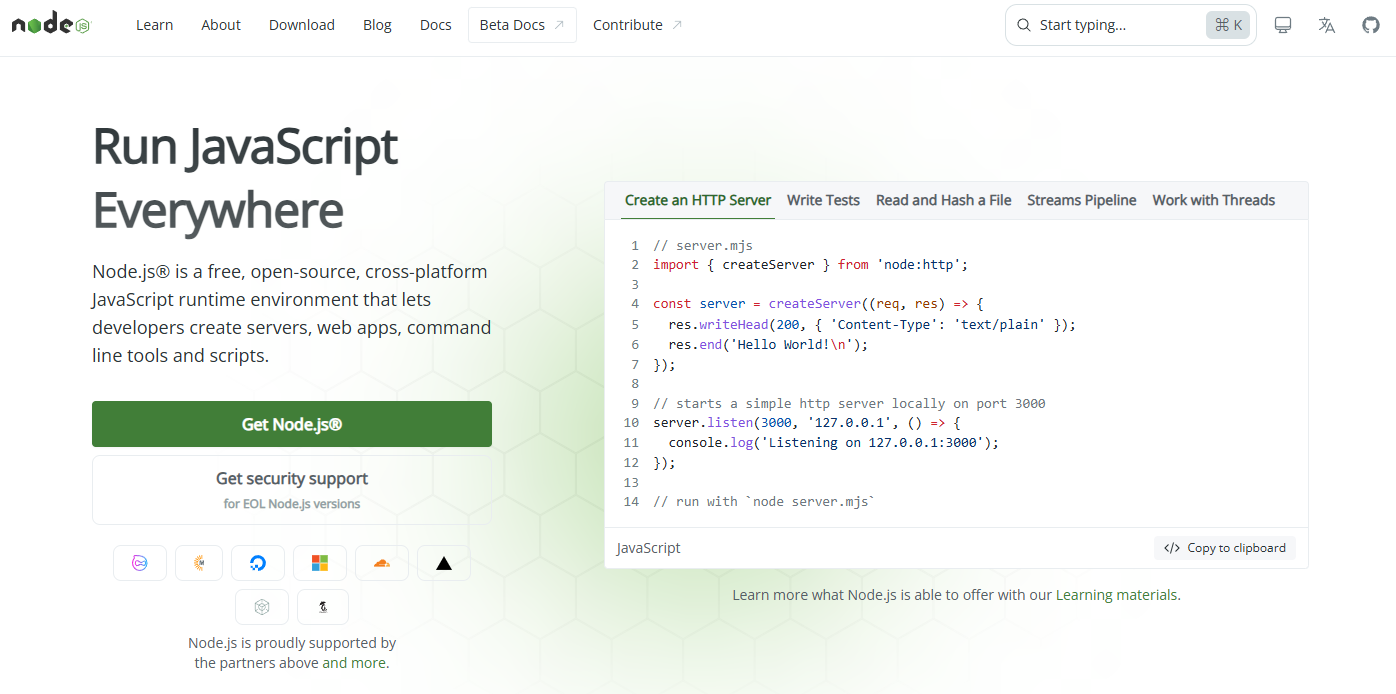
Node.js is a free, open-source, cross-platform JavaScript runtime built around the V8 engine. It runs asynchronously and handles I/O without blocking, which makes it well suited for high-concurrency network applications. Product teams often choose it to share JavaScript or TypeScript skills across frontend and backend engineers, reducing the context-switching cost on small teams.
Best for: SaaS teams building APIs, real-time features, integration services, and backend-for-frontend layers using JavaScript or TypeScript.
Key features
- Asynchronous, event-driven execution model
- Non-blocking I/O for scalable network services
- npm package registry with broad library coverage
- Built-in HTTP, file system, cryptography, and worker thread support
- Cross-platform deployment across Linux, macOS, and Windows
Why choose Node.js: The shared language across frontend and backend teams lowers onboarding and code-review overhead. CPU-heavy workloads may need worker threads, a task queue, or a separate service, so validate concurrency requirements against the workload profile early.
Node.js pricing: Node.js is free and open source with no license cost. Hosting cost depends on the deployment platform you choose.
G2 rating: 4.8/5
2. .NET
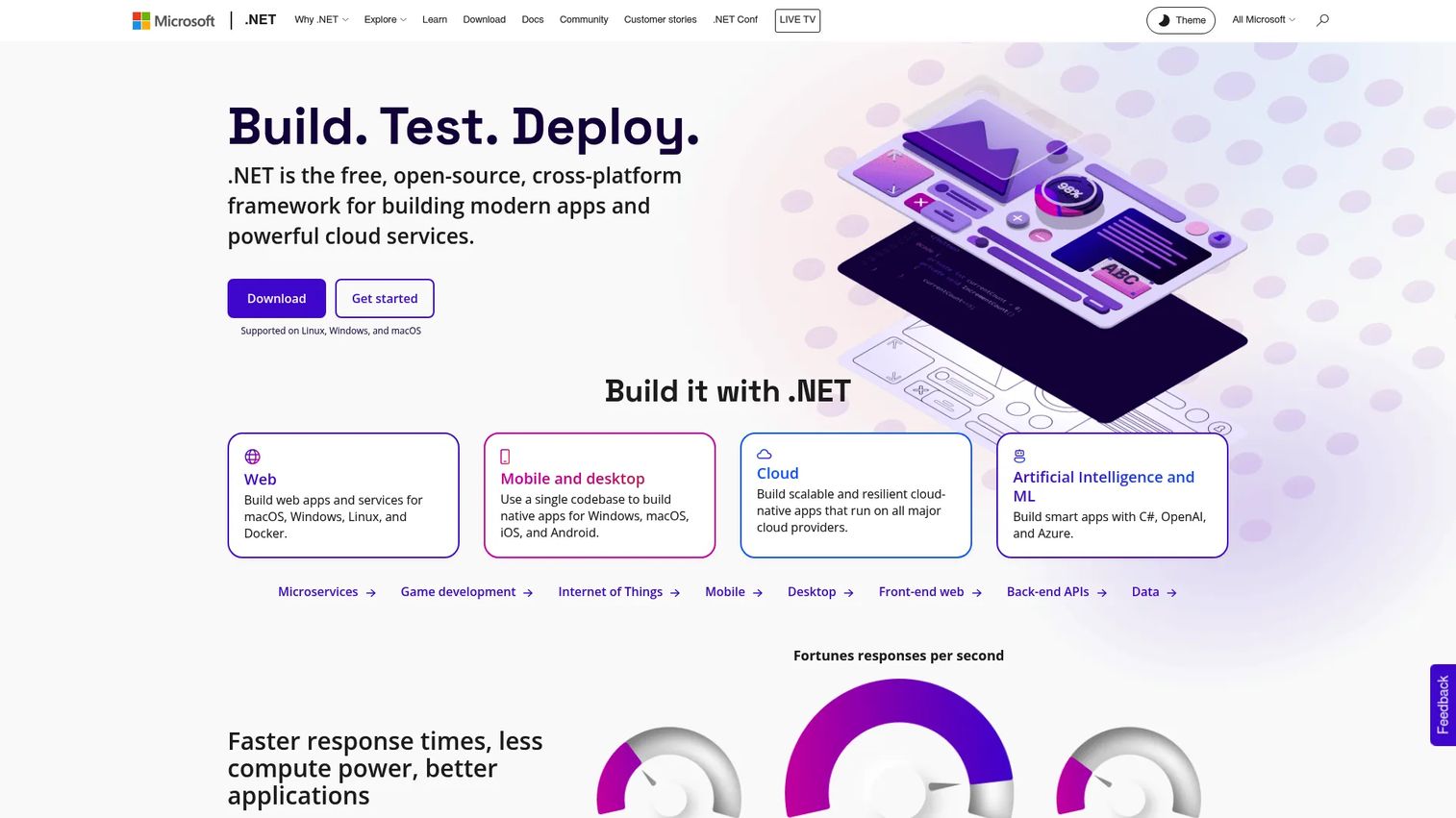
.NET is Microsoft's free, open-source, cross-platform developer platform. It combines a runtime, class libraries, language compilers, and application frameworks into a single distribution. Teams building on C# get access to ASP.NET Core for web APIs, built-in diagnostics tools, and a mature NuGet package ecosystem. It runs on Linux, macOS, Windows, and Docker without code changes.
Best for: Organizations building enterprise SaaS products, internal platforms, and APIs that benefit from C# language tooling and Azure alignment.
Key features
- C#, F#, and Visual Basic language support
- Just-in-time compilation and runtime optimization
- Cross-platform deployment including Docker and Kubernetes
- ASP.NET Core for web and API workloads
- Built-in diagnostics, profiling, and telemetry tools
Why choose .NET: It fits teams that have standardized on the Microsoft stack and want a runtime with a predictable upgrade path, enterprise security controls, and strong Visual Studio tooling integration. Plan for runtime version support windows as part of your product roadmap.
.NET pricing: .NET is free and open source. Cloud hosting, Azure services, and enterprise support contracts are separate costs.
G2 rating: 4.3/5
3. Java Virtual Machine
The Java Virtual Machine executes bytecode produced by Java and other JVM languages such as Kotlin and Scala. It provides hardware- and OS-independent execution through a runtime heap with automatic garbage collection and just-in-time compilation. The JVM is the foundation of large-scale transaction systems, integration platforms, and enterprise codebases that have run in production for years.
Best for: Product teams maintaining Java services, building integration-heavy platforms, or working within organizations that have deep JVM expertise.
Key features
- Hardware- and OS-independent bytecode execution
- Multiple garbage collection algorithms and tuning options
- Just-in-time compilation and runtime optimization
- Mature profiling and APM tooling support
- Multi-language support across the JVM ecosystem
Why choose Java Virtual Machine: The JVM pays off when the organization can support performance diagnostics and memory tuning. The depth of profiling tooling and the size of the available hiring pool make it a defensible long-term choice for performance-critical services. Check the support lifecycle for the specific JVM distribution you use, as release cadences vary.
JVM pricing: Open-source JVM distributions from OpenJDK and Eclipse Adoptium carry no license cost. Support contracts and managed hosting are priced separately by providers.
4. Python
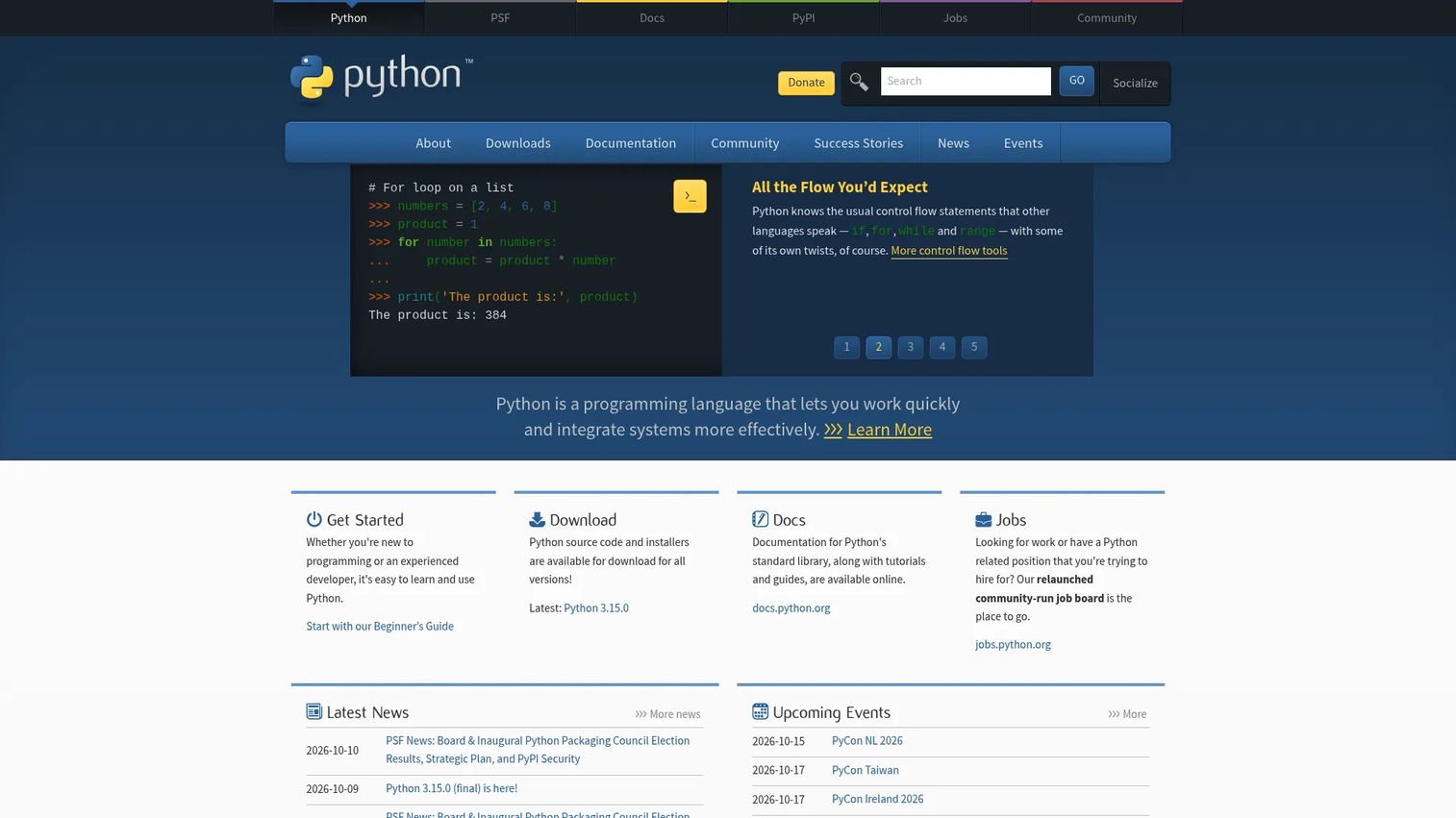
Python is a free, open-source, interpreted language with an extensive standard library and a third-party package ecosystem that covers web frameworks, data processing, automation, and machine-learning tooling. Product teams reach for it when delivery speed matters more than raw throughput, or when the required libraries exist only in the Python ecosystem.
Best for: Teams building internal automation, data-processing workflows, API services, and product features that depend on Python's data and AI library coverage.
Key features
- Readable syntax with low onboarding friction
- Extensive package ecosystem via PyPI
- Web framework support through Django and FastAPI
- Data, ML, and automation library coverage
- Broad cloud support across major providers
Why choose Python: Python reduces time-to-prototype and is the practical choice for any workload that needs ML or data pipeline libraries. Validate concurrency and throughput requirements early for high-request-volume paths, as the GIL can constrain CPU-bound parallelism without async frameworks or multi-process designs.
Python pricing: Python is free and open source under a PSF license. Hosting and managed service costs vary by provider and compute usage.
G2 rating: 4.8/5
5. Deno
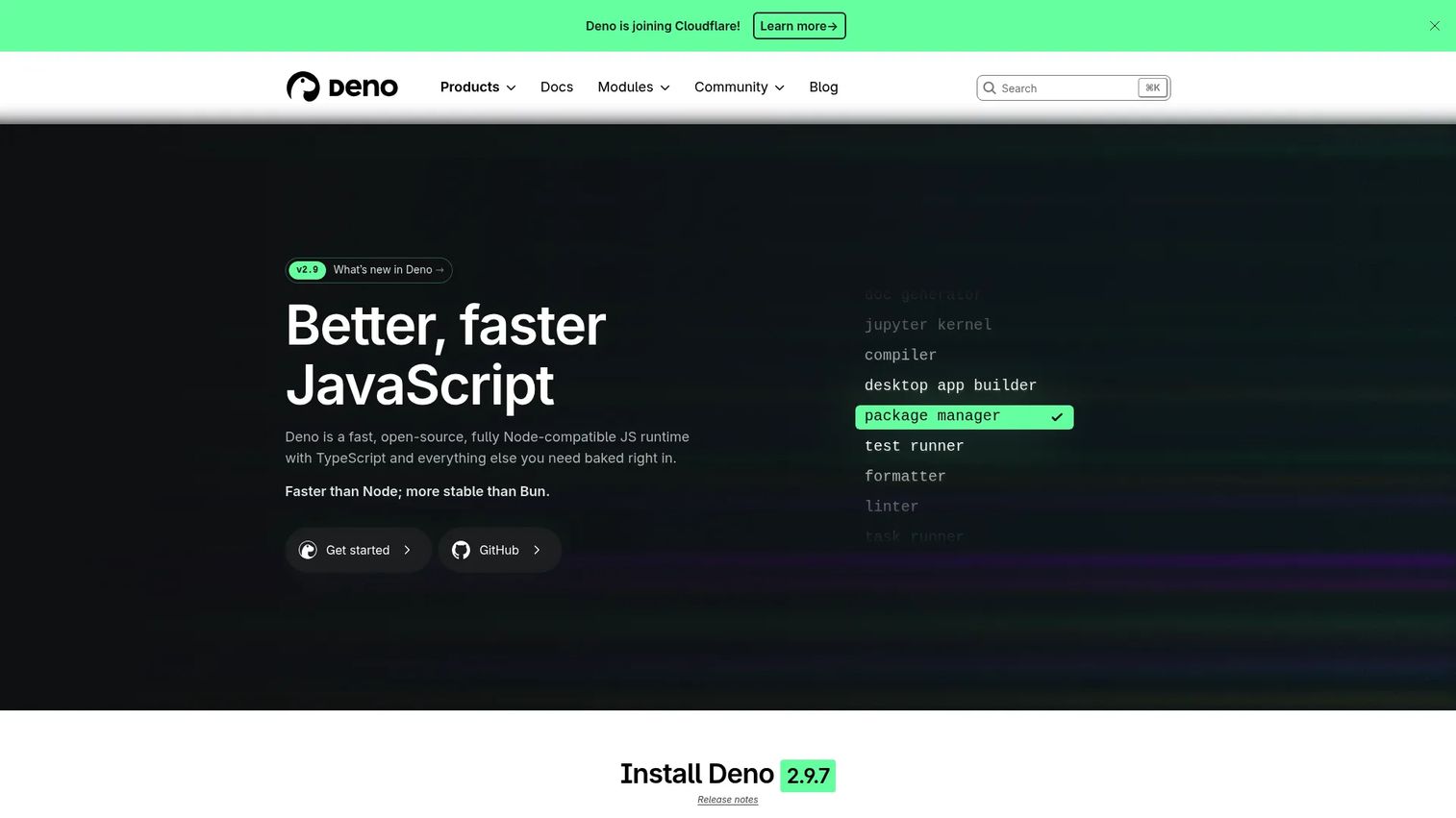
Deno is a secure JavaScript and TypeScript runtime with a built-in toolchain and a managed edge deployment platform called Deno Deploy. It runs TypeScript natively, supports web-standard APIs, and ships with linting, formatting, testing, and bundling without additional configuration. Node.js and npm compatibility is available, reducing migration friction for teams moving from an existing JavaScript codebase.
Best for: Teams that want a TypeScript-first runtime, web-standard APIs, and a reduced toolchain surface for services, scripts, and edge workloads.
Key features
- Native TypeScript execution without a build step
- Secure-by-default permission sandbox
- Built-in linting, formatting, testing, and bundling
- Node.js and npm compatibility layer
- Deno Deploy for edge hosting with cron, KV, and observability
Why choose Deno: It reduces toolchain sprawl for teams that value integrated developer tooling and TypeScript-first development. Deno Deploy adds managed edge hosting. Verify the current Node.js compatibility scope against your specific dependencies before migration.
Deno pricing: The Deno runtime is free and open source. Deno Deploy starts at $0/month on the Free plan, $20/month on Pro, and $200/month on Builder. Enterprise pricing is custom.
6. Podman
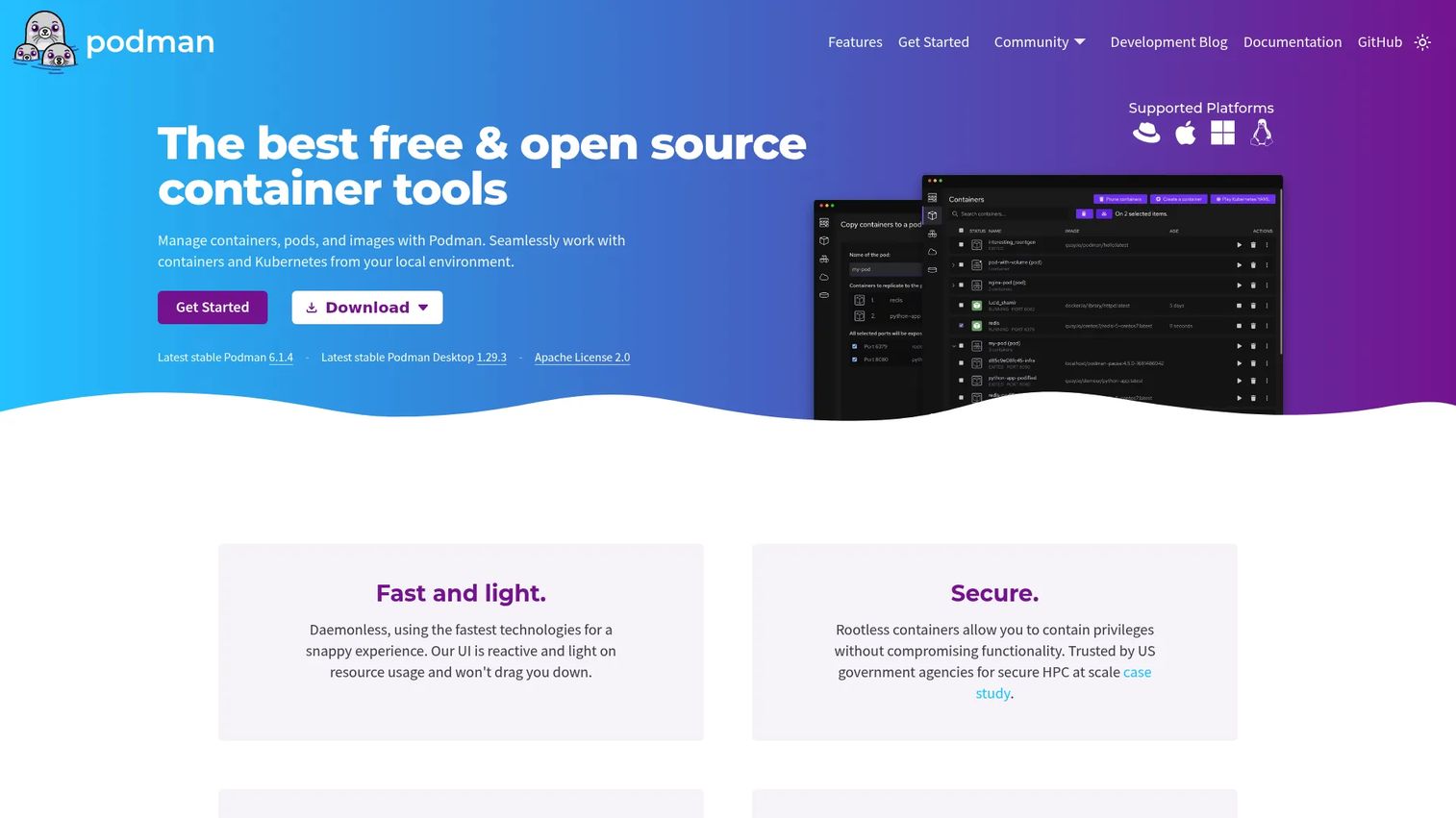
Podman is a free, open-source, daemonless container engine for managing OCI containers, pods, and images. It runs containers without a privileged background daemon, supports rootless execution out of the box, and provides a command interface that mirrors familiar container tooling. Podman Desktop extends management to a graphical interface across supported container engines.
Best for: Developers and platform teams that want reproducible container workflows with rootless operation and Kubernetes-compatible output.
Key features
- Rootless container execution by default
- Daemonless architecture with no privileged background process
- OCI image build, pull, push, and management
- Kubernetes YAML generation and playback
- Docker-compatible command interface
Why choose Podman: It fits teams that want developer environments to match production container behavior without a privileged daemon dependency. Podman usually sits within a broader delivery stack rather than replacing a managed production platform. It is a particularly strong choice for teams with security policies that restrict privileged processes on developer machines.
Podman pricing: Podman is free and open source under the Apache License 2.0. Enterprise support options may be available through Red Hat.
7. containerd
containerd is an industry-standard container runtime focused on simplicity, robustness, and portability. It handles OCI image management, image push and pull, and container lifecycle supervision. Most product managers encounter it as the runtime layer beneath Kubernetes or managed container services rather than as a tool they configure directly.
Best for: Platform teams operating container orchestration environments and building standardized infrastructure around OCI images.
Key features
- OCI image specification compliance
- Image push, pull, and local storage management
- Container lifecycle management and supervision
- Kubernetes runtime interface compatibility
- Production-focused architecture with minimal dependencies
Why choose containerd: It makes sense when the organization needs a stable, composable runtime component for a container platform. As a standalone choice for a small product team seeking a fully managed deployment experience, a higher-level managed service is the more practical option. containerd is the infrastructure layer, not the developer-facing interface.
containerd pricing: containerd is free and open source. It is a graduated CNCF project with no commercial pricing.
G2 rating: 4.7/5
8. AWS Lambda
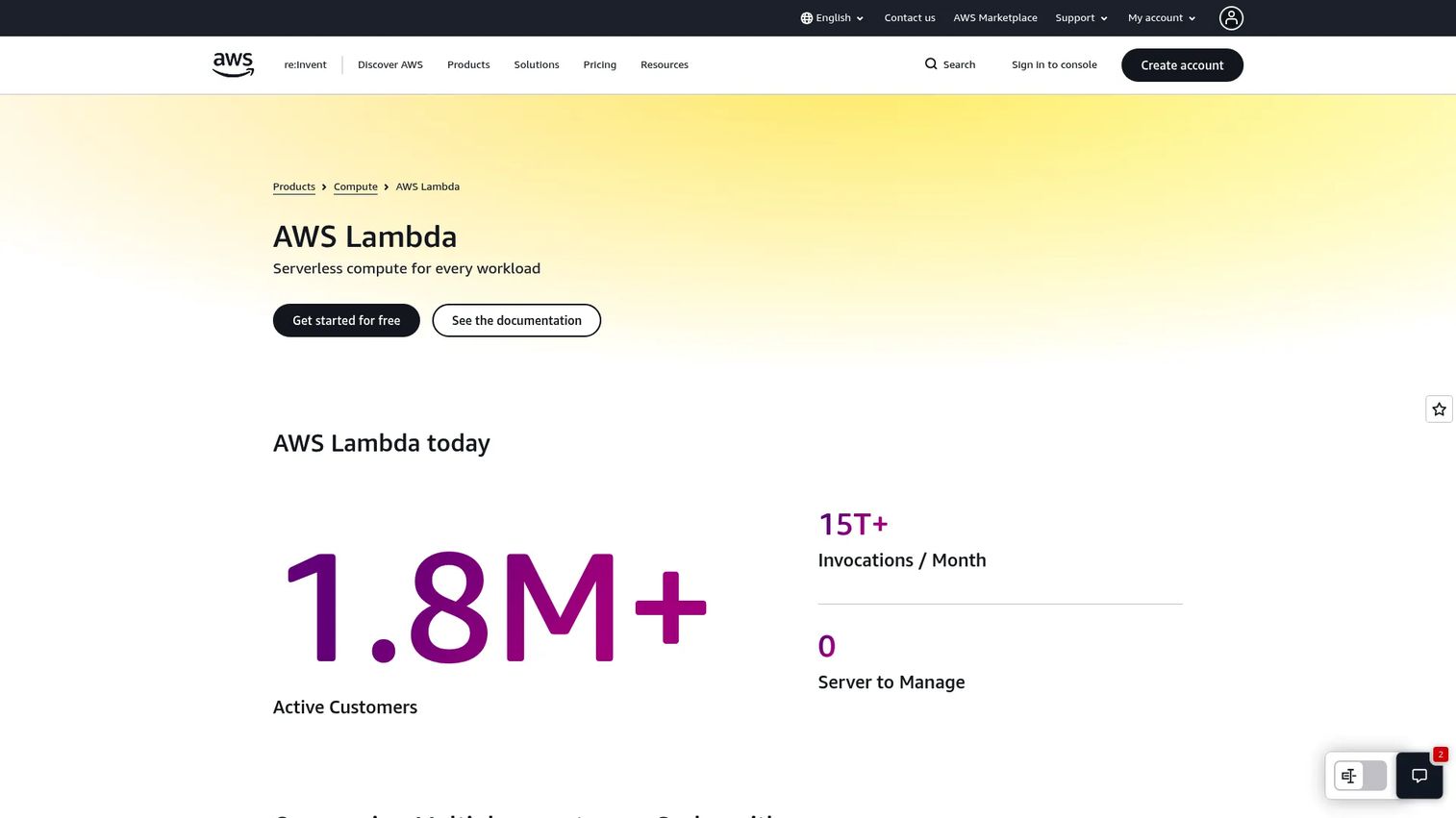
AWS Lambda is a serverless compute service that runs code without provisioning or managing servers. It scales automatically from zero to match incoming demand, integrates natively with over 220 AWS services, and supports managed runtimes across common languages. Teams deploy functions as ZIP archives or container images.
Best for: Teams already on AWS that need event-driven workflows, scheduled jobs, file processing, and variable-traffic APIs without managing server infrastructure.
Key features
- Automatic scaling from zero with no configuration
- Native integration with 220+ AWS services and 50+ SaaS apps
- Managed runtimes and container image deployment
- Built-in monitoring via Amazon CloudWatch and AWS X-Ray
- Usage-based billing with a permanent free tier
Why choose AWS Lambda: It lowers infrastructure ownership for bounded, event-driven workloads. Plan for cold start latency on infrequent invocations, execution duration limits for long-running jobs, and the observability setup required to distinguish function errors from upstream failures. Strong fit when the team is already invested in AWS tooling.
AWS Lambda pricing: The free tier includes 1 million requests and 400,000 GB-seconds per month. Beyond the free tier, Event Functions are priced at $0.20 per million requests and $0.0000166667 per GB-second of compute.
G2 rating: 4.6/5
9. Google Cloud Run
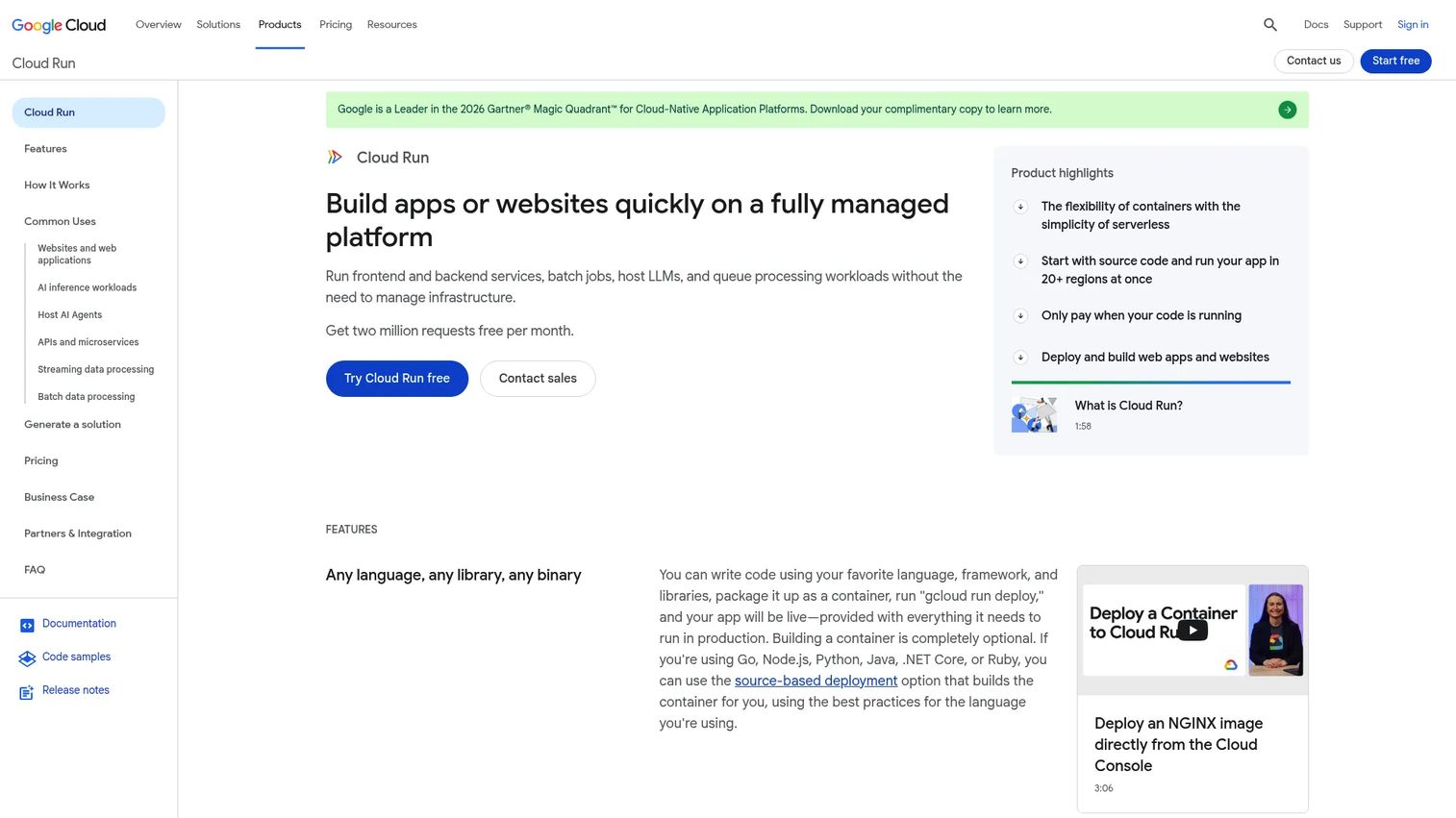
Google Cloud Run is a fully managed platform for running containerized applications, batch jobs, and AI workloads without managing infrastructure. It scales automatically from zero, supports source-based deployment with automated image builds, and accepts any language, library, or binary inside a container. Cloud Run bridges the gap between self-managed Kubernetes and function-level serverless: You bring a container, Google manages the execution layer.
Best for: Teams that want to package an application in a container and deploy it without operating a cluster. Strong fit for HTTP services, APIs, internal tools, webhooks, and containerized batch jobs.
Key features
- Container-based deployment supporting any language or binary
- Automatic autoscaling from zero
- Source-based builds with automated container image creation
- Run-to-completion batch job support
- Direct VPC connectivity and NVIDIA L4 GPU support for AI inference
Why choose Google Cloud Run: The container-as-the-interface model gives teams runtime flexibility without requiring Kubernetes expertise. It supports GPU workloads for AI inference, which matters for product teams building AI features into their platform. Portability is higher than function-level serverless because the artifact is a container image.
Google Cloud Run pricing: The free tier includes 240,000 vCPU-seconds and 450,000 GiB-seconds per month. Beyond the free tier, compute is priced at $0.00001800 per vCPU-second and $0.00000200 per GiB-second. Pricing varies by region and billing configuration.
G2 rating: 4.6/5
10. Cloudflare Workers
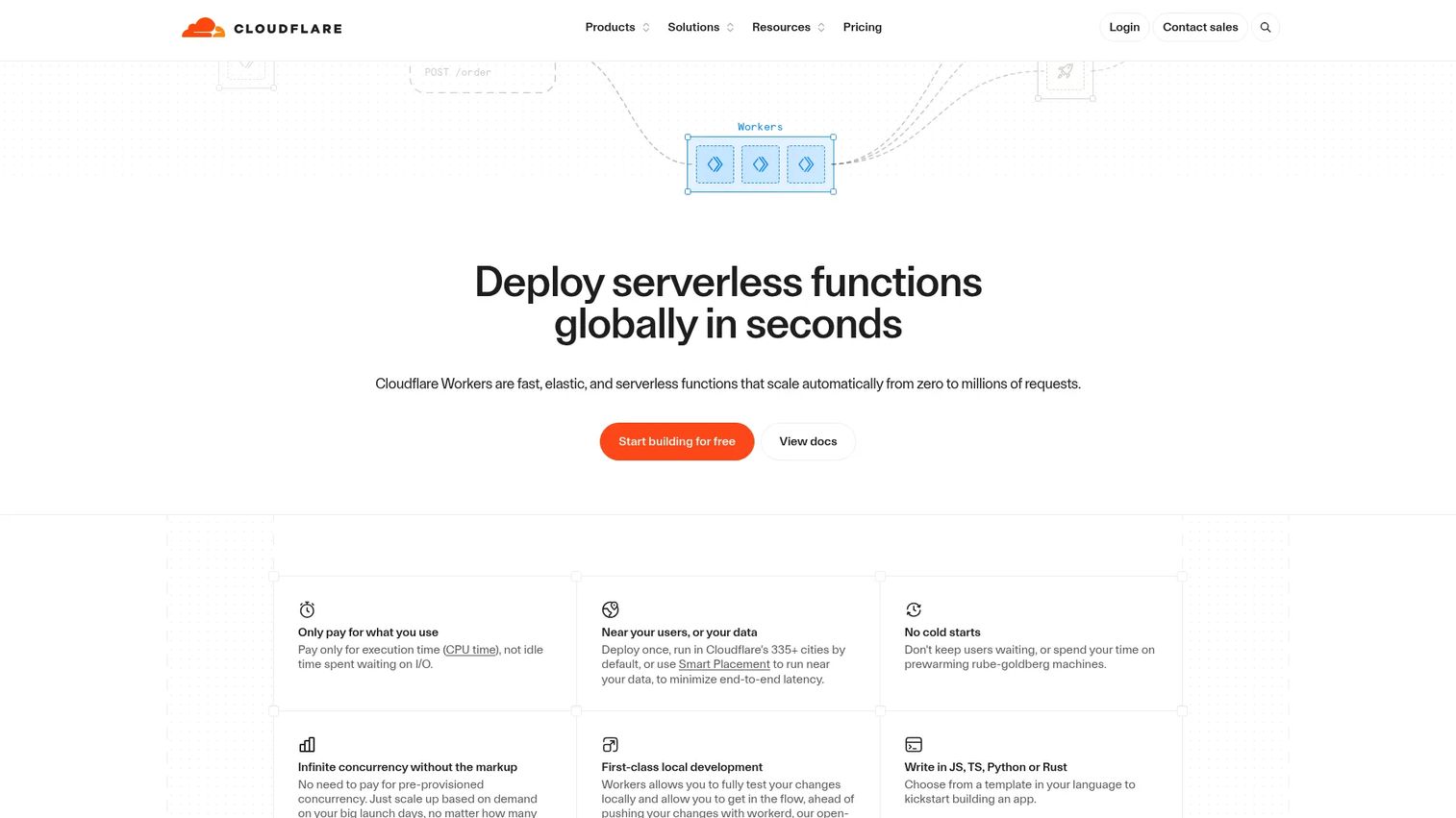
Cloudflare Workers is a globally distributed serverless platform for deploying JavaScript, TypeScript, Python, and WebAssembly workloads at the network edge. It runs across 335+ cities and scales automatically per request. Workers integrates with Cloudflare's D1 database, KV storage, AI models, Queues, and Cron Triggers, making it a practical choice for full-stack edge applications and lightweight API gateways.
Best for: Product teams delivering latency-sensitive web experiences, edge middleware, personalization logic, and lightweight APIs where global distribution shapes the user experience.
Key features
- Global deployment across 335+ cities with automatic per-request scaling
- JavaScript, TypeScript, Python, and WebAssembly support
- Integrated access to D1, Workers KV, AI models, Queues, and Cron Triggers
- Request-level billing with a generous free tier
- Isolate-based execution for fast cold start behavior
Why choose Cloudflare Workers: It performs best when global delivery latency is a product requirement and the workload fits within request-scoped execution. Validate state management needs, execution constraints, and portability requirements before committing to an edge-first architecture. Teams that need long-lived connections or complex stateful workflows may find the execution model limiting.
Cloudflare Workers pricing: The free tier includes 100,000 requests per day and 10 ms of CPU time per request. Paid usage is metered at $0.30 per million requests and $0.02 per million CPU-milliseconds.
Considerations when choosing runtime software
Match the runtime to the workload
Before comparing products, classify the workload. A long-running API, a background worker, an event-driven function, and globally distributed edge logic each belong to a different runtime category. A runtime is part of the product architecture, and picking the wrong category creates migration debt that compounds as the product scales.
Calculate the operational ownership
Identify what engineering will own after the runtime decision: OS patching, container image maintenance, autoscaling configuration, production observability, incident response, and runtime upgrades. The infrastructure decision is also an opportunity-cost decision. Every hour spent on runtime maintenance is an hour not spent on product work. Managed runtimes reduce that burden at the cost of portability and control.
Check ecosystem and migration risk
Evaluate language library availability, framework compatibility, CI workflow fit, and the vendor-specific APIs your code will depend on. Vendor-specific integrations in serverless runtimes increase switching cost. Container-based runtimes preserve more portability. Check support windows and deprecation schedules for your chosen runtime version and plan upgrade work into future sprints.
Instrument runtime behavior before launch
Define the metrics you will track in production: Startup time, P95 and P99 latency, error rate, memory pressure, and cold-start frequency for managed functions. Production behavior frequently differs from local test results. Establish baselines before launch so anomalies are detectable.
Review security and governance requirements
Address dependency patching cadence, container image provenance, runtime isolation boundaries, identity and permission models, audit logging, and secrets management. Container and serverless runtimes have different security surfaces. Container runtimes require image scanning and least-privilege configuration. Serverless runtimes require careful permission scoping to cloud service APIs.
How to choose the right runtime software for your team
Choose a language runtime when application architecture is the priority
Reach for Node.js, .NET, the JVM, or Python when the team is selecting a core application language and building services that run continuously. Start with existing engineering capability and the product's performance profile. For application performance monitoring tools and observability, language runtimes give you the most direct instrumentation surface. Node.js is the natural choice for JavaScript-first teams. The JVM is the right call for organizations with Java expertise and long-running transaction workloads.
Choose a container runtime when deployment consistency is the priority
Podman works for developer and local container workflows with rootless security requirements. containerd fits platform and orchestration contexts where a composable infrastructure layer is needed. For most product teams, a managed container service like Google Cloud Run is the more practical production choice. It offloads cluster operations while preserving the container packaging model, which supports application portfolio management software evaluations that require runtime portability across environments.
Choose a serverless runtime when operational ownership is the constraint
Route to AWS Lambda for AWS-native event-driven work with deep service integrations. Choose Google Cloud Run when the workload is containerized and needs request-based scaling without cluster management. Choose Cloudflare Workers when global edge delivery and sub-millisecond routing are product requirements. The decision rule: Select based on execution model and service dependencies, not the marketing label on the platform. Thinking through application security testing software requirements early will also surface which runtimes satisfy your security team's isolation and audit requirements.
Avoid selecting by benchmark alone
Benchmark results matter for throughput-constrained workloads, but deployment model, observability depth, release process fit, and team familiarity more consistently determine product outcomes. An unfamiliar runtime with better raw numbers often costs more in engineering time than the throughput gain is worth. Choose the runtime your team can instrument, debug, and upgrade reliably.
Conclusion
Runtime software is an umbrella category covering three distinct jobs: Language runtimes for application ecosystems, container runtimes for packaging and execution infrastructure, and managed runtimes for serverless and cloud delivery.
The most useful next step is practical: Inventory your current or planned workloads, label each by execution pattern (long-running service, background job, event-driven function, or edge request), then choose the smallest operational model that still meets your performance and governance requirements.
Node.js and Python suit teams that want a broad language ecosystem and direct runtime control. .NET and the JVM suit organizations with existing language investment and mature tooling needs. Podman and containerd serve teams standardizing container infrastructure. AWS Lambda and Google Cloud Run reduce infrastructure ownership for event-driven and containerized workloads. Cloudflare Workers fits products where global delivery latency is a first-class requirement.
Start with the workload. The runtime choice follows from that.
For related infrastructure decisions, the guides on AI model deployment software, application server software, and best AI orchestration platforms cover adjacent platform decisions that often appear on the same product roadmap.
FAQs
Runtime software is the software environment and services that allow an application to execute. The category includes language runtimes such as Node.js, Python, and the JVM, container runtimes such as containerd, and managed serverless runtimes such as AWS Lambda. Each handles a different execution model and carries different operational responsibilities.
A compiler prepares source code before execution by translating it into a build artifact or machine code. A runtime supports the application while it runs, providing memory management, I/O handling, type checks, and execution services. Some platforms use both: The JVM compiles bytecode at runtime using just-in-time compilation, and .NET uses a similar ahead-of-time and JIT model.
A container runtime executes container processes according to the OCI runtime specification. Developer tooling and container platforms include broader capabilities around building, tagging, pushing, and composing containers. containerd is a container runtime; it manages the execution layer. Higher-level tools wrap it with developer-facing interfaces. The OCI specification ensures that images built with one toolchain run across compliant runtimes.
The answer depends on the workload. Node.js, .NET, the JVM, and Python can all support HTTP API services with different performance and ecosystem tradeoffs. Google Cloud Run can run a containerized API in any of those languages with managed scaling. AWS Lambda fits APIs with variable or low traffic. Cloudflare Workers fits latency-sensitive API routing and edge logic where global distribution matters.
Runtime errors occur during execution rather than during compilation. Common causes include invalid or unexpected input, unavailable dependencies, permission failures, memory exhaustion, network timeouts, unhandled exceptions, and configuration drift between environments. Address them with structured logging, distributed tracing, test environments that mirror production, and alerting on error rate thresholds before users notice degradation.
Serverless runtimes suit event-driven workloads where the team wants to minimize infrastructure ownership and traffic is variable or unpredictable. Container runtimes suit long-running services, workloads with custom binary dependencies, and scenarios where direct control over runtime behavior matters. Google Cloud Run occupies a middle position: It accepts a container image and manages execution, removing cluster operations while preserving packaging flexibility. Check application shielding software requirements alongside this decision, as isolation models differ significantly between the two approaches.
Yes. The runtime affects startup time, request latency, memory use, concurrency behavior, and resilience under load. A language runtime with a garbage collector introduces pause times that affect P99 latency. A serverless runtime introduces cold starts that affect infrequent invocation latency. Track these metrics in production rather than relying on synthetic benchmarks, and define acceptable thresholds before launch.
Yes, and many production systems do. A common architecture combines a core API on a language runtime, background processing in serverless functions, and edge routing or personalization logic closer to users. Adding runtimes increases the observability surface and the number of deployment pipelines to maintain. Each runtime added to the stack requires a clear owner, instrumentation coverage, and an upgrade path. The best AI orchestration platforms and application performance monitoring tools guides cover how to maintain visibility across multi-runtime architectures.