Most laundry businesses do not have a software problem. They have a coordination problem. Orders land in a POS. Pickup times live in a text thread. Route sheets get printed in the morning and outdated by noon. Invoices get built by hand at the end of the month, and half of them are wrong. Every one of those handoffs is where an order gets lost, a customer gets annoyed, or margin quietly leaks out the back.
The market has noticed. Global laundry management software revenue reached USD 2.87 billion in 2024 and is projected to hit USD 6.15 billion by 2033 at a 9.1% CAGR, according to Verified Market Reports (2024). Cloud-based delivery now accounts for 71.2% of that revenue, per MarketIntelo (2025). Translation: operators are moving off spreadsheets and paper, and the tools that win are the ones that pull intake, billing, communication, and delivery into one system instead of five.
The catch is that "best" depends entirely on how you run. A single-store laundromat, a dry cleaner with alterations, and a pickup-and-delivery operation covering three zip codes need very different things. So this guide organizes seven laundry software options by business model and workflow, not by feature count. Pick the one that matches how orders actually move through your shop.
What's inside
This guide is for laundromat owners, dry cleaners, wash and fold operators, and pickup-and-delivery businesses comparing systems in 2026. It covers all-in-one platforms, pickup and delivery specialists, custom app builders, multi-store operations tools, and service-focused options.
We chose each tool on four criteria that matter to real operators: workflow coverage (POS, billing, order tracking), customer communication and delivery (notifications, route planning, proof of delivery), multi-store and reporting support, and clear fit for a specific business model. Tools were selected for commercial relevance to laundry operators, not general popularity.
TL;DR
- Best all-in-one laundry management software: CleanCloud, for laundromats and dry cleaners that want POS, pickup and delivery, marketing, and reporting in one platform.
- Best pickup and delivery software: Curbside Laundries, built by laundromat owners for wash and fold plus routing and online ordering.
- Best laundry delivery software with a driver-first workflow: Wash It, focused on billing, tracking, and driver coordination.
- Best multi-store laundry software with transparent pricing: LaundryOS, a cloud POS that scales from single store to unlimited locations.
- Best custom laundry app: Zoho Creator, a low-code builder for teams that want a configurable ordering and tracking workflow.
- Best for property and managed laundry rooms: WASH, for multifamily, campus, and hospitality operators.
- Best simple wash and fold service: WashDryFold, for local door-to-door laundry with flat per-load pricing.
What is laundry software?
Laundry software is a management platform that runs the operational core of a laundry business: taking orders, tracking garments, billing customers, coordinating pickup and delivery, and reporting on revenue. Instead of stitching together a cash register, a spreadsheet, and a group chat, laundromat software puts intake, payment, and communication in one connected system.
The core modules most operators expect look like this:
- Point of sale (POS): ring up wash and fold, dry cleaning, or alterations at the counter with itemized pricing.
- Order and garment tracking: barcode tagging and status updates so nothing gets misplaced between intake and pickup.
- Billing and invoicing: automated invoices for retail and commercial accounts, with fewer manual errors.
- Customer app and portal: a laundry ordering app or customer portal where people schedule, pay, and check status.
- Pickup and delivery: scheduling, route planning, driver updates, and proof of delivery.
- Customer notifications: automated SMS and email for ready-for-pickup, out-for-delivery, and reminders.
- Reporting: revenue, repeat-customer, and store-level performance data.
The category has a few overlapping labels. Laundromat software centers on POS and self-service or attended store operations. Laundry management software is the broader term covering multi-store operations, reporting, and delivery logistics. Dry cleaning software adds garment-level tracking, alterations, and per-piece invoicing that a pure wash and fold shop does not need. Most modern laundry service software blends all three, then differentiates on how well it handles delivery and scale.
When to use laundry software
Replace manual intake and billing
If your cashier still writes tickets by hand and your invoices get assembled from memory, you are paying for it in errors. A POS for laundromats standardizes pricing, ties every order to a customer record, and generates invoices automatically. Barcode tagging means a garment is scanned in and scanned out, so "we lost your shirt" conversations drop sharply. For commercial accounts, automated billing and invoicing turns a monthly headache into a scheduled job.
Run pickup and delivery at scale
Pickup and delivery is where most laundry businesses grow, and where manual coordination breaks first. Pickup and delivery software handles scheduling windows, builds optimized driver routes, sends customer notifications when a driver is on the way, and captures proof of delivery at the door. Route planning that adapts to same-day orders is the difference between a driver doing 20 stops and 30. This is the module that separates a hobby delivery service from a real one.
Manage multiple locations or plant operations
Once you run more than one store, you need a single view. Multi-store laundry software centralizes order visibility, consolidates reporting across locations, and lets you compare store performance without exporting three spreadsheets. For operators running a central plant that processes for satellite drop-off points, centralized tracking keeps every order accountable no matter where it was dropped or picked up.
Comparison table
Sorted by relevance to operators comparing full laundry management platforms. Pricing and ratings reflect publicly available sources at time of writing and should be verified before you buy.
| # | Product | Intent | Key use case | Pricing | G2 rating |
|---|---|---|---|---|---|
| 1 | CleanCloud | All-in-one platform | POS, pickup and delivery, marketing, reporting for laundromats and dry cleaners | Tiered (Lite, Pro, Grow, Grow+); pricing via vendor | 4.4/5 |
| 2 | Curbside Laundries | Pickup and delivery | Wash and fold POS, online ordering, routing | From $260/month (Capterra) | Not on G2 |
| 3 | LaundryOS | Multi-store operations | Cloud POS, multi-location, notifications | From $99/month | Not on G2 |
| 4 | Wash It | Delivery and driver workflow | Billing, tracking, driver routing | Not publicly listed | Not on G2 |
| 5 | Zoho Creator | Custom app builder | Configurable ordering, tracking, invoices | Free tier; from $8/user/month annually | 4.3/5 |
| 6 | WASH | Managed laundry rooms | Property and campus laundry, cashless payment | Quote-based | Not on G2 |
| 7 | WashDryFold | Wash and fold service | Local door-to-door pickup and return | From $15/load | Not on G2 |
1. CleanCloud
CleanCloud is the broadest commercial platform in this set. It is cloud software built for laundromats, dry cleaners, and full laundry services, covering point of sale, pickup and delivery, marketing automation, and reporting under one roof. If you run a mixed operation with dry cleaning, wash and fold, alterations, and a delivery arm, this is the platform designed to hold all of it without bolting on separate tools.
Best for: dry cleaning and laundry businesses that need POS plus pickup and delivery workflows in a single system.
Key strengths
- Point of sale plus delivery: counter POS and pickup and delivery run in the same platform, so orders never leave the system.
- Route optimization and API access: built-in routing for drivers, with API access for operators who want to connect other tools.
- Multi-store support and automated marketing: manage several locations and run repeat-customer campaigns without a separate marketing stack.
Why choose CleanCloud: it is the strongest fit when breadth matters more than a niche point solution. A dry cleaner adding delivery, or a laundromat adding commercial accounts, gets one system that grows with the operation instead of a patchwork. The tradeoff is that a very simple single-service shop may not use everything it pays for.
CleanCloud pricing: CleanCloud publishes tiered plans named Lite, Pro, Grow, and Grow+, billed monthly, on its pricing page. Grow+ is contact-sales. The public page lists plan names and features but does not expose dollar amounts in a stable, verifiable form, so confirm current pricing directly with the vendor. There is no free tier advertised. CleanCloud holds a 4.4/5 rating on G2.
2. Curbside Laundries
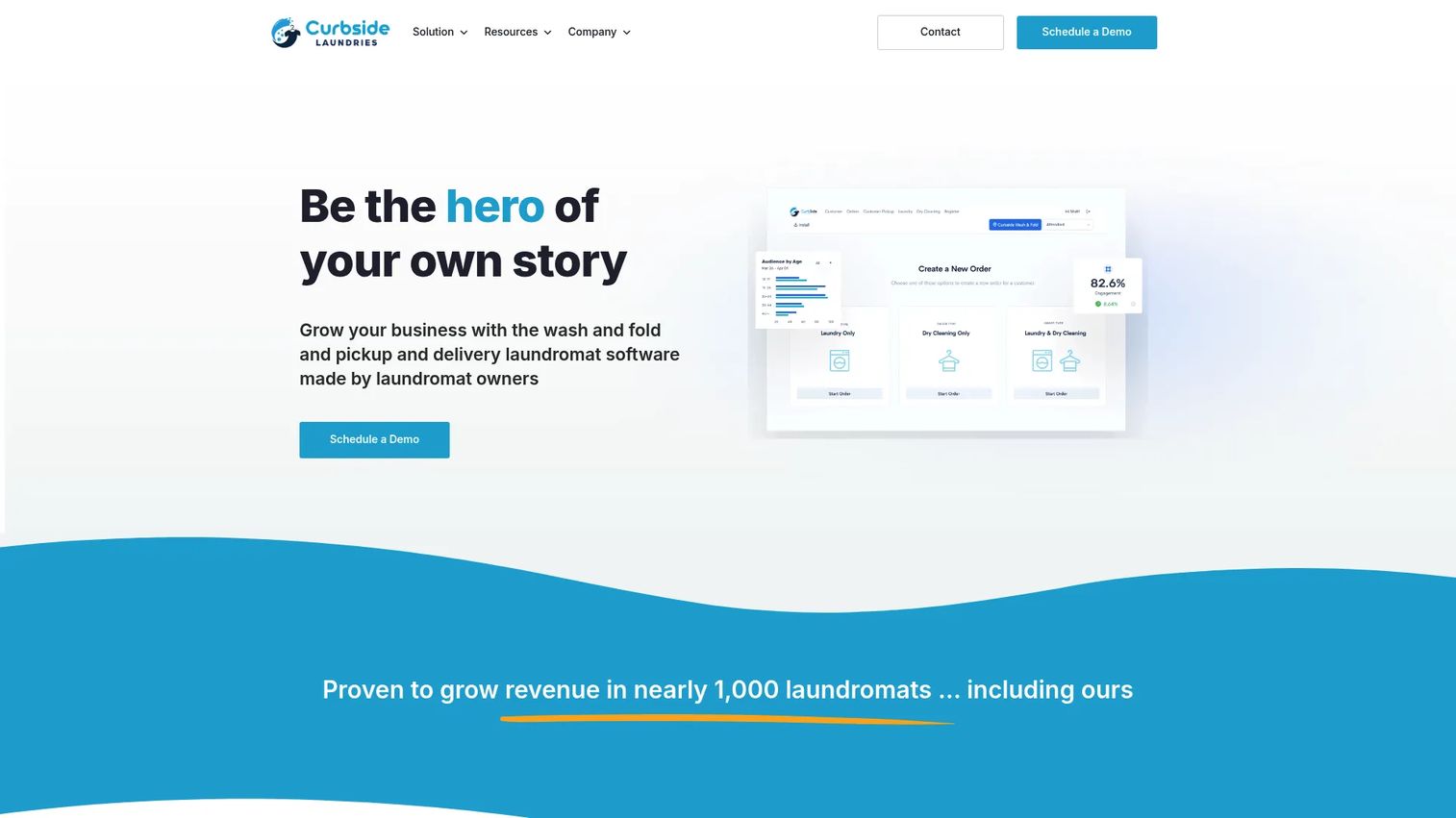
Curbside Laundries leans hard into its "made by laundromat owners" origin, and it shows in the workflow design. The platform runs wash and fold POS, pickup and delivery ordering and tracking, route optimization, and commercial invoicing, with a DoorDash integration for on-demand delivery. It is built for operators whose growth story is pickup and delivery, not just walk-in traffic.
Best for: laundromats that want an all-in-one wash and fold and pickup-and-delivery operating system.
Key strengths
- Wash and fold POS with routing: intake and driver routing live together, so orders flow from counter to doorstep in one system.
- DoorDash integration: tap into on-demand delivery capacity without building your own overflow driver pool.
- Marketing and reporting: built-in tools to drive repeat orders and measure store performance across locations.
Why choose Curbside Laundries: the operator-built angle is not marketing fluff here. The routing, invoicing, and text-reminder workflows reflect how a real wash and fold business runs, which shows up in service quality and retention. It fits best when pickup and delivery is central to your revenue, not a side experiment.
Curbside Laundries pricing: the company does not publish pricing on its own site. Capterra lists a Basic plan at $260.00 per month, flat rate, as of mid-2026. Confirm current pricing and plan structure directly with the vendor. There is no free tier listed. A G2 rating was not available; Capterra reviews are strong but should be checked at the source.
3. LaundryOS
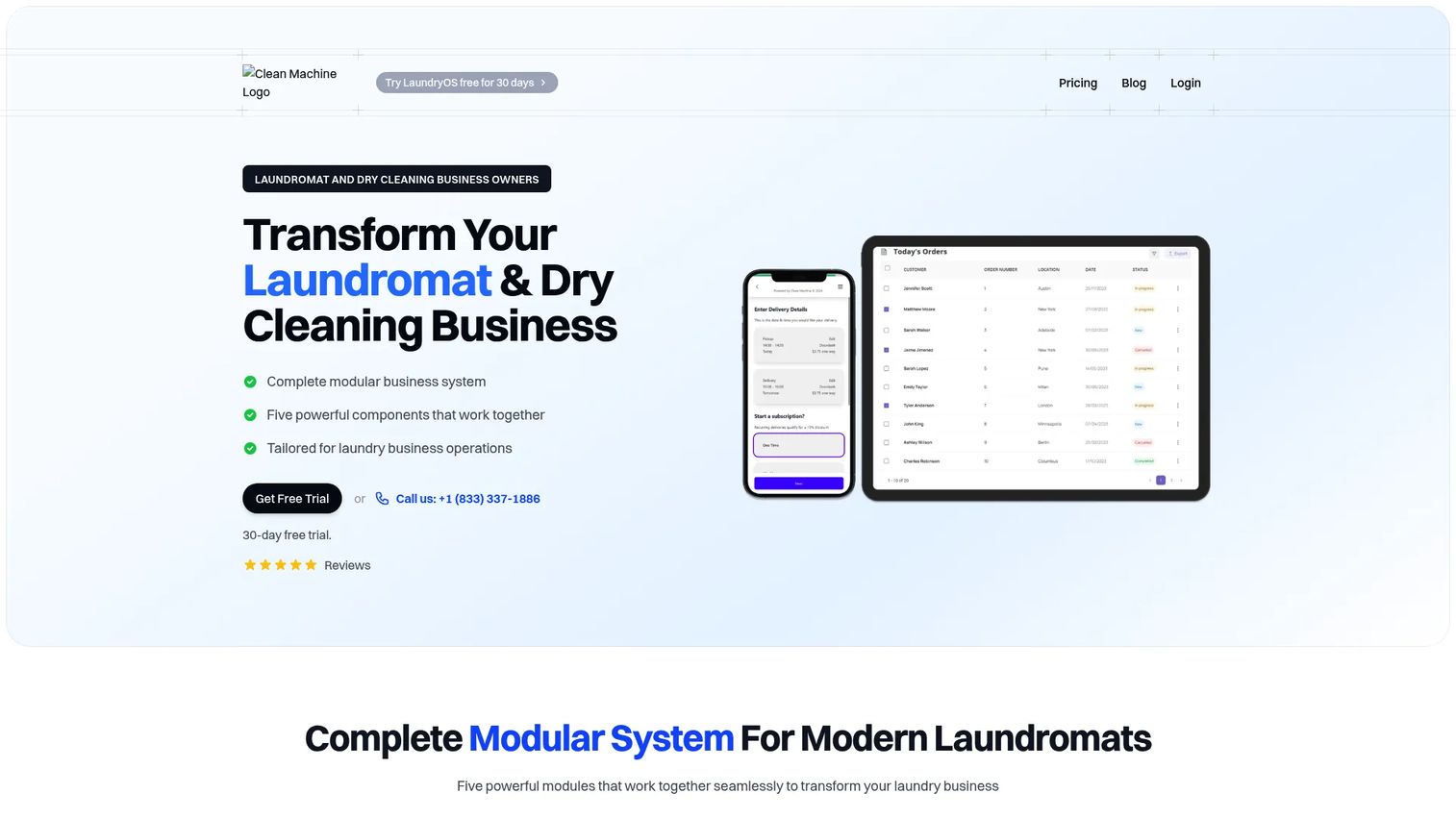
LaundryOS is a cloud POS and operations platform aimed at laundromats and dry cleaners that want transparent, published pricing and a clear path from single store to many. It covers integrated point of sale, basic garment tracking with photos, multiple-store management, email and SMS notifications, and a DoorDash integration with API access on higher tiers. The published pricing alone makes it easy to evaluate against operators who hide everything behind a quote.
Best for: laundromats and dry cleaners wanting a cloud POS and multi-location operations platform with pricing you can see upfront.
Key strengths
- Integrated POS with photo garment tracking: ring up orders and attach photos to garments so intake condition is documented.
- Multi-store management: the Professional and Enterprise tiers add multiple-store and unlimited-location support respectively.
- Notifications, DoorDash, and API: email and SMS customer notifications across tiers, with DoorDash integration and API access on Enterprise.
Why choose LaundryOS: it is a clean fit for operators who want to start on a single store and scale without renegotiating from scratch. The tier structure maps to growth stages, so you buy multi-store support when you actually open a second location, not before.
LaundryOS pricing: LaundryOS publishes three plans on its site, billed monthly. Essential is $99/month and includes core POS, basic garment tracking with photos, notifications, reporting, and single-location support. Professional is $149/month and adds multiple-store management, advanced marketing, staff tracking, and priority support. Enterprise is $299/month and adds unlimited locations, DoorDash integration, API access, and a dedicated account manager. There is no free tier.
4. Wash It
Wash It positions itself around automation and workflow efficiency for laundry delivery businesses, with a focus on billing, order tracking, customer communication, and driver routing. The pitch is replacing manual coordination between the front desk, the customer, and the driver with a single connected flow, typically split across an admin panel, a customer app, and a driver workflow.
Best for: laundry delivery operators who want billing, tracking, and driver coordination handled in one place.
Key strengths
- Admin, customer, and driver split: three connected surfaces so each role works in the view built for it.
- Billing and order tracking: automate invoicing and keep order status visible from pickup to return.
- Driver routing and notifications: coordinate drivers and keep customers updated automatically as orders move.
Why choose Wash It: the efficiency angle fits operators whose main pain is coordination overhead, not counter POS. If your business lives on delivery and repeat orders, a system that ties billing to the driver workflow removes a lot of manual back-and-forth.
Wash It pricing: first-party pricing was not verifiable from the brand's own site at time of writing, and a G2 rating was not available. Request current pricing and a demo directly from the vendor, and confirm the product is actively supported before committing, since primary-source details were limited.
5. Zoho Creator
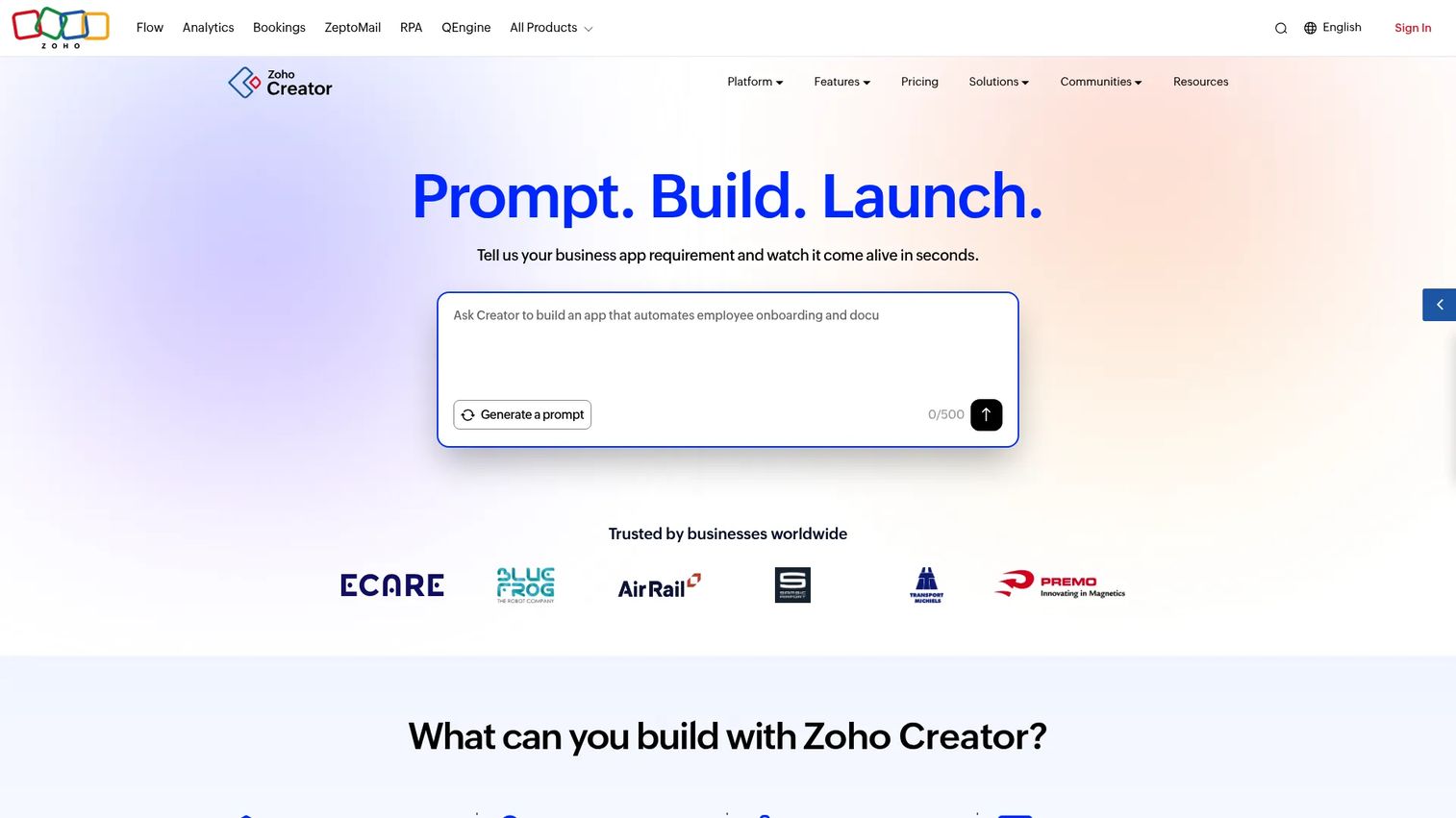
Zoho Creator is not purpose-built laundry software. It is a low-code platform for building custom business applications, and teams use it to assemble a laundry management app: scheduling, order tracking, notifications, invoices, and dashboards configured to their exact workflow. If you have unusual processes that off-the-shelf laundry service software cannot bend to, a configurable builder is a legitimate route.
Best for: teams needing a configurable low-code platform for internal business apps and workflows, including a tailored laundry ordering app.
Key strengths
- Drag-and-drop app building: design ordering, tracking, and invoicing screens without a developer for every change.
- Web, mobile, and tablet deployment: one build runs across counter tablets, driver phones, and customer web access.
- Workflow automation: trigger notifications, status changes, and invoice generation on your own rules.
Why choose Zoho Creator: it wins when your workflow is genuinely non-standard and you would otherwise fight a rigid laundry-specific tool. The tradeoff is real: you are building and maintaining the app, so you trade instant purpose-built features for flexibility. Purpose-built laundry SaaS gives you routing and garment tracking out of the box; Zoho Creator gives you a blank canvas.
Zoho Creator pricing: Zoho Creator offers a Free Edition and a 15-day free trial. Paid plans are billed per user annually: Standard at $8.00/user/month, Professional at $20.00/user/month, and Enterprise at $25.00/user/month. Zoho Creator holds a 4.3/5 rating on G2.
6. WASH
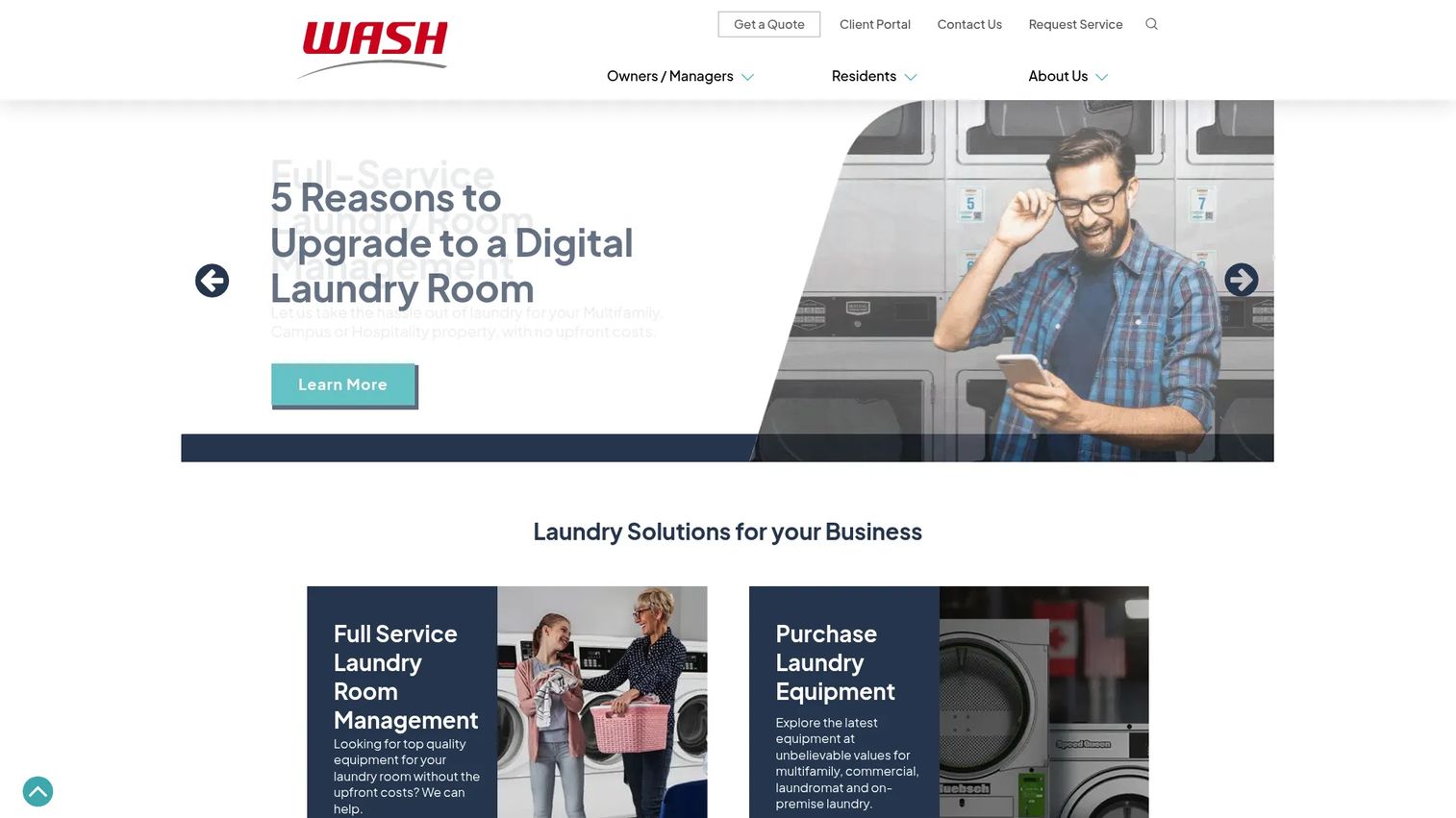
WASH serves a different corner of the laundry world. It is a commercial laundry services provider offering full-service laundry room management, commercial equipment sales and repair, and the WASH-Connect mobile app for cashless payment, service requests, and refunds. This is the platform for property-based laundry rather than retail wash and fold or dry cleaning.
Best for: multifamily, campus, hospitality, and other commercial properties that need managed laundry solutions.
Key strengths
- Full-service laundry room management: WASH runs the room, from machines to maintenance, so property teams do not have to.
- WASH-Connect app: residents and guests pay cashlessly, request service, and get refunds from their phone.
- Equipment sales and repair: commercial equipment supply and servicing alongside the managed-room model.
Why choose WASH: if you manage properties rather than operate a customer-facing laundry business, this is the fit. Apartment operators, universities, and hotels get a managed laundry room plus a resident-facing app, which is a fundamentally different job than routing wash and fold orders across a city.
WASH pricing: WASH does not publish public pricing. The site uses request-a-quote flows, and equipment pricing varies by market. Expect a quote-based engagement tied to your property portfolio and machine count. Request current pricing directly through the vendor's quote process.
7. WashDryFold
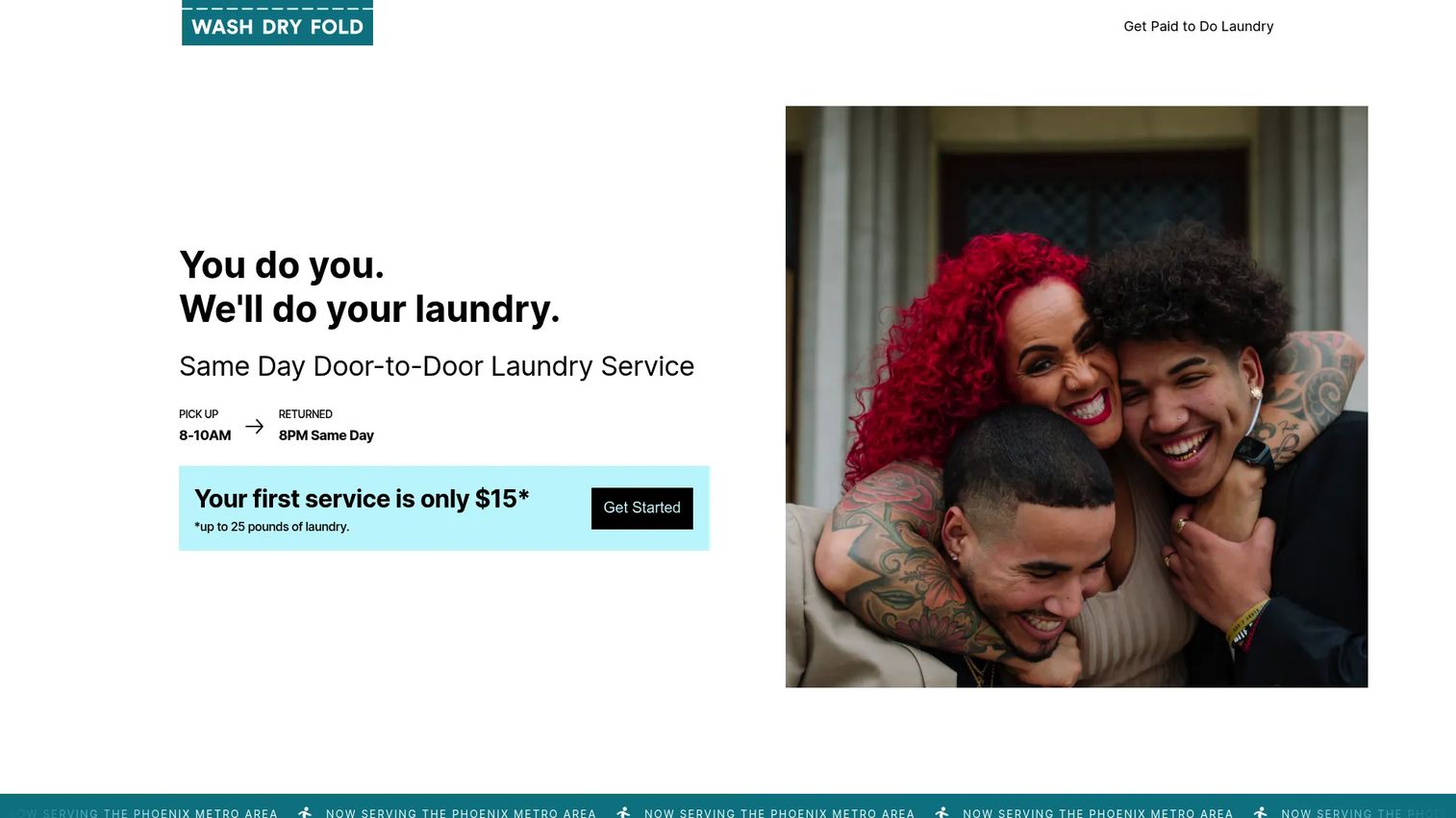
WashDryFold is the simplest option here, and deliberately so. It is a door-to-door wash, dry, and fold service with same-day pickup and return, on-site processing, and per-order preferences and handling notes. This is service simplicity over platform depth, aimed at households and the local operators serving them.
Best for: households and local operators needing straightforward pickup-and-delivery wash and fold service.
Key strengths
- Same-day pickup and return: fast turnaround built into the core service, not an add-on.
- On-site processing: laundry is handled in-house, which keeps quality and accountability in one place.
- Preferences and handling notes: customers set how their laundry is treated, order by order.
Why choose WashDryFold: it is the right fit when simplicity beats depth. If you do not need multi-store reporting, garment-level barcode tagging, or complex routing, a straightforward wash and fold service model with flat per-load pricing is easier to run and easier to explain to customers.
WashDryFold pricing: pricing is refreshingly plain. The first service is $15 for up to 25 pounds. Ongoing service is $15 per load, where a load is defined as one full wash-dry-fold bag. There is no free tier, and no per-user software licensing to model, because this is a service, not a seat-based platform.
Considerations before you choose
Feature lists all start to look the same. What actually separates these tools is how well each one matches your business model. Run through this checklist before you commit.
Match the tool to your business model
A dry cleaner needs per-piece garment tracking and alterations that a wash and fold shop never touches. A delivery-first operation needs route planning above everything. Buy for how orders move through your specific shop, not for the longest feature list.
Weigh delivery and routing depth
If pickup and delivery drives your growth, routing quality is not a nice-to-have. Test how each system handles same-day orders, driver reassignment, and proof of delivery. A tool that optimizes 30 stops instead of 20 pays for itself in fuel and labor.
Check multi-store and reporting fit
If you plan to open a second location, confirm the tool centralizes order visibility and consolidates reporting before you need it. Migrating between systems after you scale is far more painful than choosing the right one now.
Confirm real pricing and cost of switching
Several options here hide pricing behind a quote. Get real numbers, including onboarding, hardware, and per-store or per-user fees. Then factor the cost of switching: data migration, staff retraining, and downtime during the change.
Verify customer communication and acquisition tools
Automated notifications and repeat-order campaigns drive retention and customer acquisition. Confirm the platform sends the SMS and email your customers expect, and that reporting shows you which campaigns actually bring people back.
Conclusion
The right laundry software follows your business model, not the other way around. CleanCloud is the broadest all-in-one for mixed laundromat and dry cleaning operations with delivery. Curbside Laundries is the operator-built pick when wash and fold and pickup and delivery drive your revenue. LaundryOS gives you transparent, tiered pricing and a clean path from one store to many. Wash It leans into billing and driver coordination for delivery-first businesses. Zoho Creator is the route when your workflow is too unusual for off-the-shelf tools. WASH serves property and managed laundry rooms. WashDryFold keeps a local wash and fold service simple.
The next step is not booking seven demos. It is shortlisting two or three by business model, then testing the workflows that matter most to you: intake, billing, routing, and reporting. Start with the tool that matches how orders already move through your shop, and validate the delivery and multi-store paths before you sign. Choose for the operation you run today and the one you are building toward next year.
FAQs
Laundry software is a management platform that handles order intake, garment tracking, billing, customer communication, and pickup and delivery for a laundry business. It replaces separate registers, spreadsheets, and text threads with one connected system. Orders enter at the counter or through a customer app, move through tracking and processing, and trigger automated notifications and invoices along the way.
At minimum, laundromat software should include a point of sale, order and garment tracking, automated billing and invoicing, and customer notifications. If you offer delivery, add scheduling, route planning, and proof of delivery. Multi-store operators should also confirm centralized reporting and order visibility across locations before buying.
For pickup and delivery, Curbside Laundries and Wash It both center their workflows on routing and driver coordination, while CleanCloud offers delivery inside a broader all-in-one platform. The best pick depends on whether delivery is your entire business or one part of a mixed operation. Test how each handles same-day orders and route reassignment before deciding.
Yes. Curbside Laundries, CleanCloud, and LaundryOS all support wash and fold with POS, order tracking, and delivery workflows. For a simple local service without platform overhead, WashDryFold offers a flat per-load wash and fold model. Match the depth to your operation: a growing wash and fold delivery business needs routing, a single-location service may not.
If you run more than one location, or plan to, multi-store support is worth confirming upfront. It centralizes order visibility and consolidates reporting so you are not exporting separate spreadsheets per store. LaundryOS gates multi-store on its Professional and Enterprise tiers, and CleanCloud includes multi-store support, making both worth evaluating for growth.
Pricing spans a wide range. LaundryOS publishes plans from $99 to $299 per month. Curbside Laundries is listed on Capterra from $260 per month. Zoho Creator starts at $8 per user per month annually with a free tier, while CleanCloud and WASH use tiered or quote-based pricing you confirm with the vendor. Always factor onboarding, hardware, and per-store fees into the total.
Laundromat software centers on POS and store operations for wash and fold and self-service laundry. Dry cleaning software adds garment-level tracking, alterations, and per-piece invoicing that a pure wash and fold shop does not need. Many platforms, including CleanCloud, handle both, so the distinction matters most when your services and billing model require per-garment detail.