The data problem in modern research is no longer about collection. Instruments generate more output than teams can meaningfully track, and by the time someone needs to reproduce an experiment or answer a compliance question, the file might be in a shared drive, an emailed PDF, or a folder only one scientist remembers.
According to a 2024 survey published by NISTEP in 2026, only 39.7% of researchers had experience preparing a Data Management Plan, even as 85.3% reported having obtained open data from external sources. The gap between data generation and data governance is wide, and it costs teams reproducibility, audit readiness, and engineering time.
Scientific data management systems, or SDMS, exist to close that gap. The right platform turns scattered instrument outputs and unstructured files into a governed, searchable, and reusable research data repository. For product managers evaluating scientific software infrastructure, the question is not whether your team needs one. It is which system will remain maintainable as instrument volumes grow, as teams change, and as the data contracts between your lab systems evolve.
What's inside
This guide is for product managers, laboratory informatics leaders, and R&D operations teams evaluating SDMS software. Seven platforms were selected based on:
- Instrument connectivity and file format coverage
- Metadata extraction, indexing, and data discoverability
- Governance controls including audit trails and electronic signatures
- Integration depth with LIMS, ELN, and analytics tooling
- Deployment options and long-term maintenance requirements
Pricing and G2 ratings reflect verified figures from live vendor and review pages as of October 2026.
TL;DR
- Best for connected enterprise laboratories: LabVantage SDMS brings instrument data capture, metadata indexing, and audit controls inside a broader laboratory informatics suite
- Best for configurable research data environments: LabKey Server offers a free Community edition and flexible schema design for research organizations with custom data models
- Best for broader scientific R&D data workflows: Dotmatics connects data management with scientific search, analytics, and ELN capabilities across biology and chemistry
- Best for regulated enterprise lab operations: Thermo Scientific SampleManager covers sample workflows, GMP, and FDA 21 CFR Part 11 compliance in one platform
- Best for biopharma scientific data governance: IDBS Polar provides a unified data backbone for CROs, CDMOs, and biopharma R&D teams
- Best for instrument integration as the primary bottleneck: Scitara Scientific Integration Platform connects instruments and applications without per-instrument point-to-point builds
- Best for cloud-first biotech R&D teams: Benchling gives modern biotech organizations collaborative ELN, structured scientific data models, and AI capabilities in one cloud environment
The right system depends on your instrument landscape, data formats, governance requirements, and the systems already acting as sources of truth.
What is a scientific data management system?
A scientific data management system, or SDMS, is software that captures, indexes, stores, governs, and retrieves scientific data from laboratory instruments, files, and connected research systems.
SDMS software sits at the center of a laboratory's data architecture. It is not a sample tracker or a procedure guide. Its primary job is to make raw research data findable, trustworthy, and reusable across the full data lifecycle, from first instrument output through long-term scientific data archiving.
What SDMS software manages
- Instrument-generated files: Raw outputs from chromatography, spectrometry, imaging, and other equipment
- Unstructured files: PDFs, spreadsheets, images, reports, and emailed datasets
- Metadata: Experiment context, sample identifiers, method parameters, project tags, and analyst information
- Governance records: Audit trails, access logs, approval workflows, version history, and electronic signatures
- Archival data: Retention schedules, long-term storage controls, and retrieval records
- Connected system links: References to records in LIMS, electronic laboratory notebooks, analytics tools, and external repositories
SDMS versus LIMS, ELN, and LES
These four system types often appear together in laboratory environments. Each has a distinct primary job:
| System | Primary job | Typical data type | Best use |
|---|---|---|---|
| SDMS | Capture, govern, index, preserve, and retrieve | Raw files, instrument outputs, documents, metadata | Cross-system scientific data management |
| LIMS | Track samples and laboratory workflows | Structured sample and test records | Operational laboratory execution |
| ELN | Record experimental work and observations | Research notes, methods, and attached data | Scientist documentation and collaboration |
| LES | Guide and document lab procedures | Procedure steps and execution evidence | Standardized execution workflows |
Mature research environments often run all four, with clear integration boundaries rather than one tool attempting to cover every job.
When to use scientific data management software
Centralize data from disconnected instruments
A laboratory with multiple instrument vendors, proprietary file formats, and separate storage locations faces a daily tax on reproducibility. Scientists spend time locating source data instead of analyzing it, and files frequently lose their experimental context during manual transfers. An SDMS creates a single governed destination where instrument data lands with metadata intact.
Make research data searchable and reusable
Institutional memory is a fragile data strategy. When the original scientist moves to another team, the experiment context moves with them unless it has been indexed. SDMS software with strong metadata capture and change data capture software integration patterns lets teams retrieve prior experiments by project, method, instrument, or date without asking the person who ran it.
Strengthen governance and retention for research and development data
Permissions, audit trails, version history, and archival schedules are not optional in regulated research environments. They are the evidence base for quality review, reproducibility claims, and inspection readiness. An SDMS operationalizes those controls so they apply consistently across every data source, not just the ones someone remembered to govern manually.
Scientific data management systems comparison
The table below gives a compact view of all seven platforms. Verify pricing and G2 ratings directly from vendor pages before finalizing any evaluation, as both change with new contracts and review activity.
| # | Product | Best for | Key differentiator | Pricing | G2 rating |
|---|---|---|---|---|---|
| 1 | LabVantage SDMS | Enterprise laboratories with integrated informatics needs | Instrument capture tied to LIMS, ELN, and LES in one suite | Custom pricing | 3.8/5 |
| 2 | LabKey Server | Research organizations building configurable data portals | Free Community edition with configurable schemas and research data integration | Free tier available; paid plans from $5,000/year | 4.6/5 |
| 3 | Dotmatics | Scientific R&D organizations across biology and chemistry | Connected scientific data, search, analytics, and ELN on one platform | Custom pricing | 4.6/5 |
| 4 | Thermo Scientific SampleManager | Regulated enterprise laboratories | GMP, ISO 17025, and FDA 21 CFR Part 11 compliance in an integrated LIMS and SDMS | Custom pricing | 4.3/5 |
| 5 | IDBS Polar | Biopharma CROs, CDMOs, and R&D teams | Unified ELN, LES, and LIMS with GxP-compliant and non-GxP workflow support | Custom pricing | Not yet rated on G2 |
| 6 | Scitara Scientific Integration Platform | Labs with complex instrument and application integration needs | Vendor-neutral instrument and application connectivity with visual workflow orchestration | Custom pricing | Not yet rated on G2 |
| 7 | Benchling | Cloud-native biotech and R&D teams | Collaborative ELN, molecular design, AI capabilities, and REST API on one platform | Free for qualifying academic users; enterprise pricing by quote | 4.5/5 |
Best scientific data management systems for 2026
1. LabVantage SDMS
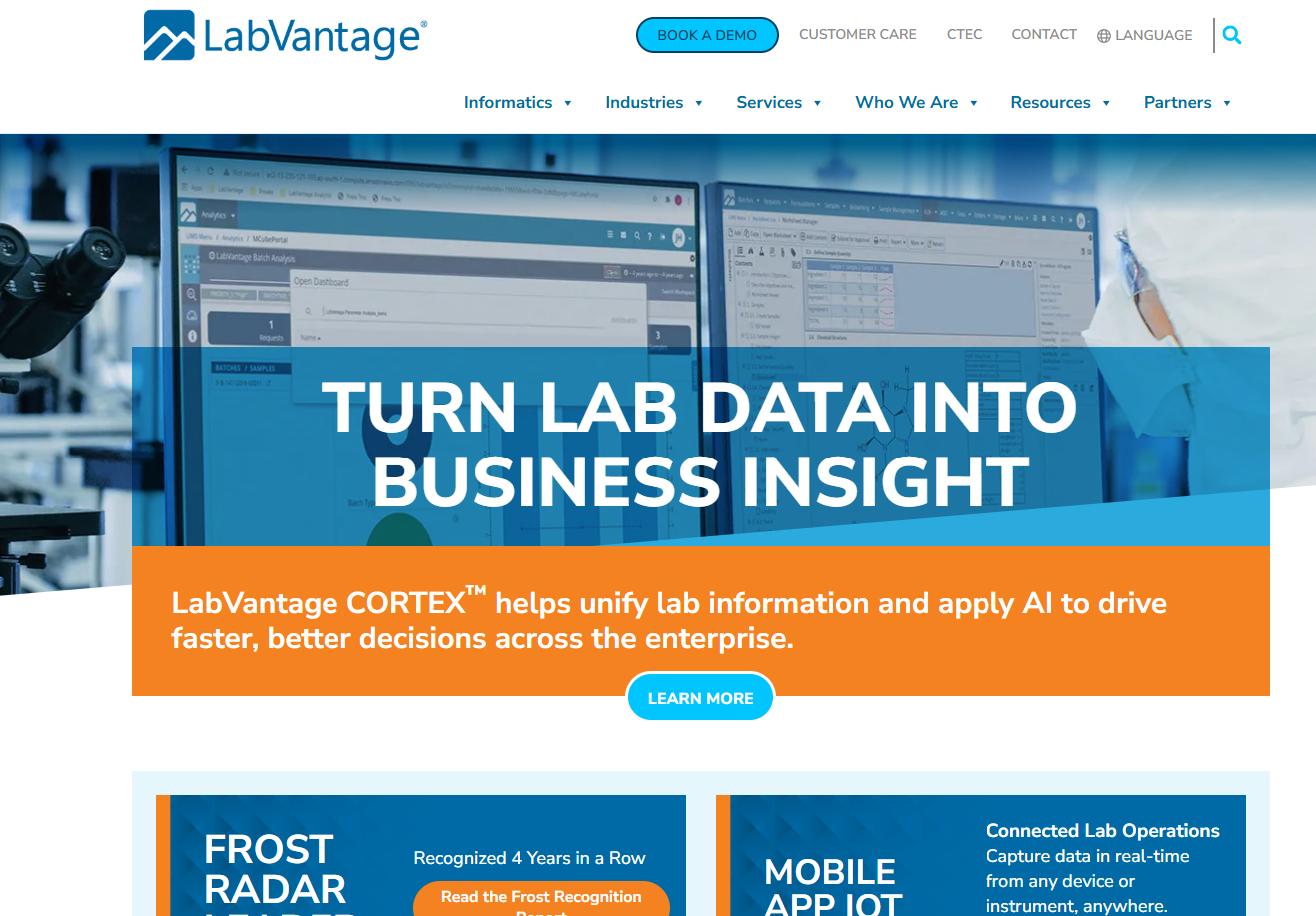
LabVantage SDMS is the scientific data management component of the broader LabVantage laboratory informatics platform. It captures data from instruments, file shares, email attachments, local drives, and real-time equipment streams, then stores it in a secure, auditable repository alongside the metadata extracted from each source. The platform uses Talend-based parsers to pull test data and metadata from instrument outputs, connecting those records directly to LabVantage LIMS, ELN, and LES.
Best for: Enterprise laboratories that need instrument data capture governed inside an integrated informatics environment.
Key features
- Instrument, email, file-share, and real-time data capture
- Talend-based metadata extraction and indexing
- Audit trails, timestamps, and electronic signature workflows
- LIMS, ELN, and LES integration within the LabVantage suite
- Distributed data collectors for remote locations and high-volume environments
Why choose LabVantage SDMS: If your team is already running, or planning to run, LabVantage for sample and workflow management, the SDMS module reduces the integration overhead of connecting a separate scientific data repository. The tradeoff is that you are committing to the LabVantage platform as operating infrastructure, so implementation governance and ownership decisions need to be made early. Teams looking for a standalone SDMS should evaluate whether the broader suite serves their needs before selecting this path.
LabVantage SDMS pricing: LabVantage prices by quote and does not display figures on its product pages. Contract cost will reflect deployment model, the modules selected, instrument connection volume, validation requirements, and support level. Reach out to their sales team directly for a scoped estimate.
G2 rating: 3.8/5
2. LabKey Server
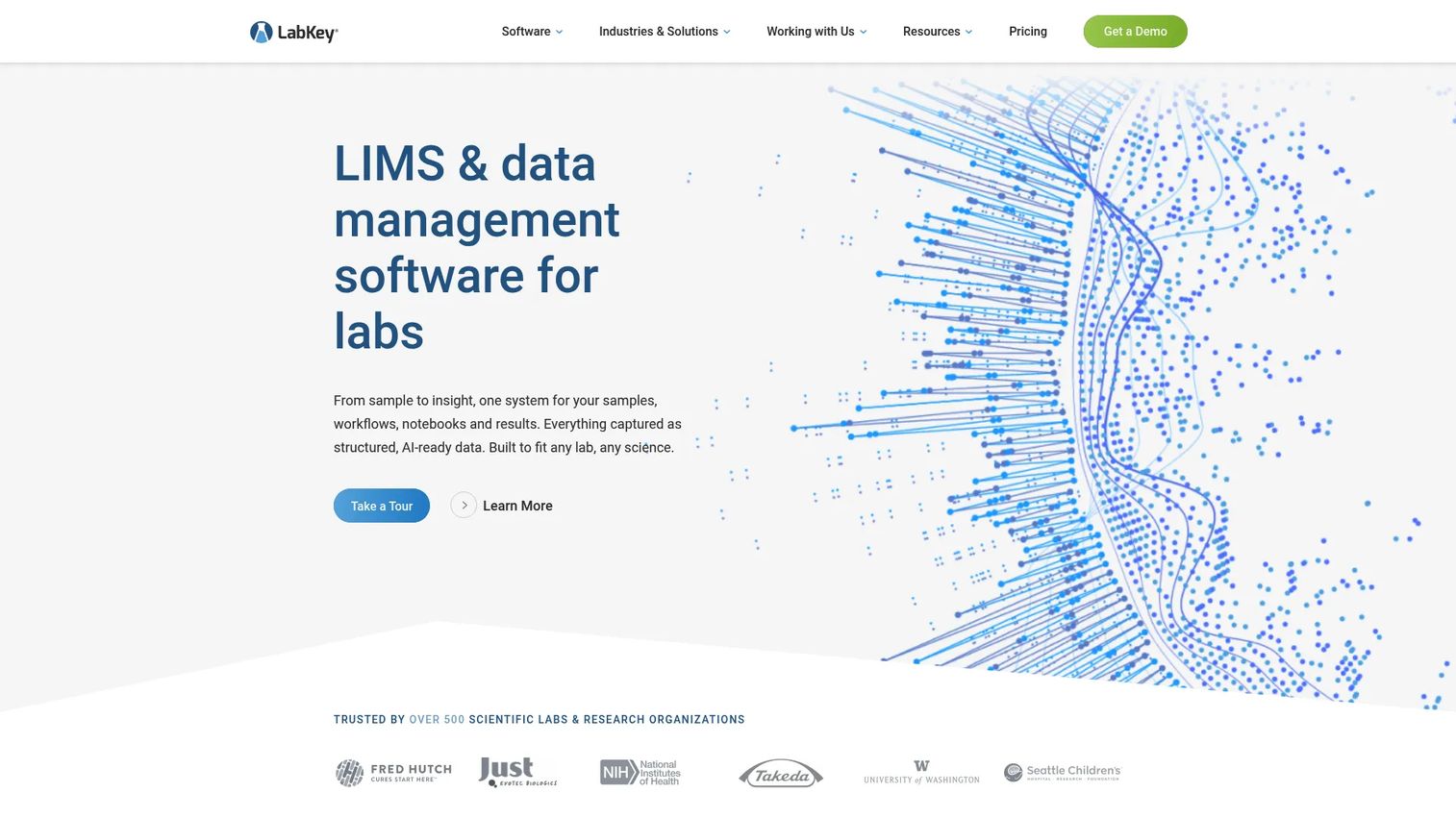
LabKey Server is a cloud-based scientific data management platform built for research organizations that need configurable, secure centralization of complex or biomedical data. It supports custom data schemas, web-based sharing across research groups, fine-grained permissions, and API-enabled extensibility for teams that want to script or build custom modules on top of a research data foundation.
Best for: Research organizations and product teams that need a configurable data portal rather than a preconfigured laboratory workflow system.
Key features
- Configurable data schemas and harmonization workflows
- Fine-grained permissions, audit logging, and compliance support
- Built-in and third-party visualization and reporting integrations
- API-enabled extensibility with scripting and custom module support
- Sample lifecycle and chain-of-custody management
Why choose LabKey Server: The free Community edition is a genuine starting point for smaller research teams or those in an early evaluation phase. Configuration power is the real differentiator here: If your data model does not fit a standard template, LabKey gives you the schema flexibility to define it. The practical consideration is that configuration depth requires clear internal data stewardship. Someone on your team needs to own the schema decisions and maintain them across updates.
LabKey Server pricing: The Community edition is free. LabKey Cloud plans are priced annually: Starter starts at $5,000 per year and Professional at $15,000 per year. Numeric prices for the Server SDMS Starter, Professional, and Enterprise tiers are not displayed on the LabKey pricing page; contact their team for those figures.
G2 rating: 4.6/5
3. Dotmatics
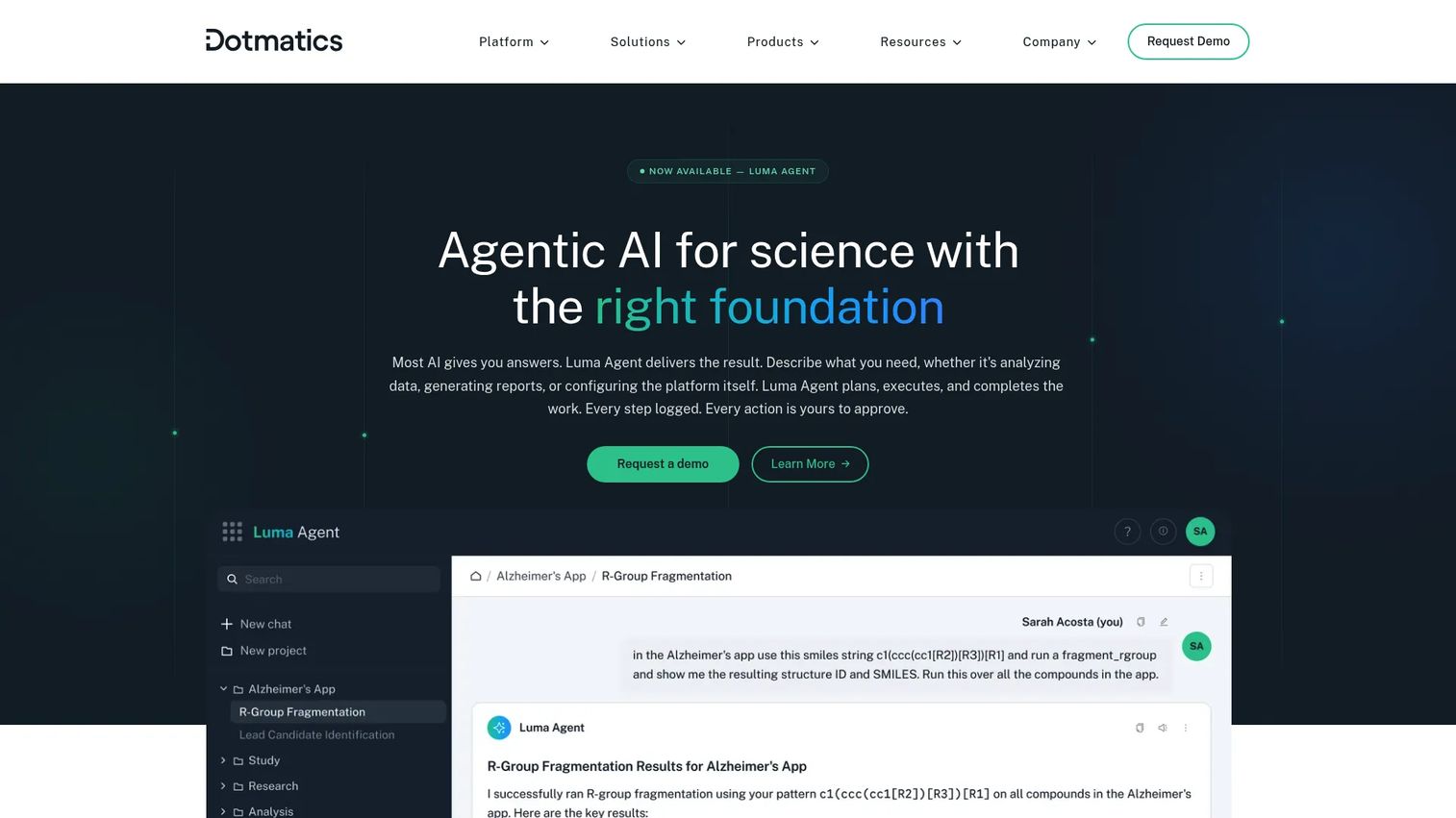
Dotmatics is an enterprise scientific R&D software platform that connects data management, scientific search, analytics, and experimentation across biology, chemistry, and materials science workflows. Its ELN captures experiments for storage, search, and sharing. Scientific search covers research databases and data sources across the organization. Workflow and integration capabilities connect Dotmatics to instruments, LIMS, and external repositories.
Best for: R&D organizations that need scientific data management connected to broader research applications and knowledge workflows, particularly in drug discovery and chemistry-heavy environments.
Key features
- Electronic laboratory notebook for experiment capture, storage, and search
- Scientific search across research databases and connected data sources
- Data visualization and analytics built into the research workflow
- Chemical searching, filtering, and compound management
- Configurable integrations with ELNs, LIMS, instruments, and data repositories
Why choose Dotmatics: The platform fits teams where scientific data management cannot be separated from the research applications scientists use daily. The ELN, search, and analytics layers work together rather than requiring separate point integrations. Before selecting Dotmatics, map your existing systems clearly: What data lives where, who owns each system boundary, and what migration scope is realistic. The breadth of the platform means more capability but also more configuration to get right.
Dotmatics pricing: Pricing is provided on application. Dotmatics directs prospective customers to contact sales, and cost will reflect the products selected, seat count, license length, and implementation scope.
G2 rating: 4.6/5
4. Thermo Scientific SampleManager
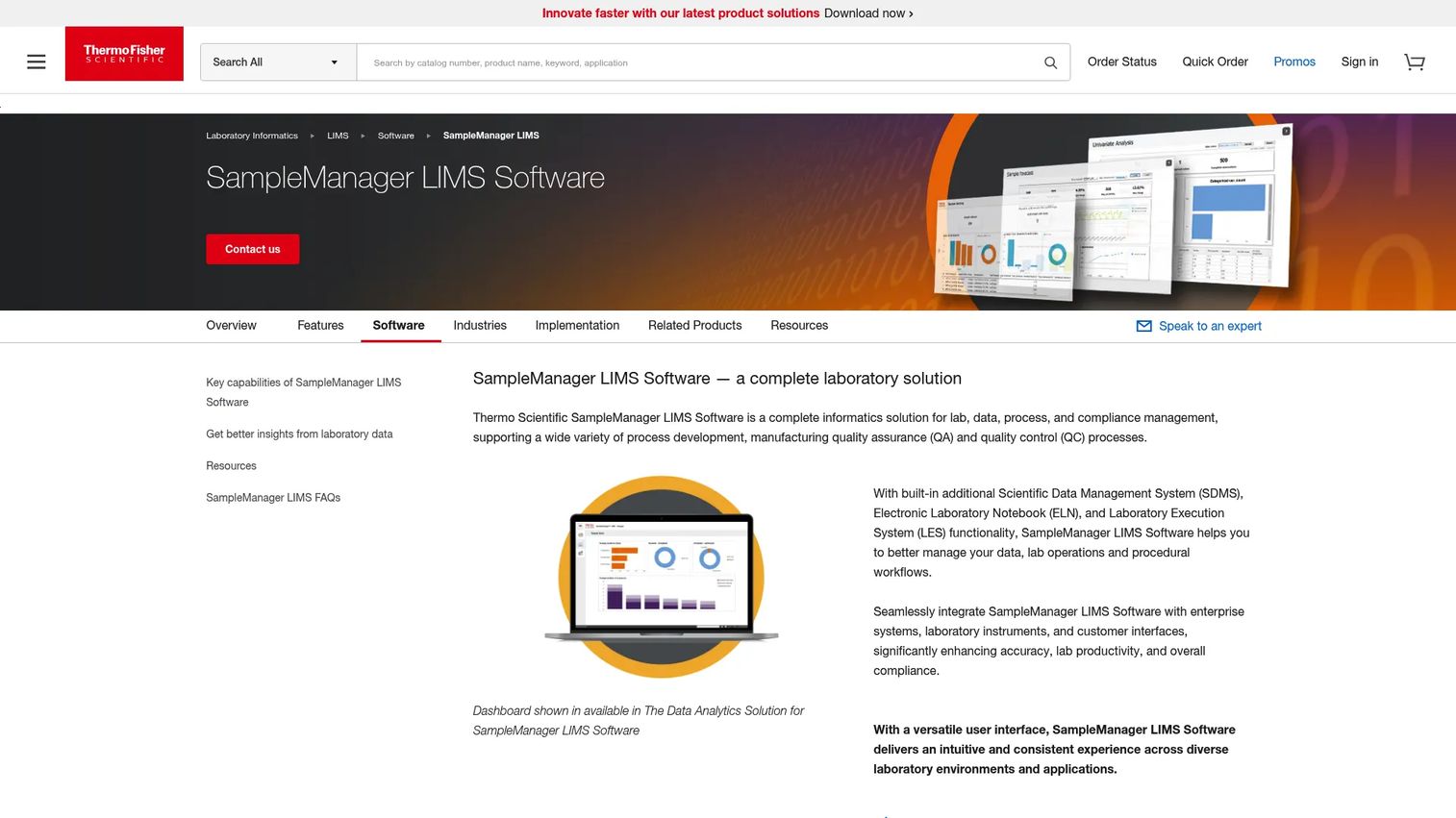
Thermo Scientific SampleManager is an enterprise laboratory informatics product from Thermo Fisher Scientific that integrates SDMS, ELN, and LES capabilities in a single platform. It runs in regulated and complex laboratory environments, with explicit support for GMP, ISO 17025, and FDA 21 CFR Part 11 compliance. Deployment options include cloud and on-premises, and the platform provides mobile application access alongside instrument, MES, and ERP integration.
Best for: Organizations in regulated industries that need sample, data, workflow, and compliance management inside a single enterprise system with Thermo Fisher ecosystem depth.
Key features
- Integrated SDMS, ELN, and LES in one system
- Cloud or on-premises deployment options
- Regulatory compliance support for GMP, ISO 17025, and FDA 21 CFR Part 11
- Mobile application access for laboratory operations
- Instrument, MES, and ERP integration
Why choose Thermo Scientific SampleManager: SampleManager suits teams already invested in Thermo Fisher laboratory infrastructure or those with extensive validation and compliance requirements. The integrated approach reduces the number of system boundaries to manage. Before committing, validate how your specific raw instrument files, metadata standards, and long-term archive requirements map to your planned configuration. The platform's compliance depth is a strength, but it requires careful configuration to deliver that value consistently.
Thermo Scientific SampleManager pricing: Thermo Fisher does not display pricing on the SampleManager product page. Cost varies by module selection, deployment choice, validation services required, and support agreements. Contact Thermo Fisher directly for a project-scoped quote.
G2 rating: 4.3/5
5. IDBS Polar
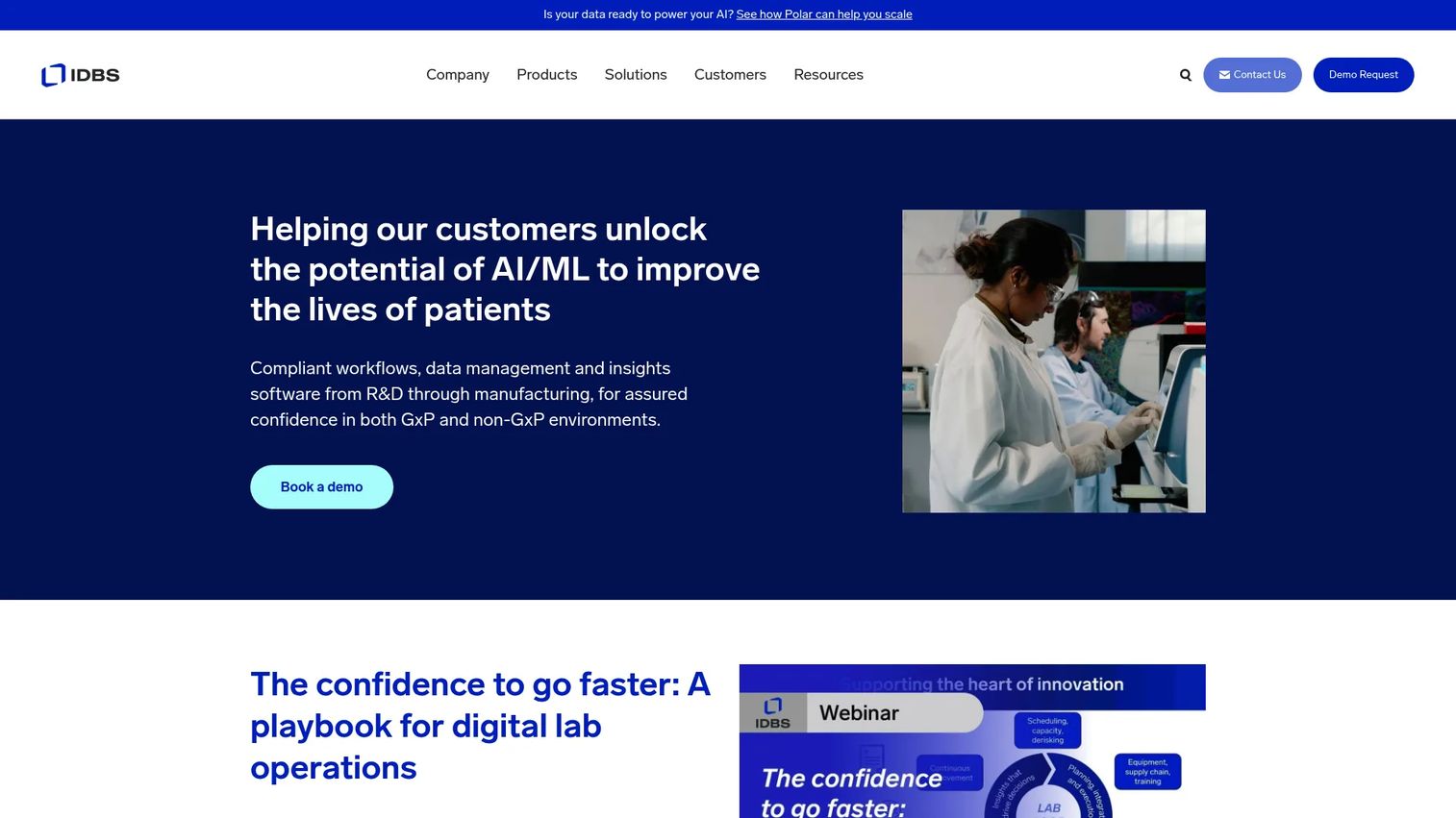
IDBS Polar is an enterprise SaaS laboratory informatics platform combining ELN, LES, and LIMS capabilities in a single system for biopharmaceutical research and development. It provides a unified data backbone connecting experiments, products, and processes, with configurable low-code and no-code scientific workflows across GxP-compliant and non-GxP environments. Inventory management, material traceability, and advanced analytics are built into the platform rather than requiring separate connectors.
Best for: Biopharma teams, CROs, and CDMOs that need governed, integrated laboratory workflows across research and development with GxP compliance support.
Key features
- Combined ELN, LES, and LIMS in one SaaS platform
- Configurable low-code and no-code scientific workflows
- Unified data backbone across experiments, products, and processes
- Inventory management with sample, material, and equipment traceability
- GxP-compliant and non-GxP environment support
Why choose IDBS Polar: The platform is built for teams where SDMS requirements cannot be separated from regulated R&D workflow execution. Rather than connecting separate systems for notebooks, execution, and sample management, IDBS Polar provides one governed environment for all three. Before committing, test integration depth directly against your specific instruments, LIMS configurations, and downstream analytics destinations. The unified approach reduces handoff complexity, but only if the integrations cover your actual stack.
IDBS Polar pricing: IDBS does not display pricing on its product pages. Contract size reflects use case scope, user population, data volume, implementation work, and integration requirements. Capterra reviewers report a rating of 4.0/5 from two reviews; a G2 product-specific rating was not available at verification time.
6. Scitara Scientific Integration Platform
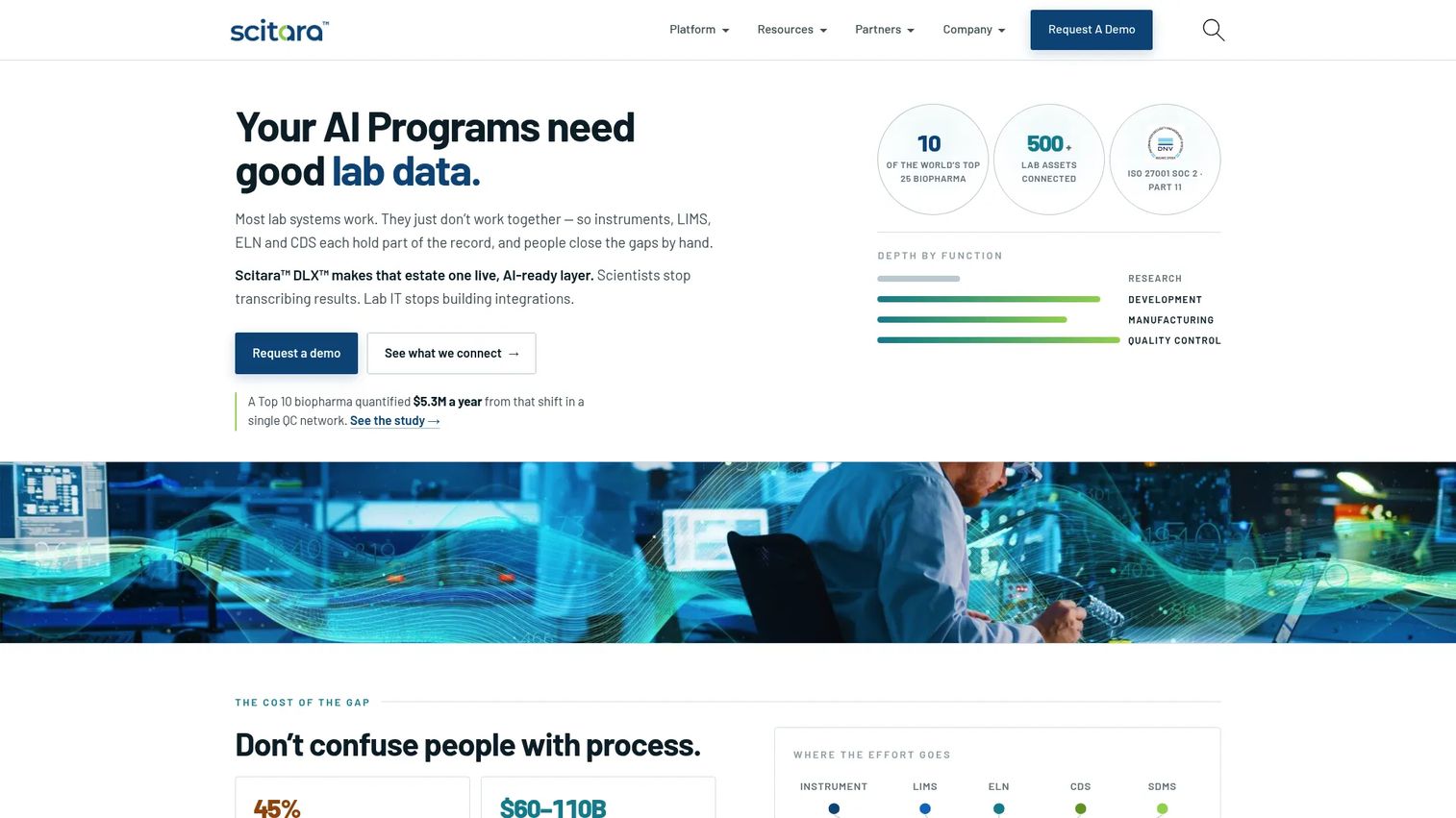
Scitara DLX is a cloud-based, vendor-agnostic integration platform that connects scientific instruments, laboratory applications, informatics systems, web services, and IoT devices. It provides visual orchestration of laboratory workflows, real-time event monitoring, bi-directional data exchange, and audit trail controls. The platform supports regulated environments with ISO 27001, SOC 2, 21 CFR Part 11, and GxP-ready operation.
Best for: Regulated scientific laboratories where the primary SDMS obstacle is connecting instrument data and laboratory applications across multiple vendors without point-to-point maintenance overhead.
Key features
- Vendor-neutral connectivity for instruments, applications, and IoT devices
- Visual workflow orchestration for routine and complex laboratory processes
- Real-time event monitoring and audit trail controls
- Bi-directional data exchange with transformation across connected endpoints
- Regulatory environment support including ISO 27001, SOC 2, and 21 CFR Part 11
Why choose Scitara: When the bottleneck is integration rather than storage or search, Scitara addresses that problem directly. Every additional instrument or application connection in a typical laboratory becomes a maintenance liability without a dedicated integration layer. Scitara's vendor-neutral architecture means instrument firmware updates and schema changes in upstream systems can be handled at the integration layer rather than requiring changes across multiple downstream applications. It is most valuable when instrument count is high, vendor diversity is significant, and engineering bandwidth for point-to-point maintenance is limited. This platform works well alongside audit management software and cloud data security software in environments with complex governance requirements.
Scitara Scientific Integration Platform pricing: Scitara does not display pricing on its website. Cost reflects the number of connected instruments and applications, deployment footprint, integration workflow complexity, and service level. Contact their team for a scoped estimate.
7. Benchling
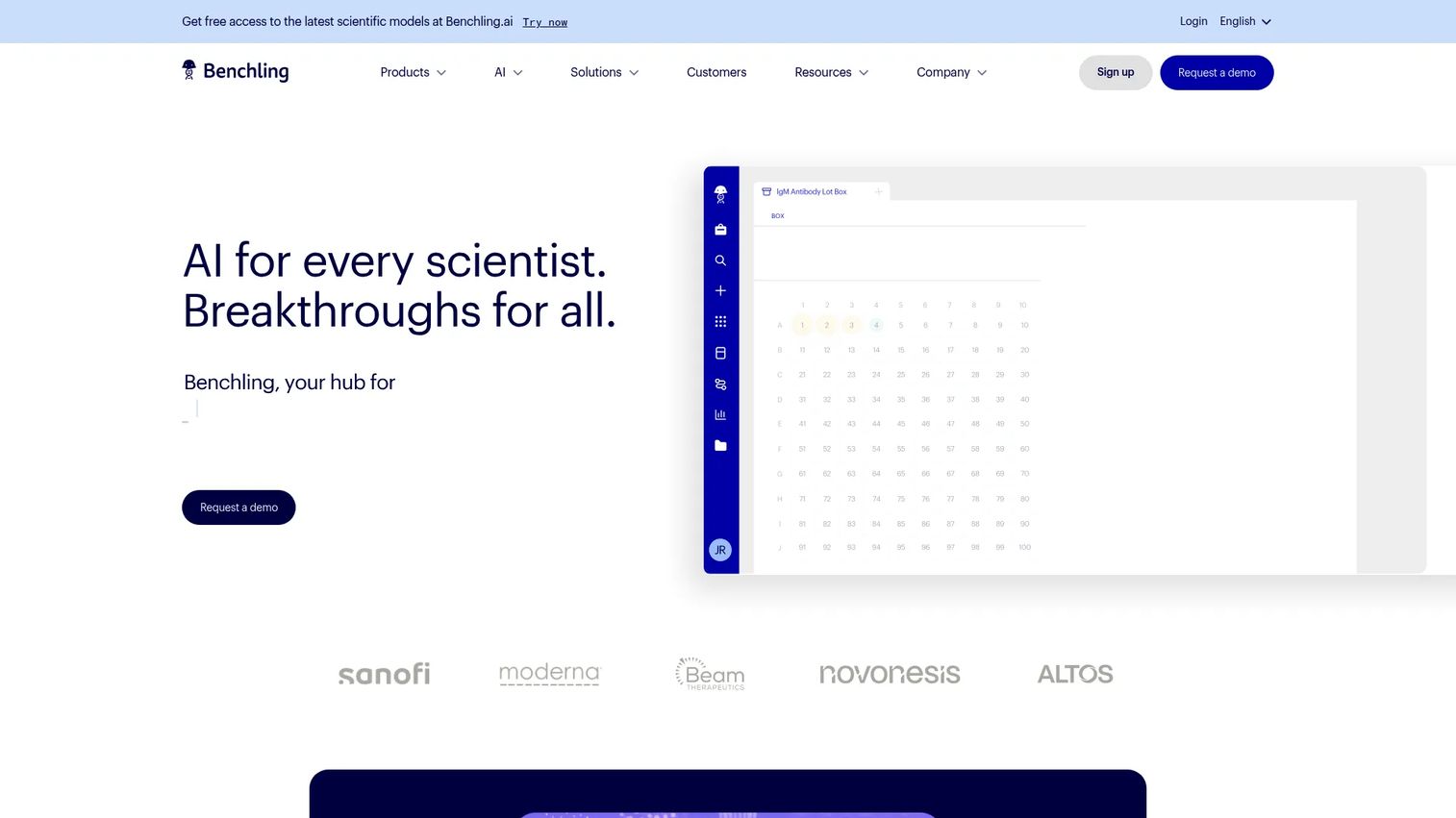
Benchling is a cloud-native R&D platform for biotechnology teams that need connected scientific workflows, collaborative electronic lab notebooks, and AI capabilities in one environment. It covers experimental data capture, molecular design for DNA, RNA, and amino acid sequences, molecule and sample inventory management, collaborative workflows, lab automation, instrument connectivity, and REST APIs for integration with external systems.
Best for: Biotech R&D organizations that prioritize scientist adoption, cloud-first infrastructure, and AI-assisted scientific workflows alongside core data management needs.
Key features
- Collaborative ELN with experimental data capture and sharing
- Molecular design for DNA, RNA, oligos, and amino acid sequences
- Molecule, sample, and inventory management
- Lab automation and instrument connectivity
- REST APIs, Python SDK, webhooks, and an application framework for integrations
Why choose Benchling: Benchling fits teams where scientist adoption and connected R&D collaboration are as important as data governance. The AI capabilities, including structure prediction models and scientific analytics, are built into the platform rather than requiring a separate analytics layer. One practical distinction to validate before selecting: Benchling is designed around research workflows and connected experimentation. If your primary need is raw instrument file archiving, long-term retention controls, and metadata extraction at scale from diverse instrument types, test those specific requirements during your evaluation. The platform covers much of the SDMS scope, but its governance depth and instrument file handling should be confirmed against your exact data types and retention requirements. Benchling's best component content management systems integrations and API surface make it easier to connect with existing R&D tooling across teams.
Benchling pricing: Benchling offers a free Academic Plan for qualifying individual academic users. Paid plans for institutional and enterprise users are priced by quote. Benchling does not display commercial pricing on its pricing page; contract terms reflect user groups, product modules, integrations, data migration scope, and enterprise controls.
G2 rating: 4.5/5
Considerations when choosing scientific data management systems
Instrument and data-source coverage
Ask which instruments, file formats, and streaming data sources each platform supports today, not on a roadmap. Require a proof of connectivity for the instruments that matter most to your environment. A roadmap promise does not reduce the integration work your team will carry this quarter.
Metadata model and data discoverability
Evaluate how the platform captures, normalizes, indexes, and exposes metadata. The most capable repository still fails if scientists cannot find the data or understand its context. Test retrieval with realistic queries from your research domains before selecting a platform. Strong ai governance tools integration can support metadata quality over time in more advanced environments.
Governance, access, and auditability
Review permissions, audit trails, approval workflows, version history, retention controls, and export records in detail. Map those controls to your actual operating model, including how QA, IT, and research leadership interact with data, before you begin configuration. Governance requirements that arrive after implementation are significantly more expensive to address.
Integration ownership and maintenance
Clarify who owns connectors, APIs, error handling, monitoring, and upgrade cycles. A product manager should define what happens when an instrument firmware update or an upstream schema change breaks a workflow. If that answer is "we file a ticket and wait," the integration model needs a second look. Well-designed SDMS integrations behave more like change data capture software patterns: Observable, recoverable, and owned by a named team.
Adoption and measurement
Plan for scientist, lab operations, QA, and IT adoption separately. Track time-to-retrieve for key data types, instrument data ingestion failures, manual file transfer volume, metadata completeness rates, and support ticket trends by lab group. Establish baselines before go-live so you have a comparison point worth using.
Conclusion
The right scientific data management system depends on where your biggest data problem actually lives.
LabVantage SDMS fits enterprise laboratories that want instrument capture and governance inside an integrated informatics suite. LabKey Server is the practical choice for research organizations that need configurable data models and can start with a free Community edition. Dotmatics makes sense when scientific data management cannot be cleanly separated from ELN, search, and analytics workflows. Thermo Scientific SampleManager covers teams with deep regulatory requirements and existing Thermo Fisher infrastructure. IDBS Polar suits biopharma and CRO environments that need ELN, LES, and LIMS unified under one governed data backbone. Scitara fits best when instrument integration is the primary bottleneck and point-to-point maintenance is the real cost. Benchling serves cloud-first biotech teams that prioritize scientist adoption, molecular design, and AI capabilities alongside core data management.
Before booking vendor evaluations, map your current instrument sources, file types, metadata requirements, connected systems, and audit needs to a document the whole team can review. That exercise will surface the decision criteria that matter most before any vendor has a chance to frame them for you.
Start your journey with Guideflow today!
FAQs
An SDMS manages scientific files, instrument outputs, metadata, and long-term data access across systems. A LIMS typically manages structured sample, test, and workflow records tied to laboratory operations. Many labs run both, with defined integration points between them, rather than expecting one system to cover both jobs.
SDMS platforms handle raw instrument files, PDFs, spreadsheets, images, reports, datasets, metadata, and references to records in connected applications. Each platform supports different file types, storage models, and indexing methods, so validate your specific instrument output formats during evaluation rather than assuming coverage.
An ELN captures experimental narrative, methods, and observations. An SDMS governs and retrieves larger bodies of scientific data across instruments and repositories. Most research organizations use both, with the ELN generating data that the SDMS governs and archives rather than replacing one with the other.
Connection methods include instrument connectors, file parsers, file watchers, APIs, middleware layers, and scheduled imports. Buyers should validate support for their exact instrument models and output formats, not just the instrument category. A connector for a vendor's instrument line does not guarantee support for your specific firmware version or output schema.
Establish baselines before go-live, then track data retrieval time, instrument data ingestion failure rates, manual file transfer volume, metadata completeness percentages, archive reuse frequency, support ticket volume by lab group, and active usage by research program. These metrics surface adoption gaps and integration issues before they compound.
Many platforms include audit and approval functionality, but the depth and configuration requirements differ significantly. Review the feature set, validation documentation, permission models, and signature workflow design with your quality and IT stakeholders before selecting a platform. Ensure the controls align with your specific operating procedures, not just the vendor's standard implementation.
The answer depends on data residency requirements, existing infrastructure, instrument connectivity, security review outcomes, IT operating model, and validation process. Some instrument connectivity approaches require proximity to on-premises systems, which may affect cloud feasibility. Map your actual constraints before treating either deployment model as a default.
Duration depends on source-system complexity, data migration scope, metadata standards, integration count, validation requirements, and internal ownership clarity. A phased rollout that starts with one high-value instrument group or data domain is more predictable than a full deployment, and it produces usable results faster while the broader configuration matures.