You run three facilities. One uses a desktop system installed on a back-office PC. Another lives in a spreadsheet. The third is on a cloud tool a former manager picked. Rent posts on different days. Late fees fire on different rules. And when the board asks how occupancy trended last quarter, you spend an afternoon stitching numbers together by hand.
That fragmentation is the real cost. Not the software fee. The hours your team burns reconciling systems, the tenants who abandon an online rental because the flow breaks, the collections that slip because nobody set the automation. The self storage software market is projected to grow from roughly USD 2.4 to 3.2 billion in 2025 to as much as USD 8.6 billion by the early 2030s, per Mordor Intelligence (2026) and Fortune Business Insights (2026). That growth is being pulled by cloud: over 70% of implementations were cloud-based as of 2025, and subscription SaaS models now represent about 80% of the market.
The shift matters for one reason. Modern operators need to standardize billing, rentals, access, and reporting across every site without the owner sitting in the middle of every process. The software you pick either makes that repeatable or keeps you as the bottleneck. This guide breaks down seven platforms so you can shortlist the right two or three before you book a single demo.
If you evaluate software for a living, you may also find our roundups of contract lifecycle management software and location intelligence software useful when a storage decision touches legal or site-selection workflows.
What's inside
This guide compares seven self storage software platforms built for operators who need cloud access, tenant self-service, billing automation, reporting, and multi-location control. We picked tools that show up repeatedly on operator shortlists and cover the core jobs a facility runs on.
We evaluated each platform against five criteria that matter most when you are trying to run a repeatable operation:
- Billing automation: recurring charges, autopay, late fees, reminders, and collections
- Online rentals: reservations, payments, e-signature, and digital leases
- Reporting: occupancy, revenue, and corporate rollups across sites
- Integrations: self storage software integrations with payments, access control, and websites
- Multi-location support: centralized settings and oversight for portfolio operators
TL;DR
- Best for broad ecosystem fit: SiteLink pairs deep property management with browser-based mobile access and a large integration marketplace.
- Best for consolidating vendors: Storable bundles management, payments, websites, insurance, and access control into one operations platform.
- Best for multi-facility revenue control: Self Storage Manager centers on centralized management, CRM, and advanced revenue tools.
- Best for web conversion: StoragePug turns storage websites into a rental engine that plugs into your management system.
- Best for simple, transparent pricing: QuikStor lists all-inclusive management at $1 per unit per month.
- Best for modern all-in-one workflows: Storeganise offers cloud management with online booking starting at $90 per month.
What is self storage software?
Self storage software is a facility management platform that lets storage operators handle rentals, billing, tenant communication, access control, and reporting from a single system, typically delivered in the cloud.
Most people call it a property management system (PMS) or facility management system (FMS). Whatever the label, storage facility software exists to replace the patchwork of spreadsheets, desktop tools, and manual processes that break down the moment you run more than one location.
Modern self storage management software usually includes these core modules:
- Facility management: unit maps, occupancy tracking, move-ins and move-outs, rate changes
- Billing and payments: recurring invoicing, autopay, late fees, reminders, and collections
- Online rentals: reservations, e-signature, digital leases, and self-service tenant portals
- Tenant communication: automated SMS, email, and phone workflows
- Reporting dashboards: occupancy, revenue, delinquency, and multi-site rollups
- Access control: integrations with gates, keypads, and smart locks
- Revenue management: dynamic street rates and existing-customer rate adjustments
One distinction trips up buyers. The core PMS or FMS runs your operation. Adjacent services (payments processing, tenant insurance, marketing websites, and gate access software) are often sold as add-ons or through partners. Some vendors bundle everything. Others expose an API and let you assemble a stack. Knowing which model you are buying into shapes your total cost more than the headline subscription price.
When to use self storage software
Different operators reach for these tools at different moments. Here is how to pattern-match to your own situation.
Centralize multi-location operations
If you run more than one facility, the case for self storage software for multi location operators is centralization. You want one place to set rate rules, fee schedules, and lease terms, then push them consistently to every site. Corporate reporting should roll up occupancy and revenue automatically instead of forcing a manager at each location to export and email a spreadsheet. This is where cloud based self storage software earns its keep.
Reduce manual billing and collections work
When your team spends more time chasing payments than renting units, automation matters more than raw feature count. Recurring billing, autopay enrollment, automated late fees, reminders, and structured collections workflows recover revenue that otherwise slips through. The right system runs delinquency steps on schedule so nobody has to remember them.
Let tenants self-serve online
Millennials account for about 35% of U.S. self-storage users, per The Insight Partners (2025), and they expect contactless, digital rentals. When you want reservations, payments, e-signature, and digital leases to move online, you need a platform with a real online rental flow and a tenant portal, not a phone-and-paper process bolted to a website.
Connect software to access control and reporting
When your stack needs to talk to hardware and business intelligence, integrations become the deciding factor. Look for clean connections to gate controllers, keypads, and smart locks, plus revenue tracking and reporting that feeds the numbers you actually review each week. If you also manage vendor agreements or facility events, tools like contract management software and event management software can sit alongside your PMS.
Comparison table
Compare workflow fit, pricing model, and integrations first. Those three decide more than any single feature. The table below ranks the seven platforms by relevance to operators searching for self storage software with pricing they can plan around.
| # | Product | Intent | Key differentiation | Pricing | G2 rating |
|---|---|---|---|---|---|
| 1 | SiteLink | Broad platform + ecosystem fit | myHub browser-based mobile access and large integration marketplace | Not publicly listed | 4.4/5 |
| 2 | Storable | End-to-end operations suite | Bundles management, payments, websites, insurance, access control | Demo-based | 3.9/5 |
| 3 | Self Storage Manager | Multi-facility revenue control | Centralized management, CRM, advanced revenue tools | Not publicly listed | Not listed |
| 4 | StoragePug | Web conversion layer | Storage websites optimized for rentals and local search | Not publicly listed | Not listed |
| 5 | StorEdge | Cloud facility management | All-in-one management with SMS, email, phone comms | Demo-based | 3.5/5 |
| 6 | QuikStor | Transparent, all-inclusive plan | $1 per unit management with digital leases and access control | $1 per unit/mo | Not listed |
| 7 | Storeganise | Modern all-in-one | Online booking, customer portal, and management portal | From $90/mo | 4.8/5 |
1. SiteLink
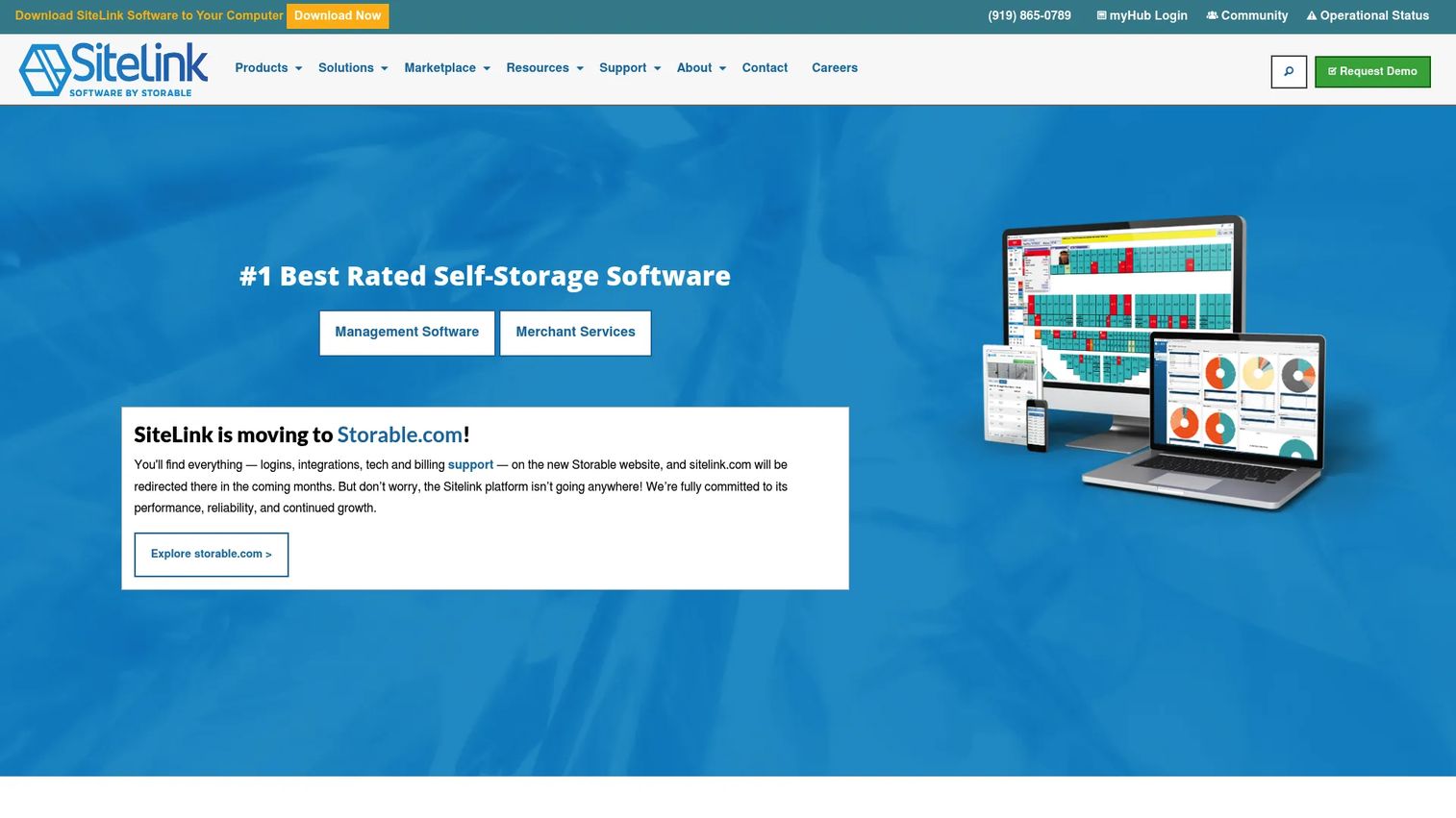
SiteLink is one of the most established names in self storage facility management software, built around SiteLink Web Edition for property management and its myHub browser-based companion for mobile use. Operators reach for it when they want a mature platform with deep operational controls and an integration marketplace that connects to payments, revenue management, and third-party services. It fits owners who value ecosystem breadth over minimalism.
Best for: self-storage operators needing cloud-based property management plus mobile workflows across one or many sites.
Key strengths
- myHub mobile access: run daily workflows from a browser, so managers are not tied to a back-office desktop.
- Integration marketplace: connect to payment processors, revenue tools, and access control through a wide partner network.
- Revenue management: adjust street rates and existing-customer rates with built-in controls.
Why choose SiteLink: if you run a portfolio and want a platform other vendors already integrate with, SiteLink's marketplace reach is hard to match. The ecosystem is the point. When you want your access control, payments, and website partners to plug into a system they already support, that breadth reduces the custom work your team would otherwise carry.
SiteLink pricing: public pricing was not visible on SiteLink's site during our review, and the vendor appears to sell through demos and quotes. The product and features are confirmed through official materials, but you will need to contact the team for current numbers and contract structure. SiteLink holds a 4.4/5 rating on G2.
2. Storable
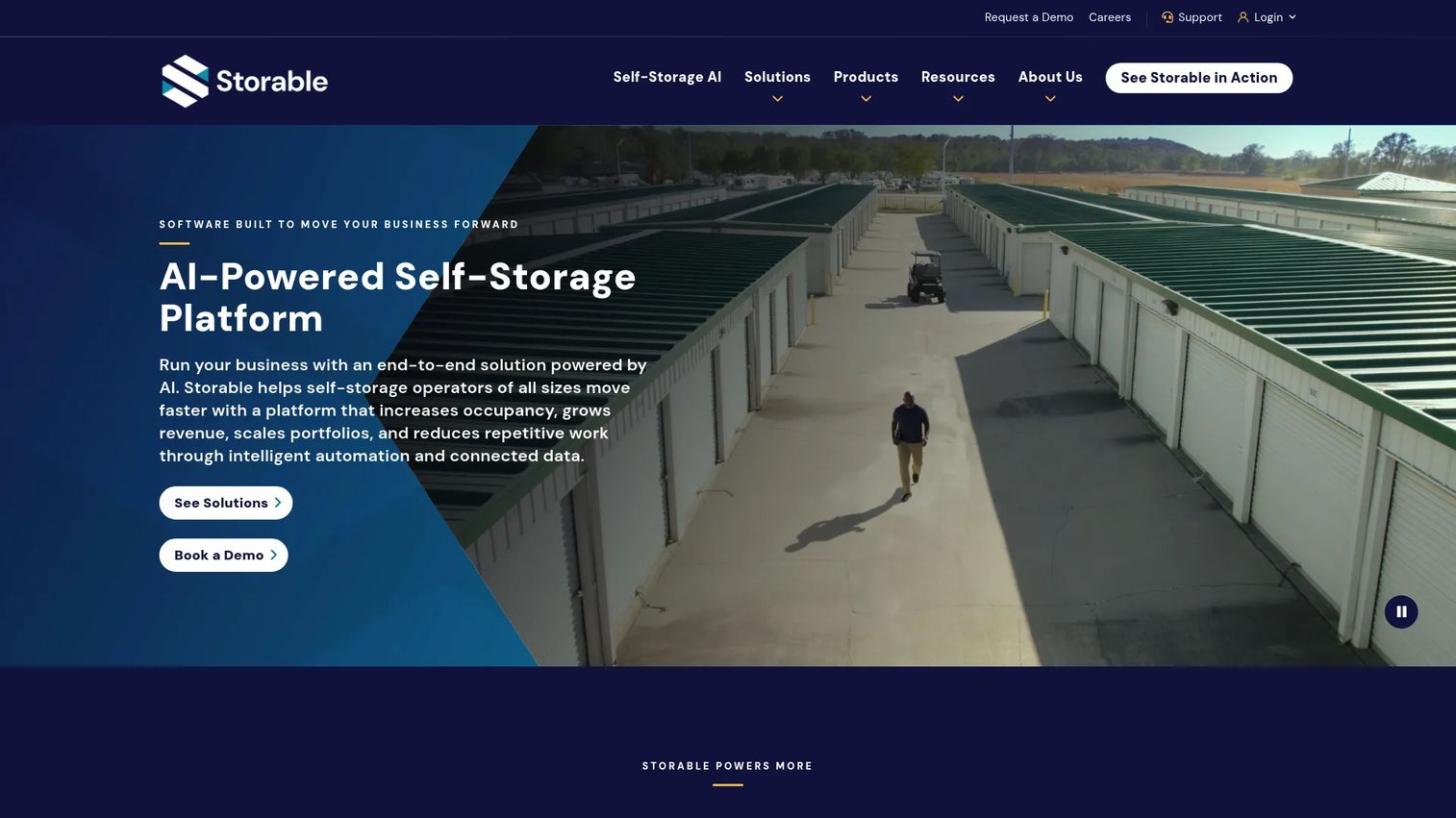
Storable positions itself as an end-to-end self storage software platform rather than a single product. The suite spans management software, marketing websites and lead generation, payments, collections automation, tenant insurance, and access control. The pitch is consolidation: instead of stitching together five vendors, an operator runs the core operation and its adjacent services under one roof.
Best for: operators who want to reduce vendor sprawl and run management, payments, websites, and access from one platform.
Key strengths
- Consolidated suite: management, payments, websites, insurance, and access control in one ecosystem.
- Collections automation: structured delinquency and payment workflows to recover revenue.
- Lead generation tools: websites and marketing features that feed the rental funnel.
Why choose Storable: the bundle logic is the draw. If you are tired of reconciling separate contracts for your PMS, your payment processor, and your website vendor, a single platform simplifies procurement and support. That consolidation is worth real money when you count the time your team spends managing multiple relationships.
Storable pricing: Storable does not publish a public price and appears to use demo and request-based sales. Capabilities and positioning are confirmed on its own product pages, but you will need a quote for numbers. Storable carries a 3.9/5 seller rating on G2.
3. Self Storage Manager
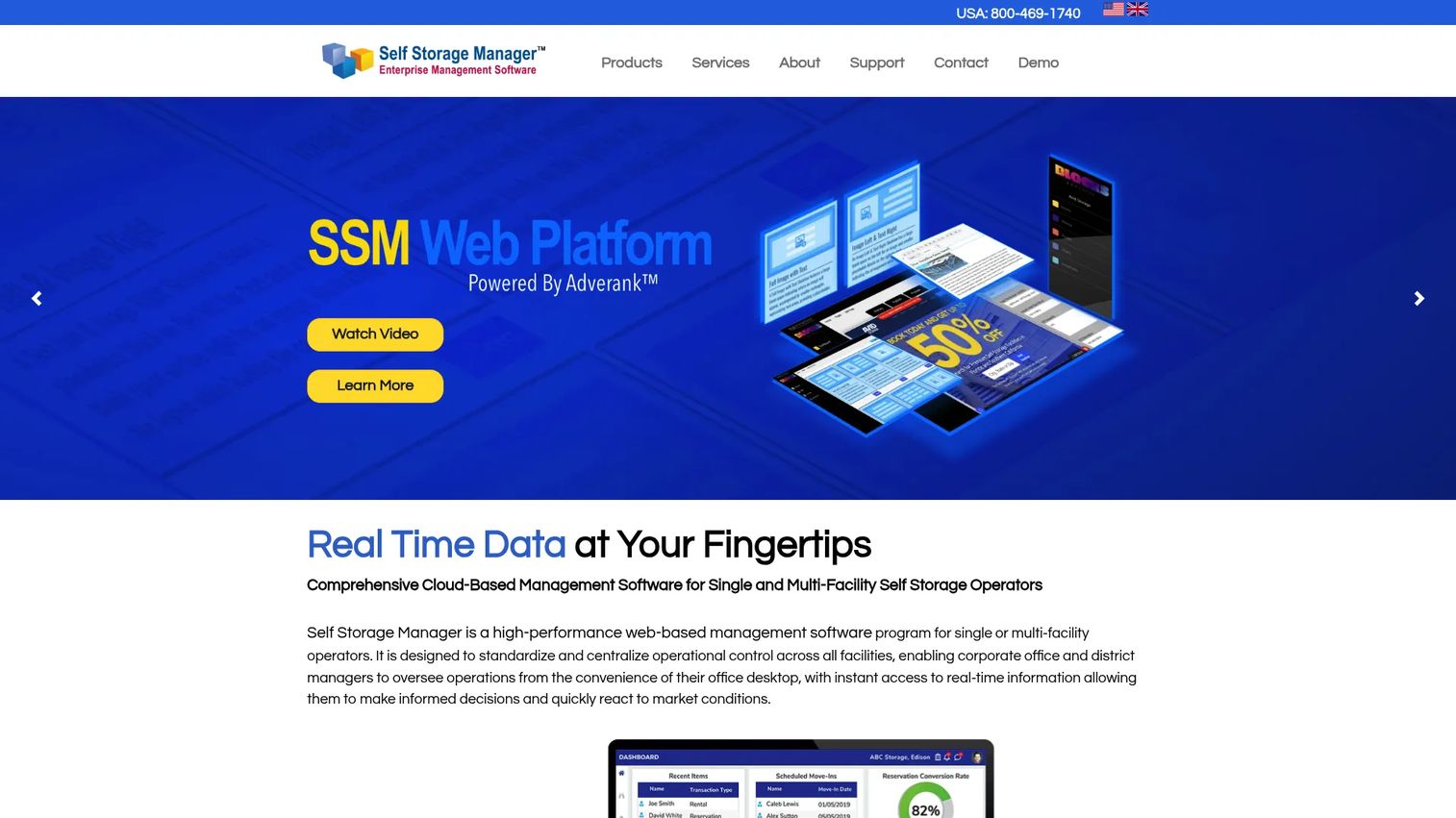
Self Storage Manager is cloud-based self storage management software built for both single-site and multi-facility operators, with a clear lean toward portfolios that need centralized control. It combines management with an integrated CRM, online reservations and rentals, a customer portal, and advanced revenue management. Operators who care about real-time visibility across many locations tend to shortlist it.
Best for: operators who need enterprise-grade multi-facility management with strong revenue and pricing controls.
Key strengths
- Centralized multi-facility control: manage single and multi-site portfolios from one cloud system.
- Integrated CRM and portal: online reservations, rentals, and a self-service customer portal in one flow.
- Advanced revenue management: granular pricing and rate controls to protect and grow revenue.
Why choose Self Storage Manager: if your priority is corporate oversight and revenue optimization across a growing portfolio, this platform is built around that job. The CRM and revenue tools are not add-ons; they are core to how the system approaches multi-site operations. That focus suits operators who treat pricing as a lever, not an afterthought.
Self Storage Manager pricing: no public pricing appears on the official site, which uses demo and contact-sales CTAs. Features are confirmed from first-party pages. A current third-party rating was not available from primary sources during our review, so treat feature fit and a live demo as your evaluation anchors.
4. StoragePug
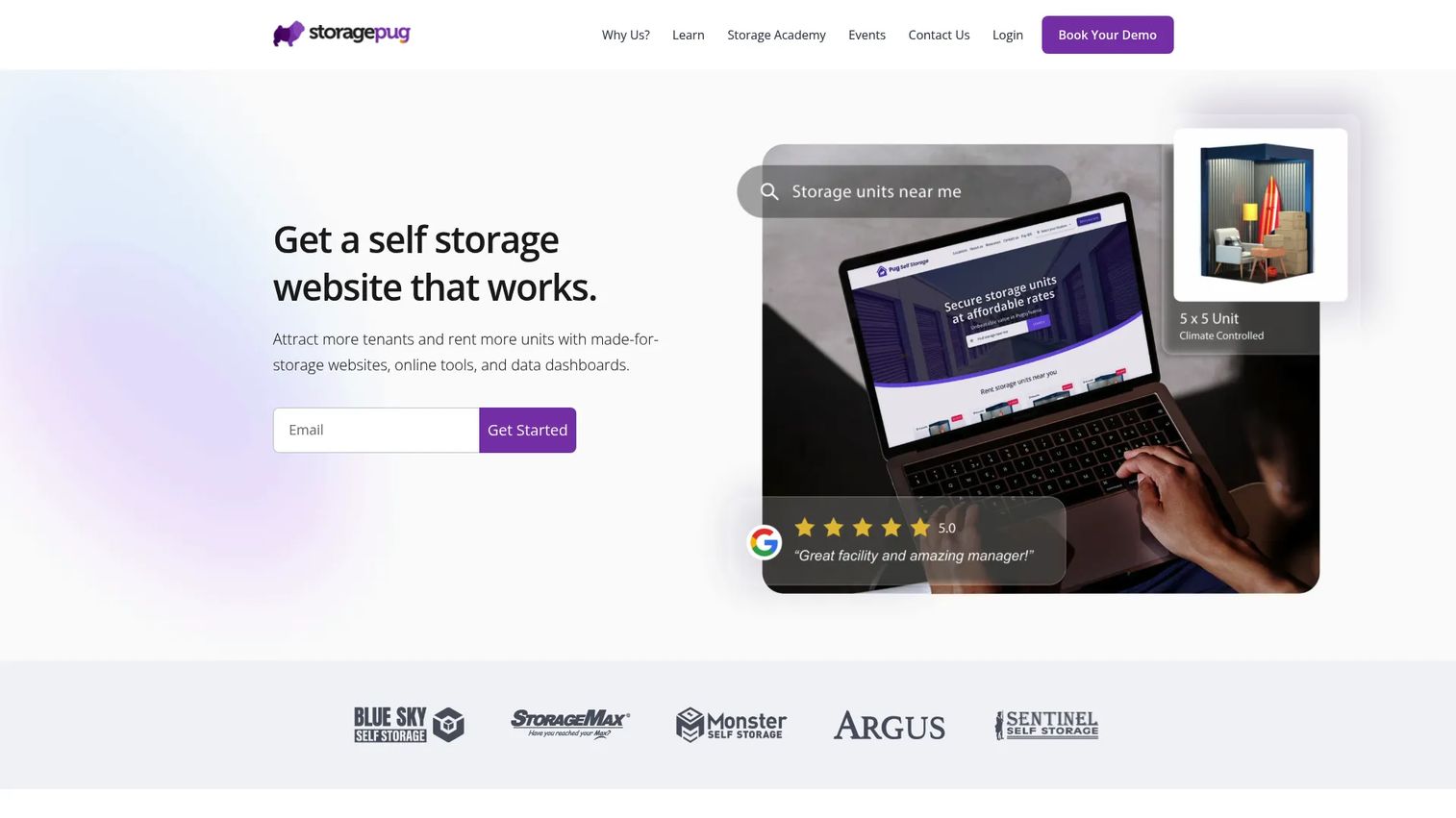
StoragePug is a self-storage website, rentals, and analytics platform rather than a full PMS replacement. It focuses on the customer-facing layer: conversion-optimized websites, simplified online rental flows, unit and lead management, online bill pay with autopay, and data dashboards. It integrates with management systems so web traffic turns into completed rentals and paying tenants.
Best for: operators who want a conversion-focused website plus online rental and payment tools that connect to their management stack.
Key strengths
- Conversion-focused websites: sites optimized for local search and completing rentals, not just displaying listings.
- Simplified online rentals: a streamlined booking flow with online bill pay and autopay.
- Analytics dashboards: website and lead data so you can see what drives rentals.
Why choose StoragePug: think of StoragePug as the front door to your operation. If your management system handles the back office well but your website leaks prospects, this fills that gap. It is an important stack layer for operators who want online rentals and clean conversion tracking, working alongside a PMS rather than replacing it.
StoragePug pricing: no public first-party pricing with visible numbers was found during our review, and G2 shows too few reviews to produce an average rating. Request a quote and confirm which management systems it integrates with before committing.
5. StorEdge
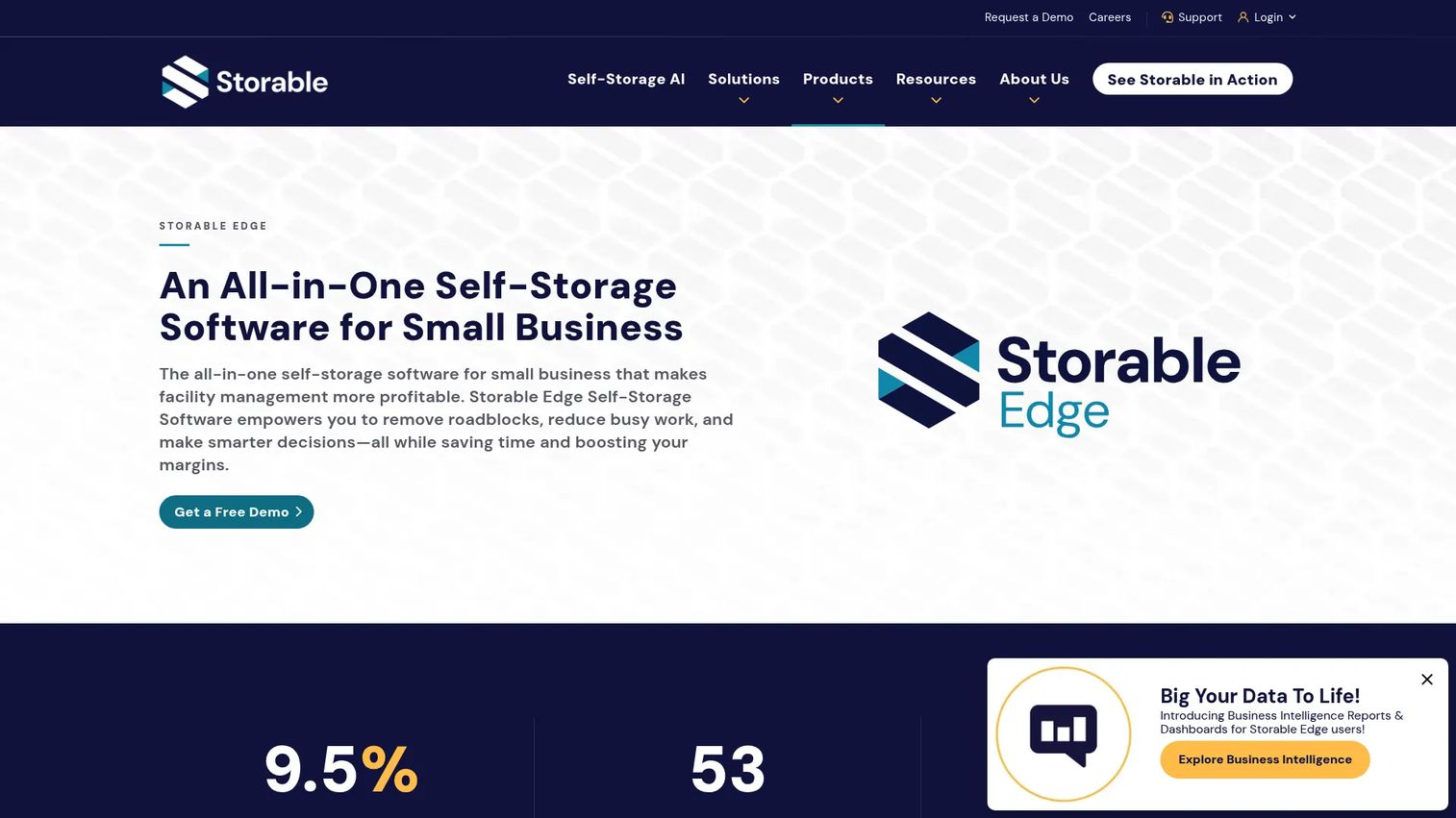
StorEdge, now part of the Storable family and accessible under the Edge product line, is cloud-based self storage facility management software for both small and larger operators. It offers all-in-one management, automated task and workflow management, and integrated SMS, email, and phone communications. Operators who want Storable's ecosystem and reporting with a cloud-native management core often land here.
Best for: operators needing cloud-based facility management with built-in communications and workflow automation.
Key strengths
- All-in-one management: run core facility operations from one cloud system.
- Workflow automation: automated task and workflow management to standardize daily operations.
- Built-in communications: SMS, email, and phone integrations to reach tenants without leaving the platform.
Why choose StorEdge: if you want cloud-native management inside Storable's broader ecosystem, StorEdge connects the operational core to the payments, websites, and access services Storable offers. The workflow automation is the practical draw for teams that want daily tasks to run on rails rather than memory.
StorEdge pricing: the product page prompts a demo request and notes that support is included within the monthly subscription, but no public price number is listed. Features are confirmed from the first-party product page. StorEdge carries a 3.5/5 rating on G2.
6. QuikStor
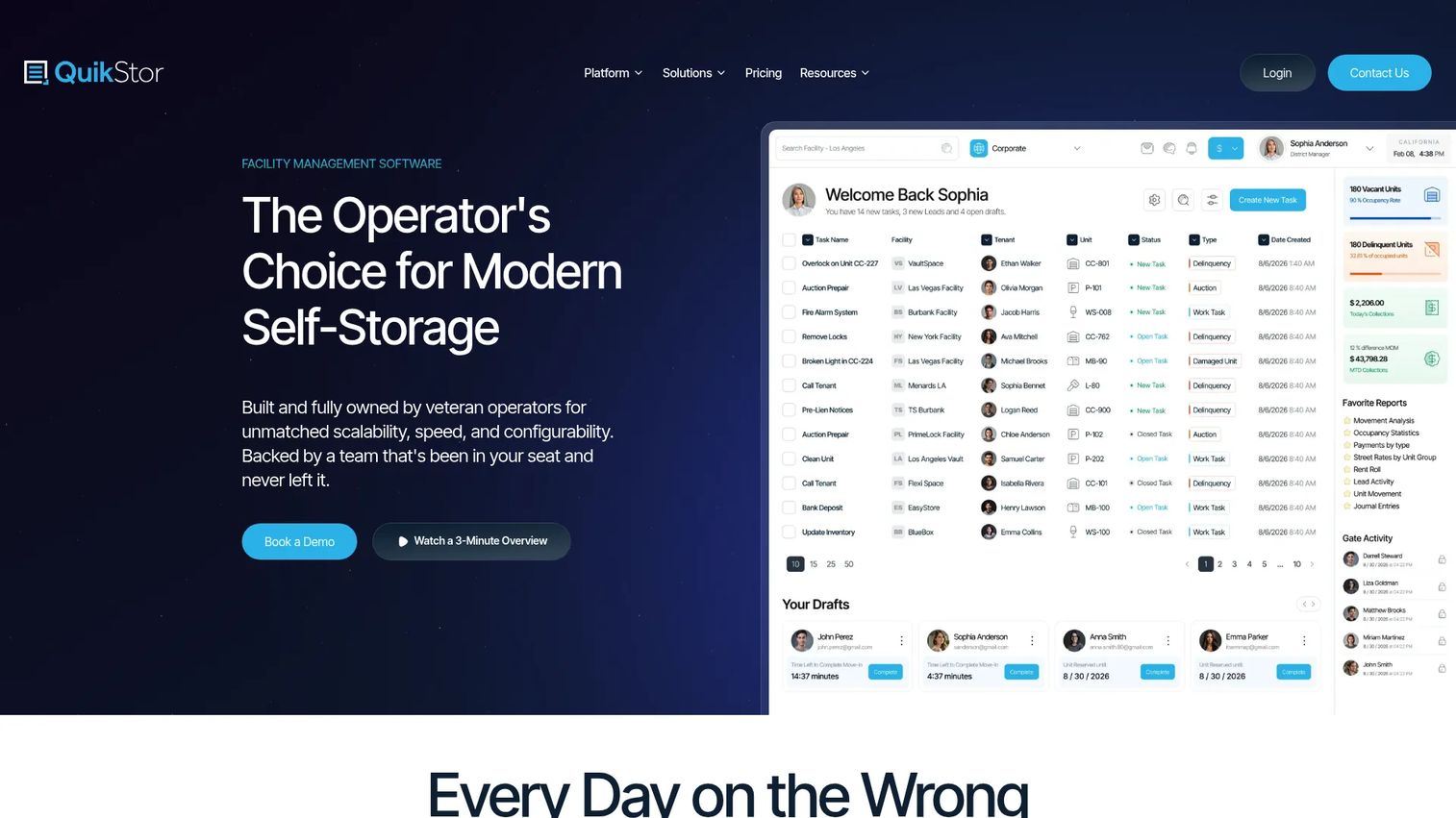
QuikStor is self storage facility management software that stands out for one thing many competitors hide: transparent, published pricing. It covers reservations, rentals, and digital lease signing, automated billing, payments, and delinquency workflows, plus multi-site portfolio management and access control integrations. It suits operators who want a straightforward, all-inclusive system without a drawn-out quote process.
Best for: operators who want an all-in-one management platform with clear, predictable pricing.
Key strengths
- Digital leases and rentals: reservations, online rentals, and e-signature lease signing built in.
- Automated billing and delinquency: recurring billing, payments, and structured late-fee workflows.
- Access control integrations: connect the software to gate and access hardware across sites.
Why choose QuikStor: the transparent pricing model is refreshing in a category full of demo-gated quotes. If you want to budget accurately before you talk to sales, QuikStor lets you do the math upfront. The all-inclusive structure also means fewer surprise add-on fees as you scale across facilities.
QuikStor pricing: QuikStor lists management software at $1 per unit per month, billed monthly, as one all-inclusive plan. A WordPress website add-on is available at $25 per month per facility. There is no free tier. These figures come from QuikStor's pricing page.
7. Storeganise
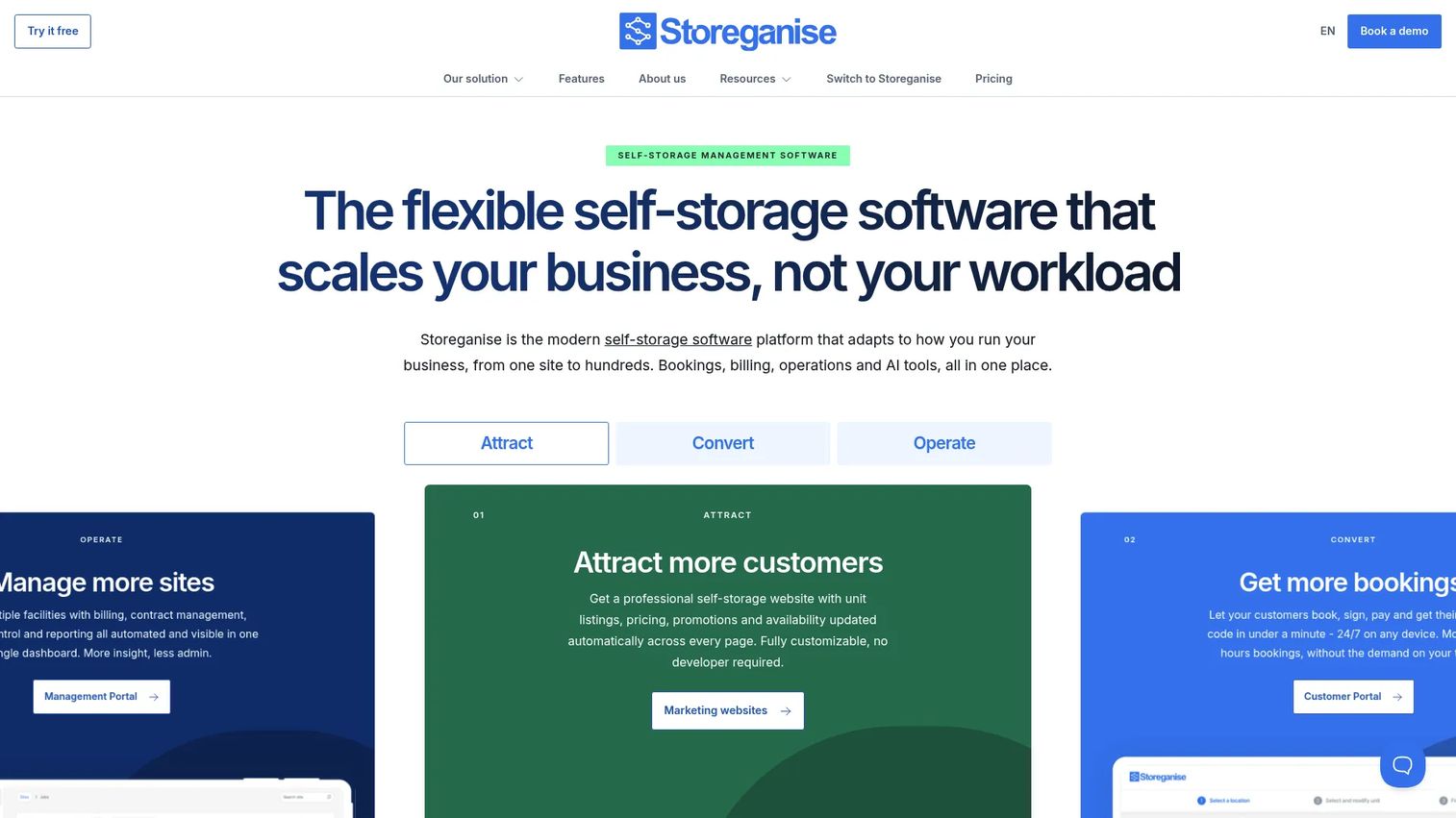
Storeganise is modern, cloud-based self storage software programs rolled into one all-in-one booking and operations platform. It combines marketing websites with unit listings, pricing, promotions, and availability; a customer portal for booking, signing, paying, and access-code workflows; and a management portal with billing, contract management, access control, reporting, an API, and integrations. It appears on shortlists for operators who want a clean, contemporary system with real self-service.
Best for: operators wanting an all-in-one booking and operations platform with a modern tenant experience.
Key strengths
- Customer portal: tenants book, sign, pay, and manage access codes without staff involvement.
- Full management portal: billing, contract management, access control, and reporting in one place.
- API and integrations: connect to your wider stack, with AI tools layered on top.
Why choose Storeganise: if you value a modern interface and true tenant self-service, Storeganise delivers both with public pricing you can plan around. The customer portal handles the full booking-to-access lifecycle, which is exactly what younger tenants expect. That self-service depth reduces the manual touchpoints your team handles daily.
Storeganise pricing: Storeganise lists a starting price of $90 per month, with monthly or yearly billing and currency selectors for USD, AUD, GBP, and EUR. There is no free tier, and add-ons or a marketing website may cost extra, so confirm your exact quote. Storeganise holds a strong 4.8/5 rating on G2.
Considerations before you buy
Before you shortlist, run each candidate through these criteria. They separate a tool that fits your operation from one that fights it.
Pricing model and total cost
Look past the headline number. QuikStor and Storeganise publish starting prices, while SiteLink, Storable, StorEdge, and Self Storage Manager sell through demos and quotes. Factor in payment processing, website, insurance, and access add-ons, since bundled suites and à la carte stacks reach very different totals as you scale.
Multi-location support
If you run a portfolio, confirm the platform pushes standardized settings to every site and rolls up occupancy and revenue automatically. A tool built for a single facility will make you the manual integration layer across locations.
Integrations and access control
Verify the specific gate controllers, keypads, and smart locks your sites use are supported. Then confirm payment and website integrations. Self storage software integrations decide whether your stack works as one system or five disconnected tools.
Online rentals and tenant self-service
Test the actual rental flow. Can a tenant reserve, e-sign a digital lease, pay, and get an access code without calling? Weak self-service pushes work back onto your team and loses digital-first tenants.
Migration and implementation risk
Ask how the vendor handles data migration from your current system, how long onboarding takes, and what support is included. The switch itself is often the biggest hidden cost, so treat first-week setup and data integrity as evaluation factors, not afterthoughts.
Conclusion
The right pick depends on your operating profile, not a feature scoreboard. SiteLink and Storable suit operators who want platform breadth and vendor consolidation. Self Storage Manager fits portfolios that treat revenue management as a core lever. StoragePug strengthens the web conversion layer alongside your PMS. StorEdge brings cloud-native management inside Storable's ecosystem. QuikStor and Storeganise win on transparent pricing and modern self-service for operators who want to budget upfront.
Your next step is simple. Shortlist two or three based on three questions: how many locations you need to centralize, how much of your billing and collections should run automatically, and how important online rentals are to your growth. Then book demos with only those finalists and test the real rental and reporting flows, not the sales deck. That focus turns a crowded category into a clear decision, and it keeps operator workflow automation working for you instead of the owner running every process by hand.
FAQs
Self storage software is a facility management platform that handles rentals, billing, tenant communication, access control, and reporting from one system. It replaces spreadsheets and desktop tools with a cloud-based operation that scales across sites. Most platforms also support online rentals and tenant self-service portals.
Prioritize billing automation, online rentals, reporting dashboards, and integrations. Automated recurring billing, late fees, and collections recover revenue without manual chasing. Strong online rentals and a tenant portal capture digital-first customers, while reporting and integrations keep multi-site oversight and your hardware stack connected.
It varies widely. Some vendors publish prices, like QuikStor at $1 per unit per month and Storeganise from $90 per month. Others, including SiteLink, Storable, StorEdge, and Self Storage Manager, sell through demos and custom quotes. Always factor in payments, website, insurance, and access control add-ons when comparing total cost.
For portfolios that need centralized control and revenue tools, Self Storage Manager and SiteLink are strong fits. Storable and StorEdge appeal to operators consolidating vendors into one ecosystem. Confirm that any platform pushes standardized settings to every site and rolls up corporate reporting automatically.
Most modern storage facility software includes online rentals, reservations, and payment processing. Platforms like Storeganise, QuikStor, and StoragePug emphasize self-service booking, e-signature digital leases, autopay, and online bill pay. Confirm the full flow works end to end before you commit, since implementations differ.
Yes. Most platforms integrate with gate access software, keypads, and smart locks, either natively or through a partner marketplace. SiteLink's integration marketplace and Storable's bundled access control are common examples. Always verify your specific hardware model is supported before purchase.
Compare pricing model, multi-location support, integrations, online rental depth, and migration risk. The switch itself, including data migration and onboarding time, is often the biggest hidden cost. Test the real rental and reporting flows during a demo rather than relying on the sales pitch.
For most operators, yes. Cloud based self storage software gives you remote access, automatic updates, and centralized multi-site oversight without maintaining a back-office server. Over 70% of implementations were cloud-based as of 2025, per Mordor Intelligence, reflecting how operators increasingly favor browser access and self-service over legacy desktop tools.