The release is staged. Then a dependency alert lands in the security channel, someone asks for a software bill of materials, and engineering has no fast answer for which service owns the affected package. The immediate problem is not the CVE. It is that the team has no reliable system for tracing software from source code through build, registry, and deployment.
SolarWinds and Log4j made this concrete. Both incidents exposed how quickly an unverified dependency or a compromised build artifact can cascade into a company-wide emergency. Security debt in your release pipeline becomes product delivery debt the moment engineering cannot rapidly identify affected owners and release paths.
The market has responded. Software supply chain security platforms reached $5.53 billion in 2025 and are projected to grow at 12.8% CAGR through 2030, according to Mordor Intelligence (2025). Tools in this space differ by operating model, not just scanner coverage. Some start from the artifact repository. Others start from the pull request. Choosing the wrong anchor means your security program adds noise without improving release governance.
This guide maps ten platforms to the operating contexts where each one fits best.
What's inside
This guide is written for product managers who influence security requirements, engineering prioritization, and vendor selection at B2B SaaS companies.
- Ten platforms covering artifact governance, SCA, SBOM operations, CI/CD policy, and developer-native security
- A comparison table with fit, key differentiator, pricing, and G2 rating
- Selection criteria focused on release cadence, remediation ownership, and engineering cost
- Plain-English definitions of SBOMs, software composition analysis (SCA), provenance, and CI/CD policy gates
- A buyer checklist across coverage, prioritization, workflow fit, and governance
Selection criteria used:
- Coverage across dependencies, artifacts, CI/CD, containers, and SBOM workflows
- Fit with engineering workflows and release governance
- Ability to prioritize and route meaningful risk
- Pricing transparency and enterprise readiness
TL;DR
- Best for artifact and dependency governance across the delivery chain: JFrog Software Supply Chain Platform
- Best for developer-centric AppSec coverage: Snyk, with a free tier that covers SCA, SAST, IaC, and containers
- Best for SBOM operations and container supply chain evidence: Anchore Enterprise
- Best for cutting a large dependency backlog to a prioritized shortlist: Endor Labs
- Best for blocking malicious packages before they enter projects: Socket
- Best for teams standardized on GitHub or GitLab: GitHub Advanced Security or GitLab Ultimate, respectively
- Best for policy-driven artifact trust and hardened supply chains: Chainguard Enforce
- Best for enterprise open-source governance programs: Sonatype Lifecycle or Mend SCA
What are software supply chain security solutions?
Software supply chain security solutions help teams identify, verify, monitor, and control the code, dependencies, build systems, artifacts, infrastructure, and delivery workflows used to ship software.
The category is wider than a vulnerability scanner. A scanner tells you a package has a known CVE. A supply chain security platform tells you which services depend on that package, who owns each service, whether the vulnerability is reachable, and what a remediation block would do to your next release.
What the software supply chain includes
Every component between a developer's commit and a running production service is in scope:
- Source code repositories
- Open-source and proprietary dependencies
- Build tools and CI/CD pipelines
- Package registries and artifact repositories
- Container images and infrastructure-as-code
- Deployment systems and runtime environments
- Third-party services, contributor access controls, and external build actions
Core capabilities to look for
When evaluating platforms, prioritize:
- SBOM generation, versioning, and inventory management
- Dependency and vulnerability analysis with SCA
- Malicious package detection before installation
- Build provenance, code signing, and artifact integrity controls
- CI/CD policy enforcement and release gate management
- Risk prioritization by reachability, exploitability, and business impact
- Reporting for security reviews and audit evidence
How supply chain security differs from application security
Application security testing software assesses vulnerabilities in your own code. Supply chain security extends the lens outward to the components you consume, the build process that assembles them, the artifact integrity across registries, and the delivery path from commit to production. Both matter. They address different failure modes.
When to use software supply chain security solutions
Ship software that depends on open-source packages
Every public package your team imports carries license terms, known vulnerabilities, and transitive dependencies. Without instrumentation, those risks are invisible until a CVE surfaces during a customer security review. Teams need continuous visibility, not a one-time scan before launch.
Add policy gates to CI/CD and release workflows
A policy gate blocks or routes a release based on the security state of its components. The gate is only useful when it comes with actionable ownership. An unexplained build failure that routes to the wrong team does not improve security. It adds engineering interrupt cost.
Prepare for enterprise security reviews
Enterprise procurement now routinely asks for SBOMs, provenance evidence, and documented remediation workflows. Teams that cannot produce this evidence lose deals or delay closes. A software bill of materials (SBOM) is the inventory an enterprise buyer uses to understand how your product is built and maintained.
Software supply chain security solutions comparison
The table below maps each platform to the operating context where it fits best. Pricing and G2 ratings were verified in October 2026 from vendor pricing pages and current G2 listings. Where no rating existed for the specific product, the cell reflects that.
| # | Product | Best for | Key differentiator | Pricing | G2 rating |
|---|---|---|---|---|---|
| 1 | JFrog Software Supply Chain Platform | Artifact-centric DevSecOps teams | Repository, binary, and policy control across the lifecycle | From $50/month | 4.3/5 |
| 2 | Snyk | Developer-first security programs | Broad coverage: Code, open source, containers, IaC | Free; paid from $25/month | 4.5/5 |
| 3 | Anchore Enterprise | SBOM and container-focused teams | SBOM analysis, drift detection, and policy enforcement | Custom pricing | 4.4/5 |
| 4 | Endor Labs | Teams overloaded by dependency findings | Reachability and dependency prioritization context | Free tier; paid custom | 4.8/5 |
| 5 | Socket | JavaScript and package-risk teams | Malicious package and supply chain behavior detection | Free; paid from $25/dev/month | N/A |
| 6 | GitHub Advanced Security | GitHub-native organizations | Security inside the repository and pull request process | From $19/committer/month | N/A |
| 7 | GitLab Ultimate | GitLab-native DevSecOps teams | Integrated CI/CD security and governance workflow | Custom pricing | 4.5/5 |
| 8 | Chainguard Enforce | Teams managing hardened artifact policies | Policy-based control over trusted software artifacts | From $19K/year (team of 10) | 4.7/5 |
| 9 | Sonatype Lifecycle | Enterprise open-source governance programs | Component intelligence and policy management depth | Custom pricing | 4.2/5 |
| 10 | Mend SCA | Broad enterprise application security teams | Automated open-source remediation and governance | Up to $1,000/dev/year | 4.3/5 |
Best 10 software supply chain security solutions for 2026
1. JFrog Software Supply Chain Platform
JFrog is an end-to-end platform for managing, securing, governing, and automating software supply chains from development through distribution and production. It treats the artifact repository as the center of gravity, connecting package storage, vulnerability scanning, SBOM generation, and policy controls into a single operating layer. For product teams managing many services with significant artifact volume, that centralized model reduces the number of handoffs between security and engineering teams.
Best for: Enterprise DevOps and platform teams that need centralized artifact management and traceable software delivery at scale.
Key features
- Universal artifact, package, container, AI/ML model, and build-asset management
- Integrated vulnerability, license, and runtime security scanning
- End-to-end SBOM generation, traceability, and evidence collection
- Build and artifact policy controls across cloud, hybrid, and self-managed environments
- CI/CD integration support across major pipeline tools
Why choose JFrog: The platform suits organizations with mature release processes where artifact governance is the primary control point. If your security program needs to span binary promotion, repository governance, and delivery policy in one place, JFrog is the strongest candidate.
JFrog pricing: The Pro plan starts at $50/month and covers Artifactory with universal binary management. Enterprise X and Enterprise+ add broader security, governance, and distribution capabilities at custom pricing.
G2 rating: 4.3/5
2. Snyk
Snyk is an AI security platform that surfaces vulnerabilities across code, open-source dependencies, containers, cloud infrastructure, and APIs. Its integration depth in developer tooling, from IDEs and pull requests to CI/CD and source control, means security findings appear where engineers already plan and ship work. For product managers trying to reduce remediation cycle time, that proximity matters: An alert in the pull request resolves faster than a ticket two sprints later.
Best for: SaaS product teams that want developers and security to work from shared, prioritized vulnerability data.
Key features
- Open-source dependency scanning with license and vulnerability analysis
- SAST code scanning with automated fix suggestions
- Container image and infrastructure-as-code security scanning
- IDE, CLI, and source-control integrations
- SBOM reporting options
Why choose Snyk: The free tier includes SCA, SAST, IaC, and container access, which makes it a practical starting point before committing to an enterprise contract. Buyers evaluating Snyk at scale should assess alert quality and the total cost of a credit-based enterprise model.
Snyk pricing: Free plan available at $0/month. The Team plan is $25/month. Enterprise uses a credit-based model where 1 credit equals $1; contact sales for volume terms.
G2 rating: 4.5/5
3. Anchore Enterprise
Anchore Enterprise is an SBOM-powered software supply chain security platform built for continuous vulnerability detection, compliance enforcement, and runtime monitoring. Its core strength is treating the SBOM as an operational asset rather than a one-time export. Teams can generate SBOMs, monitor them for drift as new CVEs are disclosed, and enforce policy-as-code across container images and cloud-native artifacts.
Best for: Product, security, and platform teams that need defensible SBOM operations and container supply chain controls for enterprise or public-sector requirements.
Key features
- SBOM generation and centralized management
- Continuous vulnerability scanning with EPSS and CISA KEV enrichment
- Policy-as-code compliance enforcement with NIST, FedRAMP, CIS, and DoD policy packs
- Malware, secrets, and misconfiguration detection
- Kubernetes admission control and Amazon ECS runtime inventory
Why choose Anchore Enterprise: Teams producing SBOMs for customer security reviews or government procurement will find Anchore's policy-pack library and drift detection directly applicable. Confirm language, registry stack, and deployment model coverage before signing.
Anchore Enterprise pricing: Anchore prices by deployment model (Cloud Image or Container Image). Contact sales for a quote; no self-serve pricing is displayed.
G2 rating: 4.4/5
4. Endor Labs
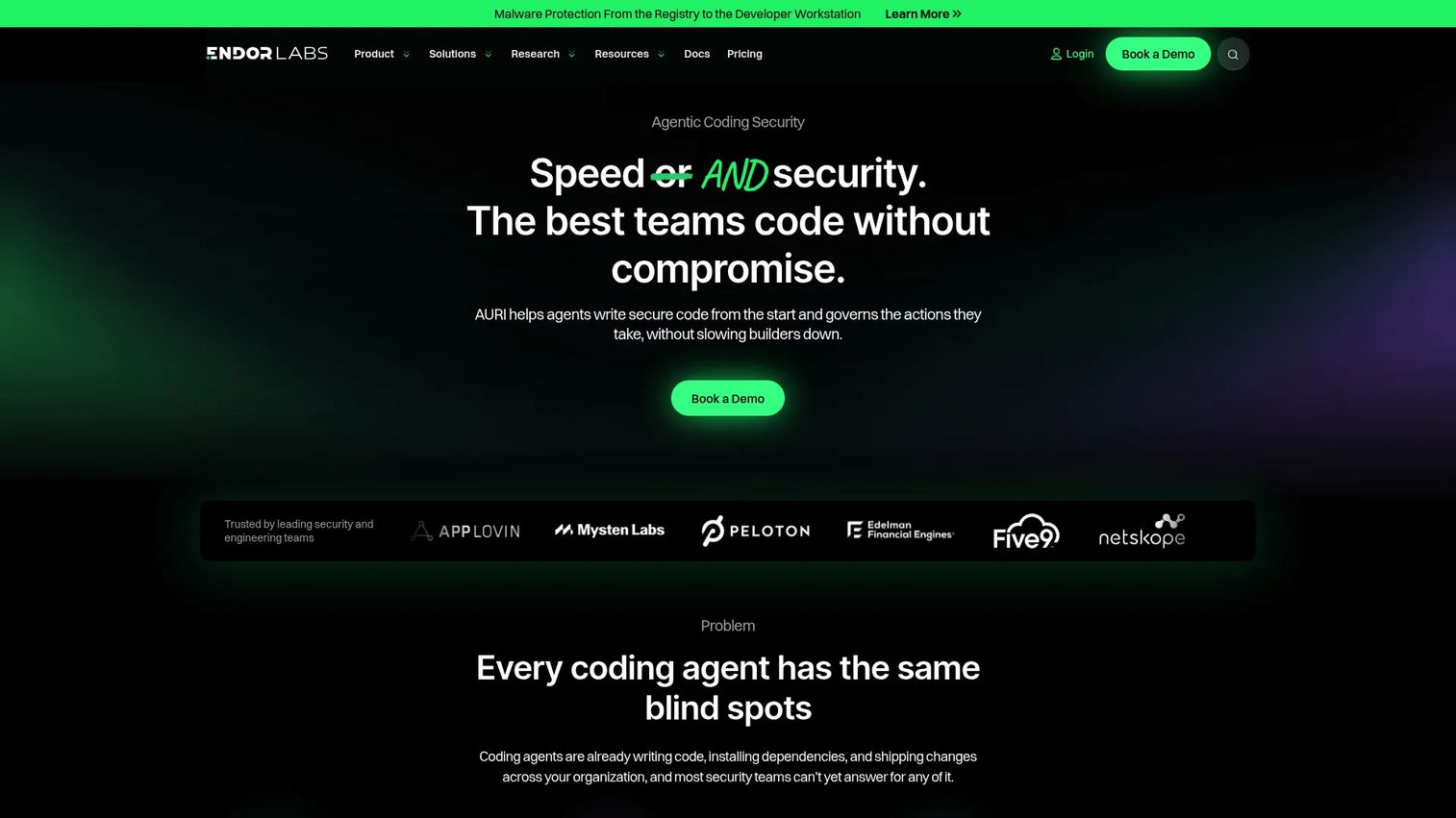
Endor Labs is an AI-native application security platform built to help teams cut through dependency alert volume by surfacing which findings are reachable in shipped code. Its full-stack reachability analysis spans code, dependencies, and container images, giving product and engineering teams a basis for prioritizing remediation by actual business impact rather than CVSS score alone.
Best for: Security and engineering teams turning a large vulnerability backlog into a prioritized remediation plan without adding engineering interrupt cost.
Key features
- Full-stack reachability analysis across code and dependencies
- Open-source risk and malicious package detection
- Secrets detection
- SBOM and VEX management
- AI coding agent governance
Why choose Endor Labs: The practical advantage is prioritization. If your release backlog is full of dependency alerts with unclear ownership or urgency, Endor Labs helps the team focus on findings that meaningfully affect shipped software. The free Developer tier lets small teams get started without a sales cycle.
Endor Labs pricing: The Developer tier is free. Core and Pro are seat- and SKU-based with pricing through sales.
G2 rating: 4.8/5
5. Socket
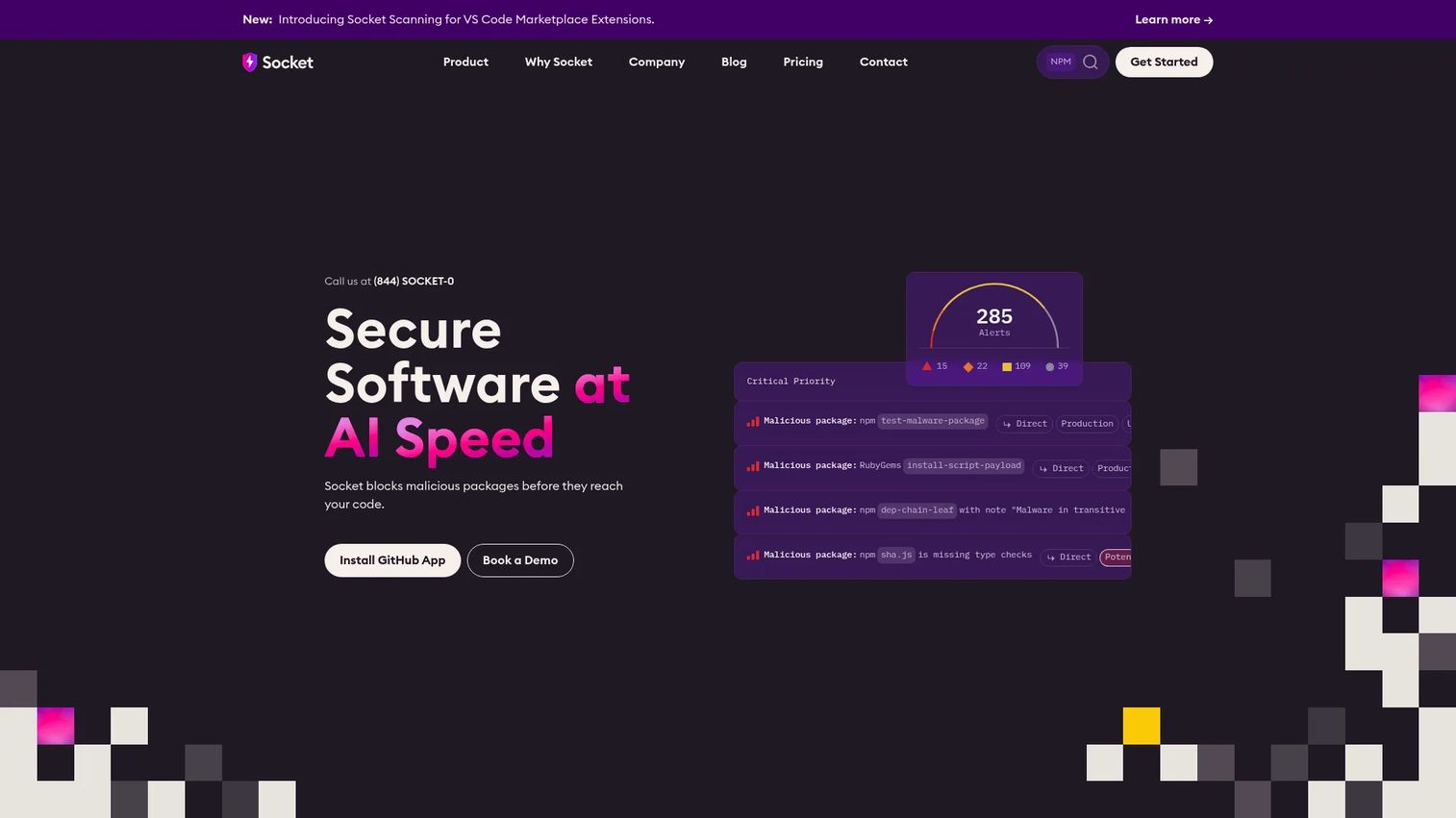
Socket is a developer-first security platform focused on protecting projects from malicious, vulnerable, and risky open-source dependencies. Rather than relying solely on known CVE databases, Socket analyzes package behavior, install scripts, and supply chain signals to detect suspicious patterns before they enter a project. It integrates directly into GitHub pull requests, the CLI, and VS Code.
Best for: Engineering and security teams that need early-stage detection of malicious packages and dependency confusion risks before packages are merged.
Key features
- Malicious package detection and blocking
- Vulnerability, license, and supply chain risk analysis
- Pull request security checks with inline alerts
- Package reputation and behavior signals
- SBOM support and firewall mode
Why choose Socket: Socket covers the package intake stage, where dependency confusion and typosquatting attacks begin. Teams using npm, PyPI, or other open package ecosystems will find its behavior-based detection complementary to a CVE-focused scanner. Assess language ecosystem coverage and how findings route into your existing vulnerability management workflow.
Socket pricing: Free tier available at $0/dev/month. Team plan is $25/dev/month (5-developer minimum). Business plan is $50/dev/month (20-developer minimum). Enterprise pricing is custom; annual billing saves 20%.
6. GitHub Advanced Security
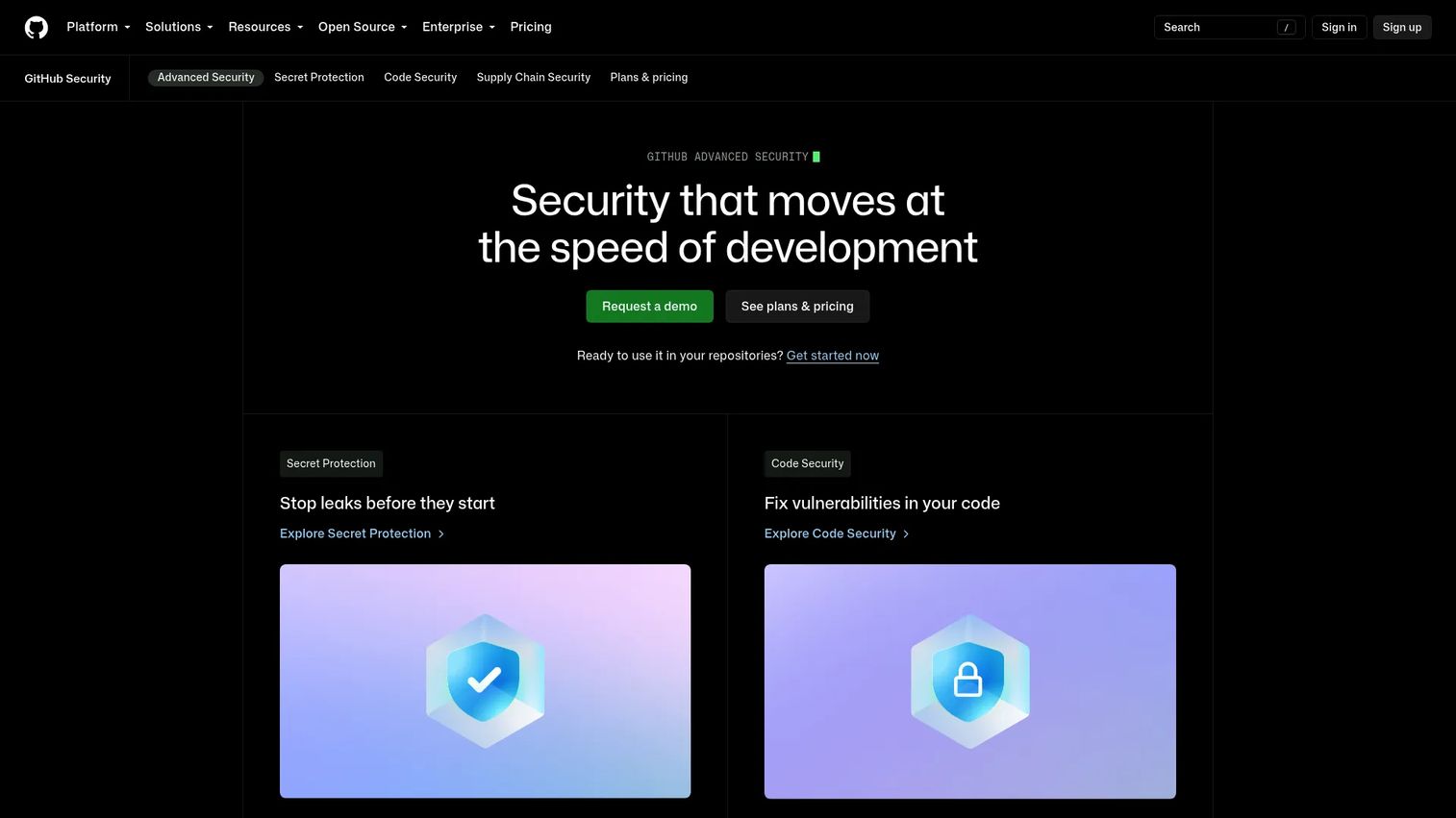
GitHub Advanced Security is an application security offering comprising GitHub Secret Protection and GitHub Code Security. For organizations already building and reviewing code in GitHub, the integration advantage is significant: Security findings appear inside the pull request, dependency alerts show up in the repository, and secret push protection blocks commits before they reach the main branch.
Best for: Product teams standardized on GitHub repositories and pull-request-based engineering processes that want security controls without leaving the developer workflow.
Key features
- Code scanning and CodeQL analysis
- Secret scanning and push protection
- Premium Dependabot dependency review and security updates
- Dependency graph and alert notifications
- Security overview dashboards across the organization
Why choose GitHub Advanced Security: Security findings in the pull request reach the engineer with the most context. For product managers, this translates to faster remediation cycles and less back-and-forth between security and engineering. Evaluate total licensing cost per active committer at organization scale before committing.
GitHub Advanced Security pricing: GitHub Secret Protection is $19/active committer/month. GitHub Code Security is $30/active committer/month. Some features are free for public repositories.
7. GitLab Ultimate
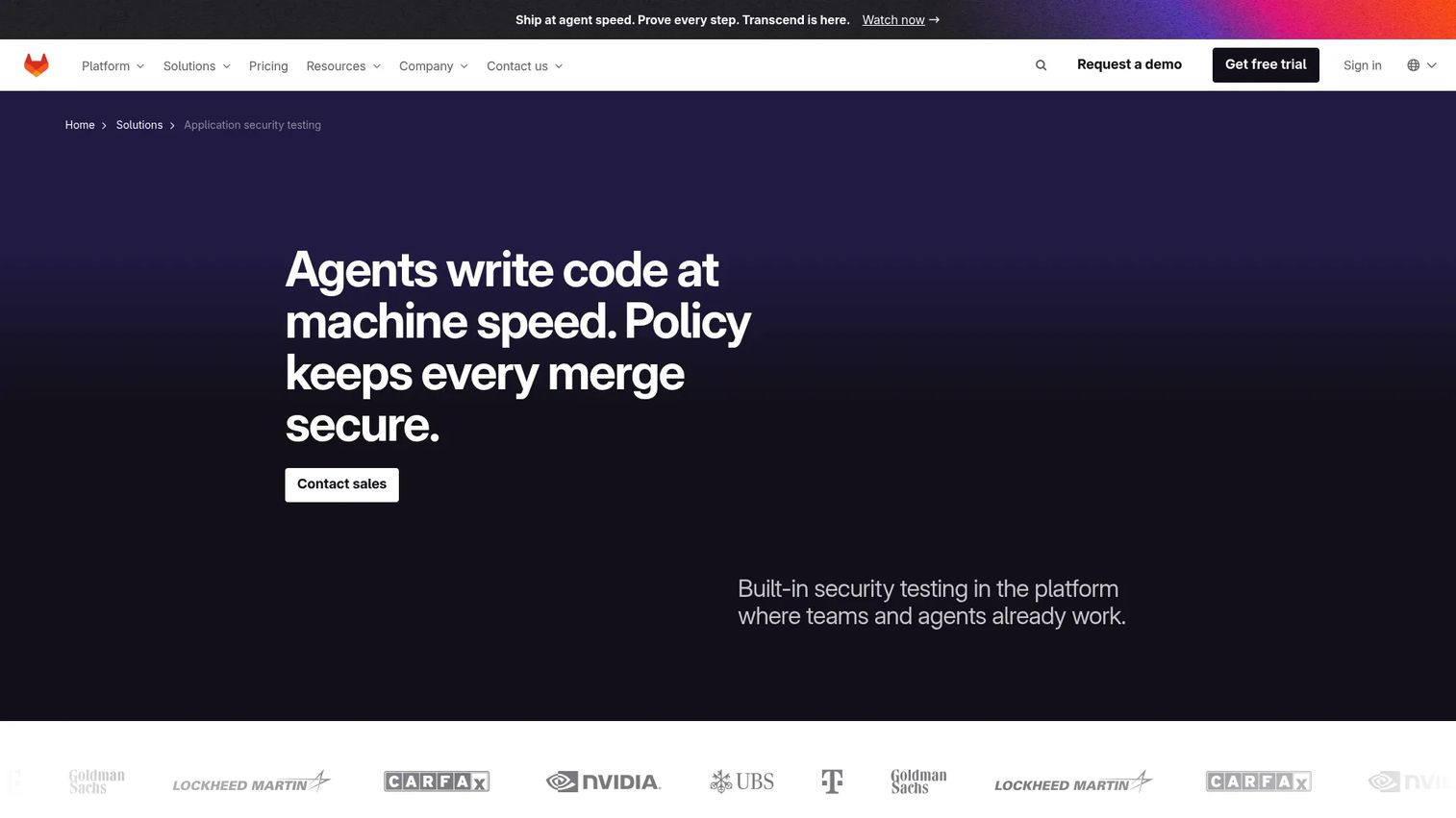
GitLab Ultimate is an enterprise DevSecOps platform that integrates source code management, CI/CD, application security testing, and compliance governance into one system. For organizations running their full development and delivery cycle in GitLab, the consolidation benefit is real: Dependency scanning, container scanning, and security policy management run inside the same pipelines that build and deploy software.
Best for: GitLab-native DevSecOps teams that want supply chain security checks connected to source control and delivery without managing separate security tooling.
Key features
- Dependency scanning within CI/CD pipelines
- Container scanning and vulnerability reports
- Security policy management and merge request approvals
- Vulnerability tracking and remediation workflows
- Software composition analysis integrated into the platform
Why choose GitLab Ultimate: The key buying question is depth. GitLab Ultimate consolidates security into the existing developer system of record, reducing tool sprawl. Teams with strict SBOM or provenance requirements should evaluate whether the integrated capabilities cover their needs or whether a dedicated artifact platform is required alongside it.
GitLab Ultimate pricing: Custom pricing through sales. GitLab does not display a self-serve subscription price for the Ultimate tier.
G2 rating: 4.5/5
8. Chainguard Enforce
Chainguard provides policy-governance capabilities that control which open-source artifacts an organization can consume and enforce compliance across environments. Enforce-specific capabilities include policy-based control over container and library consumption, enforce or dry-run policy modes, cooldown windows, end-of-life checks, support-window enforcement, and block-and-override controls managed through the Chainguard Console.
Best for: Security and platform teams with strict software artifact trust requirements and the operational maturity to manage policy-based delivery controls.
Key features
- Policy-based control over container and library artifact consumption
- Enforce and dry-run policy modes for incremental rollout
- Cooldown, end-of-life, and support-window policies
- Centralized management through Chainguard Console and chainctl
- Continuous policy enforcement across Chainguard Containers and Libraries
Why choose Chainguard Enforce: The platform fits teams that need governance depth around artifact trust, not just scanning. If your supply chain program requires enforceable policies on what artifacts are permitted to reach production, Chainguard Enforce addresses that control point directly.
Chainguard pricing: Free access for up to five container images. Catalog access starts at $19K/year for a team of ten. Per-image enterprise pricing is available through sales.
G2 rating: 4.7/5
9. Sonatype Lifecycle
Sonatype Lifecycle is an SCA and DevSecOps platform that identifies open-source risks, enforces policies, and supports automated remediation across the software development lifecycle. Its component intelligence database and contextual risk prioritization, using reachability, breaking-change data, and upgrade availability, make it a strong fit for enterprise teams managing open-source risk across many product lines and repositories.
Best for: Large organizations with formal open-source governance programs that need component intelligence, license policy management, and remediation automation at scale.
Key features
- Automated vulnerability and dependency remediation
- Customizable security, license, and architectural policies
- Contextual risk prioritization with reachability and upgrade-availability context
- SBOM generation and application visibility dashboards
- Integrations with GitHub, GitLab, Azure DevOps, IDEs, and CI/CD tools
Why choose Sonatype Lifecycle: Enterprise product organizations with large open-source footprints and formal third-party approval processes will find Sonatype Lifecycle's governance depth applicable. Evaluate how the platform fits ownership models across product lines before contracting.
Sonatype Lifecycle pricing: Pricing is not listed on the Sonatype website. New customers must purchase Sonatype Guide for Lifecycle's SCA and governance capabilities; existing customers can add licenses through sales.
G2 rating: 4.2/5
10. Mend SCA
Mend SCA provides software composition analysis focused on identifying, prioritizing, and remediating open-source security and license risks. Its reachability analysis for direct and transitive dependencies, CVSS 4.0 and EPSS-based prioritization, and automated remediation workflows address the core challenge of managing a high-volume dependency risk backlog without creating unmanageable engineering queues.
Best for: Enterprise product organizations with many repositories, large open-source footprints, and formal remediation processes needing automation and governance.
Key features
- Reachability analysis for direct and transitive dependencies
- CVSS 4.0 and EPSS-based risk prioritization
- SBOM generation and ingestion in SPDX and CycloneDX formats
- Automated remediation pull requests and workflows
- License compliance policy management
Why choose Mend SCA: Automated remediation matters when your engineering team cannot manually triage every alert. Mend SCA's governance and reporting capabilities also support the evidence gathering that enterprise security reviews typically require. Compare implementation requirements and report usability against your existing AppSec stack before selecting.
Mend SCA pricing: Mend SCA is included in the Mend AppSec bundle, priced at up to $1,000 per contributing developer per year. No standalone free tier is confirmed.
G2 rating: 4.3/5
Considerations when choosing software supply chain security solutions
Choose the coverage model before comparing feature lists
Different platforms start from different control points: Artifact repositories, pull requests, source code, package registries, or runtime environments. Map your actual release path first. A platform that excels at artifact governance may not address malicious package intake at the dependency selection stage.
Prioritize findings by product and release impact
CVSS severity alone does not decide roadmap priority. Ask whether the platform shows where a component is used, who owns the service, whether the vulnerability is reachable in production, and whether a remediation would block an upcoming release. Instrumentation that answers those questions reduces engineering interrupt cost.
Treat SBOMs as an operating system, not a one-time export
SBOM generation is not SBOM management. Teams need generation, versioning, drift monitoring as new CVEs are disclosed, sharing with customers and security reviewers, and mapping to deployed artifacts. A static SBOM created during procurement does not solve ongoing ownership or remediation traceability.
Test CI/CD policy controls against a live release workflow
In any proof of concept, run an active repository and pipeline rather than a demo environment. Measure finding quality, developer experience when a build is blocked, override governance, and whether release owners know what action to take. A policy gate that cannot route ownership clearly adds friction without improving security.
Plan for evidence needs across multiple teams
Security, engineering, product, legal, and customer-facing teams often need different views of the same risk data. Evaluate reporting access controls, audit trails, and integration with your CRM or ticketing system. The attack surface management software and AI security posture management layers that sit above this category will need to pull data from whichever supply chain platform you select.
How to choose the right software supply chain security solution for your team
If you need artifact and repository control across the delivery chain
Start with JFrog Software Supply Chain Platform. It suits teams where package repositories, binary promotion controls, and CI/CD policy enforcement are the center of the program. If artifact governance at the repository layer is the primary gap, JFrog addresses it most directly.
If developers need security feedback inside daily workflows
The right choice depends on your source control platform. GitHub Advanced Security fits GitHub-native organizations where pull request integration matters most. GitLab Ultimate fits teams running the full delivery cycle in GitLab. Snyk works across both and adds broader SCA, container, and IaC coverage with a free entry tier.
If SBOM operations and container evidence drive your program
Anchore Enterprise is the strongest fit for teams that need continuous SBOM management, drift detection, and policy-pack enforcement. Add Chainguard Enforce when the program requires stricter governance over which artifacts are permitted to progress through delivery.
If the dependency alert backlog is the immediate problem
Endor Labs addresses prioritization through reachability context, making it suitable when the engineering team is spending too much time on alerts that do not affect shipped software. Socket focuses on the package intake stage and fits teams concerned about malicious packages, dependency confusion, or typosquatting. For enterprise governance and remediation at scale, evaluate Sonatype Lifecycle alongside Mend SCA based on organizational scale, preferred remediation model, and existing AppSec stack fit.
Conclusion
Software supply chain security is broader than running a dependency scanner. The core decision axes are artifact control, developer workflow integration, SBOM depth, package intake risk, policy enforcement, and remediation ownership.
For product managers, the evaluation should connect each platform decision to release cadence and engineering opportunity cost. A platform that generates alerts without helping the team prioritize and route remediation adds backlog without improving security posture.
The most practical next step: Pick two or three platforms from this list based on your operating model, run each against a live repository and pipeline, generate one SBOM, trace one remediation path from alert to merged fix, and compare the developer experience. That proof-of-concept test reveals the gaps that a demo environment never shows.
Related reading: bill of materials software, CI/CD tools, and AI code generation tools for teams modernizing their delivery and security infrastructure together.
FAQs
Application security focuses on finding and fixing vulnerabilities in your own codebase, typically through SAST, DAST, and code review. Supply chain security extends the lens to everything you consume and use to build that application, including open-source dependencies, build tools, artifact registries, and the delivery path from commit to production. Both are necessary. They catch different failure modes.
A complete platform covers SBOM generation and management, software composition analysis, artifact or container scanning, provenance or code signing controls, CI/CD policy enforcement, vulnerability prioritization by reachability, and reporting for security reviews. Most teams will need capabilities from at least two of those groups, which is why platform selection should start from the specific gap in the release workflow.
An SBOM is an inventory document, not a security control. Its value emerges when teams can update it as software changes, analyze it for new CVEs as they are disclosed, connect it to deployed artifacts in production, and assign remediation ownership. A static SBOM created once for procurement does not address ongoing risk management.
Tools can enforce scoped namespaces and approved registries, run package reputation and behavior checks at the pull request stage, enforce dependency lock files, and block packages that fail policy. Socket's behavioral detection and GitHub Advanced Security's dependency review both address the intake stage. No tool guarantees prevention, but earlier detection reduces the blast radius when a malicious package enters the ecosystem.
Ownership is shared across security, platform engineering, individual developers, and product leadership. Security teams set policy and evaluate risk. Platform engineering builds and maintains the tooling and CI/CD controls. Developers resolve alerts and maintain dependency inventories. Product managers set risk trade-offs, remediation SLAs, and release requirements. Fragmented ownership is one of the most common reasons supply chain programs stall.
Severity scores are a starting point, not a decision. The factors that matter for roadmap priority are exploitability in the current environment, reachability in shipped code, exposure to external users, whether compensating controls already exist, affected customer segments, upcoming release timing, and the engineering effort required. A CVSS 9.8 in an unused transitive dependency may be lower priority than a CVSS 6.0 in a package called in every request path.
SLSA (Supply-chain Levels for Software Artifacts) is a framework for improving build integrity and artifact provenance. It defines four levels of maturity, from basic build hygiene at Level 1 to hermetic, fully attested builds at Level 4. Teams should adopt SLSA controls appropriate to their current environment and operational maturity rather than treating it as a binary compliance requirement.
Yes, within limits. These platforms can generate SBOMs, provide provenance attestations, document policy enforcement, and produce vulnerability remediation histories. That evidence supports the questions that enterprise security teams ask during procurement. The tools support evidence gathering and do not replace a company's broader security program, legal review, or contractual obligations.