
You lost 40 minutes today finishing notes after your last patient left. Your front desk chased three claims that bounced back for a missing modifier. Two patients no-showed because your reminders went to the wrong numbers. None of these are patient-care problems. They are workflow problems, and they compound quietly until they eat your margin.
The global physical therapy software market sat at roughly $1.25 billion in 2023 and is forecast to reach $2.52 billion by 2030, an 11% compound annual growth rate, according to Grand View Research (2024). That growth tracks a simple truth: clinics are done running documentation, scheduling, and billing on disconnected tools. They want one system where the front desk, the clinician, and the biller are looking at the same patient record.
The problem is that "one system" means something different to a five-person outpatient clinic than it does to a 40-location rehab group. A pediatric OT practice needs goal banks and authorization tracking. A cash-pay clinic needs clean scheduling and lightweight billing. A multi-site group needs revenue cycle management that survives payer scrutiny. Buying the wrong rehab therapy software is expensive, because migration is painful and staff retraining kills months of productivity.
This guide compares eight physical therapy software platforms on the criteria that actually move clinic operations: documentation speed, billing performance, scheduling, compliance, and fit by clinic size. If you operate a practice and want a shortlist before you sit through a sales call, start here. If you are researching related buying decisions, our roundups of contract management software and audit management software apply the same practical lens to adjacent operational tooling.
What's inside
This is a buyer's decision guide for physical therapy and rehab clinic operators, not a directory dump. We selected eight platforms that show up repeatedly in real PT buying evaluations and cover the full clinic workflow: documentation, scheduling, billing, patient engagement, and reporting.
We chose and ordered them on four criteria that matter most to operators:
- Documentation speed and clinical fit for rehab
- Billing and claims performance, including revenue cycle management
- Clinic-size fit, from solo practice to multi-site group
- Pricing transparency and implementation effort
Every pricing figure and rating below comes from verified first-party or public sources. Where a vendor does not publish a number, we say so plainly instead of guessing.
TL;DR
- Best all-in-one for outpatient rehab clinics: WebPT covers documentation, scheduling, billing, and patient engagement in one platform.
- Best for AI-driven automation and revenue lift: Prompt pairs an outpatient-rehab EMR with scheduling, billing, and AI scribing.
- Best for operationally complex therapy groups: TheraOffice delivers deep EMR, billing, and compliance workflows.
- Best for broader practice management: AdvancedMD suits multi-specialty clinics needing a unified cloud suite.
- Best pricing entry point for solo and small clinics: TheraPlatform starts under $20 per month with telehealth built in.
- Best AI-native option for lean rehab clinics: SPRY starts at $79 per provider per month with integrated billing and AI workflow automation.
What is physical therapy software?
Physical therapy software is a clinical and administrative platform that helps rehab practices document patient care, schedule visits, submit claims, track outcomes, and stay compliant, all from a single system. Most modern products combine a physical therapy EMR or EHR with practice management, physical therapy billing software, and patient engagement tools so a clinic runs on one record instead of stitching together separate apps.
The category has consolidated around a few core capabilities that any serious platform is expected to cover:
- Documentation and charting: Rehab-specific templates, flowsheets, goal tracking, and increasingly AI documentation that drafts notes from a visit so clinicians spend less time charting after hours.
- Physical therapy scheduling software: Calendar management, waitlists, automated reminders, and self-scheduling to keep the schedule full and cut no-shows.
- Billing and claims management: Charge capture, claim scrubbing, electronic submission, denial management, and revenue cycle management that ties documentation to reimbursement.
- Patient intake and engagement: Digital intake forms, patient portals, home exercise programs, and outcomes tracking that improve adherence and reduce front-desk load.
- Compliance and reporting: HIPAA safeguards, MIPS and CMS reporting, audit trails, and dashboards that show utilization, collections, and clinician productivity.
Deployment matters too. Cloud-based systems account for roughly 62% of physical therapy software solutions versus 38% on-premise, per Business Research Insights (2024), and mobile or tablet access dominated usage at 64.18% share in 2023, per SNS Insider (2024). Clinicians want to chart at the point of care, not chained to a front-desk workstation.
When to use physical therapy software
Replace disconnected tools with one clinic record
If your front desk uses one app for scheduling, your clinicians chart in another, and billing lives in a spreadsheet, you are paying a fragmentation tax in double entry and dropped context. A single physical therapy practice management software platform closes those gaps so a schedule change updates the chart and the claim without anyone rekeying data.
Cut documentation time after hours
Charting overrun is the quiet driver of clinician burnout. If your therapists routinely finish notes at home, physical therapy documentation software with rehab templates, flowsheets, and AI note drafting can pull that time back into the clinic day. This is where most platforms now compete hardest.
Fix billing performance and collections
If claims bounce for coding errors or aging accounts pile up, you have a revenue cycle problem, not a volume problem. Physical therapy billing software with claim scrubbing, denial management, and payer-rule automation turns documentation into clean claims and shortens the days from visit to payment.
Comparison table
Here is how the eight platforms compare on intent, key use case, verified pricing, and G2 rating. Pricing reflects each vendor's public or first-party figures as of July 2026; where a vendor does not publish a number, we note it rather than estimate.
| # | Product | Intent | Key use case | Pricing | G2 rating |
|---|---|---|---|---|---|
| 1 | WebPT | All-in-one rehab platform | Documentation, scheduling, billing, engagement | Not publicly listed | 4.4/5 |
| 2 | Prompt | AI-automated outpatient EMR | Scheduling, billing, AI scribing | Flat per-provider, not public | 4.9/5 |
| 3 | TheraOffice | EMR for complex therapy groups | Documentation, billing, compliance | MIPS registry from $314/provider/yr | 3.4/5 |
| 4 | AdvancedMD | Broad practice management | EHR, billing, patient engagement | From $130/provider/mo | 3.6/5 |
| 5 | Net Health TherapySource | Rehab-focused EMR | Documentation, outcomes, analytics | Not publicly listed | 3.6/5 |
| 6 | SPRY | AI-native rehab EMR + RCM | AI intake, scheduling, billing | From $79/provider/mo | 4.6/5 |
| 7 | TheraPlatform | Accessible therapy platform | Telehealth, documentation, billing | From $19.50/mo | 3.9/5 |
| 8 | Fusion Web Clinic | Pediatric therapy platform | Scheduling, documentation, billing | Not publicly listed | Not listed |
1. WebPT
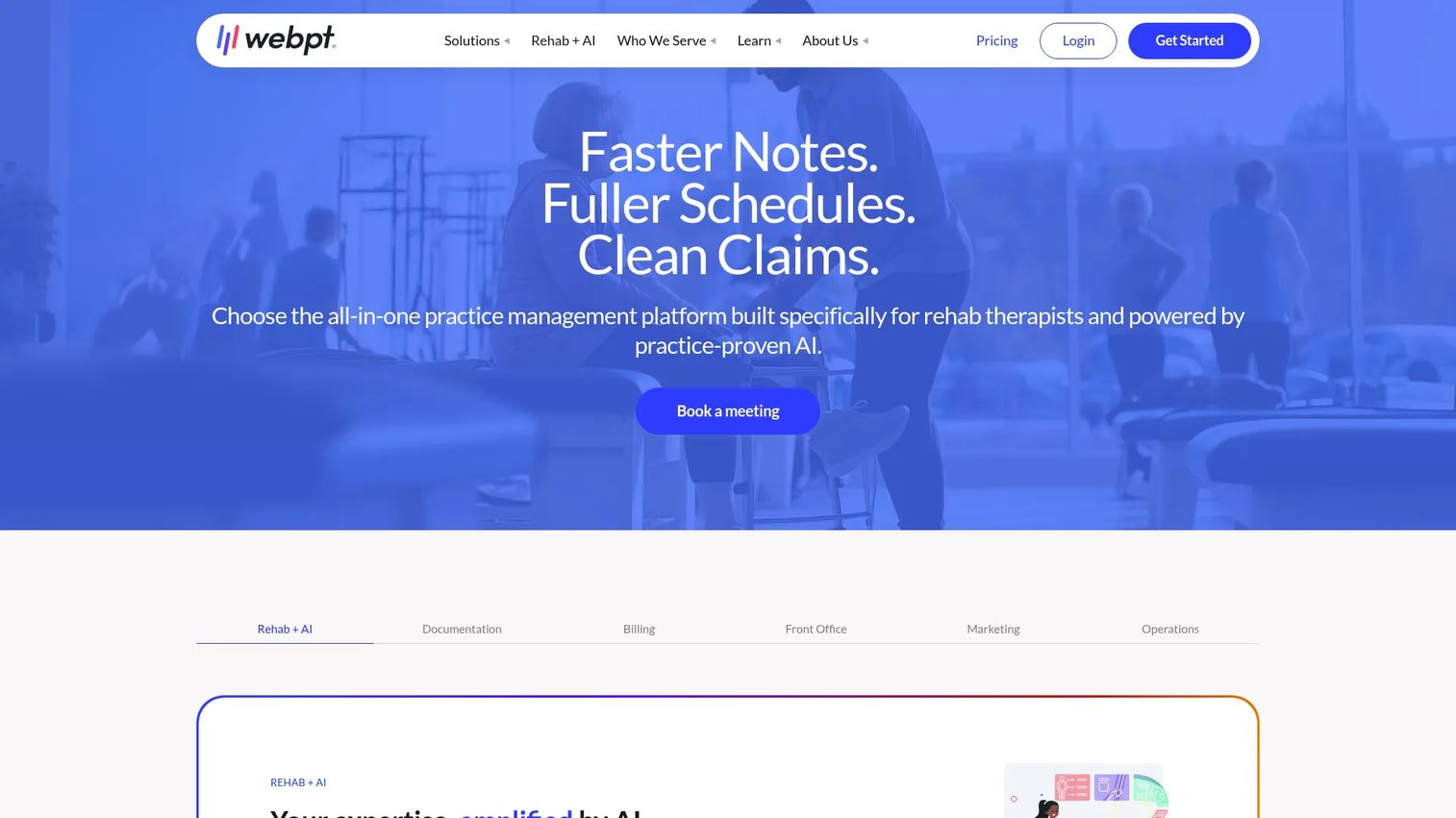
WebPT is one of the most established names in rehab therapy practice management software, built specifically for physical, occupational, and speech therapy clinics. It bundles documentation, scheduling, billing, and patient engagement into a single platform so an outpatient clinic runs the front office and the treatment room on one record. For clinics tired of gluing point tools together, WebPT positions itself as the consolidation layer.
Best for: Outpatient rehab clinics that want an all-in-one EMR and practice management platform under one vendor.
Key strengths
- AI-powered documentation and charting: Rehab-specific templates and AI note drafting reduce the after-hours charting that burns out clinicians.
- Digital patient intake: Online forms and portals move intake off the front desk and into the patient's hands before they arrive.
- Scheduling, billing, and compliance workflows: Calendar, claims, and Medicare compliance tooling live in the same system, so a schedule change flows through to the claim.
Why choose WebPT: WebPT earns its place when a growing clinic wants a mature, rehab-specific platform that covers the full workflow rather than a general medical EHR retrofitted for therapy. Its breadth across documentation, billing, and front-office automation makes it a common default for outpatient groups scaling past a single location.
WebPT pricing: WebPT does not publish a public numeric price. Its pricing page lists Starter, Enhanced, Care, and Monetize plans, and notes that cost depends on the plan and customization, quoted per provider per month or per visit. You will need a quote to see real numbers, so factor a sales conversation into your evaluation timeline. WebPT holds a 4.4/5 rating on G2.
2. Prompt
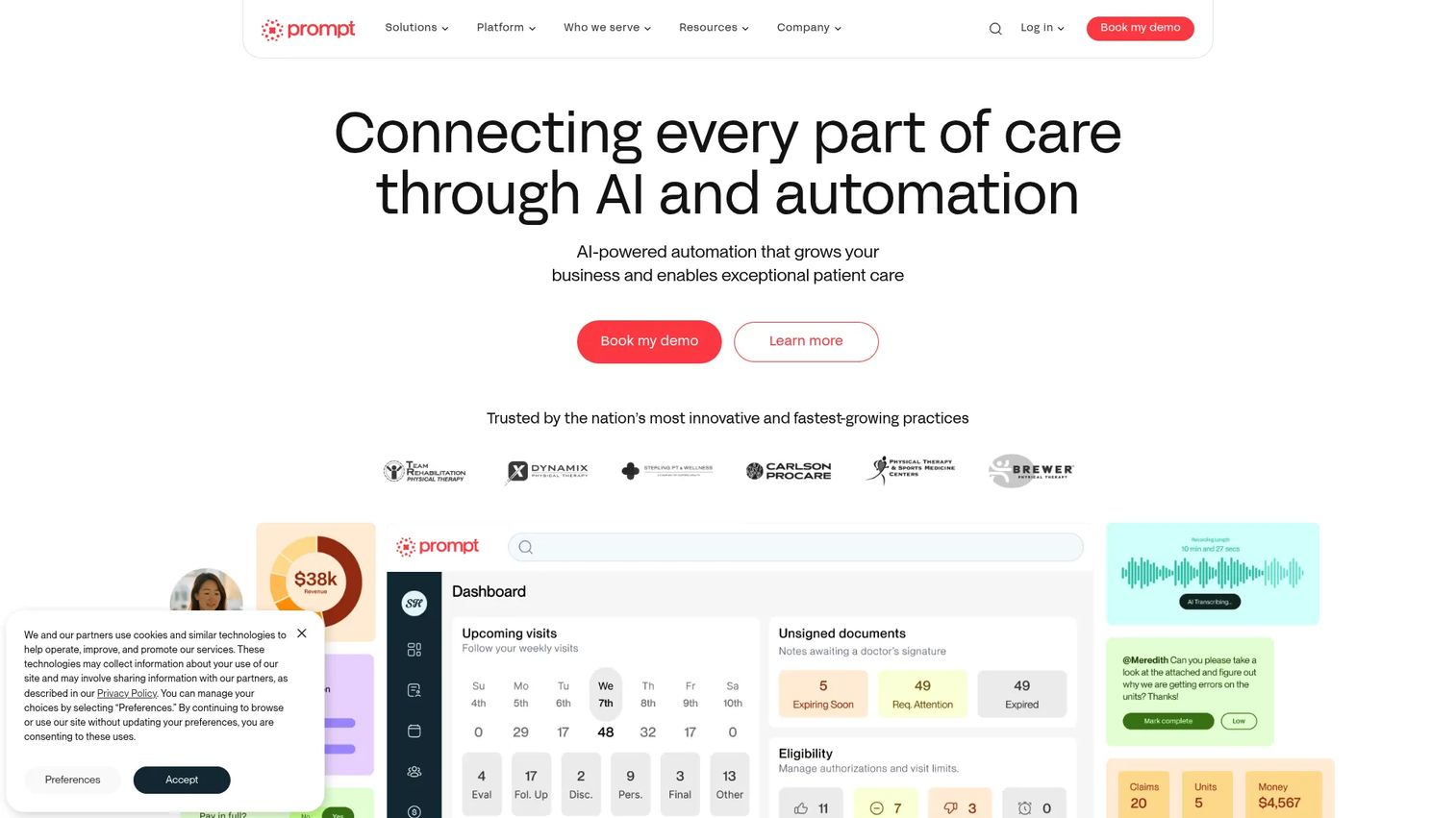
Prompt is an AI-powered EMR and practice management platform built for outpatient rehab therapy clinics, positioned around clinician efficiency and revenue lift. It covers scheduling, billing, documentation, and patient experience, with automation woven through the workflow so staff spend less time on repetitive admin. Teams compare Prompt when they want stronger revenue and engagement tooling than a legacy system delivers.
Best for: Rehab therapy clinics that want an all-in-one EMR with heavy AI automation across scheduling, documentation, and billing.
Key strengths
- Scheduling and waitlist automation: Automated waitlist backfill and reminders keep the schedule dense without manual chasing.
- Billing and claims workflow management: End-to-end claims handling ties clean documentation to faster reimbursement.
- AI-powered documentation and scribing: AI scribing drafts notes from the visit so clinicians close charts inside the clinic day.
Why choose Prompt: Prompt fits clinics that treat operational efficiency as a growth lever, not just a cost line. Its emphasis on automation across the full workflow appeals to operators who want the front desk, clinicians, and billers pulling from one automated record. It carries one of the highest ratings in the category.
Prompt pricing: Prompt states it uses transparent, flat-rate per-provider pricing but does not display a public numeric price on its site. Expect a quote scoped to your provider count, and confirm what the flat rate includes before you sign. Prompt holds a 4.9/5 rating on G2, among the strongest in this comparison.
3. TheraOffice
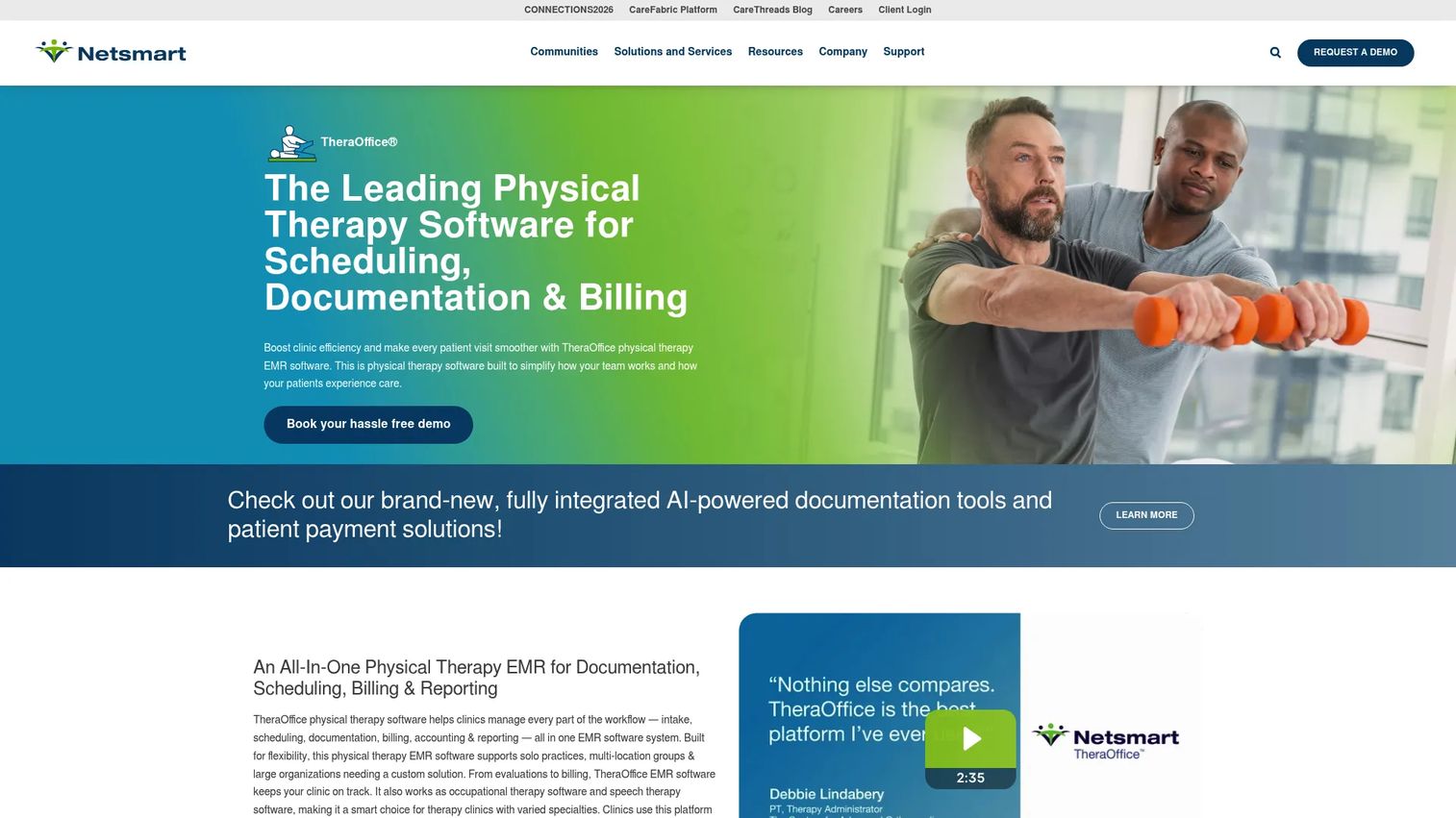
TheraOffice is a physical therapy EMR and practice management platform aimed at operationally complex therapy practices. It covers scheduling, documentation, billing, and reporting with the depth that multi-discipline groups need, and it carries strong compliance and certification language for practices that live under payer and regulatory scrutiny. Physical, occupational, and speech therapy practices use it as an all-in-one EMR.
Best for: Physical, occupational, and speech therapy practices that need an all-in-one EMR with operational depth.
Key strengths
- Scheduling: Calendar and visit management built for multi-clinician, multi-discipline practices.
- Documentation: Structured clinical documentation designed around rehab workflows.
- Billing and reporting: Integrated billing paired with reporting that surfaces utilization and collections.
Why choose TheraOffice: TheraOffice suits groups whose operational complexity has outgrown lighter tools, especially those managing MIPS reporting and multi-site compliance. If your practice needs module depth and certification support more than a slick consumer-grade UI, it belongs on your shortlist.
TheraOffice pricing: Public product pricing is not displayed. The company does list MIPS registry pricing at $314 per provider per year for Individual Reporting, with Group Reporting quoted as custom. General platform pricing requires a quote. TheraOffice holds a 3.4/5 rating on G2, so weigh reviewer feedback on usability during your evaluation.
4. AdvancedMD

AdvancedMD is a cloud-based practice management, EHR, and patient engagement platform for independent healthcare practices, including a dedicated physical medicine configuration. PT buyers consider it when their needs stretch beyond rehab-only workflows into broader administrative and multi-specialty operations. It unifies EHR, billing, and patient engagement in one cloud suite.
Best for: Independent practices, including physical medicine, that need a unified cloud suite spanning EHR, billing, and patient engagement.
Key strengths
- Unified EHR, practice management, and patient engagement: One cloud platform across clinical, administrative, and patient-facing workflows.
- ePrescribing and controlled-substance prescribing: Built-in prescribing supports practices with broader clinical scope.
- Telemedicine, patient portal, and self-scheduling: Patient-facing tools reduce front-desk load and support remote visits.
Why choose AdvancedMD: AdvancedMD makes sense for practices that are not purely rehab, or for groups that value a broad, established cloud suite over a rehab-first specialist. If your operation spans specialties or you want deep revenue cycle management services, it is worth evaluating. PT-only clinics should confirm the physical medicine configuration matches their documentation needs.
AdvancedMD pricing: AdvancedMD publishes specialty-based ranges. The Physical Medicine configuration starts at $399 per provider per month, with other specialties ranging from $130 to $1,070 per provider per month. RCM services are priced at 4% to 8% of collections, and there is no free tier. AdvancedMD holds a 3.6/5 rating on G2.
5. Net Health TherapySource
Net Health TherapySource is rehab therapy software from Net Health, built around documentation workflows, analytics, and patient engagement. It belongs on the shortlist for clinics that want a rehab-focused system with customizable documentation and a clinical knowledgebase rather than a general medical platform. Rehab therapy organizations use it for specialized EMR and workflow automation.
Best for: Rehab therapy organizations that need specialized EMR and workflow automation with strong documentation tooling.
Key strengths
- Customizable documentation workflows and templates: Templates and workflows tailored to rehab disciplines speed up charting.
- Clinical knowledgebase and text shortcuts: Built-in knowledgebase and text replacement cut repetitive typing.
- Patient engagement and outcomes tools: Engagement and outcomes tracking support adherence and measurable results.
Why choose Net Health TherapySource: TherapySource fits rehab organizations that prioritize documentation flexibility and outcomes reporting. The customizable workflows and clinical knowledgebase appeal to practices that want to shape the EMR around their protocols rather than adapt to a rigid template set.
Net Health TherapySource pricing: Net Health does not publish public pricing for TherapySource, so plan on a quote scoped to your organization. The Net Health seller rating on G2 sits at 3.6/5, though that reflects the seller across products rather than TherapySource specifically. Confirm implementation timelines and integration scope during your evaluation.
6. SPRY Physical Therapy Software
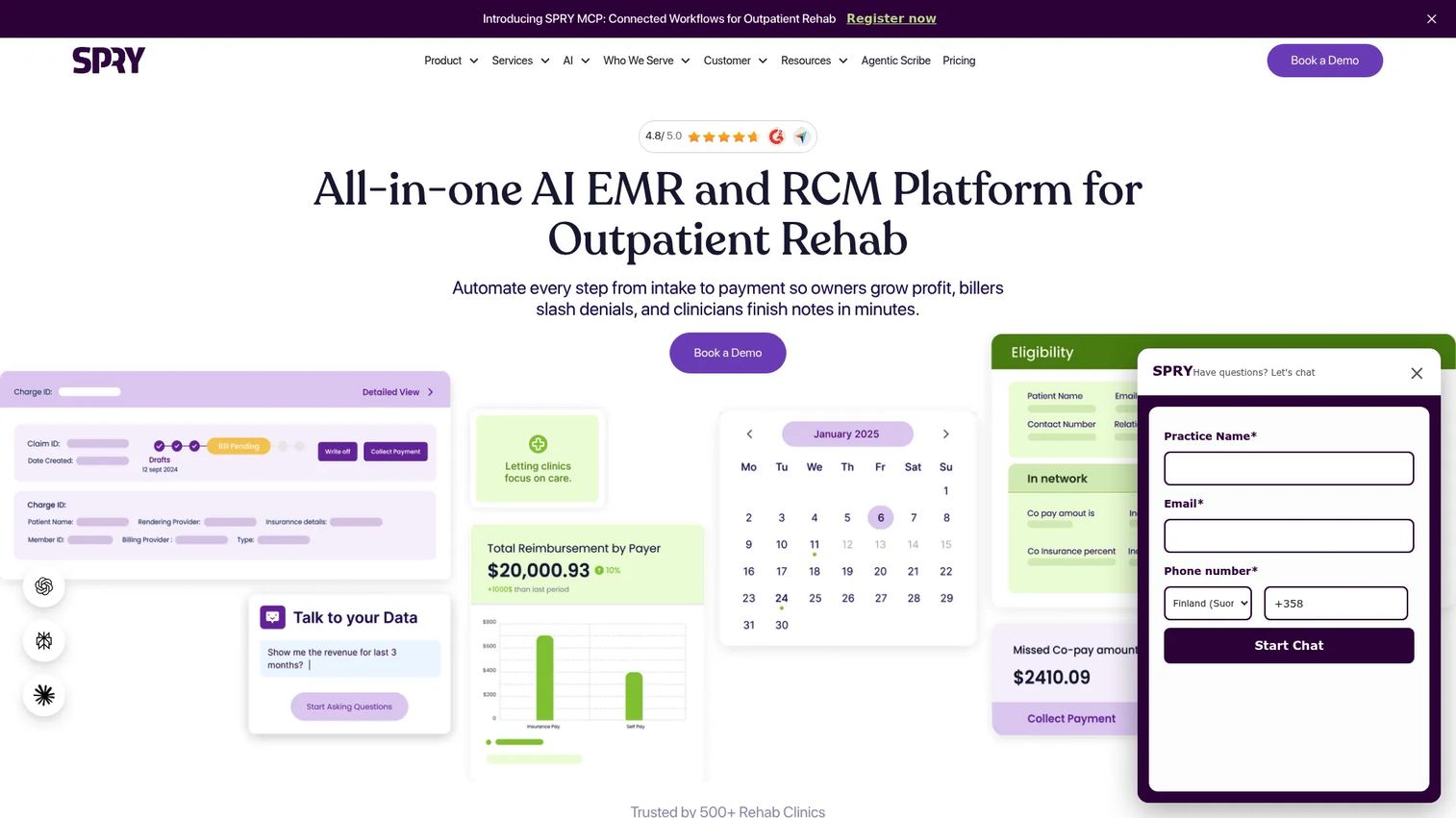
SPRY is an AI-native EMR and revenue cycle management platform for outpatient rehab therapy clinics. It leans hard into automation, from AI insurance card capture to agentic scribing, and packages EMR, billing, and documentation into one modern stack. Clinics compare SPRY when they want a lighter, AI-forward rehab platform without sacrificing billing depth.
Best for: PT, OT, and SLP clinics that want an integrated EMR and billing platform with heavy AI workflow automation.
Key strengths
- AI intake automation: AI insurance card capture, fax intake, and eligibility verification pull manual work out of the front desk.
- AI scheduling and scribing: Prior authorization automation, AI scheduling, and an agentic scribe compress admin time across the visit.
- Integrated billing and compliance: Documentation, billing, reporting, and HIPAA compliance live in one system.
Why choose SPRY: SPRY fits lean, growth-oriented clinics that want modern AI automation and transparent pricing without a heavy implementation. Its published entry price and included onboarding make it easy to model cost, which appeals to operators who want to know their number before a sales call.
SPRY pricing: SPRY publishes pricing starting at $79 per provider per month for Essentials. The Plus tier adds AI Scribe, a companion mobile app, and kiosk check-in, and managed billing (RCM) is an add-on at 4% to 6% of collections. Setup, migration, and onboarding are described as included at no fee. There is no free tier. SPRY holds a 4.6/5 rating on G2.
7. TheraPlatform
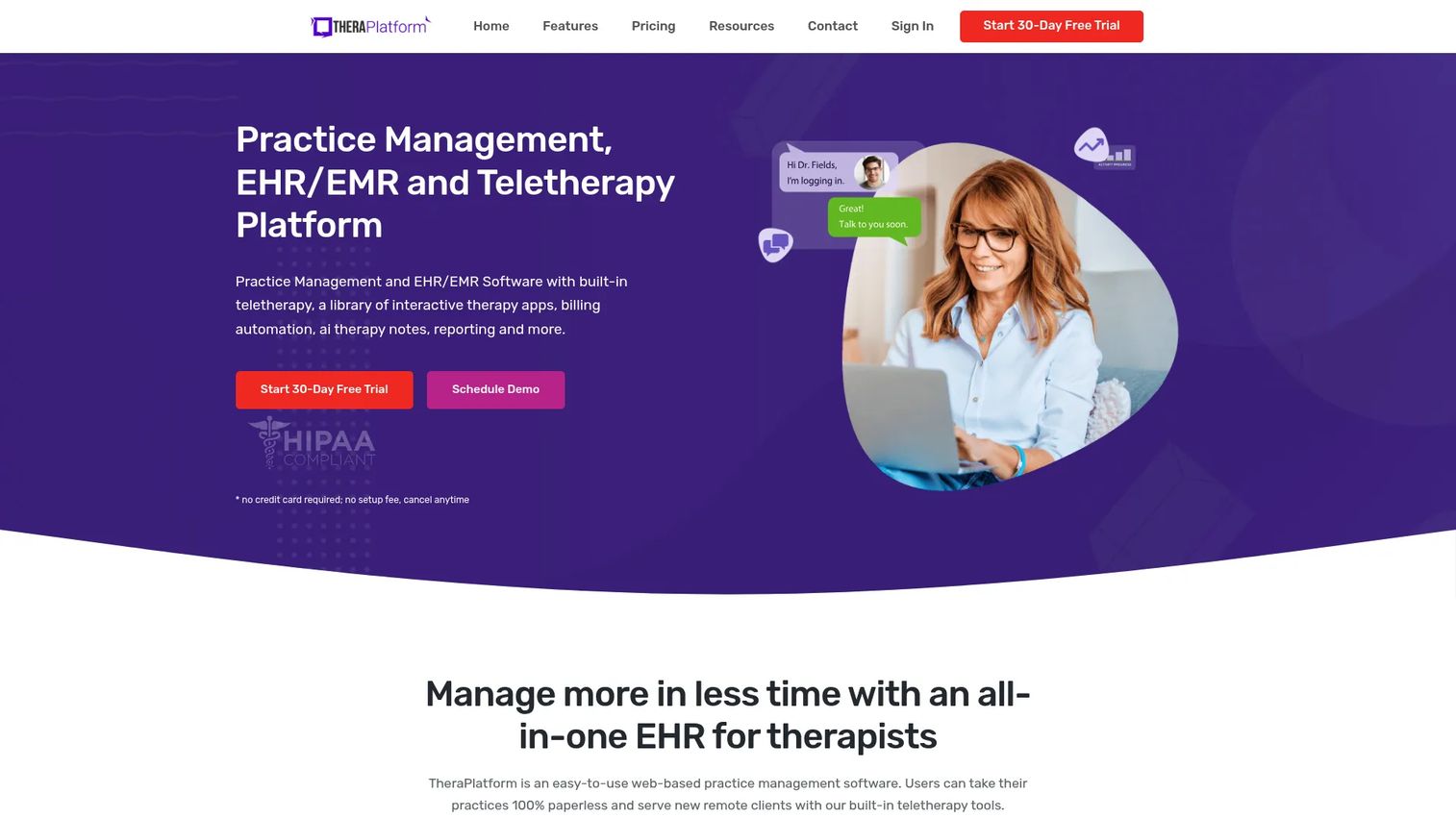
TheraPlatform is a HIPAA-compliant practice management, EMR/EHR, billing, and teletherapy platform for therapy and behavioral health practices. It pairs broad workflow coverage with an accessible entry price and built-in telehealth, which makes it a practical option for smaller clinics and solo practitioners. Practices choose it for an all-in-one EMR, billing, and telehealth workflow.
Best for: Therapy and behavioral health practices, including smaller PT clinics, that want an accessible all-in-one EMR with telehealth built in.
Key strengths
- Scheduling with reminders and waitlist management: Automated reminders and waitlists keep the calendar full and reduce no-shows.
- Documentation with ICD-10, templates, and AI notes: Structured documentation with coding support and AI note drafting.
- Telehealth with whiteboard and interactive apps: Screen sharing, chat, whiteboard, and interactive tools support remote sessions.
Why choose TheraPlatform: TheraPlatform is the accessible entry point in this list, well suited to solo practitioners and small clinics that want telehealth and documentation without an enterprise price tag. Larger groups should confirm that billing and reporting depth scale with their volume.
TheraPlatform pricing: TheraPlatform publishes three plans at introductory monthly prices: Basic at $19.50, Pro at $34.50, and Pro Plus at $39.50, with add-on fees for some services. There is no free tier, but a 30-day free trial is available. TheraPlatform holds a 3.9/5 rating on G2.
8. Fusion Web Clinic
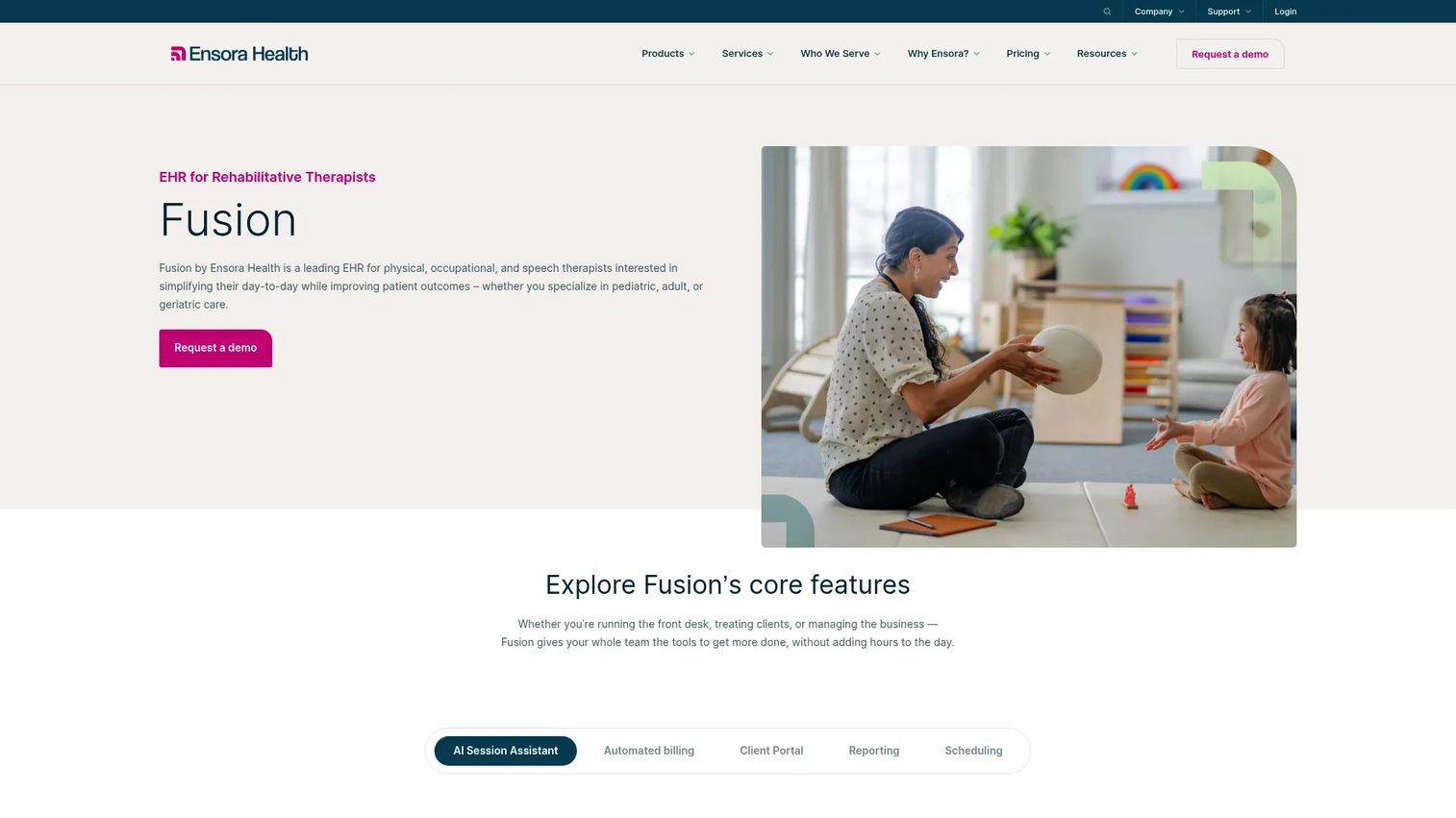
Fusion Web Clinic is pediatric therapy clinic management software for OT, PT, and SLP practices, now part of the Ensora Rehab Therapy Suite. It stands out for pediatric-specific content and authorization tracking, which matter enormously to clinics that live and die by insurance authorizations and pediatric goal documentation. It works as an all-in-one EMR and workflow platform for pediatric therapy.
Best for: Pediatric therapy clinics that need an all-in-one EMR and workflow platform built around OT, PT, and SLP practice realities.
Key strengths
- Authorization tracking and reminders: Authorization tracking and drag-and-drop scheduling keep pediatric caseloads compliant and full.
- Pediatric-specific content and goal banks: Pediatric goal banks and content speed up documentation for younger caseloads.
- Integrated billing and task management: Claims generation plus task management for documentation and renewals keep revenue moving.
Why choose Fusion Web Clinic: Fusion Web Clinic is the specialist pick for pediatric therapy practices, where generic rehab tools fall short on authorization tracking and pediatric goal documentation. If your caseload is primarily pediatric, its purpose-built content is a genuine advantage.
Fusion Web Clinic pricing: Fusion Web Clinic does not publish public pricing on its site, so plan on a quote. A current standalone G2 rating was not available at the time of writing, so lean on demos and reference checks with peer pediatric clinics during your evaluation.
Considerations before you buy physical therapy software
A shortlist is only useful if you pressure-test each option against your actual operation. Work through these criteria before you commit.
Billing and revenue cycle complexity
Match the platform to how you get paid. High-volume insurance clinics need robust claim scrubbing, denial management, and revenue cycle management, and should weigh percentage-of-collections RCM services against flat software fees. Cash-pay clinics can favor lighter billing and lower monthly cost.
Documentation burden and clinical fit
Test the documentation flow with your actual note types before you sign. Rehab-specific templates, flowsheets, and AI documentation should reduce charting time, not add clicks. If clinicians still chart after hours during a trial, the fit is wrong regardless of the feature list.
Clinic size and multi-site needs
A solo practitioner and a 20-location group have different requirements. Small clinics should prioritize speed to value and low per-provider cost. Multi-site groups should verify centralized reporting, role-based access, and consistent compliance across locations.
Compliance and data security
Confirm HIPAA safeguards, audit trails, MIPS and CMS reporting support, and where your data lives. Ask specifically about business associate agreements, breach history, and how the vendor handles data export if you ever leave.
Pricing transparency and implementation time
Several strong platforms gate pricing behind a quote, so budget for sales conversations and get total cost in writing, including setup, migration, and training. Ask for a realistic implementation timeline and confirm what onboarding is included versus billed separately.
Conclusion
The right physical therapy software depends less on the longest feature list and more on how your clinic actually operates. Outpatient groups scaling past one location tend to shortlist WebPT and Prompt for full-workflow coverage. Operationally complex therapy groups lean toward TheraOffice for depth and compliance, while broader multi-specialty practices consider AdvancedMD. Rehab-focused organizations weigh Net Health TherapySource for documentation flexibility. Lean, AI-forward clinics gravitate to SPRY, solo and small practices to TheraPlatform for its accessible entry price, and pediatric clinics to Fusion Web Clinic for purpose-built authorization and goal tracking.
Shortlist on the three variables that drive clinic operations: billing complexity, documentation burden, and patient volume. Then run a real trial with your own note types and claims before you sign anything. Book demos with your top two or three, put every cost in writing, and confirm the implementation timeline. The platform that fits your workflow on day 30 is the one that earns its place in your stack.
FAQs
Physical therapy software is a clinical and administrative platform that lets rehab clinics document care, schedule patients, submit claims, track outcomes, and stay compliant from one system. Most products combine a physical therapy EMR or EHR with practice management, billing, and patient engagement tools so the whole clinic works from a single patient record.
The features that move clinic operations are rehab-specific documentation, integrated scheduling, billing with claim scrubbing, patient intake and engagement, and compliance reporting. AI documentation that drafts notes from the visit has become a top differentiator because it directly cuts the after-hours charting that drives clinician burnout.
Not exactly. A physical therapy EHR focuses on the clinical record, documentation, and outcomes, while practice management software covers scheduling, billing, and front-office workflows. Most modern PT platforms combine both, which is why buyers often use the terms interchangeably, but you should confirm which capabilities a given product actually includes.
It depends on your billing model. High-volume insurance clinics should look at platforms with strong claim scrubbing, denial management, and revenue cycle management services, such as AdvancedMD or SPRY, which offer percentage-of-collections RCM. WebPT and Prompt also cover end-to-end billing tied to documentation. Confirm denial rates and support during a trial.
A small clinic should prioritize speed to value, a low per-provider cost, and a documentation flow that does not add clicks. Accessible platforms like TheraPlatform, which starts under $20 per month, or SPRY, with published entry pricing, make cost easy to model. Avoid paying for enterprise reporting you will not use.
Many platforms now include telehealth, though depth varies. TheraPlatform and AdvancedMD build telehealth directly into their workflows with features like screen sharing, whiteboards, and patient portals. If remote visits are core to your practice, confirm the telehealth tools are integrated with documentation and billing rather than bolted on.
Several vendors gate pricing behind a quote, so ask for total cost in writing, including software, setup, migration, and training. Compare per-provider monthly fees against percentage-of-collections RCM models, and request a realistic implementation timeline. A platform that quotes fast onboarding and included migration lowers your switching risk.
Confirm HIPAA safeguards, audit trails, role-based access, and support for MIPS and CMS reporting. Ask where your data is stored, whether the vendor signs a business associate agreement, and how data export works if you leave. For multi-site groups, verify that compliance controls apply consistently across every location.