You had a strong quarter. The board meeting goes well. Then someone, usually the VP of Product or Head of Growth, gets handed a sticky note that says "EU launch by Q3." Within a week, that person is staring at fifteen browser tabs of localization tools that all claim to be AI-powered, enterprise-ready, and the obvious choice.
This is the Series B founder's localization problem. The product works in English. Pipeline in the new geography is real. And nobody on the team has shipped a multilingual SaaS product before.
The stakes are bigger than they look. CSA Research's Can't Read, Won't Buy study found that 76% of consumers prefer to buy products with information in their own language. The software localization market itself reached USD 4.9 billion in 2024 and is projected to grow at a 12.4% CAGR through 2034, according to Global Market Insights software localization market forecast. The vendors selling into that growth have multiplied accordingly.
Picking the wrong localization platform burns three things at once: engineering time, release velocity, and the goodwill of the team you just convinced to take on international expansion. Picking the right one closes deals in markets you couldn't reach last quarter.
This guide is for the operator who has to make that call without becoming a localization industry expert first.
What's inside
This guide evaluates 10 localization tools across the criteria that actually matter for a 30 to 150-person SaaS team shipping into a new geography:
- Engineering bandwidth required to set up and maintain
- Stack fit with your CRM, CMS, repos, and design tools
- Pricing transparency and how the model scales
- AI translation quality and human-in-the-loop review workflows
Coverage spans product UI, marketing sites, help centers, and in-app content. Tools were selected based on first-party pricing pages, G2 reviews from SMB and mid-market buyers, and integration depth relevant to a modern SaaS stack.
TL;DR
- Best overall for SaaS teams: Lokalise, for product, marketing, and docs in one platform
- Best enterprise-grade workflow: Phrase, for governance, audit trails, and AI orchestration
- Best engineering-led continuous localization: Crowdin, for repo-native CI/CD workflows
- Best for marketing-led website translation: Weglot, for no-code multilingual SEO
- Best no-code web app translation: Localize, for JavaScript-tag installs
- Best translation services bundled with software: Smartling, for managed linguist networks
- Best affordable starter option: POEditor, with a genuine free tier
What localization tools actually do
Localization tools are software platforms that manage the translation, adaptation, and deployment of product content across multiple languages and regions, connecting source content (code, UI strings, marketing copy, help docs) to translators, AI engines, and end users through automated workflows.
The category sits at the intersection of translation management, content operations, and engineering tooling. A modern localization platform is not just a place where translators type. It is the system of record for every piece of multilingual content your company ships, from the signup button to the GDPR disclosure requirements for EU customers on the EU pricing page.
Core capabilities every localization platform includes
Most platforms in this list share a baseline of capabilities, though the depth varies:
- Translation memory and glossary management: Reuse approved translations, enforce brand terminology, and reduce per-word costs over time
- Integrations with repos, CMSs, and design tools: GitHub, GitLab, Bitbucket, WordPress, Webflow, Contentful, Figma design tool, and more
- Machine translation engines with human-in-the-loop review: DeepL machine translation engine, Google Translate, and increasingly large language models for AI localization
- Workflow automation: Continuous localization, branch-based translation, approval chains
- In-context editing and screenshots: Translators see the UI as users will, reducing review cycles
- Analytics on translation progress and quality: Dashboards covering completion, cost, and QA scores
Localization platform vs translation service vs translation management system
These terms get used interchangeably. They are not the same.
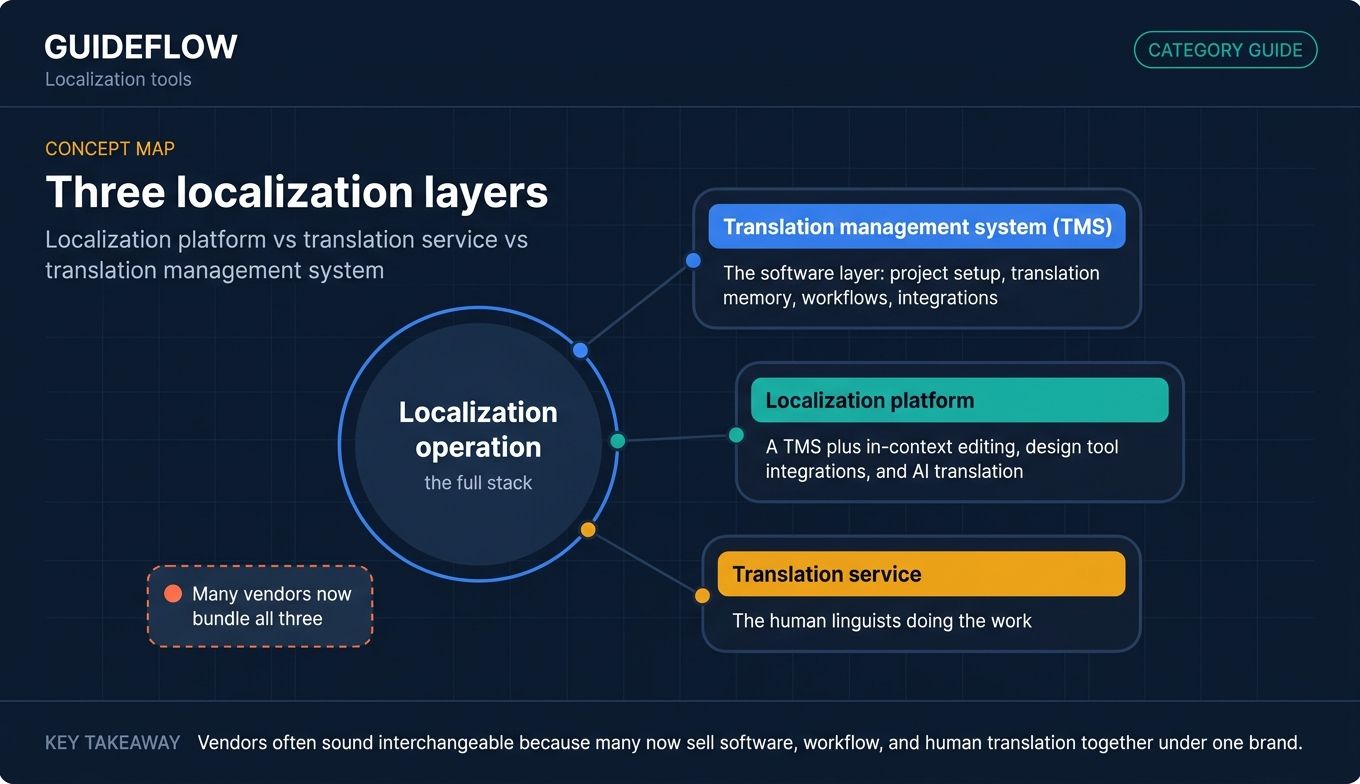
A translation management system (TMS) is the software layer: project setup, translation memory, workflows, integrations. A localization platform is usually a TMS plus broader capabilities like in-context editing, design tool integrations, and AI translation. A translation service is the human linguists doing the work. Many vendors now bundle all three, which is part of what makes the category confusing.
When SaaS teams need a localization tool
Ship a multilingual product into a new geography
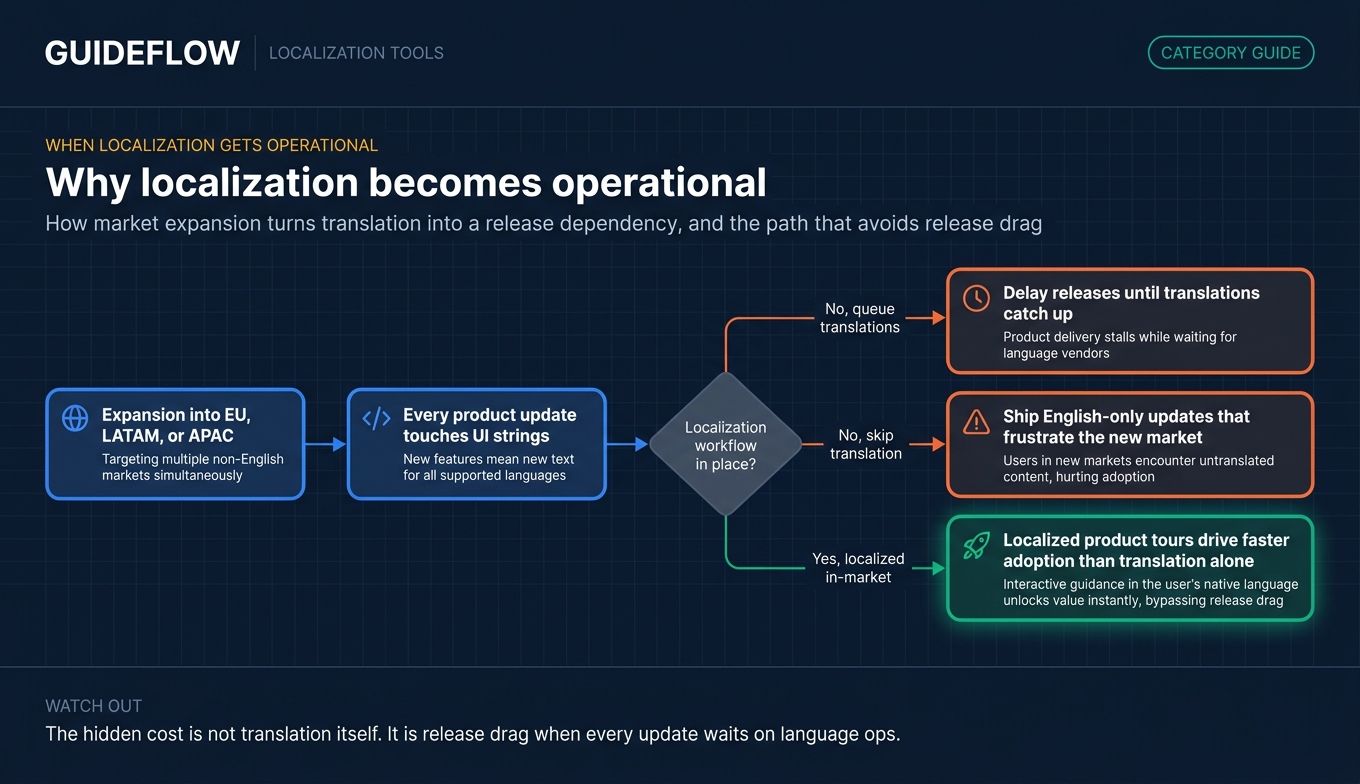
Expansion into the EU, LATAM, or APAC turns translation from a one-time project into a release dependency. Every product update touches UI strings. Without a localization workflow, you either delay releases until translations catch up or you ship English-only updates that frustrate the new market you just opened. Teams that pair localization with interactive product tours localized in-market often see faster adoption than translation alone.
Localize the marketing site and help center without engineering tickets
Product Marketing and Support need to update content in six languages weekly. If every change requires a developer to push new files, the work doesn't happen. Website localization tools that integrate with your CMS let non-technical teams ship updates the same day they write them.
Maintain translation quality as the product evolves
Translation Memory standards and best practices and glossary management exist because language drifts. The word you used for "dashboard" in German six months ago needs to be the same word today, even if a different translator handles the new screen. Without a localization workflow, your product reads like it was translated by twelve different freelancers, which it was. This is closely related to the consistency challenges solved by digital adoption platforms, which face similar in-product content governance issues.
Comparison table
The table below sorts tools by relevance to SaaS teams, not alphabetically. The top of the list covers the platforms most commonly chosen by Series B and mid-market SaaS companies. Pricing reflects vendor pricing pages verified at the time of publishing. G2 ratings come from each tool's current G2 listing.
| # | Product | Intent | Key use case | Pricing | G2 rating |
|---|---|---|---|---|---|
| 1 | Lokalise | AI localization platform | Product UI, marketing, and docs in one workspace | Free tier; Explorer from $144/mo (annual) | 4.7/5 |
| 2 | Phrase | Enterprise localization | AI-powered workflow orchestration and governance | Freelancer from $27/mo; Team from $1,245/mo (annual) | 4.5/5 |
| 3 | Crowdin | Continuous localization | Engineering-led repo-native localization | Free tier; paid plans on pricing page | 4.4/5 |
| 4 | Weglot | Website translation | No-code multilingual sites with built-in SEO | Free tier; Starter from $17/mo | 4.7/5 (Capterra) |
| 5 | Localize | No-code web app translation | JavaScript-tag install for SaaS UI | Individual from $60/mo | 4.6/5 (Capterra) |
| 6 | Smartling | Enterprise + managed services | AI translation with linguist network | Usage-based, from $0.0075/word (MT) | 4.4/5 |
| 7 | Transifex | Developer-friendly TMS | Continuous localization for apps and sites | Starter and Growth tiered plans | 4.2/5 |
| 8 | POEditor | Affordable team localization | Lightweight TMS for small teams | Free tier; Start from $20/mo | 4.5/5 |
| 9 | Centus | Collaborative localization | All-in-one workflow for mixed teams | Start from $145/mo | 5.0/5 |
| 10 | Smartcat | Marketplace + AI | Built-in translator marketplace with AI | Basic from $1,200/year | 4.6/5 |
1. Lokalise
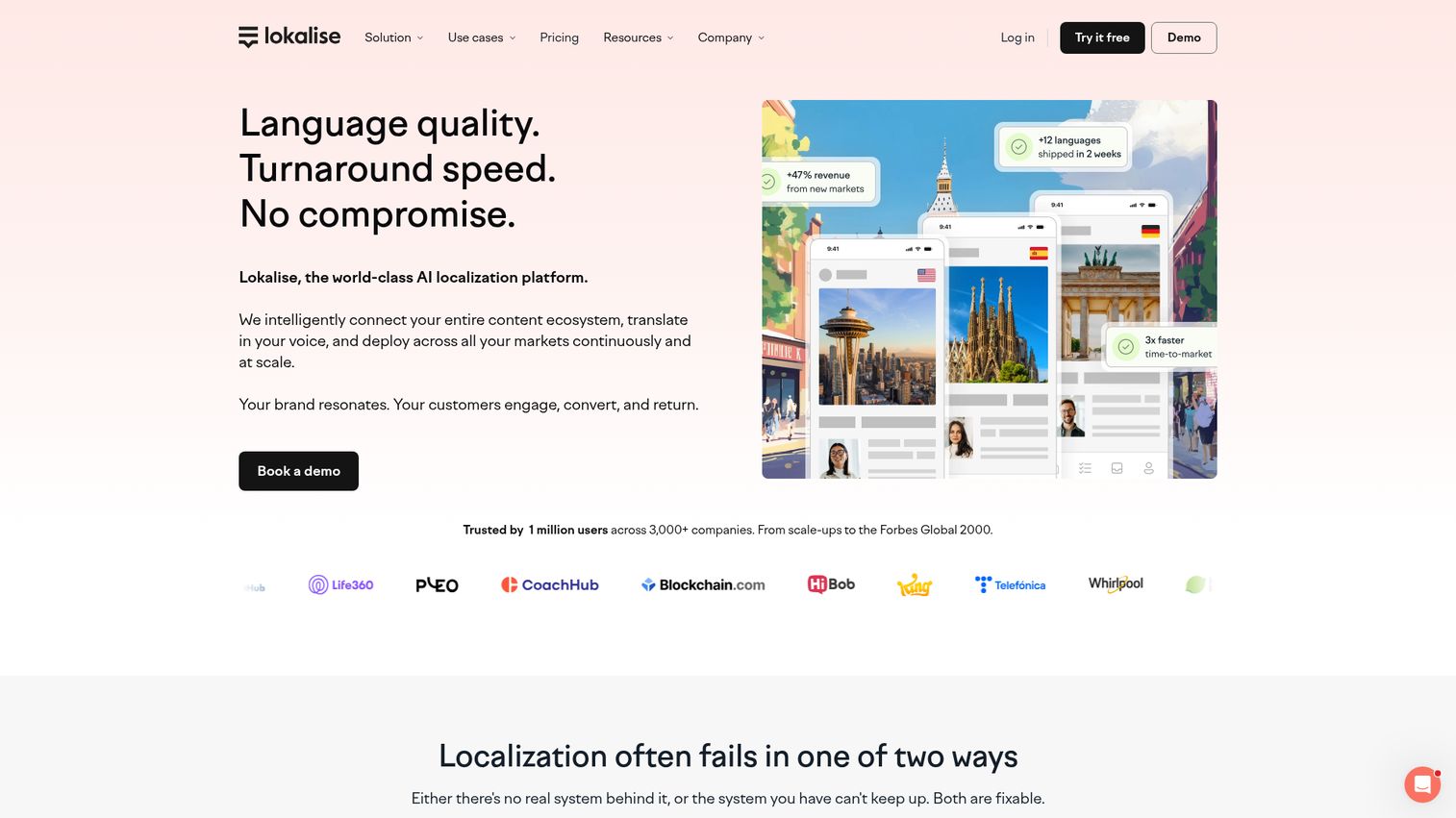
Lokalise is a localization and translation management platform designed for agile teams. It is one of the most common choices among SaaS companies that want a single platform covering product UI, marketing site, and help documentation without hiring a dedicated localization manager. The product positions itself around AI-assisted translation, collaboration, and automation rather than acting as a pure translator workbench.
Best for: Series B SaaS teams that need one tool to cover product, marketing, and docs and don't yet have a dedicated localization hire.
Key strengths
- Collaborative web-based editor: Translation memory, inline machine translation, and QA checks in one workspace
- Automated localization workflows: Ready-to-use templates, task scheduling, and webhooks reduce manual project management
- Code repository integrations: API, CLI, and branching for version control, with support for GitHub, GitLab, Bitbucket, Figma, and CMSs
Why choose Lokalise: The product is built for teams shipping weekly or faster. The setup investment pays off when releases are frequent and translation needs to keep pace without becoming a bottleneck. Teams that pick Lokalise tend to value the breadth of integrations and the in-context editing that reduces review cycles.
Lokalise pricing: Lokalise offers five tiers on its pricing page: Free at $0/mo, Explorer at $144/mo with annual billing, Growth at $499/mo with annual billing, Advanced starting at $999/mo with annual billing, and Enterprise via custom quote. All paid plans come with a 14-day free trial. The Free tier is suitable for evaluation, while most production SaaS teams land on Explorer or Growth depending on language and seat counts.
2. Phrase
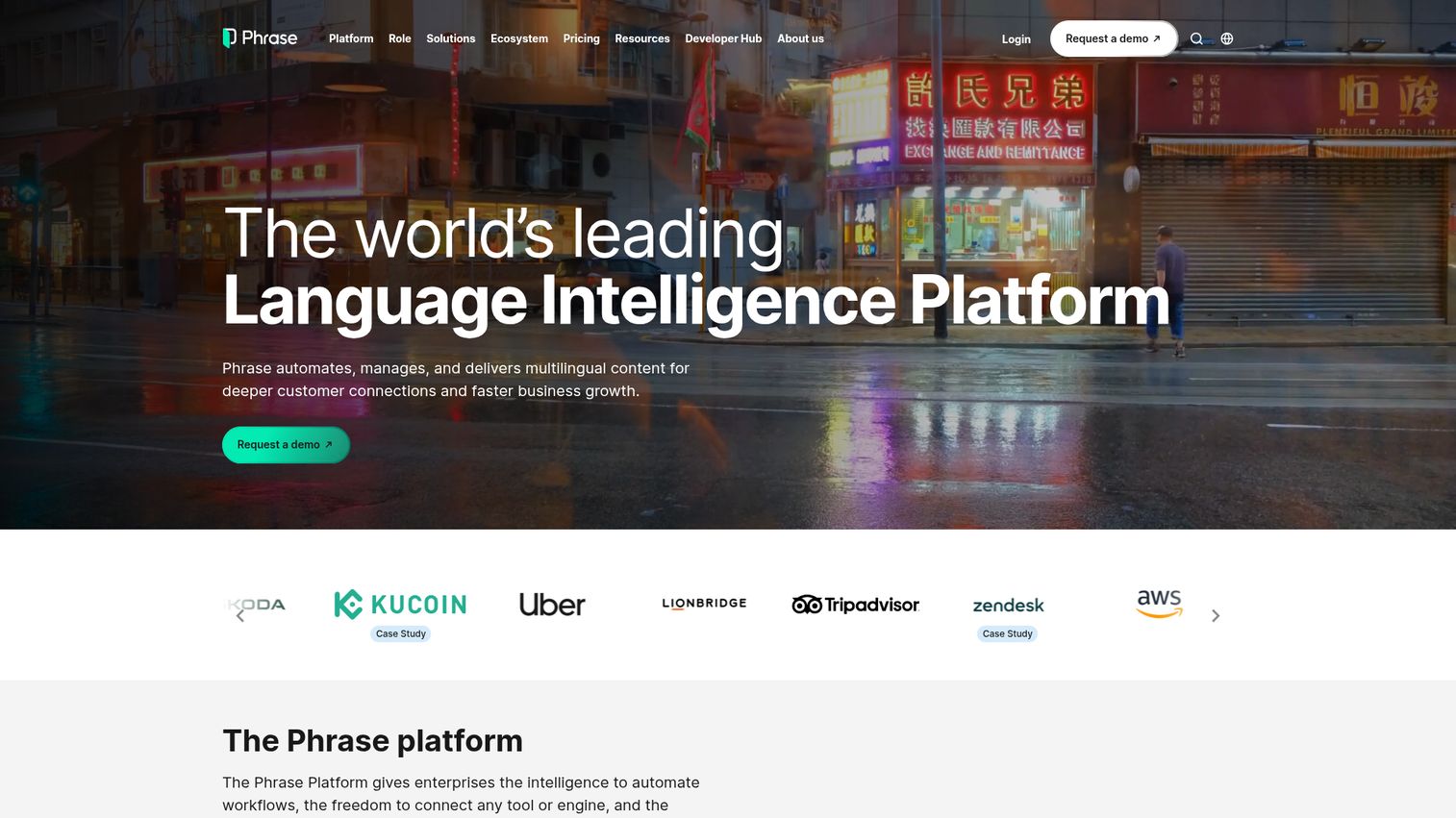
Phrase is an AI-powered localization and translation platform built for businesses and language service providers. It is the heavier, more governance-focused option in this list, with a product family that spans translation management, software string localization, and no-code workflow automation. Phrase also absorbed Memsource acquisition by Phrase in earlier years and now markets the combined offering under the Phrase brand.
Best for: Mid-market to enterprise SaaS teams with complex localization workflows, compliance requirements, and multiple stakeholders across product and content.
Key strengths
- Translation management across content types: Handles UI strings, marketing copy, and long-form content with workflow automation
- Phrase Strings for software localization: Direct integration with code repositories and design tools for product UI
- Phrase Orchestrator: No-code workflow automation for routing, approvals, and quality steps
Why choose Phrase: Phrase is the right call when localization needs governance, audit trails, and SSO. The platform is heavier than what a 30-person team typically needs and excels for a 100-plus person company scaling into many languages, with multiple stakeholders touching content.
Phrase pricing: Phrase publishes annual plans across multiple plan families. Freelancer starts at $27/month billed annually. Software UI/UX and Professional both list at $525/month billed annually. Team is $1,245/month billed annually. Business and Enterprise tiers are custom. All plans include a 14-day free trial. There is no permanent free tier.
3. Crowdin
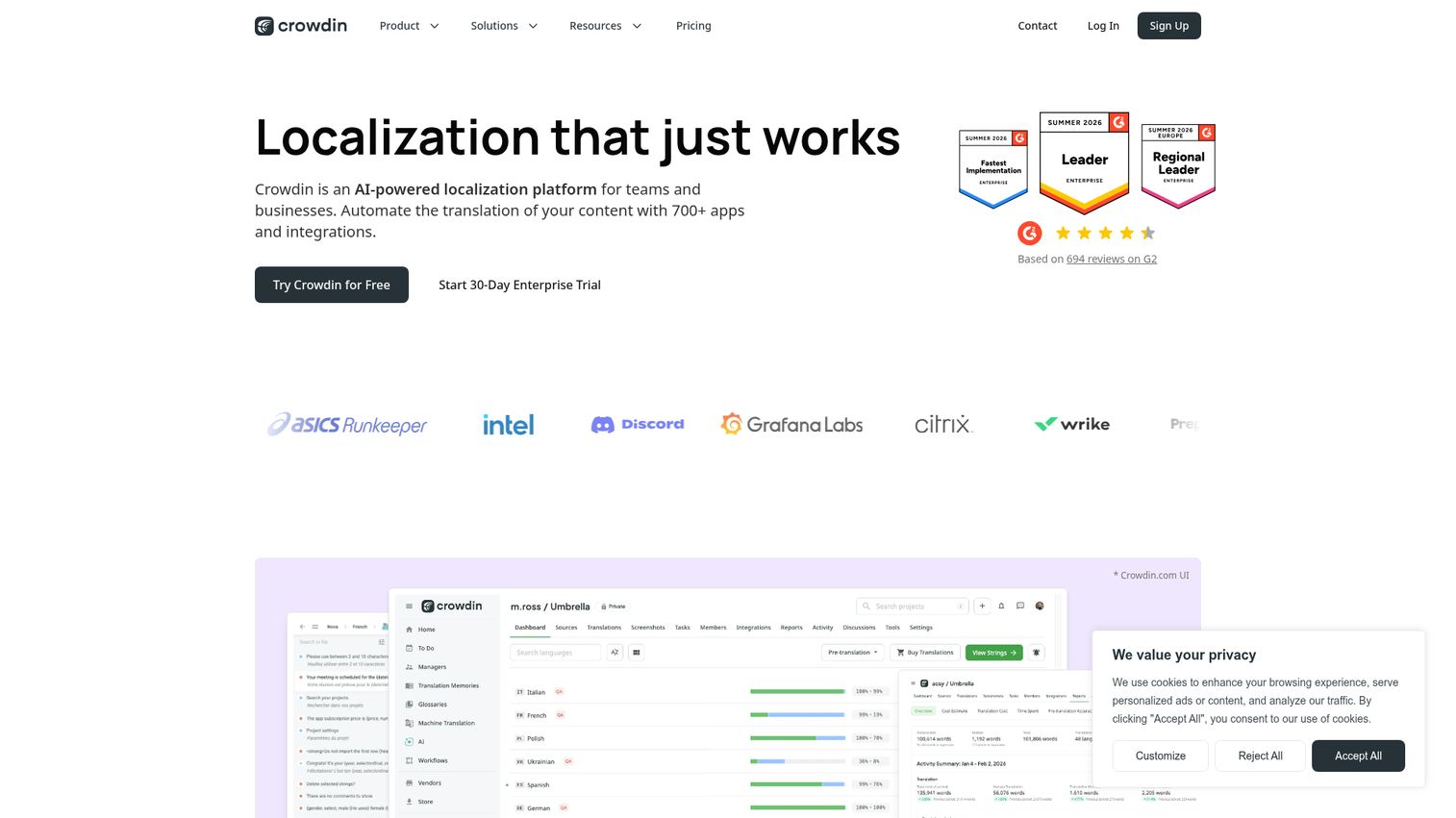
Crowdin is an AI-powered localization platform for teams and businesses that want to translate and manage multilingual content in one place. The product is widely used in open-source communities and engineering-led SaaS teams that want continuous localization in CI/CD pipelines rather than as a separate operational stream.
Best for: Engineering-led SaaS teams that want continuous localization to run inside their existing repo-driven workflow.
Key strengths
- 700+ integrations: Connects with GitHub, GitLab, Bitbucket, Figma, and a large library of CMSs and dev tools
- Online translation editor: WYSIWYG preview, terms helper, and live spell check for translator productivity
- Real-time localization analytics: Translation progress, cost estimation, and customizable reports
Why choose Crowdin: Crowdin excels when engineering owns the localization workflow and wants tooling that fits inside the existing repo-driven process. Open-source projects use it heavily, which has shaped the product around developer ergonomics rather than enterprise governance.
Crowdin pricing: The first-party pricing page lists a Free plan, a Team plan, and a Business plan, with the Enterprise trial including all Business plan features. Specific dollar amounts on the pricing page were not fully exposed at time of publishing; check crowdin.com/pricing for current numbers. A free option for getting started is available, which has historically made Crowdin friendly to smaller teams and OSS projects.
4. Weglot
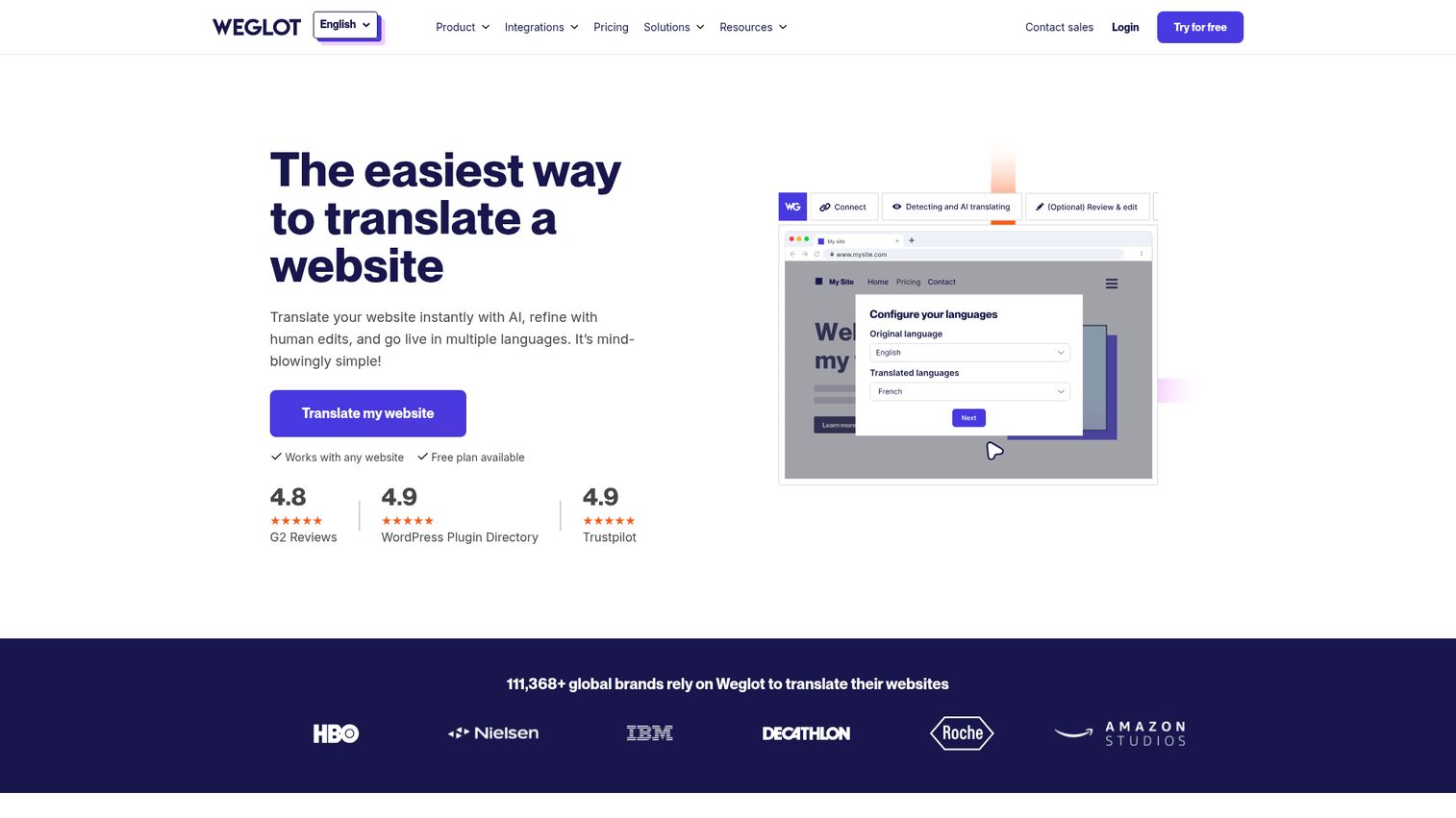
Weglot is an AI website translation platform that helps businesses launch multilingual websites with built-in multilingual SEO. It is the marketing-team favorite for translating WordPress, Webflow, Shopify, and Squarespace sites without needing the product engineering team in the loop.
Best for: Marketing teams localizing the company website and landing pages independently of the product engineering roadmap.
Key strengths
- AI-powered website translation: Automated translation with human editing control for brand-sensitive copy
- Multilingual SEO built in: Language-specific URLs, translated metadata, and hreflang tag implementation guide handled automatically
- Visitor auto-redirection: Detects browser language and routes users to the right localized version
Why choose Weglot: The product is the most direct fit when the site is the primary localization surface and the product team is busy. Founders pick Weglot to ship a multilingual marketing site in days rather than weeks, and it removes the need for engineering tickets every time Marketing wants to update a hero section. For teams pairing localized sites with high-converting landing page builders, Weglot fits naturally into that stack.
Weglot pricing: Weglot's pricing page lists Free at $0/month, Starter at $17/month, Business at $32/month, Pro at $87/month, Advanced at $329/month, and Extended at $769/month. USD figures are estimates because Weglot prices and charges in euros. The Free plan covers projects under 2,000 words with one translated language, useful for evaluation.
5. Localize
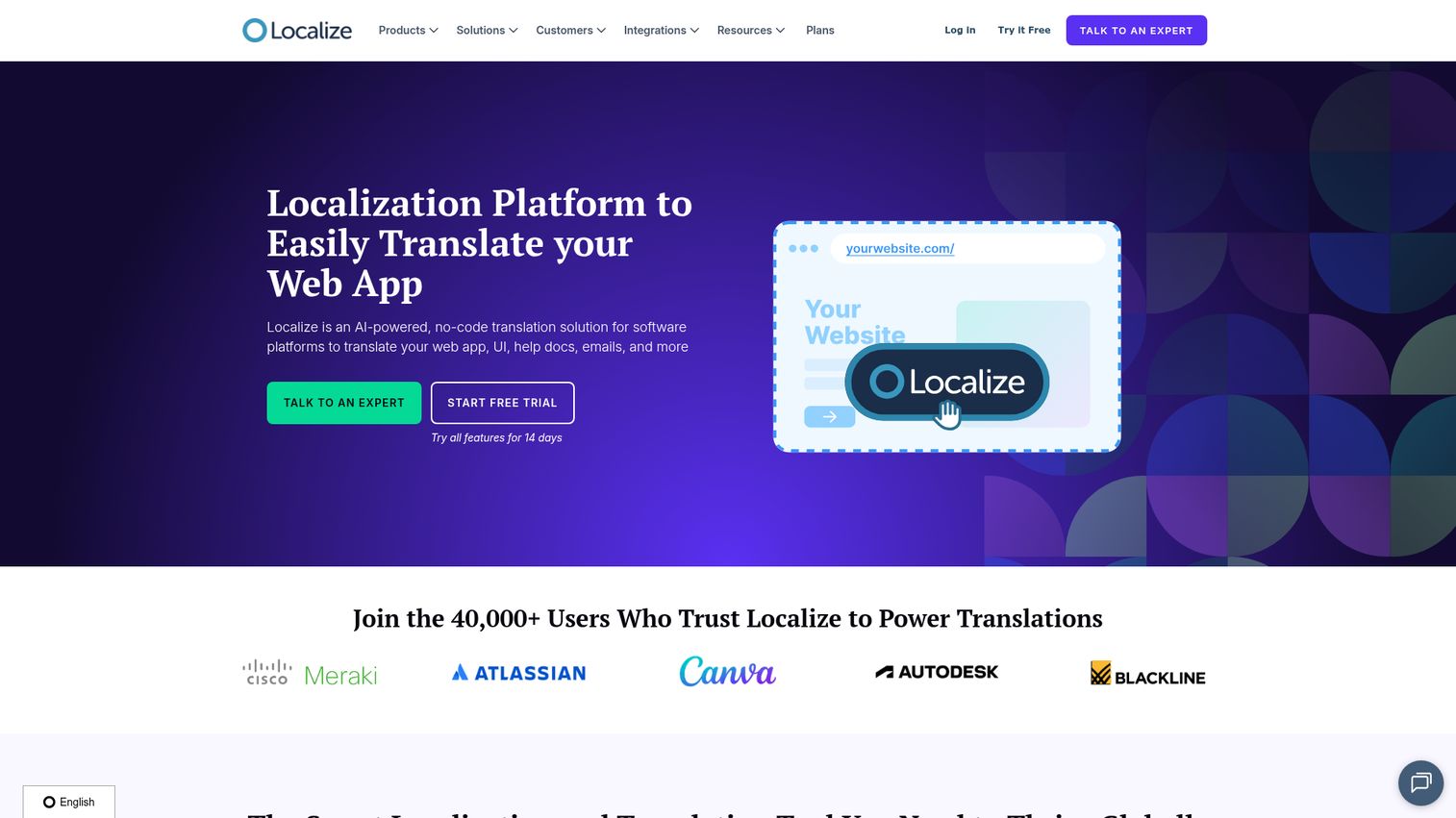
Localize is an AI-powered, no-code translation and localization platform for web apps, UI, help docs, emails, and more. The implementation model centers on a single JavaScript snippet that detects translatable content automatically, which makes it appealing when engineering bandwidth is the bottleneck.
Best for: SaaS teams that want product-level translation without modifying source code or refactoring how strings are managed.
Key strengths
- AI translation: Automated translation pipeline with on-page review and edits
- On-page editor: Marketing, product, and CS can edit translations in context without touching code
- Developer tools: APIs and SDKs for teams that want deeper control over the translation lifecycle
Why choose Localize: Localize excels when engineering bandwidth is the constraint and the team needs a fast path to multilingual without a deep integration project. The JavaScript-tag model means the first language can ship in days, not weeks.
Localize pricing: The self-serve Basic Platform includes Individual at $60/month, Basic at $330/month, and Core at $750/month, all billed monthly. Localize also offers an Advanced Platform with enterprise pricing available through contact-sales. No permanent free tier was confirmed at time of publishing; trials are available.
6. Smartling
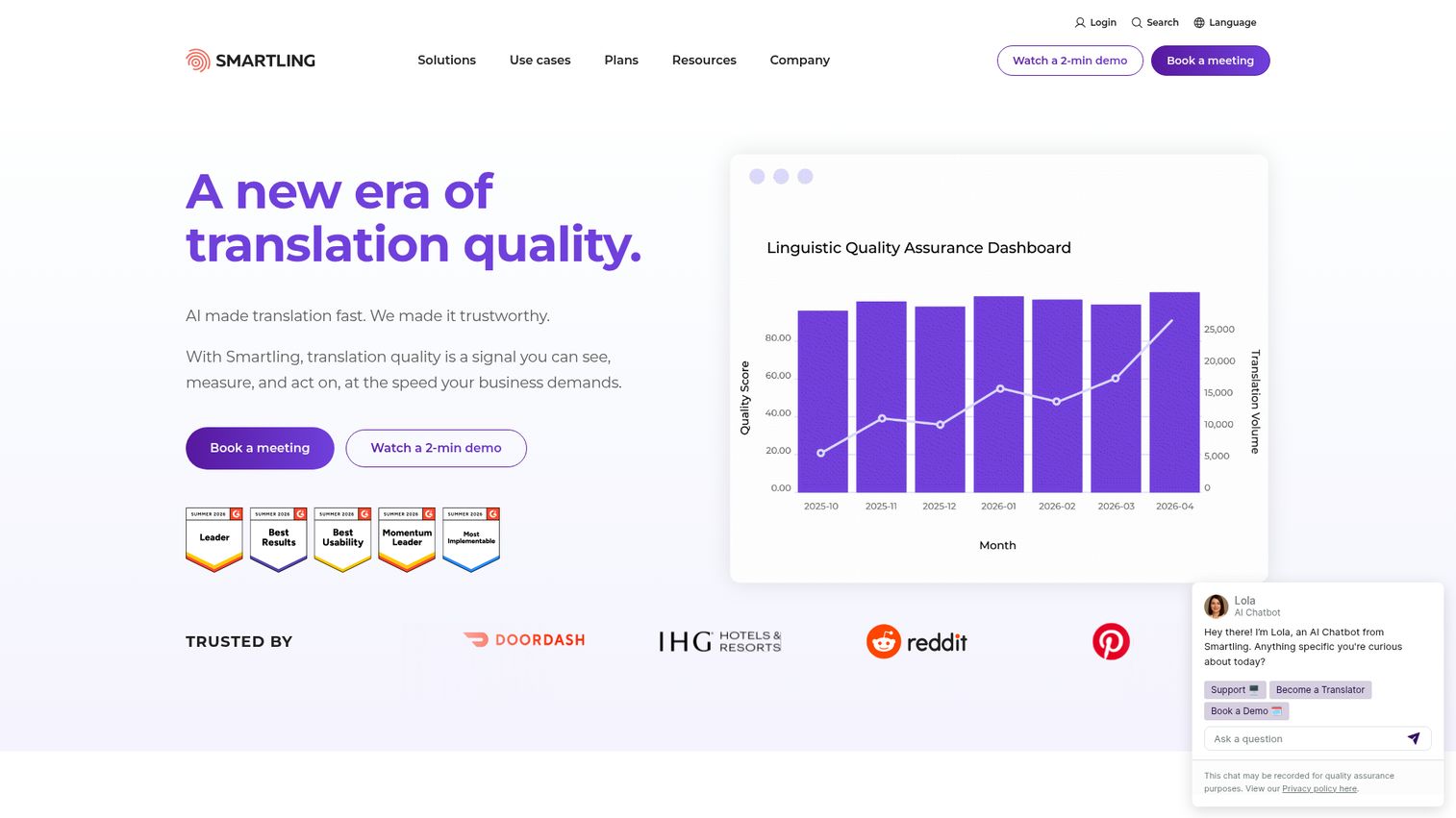
Smartling is an AI translation and localization platform that helps companies translate and manage global content at scale. The product is built for content-heavy enterprises and pairs the software platform with access to a managed network of professional linguists.
Best for: Larger SaaS companies that want a platform plus a managed translation network in one contract, with strong governance and integrations.
Key strengths
- 50+ pre-built integrations: Automate content flow from CMSs, marketing platforms, and product systems
- Translator tools with advanced visual context: Reduces review loops on UI strings and marketing copy
- Real-time dashboards: Detailed translation performance and quality reporting for enterprise teams
Why choose Smartling: Smartling is the right pick when the team wants to outsource the linguist coordination layer rather than just buying software. The platform is enterprise-grade and scales for organizations localizing thousands of strings per week.
Smartling pricing: Smartling uses usage-based per-word pricing. The published rates are $0.0075 per word for Machine Translation, $0.06 per word for AI Translation, $0.12 per word for AI Human Translation, and $0.20 per word for Human Translation. Final cost depends on content volume, translation type, and workflow automation. There is no published free tier.
7. Transifex
Transifex is a localization management platform that blends an advanced TMS with AI built for brand and context. The product targets software, product, and engineering teams that need continuous localization for apps, websites, and multilingual content.
Best for: Engineering teams that want a clean TMS with API depth, in-context preview, and AI quality scoring without enterprise governance overhead.
Key strengths
- Context-aware AI translation: Uses glossaries, style guides, and translation memory to produce on-brand output
- Translation Quality Index (TQI): Scores translations and can auto-publish high-confidence content
- Website and app localization: In-context website localization plus SDK, API, and CLI-based continuous localization
Why choose Transifex: Transifex is the right fit when a small engineering team owns localization end-to-end and wants tooling that respects developer workflow. The TQI feature is useful for teams that want to put more trust in AI translation without giving up quality controls.
Transifex pricing: The pricing page lists Starter and Growth as tiered plans with monthly and annual billing options, plus Enterprise+ via contact sales. Annual Growth includes 60,000 AI words per year, and annual Enterprise+ includes 300,000 AI words per year. Specific tier pricing varies by usage band; check transifex.com/pricing for current numbers.
8. POEditor
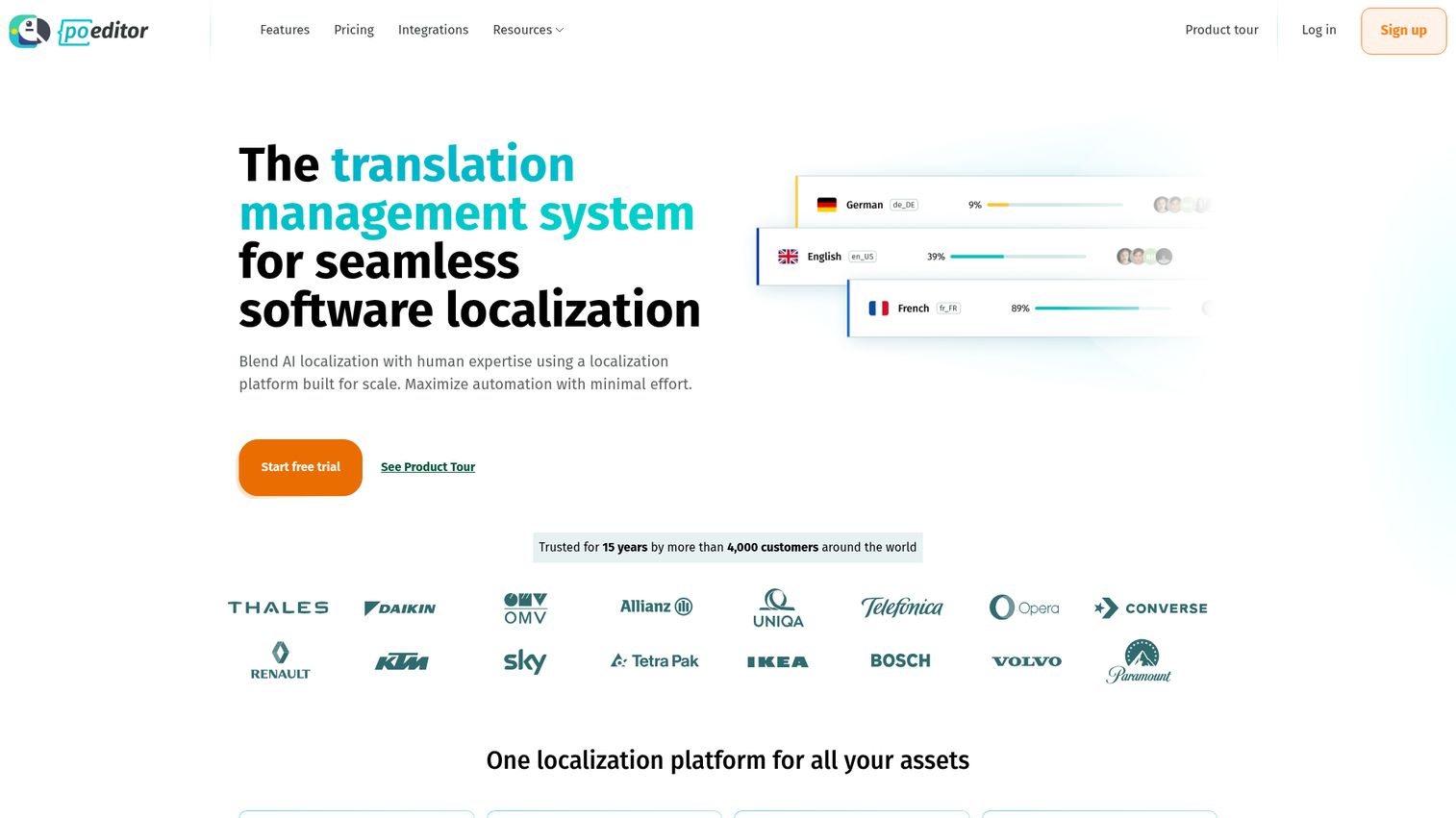
POEditor is a translation management system for seamless software localization. The platform is the lightweight, affordable option for teams testing localization before committing to enterprise tooling. It is also a popular choice for indie developers and early-stage teams that want a genuine free tier.
Best for: Early-stage and small SaaS teams testing localization before committing to enterprise tooling.
Key strengths
- Glossary and automated QA checks: Catches inconsistencies and quality issues without manual review
- Real-time online translation editor: Collaborative editing for distributed contributors and translators
- Code repository integrations: Direct sync with GitHub, GitLab, Bitbucket, and Azure Repos
Why choose POEditor: POEditor is the right call when you need to ship a second language for under $100/month and prove ROI before scaling tooling. The free tier is generous enough to evaluate the platform on a real project.
POEditor pricing: POEditor offers Free at $0/month, Start at $20/month, Plus at $60/month, Premium at $160/month, and Enterprise at $260/month, with lower rates available for 6-month and yearly billing. The free plan supports small projects, which makes it the most accessible entry point in this list.
9. Centus
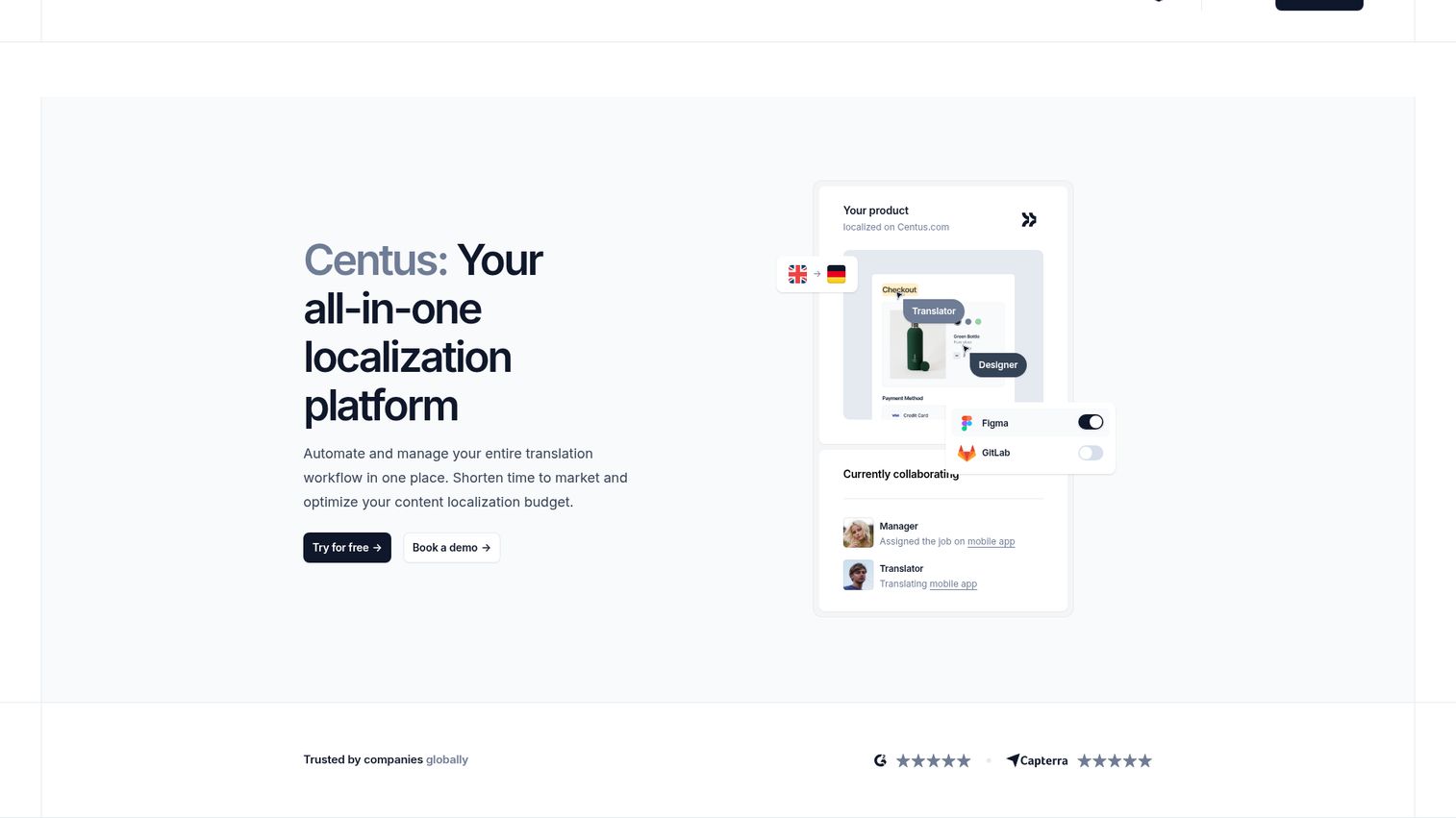
Centus is an all-in-one localization management platform for automating and managing translation workflows. The product positions itself around collaboration between developers, content writers, and translators in a single workspace, which fits teams where localization spans multiple non-technical contributors.
Best for: Teams that want collaboration between developers, content writers, and translators in one workspace, with hands-on support.
Key strengths
- Machine translation engines: Google Translate, DeepL, and Microsoft Translator built in
- Glossaries, term bases, and translation memories: Standard TMS quality controls applied consistently across projects
- QA checks and localization automation: Catches errors and routes work without manual project management
Why choose Centus: Centus is a strong fit when the localization workflow spans multiple non-technical contributors and you want collaboration features front and center. Reviewers on G2 give it a 5.0/5 rating, which reflects strong support and product experience for the buyers using it.
Centus pricing: Centus lists Start at $145/month, Grow at $295/month, Business at $545/month, and Enterprise via custom quote. Pricing is paid annually or monthly, and a 14-day free trial is available. No permanent free tier was confirmed at time of publishing.
10. Smartcat
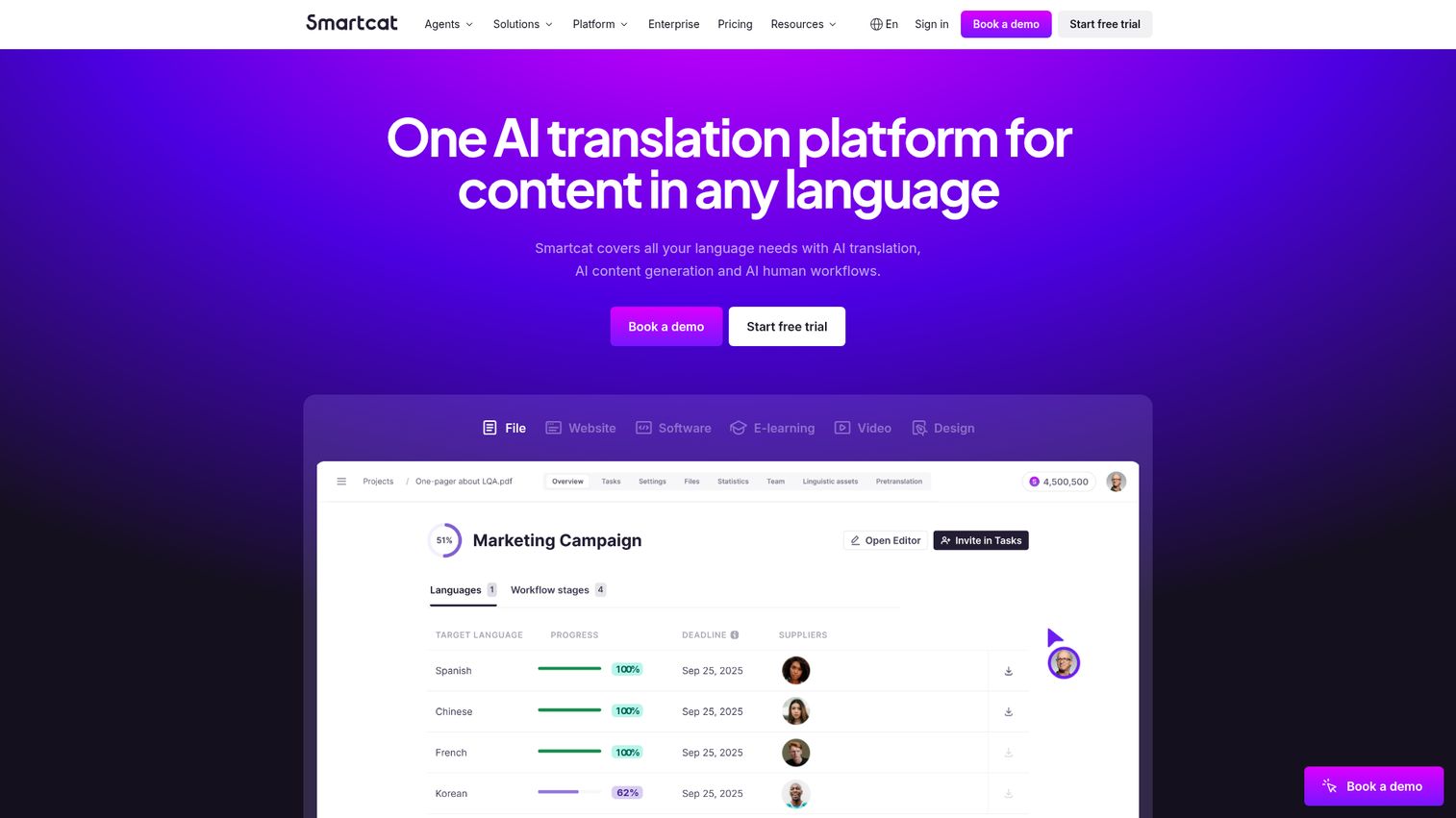
Smartcat is an AI platform for global content with AI translation, AI content generation, and AI human workflows. The differentiator is a built-in translator marketplace that lets teams source linguists inside the same platform they use to manage projects.
Best for: Teams that want software plus translators in one contract, without committing to an enterprise platform.
Key strengths
- AI-powered translation with adaptive translation memory: Quality improves as the system learns from your content
- 30+ plug-and-play integrations: Pull and push content across CMSs, repos, and marketing platforms
- AI-powered analytics and automatic reports: Track localization cost and usage without manual reporting
Why choose Smartcat: Smartcat is the right pick when the team wants AI translation, a marketplace of vetted linguists, and analytics in one platform. The pricing model is friendly to teams that don't want a large upfront commitment but still need professional translation capacity.
Smartcat pricing: Smartcat offers Basic starting at $1,200/year for independent creators and small companies, and Enterprise with custom pricing for global teams, regulated industries, and enterprise transformation. A 15-day free trial is available; no permanent free tier is documented on the pricing page.
Considerations for SaaS teams choosing a localization tool
The category looks similar from a feature checklist. The real differences show up after week two. Here is the buyer's checklist that matters for a 30 to 150-person SaaS team.
Engineering bandwidth required
A JavaScript tag install (Localize, Weglot) gets you to a first translated language in days. A full repo integration with branching logic (Lokalise, Crowdin, Phrase) is more powerful but takes weeks of engineering time. Match the setup model to your available bandwidth, not the marketing copy.
Stack fit
Does the tool integrate natively with your CMS, repo, design tools, and CRM? If your team lives in Webflow and Figma, a tool with deep coverage there will save real hours. If your stack is GitHub and Contentful, look for repo-native workflows. Forced workarounds are the silent killer of localization adoption. Reviewing your broader integrations map before signing a contract usually surfaces gaps you'd otherwise hit in week three.
Translation quality controls
Translation memory, glossary support, and brand voice rules are the difference between a localized product and a product that reads like five different translators wrote it. Ask vendors how their AI localization handles your glossary, and whether human review is a first-class workflow or an afterthought.
Pricing model and scalability
Per-word, per-string, per-language, per-seat: pricing models break differently as you scale. A tool that looks cheap at one language and 5,000 words can get expensive at six languages and 100,000 words. Model the cost at your two-year roadmap, not your current state.
Speed to first translated release
What can you ship in week one? This matters for founders who need a first win to justify the tool internally. Tools with no-code installs win on this dimension. Enterprise platforms win on long-term governance. Pick the tradeoff that matches your stage.
How to pick the right localization tool for your stage
The right tool depends on where you are in the SaaS lifecycle and which surface you are localizing first.
Early Series A or seed with no dedicated localization owner
You need cheap, fast, and good-enough. POEditor's free tier handles product strings without a budget conversation. Weglot covers the marketing site with a JavaScript snippet that any marketer can deploy. The combined cost is under $50/month for a first language, which is the right shape at this stage.
Mid-stage Series B shipping product into a new geography
This is where Lokalise tends to win. It covers product, marketing, and docs in one workspace, integrates with the modern SaaS stack, and scales as you add languages. Pair it with Weglot if the website lives in WordPress or Webflow and Marketing wants to own it without filing engineering tickets.
When you are localizing onboarding flows, in-app product education, and the demos your sales team uses with international buyers, teams often pair localization tools with interactive demo platforms that can translate demo content alongside the product itself, which keeps the buyer experience consistent across language and surface. Many teams also adopt product tour software to deliver those localized in-app walkthroughs to new-market users, and user onboarding tools to keep activation metrics consistent across regions.
Late-stage with multiple languages, compliance needs, and a localization manager
Phrase and Smartling are the two serious choices. Phrase wins when you want governance, SSO, and AI orchestration in one platform. Smartling wins when you want the linguist network and the software in one contract. Both are enterprise-grade and priced accordingly.
Multilingual SaaS across product lines
Crowdin handles complexity well when engineering owns the workflow and wants continuous localization inside CI/CD. Smartcat is worth a look when you want AI translation, a marketplace of linguists, and a flexible commitment in one platform.
Conclusion
The 10 tools in this list cover the realistic options for a SaaS team localizing in 2026. Lokalise is the most common pick for mid-stage teams that need one platform for product, marketing, and docs. Weglot and Localize are the no-code shortcuts for website and web app translation. Phrase and Smartling are the enterprise picks. Crowdin owns the engineering-led continuous localization motion. POEditor, Centus, Transifex, and Smartcat each fill specific niches at different price points.
The concrete next step: shortlist two or three tools that match your stack, request a 14-day trial from each, and ship one language end-to-end during the trial. The trial period tells you everything the sales call doesn't. You'll learn how fast setup actually is, how well the AI translation handles your product copy, and how your team feels about the editor. If demos and product education are part of your launch surface, browsing the demo showcase can spark ideas for how localized interactive content fits next to translated UI.
International expansion is one of the most reliable growth levers available at Series B. The localization platform you pick is the infrastructure that makes that lever work.
FAQs about localization tools
Localization tools are software platforms that manage workflows, translation memory, and integrations. Translation services are the human linguists doing the actual translation work. Many modern platforms (Smartling, Smartcat, Phrase) bundle both, while others (Lokalise, Crowdin) focus on the software layer and let you bring your own translators.
Free tiers exist on Lokalise, Weglot, POEditor, and Crowdin. Mid-tier platforms generally run between $50 and $500 per month depending on languages, words, and seats. Enterprise platforms like Phrase, Smartling, and Smartcat scale into four- or five-figure annual contracts, often with custom pricing tied to volume.
Not for early-stage teams using Weglot, Localize, or POEditor. These tools are designed for self-serve setup. A dedicated localization manager becomes useful once you are managing five or more languages, multiple content surfaces, and a translator network. At that point, the coordination cost exceeds the tool cost.
For straightforward UI strings, modern AI localization handles a large share of content well, especially when paired with a glossary and translation memory. Marketing copy, legal content, and brand-sensitive messaging still benefit from human review. The realistic workflow in 2026 is AI-first with human-in-the-loop for high-stakes content.
Continuous localization syncs translations every time source content changes in your repo, CMS, or design files. Crowdin, Lokalise, and Phrase all position continuous localization as a core capability, with native repo integrations and webhooks. Transifex and Smartling also support it through their developer tools.
Weglot is the most direct fit for website localization tools on these platforms. The JavaScript-tag install and automatic hreflang tag handling means a marketer can launch a multilingual site without engineering involvement. Localize is the alternative for teams that also need web app translation through a similar no-code model.
Most platforms integrate via repo sync (GitHub, GitLab, Bitbucket), webhooks, CLI tools, and CI/CD hooks. Crowdin lists 700+ integrations. Lokalise has deep CI/CD coverage. Smartling lists 50+ pre-built integrations. Engineering-led teams should evaluate API depth, branching support, and how the tool handles merge conflicts in translation files.
Combine a no-code marketing translation tool (Weglot or Localize) for the website with an AI-first product localization platform (Lokalise or Crowdin) for in-app content. With this pairing, many teams ship a first additional language within a few weeks, depending on content volume and how clean the source strings are.