
Your team spent three hours debating which vendor to choose. Two weeks later, someone asks why you picked that one, and nobody can remember the actual reasoning.
Decision making tools are structured frameworks and software that help teams organize information, evaluate alternatives, and document choices systematically. This guide covers 15 platforms for 2026, with pricing, G2 ratings, and criteria for matching the right tool to your decision type.
What this guide covers
This guide covers everything you need to evaluate and choose decision making tools for your team:
- What decision making tools actually are: The difference between frameworks you apply manually and software that operationalizes them
- 15 software platforms compared: Pricing, G2 ratings, and ideal use cases for each tool
- Selection criteria: How to match tool capabilities to your team's decision complexity
- Getting started: A practical path from evaluation to implementation
Quick summary of best decision making tools
- Best for board governance: Diligent Boards provides enterprise-grade security and compliance for corporate decision documentation.
- Best for product prioritization: Productboard and airfocus offer flexible scoring frameworks for roadmap decisions.
- Best for financial planning decisions: Runway Financial helps startups model scenarios and make data-driven budget choices.
- Best for group decision making online: 1000minds and Loomio support distributed teams with async input and voting.
- Best for workflow automation decisions: FlowForma standardizes recurring approval processes without code.
What are decision making tools
Decision making tools are structured frameworks and techniques designed to help individuals and groups organize information, evaluate alternatives, and eliminate cognitive bias. The term covers two distinct categories, and understanding the difference matters when you're evaluating options.
| Type | Definition | Example |
|---|---|---|
| Decision making methodologies | Mental frameworks and techniques you apply manually | SWOT analysis, decision matrix, Eisenhower matrix, cost-benefit analysis |
| Decision making software | Digital tools that operationalize decision making methods at scale | Productboard, 1000minds, Cloverpop, Loomio |
This guide focuses on software tools (decision making tools online) that help teams apply decision making methods consistently. You might already know the frameworks. The challenge is using them reliably when stakes are high and stakeholders disagree.
Methodologies like the decision matrix or SWOT analysis work well in theory. In practice, teams skip steps, weight criteria inconsistently, or let the loudest voice dominate. Software enforces the structure that makes decision making frameworks actually work.
Why teams need structured decision making software
Knowing a framework exists and using it consistently are different things. Most teams default to meetings, email threads, and gut instinct because structured approaches feel slow.
Yet fast decisions are 1.98 times more likely to be higher quality. The irony: unstructured decisions take longer and produce worse outcomes.
Reduced bias in high stakes choices
Structured decision making tools force teams to articulate criteria before seeing options. This simple constraint reduces anchoring bias (where the first option mentioned dominates) and groupthink (where dissent gets suppressed).
Spreadsheets and meetings fail here because they don't enforce sequence. Someone proposes an option, and suddenly the conversation centers on defending or attacking it rather than defining what "good" looks like first.
Faster alignment across stakeholders
Async decision making programs let distributed teams contribute input without scheduling conflicts. The key decision maker still owns the final call, but input gets captured systematically rather than lost in Slack threads.
This matters more as teams grow. A five-person startup can align in a hallway conversation. A fifty-person company with remote employees across time zones cannot.
Transparent documentation for accountability
Decision logs help teams revisit why a choice was made without re-litigating the discussion. When a decision ages poorly, you can examine the reasoning and inputs rather than assigning blame.
Documentation also helps new team members understand context. Why did we choose this vendor? What alternatives did we consider?
Without a record, institutional knowledge walks out the door with every departure.
Scalable processes for growing organizations
Manual decision making methods break down as team size increases. What worked with ten people becomes chaos with fifty.
Software tools enforce consistency across departments. The product team and the finance team use the same framework, which means cross-functional decisions don't stall while everyone argues about process.
When to use decision making tools
Not every choice warrants software. You don't need a weighted decision matrix to pick a lunch spot. But certain decision types benefit significantly from structured approaches.
Strategic planning and resource allocation
Budget prioritization, headcount planning, and capital allocation decisions involve multiple stakeholders with competing priorities. Weighted criteria and systematic input collection prevent conversations from devolving into political battles.
When these decisions involve sales technology investments, teams often evaluate demo centers for sales teams to improve buyer evaluation experiences. Product managers can also reference best product management tools to find platforms that support structured planning.
The stakes are high enough that getting it wrong can cost 530,000 manager days each year. The complexity is high enough that intuition alone produces inconsistent results.
Vendor and technology selection
Procurement decisions require comparing multiple options against defined requirements. RFP scoring is a common application, but the same logic applies to any "which tool do we buy" question.
Decision making tools and techniques help here because they force explicit trade-off conversations. Is price more important than support quality? How much does integration capability matter?
Without structure, the loudest voice answers implicitly.
Product roadmap prioritization
Product teams use these tools to score features against business value, customer demand, and effort. Feature prioritization is a challenge for 73% of product teams.
This is where tools like Productboard and airfocus excel. Product managers can also leverage interactive demos for product managers to validate feature decisions with stakeholders before committing resources.
The alternative is the HiPPO problem (Highest Paid Person's Opinion). Structured prioritization doesn't eliminate executive input, but it does make the reasoning visible and debatable.
Comparison table
| # | Product | Intent | Key differentiation | Pricing | G2 rating |
|---|---|---|---|---|---|
| 1 | Diligent Boards | Board governance | Enterprise security and compliance for corporate boards | Custom | 4.4/5 |
| 2 | Nasdaq Boardvantage | Board portal | Governance documentation for mid-market and enterprise | Custom | 4.3/5 |
| 3 | airfocus | Product prioritization | Modular scoring frameworks with custom weighting | $59/editor/mo | 4.4/5 |
| 4 | Runway Financial | Financial planning | Scenario modeling for startup runway and hiring decisions | Custom | 4.8/5 |
| 5 | Productboard | Product management | Customer feedback aggregation tied to feature prioritization | $20/maker/mo | 4.3/5 |
| 6 | UserVoice | Feedback validation | Demand testing before committing resources | $899/mo | 4.5/5 |
| 7 | FlowForma | Process automation | No-code approval routing and conditional logic | $12/user/mo | 4.6/5 |
| 8 | 1000minds | Multi-criteria analysis | PAPRIKA method for pairwise comparisons | Custom | 4.7/5 |
| 9 | Craft.io | Product strategy | Roadmapping with built-in prioritization | $39/editor/mo | 4.5/5 |
| 10 | Fibery | Work management | Custom prioritization views as flexible databases | $10/user/mo | 4.8/5 |
| 11 | Cloverpop | Decision intelligence | Decision tracking and outcome measurement | Custom | 4.2/5 |
| 12 | Loomio | Collaborative decisions | Proposal, discussion, and voting for distributed teams | Free tier available | 4.6/5 |
| 13 | ThinkTank | Facilitated brainstorming | Anonymous input and real-time prioritization for workshops | Custom | 4.3/5 |
| 14 | Smaply | Journey mapping | Stakeholder visualization for experience decisions | €19/user/mo | 4.5/5 |
| 15 | Lucidchart | Visual diagramming | Decision trees and flowcharts for process mapping | $9/user/mo | 4.5/5 |
15 best decision making tools for teams
The platforms below help B2B teams structure, document, and improve their decision processes. Each serves a different primary use case.
1. Diligent Boards
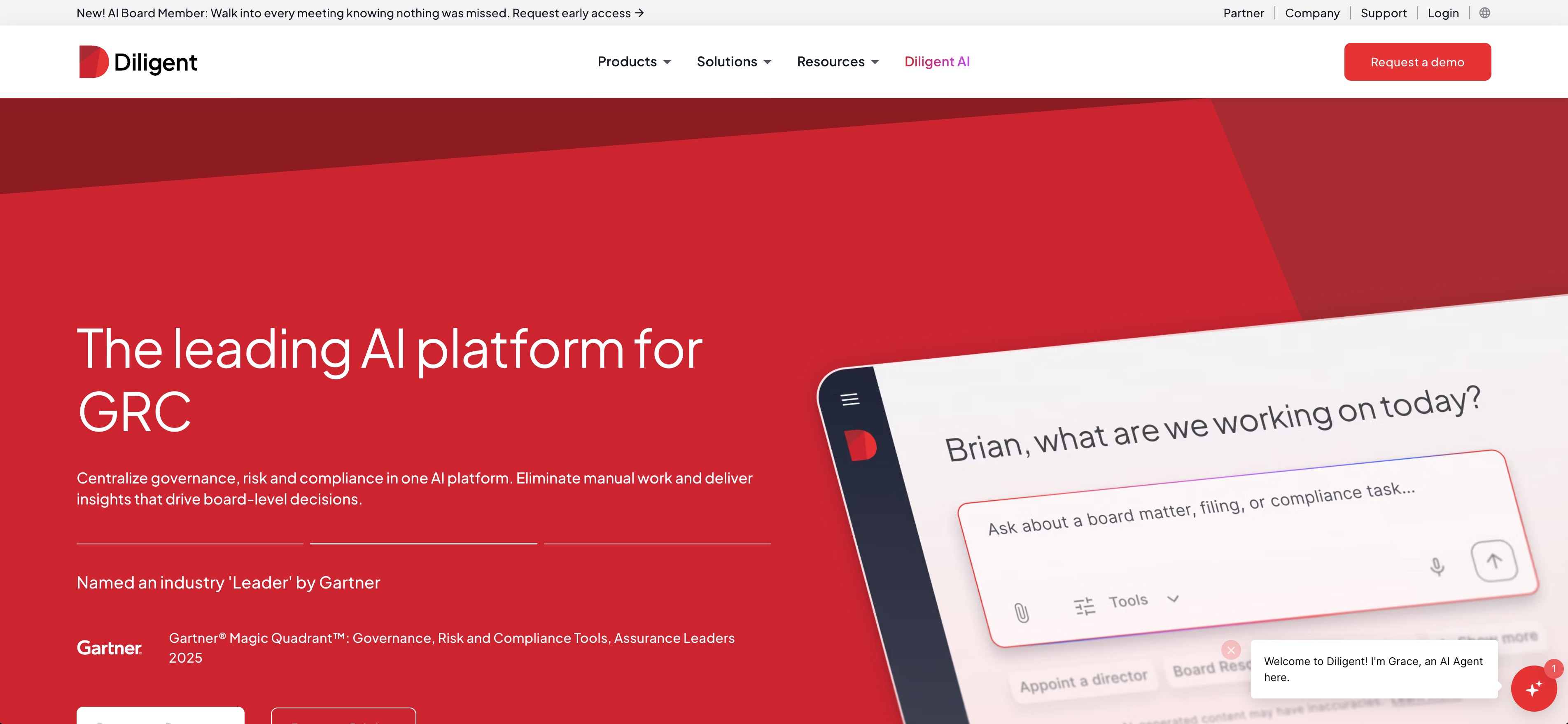
Diligent Boards provides enterprise board governance software for corporate decision documentation. The platform handles secure document sharing, voting, meeting management, and compliance tracking for boards of directors.
Best for: Publicly traded companies and large nonprofits with formal governance requirements.
Key strengths
- Enterprise security: SOC 2 compliance, data encryption, and granular access controls for sensitive board materials
- Meeting management: Agenda building, document distribution, and voting workflows in one platform
- Compliance documentation: Audit trails and retention policies that satisfy regulatory requirements
Why choose Diligent Boards
Pick Diligent when your board decisions carry legal and regulatory weight. The platform's security posture and compliance features justify the enterprise pricing for organizations where board documentation matters for audits and shareholder accountability. Teams evaluating board platforms may also want to review best board management software tools for a broader comparison.
Diligent Boards pricing
Custom pricing based on board size and feature requirements. Expect enterprise-level investment.
2. Nasdaq Boardvantage
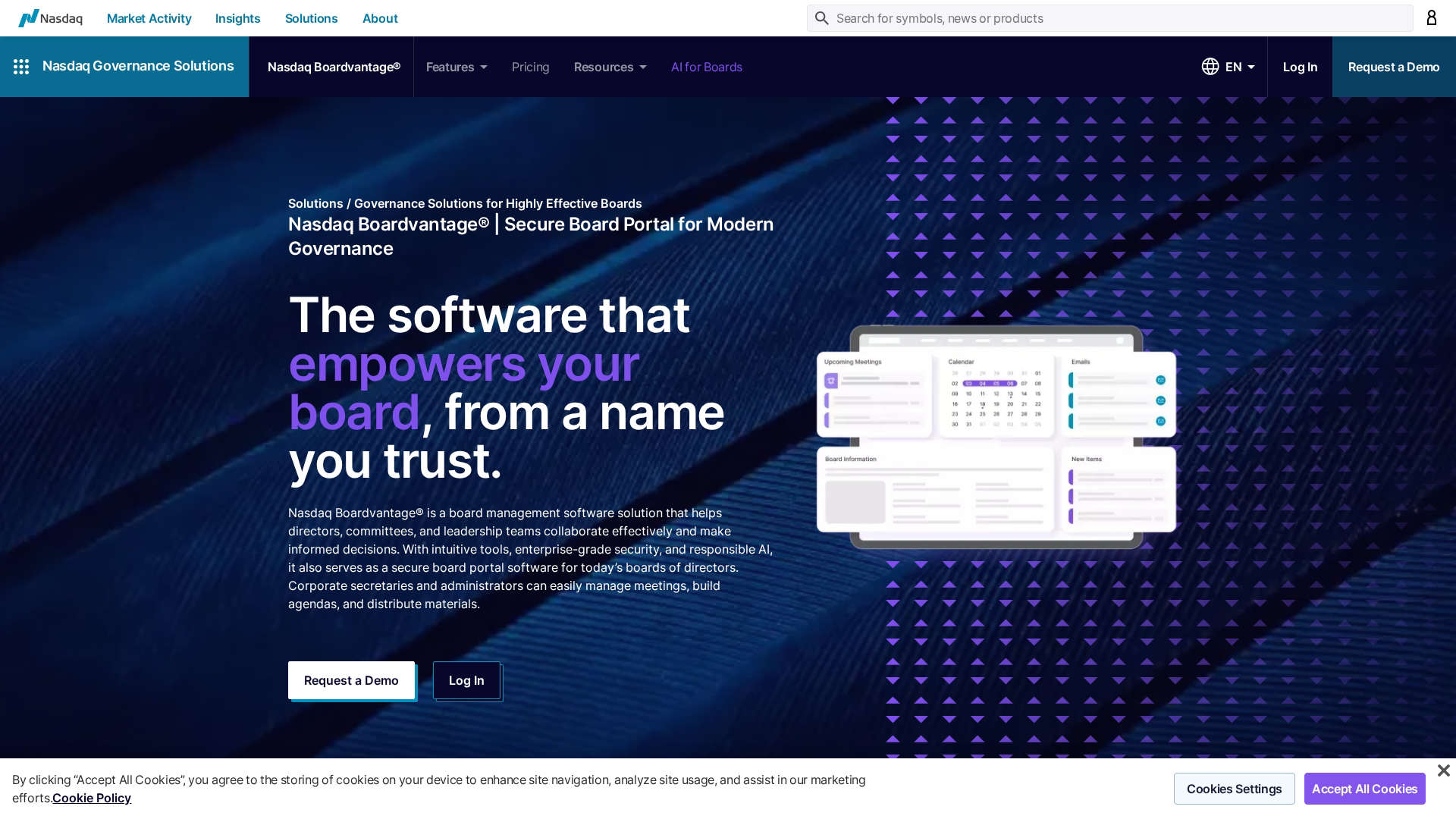
Nasdaq Boardvantage offers board portal and governance capabilities similar to Diligent. Organizations already in the Nasdaq ecosystem often find integration advantages here.
Best for: Mid-market and enterprise boards needing compliance documentation with Nasdaq ecosystem integration.
Key strengths
- Secure collaboration: Encrypted document sharing and discussion threads for board members
- Mobile access: Board materials available on tablets and phones for directors on the move
- Voting and approvals: Formal resolution tracking with electronic signatures
Why choose Nasdaq Boardvantage
Consider Boardvantage if you're already using other Nasdaq solutions or if your board prefers the Nasdaq brand association. Feature parity with Diligent is close; the choice often comes down to existing relationships and pricing.
Nasdaq Boardvantage pricing
Custom pricing. Contact sales for quotes based on board size and requirements.
3. airfocus

airfocus (now part of Lucid) provides modular product management with customizable prioritization frameworks. Teams can build their own scoring models using weighted decision matrix approaches or choose from pre-built templates.
Best for: Product teams who want flexibility in decision making methodologies without building everything from scratch.
Key strengths
- Custom scoring frameworks: Build weighted prioritization models that match your specific criteria
- Modular architecture: Add only the features you need; avoid bloat from unused capabilities
- Integration ecosystem: Connects with Jira, Trello, Asana, and other tools where work actually happens
Why choose airfocus
Choose airfocus when your team has opinions about how prioritization works and wants to encode those opinions in software. The flexibility is the point: you're not locked into someone else's framework.
airfocus pricing
Plans start at $59 per editor per month. Viewer seats are free, which helps when stakeholders want visibility without editing access.
4. Runway Financial
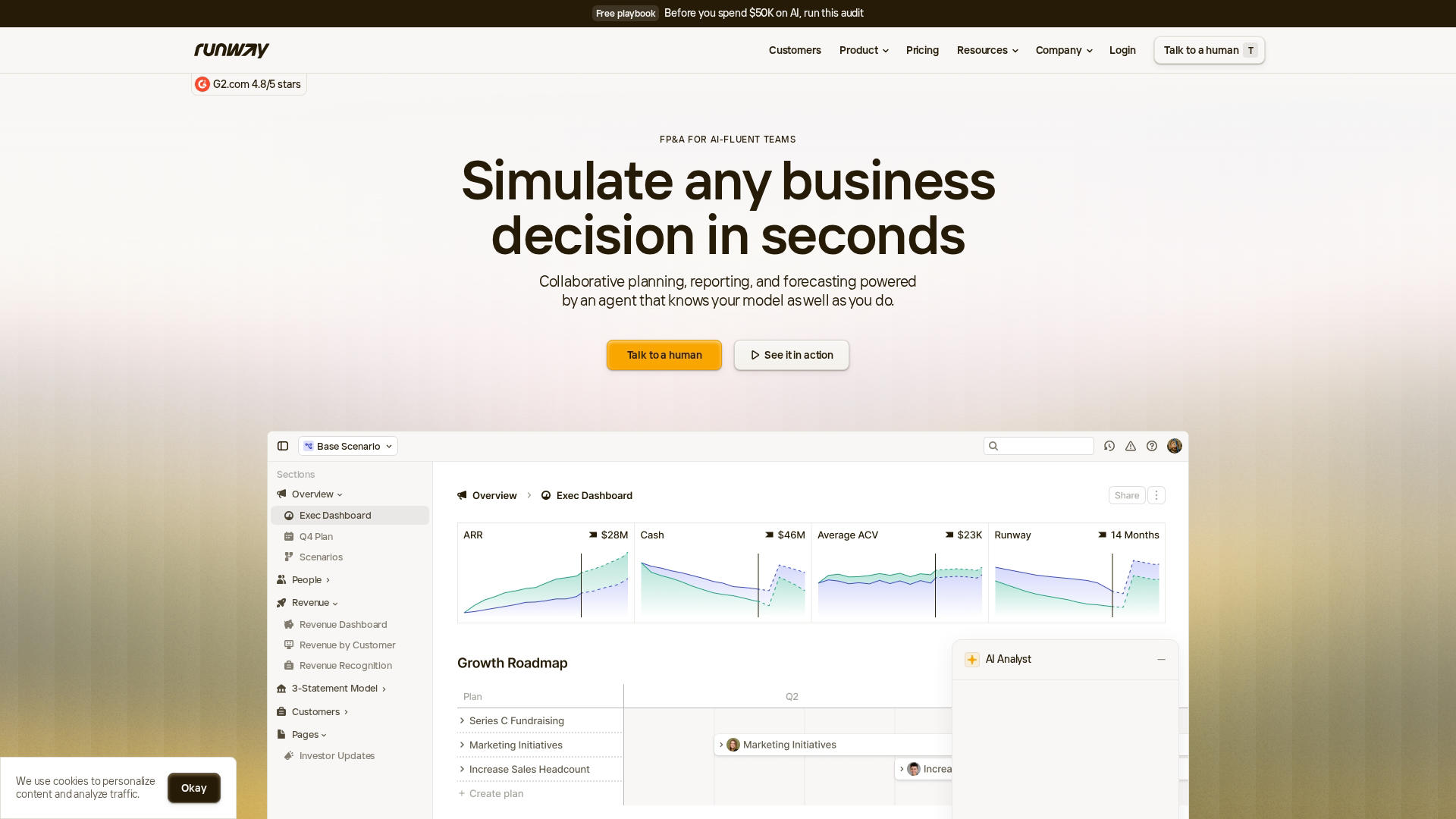
Runway Financial provides financial planning and scenario modeling for startups. The platform helps founders and finance teams make data-driven decisions about runway, hiring, and spending.
Best for: Startups and growth-stage companies making financial decisions with limited historical data.
Key strengths
- Scenario modeling: Compare multiple financial futures side by side.
- Real-time data: Connects to accounting systems for actuals that update automatically.
- Investor-ready outputs: Generate board decks and investor updates from the same data.
Why choose Runway Financial
Pick Runway when your decisions hinge on financial projections and you're tired of maintaining spreadsheets that break. The scenario comparison feature is particularly valuable for "what if" conversations with your board or leadership team. Organizations evaluating multiple software vendors often also explore presales software tools to streamline their demonstration and selection processes.
Runway Financial pricing
Custom pricing based on company size and feature requirements. Free trial available.
5. Productboard
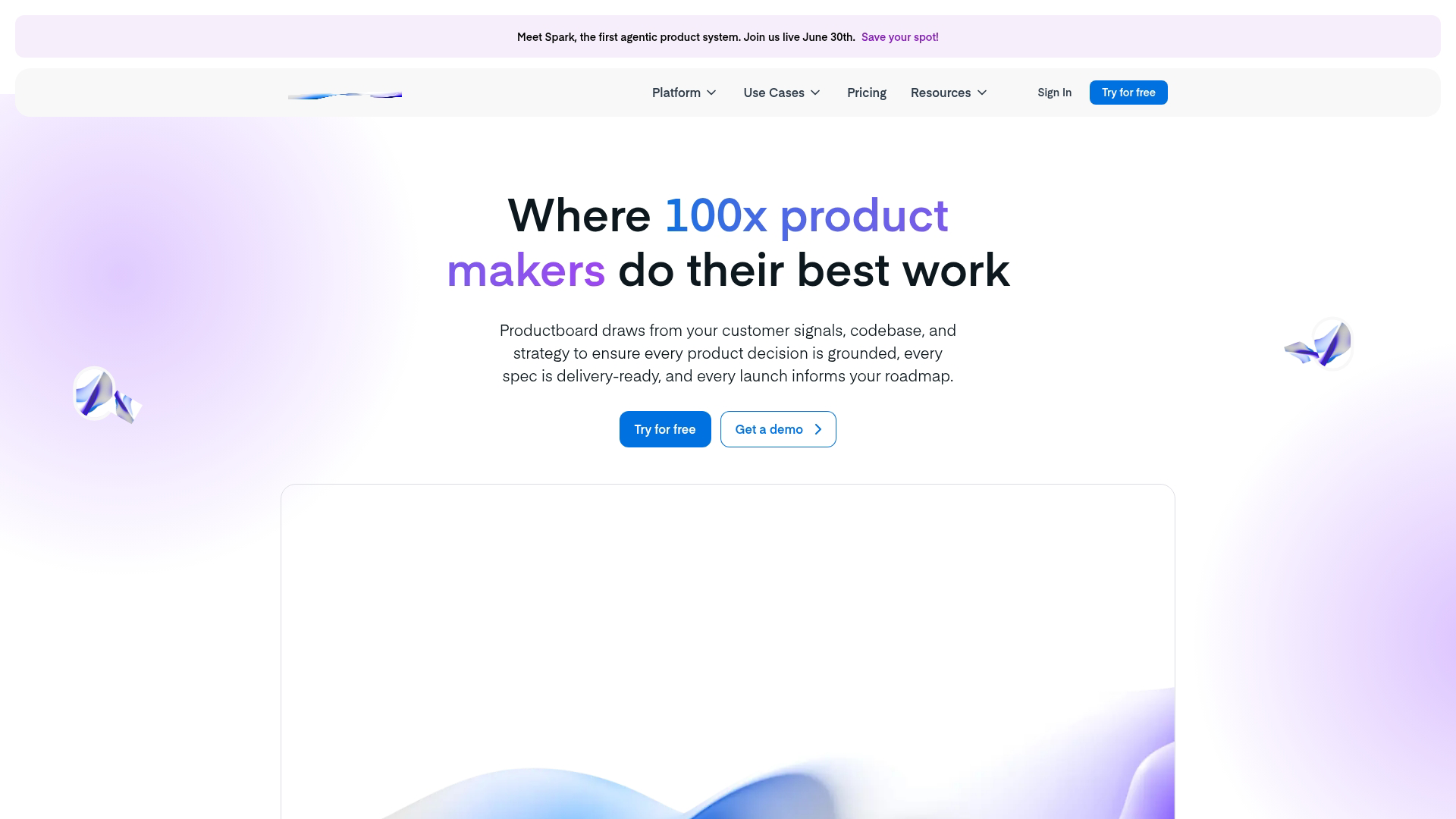
Productboard positions itself as customer-centric product management. The platform aggregates customer feedback and maps it to features for prioritization decisions.
Best for: Product teams who want to tie decisions directly to customer input rather than internal opinions.
Key strengths
- Feedback aggregation: Collect and organize customer input from support tickets, sales calls, and research
- Feature scoring: Prioritize based on customer demand, strategic fit, and effort
- Roadmap communication: Share prioritization rationale with stakeholders in visual formats
Why choose Productboard
Choose Productboard when "what do customers actually want?" is the question driving your roadmap decisions. The feedback-to-feature connection is the core value proposition.
Productboard pricing
Plans start at $20 per maker per month for Essentials. Pro and Enterprise tiers add advanced features.
6. UserVoice

UserVoice focuses on feedback collection and validation for product decisions. The platform helps teams validate ideas before committing resources.
Best for: Teams who want to reduce decision risk by testing demand before building.
Key strengths
- Idea validation: Let customers vote on potential features before you build them
- Feedback portals: Public or private spaces where users submit and discuss ideas
- Segmentation: Understand which customer segments want which features
Why choose UserVoice
Pick UserVoice when you're making build-or-not-build decisions and want customer input to inform the choice. The validation approach reduces the risk of building features nobody wants.
UserVoice pricing
Plans start at $899 per month for Essentials. Premium and Enterprise tiers available.
7. FlowForma Process Automation
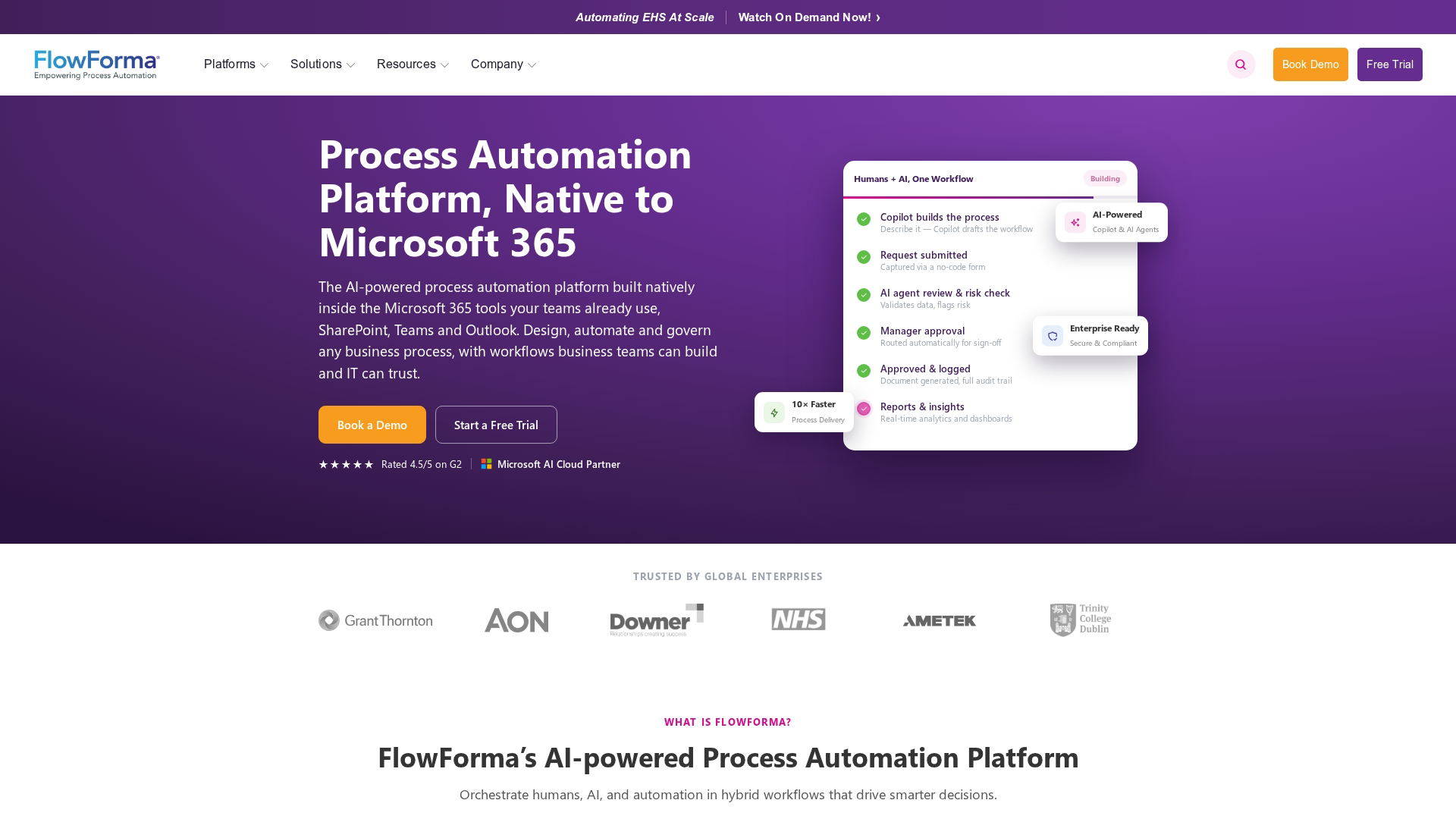
FlowForma provides no-code workflow automation for decision processes. The platform handles approval routing, conditional logic, and process standardization.
Best for: Operations teams who want to automate recurring decisions without developer involvement.
Key strengths
- No-code builder: Create approval workflows without writing code or involving IT
- Conditional logic: Route decisions based on criteria (amount, department, risk level)
- Audit trails: Track who approved what and when for compliance purposes
Why choose FlowForma
Choose FlowForma when your decisions follow predictable patterns and you want to automate the routing. Expense approvals, vendor onboarding, and change requests are typical use cases.
FlowForma pricing
Plans start at $12 per user per month. Volume discounts available for larger deployments.
8. 1000minds

1000minds specializes in multi-criteria decision analysis (MCDA) using the PAPRIKA method for pairwise comparisons. PAPRIKA stands for Potentially All Pairwise RanKings of all possible Alternatives, a research-backed approach to weighting criteria through systematic comparison.
Best for: Teams making complex decisions with many weighted criteria who want academic rigor in their methodology.
Key strengths
- PAPRIKA method: Pairwise ranking applied to potentially all alternatives; a research-backed approach to weighting criteria
- Group decision support: Aggregate preferences from multiple stakeholders systematically
- Conjoint analysis: Understand trade-offs between attributes in complex decisions
Why choose 1000minds
Pick 1000minds when decision quality matters more than decision speed. The methodology is more rigorous than typical scoring approaches, which makes it valuable for high-stakes choices where you want defensible reasoning.
1000minds pricing
Custom pricing based on use case and team size. Academic and government pricing available.
9. Craft.io
Craft.io provides product strategy and roadmapping with built-in prioritization. The platform connects strategy to execution so decisions have context.
Best for: Product managers who want roadmap context around prioritization decisions.
Key strengths
- Strategy-to-execution: Link high-level objectives to specific features and initiatives
- Prioritization frameworks: Built-in scoring models including RICE, value vs. effort, and custom approaches
- Stakeholder alignment: Share roadmaps that show the reasoning behind priorities
Why choose Craft.io
Choose Craft.io when your prioritization decisions feel disconnected from strategy. The platform's strength is making the "why" visible alongside the "what."
Craft.io pricing
Plans start at $39 per editor per month. Free viewer seats available.
10. Fibery
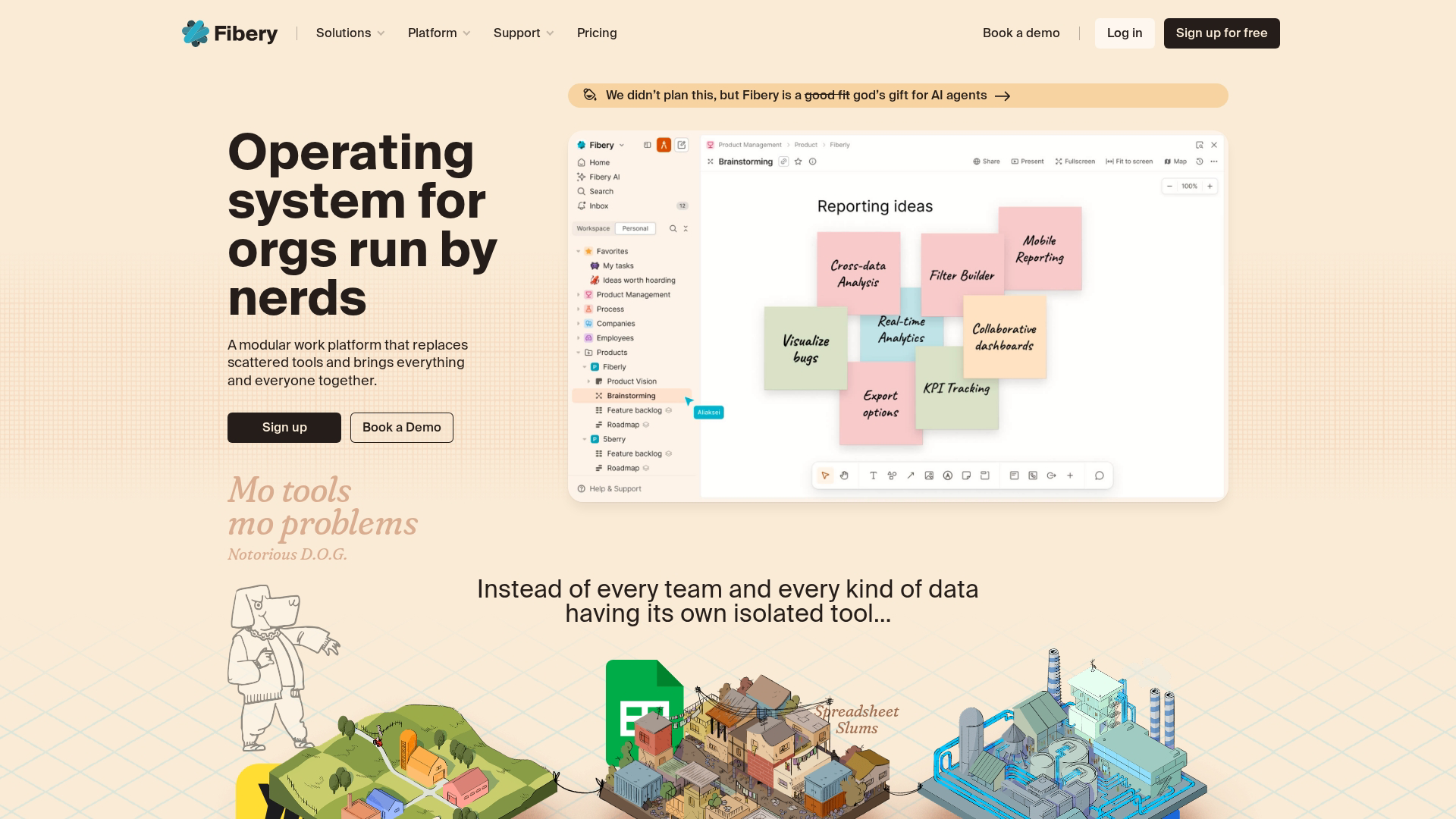
Fibery offers flexible work management with custom prioritization views. The platform lets you model any decision framework as a database.
Best for: Teams who want to build their own decision making system without code.
Key strengths
- Flexible data model: Create custom entities and relationships that match your decision process
- Formula-based scoring: Build prioritization calculations using spreadsheet-like formulas
- Connected workspaces: Link decisions to the work they affect
Why choose Fibery
Pick Fibery when off-the-shelf prioritization frameworks don't fit your process. The flexibility is both the strength and the challenge: you get exactly what you build.
Fibery pricing
Plans start at $10 per user per month. Free tier available for small teams.
11. Cloverpop
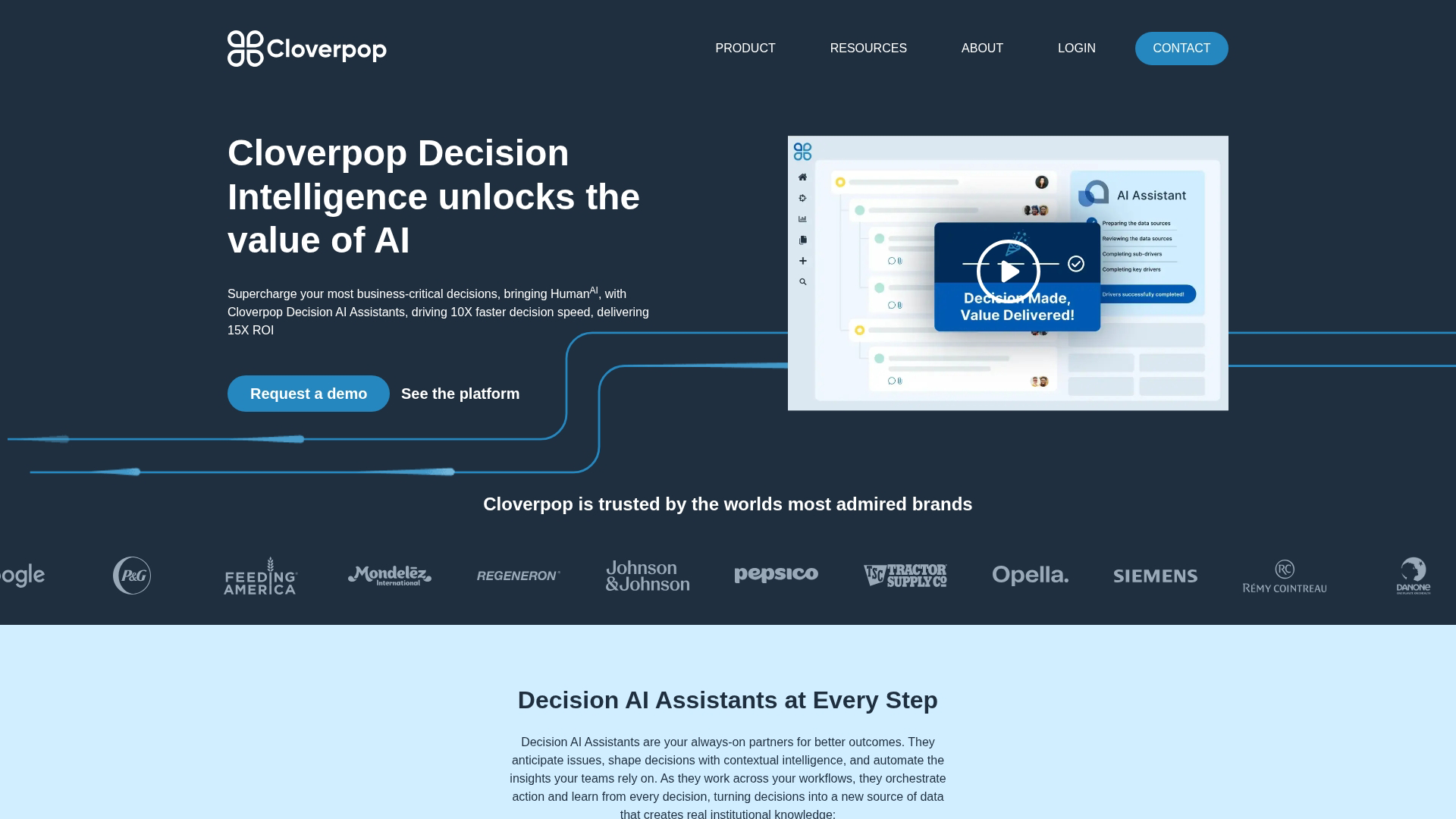
Cloverpop positions itself as a decision intelligence platform focused on decision tracking and outcomes. The platform helps teams log decisions, track results, and improve over time.
Best for: Organizations that want to measure decision quality, not just make decisions.
Key strengths
- Decision logging: Capture the context, alternatives, and reasoning for each decision
- Outcome tracking: Connect decisions to results so you can learn from experience
- Pattern analysis: Identify which decision types and processes produce better outcomes
Why choose Cloverpop
Choose Cloverpop when you want to improve your decision-making capability over time. Most tools help you make individual decisions; Cloverpop helps you get better at deciding. Teams building out their analytics stack may also benefit from business intelligence software to support data-driven choices.
Cloverpop pricing
Custom pricing based on team size and feature requirements.
12. Loomio
Loomio provides collaborative decision making for distributed teams. The platform supports proposal, discussion, and voting features.
Best for: Remote teams, cooperatives, and organizations that practice participatory governance.
Key strengths
- Proposal workflows: Structure discussions around specific proposals with clear outcomes
- Multiple voting types: Consent, consensus, ranked choice, and simple majority options
- Async-first design: Built for teams who can't be in the same room at the same time
Why choose Loomio
Pick Loomio when decisions involve many voices and you want structured participation rather than whoever-shows-up-to-the-meeting dynamics. The tool is particularly popular with cooperatives and mission-driven organizations.
Loomio pricing
Free tier available for small groups. Paid plans start at $25 per month for larger teams.
13. ThinkTank
ThinkTank (now part of Accenture) provides facilitated brainstorming and group decision making software. The platform supports anonymous input collection and real-time prioritization for workshops.
Best for: Consultants and facilitators running structured decision sessions.
Key strengths
- Anonymous input: Collect ideas without attribution to reduce groupthink
- Real-time prioritization: Vote and rank during live sessions
- Facilitation tools: Designed for professional facilitators running workshops
Why choose ThinkTank
Choose ThinkTank when you're facilitating group decisions professionally. The anonymous input feature is particularly valuable for sensitive topics where hierarchy might suppress honest opinions.
ThinkTank pricing
Custom pricing. Contact Accenture for current offerings.
14. Smaply
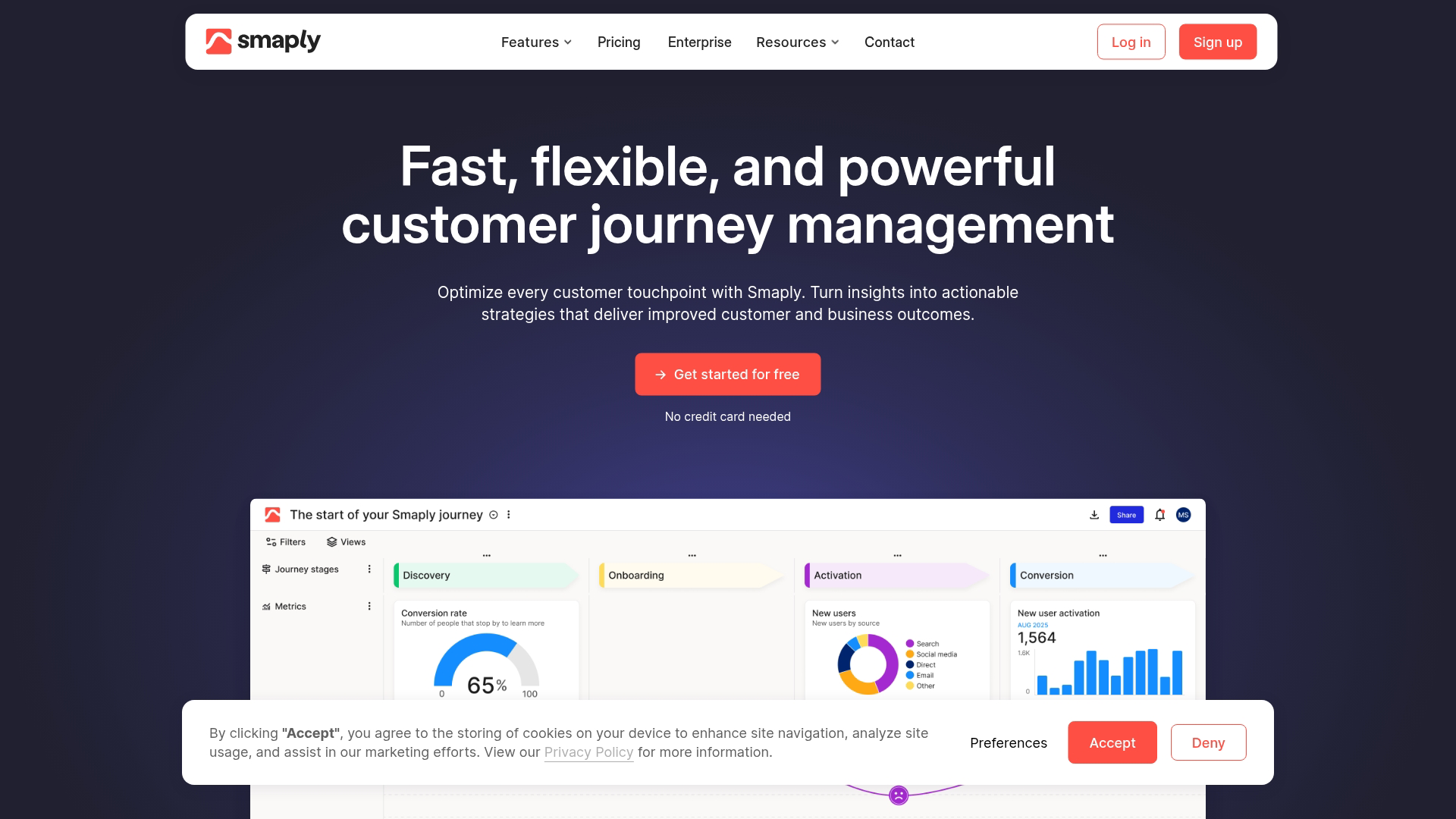
Smaply focuses on journey mapping and stakeholder visualization. The platform helps teams make experience-related decisions by mapping customer and employee journeys.
Best for: CX and UX teams making decisions about experience improvements.
Key strengths
- Journey mapping: Visualize customer or employee experiences across touchpoints
- Stakeholder maps: Understand who influences and is affected by decisions
- Persona management: Keep customer archetypes consistent across decision contexts
Why choose Smaply
Pick Smaply when your decisions affect customer or employee experience and you want visual context for those choices. The journey map becomes a decision-making artifact.
Smaply pricing
Plans start at €19 per user per month. Free trial available.
15. Lucidchart
Lucidchart provides visual diagramming including decision trees and flowcharts. While not a dedicated decision tool, it's widely used for mapping decision processes.
Best for: Teams who want to visualize decision logic and processes.
Key strengths
- Decision tree templates: Pre-built starting points for mapping decision logic
- Collaborative editing: Multiple team members can work on diagrams simultaneously
- Integration breadth: Connects with Google Workspace, Microsoft 365, Atlassian, and more
Why choose Lucidchart
Choose Lucidchart when you want to visualize how decisions flow rather than automate the decision itself. The tool is particularly useful for documenting decision processes that others will follow.
Lucidchart pricing
Free tier available. Paid plans start at $9 per user per month.
How to choose the right decision making tool
The right tool depends on your decision types, team size, and existing stack. Use the criteria below to narrow your options.
Decision complexity and methodology support
Simple yes/no decisions don't warrant software. Look for tools that match your decision complexity:
- Low complexity: Basic voting and polling (Loomio free tier, simple survey tools)
- Medium complexity: Weighted scoring and prioritization frameworks (airfocus, Productboard)
- High complexity: Multi-criteria analysis with pairwise comparisons (1000minds)
Match tool capability to decision type. Overkill creates friction; underkill produces poor outcomes.
Collaboration and async capabilities
Consider how your team works:
- Synchronous teams: Real-time collaboration features matter (ThinkTank, Lucidchart)
- Async teams: Notification systems, comment threads, and voting windows matter (Loomio, Cloverpop)
- Hybrid teams: Look for tools that support both modes
Distributed teams particularly benefit from async decision making programs that capture input without requiring everyone online simultaneously.
Integration with your existing stack
Decision data becomes more valuable when it flows into systems of record. Check for:
- CRM integration: Decisions about accounts and opportunities sync to Salesforce or HubSpot
- Project management: Prioritization decisions connect to Jira, Asana, or Monday
- Communication: Notifications flow to Slack or Teams where your team already works
Isolated decision tools create data silos. Integrate with HubSpot, Salesforce, and more to keep decision context connected to execution.
Security and compliance requirements
Different decision types carry different security requirements:
- Board governance: SOC 2, data encryption, audit logging (Diligent, Boardvantage)
- Product decisions: Standard SaaS security is typically sufficient
- Financial decisions: May require specific compliance certifications
Enterprise tools often require professional services for implementation. Factor that into total cost of ownership.
Pricing model and total cost of ownership
Pricing models vary significantly:
- Per-seat: Costs scale with team size (airfocus, Fibery)
- Flat rate: Predictable costs regardless of users (UserVoice)
- Custom: Enterprise pricing based on requirements (Diligent, 1000minds)
Consider implementation costs, training time, and ongoing administration. A cheaper tool that requires more manual work may cost more in practice.
How to get your team started with decision making software
Adopting new tools fails when teams try to change everything at once. Start small and expand based on results.
Step 1: Identify one recurring decision that causes friction. Vendor selection, feature prioritization, and budget allocation are common starting points. Pick something that happens regularly so you get multiple chances to refine the process.
Step 2: Run a pilot with one team before rolling out company-wide. Let a single team use the tool for 30 to 60 days. Gather feedback on what works and what doesn't before expanding.
Step 3: Document the decision framework before choosing the tool. Know your criteria first. What factors matter? How are they weighted?
Who has input versus decision authority? The tool operationalizes the framework; it doesn't create it for you.
Tip: Once you've selected your decision making tool, create an interactive demo to train your team on the new process. Self-serve training scales better than scheduling live sessions for every new hire.
Start your journey with Guideflow today
FAQs about decision making tools
What are the most common decision making methods used in business?
Core frameworks include decision matrix (weighted scoring), SWOT analysis, cost-benefit analysis (quantified trade-offs), Eisenhower matrix (urgency vs. importance), and multi-criteria decision analysis (MCDA). Decision making software helps teams apply these frameworks consistently rather than relying on memory or intuition.
Decision tools vs. frameworks
A framework is a mental model or methodology you apply manually, like SWOT analysis or a pros-and-cons list. A tool is software that helps you apply that methodology consistently and collaboratively. Tools enforce structure; frameworks provide the logic.
Can online decision making tools support remote and async teams?
Yes. Most modern decision making tools online include async input collection, voting windows, comment threads, and notification systems. Loomio and Cloverpop are particularly strong for async collaboration where team members contribute on their own schedules.
How do organizations measure the ROI of decision making software?
Common metrics include decision velocity (time from question to commitment), decision quality (outcomes vs. predictions), and stakeholder alignment (reduced re-litigation of past decisions). Some organizations also track the cost of decision delays because 68% of middle managers say most decision time is inefficient.
What integrations do decision making tools typically offer?
Most tools connect with CRM systems (Salesforce, HubSpot), project management platforms (Jira, Asana), communication tools (Slack, Teams), and analytics platforms. Integration requirements depend on where decision outputs flow.
Marketing teams making strategic decisions often combine these tools with demand generation tools to execute on their prioritized initiatives. Product prioritization tools typically integrate with development workflows; financial tools integrate with accounting systems.
Are there free decision making tools available for small teams?
Yes. Loomio offers a free tier for small groups. Fibery has a free plan for limited users.
Lucidchart provides free diagramming with usage limits. For basic requirements, spreadsheet-based decision matrices remain free but lack collaboration features and audit trails.
How do AI features improve decision making software?
Emerging AI capabilities include pattern recognition, scenario modeling (projecting outcomes based on historical data), and bias detection (flagging potential blind spots in reasoning). AI features are not yet standard across all tools but are appearing in newer platforms and updates to established products.