You finished the board deck at 11:47pm. The independent director emailed at 6am asking where the updated CAC slide lived. The corporate secretary is still chasing two action items from last quarter. Your lead investor noticed.
This is the founder bottleneck nobody talks about. As the company scales past Series A, the board cadence gets formal: quarterly meetings, committees, written consents, audit prep. The Google Drive folder that worked at seed becomes a liability. Materials get version-confused. Action items die in Slack threads. And the more independent directors you add, the worse it gets, because they live in inboxes, not your tooling.
Recent market research puts the global board management software market around $2.3 to $2.6 billion in 2024, growing at roughly 8 to 9 percent annually through the early 2030s (Market Research Future, 2025). The category is no longer reserved for Fortune 500 boards. Growth-stage SaaS companies are buying earlier, because investors increasingly expect SOC 2 Type II controls and clean governance records before the next round closes.
The goal of this guide is simple: help you pick a system your COO or Chief of Staff can run without you. We focused on tools that fit growing companies (not just enterprise), tools that directors actually adopt, and tools that survive due diligence. We left out the 30-vendor mega-lists. Ten is enough.
What's inside
This guide covers 10 board management platforms across growing SaaS companies, established corporate boards, nonprofits, and pre-IPO companies. We selected based on four criteria:
- Adoption ease for non-technical directors. Your independent directors will not learn a tool. Whoever has the lowest friction wins. Vendors who invest in interactive demos of their product before sales calls tend to also invest in director-facing UX.
- Meeting lifecycle coverage. Agenda, board pack, minutes, voting, action tracking, archive, in one place.
- Security and compliance posture. SOC 2 Type II at minimum. ISO 27001, AES-256 encryption, audit logs, granular permissions for anything past Series B.
- Real user signal. G2 ratings, review volume, and verified buyer feedback over vendor marketing.
We verified pricing on every vendor's pricing page in June 2026. Where pricing is gated, we say so explicitly.
TL;DR
- Best overall for growing SaaS companies: OnBoard, for AI-assisted prep and the highest director adoption signal.
- Best for enterprise and pre-IPO governance: Diligent Boards, for the deepest entity and committee infrastructure.
- Best for SMEs on a budget: BoardPro, with public pricing starting at $165 per board per month.
- Best for nonprofits: Boardable, purpose-built for nonprofit boards at $20.99 per user per month.
- Best for public companies: Nasdaq Boardvantage, for issuer-grade workflows.
- Best for international and on-premise needs: Azeus Convene, with deployment flexibility most peers do not offer.
- Best budget pick for HOAs and small nonprofits: BoardSpace, at $69 per month with public pricing.
Background: what is board management software?
Board management software is a secure digital platform that centralizes board meeting preparation, document distribution, minutes, voting, and governance records for directors, executives, and corporate secretaries. It replaces the patchwork of shared drives, email threads, PDF attachments, and last-minute Notion pages that most growing companies use until they cannot.
The category is also called board portal software, board meeting software, or board management solutions. Vendors sometimes split hairs between "portal" (document access) and "management" (full meeting lifecycle), but in 2026 the terms are interchangeable. Every serious board of directors software vendor covers the full cycle.
Core capabilities of a modern board portal include:
- Agenda builder. Drag-and-drop agendas with attached materials per item.
- Board pack assembly. Auto-generated PDF or interactive pack with version control.
- Minutes and action tracking. Drafted in-platform, signed, and linked to future agendas.
- Voting and e-signatures. Written consents and resolutions without DocuSign side trips. If you're still standardizing e-signature workflows, our roundup of the best e-signature software is a useful starting point.
- Secure document repository. AES-256 encryption at rest, granular role-based permissions.
- Mobile access. Native iOS and Android apps for directors who travel.
- Engagement analytics. Who read the pack, who did not, where attention dropped.
- Audit logs. Every view, edit, and download recorded for due diligence and compliance.
How it differs from generic tools like Google Drive or Notion comes down to three things: governance hygiene (permissions and audit trails built for fiduciary records), workflow specificity (the system understands what an agenda, minute, and resolution actually are), and director experience (directors will not learn your Notion workspace, but they will tap a board app icon).
Founders are buying earlier in the company lifecycle now. Three reasons drive this shift: investor due diligence increasingly asks for SOC 2 Type II and clean board records, acquirers want a traceable decision history, and boards with multiple independent directors generate too much administrative load for ad-hoc tooling to survive.
When to use board management software
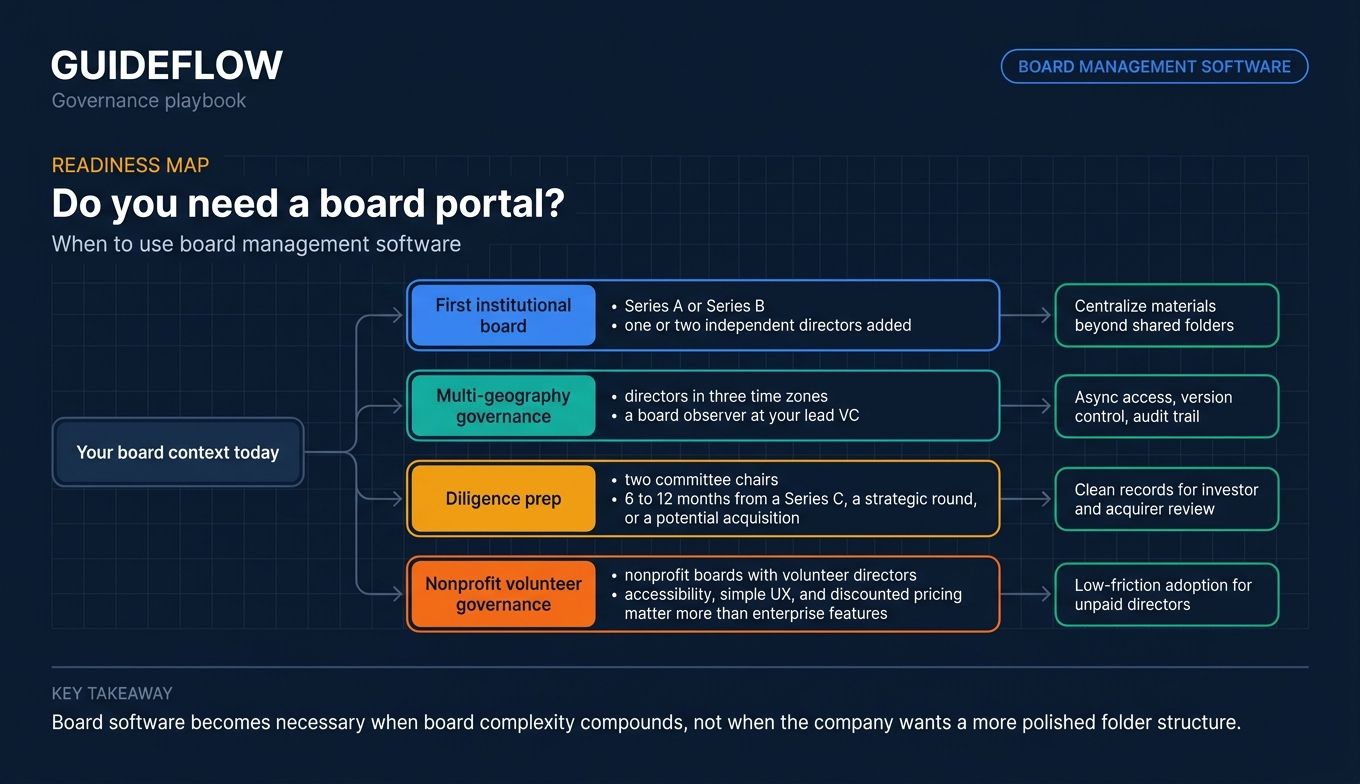
Not every company needs a board portal. Here's how to think about timing.
Prepare for your first institutional board
You closed Series A or Series B. You added one or two independent directors. The quarterly cadence is now formal: pre-reads, board packs, committee meetings, written consents between sessions. Your investor's chief of staff is asking when materials will land. This is the moment to standardize. Board meeting management software turns the first institutional board cycle into a repeatable process instead of a fire drill.
Run a multi-stakeholder board across geographies
You have directors in three time zones, a board observer at your lead VC, two committee chairs, and a corporate secretary who is also your VP Finance. Email threads break down fast. A central portal with role-based permissions, mobile access, and asynchronous voting becomes the only way to keep momentum between meetings.
Tighten governance before due diligence
You are 6 to 12 months from a Series C, a strategic round, or a potential acquisition. Diligence teams will ask for historical board minutes, resolutions, and decision records. If those live in Slack DMs and Google Docs with shifting permissions, you have a problem. A board portal gives you a clean, exportable archive and an audit log that survives scrutiny. For broader contract hygiene at this stage, see our guide to the best contract management software tools.
Support a nonprofit board with volunteer directors
For nonprofits, the calculus is different. Volunteer directors have day jobs. Accessibility, simple UX, and discounted pricing matter more than enterprise features. Nonprofit board management software like Boardable and BoardPro is purpose-built for this segment.
Comparison table
We sorted by relevance to a growing SaaS company first, then enterprise, then niche. Pricing reflects what each vendor publishes on its own pricing page as of June 2026. Where pricing is quote-based, we say so. G2 ratings are pulled from each tool's current listing.
| # | Product | Intent | Key differentiation | Pricing | G2 rating |
|---|---|---|---|---|---|
| 1 | OnBoard | Growing SaaS, AI-forward boards | AI meeting assistant, strong director adoption | Quote-based (Essentials, Premium, Ultimate tiers) | 4.7/5 |
| 2 | Diligent Boards | Enterprise and pre-IPO | Deepest entity and governance infrastructure | Quote-based, tiered | 4.5/5 |
| 3 | BoardPro | SMEs and small boards | Public pricing, SME-first design | From $165/board/month | 4.8/5 (Capterra) |
| 4 | Boardable | Nonprofits | Per-user pricing, nonprofit-focused | From $20.99/user/month (annual) | 4.5/5 |
| 5 | Nasdaq Boardvantage | Public companies, pre-IPO | Issuer-grade workflows, Nasdaq ecosystem | Quote-based, "one price" model | 4.7/5 (Capterra) |
| 6 | Azeus Convene | International, regulated industries | Cloud, on-premise, hybrid deployment | Quote-based (Lite, Standard, Enterprise) | 4.7/5 |
| 7 | BoardEffect | Mid-market mission-driven | AI agendas, secure workspaces | Quote-based (Pro, Plus) | 4.4/5 (Capterra) |
| 8 | iBabs | European boards, GDPR-first | EU residency, public sector adoption | Quote-based | 4.6/5 |
| 9 | Govenda | Mid-market modern UX | Gabii AI, Microsoft 365 integration | Quote-based | 4.4/5 |
| 10 | BoardSpace | HOAs, small nonprofits | Public tiered pricing by org type | From $69/month | 4.5/5 (Capterra) |
1. OnBoard
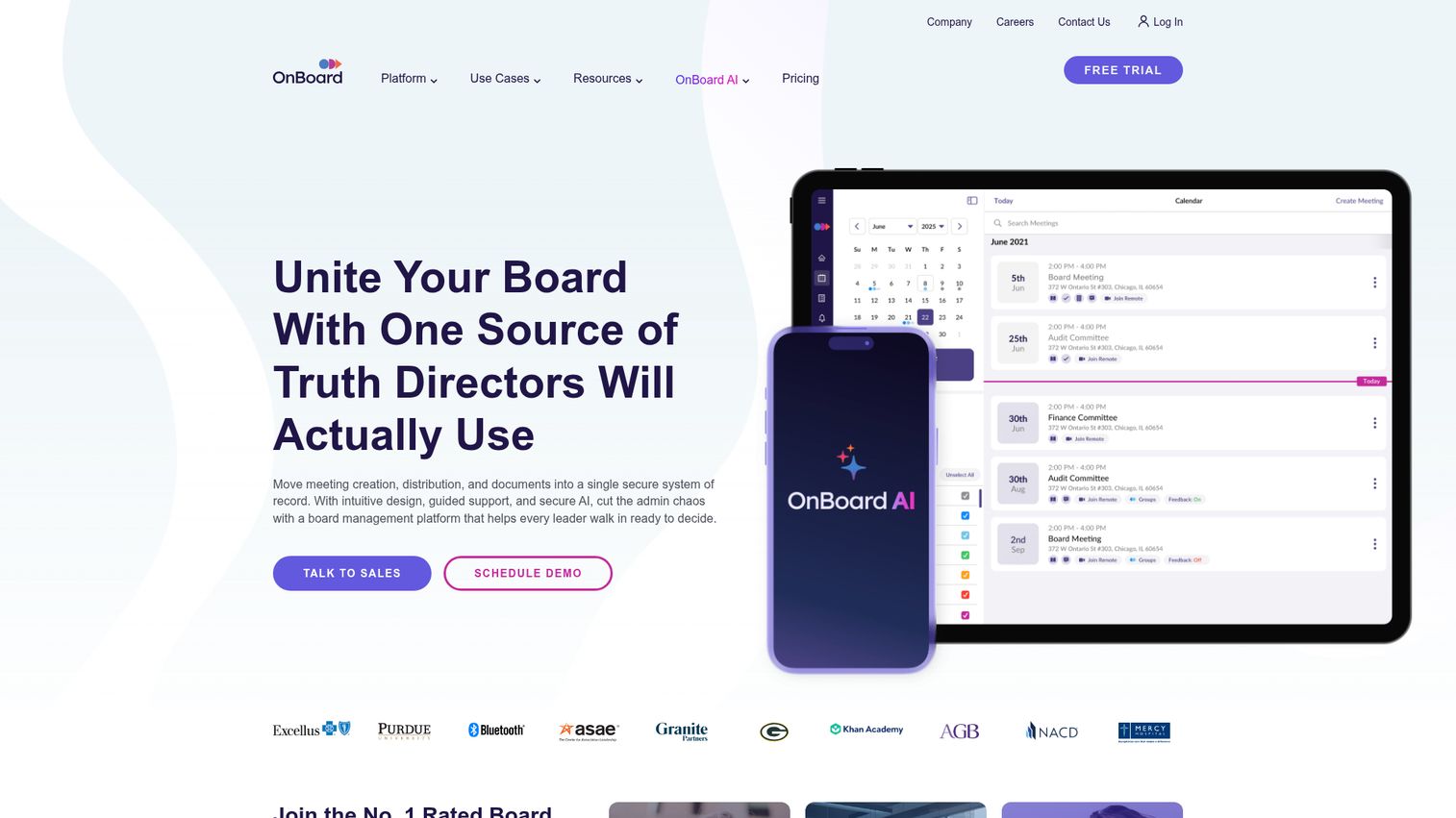
OnBoard is a board management platform designed to help boards and leadership teams work smarter, move faster, and achieve more for the organizations they govern. It is the closest the category comes to a "growing SaaS company default," because it pairs AI-assisted meeting prep with a director experience that does not require training sessions for your independent directors.
Best for: Growing SaaS companies that want AI-assisted board prep and high director adoption without long onboarding.
Key strengths
- Agenda and book builder: Drag-and-drop agenda creation with attached materials, AI assistance for prep, and auto-generated board books.
- Voting and approvals: Asynchronous voting and written decisions between meetings, with clear audit trails.
- Secure messenger: Encrypted director-to-director and director-to-admin messaging that stays inside the governance perimeter, instead of bleeding into personal email.
Why choose OnBoard: Director adoption is the variable that decides whether a board portal succeeds or quietly dies. OnBoard earned G2's "Highest User Adoption" recognition in its category and is the closest peer-recommended pick for founders adding their first independent directors. Vendors increasingly let buyers experience the product through interactive demos before booking a sales call, which is a useful sign of how seriously they take the director-facing UX.
Pricing: OnBoard publishes three plans on its pricing page: Essentials, Premium, and Ultimate. Pricing is quote-based and depends on plan tier and number of users. There is no public numeric pricing, and you will need to contact sales for an accurate quote. Free trials are available.
2. Diligent Boards
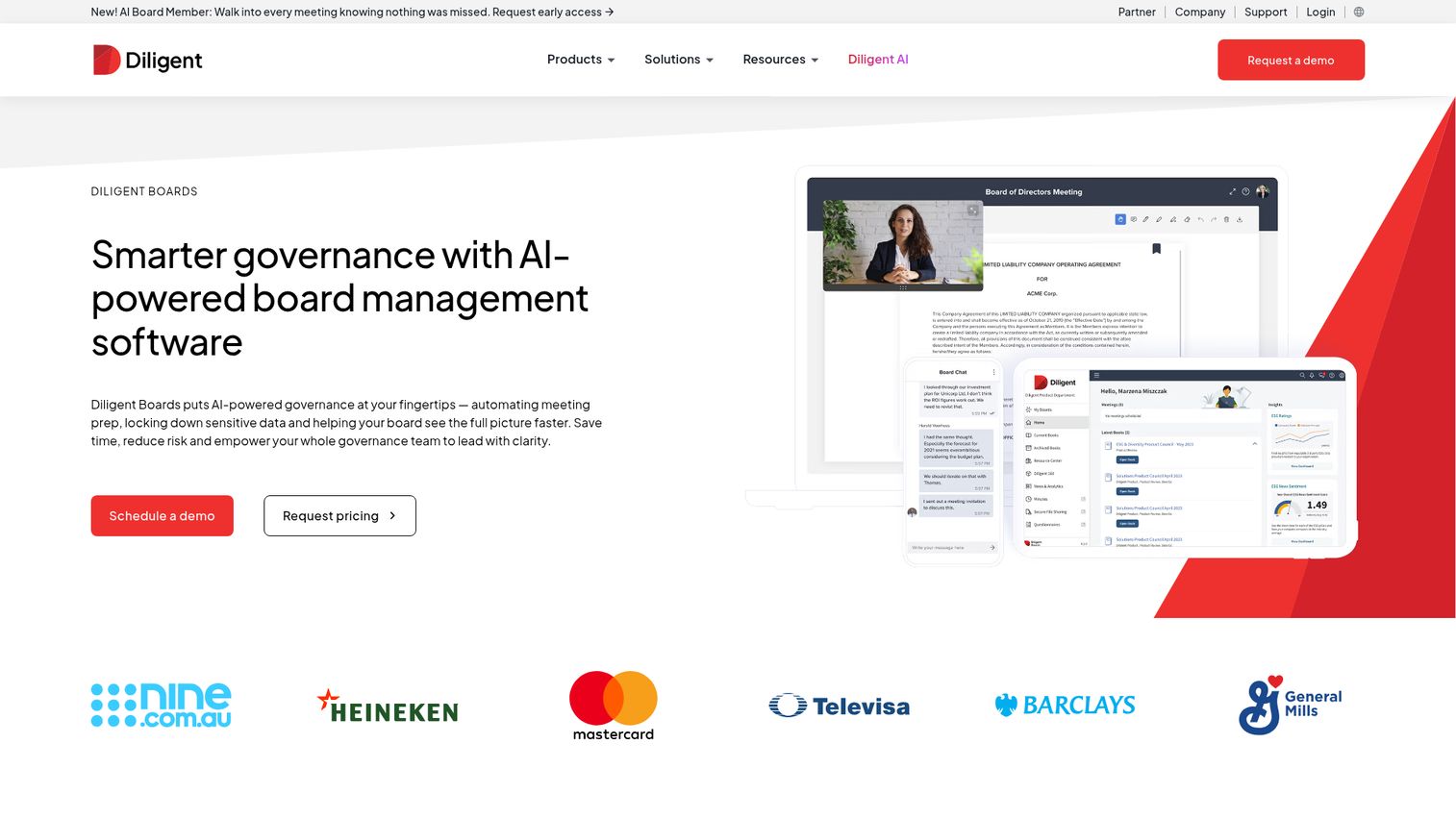
Diligent Boards is AI-powered board management software that automates meeting prep, secures sensitive data, and helps directors make decisions faster. It is the legacy market leader, with widespread adoption among large enterprises and public-company boards. If your governance complexity outpaces what mid-market tools handle, this is the category standard.
Best for: Later-stage SaaS companies preparing for IPO, plus established enterprises with multi-entity governance.
Key strengths
- Agenda and board book preparation with AI: AI-assisted drafting, automated pack assembly, and version control across complex board cycles.
- Secure board messaging: Encrypted director communication that keeps fiduciary conversations off personal email and consumer messaging apps.
- Live meeting streaming inside the platform: Built-in meeting streaming so directors do not pivot between board materials and a separate video tool.
Why choose Diligent Boards: When the board has subsidiaries, committees, and international directors, generic tools break. Diligent is the reference point for enterprise-grade governance. It is heavier than what a 50-person company needs, but it is the right call when complexity is real and audit scrutiny is high.
Pricing: Quote-based. Diligent's pricing page describes tiered pricing and requires a request form. No numeric pricing, plan names, or billing cadence is published publicly.
3. BoardPro
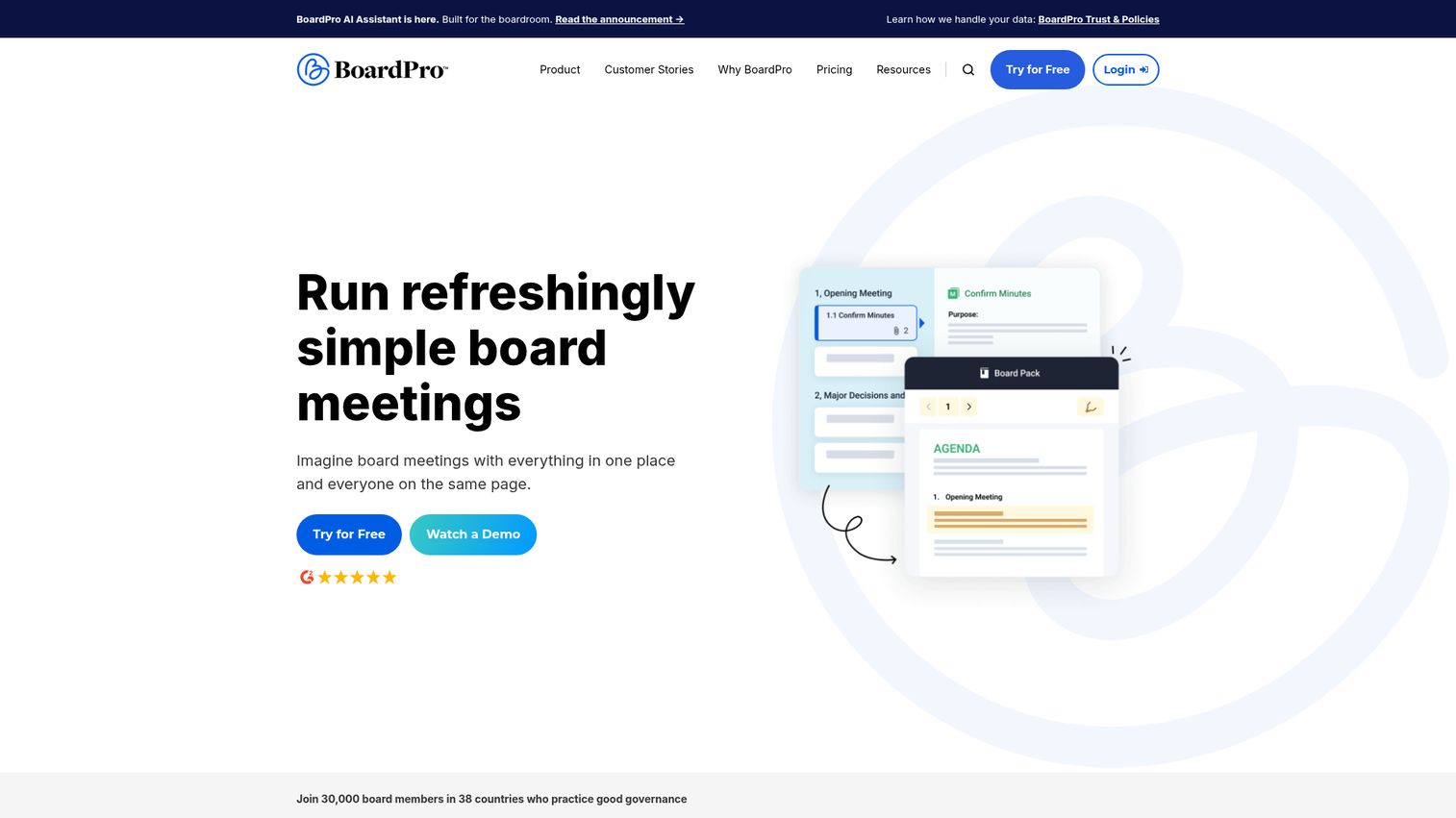
BoardPro is board management software designed to make governance easy for growing organisations, with a clear focus on SMEs and nonprofits. The differentiator versus enterprise tools: BoardPro publishes its prices, has a tight feature surface, and gets out of the way.
Best for: Smaller boards, nonprofits, and early-stage companies that want structure without enterprise pricing.
Key strengths
- Agenda builder: Templated agendas that the corporate secretary can clone and adapt in minutes, not hours.
- Board pack builder: One-click pack assembly with version control and distribution.
- Voting: Resolutions and votes captured in-platform, with clean records for the minute book.
Why choose BoardPro: This is a strong default for boards under about 12 people that do not need AI bells and whistles or enterprise compliance modules. The public pricing alone saves you two weeks of vendor calls.
Pricing: BoardPro publishes its tiers on its pricing page. Essentials is $165 per board per month or $1,650 per year. Premium is $275 per month or $2,750 per year. Ultimate is $440 per month or $4,400 per year. A 30-day free trial is available.
4. Boardable
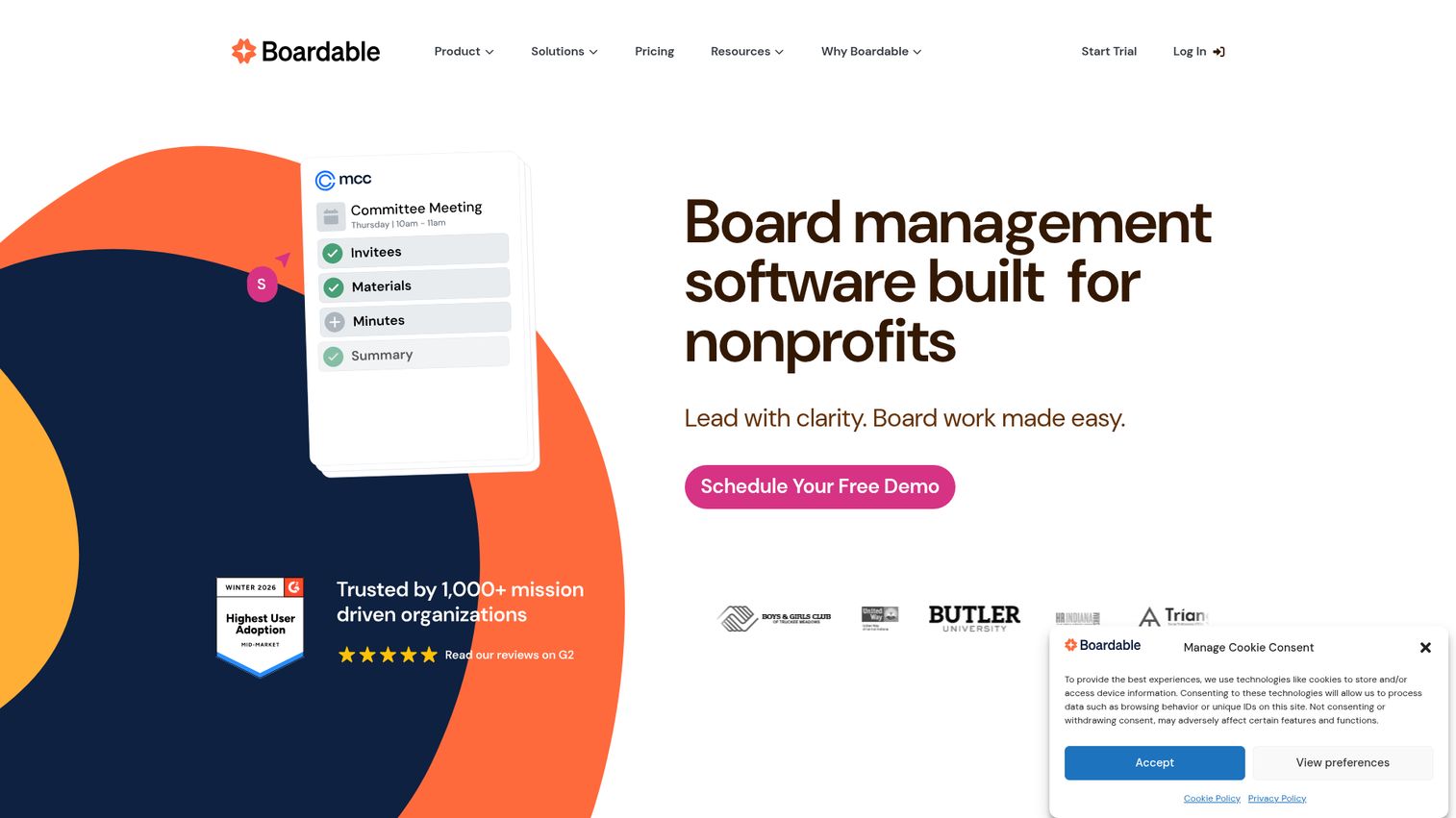
Boardable is nonprofit board management software that brings agendas, documents, discussions, video, voting, minutes, and follow-up into one secure platform. The nonprofit focus shapes everything from the pricing model to the UX. If your board has volunteer directors and a part-time executive director, this is the segment leader.
Best for: Nonprofits with volunteer boards and distributed members who need a centralized portal for meeting prep, document sharing, and governance workflows.
Key strengths
- Agenda builder: Templated agendas with attached pre-reads and time blocks for volunteer-led meetings.
- Board packet: Auto-generated packets with version control and mobile-friendly viewing.
- Document center: Centralized repository with role-based access for staff, directors, and committees.
Why choose Boardable: Nonprofit pricing models matter. Boardable charges per active user rather than per board, which scales cleanly as committees expand. The platform is purpose-built for the nonprofit workflow, not adapted from a corporate product.
Pricing: Public per-user pricing on the plans page. Essentials is $20.99 per user per month, Professional is $29.99, and Professional+ is $35.99, all billed annually. There is no free tier, but a 14-day free trial of Professional is available, and volume discounts apply for larger teams.
5. Nasdaq Boardvantage
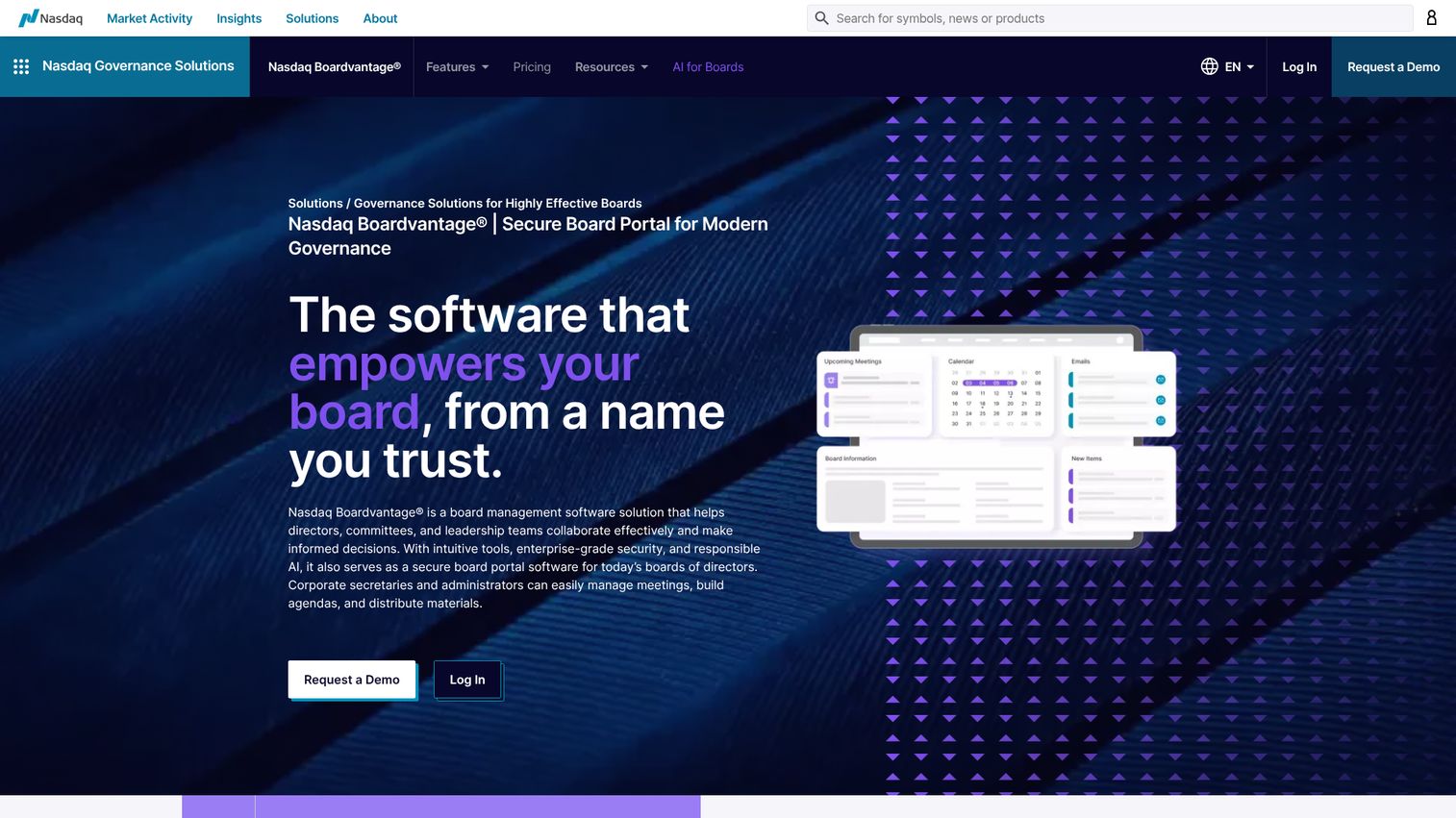
Nasdaq Boardvantage is board management software designed for boards, committees, and executive leadership teams, with robust security features and a user-friendly experience. It sits inside Nasdaq's broader governance and issuer-services ecosystem, which matters if you are pre-IPO or already public.
Best for: Public companies, pre-IPO SaaS boards, and companies already engaged with Nasdaq Private Markets.
Key strengths
- Virtual meetings: Integrated meeting workflows for hybrid and remote board sessions.
- Meetings workflow: End-to-end agenda, pack, minutes, and approval cycles built for issuer-grade governance.
- Information security: Security posture aligned with public-company expectations.
Why choose Nasdaq Boardvantage: Companies inside Nasdaq's issuer ecosystem often standardize on Boardvantage for alignment. If you are within 18 months of going public, the workflows will feel familiar to the lawyers and bankers around the table.
Pricing: Quote-based. Nasdaq's pricing page describes pricing as transparent and all-inclusive ("one price, no upcharges"), but no numeric price is published. Contact sales for a quote.
6. Azeus Convene
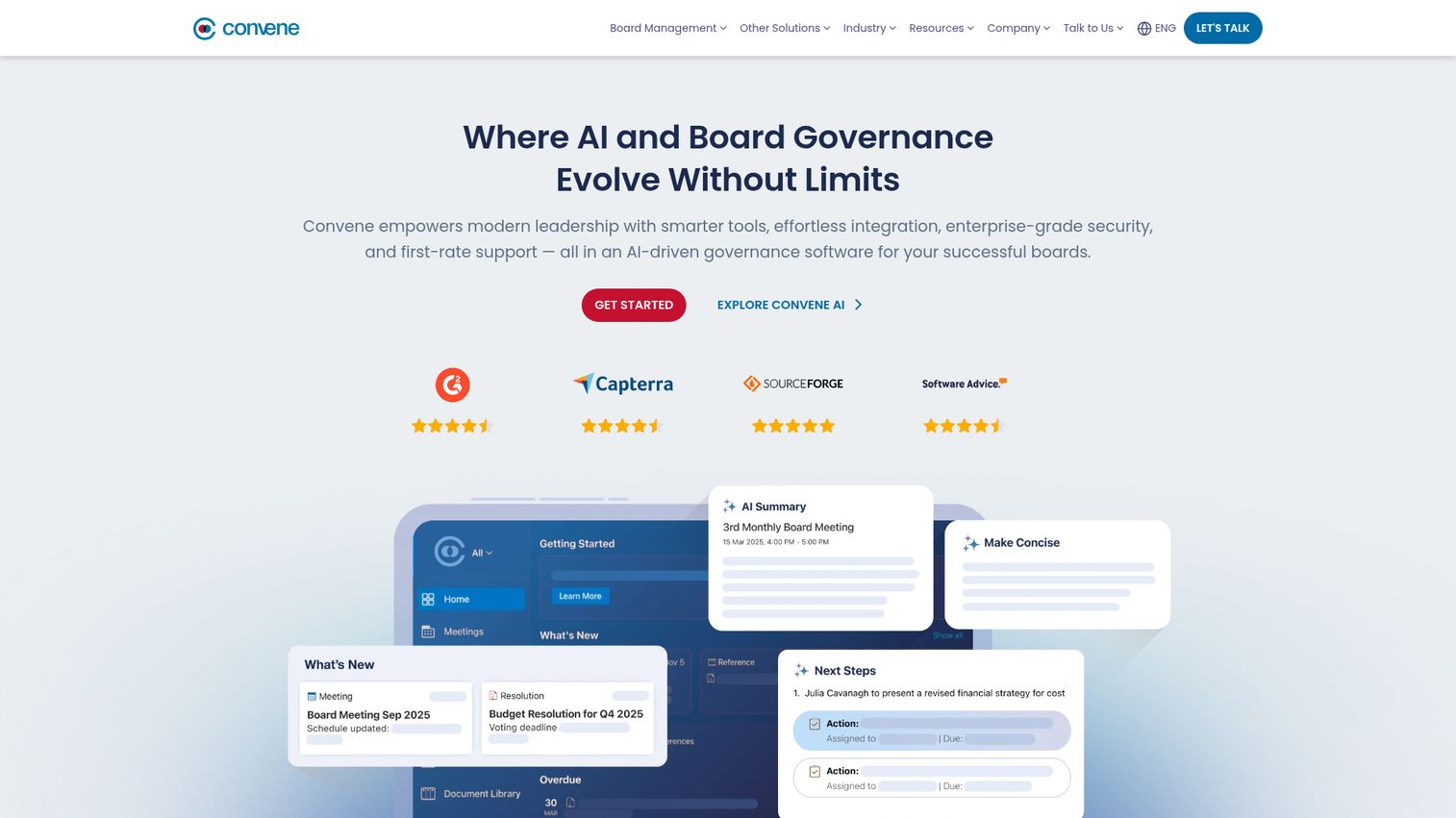
Azeus Convene is an award-winning board portal for secure board and leadership meetings across physical, remote, and hybrid settings. It has the broadest international footprint of the tools on this list, plus a deployment flexibility that few peers offer.
Best for: Boards with international directors, regulated industries, and organizations with data residency or on-premise hosting requirements.
Key strengths
- Agenda builder with drag-and-drop meeting pack creation: Fast pack assembly with clean version control.
- Real-time meeting collaboration: Video conferencing, page sync, laser pointer, annotations, and live minute-taking inside the platform.
- Voting, digital signatures, action item tracking, and audit trails: Full decision lifecycle captured with audit-ready records.
Why choose Azeus Convene: Strong fit when data residency or on-premise hosting is a hard requirement, or when your board operates across multiple regulatory environments. Few competitors offer cloud, on-premise, and hybrid deployment options together.
Pricing: Convene's pricing page lists three plans: Lite, Standard, and Enterprise. The model is per-user, per-year. No numeric prices are published. Free trials are available.
7. BoardEffect
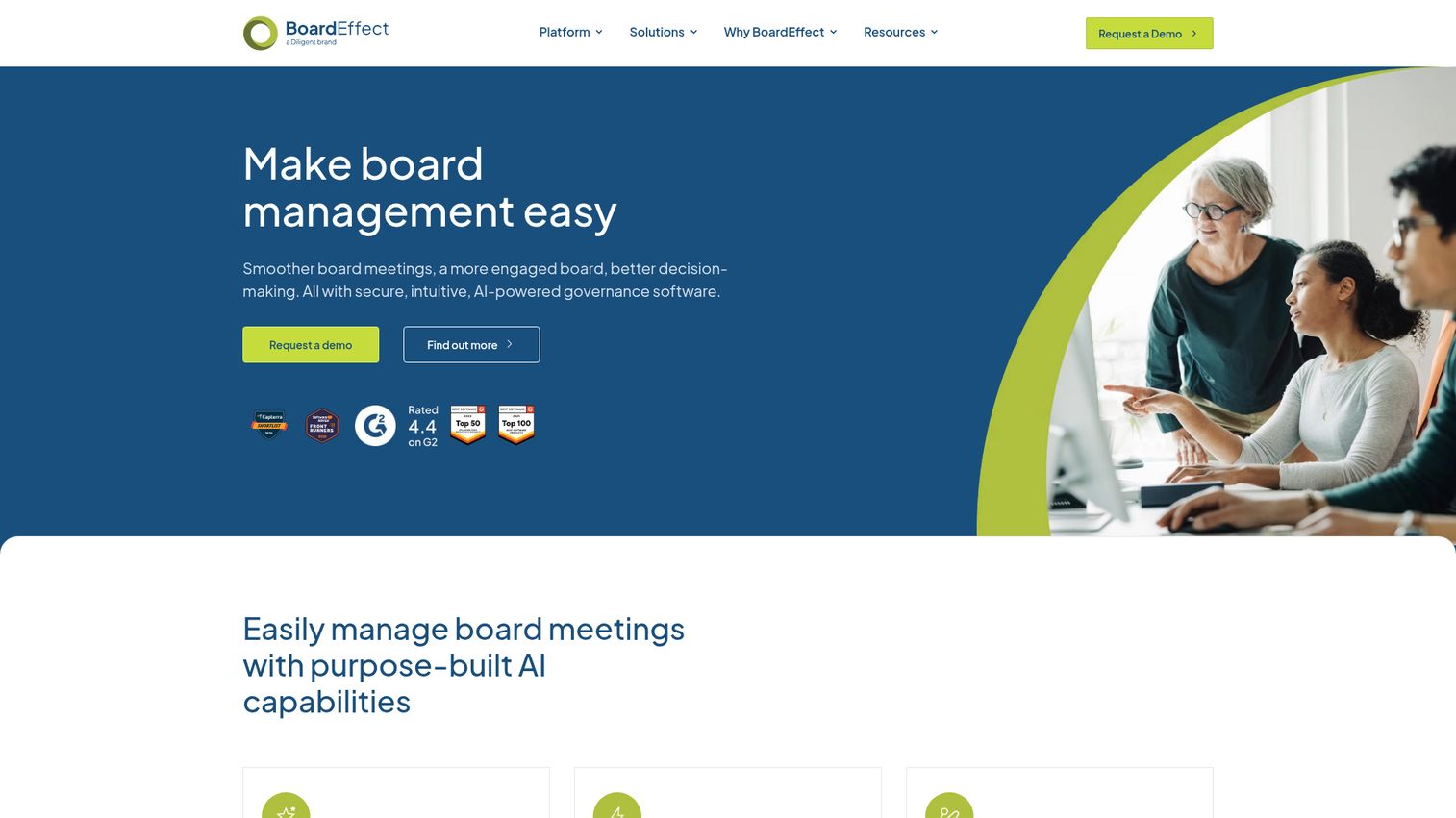
BoardEffect is secure, intuitive, AI-powered governance software for smoother board meetings, more engaged boards, and better decision-making. It is part of Diligent's product family, focused on mission-driven mid-market organizations: healthcare systems, higher education, credit unions, and large nonprofits.
Best for: Mid-market mission-driven organizations and governance teams that need secure board management without full Diligent Boards complexity.
Key strengths
- AI agendas and meeting summaries: AI-assisted agenda drafting and post-meeting summaries that cut prep and follow-up time. For broader context on AI note-taking, see the best AI note-taking tools.
- Secure workspaces: Permissioned committee and working-group spaces for parallel governance workstreams.
- Instant access to board books, minutes, and other materials: Mobile-friendly repository with strong findability.
Why choose BoardEffect: Strong fit for regulated mid-market organizations that need governance discipline but want a lighter footprint than enterprise Diligent. The sector focus means the templates and workflows feel native, not adapted.
Pricing: Quote-based. BoardEffect's pricing page lists two plans, Pro and Plus, and invites buyers to request a custom quote. No numeric pricing is shown publicly.
8. iBabs
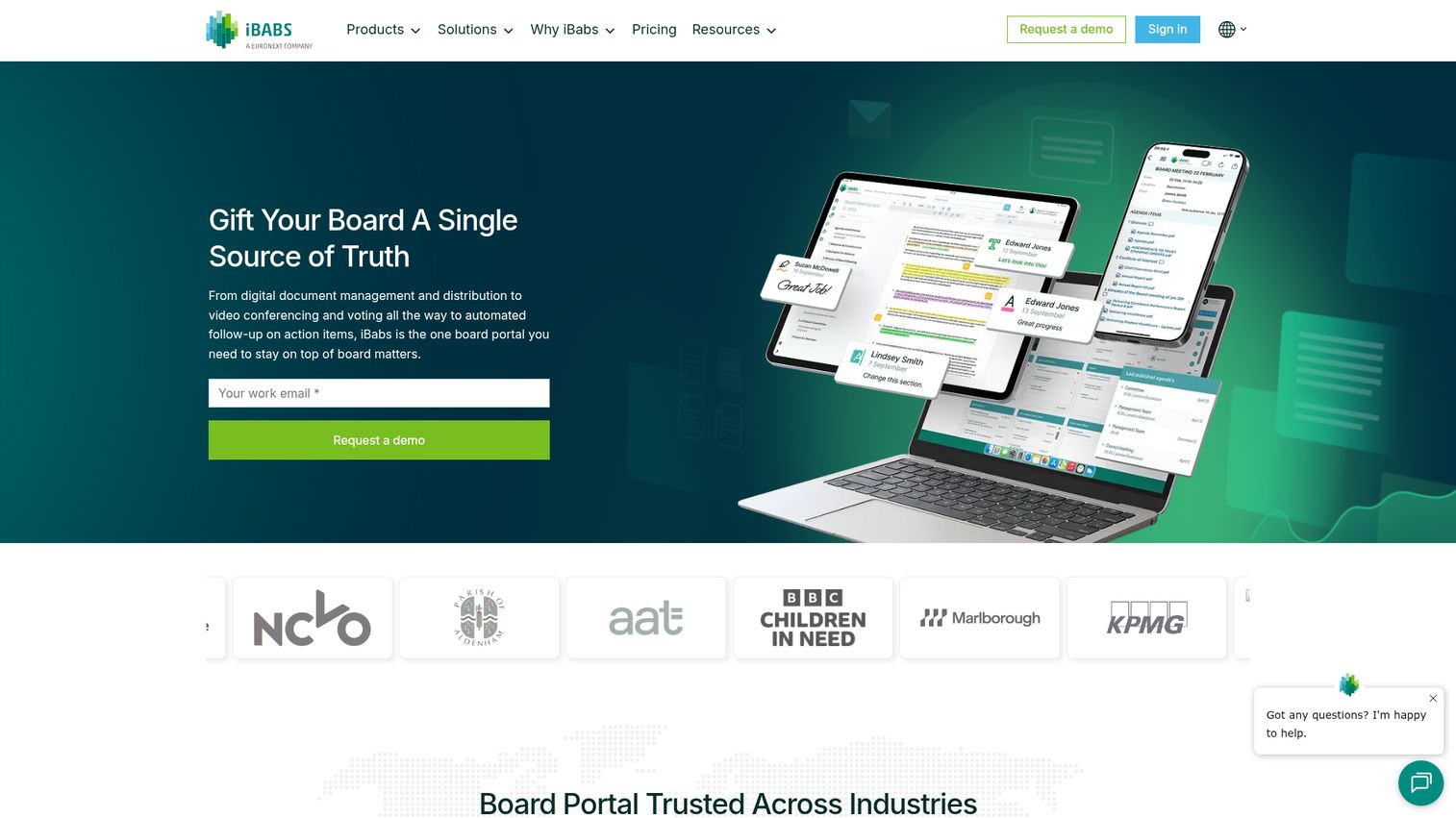
iBabs is a secure board portal and meeting management platform for managing agendas, documents, decisions, and board communication. European-rooted with deep adoption across public-sector and corporate boards in the EU and UK.
Best for: EU-based boards with GDPR-first requirements and public-sector adoption needs.
Key strengths
- Actions and decisions: Decision logging and action tracking that survive across meeting cycles, with clear ownership and due dates.
- Minute taking: In-platform minute drafting tied directly to agenda items and resolutions.
- Video conferencing: Built-in meeting capabilities for remote and hybrid boards.
Why choose iBabs: Best when European data residency or strong public-sector references are decisive factors. The product is mature, the market position is established, and the workflow fit for European governance norms is strong.
Pricing: Quote-based. iBabs' pricing page lists product modules including iBabs Meet, iBabs Publish, iBabs Stream, and iBabs Debrief, but no numeric prices are published. Contact sales for a quote.
9. Govenda
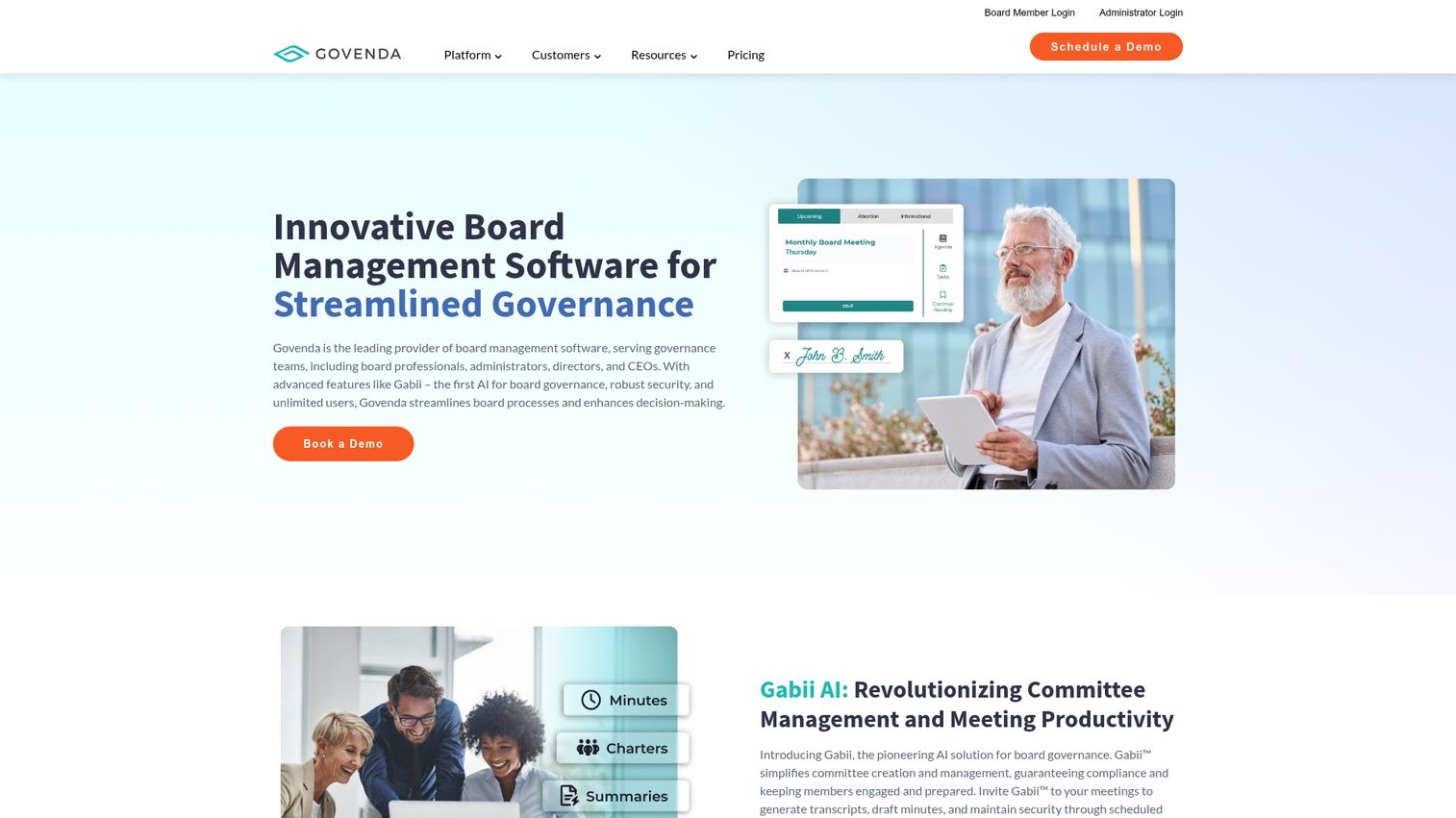
Govenda provides board management software for governance teams, including board professionals, administrators, directors, and CEOs. Post-acquisition by Diligent, Govenda continues to be positioned as a modern-UX option for mid-market boards that want Diligent's security stack without legacy interface friction.
Best for: Mid-market companies that want modern UX with enterprise-grade security backing.
Key strengths
- Gabii AI for board governance: AI-assisted meeting transcripts and draft minutes that cut hours of post-meeting work.
- Microsoft 365 integration: Synchronous in-browser editing with native Microsoft 365 workflows, useful for teams already standardized on that stack. See how Guideflow handles integrations for a sense of what to expect from modern connectors.
- Meeting management tools: Agendas, minutes, questionnaires, voting, eSignatures, and reports in one workflow.
Why choose Govenda: A solid middle ground between SME-tier tools and full Diligent Boards. The Microsoft 365 integration is genuinely useful if your governance team already lives in that ecosystem.
Pricing: Quote-based. Govenda's pricing page says to connect for pricing details and mentions unlimited users, no implementation fees, automated updates, and 24/7 customer support. No public dollar amounts.
10. BoardSpace
BoardSpace is board management software for HOAs, condos, charities, and nonprofits that handles agendas, minutes, documents, and action items. It is the most affordable transparent-pricing option on this list and is segmented by organization type.
Best for: Volunteer-led boards such as HOAs, condos, charities, nonprofits, and associations that need simpler governance workflows without per-user pricing.
Key strengths
- Meeting management: Agenda templates, motions, votes, attendance tracking, and e-signatures in a single workflow.
- Document library: Tagging, search, filters, and role-based access control for board records and historical materials.
- Polls and action tracking: Between-meeting decisions and follow-ups that do not get lost in email.
Why choose BoardSpace: Solid budget option when your board is volunteer-led and you do not need AI features or enterprise compliance certifications. The flat monthly pricing avoids per-seat creep as committees grow.
Pricing: Public tiered pricing on the pricing page. Condos and HOAs under 75 units are $69 per month. Condos and HOAs with 76 to 150 units are $99 per month. Non-profits and charities with one committee are $99 per month. Non-profits and charities with two or three committees are $130 per month. Annual plans include two free months. Larger or smaller organizations are quoted separately.
Considerations before you buy
Pick the wrong tool and you will live with it for three years, because migrating board records is painful enough that nobody volunteers to do it twice. Five things to verify before you sign.
Director adoption matters more than feature count
Your independent directors are not testing 12 tools. Whichever one they open first becomes the standard. Optimize for the lowest-friction director experience: mobile app quality, single sign-on, and how quickly a new director can find this quarter's pack without help. Feature parity comes later. For broader UX patterns that drive adoption, the best digital adoption platforms and best onboarding flow software roundups are worth a skim.
Pricing models are deceptive
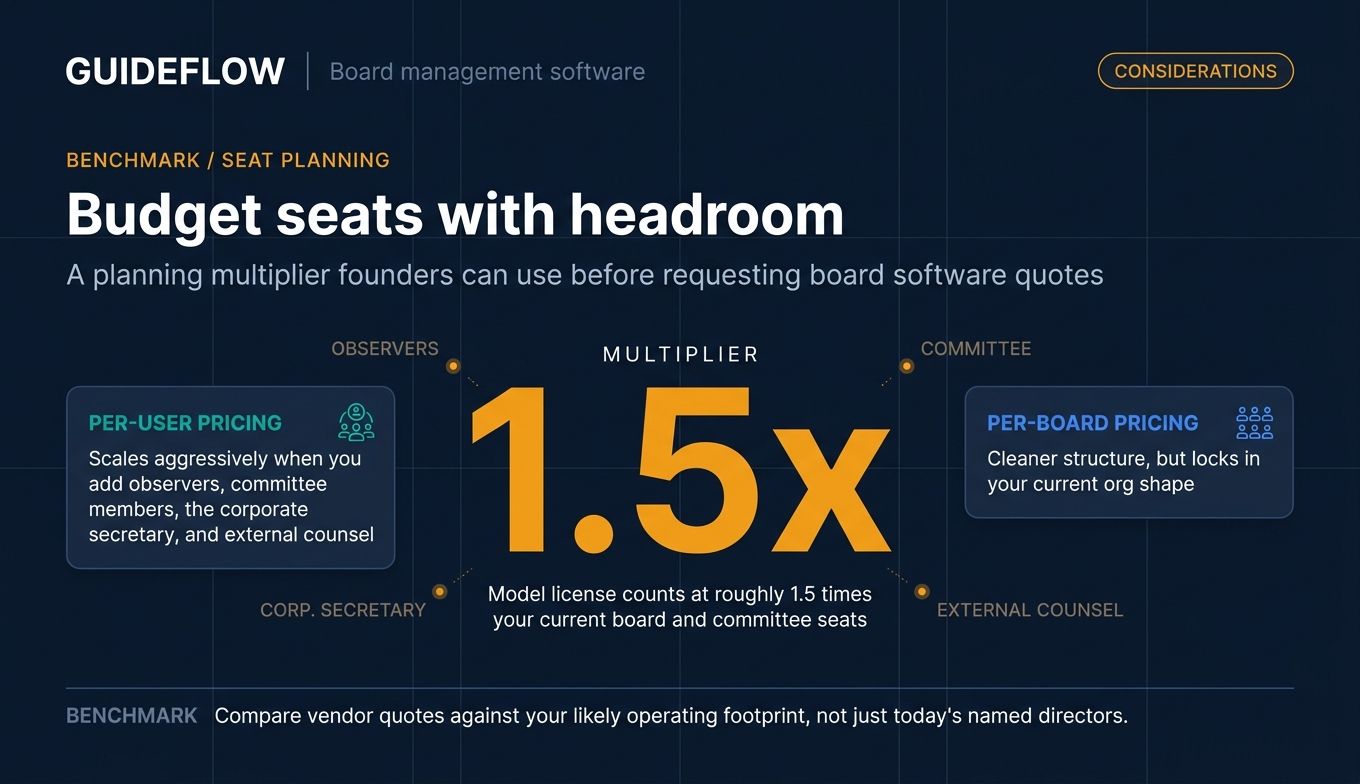
Per-user pricing scales aggressively when you add observers, committee members, the corporate secretary, and external counsel. Per-board pricing is cleaner but locks in your structure. As a rough planning heuristic, model license counts at roughly 1.5 times your current board and committee seats to leave room for growth. Get an all-in quote, not a per-seat headline. If you also evaluate quote workflows internally, the best CPQ software list covers adjacent patterns.
Security posture is not optional past Series B
Growth-stage investors increasingly expect SaaS companies to have SOC 2 Type II in place by Series B, especially for enterprise sales. The same expectation applies to your board portal. Confirm the vendor's SOC 2 Type II report is current and not in-progress. Ask for ISO 27001, AES-256 encryption at rest, role-based permissions, and audit logs in writing. Guideflow's own security and compliance page is one example of the kind of disclosure to expect.
Implementation is rarely fully self-serve
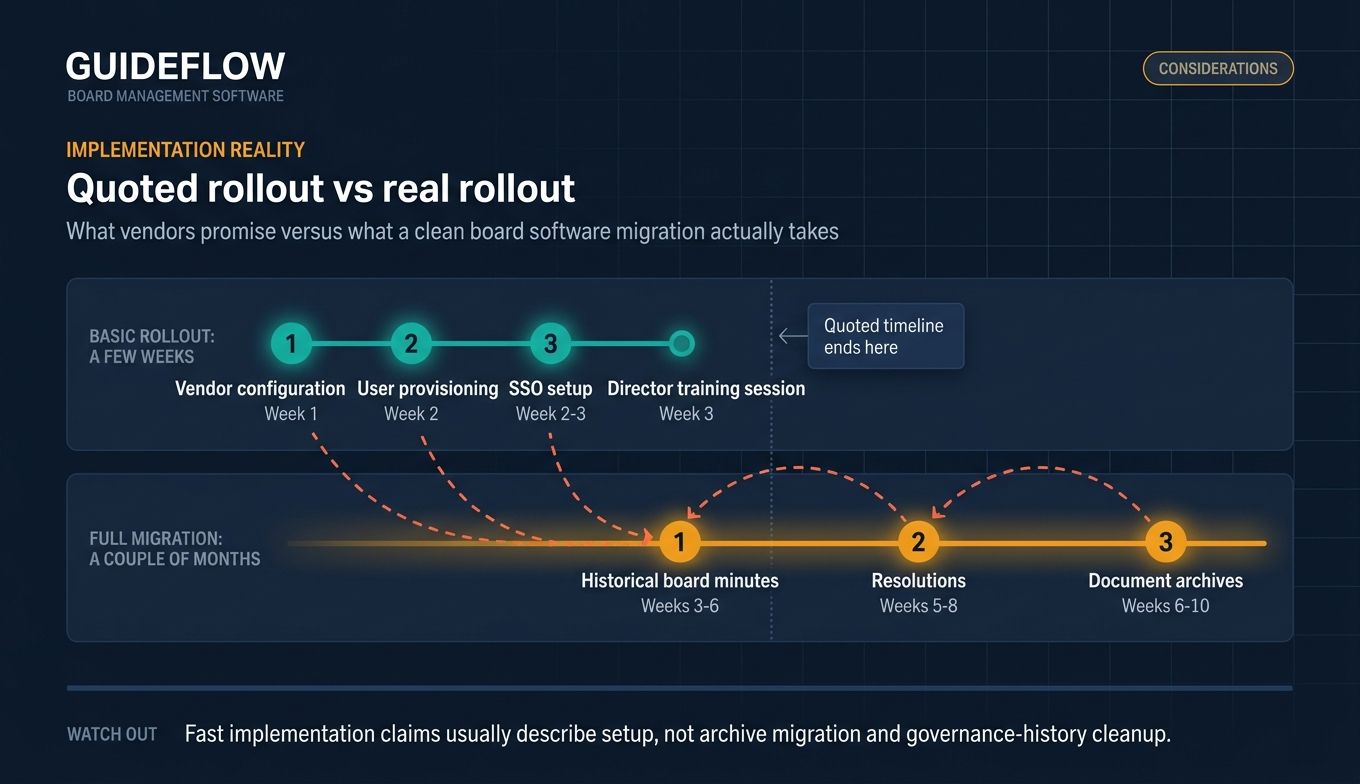
Most vendors quote a few weeks for implementation. Realistic is closer to a couple of months for a clean migration of historical minutes, resolutions, and document archives. Budget the corporate secretary's time, not just the vendor's.
Data export and ownership
What happens to your governance history if you switch vendors? Ask for an export format spec and audit-log retention policy in writing. If they cannot answer, that is the answer.
Common mistakes to avoid when choosing board management software
A few patterns we see repeatedly when founders pick the wrong tool.
- Choosing for the corporate secretary's preference rather than directors' actual usage patterns. The corporate secretary uses the tool every day, but the directors decide whether it gets used at all. Optimize for the harder problem.
- Buying enterprise capability you will not use for 18 or more months. The entity management module, the skills matrix, the D&O questionnaire workflow. Buy what you need now, with a clean upgrade path.
- Skipping the historical document migration scope conversation. Vendors love to quote the rollout. Few quote the migration. Get it in writing before you sign.
- Underestimating the role of the board chair in driving adoption. If the chair does not pick up the app, the directors will not either. Get them in the demo.
- Confusing board management software with document management or e-signature tools. A Drive folder and DocuSign do not replace a board portal. They are pieces of one. The portal stitches them together with audit logs and governance hygiene.
Conclusion
The 10 tools on this list are not equally strong, and that is the point. For a growing SaaS company adding its first independent directors, OnBoard or BoardPro will be the realistic shortlist. For a pre-IPO board or an enterprise with multi-entity complexity, Diligent Boards and Nasdaq Boardvantage become the references. For nonprofits, Boardable and BoardPro lead. For European boards with GDPR-first requirements, iBabs. For volunteer-led HOAs and small charities, BoardSpace.
The goal is not best-in-class features. The goal is removing yourself, the founder, from board prep. The right tool is the one your COO or chief of staff can run without you in the loop, the one your independent directors actually open on Sunday night, and the one that survives the next due diligence cycle without anyone scrambling.
Pick two or three from the shortlist. Book demos. Let your corporate secretary run the eval and report back with a recommendation. If you can hand them a clean comparison and stay out of the procurement loop, the system is already starting to work.
FAQs
Board management software is a secure digital platform that centralizes board meeting preparation, document distribution, minutes, voting, and governance records for directors, executives, and corporate secretaries. It replaces ad-hoc tools like shared drives, email threads, and Notion pages with workflow-specific governance infrastructure. Categories adjacent to it include board portal software and board meeting management software, though the terms are largely interchangeable in 2026.
Expect small-org board portals to start in the low thousands per year, with publicly-priced options like BoardSpace from $69 per month and BoardPro from $165 per board per month. Mid-market and enterprise platforms typically run into the tens of thousands annually or more, depending on board size, entity count, and feature scope. Most enterprise vendors use custom, quote-based pricing, so plan to model 1.5 times your current seat count when comparing.
The terms are largely interchangeable today. "Portal" historically emphasized document access for directors. "Management" emphasized the full meeting lifecycle, from agenda to archive. Modern vendors cover both, so the labels mostly reflect marketing preference rather than functional difference.
Honestly, usually no. Until you have two or more independent directors and a quarterly board cadence, a structured Notion workspace plus Google Drive plus a clean meeting template is enough. The buying trigger is when board prep starts eating founder time, when directors complain about finding materials, or when you are 6 to 12 months from a fundraise where due diligence will look at governance records.
Boardable and BoardPro are the strongest options in this segment. Boardable is purpose-built for nonprofit boards with per-user pricing starting at $20.99 per month annual. BoardPro targets SMEs and nonprofits with public per-board pricing and a 30-day free trial. The right pick depends on whether you prefer per-user or per-board billing as your committee structure evolves.
Look for SOC 2 Type II, ISO 27001, AES-256 encryption at rest, role-based permissions, and detailed audit logs. Enterprise tools like Diligent Boards and Nasdaq Boardvantage publish strong security postures aligned with public-company expectations. Mid-market tools vary more than vendors admit, so confirm the certifications are current and not in-progress, especially if you are past Series B and headed into investor diligence.
Most modern board portals integrate with Google Workspace, Microsoft 365, e-signature tools like DocuSign, and SSO providers including Okta and Azure AD. Integration depth varies. Govenda highlights synchronous in-browser editing with Microsoft 365, while other tools offer lighter document sync. API availability is less common at the SME tier. Ask for integration documentation rather than relying on marketing claims.
For a basic rollout, plan on a few weeks: vendor configuration, user provisioning, SSO setup, and a director training session. If you are migrating historical board minutes, resolutions, and document archives, implementation can stretch to a couple of months. Budget the corporate secretary's time, not just the vendor's project manager, because the migration scoping work happens on your side.