
A sale closes on the lot. The deal details live in one spreadsheet. Service picks it up two days later from a paper work order. Parts orders a component nobody logged. Accounting reconciles the whole thing at month end, chasing five people for numbers that should have flowed automatically. Sound familiar?
That is the tax RV dealerships pay when their operations run on disconnected tools. Every handoff between sales, service, parts, and accounting is a place where a customer detail gets dropped, a follow-up gets missed, or revenue leaks quietly out the back. The fix is not another CRM bolted onto another inventory app. It is a dealership management system built for how RV dealers actually work.
RV dealer software is DMS-centered software, not a single-purpose tool. It ties sales, service, parts, inventory, accounting, CRM, and reporting into one system of record. The stakes are rising, too. The U.S. automotive dealer software market is expected to grow from USD 2.0B in 2024 to USD 4.2B by 2033 at an 8.4% CAGR, according to the Automotive Dealer Software Market report (2024). Dealers are consolidating fragmented stacks into fewer, deeper systems, and the RV segment is no exception.
If you run or operate an RV dealership, the questions you care about are practical. Which platform handles your service throughput? Which one keeps multi-store inventory honest? Which gives your managers real numbers without a spreadsheet export? This guide answers those questions with seven cloud-based RV dealer software options, mapped to real operational pain, not feature checklists.
What's inside
This guide compares seven RV dealership software platforms for dealership owners, general managers, and operations leaders who need one system across departments. It is a buyer's decision guide, not a vendor landing page.
We selected and ranked each platform on five criteria that matter for RV operations:
- RV-specific fit - built for RV, marine, trailer, or specialty vehicle workflows, not generic retail
- Department coverage - sales, service, parts, inventory, accounting, and CRM in one place
- Workflow depth - how well the software handles real day-to-day tasks like deal desking, work orders, and warranty
- Mobile access - whether managers and staff can work away from a desk
- Reporting - dashboards and visibility across locations and departments
TL;DR
- Best overall for cloud-first RV dealerships: DealerRock, an all-in-one DMS with sales, service, CRM, parts, and built-in texting.
- Best for deeper dealership operations coverage: IDS Astra, with integrated accounting, VIN decoding, and recall workflows.
- Best for parts, service, accounting, and rentals in one platform: Lightspeed DMS.
- Best for leaner teams focused on inventory, service, and reporting: Motility Software.
- Best for QuickBooks-connected dealerships: EverLogic.
- Best for broad industry-specific support and a long operating history: DCS Inc.
- Best for trailer, RV, and repair shop workflows: WebbRes.
What is RV dealer software?
RV dealer software is a dealership management system built to centralize the sales, service, parts, inventory, accounting, CRM, and reporting workflows of a recreational vehicle dealership in one platform. It replaces the patchwork of spreadsheets, standalone CRMs, and disconnected accounting tools most dealers accumulate over time with a single system of record.
Unlike generic retail software, RV dealer management software understands unit-based inventory, warranty claims tied to specific VINs, deal desking for high-ticket units, and the service throughput that keeps fixed ops profitable. It is a specialized DMS, not a repurposed point-of-sale tool.
Core capabilities of RV dealership software include:
- Sales and lead management - an RV CRM that tracks prospects, quotes, deals, and follow-ups
- Parts and inventory control - RV parts management and RV inventory management with real-time unit tracking
- Service scheduling and warranty workflows - RV service scheduling, work orders, repair photos, and recall handling
- Accounting and reporting - accounting integration or a built-in ledger, plus reporting dashboards
- CRM and customer communication - built-in texting, email, and lead tracking
- Mobile access and compliance - a mobile app for dealers, plus VIN decoding and recalls support
The recreational vehicle market itself keeps expanding, with the global RV market expected to rise from USD 53.18B in 2026 to USD 75.24B by 2034 at a 4.40% CAGR, per Fortune Business Insights (2025). North America held 48.42% share in 2025. More units sold and serviced means more operational complexity, which is exactly what a purpose-built DMS is designed to absorb.
When to use RV dealer software
Not every dealership needs to overhaul its stack at the same moment. Here is how to tell when a dedicated DMS earns its place.
Consolidate fragmented dealership operations
If your sales team lives in one CRM, your parts counter runs on a separate system, and your accountant rekeys everything into QuickBooks at month end, you are paying for double entry with staff time and lost accuracy. This is the clearest signal to move to a dealership management system. When duplicate data entry or missed follow-ups start creating revenue leakage, a single system of record stops the bleed. One entry flows to every department that needs it.
Improve fixed ops and service throughput
Service is where dealerships make steady margin, and it is where disorganized workflows cost the most. If technicians work off paper, warranty claims sit in a drawer, and recall notices get lost, you need software that makes fixed ops visible. RV service scheduling, digital work orders, repair photos, warranty management, and recall handling turn the service bay from a black box into a measurable department. Service-heavy dealerships benefit most when technician workflows become trackable end to end.
Centralize visibility across locations
Multi-store operators cannot run on gut feel. When inventory lives in three different systems and each location reports numbers a different way, leadership loses the ability to make fast decisions. Software with multi-store operations support gives you one source of truth for inventory, sales, and performance data. Managers want dashboards they can open in the morning, not a report someone builds by Friday.
Comparison table
Here is how the seven platforms compare on intent, differentiation, pricing, and available ratings. Pricing reflects each vendor's published figures as of mid-2026. Where a public price or verified rating was not available, the cell is left open.
| # | Product | Intent | Key differentiation | Pricing | G2 rating |
|---|---|---|---|---|---|
| 1 | DealerRock | Cloud-first all-in-one DMS | Sales, service, CRM, parts, built-in texting in one platform | From $390/month | - |
| 2 | IDS Astra | Deep dealership operations | Integrated accounting, VIN decoding, recall workflows | Contact sales | - |
| 3 | Lightspeed DMS | Broad retail plus rentals | Sales, service, parts, accounting, and rental modules | From $450/month | - |
| 4 | Motility Software | Inventory, service, reporting | All-in-one DMS with deal desking and rentals | Contact sales | 3.5/5 |
| 5 | EverLogic | QuickBooks-connected DMS | Native QuickBooks integration, per-license pricing | From $129/month per license | - |
| 6 | DCS Inc. | Long-history RV specialist | No-cost entry plan, front-to-back operations | From $149.95/month | 2.3/5 |
| 7 | WebbRes | Trailer, RV, repair shop | Sales, rental, and service center modules | Contact sales | - |
The 7 best RV dealer software platforms
1. DealerRock
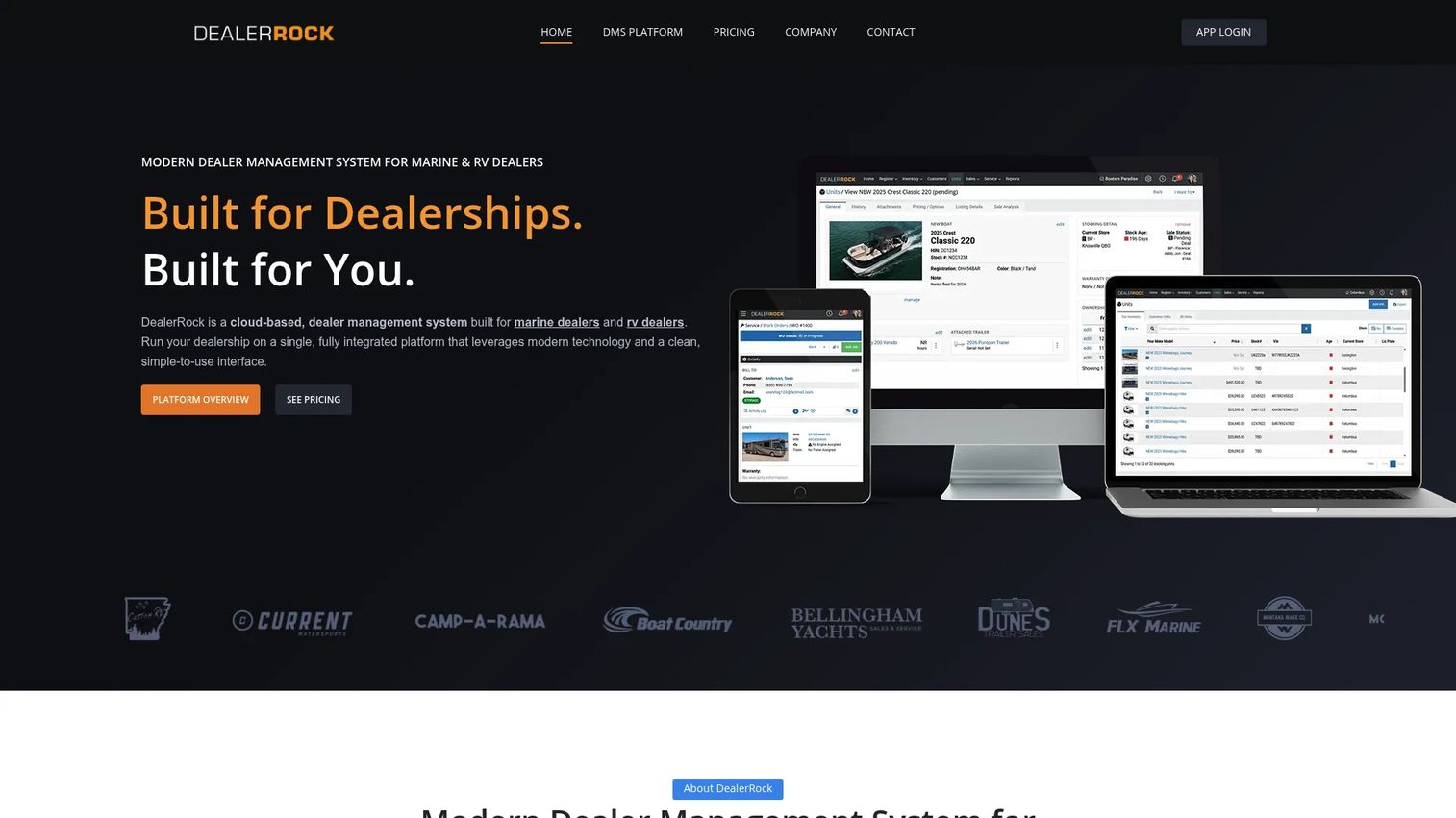
DealerRock is a cloud-based dealer management system built for marine and RV dealerships. It puts sales, service, inventory, and CRM in a single platform, so a unit sold on the lot, a work order in the service bay, and a parts reorder all live in the same system. For operators tired of stitching tools together, that consolidation is the pitch.
The platform covers the daily workflows an RV dealer actually runs. Point of sale, parts, purchasing, and vendor management handle the retail and back-of-house side. Job scheduling and warranty management keep fixed ops organized. Built-in texting lets your team communicate with customers without leaving the DMS, which matters when follow-up speed decides whether a deal closes.
Best for: Marine and RV dealers who want a modern, all-in-one DMS with broad daily workflow coverage.
Key strengths
- Unified sales, service, and CRM: One platform for selling, servicing, and tracking customers, so no department works from a stale copy of the data.
- Point of sale and parts management: Purchasing and vendor management sit alongside RV parts management, keeping the counter and the back office in sync.
- Built-in texting and warranty tools: Communicate with customers and manage warranty claims without bolting on a second app.
Cloud access and DealerRock's no-contract positioning matter to operators who want flexibility. You get remote access from any location, automatic updates, and no long-term lock-in, which lowers the risk of committing to a platform before you know it fits.
DealerRock pricing: Public pricing lists three plans. Sales Core is $390 per month, Service Core is $490 per month, and Complete is $690 per month. Enterprise pricing is custom, and setup fees are listed separately. There is no free tier.
2. IDS Astra
IDS Astra is dealer management software for RV, marine, and trailer dealerships, and it leans into depth of operations coverage. Where some platforms treat accounting as an afterthought, IDS Astra builds integrated accounting into the same system that runs sales, service, parts, and CRM. That integration is what centralizes your numbers instead of pushing them into a separate ledger.
The platform pairs core department modules with cloud hosting and a mobile app, so managers and staff can work away from the desk. It also handles the compliance side of RV retail, including VIN decoding and recalls, which keeps service accurate and customer communication clean. Reporting and analytics roll everything into leadership insights.
Best for: RV, marine, and trailer dealers who want an all-in-one DMS with real-time reporting and tight process control.
Key strengths
- Integrated accounting: Accounting lives inside the DMS, so financial data flows from sales and service without rekeying.
- VIN decoding and recalls: Built-in VIN decoding and recall workflows keep service records accurate and customers informed.
- Mobile access and analytics: A mobile app plus reporting dashboards give leadership real-time visibility across the dealership.
IDS Astra fits dealerships that value scalability and dealership-specific process control. The platform is designed to grow with a dealer's operations and to standardize workflows across departments, which appeals to operators who want repeatability rather than one-off fixes.
IDS Astra pricing: IDS Astra does not display public pricing on its website. The vendor uses a demo and contact-sales flow, so you request a quote based on your dealership's size and needs.
3. Lightspeed DMS
Lightspeed DMS is a cloud-based dealer management platform that spans powersports, marine, RV, trailer, OPE, and golf dealerships. Its breadth is the draw. Sales and F&I, parts, service, accounting, and CRM all live in one system, and it adds rental modules for dealerships that move units both ways. If you sell and rent, that combination is hard to match with separate tools.
The CRM tracks leads and automates text and email communication, so follow-ups do not fall through. Real-time inventory tracking and customer alerts keep the sales floor and the parts counter working from current data. Mobile transaction support means staff can complete work from the lot or the service drive, not just a back office terminal.
Best for: Dealerships in RV, marine, powersports, trailer, OPE, or golf that need an integrated DMS spanning retail and rentals.
Key strengths
- Retail plus rentals in one platform: Sales, service, parts, and accounting sit alongside RV rental management, covering both revenue streams.
- CRM with automated communication: Lead tracking plus automated text and email keep customer follow-up consistent.
- Real-time inventory and alerts: Live inventory tracking and customer alerts keep every department on current numbers.
Lightspeed stands out for dealerships that want one broad platform instead of a specialized point tool. The modular structure lets you scale coverage as operations grow, which suits dealers running multiple revenue lines under one roof.
Lightspeed DMS pricing: Public pricing is modular and scales from $450 to $3,000+ per month based on dealership size and complexity. Lightspeed does not list fixed plan tiers, and there is no free tier.
4. Motility Software
Motility Software is an all-in-one dealership management system built for RV, marine, trailer, powersports, bus, heavy truck, emergency vehicle, and golf cart dealers. It centers on operational visibility, giving leaner teams a single system for service, inventory, and reporting without the sprawl of separate tools. The messaging leans into adaptability and handling peak demand, which resonates with dealers whose service volume swings by season.
The platform covers CRM, deal desking, parts and service, accounting, unit inventory, rentals, and reporting and analytics in one system. Mobile access lets sales, inventory, and service staff complete tasks on the move. Performance dashboards turn raw activity into numbers managers can act on, so nothing important stays buried in a subsystem.
Best for: Dealerships that want an industry-specific DMS with strong operational visibility and service-heavy workflows.
Key strengths
- All-in-one operations: CRM, deal desking, parts and service, accounting, unit inventory, and rentals in one system.
- Mobile workflows: Sales, inventory, and service tasks work from a mobile device, not just a desk.
- Performance dashboards: Reporting and analytics surface operational performance so managers act on current data.
Motility fits dealerships that care about tighter operational control and handling peak demand without losing visibility. Teams that want one adaptable system across specialty vehicle lines, rather than a tool built for a single vertical, get broad coverage here.
Motility Software pricing: Motility does not publish pricing on its website, so you request a quote directly. On G2, the platform holds a 3.5/5 rating.
5. EverLogic
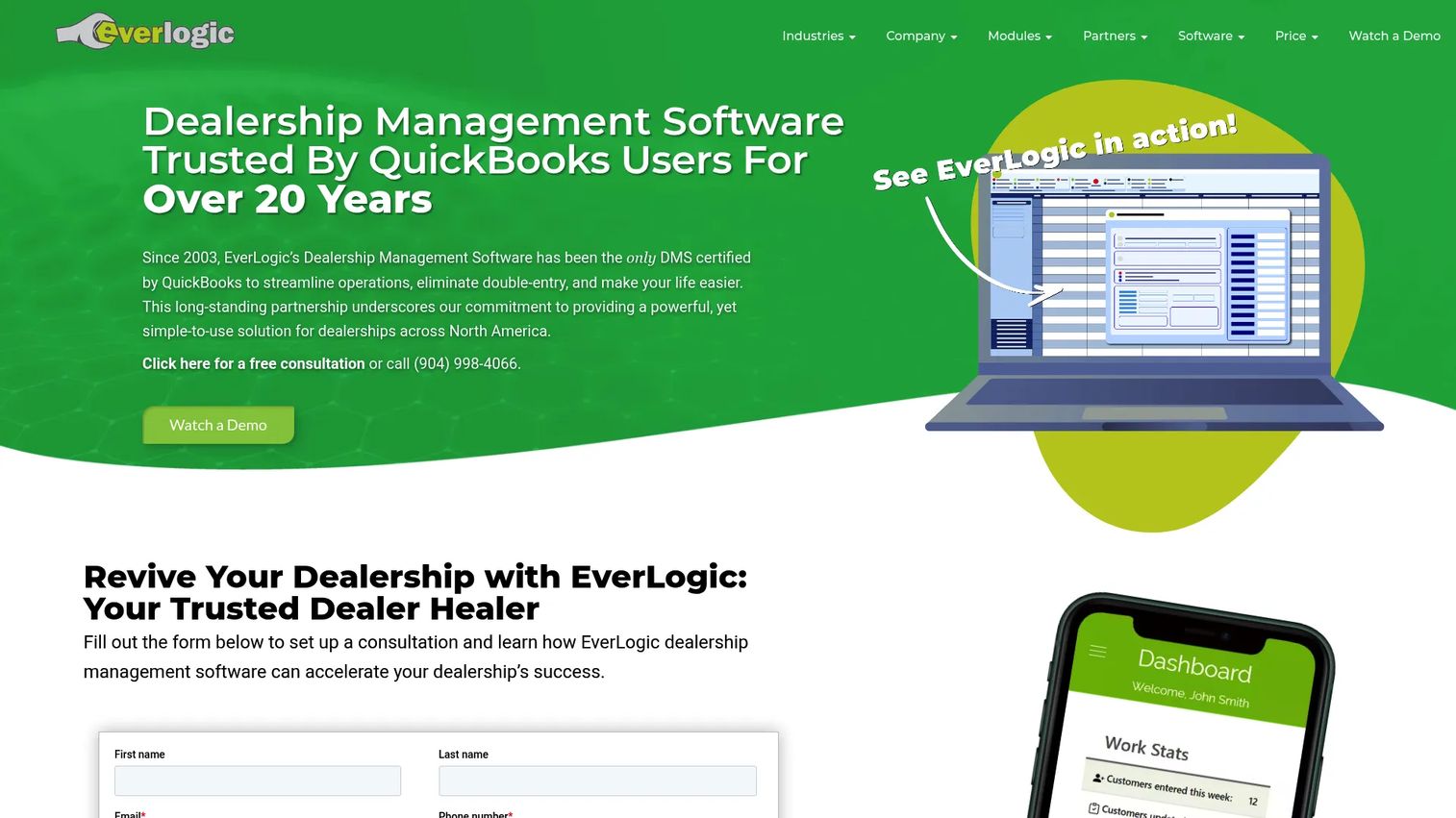
EverLogic is dealership management software for RV and related dealerships, and its headline differentiator is native QuickBooks integration. For dealers who already run their books in QuickBooks and do not want to migrate to a new ledger, that connection removes duplicate data entry between operations and accounting. You keep the accounting system your bookkeeper knows while running the dealership from one web-based platform.
The software covers customer management, inventory, sales, service, and accounting modules, so the whole dealership runs from a single web-based system. The focus here is simplicity and accounting alignment rather than a sprawling feature set. For a team that wants to reduce rekeying and keep financials clean, that focus is the point.
Best for: RV and powersports dealerships that run on QuickBooks and want a DMS that connects to it directly.
Key strengths
- Native QuickBooks integration: Financial data syncs to QuickBooks, so accounting stays in the system your team already uses.
- Full department modules: Customer management, inventory, sales, and service run from one web-based platform.
- Accounting-aligned simplicity: Built to reduce duplicate data entry between operations and the books.
EverLogic suits dealers who value QuickBooks continuity over a rip-and-replace accounting overhaul. If your finance workflow already works and you want operations to feed it cleanly, EverLogic's approach keeps the transition low-friction.
EverLogic pricing: Published pricing lists Core Desktop at $129 per month per license and Mobile at $39 per month per license, plus a one-time implementation fee of $4,000. There is no free tier.
6. DCS Inc.
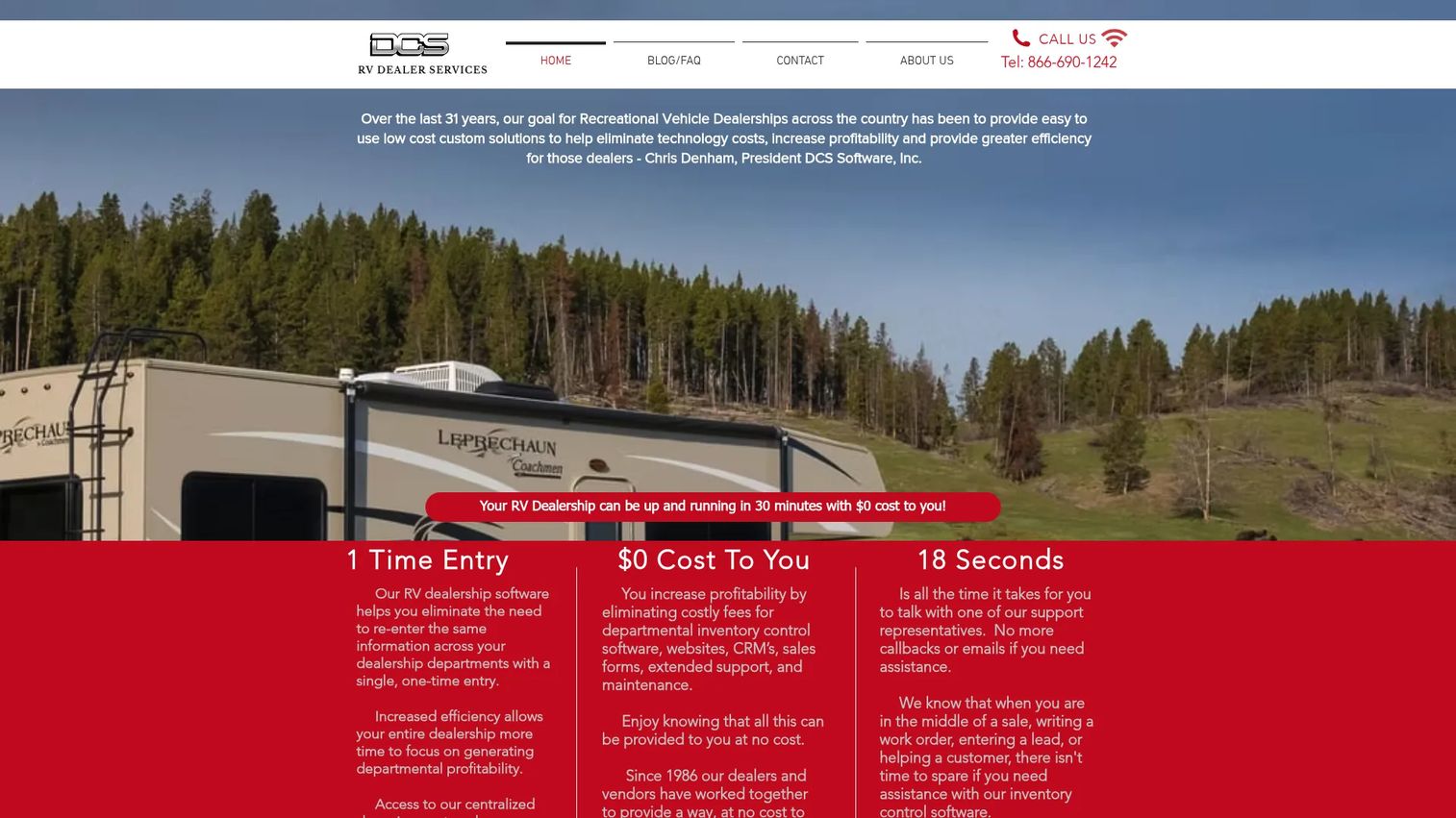
DCS Inc. offers RV dealer management software and services backed by a long operating history in the space. Its approach centers on front-to-back operations, with one-time data entry that carries across dealership departments instead of forcing staff to rekey the same information into separate systems. For dealers who want an established RV software vendor with broad process coverage, that track record is part of the appeal.
The platform runs as a cloud app with cloud data backup, and it covers sales, service, parts, accounting, and rental workflows. Dealership-wide automation reduces the manual steps between departments, and the vendor's industry-specific support reflects years of working with RV dealers specifically. That specialization shows up in how the software handles RV-specific processes.
Best for: RV dealers who want an established vendor with broad, front-to-back process coverage and industry-specific support.
Key strengths
- One-time data entry: Enter information once and it carries across sales, service, parts, and accounting.
- Cloud app with backup: A cloud-based system with cloud data backup keeps records safe and accessible.
- RV-specific support: A long operating history and industry-specific support built around RV dealership needs.
DCS Inc. fits dealers who prefer a vendor with deep RV experience and a low-risk entry point. The no-cost plan lets a dealership start without a large upfront commitment, then move to a paid plan as needs grow.
DCS Inc. pricing: DCS offers a no-cost entry plan, and paid RV dealer management system plans start as low as $149.95 per month. On G2, the software holds a 2.3/5 rating.
7. WebbRes
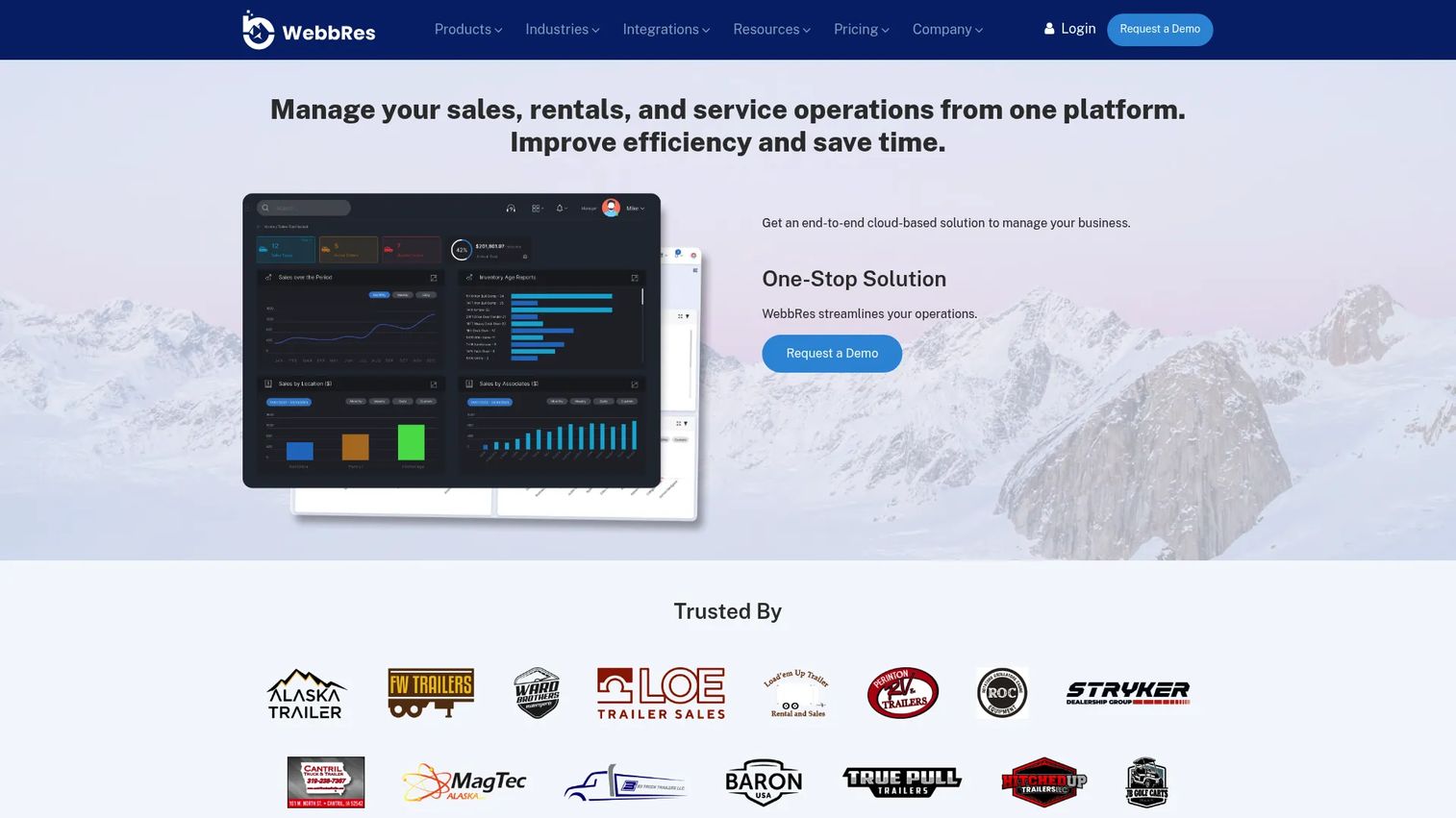
WebbRes is business management software for sales, rental, and service operations across RV, trailer, equipment, and repair shop businesses. Its cross-category flexibility is the differentiator. Rather than locking into pure RV retail, WebbRes fits operations that span multiple verticals or that lean heavily on rentals and service alongside sales.
The platform is built around three modules. The sales module handles inventory, quotes, orders, leads, workflow, reports, email and SMS, and digital signatures. The rental module manages bookings, an availability calendar, contracts, and multi-location support. The service center module covers vehicle management, service orders, an appointment calendar, technician scheduling, and wrench time reporting, which gives fixed ops real throughput visibility.
Best for: RV, trailer, equipment, and repair shop operations that need dealership software beyond pure RV retail.
Key strengths
- Full sales module: Inventory, quotes, orders, leads, workflow, reporting, and digital signatures in one place.
- Rental management: Booking management, availability calendar, contracts, and multi-location support for rental-heavy operations.
- Service center depth: Service orders, technician scheduling, and wrench time reporting make fixed ops measurable.
WebbRes suits smaller or multi-vertical operations that need one system across sales, rental, and service. If your business is not exclusively RV retail, its cross-category design gives you dealership software that flexes to match how you actually operate.
WebbRes pricing: WebbRes does not display public pricing. The site lists Starter, Advanced, Premium, and Premium Plus tiers and directs you to contact sales for module and tier pricing, with annual discounts and flexible plans available.
What to evaluate before you buy
A demo looks great in a controlled walkthrough. Your dealership runs on messier reality. Before you commit, pressure-test each platform against these criteria.
Department coverage that matches your operation
List the departments that generate revenue and cost today: sales, service, parts, accounting, rentals. Then map each candidate against that list. A platform strong in service but thin on rentals will cost you elsewhere. The goal is one system of record, not a DMS plus three point tools you still have to reconcile.
Workflow depth, not just feature presence
Every vendor claims service scheduling. The question is whether it handles your actual work orders, warranty claims, and recall notices without workarounds. Ask to run your real workflows in the demo, including the awkward edge cases, and watch how many clicks each task takes.
Mobile access for the people off the desk
Your sales team works the lot. Your techs work the bay. If the software only works from a back office terminal, adoption suffers. Confirm the mobile app for dealers covers the tasks those roles actually perform, not just a read-only view.
Reporting that leadership will use
Reporting dashboards matter only if managers open them. Check whether the reporting gives you the metrics you track weekly, whether it works across multi-store operations, and whether pulling a report takes a click or a support ticket.
Implementation effort and support model
Ask about setup timelines, data migration, training, and ongoing support. A capable platform with a painful rollout can stall for months. Get the implementation plan and support terms in writing before you sign.
Conclusion
The right RV dealer software depends on how your dealership actually runs, not on which vendor has the longest feature list. For cloud-first teams that want a modern all-in-one DMS, DealerRock covers sales, service, CRM, and parts with built-in texting. For deeper dealership operations coverage with integrated accounting and compliance tools, IDS Astra goes further. Dealers running both retail and rentals get broad coverage from Lightspeed DMS, while leaner teams focused on visibility and service-heavy workflows fit well with Motility Software.
For QuickBooks continuity, EverLogic connects directly to the books your team already uses. DCS Inc. brings a long RV operating history and a low-risk entry plan, and WebbRes flexes across RV, trailer, equipment, and repair shop operations.
The next step is not to pick from a spec sheet. Book demos with your shortlist, run your real workflows through each one, and compare how each platform fits the way your departments actually work. Workflow fit, not feature count, is what determines whether the software earns its place in your dealership.
FAQs
RV dealer software is dealership management software built specifically for RV sales, service, parts, inventory, accounting, and CRM. It centralizes the workflows a recreational vehicle dealership runs across departments into one system of record, replacing spreadsheets and disconnected tools. Unlike generic retail software, it understands unit-based inventory, warranty claims, and the deal desking that high-ticket RV sales require.
At a minimum, look for sales and lead management, service scheduling with work orders, RV parts management, inventory control, accounting or accounting integration, and an RV CRM. Strong platforms also add reporting dashboards, a mobile app for dealers, and built-in communication tools like texting and email. Rentals and warranty management matter if those are part of your operation.
No. A CRM is usually just one module inside a full dealership management system. RV dealer software includes an RV CRM for tracking leads and customers, but it also handles service, parts, inventory, accounting, and reporting. Buying only a CRM leaves the rest of your operation running on separate tools.
Yes, for most dealerships. VIN decoding pulls accurate unit specifications automatically, which reduces manual entry errors in service and inventory records. Recall tools help you identify affected units, notify customers, and track resolution. Together they improve service accuracy, customer communication, and operational efficiency, especially as unit volume grows.
Multi-store operators should prioritize consolidated reporting across locations, role-based permissions so each site sees the right data, and shared inventory visibility so units and parts are trackable everywhere. Workflow consistency across locations matters too, so every store runs the same process. The goal is one source of truth, not separate systems per location.
Very important for dealerships where staff work away from a desk. Sales teams on the lot, technicians in the service bay, and managers checking numbers between meetings all benefit from a mobile app for dealers. Mobile access keeps records current in real time and improves adoption, since staff update the system where the work actually happens.
For most dealers, yes. Cloud-based RV dealer software gives you remote access from any location, automatic updates without manual maintenance, and easier data backup. It also supports multi-store operations more cleanly than on-premise systems, since every location works from the same live data. That operational flexibility is why most modern RV software is cloud-first.
Dealer software is a broad term for any tool a dealership uses, which could mean a standalone CRM, an inventory app, or an accounting package. A DMS, or dealership management system, is the central system of record that ties departments together into one platform. When people search for RV dealer management software, they usually mean a full DMS, not a single-purpose tool.