
You sent the invoice. Net 30, maybe net 60. Payroll doesn't run on net 60. Neither does your inventory reorder, your ad spend, or the vendor waiting on their own check from you.
That gap between doing the work and getting paid is where cash flow quietly kills otherwise healthy businesses. And it's not a fringe problem. About 4.8 million SMEs worldwide are expected to use digital invoice financing in 2026, up 22% year on year, with 74.8% of deployments running in the cloud, according to MarketIntelo (2025). The tooling around this is scaling fast because the pain is universal.
Invoice financing software lets you borrow against unpaid invoices instead of waiting for customers to pay. You get most of the invoice value now, the software handles fees and repayment, and you keep working capital moving. The catch is that not every platform works the same way. Speed, fees, eligibility, and who controls collections all vary, and the wrong pick costs you either money or customer relationships.
This guide breaks down four options and the mechanics behind them so you can choose without guessing.
What's inside
This guide is for founders, finance leads, and operators who need working capital faster than their customers pay. We looked at four platforms that touch invoice financing in different ways, from productized advances to educational and ecosystem-based approaches.
We selected and compared them on the factors that actually decide fit:
- Speed to funding: how fast you move from submitted invoice to cash in hand
- Fee transparency: whether you can see the real cost before you commit
- Eligibility and underwriting: what the provider screens for and how
- Control over collections: whether you or the provider chases payment
You'll also learn what invoice financing is, how it works, how it differs from factoring, and what to check before signing anything.
TL;DR
- Best for fast, productized funding: BILL, especially if you already run payables and receivables in one place and want financing inside that workflow.
- Best for existing retail and supplier workflows: SPS Commerce, for businesses already in its ecosystem that want control over which invoices get financed.
- Best for understanding the mechanics: NetSuite, a strong reference point for the economics of invoice financing and how it sits inside broader finance operations.
- Best for a plain-English education plus receivables protection: Allianz Trade, which explains the model clearly and adds trade credit insurance context.
- The real decision comes down to three things: speed, fee structure, and how much control you keep over customer relationships.
What is invoice financing software?
Invoice financing software is a tool that advances you cash against unpaid customer invoices, then manages the fees and repayment when your customer settles the bill.
Here's the plain version. You raise an invoice with net terms. Instead of waiting 30 to 90 days, you submit that invoice to a financing provider. They advance you a percentage of its value, often 80% to 90%, within a day or a few days. When your customer pays, the provider takes its advance back plus a fee, and you keep the rest.
That's invoice finance in one loop. The software layer is what makes it repeatable instead of a one-off phone call to a lender.
Core capabilities to expect:
- Early payment against receivables: advance cash tied to specific invoices, not a general loan
- Fee preview and funding terms: see the cost and advance rate before you accept
- Eligibility and underwriting: the provider assesses invoice quality and, often, your customer's creditworthiness
- Automatic settlement or deduction: repayment happens when the invoice is paid, without manual reconciliation
- Workflow visibility and tracking: see which invoices are financed, funded, or repaid in one view
Invoice funding sits close to broader receivables financing and accounts receivable financing. The distinction that matters most is invoice financing vs invoice factoring, which we cover further down, because it changes who talks to your customer.
When to use invoice financing software
Not every cash crunch calls for financing. These are the moments where it earns its place.
Bridge a cash gap between invoicing and payment
Your customer is good for the money. They just pay slowly. When you've delivered, invoiced, and now have to cover payroll or a supplier before that payment lands, single invoice financing bridges the gap. Software matters here because you can finance one invoice on demand instead of negotiating a facility every time.
Fund growth without waiting on collections
Growth eats cash. A big new order means more inventory, more staff, more spend, all before the revenue arrives. Rather than pausing until customers pay, you finance the receivables you've already earned. This keeps expansion moving without diluting equity or taking on a fixed-term loan you'll carry after the need passes.
Reduce manual admin around repeat financing
If you're financing invoices regularly, doing it manually is a drag. Recurring financing rules, invoice selection, and automatic repayment turn a repeated scramble into a background process. The value of software over ad hoc financing is repeatability. Set the rules once, and the workflow runs without you rebuilding it each month.
Comparison table
Four platforms, ranked by how directly they serve the invoice financing job. Read the table as a shortlist, not a scoreboard. Pricing for financing products often depends on invoice volume, customer credit, and account setup, so treat listed pricing as a starting point and confirm rates for your situation.
| # | Product | Best for | Key use case | Pricing | G2 rating |
|---|---|---|---|---|---|
| 1 | BILL | SMBs and finance teams automating payables and receivables | Financing inside a unified AP and AR workflow | Spend & Expense $0/user/mo; AP & AR plans from $49/user/mo | 4.4/5 |
| 2 | SPS Commerce | Retail suppliers already using its network | Invoice financing tied to existing commerce workflows | Quote-based | 4.3/5 |
| 3 | NetSuite | Mid-market and enterprise finance operations | Understanding financing mechanics inside a cloud ERP | Custom pricing | 4.1/5 |
| 4 | Allianz Trade | Businesses wanting receivables protection and clarity | Trade credit insurance and receivables risk context | Quote-based | Not publicly listed |
Best invoice financing software for 2026
Below, each platform gets a full breakdown: what it does, who it fits, its strengths, and how pricing and eligibility work.
1. BILL
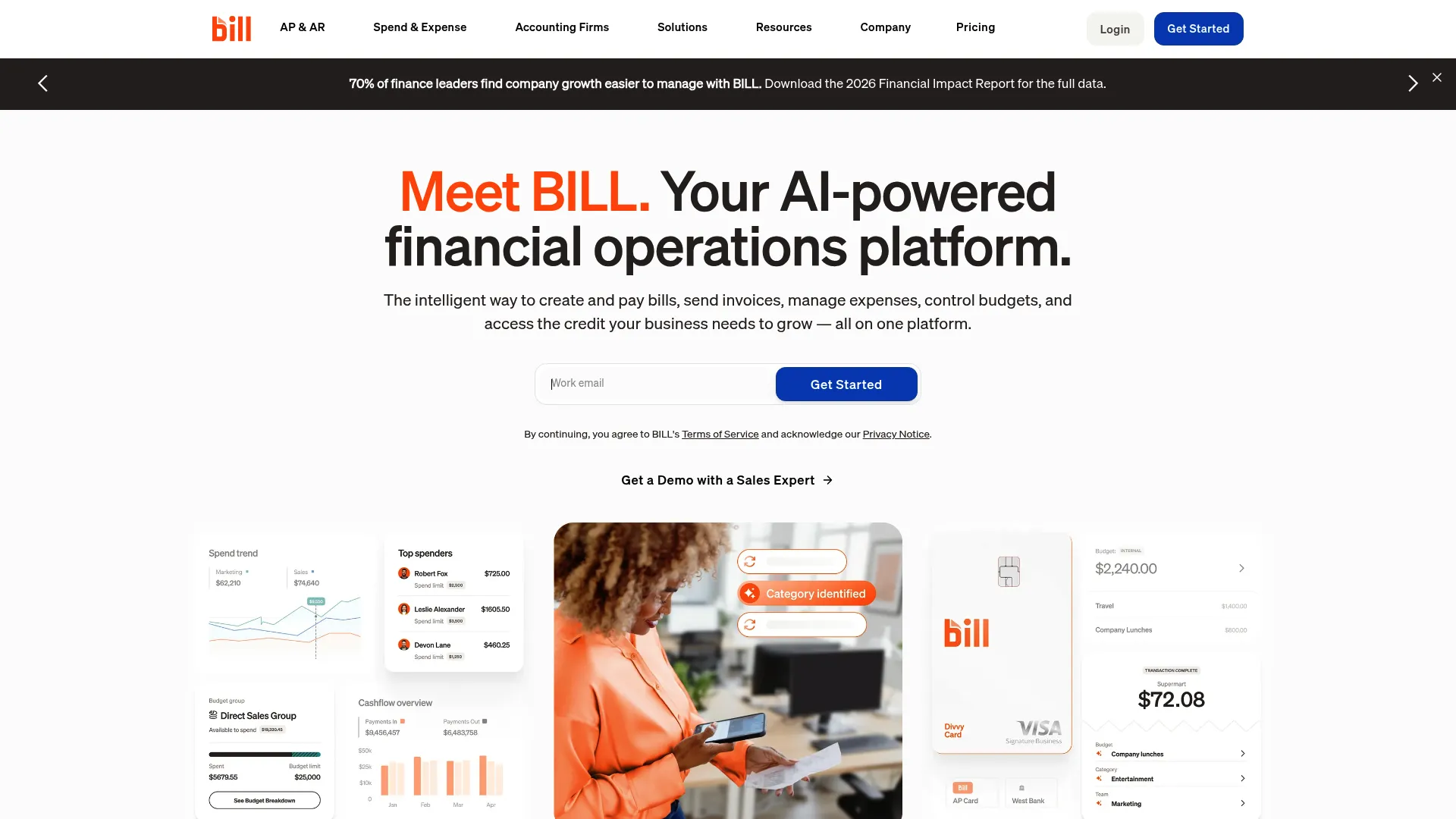
BILL is financial operations software that automates accounts payable, accounts receivable, and spend and expense management. For invoice financing, that matters because the financing sits inside the same place you already track who owes you and when. You're not exporting invoices to a separate lender portal. The receivables you're financing already live in the system.
The appeal for a finance team is speed and workflow simplicity. Invoices you've raised are already in BILL. Requesting an advance against them happens in the same flow, with the fee and terms visible before you commit. Repayment is tied to the invoice, so when your customer pays, settlement handles itself rather than becoming another reconciliation task.
Best for: SMBs and finance teams that want fast funding without leaving their payables and receivables workflow.
Key strengths
- Accounts payable and receivable automation in one platform
- Spend and expense management alongside financing
- Accounting software integrations to keep books in sync
Why choose BILL: if your invoicing, payments, and financing all living in one system matters more than shopping every advance around, BILL removes steps. The tradeoff is that it's a broad financial operations platform first, so you're adopting the wider toolset, not a single-purpose financing product. For teams already consolidating their finance stack, that's a feature, not a cost.
BILL pricing: Spend & Expense is $0 per user per month. AP and AR plans are user-based: Essentials at $49 per user per month, Team at $65 per user per month, and Corporate at $89 per user per month. Enterprise is custom pricing. All paid tiers are billed monthly. Financing fees depend on the invoice and terms, previewed before you accept.
2. SPS Commerce
SPS Commerce is a cloud-based retail network and EDI platform that handles order, invoice, and document management between suppliers and retailers. Its invoice financing angle is practical rather than standalone: if you're already selling through its network, financing ties into the commerce workflows and invoices you're generating anyway.
The standout for existing customers is control. Rather than financing your whole ledger, you choose which invoices to finance and which to leave alone. That's useful when some customer relationships are sensitive and others aren't. SPS Commerce also brings retail and supplier context, plus a partner lender structure, so the financing connects to the trading-partner data it already manages for you.
Best for: Retail suppliers already running EDI and fulfillment through SPS Commerce who want financing inside that ecosystem.
Key strengths
- Full-service EDI fulfillment and compliance
- Order, ASN, invoice, and document management
- Retail inventory and sell-through data automation
Why choose SPS Commerce: if you're a supplier already living in its network, adding financing on top of managed EDI keeps everything in one relationship. It's more niche if you're outside retail supply chains, since the value is tied to the ecosystem. Enrollment runs through your existing SPS account, and eligibility depends on your trading-partner setup and invoice profile.
SPS Commerce pricing: SPS Commerce uses quote-based, demo-led pricing. No public plan price is published on its site, and pricing depends on your fulfillment needs and trading-partner requirements. Contact SPS Commerce for a quote tied to your setup.
3. NetSuite
NetSuite is Oracle's cloud ERP and business management platform. Be clear on what it is here: NetSuite is the strongest reference point for understanding invoice financing mechanics and economics inside broader finance operations, rather than a dedicated standalone financing product. If you want to grasp how advances, fees, and repayment actually work before you commit, this is where the model gets explained cleanly.
That educational value is real for finance operators. NetSuite frames the fee math, advance percentages, and cost structure in a way that helps you compare options with clear eyes. It also draws the invoice financing versus factoring distinction plainly, which is the single most confused point in this category. With invoice financing, you keep control of collections and your customer relationship. With factoring, the provider typically buys the invoice and takes over collection.
Best for: Mid-market and enterprise finance teams who want the mechanics and economics of financing explained inside a unified ERP.
Key strengths
- Cloud ERP with global financial management
- SuiteBilling for subscription and recurring billing
- Unified visibility across finance operations
Why choose NetSuite: if you're running finance operations at scale and want financing understood in the context of your full ledger, NetSuite gives you that framing. It's a broad ERP, so it fits companies ready for that scope rather than teams wanting a quick single-invoice advance. Use it to model the economics, understand invoice financing costs, and set expectations before you fund.
NetSuite pricing: NetSuite uses custom pricing. It does not publish public plan prices, and cost depends on modules, users, and configuration. Contact NetSuite for a quote based on your requirements.
4. Allianz Trade

Allianz Trade is a trade credit insurance and credit management provider. Its role in this list is the broad, plain-English explainer plus a receivables protection angle that the pure financing tools don't cover. If you're new to the model and want the definition, workflow, and terminology laid out clearly, Allianz Trade does that well.
The step-by-step framing is genuinely useful. You raise an invoice, submit it, receive an advance against a percentage of its value, and repay when your customer pays. Alongside that, Allianz Trade adds trade credit insurance, which protects your receivables if a customer doesn't pay at all. That's a different lever from financing itself: financing accelerates cash, insurance reduces the risk of non-payment. The disadvantage worth naming is that it's less of a dedicated financing product and more of a risk and education layer, so pair it with a financing tool if speed to cash is your priority.
Best for: Businesses that want a clear education on invoice financing plus protection against customer non-payment.
Key strengths
- Trade credit insurance for B2B receivables
- Risk mitigation across economic, commercial, and political risks
- Digital tools and APIs for policy and financial health insights
Why choose Allianz Trade: if your worry is not just slow payment but non-payment, the insurance angle addresses a risk the financing-only tools leave open. It's best as a complement rather than a fast single-invoice advance. Eligibility and cost depend on your customer base and risk profile.
Allianz Trade pricing: Allianz Trade uses quote-based pricing. Its site offers an estimate calculator but does not display a fixed public price, directing you to contact sales for a quote. Cost depends on your receivables, customer risk, and coverage needs.
Considerations
Before you commit to any invoice financing software, run through this checklist. The differences between providers show up in exactly these five places.
Speed to funding
There's a difference between "instant approval" and money in your account. Ask how long from submitted invoice to actual payout, not just how fast approval happens. A same-day decision means little if funding takes four business days. For a payroll deadline, that gap is the whole point.
Fee transparency
Compare flat fees, percentage fees, factor rates, and recurring charges. The cheapest-looking headline number is often not the cheapest in practice. A low advance fee paired with weekly charges on outstanding balances can cost more than a higher one-time fee. Model the full cost on a real invoice at your real payment timeline before you choose.
Eligibility and underwriting
Providers screen different things: your customer's creditworthiness, invoice quality, your business type, and account setup. Some run a soft credit inquiry that doesn't affect your score; others check harder. Ask who they underwrite, you or your customer, because with invoice financing the invoice and its payer often matter more than your own credit.
Control over collections
This is the relationship decision. With invoice financing, you usually keep control and your customer never knows a financier is involved. With factoring, the provider may take over collection and contact your customer directly. If customer relationships are sensitive, confirm exactly who chases payment before you sign.
Automation and repeatability
Good software reduces repeat admin instead of adding it. Look for recurring financing, invoice selection rules, and automatic settlement. If you're financing invoices monthly, you want the workflow to run in the background, not force you to rebuild it every cycle.
Conclusion
The right invoice financing software depends on where you are and what you value.
If you want fast, productized funding inside a workflow you already run, start with BILL, especially if your payables and receivables are already there. If you're a retail supplier living in an existing network, SPS Commerce ties financing to commerce workflows you already manage. If you want to understand the mechanics and economics before committing, NetSuite is the strongest reference point inside a broader finance operation. And if non-payment risk worries you as much as slow payment, Allianz Trade pairs clear education with trade credit insurance.
The three questions that decide it: How fast do you actually need the cash? What does the full fee structure cost on a real invoice? And how much control do you need to keep over your customer relationships?
Answer those honestly, model the cost on a live invoice, and pick the platform that fits your operational reality. For most operators wanting speed and simplicity in one place, BILL is the most direct starting point. Explore it first, then compare against the others based on your setup.
FAQs
Invoice financing software advances you cash against unpaid customer invoices, then manages the fees and repayment when the invoice is paid. It automates what used to be a manual lender conversation, so you can request an advance, preview the cost, and track repayment in one workflow. Most tools advance 80% to 90% of an invoice's value.
Invoice financing costs usually combine an advance fee with a percentage or factor-based charge tied to how long the invoice stays unpaid. Fees vary by provider, invoice size, and your customer's credit. The cheapest headline rate isn't always cheapest overall, so model the full invoice financing fees on a real invoice at your actual payment timeline before choosing.
It depends on the provider. Some run only a soft credit inquiry that doesn't affect your score, while others run a harder check. Because invoice financing is secured against the invoice, providers often weigh your customer's creditworthiness more than your own. Ask each provider directly what kind of credit check they run before you apply.
The core difference in invoice financing vs invoice factoring is who controls collections. With invoice financing, you borrow against invoices but keep control and your customer usually never knows a financier is involved. With factoring, the provider typically buys the invoice and takes over collecting payment directly from your customer. If customer relationships are sensitive, that distinction matters a lot.
Eligibility for invoice financing depends more on your invoices and customers than on your own credit. Providers typically screen invoice quality, your customer's creditworthiness, your business type, and how long you've been operating. Businesses with creditworthy B2B customers and clean, verifiable invoices are the strongest fit. Requirements vary, so confirm the specific criteria with each provider.
Many platforms fund within one to a few business days after approval. Watch the gap between approval speed and actual payout, since an instant decision doesn't guarantee same-day cash. If you're covering a hard deadline like payroll, confirm the real time from submitted invoice to money in your account, not just how fast the approval comes back.
Invoice financing for small business works well when you have creditworthy customers who simply pay slowly. It converts unpaid invoices into working capital without diluting equity or taking a fixed-term loan. It's less useful if your customers are high-risk or your invoices are small and irregular. For steady B2B receivables on net terms, it's often a strong fit.
With standard invoice financing, no, you keep control and continue collecting payment yourself, so the arrangement stays invisible to your customer. With invoice factoring, that changes: the provider often takes over collection and contacts your customer directly. If keeping the customer relationship in your hands matters, confirm the collections model before you sign.