A missed office action response date can abandon a patent application. A dropped annuity payment can lapse a granted patent. And when your IP data lives across spreadsheets, shared inboxes, and three different calendars, those failures are not edge cases. They are a matter of time.
Patent teams carry a specific kind of operational risk. Every asset has statutory deadlines, jurisdictional rules, and a paper trail that must survive an audit. Miss one date and the cost is not a slow quarter, it is a lost invention. Yet the market keeps growing precisely because more organizations are treating IP as a portfolio to manage, not a filing cabinet to store. The global patent management software market was valued at roughly USD 2.19 to 2.5 billion in 2024 and is forecast to reach USD 5.0 to 6.81 billion by 2035, growing at double-digit CAGRs, according to Market Research Future and Verified Market Reports (2024 to 2025).
The shift is structural. By 2024, 73% of organizations had moved from spreadsheet-based IP tracking to centralized platforms, and over 76% of Fortune-level U.S. enterprises now run centralized IP management software, per MarketGrowthReports (2024). If you are still stitching together docketing by hand, you are working against the operating standard of your market.
This guide breaks down the best IP management software and patent-specific platforms for 2026, ranked by how they actually handle docketing, workflow automation, portfolio visibility, and reporting. We wrote it for the person who has to align legal, R&D, operations, and leadership around a single system of record, not just tick a feature box.
What's inside
This guide covers patent management software for three buyer types: law firms running prosecution and docketing at volume, in-house IP teams managing corporate portfolios, and R&D-heavy organizations that need structured invention intake.
We selected and ranked tools on four criteria that matter for real IP operations:
- Docketing depth and deadline management, including country-law coverage and reminder logic
- Workflow automation across prosecution, invention disclosure, and approvals
- Reporting and analytics for portfolio visibility and executive decisions
- Deployment and fit, including cloud versus hosted options and law firm versus corporate design
Pricing and G2 ratings reflect the most recent verified public data. Where a vendor gates pricing behind sales, we say so plainly.
TL;DR
- Best overall for most teams: AppColl for flexible docketing and matter management, or Clarivate if you need a broad IP suite.
- Best for enterprise IP operations: Clarivate and Anaqua handle governance, scale, and complex portfolios.
- Best for law firm workflows: FoundationIP and AppColl lead on prosecution, docketing precision, and outside counsel coordination.
- Best for portfolio-heavy corporate teams: IPfolio and Unycom deliver portfolio oversight and multi-team collaboration.
- Best for R&D intake and research: Patsnap for patent intelligence, Alt Legal for lightweight modern docketing.
- Best for small teams: Alt Legal keeps admin overhead low with matter-based pricing.
What patent management software is
Patent management software is a system for managing patent-related workflows across invention intake, docketing, prosecution, deadlines, documents, reporting, and portfolio oversight. It replaces the manual coordination of spreadsheets, calendars, and email with a single source of truth that tracks every asset, deadline, and status change with an audit trail.
The category sits inside the broader intellectual property management software market, which also covers trademarks, copyrights, and designs. Patents are the largest functional segment: patent modules account for about 41.3% of total IP management spending by IP type as of 2025, according to Mordor Intelligence. Many tools handle adjacent IP tasks, but the core job of patent management software is organized, auditable patent administration.
Core capabilities to look for
- Docketing and deadline reminders: automated date calculation based on jurisdiction rules, with escalating reminders so nothing slips.
- Invention disclosure intake: structured forms and review workflows that capture ideas from R&D before they become filings.
- Portfolio tracking and status visibility: a live view of every asset, its stage, and its cost.
- Collaboration: shared workspaces across in-house legal, R&D, and outside counsel.
- Analytics and reporting: dashboards and exports that turn raw records into portfolio-level insight.
- Deployment and API flexibility: cloud deployment, hosted, or on-premise options, plus integrations with your document and data systems.
Law firm and corporate use cases
Law firms and in-house teams buy the same category for different jobs.
Law firms need docketing precision above all else. Their workflows center on prosecution, client matter management, and coordinating instructions with foreign associates and outside counsel. Billing accuracy and audit trails are non-negotiable because a docketing error is a malpractice exposure.
Corporate IP teams optimize for portfolio visibility. Their workflows emphasize invention capture from R&D, approval routing, budget forecasting, and executive reporting. They need to answer questions like "what does this portfolio cost us this year" and "which assets are worth renewing" without a manual audit. The best legal IP management software serves both, but the fit depends on which of these jobs dominates your day.
When to use patent management software
Centralize patent deadlines and docketing
You outgrow spreadsheets the moment a single missed date carries real cost. If your team tracks deadlines across personal calendars, shared inboxes, and manual follow-up, you are one vacation or one resignation away from a lapse. A dedicated patent docketing software system centralizes every date, calculates jurisdictional deadlines automatically, and sends escalating reminders. The payoff is compliance, visibility, and far less manual chasing.
Standardize invention disclosure and review
When product, R&D, and legal each capture ideas differently, good inventions die in someone's notebook. This is the moment to standardize invention disclosure management with a structured intake process: a consistent form, a clear review path, and a documented decision. You get better upstream capture and cleaner decision-making about what to file, what to hold as trade secret, and what to drop.
Improve portfolio reporting and executive visibility
Leadership does not want raw docket records. They want to know what the portfolio is worth, what it costs, and where to spend next. When renewal decisions, budget planning, and prioritization start hitting the boardroom, you need ip portfolio management software that produces reliable, exportable views of assets, status, cost, and strategic value. That visibility drives smarter budget and renewal calls.
Comparison table
Read this table top to bottom by relevance to core patent management workflows. "Intent" tells you the primary buyer fit, "Key differentiation" is the one thing each tool does best, and pricing reflects verified public data where it exists.
| # | Product | Intent | Key differentiation | Pricing | G2 rating |
|---|---|---|---|---|---|
| 1 | AppColl | Law firm and corporate docketing | Modular workflows with free corporate portal (Tandem) | Free tier; PM Corporate from $130/user/mo | 4.7/5 |
| 2 | Clarivate | Enterprise unified IP management | Broad IP suite with country law engine | Quote-based (public pricing limited) | Not listed |
| 3 | FoundationIP | Law firm docketing and prosecution | Cloud docketing across 300+ jurisdictions | Quote-based | 4.0/5 |
| 4 | IPfolio | Corporate portfolio management | Centralized corporate IP with Clarivate data | Quote-based | 4.6/5 |
| 5 | Memotech | Large corporate IP departments | Highly customizable with data verification | Quote-based | 4.0/5 |
| 6 | Unycom | Hosted or on-premise corporate IP | On-premise deployment with global portfolio scope | Quote-based | Not rated |
| 7 | Anaqua | Enterprise IP operations | AQX platform with portfolio intelligence | Quote-based | 4.1/5 |
| 8 | Patsnap | R&D and patent intelligence | AI-native research and competitive intelligence | Free; Pro $200/mo; Custom | 4.0/5 |
| 9 | Alt Legal | Modern docketing for smaller teams | Matter-based pricing across 180+ jurisdictions | From $60/mo + $30/mo | 4.8/5 |
1. AppColl
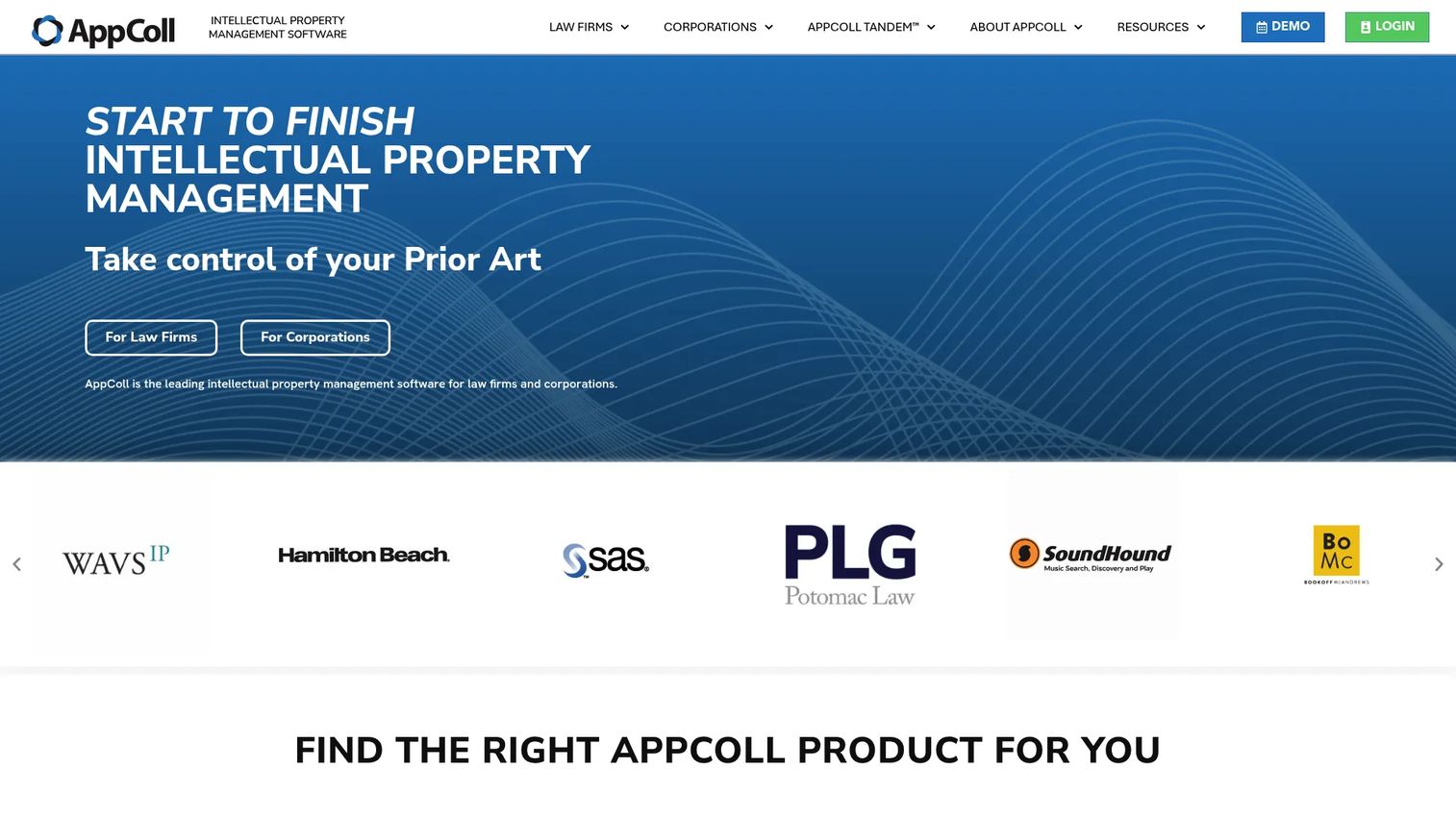
AppColl is cloud-based intellectual property management software built for both law firms and corporate IP teams. It centralizes portfolio and prosecution work in one platform across tasks, matters, prior art, files, contacts, reports, and finances. The modular design lets you buy the workflow coverage you need, from a standalone invention manager to full corporate portfolio administration, which makes it a genuinely flexible pick for teams that do not fit a single mold.
Best for: Law firms and corporate IP teams that want configurable docketing and matter management without an enterprise price tag.
Key strengths
- Automated docketing workflows: Highly customizable, template-driven workflows send emails that keep your team and clients informed automatically.
- Real-time data reports: Live reporting across matters and finances gives you portfolio status without manual assembly.
- Easy data import and export: CSV import and export makes migration and data movement straightforward.
Why choose AppColl: AppColl earns a 4.7/5 on G2, one of the strongest ratings in this category. The reason is fit. It covers the full prosecution and portfolio workflow while staying approachable for smaller firms and lean corporate teams. The finance module, which handles budgets, legal spend, invoice review with configurable approval flows, and expense forecasting, is a real advantage for teams that answer to a CFO.
AppColl pricing: AppColl is a subscription service billed monthly. Its Tandem corporate portal starts at $0, giving corporate clients a single free window into their IP portfolio. AppColl PM Corporate starts at $130 per user per month plus $100 per law firm added. The invention manager plan runs $350 per month for 100 users billed annually, and law-firm plans PM PRO and PM PLUS start at $100 and $130 per month respectively. A free tier is available.
2. Clarivate

Clarivate is the enterprise anchor of this list. It is a global provider of data, analytics, and workflow software spanning academia, IP, life sciences, and healthcare, and its IP Management System (TIPMS) positions as an all-in-one intellectual property management software solution. For organizations that want deadline automation, country-law coverage, portfolio analytics, and a broad IP suite under one roof, Clarivate is the default enterprise conversation.
Best for: Large organizations that need unified IP management with deep suite breadth and enterprise-grade workflow automation.
Key strengths
- Country law engine: Automated jurisdictional rules and recalculations reduce the manual work of tracking deadlines across borders.
- Workflow automation: Prosecution and lifecycle workflows scale across large, distributed IP teams.
- Suite breadth: Patents, trademarks, and broader IP intelligence sit inside a connected data and analytics ecosystem.
Why choose Clarivate: Clarivate owns several of the products further down this list, including FoundationIP, IPfolio, Memotech, and Unycom. That means you can standardize on one vendor and pick the module that matches your team, whether corporate or law firm. The value is a single source of truth backed by Clarivate's data assets, which matters when your portfolio spans dozens of jurisdictions and you need connected analytics rather than isolated records.
Clarivate pricing: Most Clarivate IP products use quote-based pricing, so you will engage sales for a tailored figure. Public pricing exists for some adjacent products but not for the core IP management suite. Expect enterprise packaging with a demo and scoping conversation before any number.
3. FoundationIP
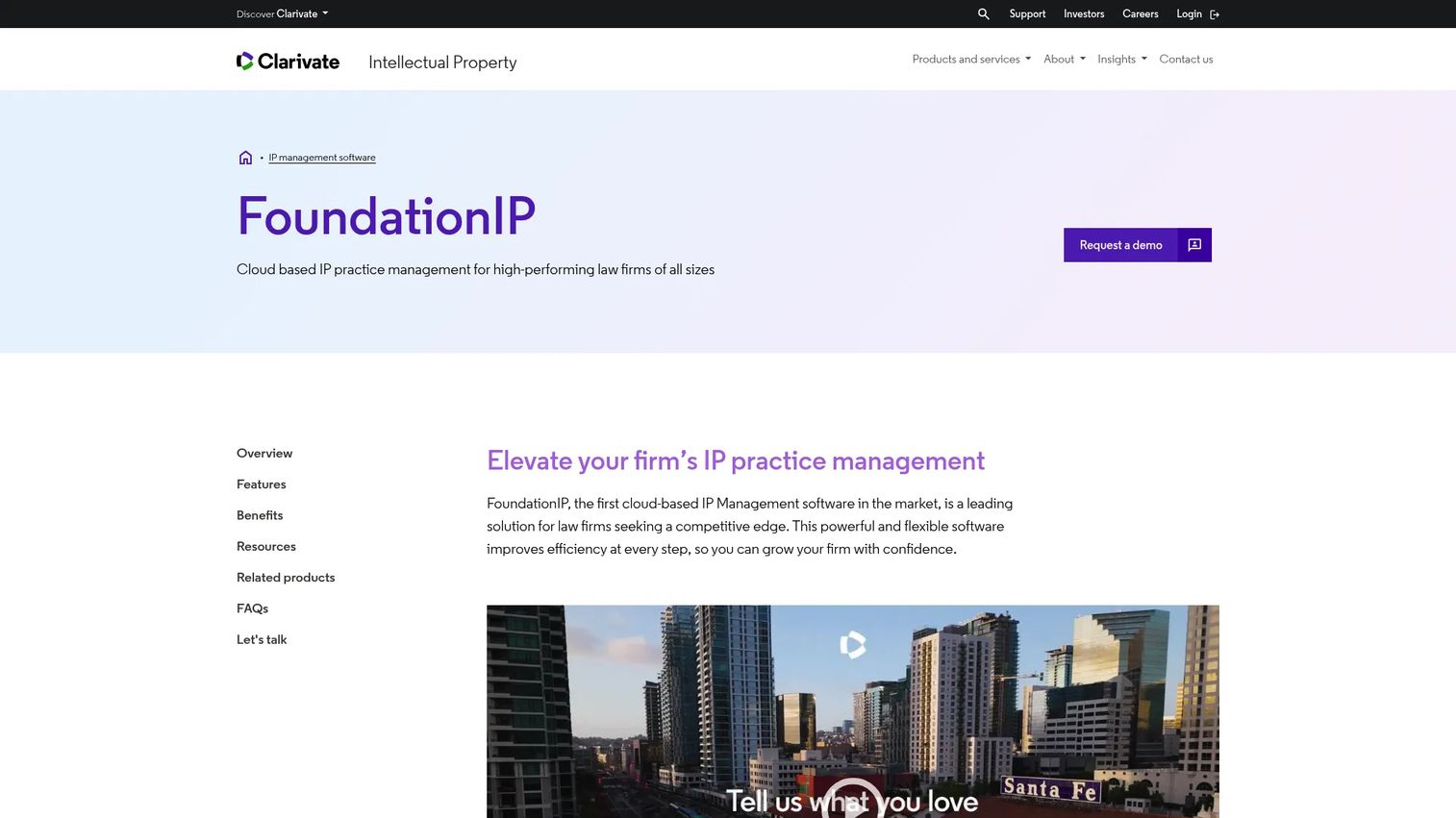
FoundationIP is a cloud-based IP practice management platform built for law firms, and it markets itself as the first cloud-based IP management software in the market. Docketing is its center of gravity. If your firm needs established prosecution infrastructure with strong deadline discipline, FoundationIP is a serious candidate.
Best for: Law firms of any size that need reliable IP docketing and full lifecycle management.
Key strengths
- One-click docketing: Docket directly from USPTO Private PAIR or from an email, with task dashboards and email reminders keeping deadlines visible.
- Automatic law updates: Receive law updates and recalculations three times a year across 300+ jurisdictions.
- Report builder: Build custom charts, graphs, and scheduled complex reports, backed by over 100 system reports and 150+ managed USPTO forms.
Why choose FoundationIP: FoundationIP shines on outside counsel coordination. You can send multiple agent instructions at once from a single collaboration portal integrated with the platform, and import hundreds of references in minutes. It handles patents, trademarks, copyrights, and more in one place, and includes automation for priority lineage, terminal disclaimers, and family tree relationships. Its G2 rating sits at 4.0/5, and it fits firms that value depth of docketing infrastructure over lightweight simplicity.
FoundationIP pricing: FoundationIP does not publish pricing on its site. Plans are quote-based, and the page routes you to request a demo. Budget for an enterprise scoping conversation with Clarivate to get a figure tailored to your firm size and jurisdiction footprint.
4. IPfolio
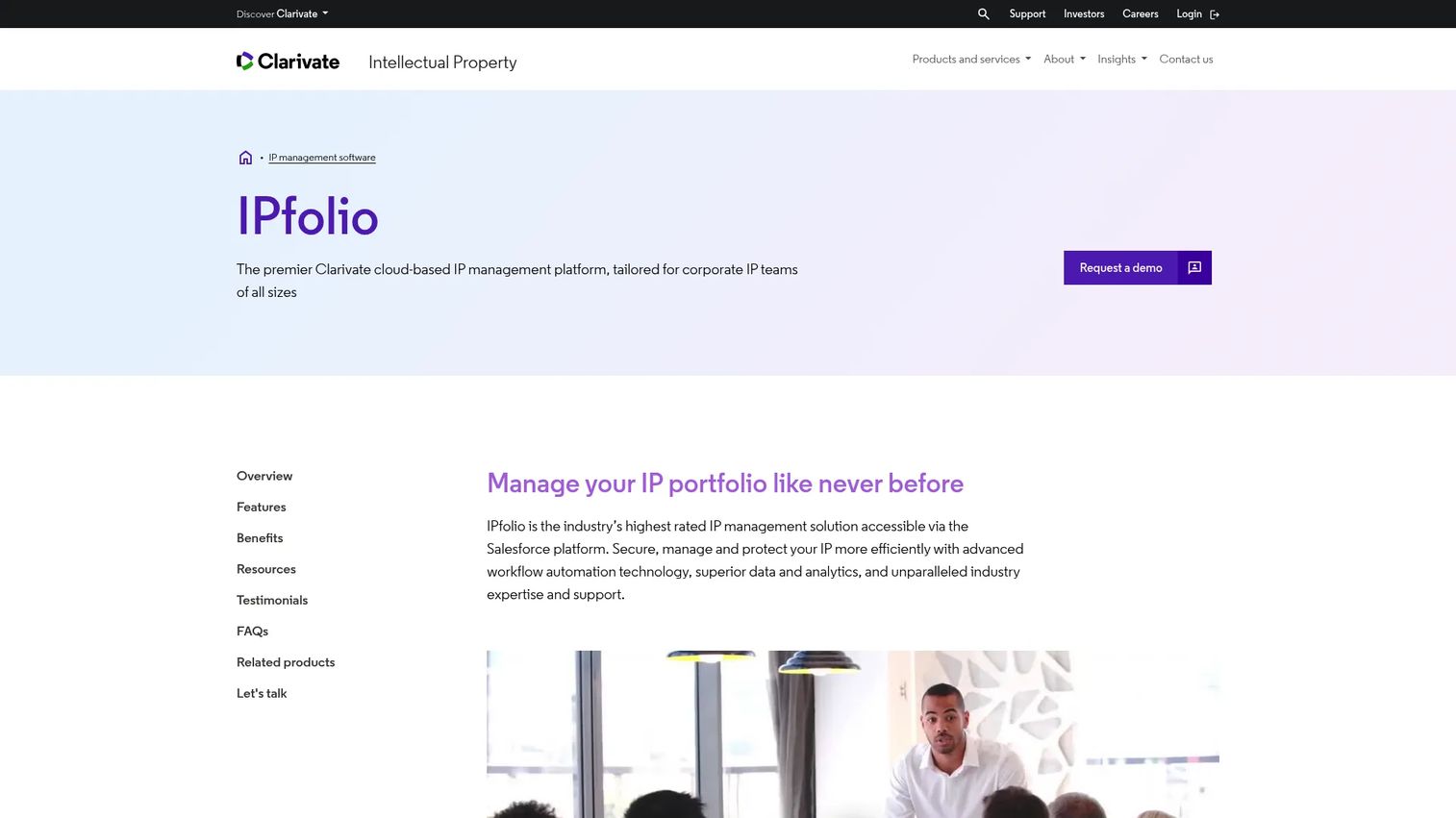
IPfolio is Clarivate's cloud-based IP management platform tailored for corporate IP teams of all sizes. Where FoundationIP leans law firm, IPfolio leans corporate. It focuses on centralized portfolio management, structured IP operations, invention capture, and executive reporting, making it a strong fit for in-house teams that need a clean single source of truth.
Best for: Corporate legal and IP teams managing patents, trademarks, and broader portfolios across the business.
Key strengths
- Centralized portfolio management: One view of the entire corporate IP portfolio, organized for internal collaboration.
- Workflow automation: Automated due-date calculations and workflow routing reduce manual deadline tracking.
- Integrations: Connects with Clarivate data and services plus third-party tools your team already uses.
Why choose IPfolio: IPfolio earns a 4.6/5 on G2, a strong score among corporate-focused platforms. Its value is internal alignment. Disclosure workflows capture inventions from R&D, approval paths route decisions cleanly, and executive reporting gives leadership the portfolio-level view they ask for. If your priority is portfolio visibility and cross-functional collaboration rather than heavy prosecution docketing, IPfolio maps to your reality.
IPfolio pricing: IPfolio does not display public pricing. The site routes users to request a demo, and pricing is handled through Clarivate sales. Plan for a scoping conversation sized to your portfolio and user count.
5. Memotech
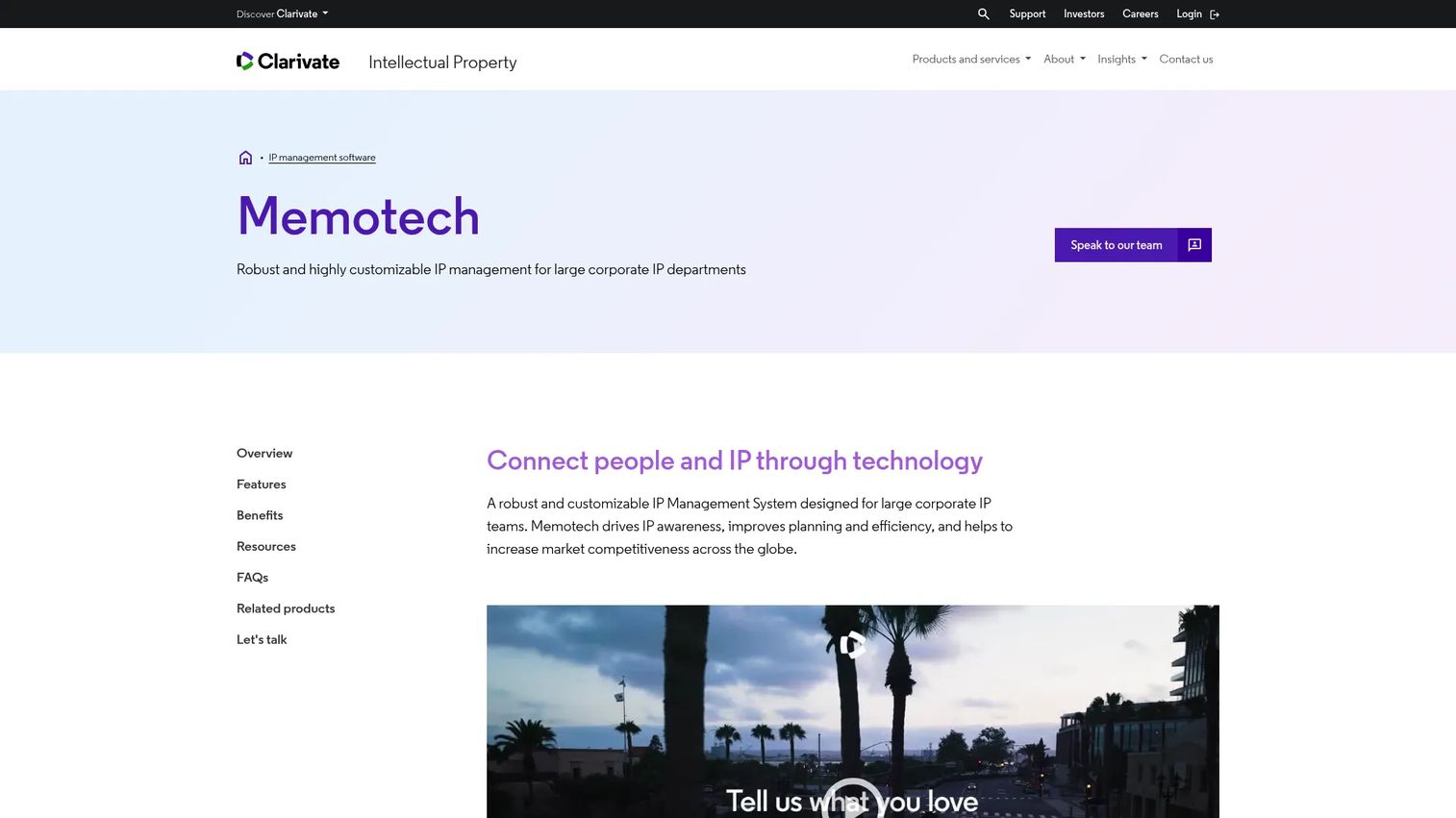
Memotech is Clarivate's highly customizable IP management system designed for large corporate IP departments. It targets organizations that need robust administration, operational consistency, and deep configurability rather than an out-of-the-box template. If your IP operation is large enough to demand tailored workflows and clean data governance, Memotech is built for that scale.
Best for: Large corporate IP departments that need customizable portfolio management and workflow support.
Key strengths
- Portfolio visibility: A structured view of large, complex portfolios for operational oversight.
- Deep analysis: Analytical depth for teams that need more than surface-level reporting.
- Clean, accurate data: Automated data verification checks and corrects bibliographic detail against IP One Data.
Why choose Memotech: Memotech's differentiator is control. Functional roles let you assign different levels of access across a large team, which matters for governance in a big IP department. The automated data verification is a quiet but valuable feature: clean bibliographic data is the foundation of accurate docketing and trustworthy reporting. Its G2 rating sits at 4.0/5 based on a small review base. Choose it when customization and data integrity outrank speed of setup.
Memotech pricing: Memotech does not publish public pricing. Pricing and tier details are handled through Clarivate sales, so expect a demo and scoping conversation tailored to your department's size and requirements.
6. Unycom
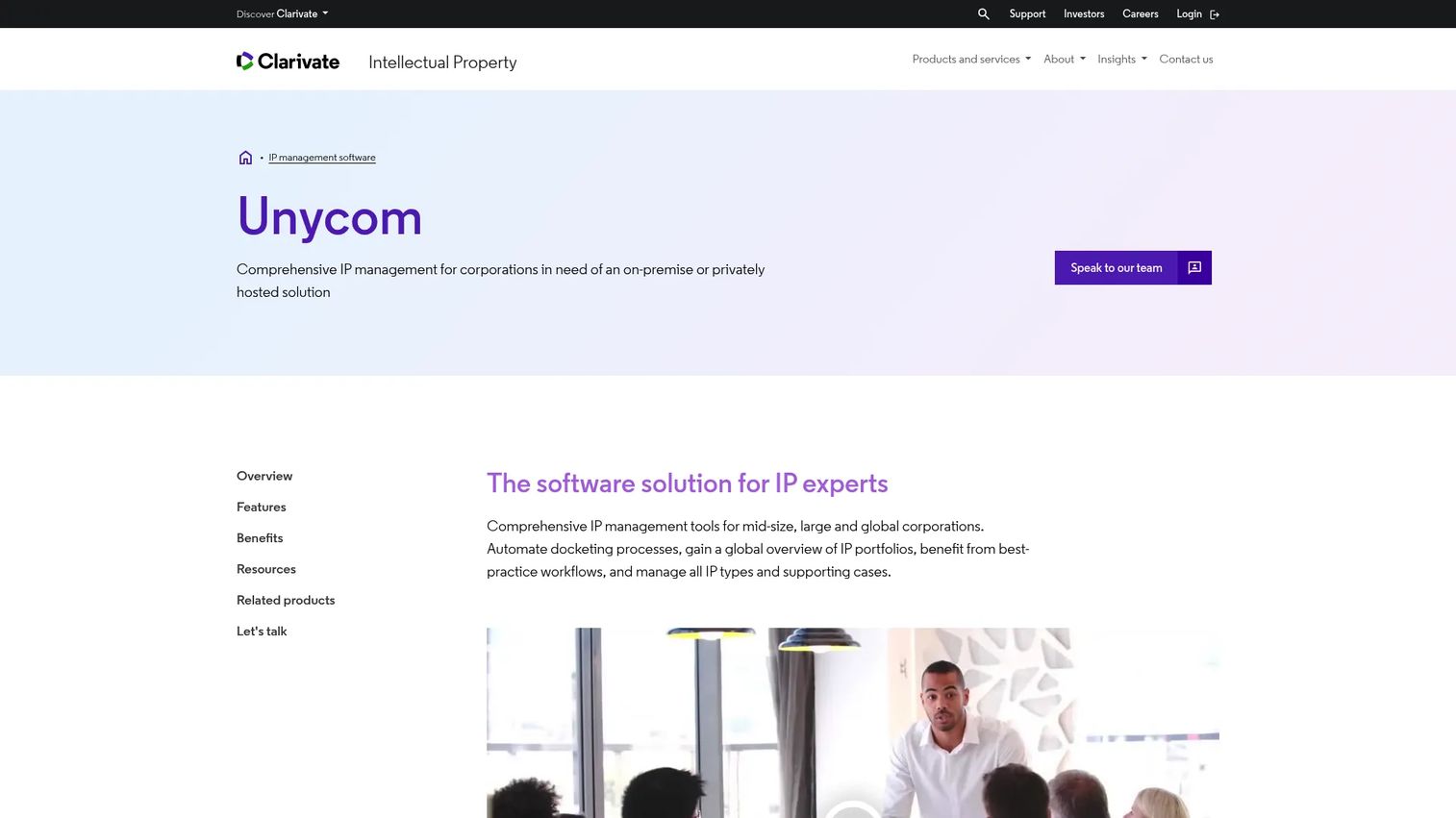
Unycom is Clarivate's IP lifecycle management solution for corporate patent and brand portfolios, and it stands out for one reason many enterprises care about: deployment flexibility. Unycom supports on-premise or privately hosted deployment, which is a genuine differentiator for organizations with strict data-residency, security, or governance requirements that rule out pure cloud.
Best for: Mid-size to global corporations that need IP management software with hosted or on-premise deployment.
Key strengths
- Deployment flexibility: On-premise or privately hosted options for teams with data-control requirements.
- Automated docketing: Automated docketing processes and best-practice workflows across all IP types and supporting cases.
- Portfolio management: Global portfolio overview with analytics, reports, and dashboards.
Why choose Unycom: Unycom fits teams that want broad IP management with portfolio, process, and reporting depth, plus the ability to keep systems inside their own infrastructure. It handles patent, trademark, and design portfolios and supports multi-team collaboration across a global footprint. Its G2 profile does not yet carry a meaningful rating, so weight your evaluation toward a hands-on trial and reference calls. Choose Unycom when deployment control is a hard requirement, not a nice-to-have.
Unycom pricing: Unycom does not publish public pricing. Pricing is quote-based through Clarivate, so plan for a scoping conversation tied to deployment model, portfolio scale, and user count.
7. Anaqua

Anaqua delivers complete intellectual property software and services for enterprise IP departments and law firms. It is built for large-scale, complex patent operations where governance, automation, and portfolio intelligence all matter at once. If your IP department operates at enterprise scale and needs executive-ready visibility across a sprawling portfolio, Anaqua belongs on your shortlist.
Best for: Enterprise IP teams and law firms managing patents, trademarks, and related services at scale.
Key strengths
- AQX Corporate: IP workflow automation, business intelligence, and analytics for corporate departments.
- AQX Law Firm: Workflow simplification and risk reduction tailored to firm operations.
- PATTSY WAVE: Real-time IP portfolio visibility and analytics for fast decision-making.
Why choose Anaqua: Anaqua's strength is breadth at scale. It offers separate products for corporate teams and law firms, so a single vendor can serve both sides of a complex IP operation. Portfolio intelligence and executive visibility are central to the platform, which is what enterprise leadership wants when governing IP spend and strategy. Its G2 seller rating sits at 4.1/5. Choose Anaqua when your operation is large, governance-heavy, and needs analytics-driven portfolio management.
Anaqua pricing: Anaqua does not publish public pricing. The site directs visitors to contact sales, and packaging is enterprise-oriented. Expect a scoping and demo process sized to your department's complexity before you see a number.
8. Patsnap
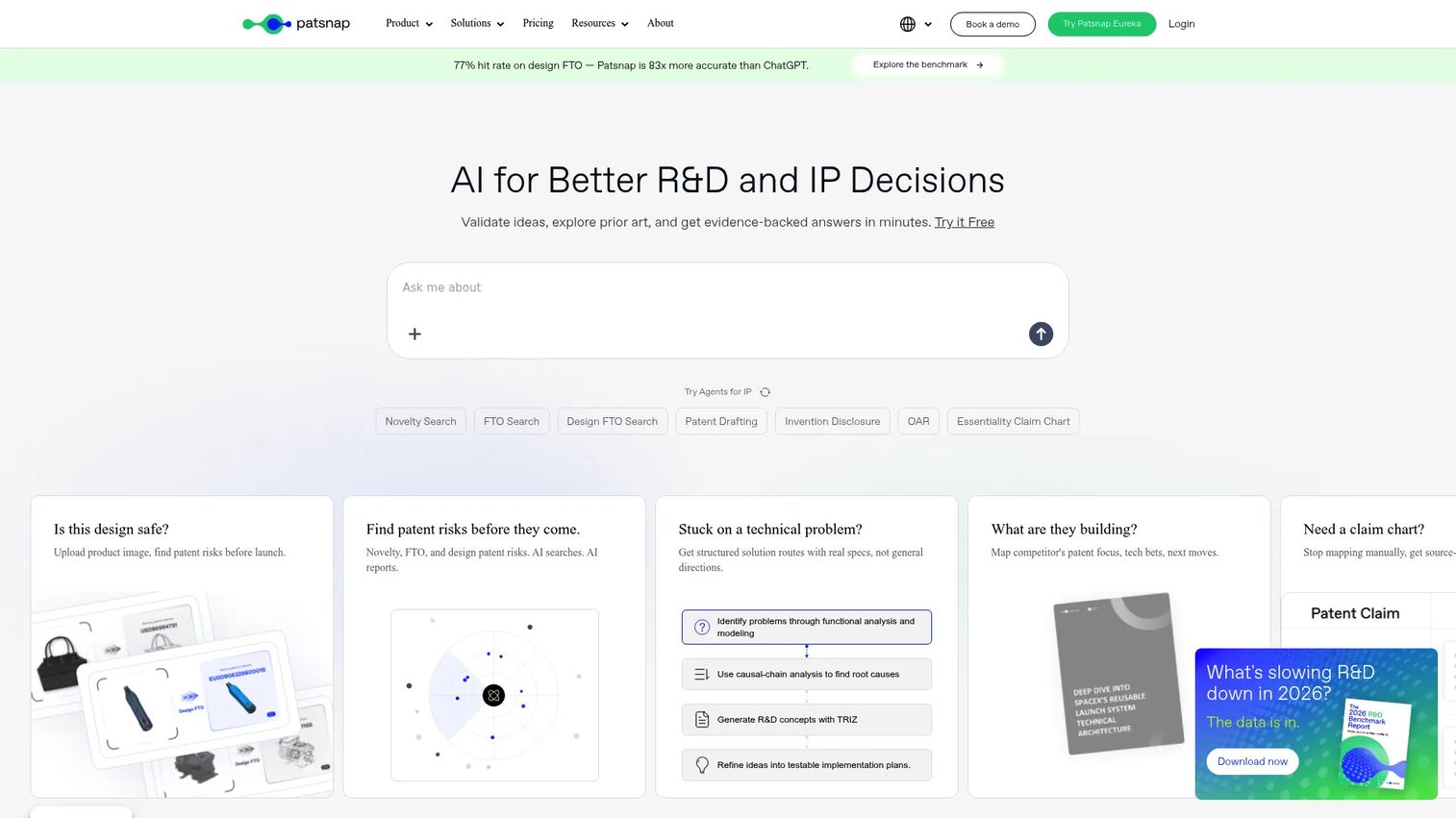
Patsnap is an AI-native innovation intelligence platform for patents, R&D, and related research workflows. It sits slightly apart from pure docketing tools: its center of gravity is patent intelligence, discovery, and competitive research rather than deadline administration. For R&D-heavy organizations that need to inform filing decisions with market and prior-art insight, Patsnap adds a dimension the docketing-first tools do not.
Best for: Teams that need patent, scientific, and competitive-intelligence research in one platform.
Key strengths
- Patent and scientific search: Broad search and analytics across patent and scientific literature.
- AI-assisted workflows: AI agents and assisted workflows speed up research and analysis.
- Competitive and R&D intelligence: Market insight and R&D intelligence to support innovation decisions.
Why choose Patsnap: Patsnap fits the front end of the IP lifecycle, where R&D and product teams decide what is worth pursuing. It supports research workflows, market insight, and idea management adjacency, which complements a dedicated docketing system rather than replacing it. Its G2 rating sits at 4.0/5. Choose Patsnap when your priority is upstream innovation intelligence and competitive research, and pair it with a docketing platform for the administrative side.
Patsnap pricing: Patsnap publishes tiered pricing. A free Basic plan is available, a Pro plan runs $200 per month, and platform and API offerings use Custom pricing. Several product modules carry their own freemium and premium tiers with usage limits, so confirm which modules you need before committing.
9. Alt Legal
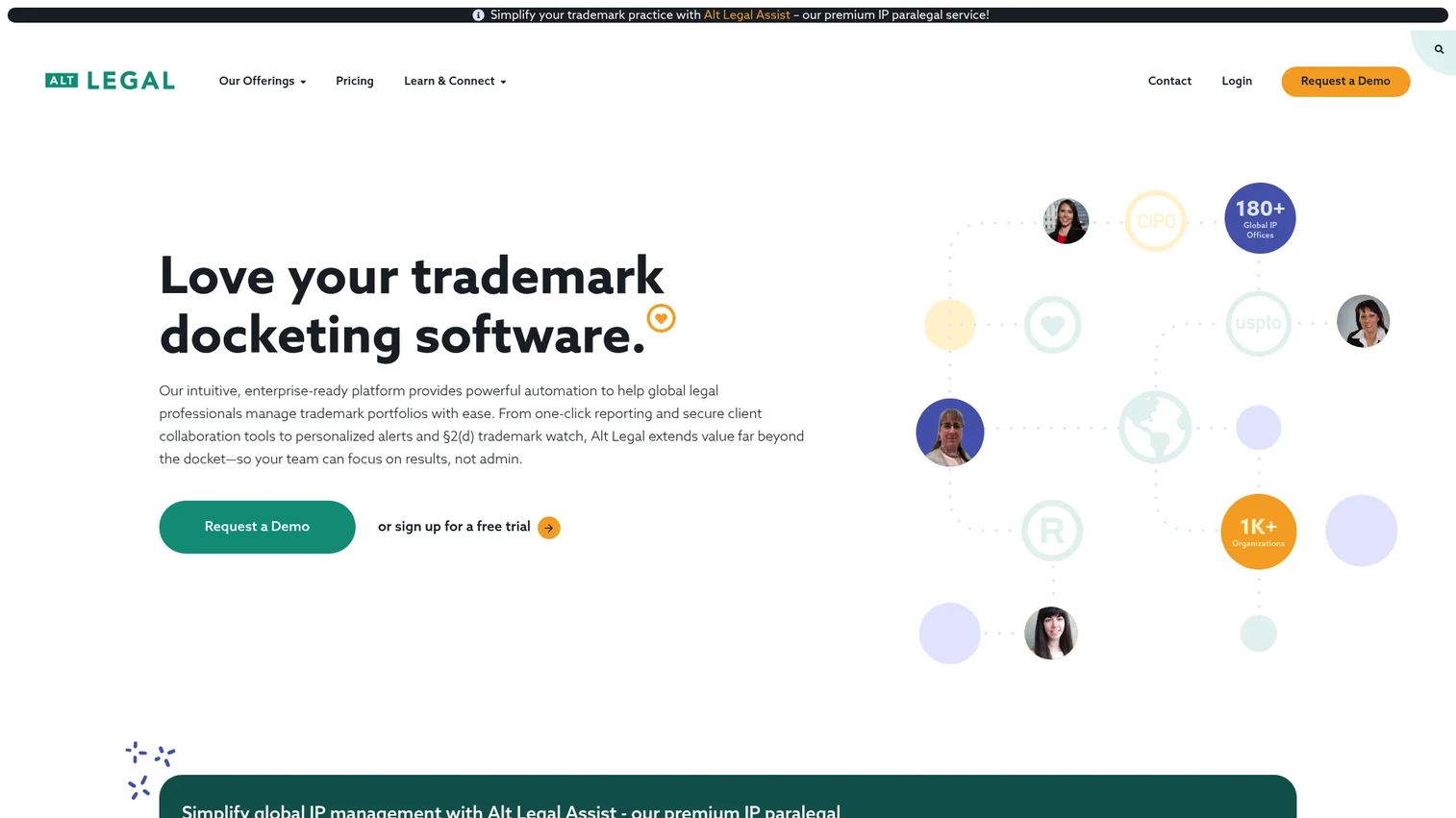
Alt Legal is cloud-based trademark docketing and IP management software that helps legal professionals automate portfolio tracking, deadline alerts, and filings across 180+ global jurisdictions. It is the lightest-weight, most modern-feeling option on this list. If your team wants clean docketing and low admin overhead without an enterprise implementation, Alt Legal is the fast path.
Best for: Law firms and IP teams managing trademark-heavy dockets who want simplicity and speed.
Key strengths
- Automated docketing: Automated docketing and deadline updates across 180+ jurisdictions with minimal manual entry.
- Daily email updates: Daily email updates and calendar sync keep every deadline in front of the team.
- Unlimited third-party docket access: Share docket access without per-seat friction.
Why choose Alt Legal: Alt Legal earns a 4.8/5 on G2, the highest rating in this roundup, largely on ease of use and low administrative burden. Its automation and reminders are built for teams that want deadlines handled without a heavy configuration project. The tradeoff is scope: it leans trademark-heavy and lighter-weight than the enterprise patent suites above. For smaller teams and firms that value implementation speed and simplicity, that is a feature, not a gap.
Alt Legal pricing: Alt Legal prices by total docketed matters. Plans start at $60/month plus $30/month for up to 50 matters, scaling to $195/month plus $60/month for up to 200 matters and $295/month plus $95/month for up to 400 matters. Larger portfolios move to custom pricing. There is no free tier.
Considerations before you buy
Docketing accuracy
Deadline management is the one thing you cannot get wrong. A single missed statutory date can abandon an application or lapse a patent, and no feature elsewhere compensates for that failure. Before you sign, verify country-law coverage for every jurisdiction you file in, test the reminder and escalation logic, and confirm the system keeps a complete audit trail. Ask specifically how the tool recalculates deadlines when rules change, and how often those rule updates land.
Workflow fit
Law firms and corporate teams buy differently, so test the workflow that matches your reality. Firms should stress-test prosecution docketing, client matter management, and outside counsel coordination. Corporate teams should run a real invention disclosure through the intake and approval path, and confirm the routing matches how decisions actually get made. Do not evaluate on a canned demo alone. Load your own scenarios.
Reporting and visibility
Leaders need reporting that goes beyond raw records. Confirm the platform produces portfolio summaries, cost views, and exportable data that map to renewal decisions and budget planning. Check whether dashboards are configurable, whether exports land in formats your finance team can use, and whether you can slice the portfolio by business unit, jurisdiction, or status without a manual pull.
Deployment and integration
Decide early whether cloud deployment, hosted, or on-premise fits your security and governance posture. Then verify integration depth. Confirm the tool connects to your document management, CRM, and data systems, and ask about API access if you need to move data programmatically. Deployment flexibility is exactly where a tool like Unycom differentiates for regulated environments.
Security and governance
Permissions, access control, and change tracking are not optional in an IP system. Confirm the platform supports role-based access so different team members see only what they should, and verify that every change is logged for audit. Ask about SSO, admin controls, and any compliance certifications your organization requires. Governance is what keeps a shared system trustworthy as your team grows.
Conclusion
The right patent management software depends on which job dominates your operation. For enterprise IP departments that need governance, scale, and connected analytics, Clarivate and Anaqua lead. For law firms that live in prosecution and docketing, FoundationIP and AppColl deliver the precision and outside-counsel coordination the work demands. Corporate portfolio teams that need visibility and invention capture will fit IPfolio or Unycom, with Unycom the pick when deployment control is mandatory. R&D-heavy organizations should look at Patsnap for intelligence, and smaller teams will move fastest with Alt Legal's low-overhead docketing.
The honest answer is that no single tool wins on every axis. Docketing depth, workflow automation, and reporting needs pull in different directions, and the law firm versus corporate distinction changes the calculus entirely.
Your next step is practical: shortlist two or three tools from this list, then map each against your real patent workflows. Run a genuine invention disclosure through the intake path. Load your own jurisdictions into the docketing engine. Pull a portfolio report your CFO would actually read. The tool that survives your own workflows, not a vendor's demo, is the one to buy.
FAQs
They overlap heavily, but the scope differs. Intellectual property management software covers all IP types, including patents, trademarks, copyrights, and designs, along with the workflows around them. Patent management software is the narrower workflow focused specifically on patent intake, docketing, prosecution, deadlines, and portfolio oversight. Most platforms handle both, but patents are the largest functional segment, accounting for about 41.3% of IP management spending by type.
Deadline reminders and country-law coverage come first, since a missed statutory date carries the highest cost of any error. Beyond that, look for accurate jurisdictional recalculation when rules change, complete audit trails for compliance, and collaboration features for coordinating with outside counsel. The best patent docketing software automates date calculation so your team is not manually tracking rules across jurisdictions.
Yes, though the categories overlap. Law firm workflows emphasize prosecution, client matter management, and coordination with foreign associates and outside counsel, where docketing precision and billing accuracy are paramount. Corporate teams emphasize portfolio oversight, invention capture from R&D, approval routing, and executive reporting. Tools like FoundationIP lean law firm while IPfolio leans corporate, even though both sit under the same vendor.
It centralizes every deadline in one system, calculates jurisdictional dates automatically, and sends escalating reminders through dashboards and email so nothing depends on one person's memory. Centralized records mean no deadline lives only in a personal calendar or inbox. That said, configuration quality still matters. A poorly set up reminder chain will not protect you, so test the automation and reminders against your real workflows before you rely on them.
Focus on the front end of the IP lifecycle: structured invention disclosure management, upstream idea intake, and collaboration between inventors and legal. R&D teams also benefit from status visibility so inventors can see what happened to their disclosures. Tools with patent intelligence and competitive research, like Patsnap, help R&D decide what is worth pursuing before a filing decision is made.
Look past raw record lists. Strong reporting produces portfolio summaries, cost and status views, and exportable data that support real decisions like renewals and budget planning. Confirm dashboards are configurable, exports land in formats finance can use, and you can slice the portfolio by jurisdiction, business unit, or status. Executive-ready views are what turn an IP management system into a decision tool rather than a filing cabinet.
It depends on your security, control, and integration requirements. Cloud deployment now represents roughly 60 to 71% of IP systems and offers faster setup and easier updates. On-premise or privately hosted options, like those Unycom provides, suit organizations with strict data-residency or governance rules. There is no universal answer. Match the deployment model to your compliance posture and integration needs rather than defaulting to either.
Smaller teams usually win with lighter-weight, faster-to-implement tools. Alt Legal, with its matter-based pricing and 4.8/5 G2 rating, keeps administrative overhead low and gets teams running quickly. AppColl also serves lean teams well, offering a free Tandem corporate portal and modular plans so you only pay for the workflow coverage you use. Prioritize implementation speed and admin simplicity over enterprise depth you will not use.