Your product moves through resale, repair, refurbishment, and recycling. Your data does not follow it. It sits in six spreadsheets, two ERP modules, and a shared drive nobody trusts. So when a regulator, a board member, or a customer asks where a given material actually went, the answer takes three days and a Slack thread.
That gap is the real problem circular economy software solves. Not sustainability slogans. Traceability, governance, and decision speed across closed-loop flows.
The market is moving fast. Mordor Intelligence valued the digital circular economy market at $4.28 billion in 2025, projecting $11.89 billion by 2030 at a 22.67% CAGR. The tooling is maturing, and the spreadsheet-glue era is ending.
This guide compares seven platforms on the criteria that matter to operators, not just compliance teams: lifecycle traceability, ERP and PLM integration, analytics, and support for reuse, repair, refurbish, and recycle workflows.
What's inside
This guide is for founders and operators evaluating circular economy platforms who want an operating advantage, not a reporting checkbox. We compared tools on the factors that decide whether software earns its place in your stack.
Selection criteria:
- Traceability depth: how well the platform tracks products and materials across their lifecycle
- Integration fit: how cleanly it connects to ERP, PLM, and logistics systems
- Workflow coverage: support for reuse, repair, refurbish, recycle, resale, and reverse logistics
- Analytics and governance: lifecycle analytics, compliance reporting, and Digital Product Passport readiness
Every platform here fits at least one of those jobs well. Your shortlist depends on which job is breaking first.
TL;DR
- Best for compliance and lifecycle analytics: iPoint Systems, with product sustainability, LCA, and impact intelligence in one platform
- Best for design-led circularity and virtual twins: Dassault Systèmes, strongest upstream at design and simulation
- Best for ERP-style operational control: Loop ERP, a NetSuite-powered system of record for scrap, recycling, and brokerage
- Best for IT asset and device lifecycle: Foxway for refurbishment services, Evercycle for lifecycle orchestration
- Best for resale commerce: Gierd as a marketplace commerce layer, LoopOS for no-code after-sales orchestration
Shortlist by the job breaking first: compliance, operations, or resale.
What is circular economy software
Circular economy software is a category of operations and sustainability tooling that helps organizations track products and materials across their full lifecycle, then manage the reuse, repair, refurbish, and recycle flows that keep those materials in circulation.
It sits between your ERP, your PLM, and your logistics systems. Instead of treating a sold product as the end of a record, it treats every product as an asset with a lifecycle worth tracking, costing, and governing.
Core capabilities across the category:
- Lifecycle and supply chain transparency: track where materials and products go across repair, reuse, resale, and recycling chains
- Closed-loop workflows: manage trade-in, repair, refurbishment, resale, donation routing, and reverse logistics
- Compliance and sustainability reporting: centralize regulatory reporting, substance data, and material flow accounting
- Circularity analytics: measure circular decisions with LCA, PCF, and impact intelligence
- ERP, PLM, and logistics integration: connect circular data to your systems of record
- Digital Product Passport readiness: structure product data to meet emerging DPP requirements
The distinction worth holding onto: some platforms are compliance and analytics layers, some are operational systems of record, and some are commerce layers for resale. Most buyers need one primary layer and clean integrations to the rest. Naming which layer you need first cuts the evaluation in half.
When to use circular economy software
Improve traceability across products and materials
When a product moves through repair, reuse, resale, and recycling, its data trail fractures at every handoff. Lifecycle traceability keeps one record intact across all of them. That matters when you need to prove chain of custody, answer a regulator, or reconcile what material actually came back versus what was sold.
Connect compliance and sustainability work
Compliance, reporting, and circularity decisions often live in separate tools and separate teams. One system for governance means your substance data, LCA outputs, and sustainability reporting draw from the same source. That is also the foundation for Digital Product Passport readiness, which requires structured, defensible product data rather than a scramble at audit time.
Replace spreadsheets and disconnected workflows
Most circular operations start as spreadsheet glue: one sheet for returns, another for refurb status, a third for resale pricing. It works until volume breaks it. Circular economy software centralizes the decision-making, so your operators stop reconciling versions and start acting on one view. For a founder, that is the difference between a process that depends on one person and a system a new hire can run on day one.
Comparison table
We sorted these seven platforms by how they map to the primary jobs buyers face: lifecycle traceability and compliance, ERP-style operational control, and resale or refurbishment operations. Ratings and pricing reflect what each vendor and its review profiles published at the time of writing. Several vendors in this category use quote-based pricing, which is normal for operations software sold into complex environments.
| # | Product | Best for | Key differentiator | Pricing | G2 rating |
|---|---|---|---|---|---|
| 1 | iPoint Systems | Compliance and lifecycle analytics | Product sustainability, LCA, and impact intelligence in one platform | From €5,000/year | 4.3/5 |
| 2 | Dassault Systèmes | Design-led circularity | 3DEXPERIENCE platform with virtual twins and design for disassembly | From $526/quarter | 4.2/5 |
| 3 | Loop ERP | ERP operational control | NetSuite-powered system of record for circular industries | Custom pricing | Not listed |
| 4 | Foxway | IT asset refurbishment | Circular tech services across DaaS, trade-in, and ITAD | Custom pricing | Not listed |
| 5 | Gierd | Resale marketplace commerce | Unified marketplace sales, pricing, and reconciliation | Custom pricing | Not listed |
| 6 | Evercycle | Device lifecycle orchestration | Workflow automation and vendor orchestration for hardware | From $550/month | Not listed |
| 7 | LoopOS | After-sales orchestration | No-code workflow builder for circular operations | Custom pricing | Not listed |
Best 7 circular economy software tools for 2026
1. iPoint Systems

iPoint Systems is a software company built around product compliance, sustainability, and supply-chain impact intelligence. It handles the parts of circularity most operators dread: substance data collection across suppliers, product carbon footprint and LCA calculation, and defensible compliance reporting. For enterprise teams, the pull is having governance and analytics in one platform instead of stitched across four.
Best for: Manufacturers that need product compliance and sustainability analytics in a single, auditable system.
Key features
- Product compliance and sustainability management
- Supply-chain material and substance data collection
- PCF and LCA calculation and reporting
- Impact intelligence for lifecycle decisions
- Structured data for Digital Product Passport readiness
Why choose iPoint Systems: If your circular economy problem is really a compliance and lifecycle transparency problem, iPoint keeps the data collection, the LCA math, and the reporting in one governed place.
iPoint Systems pricing: The Product Sustainability Core package starts at €5,000 per year, with a free tier available. Growth and Scale packages use custom pricing.
iPoint carries a 4.3 out of 5 rating on its G2 seller profile.
2. Dassault Systèmes

Dassault Systèmes approaches circularity from upstream, where products are designed. Its 3DEXPERIENCE platform brings together 3D modeling, simulation, and virtual twins, which lets teams design for disassembly and model circular scenarios before anything is manufactured. It also supports digital product passports and circular design pathways. This is less an operational reporting tool and more the place decisions about circularity get baked in early.
Best for: Enterprises that want to embed circularity at the design and simulation stage rather than only report on it downstream.
Key features
- 3DEXPERIENCE platform for connected innovation workflows
- Virtual twins for circular scenario modeling
- Design for disassembly and material choices
- Digital product passport support
- Role-based, cloud-based access across teams
Why choose Dassault Systèmes: Choose it when your circular strategy starts at product design and you already need PLM-grade modeling. Operators who mainly need downstream lifecycle tracking may pair it with a more operations-specific tool.
Dassault Systèmes pricing: Its BPM software store lists a quarterly subscription from $526 and a yearly subscription from $1,764, with prices excluding local VAT. Broader platform licensing is quoted per deployment.
Dassault Systèmes holds a 4.2 out of 5 rating on its G2 seller profile.
3. Loop ERP
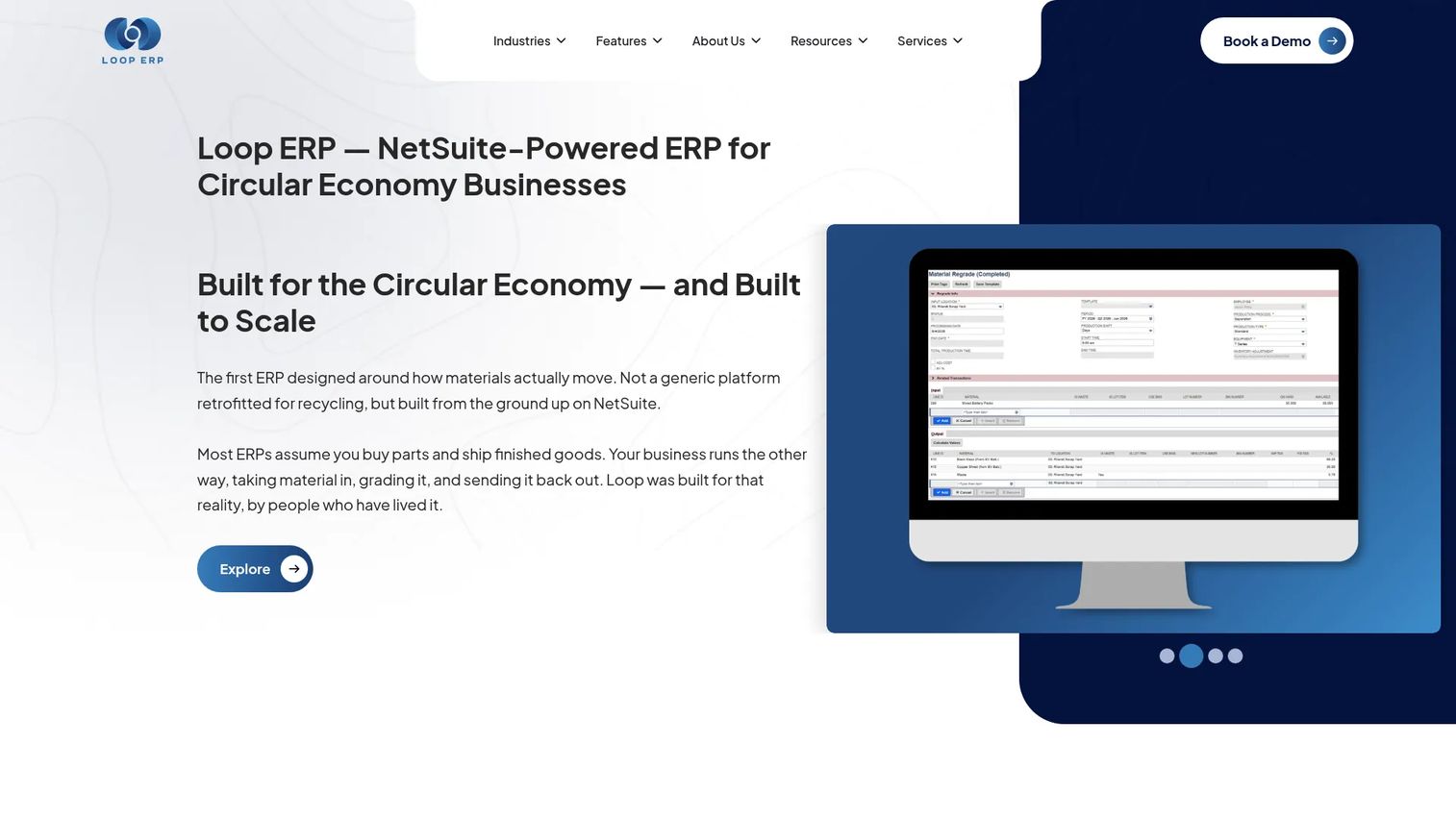
Loop ERP is a NetSuite-powered ERP built for circular-economy and materials-based operations. It targets scrap, recycling, aggregates, and brokerage operators who need one system for both operations and finance. Instead of running logistics in one tool and financials in another, Loop ERP ties inbound and outbound logistics, material traceability, real-time inventory, and condition-based pricing into a single system of record.
Best for: Scrap, recycling, and brokerage operators who want operations and finance in one ERP rather than glued-together tools.
Key features
- Inbound and outbound logistics management
- Traceability and material tracking
- Real-time inventory management
- Dynamic, condition-based pricing
- Compliance and sustainability reporting
Why choose Loop ERP: This is the operational backbone play. If your circular business runs on physical material flows and you want financials tied to lifecycle tickets in real time, Loop ERP is built for that shape.
Loop ERP pricing: Loop ERP directs prospective buyers to request a demo, which is typical for NetSuite-based ERP sold into complex operations.
A current G2 rating for Loop ERP was not listed at the time of writing.
4. Foxway
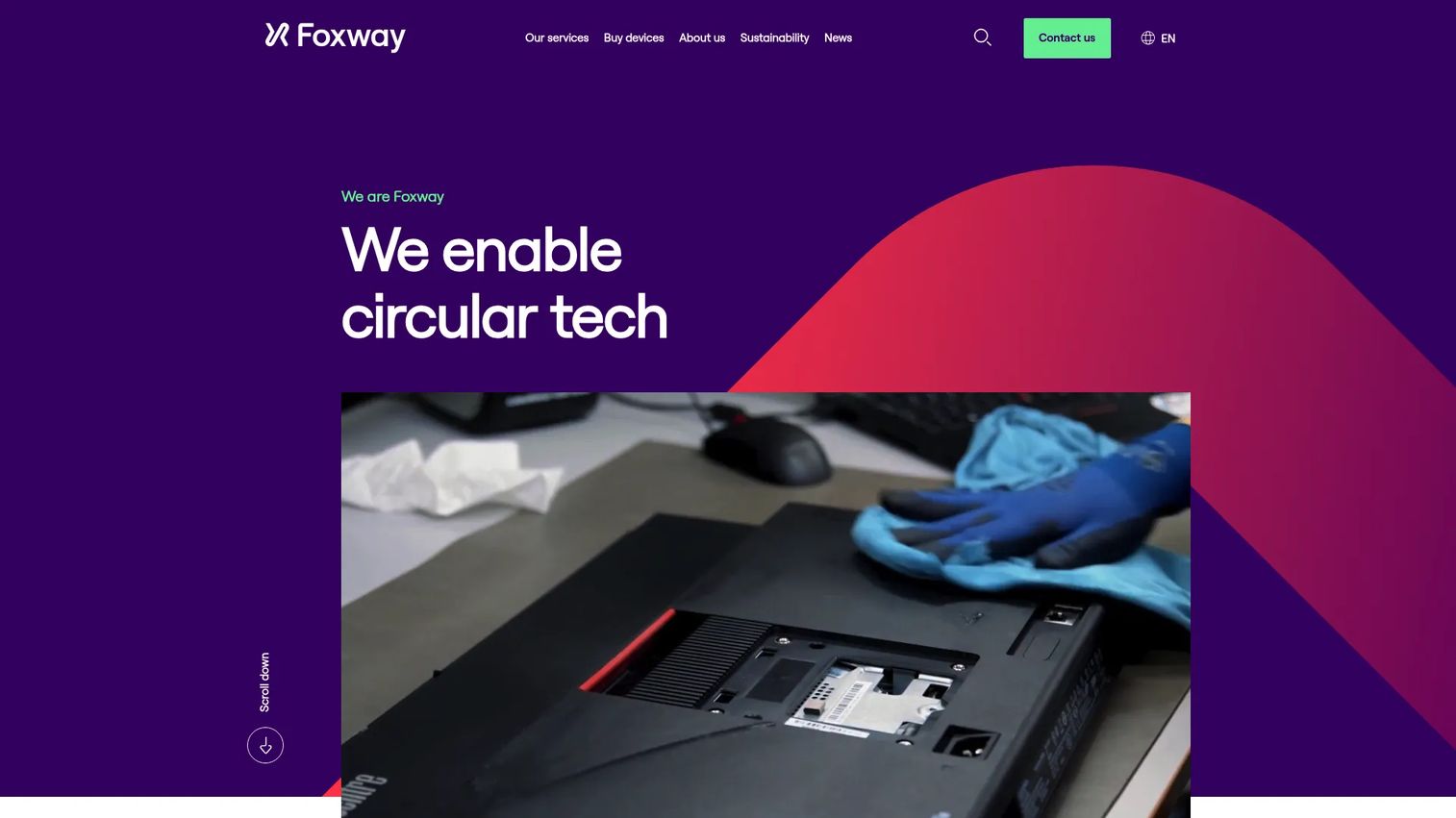
Foxway provides circular tech services centered on device lifecycle. It covers refurbished devices, Device as a Service, asset recovery, trade-in and buyback, and IT asset disposition. For organizations managing large fleets of hardware, Foxway handles the messy middle of device circularity, from sourcing and leasing through refurbishment and resale.
Best for: Large organizations and resellers that need circular IT services and refurbished-device lifecycle management at scale.
Key features
- Device as a Service (DaaS)
- Asset recovery, trade-in, and buyback
- Lifecycle management and IT asset disposition
- Refurbishment and resale workflows
- Sourcing and leasing operations
Why choose Foxway: Choose Foxway when your circularity problem is specifically hardware, and you want a service partner running refurbishment and disposition rather than software you operate yourself.
Foxway pricing: Foxway service pages direct buyers to contact the team, which fits a services-led model priced by fleet size and scope.
A verifiable software rating for Foxway was not available at the time of writing.
5. Gierd
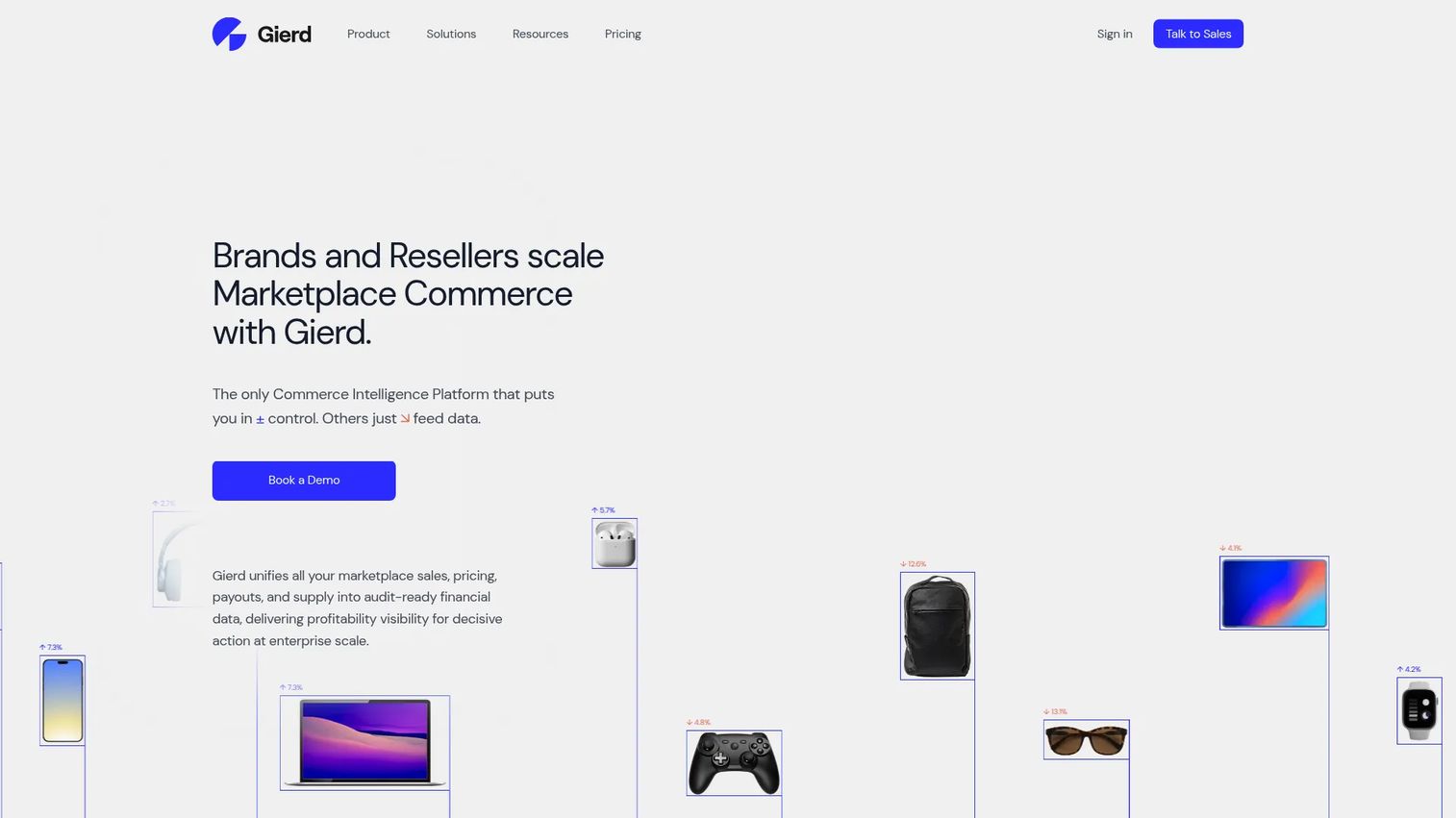
Gierd is an enterprise marketplace commerce platform for sales, pricing, finance, supply, and reconciliation. In a circular context, it functions as the commerce layer for resale and secondary markets. It unifies marketplace sales data, applies AI-driven pricing and forecasting, and closes the loop with audit-ready financial reconciliation so multi-channel resale does not become a reconciliation nightmare.
Best for: Enterprise brands and resellers running resale commerce across multiple marketplaces and channels.
Key features
- Unified marketplace sales, pricing, payouts, and supply data
- AI-driven pricing and forecasting
- Audit-ready financial reconciliation and variance tracking
- Multi-channel resale management
- Fraud and inventory controls
Why choose Gierd: Pick Gierd when resale revenue is real and the pain is commerce and reconciliation, not physical lifecycle tracking. It sits on top of your resale channels and keeps the money side auditable.
Gierd pricing: Gierd uses a flat monthly subscription per company with maturity tiers, plus a performance-based take rate and optional add-on services. Onboarding is free, and the enterprise tiers are quoted directly.
A G2 rating for Gierd was not listed at the time of writing.
6. Evercycle
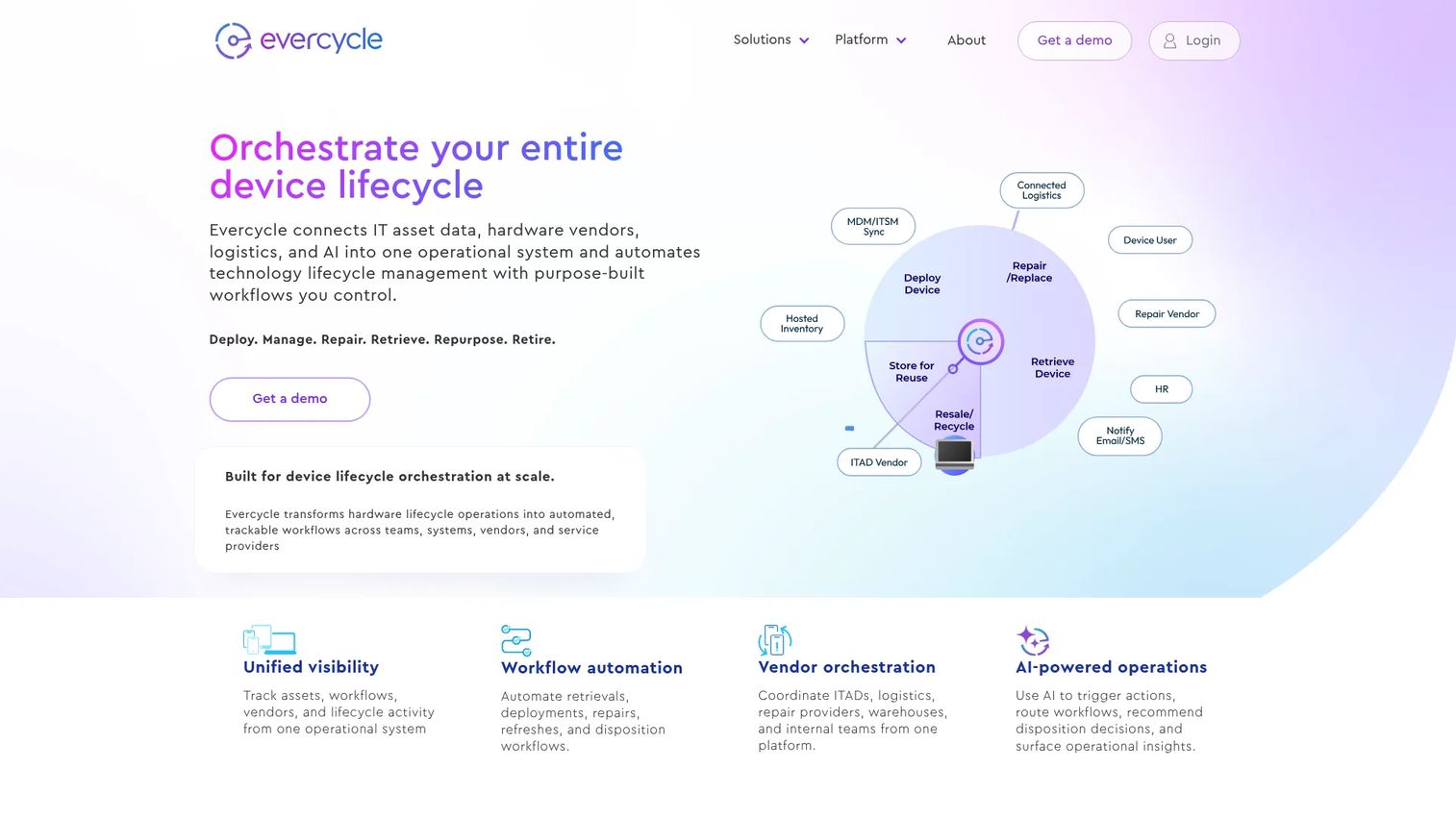
Evercycle is device lifecycle orchestration software for enterprise and service-provider hardware operations. It gives one view across assets, workflows, vendors, and lifecycle activity, then automates the reverse-logistics work: retrievals, deployments, repairs, refreshes, and disposition. AI-assisted routing and disposition recommendations cut the manual coordination that usually eats a lifecycle team's week.
Best for: Enterprises, MSPs, and ITAD providers that need clean lifecycle tracking and reverse-logistics automation.
Key features
- Unified visibility across assets, workflows, and vendors
- Workflow automation for retrievals, repairs, and disposition
- Vendor orchestration across the lifecycle
- AI-assisted routing and disposition recommendations
- Chain-of-custody visibility for reverse logistics
Why choose Evercycle: Choose Evercycle when the problem is coordination overhead, and you want automated orchestration plus clean chain-of-custody data instead of a shared spreadsheet tracking every device.
Evercycle pricing: Enterprise plans start at $550 per month for the parent account, billed annually. Child-account, workflow, and usage fees scale by volume, with a $2 per device or return kit usage fee. Fleets above 50,000 managed devices are quoted directly.
A current G2 rating for Evercycle was not listed at the time of writing.
7. LoopOS
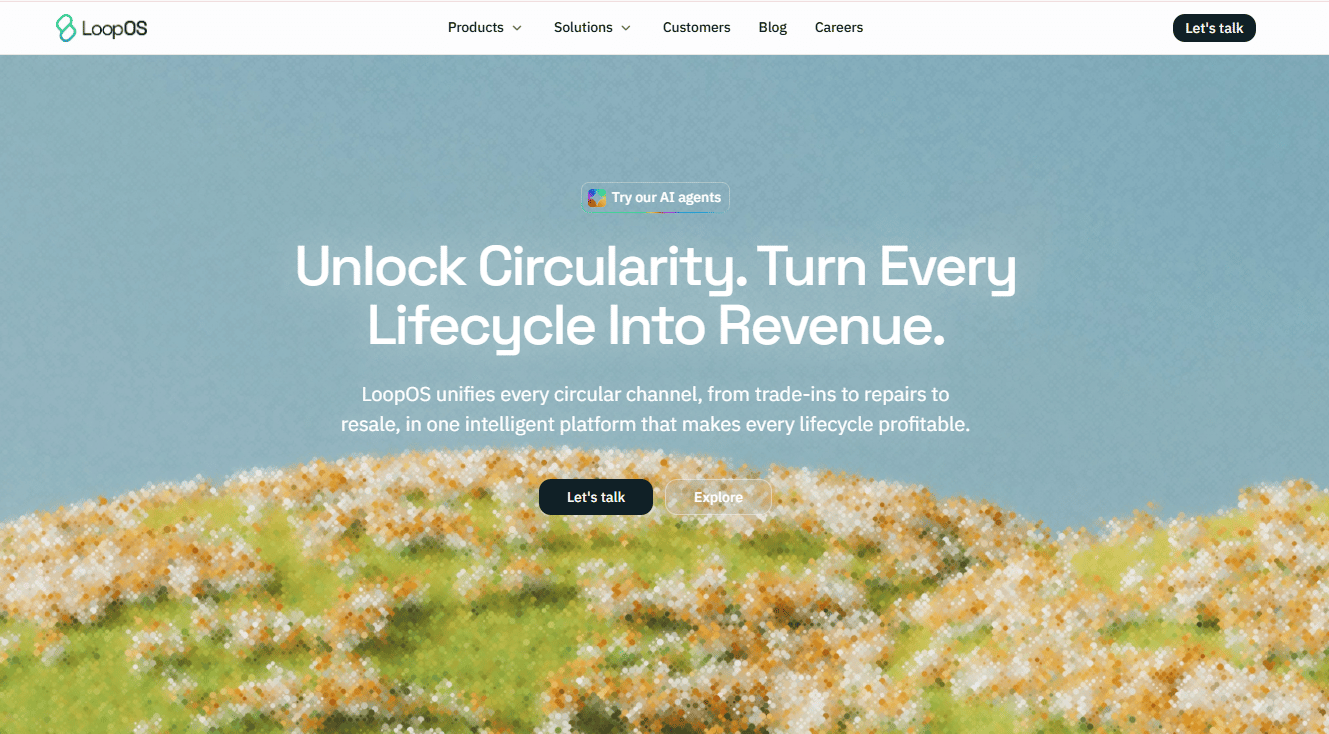
LoopOS positions itself as an operating system for after-sales orchestration and circular operations. Its draw is flexibility: a no-code workflow builder that lets teams assemble trade-in, repair, refurbish, resale, and donation-routing flows without engineering. AI-assisted pricing intelligence and product condition diagnosis sit inside those flows, and it integrates with 30-plus apps to fit an existing stack.
Best for: Enterprises managing returns, repairs, refurbishment, and second-life commerce that want to build workflows without code.
Key features
- No-code workflow orchestration for circular operations
- AI-assisted pricing intelligence
- Product condition diagnosis
- Trade-in, repair, refurbish, resale, and donation routing
- Integrations with 30-plus apps
Why choose LoopOS: Choose LoopOS when your circular operations are varied enough that a rigid system does not fit, and you want operators building and adjusting flows themselves as volume changes.
LoopOS pricing: LoopOS does not publish pricing on its site and invites prospective buyers to talk to sales, which suits a configurable, workflow-driven platform priced by scope.
A verified G2 rating for LoopOS was not available at the time of writing.
Considerations
Before you commit, pressure-test each shortlisted platform against the criteria that actually decide whether it holds up in production.
Traceability depth
Ask how granular the lifecycle record gets. Can it follow a single unit or batch across repair, resale, and recycling, or does it lose the thread at handoffs? Chain-of-custody and material flow accounting are where thin platforms show cracks. If you need to prove where material went, verify that path end to end during evaluation.
Integration fit
Circular software only earns its place if it connects to your systems of record. Confirm native or well-documented ERP integration and PLM integration, plus logistics connections. A platform that cannot sync with your ERP becomes another silo, and another spreadsheet export.
Workflow coverage
Map the tool against your actual flows: reuse, repair, refurbish, recycle, resale, reverse logistics. Some platforms cover commerce but not physical operations. Others do operations but not resale. Name your primary flows first, then check coverage against them, not against a feature list.
Analytics and decision support
Reporting is table stakes. The question is whether the analytics change decisions. Look for LCA, PCF, and circularity analytics that feed operational choices, not just annual reports. Sustainability intelligence is only useful if it reaches the people making pricing and routing calls.
Compliance and governance
Verify Digital Product Passport readiness and how the platform structures product data for governance. Regulations are tightening, and structured, defensible data is far cheaper to maintain than to reconstruct at audit time.
Conclusion
There is no single winner here, because circular economy software splits into three jobs. If compliance and lifecycle analytics are breaking first, a platform like iPoint Systems keeps governance and LCA in one place. If your circularity starts at design, Dassault Systèmes embeds it upstream with virtual twins and design for disassembly. If you run physical material flows, Loop ERP gives you an operational system of record.
For hardware and device lifecycle, Foxway handles refurbishment as a service and Evercycle orchestrates reverse logistics. For resale, Gierd covers marketplace commerce and reconciliation, while LoopOS gives operators no-code control over after-sales flows.
The practical next step: name the job breaking first, shortlist the two platforms built for it, and run a real traceability path plus an ERP integration test before you sign. That single evaluation tells you more than any feature grid. If you also need to show your own product to buyers through a clickable walkthrough rather than static slides, Guideflow is worth a look.
Start your journey with Guideflow today!
FAQs
It tracks products and materials across their full lifecycle and manages the reuse, repair, refurbish, and recycle flows that keep them in circulation. In practice, it connects product data, supply chain information, compliance reporting, and operational workflows into one system so teams can prove chain of custody and act on circular decisions.
An ERP runs your core operations and finance. Circular economy software adds lifecycle traceability, closed-loop workflow management, and sustainability analytics on top of, or integrated with, that ERP. Some tools like Loop ERP are themselves ERP built for circular industries, while others are analytics or commerce layers that sync with your existing ERP.
A Digital Product Passport is a structured record of a product's materials, origin, and lifecycle data, increasingly required by regulation. DPP readiness means the software captures and structures that data in a defensible, exportable form. It saves you from reconstructing product histories under audit pressure, because the data is already governed and organized.
Sustainability and compliance teams use it for reporting and governance. Operations teams use it for reverse logistics, refurbishment, and resale workflows. Finance uses it for reconciliation and lifecycle costing. For founders scaling circular operations, it centralizes visibility so decisions do not route through one person.
Yes. Most platforms in this category handle trade-in, repair, refurbishment, resale, and donation routing. Tools like LoopOS let operators build these flows with no code, while Evercycle automates device retrievals, repairs, and disposition. Match the workflow depth to your primary flows before buying.
Track reduction in manual coordination hours, faster traceability response times, and recovered material value through resale and refurbishment. Also measure compliance cost avoidance and reconciliation accuracy. The clearest signal for a founder is when circular operations stop depending on a single person and start running as a repeatable system.
ERP integration and PLM integration come first, because they connect circular data to your systems of record. Logistics and marketplace integrations matter for reverse logistics and resale. Confirm these are native or well-documented before committing, since a platform that cannot sync becomes another silo.
Not universally. Compliance and sustainability platforms like iPoint Systems build LCA and PCF calculation directly into the product. Operational and commerce-focused tools may not, relying instead on integrations or separate analytics. If lifecycle assessment is central to your reporting, verify it is native rather than assumed.