You opened the same spreadsheet again this morning. Forty tabs. Three of them broke last week when someone reformatted a column. The buy is due Friday, and you still cannot say with confidence which 200 stores should carry the premium line and which 400 should not.
That gap between what your data knows and what your planning tools let you act on is where margin leaks out. Carry the wrong product in the wrong store and you eat markdowns. Hold back the right product and you stock out during peak. Both happen at once across a chain of any size, and a static rule set cannot tell the difference.
The market is responding. The global retail assortment planning software market was valued at USD 2.29 billion in 2024 and is forecast to reach USD 5.8 billion by 2035, growing at an 8.8% CAGR through 2035, according to WiseGuy Reports (2025). Cloud-based deployments alone accounted for USD 1.24 billion of that 2024 figure. As of June 2026, GetLatka counts 48 SaaS companies focused specifically on this category, serving 5,700 customers between them.
Most buyers evaluating these tools come from one of four pain points: too much manual work in Excel, inconsistent store-level decisions, weak linkage between assortment and financial targets, or poor alignment across merchandising, planning, and replenishment. If you run product or planning at a retailer, this guide ranks the platforms worth your shortlist and shows where each one actually fits. For adjacent operational software decisions, you may also find our roundups of contract lifecycle management and loyalty management tools useful as you build out the broader retail stack.
What's inside
This guide covers eight enterprise and mid-market retail assortment planning solutions chosen for the capabilities that separate real planning depth from spreadsheet replacement: AI and analytics support, store clustering and localization, financial governance through merchandise planning and open-to-buy, omnichannel coordination, seasonal and lifecycle planning, and SKU rationalization.
We ranked each tool on retail fit, planning depth, automation maturity, and cross-functional usability. The goal is a practical shortlist, not a vendor brochure, so every entry tells you who it serves best and when it is the stronger choice. You will leave able to narrow eight options down to two or three worth a demo.
TL;DR
- Best for enterprise planning platforms: o9 Solutions, for unified planning that ties assortment to demand, supply, and finance across a large organization.
- Best for AI-led assortment decisions: Impact Analytics, for agentic AI that connects planning, pricing, and replenishment in one decision layer.
- Best for store clustering and localization: Retano, for cluster-based assortment corrections and shelf-level execution across retail chains.
- Best for visual and fashion-driven planning: Centric Software, for apparel and consumer goods teams that plan against visual boards.
- Best for validating changes before rollout: Curate by Vision Group, for simulating assortment changes against POS and loyalty data before committing.
- Best for fast, data-led category decisions: Zenline AI, for category teams that want assortment intelligence starting from public data.
What is retail assortment planning software?
Retail assortment planning software is a system that helps retailers decide which products to carry, where to carry them, and in what quantities, by connecting demand data, store characteristics, and financial targets into a single planning workflow.
In practice it answers three questions at once: what goes in the range, which stores or clusters get it, and how the buy maps to budget and margin goals. Done well, it replaces the spreadsheet sprawl that breaks every season with a repeatable, governed process.
The capabilities that matter most:
- AI and analytics support: demand forecasting, attribute-based clustering, and exception flagging that surface where a plan is drifting from reality.
- Store clustering and localization: grouping stores by demand pattern, demographics, or space so assortments fit local behavior instead of a national average.
- Financial governance: merchandise financial planning and open-to-buy controls that keep the assortment inside budget, margin, and inventory targets.
- Omnichannel coordination: a single view of assortment across stores, e-commerce, and fulfillment so online and in-store ranges stay coherent.
- Seasonal and lifecycle planning: building, transitioning, and exiting ranges across seasons without manual rework each cycle.
- SKU rationalization and inventory efficiency: identifying overlap and underperformers so the range stays tight and capital is not trapped in slow movers.
When to use retail assortment planning software
When store assortments vary too much by location
A broad, one-size-fits-all range almost guarantees mismatches. The same SKU that turns weekly in an urban flagship sits dead in a suburban store for a month. National assortments smooth over real differences in demand, demographics, and space, and the cost shows up as simultaneous stockouts and markdowns. Assortment planning tools with store clustering let you build localized ranges that match how each cluster actually buys, which protects both margin and availability.
When planning is still trapped in spreadsheets
Excel scales until it doesn't. The moment your plan spans hundreds of stores and thousands of SKUs across multiple seasons, version control breaks, formulas decay, and one bad paste ripples through the whole buy. Assortment management software automates scenario planning, approval routing, and exception handling so the planning team spends its time on decisions instead of cell maintenance. The instrumentation also makes the process auditable, which matters when finance asks why a buy changed.
When merchandising and finance are out of sync
Assortment decisions that ignore the financial plan create the worst kind of surprise late in the season. If the range is built without open-to-buy and merchandise financial planning baked in, buyers commit to product the budget cannot absorb. Software that ties assortment directly to budget, margin, and inventory constraints keeps merchandising and finance reading from the same numbers, so the plan that gets approved is the plan that gets executed.
Comparison table
We ranked these platforms on retail fit, planning depth, automation maturity, and cross-functional usability. Pricing for this category is almost universally quote-based, so we have noted publicly available pricing where it exists and flagged where vendors route buyers to sales. G2 ratings reflect each tool's current listing where available.
| # | Product | Intent | Key use case | Pricing | G2 rating |
|---|---|---|---|---|---|
| 1 | o9 Solutions | Enterprise unified planning | Assortment tied to demand, supply, and finance | Custom (contact sales) | 4.2/5 |
| 2 | Board | Configurable planning platform | Modeling assortment within a connected operating model | Custom (contact sales) | 4.4/5 |
| 3 | Oracle Retail | Enterprise retail operations | Assortment within a full merchandising stack | Custom (pay-as-you-go) | 4.1/5 |
| 4 | Centric Software | Visual, fashion-led planning | Apparel and consumer goods assortment on visual boards | Custom (request demo) | 4.3/5 |
| 5 | Retano | AI retail management | Cluster-based assortment and shelf planning | Not publicly listed | Not listed |
| 6 | Zenline AI | Assortment intelligence | AI-led category and assortment decisions | Free initial audit | Not listed |
| 7 | Curate by Vision Group | Pre-rollout simulation | Testing assortment changes before commit | Not publicly listed | 4.8/5 |
| 8 | Impact Analytics | AI-native retail planning | Assortment connected to pricing and replenishment | Custom (contact sales) | 4.5/5 |
1. o9 Solutions
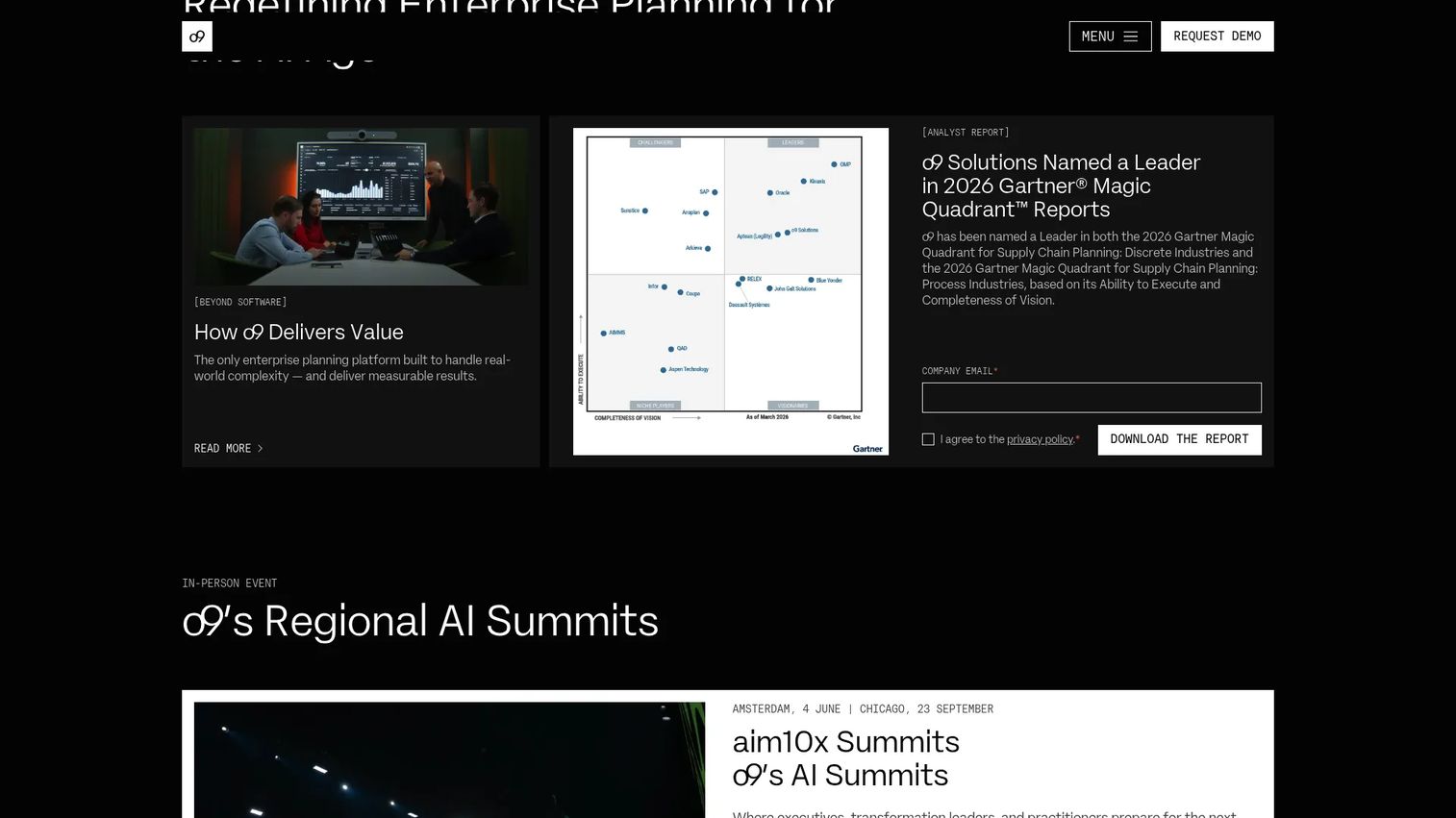
o9 Solutions is an enterprise planning and execution platform that runs supply chain, commercial, product, and financial planning on one connected system the company calls the Digital Brain. For assortment work, that means clustering and range decisions never sit in isolation. They connect directly to demand forecasts, supply constraints, and financial plans, so a change to the assortment immediately reflects in the buy and the budget.
This is the platform you choose when assortment is one node in a much larger planning problem. Large retailers running integrated business planning across finance, marketing, sales, and supply chain use o9 to keep merchandise planning aligned with everything downstream of it.
Best for: Large enterprises that need unified planning and decision-making across supply chain and commercial functions, not a standalone assortment tool.
Key strengths
- AI-driven Digital Brain platform: A unified data and modeling layer that connects assortment to demand, supply, and finance in real time.
- Integrated business planning: Assortment decisions read against finance, marketing, sales, and supply chain plans so the buy stays coherent end to end.
- End-to-end planning scope: Demand, supply chain, revenue growth management, merchandise planning, supplier collaboration, and sustainability in one platform.
Why choose o9 Solutions: If your bottleneck is the disconnect between merchandising and the rest of the planning organization, o9 closes it structurally rather than through integrations. The trade-off is scope. This is a large platform decision, best suited to organizations ready to plan holistically rather than solve assortment alone. o9 was named a Leader in 2026 Gartner Magic Quadrant reports.
o9 Solutions pricing: o9 does not publish pricing on its site, and G2 confirms pricing details are not currently available. Expect an enterprise, quote-based engagement scoped to your planning footprint. Contact o9 directly for a tailored quote.
2. Board
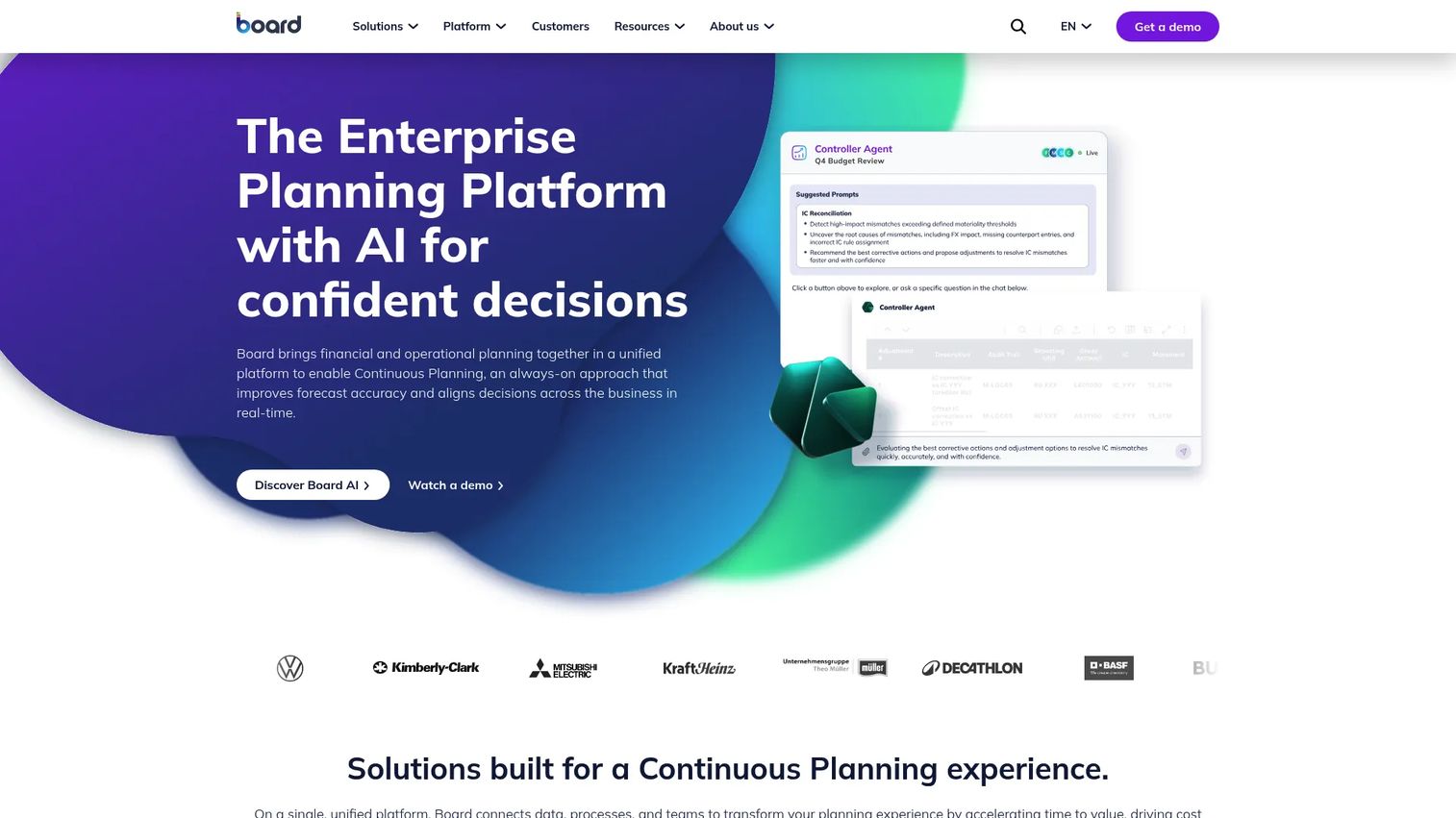
Board is an enterprise planning platform that spans finance, supply chain, retail, sales, HR, and predictive analytics. Its retail planning capabilities are built to replicate a retailer's full operating model, including customer, inventory, revenue, and SG&A, inside one connected platform. For assortment teams, that means continuous assortment sensing and AI-driven clustering that adapt plans as customer behavior and market conditions shift.
The platform's strength is configurability. Rather than forcing a fixed planning template, Board gives teams drag-and-drop analysis, real-time modeling, and pre-built data connectors to shape the planning process around how they actually work.
Best for: Mid-market to enterprise teams that want a configurable planning and analytics platform they can model to their own assortment logic.
Key strengths
- Connected operating model: Replicates customer, inventory, revenue, and SG&A in one platform so assortment plans tie to the full P&L.
- AI-driven clustering and sensing: Continuous assortment sensing adapts plans in real time to customer behavior and market shifts.
- Flexible deployment and modeling: On-premise, hosted, or cloud, with drag-and-drop analysis, real-time modeling, and granular cell-level security.
Why choose Board: Teams that have outgrown rigid planning tools but do not want to hand modeling logic to a vendor pick Board for its configurability. The collaboration and security controls also make it a fit where multiple stakeholders touch the same plan and governance matters.
Board pricing: Board's pricing page shows only solution-specific "Request pricing" calls to action and asks visitors to request a customized quote. No public price is displayed. Pricing is scoped per deployment.
3. Oracle Retail
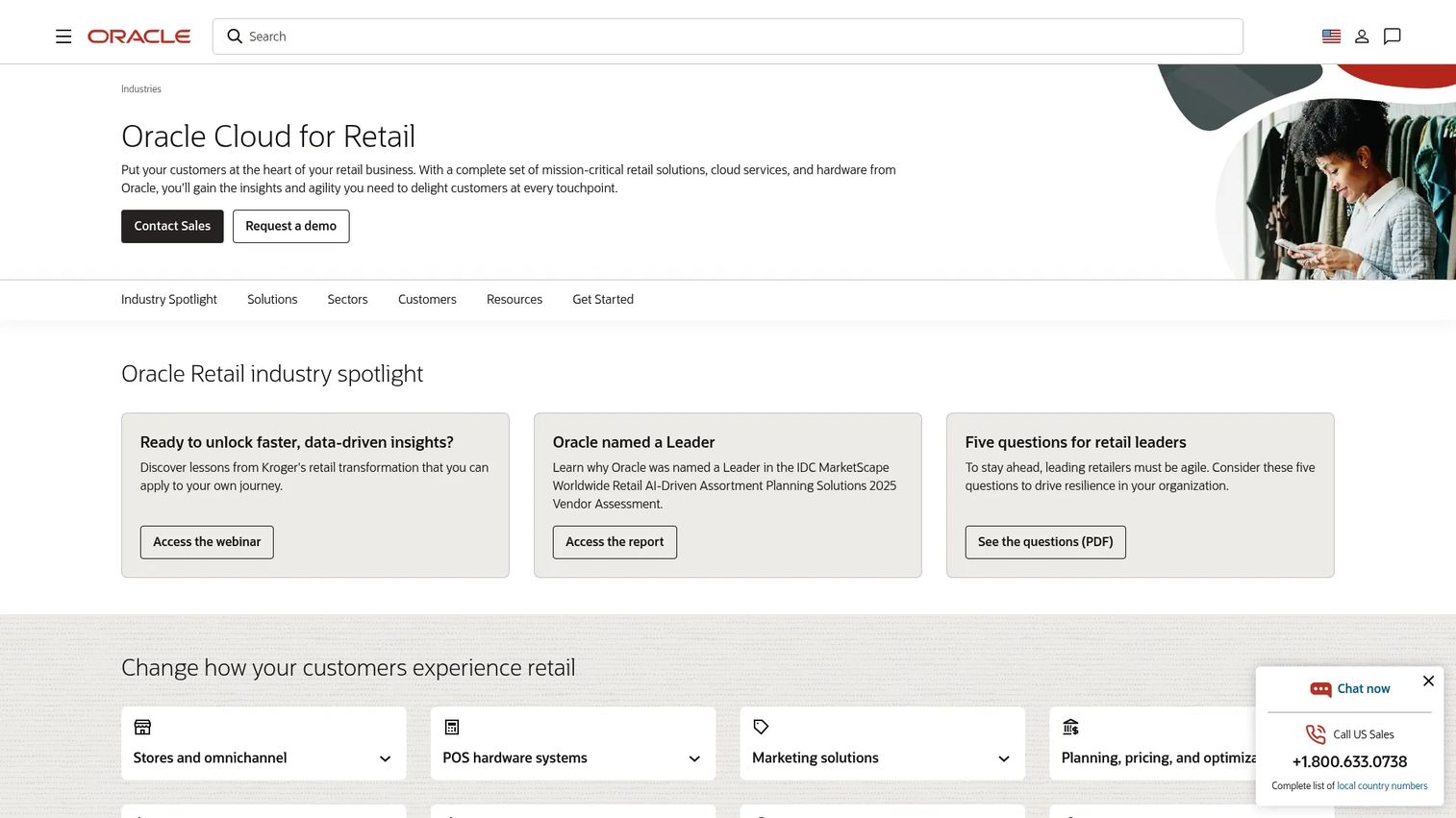
Oracle Retail is Oracle's retail software suite covering merchandising, pricing, planning, POS, analytics, and related cloud services. Its assortment planning sits inside a much larger merchandising and operations ecosystem, which is the point. For retailers already running Oracle, assortment decisions feed directly into the Merchandising System for purchasing, distribution, and order fulfillment, and into Retail Pricing for regular, promotional, and clearance pricing across touchpoints.
The Retail Data Store consolidates sales, inventory, pricing, promotions, customers, orders, demand, and supplier data, which gives assortment planning a deep, unified data foundation that few standalone tools can match.
Best for: Large retailers that need an integrated Oracle retail operations stack rather than a point solution for assortment.
Key strengths
- Integrated merchandising system: Assortment connects to purchasing, distribution, order fulfillment, and financial close in one suite.
- Unified retail data store: Consolidates sales, inventory, pricing, promotions, customers, orders, demand, and supplier data across channels.
- Full pricing coverage: Regular, promotional, and clearance pricing across every touchpoint, tied to the same data as assortment.
Why choose Oracle Retail: The case for Oracle Retail is ecosystem depth. If you already run Oracle's merchandising and pricing stack, planning assortment inside the same platform removes integration overhead and keeps one version of the data. For retailers outside the Oracle ecosystem, the calculus shifts toward lighter, faster-to-deploy alternatives.
Oracle Retail pricing: Oracle's retail page references a pay-as-you-go price list, but no public numeric price was visible. Pricing is enterprise and consumption-based. Contact Oracle for a scoped quote.
4. Centric Software
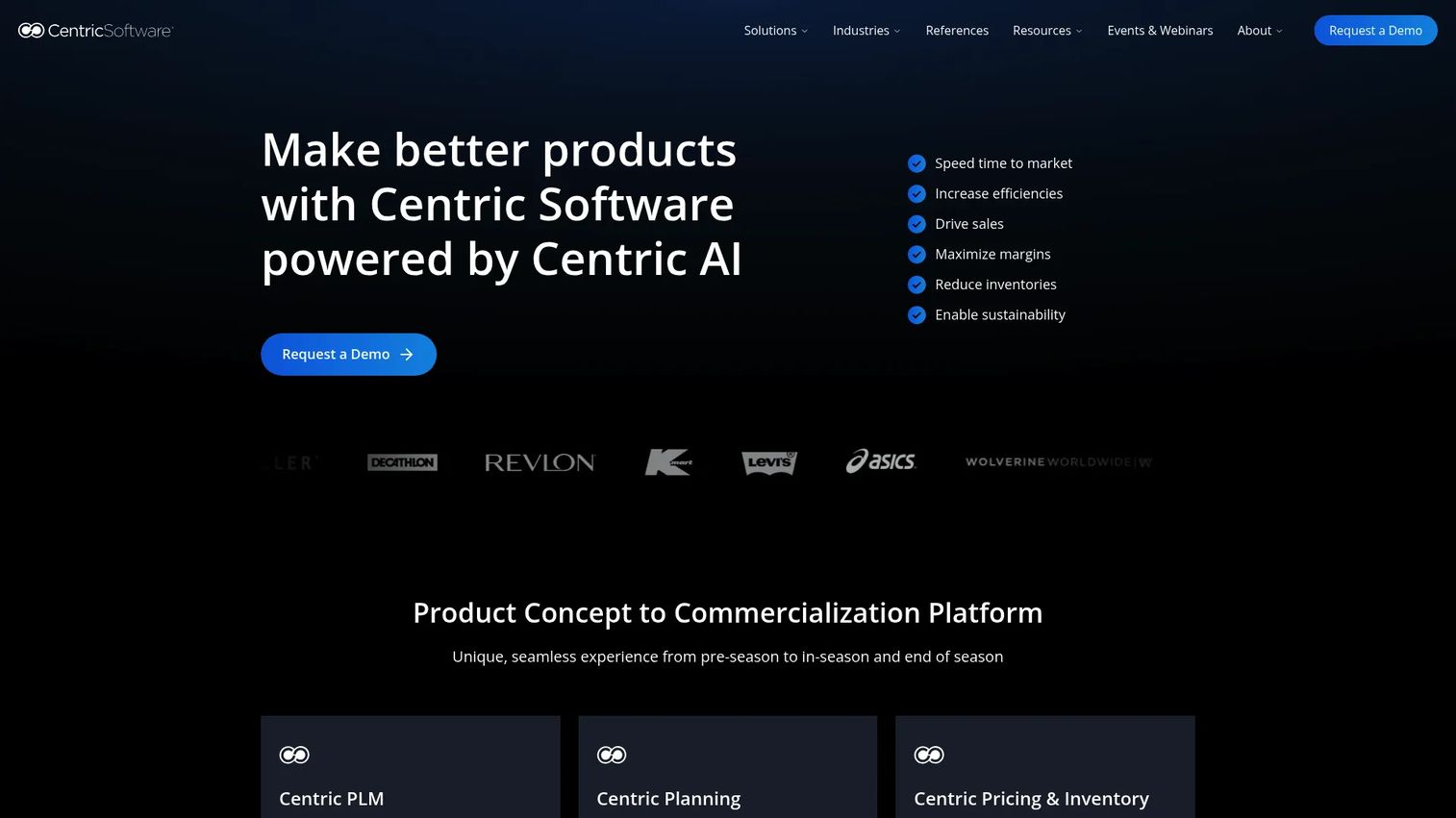
Centric Software builds enterprise software for the full product concept-to-commercialization lifecycle, including PLM, planning, pricing, market intelligence, visual boards, and product experience management. Centric Planning is the assortment and merchandise planning layer, and its visual boards make it a natural fit for categories where the range is as much a visual decision as a numeric one.
For apparel, fashion, and consumer goods teams, planning an assortment on a visual board mirrors how merchants already think. AI-enhanced predictive pricing and inventory optimization sit alongside the planning tools, so visual range decisions stay connected to margin and stock reality.
Best for: Global consumer goods brands and retailers that need enterprise PLM and visually driven retail planning in one place.
Key strengths
- Visual boards for planning: Merchants build and review assortments visually, matching how fashion and consumer goods teams actually plan.
- AI-enhanced pricing and inventory: Predictive pricing and inventory optimization keep visual decisions tied to margin and stock.
- Concept-to-commercialization scope: PLM, planning, market intelligence, and product experience management in one connected platform.
Why choose Centric Software: For brands where product design and assortment are inseparable, Centric's combination of PLM and visual planning removes the gap between what gets designed and what gets ranged. Retailers without a heavy product-development motion may not need the full PLM breadth.
Centric Software pricing: Centric does not publicly list pricing. The site routes users to request a demo or contact sales, so pricing is scoped per engagement.
5. Retano
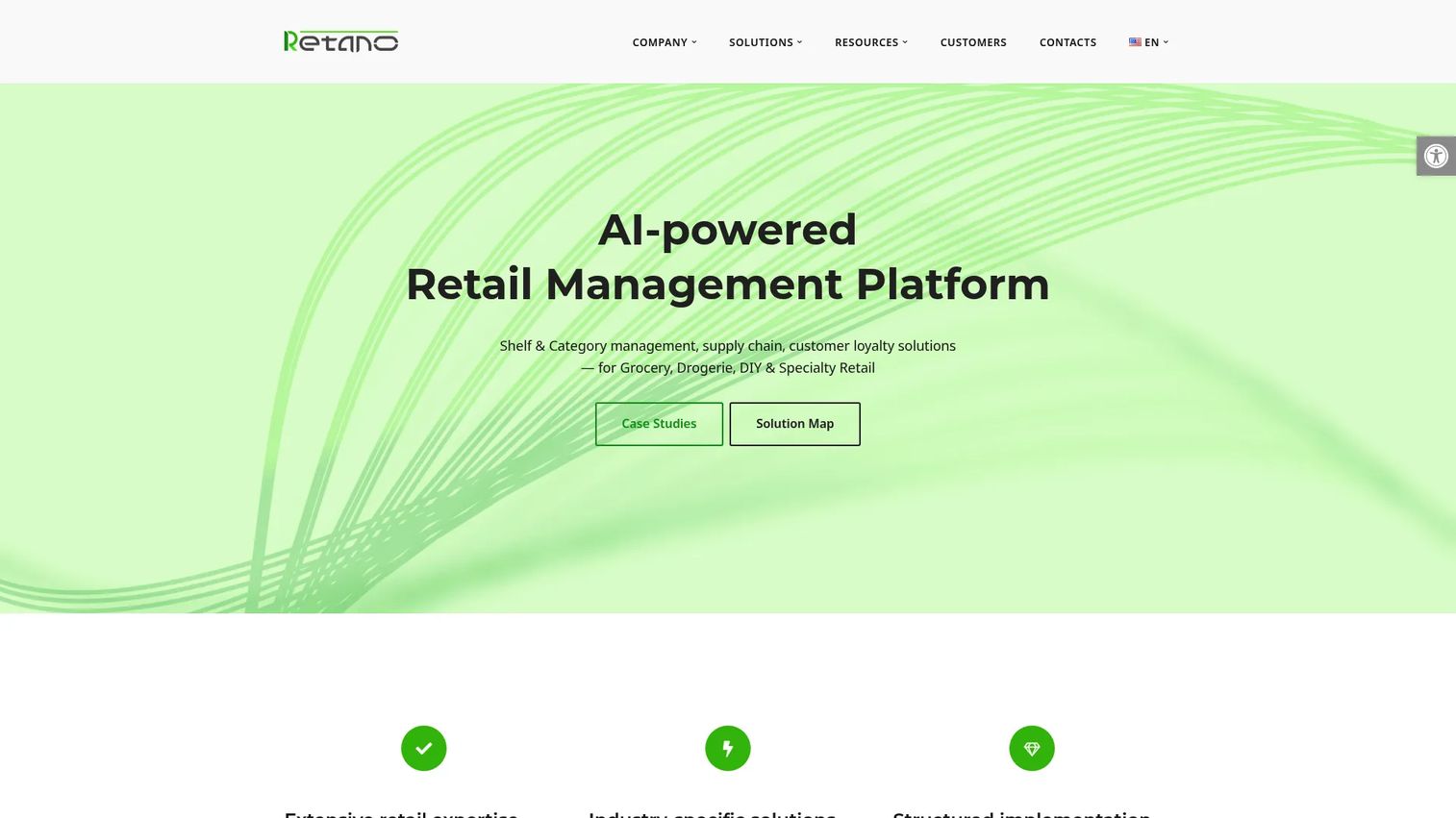
Retano is an AI-powered retail management platform covering merchandising, shelf planning, supply chain, and loyalty. Where it stands out for assortment work is the link between cluster-based range decisions and physical execution. Its Shelfplan module generates planograms automatically and controls store layout, so an assortment change does not stop at the plan. It flows to the shelf.
This tight loop between assortment and shelf suits retail chains that need automated category corrections at store-cluster level, not just a plan that lives in a planning tool and never reaches the floor.
Best for: Retail chains that need integrated AI and ML tools for inventory, shelf, and category operations in one platform.
Key strengths
- Cluster-based assortment with shelf execution: Range decisions flow into automatic planogram generation through the Shelfplan module.
- Integrated retail ERP: Merchandise operations, pricing, promotions, supplier management, and store reporting in one system.
- Demand forecasting and replenishment: The SCM layer handles forecasting and automated replenishment alongside assortment.
Why choose Retano: Retano fits teams that want assortment, shelf, and replenishment to operate as one connected workflow rather than separate tools stitched together. The combined ERP-plus-planning approach is most valuable for chains that manage many stores and want category corrections executed automatically.
Retano pricing: Retano does not publish pricing on its site. Reach out to the Retano team directly to scope a plan for your store count and module needs.
6. Zenline AI
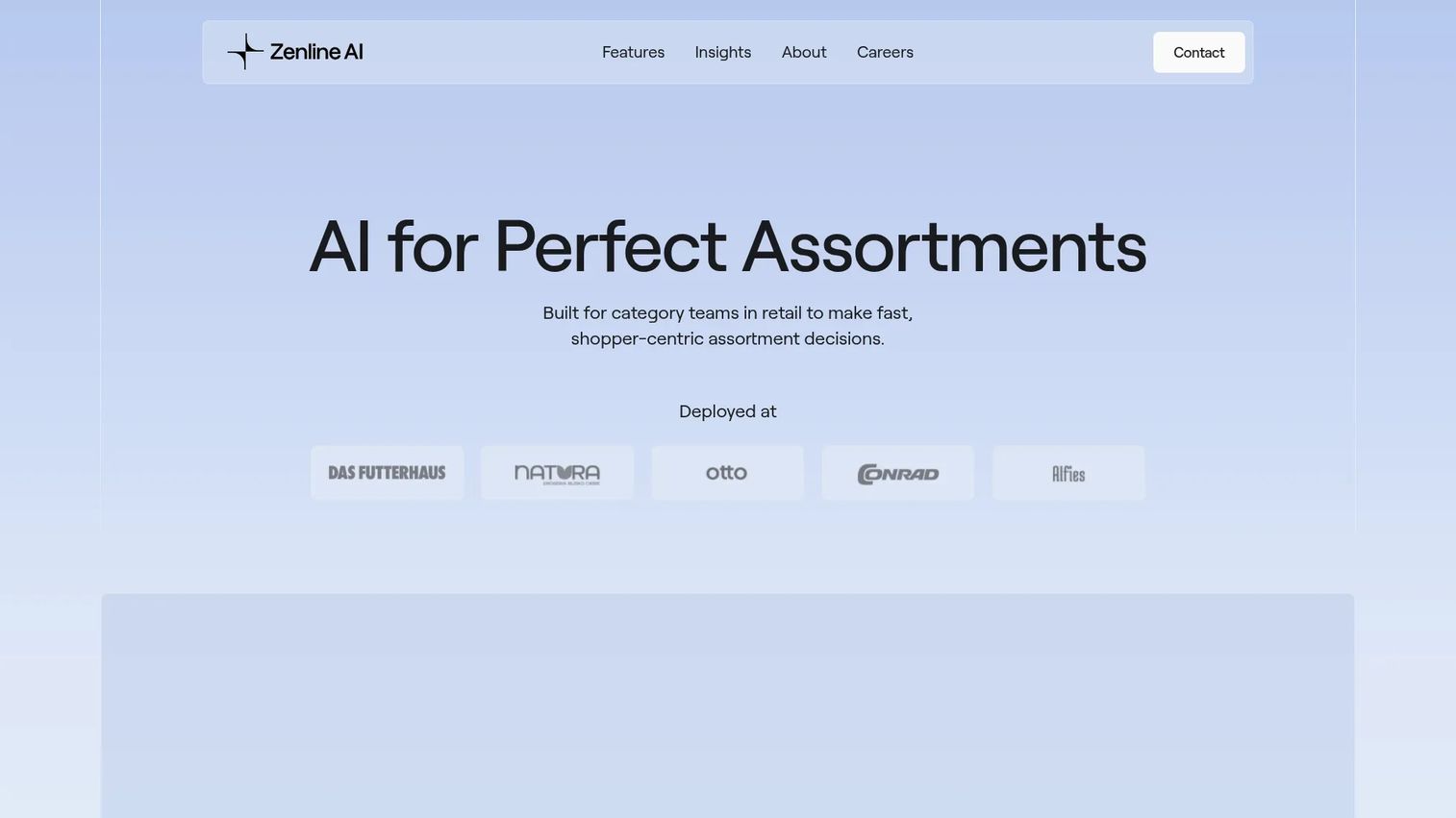
Zenline AI is an AI platform for retail assortment intelligence and shopper insights. Its distinguishing approach is the starting point: Zenline begins with public data to deliver instant assortment insights, then enriches the picture with your own data, cleaned and structured by its AI agents. That lets a category team get to a first read fast, before a full data integration is in place.
The platform covers assortment recommendations, SKU consolidation, pricing optimization, product launches, competitor insights, and shopper insights, which makes it a broad assortment intelligence layer rather than a single-purpose tool.
Best for: Retail category teams that need fast, AI-driven assortment, pricing, and launch insights without a long data project up front.
Key strengths
- Public-data starting point: Instant assortment insights from public data, enriched by AI agents as your own data comes in.
- Broad intelligence coverage: Assortment recommendations, consolidation, pricing optimization, launches, and competitor analysis in one place.
- Data cleaning and enrichment: AI agents clean and enrich incoming data so insights improve as the platform learns your catalog.
Why choose Zenline AI: For category teams that want to validate the direction of an assortment decision quickly, Zenline's instant-insight model shortens time to a first answer. The free initial assortment audit lowers the bar to seeing what the platform surfaces against your range before any commitment.
Zenline AI pricing: Zenline does not display public numeric pricing. The site confirms one assortment audit is free of charge initially, after which teams can scale category by category. Contact Zenline for pricing beyond the free audit.
7. Curate by Vision Group
Curate by Vision Group is AI-powered retail assortment optimization software for CPG and retail teams, focused on a problem most planning tools skip: testing a change before you commit to it. Curate runs assortment simulation at store-cluster level, building consumer decision trees from POS and loyalty data and modeling demand transfer and revenue impact when SKUs are added or dropped.
That simulation-first approach answers the question every merchant asks before a reset: if we cut these ten SKUs and add these five, what happens to revenue and to the shopper who used to buy the dropped item? Curate models the demand transfer rather than leaving it to guesswork. The product is the assortment intelligence layer of Vision Group's retail platform.
Best for: CPG and retail teams that want to validate assortment changes against real shopper data before rolling them out.
Key strengths
- Store-cluster simulation: Models assortment changes at cluster level before any change reaches a shelf.
- Consumer decision trees: Built from POS and loyalty data to reflect how shoppers actually substitute and choose.
- Demand transfer modeling: Simulates revenue impact and where demand moves when SKUs are added or dropped.
Why choose Curate by Vision Group: When the cost of a bad reset is high, Curate's simulation lets you pressure-test the range before committing inventory and shelf space. It holds a 4.8/5 rating on G2. Teams that simply need a planning workflow rather than pre-rollout validation may find the simulation focus more than they require.
Curate by Vision Group pricing: Curate does not publish public pricing. The site presents a demo-only path, so pricing is scoped per engagement. Request a demo to get a quote.
8. Impact Analytics
Impact Analytics is an AI-native retail planning, pricing, promotion, and supply-chain analytics platform, paired with consulting services. Its pitch is to plan, assort, price, and replenish through agentic AI that delivers measurable results at scale, which means assortment decisions never live in isolation from the pricing and replenishment decisions that determine whether they work.
That connected decision layer matters because assortment, pricing, and stock are the same problem viewed from three angles. Impact Analytics surfaces the data to act on all three. The company's own research, for example, recently flagged that clothing returns climbed from 3% to 4%, the kind of signal that should reshape both assortment and pricing strategy.
Best for: Retailers that want AI-driven assortment planning tied closely to pricing, promotion, and replenishment decisions.
Key strengths
- Agentic AI decision layer: Plan, assort, price, and replenish through AI that connects the decisions instead of siloing them.
- AI pricing automation: Lifecycle pricing automation that keeps the assortment's margin reality in view.
- Decision intelligence with services: Retail planning and merchandising backed by consulting to operationalize the platform.
Why choose Impact Analytics: For retailers that see assortment, pricing, and replenishment as one connected problem, Impact Analytics's agentic approach treats them that way rather than forcing three tools to talk. The platform holds a 4.5/5 rating on G2. Teams wanting assortment in isolation may not need the broader decision stack.
Impact Analytics pricing: Impact Analytics does not publish public pricing; engagements are contact-sales. Reach out for a quote scoped to your planning and pricing needs.
Considerations before you buy
Before you shortlist, pressure-test each platform against the operational realities that decide whether a tool earns its place in your stack.
Store clustering depth
A tool that clusters only by region or store size will not match how customers actually behave. Look for attribute-based and behavior-based clustering that can group stores by demand pattern, demographics, and space, and that lets you adjust clusters as patterns shift across seasons.
Financial governance
Assortment that ignores the budget creates late-season surprises. Verify that the platform integrates merchandise financial planning and open-to-buy directly into the assortment workflow, so the range you build stays inside margin, budget, and inventory targets without a manual reconciliation step.
Automation and exception handling
The value of these tools is reclaiming planner time. Check how the platform automates scenario planning, approvals, and exception flagging. The question is not whether it can run a forecast, but whether it tells you where a plan is drifting before the markdown hits.
Omnichannel coordination
Online and in-store ranges that drift apart confuse customers and trap inventory. Confirm the tool gives a single view of assortment across stores, e-commerce, and fulfillment, and that it can plan ship-from-store and online-only SKUs without a separate process.
Maintainability across releases
A planning tool you cannot adjust without a vendor ticket becomes a bottleneck. Evaluate how configurable the planning logic is and how the platform handles change as your store network, categories, and data sources evolve over time.
Conclusion
The right retail assortment planning software depends less on rank and more on which problem is costing you most right now. If your bottleneck is the disconnect between merchandising and the wider planning organization, o9 Solutions or Oracle Retail close it through platform depth. If you need configurable planning you can model yourself, Board fits. For fashion and consumer goods where the range is a visual decision, Centric Software maps to how merchants think.
If store-level execution is the gap, Retano links assortment to the shelf. If you want to validate changes before committing inventory, Curate by Vision Group simulates the outcome first. For fast, AI-led category reads, Zenline AI gets you to a first answer quickly, and Impact Analytics ties assortment to pricing and replenishment in one decision layer.
Your next step is narrowing this list to two or three based on store clustering depth, financial governance, and omnichannel fit, then running each against a real planning scenario from last season. The tool that handles your hardest cluster cleanly is the one worth buying.
FAQs
Retail assortment planning software helps retailers decide which products to carry, in which stores, and in what quantities. It connects demand data, store characteristics, and financial targets so range decisions are made at the store or cluster level rather than across a single national assortment. The result is a localized, governed plan instead of a one-size-fits-all range.
It reduces manual spreadsheet work, supports store-level localization through clustering, and aligns assortment decisions with financial targets. Instead of building plans by hand across hundreds of tabs, teams automate scenario planning and exception handling, then route plans through approvals. That cuts markdowns from over-ranged stores and stockouts from under-ranged ones.
The features that separate real planning depth from spreadsheet replacement are store clustering, demand forecasting, financial integration through merchandise financial planning and open-to-buy, scenario planning, and seasonal or lifecycle support. Prioritize the capability that addresses your sharpest pain, then confirm the others are present rather than chasing the longest feature list.
No. While enterprise retailers were the early adopters, smaller and mid-market chains benefit too, especially those managing many stores or wide product lines. Any retailer whose store-level variation or SKU count has outgrown manual planning can gain from automated clustering and financial governance, regardless of total revenue.
Assortment planning decides what to carry and where, while merchandise financial planning sets the budget, margin, and inventory targets the assortment must hit. Strong tools integrate the two so the range is built inside the financial plan, with open-to-buy controls preventing buyers from committing to product the budget cannot absorb. The plan that gets approved is then the plan that gets executed.
Assortment planning decides which products to carry in which locations. Inventory planning decides how much to stock and when to replenish each item. The two are tightly linked, since an assortment decision sets up the inventory it requires, but they answer different questions and the strongest platforms connect both so a range change flows into the replenishment plan automatically.
AI is most valuable when it improves speed, clustering accuracy, and exception handling rather than as a label. Practical AI surfaces where a plan is drifting, groups stores by behavior more precisely than manual rules, and models demand transfer when SKUs change. Evaluate AI features by the planning work they remove, not by how prominently they appear in the marketing.